




Abstract
The unique nature of the seafaring profession exposes seafarers to severe work-family conflict (WFC). However, existing research often treats WFC as a single continuous variable, overlooking its inherent heterogeneity. This study aims to employ a person-centered approach, Latent Profile Analysis (LPA), to identify latent profiles of WFC among Chinese seafarers and to explore their demographic predictors and differential impacts on mental health. A survey was conducted with 2,619 active Chinese seafarers, measuring their levels of work-interfering-with-family (WIF), family-interfering-with-work (FIW), and multiple mental health indicators. LPA results identified four distinct conflict profiles: “Low Conflict-Balanced” (9%), “Unidirectional WIF” (27%), “Bidirectional WFC and Work-Dominant” (46%), and “Bidirectional High-Conflict” (18%). Multinomial logistic regression revealed that being married with children was a risk factor for belonging to more complex conflict profiles, while younger and more educated seafarers were more likely to be in the “Bidirectional High-Conflict” profile. Analysis of variance (BCH) showed significant differences in mental health across profiles, with the “Bidirectional High-Conflict” group reporting the lowest life satisfaction and the most severe symptoms of depression, anxiety, somatization, and sleep/eating disturbances. These findings uncover the heterogeneity of WFC among seafarers and identify a high-risk group in urgent need of intervention, providing crucial empirical evidence for shipping companies to develop differentiated and targeted mental health support strategies.
Plain Language Summary
Seafaring is a uniquely stressful job that requires long periods away from home, making it difficult to balance work duties and family life. This struggle, known as work-family conflict, can seriously harm a seafarer’s mental health. Instead of viewing this conflict as simply “high” or “low,” our study explored if seafarers experience it in different ways. We surveyed over 2,600 active Chinese seafarers and found they fall into four distinct groups: Low Conflict-Balanced (9%): A small group successfully managing both work and family with minimal interference. Work Interfering with Family (27%): A group where job demands spilled over into family life, but family issues didn’t affect their work. Two-Way Conflict, Work-Dominant (46%): The largest group, experiencing conflict from both directions, but with work demandsbeing the primary problem. High-Conflict Crew (18%): A high-risk group trapped in a severe cycle where work and family constantly and intensely interfere with each other. We discovered that being married with children increased the risk of being in a more conflicted group. Surprisingly, younger and more highly educated seafarers were the most likely to belong to the “High-Conflict Crew.” This group reported the worst mental health, including the lowest life satisfaction and the most severe symptoms of depression, anxiety, and sleep problems. These findings show that a one-size-fits-all approach to mental health support is not enough. Shipping companies can use this research to identify those most at risk—particularly younger, educated seafarers—and develop targeted support programs to help them navigate the challenges of their demanding career.
Introduction
Work-Family Conflict in the Seafaring Profession
Seafaring is globally recognized as one of the most demanding and high-stress occupations. Seafarers endure prolonged periods away from home, social isolation, hazardous working conditions, and immense pressure, placing them at high risk for various mental health issues (Oldenburg et al., 2009; Slišković & Juranko, 2019). Among these occupational stressors, the imbalance between work and family domains, known as Work-Family Conflict (WFC), has emerged as a critical challenge (An et al., 2020). Specifically, WFC has been identified as a significant predictor of severe psychological outcomes such as job burnout (Turan et al., 2022) and work alienation (Toygar et al., 2023). Furthermore, its detrimental effects extend to organizational outcomes, negatively impacting job performance (An et al., 2020; Chao et al., 2022) and amplifying job stress, which poses a direct threat to navigational safety (Liu et al., 2022).
The unique nature of seafaring exacerbates WFC. Unlike shore-based jobs, the work and family domains for seafarers are almost completely segregated by time and space. This unique context creates what Slišković and Juranko (2019) aptly described as a “dual life,” where seafarers must navigate two separate worlds—one at sea focused on professional duties, and another at home centered on family roles. The transition between these worlds is often abrupt and stressful, making the management of work and family demands exceptionally difficult. This distinctiveness suggests that findings from general occupational WFC research may not be directly applicable to seafarers, underscoring the need for targeted investigation within this specific population.
Beyond the Variable-Centered Approach: A Person-Centered Rationale
Previous research, predominantly using a “variable-centered” approach, has consistently confirmed a linear relationship between WFC and various negative outcomes through regression analysis or structural equation modeling (e.g., An et al., 2020; Liu et al., 2022). These studies have provided a solid foundation for understanding the general principle that “more conflict leads to more harm.” However, an inherent limitation of this approach is its homogeneity assumption, which posits that all seafarers experience conflict in a similar pattern, differing only in magnitude (Clark et al., 2013). This assumption may obscure the complexity of reality. Variations in seafarers’ personal backgrounds, family structures, and career stages may be associated with qualitatively different patterns of conflict. For example, some may primarily experience unidirectional interference from work to family, while others might be trapped in a vicious cycle of bidirectional conflict. Therefore, a more nuanced question needs to be addressed: Do distinct, typical patterns of WFC exist within the seafarer population?
To answer this question, this study innovatively adopts a “person-centered” approach, Latent Profile Analysis (LPA). LPA identifies latent subgroups or “profiles” within a sample based on individuals’ response patterns across multiple indicators (in this case, WIF and FIW; Porcu & Giambona, 2017). This method allows us to move beyond a simple “high-low” dichotomy and explore how WIF and FIW combine to form different conflict configurations, thus offering a novel and deeper perspective on the heterogeneity of WFC among seafarers.
Theoretical Foundation
This study is grounded in a dual theoretical framework. We first adopt the foundational model of Work-Family Conflict (WFC; Greenhaus & Beutell, 1985) to conceptualize and structure the conflict itself. Subsequently, we employ Conservation of Resources (COR) Theory (Hobfoll, 1989) to explain the psychological mechanisms through which different patterns of WFC impact seafarer well-being.
Conceptualizing Work-Family Conflict
Work-Family Conflict (WFC), as defined by Greenhaus and Beutell (1985), is a form of inter-role conflict where role pressures from the work and family domains are mutually incompatible. This foundational theory posits that conflict arises from three primary sources: time-based, strain-based, and behavior-based pressures. Critically for this study, the theory delineates that WFC manifests in two distinct directions: Work-Interfering-with-Family (WIF), where work demands impede family life, and Family-Interfering-with-Work (FIW), where family responsibilities disrupt work. Following this model, our study utilizes these two dimensions as the core indicators for profiling, as they represent the fundamental structure of the WFC experience and provide the basis for identifying latent conflict profiles among seafarers.
The Psychological Impact: Conservation of Resources (COR) Theory
While WFC theory defines the structure of the conflict, Conservation of Resources (COR) theory explains why it is a potent stressor. COR theory posits that individuals are fundamentally motivated to obtain, retain, protect, and foster valued resources. These resources can be personal (e.g., self-esteem, skills), conditional (e.g., marital status, job security), or energetic (e.g., time, energy; Hobfoll, 1989). Stress, according to this framework, occurs when these resources are threatened with loss, are actually lost, or when individuals fail to gain sufficient resources following a significant investment.
Within this dual framework, WFC is conceptualized as a quintessential resource-draining stressor. In the unique context of seafaring, WIF depletes crucial social and emotional resources derived from family life (e.g., spousal support, parent-child bonds), while FIW consumes cognitive and energetic resources needed for safe and efficient job performance (e.g., concentration, resilience). COR theory further proposes the concept of “loss spirals,” where an initial resource loss makes individuals more vulnerable to future losses (Hobfoll, 1989). This theoretical lens is exceptionally well-suited for our person-centered approach, as the identified latent profiles (derived from WIF and FIW dimensions) can be conceptualized as distinct states of resource management: from successful resource protection (“Low Conflict-Balanced”) to a severe and escalating resource loss spiral (“Bidirectional High-Conflict”).
The Present Study
Building on this theoretical foundation, understanding who is more likely to fall into specific conflict profiles is crucial for prevention and intervention. Demographic characteristics are not merely static labels; they represent an individual’s resources, social roles, and life stages, which collectively shape their experience of WFC, particularly within the unique context of seafaring (Chao et al., 2022). For instance, sea service tenure reflects not just professional experience but also the cumulative duration of separation from family. Marital and parental statuses directly define the complexity of family roles an individual must navigate. Therefore, this study will systematically examine key demographic variables such as age, sea service tenure, education level, and marital status to uncover the distribution patterns of different seafarer groups across conflict profiles, providing crucial clues for accurately identifying high-risk populations.
Equally important is assessing the real-world impact of these different conflict profiles. As predicted by COR theory (Hobfoll, 1989), the continuous depletion of psychological resources through WFC is expected to significantly harm seafarers’ mental health. Consequently, this study aims to systematically examine the differential effects of various conflict profiles on seafarers’ mental health. We selected five key indicators—life satisfaction, depression, anxiety, somatization, and sleep/eating disturbances—to construct a multi-faceted and robust assessment of well-being. This suite of indicators was chosen specifically because it captures the impact of stress across different domains: cognitive, emotional, physical, and physiological. Life satisfaction serves as a global cognitive appraisal of an individual’s life quality (Diener et al., 1985). Depression and anxiety represent the core emotional dimensions of psychological distress (Roche et al., 2014). Somatization addresses the physical manifestation of this distress, a common pathway in high-pressure occupations (Lipowski, 1988). Finally, sleep and eating disturbances reflect disruptions in fundamental physiological processes, often the earliest tangible signs that an individual’s coping resources are overwhelmed (Rief & Fichter, 1992). Together, they provide a nuanced picture of how WFC degrades seafarers’ overall health.
Specifically, we will use Latent Profile Analysis (LPA) to move beyond a simplistic high-versus-low conflict view, aiming to identify distinct configurations or “profiles” of WFC as they naturally occur within the seafarer population. This person-centered approach will allow us to understand not just how much conflict seafarers experience, but how the two dimensions of conflict (WIF and FIW) combine into meaningful patterns. In summary, this study will utilize LPA to achieve the following three research questions:
To identify the heterogeneous latent profiles of work-family conflict among active Chinese seafarers.
To investigate the predictive role of demographic variables such as age, sea service, education, and marital status on membership in these latent profiles.
To examine the differences in a range of mental health outcomes (life satisfaction, somatization, depression, anxiety, and sleep/eating disturbances) across the identified latent profile groups.
Based on the existing literature, this study proposes the following hypotheses (Hs):
Through this research, we hope to provide a more refined theoretical perspective on seafarer WFC and offer solid empirical evidence for the shipping industry to develop differentiated and targeted mental health support and intervention strategies.
Methods
Participants and Sampling
The study targeted active Chinese seafarers, operationally defined as Chinese nationals who were currently on board a vessel and actively fulfilling their contractual duties, as opposed to those on leave. A multi-stage sampling procedure was employed to access this specific population. First, several shipping companies were contacted through convenience sampling. Upon securing their cooperation, these companies facilitated introductions to the captains of their vessels currently at sea. Subsequently, cluster sampling was implemented, where each vessel was treated as a distinct cluster. This method allowed for the recruitment of entire crews, ensuring the inclusion of various on-board ranks and departments.
Data collection was conducted using an online questionnaire platform. With the assistance of the ship captains, crew members were invited to participate during regular on-board meetings where the study’s purpose and significance were explained. Participation was emphasized as being strictly voluntary. To ensure informed consent, the first page of the online survey consisted of a detailed electronic consent form. Participants were required to review and digitally agree to the terms before gaining access to the questionnaire items. The data collection period was open for 3 months, from April 1, 2025, to June 1, 2025. Monthly reminders were sent out by the captains to accommodate the demanding work schedules of the seafarers and maximize participation.
An initial total of 4,000 responses were collected. To ensure the validity of the data, a rigorous screening process was applied to identify and remove invalid responses. Responses were flagged as invalid if the participant failed to correctly answer two embedded attention check items. These items were designed to confirm attentive participation and included: (1) an instructional manipulation check (e.g., “For this question, please select ‘Strongly Disagree’”), and (2) a content comprehension question assessing their overall understanding of the survey’s topic. This procedure ensures that the final dataset consists only of responses from participants who were genuinely engaged. After this screening process, a final effective sample of 2,619 participants was obtained, yielding an effective response rate of 65.5%. The final sample consisted predominantly of male seafarers (99.5%), with a mean age of 36 years (SD = 8.79) and a mean sea service tenure of 10 years (SD = 7.80).
Measures
Work-Family Conflict (WFC)
The widely validated 10-item WFC scale developed by Netemeyer et al. (1996) was used. It includes two core dimensions: Work-Interfering-with-Family (WIF, five items) and Family-Interfering-with-Work (FIW, five items). To address the foundational need for measurement validity in latent profile analysis, we first conducted a confirmatory factor analysis (CFA) to verify the two-factor structure of the scale within our sample. The results indicated an acceptable model fit: χ2(34) = 654.56, p < .001; CFI = 0.921; TLI = 0.914; RMSEA = 0.061 (90% CI [0.058, 0.065]); SRMR = 0.05. Although the chi-square was significant, which is common in large samples, other key fit indices met the criteria for acceptable fit. This CFA result provides crucial evidence for the construct validity of the measure in our population, confirming that WIF and FIW are distinct yet related constructs. Furthermore, the strong internal consistency (Cronbach’s α for WIF = 0.91; for FIW = 0.85) supports convergent validity within each subscale, while the confirmation of a two-factor structure supports discriminant validity between them. Therefore, the scores on these two validated dimensions were used as indicator variables for the subsequent LPA.
Mental Health Outcomes
Subjective well-being was assessed using the Satisfaction with Life Scale (SWLS; Diener et al., 1985). Psychological distress was evaluated using four subscales from the Symptom Checklist-90 (SCL-90, Derogatis, 1975): Somatization, Depression, and Anxiety, and Sleep/Eating Disturbances. The reliability of these scales in this study ranged from 0.83 to 0.94.
Demographic Variables
Information on age, total sea service, education level, and marital status was collected.
Data Analysis Procedure
The data analysis was conducted in three primary stages. First, preliminary analyses were performed using SPSS 26.0, which included calculating descriptive statistics and Pearson correlations for all key variables to provide an initial overview of the data. Second, the core of our analysis involved identifying distinct subgroups of seafarers based on their work-family conflict experiences using Latent Profile Analysis (LPA) in Mplus 8.3. Work-to-Family Interference (WIF) and Family-to-Work Interference (FIW) served as the continuous indicators for the LPA. To determine the optimal number of profiles, we systematically fitted and compared a series of models, beginning with a one and-profile solution progressively increasing to a seven-profile solution.
The selection of the optimal model was guided by a holistic evaluation of multiple criteria: (1) Information Criteria: Lower values of the Akaike (AIC), Bayesian (BIC), and sample-size Adjusted Bayesian (aBIC) Information Criteria were sought, indicating a more parsimonious and better-fitting model (Lubke & Muthén, 2005). (2) Classification Accuracy: Entropy values were examined, with a value greater than 0.8 suggesting excellent classification precision (Lubke & Muthén, 2005). (3) Likelihood Ratio Tests: The Lo-Mendell-Rubin (LMR-LRT) and the Bootstrap (BLRT) Likelihood Ratio Tests were used to compare nested models. A significant p-value (p < .05) for these tests suggests that the k-profile model provides a significant improvement in fit over the k–1 profile model (McLachlan & Peel, 2000). (4) Theoretical and Substantive Meaningfulness: Beyond statistical indices, the final decision was heavily informed by the theoretical coherence and practical interpretability of the resulting profiles (Morin et al., 2011). To ensure the robustness of the final solution and avoid local maxima, a high number of random starts (20,000) and final stage optimizations (5,000) with 200 iterations were specified for each model (Lubke & Muthén, 2005).
Third, after identifying and interpreting the optimal latent profile solution, we proceeded to examine the antecedents and consequences associated with profile membership. To accomplish this accurately while accounting for classification uncertainty, we employed a modern three-step approach. To explore the predictors of profile membership (Antecedents), the R3STEP command in Mplus was used to conduct a multinomial logistic regression. In this analysis, profile membership was treated as the nominal outcome variable, and demographic characteristics served as the predictors. This step allowed us to determine the probability of seafarers with different backgrounds belonging to specific conflict profiles. To compare the differential effects of profile membership on well-being (Consequences), the BCH method (Bolck-Croon-Hagenaars) was implemented. This method treats the latent profile class as the independent variable and the five mental health indicators as dependent variables. The BCH approach provides unbiased estimates of mean differences across profiles by correcting for classification errors, thus offering a more accurate assessment of the outcomes.
Results
Preliminary Analysis
Table 1 presents the means, standard deviations, and bivariate correlation coefficients among the tested variables for the Chinese seafarers. All the variables were positively and significantly correlated, with r ranging from .38 to .82, ps < .001.
Results of the Descriptive Statistics and Pearson Correlations Among Variables.
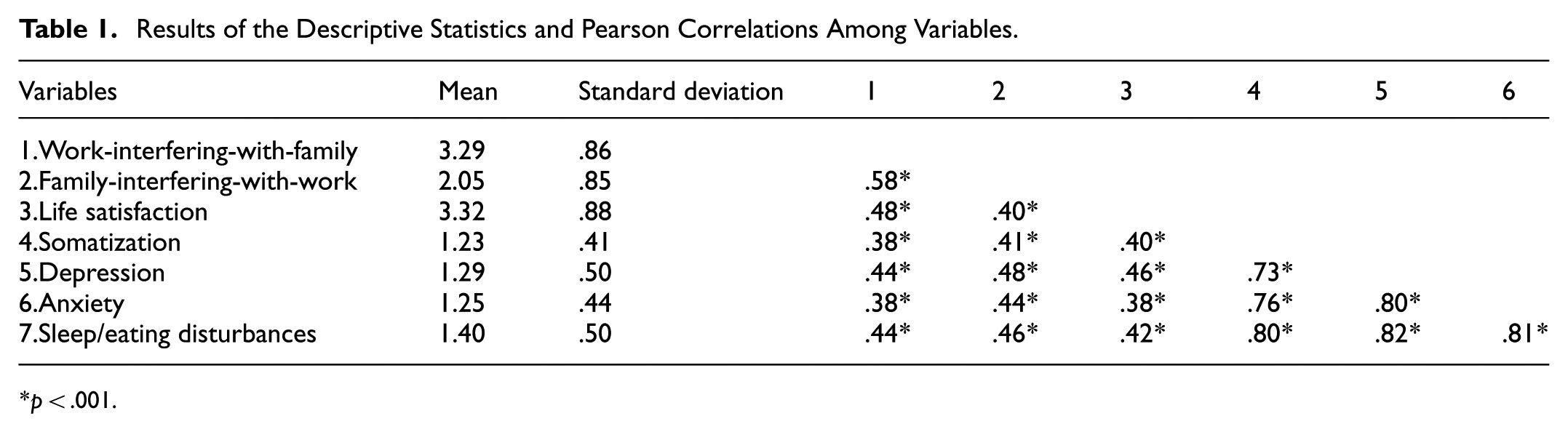
p < .001.
Latent Profiles of Seafarer Work-Family Conflict
By comparing model fit indices for solutions with 2 to 7 classes (see Table 2 and Figure 1) and examining the elbow plot, the four-profile solution was identified as the optimal one. This model demonstrated lower AIC, BIC, and aBIC values, significant LMR-LRT and BLRT results (p < .001), and a high Entropy value of 0.938, indicating excellent classification quality. The four latent profiles and their scoring patterns on the WIF and FIW dimensions are illustrated in Figure 2. Based on the unique pattern of each profile, they were named as follows:
Fit Indexes of the Latent Profile Model of Seafarers’ Work-Family Conflict.

Note. Bold values indicate the selected model.

Elbow plot of model fit indices (AIC, BIC, & aBIC).

The four latent profiles of work-family conflict among seafarers.
Profile 1 “Low Conflict-Balanced” (9%)
Seafarers in this profile had the lowest scores on both WIF and FIW, indicating a very low level of WFC and an ideal state of balance.
Profile 2 “Unidirectional WIF” (27%)
This profile was characterized by a high score on WIF and a relatively low score on FIW, revealing a typical unidirectional conflict pattern where job demands significantly interfered with family life, but family pressures did not substantially spill over into work.
Profile 3 “Bidirectional WFC and Work-Dominant” (46%)
This was the largest group. Seafarers in this profile experienced conflict in both directions, but their WIF scores were significantly higher than their FIW scores, suggesting a bidirectional conflict predominantly driven by work-related issues.
Profile 4 “Bidirectional High-Conflict” (18%)
This profile exhibited the highest scores on both WIF and FIW, indicating that these seafarers were trapped in a severe vicious cycle of bidirectional conflict, representing the group with the most strained work-family relationship.
Demographic Predictors of Latent Profiles
To identify demographic variables of membership in the different work-family conflict profiles, a multinomial logistic regression was conducted, which accounts for classification uncertainty. The “Profile 1: Low Conflict-Balanced” group served as the reference category for all comparisons. The results, presented as Odds Ratios (OR), are detailed in Table 3. An OR greater than 1 indicates that an increase in the associated factors is associated with higher odds of being in the comparison profile relative to the reference profile, while an OR less than 1 indicates lower odds.
Multinomial Logistic Regression Predicting Latent Profile Membership from Demographic Variables.

Note. “r” indicates the reference group. *p < .05. **p < .01. ***p < .001.
Predictors of Initial Conflict Emergence (Comparison to Profile 1)
From “Low Conflict-Balanced” (P1) to “Unidirectional WIF” (P2): An increase in seafarers’ education level (OR = 1.12, p < .05) and sea-going experience (OR = 1.04, p < .05) was associated with higher odds of belonging to the “Unidirectional WIF” profile. Specifically, for each unit increase in education level, the odds of being in Profile 2 versus Profile 1 increase by a factor of 1.12. This suggests that as professional capital accumulates, escalating work responsibilities may act as initial triggers for work encroaching upon family life.
From “Low Conflict-Balanced” (P1) to “Bidirectional Conflict-Work Dominant” (P3): Several factors were associated with significantly higher odds of membership in this widespread conflict profile. These included being older (OR = 1.03, p < .001), having a higher education level (OR = 1.34, p < .001), longer sea-going experience (OR = 1.06, p < .001), and being married with children (vs. unmarried; OR = 1.30, p < .05). This pattern points to a “high-investment” demographic—senior, highly educated seafarers with established family roles appear most susceptible to this form of bidirectional conflict.
From “Low Conflict-Balanced” (P1) to “Bidirectional High-Conflict” (P4): The odds of belonging to the most severe conflict profile were most strongly associated with education level (OR = 1.73, p < .001) and sea-going experience (OR = 1.06, p < .001). The particularly large odds ratio for education suggests that highly educated individuals may hold elevated expectations for both career and family, and the discrepancy with on-board reality could trigger a more intense conflict experience.
Predictors of Conflict Escalation and Deterioration
To better understand the dynamics of conflict evolution, we also examined predictors for transitions between conflict profiles by changing the reference group in subsequent analyses.
Escalation from Unidirectional to Bidirectional Conflict (P2–P3): Compared to those in the “Unidirectional WIF” profile, an increase in age (OR = 1.02, p < .01) and education level (OR = 1.20, p < .01) was associated with higher odds of being in the “Bidirectional Conflict-Work Dominant” profile. Notably, being married with children (vs. unmarried; OR = 1.85, p < .001) showed a strong association, suggesting that the role demands of marriage itself may be sufficient to facilitate the spillover of family pressures into the work domain.
Escalation to Severe Conflict (P2–P4 & P3–P4): Compared to Profile 2 (“Unidirectional WIF”), a higher education level (OR = 1.55, p < .01) and being married with children (vs. unmarried; OR = 1.49, p < .05) were associated with greater odds of being in the most severe “Bidirectional High-Conflict” profile (P4). This indicates that for highly educated seafarers with children, an initial work-family imbalance may be prone to rapid escalation.
A particularly insightful finding emerged when comparing Profile 3 (“Bidirectional Conflict-Work Dominant”) to Profile 4 (“Bidirectional High-Conflict”). This comparison isolates the factors associated with the most extreme conflict escalation among those already experiencing bidirectional conflict. Paradoxically, being younger (OR = 0.98, p < .01) was associated with higher odds of belonging to the most severe profile. For each year increase in age, the odds of being in Profile 4 versus Profile 3 decrease by 2%. Concurrently, a higher education level remained a strong correlate (OR = 1.29, p < .001).
Synthesis and Interpretation of Key Findings
Overall, higher education and being married with children consistently emerged as risk factors for membership in more severe conflict profiles. However, the analysis revealed a crucial paradoxical effect related to age. While older age and longer tenure are associated with entering a general state of bidirectional conflict (P3), it is the younger, highly educated seafarers who are at the highest risk of escalating to the most severe conflict state (P4) once already in conflict. This finding points to a potential non-linear association with age, suggesting a complex dynamic. While seniority may be linked to a general state of bidirectional conflict, it is the younger, highly educated cohort that appears most susceptible to the most severe conflict state. One possible interpretation, which remains speculative, is that this group may experience a greater “expectation-reality” gap regarding work-life balance. This observation highlights a specific subgroup that appears particularly vulnerable and warrants further investigation and potentially targeted organizational support.
Mental Health Consequences of Different Latent Profiles
The BCH analysis of variance (see Table 4) showed that the four profile groups differed significantly in all mental health indicators (p < .001).
Comparison of Mental Health Indicators Across Latent Profile Groups.

Note. All between-group differences in scores were significant at p < .001. Profiles marked with “r” represent the means and standard deviations of M1, whereas profiles without “r” represent the means and standard deviations of M2.
“Bidirectional High-Conflict” (Profile 4) as the Highest-Risk Group: This group demonstrated the poorest mental health. Their life satisfaction score (M = 2.76) was significantly lower than all other groups, while their scores on somatization (M = 1.60), depression (M = 1.81), anxiety (M = 1.95, and) sleep/eating disturbances (M = 1.88) were significantly higher. Effect size analysis revealed large effects for the differences in anxiety (Cohen’s d = 1.56) and depression (d = 1.42) compared to the “Low Conflict-Balanced” group, indicating practical significance.
A Gradient Effect of Conflict Level on Mental Health: From Profile 1 to Profile 4, as the type and severity of WFC intensified, seafarers’ life satisfaction showed a linear decrease, while scores on all negative mental health indicators showed a linear increase. This strongly supports the notion that WFC is a key stressor affecting seafarers’ mental health.
Discussion
Employing a person-centered latent profile analysis, this study successfully identified four heterogeneous patterns of work-family conflict among Chinese seafarers and explored the demographic characteristics and mental health consequences associated with these profiles. This provides a novel and more nuanced perspective for understanding occupational stress in seafarers.
First, the heterogeneity of seafarer WFC was confirmed, challenging the homogeneity assumption in traditional research that treats WFC as a single continuous variable (An et al., 2020; Toygar et al., 2023) and supporting Hypothesis
Second, this study revealed the demographic characteristics associated with membership in the different conflict profiles, partially supporting Hypothesis
To better contextualize our findings, they can be compared to WFC research in other high-risk professions. For instance, similar to studies on first responders and military personnel, the prolonged separation and high-stakes work environment clearly drive WIF (e.g., Strader & Smith, 2022). However, the “Bidirectional High-Conflict” profile in our study, particularly the paradox of younger, educated seafarers being at higher risk, may be unique to seafaring. Unlike on-shore high-risk jobs where workers return home daily or weekly, the complete and prolonged spatio-temporal segregation in seafaring might create a more extreme “expectation-reality” clash for those with higher life-balance ideals, a phenomenon less pronounced in other fields. This comparison highlights the unique stressors of the maritime profession and reinforces the need for industry-specific interventions.
Finally, the findings strongly support Hypothesis
Limitations and Further Directions
The findings of this study should be considered in light of several limitations that offer clear directions for future inquiry.
The most significant limitation stems from our use of a cross-sectional design, which precludes any causal inferences and fails to capture the dynamic evolution of work-family conflict (WFC) over time. Seafaring is inherently cyclical, and the challenges faced at sea are vastly different from life on shore. A single snapshot cannot reveal whether these conflict profiles are stable traits or transient states that fluctuate with the voyage cycle. To address this, longitudinal research is essential. Tracking seafarers across multiple time points—before, during, and after a voyage—would allow researchers to model the stability of these profiles and identify the triggers that lead to transitions between them, offering a much richer understanding of the WFC experience.
Furthermore, the generalizability of our findings is constrained by the specific demographic of our sample, which consisted mainly of Chinese seafarers. Because cultural contexts shape perceptions of family obligation, gender roles, and the work-life interface, the profiles identified here may be culturally specific. It is imperative that future research validates these findings across diverse multinational crews to establish whether these WFC typologies are universal or culturally bound. Cross-cultural comparative studies would be particularly valuable in this regard.
A third limitation concerns the potential for self-selection bias inherent in our online, voluntary survey methodology. The 65.5% effective response rate, while robust, cannot entirely rule out the possibility that seafarers who chose to participate were systematically different from those who did not. It is plausible that individuals experiencing particularly high levels of work-family conflict—and the associated distress—were more motivated to share their experiences. Conversely, those coping exceptionally well might also have been more inclined to respond. This could potentially lead to an overestimation of the prevalence of both the “Bidirectional High-Conflict” and “Low Conflict-Balanced” profiles, while underrepresenting the more moderate majority. Future research could attempt to mitigate this by employing stratified sampling techniques with more direct recruitment methods or by comparing the demographic profiles of respondents and non-respondents (where ethically and practically feasible) to assess the extent of this bias.
Lastly, to advance the practical utility of this line of research, the scope of outcome variables should be expanded. While linking WFC profiles to mental health is a critical first step, the maritime industry is also deeply concerned with operational outcomes. Future studies would benefit from constructing a more comprehensive model that links WFC profiles to key performance indicators such as job performance, turnover intention, and, most critically, safety metrics like accident rates and safety compliance. Examining these tangible outcomes would not only deepen the theoretical model but also provide compelling, evidence-based arguments for developing targeted support systems and policies to mitigate WFC in this demanding profession.
Conclusion and Implications
Based on a survey of 2,619 Chinese seafarers, this study draws three core conclusions. First, seafarer WFC is not a monolithic construct but comprises at least four distinct heterogeneous profiles: “Low Conflict-Balanced,”“Unidirectional WIF,”“Bidirectional Work-Dominant,” and “Bidirectional High-Conflict.” Second, demographic characteristics can effectively predict profile membership. Being married with children is a risk factor for escalating conflict, whereas younger and more educated seafarers are paradoxically more susceptible to the most severe “Bidirectional High-Conflict” profile. Third, WFC profiles are closely linked to seafarers’ mental health. The greater the severity and bidirectionality of the conflict, the poorer the mental health outcomes, with the “Bidirectional High-Conflict” group being at the highest risk.
This research offers significant practical implications for creating more precise intervention strategies for shipping companies and maritime authorities. First of all, shift from “Universal Care” to “Targeted Intervention.” Management should no longer view all seafarers as a homogeneous group. Instead, they should implement differentiated management based on the four identified profiles. Limited mental health resources should be prioritized for the identification and intervention of seafarers in the “Bidirectional High-Conflict” group, providing them with professional counseling and crisis support. Second, develop differentiated support strategies. For the largest “Bidirectional Work-Dominant” group, interventions should focus on improving working conditions, optimizing work schedules, and ensuring accessible ship-to-shore communication to reduce work interference with family at its source. For the “Unidirectional WIF” group, training in maintaining family relationships and parent-child communication skills could be beneficial. Third, focus on Key High-Risk Populations. Special attention should be given to married seafarers with children, as well as the younger, highly educated cohort. Establishing family support programs, mentorship systems, and career planning guidance can help them better manage work-family relationships and adjust their occupational expectations.
Our findings also highlight the urgent need for targeted organizational support. Given that seafarers with higher education and those in the early-to-mid stages of their careers are at higher risk, shipping companies should develop tailored support programs. These could include pre-voyage family counseling and onboard mental health resources. Crucially, our results underscore the importance of leadership. In this regard, the role of senior officers and shore-based managers is paramount, as supervisor support can effectively buffer the negative impact of WFC on outcomes like fatigue and emotion. Therefore, training senior officers in supportive leadership and WFC management should be a strategic priority for shipping companies. Such training would equip them to identify signs of distress, offer practical assistance, and foster a more supportive onboard climate, ultimately mitigating the risks associated with high WFC.
Footnotes

Ethical Considerations
The authors confirm that the study was approved by the Research Ethics Committee of the Dalian Maritime University and certify that the study has been carried out following The Code of Ethics of the World Medical Association (Declaration of Helsinki) for research involving human participants.
Consent to Participate
Informed consent was obtained from all participants before they participated in the study.
Author Contributions
Tianxue Cui: Conceptualization, Methodology, Validation, Formal analysis, Writing – original draft, Writing – review & editing.
Chuanyong Yang: Project administration, Data collection, Writing – review & editing.
Tingting Li: Resources, Investigation, Writing – review & editing.
Siming Fang: Validation, Investigation, Writing – review & editing.
Funding
The authors disclosed receipt of the following financial support for the research, authorship, and/or publication of this article: This research was supported by Dalian Maritime University Development Fund Project (Project title: Research on Norms of Mental Health of Chinese Seafarers) and the Special Fund for Think Tank Projects from the Fundamental Research Funds of Dalian Maritime University (Project title: China Maritime Science and Technology (Maritime Culture and Education) - Development Report (2025 Edition).
Declaration of Conflicting Interests
The authors declared no potential conflicts of interest with respect to the research, authorship, and/or publication of this article.
Data Availability Statement
The data that support the findings of this study are available from the corresponding author upon reasonable request.*
Declaration of Generative AI in Scientific Writing
The Authors declare they have not used the generative AI in scientific writing upon submission of the paper.