




Abstract
This qualitative case study examines how game-based learning structured around the 5E learning model enhances ninth-grade gifted physics students’ understanding of the Sustainable Development Goals (SDGs). Conducted in a Science and Art Centre located in a developing country, the study aimed to explore students’ knowledge of the SDGs through a 6-week (12 class periods) game-based instructional process. During the intervention, students participated in a researcher-designed lesson plan consisting of interactive, game-based activities encompassing all 17 SDGs. Data were collected through pre- and post-intervention visual (drawing) and written expression tasks. The collected data were analyzed using an inductive content analysis approach, in which students’ drawings and written narratives were coded according to the SDG goals and their sub-targets. To ensure the reliability and consistency of the coding process, expert review was employed. Students were asked to produce drawings and accompanying explanations related to the SDGs before the intervention, and the same tasks were repeated after the intervention to examine changes in their conceptual understanding. The findings indicate that students developed more accurate, detailed, and goal-specific representations in their drawings and written explanations. The results further reveal that students were able to articulate the purposes of the SDGs and the relationships among different goals in a clearer and more reasoned manner. Overall, the findings suggest that implementing game-based learning within the constructivist 5E learning model is an effective approach for supporting sustainability education among gifted physics students.
Introduction
Sustainability has become one of the critical global competencies emphasized in contemporary science education frameworks. Sustainability is a multifaceted concept concerned with the long-term, balanced utilization of natural and renewable resources while preserving ecological integrity (Tennakoon et al., 2024). Its conceptual roots can be traced back to the 19th century, though its formal articulation gained prominence with the World Charter for Nature, adopted by the International Union for Conservation of Nature (IUCN) in 1982. The notion of Sustainable Development entered the global policy agenda through the seminal report Our Common Future, published by the United Nations in 1987. This was later operationalized in the Agenda 21 action plan, introduced at the 1992 Rio Earth Summit (United Nations, 1992). The adoption of the United Nations 2030 Agenda marked a transformative shift, offering a comprehensive framework for advancing global prosperity through the 17 Sustainable Development Goals (SDGs), which emphasize the indivisible and universal nature of sustainable development (United Nations General Assembly, 2015). The SDGs aim to ensure the responsible use of natural resources and to reduce global inequalities without compromising individual and collective well-being. Replacing the Millennium Development Goals, the SDGs adopt a human rights-based and multidimensional approach to development (KöybaşıŞemin, 2022). Education is widely recognized as a catalyst for achieving the SDGs. The UNECE’s Strategy for Education for Sustainable Development (2005) underscores the transformative role of education in enabling individuals to make informed, responsible decisions for sustainable living (United Nations Economic Commission for Europe [UNECE], 2005). Complementary global initiatives, such as the Decade of Education for Sustainable Development (2005–2014) and the subsequent Global Action Program, positioned education as a primary driver of societal transformation. In alignment with the 2030 Agenda, learners are expected to acquire the knowledge, competencies, and values necessary to foster sustainable lifestyles, promote gender equality, uphold peace, and appreciate cultural diversity (Rieckmann, 2017). Several scholars have affirmed the critical role of education in advancing sustainability objectives (Ekinci et al., 2022; Şeker & Aydınlı, 2021).
In the acquisition of SDGs through education, disciplines based on natural sciences, such as physics, hold a special importance in terms of developing sustainability awareness in individuals. It is stated that by integrating physics education with sustainability, students’ scientific thinking skills can be developed, they can gain a sense of social and economic responsibility, and environmental awareness can be increased (Gülhan, 2023). In this context, it is noted that fostering in individuals the responsibility to live in harmony with nature through physics education contributes to supporting SDGs within the framework of interdisciplinary and value-based approaches (Kızılcık et al., 2024). Especially the field of physics occupies a privileged position in this process due to its inclusion of themes directly related to the SDGs, such as energy use, environmental technologies, renewable resources, and climate change (Rizki et al., 2024). Accordingly, it is emphasized that physics courses enable students to address environmental problems from a scientific perspective while also contributing to the development of environmental awareness as well as social and economic responsibility (Matthew, 2013). In conclusion, physics education has a strong relationship with SDGs not only at the content level but also across pedagogical, ethical, social, economic, and cultural dimensions. It is stated that in order for this potential to be effectively realized, sustainability-based instructional practices need to be disseminated (Malavoloneque & Costa, 2022).
This study focuses on how game-based learning, within the framework of a constructivist approach based on the 5E learning model, can support the interaction of gifted students in the field of physics with SDGs. There is a growing body of evidence in the literature indicating that game-based learning facilitates students’ understanding of complex and abstract sustainability concepts through more concrete, meaningful, and motivating learning experiences (Chen & Ho, 2022; Neset et al., 2020). However, it is observed that existing studies largely focus on general student populations, and that research examining how gifted students in the field of physics—particularly in developing countries—make sense of SDGs in game-based learning environments remains limited. In this respect, the present study is positioned as an original research endeavor that investigates how a game-based instructional process designed based on the 5E learning model contributes to the development of gifted physics students’ conceptual understanding of the SDGs.
5E Learning Model and Game-Based Learning
The 5E learning model provides a constructivist framework consisting of the stages of “engagement, exploration, explanation, elaboration, and evaluation,” which enable students to construct conceptual understanding in a gradual manner (Bybee et al., 2006). This model is based on constructivist theory. In the literature, it is stated that the 5E learning model enhances the conceptual understanding of gifted students in contexts that require critical thinking and problem-based reasoning (Emihovich, 2024; Li & Wang, 2025). At the same time, research emphasizes that gifted students can benefit significantly from structured inquiry-based models such as the 5E learning model due to their advanced creativity and problem-solving capacities. Therefore, it is argued that the use of the 5E learning model—effective in ensuring the active participation of gifted students—in instructional content will influence their motivation and academic achievement (Bozan & Taşlıdere, 2024). In this context, studies indicate that the 5E learning model can be used in an integrated manner with various methods for students’ education (Ceylan Eliyeşil & Tuna, 2023). In the present study, it was also intended to integrate game-based learning into the 5E learning model. This is because, in the integration of game-based learning into the 5E learning model, games are utilized not only as motivational tools but also as pedagogical tools that meet the cognitive requirements of each learning phase of the 5E learning model (Bozan & Taşlıdere, 2024; Yonyubon et al., 2022). For example, during the engagement stage, the game arouses students’ curiosity about the topic by including interesting questions or by focusing on images. In the exploration stage, students who are active in the process through the game are guided without being given information directly, allowing them to construct concepts on their own. In the explanation stage, students are allowed to explain their ideas through the game, to relate their experiences to conceptual expressions, and detailed explanations of the concepts are provided to students after the game. In the elaboration stage, the knowledge learned through the game is transferred to different contexts, and students participate in more complex problem-solving processes. At this stage, games are conducted especially through the use of materials that support learning and retention. Finally, in the evaluation stage, it is intended to evaluate whether students have reached the relevant objectives through the game and to present and recognize progress concretely (Büyükkarci & Taşlidere, 2024; Schallert et al., 2022; Şeker & Aydınlı, 2021). Within this framework, studies argue that in learning environments based on the 5E learning model, students’ conceptual understanding and their attitudes toward the subject will increase (Bantaokul & Polyiem, 2022; Namgyel & Buaraphan, 2017). For example, Namgyel and Buaraphan (2017) stated that with a game-based learning process integrated into the 5E learning model, students made sense of the subject more effectively, their academic achievement increased, and their attitudes toward the course improved. Bantaokul and Polyiem (2022) stated that this process supports students in becoming more willing to learn the subject and increases their self-confidence. Other studies have argued that in this learning process, students move away from being passive recipients, can personally discover cause–effect relationships through the dynamics within the game, can concretize abstract concepts, and are provided with opportunities to gain conceptual depth (Ho et al., 2022; Scurati et al., 2023; Şeker & Aydınlı, 2021). Therefore, it is observed that studies mostly emphasize the strengths of integrating game-based learning into the 5E learning model. However, certain criticisms regarding the integration of game-based learning into the 5E learning model have also been encountered in the literature. For example, it has been suggested that integrating game-based learning into the 5E learning model may lead to problems in terms of time management and may pose risks regarding conceptual clarity (Kirschner et al., 2006). In response to the criticism concerning risks to conceptual clarity, Bybee et al. (2006) state that this issue can be resolved by incorporating direct instruction into the process during the “Explanation” stage of the 5E learning model. Regarding criticisms related to time management, it is emphasized that the effectiveness of such practices largely depends on the teacher’s pedagogical fidelity to the model and their conscious structuring of the process (Duran & Duran, 2004; Ruiz-Martín & Bybee, 2022). For this reason, integrating game-based learning into the 5E learning model is considered, within a general framework, to be a promising practice for improving gifted students’ understanding of complex concepts such as SDGs in the field of physics. Based on this theoretical foundation, the study aims to contribute to gifted students in the field of physics, establishing conceptual connections related to SDGs, making sense of abstract goals through concrete game scenarios, and structuring sustainability themes within a holistic framework.
Sustainable Development Education: Game-Based Learning
Education for sustainable development aims to provide individuals with the necessary knowledge and skills to understand the balance between environmental protection, social justice, and economic development and to adopt sustainable lifestyles (Akgül, 2020). UNESCO (2014) sees education as a critical tool in solving global challenges. In this context, it is stated that placing children at the centre of the process is essential in contributing to a sustainable future by raising their understanding. As an essential part of this process, science/physics curricula comprehensively address sustainable development and aim to promote efficient use of natural resources, environmental ethics awareness, and sustainable living habits. Programs focus on energy and sustainability, environmental problems, and sustainable cities, and aim to help students understand the relationship between the individual, society, and the environment (NGSS Lead States, 2013). It can be stated that this educational process seeks to help students develop sustainable living habits and integrate these habits into their daily lives (UNESCO, 2017; Wals, 2010). In this way, it is conceivable that the aim is not only for students to acquire knowledge but also to put it into action and contribute to a sustainable future (Tilbury, 2011). In addition, the Science and Art Centre Physics Course Framework supports sustainable development topics such as “What is Sustainability?,”“Zero Hunger,”“Clean Water and Sanitation,”“Affordable and Clean Energy,”“Industry, Innovation and Infrastructure,”“Sustainable Cities and Communities,”“Climate Action,”“Life Below Water,”“Life on Land,” and “Responsible Consumption and Production” with learning outcomes. Therefore, the constructivist approach adopted in curricula enables students to learn sustainability principles at a cognitive level (Turan & Özkan, 2025). Game-based learning reinforces students’ scientific knowledge and ability to develop solutions to environmental, social, and economic problems (Adipat et al., 2021).
Game-based learning is regarded as an effective approach that supports students’ engagement with complex sustainability issues and increases awareness of environmental, social, and economic problems (Chen & Ho, 2022; Kitamura & Ito, 2022). In contemporary approaches to education for sustainable development, increasing emphasis is placed not merely on the transmission of factual knowledge, but on the development of sustainability-oriented competencies that enable individuals to respond holistically to real-life problems (Rieckmann, 2017; UNESCO, 2017). These competencies are generally addressed within the framework of the environmental, social, and economic dimensions of sustainable development. Environmental sustainability competencies include understanding ecological systems, recognizing interrelationships within the natural environment, and developing awareness regarding the responsible use of natural resources (Tilbury, 2011). Social sustainability competencies, on the other hand, foreground relational and ethical dimensions such as collaboration, problem solving, justice, equality, and participatory decision-making processes (Rieckmann, 2017). Economic sustainability competencies are associated with the efficient use of resources, prioritization, and understanding the principles of sustainable production and consumption (UNESCO, 2017). In this context, sustainability education aims to enable students to integrate knowledge, skills, and values across these three dimensions, relate them to life beyond the classroom, and develop informed approaches to sustainability-related issues (Yalman-Polatlar et al., 2021). As a result, adopting constructivist and game-based learning approaches to sustainable development education in physics courses enables students to acquire knowledge and develop values and skills toward sustainability principles. This is considered an effective method for making them sustainable leaders of the future (Ekinci et al., 2022; Özkan, 2021).
A literature review reveals that game-based learning methods are essential in sustainable development education. It is stated that such methods make learning fun and motivating, embody complex environmental processes, and increase students’ environmental understanding (Chen & Ho, 2022; Kitamura & Ito, 2022). Shingai et al.’s (2020) study is an example of this approach. Using a simulation game developed to teach the management and biodiversity of Satoyama forests in Japan, the study showed that students gained a better understanding of long-term environmental processes. The authors emphasize that game-based learning is an effective method for students to understand long-term processes they cannot experience in real life. Similarly, Neset et al. (2020), in a study conducted with high school students in Sweden, demonstrated the potential of serious games to raise students’ understanding of climate change adaptation and SDGs. The study results showed that such games facilitate students’ understanding of the measures taken to combat climate change by increasing their knowledge of environmental processes. Jolly and Budke’s (2023) study on the Cities: Skylines game examined how education about sustainable urban planning can be supported through games. The study found that players became more aware of urban planning, infrastructure management, and the development of green energy strategies. However, it was also noted that there were some limitations, as the feedback mechanisms of the game were not specific enough toward sustainability goals. Cravero et al. (2021) reported that the design process of sustainability-themed games improved students’ knowledge acquisition and problem-solving, teamwork, and communication skills. The study stated that students involved in the game-making process had a deeper understanding of sustainable development issues and integrated the knowledge they gained in this process into their personal lives.
The board game developed by Chen and Ho (2022) stands out as an effective tool for raising understanding about SDGs. Such games enable students to understand environmental concepts more efficiently and increase their motivation to apply this knowledge daily. In addition, it is emphasized that using innovative technologies in education also increases the impact of game-based learning. For example, Hsiao and Su (2021) integrated virtual reality (VR) to support STEAM education learning SDGs. The research shows that VR-supported learning experiences increase students’ motivation and deepen conceptual learning. Similarly, Nisiotis et al. (2024) evaluated VR-based games, demonstrating how such tools can play an effective role in sustainability education processes. The “2030 SDGs” game examined by Andreoni and Richard (2024) stands out as a method to promote interdisciplinary learning. The study emphasizes that this game created a strong understanding among the participants of the interconnectedness of social, economic, and environmental goals and improved their collaboration skills. Rodrigo et al. (2022) developed “For People and Planet: An SDG Adventure,” which was similarly an effective tool in raising students’ understanding of SDGs. These studies show that game-based learning is an effective tool for teaching SDGs and raising environmental understanding. Developing educational games in both digital and traditional formats and integrating these tools into the academic curriculum will help students gain sustainability awareness. Making educational games open-access and easily usable for teachers can further increase their reach and impact (Nisiotis et al., 2024). Within this framework, the interactive, collaborative, and motivation-enhancing nature of game-based learning in existing knowledge and learning processes related to SDGs strengthens students’ cognitive and social engagement (Chen & Ho, 2022).
Purpose of the Study
This study aims to effectively convey the SDGs to new generations by integrating game-based learning into the 5E learning model. For this purpose, it was desired to help gifted physics students through games and to make teaching more effective (Bozan & Taşlıdere, 2024; Janakiraman et al., 2018). Because it is believed that SDGs can be assigned to students in a more enjoyable and motivating way through games (Shin & Rowe, 2026), in this way, it is thought that students can grasp complex concepts more efficiently and better understand the importance of SDGs. In addition, it is known that the 5E learning model is accepted as an example of the constructivist approach. Therefore, the games included in this study served not only as a motivational tool but also as a pedagogical tool that met the cognitive requirements of each learning stage of the 5E learning model (Namgyel & Buaraphan, 2017). Here, it is stated that teachers should assume a guiding and organizing role throughout the process. In this way, it can be noted that students are helped to develop their knowledge and skills. In other words, the teaching based on this model is aimed at students to reach new concepts by using their existing knowledge and to be able to express these concepts easily (Şahiner, 2022).
The study investigates whether a game-based learning model built on the 5E learning model framework can enhance gifted physics students’ understanding of the SDGs. The research questions are:
(1) What was students’ knowledge of SDGs before the game-based learning intervention?
(2) How did students’ knowledge of SDGs change after the intervention?
Method
Research Model
The research was designed using a case study, one of the qualitative research methods. In the research, it was desired to examine an event, environment, situation, individual, group, and the whole system in depth (Tisdell et al., 2025). In the study, the game-based SDGs lesson plan developed based on the 5E learning model was aimed at examining gifted physics students’ knowledge in depth through drawings and written narratives before and after the implementation.
Participants
The study participants comprised 40 ninth-grade gifted physics students (21 females, 19 males) studying at the science and art center in the 2024–2025 academic year. Criterion sampling, one of the purposeful sampling methods, was used to select the participants in the study. This allows researchers to examine a particular situation or phenomenon from different angles and in detail (Fraenkel et al., 2011). This study selected the study group according to two essential criteria. Firstly, the students must have completed the “Environmental Education and Climate Change” course. The reason for choosing this criterion is that the aim of “Believing in the necessity of leaving a liveable environment to future generations by gaining sustainable development understanding,” which is included in the specific objectives of the Environmental Education and Climate Change Course Curriculum, is directly related to the subject of the study. It is assumed that students who have completed the environmental education and climate change elective course, which will be taught for 2 hr a week in sixth, seventh, or eighth grades of secondary school, have an understanding before the implementation (Cangüven et al., 2022). As a second criterion, for the study to be conducted with students who are capable of assuming leadership roles in the societal transformations required by the SDGs emphasized by the United Nations (2015), students from Science and Art Centers who had been officially identified as gifted in the field of physics were preferred.
There are various stages for these two criteria to be met by the student, as the identification process of Science and Art Centers has a multi-stage structure that extends over a large part of the academic year. First, students who are considered talented by their teachers among first, second, and third-grade primary school students are nominated. These nominated students are administered a general ability screening test. This test measures attention, logic, memory, visual perception, and problem-solving skills. Students who pass this examination are invited to an individual assessment. In these assessments, which are conducted under the supervision of official commissions established within a centralized system, intelligence tests referred to as General Mental Ability are administered to students. As a result of the individual assessment, students with an IQ score of 130 or above are identified as “Gifted/Talented Individuals” (Kurnaz & Ekici, 2020). Students who qualify to become Science and Art Center students at the primary school level and continue in the process are directed, when they reach the seventh grade, to work in depth in disciplines appropriate to their interests and abilities within the scope of the Special Abilities Development Program. This guidance is based on the student’s performance demonstrated in the previously completed Orientation, Support Education, and Individual Ability Recognition programs, as well as on multiple assessment processes. At this stage, students attend discipline-based or interdisciplinary courses offered in fields such as physics, biology, chemistry, and mathematics; thus, the student is directed to and participates in the relevant course according to their area of strength. The ninth-grade students who were included in the study voluntarily were selected from among groups who had been Science and Art Center students since primary school and who had actively attended physics courses since the seventh grade. At the same time, these students had completed the elective course Environment Education and Climate Change, taught for 2 hr per week in the sixth, seventh, or eighth grades. Therefore, in the study, Science and Art Center students studying in the field of physics were included in the study group based on the assumption that they would show a higher level of interest in SDGs and would have higher cognitive readiness in terms of analyzing abstract concepts and problem-solving.
Data Collection
This study used drawings and written narratives as data collection tools. Drawings reflect students’ imagination and perceptions and allow in-depth analysis (Rodari, 2007). Drawing helps students interpret social events and scientific concepts from their perspectives. In addition, students’ drawings reflect their thinking styles and scopes and can be used to evaluate the role of cultural and social factors (Yavuzer, 2018). In the study, considering that students’ drawings were not sufficient only for analyzing the picture, students were also asked to describe their drawings in writing. For this reason, the study used students’ drawings and written descriptions of their drawings as data collection tools. This method enriches data collection by including both visual and verbal expressions. In short, participants were asked to draw and describe their understanding of SDGs before and after the learning intervention. These visual and written narratives served as the primary data sources. No scaffolding was provided during the task to allow authentic expression.
The researchers developed and used the data collection tools before and after the implementation. Before and after the game-based SDGs teaching developed based on the 5E learning model, A4-sized papers were distributed to each student, and the question “Can you convey your thoughts about SDGs by drawing a picture?” was asked of the students. Then, the students were asked to write on the back of the paper on which they drew a picture, “Which goals did you depict in your drawing? Can you evaluate the picture you drew holistically?” In short, students were asked to create drawings for each of the 17 SDGs and provide detailed written explanations. Thus, students’ knowledge of SDGs was determined through drawing and written expression. There was no limitation on the number of drawings that the students were asked to make. In addition, the researchers gave the students no guidance while making their drawings, and the students were allowed to express their ideas freely through original drawings and narratives. Students were given 30–35 min for drawing and writing before and after the application. After completing their drawings and written narratives, the students submitted their papers to the researchers.
Implementation Process
In the implementation process of the study, a game-based SDGs lesson plan based on the 5E learning model developed by the researchers was used. In the preparation phase of the lesson plan, the literature (Bozan & Taşlıdere, 2024; Demir, 2020; Garcia I Grau et al., 2021) was first analyzed. Following the literature review, the games included in the lesson plan were structured in accordance with the 5E learning model to support students’ conceptual understanding of the SDGs. In this process, the general framework of the unit “Sustainable development and environmentally friendly technologies” included in the Environment Education and Climate Change Course Curriculum was taken into consideration, and the content of this unit was used as a guiding reference in the study. The development of sustainability-related competencies in the game-based learning process designed in the study was also supported through the environmental, social, and economic dimensions of sustainable development. Within the scope of environmental competencies, it was aimed for students to acquire knowledge regarding the responsible use of natural resources, the cause–and–effect relationships of environmental problems, and the protection of ecosystems. In the context of social competencies, students’ acquisition of knowledge related to values such as cooperation, problem solving, justice, and equality was supported through group work and shared decision-making processes. Economic competencies were addressed in line with the efficient use of resources, prioritization, and the development of an understanding of sustainable production and consumption (Rieckmann, 2017; Tilbury, 2011; UNESCO, 2017). The lesson plan developed within this framework was presented for review before implementation to three experts holding doctoral degrees in science and physics education. In addition to expert opinions, pilot feedback regarding perceptions of clarity and applicability was collected from students with a similar profile. Revisions were made to the lesson plan through this multi-stage validation process. In line with the feedback and suggestions received, both content validity and pedagogical functionality were verified through expert and user opinions, and the lesson plan was finalized.
The relationship between each game developed in the study, its function within the 5E learning model, and the sustainability competency is presented in Figure 1.
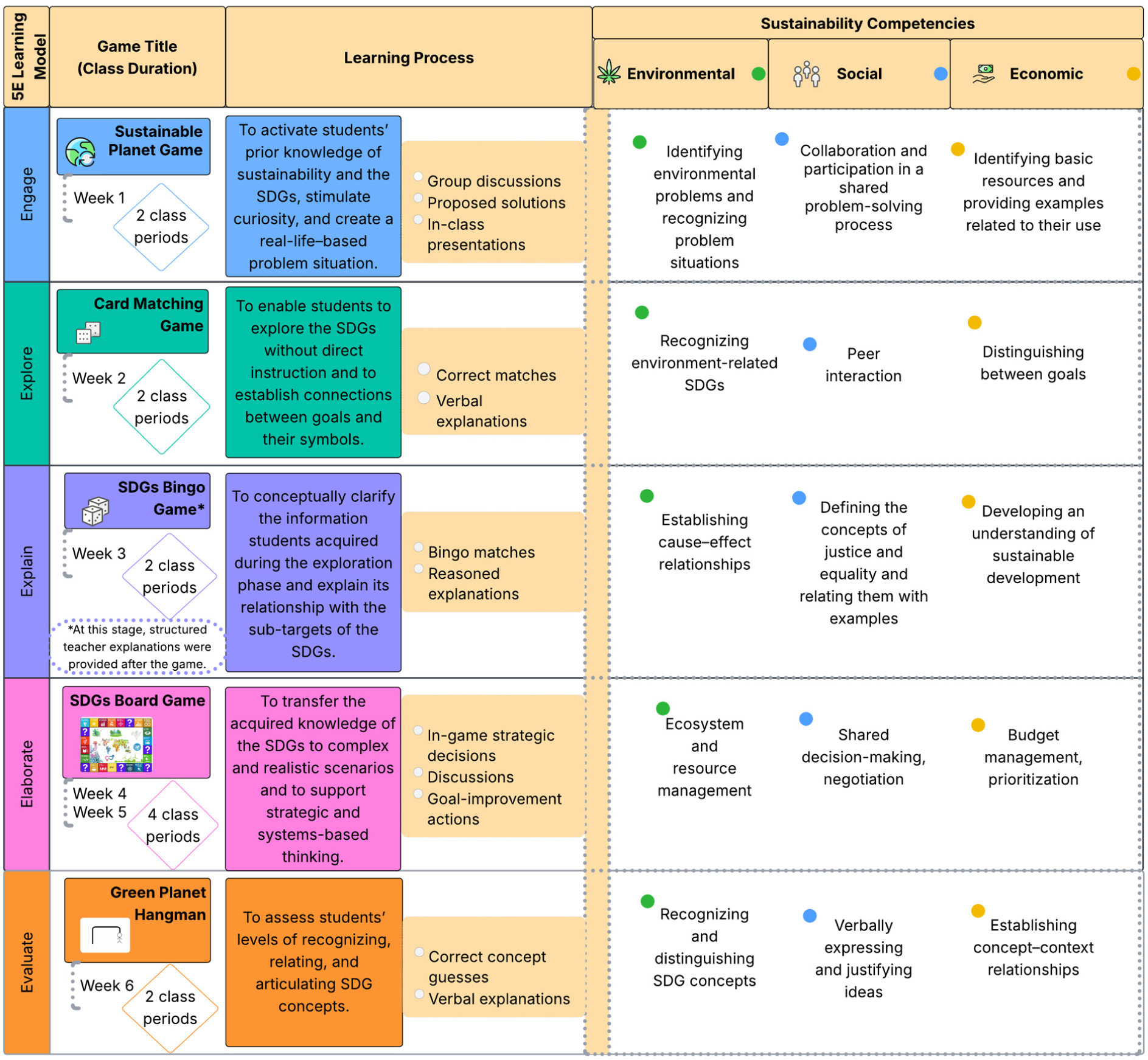
The relationship between the stages of the 5E learning model, game activities, and sustainability competencies.
The detailed content and implementation guidelines of the game activities summarized in Figure 1 are presented in Supplemental Appendix 1.
In conclusion, through game-based learning structured within the framework of the 5E learning model, the study aimed for students to develop conceptual understanding of the SDGs by experiencing them in a way that encompasses sustainability competencies (environmental, social, and economic). In this learning process, the role of the teacher is not that of an authority who directly transmits knowledge, but rather that of a guide who accompanies the process as a facilitator—organizing the learning environment, guiding the process, deepening students’ thinking through appropriate questions, supporting reflection processes, and providing structured feedback when necessary. Students, on the other hand, were positioned as active participants in the learning process; through games, they assumed roles that involved analyzing problem situations, collaborating within groups, generating alternative solutions, and discussing the sustainability dimensions of the decisions they made (Aköz et al., 2022; Scurati et al., 2023). In line with this, the intervention process was structured to support students’ active participation at each stage of the 5E learning model and was carried out within an interactive structure in which students took responsibility, made decisions, and evaluated outcomes.
Data Analysis
The drawings and written narratives obtained in the study were analyzed by content analysis. Content analysis systematically examines written, visual, and other materials. Content analysis is not only a technique used on texts. It is also used to analyze visuals such as student drawings. This inductive content analysis focuses mainly on the variety and frequency of the data and the number of times a particular speech pattern or phrase is used. In this context, the content analysis conducted in this study focused on keywords, including images, words, and nuances (Tisdell et al., 2025). The MAXQDA 24 software was used during the analysis process.
Students’ drawings, notes, and written narratives formed the basis for the development of codes, categories, and themes. In the data analysis, meaningful codes were first identified from the drawings and written narratives. Codes related to similar SDG concepts were grouped and categorized according to the 169 SDG targets. These target-based categories were then organized into broader themes aligned with the 17 SDGs. In this way, students’ knowledge and conceptual understanding of SDGs were analyzed.
In the study, a clear and systematic approach was followed in the content analysis process when matching students’ drawings and written explanations with the relevant SDGs and targets. During the process, taking the United Nations SDGs into account, codes were associated with the relevant SDG and SDG sub-target when student statements and drawings met at least one of the following conditions. The criteria below were developed in alignment with previous studies in which SDGs were analyzed through games and visual representations (Chen & Ho, 2022; Neset et al., 2020). In this context, in students’ statements and drawings:
(a) If the SDG name or symbol was stated directly,
(b) If there was a symbol, icon, or commonly used visual element or expression representing an SDG-related concept (e.g., solar panel – SDG 7; scales of justice symbol – SDG 16; cityscape – SDG 11; marine ecosystem – SDG 14),
(c) If there was a behavior directly related to a specific SDGs or sub-target (e.g., planting trees – SDG 15; distributing food – SDG 2) or a problem together with a proposed solution (e.g., factory smoke + wind turbines – SDG 13 and SDG 7), the relevant code was included in the data analysis process.
For example, before the game-based SDGs experience based on the 5E learning model, the drawings and statements of three students were not analyzed because they did not meet the identified indicators. At the same time, three students were unable to express any ideas before the intervention and submitted blank sheets of paper. However, after the intervention, all students’ papers met the indicators and were included in the analysis. The data analysis process is explained more clearly through three examples in Figure 2 (S: Student; #: Student number).

Examples of coding based on students’ drawings and statements.
In the study, data analysis was conducted by two researchers at different time intervals. In order to ensure the validity and reliability of the researchers’ data analyses, the codes, categories, and themes were presented to three experts holding doctoral degrees in science and physics education, and each expert was allowed to conduct the coding independently for 1 month. Following this process, the inter-rater reliability between the researcher and the experts was calculated. The formula proposed by Miles and Huberman (1994) (agreement/[agreement + disagreement] × 100) was used. As a result of the calculation, the reliability coefficient was found to be 88%. In the literature, a reliability value of 70% or above is considered sufficient (Miles & Huberman, 1994). However, in order to achieve 100% agreement afterward, focus group meetings were held with the experts, and consensus was reached. In this way, the reliability of the data was ensured, and the findings were presented in the relevant section free from researcher bias.
Validity and Reliability
In this study, the validity and reliability of qualitative data were ensured through the strategies of credibility, transferability, dependability, and confirmability. In order to enhance credibility, the findings were presented in an unbiased manner, and expert opinions were consulted during the process. To ensure transferability, the context of the study was described in detail; participant characteristics, the stages of game-based instruction based on the 5E learning model, the duration of implementation, the flow of activities, data collection tools, and coding procedures were reported in detail. In addition, direct quotations from students were included. For dependability, expert opinions were consulted regarding the validity and reliability of the data. For confirmability, the research data were presented with support from the literature, and the findings were explained in detail (Yin, 1994).
Ethical Procedures
Ethical approval was obtained from the relevant ethics committee prior to the implementation of the study, and official permission was also granted by the school administration where the research was conducted. Participation in the study was entirely voluntary, and students were informed that they could withdraw from the study at any stage without any negative consequences. The game-based learning activities were designed in alignment with the existing curriculum and regular classroom practices; therefore, no physical, psychological, or social harm was anticipated. Grading or competition-based practices were deliberately avoided. Informed consent was obtained prior to data collection. Written consent was secured from parents or legal guardians, students were provided with age-appropriate information about the study, and students’ assent was obtained. Throughout the research process, the confidentiality and anonymity of all participants were ensured.
Role of the Researcher
In this study, the researchers were responsible for planning the fieldwork, conducting it, and carefully managing the data collection process. One of the researchers interacted continuously and directly with the participants as the implementing teacher. For this reason, the researchers collected detailed and reliable data regarding the research topic. Consequently, a critical influence was exerted on the robustness and validity of the research findings throughout the process (Creswell, 2007). The theoretical framework of the study was also developed through collaboration among the researchers. In this way, consensus was achieved, and progress was made in selecting the most appropriate research design and methodology for the research topic. At every stage of the study, ethical principles were prioritized, participants’ rights were respected, and their confidentiality and anonymity were protected.
Findings
This study aimed to determine the knowledge of ninth-grade gifted physics students before and after the game-based SDGs experiences based on the 5E learning model through drawing and written expression. The data obtained in the study are presented in Table 1. This table includes the themes/categories, number of participants, and percentages of the students who drew about various SDGs.
Findings Related to Students’ Drawings and Written Explanations Before and After the Experience.
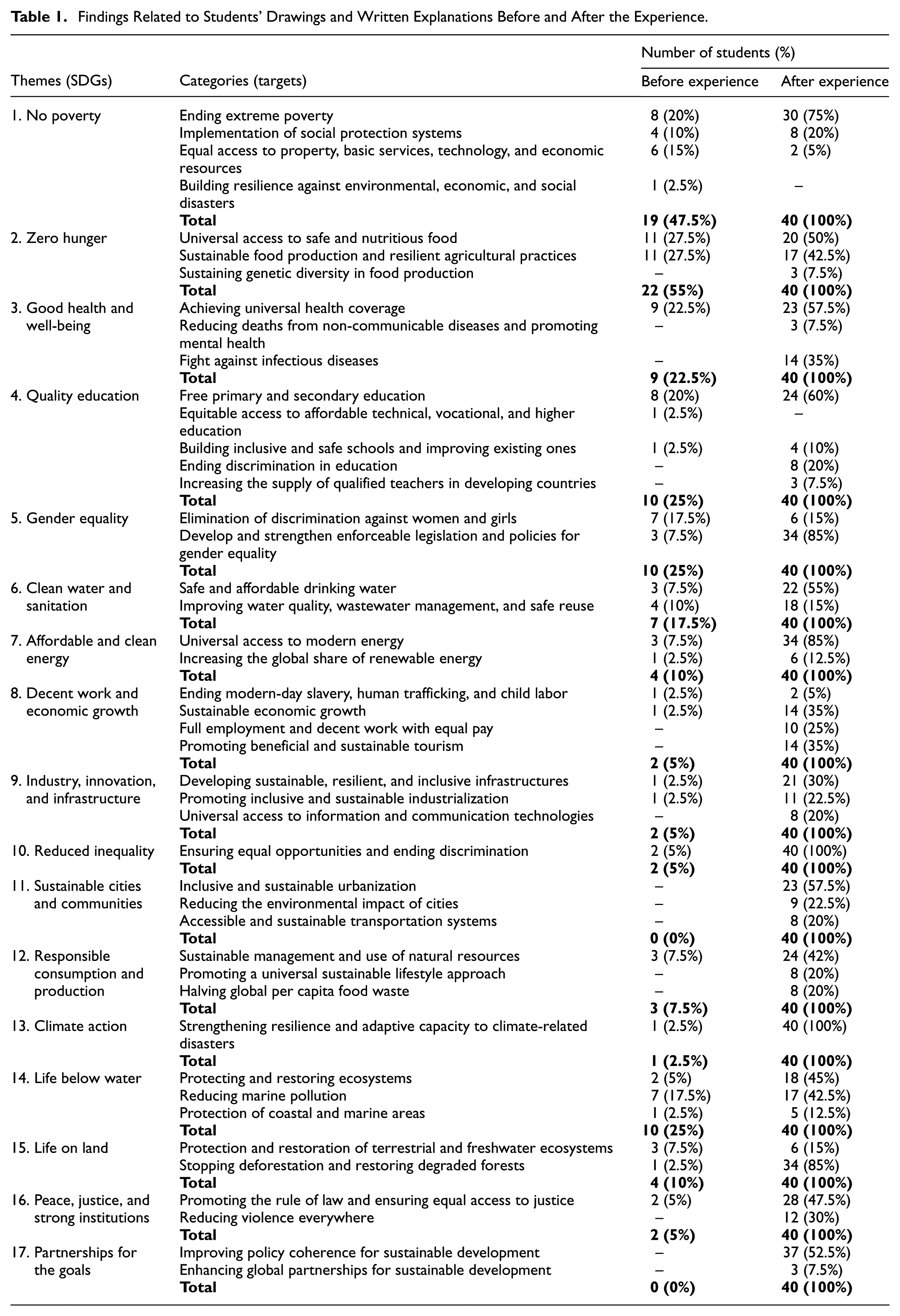
For the data in Table 1, Figure 3 shows examples compiled from the students’ pre-drawings and post-drawings about the SDGs.

Examples of students’ pre-drawings and post-drawings.
According to the data obtained, it was determined that the students’ knowledge on SDGs before the gamified SDGs experience mainly was on “No Poverty (SDG 1)” (47.5%), “Zero Hunger (SDG 2)” (55%), “Gender Equality (SDG 5)” (25%), “Life Below Water (SDG 14)” (25%), “Quality Education (SDG 4)” (25%), and “Good Health and Well-Being (SDG 3)” (22.5%). According to the data obtained after the students’ gamified SDGs experience, 100% participation was achieved in each SDG title, and all students made at least one drawing for each SDG.
Beyond these descriptive outcomes, qualitative evidence offered deeper insight into how students’ conceptual understanding evolved. When students’ drawings and written statements before and after the intervention were examined, a significant transformation in their conceptual understanding of the SDGs was observed. While students’ initial responses mostly consisted of superficial descriptions, by the end of the process, solution-oriented descriptions and explanations based on relationships at the sub-target level were observed. At the same time, it was determined that students who had not produced drawings or provided any statements before the intervention were able to express ideas after the implementation. Figure 4 presents selected examples from students’ drawings and written explanations before and after the instructional process.

Examples from students’ drawings and written statements before and after the implementation.
Post-experience data shows that student understanding of specific sub-objectives increased remarkably. In particular, significant changes were observed in their understanding of the targets under the “No Poverty” theme. Before the experience, 20% of the students focused on the target of “Ending Extreme Poverty,” but this rate increased to 75% after the experience. This increase shows that the training created a strong understanding among the students and contributed to developing concrete ideas on poverty alleviation. In the sample drawings selected for the No Poverty objective, S14 explained his preliminary drawing as follows: “I give water and food parcels to poor people to fight poverty. If we meet their basic needs, they will live a better life. Therefore, it is important to distribute water and food to the poor.” Here, the student expresses that meeting vital needs such as water and basic foodstuffs is an important step in the fight against poverty. When the theme of “Gender Equality” is analyzed, the number of drawings for the target of “Develop and strengthen enforceable legislation and policies for gender equality” showed a remarkable increase from 7.5% to 85%. In the sample drawings selected for the Gender Equality objective, S18 explained his preliminary drawing: “Here the man mistreats the woman, the woman sues the man, and the judge defends women’s rights.” This explanation shows that the student is deeply aware of gender equality and women’s rights. S14 explained his last drawing with the same goal: “I drew gender symbols and a rainbow to emphasize gender equality.” This explanation shows that the student emphasized her understanding of gender equality and its importance of gender equality. When the theme of “Affordable and Clean Energy” is analyzed, while the target of universal access to modern energy was represented by 7.5% before the experience, it reached 85% after the experience. S37 explained his last drawing: “In this drawing, I drew wind turbines and solar panels because they are clean energy sources and do not harm nature. I thought that we should use renewable energy so that everyone can have access to electricity.” This result shows the impact of education in terms of raising understanding and increasing knowledge on renewable energy and energy access. When the theme of “Reduced Inequalities” is analyzed, the rate of drawing in the target of ensuring equality of opportunity and ending discrimination increased from 5% to 100%. This increase enabled the students to understand the concept of equality more comprehensively and to develop more solutions to this issue. S2 explained her last drawing: “Open and closed women, a disabled person, and a healthy person are all equal.” This explanation shows that the student understood that everyone is equal, despite gender, religious beliefs, and physical differences, and emphasized the importance of this equality. When the “Climate Action” theme is analyzed, the target of strengthening resilience and adaptive capacity to climate-related disasters was covered by 2.5% before the experience. In comparison, all students (100%) covered it with drawings after the experience. S5 explained his last drawing: “I drew that the use of fossil fuels harms the world, and I drew a clean world on the other side.” It shows that the students realized the destructive consequences of climate change on ecosystems and the environment. When the “Life on Land” theme was analyzed, the proportion of students who focused on the target of stopping deforestation and restoring degraded forests increased from 2.5% to 85%. S28 explained his last drawing: “In this drawing, I emphasized the importance of protecting nature and animals. I depicted the damage to nature by showing people cutting down trees and the heroes defending nature with Kung Fu Panda.” This shows that the student has developed environmental understanding and an understanding of the importance of individual contributions to a sustainable world.
The data obtained show that students’ level of knowledge about the SDGs increased significantly after the experience. Notably, while students’ understanding of specific goals was limited before the experience, after the training process, students knew all goals, and their participation rates increased. The fact that some of the goals that were not addressed in any of the drawings before the experience (e.g., Sustainable Cities and Communities 11, Partnerships for Goals 17) were represented with 100% participation after the experience revealed that game-based teaching based on the 5E learning model was very effective in increasing their knowledge levels on these issues. The following figure summarizes the results of the research within the framework of themes (Figure 5).

Themes framework summary visualization of research findings.
Discussion
This study revealed that game-based learning grounded in the 5E learning model enhances gifted students’ conceptual understanding of the SDGs in the field of physics. Qualitative findings based on students’ drawings and written explanations indicate that, following the intervention, their knowledge levels did not merely increase quantitatively; rather, they transformed into a more holistic, goal-specific, and relational structure. It was determined that before the implementation, students predominantly used representations limited to singular and superficial symbols, whereas after the implementation, they consciously selected elements representing SDG-specific sub-targets (such as the dove of peace and olive branch, universal energy infrastructure, representations of global hunger, symbols of legal equality, and indicators of modern water access) and supported these symbols with coherent explanations. This development can be explained by students’ ability to establish goal–sub-target relationships in their drawings and written narratives, to express cause–and–effect contexts, and to justify solution proposals for sustainability-related problems. This indicates that students understood the SDGs not merely at the level of naming, but within the context of systemic, functional, and inter-goal relationships (Khot et al., 2026). In particular, the evolution of narratives that were limited to superficial descriptions prior to the intervention into more systematic and purpose-oriented explanations after the intervention demonstrates that the game-based learning process based on the 5E learning model plays a transformative role in the quality of learning (Li & Zhang, 2025). This result reflects the development of students’ conceptual understanding of the SDGs and should not be interpreted as a direct behavioral change or a long-term increase in global awareness.
The literature indicates that gifted students are able to conduct deeper analyses, evaluate multiple variables simultaneously, and develop original solution strategies when confronted with open-ended and complex problem situations (Bozan & Taşlıdere, 2024). The conceptual deepening observed in this study suggests that this cognitive characteristic was effectively activated within a game-based and constructivist learning environment. This situation aligns with constructivist learning theory, which posits that knowledge is actively constructed by learners (Bybee et al., 2006). It is also considered that conducting the study with gifted students in the field of physics influenced the obtained results. In the context of physics education, these students’ advanced system thinking, cause–and–effect reasoning, and modeling skills are argued to provide a supportive advantage for learning multidimensional topics such as sustainable development (Cravero et al., 2021). Accordingly, game-based learning is thought to provide flexible, interactive, and decision-making-oriented learning environments in which these students can reveal their cognitive potential; thus, it is stated that their higher-order thinking skills are supported (Andreoni & Richard, 2024). Indeed, given that gifted students in the field of physics were able to make strategic decisions regarding sustainability issues through games and to evaluate the potential environmental, social, and economic consequences of their decisions in this study (Shin & Rowe, 2026), it can be stated that the research findings are consistent with the literature.
Moreover, the literature indicates that in the teaching of multidimensional, abstract, and interdisciplinary topics such as sustainable development, traditional instructional approaches in which students are passive recipients of information remain limited; in contrast, game-based learning provides opportunities to experience complex systems, make decisions, and observe the consequences of those decisions (Chen & Ho, 2022; Kitamura & Ito, 2022; Neset et al., 2020). In this sense, this situation also explains the pedagogical rationale for why game-based learning was preferred in the present study. Through game-based learning activities, students were enabled to address the environmental, social, and economic dimensions of sustainable development simultaneously, thereby contributing to the meaningful understanding of the SDGs and making the relationships among them visible. In this way, it can be considered that students supported within the framework of sustainability competencies may develop skills related to understanding environmental systems, engaging in collaborative problem solving, and developing a sense of justice, as well as making decisions regarding the efficient use of economic resources (Rieckmann, 2017). Similarly, in the study on the Science Education for Sustainable Development module developed by Şeker and Aydinli (2023), it was determined that students’ abilities to explain the goals improved significantly as they associated sustainable development with its environmental, social, and economic dimensions. In line with the findings of Şeker and Aydinli (2023), this study also found that students were able to express the SDGs more clearly and with stronger justification after the intervention. In particular, students’ development of solution proposals for SDG 1 (No Poverty), SDG 4 (Quality Education), SDG 7 (Affordable and Clean Energy), SDG 10 (Reduced Inequalities), and SDG 15 (Life on Land) can be considered important indicators of this conceptual transformation. In conclusion, it can be stated that the game-based learning process developed on the basis of the 5E learning model in this study functioned not merely as a tool to motivate learning, but as an effective pedagogical approach that supports the understanding of system-based topics such as sustainability. In this respect, game-based learning grounded in the 5E learning model emerges as a holistic instructional approach that enables abstract, multidimensional, and value-based content, such as sustainable development, to be made meaningful by students not only at the cognitive level, but also in the contexts of decision making and taking action (Li & Zhang, 2025).
In addition, the use of game-based learning based on the 5E learning model during the intervention process in the study can be considered one of the key factors that increased the effectiveness of the learning process. This is because structuring the learning process according to the 5E learning model created a learning environment that supported triggering students’ curiosity and desire to explore, constructing new knowledge upon prior knowledge, and applying learned knowledge to different situations (Aköz et al., 2022; Bybee et al., 2006). In this context, the 5E learning model enabled students not merely to memorize information but to question, evaluate, and use knowledge in a functional manner (Şeker & Aydinli, 2023). Indeed, the conceptual deepening observed in this study supports these claims, and it was determined that the most pronounced conceptual deepening occurred in SDG 11 (Sustainable Cities and Communities) and SDG 17 (Partnerships for the Goals). These two goals, which were not represented by any student prior to the implementation, appeared in the drawings of all students (100%) after the implementation. This finding indicates that the games may have supported the understanding of abstract topics such as urbanization, infrastructure, global cooperation, and shared responsibility (Wals, 2010). This change was followed by increases in SDG 1 (No Poverty), SDG 7 (Affordable and Clean Energy), and SDG 4 (Quality Education). For example, within the scope of SDG 1, students considered not only short-term solutions such as distributing aid, but also the structural causes of poverty and long-term strategies after the intervention. This situation is consistent with the findings of Chen and Ho (2022), who reported that game-based learning supports deeper thinking processes regarding sustainable development issues within the framework of SDG 1. Similarly, Tlili et al. (2024) argue that students developed empathy particularly toward the theme of poverty during the process, stating that the emphasis on global solidarity and benevolence observed in the results of this study may have emerged because students engaged in empathetic thinking. In addition, the increase in students’ knowledge levels related to the theme of Affordable and Clean Energy within the scope of SDG 7 after the intervention indicates that game-based instruction can raise awareness regarding energy and environmental sustainability issues. In this context, the statement by Albertarelli et al. (2018) that game-based systems contribute to the comprehensibility of energy and water sustainability supports the findings of the present study. Within the scope of SDG 13 (Climate Action), students mostly associated climate issues with the effects of fossil fuel use. This result is supported by Neset et al. (2020), who stated that students’ participation in the “climate adaptation” game used in their research was influential in enabling them to grasp the complex relationships between environmental factors and the critical decisions that need to be made. In addition, Garg and Agarwal (2024) also state that games are an important tool for increasing students’ knowledge levels regarding climate change within the framework of sustainable development. Furthermore, the frequent emphasis by students after the intervention on themes such as deforestation, ecosystem loss, and the protection of living organisms within the scope of SDG 15 (Life on Land) can be considered consistent with the findings of Kitamura and Ito (2022), who suggested that sensitivity to environmental problems can be strengthened through learning experiences. In short, the results of this study demonstrate that game-based learning grounded in the 5E learning model plays a constructive and supportive role in developing conceptual understandings of the SDGs.
Conclusions and Implications
In this study, it was determined that game-based learning grounded in the 5E learning model is effective in developing gifted students’ conceptual understanding of the SDGs in the field of physics. The results of the study are expected to shed light on instructional curricula. In addition, it is intended that the game-based lesson plan developed within the scope of the study, based on the 5E learning model, will provide a guiding perspective for teachers who wish to benefit from this field.
This study went beyond similar studies in the literature and was carried out with gifted students educated in developing countries. Since developing countries constitute the majority of the world’s population and territory, and sustainable development performance has a global impact, it is believed that working with students studying in one of these countries will contribute to the literature (Ateş & Usman, 2021). Educational policymakers and curriculum designers in developing countries should consider integrating such approaches into science/physics education. Therefore, working with gifted students in a developing country, both revealing the potential of these students and raising future leaders who will transfer SDGs to society, makes this study unique.
Limitations and Future Research Directions
As a result of this study, it was determined that game-based learning grounded in the 5E learning model is an effective method for deepening students’ conceptual structures related to the SDGs. However, there are some limitations that should be taken into consideration when evaluating these results. First, the absence of a control group in the study limits the ability to make definitive causal inferences that the observed conceptual development resulted directly from game-based learning structured with the 5E learning model. In this context, the effects of students’ natural cognitive development during the process of their out-of-school learning experiences on the findings could not be controlled (Johnson & Christensen, 2019). This situation can be considered an important factor limiting the internal validity of the study (Christensen et al., 2015). Nevertheless, since the main purpose of the study was not to make causal comparisons but rather to exploratorily reveal how game-based learning grounded in the 5E learning model supports conceptual understanding of the SDGs, it can be stated that the findings provide important preliminary evidence regarding the potential of the method. Accordingly, future studies may be recommended to test the effectiveness of this method more robustly through control-group implementations using experimental or quasi-experimental designs (Creswell, 2007). At this point, it is also not possible to reach a definitive conclusion regarding whether similar results could be obtained in different disciplines or with different student groups. In order to reduce this limitation arising from the absence of a control group, the study was conducted with gifted students in the field of physics who had similar academic backgrounds and cognitive profiles, in order to minimize individual differences as much as possible. In addition, limiting the implementation to 12 class hours was a deliberate choice aimed at reducing the intervention of external environmental effects in the process. To reduce potential measurement bias during the data collection process, drawings and written narratives were used together; during the coding process, consensus was achieved through the use of multiple coders (Lodico et al., 2010).
Secondly, the research participants were determined voluntarily, and the study was conducted with 40 gifted students in the field of physics at the ninth grade level who were enrolled in a Science and Art Center. The inability to randomly assign participants constitutes a limitation in terms of both internal and external validity (Johnson & Christensen, 2019). Voluntary participation increases the likelihood that individuals who are more motivated or more open to learning were included in the study; this may cause participants’ cognitive characteristics to differ from those of the average student population. In addition, the advanced learning speed, abstract thinking, and problem-solving skills of gifted students in the field of physics may have naturally increased the level of impact of the intervention (Bozan & Taşlıdere, 2024; Çetinkaya et al., 2023). Therefore, it is not appropriate to generalize the findings directly to the entire student population. In order to reduce this limitation, the study attempted to ensure within-group homogeneity by working with students who had similar backgrounds. Nevertheless, potential bias arising from the nature of voluntary participation should be taken into account, and the results should be interpreted within this context (Lodico et al., 2010). In future research, it may be recommended to employ maximum variation sampling by working with gifted students in different fields, or even with student groups with different levels of academic achievement (Yıldırım & Şimşek, 2018). In addition, studies structured with long-term and randomized designs in different socio-cultural contexts will strengthen the external validity and transferability of the results.
Another limitation of the study is the number of participants. Conducting the study with 40 students limits the generalizability of the findings. Although qualitative research designs aim to obtain in-depth data, similar studies conducted with larger samples may increase the representativeness of the findings (Patton, 2015). Therefore, it is recommended that future studies be carried out with a greater number of participants and implemented in different types of schools. In this way, the effects of game-based instruction grounded in the 5E learning model on students with diverse demographic characteristics can be evaluated more comprehensively.
Another important limitation is that the implementation period in the study was limited to only 12 class hours. This makes it difficult to evaluate the durability of the conceptual changes observed in students. At this point, longitudinal studies may provide opportunities to examine in greater detail the development of students’ understanding of sustainability concepts over time (Hsiao & Su, 2021). In addition, the fact that the study was conducted in a single school limits the generalizability of the findings to different socio-cultural and institutional contexts. Studies to be carried out in different regions, across different types of schools, and with different teacher profiles will reveal the context sensitivity of the method more clearly.
In addition, the primary data sources of the study were students’ drawings and written narratives. The use of these data types both before and after the implementation may have influenced the results due to participants’ increased familiarity with the measurement tools (Gay et al., 2012). However, the fact that the implementation was spread over 6 weeks was considered a factor that reduced the likelihood of students remembering the initially posed questions in detail. Nevertheless, it is not possible to eliminate researcher subjectivity in the process of interpreting drawings, as qualitative research inevitably entails the risk of researcher bias (Maxwell, 2013). In the study, individual differences in students’ drawing skills and diversity of expression may have influenced the coding process. At the same time, the researchers’ theoretical frameworks and areas of expertise may have indirectly affected the data interpretation process (Miles et al., 2014). Although multiple coders were used in the study, inter-coder agreement was established, and the analysis process was reported transparently to reduce this risk. Future studies may enhance the reliability of findings by using structured interviews, performance tasks, concept tests, and multiple data collection tools in combination (Çetinkaya et al., 2023).
Finally, the fact that the SDGs were addressed within the framework of environmental, social, and economic competencies in the study can also be considered a limitation. Although sustainability education is inherently multidimensional, this study was limited to specific competency frameworks. While this framework encompasses the core components of sustainability, more complex socio-scientific structures that lie at the intersection of these components remain outside the scope of the study. Future research may focus on themes that require the integrated consideration of environmental, social, and economic dimensions, such as climate justice, circular economy, biodiversity loss, and sustainable urban planning (Hsiao & Su, 2021; Şeker & Aydinli, 2023).
Considering all these limitations, it can be stated that the research findings should be evaluated as exploratory in nature. Nevertheless, the study provides strong preliminary evidence regarding how game-based learning grounded in the 5E learning model can support students’ conceptual understanding of the SDGs and establishes a solid theoretical and practical foundation for future research.
Supplemental Material
sj-docx-1-sgo-10.1177_21582440261423757 – Supplemental material for Gifted Physics Students Engage with the Sustainable Development Goals Through Game-Based Learning
Supplemental material, sj-docx-1-sgo-10.1177_21582440261423757 for Gifted Physics Students Engage with the Sustainable Development Goals Through Game-Based Learning by Sevim Bezen and Semra Tanriöver in SAGE Open
Footnotes

Ethical Considerations
Before involvement, informed written and verbal agreement was sought, and participation was voluntary. Hacettepe University Research Ethics Committee examined and approved the program before the study’s start (protocol number E-51944218-050-00003622138 dated 28.06.2024).
Consent to Participate
The subject of the study has signed an informed consent form before the study, which indicates their willingness to participate in the study.
Author Contributions
All authors contributed to the conception, design, and development of the study. All authors read and approved the final manuscript and agree with the order of authorship and the content of the manuscript. Sevim Bezen: conceptualization, investigation, analysis, writing—review and editing; Semra Tanrıöver: conceptualization, investigation, analysis, writing—review and editing.
Funding
The authors received no financial support for the research, authorship, and/or publication of this article.
Declaration of Conflicting Interests
The authors declared no potential conflicts of interest with respect to the research, authorship, and/or publication of this article.
Data Availability Statement
The data that support the findings of this study are available from the corresponding author upon reasonable request.*
Declaration Regarding the Use of Generative AI and AI-Assisted Technologies in the Writing Process
During the preparation of this study, the author(s) used ChatGPT solely to enhance the language and readability of the text. After using this tool, the author(s) thoroughly reviewed and revised the content, assuming full responsibility for the final content of the publication.
Supplemental Material
Supplemental material for this article is available online.
References
Supplementary Material
Please find the following supplemental material available below.
For Open Access articles published under a Creative Commons License, all supplemental material carries the same license as the article it is associated with.
For non-Open Access articles published, all supplemental material carries a non-exclusive license, and permission requests for re-use of supplemental material or any part of supplemental material shall be sent directly to the copyright owner as specified in the copyright notice associated with the article.
