




Abstract
This study tests the Integrative Model of Activism (IMA) developed by Chon and Park (2020) in the context of the refugee issue in Türkiye and extends the theoretical framework by incorporating the subjective norm variable. Türkiye provides a particularly relevant context for exploring the transitional dynamics between online and offline activism, given the persistence of strong social belonging and the increasing visibility of political engagement on digital platforms. This study is based on data collected through an online survey of university students (N = 638) and analyzed using structural equation modeling (SEM). The results demonstrate that problem recognition and involvement recognition significantly increase situational motivation, whereas constraint recognition exerts a negative influence. Situational motivation was found to increase social media activism but did not directly affect offline activism. Additionally, perceptions of affective injustice and subjective norms were found to directly and significantly impact both social media and offline activism. In addition, social media self-efficacy emerged as a strong predictor of social media activism. Social media activism significantly predicts offline activism, mediating the relationship between situational motivation and offline activism. The model’s goodness-of-fit indices indicate an acceptable level of fit (e.g., CFI = 0.933; RMSEA = 0.052). These findings reveal that social media activism can trigger online participation as well as offline political action. The study presents implications for policymakers and civil society actors in developing strategies for digital citizenship, political communication, and social cohesion.
Plain Language Summary
This study looks at how young people in Türkiye use social media to engage with the refugee issue and how that online activity can lead to real - world action. Using surveys with 638 students, the research tested the Integrative Model of Activism, a framework that explains why people get involved in social movements. The findings show that when people recognize the refugee issue as important, feel less limited by barriers, and believe they have the skills to use social media, they are more likely to take part in online activism. Feelings of unfairness or injustice also make people more active. Importantly, social expectations (what friends, family, or communities think) play a strong role in pushing people to engage. The results highlight that online activism is not just symbolic. It often leads people to take action offline, such as joining protests or campaigns. In this way, social media acts as a bridge between personal motivation and public participation. These insights can help policymakers, educators, and civil society groups design youth programs and communication strategies that support dialogue, reduce polarization, and encourage constructive engagement around refugee issues in Türkiye.
Keywords
Introduction
Activism, which is a multidimensional process by which individuals channel their concerns about social issues into public action, is analyzed in communication studies and the social sciences from a variety of theoretical viewpoints. The Situational Theory of Problem Solving (STOPS; Kim & Grunig, 2011) seeks to explain individuals’ communicative behaviors based on their perceptions of problems, perceived involvement, and recognition of constraints. The Social Identity Model of Collective Action (SIMCA; van Zomeren et al., 2008) emphasizes the role of shared identity, perceived injustice, and perceived efficacy in motivating collective behavior. The Theory of Planned Behavior (Ajzen, 1991) explains people’s intentions based on attitude, subjective norm, and perceived behavioral control, while framing approaches focus on how the public makes sense of social issues (Snow & Benford, 1988). While these approaches offer valuable insights into specific aspects of activism, there is still need for a model that addresses emotional, cognitive, and communicative processes in an integrated manner. Accordingly, the Integrative Model of Activism (IMA) developed by Chon and Park (2020) offers an integrated theoretical framework that considers individuals’ participation in activism in terms of both emotional and cognitive processes, as well as communicative and structural conditions. The IMA considers activism as a processual construct shaped by a combination of cognitive appraisals (e.g., problem recognition, involvement recognition and constraint recognition), emotional responses (affective injustice), and communicative practices (social media activism). The model explains how online participation translates into offline action by positioning social media activism as a mediating variable. In this sense, the IMA consolidates fragmented theoretical perspectives in the activism literature and explains the reciprocal relationship between individual motivations and the communicative foundations of contemporary activism.
The IMA has been adapted with different variables in different contexts. Indeed, Diers-Lawson (2023) examined the model qualitatively in the context of the Scottish independence movement and conceptualized crisis as a fundamental trigger of activism. By incorporating the dynamic triggering role of crises and the importance of historical context, the author developed a comprehensive and explanatory model and argues that the Unified Model of Activism is applicable across diverse cultural and political contexts.
Existing IMA studies (Chon, 2023; Chon & Harrell, 2024; Chon & Park, 2020) and the IMA-based Diers-Lawson model (2023) have all been conducted in Western contexts, highlighting a clear gap in testing the model in other social and cultural settings. Activism practices vary across societies, as normative structures, cultural orientations, and the intensity of interpersonal relationships play a significant role in shaping collective participation. Consequently, testing the IMA in non-Western contexts is important not only as an empirical extension, but also for evaluating the model’s theoretical validity.
In this context, Türkiye offers a theoretically appropriate context for testing the IMA. Migration patterns and the high level of online engagement among young people make Türkiye an important research area for exploring the links between social media activism and offline activism. In this study, Türkiye is not treated as a problem case, but as a context where social norms, a relatively collectivist culture, and strong digital interactions can be observed.
This study is one of the first to test the IMA in the context of Türkiye, and it also expands the framework by incorporating the subjective norm variable into the model. Subjective norm refers to an individual’s perception of social expectations related to engaging in political action (Ajzen, 1991). In cultural contexts where community-based social relationships are strong, social approval is expected to play a decisive role in online and offline activism, particularly among young adults. Accordingly, the primary aim of this study is to test the validity of the IMA in relation to the refugee issue in Türkiye and to contribute theoretically by incorporating the subjective norm variable into the model. It also aims to contribute to research, implementation, and policy development. The findings are expected to contribute to the redesigning of youth policies, civil society programs, and strategic communication plans.
Literature Review
Refugee Issues and Activism in Türkiye
The term ‘refugee’ refers to individuals compelled to leave their home country due to armed conflict, violence, or persecution, and who seek asylum elsewhere (United Nations High Commissioner for Refugees [UNHCR], 2024). Since 2015, Türkiye has hosted the highest number of refugees worldwide, with approximately 3.6 million registered Syrian refugees and around 320,000 from other nationalities (UNHCR, 2024). This development has shifted migration in Türkiye beyond the scope of a purely humanitarian issue, turning it into a multidimensional social phenomenon directly linked to processes of social integration, social policy formation, and public discourse.
In Türkiye, the refugee issue is addressed across a broad spectrum ranging from individual attitudes to political discourse and is debated through both traditional media and digital platforms. Social media in particular increases the visibility of migration debates, as different views interact through these platforms. In this context, digital platforms function not only as spaces where individuals express their views, but also as platforms for shaping of collective attitudes and circulation of public demands.
The literature (Erdoğan, 2020; Unutulmaz, 2022) goes beyond legal regulations to address the refugee issue in Türkiye based on social perceptions, media representations, and civil society practices. It emphasizes that the change observed in public attitudes over time is shaped through both security and solidarity practices. Digital media studies show that these discussions extend into online spaces, and discourses regarding refugees enter into circulation on social media and news platforms (Bayram, 2020; Bolgün & Uçan, 2020; Küçük & Koçak, 2020). On the other hand, literature on civil society proposes that forms of social participation are diversifying through volunteer networks and local initiatives, and that the refugee issue also provides a meaningful basis for public participation (Duman & Coşkan, 2023; Sunata & Tosun, 2019). Accordingly, it can be said that the refugee issue in Türkiye is a multi-layered phenomenon shaped by security discourses, digital representations, the normative environment, and civil society dynamics.
Regional comparisons offer an important perspective for better understanding the case of Türkiye. In Europe, activism related to refugees has become increasingly visible, particularly since 2015, through organized solidarity networks centered around border crossings, reception centers, and major cities. During this period, rights-based advocacy, campaigns, and legal monitoring initiatives have become highly visible in the public sphere (Della Porta, 2018). Digital media has played a significant role in bringing feelings of solidarity into circulation and in making offline actions visible through discursive frames such as “refugees welcome” (Sajir & Aouragh, 2019). In the Middle East, on the other hand, activism related to refugees focuses on humanitarian needs such as housing, healthcare, and access to basic services (Chatty, 2017). Particularly in the cases of Lebanon and Jordan, humanitarian aid activities are carried out through local and international actors, while rights-based advocacy activities remain secondary due to the limited number of official refugee camps and the relatively limited state capacity (Chatty, 2017).
Türkiye holds a unique position between these two contexts. Given the large refugee population and the fact that refugees largely live alongside the host society rather than in camps, activism tends to take shape around everyday interactions, processes of social cohesion, and humanitarian support, rather than being centered primarily on border policies. This makes Türkiye a theoretically significant context for examining how online and offline activism are interconnected. Accordingly, Türkiye offers a particularly suitable research area for the IMA to test the relationships between the normative environment, digital participation, and collective action under different cultural conditions.
The proliferation of digital platforms has also transformed the forms of activism. On the one hand, it is argued that social media facilitates public participation, accelerates the flow of information, encourages individuals to take action (Tufekci & Wilson, 2012), and that individuals and civil society organizations can organize at relatively low costs (Topbaş & Doğan, 2016). On the other hand, there are criticisms that online participation may remain superficial, may not translate into long-term civic engagement, and that digital tools tend to create an environment of control and surveillance (Gladwell, 2010; Morozov, 2011). These discussions point to the risk that digital participation may remain largely symbolic, a concern often captured by the notion of “slacktivism” (Rotman et al., 2011). However, these critiques also underscore the need for theoretical models capable of addressing the relationship between online and offline activism in a holistic manner.
The Integrative Model of Activism and Subjective Norm
This study examines the IMA developed by Chon and Park (2020) in the context of the refugee issue to explain the determining factors of activism in the digital age. The IMA is based on the Situational Theory of Problem Solving (STOPS; Kim & Grunig, 2011). STOPS argues that perceptual variables such as problem recognition, involvement recognition, and constraint recognition shape situational motivation when explaining individuals’ communication behaviors (Grunig, 2003; Kim & Grunig, 2011). According to the Situational Theory of Problem Solving (STOPS), problem recognition refers to the extent to which individuals perceive a discrepancy between the current situation and a desired state; involvement recognition refers to the perceived relevance of the problem to oneself and one’s immediate social environment; and constraint recognition refers to perceptions of internal and external obstacles that limit individuals’ ability to take action to address the problem (Kim & Grunig, 2011). Situational motivation is defined as an individual’s “cognitive and epistemic readiness to reduce the perceived incongruence between expected and experienced situations” (Kim & Grunig, 2011, p. 132). Based on the empirical findings in the literature (Chon & Harrell, 2024; Chon & Park 2020; Kim & Grunig, 2011; Li et al., 2025), an increase in problem recognition and involvement recognition significantly and positively increases an individual’s situational motivation, while an increase in constraint perception weakens situational motivation. In this context, the following hypotheses have been formulated:
The IMA argues that situational motivation is not merely an intrinsic state of readiness, but a central process that guides an individual’s online and offline actions (Chon & Park, 2020). Research (Chon, 2023; Chon & Park, 2020) has demonstrated that situational motivation is a key determinant of both social media activism and offline activism. Within this theoretical and empirical framework, the following hypothesis has been formulated in the context of the refugee issue with the assumption that situational motivation is a fundamental variable predicting both online and offline activism:
Another factor in the IMA is affective injustice. Based on the Relative Deprivation Theory (Crosby, 1976), this concept, unlike cognitive injustice, encompasses emotional responses such as anger and is defined as a powerful determinant of collective action (Lagrange, 2025; van Stekelenburg & Klandermans, 2013). Research indicated that perceived affective injustice significantly increases both online and offline activism (Chon, 2023; Chon & Park, 2020; Eniayejuni, 2023; Simon et al., 1998). Accordingly, it is assumed that affective injustice perceptions play a determining role in motivating individuals to engage in both online and offline activism. Therefore, the following hypothesis is proposed:
This study adds subjective norm to the model. The subjective norm refers to the tendency of individuals to behave in accordance with social expectations (Ajzen, 1991; Sturmer & Simon, 2004). In collectivist cultures, individuals’ decisions are expected to be shaped by social expectations and the approval of reference groups rather than personal attitudes (Fischer & Karl, 2021; Triandis, 1995). Kim and Sriramesh (2009, p. 96) state that certain characteristics of social culture are more conducive to the existence of high levels of activism, as collectivist cultures are likely to foster higher levels of activism. Empirical studies (Morren & Grinstein, 2021; Roseira et al., 2022; Yang et al., 2024) also show that subjective norm has a stronger influence on behavior in collectivist contexts. In line with these theoretical and empirical findings, subjective norm is regarded as a critical determinant in explaining individuals’ participation in both social media activism and offline activism related to the refugee issue; accordingly, the subjective norm variable was incorporated into the model in this study. Based on the findings in the current literature, the following hypothesis has been developed:
Social media platforms facilitate rapid information exchange, mobilization, the formation of online communities, increased visibility of issues, coordination of protest activities, and the providing of emotional and motivational support among participants (Jost et al., 2018). Social media self-efficacy refers to an individual’s perception of their ability to use digital platforms effectively and create impact on these platforms (Hocevar et al., 2014). Previous studies (Chon, 2023; Chon & Park, 2020) have shown that social media self-efficacy significantly increases social media activism. Accordingly, the following hypothesis has been formulated.
In this study, social media activism is conceptualized as actions taken for social and political change through digital platforms (Estrella-Ramón et al., 2024), while offline activism is conceptualized as a form of political participation.
The IMA emphasizes the role of social media as a catalyst in social movements. Examples such as Occupy Wall Street and the Arab Spring demonstrated that social media is instrumental in increasing offline participation (İnceoğlu & Çoban, 2015; Lee et al., 2017; Tufekci & Wilson, 2012). Therefore, it is argued that social media activism positively influences offline activism and plays a mediating role in the relationship between situational motivation and offline activism (Chon, 2023; Chon & Park, 2020). In light of this information, we propose the following hypotheses and research question:
Method
Research Design and Data Collection
This study, grounded in the Integrative Activism Model, aims to understand when and how Turkish individuals mobilize online and to identify the catalysts driving their collective actions. This study adopted a quantitative approach, with data collected via an online survey. The survey instrument consisted of 60 items. Problem recognition (4 items), constraint recognition (4), involvement recognition (5), situational motivation (3), social media self-efficacy (5), affective injustice (4), social media activism (10), offline activism (7), and subjective norm (6) were measured using established scales. Additionally, five items were included to measure participants’ perceptions of the refugee issue. In addition, seven items were used to assess participants’ demographic characteristics. With the exception of demographic variables, all items were measured using 7-point Likert scales, adapted to the content of each item (e.g., 1 = Strongly Disagree to 7 = Strongly Agree; 1 = Not at All to 7 = Very Much So; 1 = Highly Unlikely to 7 = Highly Likely; 1 = Absolutely No to 7 = Absolutely Yes).
Following approval from the Ethics Committee, data for this study were collected between May 4 and May 18, 2024. In Türkiye, the refugee issue remains at the center of ongoing public debate, making the country a suitable setting for examining attitudes and perceptions related to activism.
The survey, created using Google Forms, was distributed to participants via email.
The study population consisted of associate, undergraduate, master’s, and doctoral students currently enrolled in higher education institutions in Türkiye. This sample aligns with the research objectives, as it represents a demographic characterized by high digital media use, relatively greater sensitivity to political and social issues (Offe, 2016), and more active engagement in online public interactions (Bobzien et al., 2025). However, limiting the sample to higher education students constitutes a constraint on the generalizability of the study, and the findings should be interpreted in light of this limitation.
Data were collected from 678 participants selected through convenience sampling to represent the study population. Forty surveys that did not comply with the analysis criteria were excluded from the dataset, and the final sample consisted of 638 participants. The adequacy of the sample group for SEM analysis was evaluated. Considering the number of observed variables included in the model, it was concluded that a sample group of 638 people was sufficient for the analyses per the 10:1 ratio suggested by Kline (2016).
Participants completed the survey after reviewing and agreeing to an informed consent that summarized the objectives of the study. The study did not collect any personally identifiable data, and all responses were recorded anonymously. Participants were expressly informed that they could withdraw from the study at any time.
Figure 1 presents the research model.
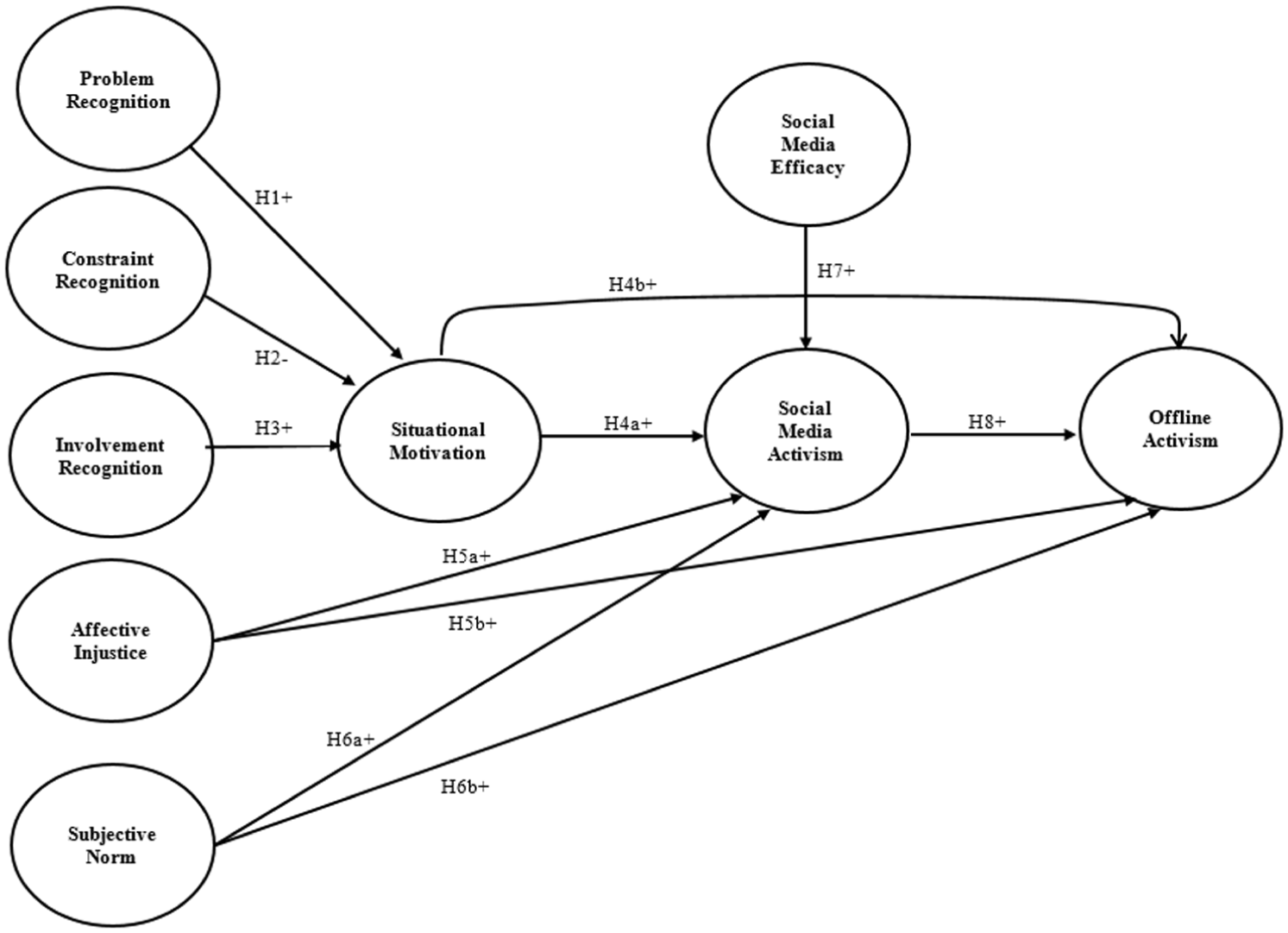
A proposed integrated model of activism on refugees issues.
Participants
Table 1 presents a summary of the demographic characteristics of the participants. Of the participants, 39.8% (n = 254) were male, and 60.2% (n = 384) were female. The majority (53.1%) were between the ages of 17 and 22, 23.5% (n = 150) were aged 23 to 28, while 23.4% (n = 149) were aged 29 or above. Concerning education, 35.1% (n = 224) had an associate degree, 39.2% (n = 250) had a bachelor’s degree, 15.5% (n = 99) had a master’s degree, and 10.2% (n = 65) had a doctorate degree. Income levels varied, with 29% (n = 185) reporting an income of Turkish Lira (TRY) 10,000 (≈$259) or less, 26.6% (n = 170) earning between TRY 10,001(≈$260) TL and TRY 25,000 (≈$648), 24.3% (n = 155) earning between TRY 25,001 (≈$649) and TRY 48,000 (≈$1,245), and 20.1% (n = 128) reporting an income of TRY 48,001 (≈$1246) or above. (U.S. dollar equivalents were calculated using the average exchange rate at the time of the survey ($1 ≈ TRY 38.57). Politically, 45.8% (n = 292) identified as nationalist, 27% (n = 172) as republican, 8.6% (n = 55) as social democrat, 5.3% (n = 34) as apolitical, 1.9% (n = 12) as conservative (Islamist), 1.6% (n = 10) as democrat, 1.4% (n = 9) as socialist, 1.1% (n = 7) as liberal, and 0.5% (n = 3) as conservative nationalist. Additionally, 5.2% (n = 33) identified as “other,” and 1.7% (n = 11) chose not to specify their political identity. Religiously, 94.8% (n = 605) identified as Muslim, 2.7% (n = 17) as atheist, 0.3% (n = 2) as deist, and 0.6% (n = 4) as agnostic. Another 0.6% (n = 4) selected an alternative option called in this study (other), and 0.9% (n = 6) preferred not to specify their religion. When asked about their approval of Türkiye’s refugee policy, 75.9% (n = 484) disapproved, 6.3% (n = 40) approved, and 17.9% (n = 114) had no opinion.
Sample Descriptive Statistics (N = 638).

Perceptions of the Refugee Issue Among Participants
In this study, a five-item questionnaire was used to assess participants’ general perceptions of the refugee issue; while this measure was not incorporated into the model, it served to enhance contextual understanding. The items were not included as variables in the main analyses but were used to describe overall attitudinal trends within the sample. The relevant items were measured using a 7-point Likert scale (1 = Strongly Disagree, 7 = Strongly Agree). The Cronbach’s alpha value (.817) calculated in relation to the items has been reported as a technical indicator for this set of items. It should be noted that these items do not form a standalone, previously validated measurement instrument. The mean score (M = 2.02, SD = 1.32) indicates that participants, on average, reported relatively low levels of support for the refugee issue. This result is reported solely to contextualize the sample and was not included as an analytical variable in the structural model analysis (Table 2).
Reliability, Means (M), and Standard Deviations (SDs) of Items Regarding Perception of Refugee Issue (N = 638).

Note. In the current study, a 7-point Likert scale ranging from 1 (Strongly Disagree) to 7 (Strongly Agree) was used. Means (M), and Standard Deviations (SDs) for the total score.
Measurement
The measurement instruments were adapted from the items used in the Integrative Model of Activism (IMA) developed by Chon and Park (2020). Written permission was obtained from the author of the article prior to the research. All items covered in the study can be found in Supplemental Appendix 1. The items were translated into Turkish using a round-trip method. The translations were reviewed by linguists and communication and public relations experts in terms of semantic coherence, conceptual equivalence and cultural appropriateness. Corrections were made based on their feedback. To assess the comprehensibility and applicability of the data collection tool, a preliminary test was conducted with 50 participants with similar characteristics to the main sample group before the main application. The measurement form was finalized after making corrections based on participant feedback, which was followed by the actual application.
Offline activism was assessed using the seven items adapted by Chon and Park (2020) based on the literature (α = .96). The items were adapted to the context of the refugee issue, and participants rated each statement using a 7-point Likert scale (1 = Highly Unlikely, 7 = Highly Likely).
Social media activism was evaluated using the 10 items adapted by Chon and Park (2020) based on the literature. Consisting of two sub-dimensions, namely proactive (6 items) and reactive (4 items) social media activism, the construct was considered solely in terms of social media activism in the established model. This combination was chosen to reduce model complexity and increase analytical clarity (α = .955). Social media activism was scored based on a 7-point Likert scale (1 = Highly Unlikely, 7 = Highly Likely).
As part of STOPS, perceptual variables and situational motivation were measured by adapting items used in previous studies (Chon & Park, 2020; Kim & Grunig, 2011). Measurement was carried out with four items for problem recognition (α = .734), four items for constraint recognition (α = .846), five items for involvement recognition (α = .878), and three items for situational motivation (α = .803). The items have been adapted to the context of the refugee issue. Participants scored each statement based on a 7-point Likert scale (1 = Not at All, 7 = Very Much So).
The affective injustice variable was assessed using four items adapted by Chon and Park (2020) from van Zomeren et al. (2008; α = .957). Participants rated their agreement with each statement on a 7-point Likert scale (1 = Not at All, 7 = Very Much So).
Social media self-efficacy was measured using the five items adapted from the literature by Chon and Park (2020) (α = .894). Participants rated their social media proficiency on a 7-point Likert scale (1 = Strongly Disagree, 7 = Strongly Agree).
The subjective norm variable, consisting of six items, was adapted from scales developed within the framework of Ajzen’s (1991) Theory of Planned Behavior (α = .872). Participants indicated their subjective perceptions of norms based on a 7-point Likert scale (1 = Absolutely No, 7 = Absolutely Yes).
Based on the preliminary analyses, the first items of the involvement recognition and subjective norm variables (IR1 and SN1), which had factor loadings below the 0.50 threshold, were excluded from the analysis (Hair et al., 2019; Kline, 2016). Factor loadings of all items included in the final measurement model were above the acceptable threshold values.
The reliability of the measurement instruments was evaluated using Cronbach’s alpha coefficients, with all dimensions exceeding the .70 threshold suggested in the literature (Hair et al., 2019). Convergent validity was assessed using Composite Reliability (CR) and Average Variance Extracted (AVE). Across all constructs, CR values exceeded 0.70 and AVE values exceeded 0.50 (Hair et al., 2019). Table 3 presents detailed information on the number of items, reliability coefficients, and validity results for the scales.
Reliability, Item Loading, Means (M), and Standard Deviations (SDs) of Items for Refugees Issue (N = 638).

Note. α = Cronbach’s alpha (α).
Means (M), and Standard Deviations (SDs) for the total score. **IR1 from Involvement Recognition (IR) Items was excluded. **SN1 from Subjective Norm (SN) Items was excluded.
Discriminant validity was assessed using the Fornell and Larcker (1981) criterion. According to this criterion, the square root of the Average Variance Extracted (AVE) for each construct must be higher than its correlation with the other constructs. As shown in Table 4, the square roots of the AVE values on the diagonal axis (ranging from 0.643 to 0.921) are higher than the correlations between all constructs in the rows and columns (the highest correlation is 0.802). Notably, even the dimensions of social media activism and offline activism, which are highly correlated with each other, were found to have higher internal consistency (0.826 and 0.880, respectively) than the relationship between the two constructs. These findings show that all constructs in the measurement model are statistically distinct, confirming discriminant validity.
Discriminant Validity – Fornell- Larcker.

Note. PR = Problem Recognition; AI = Affective Injustice; CR = Constraint Recognition; IR = Involvement Recognition; OA = Offline Activism; SM = Situational Motivation; SMA = Social Media Activism; SME = Social Media Efficacy; SN = Subjective Norm.
Variance Inflation Factor (VIF) values were examined to assess multicollinearity, and all values were found to be below 3 (VIF = 1.29–2.03). These values show that there is no multi-collinearity problem (Hair et al., 2019).
Because the data were collected from a single source (a self-report survey), Harman’s one-factor test was conducted to assess potential common method bias. In the exploratory factor analysis conducted without rotation, a single factor was found to account for 36.25% of the total variance. This rate is well below the critical threshold (50%; Podsakoff et al., 2003). This finding suggests that common method bias does not pose a serious threat to the study’s findings.
Multivariate normality was assessed using the Mardia coefficient, which indicated deviations from the assumption of normality. Accordingly, the bootstrap method with 5,000 resamples and bias-corrected confidence intervals was used to get robust parameter estimates for testing indirect effects (Preacher & Hayes, 2008). Maximum Likelihood (ML) estimation was used to examine direct effects, as ML is robust to violations of normality in large samples (N = 638; Kline, 2016).
Analysis
The data were analyzed using IBM SPSS Statistics 26 and AMOS 20. Confirmatory factor analysis (CFA) was conducted using AMOS to assess the validity of the measurement model. The resulting fit indices indicated acceptable model fit (χ2/df = 2.651, CFI = 0.936, TLI = 0.930, RMSEA = 0.051, SRMR = 0.0618), consistent with established criteria (Hu & Bentler, 1999; Kline, 2016). The findings show that the measurement model demonstrates an adequate level of fit in terms of both absolute and comparative fit indices and provides a methodologically sound basis for proceeding with structural analyses.
The hypothesized relationships were tested using Structural Equation Modeling (SEM) with maximum likelihood estimation.
Results
To evaluate the proposed model, data model fit criteria were examined. The results indicated that the model fit indices are within acceptable ranges (Byrne, 2016; Kline, 2016): χ2 = 2,590.567, df = 957, χ2/df = 2.707; CFI = 0.933; RMSEA = 0.052; SRMR = 0.0699. The model explains 49% of the variance in social media activism (R2 = .490) and 62.5% of the variance in offline activism (R2 = .625). These findings indicate that the model explains both dependent variables to a significant extent. Since the proposed model met the fit criteria, hypothesis testing and interpretation were subsequently carried out.
The hypotheses were tested in the context of the refugee issue in Türkiye using structural equation modeling (SEM; see Figure 2). The magnitudes of the standardized path coefficients were interpreted based on commonly accepted criteria in the literature (Cohen, 1988; Hair et al., 2019; Kline, 2016). Accordingly, coefficients of approximately 0.10 were classified as weak, those around 0.30 as moderate, and those of 0.50 or higher as strong.

The results of testing integrated model of activism on refugee issue (N = 638).
Hypotheses H1, H2, and H3 relate to three perceptual antecedents that influence individuals’ situational motivations regarding the refugee issue in Türkiye. The results supported hypothesis H1, which states that “Problem recognition is positively associated with situational motivation on the refugee issue” (β = .144, p < .05). This weak effect therefore indicates that problem recognition plays a significant but limited role in increasing situational motivation.
Hypothesis H2, predicting that individuals’ constraint recognition negatively affects their situational motivation, was accepted (β = −.255, p < .001). This moderate negative effect indicates that perceived constraints significantly reduce situational motivation.
Hypothesis H3, stating that “Involvement recognition is positively associated with situational motivation on the refugee issue” was also accepted (β = .389, p < .001). This moderate effect indicates that personal relevance is one of the key predictors of situational motivation and is consistent with expectations within the STOPS framework.
The results for hypothesis H4, which posited that “On the refugee issue, situational motivation in problem solving is positively associated with (a) social media activism and (b) offline activism” indicated a positive relationship between situational motivation in problem solving and social media activism. (H4a; β = .344, p < .001). This finding suggests that situational motivation significantly enhances social media activism. Conversely, hypothesis H4b, which proposed a relationship between situational motivation in problem solving and offline activism, was rejected (β = .004, p > .05). This non-significant finding indicates that situational motivation does not directly translate into offline activism without the mediating role of social media participation.
The study also examined the association between affective injustice and both social media activism (H5a) and offline activism (H5b). The results demonstrated that affective injustice positively influences both social media activism (β = .088, p < .001) and offline activism (β = .061, p < .001). The weak magnitude of the effect indicates that affective injustice has a limited impact on activism.
Hypothesis H6, which posited that “On the refugee issue, subjective norm is positively associated with (a) social media activism and (b) offline activism” was also tested. The analysis revealed that subjective norm significantly increases both social media activism (H6a; β = .353, p < .001) and offline activism (H6b; β = .141, p < .001). The moderate effect of subjective norm on social media activism in particular indicates that social approval plays a significant role in digital activism. The weak but significant effect of subjective norms on offline activism indicates that social norms have a limited influence on individuals’ engagement in physical action.
Hypothesis H7 explored the relationship between social media efficacy and social media activism. The results indicated that social media efficacy significantly enhances social media activism (β = .249, p < .001), confirming hypothesis H7.
Finally, to assess the relationship between social media activism and offline activism, hypothesis H8 was formulated. The analyses showed that social media activism significantly increases offline activism (β = .686, p < .001). The magnitude of this effect demonstrates that social media activism is a strong predictor of offline activism (Table 5).
Hypothesis Testing Results.

Note. β = Standardized Regression Weight; SE = Bootstrap Standard Errors; C.R. = Critical Ratio; p = Level of Statistical Significance; SM = Situational Motivation; PR = Problem Recognition; CR = Constraint Recognition; IR = Involvement Recognition SMA = Social Media Activism; AI = Affective Injustice; OA = Offline Activism; SN = Subjective Norm; SME = Social Media Efficacy.
p < .001.
To test whether social media activism mediates the effect of situational motivation on offline activism in problem solving (RQ.1), a regression analysis using the bootstrap method was conducted. The analyses were performed in AMOS 20 with 5,000 bootstrap resampling options. According to the bootstrap technique, the research hypothesis is supported if the 95% confidence interval of the obtained values does not include zero (Gürbüz, 2021; MacKinnon et al., 2004).
There are two primary methodologies for analyzing mediation models: the Baron and Kenny approach and contemporary methods. Contemporary approaches focus on calculating the indirect effects and drawing inferences based on these calculations. The indirect effect is defined as the product of the effect of the independent variable (X) on the mediator variable (M; path a) and the effect of the mediator variable (M) on the dependent variable (Y; path b), denoted as (a × b). According to contemporary methods, the validity of the mediation model is confirmed if the indirect effect (a × b) of X is statistically significant in the bootstrap test. In this scenario, no additional tests are required (Gürbüz, 2021). Moreover, contemporary approaches do not require the statistical significance of the total effect (path c; Fritz & MacKinnon, 2007; Gürbüz, 2021; Hayes, 2018; MacKinnon et al., 2004; Preacher & Hayes, 2004). Within this framework, the mediating effect of social media activism on the relationship between situational motivation and offline activism was investigated.
As illustrated in Table 6 and Figure 3, the total effect of situational motivation on offline activism in problem-solving (path c) was found to be statistically significant (β = .242; p < .05). However, when social media activism was included in the model as a mediator, the direct effect became non-significant (β = .066, p = .928). The indirect effect created through social media activism is statistically significant (β = .239, 95% CI [0.168, 0.315]).
Results of Total, Direct and Indirect Effects of the Model Using Bootstrapping.

Note. This is based on the 5,000 bootstrap procedure to examine the significance of the total effects and the indirect effects. β = Standardized Loading Estimate; S.E. = Bootstrap Standard Errors; CI = Confidence Intervals; SM = Situational Motivation; SMA = Social Media Activism; OA = Offline Activism.

Mediation analysis.
Findings from the mediation test suggest that social media activism fully mediates the relationship. This finding suggests that, in the context of Türkiye, social media activism functions as a bridge to offline action.
Discussion
The study tested the Integrative Model of Activism in the context of Türkiye’s refugee issue. It also expanded the model by incorporating the subjective norm as a predictor of social media activism and offline activism. The findings obtained provide theoretical and practical contributions to understanding offline activism mediated by social media activism, particularly in collectivist cultural contexts.
Theoretical Implications
The results confirm the IMA’s key predictions, demonstrating the model’s applicability beyond Western contexts. Consistent with STOPS, problem recognition and involvement recognition significantly increased situational motivation, whereas constraint recognition exerted a significant negative effect on situational motivation. These findings align with previous research (Chon, 2023; Chon & Park, 2020; Kim & Grunig, 2011) and reinforce the idea that individuals’ cognitive appraisals of a problem shape their readiness to engage in problem-solving behaviors. In the context of Türkiye, the moderate effect of involvement recognition (β = .389) indicates that this variable serves as a particularly strong driver of situational motivation. This finding may be indicative of the collectivist cultural orientation prevalent in Türkiye. As noted by Hofstede (2001, p. 209), collectivist cultures are characterized by a dominant “we” orientation, in which individuals look after the interests of their own group, while the group provides protection to the individual when needed. By contrast, the relatively weak effect of problem recognition (β = .144) suggests that recognizing a problem alone is not sufficient to prompt action; individuals also need to recognize personal or societal benefits associated with their engagement. The negative effect of constraint recognition (β = −.255) highlights the role of perceived constraints in reducing situational motivation. As discussed in the literature, although the internet and social media make it easier to access accurate information and organize collectively, they also raise concerns regarding surveillance and censorship. Perceptions of self-expression in social media environments can vary, particularly across different cultural and political contexts. This finding demonstrates that reducing perceived barriers to activism through secure digital environments, legal regulations, and supportive social structures may facilitate individuals’ online participation.
One of the most important findings in the study is the full mediating role of social media activism in the relationship between situational motivation and offline activism. While situational motivation directly predicted social media activism, it had a non-significant direct effect on offline activism. However, situational motivation exerted an indirect effect on offline activism through social media activism. This model shows that social media functions as a critical bridge between cognitive and motivational preparedness and offline action. The findings support Bennett and Segerberg’s (2012) logic of connective action, which argues that digital platforms facilitate the transformation of individual motivations into collective mobilization. In the context of Türkiye, social media can provide a low-threshold entry point for participation in activism, allowing individuals to express their views, connect with like-minded individuals, and build collective identity and solidarity before engaging in riskier offline actions. This interpretation is further supported by the strong direct effect of social media activism on offline activism (β = .686). This finding is consistent with previous IMA studies (Chon, 2023; Chon & Park, 2020) as well as research examining the relationship between social media activism and offline activism (Greijdanus et al., 2020; Piatak & Mikkelsen, 2021; Subaşı, 2024), suggesting that online participation does not replace offline participation but instead serves as a precursor to it. Social media activism appears to facilitate offline action by creating awareness, promoting collective action, and lowering mobilization costs. On the other hand, this finding contradicts “slacktivism” or “clicktivism” (Gladwell, 2010; Morozov, 2011). These criticisms argue that online participation is superficial and not a “stepping stone” to collective action, as it often fails to translate into meaningful actions. Schumann and Klein (2015) also state that online collective actions do not encourage offline participation but rather reduce it. However, our results show that social media activism is more than symbolic and serves as a catalyst for offline participation.
Our findings do not imply that all forms of online activism are equally effective, nor that digital engagement is a panacea for social change. The quality, intensity, and strategic orientation of online activism are just as important as its volume. Future research should examine the mechanisms through which social media activism translates into offline action.
The inclusion of subjective norms in the model serves a significant theoretical contribution of this study. Subjective norm significantly predicted both social media activism (β = .353) and offline activism (β = .141). In Türkiye, where family, groups, and peer relationships play a central role, individuals may be more sensitive to the expectations and approval of reference groups when deciding to engage in activism. However, the weak effect of subjective norm on offline activism may be reflecting the higher costs and risks associated with physical participation. Perceived social approval may encourage individuals to engage in low-risk online behaviors (e.g. sharing posts on the social media, signing petitions), but logistical constraints, lack of confidence in collective action, and fear of consequences may prove to be challenging in overcoming barriers to offline action. Our findings suggest that this variable may be more pronounced in collectivist contexts, underscore the importance of cultural adaptation in activism research and demonstrate that the IMA can be enhanced by incorporating culturally relevant variables.
Affective injustice was found to have a significant but weak effect on both social media activism (β = .088) and offline activism (β = .061). This finding diverges somewhat from previous research suggesting that group-based moral anger strongly motivates collective action (Simon et al., 1998; van Stekelenburg & Klandermans, 2013). This situation can be explained by three factors. First, the refugee issue is highly polarizing in Türkiye, and individuals holding anti-refugee attitudes tend to direct their sense of injustice toward refugees themselves rather than toward public policies. Second, the findings suggest that participants may not view the refugee issue as an urgent concern (M = 2.02). Third, in collectivist cultures where social harmony is emphasized, emotions such as anger may have a more limited potential to translate into activism. In these contexts, cognitive and social factors are stronger determining factors of activism than emotional responses.
Social media self-efficacy emerged as a strong determinant of social media activism. This suggests that individuals who feel confident in their ability to express themselves on digital platforms are more inclined to engage in social media activism.
Practical Implications
This study offers several practical insights for policymakers, civil society organizations, and communication professionals.
First, policymakers should support activities like facilitating online dialogue, creating safe spaces for youth participation, and offering digital literacy training. Civil society organizations should focus on strengthening the online communication capacity of their members and supporters and should engage with digital platforms not merely as channels for information dissemination but as spaces for dialogic communication. That said, communications professionals need to avoid attempts to control or suppress activist discourse and instead establish transparent, dialogue-based and ongoing relationships with activists. This allows for a clear understanding of public expectations and the creation of targeted messages.
The strong effect of subjective norm highlights the need for policymakers to work with community leaders and local networks to drive behavioral change on societal issues. Similarly, civil society and activist organizations should more effectively implement peer-based interventions and community-focused campaigns.
The relatively weak effect of perceived affective injustice suggests that emotional associations alone may be insufficient to motivate action. Therefore, individuals need to understand the personal relevance of the problem, identify concrete paths to action, and recognize relevant opportunities for engagement. Such an approach may yield more effective outcomes in public information campaigns, social awareness initiatives led by civil society organizations, and communication practices.
The strong role of social media self-efficacy makes it important for policymakers and educational institutions to include digital literacy and online communication skills in their curricula. Civil society organizations should strengthen their members’ skills in digital communication strategies, online organizing tactics, and critical media literacy.
The inclusion of subjective norm in the model highlights a culturally specific factor that may be less salient in individualistic Western contexts. This underscores the value of culturally adaptable approaches to activism research and demonstrates that the IMA can be enriched by incorporating variables that reflect local norms and values.
Limitations and Future Research
Although this study makes important contributions to understanding activism in Türkiye, it has several limitations. First, the cross-sectional nature of the data precludes drawing key causal inferences. Although the hypothesized model is grounded in theory and prior research, the direction of causality cannot be determined conclusively. Therefore, longitudinal or experimental designs will be necessary for future studies. Secondly, the study’s reliance on convenience sampling of university students limits the generalizability of the findings to the wider Turkish population. Future research should include different sample groups to test the validity of the IMA across various demographics. Third, all data was collected through self-report surveys. This also raises concerns about social desirability bias and common method variance. We conducted Harman’s single-factor test and found no significant evidence of bias (36.25% < 50%). That said, participants may have reported more socially desirable behaviors and fewer negative opinions. Future studies could complement self-report data by incorporating behavioral measures, such as social media analytics or participation records, as well as experimental manipulations. Fourth, the findings are context-specific and pertain to the refugee issue in Türkiye at a particular point in time (May 2024). The importance of the refugee issue and the dynamics of activism may change over time and depending on the specific issues at hand. Studies could be conducted in other contexts to test the generalizability of the IMA. Fifth, while this study shows the IMA’s applicability in a collectivist cultural context, cross-cultural comparisons are needed to identify both culture-specific and universal determinants of activism. Finally, the model does not include several potentially important variables, such as trust in the media, algorithmic exposure, and prior activism experience. Future research could enhance the model’s explanatory power by including these variables as predictors or moderators.
Supplemental Material
sj-docx-1-sgo-10.1177_21582440261423601 – Supplemental material for From Online to the Streets: Applying the Integrative Model of Activism to Türkiye’s Refugee Issue
Supplemental material, sj-docx-1-sgo-10.1177_21582440261423601 for From Online to the Streets: Applying the Integrative Model of Activism to Türkiye’s Refugee Issue by Hüriye Subaşı and Myoung-Gi Chon in SAGE Open
Footnotes

Ethical Considerations
The ethical standards of the American Psychological Association were followed during the data collection process. Ethical approval for this study was obtained from the Ethics Committee of Artvin Çoruh University (Approval No. E-18457941-050.99-132267, dated April 16, 2024). The study was reviewed and approved unanimously and was found to be in full compliance with the principles of scientific and research ethics.
Consent to Participate
Participants completed the survey after reading and providing consent via an informed consent form that summarized the study’s objectives. No personally identifiable information was collected, and all responses were recorded anonymously. Participants were clearly informed that they could withdraw from the study at any time.
Funding
The authors received no financial support for the research, authorship, and/or publication of this article.
Declaration of Conflicting Interests
The authors declared no potential conflicts of interest with respect to the research, authorship, and/or publication of this article.
Data Availability Statement
Analysis methodologies are contained in the manuscript. The datasets used and/or analyzed during the current study are available from the corresponding author upon reasonable request. The questionnaire is provided as a supplementary file.*
Supplemental Material
Supplemental material for this article is available online.
Artificial Intelligence Use Statement
Artificial intelligence–assisted tools were used solely to support the literature search, compilation of relevant sources, and translation of research materials during the research process. No artificial intelligence tools were used in the generation, analysis, or interpretation of the research data. The authors confirm that all content is accurate and that full responsibility for the integrity, originality, and compliance of the study with applicable legal, ethical, and scientific standards rests with the authors.
References
Supplementary Material
Please find the following supplemental material available below.
For Open Access articles published under a Creative Commons License, all supplemental material carries the same license as the article it is associated with.
For non-Open Access articles published, all supplemental material carries a non-exclusive license, and permission requests for re-use of supplemental material or any part of supplemental material shall be sent directly to the copyright owner as specified in the copyright notice associated with the article.
