




Abstract
This study develops and tests an integrative model of academic writing competence, examining the sequential interplay among Digital self-efficacy (DSE), genre awareness (GA), collaborative writing (CW), and reflective revision (RR) in Indonesian higher education. Data were collected from 750 university students and analyzed using Structural Equation Modeling with SmartPLS. The model explains 79.4% of the variance in GA, 78.1% in CW, and 77.5% in RR, indicating substantial predictive power. DSE significantly predicts GA (β = .041, f 2 = .02) and CW (β = .018, f 2 = .01), GA significantly predicts CW (β = .033, f 2 = .04), and CW significantly predicts RR (β = .039, f 2 = .05). Mediation analyses show that GA and CW sequentially transmit the effects of DSE on RR (β = .027, f 2 = .03), highlighting the cumulative and interconnected contributions of cognitive, social, and reflective dimensions. These findings provide evidence-based guidance for designing instructional strategies that integrate digital literacy, genre awareness, and collaborative practices to enhance academic writing performance. Future research should explore longitudinal or multi-method designs to validate and extend the model across diverse educational contexts.
Plain Language Summary
This study explores how university students develop academic writing skills by focusing on four key factors: digital self-efficacy, genre awareness, collaborative writing, and reflective revision. Academic writing is essential for success in higher education, but many students, especially in Indonesia, face challenges such as unfamiliarity with academic text structures, limited confidence in using digital tools, lack of collaboration, and minimal feedback-based revision. To address these challenges, the researchers surveyed 750 university students and used statistical modeling to examine how these four factors are connected. The results show that students who are confident in using digital tools are more likely to understand how academic texts are structured (genre awareness). This understanding helps them engage in meaningful collaboration with peers, which then supports their ability to revise and improve their writing. The study confirms that academic writing is not just an individual task but a process shaped by digital, social, and reflective elements. These findings suggest that educators should support students in building digital confidence, understanding academic writing conventions, and participating in peer-based writing activities. By doing so, writing instruction can become more effective, especially in today’s digitally connected and collaborative learning environments.
Keywords
Introduction
Academic writing has long been regarded as a foundational skill in higher education, essential for academic success, professional development, and critical participation in society. In the contemporary digital era, academic writing is no longer conceived as an individual, text-centered task but has evolved into a multimodal, collaborative, and digitally mediated practice (Cho & Kim, 2021; Duin & Pedersen, 2021; Literat, et al., 2017; Nelson, 2023). As students engage with diverse forms of information and technologies, the demands of writing extend beyond language accuracy to include digital fluency, rhetorical awareness, reflective thinking, and peer collaboration. These dynamics position academic writing competence as a crucial component of 21st-century literacy that must be continuously revisited in light of emerging pedagogical and technological developments (Bircan et al., 2025; Malik et al., 2023; Zou et al., 2025).
Indonesia, with one of the largest higher education systems in Southeast Asia, faces persistent challenges in developing students’ academic writing competence. National assessments and scholarly studies indicate that Indonesian students struggle with genre-specific writing, revision skills, and digital tool use, limiting their ability to communicate effectively in academic settings (Apridayani et al., 2024; Subandowo & Sardi, 2023). These issues are compounded by teacher-centered instruction and limited opportunities for collaborative and reflective writing. However, Indonesia’s diverse and tech-savvy student population offers potential for more integrative, student-centered approaches to improve writing instruction.
In recent years, research has increasingly explored the cognitive and social dimensions of writing competence. M. Li and Yuan (2022) highlighted the role of metacognitive regulation in improving revision. Studies (e.g., X. Li and Alharbi, 2025; Chang et al., 2013) found that digital self-efficacy enhances students’ motivation and engagement. Yasuda (2011) and Rahimi and Zhang (2021) emphasized genre awareness as key to organizing ideas. K. Wang et al. (2024) found collaborative writing boosts linguistic complexity and engagement. Although each construct has been studied individually, few have been integrated into a unified model.
Although each of these constructs has been examined in previous studies, few have been integrated into a comprehensive framework to assess academic writing competence as a multidimensional process. To date, no study has systematically explored the interrelationships among Digital self-efficacy, genre awareness, collaborative writing, and reflective revision as combined predictors of writing performance in higher education. Given the increasing reliance on digital tools and collaborative platforms in academic settings worldwide, there is a pressing need to investigate how these constructs interact and contribute holistically to students’ writing development. Addressing this gap, the present study develops and tests a conceptual model of academic writing competence through a quantitative approach using Structural Equation Modeling (SEM) with SmartPLS, offering insights that are both contextually grounded and broadly applicable across educational systems. Accordingly, the study proposes the following research questions:
This study contributes to four keyways. First, it extends academic writing literature by proposing an integrative model combining four emerging constructs rarely examined together. Second, it deepens understanding of how digital, cognitive, and social factors interact to shape students’ academic writing competence. Third, it offers practical insights for instructors and curriculum designers to create more effective, digitally integrated writing instruction. Fourth, it informs policymakers and educational stakeholders seeking to enhance academic literacy aligned with higher education demands in the digital era.
Literature Review
This study adopts an integrative theoretical framework combining Social Cognitive Theory (Schunk & Usher, 2020), Sociocultural Theory of Writing (Lantolf, 2006), and Genre Theory (Hyland, 2008), supported by recent findings on digital self-efficacy, collaborative writing, and reflective revision. digital self-efficacy serves as a mediating factor between digital literacy and writing performance, influencing learners’ motivation and self-regulation (Bouzar et al., 2024; Lee et al., 2015). Collaborative writing, as emphasized by Storch (2019), provides interactive spaces for meaning negotiation and joint construction of academic texts within the zone of proximal development. Genre awareness enables students to transfer writing skills across academic contexts (Clark, 2022), while reflective revision fosters metacognitive evaluation and continuous text improvement (Gibbons, 2018). Together, these perspectives conceptualize academic writing competence as a cognitively driven, socially mediated, and rhetorically informed process.
This study is underpinned by an integrative framework that draws on social cognitive theory, sociocultural theory, and genre theory. Each theory offers a conceptual foundation for understanding how cognitive beliefs, social interaction, and rhetorical knowledge contribute to the development of academic writing competence in digital learning environments.
The first model is digital self-efficacy, which refers to learners’ confidence in using digital tools to complete academic tasks (Ulfert-Blank & Schmidt, 2022; Yuan et al., 2024). Within the lens of social cognitive theory, this construct reflects students’ beliefs in their ability to perform specific digital writing activities, which in turn influence their motivation, persistence, and engagement. Digital self-efficacy plays a crucial role in enabling learners to access online resources, utilize feedback tools, and manage complex writing processes independently (Abdelhalim, 2024; Y. Tang et al., 2022; Y. Zheng & Xiao, 2024).
The second model is genre awareness, referring to students’ understanding of rhetorical structures and linguistic features associated with various academic text types (Deng et al., 2024; Tardy, et al., 2020; Yayli, 2011). Informed by genre theory, this construct emphasizes that academic writing is a socially situated practice, and genre knowledge serves as a scaffold that guides students in organizing and presenting ideas following disciplinary expectations. The third model is collaborative writing, which involves producing texts through peer interaction, negotiation, and feedback (Chen, 2020; Wigglesworth & Storch, 2012). Grounded in sociocultural theory, collaborative writing is understood as a socially mediated process in which students co-construct knowledge, develop critical awareness, and refine writing through shared efforts within their learning community. The fourth model is reflective revision, defined as students’ ability to self-assess and make iterative improvements to their writing (Chung et al., 2021; Delante, 2017; Peeters & Sexton, 2019; L. Tang et al., 2024). This process reflects a metacognitive approach to writing, where students monitor and adjust their work based on personal judgment and external feedback to enhance clarity, coherence, and overall quality.
These four constructs form a comprehensive foundation for understanding academic writing competence as a multidimensional process that involves digital literacy, rhetorical understanding, collaborative engagement, and reflective thinking. Based on this conceptual framework, the first hypothesis is proposed:
Research on digital self-efficacy highlights its crucial role in supporting students’ engagement and achievement in academic writing. High levels of digital self-efficacy have been associated with stronger academic motivation, reduced procrastination, and improved self-regulation during complex writing tasks (Abdolrezapour et al., 2023; L. Li et al., 2020; Yu et al., 2022). In particular, confidence in navigating digital platforms and tools enables students to manage the cognitive demands of academic writing more effectively, facilitating planning, drafting, and revision. Digital self-efficacy functions as a mediating factor between digital literacy and writing performance, empowering learners to take control of their writing process (Ibrahim & Aldawsari, 2023). However, without purposeful integration into writing instruction, students' digital confidence may remain superficial and underutilized.
Research on genre awareness reveals that knowledge of academic text types enhances students’ ability to organize arguments, apply disciplinary conventions, and develop coherence in writing (Pun & Cheung, 2023; To & Pang, 2019). Genre awareness provides mental scaffolding that shapes the cognitive and rhetorical structure of writing (Negretti & McGrath, 2018). Agesta and Cahyono (2017) confirmed that genre-based instruction helps Indonesian learners improve logical organization and textual cohesion. However, students’ genre knowledge is often passive unless actively linked to purposeful writing tasks.
In the digital classroom, collaborative writing fosters co-construction of knowledge and strengthens critical thinking and linguistic development (Pratama et al., 2025; Rico et al., 2023; Ruiz-Rojas, 2024; Q. Wang & Newell, 2025). Students engaged in peer review, joint drafting, and shared editing demonstrate greater lexical complexity and syntactic fluency (Soleimani et al., 2015). Collaborative writing serves as a social mental model that provides feedback, negotiation, and revision loops, enhancing metacognitive awareness. In the Indonesian setting, however, collaborative writing is still underutilized due to teacher-centered pedagogy.
Reflective revision is central to academic writing development. As a metacognitive process, it enables learners to assess the quality of their writing, detect gaps in argumentation, and refine their expression (O’Loughlin & Griffith, 2020; Teng & Yue, 2023). Reflective revision includes strategies such as re-reading, self-questioning, peer feedback integration, and error correction. Studies by Kessler (2023) and Lim and Renandya (2020) noted that reflective writers tend to achieve higher writing performance due to their iterative approach to text improvement. This process is shaped by mental models that encourage flexible thinking and self-monitoring.
Digital self-efficacy plays a pivotal role in shaping students’ engagement with collaborative writing by enabling them to explore and understand academic genres through digital tools. When students are confident in navigating online platforms and accessing exemplars, they develop greater genre awareness knowledge of text structures and rhetorical patterns (Crosthwaite et al., 2021; Pourdana & Tavassoli, 2022). This genre competence becomes essential in collaborative settings, where students must align their contributions with academic conventions and negotiate meaning with peers (Lindgren et al., 2025; Yu, 2020). Thus, genre awareness mediates the relationship between digital self-efficacy and collaborative writing by supporting both cognitive and social aspects of academic discourse.
Genre awareness enables students to recognize the rhetorical structure and linguistic features of academic texts, which supports their participation in peer-based writing tasks (Kessler, 2021; T. Zhang & Zhang, 2021). In collaborative writing, genre-aware students contribute more coherently and engage in feedback exchanges that promote deeper understanding and reflection (Philippakos et al., 2023; Ware & Zilles, 2023). This collaborative process becomes a critical space where students evaluate their own writing and revise based on peer input. Therefore, collaborative writing mediates the link between genre awareness and reflective revision, bridging rhetorical knowledge with metacognitive writing strategies.
Digital self-efficacy has a positive and significant effect on reflective revision through the serial mediation of genre awareness and collaborative writing (H7). From the perspective of Social Cognitive Theory, students with high digital self-efficacy are more likely to take initiative in exploring academic texts, digital writing aids, and feedback tools, which enhances their self-regulatory capabilities and supports mastery experiences necessary for cognitive development (Zimmerman, 2000). Genre Theory further explains that awareness of rhetorical conventions allows students to recognize structural patterns and communicative purposes of academic texts, enabling them to align their writing with disciplinary expectations (Hyland, 2008; Swales, 1990). Sociocultural Theory of Writing emphasizes that collaborative interaction mediates cognitive and metacognitive development through social negotiation, co-construction of knowledge, and shared scaffolding within peer groups (Lantolf et al., 2014).
Digital self-efficacy empowers students to independently explore academic texts and digital feedback tools, strengthening their awareness of rhetorical conventions (Frederick, et al., 2025; Tecedor, 2024). Genre awareness supports students in collaborative writing tasks by enabling them to align with academic expectations and negotiate meaning effectively with peers (M. Zhang & Li, 2023). Within these collaborative spaces, students engage in dialogue, co-editing, and structured peer feedback—activities that activate reflective revision strategies such as self-monitoring, reorganizing content, and refining arguments (Wu et al., 2022). Thus, Digital self-efficacy fosters a progression from cognitive access to rhetorical understanding, to social interaction, and finally to metacognitive reflection. This multi-step process affirms the integrated nature of academic writing competence in digital learning contexts.
Further, the literature suggests the interconnectedness among the four constructs. For instance, Digital self-efficacy enhances the effectiveness of reflective revision and collaborative engagement. Similarly, genre awareness provides a foundation for meaningful peer collaboration and reflection. Thus, these constructs are not only independent predictors but may also function as mediators in influencing overall academic writing competence.
Research Design
This study employs a quantitative research design structured in seven stages. It begins with the formulation of four research questions derived from identified theoretical gaps in academic writing studies. The second stage involves a literature review that informed the development of seven hypotheses. A structured questionnaire was then designed, tested for content validity and internal consistency, and administered to university students. Data collection was conducted through surveys, and the analysis used Structural Equation Modeling (SEM) via SmartPLS to examine both direct and mediating relationships among the constructs. PLS-SEM was selected as the analytical approach because the primary objective of this study is prediction-oriented, emphasizing the assessment of the model’s predictive capability rather than strict theory confirmation. The method is particularly suitable given the observed deviations from normality in the data, as PLS-SEM is robust to non-normal distributions. Additionally, PLS-SEM accommodates relatively small-to-medium sample sizes and complex models with multiple constructs, making it ideal for simultaneously estimating the direct and mediated effects among digital self-efficacy, genre awareness, collaborative writing, and reflective revision.
Instrument and Measurement
This study employed a structured questionnaire using a five-point Likert scale ranging from 1 (strongly disagree) to 5 (strongly agree) to measure the main variables. The questionnaire consisted of two sections. The first section gathered demographic data including age, gender, academic year, and experience in academic writing. The second section included items measuring four core constructs: Digital self-efficacy, genre awareness, collaborative writing engagement, and reflective revision strategies. All items were adapted from recent, well-established studies to ensure conceptual clarity and empirical validity The detailed items and their sources are presented in Table 1.
Initial Instrument.

Sample, Data Collection, and Ethical Approval
The participants in this study were selected using purposive sampling to ensure alignment with the research objectives on academic writing competence. Inclusion criteria were: (1) undergraduate students currently enrolled in academic writing or language-related courses; (2) aged 18 to 25; and (3) having prior experience completing academic writing tasks such as essays, reports, or research papers. These criteria were designed to capture perspectives of students actively engaged in academic writing within higher education contexts. Data collection took place between February and April 2024 through online and offline questionnaire distribution across multiple universities. A total of 770 questionnaires were distributed, and 750 valid responses were obtained, resulting in a high response rate of 97.40%. The process was supported by faculty contacts and student organizations to ensure wide participation. Ethical approval was obtained from the university’s ethics committee prior to distributing the research instrument. All procedures followed ethical principles outlined in the Declaration of Helsinki. Participants received a clear explanation of the study’s purpose, were assured of confidentiality, and provided written informed consent. Participation was voluntary, and respondents were informed of their right to withdraw at any time without consequence.
Data Analysis
This study employed Partial Least Squares Structural Equation Modeling (PLS-SEM) using SmartPLS version 4.0 to examine the proposed model. The analysis was carried out in two stages: the measurement model assessment and the structural model evaluation. In the first stage, the measurement model was evaluated to test the constructs’ reliability and validity. Convergent validity was assessed through factor loadings, average variance extracted (AVE), and composite reliability, while discriminant validity was confirmed using the Fornell-Larcker criterion and HTMT ratio. The second stage involved evaluating the structural model to test the significance of path coefficients and the model’s explanatory power using the R2 value, where .75 is substantial, .50 is moderate, and .25 is weak (Hair et al., 2021). Additionally, effect size (f 2) was used to determine the strength of influence between variables, with .02 indicating a small effect, .15 moderate, and .35 large. This two-stage analysis ensured a rigorous evaluation of both the measurement properties and the structural relationships within the model.
Result
Demography Participant
Table 2 presents the demographic profile of the 750 undergraduate student respondents who participated in this study. All respondents were classified as part of Generation Z (aged 18–25 years) and were enrolled in academic writing or related language-focused courses. A total of 485 respondents (64.67%) were female, while 265 respondents (35.33%) were male, reflecting the general trend of higher female enrollment in language and education programs across Indonesian universities. In terms of age distribution, the majority of students (41.33%, n = 310) were between 18 and 19 years old, followed by 272 students (36.27%) aged 20–21 years, and 168 students (22.40%) aged 22–25 years.
Demographic Profile of Respondents.

Table 2 indicated that most participants were in the early stages of their undergraduate studies, aligning with the academic level where writing competence is typically developed. Respondents were drawn from various higher education institutions located in Eastern and Central Indonesia, including both public and private universities. A total of 432 students (57.60%) were enrolled in public universities, while 318 students (42.40%) came from private institutions. This distribution ensures representativeness across institutional types and regional academic settings. Geographically, 502 students (66.93%) were domiciled in urban areas, primarily from cities such as Makassar, Kendari, Palu, and Kupang. Meanwhile, 248 students (33.07%) were from rural or semi-urban regions, such as Tana Toraja, Luwu, Mamuju, and Tolitoli. This variation allows the study to capture differences in digital access and writing support infrastructure across regional contexts. In terms of academic background, 395 respondents (52.67%) were from education and language faculties, while 355 respondents (47.33%) were from non-language faculties such as social sciences, engineering, and health. This mix enables the study to assess writing competence not only in language-specialized programs but also in broader academic contexts where writing is increasingly emphasized.
Measurement
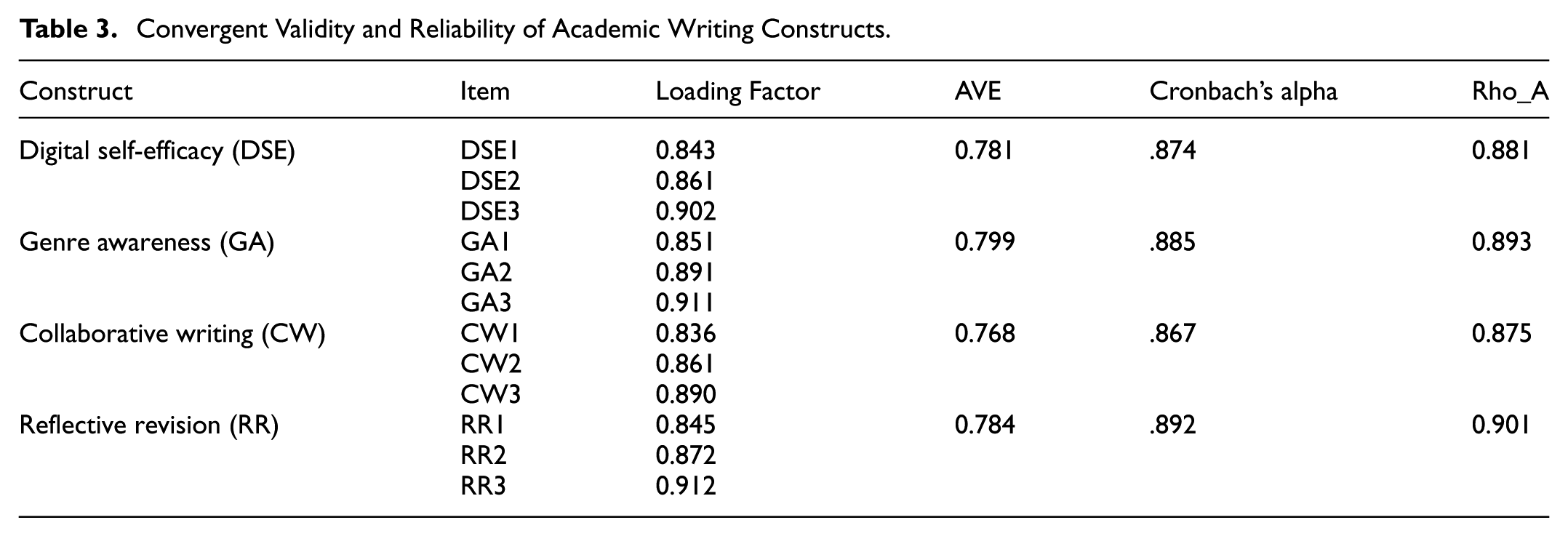
In the initial stage of analysis, validity and reliability tests were conducted to assess the adequacy of the proposed measurement model and its latent constructs. Figure 1 presents the fitted structural model of academic writing competence, illustrating the relationships between the four latent variables: Digital self-efficacy (DSE), genre awareness (GA), collaborative writing (CW), and reflective revision (RR). As shown in Figure 1 and Table 3, the loading factor values range from 0.843 to 0.902 for DSE, 0.851 to 0.911 for GA, 0.836 to 0.890 for CW, and 0.845 to 0.912 for RR. All item loadings exceed the 0.70 threshold, and the Average Variance Extracted (AVE) values are also above 0.50, confirming the model’s convergent validity (Hair et al., 2021). To establish discriminant validity, the Fornell–Larcker criterion was applied, as shown in Table 4.

Measurement model.
Convergent Validity and Reliability of Academic Writing Constructs.
Discriminant Validity (Cross-Loading and Fornell–Larcker Criteria).

As shown in Table 3, the square root of the AVE for each construct is greater than its correlations with other constructs, confirming that each latent variable is empirically distinct. In addition, the cross-loading analysis demonstrates that every indicator loads more strongly on its intended construct than on any alternative construct, thereby reinforcing the discriminant validity of the model. With respect to reliability, all constructs exhibit Cronbach’s alpha and rho_A values exceeding the threshold of .70, indicating strong internal consistency. Specifically, DSE (α = .874; ρ_A = .881), GA (α = 0.885; ρ_A = .893), CW (α = .867; ρ_A = .875), and RR (α = .892; ρ_A = .901) are all within the acceptable range. Collectively, these results provide robust evidence that the measurement model is both valid and reliable, thus serving as a solid foundation for subsequent structural analysis.
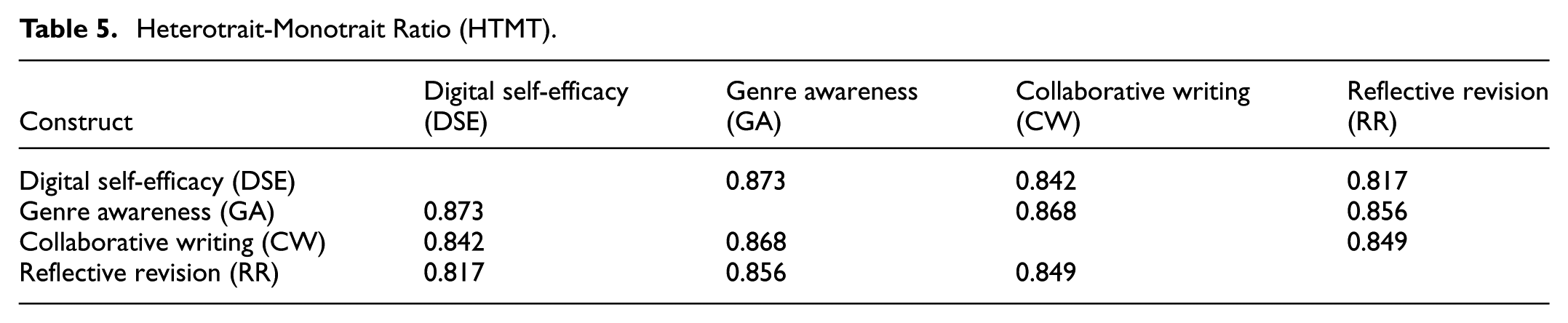
Table 4 shows the results of discriminant validity testing using cross-loadings and the Fornell–Larcker criterion. Each indicator loads higher on its intended construct, and the square roots of AVE exceed inter-construct correlations, confirming that DSE, GA, CW, and RR are empirically distinct. Furthermore, the results demonstrate that the HTMT values for all construct pairs are consistently below the 0.90 threshold, which confirms that discriminant validity is achieved. In other words, the constructs of DSE, GA, CW, and RR are empirically distinct, thereby strengthening the robustness of the measurement model (see Table 5).
Heterotrait-Monotrait Ratio (HTMT).
Structural Model
The structural model was estimated using SmartPLS 4.0, with the explained variance (R2) and effect sizes (f 2) detailed in Table 6. The results indicate that Digital Self-Efficacy (DSE) explains a modest portion of the variance in Genre Awareness (GA) (β = .041, t = 5.832, f 2 = .02), while DSE and GA together contribute to Collaborative Writing (CW) (β for DSE → CW = 0.018, t = 4.225, f 2 = .01; β for GA → CW = 0.033, t = 7.894, f 2 = .04). Additionally, CW substantially predicts Reflective Revision (RR) (β = .039, t = 6.183, f 2 = .05). Collectively, these results indicate that each construct meaningfully contributes to the subsequent stage of writing competence, highlighting the cognitive, social, and reflective dimensions of academic writing.
Structural Model: Hypothesis Testing Results.
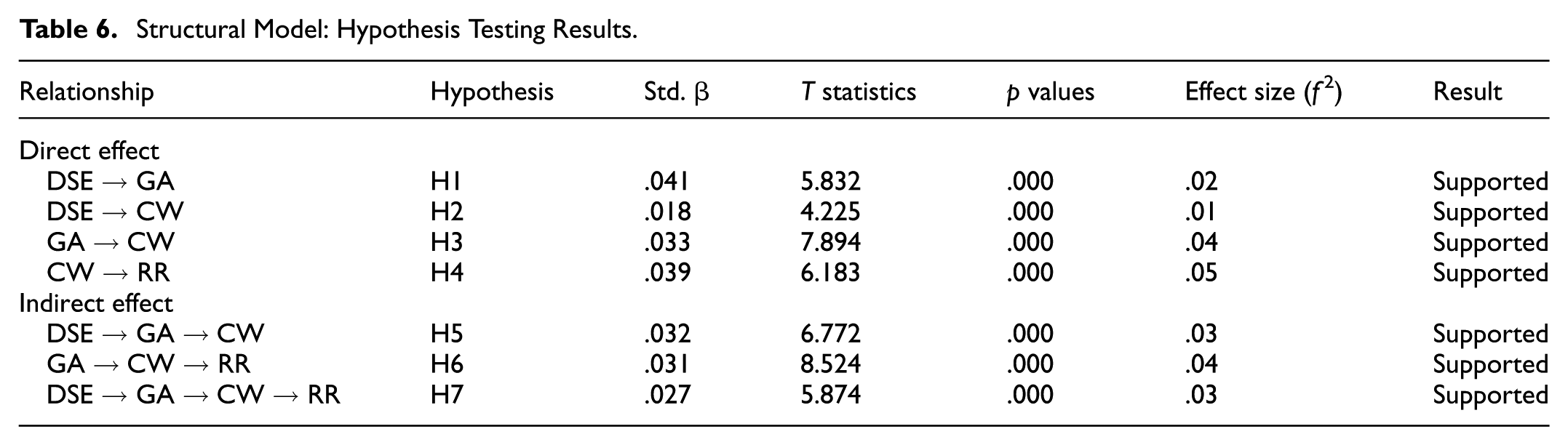
Hypothesis testing confirms that all direct paths are positive and statistically significant. Specifically, DSE significantly predicts GA (H1 supported), DSE significantly influences CW (H2 supported), GA significantly predicts CW (H3 supported), and CW significantly affects RR (H4 supported). Although the effect sizes range from small to moderate according to Cohen’s guidelines, each path demonstrates reliable predictive relationships.
The mediation analysis using bootstrapping further reveals that GA mediates the effect of DSE on CW (β = .032, t = 6.772, f 2 = .03; H5 supported), CW mediates the effect of GA on RR (β = .031, t = 8.524, f 2 = .04; H6 supported), and the sequential mediation from DSE to RR through GA and CW is significant (β = .027, t = 5.874, f 2 = .03; H7 supported). These findings collectively emphasize the sequential, mediated, and interconnected processes by which digital self-efficacy, genre awareness, and collaborative practices shape reflective revision in academic writing.
Discussion
Academic writing competence in the digital era cannot be understood solely as a set of technical skills. Rather, it emerges from the interplay among students’ digital literacy, understanding of genre conventions, collaborative abilities, and capacity for reflective revision. As writing increasingly takes place in multimodal, collaborative, and digitally mediated contexts, it is crucial to reconceptualize writing as a socially and technologically supported practice (Dahl et al., 2023; Fathi & Rahimi, 2022; D. Kim et al., 2021; Weber et al., 2025). This study examined writing competence through four interrelated constructs: Digital self-efficacy (DSE), genre awareness (GA), collaborative writing (CW), and reflective revision (RR). The structural model confirmed that these constructs are sequentially and significantly linked, forming a pathway from digital confidence to reflective revision. Collectively, the results indicate not only direct effects but also the mediating roles of GA and CW, revealing a layered and recursive process in which early digital self-efficacy catalyzes subsequent cognitive and collaborative engagement. These findings reinforce the view that writing competence develops through recursive processes and layers of support, both technological and interpersonal, aligning with pedagogical trends that prioritize integrated skills and process-oriented approaches over isolated skill acquisition (Dubek et al., 2024; Johnson & Bradley, 2024; Nasim et al., 2024; Rubin & Land, 2024; B. Zheng & Chen, 2025). Importantly, the findings suggest that digital self-efficacy acts as a gateway skill, amplifying the effects of genre awareness and collaboration on reflective outcomes, which may explain variations in student writing performance across digitally enriched environments.
The first key finding indicates a positive and significant relationship between DSE and GA (H1). Students with higher digital self-efficacy are better able to understand and apply genre conventions. Digital competence facilitates access to, organization of, and internalization of academic text models through digital resources such as writing aids and online databases (Liu et al., 2024; Maran et al., 2022; Sharma & Saini, 2022). This underscores the foundational role of digital confidence in shaping genre awareness and highlights that technological skills are deeply intertwined with cognitive processes involved in understanding rhetorical structures. Moreover, the strong link between DSE and GA suggests that digital literacies may reduce cognitive load during text analysis, allowing students to focus more on nuanced rhetorical and discourse features. This confirms that digital fluency serves as a foundational element for genre awareness and the modeling of effective academic discourse (Smith & Chipley, 2015). In practice, this finding emphasizes the need for pedagogical designs that explicitly integrate digital literacy training into genre-based writing instruction. Strengthening students’ self-efficacy in navigating digital tools can therefore enhance their engagement with complex academic texts. Ultimately, fostering digital self-efficacy not only supports genre awareness but also contributes to students’ overall academic writing development.
Second, DSE also exerts a significant positive effect on CW (H2). Students who are confident in digital environments participate more actively in co-writing, peer review, and shared editing. Tools like Google Docs and cloud-based platforms enable real-time collaboration, discussion, and joint decision-making, fostering engagement and contribution in group writing tasks (Alsahil, 2024; Blau et al., 2020; Gan et al., 2015; Hoang & Hoang, 2022; Lazou & Tsinakos, 2022). Importantly, the effect of DSE on CW is partially independent of GA, suggesting that digital self-efficacy directly motivates engagement and agency in collaborative contexts. This finding highlights the potential of digital tools to transform social learning environments, where confidence with technology can encourage participation even among students with initially lower genre awareness. Beyond reiterating statistical significance, this result invites a critical reflection on how technological confidence reshapes traditional peer dynamics and redistributes participation in group tasks. It also points to alternative interpretations, such as whether high DSE might sometimes mask surface-level engagement rather than guarantee deeper collaborative learning.
Third, GA significantly influences CW (H3). A solid understanding of rhetorical and structural conventions allows students to negotiate roles effectively, provide relevant feedback, and co-construct texts with confidence. This illustrates the mediating nature of GA in translating individual cognitive readiness into social collaboration (H5), highlighting that awareness of genre structures enhances students’ ability to coordinate, negotiate, and co-author meaning in group contexts. Additionally, the interaction between GA and CW may create a feedback loop where collaborative experiences further reinforce genre understanding, suggesting a mutually reinforcing dynamic that strengthens overall writing competence. This supports genre-based pedagogies that integrate both text production and collaborative negotiation in group settings (Cleeve Gerkens, 2024; Darvin, 2023; Hamman-Ortiz et al., 2023). As these studies collectively affirm, collaboration not only deepens students’ rhetorical awareness but also nurtures critical dialogue and shared responsibility in constructing meaning. At the same time, a more critical inquiry is required to explore how such collaborative dynamics unfold across varying disciplinary traditions and within the affordances and constraints of digital platforms.
Fourth, CW has a significant effect on RR (H4). Collaborative engagement promotes metacognitive development as students revise through peer feedback, discussion, and negotiation. Beyond individual reflection, CW allows multiple perspectives to converge, which enhances the depth of revision and supports iterative knowledge building. GA also indirectly strengthens RR via CW (H6), demonstrating that reflective revision is not an isolated activity but emerges from both genre understanding and active collaboration. Through these processes, students enhance coherence, clarity, and audience awareness (de Caux & Pretorius, 2024; J. Kim et al., 2025). Notably, the integration of collaboration with reflective practices may mitigate common revision pitfalls such as confirmation bias or tunnel vision, enabling richer, more critically evaluated drafts. This suggests that reflective revision should be framed not merely as a technical skill but as a socially mediated practice shaped by dialogue and collective inquiry. Consequently, embedding structured collaborative revision activities into writing pedagogy could provide a sustainable pathway for cultivating critical, self-regulated writers. As the next finding will illustrate, these collaborative and reflective dimensions also intersect with broader constructs of digital competence, signaling the need to view writing development through an integrative lens.
Finally, mediation analysis demonstrates that the effect of DSE on RR is fully mediated by GA and CW (H7), revealing a sequential developmental pathway: digital confidence fosters genre understanding, which facilitates collaborative engagement and ultimately reflective revision. This sequential mediation highlights the interconnectedness of cognitive, social, and reflective dimensions in academic writing. It also points to the practical implication that interventions targeting digital self-efficacy alone may be insufficient; optimal instructional design should scaffold students’ genre awareness and collaborative skills concurrently to maximize reflective outcomes. These findings underscore the value of instructional models that scaffold writing as a cumulative, interconnected process across multiple stages, emphasizing both technological proficiency and social interaction as essential components of academic writing competence. Overall, the results provide empirical support for a process-oriented and socially mediated model of digital-era academic writing, suggesting that educators should prioritize integrated skill development and collaborative opportunities to enhance both cognitive and metacognitive dimensions of student writing.
Despite the robust findings, several limitations should be acknowledged. First, the sample was drawn exclusively from Eastern and Central Indonesia, which may limit the generalizability of the results to students in other regions with different educational infrastructures, digital access, or cultural practices. Second, potential non-response bias could have influenced the findings, as students with lower digital self-efficacy or less experience in collaborative writing might have been less likely to participate, potentially inflating observed relationships. Third, the measurement instruments, although adapted from validated scales, involved translation and contextualization for the Indonesian setting, which could introduce subtle inconsistencies or interpretation differences among respondents. Finally, some unusually high t-statistics (exceeding 40) suggest the possibility of common method variance (CMV) arising from self-reported, cross-sectional data. While formal CMV diagnostics (e.g., Harman’s single-factor test, full collinearity VIF, or marker variable approach) were not conducted, it is important to acknowledge that CMV could partially inflate effect sizes and significance levels. Future research should address these limitations by including geographically diverse samples, implementing strategies to reduce non-response bias, further validating adapted instruments, and employing multi-method or longitudinal designs to mitigate CMV and strengthen causal inferences.
Conclusion
This study aimed to explore how digital self-efficacy, genre awareness, collaborative writing, and reflective revision contribute to the development of academic writing competence among university students. The results confirm that these constructs are interrelated and operate sequentially in shaping writing performance. Digital self-efficacy provides initial confidence to engage with digital tools and academic conventions. Genre awareness helps students organize ideas within structured rhetorical forms, which facilitates collaborative engagement. Through collaboration, students develop the capacity for reflection and revision. The structural model also reveals significant indirect pathways, showing that writing competence results from both cognitive and social processes. These findings emphasize the need for integrated instructional approaches that combine digital literacy, genre-based pedagogy, peer interaction, and reflective strategies. The model offers a holistic view of writing development and provides practical implications for instruction in digitally mediated higher education.
Footnotes

Funding
This research did not receive any specific grant from funding agencies in the public, commercial, or not-for-profit sectors.
Declaration of Conflicting Interests
The authors declared no potential conflicts of interest with respect to the research, authorship, and/or publication of this article.
Data Availability Statement
The data that support the findings of this study are available from the corresponding author upon reasonable request.