




Abstract
This study investigates the impact of integrating the Production-Oriented Approach (POA) with mobile learning on learning outcomes, motivation, and satisfaction in the EFL context. The rationale is to improve learning effectiveness by integrating the POA’s focus on real-world language use with the flexibility of mobile learning, addressing the latter’s limitation of lacking a structured approach to language output for practical skills development. Using a quasi-experimental design, 110 participants were divided into experimental and control groups based on their English proficiency. The experimental groups engaged in POA-based mobile learning, while the control groups used non-POA-based mobile learning methods. The results showed that POA-based mobile learning significantly improved learning outcomes, especially for students with higher English proficiency, and notably boosted motivation, particularly among lower proficiency learners. Furthermore, learner satisfaction was also significantly enhanced in the POA-based mobile learning groups. These findings suggest that combining the POA with mobile learning provides a promising approach to addressing challenges in EFL education by promoting language output and fostering increased motivation and satisfaction. Future research could explore the long-term effects of this integration across diverse educational contexts.
Plain language summary
This study explores how effective it is to combine the Production-Oriented Approach (POA) with mobile learning for students learning English as a Foreign Language (EFL). Conducted over 16 weeks, the study involved 110 students from 4 College English classes at a Chinese university. The study used two experiments and semi-structured interviews with both control and experimental groups. The findings were: 1. EFL students using POA-based mobile learning performed significantly better academically than those using non-POA-based mobile learning, especially those with higher English proficiency. 2. EFL students using POA-based mobile learning had much stronger learning motivation compared to those using non-POA-based mobile learning, particularly those with lower English proficiency. 3. EFL students were more satisfied with POA-based mobile learning than with non-POA-based mobile learning. These results suggest that POA-based mobile learning can improve EFL outcomes by encouraging active participation and practical use of the language.
Introduction
In recent years, growing researches focus on mobile learning, fueled by advancements in technology. Mobile technology has been recognized as a beneficial tool for learning, enabling learners to engage in short and manageable lessons in free time (Arvanitis & Krystalli, 2021). An increasing number of studies have explored mobile application-assisted learning (Crompton et al., 2017), with many reporting positive impacts on language acquisition (Read et al., 2021; Yu, 2015, 2020; Yu & Wang, 2016; Yu & Yi, 2020; Yu & Zhu, 2019; Zhonggen et al., 2019). However, the effectiveness of mobile learning can vary significantly depending on learning strategies, with noticeable variations in learning outcomes, motivation, and learner’s perception (Troussas et al., 2020; Tsai et al., 2017; Viberg et al., 2020; Yu et al., 2023). Students, particularly those with weak self-discipline, tend to engage with learning content superficially in personalized mobile language learning, and lack goal-setting and management, resulting in poor learning outcomes (Yu et al., 2022). These inconsistent findings suggest that greater attention should be given to the motivation and learning outcomes in mobile learning.
In the EFL context, one key factor contributing to poor motivation and learning outcomes is the disconnect between learning and practical language use. To bridge this gap, Wen (2015a) proposed the Production-Oriented Approach (POA), which emphasizes real-world application of language, helping learners transfer classroom knowledge into actual language use (Q. F. Wen, 2022). While POA has gained considerable attention in EFL teaching research in China, there is a notable lack of studies exploring its integration with mobile learning technologies.
This study attempts to combine mobile learning with POA to explore the potential benefits and innovations for learning outcomes and motivation. Mobile learning excels at providing flexible learning environments, yet often lacks a structured approach to language output training (Hockly, 2013). POA, on the other hand, emphasizes the combination of learning and practical use, filling this gap by promoting language production (Q. F. Wen, 2022). The integration of these two approaches leverages mobile learning’s flexibility and POA’s output-driven model, offering learners more opportunities to practice language in meaningful contexts. Such a combination represents not only an innovation in existing teaching models but also an essential response to the evolving landscape of educational technology. By combining mobile learning with POA, this study explores its effects on learning outcomes, motivation, and learner satisfaction, which are key indicators of success for any learning approach. It aims to provide more effective learning strategies for English learners while providing data-driven insights for educators and curriculum designers. Furthermore, the issue of “learning without application,” which hinders language proficiency in China and other non-English-speaking countries, remains a global challenge. Although this research is grounded in Chinese educational context, its findings hold broader relevance, offering significance for English learning in other non-English-speaking regions.
Literature Review
Mobile Learning
Mobile learning refers to the use of portable devices, such as smartphones and tablets, to access educational content, allowing learning to occur anytime, and anywhere (Traxler, 2005, 2009). Traxler was among the first to conceptualize mobile learning, emphasizing its flexibility and potential for location-independent education. Over time, the concept has evolved to include not only the mobility of devices but also the mobility of learners and learning processes, reflecting a broader understanding of how learning can adapt to various contexts (Kukulska-Hulme et al., 2015). Current definitions of mobile learning extend beyond content delivery to support personalized, collaborative, and adaptive learning approaches (Ally & Prieto-Blázquez, 2014). This flexibility has made mobile learning particularly useful in language education, where Mobile-Assisted Language Learning (MALL) facilitates language acquisition through personalized and flexible learning experiences. Despite these advantages, challenges persist. Mobile learning often lacks structured methods for promoting language production, which is critical for skill development (Kukulska-Hulme et al., 2015). Additionally, the proliferation of mobile applications introduces risks such as exposure to inaccurate or irrelevant information, which may hinder learning (Wall et al., 2017). Therefore, effective integration of mobile learning into curricula requires careful pedagogical design, ensuring that learning is both flexible and aligned with learners’ needs in terms of time, space, and motivation (Ishaq et al., 2019).
The Effect of Mobile Learning on Learning Outcomes, Motivation, and Satisfaction
Mobile learning has proven effective in enhancing learning outcomes by providing flexible, accessible, and personalized learning opportunities. Studies show that mobile learning facilitates improved academic performance and language acquisition by allowing learners to engage with content at their own pace and on their own schedule (Ally & Prieto-Blázquez, 2014; Stockwell, 2010). This flexibility supports better retention and comprehension through repeated access to materials and timely feedback (Crompton et al., 2017). However, the effectiveness of mobile learning can differ greatly based on the learning strategies employed, leading to significant differences in learning outcomes (Viberg et al., 2020).
Mobile learning also plays a significant role in boosting learning motivation. By offering autonomy and control over the learning process, it fosters intrinsic motivation, encouraging students to engage more actively with their studies (Kukulska-Hulme et al., 2015). Interactive features, multimedia elements, and real-time feedback enhance learner engagement, making the experience more dynamic and enjoyable. As a result, learners who are motivated by the convenience and autonomy of mobile learning tend to demonstrate greater persistence and commitment to their learning (Yu, 2019).
For evaluating a learning approach, learner satisfaction is another critical aspect influenced by mobile learning. Interactive tools such as quizzes, immediate feedback, and collaborative options contribute positively to the learning experience (Viberg & Grönlund, 2013). However, learners with low self-discipline may find it difficult to stay focused, leading to frustration and dissatisfaction (Yu et al., 2022). Additionally, an excess of poorly organized or irrelevant content can result in dissatisfaction (Hockly, 2013). To address these challenges, mobile learning systems need structured learning approach and clear goals to ensure sustained engagement and satisfaction.
While mobile learning has been praised for its flexibility and accessibility, it often lacks structured guidance for language output, particularly in EFL contexts, where the gap between language input, and language output remains a significant challenge.
Production-Oriented Approach
The Production-Oriented Approach (POA), proposed in 2015, reinterprets Second Language Acquisition (SLA) theories to suit the socio-cultural and historical context of English teaching in EFL settings in China, deriving principles from the communicative approach (Q. F. Wen, 2015b). This strategy, a pivot from traditional grammar-based methods, stresses communication, and interaction as core to language acquisition (Q. F. Wen, 2019). The POA enhances practical language skills via experiential, project-based learning, integrating theories like the output hypothesis (Swain, 1985), the input hypothesis (Krashen, 1985), and the interaction hypothesis (Long, 1983). It redefines traditional views of input and output in language learning, suggesting output as a catalyst for effective teaching and assimilation of new information (Q. F. Wen, 2015a). The approach also contests the text-focused Intensive Reading Approach (IRA), advocating for an interactive teaching model that utilizes teacher mediation (Q. F. Wen, 2015b; Wen, 2016). Influenced by sociocultural theory, the POA asserts that expert guidance can expand an individual’s capabilities, facilitating the development of new skills (Eun, 2019). The theoretical foundation of the POA (Figure 1) is delineated through four hypotheses: output-driven, input-enabled, selective learning, and collaborative assessment (Q. F. Wen, 2018).
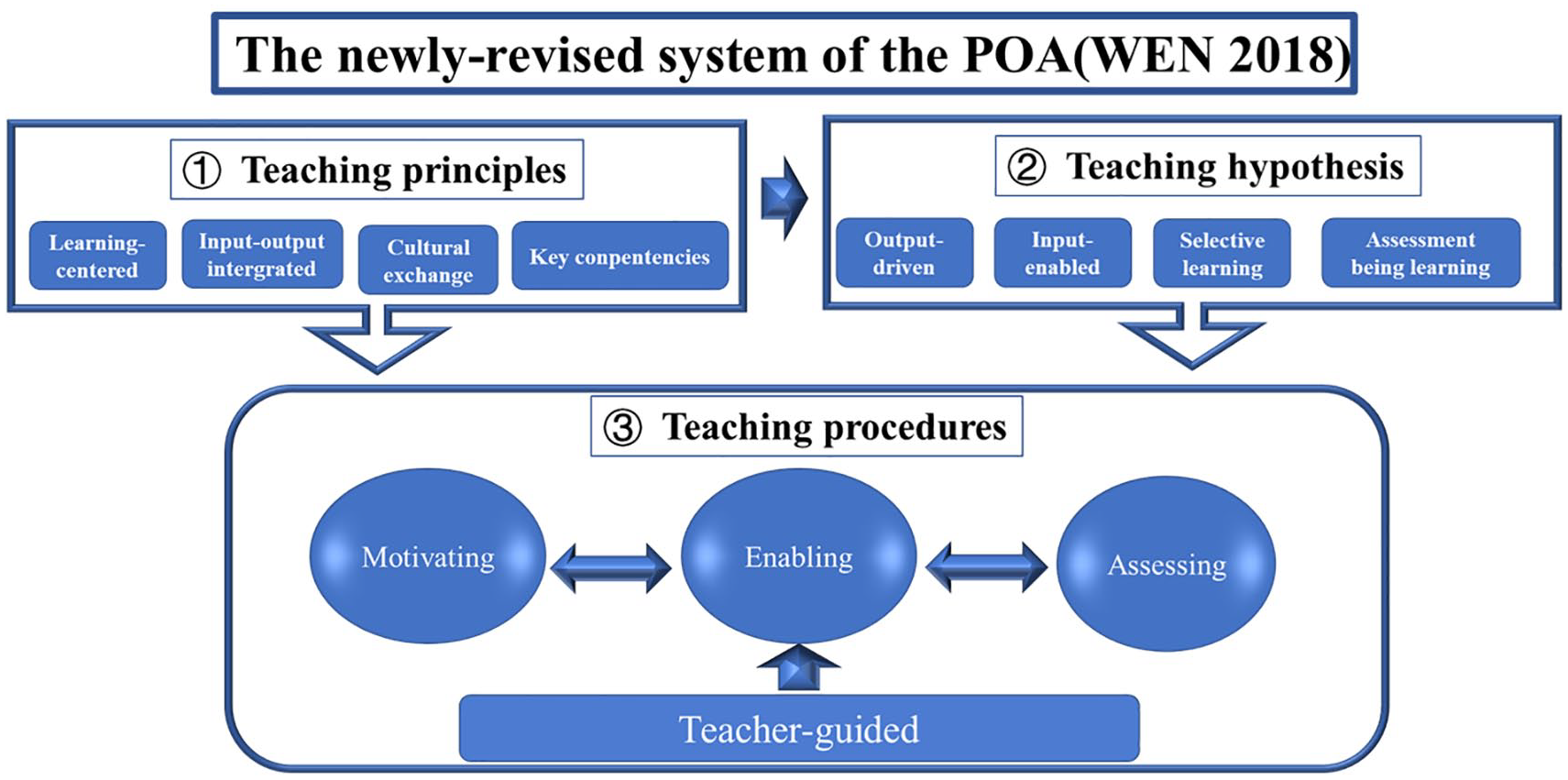
The theoretical framework of POA.
Within the framework of the POA for foreign language learning, learners actively engage with the target language through communicative scenarios. This method prioritizes experiential learning, urging learners to utilize their linguistic knowledge in real-life contexts. Research conducted in China has substantiated the effectiveness of the POA in enhancing the language production skills of EFL students (Deng, 2018; Duan, 2021; Fan, 2019; Peng, 2019; Y. J. Xie, 2017; Zhang, 2018). Furthermore, the application of the POA has expanded globally, adapting to diverse cultural environments such as in reading-to-write classes in Korea (Yin, 2019) and in international pre-service teacher training programs (Polio, 2017). These studies indicate that the POA, while originating in China, has gained acceptance, and has been successfully implemented across various cultural settings. Nevertheless, some researchers have identified challenges associated with the POA in foreign language instruction. Notable concerns include its scalability in large classroom settings and resource limitations (Bransford et al., 2000). Accordingly, to mitigate the challenges associated with the effectiveness of the POA in large classroom settings, it is interesting and valuable to study the effects of POA-based mobile learning in EFL context.
The Effect of the POA on Learning Outcomes, Motivation and Satisfaction
The POA’s focus on productive tasks helps learners transfer their theoretical knowledge into practical language use. Studies show that the POA can significantly enhance learners’ language proficiency by encouraging active language output (Q. F. Wen, 2022), especially for students with higher English proficiency (Q. Xie, 2021). By engaging students in real-world communicative activities, the POA fosters deeper understanding and retention of language structures, leading to improved academic performance.
The POA has been shown to have a positive effect on learner motivation. By emphasizing meaningful, outcome-oriented tasks, the approach makes learning more relevant and engaging for students. Learners become more motivated when they see direct applications of their language skills in communicative contexts (Li et al., 2021). The focus on real-life language use also helps to bridge the gap between classroom learning and practical application, which can reduce learner frustration and increase intrinsic motivation.
Learner satisfaction is also enhanced through the POA’s emphasis on task completion and real-world language application. Students report higher satisfaction when they feel that the learning process is purposeful and that they are making tangible progress in their language skills (Zhao & Li, 2021). The sense of achievement that comes from successfully using the language in practical tasks contributes to a more fulfilling and satisfying learning experience.
However, despite these benefits, the application of the POA in digital or mobile learning environments remains underexplored. Most existing studies focus on the POA in traditional classroom settings, where face-to-face interaction plays a key role in task completion. Therefore, integrating the POA with mobile learning represents a promising new direction for research, particularly in exploring how mobile technology can support the productive tasks central to the POA.
Research Questions
Evidently, while the POA has demonstrated considerable promise in enhancing language learning outcomes and motivation, its implementation in large classroom settings presents notable challenges. On the other hand, while mobile learning offers flexibility and engagement, it often lacks structured guidance and a focus on language output. Accordingly, combining the POA with mobile learning may potentially make up for each other. Therefore, this study is to systematically investigate how POA-based Mobile Learning impacts EFL learning in three dimensions: learning outcomes, motivation, and learner satisfaction.
The study focuses on addressing the following pivotal questions:
(1) Are learning outcomes in POA-based mobile learning significantly better than in non-POA-based mobile learning?
(2) Is the motivation in POA-based mobile learning significantly stronger than in non-POA-based mobile learning?
(3) Is the satisfaction in POA-based mobile learning significantly higher than in non-POA-based mobile learning?
(4) Is POA-based mobile learning more effective for students with high English proficiency than for students with low English proficiency?
Methodology
Research Method
This study adopted a quasi-experimental research method and carried out a mixed research method by integrating quantitative and qualitative data. The research procedure consisted of two experiments followed by semi-structured interviews (Figure 2).
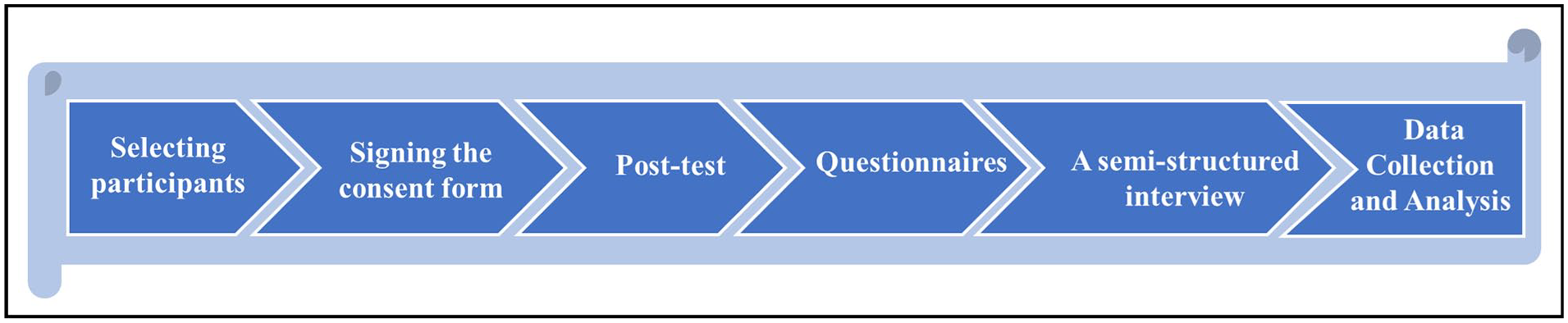
Research procedure.
Participants
Data in the study were collected from a Chinese university with a non-English-major freshman cohort (N = 2,460). The study was advertised to these non-English-major freshman via the internet. The resulting participants randomly selected comprised a total of 110 students. In view of previous studies reporting POA more effective for students with higher English proficiency (Q. Xie, 2021), this study divided the participants into two categories based on English proficiency to explore whether POA-based mobile learning has different effects on learners with different English proficiency. By purposeful criterion sampling (Sandelowski, 2000), students are divided into 2 control group classes and 2 experimental group classes based on GAOKAO (National College Entrance Examination in China) English subject scores. Students in experiment group 1 (N = 25) and control group 1 (N = 25) scored over 120 (out of 150), and Students in experimental group 2 (N = 30) and control group 2 (N = 30) scored between 90 and 120 (out of 150). Meanwhile, to control the variables, the English courses of the four participant groups are taught by the same teacher. The College English classes were conducted twice a week for 90 min each, spanning 4 semesters of 16 weeks each. In addition to participating in identical in-class activities, all participants dedicated 1 hr daily to mobile English learning. Those in Experimental Groups 1 and 2 engaged in POA-based mobile learning activities (see Supplemental Tables S1 and S2), whereas those in Control Groups 1 and 2 used non-POA-based mobile learning, relying on traditional methods such as watching micro-lectures, reading articles, and listening to materials. Unlike the structured, output-driven POA approach, the control groups’ activities were self-regulated by students, with content chosen independently to reflect real-world mobile learning scenarios. While this non-standardized design risked introducing uncontrolled variables, we provided a list of recommended CET-4 related resources to guide content selection; nonetheless, variations in engagement and performance remained, with their potential impacts assessed through statistical adjustments in the data analysis. In the first experiment, both control groups and experimental groups undertook post-tests during the final week of the semester. The second experiment involved all the participant groups completing post-questionnaires at the end of the semester, including scales for assessing motivation and satisfaction levels. Subsequent to the experiments, 14 participants in experimental groups were randomly selected for interviews. The interview questions were adapted from scales measuring motivation and satisfaction in POA-based mobile English learning.
This study minimized participant risk by embedding the educational intervention within regular English coursework, ensuring no additional burden beyond standard academic requirements. Participants’ privacy was protected through data anonymization, with no sensitive personal information collected. The potential benefits of enhancing English proficiency, motivation, and satisfaction through an innovative pedagogical approach were deemed to outweigh minimal risks such as time commitment, aligning with educational goals and societal needs for effective language learning. Written informed consent was obtained from all 110 participants prior to enrollment, following a briefing on the study’s purpose, procedures, voluntary nature, and right to withdraw without penalty.
Instruments
A Scale of Learning Outcomes
Learning outcomes in this study are defined as English proficiency acquired after one semester English learning. A simulated CET-4 as a post-test was adopted to measure learners’ English proficiency. The CET-4 is a criterion-referenced exam designed to assess the English proficiency of non-English major college students in China, equivalent to B2 in CEFR (Jin et al., 2022). CET-4 includes written test and oral test. The written test has a full score of 750, listening 30%, reading 40%, translation 15%, writing 15%. The oral test has a full score of 200. The post-tests were conducted via an online platform with a blinded marking system, where a randomly assigned rater evaluated all subjective questions.
A Scale of Motivation Level
The learning motivation level was identified based on L2 Motivational Self System. It is a prominent theoretical framework in the field of second language acquisition (SLA), particularly focusing on the role of motivation in language learning, which Introduced by Dörnyei in the early 2000s. The L2 Motivational Self System is based on three main components: The Ideal L2 Self; The Ought-to L2 Self; The Ought-to L2 Self. The learning motivation scale used in this study consisted of 12 items measured on a 5-point Likert scale, ranging from strongly disagree, disagree, neutral, agree, to strongly agree (Supplemental Appendix 1). Participants received 1 point for strongly disagree, 2 points for disagree, 3 points for neutral, 4 points for agree, and 5 points for strongly agree. The scale’s reliability had a Cronbach’s alpha of .83.
A Scale of Satisfaction Level
The level of learner satisfaction was determined based on OLLES - Online Learning Environment Survey, which was developed by Walker and Fraser in (2005). It was designed to assess students’ perceptions and satisfaction with online learning environments, particularly in the context of distance education and web-based courses. The survey encompasses various factors such as course design, interaction, technical support, and accessibility of resources, all crucial for the online learning experience and outcomes. The learner satisfaction scale used in this study consisted of 15 items measured on a 5-point Likert scale, ranging from strongly disagree, disagree, neutral, agree, to strongly agree (Supplemental Appendix 2). The scale’s reliability had a Cronbach’s alpha of .84.
Semi-Structured Interview
The semi-structured interview consists of three sections and lasts approximately 30 min. The first section gathers demographic information such as gender, age, and English proficiency. The second section, which forms the core of the interview, collects data on motivation, and satisfaction levels based on questions from the questionnaires. In order to avoid the deviation of interview data due to the English language level of the interviewees, Chinese was adopted as the interview language. The final section is dedicated to expressing gratitude to the interviewees.
Data Analysis
In the first experiment, comparisons of the data sets of post-test scores among different participant groups were performed to study the learning outcomes of EFL learners in the POA-based Mobile Learning. Three-sigma outlier judgment standard was used for data clearing to ensure the stability and accuracy of the analysis results, and a total of 110 samples were processed. To assess the potential impact of control group variability, we examined descriptive statistics of performance variability as a proxy for engagement levels and applied Dunnett T3 tests, which adjust for unequal variances that may arise from differing content selections. In the second experiment, 110 survey copies were distributed; 2 questionnaires were discarded because respondents provided incomplete survey information. One hundred and eight effective samples of the questionnaire were completed and returned, with a survey return rate of 98.1%. All the analysis of variance (ANOVA) and Dunnett T3 test were conducted by using SPSS 25. In the Semi-Structured Interview, we transcribed the interviews and used pseudonyms for anonymity. The coding process followed a systematic approach, starting with open coding to identify initial themes, and then grouping them by category through axial coding. Thematic quantitative content analysis (adapted from Cohen et al., 2011) were performed on semi-structured interview data using NVIVO 12. Additionally, triangulation was employed to cross-verify the interview findings with the questionnaire results, ensuring the accuracy of the data.
Results
Learning Outcomes
An initial examination of descriptive statistics revealed variability in control group performance, with standard deviations ranging from 5.05 to 9.87 reflecting differences in self-regulated content selection, which was accounted for using Dunnett T3 tests. To address the first research question, the Analysis of Variance (ANOVA) was used to compare the performance of experimental and control groups, to assessing the impact of POA-based mobile learning on learning outcomes, as shown in Table 1.
Results of ANOVA for English Learning Performance.

p < .05.
For students with good English proficiency (Group 1), experimental group significantly outperformed Control Group in writing (average score 86.0 vs. 75.0, F = 23.65, p < .01) and translation (average score 80.0 vs. 68.0, F = 35.36, p < .01). A significant improvement was also noted in speaking (average score 76.9 vs. 72.3, F = 12.10, p < .01), listening skills (average score 78.0 vs. 72.0, F = 6.05, p = .01), but not in reading skills. For students with weaker English proficiency(Group 2), experimental group improvements were observed in speaking (average score 72.7 vs. 690.8, F = 4.04, p < .05), writing (average score 70.0 vs. 64.0, F = 6.74, p < .05), and translation (average score 67.0 vs. 60.0, F = 9.88, p < .05), with no significant differences in listening and reading. These findings indicate that POA-based mobile learning has a positive impact on improving EFL learners’ learning outcomes, especially for learners with higher English proficiency.
Learning Motivation
As shown in Table 2, significant findings were observed when comparing the effects of POA-based mobile learning with non-POA-based approaches. For learners in Experimental Group 1 and Control Group 1, which comprises students with higher English proficiency, a significant variance was observed solely in the dimension of “learning experience” (F = 10.31, p = .00, with an effect size of η2 = 0.17). This indicates that, in contrast to non-POA-based mobile learning, POA-based mobile learning substantially enhances the EFL learning experience. However, no significant differences were found in the dimensions of “Ideal L2 Self” (F = 0.31, p = .58), “Ought-to L2 Self” (F = 0.15, p = .69), and “Motivation and Intention” (F = 0.04, p = .82) between these two groups, indicating that the experimental intervention did not markedly affect these aspects. For students with a weaker English proficiency (Experimental Group 2 and Control Group 2), there were significant differences in both “learning experience” (F = 5.65, p = .02) and “motivation and intention” (F = 4.63, p = .03), with effect sizesη2of 0.08 and 0.07, respectively. Thus, the result demonstrates that POA-based learning improves the learning motivation, especially for lower English proficiency.
Results of ANOVA for English Learning Motivation.

p < .05.
Learner Satisfaction
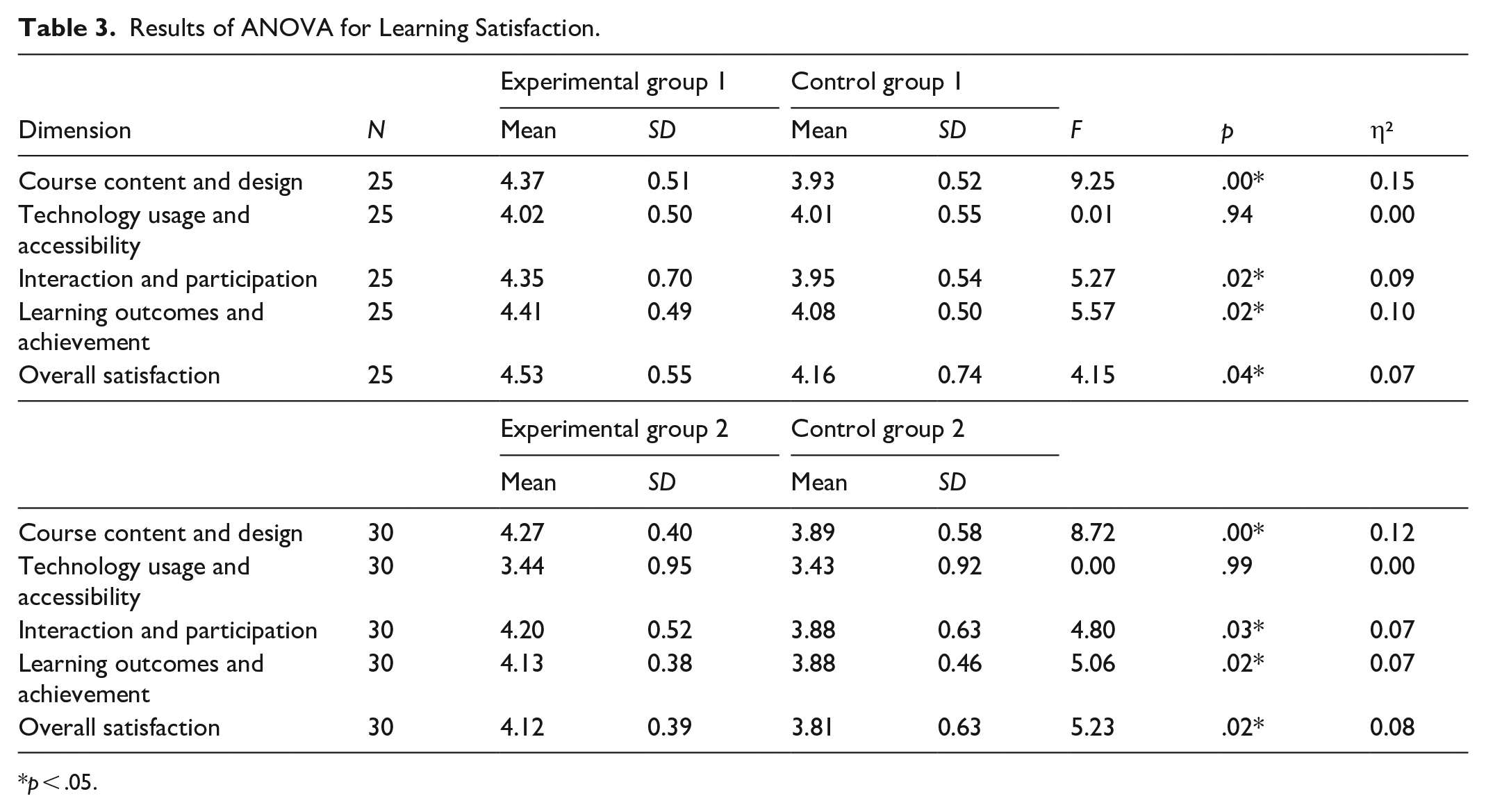
Data results of learner satisfaction are shown in Table 3. Experimental Group 1 significantly surpassed Control Group 1 in course content and design (F = 9.25, p < .01), interaction and participation (F = 5.27, p = .02), and learning outcomes and achievement (F = 5.57, p = .02). Similarly, Experimental Group 2 also outperformed Control Group 2, scoring higher in course content and design (F = 8.72, p < .01), interaction and participation (F = 8.72, p < .01), and learning outcomes and achievement (F = 5.06, p = .02). However, there were no significant differences in technology usage and accessibility between the experimental and control groups. Students’ perceptions of technology usage and accessibility during mobile learning show no significant differences despite using the POA.
Results of ANOVA for Learning Satisfaction.
p < .05.
These results indicate that POA-based mobile learning positively affects learner satisfaction for learners of different English levels, as compared to non-POA-based mobile learning.
Semi-Structured Interview
Table 4 displays the results of the content analysis performed on the participants’ semi-structured interview transcripts. The findings are organized into eight main themes, each encompassing several positive, neutral, and negative sub-categories. These results offer a concise overview of the semi-structured interview outcomes. The higher frequency of positive sub-categories indicates that participants generally had a favorable attitude toward the quests.
Summary of Interview Responses.
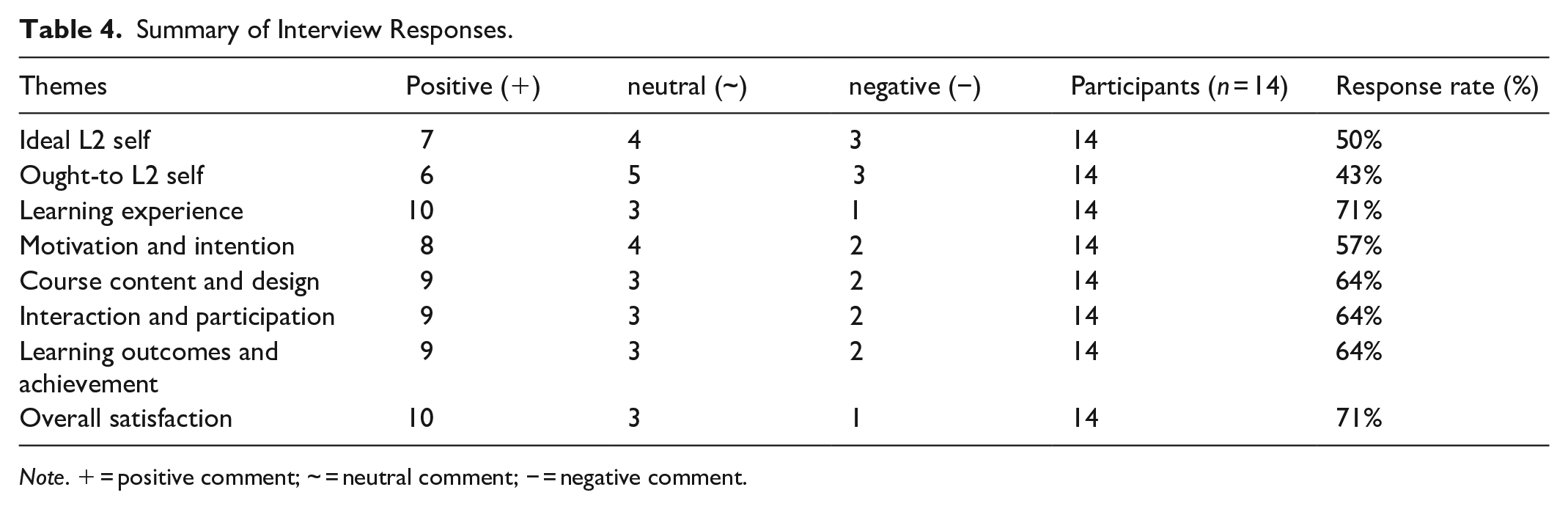
Note. + = positive comment; ~ = neutral comment; − = negative comment.
Discussion
Rationales for Improving Learning Outcomes
Previous studies are generally in favor of the findings in this study. The integration of the POA with mobile learning technologies significantly enhances learning outcomes, particularly among learners with higher English proficiency. This improvement can be attributed to the POA’s emphasis on productive tasks that actively engage students in the learning process. By encouraging real-world language use, the POA fosters deeper understanding and retention of language structures, resulting in improved learning outcomes. This finding is consistent with prior research that highlights how output-driven tasks, such as those in experiential learning models, enhance student engagement, and lead to better learning outcomes (Duan, 2021; Zhang, 2018). Coincide with what was said in the interviews (interviewee 3 and 9), mobile learning platforms provide flexible environments where students can practice language use in varied contexts, reinforcing learning through repetition and practical application, which aligns with the principles of the POA.
This study shows POA-based mobile learning is more effective for students with higher English proficiency on learning outcomes, consistent with the perspective of Q. Xie (2021). This aligns with Swain’s Output Hypothesis (1985), producing language encourages learners to process input more deeply, which leads to greater language proficiency. Learners with higher proficiency are more likely to benefit from this output-driven process because they already possess a broad base of input knowledge to draw upon when completing tasks. Their stronger grasp of grammar, vocabulary, and syntactic structures enables them to engage in more complex, authentic language use, which further strengthens their language abilities. Nevertheless, given that these outcomes were observed within a single semester, their long-term sustainability requires further investigation.
Rationales for Improving Learning Motivation
Motivation plays a crucial role in effective language learning, and this study demonstrates that POA-based mobile learning significantly enhances motivation. The focus on real-world communicative tasks helps students see the direct application of their learning, which increases intrinsic motivation, consistent with previous studies that emphasize the importance of making learning relevant, and purposeful to boost learner engagement (Li et al., 2021). In the semi-structured interview, for example, Interviewee 4 explained, During a recent writing assignment on the complex topic of “Climate Change and Its Impact on Global Food Security,” I was able to explore the interconnections between environmental, economic, and political factors, which deepened my understanding and made the learning process much more enjoyable and meaningful. When learners feel that their language skills can be applied practically and that they are making meaningful progress, they are more motivated to persist in their studies. Furthermore, the flexibility offered by mobile learning allows students to manage their learning schedules, which promotes autonomy—a key factor in fostering motivation (Kukulska-Hulme et al., 2015). Interviewee 8 mentioned, Organizing my study schedule reduces a lot of pressure, making me more motivated to learn. Being able to access materials anytime keeps me on track and gives me a sense of control over my learning, rather than being bound by external schedules.
POA-based mobile learning is particularly effective in improving motivation for learners with lower English proficiency because it provides practical tasks that make learning more relevant and engaging. Lower-proficiency learners often struggle with abstract language concepts in traditional settings. POA’s focus on real-world, communicative tasks makes language learning more tangible and directly applicable (Q. F. Wen, 2022). The task-based structure offers clear, manageable goals, building confidence as learners experience incremental success. According to Dörnyei’s L2 Motivational Self System, this sense of progress enhances learners’ vision of their ideal L2 self. Additionally, the flexibility and autonomy of mobile learning allow lower proficiency learners to revisit materials and practice at their own pace, reducing the anxiety associated with making mistakes in traditional classrooms (Kukulska-Hulme et al., 2015). Coincide with what was mentioned in the interviews (Interviewee 5, 7, 12), this supportive, low-pressure environment further encourages learners to take risks and engage more deeply, boosting their motivation. However, as these gains were observed over one semester, their long-term persistence remains uncertain.
Rationales for Improving Learner Satisfaction
POA-based mobile learning enhances learner satisfaction by providing autonomy, clear progress, and practical relevance. According to Self-Determination Theory (Deci & Ryan, 1985), satisfaction increases when learners feel autonomous and competent. POA’s structured, task-based approach offers clear goals and immediate feedback, fostering a sense of achievement, while mobile learning’s flexibility allows learners to control their pace and environment. For example, Interviewee 6 mentioned, In a recent writing task on environmental issues, I was able to break the assignment into smaller sections. After each section, I got quick feedback, which helped me correct errors right away. By the time I finished the entire assignment, I could clearly see how much my writing had improved, and this step-by-step progress made me feel a real sense of accomplishment. This combination of autonomy and competence, along with the real-world application of language tasks, makes learning more relevant, and purposeful. Interviewee 9 supported this, saying, The fact that the tasks were connected to real-world situations, like drafting a report on climate change, made me feel like what I was learning could actually be useful in my future career, which made the process much more rewarding. These factors collectively boost satisfaction, as learners not only feel capable but also see the value in what they are learning. Given that these findings reflect a single semester, however, their sustained impact merits further exploration.
Limitation and Challenge
Despite the valuable and insightful findings of this study, several inherent limitations must be acknowledged. The control groups’ self-regulated mobile learning varied in intensity, content quality, and engagement. Though intended to reflect real-world learning, this variability may confound results, potentially exaggerating gains in writing, and speaking, obscuring whether improvements stem fully from POA. Future studies could standardize content, such as CET-4 writing tasks, or use propensity score matching to clarify POA’s contribution.
The single-semester duration limits insight into long-term effects of POA-based mobile learning. Gains in motivation and speaking may reflect a novelty effect (Ames, 1992), potentially weakening over time without sustained practice, thus tempering claims of enduring impact. Future research could use multi-semester longitudinal designs to track motivation, speaking fluency, and skill retention, integrating AI tools for real-time monitoring and modeling sustained EFL learning trajectories.
Mobile learning’s flexibility, while a strength, risks superficial engagement for less disciplined students and poses technical challenges. In resource-limited settings, inconsistent device access and connectivity disrupt POA tasks like real-time oral practice, potentially impairing speaking gains and reducing efficacy. Future research could explore AI-driven platforms with offline modes and real-time feedback to enhance delivery consistency across diverse technological contexts.
The sample, limited to 110 non-English-major freshmen from one Chinese university, restricts generalizability. Cultural and educational factors may amplify motivation gains here, potentially misaligning with younger or non-Chinese EFL learners favoring communicative tasks. Cross-cultural studies comparing diverse learners, such as rural versus urban or secondary versus tertiary, could quantify contextual effects and adapt POA tasks using learner analytics.
Conclusion
This study investigated the impact of integrating the POA with mobile learning on learning outcomes, motivation, and satisfaction in an EFL context. The results show that combining the POA’s emphasis on productive language use with the flexibility of mobile learning can significantly enhance learning outcomes, especially in writing, translation, and speaking, for learners with higher English proficiency. In terms of motivation, POA-based mobile learning proved more effective than non-POA-based mobile learning, especially for lower-proficiency learners, offering practical, real-world tasks that make learning more engaging and relevant. The autonomy provided by mobile learning, coupled with structured POA tasks, boosted learners’ confidence, and motivation, especially for those who struggle with traditional classroom methods. Learner satisfaction also improved, with students reporting greater fulfillment due to the clear goals and real-world application of their learning. The structured feedback from the POA combined with the flexibility of mobile learning created a more satisfying learning experience.
However, although POA-based mobile learning significantly improved learning outcomes, motivation, and satisfaction in the short term, its long-term effects and applicability in different educational contexts still require further exploration. The limitations include the study’s short duration and its focus on a single educational context, suggesting the need for further research into long-term impacts and the scalability of this approach. Future studies could explore adaptive technologies to provide personalized feedback and support across varied EFL learner profiles.
In conclusion, POA-based mobile learning offers a promising approach to enhancing EFL learning outcomes, motivation, and satisfaction, providing valuable insights for educators aiming to optimize language teaching in a digital age.
Supplemental Material
sj-docx-1-sgo-10.1177_21582440251357355 – Supplemental material for Effects of the Production-Oriented Approach-Based Mobile Learning on Learning Outcomes, Motivation, and Satisfaction in EFL Context
Supplemental material, sj-docx-1-sgo-10.1177_21582440251357355 for Effects of the Production-Oriented Approach-Based Mobile Learning on Learning Outcomes, Motivation, and Satisfaction in EFL Context by Xi Wang, Jiang Jing and Yuedong Zhang in SAGE Open
Footnotes

Ethics Considerations
This study was approved by the Foreign Languages Research Ethics Review Committee of Chengdu Technological University (No. 230903) on Sep 3rd, 2023.
Informed Consent
All participants provided written informed consent prior to enrollment in the study. The research was conducted following the Declaration of Helsinki’s appropriate rules and regulations that apply when involving human participants.
Funding
The author(s) disclosed receipt of the following financial support for the research, authorship, and/or publication of this article: This study was supported by Sichuan Education and Scientific Research Grant Project (Grant No. JG2021-1412), Sichuan Foreign Language and Literature Research Center Support Program (Grant No. SCWYH22-26), and Sichuan Province Science and Technology Support Program (Grant No. 2021YFN0130), China.
Declaration of Conflicting Interests
The author(s) declared no potential conflicts of interest with respect to the research, authorship, and/or publication of this article.
Data Availability Statement
The datasets analyzed are available upon reasonable request.
Supplemental Material
Supplemental material for this article is available online.
References
Supplementary Material
Please find the following supplemental material available below.
For Open Access articles published under a Creative Commons License, all supplemental material carries the same license as the article it is associated with.
For non-Open Access articles published, all supplemental material carries a non-exclusive license, and permission requests for re-use of supplemental material or any part of supplemental material shall be sent directly to the copyright owner as specified in the copyright notice associated with the article.
