




Abstract
E-commerce, one of the most important methods in modern business, has improved organizational efficiency and contributed to countries’ economic growth by fostering customer satisfaction and trust. The purpose of the study is to examine the relationships among these variables (payment security, information quality, website Usability, e-trust, and perceived-to-actual performance) and consumer satisfaction in the online shopping context. Primary data were collected from 245 respondents via a quantitative survey, and the analysis was conducted using Smart PLS 4 and IBM SPSS 27, employing structural equation modeling. The findings show that payment security, information quality, and perceived actual performance contribute to e-commerce satisfaction, while website usability enhances perceived performance, which does not directly improve satisfaction. E-trust directly impacted satisfaction, but it did not moderate the relationship between payment security and customer satisfaction. The research is also crucial for aligning customer expectations with the e-commerce site’s actual performance. The integrated models, including the DeLone & McLean IS Success Model and Expectation Confirmation Theory, offer promise for an improved understanding of e-commerce satisfaction, reflecting conceptual value through their merger. E-commerce platforms in emerging markets like Bangladesh should improve website usability, payment security, and information quality to build trust and enhance customer satisfaction. Applying insights from the literature and study findings can help them refine user experience across demographics and strengthen customer loyalty.
Keywords
Introduction
Over the past decade, e-commerce has experienced unprecedented growth, becoming a cornerstone of the global economy (Wang et al., 2024). In 2025, worldwide e-commerce retail sales are projected to reach approximately $6.42 trillion, marking a 6.9% increase from 2024 and accounting for about 20.5% of total global retail sales (Statistics, 2025). This expansion is driven by increased internet penetration, the proliferation of mobile commerce, and the growing adoption of digital payment technologies. More than 2.77 billion people are expected to shop online in 2025, reflecting the integration of e-commerce into everyday life worldwide (Shopify, 2025).
Kulkarni and Fadewar (2017) highlight the significance of the Internet and web development as key information and communication technologies. By 2021, 4.66 billion people, 92.6% via mobile devices, accessed the Internet, driving substantial growth in e-commerce globally and locally (Langdale, 2019). However, B2C e-commerce is rapidly evolving, and e-retailers are facing challenges in maintaining customer loyalty. Research highlights the importance of drivers like e-customer satisfaction and e-trust, examining whether website usability, information quality, and payment security concerns predict trust and satisfaction in B2C e-commerce (Gevers et al., 2024). Anggraini and Sari (2024) defined e-commerce as trade between parties via networks or digital technology. Their study examines service quality, customer satisfaction, and trust, focusing on how cultural differences shape perceptions of service quality. Da Costa and Casais (2020) highlighted that e-commerce encompasses diverse activities, such as shopping, investments, meal ordering, and ticketing, using websites, email, mobile apps, and social media as platforms.
Online shopping provides convenient and efficient access to a wide range of products worldwide. Driven by advancements in information technology and high-speed internet, e-commerce facilitates virtual transactions and business interactions (Wu, 2022). As a key business strategy, it enhances organizational efficiency and contributes to national economies through the service sector. Lam (2020) notes that e-commerce is growing at an average global rate of 20% annually, despite challenges faced by physical retail. Operating 24/7, e-commerce platforms provide instant access to information, hassle-free shopping, price comparisons, and freedom from time and location constraints, significantly boosting economies worldwide.
Yousuf et al. (2021) noted that in competitive markets, companies strive to establish lasting customer relationships, as unmet needs frequently prompt customers to switch to competitors. Enhancing e-customer satisfaction depends on improving product or service quality, as well as factors such as consumer preferences and market conditions. This research aims to identify key drivers of e-customer satisfaction in e-commerce (Amadea et al., 2022). Given the relatively low adoption of e-commerce, it is essential to explore how various factors influence e-consumer satisfaction and trust, ultimately fostering customer loyalty (Anggraini & Sari, 2024).
The study begins by reviewing existing literature on key theories underpinning the proposed research model, focusing on the relationships between e-commerce satisfaction, e-trust, and their influencing factors to construct a conceptual framework (Xie et al., 2024). In addition, the study concludes with key findings, implications, limitations, and recommendations for future research. Prior studies, such as H. Zhou and Xing (2022) and Sastika et al. (2023), primarily examined the effects of service quality and website design on customer satisfaction in e-commerce, suggesting that other influencing factors remain underexplored. Extensive research has identified several determinants of e-commerce satisfaction, including website usability (Gevers et al., 2024), information quality (Widjaja et al., 2020), and e-trust (Kustiani et al., 2022). Among these, payment security stands out as a critical factor influencing consumers’ trust and satisfaction, as secure transactions reduce perceived risks and foster confidence in online shopping (Kim et al., 2008; Pavlou, 2003; Stamkou et al., 2025). However, the existing literature offers fragmented insights and limited exploration of the interplay among these factors, particularly the moderating role of e-trust and the mediating role of perceived-to-actual performance (Asawawibul et al., 2025; Wang et al., 2024).
Research Gap
H. Zhou and Xing (2022) stated that e-commerce customer satisfaction reflects a consumer’s willingness to repurchase from the same merchant. However, recent studies suggest satisfaction alone may not ensure long-term loyalty (Savastano et al., 2025). Customer satisfaction mediates the perceived-to-actual performance gap, directly influencing satisfaction and positively correlating with repurchase intent (Asawawibul et al., 2025; Stamkou et al., 2025). To date, no research has explored these interactions in the context of e-commerce consumer loyalty (Sinaga & Rizal, 2024; H. Zhou & Xing, 2022). The Theory of Reasoned Action (TRA) predicts individuals’ behavior and tendencies but is limited to actions within their control. Research highlights that e-satisfaction and e-trust significantly influence e-loyalty (Khowjoy et al., 2023). Trust is linked to positive purchase intentions and repeat purchases, influenced by consumers’ evaluations of e-service quality in virtual markets that lack face-to-face interactions (S.-J. Lee et al., 2018). Limited research exists on how institutional mechanisms of e-commerce moderate the impact of interactivity and trust on repurchase intentions in Bangladesh (Bashar et al., 2024; Sayem et al., 2025). Data collection was conducted directly from respondents without manipulation, ensuring authenticity and reliability (Rahman et al., 2022). While prior studies have focused on individual influences on e-commerce satisfaction, gaps remain regarding how payment security’s impact on satisfaction functions independently of customers’ trust levels or in conjunction with perceptions of usability and performance (Miao et al., 2022). Furthermore, contextual understudies are evident, especially in emerging e-commerce markets such as Bangladesh (Bashar et al., 2024)
Research Objective
Literature Review
H. Zhou and Xing (2022) conducted a study focusing on the factors influencing customer satisfaction and trust in electronic commerce. They found that younger consumers’ perceptions of product excellence and service assurance significantly influenced their well-being and satisfaction with electronic shopping experiences. E-commerce, defined as conducting commercial transactions through electronic media and telecommunications networks, has become a pivotal force in reshaping business operations and consumer behavior. While numerous studies have aimed to enhance e-commerce service quality and understand factors impacting customer satisfaction and purchasing intentions, few have delved into the role of system quality in influencing customer behavior (V. Lee et al., 2022).
Website Usability (WU)
Website Usability (WU) is based on the DeLone and McLean (2003) and literature on Human-Computer Interaction (HCI). Website usability, or system quality, refers to the extent to which a system (e-commerce website) enables users to accomplish their tasks effectively through attributes such as reliability, ease of use, and ease of navigation. It leads users to be satisfied with e-commerce and to use it further. Website design encompasses elements that aim to create visually appealing and engaging user experiences (Chan & Seong-won, 2021). Effective designs prioritize fast loading times and clear product information, enhancing post-purchase satisfaction and interest in the platform. Usability refers to how easily users navigate and interact with a site to achieve their goals. A user-focused e-commerce site typically includes explicit content, comprehensive product categorization, intuitive navigation, personalized services, and strong security measures to ensure a positive user experience and high satisfaction (Meiyantika & Rusdianto, 2024). Maguire (2022) emphasizes that website usability, essential for evaluating user-friendliness, involves analyzing how users interact with features and interfaces. In a competitive market, usability is crucial for differentiating websites and retaining customers, as it drives sales and supports the survival and competitiveness of e-commerce businesses (Arshad et al., 2021).
Information Quality (IQ)
Information Quality can be defined as the extent to which the information transmitted by the e-commerce site covers all necessary data, allowing consumers to obtain information about product/brand quality (DeLone & McLean, 2003; W. Gao & Li, 2019). Information quality refers to how customers perceive the value of product evidence provided on electronic commerce websites, including its relevance and usefulness. The higher the quality of the information customers recognize about products or services offered on the site, the more likely high-quality online buyers are to show interest in purchasing them. W. Gao and Li (2019) noted that information, defined as processed data with real value for decision-making, plays a fundamental role in various online activities, such as learning, shopping, and marketing. The dissemination of information through the internet has become essential in today’s society. Research suggests that high-quality information significantly impacts website selection and overall business performance. Research suggests a positive correlation between information quality and customer satisfaction (Widjaja et al., 2020). H. Zhou and Xing (2022) argue that user-friendly systems encourage repeat e-commerce usage. Studies highlight the impact of logistics facility value on customer satisfaction and repurchase intentions. Customers often browse product information before making an online purchase. Therefore, it is essential for the smooth transmission of high-quality, accurate, transparent, trustworthy, and honest information.
Payment Security (PS)
L. Gao and Waechter (2017) and Pavlou (2003) develop a risk/trust model that focuses on payment security measures that reduce consumers’ perceived risks, thereby fostering trust and enabling transaction completion. Payment security is crucial in online shopping, where direct payments rely on systems such as bank transfers, credit cards, and mobile banking, raising concerns about privacy and security. Payment gateways ensure secure transactions by encrypting sensitive data (Yousuf et al., 2021). Strategies to enhance security focus on safeguarding communication between clients and gateways. The rise of e-payment systems reflects the growing popularity of online banking and shopping, driven by technological advancements (Basbeth & Sumapraja, 2021).
E-Trust (ET)
Trust, particularly in online contexts such as e-trust, reflects consumers’ confidence in digital environments despite the risks (Lin & Zhu, 2024). L. Gao and Waechter (2017) and Pavlou (2003) propose a risk–trust framework suggesting that strong payment security mechanisms lower consumers’ perceived risk, which, in turn, builds trust and facilitates successful transactions. E-trust, centered on websites and sellers, is crucial for online transactions and differs from traditional trust by involving interactions with digital platforms (Ryan, 2019). The lack of trust can deter online engagement, highlighting its importance for platform success. Security concerns significantly impact e-trust and purchase intentions, driving the development of technical measures to ensure safety (Lăzăroiu et al., 2020). E-trust reduces uncertainty in electronic markets, enabling transactions mediated by electronic devices. Trust-building efforts, such as clear customer service information, office locations, and contact details, enhance consumer confidence in e-commerce. Studies consistently show a positive correlation between e-trust and e-satisfaction, underscoring its role in fostering strong customer relationships (Kustiani et al., 2022). In e-commerce, trust is critical for sustaining relationships, especially when transactions precede product receipt.
Perceived to Actual Performance (PAP)
Reynaldi and Wuisan (2023) define Perceived-to-Actual Performance as customers’ cognitive evaluation of their purchase experience, while Satisfaction reflects their emotional response. PAP, focusing on tangible attributes like competence and reliability, contrasts with satisfaction, which compares performance to expectations (Sastika et al., 2023). PAP is based on ECT (also known as Expectation Confirmation Theory; AlSokkar et al., 2024), which is the extent to which the consumer’s expectations about the experience on an e-commerce website correspond to the actual experience, making it satisfactory. In e-commerce, factors such as website usability, transaction speed, security, and customer service influence satisfaction. Customer feedback and reviews provide insights into perceptions of e-commerce performance, aiding platform improvement (Marlina, 2024). Perception reflects subjective judgments of goods and services, while expectations, shaped by past experiences and advertisements, serve as benchmarks before service interaction.
E-Commerce Satisfaction (ECS)
Customer satisfaction occurs when a product or service meets consumers’ needs, desires, and expectations. Batheja (2020) identifies key metrics for measuring satisfaction across all stages of the shopping journey, from need perception to post-purchase behavior, including quality, pricing, and convenience. It represents a customer’s overall evaluation of a company’s performance, emphasizing the importance of improving logistical processes to enhance satisfaction. Daulay (2022) highlights satisfaction as a critical indicator of firm-customer relationships, driven by meeting expectations, which fosters repeat purchases. In e-commerce, activities like online transactions and customer relationship management rely on factors such as website usability, information quality, payment security, e-trust, and perceived versus actual performance, all of which are vital to understanding and improving customer satisfaction (Sastika et al., 2023).
Conceptual Framework and Hypothesis Development
This Conceptual Framework integrates constructs from many foundational models, including the DeLone and McLean (2003), W. Gao and Li (2019), and Pavlou’s trust and risk model (Pavlou, 2003), and the Expectation Confirmation theory by AlSokkar et al. (2024), to understand the direct and indirect impacts of website usability, payment security, information quality, e-trust, and perceived-to-actual performance on e-commerce satisfaction (Miao et al., 2022) in Figure 1. E-trust and PAP serve as intermediaries that facilitate the transmission of influence from antecedent factors to satisfaction. The e-trust construct has also been employed more recently in the literature to moderate the effect of satisfaction on outcomes such as repurchase intention (L. Gao & Waechter, 2017; Pavlou, 2003). The developed hypotheses aim to test these relationships, with a focus on the mediating and moderating roles of perceived-to-actual performance and e-trust in satisfaction. An integrated model can effectively explain e-commerce satisfaction and success by drawing on the strengths of each foundation (Rustandi et al., 2024). Figure 1 illustrates the underlying assumptions within this conceptual framework.

Conceptual framework and hypotheses.
Payment Security (PS) With E-Commerce Customer Satisfaction (ECS)
Payment security refers to the extent to which consumers feel confident that online payment methods are safe from risks like fraud and unauthorized use of their personal information (L. Gao & Waechter, 2017) where PS is the perceived reliability and importance of secure transactions, influencing user trust in e-commerce platforms. The rise of digital payment methods, such as electronic money, has streamlined retail payment systems, driven by technological advancements (Hisyam & Manuaba, 2022). These gateways enable secure, cashless transactions and are valued for their efficiency, service quality, convenience, speed, enjoyment, and security (Zeynalov, 2023). Halim and Orleans (2023) noted that e-commerce platforms are adopting diverse digital payment systems, including e-wallets, PayPal, Visa, and MasterCard, to enhance customer satisfaction and simplify purchasing. Payment systems significantly influence online shopping decisions, as customers prefer options that meet their needs. A lack of suitable payment methods may prevent transactions, while a wider variety positively impacts satisfaction. This study posits that implementing secure and convenient digital payment systems on e-commerce platforms enhances customer satisfaction. Payment security reduces risk perception. It also enhances trust on the consumer end (Pavlou, 2003). When customers feel secure while paying, they are more likely to be satisfied with the e-commerce transaction.
Information Quality (IQ) With E-Commerce Customer Satisfaction (ECS)
Information Quality (IQ) refers to the desirable characteristics of the system’s output, specifically its accuracy, relevance, completeness, timeliness, and format (DeLone & McLean, 2003). In contrast, system quality focuses on technical features and usability. Consumer satisfaction is positively linked to IQ, with secure payment options and data privacy playing critical roles (Ludwina et al., 2022). Factors such as product quality, reliability, shipping methods, and satisfaction with e-commerce services also influence customer satisfaction. Transaction security, data protection, and effective use of consumer information for targeted marketing further enhance satisfaction. Organizations must improve their IQ to help customers make informed purchase decisions by providing detailed product information, reviews, and service details (Sudharshan, 2020). Well-designed shopping pages simplify information retrieval, reducing customer confusion and effort and boosting post-purchase satisfaction. This study aims to test the assumption that higher IQ positively affects consumer satisfaction in online shopping (Novialeta & Slamet, 2020). DeLone and McLean (2003) argue that high-quality information, for example, accurate, relevant, and timely, helps build user satisfaction. Consumers tend to be satisfied when they are appropriately informed about the product they are purchasing, and they have reliable information.
Website Usability (WU) With Perceive to Actual Performance (PAP)
Cai (2022) and Merve Demirci (2021) suggest that perceived performance significantly enhances the user experience on e-commerce websites. Website design plays a crucial role in usability, user satisfaction, and performance, with high usability and user-centered design being essential for success (Jabbari & Bussracumpakorn, 2022). When actual performance meets or exceeds expectations, satisfaction increases. Usability reflects a website’s ability to fulfill user needs and facilitate goal achievement effectively, influencing consumer willingness to return (Bartels et al., 2024). Djulianto et al. (2022) highlight that user-centered design ensures website effectiveness and usability. In e-commerce, performance and usability mediate the relationships among design elements, customer satisfaction, and loyalty, with satisfaction closely tied to usability and the overall site experience.
Website Usability (WU) With E-Commerce Customer Satisfaction (ECS)
Website usability is a website that is easy to navigate, user-friendly, and efficient in helping users achieve their goals with minimal effort, error, and confusion (Flavián et al., 2006). Gevers et al. (2024) examined B2C e-commerce as a competitive marketing channel, highlighting the role of website effectiveness in driving customer satisfaction. Similarly, Amadea et al. (2022) found that website features, product availability, and the quality of customer support directly impact satisfaction among online pharmacy users. Sudira et al. (2019) identified additional factors boosting satisfaction, including suitable payment platforms, quick feedback, effective advertising, personalized promotions, and robust security measures. Research suggests that system design quality and customer interaction are crucial to a website’s success. Enhancing system quality is thus proposed to increase consumer satisfaction, with website quality being pivotal to a company’s digital progress in e-commerce (Sastika et al., 2023). User satisfaction is affected by the system quality (which includes usability) suggested by DeLone and McLean (2003). A simple, functional website means a better user experience, making users satisfied with e-commerce activities.
Perceived to Actual Performance (PAP) With E-Commerce Customer Satisfaction (ECS)
Customer satisfaction reflects users’ evaluations of products and services, indicating how website content aligns with customer expectations and influencing satisfaction (Ingale et al., 2024). When customers are satisfied, they are more likely to trust the company. Perceived performance refers to the belief that using a system enhances productivity and efficiency. Satisfaction arises from comparing actual performance to expectations, with alignment leading to higher satisfaction (Tan, 2019). Dissatisfaction occurs when performance falls short (Suchanek & Kralova, 2023). Perceived performance directly influences online shopping intentions, encouraging engagement and overcoming challenges (Lăzăroiu et al., 2020). Key factors affecting satisfaction include service quality, product quality, and price (Naini et al., 2022). Customer satisfaction improves when the actual performance of an online platform aligns with customer expectations (AlSokkar et al., 2024). The closer the actual performance is to expectations, the greater the satisfaction.
E-Trust (ET) with E-Commerce Customer Satisfaction (ECS)
Juwaini et al. (2022) emphasize that strong customer trust fosters relationships within a company’s network and is vital for maintaining business partnerships. In e-commerce, where upfront payments and product images are common, trust is crucial. Haryono et al. (2024) highlight that e-trust positively influences e-satisfaction, with its foundation rooted in e-service quality and operational security. Apidana and Prasetyo (2023) noted that consumer satisfaction in online environments depends on trust in e-commerce services, as satisfied customers view the company as reliable and committed to their interests. Trustworthy websites enhance user experience, sales, and overall business performance. Prasojo and Sari (2023) define e-trust as the mental state of users when navigating risks in digital interactions, underscoring its role in the success of online systems. E-trust is important to maintain long-term relationships. When users trust the platform’s reliability and security, they are satisfied with the service (Pavlou, 2003)
Perceive to Actual Performance (PAP) With E-Commerce Customer Satisfaction (ECS), Website Usability (WU)
Research shows that repurchase intention is strongly influenced by perceived value, defined as the gap between what customers receive (quality, benefits, and utility) and what they pay (price and effort) (Azhar & Wuryan, 2024). Positive perceived value boosts repurchase intention, while negative value reduces it. Customer perceptions of value evolve, emphasizing the need for consistent product and service quality. High-quality products significantly enhance customer satisfaction (Efendi & Dirgantara, 2023). In e-commerce, transactions depend on suitable payment options and user-friendly platforms. The user interface (UI) is critical to the user experience, with its design significantly shaping perceptions (Shao et al., 2020). This study proposes that a well-designed UI enhances user experience and purchase decisions, while perceived value and product quality positively impact repurchase intention and customer satisfaction. The Expectation Confirmation Theory (ECT) states that perceived-to-actual performance mediates the relationship between user experience (e.g., website usability) and satisfaction (Abd Ghani et al., 2017).
E-Trust (ET) With E-Commerce Customer Satisfaction (ECS), Payment Security (PS)
Octadyla and Mismiwati (2024) emphasize that e-customer trust is crucial for cultivating loyalty in e-commerce, where customer satisfaction fosters trust, which is vital for both online and offline transactions. According to Pavlou (2003), a secure payment system will enhance a platform’s trustworthiness and build confidence in the platform’s commitment to customer data safety. Trust in a company influences e-trust among customers (Abd Ghani et al., 2017). Trust influences consumer decisions, with security and privacy concerns playing a significant role. Satisfied customers perceive e-commerce as efficient and helpful, while loyalty encourages repeat purchases. Good information reduces uncertainty and enhances e-trust, thereby positively affecting satisfaction with services such as home delivery (Joseph & Sajikumar, 2024). Huddin et al. (2024) highlight a positive link between e-trust and loyalty, showing that trust fosters comfort, security, and recurring business. Trust is the foundation of lasting customer relationships (Sari & Darma, 2022). This study posits that improving e-customer trust through enhanced service, privacy, and security protocols will positively impact satisfaction and loyalty in e-commerce. E-trust is likely to improve the effect of payment safety on e-commerce satisfaction. As e-trust increases, the positive effect of payment security on satisfaction is expected to be greater, according to trust-based models (Miao et al., 2022).
Research Methodology
Research Design
This study employs a quantitative research design, focusing on collecting numerical data and using statistical techniques to test hypotheses, ensuring objectivity and explanatory analysis to determine the e-commerce satisfaction of Bangladesh (Nikose, 2022). Hypotheses were developed from existing literature and experimental studies. An online structured survey method was chosen for its efficiency in gathering extensive data on customer trust and satisfaction in e-commerce (Lipp et al., 2020). Responses were measured using a 5-point Likert scale, from “strongly disagree” to “strongly agree.” Demographic and socioeconomic questions placed at the start addressed sensitive topics such as ethnicity, gender, age, marital status, education, and income, reflecting respondents’ reserved nature in a conservative market. The details of the study instruments are provided in Appendix A (Table A1).
Sampling Strategy and Sample Size Justification
The study employed convenience sampling, collecting data from 245 respondents via an online survey. This approach was selected to efficiently gather preliminary insights into e-commerce satisfaction in a rapidly evolving market. While convenience sampling may limit the generalizability of findings, the sample reflects a diverse demographic profile, including variation in age, education, and income levels. The sample size of 245 respondents was deemed adequate for the structural equation modeling (SEM) analysis based on multiple established criteria, including the 10-times rule, which states that the minimum sample size should exceed 10 times the maximum number of inner model paths directed at any latent variable (Hair, 2014). Given the model structure with six variables, each with four items (a total of 24), multiply by 10 to obtain a data size of 240. Our usable data set was 245, above the minimum requirement of 240, so this criterion was met by Jacoby (1972). Furthermore, power analysis considerations suggest that for moderate-to-strong effect sizes and factor loadings above 0.6, samples of approximately 200 to 300 participants typically achieve sufficient statistical power (≥0.80) to detect significant path relationships. Simulation studies corroborate that sample sizes around 200 provide robust parameter estimates and acceptable levels of bias for models of comparable complexity (Muthén & Muthén, 2002). While acknowledging the benefits of larger samples, the chosen sample size is consistent with field norms and appropriate for the analytic techniques employed.
Data Collection
Primary data were collected via an online Google Form questionnaire. The sample consisted of 245 individuals selected through convenience sampling, based on the distribution of 350 data, with 70% of respondents. Key variables included security, information quality, e-trust, and website usability as independent variables, e-commerce satisfaction as the dependent variable, and moderating and mediating factors.
Analysis
To assess the effectiveness of our proposed model, we analyzed the collected data using structural equation modeling (SEM), focusing on both the measurement and structural models. SEM was selected for this study due to its advantages over methods such as linear regression, which have limitations for evaluating path relationships among constructs. Data obtained from Google Forms in CSV format was processed using SmartPLS version 4.00, while IBM SPSS Statistics 27 was utilized to analyze the demographic profile of the respondents.
Findings
The study findings reveal that 73.50% of respondents are male, while 26.50% are female. In addition, the predominant age group is 20 to 30 years, comprising 93.06% of the sample, followed by 3.67% aged 30 to 40 years, 2.86% aged under 20 years, and 0.41% aged 50 years or older. Moreover, most respondents (84.08%) are highly educated, having completed graduation, while 13.06% have secondary-level education, 2.04% have primary education, and 0.82% are illiterate. A significant majority (81.63%) earn a monthly income below 10,000, with 11.43% earning between 10,000 and 20,000, and 5.31% between 20,000 and 30,000. Only 1.63% earn above 30,000. Internet access is primarily through smartphones or tablets (88.16%), with 11.84% using desktops or laptops. Online shopping habits vary: 40.82% of individuals shop once a year, 27.35% every 3 months, 22.04% every 6 months, 7.76% weekly, and 2.04% daily, as shown in Table 1.
Demographic Profile of the Respondents.

Measurement Model
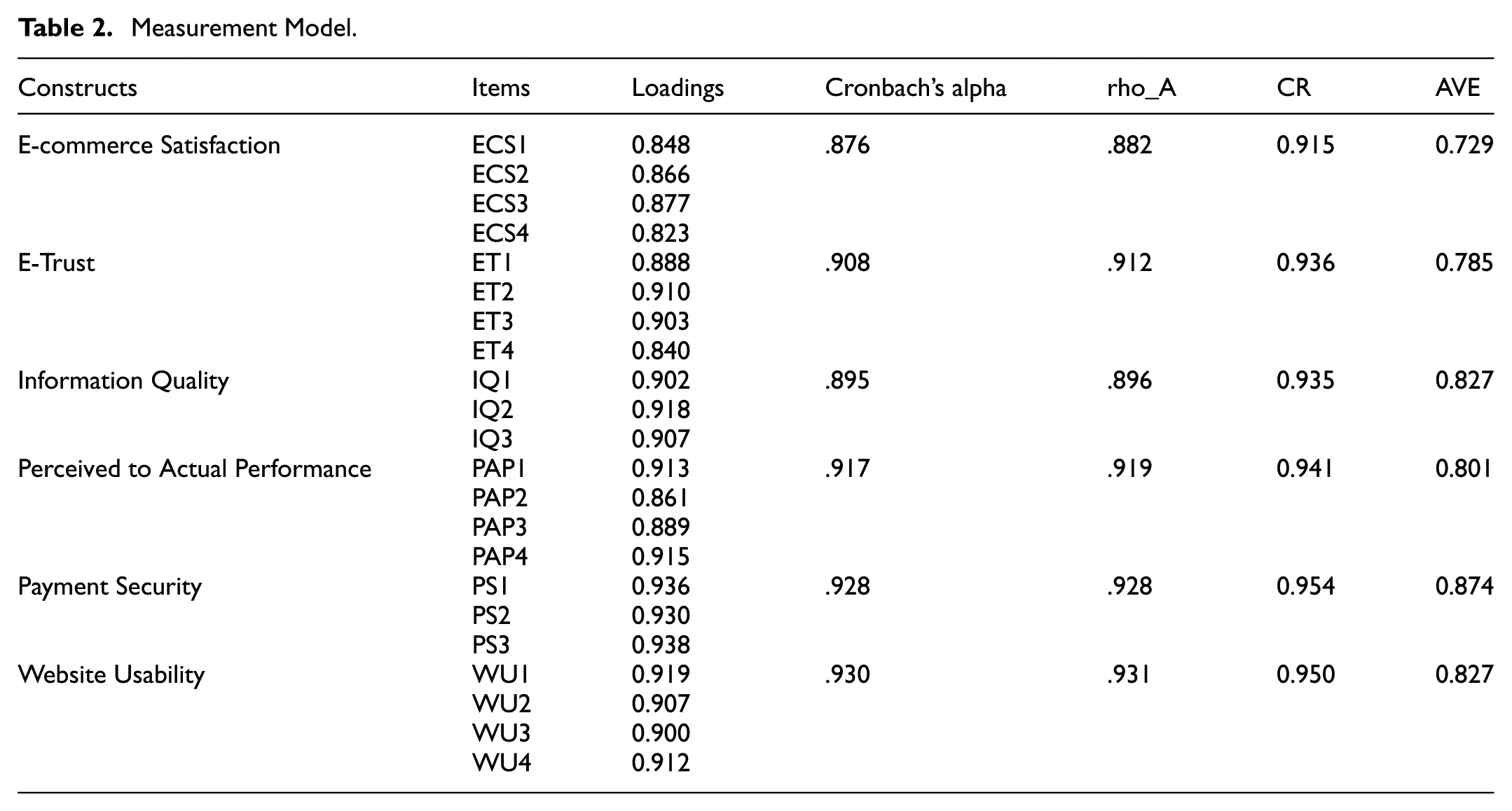
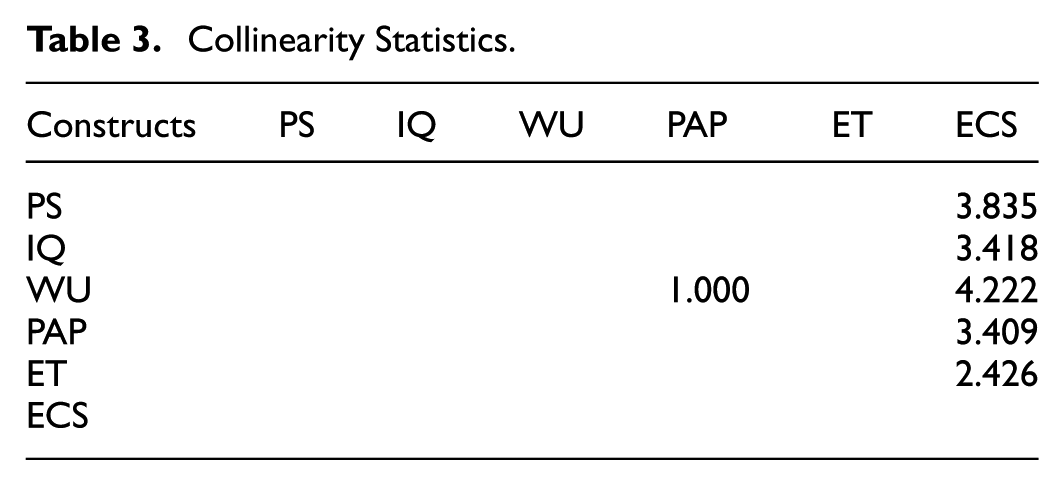
We evaluated the adequacy of the measurement model and the reliability of the measurement items using various parameters of convergent and discriminant validity (Hulland, 1999). To assess model reliability, we employed Cronbach’s alpha and composite reliability. For convergent validity, we examined item loadings and Average Variance Extracted (AVE). Discriminant validity was assessed using the Fornell and Larcker correlation matrix, the square root of AVE, and the Heterotrait-Monotrait ratio of correlations (HTMT). In social science research, Cronbach’s alpha is typically used to assess internal consistency, with a recommended standard of .7 (Ab Hamid et al., 2017). Ideally, measurement items should have a factor loading of 0.70 or higher; a loading of 0.40 or higher is acceptable in exploratory studies (Hulland, 1999). Composite reliability (CR) should be 0.70 or higher, but a CR of 0.60 or more is acceptable, and the Average Variance Extracted (AVE) should be 0.50 or higher (Bagozzi & Yi, 1988). In this study, Table 2 presents factor loadings, Cronbach’s alpha, rho_A, CR, and AVE. All items have factor loadings above 0.7, and Cronbach’s alpha for all constructs is also above .7. Additionally, the AVE values for all constructs exceed 0.5, indicating good internal consistency and convergent validity. This study used VIFs to assess the potential for common-method bias. A VIF score below 5 is considered acceptable, suggesting that multicollinearity is not an issue (Kock, 2015). As shown in Table 3, the VIF values for all independent and dependent variables were within the acceptable threshold, indicating that multicollinearity is not a concern in this analysis. Discriminant validity was evaluated using methods proposed by Fornell and Larcker (1981) and the Heterotrait-Monotrait (HTMT) ratio of correlations (Sarstedt et al., 2021). Table 4 shows that the square roots of the AVEs were higher than the correlations with other constructs. Furthermore, Table 5 shows that all HTMT values fall within an acceptable range. Therefore, these results suggest adequate discriminant validity.
Measurement Model.
Collinearity Statistics.
Correlation Matrix and Square Root of the AVE.
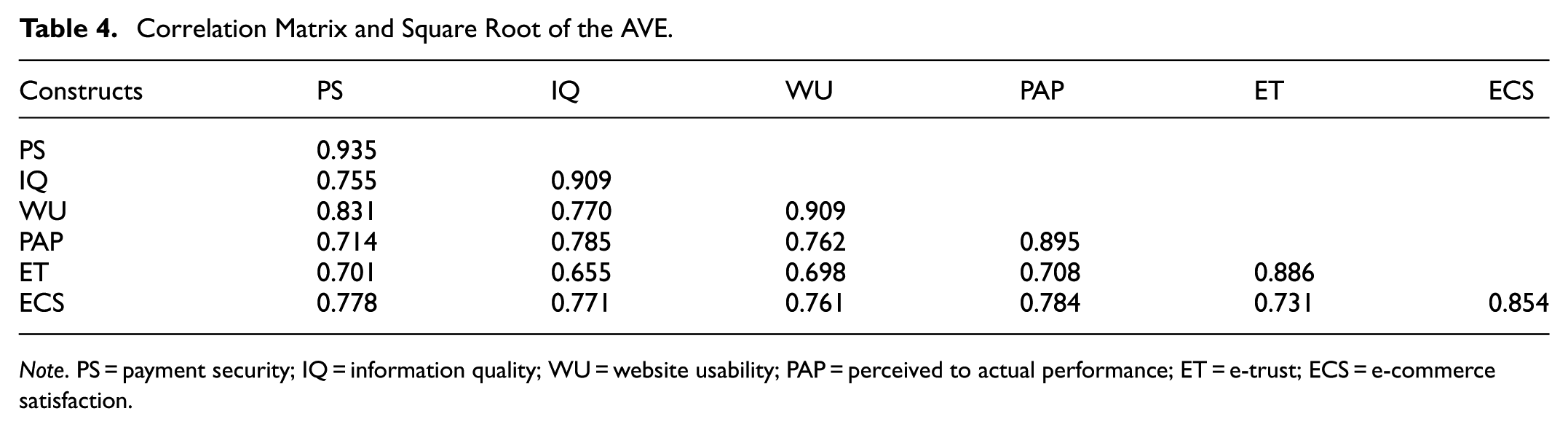
Note. PS = payment security; IQ = information quality; WU = website usability; PAP = perceived to actual performance; ET = e-trust; ECS = e-commerce satisfaction.
Heterotrait–Monotrait Ratio.

Note. PS = payment security; IQ = information quality; WU = website usability; PAP = perceived to actual performance; ET = e-trust; ECS = e-commerce satisfaction.
Structural Model
In this study, we employed the bootstrap method to test hypotheses at the 5% significance level, using 5,000 bootstrap samples from the primary dataset (N = 245). Bootstrapping involves repeatedly sampling subsamples from the original dataset to calculate model parameters iteratively. T-values are then derived to assess the significance of the weights. We analyzed path coefficients (β), t-statistics, and p-values to explore the relationships between explanatory and endogenous variables. The results of the structural model analysis, including path coefficients (β), t-statistics, p-values, and hypothesis outcomes, are detailed in Table 6. Additionally, Figure 2 illustrates the path diagram and loadings along with their p-values.
Structural Model Assessment for Direct Connections.

Note. PS = payment security; IQ = information quality; WU = website usability; PAP = perceived to actual performance; ET = e-trust; ECS = e-commerce satisfaction.

Structural model with path coefficients and p value.
We identified the direct relationship between PS and ECS (β = .241; t-statistics = 2.913; p-value < .05), IQ and ECS (β = .189; t-statistics = 2.529; p-value < .05), WU and PAP (β = .762; t-statistics = 26.157; p-value < .05), WU and ECS (β = .061; t-statistics = 0.743; p-value > .05), PAP and ECS (β = .261; t-statistics = 3.420; p-value < .05), ET and ECS (β = .196; t-statistics = 2.959; p-value < .05). Therefore, our findings indicate that all hypotheses were supported except for H4. Table 6 also reports the f2 values, which indicate the effect of each independent variable on its corresponding dependent variable, ranging from very small to large. Table 7 displays the R2 values for PAP and ECS, which were .580 and .745, respectively, indicating the model’s explanatory power. Additionally, Table 7 reports Q2 values greater than 0, indicating that predictive relevance has been established in this study.
R and Q Square.

Note. PAP = perceived to actual performance; ECS = e-commerce satisfaction.
Mediation and Moderation Analysis
PAP mediates the direct relationship between WU and ECS. In this study, we employed SmartPLS version 4 to assess the mediating effect of PAP on the relationship between WU and ECS. In this study, 5,000 bootstrap samples were randomly extracted from the dataset (N = 245). Table 8 shows that PAP mediates the relationship between WU and ECS (β = .199; t-statistic = 3.414; p-value < .05). Our analysis indicates that PAP mediates the relationship between WU and ECS (complete mediation). Additionally, we also performed the Sobel test to validate the full mediation effect of PAP in the relationship between WU and ECS (Sobel, 1982). Thus, our hypothesis H7 is supported. In addition, we also examined the moderating effect of ET in the relationship between PS and ECS (β = −.046; t-statistic = 1.441; p-value > .05). Therefore, our hypothesis H8 is rejected, as illustrated in Table 8. Consistent with our findings, the effect of payment security on e-commerce satisfaction is direct and significant. However, it is not moderated by individual differences in e-trust, indicating that the influence of payment security on customer satisfaction operates independently of the level of trust customers have in the platform.
Mediation and Moderation Analysis.

Note. PS = payment security; IQ = information quality; WU = website usability; PAP = perceived to actual performance; ET = e-trust; ECS = e-commerce satisfaction.
Discussion
According to the objectives of the study, the findings show that payment security significantly and positively influences e-customer satisfaction, which is consistent with the previous studies conducted by Kim et al. (2008) and Pavlou (2003) who found that secure payment systems are crucial for establishing trust and mitigating perceived risks, both of which are directly related to customer satisfaction in e-commerce. This outcome suggests that payment security is a crucial factor in enhancing e-commerce customer satisfaction. When customers perceive that a platform has secure payment processes, it reduces their concerns about potential fraud or financial risk, building trust in the platform. This increased trust leads to a more positive shopping experience, as customers feel more comfortable and confident in their transactions. The finding suggests that e-commerce businesses can enhance customer satisfaction by prioritizing and clearly communicating robust payment security measures, as this not only alleviates customer anxiety but also fosters repeat purchases and loyalty.
In addition, the outcomes of this study reveal that information quality significantly impacts e-commerce customer satisfaction, which is strongly supported by the previous studies of Wixom and Todd (2005) and T. Zhou (2013). They found that information quality is an important factor in e-commerce customer satisfaction. The result indicates that higher information quality directly enhances customers’ satisfaction with e-commerce platforms. When customers perceive that product information is accurate, reliable, complete, and up-to-date, they tend to feel more confident and satisfied with their shopping experience.
Moreover, the study’s findings reveal that Website usability, as perceived by users, aligns with actual performance, as noted in previous studies by Tandon et al. (2018). These studies found that website usability enhances both perceived and actual performance in online shopping by reducing perceived risk and improving customer satisfaction through task efficiency and ease of use. The result indicates that website usability positively influences the alignment between perceived and actual performance, implying that a well-designed, user-friendly website not only enhances users’ perceptions of their efficiency but also improves actual task performance. This alignment occurs because usability features such as intuitive navigation, clear layout, and responsive design reduce cognitive load, making it easier for users to complete tasks effectively. As a result, users feel more capable and efficient, and their experience validates this perception. This outcome highlights the importance of prioritizing usability in website design, ensuring that users’ expectations of ease and performance align with their experience, thereby enhancing user satisfaction and overall site effectiveness.
However, this study shows that Website usability does not positively influence e-customer satisfaction, which is supported by the studies of Ashiq and Hussain (2024) and Guo et al. (2023), who suggest that usability does not always translate into affective satisfaction. In the context of highly standardized, competitive e-commerce platforms, website usability appears to serve as a hygiene factor. It is necessary to prevent dissatisfaction, but it is insufficient to generate satisfaction in itself. Customers now expect basic usability features such as easy navigation, clarity, and functional responsiveness; thus, only exceptional or highly optimized usability performance is likely to enhance satisfaction. Instead, more psychologically meaningful factors such as trust, security, personalization, and emotional engagement play a stronger role in shaping customers’ satisfaction and loyalty in contemporary e-commerce environments.
Furthermore, the study’s findings indicate that perceived actual performance has a significant and positive influence on e-commerce customer satisfaction. This finding is aligned with previous studies, such as those in the field of online retail experience (Aljohani, 2024), and online purchase intention (Saleem et al., 2022). This outcome recommends that businesses should focus on aligning customer expectations with the real performance of their products or services. When customers find that the experience meets or exceeds their expectations, it builds trust and enhances satisfaction, which can lead to increased loyalty, positive reviews, and word-of-mouth recommendations. This alignment is critical in e-commerce, where perceived quality and actual performance, such as product accuracy, delivery speed, and service reliability, play a central role in customer retention and satisfaction.
Besides, this study also reveals that e-trust significantly influences e-commerce customer satisfaction, which is strongly supported by the study of Quintus et al. (2024) and Saoula et al. (2023), who found that e-trust has a positive and significant impact on e-commerce customer satisfaction, indicating that customer satisfaction in online shopping is strongly tied to the level of trust consumers place in the platform. This relationship suggests that when consumers trust an e-commerce site, they feel more secure and confident about the transaction’s reliability and the platform’s ability to protect their data and deliver products as promised. This trust mitigates common online shopping concerns such as fraud, poor product quality, or data security issues, making customers more satisfied with their experience.
In examining the mediating role of perceived actual performance (PAP) between website usability (WS) and e-commerce customer satisfaction (ECS), the results indicate that PAP fully mediates this relationship. Specifically, website usability alone does not have a significant direct impact on ECS; however, it significantly contributes to enhancing PAP, which, in turn, positively influences customer satisfaction. Thus, WS is instrumental in shaping PAP, and it is through this perceived alignment of performance with expectations that customer satisfaction in e-commerce is ultimately achieved.
Finally, the study does not find any moderating effect of e-trust on payment security and e-commerce customer satisfaction. The absence of a moderating effect of e-trust on the relationship between payment security and e-commerce customer satisfaction may stem from several key factors. Firstly, many customers may already expect a baseline level of payment security, rendering e-trust a less impactful factor in shaping their satisfaction if that expectation is met. Additionally, the direct influence of payment security may be so strong that it overshadows any additional contribution of e-trust, as secure transactions alone may be sufficient for customer satisfaction.
Theoretical Implications
By integrating multiple foundational theories, this study enhances understanding of e-commerce customer satisfaction. These theories include the DeLone and McLean IS Success Model, Pavlou’s Trust and Risk Model, and Expectation Confirmation Theory. This integrated conceptual framework explains the direct and indirect effects of a website’s usability, payment security, information quality, e-trust, and perceived-to-actual performance on e-commerce satisfaction (H. Zhou & Xing, 2022). A key conceptual insight is that perceived-to-actual performance serves as a full mediator between website usability and customer satisfaction. This finding highlights that website usability does not directly lead to satisfaction. It influences satisfaction, though, through perceptions about performance. This research shows that website usability does not elevate customer satisfaction, contrary to the usability-performance experience.
Moreover, the significant role of payment security in determining e-commerce satisfaction underscores the need to build trust in secure transactions and in accurate, relevant product information. Although e-trust influences satisfaction directly, it does not moderate the effect of payment security on satisfaction, as it is a given set by customers. Payment security is a prerequisite for customers and not dependent upon overall trust (Rico et al., 2019). The findings are theoretically significant as they extend e-commerce satisfaction research beyond expert-oriented consumer behavior observed in developed countries to a less developed country, Bangladesh. Also, it shows that we need to integrate psychological and technological factors. These findings extend theoretical frameworks by contextualizing e-commerce satisfaction in emerging markets, such as Bangladesh, and highlight the need to integrate psychological and technical factors to understand consumer behavior in digital commerce better. This comprehensive approach offers an enriched conceptual model that can inform future research and practical applications to improve customer satisfaction and loyalty in competitive online markets.
Practical Implications
The implications of this study offer many suggestions for e-commerce practitioners and businesses to improve customer satisfaction and loyalty. To begin, the website’s usability should be improved alongside an assurance that performance meets or exceeds customer expectations, as perceived-to-actual performance mediates satisfaction (Cho & Moon, 2023). So, investments in user-friendly design need to go hand in hand with the service delivery system. Secondly, payment security appears to be another driver of customer satisfaction. Thus, e-commerce platforms will also have to enhance transactional security and clearly communicate this to customers.
Thirdly, if online shoppers have high-quality, accurate, and relevant information, it will reduce their uncertainty and increase their confidence in their purchasing decisions. It shows that companies need to improve the information on their websites (Mogea, 2022). In the end, e-trust enhances satisfaction; however, people already expect a secure payment. Hence, trust-building activities must go beyond transaction security to include brand credibility, customer support responsiveness, and post-purchase engagement, among others (Kedaton et al., 2024). Businesses and policymakers in Bangladesh – and other emerging economies – can use the insights from this study to allocate resources and design policies that help achieve sustainability and improved experiences in the online environment (Sihombing et al., 2023).
Limitations and Future Research
This research has certain limitations that have to be considered. To begin with, the study targets a specific group (young adults in Bangladesh). In that case, the findings may not be that helpful for other ages. To enhance the external validity of the results, a wider range of separate samples could be included in future work (e.g., age groups, regions, cultural backgrounds). The second limitation is the use of self-reported data, which is subject to bias that could influence the results. To address this limitation, potential future research could expand on the use of mixed-methods research to explore consumers’ behavior in greater depth.
Another limitation is the exclusive reliance on convenience sampling, which may not fully represent the broader e-commerce customer base He (2023). To achieve greater representativeness, future studies may benefit from random or stratified sampling. Also, the study looks at a limited number of variables, that is, website usability, payment security, quality of information, e-trust, and perceived-to-actual performance, which may miss other factors that can also be important. The scope of future research should include additional variables, such as product quality, customer service, and logistics performance, to better understand customer satisfaction in the e-commerce context. Ultimately, the research offers no insight into long-term consumer behavior, such as repurchase intention or brand loyalty, which may change over time (Mahsyar & Surapati, 2020; Sari & Darma, 2022). Future studies could examine the long-term effects of the factors discussed in this study on client satisfaction and loyalty. Furthermore, how leading technologies like artificial intelligence and personalization influence satisfaction is another interesting area of e-commerce research that future researchers could focus on.
Conclusion
This study examined the primary factors that influence e-commerce customer satisfaction. It uncovers several significant outcomes. Payment security and information quality emerged as robust and substantial indicators of satisfaction, underscoring that buyers prioritize secure transactions and precise, dependable product information as fundamental elements of a favorable online buying experience. The perceived-to-actual performance gap had a significant impact, suggesting that satisfaction rises when customers’ expectations align with the platform’s actual performance in terms of product accuracy, delivery reliability, and service quality. While website usability markedly improved perceived actual performance, its direct impact on satisfaction was minimal, indicating that usability acts as a hygiene factor: it mitigates dissatisfaction but fails to elicit satisfaction unless performance is exceptionally elevated. Furthermore, e-trust was found to affect satisfaction directly; however, it did not reduce the correlation between payment security and contentment, likely because customers’ pre-existing expectations for a fundamental level of transactional security remained. Notably, the perceived-to-actual performance gap entirely mediated the association between website usability and happiness, underscoring the importance of performance-driven perceptions of usability in consumer evaluations. Ultimately, these conclusions must be regarded with caution, given that the data were obtained from 245 young Bangladeshi customers. Consequently, the results may not entirely apply to older users, individuals from other cultural backgrounds, or consumers in non-mobile or more expansive e-commerce environments. Subsequent research should corroborate these associations utilizing more heterogeneous samples and cross-cultural settings.
Footnotes
Appendix A
Items and Constructs of the Research on E-Commerce.

| Construct | Items | Options | Source |
|---|---|---|---|
| Website Usability | 1. Able to access the website easily. 2. Quickly find the products or information 3. To work the website across different devices (e.g., desktop, mobile) 4. To navigate through the website |
• Much Weaker • Weaker • Neutral • Strong • Much Stronger |
Jogoo et al. (2019) |
| Payment Security | 1. The overall satisfaction with the payment security measures provided by the e-commerce platform 2. In the e-commerce platform’s ability to protect the payment information 3. Important is payment security when making online purchases 4. The perception of payment security influences overall trust in an e-commerce website |
• Strongly low • Low • Neutral • High • Strongly high |
Pohjanen (2019) |
| Information quality | 1. To get error-free information from the website 2. Up-to-date information on website 3. Sufficient information from the website for the task at hand 4. Getting information from the website at the right time |
• Strongly disagree • Disagree • No opinion • Agree • Strongly agree |
Saha et al. (2012) |
| Perceived to Actual Performance | 1. Efficient and fast customer service performance 2. Customer service without reservation 3. Timeliness of delivery 4. Respond to the request |
• Strongly disagree • Disagree • No opinion • Agree • Strongly agree |
Gajewska et al. (2020) |
| E-customer Satisfaction | 1. The performance of the website meets expectations. 2. The website has never had sufficient experience marketing its products and services. 3. The website knows the users well enough to offer products and services adapted to their needs. 4. The website hasn’t the necessary resources to carry out the activities successfully. |
• Much Weaker • Weaker • Neutral • Strong • Much Stronger |
Eid (2011) |
| E-Trust | 1. Readily provide the personal information to the online retailer of choice for convenience in future transactions. 2. Confidence in recommendations made by the preferred online retailer. 3. Trust the claims and promises this online retailer makes about a product. 4. There is a risk of the loss of privacy while purchasing online. |
• Strongly disagree • Disagree • No opinion • Agree • Strongly agree |
Miao et al. (2022) |
Acknowledgements
We used Grammarly Premium to enhance sentence quality and improve the overall readability of the manuscript. Moreover, we want to express our sincere gratitude to all the individuals and organizations that supported us throughout this project.

Ethical Considerations
This study was conducted with the ethical approval of the Ethical Committee of Noakhali Science and Technology University (NSTU), Noakhali, Bangladesh (Ref: NSTU/FBS/EC/2024/02a). The ethical approval was issued on 18 March 2024.
Consent to Participate
Informed consent was obtained from all respondents before participation through a structured questionnaire. Participants were fully informed about the study’s purpose, their rights, and the voluntary nature of their involvement. They were also allowed to withdraw from the survey at any stage. The authors confirm that respondents provided consent for their responses to be used exclusively for academic research purposes.
Consent for Publication
Each author has reviewed and approved the final manuscript, indicating collective agreement on the work and findings presented. In addition, the authors give their full consent to publish the manuscript in Sage Open.
Author Contributions
The development and execution of this study were the result of a collaborative effort, with each author making unique contributions. Maimuna Khatun, Mohammad Rakibul Islam Bhuiyan, and Md Al Amin initiated the project, designed the study framework, collected the data, analyzed the data, and drafted the initial manuscript. In addition, Md Al Amin and Mohammad Rakibul Islam Bhuiyan significantly deepened the proposed theory by providing critical insights that informed the development of the research model and the discussion sections. The research findings and theories were enriched through collective discussions and brainstorming sessions with all authors; moreover, Dr Md. Abdul Hannan Mia conceptualized and supervised the whole work and edited the final manuscript. Md. Deluar Hossen has contributed to analyzing data, reviewing, and addressing the reviewer’s comments to make quality work.
Funding
The authors received no financial support for the research, authorship, and/or publication of this article.
Declaration of Conflicting Interests
The authors declared no potential conflicts of interest with respect to the research, authorship, and/or publication of this article.
Data Availability Statement
The data used in this study cannot be publicly shared due to confidentiality concerns. However, the data can be made available upon reasonable request from the corresponding author.*