




Abstract
This study investigates the factors determining household participation in rural tourism using a logistic-interpretive structural model (ISM) based on survey data from 22 pro-poor tourism villages in western China. The findings reveal that, in addition to any independent influence, household livelihood capital and the community livelihood environmental factors have a hierarchical interrelationship that influences tourism participation. For low-income households, the probability of tourism participation is indirectly constrained by labor availability and community-level infrastructure and public services, with the community proximity to nearby scenic spots playing a deep-seated role. This study contributes to existing literature by proposing a hierarchical structure of factors influencing tourism participation and offers new insights into how these factors have implications for poor communities and low-income households.
Keywords
Introduction
Rural tourism plays a crucial role in promoting the sustainable development of global tourism and poverty alleviation in both developed and developing regions, given its labor-intensive and environment-friendly attributes. Rural households, as key actors in tourism attractiveness and the target of poverty alleviation policies, contribute significantly to the sustainable development of community-based tourism (CBT; Iqbal et al., 2022; Liu et al., 2017). Extensive participation in tourism serves as a prerequisite for enhancing local sustainability. However, the participation rate in rural tourism has remained low for a long time, particularly among impoverished regions and disadvantaged groups in rural China (Lu et al., 2018; Luo et al., 2022).
Theoretically, tourism participation encompasses local communities’ engagement in tourism planning, decision-making, business operations, and benefit distribution (Tosun, 2000). As key stakeholders in tourism, communities and local livelihoods are fundamental to the well-being of tourism destinations, while local households are often concerned about the tangible benefits derived from tourism development. Thus, this study mainly focuses on households’ participation in tourism operation activities and their resulting benefits. Forms of participation often refers to involvement in tourism operations such as operating rural restaurants, agritainment, and tourism-related retail shops, or employment within tourism sectors, etc. In practice, however, participation in tourism activities often remains inadequate for some reasons. Challenges such as mismatches between tourism demand and supply are prevalent in many communities, with tourism resources being inefficiently utilized and a limited supply of high-quality tourism products. In recent years, some developing countries including China, have implemented a series of policies to promote the development of impoverished areas and local livelihoods. However, these initiatives often prioritize tourism enterprises greatly, while overlooking the interests of local residents and broader community participation (Deng et al., 2017; Pramanik & Rahman, 2024), thereby exposing tourism destinations to the risk of becoming tourism enclaves (Monterrubio et al., 2018).
As the world’s largest developing country, China has regarded rural tourism as a powerful means of addressing rural poverty since the beginning of the 21st century. By 2021, China had established 1,199 rural tourism focal villages and lifted 22,600 officially registered poor villages out of poverty through tourism (Sun et al., 2021). However, despite the elimination of absolute poverty eliminated in China, many disadvantaged groups still reside in impoverished rural areas with limited resources. These groups often face barriers to participating in tourism due to constrained endowments and capabilities (Su et al., 2016, 2019). Recently, China announced a 5-year transition period (2021–2025) to consolidate its poverty alleviation achievements. During this period, all existing poverty reduction policies remain stable and are even further strengthened. Given this context, it is necessary to identify the facilitating and constraining factors of tourism participation and their influencing mechanisms, especially among low-income populations, thereby improving participation rates. This issue has become a major concern for both tourism practitioners and academics.
Since community-based participation in tourism was first proposed by Murphy (1985), the participation of households in tourism destinations has garnered considerable attention (Tosun, 2000; Zeng & Ryan, 2012). Extensive studies have investigated the factors influencing participation in tourism at different levels. At an individual level, factors often include the demographic characteristics of residents such as age, education, sex, and skills (Bhatta et al., 2019; Lu et al., 2017), individual perceptions, and awareness (such as motivation, perception, and attitude toward local participation in tourism; Latip et al., 2018; Li et al., 2020; Rasoolimanesh et al., 2017). At a household level, emphasis has been placed on the role of livelihood capital. For instance, studies have shown that farmers with highly educated household heads, a large labor force, high-quality housing, credit capital, and social relations are more likely to participate in tourism and benefit from it (Bello et al., 2017; Bennett et al., 2012; Liu et al., 2012; Lu et al., 2018). At an institutional level, institutional arrangements and policies have been identified to promote positive perceptions of tourism development, and thus positively affect community participation (Qin et al., 2019). In addition, several studies addressed the influence of macro-environmental factors, such as how well communities are endowed with tourism resources and the stage of tourism development, etc. (Gohori & Van Der Merwe, 2024; Lee & Jan, 2019).
Overall, extensive literature has examined the factors influencing rural households’ participation in tourism. However, there are still aspects that have yet to receive sufficient attention. First, extant literature has concentrated more on factors at individual and household levels than external macro-environmental factors at a community level. It is also the case that internal capital and external community factors can mutually relate and affect participation, which has been largely disregarded in previous studies. Second, although several studies have mentioned the low participation rate and barriers confronting poor groups (Su et al., 2016, 2019), systematic analysis regarding whether these factors have structural or hierarchical association with participation are still limited. To address these gaps, this study aims to provide a more comprehensive understanding of the key factors influencing tourism participation of rural households in western rural areas of China, and how these factors might be interrelated by developing a binary logistic and interpretive structural model (logistic-ISM) approach and sub-sample analysis.
This study presents the following potential contributions: (1) We use a logistic-ISM model to analyze the factors affecting tourism participation and their hierarchical relationship, besides independent influences. Logistic-ISM approach enables empirical research on seemingly chaotic and disorderly factors to achieve a scientific, multilevel, and ladder-shaped structure. Together, they can reveal the internal mechanism influencing participation decisions. (2) As poor households are the focus of “pro-poor tourism” that is advocated by the Department for International Development (DFID) and the target of Chinese poverty alleviation policies, we provide additional insights into low-income households regarding the factors influencing tourism participation, which might guide future policy. (3) We present a revised version of the DFID’s Sustainable Livelihood Framework (SLF) that unifies households’ livelihood capital and community-level environmental factors. This provides additional theoretical implications for understanding the application of SLF in households’ livelihood choices.
The study consists of six sections. Section “Theoretical Framework” reviews the related literature and proposes theoretical framework, while section “Methodology” describes the research methods, survey design, sampling, and variables. The results analysis and discussion are presented in sections “Results and Analysis” and “Discussion,” respectively. Finally, section “Conclusions and Implications” presents the conclusions and implications.
Theoretical Framework
The SLF, which has been widely used in tourism livelihoods and poverty alleviation (Shen et al., 2008; Su et al., 2016, 2019; Zeng & Ryan, 2012; Zhang et al., 2020), provides a theoretical basis for systematically examining how rural households decide whether to participate in tourism. The framework comprises five key components: vulnerability context, livelihood capitals, transforming structure and process, livelihood strategies, and livelihood outcomes. The vulnerability context of livelihoods primarily relies on macro-level conditions, including trends, shocks, and seasonality. Livelihood capital, which consists of human, natural, physical, social, and financial capital (DFID, 2000), exhibits the endowments for generating sustainable livelihoods (Ellis, 2000). Activities based on these capitals can produce diverse outcomes, such as income generation, vulnerability reduction, poverty alleviation, empowerment, and improved well-being (Ellis, 2000).
The original SLF emphasizes the subjective livelihood initiative of households and their freedom of livelihood choice. Thus, participating in tourism presents a rational choice for households relying on their capital endowments and specific livelihood environments. Livelihood environment refers to the external conditions on which households depend for survival. It often takes the form of climate, geographical location, economic tendencies, and public services, etc. These components align with the vulnerability context in the SLF. In tourism communities, they can include tourism resources such as forests, lakes, mountains, wildlife, and human landscapes. Here, we propose indicators to measure the vulnerability context referring to various livelihood environmental factors and combine them with livelihood capital factors to form an analytical framework for the analysis of households’ participation in rural tourism (Figure 1).
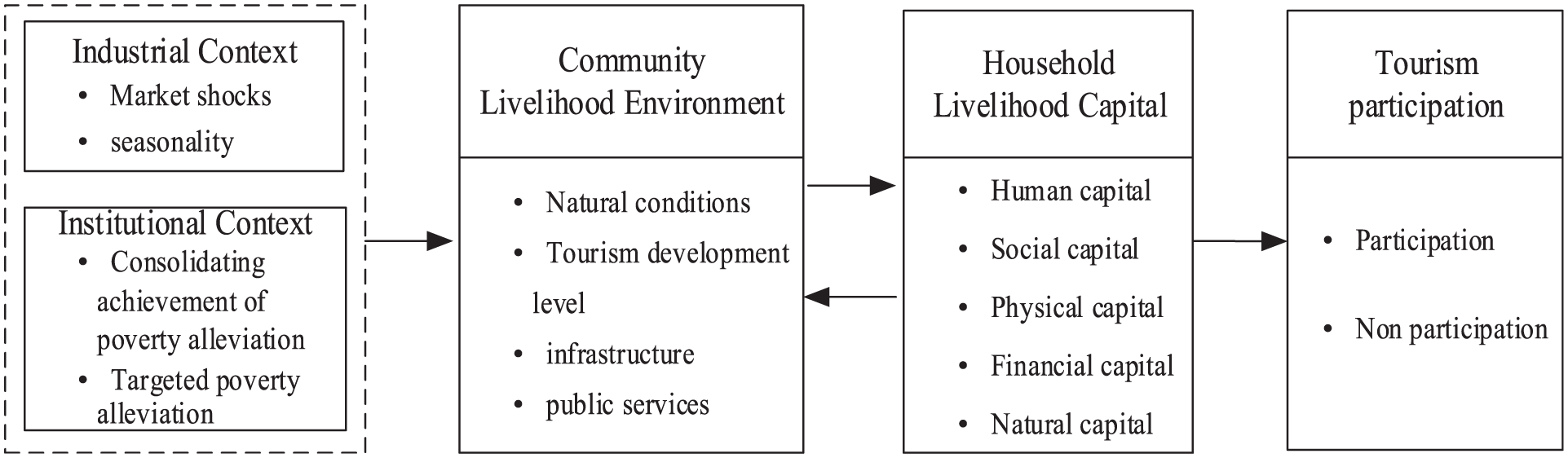
Theoretical framework for analyzing the factors influencing rural households’ tourism participation (Revised from DFID, 2000).
Household Livelihood Capital and Tourism Participation
Livelihood capital constitutes a core element of the SLF. Ideally, sustainable livelihood capitals are represented by a pentagon with balanced proportions. In practice, however, this structure is often distorted because rural households possess different types and scales of capital. Studies have shown that residents with insufficient human, social, and financial capital are less likely to participate in tourism (Liu et al., 2012; Lu et al., 2018; Sophie & Juliana, 2018). According to the SLF, livelihood capital comprises five components: human, social, physical, financial, and natural capital.
Human capital is a decisive factor in choosing livelihood strategies and promoting livelihood transformation. It is typically manifested through factors such as labor, education, and skills. As indicated, households with more available labor force are more likely to engage in tourism (Liu et al., 2012). Conversely, lower levels of education and fewer skill acquisition may constrain tourism participation (Bello et al., 2017). In western China, the household head often acts as both the leader and the primary laborer in a family. Individuals with higher levels of education or professional skills can substantially influence the direction of household livelihood strategies.
Social capital refers to the social resources attached to a household’s social network. Enriched social capital can enhance farmers’ access to knowledge and other essential resources, such as physical and financial capital. Bennett et al. (2012) and Bello et al. (2017) suggested that social norms, power relations, trust, and social networks are associated with households’ enthusiasm for tourism participation. Adequate social capital can expand access to human resources, increase job opportunities, and reduce the perceived risks associated with tourism operations, thereby encouraging participation.
Financial capital generally includes a household’s own funds and potential financial resources obtained through formal or informal borrowing channels. Insufficient financial capital hinders tourism participation (Bello et al., 2017). Sophie and Juliana (2018) examined the determinants of livelihood diversification in a wildlife tourism destination and argued that savings or liquid funds facilitate the selection of diversified livelihood strategies. In addition, households who face own fund shortages may borrow from relatives or friends to mitigate livelihood risks. In the context of China’s targeted poverty alleviation programs, low-income households in impoverished areas could obtain government-led microfinance and other credit support to alleviate financial constraints. Therefore, financial capital, including liquid funds and credit opportunities can play a positive role in promoting tourism participation.
Physical capital is also an important determinant of tourism participation (Mugizi et al., 2017). For example, Lu et al. (2017) investigated Tibetan areas in Sichuan Province, China and found that good housing conditions and adequate agricultural tools increased the likelihood of Tibetan farmers and herders engaging in rural restaurants/agritainment operations. Furthermore, natural capital highlights the role of land resources in sustaining livelihoods (Habib et al., 2023), especially for low-income groups in rural areas. Land resources can provide raw materials for household-based tourism operations and reduce operational costs, thus motivating involvement in tourism-related strategies (Mugizi et al., 2017; Su et al., 2019). However, rural households may be reluctant to engage in tourism if they already derive relatively high income from agroforestry. In other words, abundant natural capital may discourage households from participating in tourism.
To this end, this study proposes that human, social, financial, and physical capital have significantly positive relationships with rural households’ participation in tourism, whereas natural capital may exert a negative influence.
Community Livelihood Environment and Tourism Participation
According to the SLF, the livelihood environment encompasses external shocks and risks in vulnerable contexts, along with tourism resources and living conditions. Additionally, institutional arrangements and policies embodied in “transforming structure and process” influence livelihood choices by reshaping fragile environments. However, since China’s targeted poverty alleviation institutional arrangements are actually aimed at households involved in tourism, it is challenging to examine their relations with households’ tourism participation. Moreover, in some communities located in impoverished areas, such as the sample area in the Qinba Mountains, local livelihoods rely heavily on natural ecological resources and the conditions for tourism development. This study, therefore considers community-level livelihood environmental factors as fragile exposure and tourism development conditions, including natural environment, tourism development level, infrastructure, and public services.
Natural conditions present both opportunities and challenges for local livelihoods. Proximity to scenic spots can facilitate participation in tourism. Conversely, longer distances between households’ homes and scenic attractions can serve as obstacle to participation (Pham, 2020). According to the spatial poverty trap theory, the vulnerability and feasibility of farmers depend largely on geographical location and natural environments (Sun et al., 2020). In China, most officially registered poverty villages are located in remote and underdeveloped regions, characterized by large poor populations and limited arable land. Harsh geographical conditions impede livelihood options, aggravating levels of poverty. Accordingly, this study proposes that distant natural conditions, such as the proximity of a farmhouse to scenic spots will positively associated with rural households’ tourism participation, while a community identified as a registered poverty village will exert as a negative influence.
Tourism development level is a prerequisite for local households to participate in tourism. A rapidly developing and large-scale tourism industry can attract tourists and create sufficient employment opportunities. In contrast, if tourism development remains small in scale or features unremarkable scenery and tourism products, it will struggle to generate spillover effects in surrounding communities. In such cases, rural households may hold conservative expectations regarding the potential benefits of tourism-related livelihoods. Also, previous studies have indicated that infrastructure, including water supply, power, electricity, transportation, and internet network access, can expand non-agricultural employment opportunities by promoting economic growth and mitigating location-related disadvantages (Dedehouanou et al., 2018). At the same time, improved public services represented by education and healthcare can increase the attractiveness of rural areas and reduce large-scale rural labor outmigration (Li et al., 2020). Furthermore, the availability of quality living facilities such as post offices, schools, and agricultural markets, can facilitate urban-rural linkages and promote tourism development. Based on these considerations, this study argues that high levels of tourism development, together with well-developed infrastructure and public services, are positively related to household participation in rural tourism.
Several studies have further shown that the five types of capital identified in the SLF are not independent but interact with one another. For instance, Shen et al. (2008) developed a Sustainable Livelihood Framework for Tourism (SLFT) based on the SLF, demonstrating that the internal interactions among livelihood capitals affect tourism livelihood activities, in addition to their individual roles. However, many SLF-based studies have overlooked the interrelations and transformations that occur among different types of capital (Li et al., 2017). Moreover, prolonged exposure to fragile environments can threaten household livelihoods by constraining access to livelihood capital and limiting its accumulation (He et al., 2017; Sun et al., 2020). While tourism development possibly disrupt the natural and ecological systems of local communities, it also has the potential to improve infrastructure and living conditions and create new livelihood opportunities. In contrast, communities located far from scenic areas often face poor infrastructure and lagging public services. Therefore, this study further proposes that the factors influencing household livelihood capital and the community environment are hierarchically structured and exert ladder-shaped effects on tourism participation (Figure 1).
Methodology
Methods
This study examines the factors and their paths influencing rural household participation in tourism, using a logistic-ISM model. A binary logistic regression model was first used to identify the significant factors influencing tourism participation. Then, ISM was utilized to analyze the hierarchical relationship between these factors. By analyzing the hierarchical structure with the ISM model, we can identify the key factors that have a direct influence on participation and those that have an indirect influence through other factors.
Binary Logistic Regression
We define tourism participation as when a rural household chooses to participate in tourism-related activities, such as running tourism operations, taking tourism employment, etc., and obtains economic benefits from this participation, expressed as y = 1; otherwise, y = 0. Equation 1 shows the specific binary logistic regression model.

where P is the probability of household tourism participation, determined by the observed binary variable y; LC represents the five types of livelihood capital; LE represents the community livelihood environmental variables; Geo denotes dummy variables at the county level, with 8 dummy variables for the 9 counties (districts) in the study area;

In Equation 2, the odds ratio of a parameter greater than 1 indicates a positive factor for tourism participation, while a ratio less than 1 indicates a negative factor.
Interpretive Structural Model (ISM)
The Interpretative Structural Model (ISM) employs the correlation matrix principles associated with graph theory and internet technology to clarify the correlations and hierarchy among factors (Latifi et al., 2021). The ISM has been widely used in systems engineering, educational technology, and agricultural economics research. This study proposed the use of the ISM model, together with Python3.7 software, to explore the relationship between households’ livelihood capital and community livelihood environmental factors that affect tourism participation. The detailed steps are as follows.
The first step supposes that k factors significantly influencing households’ participation in rural tourism are identified by the binary logistic model.

Second, a reachable matrix M can be calculated using Equation 4:

Where I is the identity matrix,
Third, the hierarchical structure of the influencing factors can be determined using Equation 5:

where P (
The final step integrates all levels of

Analysis flowchart of ISM.
Survey and Sample
The study sample was drawn from in the poverty-stricken areas in the Qinba Mountains of western China. Compared with the central and eastern regions, the Qinba region possesses abundant natural and ecological tourism resources but has a weak economic foundation and a highly concentrated low-income population, primarily located in southern Shaanxi Province. Shaanxi Province represents a typical case of extensive tourism development and has long been exploring poverty alleviation through rural tourism. The surveyed areas encompassed 22 villages across 9 counties in 4 cities: Baoji, Ankang, Hanzhong, and Shangluo.
Initially, we used the first series of pro-poor tourism villages in Shaanxi Province as a framing sample and employed stratified random sampling to select the surveyed villages. These villages, all located near rural tourism scenic spots, are designated as typical demonstration sites for poverty alleviation by rural tourism administrations at the national or provincial level in China. A representative description can be seen in Dang et al. (2024). Face-to-face investigations were then conducted in these villages from June to September 2017. Structured questionnaires were utilized to interview household heads aged 18 to 65 or their spouses who were present at home during the investigation, selected randomly. In total, 841 valid samples out of 861 distributed questionnaires were collected for empirical analysis. Rigorous measures were taken to ensure data quality and reliability, as detailed in Dang et al. (2024).
Procedure
This study was conducted using a survey method involving farmers as respondents. The consent process was completed prior to data collection. Each questionnaire included a front-page that required participants to provide informed consent for the interview and publication before the survey could proceed. Interviewers received standardized training and were asked to read the informed consent statement to each interviewee before the interview could advance. Participants were informed that they were completely voluntary to answer any questions. They also retained the right to terminate the interview at any time and request the deletion of all recorded data. All respondents were assured that their household information would be remain strictly confidential and would not be disclosed to any third party.
Variables
As mentioned, tourism participation is the dependent variable, defined as whether a household engaged in tourism activities and benefited from them. If a household participated in any form of tourism activities (tourism operations or employment) and obtained income from doing so, it was regarded as rural tourism participation and assigned a value of 1; otherwise, the value was 0. According to our survey data, 311 households, accounting for 36.98% of the total sample, participated in rural tourism. The main forms of participation in the survey areas are tourism operations and tourism employment.
Based on the aforementioned theoretical analysis and questionnaires, a total of 18 independent variables were selected to investigate the factors affecting household participation in rural tourism regarding livelihood capital and environments. Table 1 presents the definition and description of each variable.
Independent Variable Definitions and Descriptive Statistics.

1 USD = 6.6401 CNY in 2016; 1 mu = .0667 hm2.
Table 2 displays the distribution of tourism participation across low-income and medium-high income households. Here, we adopted the relative poverty standard to identify low-income groups. That is, 40% of the median per capita income (Med) in rural China is set as the relative poverty standard, following the World Bank’s advocacy of “shared prosperity,” and a focus on the well-being of the bottom 40% of the population in society (Saavedra-Chanduvi, 2013).
Proportion of Rural Household’s Tourism Participation Across Different Groups (%).

Note. The relative poverty line was calculated by 40% of the median per capita income in rural China in 2016 (4,428 yuan), being adjusted by the Consumer Price Index (CPI) of that year.
Results and Analysis
Factors Influencing the Participation of Rural Households in Tourism
Analysis of the Binary Logistic Model Results
Table 3 presents the results generated by the binary logistic regression model, which aimed to identify the factors influencing rural households’ tourism participation, based on the total sample in the survey data (Model 1). A probit model (Model 2) was used to check the robustness of Model 1. The identified factors in both models are consistent with each other, and the logarithmic value and Prob test results indicate a good fit for the models. The following analysis is based primarily on the results of Model 1.
Estimated Results for the Binary Logistic Regression for All of the Samples.

p < .01. **p < .05. *p < .1.
Among the variables relating to livelihood capital, the estimated coefficients of human capital, namely, labor, education, and skills were found positively associated with tourism participation. The odds ratios of these three variables indicate that when the labor, education of the household head, and having skilled members in a household increase by one unit, the possibility of participating in tourism improves by 13.1%, 20.4%, and 43.9%, respectively. These results suggest that the quality of human capital variables, that is, education, and skills significantly stimulates participation in rural tourism. In addition, social experience has a positive influence, while social network and social support do not. Our field surveys showed that farmers who served as village cadres often had an advantage in obtaining tourism-related job information and receiving training in tourism operation skills. This result is consistent with the findings of Lu et al. (2017). In contrast to the results of Liu et al. (2012), this study found that social networks exert an insignificant effect on tourism participation, possibly because the stimulation for tourism participation in western China depends primarily on family members rather than on external social relationships.
Among the physical capital and financial capital variables, both housing quality and products and tools have a positive effect. The housing quality has a higher odds ratio because those who are utilizing their farmhouse for tourism operations can activate the implicit value of rural homesteads and reduce the perceived risk associated with the cost of running a tourism business, thereby stimulating enthusiasm for tourism activities. This finding is consistent with Lu et al. (2017), who reported that favorable housing conditions and adequate agricultural production tools increased the likelihood of Tibetan farmers and herders engaging in tourism. Liquid funds and loan availability also have a positive influence, aligning with the findings of Bennett et al. (2012) and Liu et al. (2012). More importantly, the odds ratios of these two variables indicate a stronger effect on loan opportunities (125%) compared with household cash income (34.5%), highlighting the potential significance of financial leverage in promoting tourism participation. Regarding natural capital, neither the area of cultivated land nor the forest land area has a significant influence on tourism participation. This result is inconsistent with the findings of Mugizi et al. (2017), which used household surveys of the Murchison Falls Conservation Area to argue that owned land significantly influenced tourism participation. In poverty-stricken areas of China, households with larger areas of cultivated land tend to choose agricultural production.
Regarding the community livelihood environment factors, the coefficients of the natural condition variables indicate a decrease in the possibility of participation if the community is registered as a poverty village. The smaller the distance from community to tourist scenic spots, the more likely the farmers are to engage in tourism. Surprisingly, the influence of tourism development level is not significant. Scenic spots with higher star ratings usually indicate a thriving tourism industry, which can help to expand non-farm employment for surrounding villages. However, our field investigations have found that some villages develop the integration of leisure agriculture or agriculture-tourism by using community resources. Although these villages are rated below 4A-level scenic spots, they still contribute to local tourism employment. As a result, we find little significant difference in tourism participation between high- and low-level scenic spots. Infrastructure and public services are positively associated with tourism participation. A possible explanation is that the improvement of infrastructure and public services provides more convenience for transportation and information exchange within and outside communities, thereby increasing the attractiveness of tourism development and reversing the massive outflow of migrant labor (Li et al., 2020). Furthermore, the odds ratio for public services is larger than it is for infrastructure, indicating the greater significance of improving accessibility to public services in tourism involvement than that of improving infrastructure.
Analysis of ISM Model Results
Table 3 shows that 12 key factors influence household tourism participation. They are labor
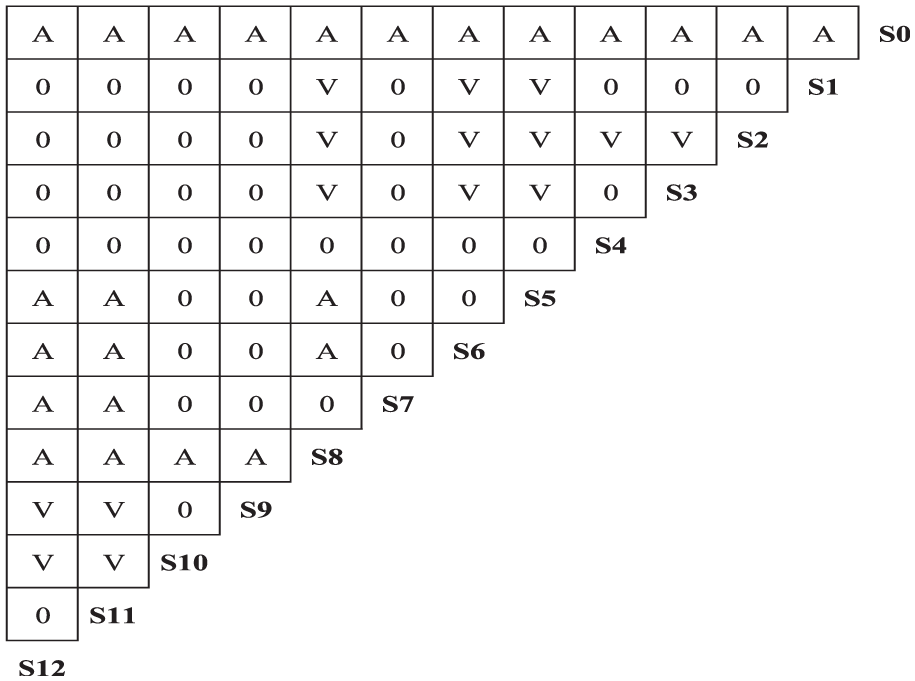
Logistic relationship between the key factors influencing participation.
Based on the Figure 3 and Equation 3, an adjacency matrix D was obtained (omitted), and using Equation 4 and Python 3.7 the reachable matrix M was then calculated (Figure 4). According to Equation 5, we get

Reachable matrix M between influencing factors.

Ordered reachable matrix R after ISM analysis.
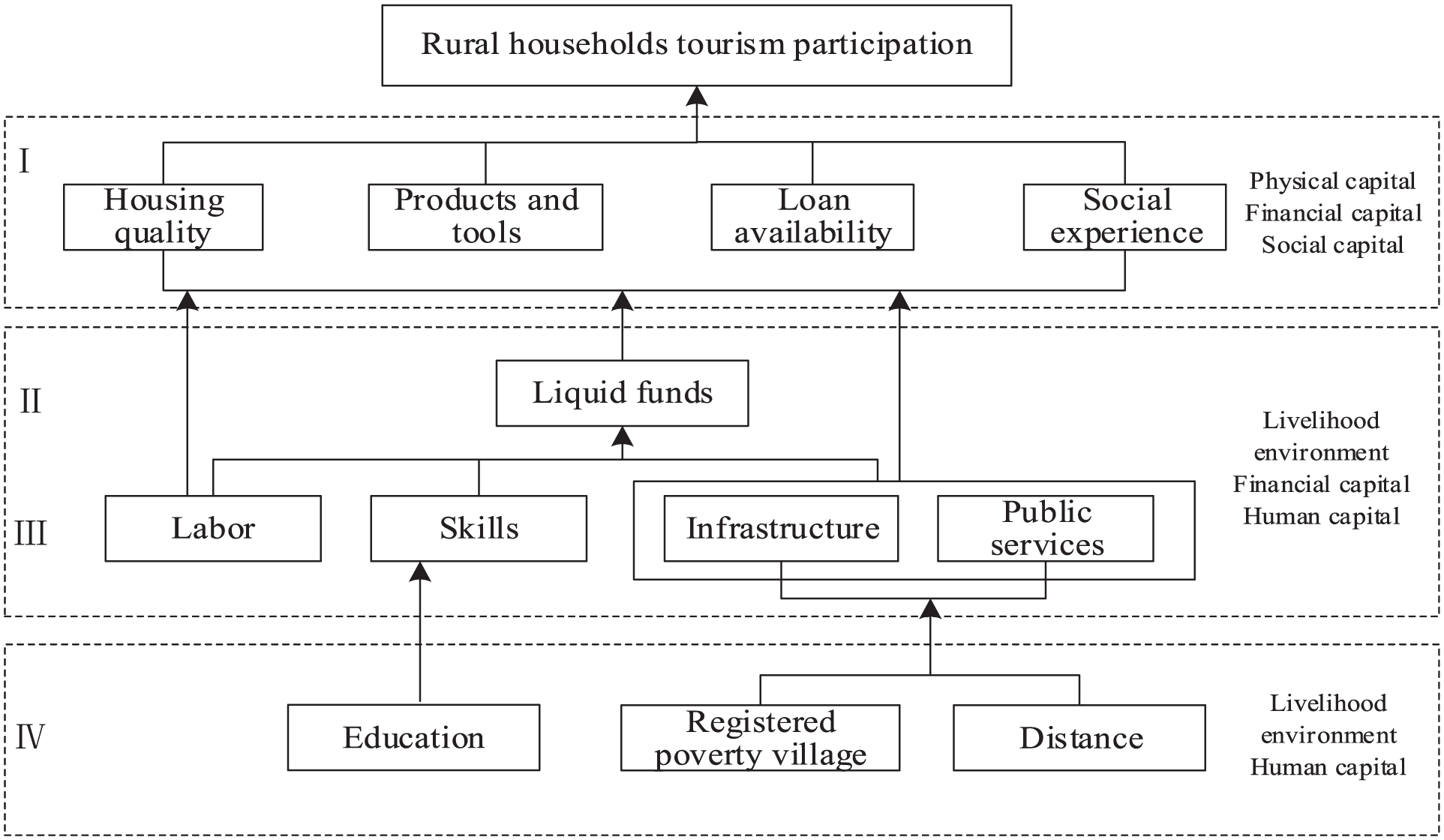
Hierarchical structure of factors influencing households participation in tourism.
It is useful to outline the hierarchical relationship between the different factors because it makes it clearer how certain relational paths affect tourism participation. As shown in Figure 6, social experience, housing quality, products and tools, and loan availability are direct factors that influence tourism participation. Liquid funds, labor, skills, infrastructure, and public services are intermediate indirect factors, while education, registered poverty village, and the distance from the community to tourism scenic spots are deep-rooted factors.
Among the three layers, the direct influences of the surface factors has already been discussed above. Regarding the influence of intermediate and deep-rooted factors, we can see four principal paths affecting tourism participation. These paths reveal a logical chain in rural household tourism participation resulting from the interaction between livelihood capital and community livelihood environment factors. First, physical, social, and financial capital form a direct path driving tourism participation. Second, human capital → financial capital → physical capital → tourism participation (i.e., education → skills → liquid funds → products and tools, housing quality → tourism participation) form a path by livelihood capital elements. Third, the path of natural conditions → infrastructure, public services → tourism participation (i.e., registered poverty village, and distance → infrastructure, public services → tourism participation) is the logical chain of tourism participation formed by community livelihood environment elements. Fourth, the paths of natural conditions → financial capital → tourism participation (i.e., registered poverty village, distance → infrastructure, public services → loan availability → tourism participation), and community livelihood environment → financial capital → physical capital → tourism participation (i.e., registered poverty village, distance → infrastructure, public services → liquid funds → products and tools, housing quality → tourism participation) are the logical chains of tourism participation influenced by the interaction of community livelihood environment and household livelihood capital factors.
In conclusion, the highlighted paths reveal that, besides any direct influence of livelihood capitals on tourism participation, they also function in a multilevel and structured way. Specifically, financial capital indirectly affects tourism participation through physical capital; it also functions as a “bridge” that connects livelihood capital with the community livelihood environment factors, to improve the participation rate. Human capital exerts an indirect influence through the surface factors of physical and social capital. Moreover, it serves as a deep-rooted force by enhancing financial assets and overcoming barriers to tourism participation. In addition, the community livelihood environment factors also have a hierarchical influence. Improved infrastructure and public services are conducive to activating participation through restructuring livelihood capitals (i.e., financial and physical capital). However, natural conditions (whether the community is a registered poverty village, and the distance from the community to tourism attractions) are the deep-rooted factors that influence tourism participation.
Factors Influencing the Participation of Low-Income Households in Tourism
Generally, low-income households may make different choices regarding tourism participation depending on their levels of livelihood capital and ability to deal with external opportunities and risks. Furthermore, as governmental policy takes a particular interest in the participation of low-income households, this study further investigated the factors influencing the tourism participation of these groups to reveal the specific paths shaping their engagement in rural tourism.
Table 4 presents the results of the binary logistic regression model for low-income households (Model 3) and the robustness test using a probit model (Model 4). The results indicate that several factors, including labor, housing quality, products and tools, loan availability, liquid funds, distance, infrastructure, and public services, significantly influence the tourism participation of low-income households. It is worth noting that the coefficient of education, skills, and registered poverty village are not significant on low-income households, which differs from the total samples. At present, low-income populations in rural China primarily consist of three types of individuals: people who have just been lifted out of poverty but remain economically vulnerable; some marginalized households prone to poverty; and those susceptible to sudden livelihood shocks. These households often have characteristically low levels of education, insufficient income, and disadvantaged ability for self-development. In addition, the latter two types of households are not usually eligible for China’s poverty alleviation policy assistance, regardless of whether they are in registered poverty villages. This may partly explain why communities being registered as poverty villages have no significant influence on low-income households’ participation in tourism, and some farmers are even marginalized.
Estimated Results of the Binary Logistic Regression for Low-Income Households.

Note. To save space, only the significant variables are listed.
p < .01. **p < .05. *p < .1.
Similarly, the binary logistic results in Table 4 show that eight factors,

Hierarchical structure of influencing factors affecting low-income households tourism participation.
Figure 7 displays four paths influencing low-income households’ participation in tourism. First, physical and financial capital constitute the direct paths. Second, there is a hierarchical structure between the various capitals, that is, human capital → financial capital → physical capital → tourism participation (i.e., labor → liquid funds → products and tools, housing quality → tourism participation). In contrast to the results for the total sample, the variables reflecting the quality of a family’s human capital (education, skills) failed to exert an indirect influence. Third, the path of natural conditions → infrastructure and public services → tourism participation (i.e., distance → infrastructure, public services → tourism participation) constitutes a logical chain formed by community livelihood environment factors for low-income households. Fourth, community livelihood environment → financial capital → tourism participation (i.e., distance → infrastructure, public services → loan availability → tourism participation), and community livelihood environment → financial capital → physical capital → tourism participation (i.e., distance → infrastructure, public services → liquid funds → products and tools, housing quality → tourism participation) form paths by the interaction between the community livelihood environment and household livelihood capital factors.
In summary, the likelihood of low-income groups engaging in tourism increases with a larger amount of available labor, higher quality of family housing, greater availability of durable products, and savings. However, long distances between communities and scenic spots reduce the likelihood of such groups participating. For low-income households, aspects related to the quality of human capital (education, skills), are often lacking, which failed to drive their participation rate; moreover, residing in disadvantaged areas hampers the accumulation of livelihood capital, leading to limited livelihood options and decreasing opportunities for tourism participation.
Discussion
Over the past 40 years, rural tourism has emerged as a crucial avenue for rural employment, industrial development, and government-led targeted poverty alleviation efforts in many developing countries. Areas developing tourism often overlap with abundant natural resources are accompanied by large poor populations. Particularly, the livelihood environment in these areas is fragile, and local conditions often constrain the structure and accumulation of household livelihood capital, which in turn limits livelihood choices. Therefore, it is crucial to understand how the hierarchical relationship between livelihood capital and the community environmental factors affects tourism participation. Unlike most studies focusing on independent roles of various factors in tourism participation, this study developed a revised SLF framework that integrates household livelihood capital with the community livelihood environment, and verified their complex influence on tourism participation using logistic-ISM method. Through in-depth analysis with sub-variables and samples, we aim to provide evidence for improving tourism participation rate in rural China and for poverty alleviation efforts in other developing countries.
Aside from the independent influence, our findings have revealed that different kinds of livelihood capital influence households’ tourism participation in a hierarchical and multilevel way. Human capital emerges as the deep-rooted factor that promotes tourism participation, while financial capital plays a mediating role. Physical and social capital represent direct surface forces that influence participation choices. In general, human capital determines the source and value of the physical and financial capital, on which households also depend to maintain their social networks. For instance, families with young and skilled labor forces are more likely to have a stable income source, which can be invested in housing improvement and the acquisition of durable facilities required for tourism operations. However, low-income households often face entry barriers to stock assets and cash flow, especially a low level of human capital, which constrains the accumulation of material capital. Thus, there is a “threshold” for poor populations to participate in tourism (Su et al., 2019). Investing in rural human capital is therefore an essential step towards stimulating other forms of capital and promoting tourism participation.
The community livelihood environment constitutes an external factor that influences households’ livelihood choices. Previous studies have indicated that community industrial development, infrastructure, public services, and the natural environment can decrease the vulnerability of poor households by accumulating livelihood capital (Sun et al., 2020). However, these studies did not specifically address how community environmental factors can affect the livelihood decisions of poorer people. This study demonstrates that community environmental factors influence households participation in tourism by reshaping the structure and composition of livelihood capital. In addition, low-income households face substantial barriers related to stock assets and cash flow when engaging in tourism. Among the community environmental factors, the distance from a community to scenic spots is significantly associated with the participation of low-income households, whereas being located in a registered poverty village shows no significant relationship. In the context of China’s targeted poverty alleviation, registered poverty villages have received more support and resources than non-registered ones. However, we found that some low-income individuals who are merely above the poverty line may fall outside the edge of this policy coverage and find it difficult to obtain assistance due to poverty standards. Meanwhile, although tourism development offers job opportunities, limited capital endowments restrict them more in the external living environment. This, to some extent, explains the persistently low participation rate of poor populations in rural tourism.
According to the SLF, capital endowments reflect the feasibility of livelihood activities. Previous studies have highlighted the need to enhance household abilities and strengthen community capacity in rural poverty-stricken areas (Latip et al., 2018; Yan & Gong, 2021). However, the key issues of “how to improve the ability” and “whose ability needs improvement” have not been adequately addressed. In China, government-led policy assistance has promoted regional tourism development, but it still shows an insignificant effect on poverty reduction in several rural areas (Deng et al., 2017). According to our findings, effectively improving rural household ability to participate in tourism requires further effort to enhance both livelihood capital and community livelihood environment conditions rather than just one other aspect. The former determines a household’s ability to participate in tourism, while the latter represents an external force that shapes the way livelihood capital is structured and transformed.
With regard to “whose ability needs improvement,” more low-income households need to be accurately targeted for participation in rural tourism. Previous studies indicated that due to disadvantages in initial asset endowments, some low-income populations find it difficult to engage in tourism (Su et al., 2019). In practice, many poor households express a willingness to participate in tourism or have previously engaged in tourism activities with limited support from government, agencies, or the tourism sector, which reduces their likelihood of continued participation. In the context of China, three types of households constitute distinct low-income groups as mentioned, among which only a portion are covered by policy assistance. Despite of these registered households participating in tourism through assistance measures such as direct subsidies and anti-poverty projects that concentrate on returns on asset investments, these assistance measures have failed to foster a wider feasibility to participate in tourism activities. Furthermore, some low-income households remain unsupported due to the poverty line constraint, even if they would otherwise engage in tourism-related activities. Therefore, our findings suggest an urgent need to further subdivide low-income populations, and prioritize households with the enthusiasm and potential to participate in rural tourism. This especially relates to those who face endowment barriers such as insufficient funds, skills, and education, social relationships, and information, to effectively participate in tourism activities.
Overall, the key contribution of this study lies in its application of the revised SLF to identify the factors influencing rural households’ participation in tourism from the perspectives of household livelihood capital and community livelihood environment. It addresses gaps in the existing literature, which has only primarily focused on independent influences as well as overlooked the role of community environment factors. In particular, this study offer a specific focus on low-income households by clarifying the pathways through which internal capital constraints and external environmental factors hinder their engagement in tourism. The findings provide valuable insights for policymakers seeking to broaden tourism participation in China and other developing countries.
Conclusions and Implications
Conclusions
Using the revised SLF and the logistic-ISM model, this study has proposed an analytical framework to unify household livelihood capital and community livelihood environment factors, and clarify the hierarchical determinants of tourism participation. On top of various independent influences reported in previous studies, this study has revealed that livelihood capital and community livelihood environment factors have a hierarchical relationship and interact in ways that strongly influence the participation of rural households.
First, human, financial, physical, and social capital show significant and beneficial effects on the probability of tourism participation. Regarding community livelihood environmental factors, natural conditions have a negative effect on tourism participation, while improvements in infrastructure and public services play a considerable and positive role. Second, physical and social capital directly influence the probability of participation, while financial capital functions as a “bridge” that connects livelihood capital with the community livelihood environment factors. Human capital and the livelihood environment, that is, the education level of household heads, the distance from the community to scenic spots, and being registered as a poverty village are deep-rooted factors. They affect the possibility of tourism participation by reshaping the scale and structure of various types of livelihood capital, community infrastructure, and public service conditions. Finally, there are different patterns in the paths that influence tourism participation of low-income households, compared with the total sample households. More importantly, the probability of low-income households participating in tourism is indirectly constrained by available labor, while community infrastructure and public services can improve tourism participation by enhancing access to financial and physical capital, with the distance from the community to scenic spots serving as a deep-rooted factor. These findings imply a need to distinguish between different sub-groups and a urgency to prioritize those poor households with the enthusiasm and potential to participate in rural tourism but that currently face capital endowment barriers, so as to improve the coverage of tourism participation in rural China.
Implications and Limitations
In the post-poverty alleviation era of China, participating in rural tourism presents a more rational, sustainable, and stable approach. This study contributes to existing theoretical implications by providing a unified perspective on the determinants shaping rural tourism participation choices, which considers both household capital endowments and community livelihood environment conditions based on a revised SLF. It also addresses a lack of research regarding these factors on poorer rural households.
Furthermore, the conclusions have several policy implications for consolidating the achievements of poverty alleviation in China. First, to improve the quality of human capital and enhance access to tourism participation, it is recommended to expand skill training programs related to rural tourism operations, service etiquette, and related competencies. Second, continuous improvement of infrastructure and public services in tourism communities is essential to generate multiplier effects through the coordinated development of the tourism industry and to create more employment opportunities in rural areas. Third, policymakers should encourage tourism enterprises and local communities to strengthen top-level planning for tourism development and promote the establishment of large-scale tourism industries, thereby enhancing their spillover effects on surrounding households. Fourth, to increase engagement and benefits in the tourism industry, governments could encourage migrant workers to return to their hometown and start businesses through preferential measures such as tax reductions, rent exemptions, and business subsidies. Finally, there is a need to re-examine the targeting mechanisms of pro-poor tourism policies in the Chinese context, with particular attention to low-income households that possess both the ability and willingness to engage in tourism but face endowment-related barriers not addressed by current policies. This, we would argue, is not only an issue for rural China, but also for other developing countries as well.
Despite the contributions mentioned, several limitations also should be addressed in future research. The definition of tourism participation adopted here, from the perspective of rural households, primarily focuses on economic aspects. That is, when local residents engage in and benefit from distinct tourism activities, it is considered as participation; and vice versa. Future research should further explore the differing determinants regarding other dimensions of tourism participation such as involvement in tourism planning and management within communities, entrepreneurship in tourism, as well as full-time and part-time employment. It is also necessary to examine the influential factors for segmented groups such as tourism entrepreneurs and non-farm employees to clarify the preference and dilemma of rural households in specific fields. In addition, this study used a convenience sampling method for sample households and focused solely on the western regions of rural China. Future investigations should adopt more optimized sampling strategies to enhance the credibility of the findings. Expanding the sample size to include other representative poverty stricken areas would further strengthen the generalizability and applicability of the findings.
Supplemental Material
sj-docx-1-sgo-10.1177_21582440261421989 – Supplemental material for Factors Determining Rural Household Participation in Tourism: A Logistic-ISM Model Approach
Supplemental material, sj-docx-1-sgo-10.1177_21582440261421989 for Factors Determining Rural Household Participation in Tourism: A Logistic-ISM Model Approach by Peiying Dang, Jie Li and Lin Zhang in SAGE Open
Footnotes
Acknowledgements

Ethical Considerations
All procedures performed in the study were in accordance with the ethical standards of the university. Ethical clearance and approval were granted by Xi’an Jiaotong University.
Consent to Participate
Informed consent was obtained from all individual participants included in the study.
Author Contributions
Conceptualization: Peiying Dang and Jie Li; Methodology: Peiying Dang and Jie Li; Software: Peiying Dang, Jie Li, and Lin Zhang; Writing – original draft: Peiying Dang; Writing – review & editing: Peiying Dang and Jie Li; Visualization: Lin Zhang. All authors have read and agreed to the published version of the manuscript.
Funding
The authors disclosed receipt of the following financial support for the research, authorship, and/or publication of this article: This work was supported by the Fund Project - the New Liberal Doctor “Qinling Light” Project of Shangluo University (Grant No: 23DSSK002).
Declaration of Conflicting Interests
The authors declared no potential conflicts of interest with respect to the research, authorship, and/or publication of this article.
Data Availability Statement
The data that presented in this study are available on request from the corresponding author.*
Supplemental Material
Supplemental material for this article is available online.
References
Supplementary Material
Please find the following supplemental material available below.
For Open Access articles published under a Creative Commons License, all supplemental material carries the same license as the article it is associated with.
For non-Open Access articles published, all supplemental material carries a non-exclusive license, and permission requests for re-use of supplemental material or any part of supplemental material shall be sent directly to the copyright owner as specified in the copyright notice associated with the article.
