




Abstract
Strengthening the adaptability of vocational skill to the economy and the society is an important path for the workforce to improve its income level. Based on 6,725 samples from the Chinese General Social Survey database spanning 7 years, Stata17.0 and the adjusted Mincer’s education earnings equation are used to empirically analyze the impact of vocational education’s skill match on the workforce’s salary income in China. The econometric results show that in general skill match, the interaction term between skill match and Internet use, and the interaction term between skill match and education could significantly positively affect individual salary income, with impact coefficients of .01, .01, and .005, respectively; the heterogeneity analysis reveals that skill matching has a more significant effect on income enhancement for the older age, male, the higher level of educational qualification, and the eastern part of the country. The effect of skill matching on income is significantly higher in the eastern region than those in the central and western regions, and the middle and lower income groups are more significantly affected by skill matching. The contribution of this study is to empirically analyze impact of skill match and its moderating effects on individual salary income as per the education level being vocational education in China, which in turn helps to strengthen the skill training at all stages of vocational education, pay attention to the dissemination of information and the use of technology on the Internet, and improve the coordination of professional settings and job requirements among regions.
Plain Language Summary
The purpose of this research is to detect the effect of skill match on salary income in China’s vocational education, 6,725 samples across seven years from the database of Chinese General Social Survey are used, Stata17.0 and the adjusted Mincer’s education earning equation are adopted to make empirical analysis, and achieves that skill match, the interaction term between skill match and Internet use, and the interaction term between skill match and education could significantly positive affect individual salary income, and the impact on the elder, the male, the higher degree of education, the eastern, the middle and lower income level groups. The contribution of this study is to empirically analyze the impact of skill match and its moderating effects on individual salary income as per the education level being vocational education in China. The limitations are the complexity of the measurement of skill match, the factor influencing skill match and salary earnings and the determination of income are complicated, and should make further analysis.
The Question Proposed
In the context of the global transformation toward a skills-based economy, skill matching has been widely validated as a core indicator of labor market efficiency linked to individual income (Allen & Van Der Velden, 2001). Currently, enhancing skills has become a focus of China’s national strategy, for example, the Implementation Plan of the Skills China Action was issued in June 2021, Guidelines on the Salary Distribution of Skilled Talents was issued in July 2021, the Opinion on Promoting the high-quality Development of Modern Vocational Education was issued in October 2021, the Opinion on Strengthening the Construction of Highly Skilled Talents in the New Era was issued in October 2022, and the Opinion on Deepening the Reform of the Construction of the Modern Vocational Education System was issued in December 2022, a series of policies demonstrate the importance of promoting the level and the quality of the workforce’s skill urgently in China. In addition, China’s leaders have also paid great attention to vocational education and vocational skills upgrading, such as President Xi Jinping’s congratulatory letter to the World Congress on the Development of Vocational and Technical Education in August 2022, “China actively promotes the high-quality development of vocational education, and supports exchanges and cooperation of vocational education between China and foreign countries.” Furthermore, Premier Li Qiang’s comments on the 2nd National 2023 Vocational Skill Competition with the instruction, “Skilled talents are valuable resources for the implementation of the strategy of strengthening the country with talents, the strategy of prioritizing employment, and the strategy of innovation-driven development.”
Meanwhile, it is an undeniable fact that China is facing a large quantity of skilled labor shortage. On one hand, for example, the Manufacturing Talent Development Planning Guide showed that the gap in talent demand in China’s key manufacturing industries in 2025 would reach 29.857 million, with the gap rate being over 48% (Xu et al., 2024); on the other hand, the current supply of graduates of vocational colleges and universities could not effectively meet the needs of society, which leads to the imbalance of supply and demand in the labor market. For example, a survey conducted by the National Bureau of Statistics of China in 2021 showed that 44% of enterprises’ biggest problem was the difficulty in recruiting laborers, which would further deepen the shortage of the skilled workforce. Seen from the workforce’s perspective, skills enhancement has become an inevitable choice to effectively adapt to the development of society, yet there exists the problem of the fitness of skills to social demand, which would inevitably be accompanied by a relative mismatch in salary level. At present, the salary income of vocational education presents an inverted phenomenon, such as the average monthly income of graduates of higher vocational colleges and universities in 2022 in Guangdong province was RMB Yuan 3,869.21, while the average monthly income of the national rural workforce in 2022 announced by the National Bureau of Statistics of China was RMB Yuan 4,615, which has aroused a hot debate on the return rate of higher vocational education, and this might be caused by skill mismatch. However, many studies have explored the existence of skill mismatch in vocational education, but they have mostly analyzed the causes of the problem from the theoretical perspective of supply-side shortages and structural imbalances. Hence, there is a relative lack of empirical research on the impact of skill matching on earnings in vocational education. For this reason, it is necessary to analyze the relationship between skill match and income in vocational education. The research provides a novel explanation for resolving the “skill-income inversion” paradox in vocational education and offers empirical evidence for the “skill value enhancement” provisions in the Vocational Education Law.
Literature Review
Considering relevant research on skill match and income in vocational education, scholars have primarily focused on the perspectives of skill mismatch, and a relevant literature review can be conducted from the following three aspects.
The first aspect is about the definition and evaluation of skill mismatch. It is a generalized phenomenon that skill mismatch occurs among laborers during work (Allen et al., 2001; Liu et al., 2016; Sun, 2023), and scholars usually define it from both vertical and horizontal dimensions. As per the vertical aspect, Wolbers (2003) defined that from angles being over-educated, under-educated, over-skilled, or under-skilled, and Quintini (2011) argued that it included the categories of “over-skilled” and “under-skilled”; as per the horizontal aspect, Robst (2007) pointed out that the fitness between the profession and the occupation was a good measure for skill match, and Schweri et al. (2020) considered horizontal mismatch to be formed when laborers were employed in a field different from the one in which they have studied or acquired corresponding vocational training. Existing studies mainly used the subjective self-evaluation method as the main treatment, that is, laborers themselves subjectively assessed the level of individual skills or evaluated the skill mismatch with the level of skills required by the content of the job. For example, Liu et al. (2020) took the graduate majoring in engineering as the research object and used the self-assessment method to define skill mismatch, which involved the question “Do you think that the skills you have mastered are compatible with the needs of your current job?”; Zhao and Jiang (2023) used the subjective self-assessment method to define skill match based on the CLDS database, which involved the question “Please rate the use of your skills in your current job”. In addition, Guvenen et al. (2018) argued that the productivity of certain individual laborers was a positive function of the quality of skill match. Meanwhile, some scholars have also argued that the longer a laborer’s job tenure, the lower the probability of obtaining a substitute job with its higher match quality would be, hence, job tenure was used as an important indicator of skill match (Topel & Ward, 1992).
The second aspect is about the factors influencing skill mismatch. Scholars usually divide factors influencing skill into categories education, industry characteristics, the demographic group, and the regional space. In terms of education factors, Morsy and Mukasa (2020) detected the situation of youth employment from 2012 to 2015 in 10 African countries, found that the phenomenons of skill insufficiency and education insufficiency among young people commonly existed, and considered that the education level of young people and their parents, field of study, job quality, and the size of the firm employed were key factors for job mismatch; Adely et al. (2021) found that skill mismatch was an important cause of unemployment in Jordan and the Arab countries in general, and that was the evidence of the low quality of education in this region; Liu (2021) found that an improvement in the quality of secondary vocational education could help to reduce the prevalence of skill insufficiency by taking a logistic model. In terms of industry characteristics, Jonbekov (2015) empirically dissected the skill mismatch of college graduates, noting that graduates in majors such as health science and engineering face a lower incidence of job and skill mismatch. In terms of the demographic group, Dibeh et al. (2019) found that perception of skill mismatch was primarily caused by being male, single, highly educated, and the upper-middle social class by taking a bivariate probability model and based on employment data for laborers being 15 to 29 years old. In terms of the regional spatial perspective, Theys et al. (2019) detected the evolution of regional mismatch in the United States over the period 1980 to 2010, and found that the extent of spatial mismatch between low-skilled and high-skilled laborers had shown an increasing trend, for example, from 2% in 1980 to almost 4% in 2010.
The third aspect is about the relationship between skill mismatch and earnings. Vocational education is an important pathway for skill development and skill formation (McGrath & Yamada, 2023), which affects the income level of an individual significantly. It is commonly believed that skill mismatch reduces salary income, which is mainly affected by gender differences, industry features of the firm, and educational degrees. In terms of gender difference, Chu (2003) found that less educated laborers in Canada could achieve wage growth by adjusting their skill levels and better skill match by taking the database of Canada’s Survey of Labor and Income Dynamics (SLID), which could help to reduce the gender wage gap; Kim and Park (2016) estimated the wage loss of skill mismatch for young laborers in South Korea by using the propensity score match method (PSM) and the ordinary least squares method (OLS), and achieved that skill mismatch led to a wage loss of 3.8% and 5.6% for the male and female, respectively. In terms of industry features of the firm, Chen (2017) found that skill mismatch caused the deterioration of consumption inequality and income inequality by constructing a dynamic stochastic general equilibrium model containing heterogeneous firms with heterogeneous skills; Liu (2019) estimated the incidence of education mismatch and skill mismatch among China’s laborers and their income effects by using the database of China General Social Survey (CGSS), and achieved that wage incomes for both over-education and over-skilled was 38% lower than those of the group with both under-education and skill match.
There is much research on skill mismatch and its impact on earnings, and the influencing factors have been examined from different perspectives, but the usually detect the impact of higher education on skill mismatch or skill formation, and the sample subject is homogeneous. Vocational education is the most important supply side of the formation of vocational skills, and the fact that vocational education is regarded as a type of education in China, highlights its importance, but the majority analyze the impact on salary income from the perspectives of education mismatch, incidence of education mismatch, over-education, etc., or examining the impact of skill mismatch and skill matching on salary income by making data from the enterprise industry. Thus, it is necessary to examine the impact of skill mismatch formed by different vocational education on the workforce’s salary and income, which is basically not addressed in the existing literature. Subsequently, taking vocational education as the object for research, and on the basis of constructing a theoretical model and putting forward the corresponding hypotheses, we detected the effect of skill match on salary income by taking the database of the Chinese General Social Survey (CGSS).
Modeling and Research Hypothesis
Establishment of Theoretical Model
As per the education’s effect on income, scholars usually take the Mincer equation. For example, Rotunno and Wood (2020) used the extended Heckscher–Ohlin model to examine the variation between skill supply and wages, Slavík and Yazici (2022) used a quantitative macroeconomic model to examine the relationship between wage risk and the skill premium, and Singh et al. (2023) took an augmented Mincer equation to examine the effect of skill certification on monthly wages, and Lasso-Dela-Vega et al. (2023) took the extended Mincer equation to examine the effect of educational mismatch and gender on wages. Based on this, drawing on Mincer’s equation for the return to education (Mincer, 1974), the basic model is shown in Equation 1:

Here,
To judge the effect of skill match on salary earnings, Equation 1 is rewritten by replacing an individual’s actual years of education with the degree of skill match:

Here,
An individual’s salary income is influenced by multiple factors. It is often assumed that in addition to skill match, an information-based society requires laborers to have appropriate skills in using the Internet (Brouer et al., 2015; Castellacci & Bardolet, 2019), and that the status quo of education could also be an important dimension(Johnson et al., 2023; Spence, 1973). The above two would be linked to an individual’s skill match affecting salary income, that is, it would have a moderating effect. Later, Internet use and educational status are included as important factors in the model for detecting relevant factors influencing salary income. However, the focus of this study is on the effect of skill match on salary income. To fully consider the effects of Internet use and educational status, the interaction terms of skill match and Internet use, and the interaction terms of skill match and educational status are incorporated into the model, resulting in Equation 3:

Here,
In addition to the three main variables mentioned above, all other factors affecting the individual’s salary income are considered as control variables. Hence, Equation 3 could be rewritten as:

Here,
Research Hypotheses
The salary income of a laborer is directly related to the remuneration that the employer is willing to pay, which could be interpreted through the theory of job match. When employers hire laborers, they would screen out the skills or talents that suit their needs through recognizable signals firstly, that is, they would treat diplomas, certificates, and work experience as signals. Only after entering the range of consideration, potential laborers in the job market might be transformed into effective employees. Based on the theory of human-job match, it is known that the differences in human personality would lead to certain individuals being suitable for different occupations or categories of work or job, but the individual characteristics and occupations not match would lead to the loss of efficiency and income of the laborers (Feng & Yue, 2023). Specific positions or jobs require corresponding skills to match, and the laborer who does not have the skill, even if owning comparatively high level of technology and skill in other areas, could not be effectively manifested in the specific work, resulting in the emergence of a more obvious mismatch between the supply of skill and the demand for skill, which might appear that the skills can not reflect its proper value, and Zou et al. (2009) achieved the same conclusion. In other words, laborers with high technical skills might earn less than the average salary of employees with the same level of skills and fit for the position due to skill mismatch. Accordingly, we propose hypothesis H1: salary income is positively related to skill match.
The rapid advancement of the digital and intelligent society has posed challenges to laborers in adapting to the needs of economic and social development. For example, the emergence of the new categories of businesses and modes would give rise to more jobs with the feature of new economy, which demonstrates that skilled personnel would be required to master more corresponding skills, and this would force laborers to take the initiative to learn various skills to strengthen their employability in the labor market. Therefore, improving laborers’ cognitive and perceptual abilities suitable for modern society, especially capabilities being able to effectively access all kinds of modern information to reduce transaction costs (Liberti & Petersen, 2019), is an important path to obtaining more and more effective jobs, which in turn would help laborers to improve their income levels. Among these, Internet use is an important means of accessing valuable information and has a more significant impact on the income of highly skilled laborers (Dimaggio & Bonikowski, 2008). In fact, the Internet could effectively be a corresponding channel for skill supply and skill demand, and achieve comparative job matches based on the search for the job, which could reduce both the current market mismatch of laborers (Stevenson, 2008) and the information retrieval and comparison costs for employers (Fen & Guo, 2023). That is, from the perspective of information asymmetry, the use of the Internet helps to reduce the information asymmetry between skill supply and skill demand in the labor market and improve the degree of match between laborers and job vacancies (Mayer, 2011), which in turn might raise the level of laborers’ salary and income. Therefore, it could be deduced that the salary income of laborers should be positively related to the degree of Internet use. Considering that the study mainly focuses on the effect of skill match on salary income, that is, the interaction term between skill match and Internet use needs to be fully considered. Accordingly, we propose hypothesis H2: salary income is positively associated with the interaction term of skill match and Internet use.
The effect of education on salary and earnings could be detected from both human capital theory and signaling theory. From the perspective of human capital theory, scholars usually consider that promotion of the educational status would increase the level of the average wage (salary) level (Kennan & Walker, 2011), but this might widen the income gap to a certain extent (Chae, 2022). Instead, it is generally believed that higher educational status would increase labor productivity (Du & Guo, 2023). For example, Prime et al. (2016) found that the median wage for a high school graduate was US $28,708 in Milwaukee and US $25,693 in Los Angeles in 2012, compared to US $66,024 and US $73,642 for those with a degree of graduate. From the perspective of signaling theory, the level of education is an effective signal reflecting the individual’s ability or future productivity (Li & Bai, 2020), that is, the employer would rely on the diploma certificate to judge the ability of the laborer in general. Meanwhile, owing to the obvious fact of being “sheepskin effect” and not being equal to the level of skill or productivity for the future, the level of education is only detected as an important reference indicator of income rather than a decisive factor. For example, the demand side of the market for migrant laborers generally attaches more importance to physical and professional skills, while the human capital signals presented based on educational status and years of education make the demand side tend to underestimate the value of the human capital of education when paying wages (Luan, 2022). At this time, there would exist payment penalties when laborers own higher skill levels but with lower educational backgrounds, that is, laborers’ skills are not well utilized in certain jobs or positions, and they might be penalized with comparatively low wages (Onozuka, 2022), which in turn leads to the phenomenon of inverse linkage between skill level and salary. Detected from this aspect, the educational background should show a significant positive correlation with salary income, and in turn, the interaction term with skill match should also be positively correlated with the laborer’s salary income. Accordingly, we propose hypothesis H3: salary income is positively associated with the interaction of skill match and education.
Description of Data Sources and Variables
Data Sources and Description
The data are derived from the Chinese General Social Survey (CGSS). Among these data 2010, 2012, 2013, 2015, 2017, 2018, and 2021 were selected, and the age of the labor force was limited to 16 to 65 years old. Given that the study aims to detect the impact of vocational education’s vocational skills on salary income, two levels of samples were selected for secondary and higher vocational education. Specifically, the vocational high school, the junior college, and the technical schools were selected as secondary vocational education, and the adult higher education (Cheng Ren Da Zhuan) and the formal higher education (Zheng Gui Da Zhuan) were selected as higher vocational education. In terms of sample size selection, referring to the treatment of Si and Zhang (2021), the group with an annual occupational income of more than RBM Yuan 1,200 was selected, and those missing values and outliers were eliminated, such as the corresponding missing values, not knowing and refusing to answer variables. Therefore, 6,725 effective samples from 31 provinces were obtained, of which the quantity of the effective sample in 2010, 2012, 2013, 2015, 2017, 2018, and 2021 is 996, 1,037, 1,069, 774, 1,157, 1,107, 585, respectively.
Definition of Variables
Explained Variable
The explanatory variable is the laborer’s annual occupational income. The salary income of the interviewees is determined based on their full-year occupational/labor income in the previous year. To reduce the effect of the range of data distribution, the annual occupational income of laborers is taken as a natural logarithm.
Explanatory Variables
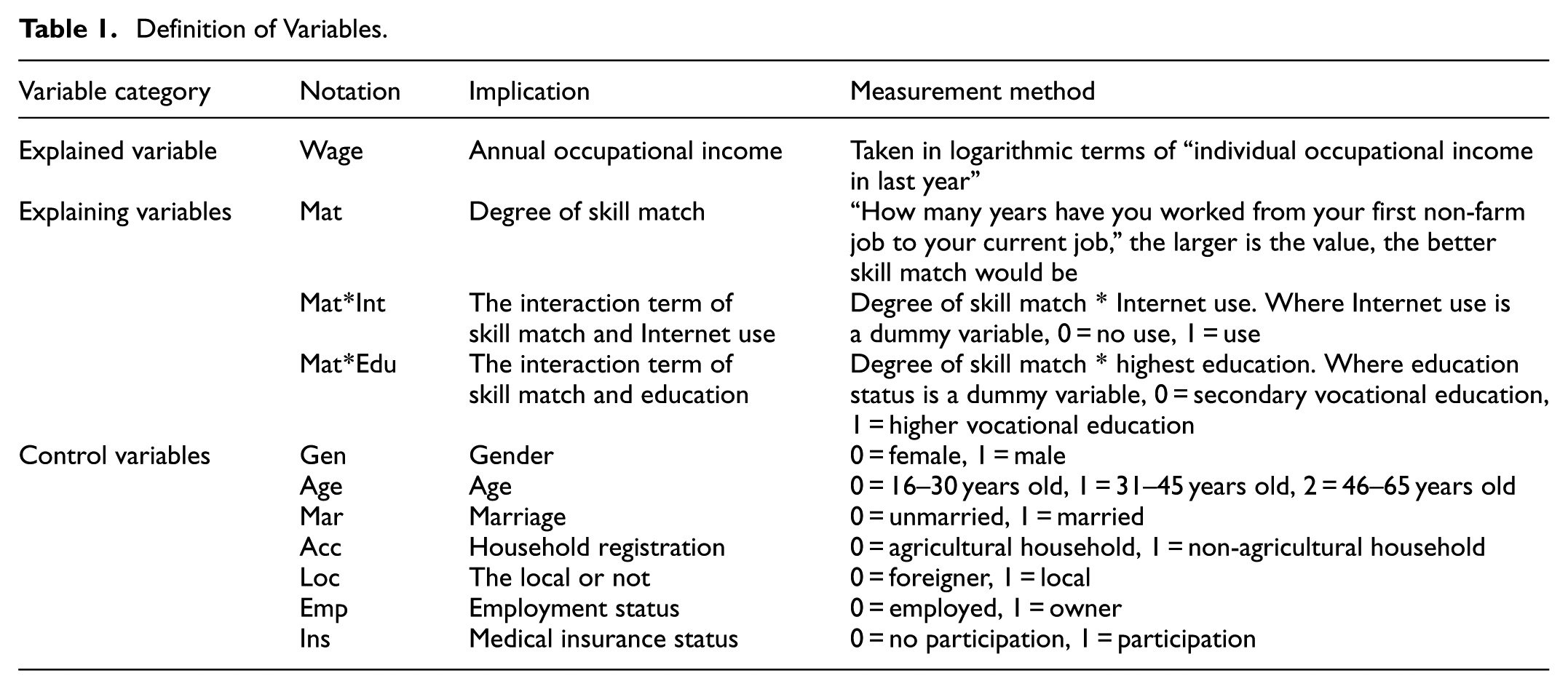
The explanatory variables include skill match, the interaction term between skill match and Internet use, and the interaction term between skill match and educational attainment. (1) Drawing on the measurement method brought by Wang (2021), the question “From the first non-farm job to the current job, how many years have you worked in total” is selected as the measurement of skill match, and the larger is the value, the higher the degree of skill match would be. (2) Drawing on the method brought by Wang and Kuang (2022), the question “Whether to use the Internet during the free time” in the questionnaire is used as the measurement of Internet-related situations, and the original data include “every day,”“several times a week,”“several times a week,”“several times a month,”“several times a year or less,”“never,” with the value assigned from 1 to 5, respectively. For detecting the moderating effect of Internet use on skill training, the interaction term between skill match and Internet use is taken and the variables are decentered. (3) Drawing on the method brought by Li and Ding (2003), different stages of education are set as dummy variables, with the question being “Your current highest level of education” in the questionnaire, and the secondary vocational education and the higher vocational education are selected as the above mentioned. Here, we donate the value of secondary vocational education and higher vocational education as 0 and 1, respectively. With the same treatment of the moderating effect of Internet use on skill training, the interaction term between skill match and Internet use is taken and the variables are decentered.
Control Variables
Many scholars consider that many factors would influence skills’ effect on income. For example, Rotman and Mande (2023) found that gender differences had a significant impact on skills on wage income, Bach et al. (2024) detected that women’s salary income were heavily influenced by characteristics of socioeconomic status such as marital status, Mnasri (2018) found that geographic mobility had an impact on income, Xu and Zheng (2023) achieved that health capital could affect residents’ income, Kwon (2023) touched that age affects income, and Shimoda et al. (2021) found that there was relationship between income and gender, or age in Japan. In summary, scholars usually considered some factors, such as gender, age, status quo of marriage, household registration, whether local or not, the status quo of employment, and the status quo of health insurance, would also have an impact on the individual salary income of laborers, which could be regarded as control variables.
As per the gender, females and males are assigned as 0 and 1, respectively. As per the age, based on the question “What is your date of birth,” the actual age is calculated by subtracting the year of birth from the year of survey, assigning the value of 0 to 16–30 years old, 1 to 31–45 years old and 2 to 46–65 years old. As per the status quo of marriage, the question “Your current marital status” is taken, we treat the state of unmarried, the state of cohabiting, the state of divorced, the state of widowed as unmarried, and donate the value as 0; treat the state of first marriage with a spouse, the state of remarried with a spouse, the state of separated and not divorced as married, and donate the value as 1. As per the household registration, the question “Your current Hukou level status” is taken, we set Agricultural Hukou, and Resident Hukou (formerly agricultural) as 0; those such as Non-Agricultural Hukou, Military Hukou, Registration as non-agricultural Hukou, No Registration Hukou, Other Hukou, are assigned as the value being 1. Meanwhile, the Blue Print Hukou was deleted. As per the local or not, the question “Your current place of Hukou registration” is taken, we treat “outside this district/county/county-level city” as a foreigner, and set it as 0; “this township (township, street)” and “other townships (townships, streets) in this county (city, district)” are considered as a local, and set it as 1. As per the status quo of employment, the question “Your current work status” is selected, we treat “employed by others (with a fixed employer),”“laborer/labor dispatcher,”“part-time or casual laborer (employed without a fixed employer)” and “freelancer” and “others” as employed, and set it as 0; treat “self-employed,”“worked/helped in own business/enterprise for pay,”“worked/helped in own business/enterprise for no pay” as the owner of a certain business or firm, and set it as 1. Meanwhile, exclude sample sizes that don't know, or refuse to answer. As per the status quo of health insurance, the question “Are you currently enrolled in any of the following social security programs: urban basic medical insurance/new rural cooperative medical insurance/publicly-funded medical care?” is selected, we set “not enrolled” and “enrolled” as 0 and 1, respectively. Meanwhile, exclude sample sizes that don’t apply, don’t know, or refuse to answer (Table 1).
Definition of Variables.
Descriptive Analysis
Using Stata 17.0 as the tool for further research, we achieve the merged cross-sectional data after the corresponding treatment, with the detailed descriptive statistical results being in Table 2. The average value of the annual occupational salary income is RBM Yuan 55,984 (here, the value being 10.536 yuan after taking the logarithm), although samples taken are larger than RBM Yuan 1,200, those are affected by the deletion of samples. The minimum value and the maximum value are RBM Yuan 1,500 (here, the value being 7.313 after taking the logarithm) and RBM Yuan 6,016,402 (here, the value being 15.607 after taking the logarithm), respectively, which shows that there is a significant difference in the salary income of laborers. The average value of the degree of skill match is 14.666, indicating that the respondents have been working for about 15 years generally, and the minimum value and the maximum value are 0 and 50, respectively. In terms of Internet use, 92.5% of the respondents use the Internet, which could be regarded as a general use of the Internet by the respondents or with the help of the Internet. However, there is still a small portion of respondents who do not use the Internet, which might be related to the fact that these samples selected are about 16 to 65 years old, that is, the age of elder respondents is not familiar with using the Internet (Du & Luo, 2023). Seen from the interaction term of Internet use and skill match, the minimum value of the sample is −32.696 and the maximum value is 13.551. Base on the degree of education of respondents, vocational high school, secondary school, and technical school account for 9.4%, 27.7%, and 4.0%, respectively, and adult junior college and regular junior college account for 23.8% and 35.1%, respectively. The above implies that the higher vocational category accounts for 58.9%, which could be considered as respondents are mainly educated being higher vocational education. In consideration of the interaction term between skill match and education, the minimum value and the maximum value are −20.811 and 14.539, respectively.
Descriptive Statistics of Major Variables.

Note. Mat*Int and Mat*Edu are decentered, which induces some value to be negative.
Empirical Analysis
The empirical analysis is conducted from three aspects, which are benchmark regression, heterogeneity, and robustness test, respectively.
Baseline Regression
To analyze the effect of laborers’ skill match on salary income, the modified OLS model and stepwise regression method are used, as the interaction term of skill match and Internet use, and the interaction term of skill match and education on salary income, with the detailed econometric result being in Table 3. As per Table 3 and the subsequent econometric tables, the seven control variables mentioned in Equation 4 are added. Given the corresponding differences in the level of individual skill match among different provinces and different years, the regional and period effects are controlled by considering empirical analysis.
Econometric Result of Impact of Skill Match on Salary Earnings.

Note. p-values are in parentheses.
, **, and *** denote passing the 10%, 5%, and 1% significance test, respectively.
All variables in the model (1), the model (2) and the model (3) passed the 1% significance test, and the overall fitness of these three models is good. In addition, whether add adjustment variables or not, the difference between β1 is not significant among the above three models, and these are all about .01. Hence, the econometric results verify hypothesis H1, that is, occupational skill match helps to improve the level of salary income of laborers.
Implementation of the interaction term of skill match and education would relatively weaken the moderating effect of the interaction term of skill match and Internet use on salary income, that is, β1 in the model (2) decreases from .011 to .010. As seen from the model (3), β2 and β3 are .010 and .005, respectively, which verifies hypotheses H2 and H3. Considering the positive correlation between skill match and salary income, we could assume that the effects of Internet use and education on salary income are both positively related. Using the Internet helps laborers improve their ability to search for jobs that match their skills, which is consistent with the findings of Brouer et al. (2015). As an important skill-screening signal, a better education leads to better career prospects, and higher earnings (Wicht et al., 2019), which is supported by the econometric results of its interaction term with occupational skill.
Heterogeneity Analysis
There might exist significant differences in occupational skills affecting salary income as per different features, such as individual characteristic differences, regional differences, and income level differences. Later, we make an econometric analysis of heterogeneity from the above three aspects.
The Individual Characteristic Difference
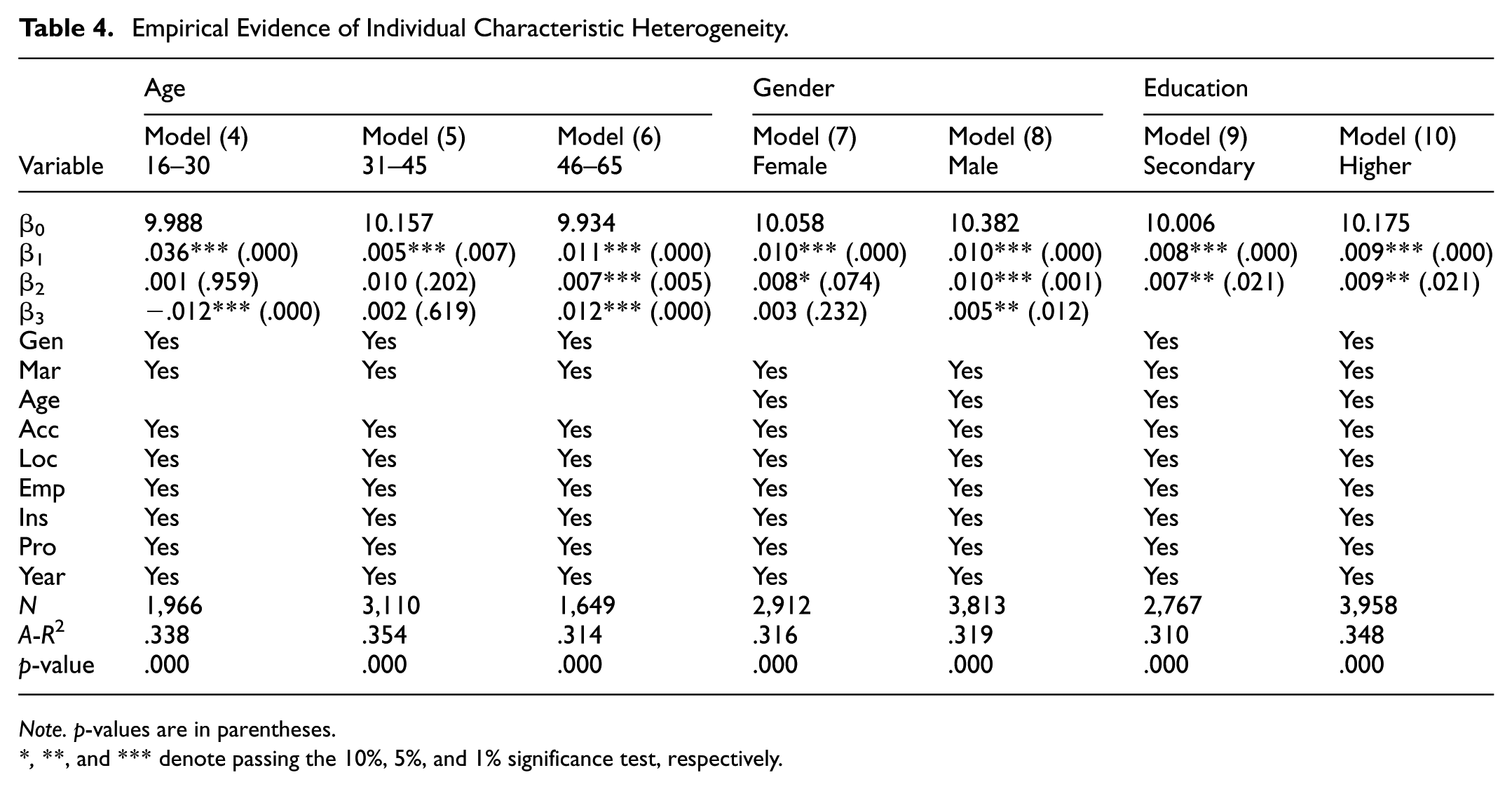
The effect of skill match on salary income might produce group heterogeneity due to the existence of differences in laborers’ age, gender, education, etc., and for this reason, it is necessary to explore what kind of group effect would be produced by different individual characteristics. Based on the targeted control variables and the targeted educational requirements, the age is divided into three sub-samples 16 to 30 years old, 31 to 45 years old, and 46 to 65 years old, respectively; the gender is divided into two sub-samples, is the male and the female, respectively; the education is divided into two sub-samples being secondary vocational education and higher vocational education. The heterogeneous results of individual characteristics of occupational skill match affecting salary income are detailed in Table 4.
Empirical Evidence of Individual Characteristic Heterogeneity.
Note. p-values are in parentheses.
, **, and *** denote passing the 10%, 5%, and 1% significance test, respectively.
Seen from the heterogeneous results on age, skill match is significantly positively related to salary income at all ages and passes the 1% significance test, but the differences in the moderating effect are obvious. Laborers less than 45 years old generally use the Internet, while there exist obvious individual differences when using the Internet among those with 46 to 65 years old, which leads to the interaction term between skill match and Internet use in the model (4) and the model (5) failing to pass significance test. Meanwhile, β2 being positive in the model (6) highlights the fact that people at this stage could fully use the Internet to improve their salary income. In fact, as the increase of age, using the Internet actively might be more conducive to finding a job that suits their levels of education or skill (Vera-Toscano & Meroni, 2021).
Seen from the heterogeneous results on gender, skill match is significantly positively related to salary income, either for males or for females, and passes the 1% significance test. However, there exist obvious differences as per the moderating effect of the interaction term between skill match and education fails the significance test in the model (7), and coefficients of β2 and β3 are higher for the male than for the female in the model (8), which demonstrates that the male’s use Internet more or the group’s feature of higher education would be more conducive to higher salary income level. The coefficient of β1 is .010 for both the male and the female, which shows that if other conditions are constant, skill match could be beneficial to either increase individual salary income or narrow the salary gap between the male and the female, which is in line with the findings of Chu (2003).
Seen from the heterogeneous results on the education, skill-match, the interaction term between skill-match and Internet use passes 1% and 5% significance test, respectively, and the coefficients of β1 and β2 are positive, but each coefficient in the model (10) is higher than that in the model (9). It is commonly believed that both education and study are representatives of skill sets (Montt, 2017). There is a direct correlation between education and skill acquisition, which might lead to the fact that better education results in a better skill match. The above might exhibit a significant positive correlation with salary income in turn, which verifies hypothesis H3. Increasing years of educational attainment might achieve higher productivity, which would facilitate the realization of a better match between laborers and jobs (Stiglitz, 1975). This result is consistent with the findings of Sun and Kim (2021), which indicates that more-educated and high-ability graduates would find it easier to match jobs.
The Regional Difference
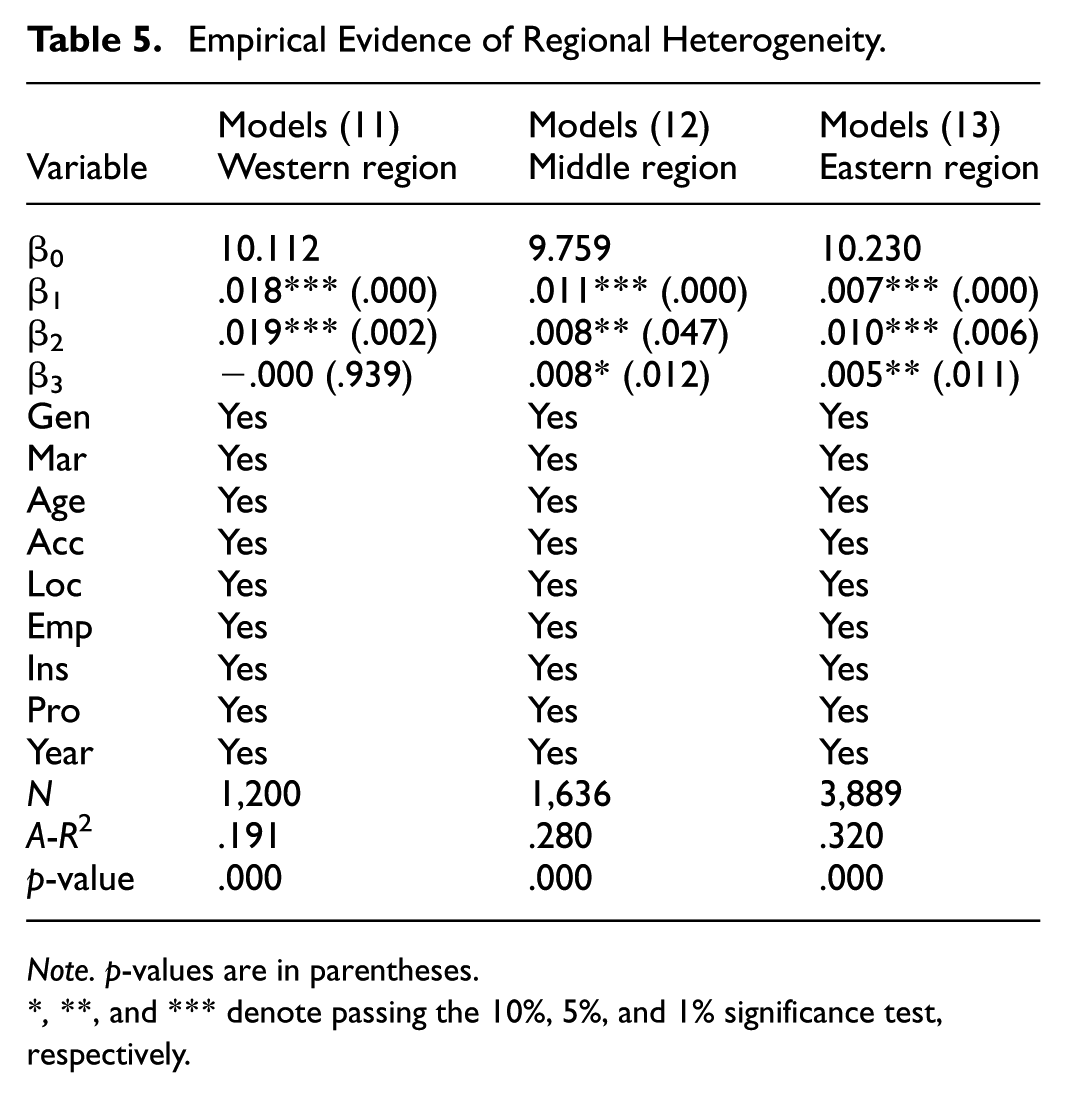
China’s economy and society are characterizes by the diversity of significant regional differences (Yu & Chao, 2022), and thus the degree of skill match might appear corresponding to vibration. According to the division of the National Bureau of Statistics of China (NBSC), the eastern, the middle, and the western are set. Among these, the eastern region includes Beijing, Tianjin, Hebei, Shanghai, Jiangsu, Zhejiang, Fujian, Shandong, Guangdong, Hainan, and Liaoning; the middle region includes Shanxi, Anhui, Jiangxi, Henan, Hubei, Hunan, Jilin, and Heilongjiang; and the western region includes Neimenggu, Guangxi, Chongqing, Sichuan, Guizhou, Yunnan, Xizang, Shanxi, Gansu, Qinghai, Ningxia, and Xinjiang. The impact of skill match on salary income in different regions is analyzed, and the empirical results are detailed in Table 5. It could be detected that the impact of skill match on individual salary income is significantly positively correlated in the eastern, the middle, and the western regions, each coefficient of β1 passes the 1% significance test. Meanwhile, the differences in the moderating effects are obvious, especially in the interaction in terms of skill match and education. The interaction term between skill match and education fails to pass the significance test in the western region, which might be induced by the reason of obvious brain drain of the skilled personnel (MacLachlan & Gong, 2022).
Empirical Evidence of Regional Heterogeneity.
Note. p-values are in parentheses.
, **, and *** denote passing the 10%, 5%, and 1% significance test, respectively.
The Income Quartile Difference
In order to judge the effect of skill match on different levels of income, the quantile regression is used to conduct an econometric study. In order to make regression results more robust, the bootstrap quantile regression is used, and the quantile points are divided into 10%, 30%, 50%, 70%, and 90%, with the detailed econometric results being in Table 6. The results show that skill match, the interaction term of skill match, and Internet use are positively related to salary income in all quantile conditions, and all of them pass the 1% significance test, which is consistent with the result obtained by taking the full sample. Without consideration of moderating impact, the effect of skill match on salary income is more obvious for those with lower income. However, there is little difference in the interaction in terms of skill match and Internet use in the effect of skill match on salary earnings across various levels of income quartile. Meanwhile, the difference between the moderating effect of skill match and education is obvious, and only the coefficient of β3 in model (15) and model (16) passes the significance test, which could be considered that the moderating effect of education on skill match is more concentrated in the middle or lower income levels of the population.
Empirical Evidence of Income Quartile Heterogeneity.

Note. p-values are in parentheses.
, **, and *** denote passing the 10%, 5%, and 1% significance test, respectively.
In order to achieve a more intuitive judgment about the changing trend of the impact of skill match and its interaction term on salary income, it is necessary to show the interquartile regression trend graphs from 0 to 1, which are shown in Figures 1 to 3. These figures represent the interquartile regression trend graph of the impact of skill match on salary income (abbreviated as: skill match on salary income), the interquartile regression trend graph of the interaction term between skill match and Internet use on salary income (abbreviated as: the interaction term of skill match and Internet use on salary income), and the interquartile regression trend graph of the impact of the interaction term between skill match and education level on salary and income (abbreviates as: the interaction term of skill match and education on salary income), respectively. Among these, the horizontal axis represents the different quantile points of income, the vertical axis represents the regression coefficients of each variable; the dotted line of the line segment represents the OLS regression estimates of the corresponding explanatory variables, and the space between the two dotted lines represents 95% confidence interval of the OLS regression values; the solid line is the quantile regression estimates of each explanatory variable, and the shaded portion is the 95% confidence interval of the quantile regression estimates.

Skill match on salary income.

The interaction term of skill match and Internet use on salary income.

The interaction term of skill match and education on salary income.
Seen from Figure 1, there are significant positive correlations between skill match and salary income, but obeying the law of diminishing margins in general, implying the impact of skill match on salary income shows a continuously decreasing trend. Among them, the decreasing trend at the 60% to 80% quantile points appears comparatively flat, which could be interpreted as a slow decline in the impact of skill match on the middle-income and high-income groups.
Seen from Figure 2, the moderating effect of Internet use on skill match is characterized by a “positive U-shape” change that first decreases and then increases, indicating that Internet use has a greater impact on lower-income and higher-income groups and less impact on those whose incomes are in the 30% quartile. It might be argued that Internet use could more effectively alleviate information asymmetry, thus it is necessary to prompt laborers to form more obvious skill matches through effective Internet use, which in turn would raise the level of wages and incomes.
Seen from Figure 3, the trend of the moderating effect of education on skill match is more complex, generally showing a trend of significant growth first, reaching a peak and then slowly declining, followed by rapid growth. It could be concluded that the moderating effect of education on skill match is relatively insignificant for those in the middle-income and upper-middle-income levels.
Synthesizing the results of the empirical analysis of heterogeneity, we could see that there is significant heterogeneity between skill match and individual salary income in vocational education, which, at the same time, is consistent with the above three research hypotheses proposed in the previous section, and is also basically consistent with the econometric results of the benchmark model. Namely, the effects of skill match on earnings are all significantly positively correlated, the moderating effect of Internet use on skill match is prevalent, and there is heterogeneity in the moderating effect of education on skill match. It could be argued that the requirement for skills in the labor market is greater than the requirement for education and that education is intrinsically linked to skill levels but could not be a necessary condition. In addition, the moderating effect among age groups is generally weak, especially among those under 45 years old. This requires the need to take full account of variability in individual characteristics, regions, and income levels when detecting the effects of skill match on salary earnings, and existing research or literature supports this opinion (Berggren, 2011; Gorry et al., 2020; Velden & Ineke, 2016).
Robustness Test
In order to test the robustness of the model, we replace the measurement of skill match. Referring to the treating method of Ye and Yang (2023), the year of education of the respondents with the highest education is selected, each occupation’s average quantity of the year of education in the “respondents’ current job” is calculated, and the absolute value of the difference between the actual quantity of the year of education and the average quantity of the year of education of the occupation is taken. The smaller the absolute value of this indicator, the higher the degree of skill match would be. However, due to the change in the measurement of skill match, resulting in the increase of the number of qualified samples in the CGSS for the above 7 years from 6,725 to 7,244, the detailed econometric result is shown in Table 7. It could get the following conclusions: (1) the variables of skill-match in three models pass 1% significance test, and the coefficient of β1 is −.031 regardless of whether the moderator variable is added or not, which is in line with hypothesis H1, but it shows a certain degree of variability after the addition of the moderator variable by comparison of Table 3. Incorporating moderating variables in the model should have a corresponding effect, that is, the variable of skill match is not as good as the original index seen from the coefficient of β2 after using the substitute indicator. (2) In terms of the moderating effect, considering the interaction term between skill match and Internet use, both model (20) and model (21) own positive correlation, which is inconsistent with hypothesis H2; the interaction term between skill match and education coincides with hypothesis H3, but only passes 10% significance test whereas that passes 1% significance test in Table 3. Seen from aspects of the variable of skill match and its moderating effect, the econometric results of the original indicator are better than those of the replaced model. Therefore, the original model could be considered more robust, which implies passing the robustness test.
Robustness Test Results.

Note. p-values are in parentheses.
, **, and *** denote passing the 10%, 5%, and 1% significance test, respectively.
Conclusion, Discussion, and Policy Recommendations
Conclusion
This study draws the following main conclusions. First, the empirical results generally support the proposed hypotheses: (1) skills matching exhibits a significant positive association with wage earnings; (2) Internet use positively moderates the effect of skills matching; and (3) educational attainment likewise serves as a positive moderator for skills matching. Second, heterogeneity analyses reveal the following three findings: (1) In terms of individual characteristics, skills-job match exhibits a significantly positive correlation with wage income across age, gender, and educational attainment; (2) Regarding regional disparities, the impact of skills-job match and its moderating effects varies notably across the eastern, central, and western regions—with the economically developed and industrially diversified eastern region being more conducive to attracting high-skilled talent and generating an agglomeration effect in skills matching, while the western region, constrained by a more homogeneous industrial structure, shows a more pronounced mismatch between vocational education and job skill requirements; (3) Based on quantile regression by income, skills–job matching exerts a positive influence on wage earnings among low-, middle-, and high-income groups. Third, robustness checks show that when an alternative measure of skills matching is used, the moderating effect of Internet use fails to hold, which contrasts with the original hypothesis. This outcome underscores the superior explanatory power of the baseline model and further confirms the robustness of the main regression results.
Discussion
Based on the database of the China General Social Survey (CGSS), using 2010, 2012, 2013, 2015, 2017, 2018, and 2021 as the data source, we empirically analyze the impact of skill match on salary income by adopting skill match, the interaction terms of skill match and Internet use, the interaction terms of skill match and education, and a series of control variables, as series explaining variables. The econometric results are generally consistent with the proposed hypotheses, which feature by significant positive correlation between skill match and salary income, the positive moderating effect of Internet use on skill match, and the moderating effect of education on skill match depending on different groups. However, the following aspects deserve further analysis.
The first concern is the complexity of the measurement of skill match. There is diversity and difference in the measurement of skill match as per different data resources (McGuinness et al., 2018; Rossi, 2022). The selection of interactions between indicators in this paper allows for a more comprehensive and clearer expression of the impact of different indicators on the results, that is, the relationship between skill matching and salary income is not a separate effect, but the evaluation criteria of skill match in this research are limited due to the data source being CGSS. For example, the only question “How many years have you worked from your first non-farm job to your current job?” is selected for the evaluation of skill match. However, it is difficult to avoid the question of whether the skill match between the respondent and his/her current job is true, and whether there is a corresponding deviation between perception and reality or not.
The second concern is the factor influencing skill match and salary earnings. Skill match not only affects salary income by itself but also has a direct effect through corresponding interactions, as evidenced by the econometric results, which might be related to the fact that skill owns the effect of spillovers (Ehrl & Monasterio, 2021; Leppmki & Mustonen, 2009). However, many other factors could have a moderating effect on skill match and combine to influence the impact of skill match on individual (or: group) earnings, but only two factors, for example, Internet use and education, are selected in the study. In fact, if other interaction terms are included in econometric analysis, the former results might change accordingly, especially for the two moderating effects that have been measured. Therefore, if a more systematic framework construction and theoretical analysis of the moderating effect of skill match could be carried out, and a more detailed empirical analysis based on other databases could be conducted, the conclusions drawn would be more persuasive, and this is an important entry point for subsequent research.
The third concern is the determination of income. As per the occupational income of laborers, there are significant differences in the welfare benefits of different jobs, types of jobs, and work industries. But, due to the problems existing in the CGSS database, it is not possible to take the net occupational income of an individual into account after deducting the welfare benefits, such as medical insurance, endowment insurance, unemployment insurance, work-related injury insurance, childbirth insurance, housing accumulation funds, which in turn might lead to the discrepancy between the annual income and the actual income. That is, it is not possible to specify whether the salary income is net or gross, and this might generate some variability in the behavioral choices of laborers, which in turn might have a corresponding impact on the econometric results. In fact, laborers are more concerned with the actual income induced by skill match, which implies net income. The persuasiveness of the empirical findings might be better if more appropriate data on individual earnings were available.
Policy Recommendations
Detected from the above research, it could achieve the following policy implications. Firstly, the increased educational attainment helps the individual to acquire skills and thus achieve skill matching, which should strengthen skill training at all stages of vocational education, especially at the secondary vocational education stage. Secondly, the Internet could increase the level of skill matching and thus salary income, and the relevant governments need to pay more attention to the learning of Internet use by people of all ages, thus reducing information asymmetry and improving skill matching. Thirdly, there are differences in the level of skill matching between different regions. In order to narrow regional differences and reduce the outflow of talent, vocational colleges and enterprises (industries) should optimize the coordination and suitability of the establishment of professions and job requirements.
Footnotes

Funding
The authors disclosed receipt of the following financial support for the research, authorship, and/or publication of this article: This study were supported by Jiangxi Provincial Philosophy and Social Science Key Research Base Project under Grant No. 25ZXSKJD30, the National Education Scientific Plan of China under Grant No. CFA230295.
Declaration of Conflicting Interests
The authors declared no potential conflicts of interest with respect to the research, authorship, and/or publication of this article.
Data Availability Statement
The data are available from the authors upon request.