




Abstract
In settings marked by persistent educational inequality, less is known about how families describe supporting children’s schooling when resources are constrained. This qualitative study examines how parents in Türkiye mobilise cultural resources under competitive schooling conditions and introduces compensatory cultural capital, defined as the strategic use of affective, relational, and organisational practices to sustain children’s engagement. Semi-structured interviews were conducted with 31 parents in a mid-sized Central Anatolian city, sampled for socioeconomic diversity, and analysed using reflexive thematic analysis. Parents portrayed education-related spending and supplementary provision as attempts to keep pace with curricular demands and high-stakes progression pressures, while emphasising the limits of what households could sustain over time. School contact was narrated as strategic communication and follow-up that often intensified during exam-focused periods to access timely information and guidance. Within households, educational labour was frequently organised as routine maternal responsibility, and parents’ self-assessed competence and “insufficiency” were commonly linked to educational background and familiarity with schoolwork. Alongside material constraints, parents described non-material forms of support such as regulating homework through time and attention, offering future-oriented guidance, and sustaining sociocultural routines valued for confidence, well-being, and learning dispositions. Overall, the findings show how families navigate inequality through everyday forms of support whose value is not captured by expenditure alone, and how this work is unevenly distributed within families. By foregrounding parents’ meaning-making and practice, the study refines sociological accounts of educational reproduction by making visible compensatory cultural capital as a practical repertoire in constrained circumstances.
Plain Language Summary
Many parents want to help their children do well at school, but families do not have the same income, time, or access to paid support. This study explores how parents in Turkey describe supporting their children under competitive and unequal schooling conditions, including during exam-focused periods. We conducted semi-structured interviews with 31 parents in a mid-sized city in Central Anatolia. We analysed recurring patterns in how parents understand school demands and how they respond. Parents described educational spending as a way to keep up with school expectations. This included exam preparation materials, tutoring, or supplementary courses. However, they stressed that spending more did not guarantee better outcomes. They spoke about limits such as unstable income, long working hours, and stress around high-stakes transitions, which shaped what families could maintain over time. Parents also described keeping in contact with school as an important form of support. Some reported more frequent communication with teachers during exam periods to get timely information and guidance. Others described barriers to regular contact, often due to time constraints. Within the household, support for schoolwork was often described as part of mothers' everyday responsibilities, while fathers' involvement was sometimes shaped by work routines or availability. Many parents, particularly those with less schooling themselves, described feeling “not enough” when they struggled to understand homework tasks or explain lessons confidently. Alongside financial constraints, parents described non-material ways of helping, such as organising homework time, encouraging persistence, discussing future options, and maintaining sociocultural routines like reading or cultural activities. We use the term compensatory cultural capital to describe these practical forms of encouragement, guidance, and organisation that help children stay engaged when financial support is limited.
Keywords
Introduction
In Türkiye, education has long been framed as the key route to mobility. Yet it is also where inequalities are reproduced most sharply. The national exam for secondary school placement (LGS) illustrates this duality. In principle it rewards talent, in practice it tends to favour those who already have cultural and economic advantages. The reach of the private tutoring sector, the rigid hierarchies of school prestige, and the quieter but powerful influence of cultural expectations all intensify this effect. Families, therefore, are not simply supporting children at the margins of the system. They are actively negotiating its terms.
Bourdieu’s account of cultural capital remains the most influential framework for understanding these dynamics. His distinction between embodied, objectified, and institutionalised forms of capital continues to shape comparative debates (Bourdieu, 1986; Reay, 2004). These resources are transmitted in family life and usually resonate with what schools recognise as legitimate. Studies across different countries confirm the reach of this model. Lareau (2011) and Reay (2004) show how middle-class parents cultivate children’s skills in ways that fit closely with school expectations. Working-class families often invest no less effort, yet their practices are more likely to be undervalued. Similar results are visible across Europe and Asia, which confirms the continued relevance of cultural capital for explaining inequality (Jin et al., 2024; Riordan, 2024; Yang, 2023).
Even so, the model is far from complete. It has been criticised for being overly deterministic and for downplaying the agency of families who operate under constraint (Friedman & Laurison, 2019; Ingram, 2011). Feminist critiques are especially important here. They highlight the absence of gender in Bourdieu’s account, pointing to the largely invisible maternal labour that sustains children’s learning (Abrahams, 2017; Skeggs, 2004). These critiques matter because they shift the focus from what structures reproduce to how families also adapt, resist, or improvise within them.
The Turkish case makes these debates more than theoretical. Much of the existing scholarship has focused on broad associations between socioeconomic background and achievement (Esen & Adıgüzel, 2023; Şirin, 2005) or on mapping how capital is distributed across the system (Atlı & Akpolat, 2023; Karadağ & Çiftçi, 2023). These contributions remain important, yet they leave a gap. We still know too little about what parents actually do in everyday life: how they help, where they struggle, and how they improvise with limited means. Studies that focus on disadvantaged or non-dominant families are particularly scarce (Aktaş & Engin, 2024; Cansız et al., 2018; Yılmaz & Günel, 2022). Without such accounts, we risk missing the lived processes through which inequality is reproduced, but also sometimes unsettled.
This study addresses this gap by examining how families in Türkiye mobilise cultural capital under competitive and unequal conditions. Three questions shape the analysis: (1) How do families describe the ways their existing forms of capital condition parental engagement across different social groups? (2) How are these practices organised within the household, particularly in relation to gendered expectations? (3) What compensatory strategies do parents describe mobilising as they navigate institutional pressures to support their children’s persistence?
The research draws on an in-depth qualitative, case-based inquiry with 31 families. Descriptive background information is reported only to contextualise participants’ accounts and is not intended to support statistical inference or generalisation. In dialogue with the critiques of Bourdieu, it proposes two conceptual refinements for interpreting these dynamics in this context. The first is compensatory cultural capital, used here to capture non-dominant but deliberate practices, including emotional scaffolding, resilience-building, and future-oriented aspirations, that generate educational value when dominant resources are lacking. The second is gendered habitus, which underscores the extent to which these practices are embedded in maternal labour and in cultural norms of motherhood. Together, these concepts allow for a more dynamic reading of cultural reproduction. They make visible not only the weight of structural constraint but also the inventive ways in which families, often working with limited means, invest in their children’s educational futures.
Method
Research Design
This study employs an in-depth, case-based qualitative inquiry to theorise the emergent and often invisible nature of compensatory cultural capital, including emotion work, resilience narratives, and future planning, within processes of social reproduction in Türkiye. The design was selected for its capacity to illuminate familial micro-practices through which social class inequalities are reproduced, particularly those that remain difficult to capture through macro-level, survey-oriented accounts. The study’s contribution therefore lies not in statistical generalisation but in generating theoretically grounded insight into how parental strategies are formed and enacted under conditions of socioeconomic constraint (Creswell & Poth, 2023; Lareau, 2011; Reay, 2004). Consistent with a case-based logic, the analysis prioritises contextual depth and analytic interpretation, with the aim of elaborating the paper’s core concepts.
Research Setting, Participants, and Sampling
The research was conducted in a mid-sized urban centre in Türkiye’s Central Anatolia Region, selected as an analytically strategic context in which neighbourhood stratification and educational hierarchies render classed differences in educational support practices visible. To protect anonymity, further identifying details are withheld in the blinded manuscript.
A maximum variation purposive sampling strategy was employed to ensure heterogeneity across income, education, and occupation, thereby supporting exploration of diverse experiential patterns (Creswell & Poth, 2023). The final sample comprised 31 parents of lower secondary school students (20 female and 11 male). The sample size was intentionally retained to capture socioeconomic heterogeneity and to support comparison of gendered patterns of engagement, including emotional labour, school communication, and aspirational planning. Across the later interviews, additional accounts largely reinforced existing codes and themes rather than introducing substantively new analytic categories.
Demographic background information, including participants’ gender, educational attainment, monthly income bracket, and housing tenure, was collected as part of the interview protocol and is presented in Figure 1 to provide transparency about the interview sample and to situate the accounts analysed. Income data were recorded in Turkish Lira (TRY), with exchange rates from Spring 2025 provided for international context (EUR 1≈TRY 43.02; USD 1≈TRY 37.87).

Distribution of key demographic characteristics of participating parents (n = 31).
Data Collection Process and Tools
Data were collected through semi-structured interviews, selected for their capacity to elicit tacit and context-dependent forms of compensatory cultural capital that standardised surveys may overlook. The interview protocol had two components. First, a brief structured section captured background information to contextualise participants’ accounts. Second, open-ended prompts explored the micro-dynamics of parental involvement, including reading habits, sociocultural activities, school communication, and the mobilisation of supplementary educational resources.
To anchor discussion of schooling experiences, parents were invited to describe their child’s school performance in their own terms. For ease of reference only, they could also select one of three plain-language labels, “Very Good,”“Good,” or “Moderate.” This label was treated as a contextual self-assessment rather than an objective measure.
The interview protocol was informed by the social reproduction literature (Lareau, 2011; Reay, 2004). It was reviewed by three educational sociologists and refined through a pilot study with five parents. Interviews were conducted between March and May 2025 during the spring semester, averaged approximately 20 min in duration, were audio-recorded with informed consent, and transcribed verbatim by the authors for analysis.
Data Analysis
The qualitative data were analysed using reflexive thematic analysis, integrating deductive and inductive coding (Creswell & Poth, 2023). Transcripts were read repeatedly to support immersion, and initial codes were developed iteratively. Deductive sensitising concepts were informed by Bourdieu’s (1986) framework and cultural reproduction scholarship, while inductive codes captured context-specific practices emerging from participants’ narratives. Codes were then clustered into higher-order themes through iterative comparison and memo-writing, with attention to internal coherence and distinctiveness across themes. The movement from codes to themes was guided by abductive reasoning, linking empirical patterns back to the study’s conceptual framing to refine interpretation of compensatory cultural capital.
Coding was managed in MAXQDA 2020. To enhance analytic clarity, a subset of transcripts was independently coded by both authors and then discussed in iterative analytic sessions to refine code definitions, clarify boundaries between closely related codes, and explore alternative readings. This process strengthened the coherence of the coding framework and ensured that each theme was supported by multiple instances across the dataset.
The thematic analysis yielded nine core analytical themes:
The Economy of Time: Regulating Homework and Family Life
Gendered Labour in Education: The Organisation of Homework Support
Forging School Alliances: Strategic Parent–Teacher Relationships
The Shadow Market of Education: Mobilising Supplementary Resources
Parental Logics: The Perceived Need for Supplementary Support
The Habitus of Competence: Self-Perception, Class, and Gender
Capital Conversion: Economic Investment in Parents’ Performance Labels
Steering Futures: Parental Intervention in Career Pathways
Cultivating Distinction: The Practice of Sociocultural Activities
These themes were subsequently organised into three aggregate dimensions for the presentation of findings. Each theme was defined and interpreted within the broader framework of cultural capital and iteratively validated through comparative rereading of transcripts. Representative quotations were selected with attention to socioeconomic diversity to strengthen analytic depth and contextual sensitivity. All data were anonymised and securely stored in compliance with ethical research protocols.
Trustworthiness: Credibility, Dependability, Confirmability, and Transferability
Several strategies were employed to strengthen trustworthiness (Creswell & Poth, 2023). Credibility was supported through sustained engagement with the data and iterative analytic discussions during coding and theme refinement. After preliminary themes were drafted, we sought participant feedback from a small subset of interviewees by sharing short thematic summaries and inviting comments on whether these accurately reflected their accounts; this was used to check for misinterpretation rather than to treat participants as arbiters of analysis. Dependability was strengthened through an audit trail documenting analytic decisions from coding to theme development. Confirmability was supported through reflexive memo-writing and peer debriefing focused on alternative interpretations and evidentiary adequacy. Transferability was facilitated through thick description of the setting and participants’ accounts, enabling analytic rather than statistical generalisation to comparable educational contexts.
Ethical Considerations
Ethical approval was obtained from the relevant institutional ethics committee (details anonymised for peer review). The study was designed to minimise risk by focusing on everyday educational practices, avoiding sensitive or identifying questions, and ensuring confidentiality through pseudonyms and secure data storage. The potential benefits, including improved understanding of how families mobilise educational support under conditions of inequality, were considered to outweigh the minimal risks associated with participation. Informed consent was obtained from all participants prior to data collection, and participants were reminded that participation was voluntary and that they could withdraw at any time without consequences. No incentives were offered, and identifying details were removed from transcripts prior to analysis.
Results
The interview findings are organised into three sections. The first offers a contextual account of how families described educational resources, school engagement, and everyday forms of support under conditions of inequality. The second examines intra-family dynamics, with particular attention to the gendered organisation of educational support. The third focuses on how parents described sustaining children’s persistence and coping under exam-related pressures, highlighting how cultural resources were mobilised in constrained circumstances. Tables are included to orient readers to the descriptive context of the accounts and are not used to indicate prevalence or support statistical inference; category sizes vary and some are small.
Part 1: The Landscape of Inequality: Economic Capital and Institutional Engagement
This section examines how parents narrated educational inequality through the material conditions surrounding schooling, including household resources and education-related spending.
Capital Conversion: Economic Investment in Parents’ Performance Labels Under Exam Pressure
Across the interviews, education-related spending was described as an important but unevenly available resource, often discussed in relation to monthly income and directed towards private tutoring, supplementary courses, and exam-preparation materials (Table 1). Parents narrated such spending as an effort to convert what households could afford into educational advantage, without presenting it as a guaranteed route to doing well at school. In talking about these experiences, parents often described their child’s school performance in their own terms and, where useful, referred to the plain-language performance labels used in this study (“Very Good,”“Good,”“Moderate”) as a shorthand for how they saw things at that moment. These labels are treated here as contextual self-assessments rather than outcome indicators.
Parents’ Self-Reported Annual Education Expenditure by Monthly Income Level.

In these accounts, spending was framed less as a direct route to improved outcomes and more as an ongoing attempt to keep pace with curricular demands and high-stakes progression pressures, within the limits of what families could sustain over time.
The Shadow Market of Education: Mobilising Supplementary Resources
Parents described different forms of supplementary provision, including paid academic tutoring and, less commonly, social enrichment lessons; others relied on school-run courses or reported no paid provision (Table 2).
Parents’ Reported Supplementary Education Provision.
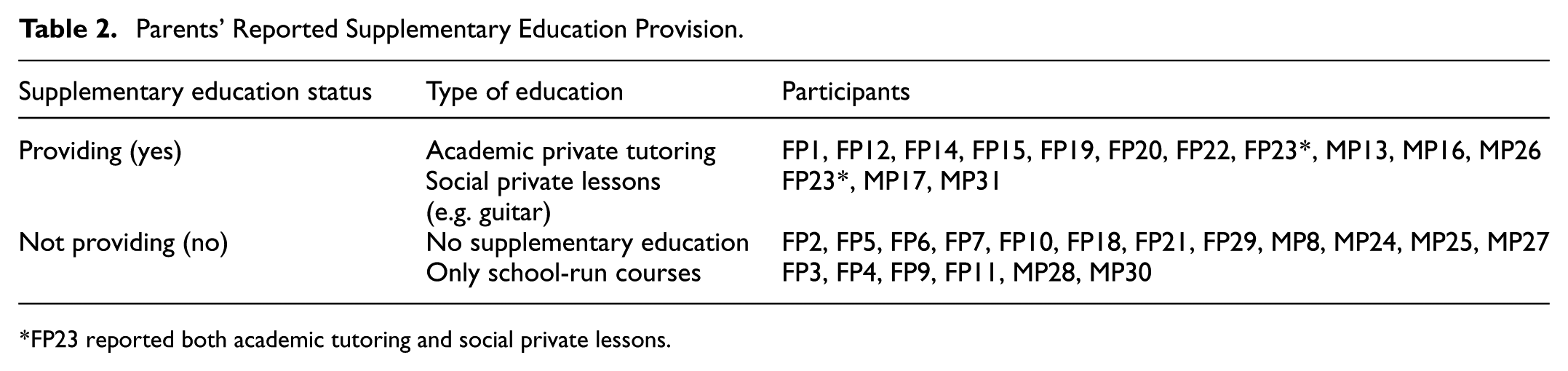
FP23 reported both academic tutoring and social private lessons.
Parents’ accounts suggest that paid tutoring was often framed as a practical response to perceived gaps in support. FP1 noted, “We do our best, but we arrange private lessons for some subjects,” echoed by FP20: “We arrange private lessons where we are not adequate. We got them for English.” By contrast, a smaller number of parents described paid lessons for social enrichment. As MP17 explained, “My child receives music education at the Science and Art Centre; first baglama, now oud lessons.” Among those who did not use paid support, rationales were sometimes economic and sometimes principled. FP21 stated, “We don’t arrange any, neither a cram school nor private lessons,” while others emphasised the adequacy of public provision, for example: “We only send them to school courses” (FP4).
Forging School Alliances: Strategic Parent–Teacher Relationships
Parents described school contact not only as physical visits but as an ongoing effort to stay informed, monitor progress, and secure timely guidance from teachers. Where parents reported being unable to visit, this was often attributed to time constraints. Those who visited once or twice per term typically referred to scheduled parent–teacher meetings, and some worried that this limited contact left them without adequate reassurance or follow-up. FP21, for example, noted: “I go once each term, but I worry that my child is negatively affected.”
In contrast, parents who described closer contact framed it as active follow-up and monitoring, particularly during the secondary school entrance exam cycle (LGS). FP12 explained: “I definitely go every 15 days. There’s more need when they are in the 8th grade.” Overall, school contact was narrated less as a fixed routine and more as something that intensified under specific pressures, especially around exam-related periods, when staying in communication with teachers was seen as important for accessing information and support.
Taken together, these accounts situate school contact as a strategic practice shaped by the broader resource conditions described across interviews. The next section shifts to the domestic sphere to examine how educational support is organised within households and how gendered expectations shape the distribution of this work.
Part 2: The Domestic Sphere: The Gendered Habitus of Educational Support
Moving beyond institutional engagement, this section examines how parents described the organisation of educational support within households and how responsibility for everyday schoolwork was distributed and justified in practice.
Gendered Labour in Education: The Organisation of Homework Support
Across interviews, parents often described homework support as organised around mothers’ everyday care work, while fathers’ involvement was more commonly framed in relation to availability, work routines, or physical absence (Table 3). The extracts below elaborate how this division was justified and experienced.
Support Provided by Family Members for Students’ Homework.

Parents’ explanations clarify how this division was talked about. In several accounts, homework support was framed as part of mothers’ routine responsibilities, with motherhood explicitly invoked as the relevant role. One participant stated, “As the mother, I take care of it” (FP2), and another noted, “As the mother, I help when needed. His father is in the village” (FP10). Where fathers’ involvement was described as limited, parents often explained this in relation to work schedules or physical absence, which, in turn, positioned mothers as the more continuous point of contact for schoolwork. MP17 remarked, “Because my working hours are not suitable, I can say that the mother deals with the child’s homework more regularly.”
In accounts where fathers, older sisters, or multiple family members were mentioned, responsibility was still commonly narrated as contingent on availability. FP20 explained, “Usually the mother. When the father has time, he follows up homework and checks past assignments.” A temporal division was also reported in some shared arrangements, as MP25 noted: “On weekends me, at other times the mother.” Where parents reported limited time, older sisters sometimes assumed a practical support role, either alongside mothers or in their place (MP30; FP4).
Taken together, these accounts align with the study’s use of gendered habitus as an interpretive lens. Parents frequently framed homework support through everyday logics of responsibility and continuity, in ways that made maternal involvement appear routine, while fathers’ contributions were more often described as periodic or contingent on circumstances.
The Habitus of Competence: Self-Perception, Class, and Gender
To open the conversation about support at home, parents often described their perceived helpfulness in their own terms and, where useful, used three broad plain-language labels as a shorthand (Table 4).
Parents’ Self-Assessed Level of Helpfulness.
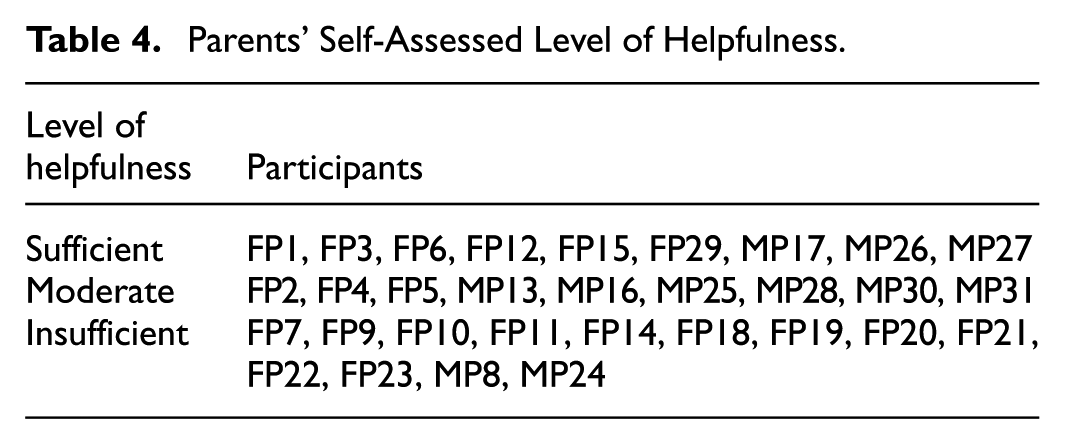
Across interviews, parents linked these self-descriptions to familiarity with curriculum demands, confidence in explaining schoolwork, and prior educational experiences. Several university-educated parents described feeling more capable of supporting particular subjects, sometimes drawing on professional knowledge. MP17, a chemistry teacher, stated, “I am proficient in maths and language-based subjects.” By contrast, many parents who used the label “Insufficient” framed this in relation to curricular unfamiliarity and the difficulty of translating school tasks into understandable guidance. FP7 explained, “I can’t understand the questions they ask,” echoed by FP10, a primary school graduate: “I can’t help.”
Parents’ narratives suggest that perceived “insufficiency” was rarely presented as a purely individual limitation. It was commonly told through the intersections of classed constraints and gendered expectations, particularly where mothers also carried routine responsibility for schoolwork at home. Parents described the pressure to be the primary educational supporter as both moral and practical, and this pressure could intensify when educational background was limited. In this sense, competence was experienced and narrated as a relational and gendered dimension of family educational labour, consistent with the study’s use of gendered habitus as an interpretive lens.
Part 3: Strategic Enactments: Resilience, Guidance, and Cultural Investment
Finally, rather than treating disadvantage as a fixed trajectory, parents’ accounts illustrate varied ways of navigating constraints and sustaining children’s engagement through everyday forms of guidance, monitoring, and emotional support.
The Economy of Time: Regulating Homework and Family Life
Across the interviews, parents described homework support through the language of time and attention. Time was narrated not simply as hours spent, but as a practical resource that could be allocated, held back, or intensified depending on perceived needs, competing responsibilities, and parents’ aspirations for the child’s independence.
A first approach involved avoiding a fixed daily routine, with support framed as cultivating autonomy and responsibility. FP9 stated, “We just tell them to do their homework; they take responsibility and do it.” Similarly, FP11 noted, “I don’t allocate time for their homework; I help when needed,” describing support as responsive rather than scheduled.
A second approach involved more structured, task-focused follow-up that could, in some households, become part of a regular routine. FP3 explained, “Reinforcement sheets take between half an hour and an hour.” In other accounts, this work was narrated as organised through shared arrangements, as FP1 noted: “We have a study schedule; sometimes I am involved, and sometimes their father is.”
A third approach involved intensive supervision, typically narrated in response to concerns about motivation or persistence. FP10 described this high-involvement form of support: “My child doesn’t want to do homework; they don’t do it unless I push them, so I allocate two to three hours.” In these accounts, sustained involvement was presented as a deliberate attempt to shape discipline and maintain engagement. Taken together, parents’ descriptions position time as a cultural resource intertwined with guidance and emotional labour, shaping how families sought to sustain effort and resilience under constrained conditions.
Parental Logics: The Perceived Need for Supplementary Support
Parents also differed in how they talked about whether supplementary education was needed. Across interviews, three broad orientations emerged: some parents treated paid support as generally necessary, others framed it as contingent on particular subjects or exam periods, and others described it as unnecessary given their child’s study habits or existing provision.
Parents who framed supplementary education as necessary often justified this view in terms of supporting progress or compensating for limits in what could be provided at home. FP14, for example, noted, “I think they will do better at school if they receive it,” articulating an instrumental rationale. At the same time, several parents described a gap between perceived need and affordability. FP5 captured this tension succinctly: “Yes, there is a need, but we cannot afford it due to financial insufficiency.” In these accounts, the idea of “need” was inseparable from the economic boundaries within which families were acting.
By contrast, parents who described supplementary education as unnecessary commonly pointed to their child’s self-regulation or to the adequacy of current schooling arrangements. FP11 explained, “They are a child who does well by working. If they work, they will do well,” framing school performance as driven by effort and autonomy. MP8 similarly situated “no need” within existing provision: “They attend a private school; we don’t feel a need for it at the moment.”
A third set of accounts treated supplementary support as situational, needed only at specific moments such as exam preparation or for particular subject areas. Importantly, one parent (MP17) reframed what “support” should mean: rather than additional content tutoring, they emphasised “a regular monitoring system and guidance support.” This shifts attention from purchasing instruction to organising oversight and direction, and it anticipates the strategy-oriented forms of non-material support developed in the sections that follow.
Steering Futures: Parental Intervention in Career Pathways
Across interviews, parents spoke about career-related guidance as part of how they supported children’s future planning. Many accounts emphasised active guidance rather than a fully hands-off stance, and three broad approaches were articulated: non-directive guidance, directive guidance, and balanced guidance.
In non-directive accounts, parents foregrounded autonomy and emphasised that children should determine their own goals. FP6 stated, “No, I don’t influence them. Let them set their own goal.” Others, such as FP20, located influence primarily outside the home, noting that “They are more influenced by school and their circle of friends.” Here, parental support was framed less as directing choices and more as allowing space for self-determination.
By contrast, directive accounts involved a more assertive stance, often justified through concerns about security, stability, and upward mobility. FP22 offered a clear example: “I want her to be a doctor. I constantly call her ‘my doctor daughter’.” MP24 similarly described using vivid comparisons to orient preferences: “I take them to the boiler room and say, ‘become a civil servant’.” In these accounts, guidance was narrated as a protective strategy anchored in parents’ assessments of risk and opportunity.
Finally, balanced guidance combined providing information with preserving autonomy. Parents described themselves as facilitators who discussed options, trade-offs, and consequences without insisting on a single endpoint. MP17 captured this stance: “I explain the positive and negative aspects of professions, but I leave the choice to them.” In these accounts, guidance took the form of sharing navigational knowledge about pathways and likely consequences, supporting children’s capacity to evaluate alternatives under constrained circumstances. In this sense, career guidance functioned as a future-oriented, strategy-based dimension of compensatory cultural capital.
Cultivating Distinction: The Practice of Sociocultural Activities
Parents described incorporating sociocultural activities into everyday family life as one way of supporting children’s development alongside schooling (Table 5). In their accounts, this included regular library visits and reading routines, participation in cultural events, music or arts learning, and culturally oriented home environments.
Parents’ Sociocultural Support Activities for Their Children.

In parents’ narratives, these activities were valued not only for personal growth but also for the indirect ways they were believed to support schooling. Some parents linked sociocultural routines to literacy and learning habits. FP3, for example, connected library visits to reading: “We go to the library with my child every weekend. They acquired the habit of reading there.” Others emphasised cultural participation as a form of emotional support that helped children manage academic pressure. MP26 noted, “I try to take them to the theatre or concerts whenever I get the chance. It’s particularly good for them to get away from exam stress.” For some families, extracurricular courses were described as spaces where children could develop interests and confidence outside the school setting. FP23 reflected this orientation in relation to music lessons: “My daughter attends guitar lessons … I see her developing outside of school.”
Taken together, these accounts suggest that sociocultural engagement functioned as a practical way of cultivating dispositions and competencies that parents associated with educational readiness, confidence, and well-being. Especially where material resources were constrained, parents’ emphasis fell on what could be organised through time, routine, and sustained encouragement rather than through additional paid provision. Read through the lens of compensatory cultural capital, these practices can be understood as efforts to build cultural repertoires that mattered within families’ everyday worlds, even when such repertoires may not align neatly with institutionally privileged forms of cultural participation.
Discussion
This discussion interprets the findings through three intertwined analytical layers: structural inequality, gendered domestic dynamics, and strategic agency, all read through the lens of compensatory cultural capital.
First, parents’ accounts position educational inequality as something lived through the everyday material conditions of schooling. Reported education-related expenditure varied across the income ranges reported in the interviews (as summarised in Table 1), and parents often described spending on tutoring, supplementary courses, and exam-preparation materials as a way of keeping pace with curricular demands and high-stakes progression pressures. Importantly, participants did not narrate spending as a guaranteed route to improved school performance. Rather, it was framed as an effort to convert what households could afford into perceived educational advantage, while remaining bounded by what families could sustain over time. This emphasis aligns with work showing how institutional familiarity and confidence in navigating schools can operate as a subtle form of advantage, often taken for granted by better-resourced families (Lareau, 2011). At the same time, the accounts in this study underscore that educational experiences cannot be reduced to expenditure alone, because families also described non-material constraints and supports that shaped how schooling was managed.
Second, the findings foreground the domestic sphere as a key site where educational support is organised and justified, often in gendered ways. Across interviews, homework support was commonly narrated as part of mothers’ routine care work, while fathers’ involvement was typically described as shaped by availability, work routines, or absence (as summarised in Table 3). Crucially, parents often explained this division through everyday logics of responsibility and continuity, rather than presenting it as an explicit negotiation of “roles.” Reading these accounts as a gendered habitus helps to capture how taken-for-granted expectations become embedded in family practices, positioning educational involvement as an extension of maternal responsibility (Çiftçi & Bal, 2015; Kim & Hill, 2015). This gendered organisation also intersected with parents’ self-perceptions of competence. Parents who described themselves as less able to help often linked this to limited educational background and curricular unfamiliarity, and these narratives were frequently paired with the moral and practical pressure to remain the primary supporter at home. In this sense, “insufficiency” appeared less as an individual deficit than as a relational experience shaped by classed constraints and gendered expectations (Moore, 2024), and it becomes more legible when situated alongside the disproportionate emotional and organisational burden mothers may carry during exam-focused periods (Büber & Başay, 2023).
Third, the findings highlight strategic forms of agency through which families sought to sustain children’s effort, motivation, and direction under constrained circumstances. Rather than treating disadvantage as a fixed trajectory, these accounts challenge more deterministic readings of educational reproduction by showing how parents actively reworked constraints through everyday, often non-material forms of support. Strategies for regulating homework included avoiding rigid routines to cultivate autonomy, offering short, responsive support, or intensifying supervision when motivation became fragile. Narratives also revealed varied orientations towards supplementary education, including the tension between perceiving paid support as necessary and recognising that it was financially out of reach. Beyond these material considerations, participants highlighted forms of guidance that were explicitly future-oriented, including non-directive, directive, and balanced approaches to steering educational and occupational pathways, as well as sociocultural activities valued for strengthening confidence. Taken together, these practices can be understood as compensatory cultural capital: the mobilisation of relational, affective, and organisational resources to mitigate limited economic or institutional leverage. Rather than implying that such strategies “overcome” structural inequality, the findings show how families attempt to navigate it, often by drawing on forms of support that are less visible in conventional accounts of advantage (Kulic et al., 2017; Zahari et al., 2025).
Finally, the implications of these findings are best read in proportion to the study design. Given the qualitative interview approach and sample size, the analysis does not support statistical claims about relationships between variables. Descriptive contextual information in the Results is used to situate participants’ narratives, not to infer associations. With that in mind, the findings nonetheless invite a broader conversation about equity that goes beyond material inputs alone. If policy and school practices focus only on formal resources or standardised outcomes, they risk overlooking the everyday, gendered, and often non-material work through which families try to sustain learning under pressure. Strengthening school communication channels, offering accessible guidance supports around high-stakes transitions, and recognising the unequal domestic distribution of educational labour may help reduce the load placed on mothers in particular, without assuming that families can reasonably be expected to compensate privately for structural gaps.
Limitations of the Research
This study has several limitations that should be kept in mind when interpreting the findings. First, the analysis draws on parents’ accounts, which foreground parental sense-making and may underrepresent children’s and teachers’ perspectives. Second, the purposive sample from a single mid-sized city supports socioeconomic diversity within the study setting but narrows the scope of analytic transferability to other contexts and may not reflect the full range of non-institutional support practices that operate elsewhere. Third, the cross-sectional design offers a snapshot and cannot capture how parental practices may shift over time, including across different stages of exam-related periods. These limitations underline the value of future research that incorporates longitudinal designs and multi-stakeholder perspectives to extend and deepen the analytic insights developed here.
Conclusion
Drawing on interview accounts from 31 families in Türkiye, this study approaches cultural capital not as a static possession but as a set of practices mobilised as parents respond to unequal and competitive schooling conditions. Across the findings, educational inequality was narrated through three intertwined arenas: the material constraints that shape education-related spending and access to supplementary provision, the gendered organisation of everyday educational labour within households, and the strategic, future-oriented forms of guidance and emotional support parents used to sustain children’s effort under exam-related pressures.
Conceptually, the notions of gendered habitus and compensatory cultural capital help make sense of how educational support becomes normalised as routine maternal responsibility and how families, particularly where economic and institutional leverage is limited, draw on relational, affective, and organisational resources to navigate schooling demands. These strategies should not be read as “overcoming” structural inequality. Rather, they illuminate how parents attempt to manage and mitigate its effects in everyday life, and how the labour of doing so is often unevenly distributed within families. As a qualitative study, the contribution lies in clarifying these processes and their meanings for participants, and in making visible forms of support that can remain obscured when educational advantage is discussed primarily in terms of measurable inputs or outcomes.
Implications for Policy and Research
Building on our findings, we outline several practical considerations for schooling practice and future research. To foster greater equity, policy discussions could prioritise inclusive school-family partnerships that recognise and value the compensatory cultural capital prevalent in underserved communities, using practical tools such as peer mentoring and culturally responsive workshops (Lareau, 2011; Reay, 2004). In parallel, capacity-building initiatives can support parents in developing autonomy-supportive home learning environments, consistent with recent work on parental empowerment (Park et al., 2023) and longstanding evidence on motivational scaffolding (Schunk & DiBenedetto, 2020). In addition, where families described school contact as an effort to stay informed and access timely guidance, strengthening communication channels requires attention to the material conditions that shape access to school platforms and teacher communication. In this sense, efforts to narrow digital inequalities may need to move beyond device provision to include sustained digital literacy support for families, particularly in communities where access constraints can weaken school-family communication during high-stakes periods (Esen & Adıgüzel, 2023). At the school level, training practitioners in empathetic, culturally sensitive communication to build trust could be paired with positioning schools in disadvantaged areas as community learning hubs, thereby supporting families’ capacity to navigate institutional expectations and reducing the private burden of compensatory work (Bourdieu, 1986).
Future research could prioritise longitudinal and mixed-methods approaches to better understand the complex processes of intergenerational capital transmission and how compensatory practices evolve over time (Creswell & Poth, 2023). There is also a pressing need for studies on the self-efficacy of parents in under-resourced families, for instance through intervention-informed evaluations that examine how confidence-building guidance supports shape parents’ sense of agency (Bandura, 2002; Moore, 2024). Our findings further indicate that intra-family relational dynamics, particularly the gendered organisation of educational labour and its emotional and temporal costs, warrant deeper theorisation and closer qualitative examination. Finally, applying interdisciplinary models may help assess how the forms of parental support identified here relate to longer-term outcomes, including young people’s vocational adaptability, satisfaction, and well-being, broadening understanding of how family-based support shapes trajectories beyond immediate schooling (Chen et al., 2023; Zhou et al., 2020).
Footnotes
Acknowledgements
The authors express their sincere gratitude to the families who participated in this study for generously sharing their time, insights, and lived experiences.

Ethical Considerations
Ethical approval was granted by the Kırşehir Ahi Evran University Social and Humanities Scientific Research and Publication Ethics Committee on 28 May 2025 (Approval no: 2025/10/13).
Consent to Participate
Informed consent was obtained from all participants verbally and in written form prior to data collection. The study involved minimal risk; potential harms were limited through confidentiality protections, avoidance of sensitive or identifying questions, and secure handling of audio files and transcripts. The anticipated benefits, including improved understanding of family-based educational support under conditions of inequality, were considered to outweigh the minimal risks associated with participation.
Author Contributions
Conceptualisation and Design: Mehmet Kart and Hüseyin Şimşek; Methodology and Data Collection: Mehmet Kart; Data Analysis: Mehmet Kart and Hüseyin Şimşek; Writing—Original Draft Preparation: Mehmet Kart; Writing—Review and Editing: Mehmet Kart and Hüseyin Şimşek. Both authors have read and approved the final version of the manuscript.
Funding
The authors received no financial support for the research, authorship, and/or publication of this article.
Declaration of Conflicting Interests
The authors declared no potential conflicts of interest with respect to the research, authorship, and/or publication of this article.
Data Availability Statement
The data supporting the findings of this study are available from the corresponding author* Mehmet Kart upon reasonable request, in accordance with ethical guidelines and participant confidentiality agreements.
Use of Artificial Intelligence Statement
Artificial intelligence (AI) tools were employed exclusively to improve linguistic clarity and stylistic coherence during the drafting and revision stages. All intellectual content, interpretive analysis, and critical decisions were entirely made by the human authors, in line with COPE and journal authorship guidelines.