




Abstract
The Metaverse, an emerging immersive and real-time environment, has transformed social interaction and given rise to Metaverse-based tourism. This study aims to investigate the continuous intentions of individuals toward Metaverse tourism through a risk-benefit analysis that considers contextual factors. Data were collected using a quantitative survey from China (n = 243). The findings conclude that the role of benefits and barriers is pivotal in shaping and predicting future intentions for the continuity of Metaverse adoption in tourism. The findings revealed that readiness to change has a positive influence on perceived benefits (
Plain Language Summary
Tourism is changing rapidly with new digital technologies. One of the most talked-about innovations is the Metaverse—a virtual space where people can explore destinations, interact with others, and enjoy immersive experiences without physically traveling. This study looks at how people decide whether they want to keep using the Metaverse for tourism in the future. We focused on two main ideas: the benefits people see in Metaverse tourism (such as convenience, cost savings, or environmental protection) and the barriers they might feel (such as concerns about risks, costs, or unfamiliarity). We also explored how people’s readiness to accept change and their environmental attitudes—what we call an eco-centric mindset—affect their willingness to embrace Metaverse tourism. To understand these factors, we surveyed 243 people in China who had some experience or awareness of the Metaverse. The findings show that both benefits and barriers strongly shape people’s decisions about using the Metaverse for tourism. Importantly, people who are more open to change and who care deeply about the environment are more likely to see value in Metaverse tourism and express interest in using it continuously. This research matters because tourism is both a major source of enjoyment and a contributor to environmental problems. The Metaverse could reduce environmental pressures from travel while still offering engaging experiences. Our study highlights the importance of designing tourism innovations that consider both human attitudes and environmental concerns. The results can help tourism companies, policymakers, and educators think about how to encourage sustainable tourism practices in the digital age.
Introduction
Background and Content
The breakthrough innovation in technological applications and the spread of the internet all over the world, virtual environments have increased rapidly. It is posited that there are paradigm shifts in information and innovation technologies every decade, and the current decade’s paradigm is the concept of the “Metaverse.” Metaverse was commercialized as “Second Life,” a social virtual world game in 2003, ten years after its first appearance in the science fiction novel “Snow Crash by Neal” Stephenson in 1992 (H. Yang et al., 2022). The Metaverse is defined as “a parallel, virtual universe that uses ambient intelligence to enhance physical spaces, products and services, emerges as a collective, virtual shared space of value cocreation” (Mystakidis, 2022).
The COVID-19 pandemic has accelerated the transition to a digital world, as it presents solutions that transcend the physical world and its variables (Stavros et al., 2022). The hotel and tourism industry traditionally reliant on physical mobility, has been exposed to vulnerabilities stemming from external and internal disturbances, as shown by recent occurrences such as the COVID-19 pandemic, travel restrictions, economic uncertainty, and safety concerns. At the same time, with the growing awareness of climate change and environmental degradation, the preferences and sustainability expectations of travel are being reevaluated. In all these scenarios, the Metaverse-mediated virtual tourism has emerged as an alternative for traditional tourism, which is adaptive and sustainable. The Metaverse has been propelled by transformative shifts in invention and technology (Gursoy et al., 2022; Koo et al., 2023).
Virtual tourism platforms such as Japan-based First Airlines and the National Geographic VR demonstrate how tourists can experience destinations like Paris or Antarctica without physically visiting them (Baker et al., 2023; Gursoy et al., 2022). These examples represents that the emergence of the Metaverse and its associated virtual experiences has had a profound impact on the hospitality and tourism industry, transforming traditional methods of selecting lodging and destinations, making bookings, and participating in events. The concept of the Metaverse and its associated virtual experiences has radically altered people’s perspectives on the future of technology and its potential impact on the hospitality and tourism industries (Buhalis et al., 2023). Businesses in this industry are eager to explore ways to capitalize on the Metaverse and create virtual hospitality and tourism experiences, products, and services for their consumers. Improvements in technology and an increase in the sophistication of virtual reality (VR) headsets have made metaverse hospitality and tourism apps increasingly immersive.
Research Gap
Despite the rapid growth of Metaverse applications (Dwivedi et al., 2022), the literature in the field of study is still limited in terms of how people develop affective dispositions, consider the possible negative and positive impacts, and develop long-lasting plans to engage in Metaverse based tourism activities. Notably, there has been a rising trend in investigating the impact of immersive environments in hospitality and tourism in contemporary fashion (Ye et al., 2022) (see Table 1 appendix A), psychological and emotional connections (Ma, 2020; Yung & Khoo-Lattimore, 2019), architecture (Paes et al., 2017), and media and entertainment (G. Wang et al., 2022). The following gap can be highlighted: (1) Theoretically, the Technology Acceptance Model (TAM; Bagozzi, 2007), Unified Theory of Acceptance and Use of Technology (UTAUT; Venkatesh & Bala, 2008), the theory of gratification (Apuke & Omar, 2021), and the theory of media richness (Cao et al., 2022) are the prominent theoretical frameworks used in VR and Metaverse tourism. Despite the fact that these frameworks are effective in explaining the initial adoption of technology, they do not provide much information regarding the sustained use and the environmental persistence in the context of an immersive and experience-oriented context. The long-term implications of metaverse tourism in the context of continuous intention are an untapped area in the existing literature. Therefore, the current research effort can be considered a novel contribution, as it explores the constant intention toward metaverse tourism through a unique theoretical lens.
In addition, the existing literature anticipates functional determinants, such as perceived ease of use or perceived usefulness, and does not pay much attention to value-related determinants, such as sustainability, eco-centric reasons, and psychological preparedness to change. The Risk-Benefit Analysis (RBA) framework provides an unexplored but promising approach in this field. According to the RBA, people are either adopting or rejecting technologies depending on the perceived relative value between the perceived advantages and potential risks (Bearth & Siegrist, 2016). Even though it is applied in the privacy of the web (Dinev & Hart, 2006), in fintech (Cocosila & Turel, 2019), and sustainable consumption literature (Abdul-Rahim et al., 2022), its use concerning the Metaverse tourism remains unexplored. An eco-centric attitude can be leveraged to promote virtual tourism by allowing users to experience and appreciate natural environments without causing harm to the physical locations. Therefore, this study examines the eco-centric attitude as a moderator in metaverse tourism, aiming to encourage environmentally friendly practices.
Moreover, whereas existing literature focuses on the experiential and economic opportunities depicted by the Metaverse, the role of the eco-centric attitudes, anxiety connected with the idea of the metaverse, and willingness to change is rarely seen as an engaging factor of long-term user attachment. The literature entries in Table 1 show that scholars have already examined Metaverse tourism in terms of smart destinations, sustainability, and the preservation of the cultural heritage (Buhalis et al., 2023; Go & Kang, 2023; Pellegrino et al., 2023). However, these studies have been found to mostly focus on technological potentials, hence overlooking aspects of user psychology and environmental virtues. Metaverse anxiety refers to the psychological distress that people may experience when navigating and interacting in virtual worlds, especially in the context of metaverse tourism. This concept highlights the need for further investigation and understanding of the potential adverse effects of prolonged immersion in virtual environments, as well as the development of strategies to mitigate these impacts in the context of metaverse tourism.
Literature on Metaverse and Sustainable Tourism.

Study Purpose
The current study aims to fill the existing gaps by focusing on the ongoing intention to use the Metaverse for tourism in the context of Risk-Benefit Analysis (RBA). In particular, it explores the relationship between perceived benefits like media richness and cost savings, and perceived barriers like metaverse anxiety and absence of tangible resources, and their effects on users in terms of attitudes and behavioral intentions. Further, the research involves an eco-centric attitude as a moderator, which can facilitate environmentally responsible virtual tourism behaviors, and willingness to change as an individual characteristic facilitating the use of technologies.
The current study is addressing three research questions:
Thus, the current study is considered significant and valuable, as it highlights the factors that predict continuous intentions to use the Metaverse for tourism purposes. As the survey is intended to underline the role of an eco-centric attitude, it can be expected to be a crucial determinant of continued intentions to use the Metaverse for tourism.
Theoretical Contribution
This research is theoretically significant as it combines the Risk-benefit Analysis (RBA) with the sustainability-oriented conceptualization and psychological preparedness. The RBA framework assumes that decisions on technology-adoption depend on the comparative weight of the perceived benefits and risk. Perceived benefits, in the particular case of Metaverse tourism, are the conceptualizations of the saving of costs and media richness, thus, presenting economic and experiential benefits, respectively. Psychological and functional costs of participation are summed up by perceived barriers, which include metaverse anxiety and lack of tangible resources. Additionally, the research adds an eco-centric attitude as a form of moderating variable that reflects the tendency of environmentally friendly behavior of individuals. Virtual tourism has the promise of reducing ecological footprints by substituting physical traveling with an experience by creating an immersive one, and thus balancing individual environmental values with digital consumption patterns. As a result, users that are eco-centric are expected to experience greater benefits and reduced risks in interacting with the tourism type in the Metaverse. Lastly, willingness to change has been included as a personality-based antecedent; it has an impact on both the perception of benefits and continuity of behavior. People with higher adaptability and innovation are better placed to believe that Metaverse tourism is an opportunity and not a threat, hence having stronger attitudes and continued intentions.
The present study contributes three substantive points with the help of this conceptual integration:
(1) The study expands on TAM/UTAUT models, including environmental and psychological constructs, and the model of the RBA.
(2) It provides an emphasis on an co-centric attitude as one of the determinants of sustainable participation in virtual tourism.
(3) It promotes the knowledge of the continuous intention formation, shifting the focus from initial technology adoption to post-adoption behavior in immersive environments.
The gap in the applicability of RBA to the sphere of Metaverse tourism is filled by the proposed research contributing both theoretical and practical value to developing the eco-friendly virtual tourism platform design. To address the proposed research questions, the study contributes to the existing literature in the following ways: in the current research, the study suggests Risk Benefit Analysis (RBA) as a unique stance in the context of metaverse tourism continuous intention. RBA posits that individuals determine the adoption of a new behavior by assessing its perceived relative advantage and strength in relation to their perceived risks (Bearth & Siegrist, 2016). RBA has been employed in studies of technology adoption to predict decisions, specifically in the areas of online privacy (Dinev & Hart, 2006), fintech adoption (Cocosila & Turel, 2019), and sustainable consumption (Abdul-Rahim et al., 2022).
Expanding these concepts to the Metaverse enables us to understand how users’ perceived benefits, risks, and readiness for change influence their ongoing intention to use virtual tourism environments. Thus, the present study contributes to the field by utilizing RBA in a sustainability-focused immersive technology setting. The proposed RBA framework includes cost savings and media richness as perceived benefits, metaverse anxiety and lack of tangible resources as perceived barriers, and an eco-centric attitude as a moderator in the model. This is a novel contribution to ongoing research on the implications and impact of the Metaverse on human behavior and well-being.
Hypothesis Development
Openness to ICT-Driven Change
The personality trait of openness can be described as characterized by curiosity, adaptability, creativity, and a willingness to immerse oneself in new experiences (Hassanzadeh et al., 2012). Openness to ICT has been applied in the context of self-service technologies (Demirci & Ersoy, 2008), Education (Mokhsin et al., 2022), Business and healthcare (Caison et al., 2008). Peng and Dutta (2022) analyzed openness in e-learning adoption during COVID-19 and found that openness plays a significant role in accepting new opportunities during COVID-19. Individuals described as having a high level of openness to change are characterized by curiosity and a willingness to adapt to new environments (Saadé et al., 2006). Change is inevitable, and openness to change is the key for an organization to respond quickly and successfully to change (Erlyani & Suhariadi, 2021). People who are open to knowledge tend to have a favorable attitude toward adaptation (Irfan & Ahmad, 2022). Therefore, this study proposes the following hypothesis:
Benefits (Media Richness and Cost Saving)
The utilization of digital technologies and related advancements offers numerous advantages to users. In this regard, various studies have highlighted the benefits of utilizing the Metaverse, including its media richness and cost-effectiveness. Media richness is defined as the capacity of a medium to convey numerous and abundant cues in addition to the content itself (U.-K. Lee, 2022). This concept has been investigated in a range of areas, such as consumer behavior research in the B2B business environment (Brunelle, 2009), instant mobile messaging (Tseng et al., 2019), and in education to examine the attitude of users toward e-books (Lai & Chang, 2011). Customers’ information search and sharing behaviors are positively influenced by media richness, as noted by S. A. Lee et al. (2021). Additionally, U.-K. Lee (2022) indicated that the media richness of tourism utilizing virtual reality significantly boosts perceived usefulness and enjoyment, leading to an increase in satisfaction, destination visit intention, and positive word-of-mouth intention. The cost of technology adoption has always been a significant factor of consideration. Cost-effectiveness is defined as the degree to which the consumer perceives that employing a specific framework will reduce the cost of operating the service (Ho & Ko, 2008). Cost savings have been examined in online self-service (Ho & Ko, 2008), and in VR education (Deakyne et al., 2021). Self-service technologies incorporate a cost-saving component that considers the savings in time, emotional effort, and finances. Ullah et al. (2022) found that cost-effectiveness has a favorable impact on users’ purchasing behaviors and has a positive effect on perceived usefulness and intention to adopt new technology. Therefore, this current study proposes the following hypothesis:
Barrier (Metaverse Anxiety and Lack of Tangible Resources)
Literature recognizes several challenges in adopting new technologies, including reliability, uncertainty, complexity, and lack of time to learn (Butler & Sellbom, 2002). Adopting the Metaverse also faces similar barriers, such as financial constraints, limited time, and a lack of technical support. Two significant barriers have been identified in this study, that is, Metaverse anxiety and lack of tangible resources. Metaverse anxiety refers to the feeling of discomfort and uneasiness experienced when interacting in a virtual reality environment, as well as the reluctance to use technology tools (Meuter et al., 2003). Metaverse anxiety has been studied during the COVID-19 pandemic. Moreover, it has been studied in the context of online mobile shopping adoption, consumers’ use and experience with self-service technology, and virtual teaching education. Research has shown that Metaverse anxiety is a critical factor in technology adoption. Sancho-Esper et al. (2023) found that anxiety over using VR technology after a virtual visit to Venice affected the intention of older adults to use VR for tourism. A lack of tangible resources, such as computer equipment, also hinders the adoption of technology. Findings from another study Soleimanpour et al. (2014) revealed a lack of tangible resources as a barrier to developing an entrepreneurial spirit in students. Elhadi et al. (2022) found that the shortage of medical equipment in Sudan, due to travel restrictions, also acts as a barrier. Sousa et al. (2022) elucidate that the lack of tangible resources was a structural barrier for the inclusion of deaf children in classrooms. Therefore, this current study proposes the following hypothesis:
Continuous Intention to Use the Metaverse for Tourism
Continuous intention refers to an individual’s intention to continue participating in a particular activity in the future (L. Y. Wang et al., 2019). Factors that may influence an individual’s continuous intention include their level of satisfaction with the activity, the perceived benefits they receive from participating, and the perceived cost (both monetary and non-monetary) of continuing to participate. Existing literature proposed that perceived benefits have a positive effect on individuals’ continuous intention to use technology. Hew and Syed Abdul Kadir (2016) demonstrate that media richness has a significant influence on intention to use blogs, podcasts, and Second Life. F.-C. Yang and Tasi (2023) proposed that media richness and social presence influence users’ satisfaction, which further leads to continuous intentions in mobile instant messaging. Gunawan and Samuel (2025) identified that Generation Z tends to use e-wallets more than the previous generations. And argued that perceived ease of use and perceived usefulness, as independent variables, have significant effects on the continuance intention of Generation Z in Surabaya. Support for this pattern also comes from research on 3D VR (Huang et al., 2021). The involvement was positively associated with VR presence, and interactivity was positively correlated to engagement, both of which were positive predictors for older adults’ sustained intention to use the virtual reality program. This indicates that the higher the users’ perceived involvement and interactive value in the experience, the greater their intention to continue participating. Moreover, Studies on Metaverse adoption in the context of tourism reveal that utilitarian, hedonic, and symbolic benefits have a significant effect on users’ continuance intention (Jo, 2023). In particular, the utilitarian benefits (e.g., perceived usefulness) refer to users’ functional value of the platform, while hedonic benefits stem from enjoyment and immersion.
Perceived barriers refer to the obstacles that an individual perceives as hindering their continued engagement or involvement in a particular activity. Cao et al. (2022) examined that computer anxiety is negatively related to perceived ease of use, and seniors feel anxiety when operating computers and using related software. Thus, computer anxiety has become the primary obstacle to seniors’ adoption and continued use of information products. Sun et al. (2022) demonstrate that technological stress and anxiety are a challenging source and examine the mechanism of how service failure affects consumers’ continuous intention. Existing literature reveals a lack of tangible resources in education as a barrier to the development of an entrepreneurial spirit (Soleimanpour et al., 2014). By applying innovation resistance theory (IRT), previous studies have shown that tourists’ resistance to the Metaverse is caused by technological vulnerability, dependence anxiety, and a lack of innovative tendency, which inhibit their willingness to participate in virtual experiences (Polisetty et al., 2024). Chen et al. (2023) also revealed that outer barriers, including government policies, the industry’s preparedness, and users’ technological readiness, have been obstacles to the development of Metaverse tourism. Supporting these results, a systematic review categorized inhibitors as technological, psychological, and privacy-related factors, whereby caricatured barriers continue to erode adoption and continuance intentions (Al-Sharafi et al., 2024). On the other hand, Chi et al. (2024) suggest that the absence of proper infrastructure and the explosive integration of technology are some of the main reasons why the ecosystem cannot become widespread across the hospitality and tourism industries. Cumulatively, such studies indicate that perceived barriers produce negative cognitive and affective appraisals, which in turn discourage ongoing Metaverse usage. Therefore, this current study proposes the following hypothesis:
Attitude Toward Metaverse and Continuous Intention
Attitude is defined as the user’s positive or negative emotional response to using a specific technology (Al-Emran et al., 2022). Attitude is the most potent predictor of intention to use technology. Studies have revealed that perceived usefulness positively influences user satisfaction and the intention to continue using an IS (Franque et al., 2020). Dang (2022) elucidates the behavioral intentions of tourists related to Coastal tourism in Thailand, which has a positive role in constructing environmentally friendly behavior. Wadhar et al. (2023) their study highlighted that an attitude toward digital tourism has a positive effect on individuals when coping with the seriousness of the pandemic. Literature revealed that users’ intention to continue learning in an online environment is greatly influenced by their attitude (Lin, 2011). Therefore, this current study proposes the following hypothesis:
Eco-Centric Attitude
Eco-centric attitudes emphasize nature and are concerned with the environment as a whole. Research indicates that environmental awareness encourages ecologically sound behavior (Backhouse & Fontaine, 2010). Additionally, research on eco-centric has been done in the area of education for sustainable development (Kopnina, 2013). Uddin et al. (2021) examined how eco-centric leadership can change an organizations’ culture by emphasizing the relationship between people and nature in the context of sustainable development. Studies in the hospitality and tourism fields indicate that people’s attitudes toward the environment are significantly influenced by their awareness of environmental issues and adoption of green practices (Patwary et al., 2022). Individuals with an eco-centric attitude are more likely to adopt new technologies that benefit the environment. Recently, Hasan et al. (2024) examined the moderating role of “eco-centric” as it has a significant influence on environmental strategy. In light of the above argument, this current study employs an eco-centric attitude as a moderator in relation to attitudes toward the Metaverse and the intention to continue using it for tourism. Therefore, this present study proposes the following hypothesis (Figure 1):

Conceptual framework.
Method
Developing Instruments
To ensure internal and external reliability of the research instrument, existing scales were used. A six-item measure was developed by Parasuraman and Colby (2015) for the purpose of mapping readiness to change. Cost savings and media richness (the perceived benefit of exploring the world in the Metaverse) were measured using research by Ullah et al. (2022) and U.-K. Lee (2022), respectively. In addition, six- and four-item measures were used to evaluate perceived metaverse anxiety and lack of tangible resources (as barriers to exploring the world through the Metaverse), adapted from the work of Tabbaa et al. (2021) and Chou and Chou (2021), respectively. As a result, Hartmann et al. (2017) have developed three scales of items for mapping the eco-centric attitude.
Additionally, an attitude toward the Metaverse was measured using a three-item scale developed by Verma et al. (2021). Furthermore, the endogenous factor’ Continuous intention to use the Metaverse for Tourism’ was measured using a five-item scale developed by Teng et al. (2022) and Madigan et al. (2017). As the survey was conducted in Chinese, back translation was used to validate and verify the instrument. A complete back-translation procedure was carried out in accordance with the recommendations made by Keren et al. (2021). It was initially translated into Chinese and then back into English for the modified version of the instrument. By comparing and evaluating the basic ideas behind the underlying constructs, the authors were able to ascertain the consistency and reliability of the instruments. In order to assess the content and face validity of the questionnaire, 45 volunteers were invited to participate in a pilot study. A revised instrument has been developed based on the valuable contributions of respondents to the pilot survey. All constructs are rated on a five-point Likert scale, where 1 indicates “strongly disagree” and 5 indicates “strongly agree.” See Supplemental Appendix A for the revised instrument.
Participants
The research objectives were achieved by contacting three types of target audiences: visitors to the Hefei Science Museum, volunteer graduate students, and experts from the virtual reality experimental space. A consent request was made to the relevant representatives by the authors. As a token of thanks for completing the survey and experiment, participants received a red package worth between 50 and 100 RMB. Pre-survey permission was considered a prerequisite for this research.
Data Collection
The study employed a playtest method, which included experiments and a survey (Davis et al., 2005). Xiaomi HMDs have been used with Huawei smartphones for VR simulation videos. Wearing the Xiaomi HMD, participants experience a 3D virtual reality world with high spectral resolution, enhancing their sense of immersion. The intervention consisted of a 5-min simulated video of a virtual tour of an archaeological cultural heritage site (a UNESCO World Heritage site) chosen for its appeal as a tourist destination, and was conducted using the www.oculus.com platform. All participants were then prompted to complete a questionnaire so that the researcher could acquire information on their VR perception. A key objective of this study is to determine whether the information presented in VR effectively enhances the public’s understanding of metaverse tourism, enabling them to make an informed decision regarding its acceptance. All participants provided informed consent before the experiment. The protocol of the study was considered and accepted by the University of Science and Technology of China. Participant-informed consent was obtained beforehand, and it was as per the Declaration of Helsinki. After conducting multiple sessions at several locations (with an average of four participants per session), data collection was completed within 6 months, from the end of September 2021 to April 2022. A convenience sampling method was used to participate in the survey. Initially, 400 questionnaires were distributed. Of these, 111 individuals refused to participate, and 46 questionnaires were returned incomplete; therefore, we have excluded (111 + 46 = 157) from the analysis. While in total, 243 valid responses were retained for final analysis.
Demographics
Table 2 contains the profile of the sample collected. Table 2 reveals that most respondents are under the age of 25 (44.8%). Male respondents are (53.9%) are more than the female respondents (46.1%). The respondents willing to try new IT gadgets, that is, smartwatches, are 85.18%, while those who have been recommended VR gadgets by family/ friends are 64.6%.
Demographics.

Common Method Bias
Since the data collected were cross-sectional and obtained through a single instrument, common method bias may be present in the responses. Using three methodologies, the research sought to identify prevalent method bias. A comparison was made between the first and second halves of the reactions. Next, Harman’s One Factor Test was conducted, where the maximum variance was computed for each variable. A variation of 29.54% was detected in the data. To eliminate the common method bias (Hulland et al., 2018), an upper limit of 50% for maximum variance extraction. Multicollinearity was also examined by examining the variance inflation factor (VIF) scores. Babin and Sarstedt (2019) recommend a threshold value of 10 based on the results of the VIF analysis. Therefore, in this study, multicollinearity was not an issue. Furthermore, standardized regression weights with and without common factors were constructed and compared using the common latent approach. There was no statistically significant difference between the two groupings of regression weights. Thus, there was no danger of common technique bias in the research. The following section presents the data analysis and findings based on the collected responses.
Analysis
In order to assess our measurement and structural model, we employed structural equation modeling using SPSS Statistics ® (version 26.0) and SPSS AMOS ® (version 24.0), and ADANCO® (version 2.0.1) as recommended in the literature (Dai et al., 2020).
Measurement Estimation
To assess the internal and external reliability and validity of the collected data, we conducted an exploratory Factor Analysis (EFA) using SPSS Statistics (Hair et al., 2012). EFA-related results showed factor loadings within the continuum of 0.81 and 0.92, which exceeds the recommended minimum threshold of 0.70 (Keren et al., 2021). The factor loadings of one item of technology readiness and one item of media richness were below 0.7; therefore, these items were deleted to improve validity. In addition, there is no indication of cross-loading in the settings adopted except. To evaluate the validity of convergence, Cronbach’s Alpha, Composite Reliability (CR), and Average Variance Extracted (AVE) were computed. Detailed results are presented in Supplemental Appendix B for each construct. Fornell and Larcker, along with the Heterotrait-Monotrait ratio of correlations (HTMT) method, were used to evaluate the discriminant validity of the constructs (Fornell & Larcker, 1981). According to Fornell and Larcker’s approach to AVEs (Ab Hamid et al., 2017), correlation scores should be lower than the square root of the variance explained. As reported by Henseler et al. (2015), the correlation score for HTMT should be below .85. The discriminant reliability scores for the overall model were satisfactory (as shown in Supplemental Appendix B). Thus, no traces of homological issues were observed during the computation of external validity. Besides verifying the internal and external validity of the collected data, Hair et al. (2012) recommended that the CFA score of the saturated model be computed and evaluated within the limits of fit indices. Based on the scores, we noted χ2 = 733.42, degree of freedom = 377, AGFI = 0.92, GFI = 0.93, TLI = 0.95, and CFI = 0.96, as well as RMSEA = 0.04, which is satisfactory according to Hu and Bentler (1999). A tabular summary of the results is provided in Supplemental Appendix B.
Hypothesis Testing
SPSS AMOS was used to test a structural model. In the case of structural path analysis, the overall model fitness was significant. In particular, the authors calculated the second-order CFA before performing the structural path analysis as recommended by Keren et al. (2021). It includes CMIN/DF = 2.00, CFI = 0.96, TLI = 0.95, and RMSEA = 0.04. After assessing the model fit, we proceed to calculate the path coefficient. The results indicate that the path coefficients calculated are significant. The findings of the study demonstrated that readiness to change is significantly associated with perceived benefits of exploring the world through the Metaverse and perceived barriers of exploring the world through the Metaverse effect (H1a = 0.45***; H1b = – 0.53***). Similar findings were also reported by Irfan and Ahmad (2022) and Erlyani and Suhariadi (2021) in the case of other Metaverse-related behavioral studies. Therefore, H1a and H1b are accepted. Perceived benefits of exploring the world (based on the cost saving and media richness) have a significant positive association with attitude toward Metaverse (confirmation; H2a: b = 0.31***). Thus, H2a is supported and in line with the findings of U.-K. Lee (2022). The perceived barriers of exploring the world (based on lack of tangible resources and Metaverse anxiety) have an adverse effect on attitude toward Metaverse (confirmation, H2b: b = –0.45***). Interestingly, Apriani et al. (2022) also reported similar trends in their study. Based on the cost-saving and media-richness-driven benefits of exploring the world in the Metaverse, there are positive and significant associations with continuous intention to explore the world in Metaverse tourism (H3: b = 0.34***). Additionally, in the literature, Ullah et al. (2022) and Hew and Syed Abdul Kadir (2016) also emphasized that the role of perceived benefit (as cost saving and media richness) has a strategic influence on the continuation of intention toward the Metaverse tourism. The present study concluded that the perceived barriers to exploring the world (based on a lack of tangible resources and Metaverse anxiety) in using the Metaverse for tourism (H4: b = −0.35***) are a stronger exogenous factor in defining tourist intention to continue using the immersive environment compared to the benefits. The findings support the argument presented by Wadhar et al. (2023). Similarly, the attitude toward the Metaverse (confirmation) has a positive and significant association with continuous intention to use the Metaverse for tourism (H5: b = 0.11***), thereby supporting H5. The results align with the findings of Sahin and Yilmaz (2020). Thus, the hypothesized model is acceptable. None of the control variables has a significant effect on continuous intention to use Metaverse for tourism. Hence, we conclude that the hypothesized model is acceptable, as shown in Figure 2.
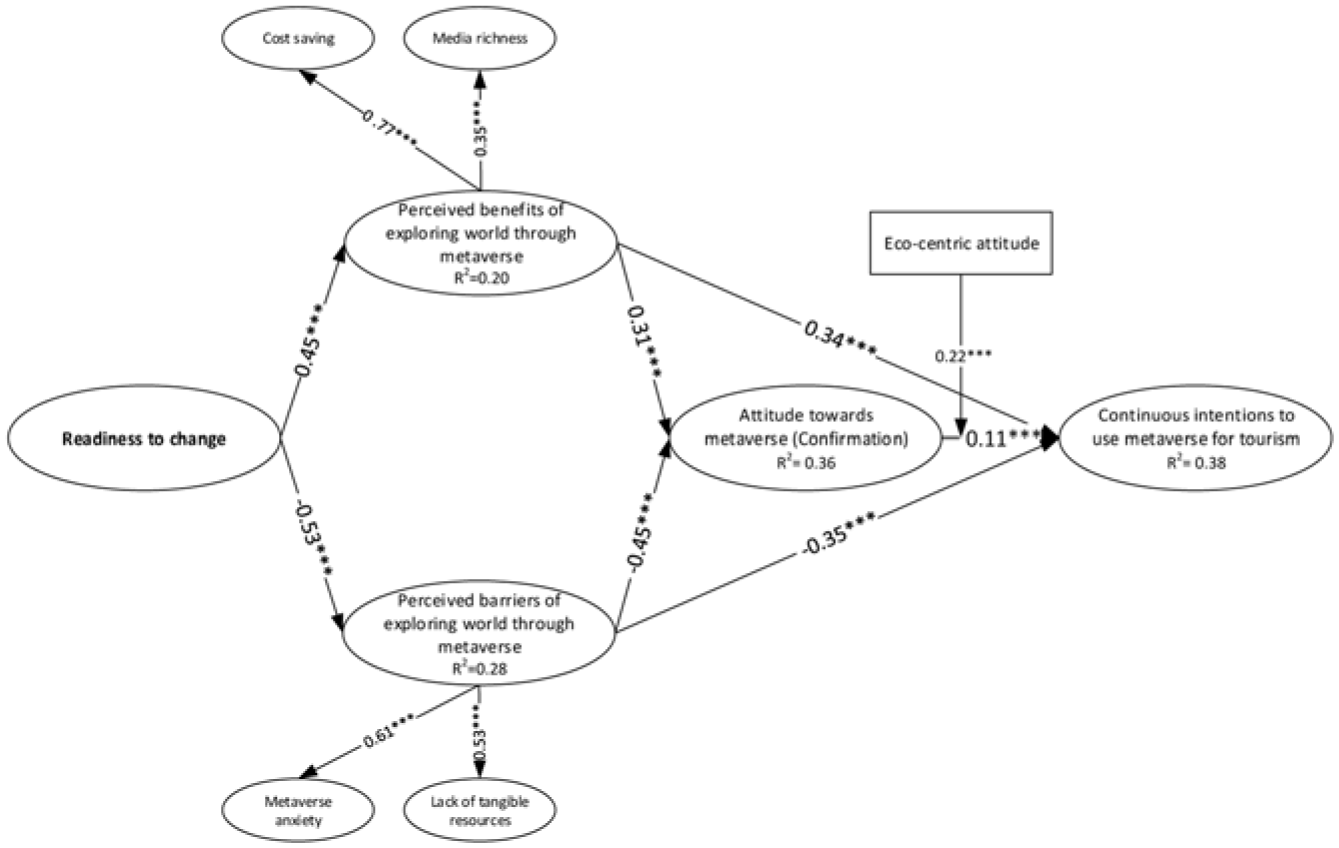
Structural path analysis.
Moderation Analysis
Using hierarchical regression analysis, the effects of eco-centric attitude as a moderator were measured on attitudes toward the Metaverse (confirmation) and continuous intentions to use metaverse tourism. Results suggest that a higher health-centric attitude is associated with a positive correlation between the attitude toward the Metaverse (confirmation) and continuous intentions to use metaverse tourism (H6: β = .22***). However, the presence of an eco-centric attitude may function as a reinforcing factor that increases awareness of metaverse tourism, thereby sustaining immersive environments, as argued by Patwary et al. (2022). The following is a graphical representation of the interaction plots for the moderation analysis (Figure 3). Interestingly, the positive impact on strengthening the relationship between attitude and continuous intentions is observed as more significant in the case of a + 1SD change in the eco-centric attitude. Moreover, its noted as non-significant in case of −1SD change in the moderator.
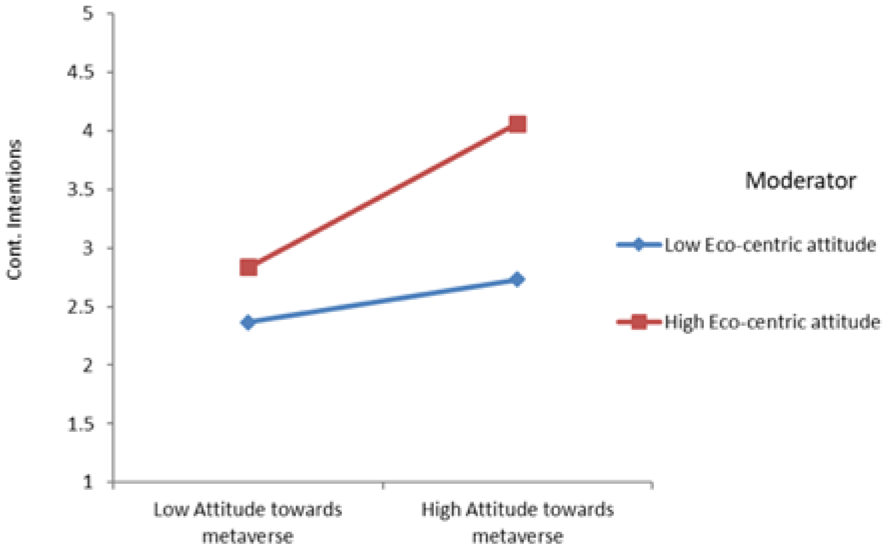
Graphical interaction plot. Eco-centric attitude strengthens the positive relationship between ATT and CI.
Discussion
In the overall model, all hypotheses were significant and supported. The graphical representation of the model is shown in Figure 3. Our findings elucidate the theory-based constructs related to continuous intentions to use the Metaverse for tourism. The findings reveal that all participants have used the Metaverse at least once in their lives. Prior studies have shown that individuals have positive attitudes toward using the Metaverse in various fields, especially after the emergence of COVID-19. Considering the hypotheses mentioned in Section 2.1, the current study’s findings on H1a and H1b reflect that, in mapping tourism in a Metaverse environment, personality trait readiness to change is an essential factor to take into consideration. Several studies discussed the role of the personality trait’ readiness to change’ in adopting new technology. Although the readiness to change has been studied in the contexts of e-learning adoption, B2B business, and education, none of the studies have identified the role of readiness to change in the context of Metaverse adoption for tourism. The current study concludes that individuals with a high level of readiness to change positively influence the perceived benefits of exploring the world through the Metaverse. Additionally, this study identified that readiness to change significantly influences individuals' perceived barriers to exploring the world through the Metaverse. The Risk–Benefit Analysis (RBA) model posits that users decide about the use of technology based on the comparison of potential negatives and positives. People are more open to and prepared for change when the emphasis is on benefit not on risk. Our findings demonstrate that those with greater readiness to change perceived the Metaverse as an exciting option for virtually traveling in tourism. They thought it was safe, convenient, and would be a new experience. Alternatively, individuals at lower levels of readiness were more concerned with privacy, technology, or novelty. This result is consistent with RBA theory in that the readiness to change affects how people evaluate risks and benefits. In other words, it shifts the cognitive “balance” between fear and opportunity, so people are more motivated to use the Metaverse. The results of the present study are in line with Saadé et al. (2006), states that individuals described as having a high level of openness to change are curious and willing to adapt to new technology. Our research shows that those who are more receptive to technology adoption have a positive outlook on using the Metaverse for tourism.
This study provides a strong and theoretically rich connection between the perceptions of benefits and the attitude of people to the Metaverse (H2a). In the perspective of the theory of Risk-Benefit Analysis (RBA), the given discovery highlights the fact that the readiness of people to adopt and use the Metaverse is largely based on their cognitive assessment of the perceived benefits in comparison to perceived risks. In the case where users perceive the Metaverse to have tangible benefits (saving costs, being immersive, and rich), the benefit appraisal is outweighed by the risk factors, causing users to have more favorable attitudes toward the technology. According to the RBA model, the adoption behavior result of the cognitive balancing process between the possible losses and the perceived gains. Cost saving and media richness are the most conspicuous benefit cues that refreeze the evaluative assessment of the perceived utility and satisfaction in the current study. Those who recognize the economic efficacy linked to virtual exploration, via a decrease in transportation, accommodation, or travel costs, will find it more probable to view the Metaverse as a low-risk, high-value innovation. In essence, our findings underscore that when individuals perceive these benefits within the Metaverse, they tend to develop more favorable attitudes toward this emerging technology. Cost savings emerge as a pivotal perceived benefit in our investigation. The Metaverse offers users the potential for significant savings compared to traditional modes of travel and exploration. Through immersion in digital environments, users can circumvent various expenses, such as transportation, accommodations, and dining, typically associated with physical travel. Cost-saving within the Metaverse signifies a fundamental transformation in how individuals access and engage with destinations, events, and cultural experiences, promoting inclusivity by dismantling economic barriers. Another critical perceived benefit lies in the concept of media richness. The Metaverse offers a uniquely immersive and interactive milieu, enabling users to interact with a diverse array of multimedia components, ranging from 3D visuals to augmented reality experiences. This heightened media richness elevates the overall quality and depth of digital experiences within the Metaverse. The immersive and interactive nature of the Metaverse enables users to engage with content in a manner that mirrors real-world experiences and, in some instances, surpasses them. This elevated level of media richness possesses the capability to captivate users, engendering highly memorable and engaging interactions. Our findings align with the research of U.-K. Lee (2022) and Deakyne et al. (2021), who have explored the relationship between perceived benefits and attitudes within the Metaverse context, thereby reinforcing the robustness and generalizability of our results within the broader discourse surrounding Metaverse technology adoption.
In current research, we explore the findings of H2b, which examines the negative association between perceived barriers, specifically Metaverse anxiety and the lack of tangible resources, and individuals’ attitudes toward the Metaverse, particularly their confirmation of this emerging technology as a valuable platform for exploration. Our study examines the significance of perceived barriers within the context of the Metaverse, illuminating how these obstacles influence individuals’ attitudes and their perception of the Metaverse as a viable exploration platform. Metaverse anxiety refers to the unease or apprehension individuals may experience when interacting with the Metaverse. This anxiety can stem from various sources, including a lack of familiarity with the technology, concerns about privacy and security, or the perceived complexity of navigating the Metaverse. Findings reveal that when individuals experience Metaverse anxiety, their overall attitude toward this technology becomes less favorable, as indicated by the negative path coefficient (H2a: b = −0.45***). These result underscores the significant relationship of anxiety-related barriers in hindering individuals from fully embracing the Metaverse as a means of exploration. It highlights the need for strategies that aim to alleviate such anxieties and enhance user comfort and confidence within the Metaverse environment. The lack of tangible resources represents another perceived barrier explored in our study. This barrier pertains to the absence of physical devices, infrastructure, or supportive ecosystems that individuals may perceive as necessary for effective engagement with the Metaverse. The negative path coefficient (b = –0.45**) suggests that this barrier also has a detrimental effect on individuals’ attitudes and their confirmation of the Metaverse as a valuable exploration platform. The adverse effects of barriers (Metaverse anxiety and tangible resources) on attitudes indicate that perceived risk will reduce user acceptance, a finding that is congruent with TPB and RBA models. This implies that technological fear and resource constraints increase cognitive load, thereby diminishing the level of confidence and emotional preparedness for user acceptance in the virtual environment. Inherent in this theoretical framework, then, is a suppression effect of positive attitudes by risk perception – a critical role in RBA. It is noteworthy that our findings align with the trends observed by Apriani et al. (2022), who also reported similar adverse effects of perceived barriers in their study. Individuals who perceive a lack of tangible resources may feel disadvantaged or excluded from Metaverse engagement due to limited access or inadequate technology. Addressing this barrier requires initiatives aimed at improving accessibility and ensuring that users have the necessary resources to explore and benefit from the Metaverse. By differentiating such particular barriers, the study advances RBA, which demonstrates how types of psychological discomfort (anxiety) and situational restrictions (resource unavailability) co-determine attitudinal responses.
The application of the findings of H3 in the context of the Risk-Benefit Analysis (RBA) framework gives more information on how and why individuals form continuous intentions to use the Metaverse for tourism. According to the RBA, people participate in a cognitive comparison of perceived risk and perceived benefit in making a decision to adopt or not adopt a technology. These two assessments result in a balance that eventually leads to behavioral persistence or withdrawal. The perceived benefits that ensued in this study became the critical factor influencing the further use of the Metaverse by the users. As demonstrated by Gao et al. (2015), when the benefits outweigh the barriers, individuals are more inclined to adopt certain technologies. On the contrary, if the barriers outweigh the benefits, individuals tend to avoid adopting new technology. In line with this, the findings of this study reveal that benefits play a significant role in individuals’ continued intention to use the Metaverse for tourism. Similarly, the benefits of media richness and cost savings positively influence individuals’ use of the Metaverse, and as a result, they tend to continue using it for tourism. Ullah et al. (2022) examined that cost-saving has a favorable effect on users’ buying behaviors. The findings of our study indicate that barriers have a greater association with people than benefits. The current study also examined how Metaverse anxiety and a lack of tangible resources play a dominant role as barriers (H4) in shaping individuals’ attitudes toward the Metaverse. The findings of the current study align with those of Sancho-Esper et al. (2023) stated that anxiety regarding the use of VR technology after virtually visiting a tourist destination (Venice) influences older adults’ intention to use VR again for tourism. Sousa et al. (2022) examined the lack of tangible resources as a structural barrier to the inclusion of deaf children in classrooms. This study concluded that the lack of tangible resources and Metaverse anxiety create barriers for individuals, negatively influencing their intention to use the Metaverse and hindering continuous use of Metaverse technology for tourism. The fact that obstacles have a negative influence on continuous intention demonstrates the asymmetrical effect of risks and benefits. According to the RBA, individuals who perceive high technological anxiety or resource limitations are less likely to sustain long-term use, despite having advantages. This contribution to the theory illustrates that risk perceptions can override benefits in driving behavioral persistence, which underscores the need to overcome emotional and logistical barriers to adopting the Metaverse.
The explanation of H5 results based on the Risk-Benefit Analysis (RBA) model provides a more sophisticated perspective between the attitudes of people to the Metaverse and the intention to use it again in tourism. Individuals within an RBA theoretical framework undergo a cognitive environment of appraisal where the individual considers the potential value of a technology over its risks or obstacles. Positive attitudes and enduring behavioral intentions are developed when perceived benefits, including enjoyment and immersion and efficiency, overshadow perceived risks, including privacy issues, complex technical aspects, or uncertainty. This confirmed that attitude is a powerful predictor of the intention to adopt the technology. The Metaverse, as an emerging technology, has acquired substantial attention due to its potential to reshape various industries, including tourism. Attitude is an evaluative result of the benefit-risk cognition in an RBA view. The users constantly evaluate the balance between the benefits and the disadvantages of the Metaverse by using it as they decide on whether the benefits in the form of convenience, novelty, and immersivity are worth the costs they incur. Users have stronger positive affective responses and become more persistent in their behavior when the perceived benefits are consistently greater than the perceived risks. Attitude toward technology has been recognized as a crucial determinant of user behavior, and our findings reinforce this notion. Individuals who hold positive attitudes toward the Metaverse as a platform for exploration and tourism are more likely to exhibit continuous intentions to use it for these purposes. The Metaverse offers unique and immersive digital experiences that have the potential to surpass traditional tourism experiences in terms of novelty and engagement. Users who perceive these advantages are more likely to develop a positive attitude toward the Metaverse for tourism. Our results align with the findings of Dang (2022) and Wadhar et al. (2023), elucidating the behavioral intentions of tourists, indicating that attitudes have a positive role in constructing environmentally friendly behavior.
In this era, users’ awareness and readiness toward an eco-friendly environment are a matter of concern in predicting future perspectives. The eco-centric orientation functions as a value amplifier for RBA: users’ intentions are higher when they perceive the Metaverse as an ecologically sound choice than when engaging in physical travel. This integration extends current models of acceptance by moral and ecological considerations, further developing the conceptual link between sustainability and digital behavior. Therefore, in the current study, the eco-centricity as a moderator (H6) depicted the relation to attitude toward Metaverse adoption and maintaining continuous intentions to use the Metaverse environment for tourism. The findings reveal that an eco-centric attitude among individuals positively influences their intention to use Metaverse technology and their continued use of Metaverse for tourism, as studies have shown a positive attitude among individuals toward eco-friendly products. Thus, our results are in line with Patwary et al. (2022) study, which examined that travelers consider the consumption of environmentally friendly products as necessary on their trips. Awareness of global warming and a sense of responsibility for the environment prompt consumers to adopt eco-centric attitudes and purchase eco-friendly products to help preserve nature. Taken together, these results support the view that the RBA model, along with personal predispositions (readiness to change) and moral values (ecocentric attitude), provides a broad theoretical solution for sustaining Metaverse use intention. Additionally, by incorporating readiness to change and an eco-centric attitude into the RBA model, this research bridges the digital transformation and sustainability conversations in the context of tourism. It implies that an environmentally sustainable Metaverse and green virtual experience are conducive to enhancing users’ durable engagement and serving the goals of environmentally responsible tourism.
Theoretical Implications
First, in the existing literature, the readiness to change has been discussed in relation to the adoption of the Metaverse. Peng and Dutta (2022), in their analysis of the adoption of e-learning during the early COVID-19 period, they discovered that readiness is a key factor in accepting new technologies. In the case of the Metaverse, Arpaci et al. (2022) employed readiness as an independent variable to map the social sustainability of Metaverse adoption. The current study, however, has used readiness to change as a stand-alone component to map over the social, psychological, and cognitive aspects that also influence individuals’ behavioral intentions toward Metaverse adoption. Second, risk-benefit analyses have been used in research across various fields to evaluate the benefits and risks associated with the adoption of innovative technologies. Risk-benefit analysis suggests that a person’s decision to accept or reject any innovation or change is influenced by the predicted cost-benefit evaluations or how individuals perceive themselves. Through a risk-benefit analysis Zhou et al. (2019) examined how Chinese social media users utilized the platform to share and seek information about GMOs/GF. Considering this, the current study employed a risk-benefit analysis as a novel contribution to the field, mapping continuous intentions in the adoption of the Metaverse.
Additionally, this study examined the risk-benefit analysis of social, cognitive, and behavioral goals across the entire Metaverse spectrum. The current study expands the significance of readiness to change in adoption behavior. To better understand the structural direction, our study assesses readiness to change while considering risk-benefit analysis. Third, Studies on the intentions to use technology in various areas of study have been found in the currently available literature. Alfaisal et al. (2024) examined the adoption and acceptability of the Metaverse in the field of education. However, no study has specifically addressed continuous intentions in the context of the Metaverse. As a result, the current study is distinctive in that it clarifies consumers’ ongoing intentions to adopt the Metaverse. Fourth, this study is unique because the existing literature has already discovered Metaverse adoption. However, it hasn’t been thoroughly investigated how eco-centric qualities affect the intentions of consumers. People today value nature for its own sake, which makes them more worried about the environment and global warming. As a result, they have an eco-centric mindset and a willingness to use eco-friendly products as well. Therefore, the most significant innovation of this study is that attitudes of users, which have been developed based on risk-benefit analysis, have not yet been identified in relation to continuous intentions, specifically whether an eco-centric value is high or low. Our study is the first to determine how an eco-centric attitude of individuals helps users maintain continuous intention for Metaverse usage.
Practical Implications
The practical implications of the current situation are drawn as follows: first, the Metaverse’s existence has brought an entirely new perspective on immersive learning. It presents fresh learning scenarios and chances for learners. Numerous training initiatives or unattainable goals may occur in the universe of the Metaverse. Tlili et al. (2022) identified that students can connect with multiple digital resources through virtual worlds, thanks to the utilization of high-performance servers in the Metaverse. Several studies have argued that striking a balance between learning and enjoyment is challenging when engaging in immersive learning. Therefore, the language learning applications should strike a balance between learning, pleasure, and excitement in Metaverse learning. Second, the risk-benefit analysis used in this study to examine continuous intentions in Metaverse adoption revealed that barriers significantly influence consumers’ intentions. The study recommends that benefits be strengthened, or barriers should be weakened, to support people in maintaining their continuous intentions for Metaverse adoption. Third, this study examined cost and media richness as benefits that help people visualize Metaverse technology; as a result, cost and richness should be carefully controlled to reduce risk and maximize benefits. Fourth, as previously stated, it is necessary to enhance the advantages or mitigate the disadvantages to alter people’s attitudes about the intent to continue using the Metaverse. Consequently, it is crucial to examine how the Metaverse can be created to be inclusive of and accessible to all people. Therefore, it is essential to make physical gadgets available so that they can function properly and provide benefits, thereby reducing risk. Further attention should be paid to media richness to influence users’ perceptions of the Metaverse. World champion organizations should study this issue to reduce barriers caused by Metaverse concerns, and authorities should develop new standardizing procedures. Fifth, the role of efficacy and self-efficacy has also been discussed in this study. Through technological standpoint studies, issues in interface design were identified as hindrances to Metaverse adoption. In light of this, the present study suggests ways to make user interfaces more autonomous and simpler to engage with, which encourages users to take an active role in their adoption decisions. The more engaging and user-friendly a device is, the more consumers will start utilizing it. As Dwivedi et al. (2022) elucidated, user interfaces have a significant effect on how customers perceive a product. It has also been demonstrated that the simulated experience is related to purchase intention through engagement, enjoyment, and satisfaction.
Managerial and Policy Implications
This research also offers some important practical insights for tourism managers and policymakers seeking to harness the Metaverse’s potential for sustainable and digitally driven tourism. Firstly, the empirical data show that readiness to change has a statistically significant impact on the perceived benefits and a continuous intention; therefore, tourism agencies must invest in digital literacy training programs, immersive training courses, and interactive tutorials that will familiarize users with virtual worlds and will reduce the perceived technological anxiety. Increasing the user preparedness is likely to increase confidence levels, ease usability, and foster long-term involvement with tourism services in the Metaverse. Second, a moderating role of eco-centric attitudes highlights the necessity to incorporate the principles of sustainability in the structure of virtual experiences. The marketers and developers of destinations can, therefore, incorporate the aspects of eco-themes, including simulations of carbon-neutral travel, conservation-oriented narratives, and green virtual destinations, in order to appeal to environmentally friendly users and further a sustainable tourism administration agenda. Third, the strong impact of perceived benefits proposes tourism entities should combine Metaverse innovation with the general digital transformation strategies and utilize data analytics, personalization, and AI-enhanced experiences to improve on value creation. The policymakers can also contribute to this shift by developing the ethical, inclusive, and accessibility-focused models, which would encourage the responsible use of the Metaverse. Taken together, these strategic imperatives can help the tourism stakeholders achieve sustainability, better user engagement, and faster digital transformation of the sector.
Limitations and Future Directions
Despite the novelty of the current study, it poses several limitations. For instance, the risk-benefit analysis used in this study incorporated stress-driven barriers. Metaverse anxiety and a lack of tangible resources are the only two components of technology-related stresses used in this study; more constructs need to be examined in future research (quality of VR device, and the quality of VR content). This study examined individuals’ motivations for engaging in metaverse tourism. In this study, we investigated cost savings and media richness, which were in-depth highlighted to highlight the resource-related benefits. Future research should examine additional benefits, including convenience, especially for older and disabled individuals, and a sense of telepresence. Additionally, the results of this study elucidate that Chinese people have a readiness toward the adoption of technology, particularly in the Metaverse, for travel and immersive environment adoption. In future studies, the mediating role of attitude toward the Metaverse can also be examined when mapping metaverse users’ continuous intentions to use the Metaverse for tourism. The outcome of this study suggests that future research should be conducted to compare the Metaverse adoption in tourism and hospitality. Moreover, this study only examines readiness to change as a personality trait; future research should consider other personality traits and comparisons regarding the adoption of the Metaverse in tourism. Future research should thus include methods that consider a variety of specializations, such as sociocultural normative influences that endure within and across areas. Moreover, the future researcher explores switching intention using a qualitative approach, employing open-ended questions to delve deeply into the differentiation between Metaverse and traditional tourism. Finally, this current study only collected data from China, which does not reflect generalizability. Therefore, we suggest that future studies must replicate these results using broader and more representative samples of participants across other cultures and geographical contexts. This will help in establishing the cross-cultural generalizability of our findings and counter sampling bias in the design of this study.
Conclusion
The current study initiative proposed a risk-benefit analysis to conceptualize the continuous intentions of individuals toward Metaverse tourism. Although the adoption of the Metaverse has been explored in the literature, this study is the first to emphasize the constant intentions in the context of Metaverse adoption. The valuable findings of the current study underscore that barriers such as Metaverse anxiety and a lack of tangible resources in the Metaverse strongly influence individuals’ intentions for Metaverse tourism. The research also shows that benefits (media richness and cost savings) have a favorable association with individuals in Metaverse adoption for tourism. It was interesting to discover that berries had a stronger relationship with consumers than benefits. Moreover, this present study has established the significance of readiness to change as an independent variable in mapping the social, psychological, and cognitive factors that also affect people’s behavioral intentions toward adopting the Metaverse. Furthermore, this study clarified that the personality attribute “readiness to change” influences individuals’ intentions favorably.
Additionally, this study examined the impact of adopting an eco-centric attitude on Metaverse adoption and found that individuals with eco-centric mindsets strongly favor utilizing the Metaverse for tourism. Therefore, to attract a younger audience and foster their engagement with Metaverse-based tourism, it is advisable to provide customizable experiences that empower them to curate their own virtual travel experiences. Emphasize sustainable practices and environmentally conscious alternatives within the realm of Metaverse tourism to match the ecological concerns of the younger demographic. Additionally, developing professional connections with influential individuals within the Metaverse community is a strategic approach to augmenting the visibility and prominence of the tourism sector in the Metaverse. By establishing strategic partnerships with prominent users and content creators inside the Metaverse, there is an opportunity to provide expansive and diverse virtual tourism experiences to a broader audience. Theoretical and practical implications emerge from this study by incorporating readiness to change and eco-centric attitudes into the RBA framework for explaining users’ continuous intention in Metaverse tourism. By combining an eco-centric attitude as a moderator, the study expands technology adoption models to encompass sustainability and demonstrates how environmentally focused values enhance involvement in emerging digital technologies. From a practical perspective, the findings shed light for tourism executives and policymakers on how to play their roles in fostering sustainable digital transformation by enhancing user readiness and integrating environmental awareness into Metaverse design and dissemination. Future studies might want to replicate the research model in a cross-cultural context to examine whether the relationships between the study’s constructs are generalizable across different tourism markets and cultural backgrounds. Longitudinal analysis is recommended to explore how Metaverse tourist behavior intention might change over time, as both familiarity with, and ecosystems of, technology development. Combined, these avenues will further our understanding of the co-creation between sustainability and digital innovation in shaping future tourism experiences.
Supplemental Material
sj-docx-1-sgo-10.1177_21582440261419863 – Supplemental material for Predicting the Future of Metaverse-Based Transformation in Tourism: Role of Eco-centric Attitude as a Moderator
Supplemental material, sj-docx-1-sgo-10.1177_21582440261419863 for Predicting the Future of Metaverse-Based Transformation in Tourism: Role of Eco-centric Attitude as a Moderator by Saba Batool Wadhar, Riffat Shahani, Yang Guang, Fahad Asmi and Daood Muhammad in SAGE Open
Footnotes

Ethical Considerations
This study was approved by the University of Science and Technology of China.
Consent to Participate
Informed consent was obtained from all human participants involved in the study.
Consent for Publication
All authors have given their consent to publish this manuscript.
Funding
The authors received no financial support for the research, authorship, and/or publication of this article.
Declaration of Conflicting Interests
The authors declared no potential conflicts of interest with respect to the research, authorship, and/or publication of this article.
Data Availability Statement
Data will be made available on request.
Clinical Trial Number
Not applicable.
Supplemental Material
Supplemental material for this article is available online.
References
Supplementary Material
Please find the following supplemental material available below.
For Open Access articles published under a Creative Commons License, all supplemental material carries the same license as the article it is associated with.
For non-Open Access articles published, all supplemental material carries a non-exclusive license, and permission requests for re-use of supplemental material or any part of supplemental material shall be sent directly to the copyright owner as specified in the copyright notice associated with the article.
