




Abstract
This study examines the profile of coping strategies employed by Tunisian football referees and assistant referees, considering gender, role specialization, and professional rank. Ninety-four participants (mean age = 25.78 years, SD = 6.23) affiliated with the Tunisian Football Federation completed the Arabic version of the Inventory of Coping Strategies in Sports Competitions (ICSCS) after officiating matches. ICSCS assesses 10 coping strategies: mental imagery, thought control, effort expenditure, seeking support, relaxation, logical analysis, venting unpleasant emotions, disengagement, social withdrawal, and mental distraction. The results reveal significant differences in coping strategies based on gender, role specialization, and rank. Male referees tend to favor task-focused strategies, such as logical analysis and effort, whereas female referees often employ emotional strategies, including social support and relaxation (p < .05). Assistant referees resort more frequently to disengagement strategies than main referees (p < .01). Higher-ranked referees prefer problem-focused strategies over avoidance strategies (p < .05). These results highlight the multidimensional nature of coping among football officials and underscore the importance of tailored interventions to optimize their psychological preparation and performance. The study also sheds light on gender-specific challenges and coping mechanisms, particularly among female referees, while contributing to filling a critical gap in sports psychology.
Keywords
Introduction
Like footballers, referees and assistant referees continually face high-stress situations during competitions (Cleland et al., 2018; Deal et al., 2018; Louvet et al., 2015). Each encounter places them in particular physical, psychological, and relational dispositions (Gulec & Yilmaz, 2016; Louvet, 2006; Wicker & Frick, 2016). High level of football referees requires physical performance (Cosma et al., 2020; Costa et al., 2013; Maslennikov et al., 2019; Weston et al., 2010), meeting stakes and interpersonal conflicts (Devís-Devís et al., 2021), fear of failure and aggression (Allen & Anderson, 2017) emotional and cognitive functioning during games (Johansen, 2015; Philippe et al., 2009; Rix-Lièvre et al., 2014) gatherings and training seminars (Helsen & Bultynck, 2004; Mascarenhas et al., 2005; Slimani, 2020), competition and FIFA physical tests (Aragao Pina et al., 2018; Catteeuw et al., 2010; Monteiro et al., 2018) occasional lack of social recognition (Johansen, 2015; Le Tiec, 2018) etc. These factors appear to be major sources of stress for referees and assistant referees in football (Forbes et al., 2015; Mendes et al., 2021; Voight, 2009). On the other hand, referees and assistant referees in football typically play an equally important role in determining the outcome of matches (Guillén & Feltz, 2011; Louvet et al., 2015). Nevertheless, the understanding of the factors that contribute to the multidimensional nature of excellence in football referees’ performance remains limited (Aragao Pina et al., 2019). The involvement of both referees and assistant referees within the sports system deserves a deeper scientific interest (L. A. Livingston et al., 2017; Morillo et al., 2017; Sánchez et al., 2022). Scholarly attention to this topic has increased over the past decade (L. Livingston et al., 2020). The earliest studies focusing on stress in referees date back to the 1990s (Kaissidis & Anshel, 1993; Taylor et al., 1990). However, the first scientific articles addressing bipolarity, stress, and coping in football referees and assistant referees emerged in the 2000s (Cleland & Cashmore, 2014; Devís-Devís et al., 2021; Louvet et al., 2009).
While coping is generally defined as the set of cognitive and behavioral efforts aimed at managing a stressful situation that exceeds an individual’s resources (Nicchi & Le Scanff, 2005), many studies have highlighted coping strategies in the sports field, including those used in sports refereeing (Dosseville & Laborde, 2011; Schmidt et al., 2019). Some studies have focused on stress management among referees (Devís-Devís et al., 2021; Hill et al., 2016), while others have examined the use of optimal coping strategies for performance (Louvet, 2006; Louvet & Campo, 2019). In this context, the current study can contribute to understanding how Tunisian referees cope with stress and prepare properly for match management (Da Gama et al., 2018; Pietraszewski et al., 2014).
Match stakes and pressure are the most dominant situational psychological aspects that predict coping strategies among football referees. However, experience remains a dispositional variable that directly manipulates these strategies (Dosseville & Laborde, 2015; Louvet et al., 2015). In this context, some previous studies have focused on the need to understand the difference between expert and non-expert referees (Mascarenhas et al., 2005; Weston et al., 2012). The experience and level of football referees play an important role in defining their coping profile. The study by Louvet & Campo (2019) examined referees of different levels and demonstrated that those who referee high-level matches tend to employ task-oriented coping strategies, which aim to directly confront the source of stress (Doron et al., 2013), unlike those who referee lower-level matches. Louvet (2006) and Louvet et al. (2015) found that among high-level referees, state anxiety acts more as a stimulator than an inhibitor. In a similar context, Johansen (2015) investigated the level factor in two different groups of elite and non-elite referees in Norwegian football. Mendes et al. (2021) examined personal experience to determine excellence and performance among Portuguese referees in a model that took referee classification into account.
On the other hand, female refereeing in football continues to evolve, with a significant increase in the number of women officiating on the pitch (Forbes et al., 2015; Kim & Hong, 2016; Ottogalli & Garcia, 2023). Female football referees may face similar challenges to male referees, but they may also encounter gender barriers and stereotypes (Perreau-Niel & Erard, 2015; Raab et al., 2019; Reid & Dallaire, 2019; Tingle et al., 2014). They constantly compromise their identity as women in a context where men and masculinity dominate. However, the study by Jones and Edwards (2013) shows that fundamental differences between men and women are not present in this area. These are simply arguments often used to justify the exclusion of women from football refereeing (Jones & Edwards, 2013).
The role specificity factor, particularly the distinction between assistant and central referees, has been the subject of very little research (Louvet et al., 2015). The psychological behavior of referees and assistant referees is explored by Weston et al. (2010), who find that the specialty factor does not affect the two professions. Similarly, Aguirre-Loaiza et al. (2020) demonstrate that the psychological characteristics related to the sports performance of football referees do not differ between the main and assistant referees. However, differences exist in terms of age and level in the study of Aguirre-Loaiza et al. (2020).
Despite numerous studies, attention to different types of refereeing in football remains limited. To date, no mental model measures have been designed specifically for football referees (Boyer et al., 2020), while behavioral effects have been addressed more in non-professional referees and assistants.
No study currently examines the coping profile of Tunisian male and female referees and assistant referees, which they could assume on the field on the day of the match. Based on the above, this study aims to contribute to understanding the impact of various factors on coping strategies that shape the excellence of referees and assistant referees in Tunisian football, while also highlighting gender variables, specialty, and rank that require additional research. It should be noted that the status of the National Arbitration Department (NAD) of the Tunisian Football Federation stipulates in its fifth chapter that referees and assistant referees must annually undergo a special medical examination and operate within the framework of existing laws and regulations. Chapter six states that the candidates for football refereeing must be at least 15 years old and not more than 25 years old. The structures affiliated with the Tunisian Football Federation are responsible for the theoretical and practical training of referees and assistant referees. The training includes enhancing both their theoretical knowledge and physical performance levels; organizing courses, seminars, and regional, national, and international training sessions; and the periodic evaluation of referees and assistant referees. These procedures are stipulated in Chapter Seven of the Statute of the Tunisian National Arbitration Directorate (2020).
Despite the development of global research on referee stress and their coping mechanisms, this remains insufficient in the Tunisian context. This study seeks to fill this gap by providing empirical data on coping strategies employed by Tunisian referees, with a particular focus on the interplay between their professional roles and gender dynamics. In doing so, it aims to contribute to the literature on sports psychology and refereeing, offering insights that could be crucial for developing more effective support systems for referees within the sporting world.
Methodology
Participants
Fifty-two referees (Mage = 24.90, SD = 5.73) and 42 assistant referees (Mage = 26.86, SD = 6.71) affiliated to the national refereeing board of the Tunisian Football Federation (45 Male referee, Mage = 25.13, SD = 5.87; 34 Male assistant, Mage = 27.06, SD = 6.30; 07 Female referee, Mage = 23.43, SD = 4.79 and 08 Female assistant, Mage = 26.00, SD = 8.68), voluntarily participated in this study. The average age range of the participants was between 17 and 47 (Mage = 25.78, SD = 6.23). According to the timing of the national arbitration board, participants were divided as follows: first degree (n = 10), second degree (n = 50), and third degree (n = 34).
To assess the adequacy of the sample size, a subsequent sensitivity and power analysis was conducted using G-Power 3.1 software with a one-way ANOVA test. The sample size was 282 participants, divided into three groups (94 per group). During the analysis, the effect size was set at f = 0.25, and the analysis revealed a power of (1−β) = .97 and a critical value (F) = 3.03. Based on Cohen’s (1988) study, the study is sufficiently powerful to determine the effect of adaptation on the gender, specialty, and grade of Tunisian referees.
Additionally, height, weight, and body mass index were measured to establish a physical profile for the participants (see Table 1).
Mean and Standard Deviation of Descriptive Research Variables.

Measures
To study the adaptation profile, 94 Tunisian referees and assistant referees, both men and women, completed an Arabic version of the Adaptation Strategies List for ICSCS Sport Competitions (Hajji et al., 2016), which was validated according to the Vallerand methodology (Vallerand, 1989). This tool measures 10 coping strategies: mental imagery, thought control, effort expenditure, seeking support, relaxation, logical analysis, venting of unpleasant emotions, disengagement, social withdrawal, and mental distraction, via 39 items rated on a Likert scale of 5 points. Each strategy has four items [response scale from 1 (never) to 5 (always)], except the Deployment efforts strategy, which has three items [response scale from 1 (never) to 5 (always)]. Referees and assistant referees were asked to respond to all items in the Arabic version of the ICSCS 1 hr after the competition. The time required to complete the ICSCS was approximately 15 min. Measurements of height, weight, and BMI in this study were obtained from the physical preparation units of the participants through regional, national, and international periodic testing sessions.
Search Procedure
Participants were treated following the ethical guidelines of the American Psychological Association (2019) regarding consent, confidentiality, and anonymity of responses. The study received ECUMUS laboratory ethics approval from the University of Sfax. The principal investigator contacted the heads of the National Department of Arbitration of the Tunisian Football Federation and requested their participation in the project. Consent was obtained through voluntary participation in the present research. Data were collected during the 2022 to 2023 sports season. Tunisian referees and assistant referees were invited to respond to the Arabic version of the inventory of coping strategies of the sports competition (Hajji et al., 2016), approximately 1 to 2 hr after officiating a match. The questionnaires were anonymous, and at no point were the data processed personally. The principal investigator was present during the data collection, overseeing the entire process and answering specific questions if necessary. Participants completed the questionnaires individually, in a distraction-free setting, within approximately 10 to 15 min. However, measures of height, weight, and BMI were obtained by the physical preparation unit of male and female referees and assistant referees through periodic regional, national, and international testing sessions.
Statistical Analysis
The distribution of the statistical data obtained by this study was examined by asymmetry and flattening tests. The data follow the normal law when the asymmetry coefficients, which measure the deviation of the distribution around the mean (skewness), are less than 1, and the flattening coefficient, which reflects the distribution of data around its center (kurtosis), is less than 1.5 (Cain et al., 2017; Carricano et al., 2010). ANOVA was employed to assess the effects of gender, role specialization, and degree on coping strategies due to its efficacy in analyzing differences across multiple groups. All observed differences were statistically significant when the p-value < .05, and effect sizes were calculated using the square eta (η2 = sum of squares in group effects/total sum of squares in ANOVA). Specifically, the total sum of ANOVA squares included the group effect, temporal effect, interaction effect, and error effect. The magnitude of the square is explained by Cohen’s suggestion (Cohen, 2013): η2 < .01 has no effect; .01 < η2 < .06, the effect level is small; .06 < η2 < .14, the effect level is moderate; η2 > .14, the effect level is significant (Cohen, 2013; Lakens, 2013). The data was analyzed using the IBM SPSS Statistics software (IBM SPSS software, France, version 21.0). Subsequently, the data obtained from the answers to the various items of the Arabic version of the ICSCS (Hajji et al., 2016) were summarized in the form of average and standard deviation (SD) to illustrate the level of coping of Tunisian referees and assistant referees, both men and women.
Results
The Effect of Gender, Role Specialization, and Degree on the Coping Strategies Used by Tunisian Referees and Assistant Referees
Normality Analysis
To guarantee the normality of the distribution, skewness and kurtosis were examined. The coefficients of all variables were within an acceptable range (−1/+1). The correlations between variables were positive. Table 2 presents the preliminary analysis of the variables.
Means, Standard Deviations, Normality of Distribution, and Correlation Variables.

Note. M = Mean; SD = Standard deviation; R = Correlation; MI = Mental imagery; TC = Thought control; EE = Effort expenditure; SS = Seeking support; Rx = Relaxation; LA = Logical analysis; VUE = Venting of unpleasant emotions; Di = Disengagement; SW = Social withdrawal; MD = Mental distraction.
p < .05. **p < .01.
Analysis of the Effect of Gender, Specialty, and Degree Variables
ANOVA analysis confirmed the existence of a significant effect of the gender variable on the logical analysis strategy [F = 9.542; p-value = .003; η2 = .094]; however, the variables of specialization and academic degree had no effect (see Table 3).
Inter-Subject Effects Tests.

Note. DV = Dependent variables; M = Mean; SD = Standard deviation; MI = Mental imagery; TC = Thought control; EE = Effort expenditure; SS = Seeking support; Rx = Relaxation; LA = Logical analysis; VUE = Venting of unpleasant emotions; Di = Disengagement; SW = Social withdrawal; MD = Mental distraction; F = Fisher test; η2 = Effect sizes.
Level of Coping Strategies According to Gender, Specialty, and Degree Variables Among Tunisian Referees and Assistant Referees
The descriptive analysis revealed that the coping strategies most used by referees and assistant referees are mental imagery, thought control, logical analysis, and effort expenditure. Table 4 shows the level of coping among the participants.
Level of Coping Among Tunisian Referees and Assistant Referees According to Gender, Specialty, and Degree.
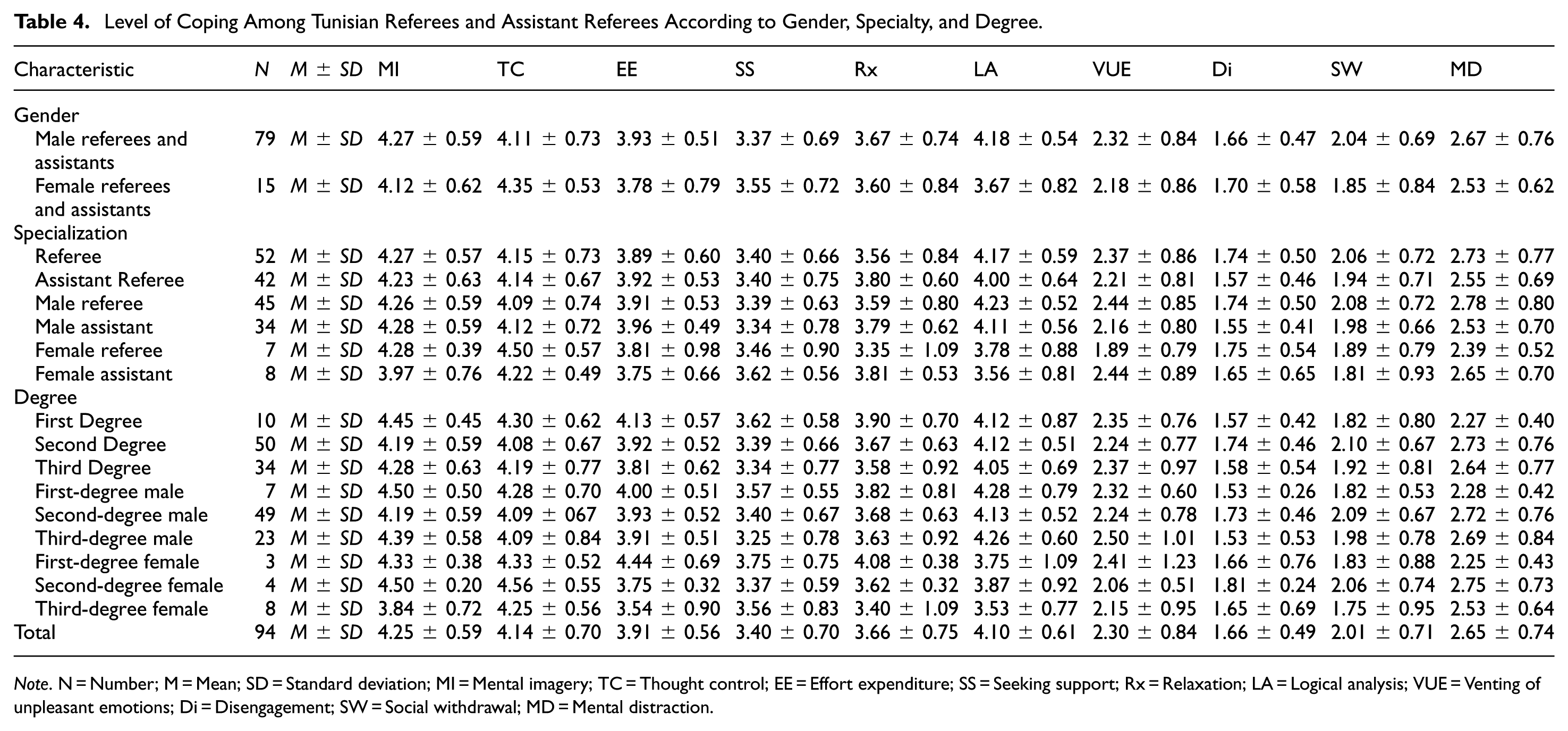
Note. N = Number; M = Mean; SD = Standard deviation; MI = Mental imagery; TC = Thought control; EE = Effort expenditure; SS = Seeking support; Rx = Relaxation; LA = Logical analysis; VUE = Venting of unpleasant emotions; Di = Disengagement; SW = Social withdrawal; MD = Mental distraction.
Discussion
Football referees and assistant referees can face various challenges on the field, and finding ways to cope with pressure and stress can be crucial to their mental well-being and performance (Cleland et al., 2018; Deal et al., 2018; Devís-Devís et al., 2021; Louvet et al., 2015). This study aimed to understand the adaptation mechanisms used by referees and assistant referees in Tunisian football. More specifically, this research aimed to discover the global profile of the coping of referees and assistant referees according to relevant variables such as gender, specialty, and degree of coping, within the constraints of competition. Despite the growing literature on adaptation in sport (Aragao Pina et al., 2018; Louvet et al., 2009), the coping skills of referees and assistant referees require further research (Aragao Pina et al., 2018).
The Effect of Gender, Specialization of the Role, and Degree on the Coping Strategies Used by Tunisian Referees and Assistant Referees
Normality Analysis
There are several methods for statistically estimating the normal distribution of data collected in the field of psychology. Among the best-known approaches are the empirical and graphical approaches to flattening and asymmetry (Cain et al., 2017; Gana & Broc, 2018). The results showed that asymmetry coefficients varied between −0.750 and 0.681, and flattening coefficients varied between −1.026 and 0.830. The coefficients of asymmetry and flattening are less than 1, which proves that the variables of this research follow a normal law (Cain et al., 2017; Carricano et al., 2010).
Analysis of the Effect of Gender, Specialization of Role, and Degree Variables
Since the data collected in this study follow the Gaussian law, the ANOVA parametric test was performed. The analysis of variance proves the significant effect of the gender variable on the coping strategies chosen by Tunisian referees and assistant referees. Football refereeing continues to be a male-dominated field that relegates women to the margins. In a space where men and masculinity prevail, female referees and assistant referees are still trying to navigate between their identities as women and as football officials (Caudwell, 2013; Devís-Devís et al., 2021; Drury et al., 2022; Jones & Edwards, 2013).
The study by Devís-Devís et al. (2021) confirms that the varied use of coping strategies is a necessary hypothesis for future studies. Likewise, the study conducted by Reid and Dallaire (2019) emphasizes the marginalization of women referees. This is due to the lack of studies in this field, perhaps due to the small number of female referees and the expected difficulties in recruiting participants (Deal et al., 2018). The study, focusing on Canadian soccer referees, confirms how these referees faced gender discrimination and how they absorbed the discrimination (Reid & Dallaire, 2019). The work of Forbes et al. (2015) is among the few studies examining gender- based coping. In officiating men’s amateur football matches in the United Kingdom, female referees have used different strategies to overcome the hostile attitudes that often welcome their presence on the football field (Forbes et al., 2015).
Similarly, female basketball referees in the United States adopt more coping strategies associated with gender-based abuse than their male counterparts (Tingle et al., 2014). The study of Lima et al. (2022) demonstrates that female referees are distinguished as capable of the same achievements as men. At the beginning of their careers as referees, women and men have similar motivations regarding the development of different abilities (concentration, decision-making, leadership under pressure, and conflict management). However, women encounter sexism, facing stereotypes and psychological abuse from dominant men in sports (Kavasoğlu, 2021; Lima et al., 2022). Following a qualitative study of 10 female referees active in English football, three themes were identified about the structure and culture of the game and its impact on women’s experiences in both men’s and women’s competitive football, concerning: gender entry into football careers; strengthening the female difference on the football field; and coping strategies to stay in the game (Drury et al., 2022).
However, little research has been conducted regarding the coping strategies among female referees in football. Most of the research with female referees, often supervised by FIFA, has been focused more on the physical than the psychological aspects (Ai et al., 2020; Martín-Sánchez et al., 2022; Moen et al., 2022; Muscella et al., 2022).
In general, the few studies focusing on gender coping among referees focus on the bias that the stressful situation is the same, but the coping mechanism differs in males and females (Kavasoğlu, 2021; Lima et al., 2022). To ensure that women referees are accepted in football, gender stereotypes must continue to evolve in football (Gençay, 2009). Unlike the gender variable, the analysis of variance in this research proves that the specialty and degree variables do not affect the use of coping strategies among referees and assistant referees in Tunisian football. However, several studies prove the effect of experience and the specificity of the role on the profile of coping in male and female referees and assistant referees. According to Louvet and Campo (2019), emotional intelligence could help football referees better adapt to their level of expertise (Louvet et al., 2009).
For experienced football referees, the study by Wolfson and Neave (2007) confirms that a number of strategies to deal with negative ratings have been identified. While respecting other referees and using support systems, they feel that their skills are superior to those of their official colleagues (Sánchez et al., 2022).
Active adjustment efforts vary according to the professional level and the role of referees. The study by R. Samuel et al. (2017), R. D. Samuel et al. (2023) confirms that the career of the referee and assistant referee in football is perceived as dynamic and includes various types of change events that need to be considered and dealt with.
In the same context, a study consisting of 61 professional and semi-professional referees from Colombia, reveals that significant differences are found between the psychological characteristics related to sports performance (stress control, influence of performance evaluation, motivation, mental skills and team cohesion) and experience, age and level of education (Aguirre-Loaiza et al., 2020).
Coping strategies play an important role in the successful long-term professional development of referees (R. Samuel et al., 2017; R. D. Samuel et al., 2023). The more football referees officiate matches, the higher their level of coping becomes (Johansen, 2015). Therefore, the mental health of referees is increasingly linked to experience, which enables them to improve their ability to cope with stress and fear and make appropriate decisions during matches (Vičar et al., 2021). In this context, a study conducted by Monteiro et al. (2018) with Brazilian referees shows that coping becomes better with improved physical fitness, weekly training, and years of experience.
The role specialization factor among referees and assistant referees was studied more under the physical aspect associated with the FIFA test than under the mental aspect. Although football referees and their assistants are considered physically capable of refereeing matches, they lack the mental readiness required to maintain focus during football refereeing (Schmidt et al., 2019). On the other hand, the positive association of role specialization with the skills of referees and assistant referees was clearly observed, as were other factors such as refereeing years, training hours, and the number of refereeing matches, according to a study conducted by Catteeuw et al. (2009).
Overall, further research is needed to better understand the perception of the threat situation, specific to each role, for both referees and assistant referees (Catteeuw et al., 2009). The lack of studies in this area has led to growing concerns about the mental health of referees (Vičar et al., 2021). Future research should examine social factors and psychological characteristics related to referee performance and include different types of roles (Aguirre-Loaiza et al., 2020). Further research is suggested, including an assessment of the type of adaptation strategy used in this area (Monteiro et al., 2018).
Level of Coping Strategies According to Gender, Specialty, and Degree Variables Among Tunisian Referees and Assistant Referees
The descriptive analysis of the present study reveals that the adaptation strategies most used by Tunisian referees and assistant referees according to gender, degree level, and role specialization are mental imagery, thought control, logical analysis, and effort expenditure. Thus, participants use task-oriented coping strategies positively associated with performance (Doron & Martinent, 2017; Hajji et al., 2016; Nicholls et al., 2016), a concept first used in the field of sport by Gaudreau and Blondin (2002). Football referees typically use various coping strategies to manage match constraints. Often used includes problem-based adaptation in response to verbal abuse by coaches and players (Devís-Devís et al., 2021). Emotional coping strategies are also employed by referees when dealing with spectator aggression (Wolfson & Neave, 2007), as well as. Avoidance strategies, in the face of stressful events (Salehi & Mohseni, 2017). Football referees use four times more problem-based coping strategies than emotion-based coping strategies (Voight, 2009). However, referees in Asian cultures use more emotion-based coping strategies than their individualistic counterparts in Western cultures (Kim & Hong, 2016).
Professional football referees from British associations adopt problem- and emotion-based coping strategies that promote better decision-making. Amateur referees are not able to cope with stress and negative emotions, and as a result, make incorrect decisions (Neil et al., 2013). Louvet et al. (2009) examine the invariance of longitudinal factors of problem-based adaptation, focusing on disengagement and seeking social support. The results reveal that most referees did not change their use of problem-based coping, while others significantly decreased their use of disengagement-based coping strategies and searched for support. Similarly, task-oriented coping strategies have been revealed in football referees in a study analyzing the relationships between emotional intelligence, level of expertise, and the use of coping strategies (Louvet & Campo, 2019).
About specialization in football refereeing, a clear difference is not seen in the literature examining referee and assistant referees, with regard to management of competitive stress (Nova et al., 2021). One hundred fifty-six Turkish football referees and assistant referees responded to a survey assessing the perceived stress of refereeing. The results showed that there was no significant difference between the extent of psychological stress among referees and assistant referees (Gençay, 2009). On the other hand, female referees are more likely than their male counterparts to adopt coping strategies. Through a rigorous thematic analysis process, coping strategies are among the most requested psychological parameters to stay in the game (Drury et al., 2022).
Generally, sources of stress are classified by gender and category of adjudicator. Stress management mechanisms also differ by age, marital status, and arbitration category (Şahin & Yıldırım, 2022).
Limits and Perspectives
The limited sample size and focus on the Tunisian context, specifically involving female and male referees and assistant referees, represent notable constraints of this study. Future research should address these limitations by expanding the sample size and including referees from diverse sports seasons and varied regions to improve the generalizability of the findings. Furthermore, investigating additional variables, such as cultural differences, personality traits, and specific training experiences, could provide deeper insights into their influence on coping strategies. Longitudinal approaches could be particularly valuable for exploring how coping strategies evolve over time and at different stages of referees’ careers. Moreover, incorporating qualitative methodologies could complement quantitative data, offering a richer and more nuanced understanding of how referees interpret and apply coping strategies across varied professional contexts.
Conclusion
The current study is one of the rare attempts to look at the coping strategies used by Tunisian football officials and assistant referees, both male and female. By providing insights into the coping mechanisms employed in football refereeing according to gender, role specialization, and professional level, its findings make a substantial contribution to the body of knowledge on sports psychology. This study also identifies crucial avenues for future development in the psychological training of football referees.
Tunisian referees and assistant referees predominantly adopt strategies such as mental imagery, thought control, logical analysis, and effort deployment to manage the demands of officiating. However, inferential statistical analyses revealed a significant influence of gender on the selection and application of coping strategies during matches.
Based on these findings, sport’s governing bodies, particularly the Tunisian Football Federation, are encouraged to develop targeted mental health support and training programs that align with the specific coping preferences and psychological needs of referees based on gender. Such programs could include stress management workshops and psychological resilience training tailored to male and female referees. While Tunisian referees and assistant referees benefit from physical preparation and theoretical and practical training programs supervised by FIFA, these measures remain insufficient for developing elite-level officials. Enhancing these efforts with robust psychological preparation programs will better equip referees to perform at the highest levels, ensuring their mental well-being and professional excellence.
Footnotes
Acknowledgements
The authors sincerely thank the Tunisian referees and assistant referees who participated in this study, as well as the National Arbitration Department (NAD) of the Tunisian Football Federation (TFF) and the Southwest Regional Football League in Gafsa, Tunisia.

Consent to Participate
Informed verbal consent was obtained from all participants before they participated in this study, in accordance with the SAGE Ethical Guidelines for Research Involving Human Participants and the APA Ethical Principles of Psychologists and Code of Conduct (Section 8.05).
Funding
The authors received no financial support for the research, authorship, and/or publication of this article.
Declaration of Conflicting Interests
The authors declared no potential conflicts of interest with respect to the research, authorship, and/or publication of this article.
Data Availability Statement
Data sharing not applicable to this article as no datasets were generated or analyzed during the current study.