




Abstract
In an era of globalization and digitalization, cosmopolitan cultural capital has become a key resource for social status acquisition in non-Western societies. However, its mechanisms of influence remain underexplored. Using nationally representative data from the Chinese General Social Survey (CGSS), this study examines how cultural consumption (CC) affects individuals’ subjective social status (SSS), and whether this effect is mediated by English proficiency (EP), cross-border travel experience (CBT), and global knowledge (GK). Regression results, controlling for demographic, socioeconomic, and psychological factors—and addressing endogeneity—confirm a significant causal effect of CC on SSS. Structural equation modeling shows that EP and CBT significantly mediate this relationship, while GK does not. A comparative analysis across seven cultural domains reveals three distinct patterns: full mediation in mass-oriented domains (cinema, books and press, internet); partial mediation in elite-oriented domains (performing arts, sound recordings, sports); and a suppression effect in the television domain. The study makes four theoretical contributions. It introduces opportunity-oriented cultural consumption, emphasizing functional capital conversion over symbolic distinction. It refines the internal structure of cosmopolitan cultural capital by identifying heterogeneity in its components. It questions the superficial similarity of status outcomes across cultural domains by revealing stratified mechanisms of capital conversion. Finally, it highlights a digital divide in access to and use of global cultural resources. These findings offer new insights into how cultural practices shape social stratification in non-Western contexts and inform strategies for promoting cultural equity through education and policy.
Plain Language Summary
In today’s globalized and digital world, what we watch, read, and participate in culturally can influence how we see ourselves and how others see us in society. This study looks at how different forms of cultural activities—like watching movies, reading books, or using the internet—affect people’s perception of their own social status in China. Using a large national survey, the study finds that cultural participation can improve a person’s social standing, especially when it helps them build global skills such as speaking English or having international travel experience. However, not all cultural activities have the same effect. Some—like watching movies or using the internet—help people gain status only if they also build global knowledge and experiences. Others—like listening to music or doing sports—can directly raise social status even without global exposure. Watching TV, on the other hand, is linked to lower English ability and may even reduce perceived social status. This research introduces the idea of “opportunity-oriented cultural consumption,” which focuses on the practical value of cultural participation rather than just its symbolic meaning. It also finds that access to global cultural resources through digital means is not equal, and that better digital skills can help bridge that gap. The findings provide new insights into how culture connects to social mobility in China, and suggest ways education and policy can better support fair access to cultural opportunities.
Keywords
Introduction
In an era of accelerating globalization and digitalization, cultural consumption (CC) has evolved from a leisure activity into a vital pathway for resource acquisition, identity construction, and social mobility. This transformation is particularly salient in China, where rapid social restructuring and the expansion of the middle class have redefined the role of cultural engagement. While classic theories—especially Bourdieu (1984) cultural capital framework—emphasize symbolic distinction between “highbrow” and “lowbrow” tastes, growing evidence suggests that functional global competencies, such as English proficiency (EP), cross-border travel experience (CBT), and global knowledge (GK), now play a pivotal role in stratification processes (Prieur & Savage, 2013; Üstüner & Holt, 2010).
These forms of “cosmopolitan cultural capital” are not merely symbolic but possess concrete value in educational and occupational competition. As such, CC may serve not only as a status signal, but also as a channel through which individuals acquire globally relevant resources. However, it remains unclear whether these mechanisms operate similarly in non-Western contexts like China. Specifically, do different types of CC lead to social status gains through the same pathways? And how do domain-specific practices—ranging from elite-oriented high arts to mass media—differ in their capacity to generate status-related capital?
This study addresses these questions using data from the 2018 wave of the Chinese General Social Survey (CGSS). Drawing on a nationally representative sample, we conduct causal regression analyses and structural equation modeling (SEM) to examine:
(1) In non-Western contexts, particularly in China, does CC significantly influence subjective social status (SSS)?
(2) Do key components of cosmopolitan cultural capital—namely EP, CBT, and GK—mediate the relationship between CC and SSS? Do these mediating pathways vary in strength?
(3) Do different cultural domains (e.g., cinema, performing arts, internet use) display systematic differences in the stratification mechanisms by which CC is converted into perceived social status?
By shifting focus from symbolic classification to functional conversion, this study offers a revised understanding of how culture operates as a stratifying force in contemporary, non-Western societies.
Literature Review
Cultural Consumption and Subjective Social Status
SSS refers to an individual’s perceived position within the social class hierarchy and reflects a psychological sense of belonging to a particular social stratum (Jackman & Jackman, 1973).
Bourdieu (1984) argued that cultural tastes serve as key markers of social distinction. To maintain class privilege, parents transmit cultural preferences to their children through lifestyle practices, thereby perpetuating class reproduction. DiMaggio (1982) noted that even non-elite individuals can achieve upward mobility by acquiring tastes aligned with high culture, highlighting the role of individual agency in the class system. Lamont (2001) further emphasized that different social groups construct their own cultural value systems, meaning that diverse types of cultural capital may be recognized and rewarded differently across social contexts. Collectively, these studies affirm that CC is closely tied to the pursuit and maintenance of social status, a notion that has gained wide empirical support. In terms of measurement, Peterson & Kern (1996) introduced the concept of “omnivorousness” in CC, suggesting that status differentiation no longer depends solely on the distinction between “highbrow” and “lowbrow” tastes, but rather on the breadth of cultural interests. Building on the concept of cultural omnivorousness, Sullivan & Katz-Gerro (2006) proposed the notion of “cultural voraciousness,” emphasizing that the frequency of CC can serve as a meaningful indicator of social stratification, as it reflects not only individual preferences but also actual participation in cultural life. While some studies distinguish between the breadth and frequency of cultural activities, the current study focuses on frequency due to data availability, viewing it as a concrete and observable proxy for cultural engagement and social positioning.
Based on the above theoretical and empirical insights, this study proposes the following hypothesis:
Mechanisms Linking Cultural Consumption to Subjective Social Status
Cosmopolitan Cultural Capital
Globalization has further expanded the concept of cultural capital by incorporating cross-cultural competencies. With increasing exposure to global cultural flows, elite cultural repertoires in Europe and elsewhere have begun to exhibit characteristics of cosmopolitan cultural capital—an orientation marked by the ability to navigate diverse cultural forms (Prieur & Savage, 2013). The consumption of American popular culture (e.g., Hollywood films, hip-hop music, and social media trends) has emerged as a component of cultural distinction on a global scale (Friedman et al., 2015).
In the context of globalization, scholars have extended Bourdieu’s theory to non-Western contexts. For example, Üstüner and Holt (2010) found that in Turkey, members of the upper class demonstrate their status by adopting Western lifestyles, whereas lower-class consumers tend to maintain localized consumption patterns. Similarly, research in Brazil has shown that local elites reinforce their social distinction by emulating American consumer behaviors (Hedegard, 2015). These findings suggest that globalization reproduces global hierarchies at the local level, with the ability to perform Western-style consumption becoming a form of cosmopolitan cultural capital (Lenger & Schumacher, 2014).
In sum, while the concrete forms of status consumption have changed over time, the underlying logic of cultural capital—as a resource to enhance social status—remains. Under globalization, the concept of cultural capital has evolved into more expansive forms, giving rise to what scholars term cosmopolitan cultural capital (Prieur & Savage, 2013). The following sections introduce three key components of this new form of capital: CBT, EP, and GK.
Cross-Border Tourism
Cross-border tourism (CBT) is recognized as a significant form of cosmopolitan cultural capital, as it directly facilitates cross-cultural understanding, expands social networks, and enhances individuals’ perceptions of their own social status (Dahlhaus & Schlösser, 2021; Engel & Gibson, 2022). This symbolic value is especially salient in non-Western societies, where traveling to developed countries and interacting with local populations has become an important marker of social distinction (Chen et al., 2021; Üstüner & Holt, 2010).
Research shows that international travel plays a dual role: it provides experiential exposure to global cultures while also functioning as a display of social mobility. For example, Chen et al., (2021) found that Chinese tourists’ destination choices are often driven by the desire to gain “face,” a concept central to social reputation and interpersonal status in collectivist cultures like China. Similarly, Roos (2017) observed that Indian professionals working in Europe accumulate experiential cultural capital through leisure travel associated with their careers. By integrating these travel experiences with their professional identities, they demonstrate their success and elevated social position to peers and family members.
In the educational context, Engel and Gibson (2022) found that study abroad programs in Washington D.C. public schools helped students—particularly those from marginalized backgrounds—develop international capital that enhanced their future social mobility. Slotkin et al. (2016) also reported that study abroad experiences offer American university students access to unique global perspectives and networks, which are difficult to acquire through passive learning methods such as reading or online study. Jarvis (2020) added that for international students, overseas study experiences are often seen as transferable into professional opportunities upon returning to their home countries. Beyond education and employment, CBT is deeply symbolic. Üstüner & Holt (2010) emphasized that for consumers in emerging economies, traveling to Western countries and interacting in English is the most direct and effective way to acquire Western lifestyles. This goes beyond material consumption: in a globalized world, simply purchasing Western products is no longer sufficient to signal status. Rather, true cosmopolitan cultural capital involves embodied familiarity with Western middle-class norms, tastes, and habits. As a result, individuals from non-Western societies are increasingly motivated to undertake international travel—particularly to Western nations—to gain firsthand experiences that reinforce their social status.
Global Knowledge
GK represents another key dimension of cosmopolitan cultural capital. It refers to an individual’s awareness and understanding of international politics, economics, society, and culture (Üstüner & Holt, 2010). This type of knowledge may provide individuals with an advantage in cross-cultural communication. However, its specific role in shaping SSS has not yet been thoroughly examined—this study aims to conduct the first systematic empirical test of its mediation effects.
According to the existing literature, discussions of GK and local knowledge reveal significant social class stratification. This stratification reflects differences in news preferences and life experiences across social classes. Individuals with higher cultural capital tend to have a broader social outlook, which equips them with a more comprehensive global perspective. In contrast, those with lower cultural capital are more focused on local topics closely related to their daily lives (Cebula, 2022). Lower-status groups are inclined to support local newspapers, as they provide comprehensive coverage of everyday matters, and their social lives are largely confined to the state or local level. Their social networks are often limited to nearby friends and family. In contrast, higher-status groups have broader social networks and life experiences that frequently extend to national and even international affairs. For them, local newspapers are viewed as narrow substitutes for international news media, as they often travel, vacation, or live abroad, gaining extensive cross-regional and cross-cultural experiences (Holt, 1998).
The level of GK serves as a form of cultural capital, enabling individuals to affirm and display their social status through an understanding of global affairs. For China’s middle and upper classes, frequent discussion and engagement with global topics, particularly in internationally connected environments (such as multinational corporations and global social platforms), signifies their integration into a globalized lifestyle. Such frequent exposure to and discussion of GK can act as a mediator for SSS, allowing individuals to showcase their elite global identity through CC.
English Proficiency
EP, as the dominant global language, has become a critical indicator of cosmopolitan cultural capital. A growing body of research shows that EP directly influences individuals’ competitiveness in career advancement, socioeconomic attainment, and even access to the marriage market (Islam et al., 2024; Üstüner & Holt, 2010). In the Chinese context, English is widely regarded as a key asset for improving job prospects, income potential, and social mobility (Gong, 2025; Guo & Sun, 2014).
Globally, English serves not only as a medium of cross-cultural communication but also as a symbolic resource for social stratification. In Brazil, El-Dash and Busnardo (2001) found that English-fluent adolescents received significantly higher social status evaluations than their monolingual Portuguese-speaking peers. In Turkey, Üstüner and Holt (2010) noted that fluency in English (and, to some extent, French or German) is perceived as a marker of cultural capital, surpassing national language proficiency in social evaluation systems. Similarly, in Bangladesh, EP functions as a form of linguistic capital that can be converted into economic capital, facilitating career development and enhancing social prestige (Islam et al., 2024).
In Vietnam, English has been institutionalized as the primary foreign language in the education system, with the explicit goal of enhancing students’ global competitiveness and endowing them with stronger linguistic and cultural capital (Vu & Do, 2021). O’Sullivan (2015) further observed that in many postcolonial and globalizing Asian societies, English continues to be seen as a vehicle for economically driven cultural capital, providing broader access to labor markets and mobility opportunities.
In China, EP has acquired both material and symbolic value and is increasingly institutionalized as a form of cultural capital (Li, 2020). Guo and Sun (2014) demonstrated that EP significantly affects Chinese university graduates’ starting salaries, their likelihood of urban migration, and their long-term income potential. In Shanghai, EP is often operationalized through credentials such as degrees, language certificates, or even foreign citizenship, and it is closely tied to occupational status and upward mobility (Gong, 2025). For immigrant professionals, EP can accelerate access to Shanghai hukou—an institutional marker of social elevation. Furthermore, in China’s marriage market, EP serves as a form of soft capital; individuals lacking English skills may be perceived as “unqualified,” thus excluded from elite matchmaking networks (Zhao & Shen, 2024).
Overall, these findings underscore the role of EP as both a symbolic and practical component of cosmopolitan cultural capital, shaping individuals’ life chances across a wide range of cultural and institutional domains.
In summary, the three aforementioned forms of cosmopolitan cultural capital—CBT, EP, and GK—may serve as key mediating mechanisms through which CC influences SSS. However, the specific mediating effects of these variables have yet to be rigorously tested. To address this gap, the present study further proposes the following hypotheses:
Differences Across Cultural Domains
Cultural domains play a pivotal role in mediating the relationship between CC and social status. However, this role does not manifest equally across all domains, nor does it remain consistent across different sociocultural contexts. The symbolic value of cultural fields varies not only in terms of consumption frequency, content, and quality, but is also deeply shaped by the broader historical and social context in which it occurs (Peterson, 2005; Sullivan & Katz-Gerro, 2006). When cultural capital theory is extended to non-Western societies, CC fields often reflect distinctions between “local” and “Western” styles (Üstüner & Holt, 2010), further complicating their symbolic function.
Moreover, the categorization of cultural domains varies significantly across countries due to differences in cultural traditions and institutional arrangements. For instance, in European studies, visiting architectural sites is commonly treated as a form of cultural participation, whereas this activity is often omitted in studies conducted in countries like Thailand or Uganda (Morrone, 2006). In the Chinese context, the CGSS dataset categorizes CC into seven major domains: television, cinema, books and press, performing arts, sound recordings, sports practice, and internet use. These categories reflect the structure of cultural participation specific to Chinese society.
Despite its theoretical importance, existing research has not systematically examined how the mechanisms linking CC and social status may differ across domains. In the context of globalization—where cultural capital is increasingly acquired and expressed through diverse means—it is crucial to investigate whether and how the mediating effects of different forms of cosmopolitan cultural capital vary by cultural domain.
To address this gap, the current study further proposes the following hypotheses:
In summary, existing literature has provided valuable insights into the relationship between CC, cosmopolitan cultural capital, and perceived social status. However, gaps remain in understanding the specific mechanisms through which different forms of cultural participation translate into social advantage, particularly in non-Western contexts like China. In addition, limited attention has been paid to how the effects of CC vary across distinct cultural domains, especially under the combined influence of globalization and digitalization.
This study aims to examine how cosmopolitan cultural capital influences Chinese cultural consumers’ perceptions of social status, and to explore whether such effects differ across cultural domains.
Materials and Methods
Sampling
To achieve this goal, the research draws on publicly available data from CGSS 2018.
Launched in 2003, CGSS is one of the most representative and consistently administered national cross-sectional surveys in China. Among existing large-scale survey datasets, CGSS is unique in including a dedicated Globalization Module, which features key variables such as CBT, EP, and GK—all of which are essential for operationalizing cosmopolitan cultural capital in the context of this study.
Although the Globalization Module was included in both the 2008 and 2018 waves, only CGSS 2018 contains the necessary indicators related to CC, making it the most appropriate and comprehensive dataset for the present analysis.
Sampling and Data Collection
The CGSS is reviewed and approved by the Ethics Committees of the Hong Kong University of Science and Technology and Renmin University of China (Bian & Li, 2012).
The CGSS 2018 core module targeted Chinese adults aged 18 and above, living in urban and rural households across 29 provinces, autonomous regions, and municipalities in mainland China (excluding Tibet, Xinjiang, Hong Kong, Macau, and Taiwan). The survey employed a multistage, stratified, probability proportional to size (PPS) sampling design to ensure national representativeness. Specifically, the sampling process involved four stages:
(1) Primary Sampling Units (PSUs): Districts, county-level cities, or counties;
(2) Secondary Sampling Units (SSUs): Neighborhood committees or village committees;
(3) Tertiary Sampling Units: Households; and
(4) Final Respondents: One adult randomly selected from each household.
A total of 12,787 individuals were successfully interviewed via face-to-face interviews conducted by trained enumerators. The analytic sample used in this study includes 4,270 respondents who completed the globalization module, which contains key measures of cross-border travel, EP, and GK. Data were collected through face-to-face interviews conducted by trained interviewers visiting respondents’ homes—a method widely considered one of the most reliable for capturing cultural participation data (Morrone, 2006).
CGSS data are typically released to the public 2 years after collection and are accessible via the Chinese National Survey Data Archive (CNSDA, http://www.cnsda.org). This study obtained authorized access to the public-use version of CGSS data. All datasets were anonymized prior to release, and researchers have no access to any personally identifiable information during or after the data collection process. Therefore, no additional ethical approval or informed consent procedures were required for this study.
The CGSS sample includes a diverse cross-section of the Chinese population in terms of age, gender, education, income, and urban-rural residence, making it suitable for studying stratification mechanisms across different social groups.
Sample Representativeness Assessment
After data cleaning, a total of 4,270 valid cases were retained for analysis. The primary reason for missing data was not data quality issues, but rather the fact that the Globalization Module in CGSS 2018 was implemented only in approximately one-third of the randomly selected sub-sample, in order to control survey costs.
To assess whether the sample selection may have affected the validity of the findings, we conducted t-tests and chi-square tests comparing the full sample (N = 12,787) with the final analytical sample (N = 4,270). The results indicate that:
The dependent variable (SSS) and mediating variables (CBT, GK, EP) show no significant differences between the two samples (p > .05); The independent variable (CC), as well as several control variables (e.g., gender, age, education, and region), and the instrumental variable (social entertainment frequency), exhibit significant differences (p < .05).
To ensure the robustness of our findings, Inverse Probability Weighting (IPW) was applied to adjust the sample distribution. We estimated both weighted and unweighted models across all analytical stages, including control variable selection, baseline regression, endogeneity tests, mediation effect analysis, and domain-specific comparisons. The results showed minimal differences in coefficients between the two models, with consistent effect directions and levels of statistical significance. These findings confirm that sample selection does not bias the conclusions of this study.
Measurement
Dependent Variable: Subjective Social Status
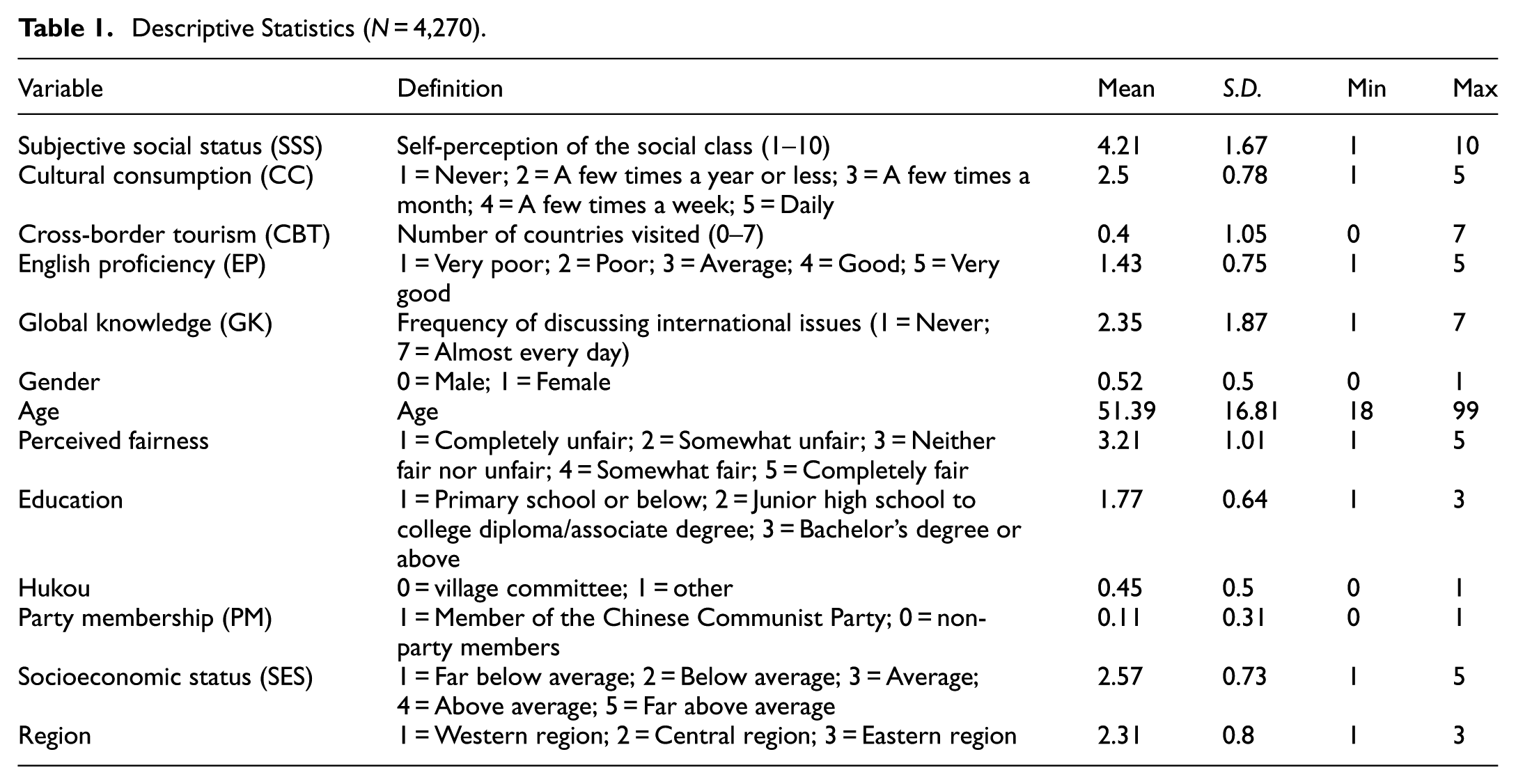
The dependent variable of this study is SSS. The questionnaire asks: “In our society, some people are at the top of the social hierarchy, and some are at the bottom. A score of ‘10’ represents the top, and a score of ‘1’ represents the bottom. Considering the overall situation, where do you place yourself in this social hierarchy?” The individual’s current SSS is measured based on their response to this question, with values ranging from 1 to 10. Table 1 summarizes the descriptive statistics of SSS.
Descriptive Statistics (N = 4,270).
Kernel density estimation was conducted using Stata 17. Figure 1 presents the distribution of SSS, overlaid with a normal density curve (bandwidth = 0.5). The distribution appears moderately right-skewed, with most values falling below the scale midpoint of 5.5, suggesting that respondents generally perceive their social status to be lower than the mid-level.
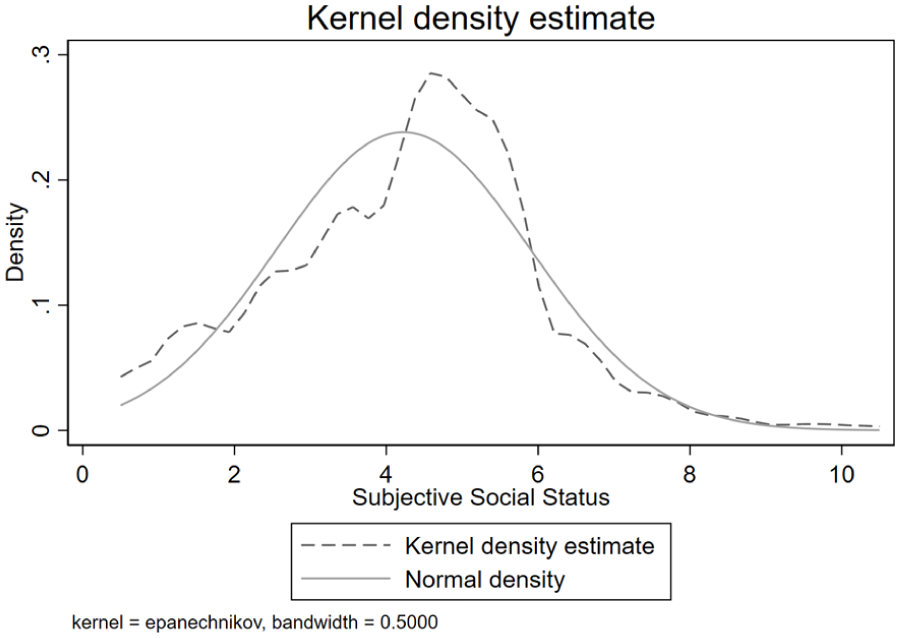
Kernel density estimation of subjective social status.
Independent Variable: Cultural Consumption
The independent variable in this study is CC. CC is measured by averaging the frequency of seven lifestyle activities in response to the question, “In the past year, have you often engaged in the following activities during your free time?” (a) Watching television or DVDs, (b) Watching films/movies, (c) Reading books, newspapers, or magazines, (d) Attending concerts, performances, or cultural exhibitions, (e) Listening to music at home, (f) Engaging in sports or physical training, (g) Using the internet. The mean value ranges from [1,5], where higher values indicate a higher frequency of CC. The measurement of the seven lifestyle activities demonstrates high internal consistency, with a Cronbach’s Alpha of .7086.
Figure 2 displays the kernel density of CC, overlaid with a normal distribution (bandwidth = 0.25). The distribution is clearly right-skewed, with a mean of 2.5, significantly below the midpoint value of 3 (p < .01). This indicates that the frequency of cultural participation among Chinese residents remains generally low.

Kernel density estimation of culture consumption.
Mediating Variables
The mediating variables include CBT, GK, and EP.
CBT is measured by summing responses to the question “Have you ever traveled to the following countries or regions?” for seven travel destinations: (a) Hong Kong or Macao, (b) Japan, (c) South Korea, (d) Taiwan, (e) Southeast Asia, (f) Europe, (g) North America. The mean value ranges from [1,7], with higher values indicating higher levels of CBT. The measurement of the seven travel destinations shows high internal consistency, with a Cronbach’s Alpha of .8022. The survey results indicate that, overall, the level of CBT among Chinese residents is very low, with a mode of 0, a heterogeneity ratio of 18.63%, and a mean of only 0.4.
GK is measured by the question: “Do you often discuss international topics with your family, friends, or others?” The scale ranges from 1 = Never, 2 = About once a year, 3 = Several times a year, 4 = About once a month, 5 = About once a week, 6 = Several times a week, 7 = Almost everyday. Higher values indicate higher GK. The survey results show that, overall, the GK level among Chinese residents is relatively low, with a mean of only 2.35, significantly below the midpoint value of 4 (p < .01).
EP is measured by averaging responses to three aspects of EP based on the question: “How would you assess your ability in the following areas?” (a) read short articles in English newspapers, (b) have conversations in English, (c) write a letter in English.. The mean value ranges from [1,5], with higher values indicating higher EP. The measurement of the three aspects of EP shows high internal consistency, with a Cronbach’s Alpha of .9765. The survey results indicate that, overall, the EP level among Chinese residents is relatively low, with a mean of only 1.43, significantly below the midpoint value of 3 (p < .01).
Control Variables
SSS is shaped by a wide range of factors across multiple dimensions. These include individual characteristics such as gender, age, and marital status; objective socioeconomic factors such as income, education, and occupation; and psychological factors such as perceived social mobility, childhood socioeconomic status, and beliefs about fairness and meritocracy (Choi & Kang, 2020; Kim & Radoias, 2021; Weiss & Blöchl, 2024; Yunsong & Xiaoguang, 2019; Zhou, 2021).
To minimize the effects of potential confounders, the analysis controlled for eight variables: Gender, Age, Socioeconomic status (SES), Hukou, Party Membership (PM), Region, Perceived fairness, and Education. Their descriptive statistics are provided in Table 1.
Data Analysis
Selection of Control Variables
To reduce the influence of redundant variables and improve model robustness, this study employed stepwise regression to select appropriate control variables. Stepwise regression incrementally adds or removes predictors based on their statistical significance, aiming to retain only those variables that have a significant effect on the dependent variable, SSS. The selection procedure consisted of the following steps:
All candidate control variables—including gender, age, SES, hukou, PM, region, perceived fairness, and education—were considered. A forward selection approach was applied to an unweighted regression model. The significance level for variable entry was set at .05, and the removal threshold was set at .10. Variables that met these criteria and significantly predicted SSS were retained.
The selected control variables were then tested in a weighted regression model using IPW, to verify their robustness under adjusted sample weights. Only variables that remained significant in the weighted model were included in the final analysis.
Variance inflation factors (VIF) were calculated to test for multicollinearity among the selected variables. All VIF values were below the commonly accepted threshold of 10, indicating that multicollinearity was not a concern and the reliability of coefficient estimates was ensured.
Baseline Regression Analysis
To test
(1) An OLS regression including only the independent variable (CC), to preliminarily assess the raw association between CC and SSS.
(2) An OLS regression including the seven selected control variables, in order to account for potential confounding factors and reduce omitted variable bias.
(3) A weighted OLS regression using IPW, to correct for sample selection bias and enhance sample representativeness.
(4) A weighted OLS regression with robust standard errors, to address potential heteroskedasticity and improve the accuracy of statistical inference.
By comparing results across these four model specifications, this study evaluates the consistency and stability of the relationship between CC and SSS. These baseline results serve as a foundation for subsequent causal inference and mediation analysis.
The basic model is specified as follows:

Where:
Endogeneity Test
Given the potential for reverse causality between CC and SSS (Olivos & Wang, 2023), this study addresses endogeneity concerns by employing social entertainment frequency (SEF) as an instrumental variable (IV) for CC and conducting causal inference using two-stage least squares (2SLS) estimation.
SEF measures the frequency with which individuals engage in social entertainment activities with friends, such as visiting each other’s homes, watching television together, dining together, playing cards, or participating in other leisure activities. The validity of SEF as an instrument rests on two considerations: first, SEF is strongly correlated with CC, as many forms of CC occur in social contexts; second, SEF does not directly affect SSS, as engaging in social entertainment itself is unlikely to alter one’s perceived social status. Prior research suggests that individuals tend to participate in social activities that align with their socioeconomic background (Jæger et al., 2023), and such behaviors are widespread across social groups, thereby reducing the likelihood of a direct effect of SEF on SSS.
The 2SLS analysis was conducted in two stages. In the first stage, SEF was used as an IV for CC, and a regression model including all control variables was estimated to obtain the predicted values of CC. In the second stage, these fitted values were substituted for the original CC variable to estimate its causal effect on SSS.
To ensure robustness, three variations of the 2SLS estimation were employed: the baseline 2SLS model, an IPW-weighted 2SLS model, and a weighted 2SLS model with robust standard errors. By comparing these results with those from the OLS models, this study further evaluates the extent to which potential endogeneity may influence the estimated effect of CC on SSS.
Mediation Effect Test
Building on the baseline regression, this study employs SEM to test the mediating effects of CBT, EP, and GK in the relationship between CC and SSS, in order to evaluate
SEM enables simultaneous estimation of the total effect, direct effect, and indirect (mediated) effects within a single model. Moreover, SEM allows for the decomposition of the total indirect effect into specific indirect paths, which helps to identify the relative contribution of each mediating mechanism. In this study, the SEM specification assumes that the error terms across the three mediators are uncorrelated. This assumption is supported by VIF tests: all variables had VIF values below 2.1, with an average of approximately 1.4, indicating that multicollinearity among the mediators was not a concern. Based on this modeling structure, the extracted mediation paths can clearly illustrate how CC affects SSS through distinct mechanisms, allowing for separate evaluation of the magnitude and significance of each path.
To ensure the robustness of the results, three SEM estimation strategies were employed:
(1) Baseline SEM estimation, using a standard path model without weighting;
(2) IPW-weighted SEM estimation, applying IPW to adjust for sample representativeness;
(3) Robust standard errors SEM estimation, incorporating robust standard errors to improve inference reliability.
By comparing results across these three estimation strategies, the study provides a comprehensive evaluation of the stability and reliability of the mediation effects, offering a solid empirical foundation for identifying the underlying mechanisms.
Comparative Analysis Across Cultural Domains
Building upon the mediation analysis, this study further applies the same SEM approach to examine whether the mediating effects of CBT, EP, and GK between CC and SSS differ across seven cultural domains. This analysis is conducted to test
The seven cultural domains include television, cinema, books and press, performing arts, sound recordings, sports practice, and internet use. These domains represent key dimensions of daily lifestyle and have been widely used in prior studies of CC (Morrone, 2006).
To explore whether there are underlying structural relationships among the seven domains that might justify grouping them, an exploratory factor analysis (EFA) was first conducted. The Kaiser-Meyer-Olkin (KMO) value was 0.8005, indicating that the data were suitable for factor analysis. However, the EFA results revealed high cross-loadings and substantial uniqueness (ranging from 0.54 to 0.92), making it difficult to extract clearly interpretable latent factors. Even after excluding the variable with the lowest KMO value (television), the model remained unstable and failed to produce a meaningful hierarchical structure. Based on these findings—and in light of the possibility that different cultural activities may operate through independent mechanisms—this study ultimately adopts a domain-by-domain approach to mediation analysis. The comparative interpretation of domain-specific results is then conducted post hoc.
To ensure the robustness of the estimates, three SEM estimation strategies are applied for each cultural domain: baseline SEM (without weighting), IPW-weighted SEM (to account for sample selection bias using IPW), and IPW-weighted SEM with robust standard errors (to improve the accuracy of standard error estimation). By comparing the coefficients and significance levels of mediation paths across the seven domains, this study identifies how cultural domain heterogeneity influences the mechanisms through which CC affects perceived social status.
Results
Baseline Regression Results
Control Variables Overview
To ensure the robustness and explanatory power of the model, control variables were selected through a stepwise regression procedure. This analysis was conducted using both weighted (see Table 2) and unweighted regression models for cross-validation. The consistency of results across both models supports the reliability of the control variable selection. All VIF values were below 1.94, indicating no serious multicollinearity issues.
Stepwise Regression Analysis of Subjective Social Status: Control Variable Selection Process (N = 4,270).
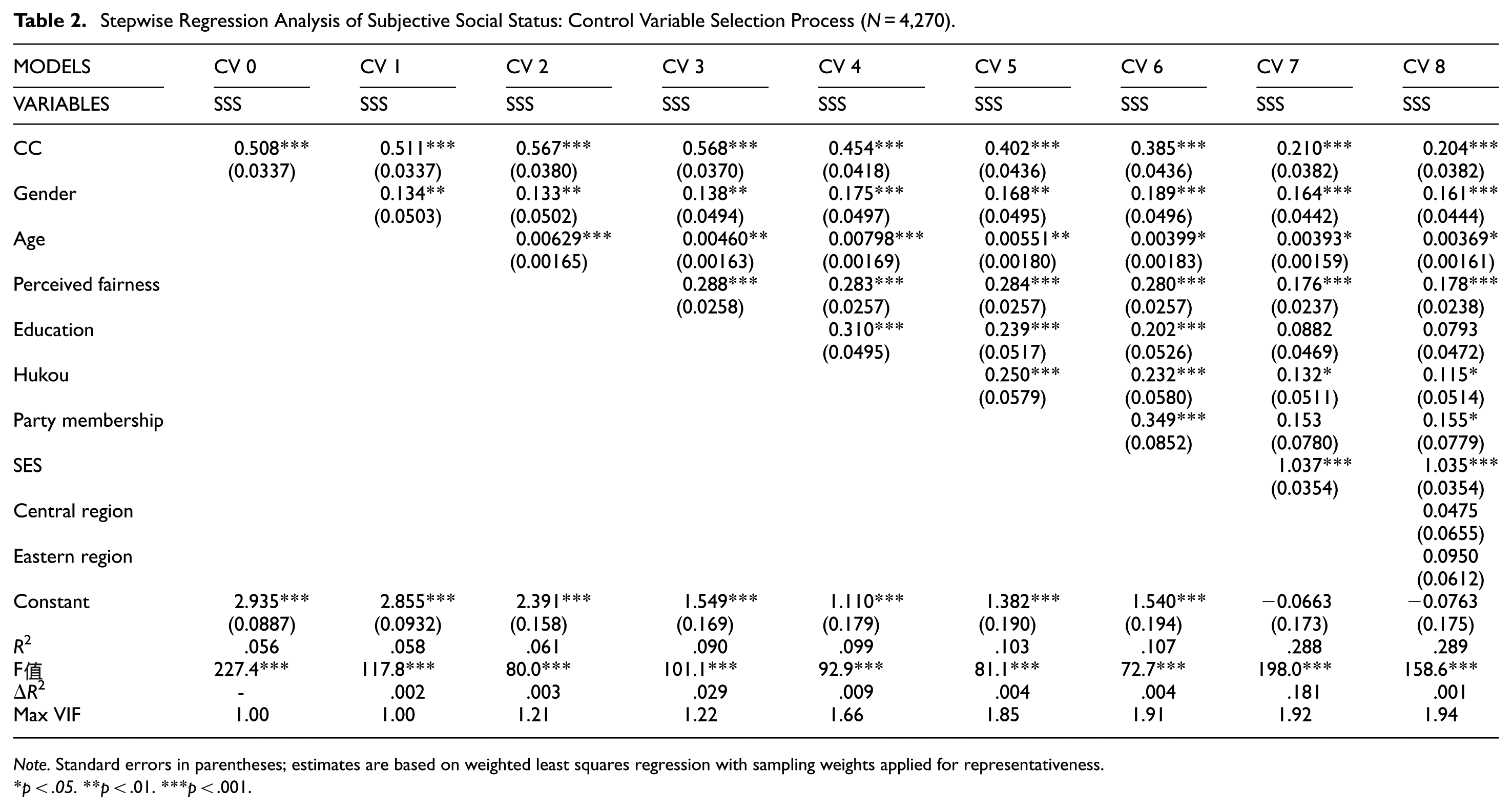
Note. Standard errors in parentheses; estimates are based on weighted least squares regression with sampling weights applied for representativeness.
p < .05. **p < .01. ***p < .001.
Based on the statistical significance observed across the stepwise regression models, this study retained gender, age, perceived fairness, education, hukou type, PM, and SES as control variables, while excluding the regional variable. This decision ensures that the model accounts for relevant confounding factors and provides a robust foundation for subsequent analyses.
Baseline Regression Results
To test the effect of CC on SSS, four regression strategies were employed to ensure the robustness of the estimated results. Table 3 presents the regression outputs from four model specifications: a baseline model with only CC (M0), a fully controlled model (M1), a weighted least squares model (WLS), and a weighted model with robust standard errors (RWLS). These models were used to systematically evaluate
Effects of Cultural Consumption on Subjective Social Status: Comparison of Baseline Regression Models (N = 4,270).

Note. Standard errors in parentheses.
p < .05. ***p < .001.
Table 3 presents the results from four baseline models. Model M0, with only the core predictor (CC), shows a significant positive association with SSS. Model M1 adds seven control variables, reducing the CC effect but retaining its significance. SES emerges as the strongest predictor. Models WLS and RWLS confirm the robustness of the findings under weighted estimation and robust standard errors, with minimal variation across models. Overall, the results consistently support a positive effect of CC on perceived social status.
Endogeneity Test Results
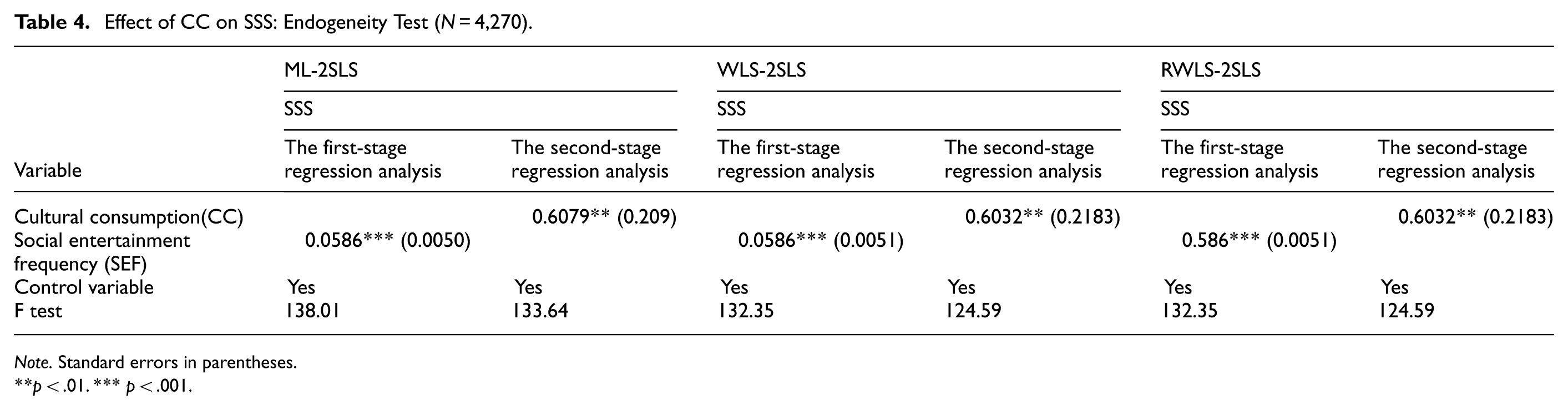
To address potential endogeneity in the relationship between CC and SSS, this study applies an IV approach for causal inference. Table 4 reports the results of three estimation strategies: baseline two-stage least squares (ML-2SLS), inverse probability weighted 2SLS (WLS-2SLS), and robust standard error weighted 2SLS (RWLS-2SLS).
Effect of CC on SSS: Endogeneity Test (N = 4,270).
Note. Standard errors in parentheses.
p < .01. *** p < .001.
It is notable that the 2SLS coefficient for CC (β ≈ .603) is substantially larger than the OLS estimate (β = .210), suggesting that the OLS estimate may suffer from downward bias. Such bias could result from measurement error or omitted variable bias. As noted by Brenner and DeLamater (2016), self-reported survey data are often subject to social desirability effects, where respondents may adjust their answers to align with perceived social norms. The use of an exogenous IV, which is uncorrelated with the error term, helps mitigate these biases and produces estimates that more closely approximate the true causal effect.
The consistency of results across all three 2SLS models indicates that the causal inference drawn in this study is methodologically robust. Even after accounting for potential endogeneity, the positive effect of CC on SSS remains statistically significant, further strengthening the causal interpretation of the findings.
Mediation Effect Results
This section presents the results of the SEM analysis that examines the mediating roles of EP, CBT, and GK in the relationship between CC and SSS.
The model fit indices for the SEM are as follows: RMSEA = 0.149 (90% CI [0.134, 0.164]), CFI = 0.949, TLI = 0.350, and SRMR = 0.022. While the values of CFI and SRMR indicate good fit, the RMSEA exceeds the conventional threshold of 0.10, and the TLI falls well below the recommended cutoff of 0.90. These results suggest that the overall model fit could be improved. However, since the primary focus of this study is on the significance of specific mediation paths rather than the global structure of the model, the fit indices are not expected to substantially impact the interpretation of the key path coefficients.
Table 5 reports the results of three estimation strategies: maximum likelihood SEM (ML-SEM), inverse probability weighted SEM (WLS-SEM), and weighted SEM with robust standard errors (RWLS-SEM).
Mediation Analysis of the Effect of Cultural Consumption on Subjective Social Status (N = 4,270).

Note. Standard errors in parentheses; standardized coefficients reported. *p < .05. **p < .01. ***p < .001.
The results from all three SEM estimation strategies are highly consistent, with minimal variation in path coefficients across models. This demonstrates strong methodological robustness in the mediation findings. The data indicate that the effect of CC on SSS is partially mediated by EP and CBT, while the mediating role of GK is not statistically significant.
Comparative Results Across Cultural Domains
This section systematically examines whether the mediating effects of EP, CBT, and GK in the relationship between CC and SSS differ across seven cultural domains. To ensure the robustness of the findings, three SEM estimation strategies were applied to each domain: maximum likelihood SEM (ML-SEM), inverse probability weighted SEM (WLS-SEM), and IPW-weighted SEM with robust standard errors (RWLS-SEM).
The results from the three estimation strategies are highly consistent within each cultural domain, indicating strong robustness and reliability across the models.
Table 6 summarizes the mediation patterns through which CC affects SSS across seven cultural domains. The results reveal substantial variation in mediation mechanisms across different types of cultural activities.
Mediation Effects Across Seven Cultural Domains (N = 4,270).

Note. Blue = positive effect; Red = negative effect; darker color indicates higher significance level. NS = not significant (p > .05).
p < .05. **p < .01. ***p < .001.
At the domain level, cinema, books and press, and internet use exhibit a full mediation pattern, meaning that the effects of these cultural activities on SSS are fully transmitted through the mediating variables. Performing arts, sound recordings, and sports practice demonstrate a partial mediation pattern, where significant direct effects are retained alongside indirect effects. In contrast, television consumption shows a suppressor-type mediation, where the direct effect is weakened by the inclusion of mediators.
At the mediator level, CBT serves as a consistent and effective mediator in most domains. In six out of seven cultural domains, CBT significantly mediates the effect of CC on SSS, indicating that various cultural activities can enhance perceived social status indirectly by facilitating international travel experiences.
EP functions as an effective mediator in four domains—cinema, books and press, performing arts, and sound recordings—but is not significant in the domains of internet use and sports practice. Notably, television viewing shows a slight negative association with EP.
GK does not serve as a significant mediator in any of the seven domains. Although CC consistently improves GK across all domains, this increase does not translate into statistically significant improvements in perceived social status.
Conclusion and Discussion
Summary of Findings
Positive Impact of Cultural Consumption on Subjective Social Status
Baseline regression results indicate that CC significantly and positively predicts SSS. This relationship holds even after controlling for demographic factors (gender, age), socioeconomic variables (education level, hukou status, PM, and SES), and psychological perceptions (perceived fairness). Furthermore, an IV analysis using SEF as the instrument confirms the causal nature of this relationship. These findings support the argument made by Reeves and de Vries (2019) that CC can serve as an effective mechanism for enhancing individual social status.
Identification of Mediation Mechanisms
Mediation analysis reveals that EP and CBT act as significant mediators in the relationship between CC and SSS, whereas the mediating effect of GK is not statistically significant. This suggests that CC not only directly contributes to higher perceived social status, but also does so indirectly by enhancing individuals’ language skills and international exposure.
These findings align with the theoretical perspectives proposed by Prieur & Savage (2013); Üstüner & Holt (2010), who argue that cosmopolitan cultural capital—such as EP and international travel experience—serves as a crucial resource for upward social mobility in non-Western societies. This study provides quantitative evidence supporting that claim.
Effects of Cultural Domain Differences
Further analysis across cultural domains reveals three distinct mediation patterns through which CC affects SSS (see Figure 3).

Mediation effect models across different cultural domains: full mediation, partial mediation, and suppression mediation.
Full Mediation
In the domains of cinema, books and press, and internet use, the effect of CC on SSS is fully mediated through EP and CBT. In other words, these forms of consumption contribute to status enhancement only when they lead to the development of tangible skills and cross-cultural experiences.
These domains reflect the CC patterns of the general population. With advances in technology and productivity, cinema has become a globally accessible entertainment form (Ke & Alwi, 2025). The past decades have witnessed profound changes in movie consumption: the rise of multiplex cinemas has redefined public movie experiences, and flexible access to screen content has made film viewing a common leisure activity (Aveyard, 2016). Similarly, long hours of internet use have become an everyday lifestyle for ordinary people, even though such behavior may not be ideal (Duong et al., 2020). The emergence of digital media has also transformed reading habits, with digital reading becoming increasingly prevalent and gradually complementing traditional formats (Solimine, 2020).
Together, these domains can be classified as “opportunity-driven” cultural variables, in which the ability to translate cultural participation into globally relevant resources is essential for status improvement.
Partial Mediation
In the domains of performing arts, sound recordings, and sports practice, CC influences SSS both directly and indirectly via EP and CBT. These activities exhibit both symbolic and functional status effects.
These domains are more closely associated with the CC patterns of elite groups. Bone et al. (2021) confirm a clear social gradient in participation in artistic activities, with elite groups more likely to engage in performing arts. Roose and Vander Stichele (2010) suggest that attending concerts requires not only cognitive competencies but also the ability to navigate social barriers, such as knowledge of etiquette and homogenous social networks. While public participation in cultural activities is more dependent on cultural capital than private listening, the types of music consumed at home and in concert settings tend to converge. In the realm of sports, Mutz & Müller (2021) find that most forms of athletic participation attract individuals with above-average cultural capital, whereas lower-status groups are overrepresented among the inactive population.
These findings suggest that elite-oriented CC serves as both a symbolic marker of social distinction and a channel for cultivating cosmopolitan competencies that reinforce social status.
Suppression Mediation
Television is the only domain that demonstrates a suppression effect. Specifically, television consumption is negatively associated with EP, while EP positively predicts SSS. This creates a suppression pathway in which increased TV viewing undermines the positive contribution of EP to social status. One explanation is that television content in China is typically localized and lacks foreign-language exposure, thus reducing opportunities to improve language skills and impeding the accumulation of cosmopolitan cultural capital.
This finding is consistent with previous research on urban China, which shows that heavy television viewing is more common among unemployed or lower-status groups (Tian & Boucher, 2021). This study builds upon that observation by identifying the underlying mechanism: television consumption fails to facilitate the accumulation of cosmopolitan cultural capital and, therefore, does not contribute to enhanced perceptions of social status.
In sum, the comparison of mediation effects across cultural domains reveals three distinct CC patterns in contemporary Chinese society: opportunity-oriented consumption among the general population, symbolic-functional consumption among elites, and inert or suppressive consumption among non-working or socially marginalized groups.
Theoretical Contributions
Building on a systematic analysis of the relationship between CC, cosmopolitan cultural capital, and SSS, this study makes contributes to the existing literature in four interrelated theoretical dimensions:
Opportunity-Oriented Cultural Consumption
This study challenges Bourdieu’s classic dichotomy between “highbrow” and “lowbrow” culture by introducing the concept of opportunity-oriented CC, which emphasizes the functional value of cultural participation rather than its symbolic distinction.
Empirical findings show that cultural domains such as cinema, books and press, and internet use contribute to SSS indirectly through the enhancement of EP and CBT. In contrast, television consumption demonstrates a suppression effect, as it fails to foster language acquisition and even undermines SSS through its negative association with EP.
These findings reveal that CC, when approached through an opportunity-oriented lens, serves as a channel for accessing status-enhancing resources rather than as a mere signal of social distinction. This perspective shifts the analytical focus from symbolic meaning to functional outcomes, offering a more dynamic understanding of how culture can facilitate upward social mobility in non-Western societies.
Internal Differentiation Within Cosmopolitan Cultural Capital
This study provides empirical validation for the theoretical model linking CC → cosmopolitan cultural capital → perceived social status, offering robust quantitative support for the framework proposed by (Prieur & Savage, 2013).
Importantly, this study disaggregates the internal structure of cosmopolitan cultural capital, revealing a clear hierarchy of mediating effects: CBT is the most effective mediator, followed by EP, while GK shows no significant mediating effect.
These findings indicate that cosmopolitan cultural capital is not a homogeneous construct but rather a hierarchically layered set of heterogeneous resources. In the Chinese context, practical and actionable global experiences—such as travel and language skills—are more readily converted into perceived social status than abstract knowledge.
This contributes to the localization of cosmopolitan capital theory and helps clarify which global resources are most instrumental in upward mobility in non-Western societies.
Stratification Effects Across Cultural Domains
This study identifies three distinct mediation patterns that align with different social strata:
(1) Cultural domains associated with mass audiences—such as cinema, books and press, and internet use—exhibit full mediation, meaning their effects on SSS are entirely channeled through cosmopolitan cultural capital.
(2) Domains linked to elite groups—including performing arts, sound recordings, and sports practice—exhibit partial mediation, where both direct and indirect effects contribute to status perception.
(3) Television consumption, associated with non-working or lower-status groups, demonstrates a suppression effect, wherein its negative relationship with EP undermines its contribution to social mobility.
By shifting the analytical focus from the breadth of participation to domain-specific mechanisms of capital conversion, this study revisits the theory of cultural omnivorousness Peterson and Kern (1996) in the context of a non-Western society. While the original theory emphasized how elites expanded their tastes to include popular culture, our findings reveal that not all cultural participation translates into social advantage via the same mechanisms.
For instance, members of the mass population may achieve status gains by converting culturally accessible domains (e.g., internet, cinema) into cosmopolitan capital—without engaging in elite-coded cultural practices. Similarly, elites may consume popular culture without concern for its convertibility into global capital, as their status is reinforced through other channels. Although the ultimate status outcomes across domains may appear similar (with the exception of television), the underlying conversion mechanisms are stratified and unequal.
These findings support Lamont (2001) argument that different social groups construct their own standards of cultural legitimacy. Cultural value is not universally recognized but is contextually validated within group-specific status hierarchies. By uncovering the differentiated pathways through which cultural resources operate in China, this study offers a critical reconsideration of cultural omnivorousness in non-Western contexts and provides empirical support for Lamont’s model of plural cultural legitimacy.
Digital Divide in Access to Cosmopolitan Cultural Capital
Building on digital divide theory, this study identifies a new mechanism of inequality: the selective and unequal access to cosmopolitan cultural capital via digital technologies.
Empirical results show that internet use significantly enhances CBT, but has no effect on EP. This suggests that digital technologies do not uniformly support the accumulation of all types of cosmopolitan cultural capital.
Moreover, the data show a polarized distribution of internet use: a significant share of respondents never use the internet, while others use it daily. This reflects both a first-level digital divide (access) and a growing second-level digital divide (differences in usage patterns and conversion effectiveness, van Deursen & van Dijk, 2014). Even in contexts where technology is available, social groups differ substantially in their motivation, skills, and ability to convert digital access into cultural capital (van Laar et al., 2020).
This reveals the exclusive and selective nature of digital access to cosmopolitan resources. Thus, more attention should be paid to building digital literacy and supporting the cultural conversion pathways of digital engagement to prevent the digital divide from deepening global cultural inequalities.
Practical Contributions
Drawing on the above theoretical findings, this study proposes targeted practical recommendations at the levels of individual behavior, educational strategy, and public policy, in order to promote the effective transformation of CC into social advantage.
Developing Strategic Cultural Consumption at the Individual Level
The results suggest that the impact of CC on SSS depends largely on the successful conversion of cosmopolitan cultural capital—particularly EP and CBT. Therefore, individuals and families are encouraged to adopt a strategic approach to cultural engagement, prioritizing activities that directly enhance global competencies.
Such activities may include watching original-language foreign films, reading international media and literature, and actively participating in cultural exchange or international travel. These practices help maximize the social return on cultural investment by linking everyday cultural choices to globally recognized forms of capital.
Enhancing Cosmopolitan Cultural Capital Through Education
The significant mediating role of cosmopolitan cultural capital highlights the importance of integrating global competence development into educational systems. Educational institutions should move beyond language instruction alone and implement a “language + culture” approach that emphasizes both linguistic proficiency and intercultural communication skills.
This could involve embedding cultural literacy into foreign language curricula, expanding access to study abroad opportunities, and supporting international exchange programs. By cultivating students’ practical global experiences alongside language skills, schools and universities can enhance students’ cultural capital and long-term social competitiveness.
Addressing the Deep Digital Divide in Cultural Resource Utilization
This study reveals substantial disparities in how digital technologies facilitate the transformation of CC into cosmopolitan cultural capital. These findings suggest that digital cultural policy should move beyond a sole focus on equitable access to infrastructure, and place greater emphasis on the quality of digital resource use and the effectiveness of its cultural conversion, particularly for groups with relatively low SES.
Accordingly, it is recommended that governments and civil society organizations develop inclusive digital cultural initiatives tailored to marginalized populations. Such programs may include free or low-cost online language training platforms, virtual international exchange communities, and cross-cultural digital experiences. These initiatives can help reduce structural barriers to cultural capital acquisition and mitigate the exacerbating effect of the digital divide on social inequality.
Limitations and Future Research Directions
Methodological Limitations
Although multiple analytical strategies were employed to enhance the robustness of the findings, several methodological limitations remain.
First, although some of the structural equation model’s fit indices (such as RMSEA and TLI) did not reach traditional ideal thresholds, the core path coefficients remained stable across multiple robustness checks, supporting the reliability of the research conclusions. This outcome may be due to the complexity of relationships among variables not being fully captured in the model, as well as the skewed distribution of the CBT variable. Future research could improve the model by employing more refined specifications or non-parametric estimation methods.
Second, although this study utilized IV analysis—employing SEF as an instrument for CC—to mitigate endogeneity, the use of cross-sectional data limits the ability to rule out potential reverse causality and omitted variable bias. Longitudinal or experimental designs are recommended for future studies to strengthen causal inference.
Third, the measurements of CC and GK in this study primarily focused on frequency dimensions. These indicators may not fully capture the quality, depth, or content of actual consumption. Future research could incorporate more nuanced measures—such as distinctions between elite versus popular content, or domestic versus international sources—to assess the effectiveness of cultural activities in generating cosmopolitan capital.
Sample Limitations
Despite the use of IPW to improve sample representativeness, the analytical sample may still be biased toward urban residents and individuals with higher levels of education. Respondents who completed the cultural participation module of the survey may already exhibit a relatively high degree of cultural engagement, limiting the generalizability of the findings to the broader Chinese population—particularly to rural or lower-educated groups.
Additionally, the data were collected in 2018, which introduces potential limitations related to temporal relevance. In recent years, rapid developments in digital media, shifts in globalization, and the disruptive impact of the COVID-19 pandemic may have significantly altered patterns of CC and the pathways for acquiring cosmopolitan cultural capital. For example, the pandemic sharply reduced opportunities for international travel, potentially weakening its role in social status construction. Meanwhile, advances in artificial intelligence (e.g., machine translation) may have transformed the role of EP in cross-cultural communication, thus complicating its function as a mediating variable.
Future research should revisit these relationships using updated datasets, particularly in light of post-pandemic global restructuring and the growing role of AI in cultural and linguistic exchange.
Finally, the findings may be shaped by the specific cultural and institutional context of China. The country’s accelerated globalization, unique patterns of social mobility, and evolving cultural norms may underlie the observed relationships. As such, cross-cultural comparative studies are needed to assess the extent to which the conclusions of this research apply in other national or institutional settings.
Directions for Future Research
Building on the findings and limitations of this study, future research can further advance the understanding of the relationship between CC, cosmopolitan cultural capital, and social status in the following four directions:
Expanding Cultural Consumption Measures to Include Content and Quality
This study primarily measured CC using frequency-based indicators. Future research could incorporate dimensions of content quality, focusing on distinctions across different types of cultural activities—such as between local and international sources, or between diverse stylistic categories. This would help identify which forms of cultural engagement are most effective in fostering the accumulation of cosmopolitan cultural capital, thereby enhancing individuals’ perceived social status.
Employing Longitudinal Designs for Causal Inference
As this study relied on cross-sectional data, it could only offer preliminary evidence of causal relationships. Future studies should adopt longitudinal or panel data designs to better capture the dynamic interactions among CC, the acquisition of cosmopolitan cultural capital, and changes in SSS over time. Such designs would provide a stronger empirical basis for testing the stability and applicability of the mediation pathways proposed in this research across different life stages and developmental contexts.
Conducting Cross-Cultural Comparisons to Test Theoretical Boundaries
Given that this study is grounded in the sociocultural context of China, it is important to examine whether the proposed models hold in other non-Western societies. Cross-cultural comparative studies can explore how different levels of globalization, linguistic environments, and institutional structures shape the mechanisms of cultural capital accumulation and social status perception. This line of inquiry would help clarify the boundary conditions and cultural variability of cosmopolitan cultural capital theory, thereby enriching its theoretical universality and contextual sensitivity.
Investigating Deep Digital Inequality in Cultural Capital Transformation
This study highlights the selective and unequal nature of how digital technologies facilitate the accumulation of cosmopolitan cultural capital. Future research should further examine the structural dimensions of the digital divide, focusing on how digital skills, media literacy, and emerging technologies (e.g., machine translation) affect different social groups. Special attention should be paid to how individuals from lower socioeconomic backgrounds are able—or unable—to effectively convert digital resources into cultural capital. A deeper understanding of these mechanisms would provide valuable theoretical and empirical foundations for designing more equitable and effective digital cultural policies.
Conclusion
These findings underscore that when viewed from an opportunity-oriented perspective, CC acts as a functional resource for social advancement—not merely a symbolic marker of class distinction. This reframes the discussion from symbolic boundaries to concrete pathways of capital conversion, offering a more dynamic understanding of how culture enables status mobility in non-Western societies.
Second, the study demonstrates that cosmopolitan cultural capital is internally heterogeneous, composed of stratified resources with differing mobilization potential. In China, practical and experiential resources such as travel and language skills are more readily converted into perceived social status than abstract GK, refining the global cultural capital framework for non-Western applications.
Third, the study critically re-evaluates the cultural omnivorousness thesis (Peterson & Kern, 1996). While prior literature emphasized elite cross-boundary consumption, our results show that not all forms of cultural participation equally generate status. For example, mass audiences may leverage accessible domains (e.g., cinema, internet) to enhance status through global competencies, while elites may consume popular culture without relying on its capital-conversion potential. This differentiation in mechanisms, despite superficially similar status outcomes, reveals layered and unequal pathways of capital transformation. These findings align with Lamont (2001) model of plural cultural legitimacy, offering empirical support for its application in non-Western societies.
Finally, the study identifies a selective and exclusionary digital divide in accessing and converting global cultural resources. Enhancing digital literacy and promoting inclusive digital pathways to cosmopolitan capital are therefore critical to preventing the deepening of global cultural inequality in the digital age.
In sum, this study contributes to cultural sociology by re-theorizing cultural capital and omnivorousness in non-Western settings. It provides fresh empirical insights into how globalized cultural practices serve as mechanisms of stratification, and offers actionable implications for education, policy, and future scholarship.
Future research should expand measurements of cultural content and quality, adopt longitudinal and cross-cultural designs, and examine how pathways of capital conversion evolve amid rapid technological change and shifting global dynamics.
Footnotes
Acknowledgements
This study utilizes data from the 2018 Chinese General Social Survey (CGSS). The authors express their sincere gratitude to the National Survey Research Center at Renmin University of China for providing this valuable data resource.

Ethics Considerations
The CGSS is reviewed and approved by the Ethics Committees of the Hong Kong University of Science and Technology and Renmin University of China. This study used the authorized public-use CGSS dataset, which is fully anonymized. As the research involved secondary analysis of publicly available data, no additional ethical approval was required.
Consent to Participate
Informed consent was obtained from all participants by the CGSS research team during the original data collection. The present study involved no direct contact with participants and required no additional informed consent.
Funding
The authors received no financial support for the research, authorship, and/or publication of this article.
Declaration of Conflicting Interests
The authors declared no potential conflicts of interest with respect to the research, authorship, and/or publication of this article.