




Abstract
Research has focused on how English proficiency influences Chinese people’s education and occupational opportunities and choices. However, little is known about how it impacts the matchmaking practice in such context. Drawing on Bourdieu’s theory of capital, this study examines the role of English in the biggest matchmaking market in Shanghai, China. Field study was conducted in People’s park in Shanghai. Information regarding marriage candidates’ English competence as presented on matrimonial posters was collected and subjected to further grounded-theory based thematic analysis. The results reveal that English competence is primarily advertised as a form of institutionalized cultural capital (e.g., the possession of particular jobs, certificates, degrees, or citizenship) to boost candidates’ socioeconomic status, and used as a gatekeeper to weed out “disqualified” candidates, meaning that non-English speaking candidates may be rejected as ineligible for matchmaking opportunities. Issues related to the commodification of English competence in the matchmaking context are discussed at the end of the paper.
Plain Language Summary
Purpose: This article investigates how English competence is perceived and valued in China’s matchmaking market, paying special attention to how English proficiency is mentioned on matrimonial posters publicly displayed in the market. Methods: The study is qualitative by nature. Fieldwork was conducted in the market to obtain information such as the size, layout, opening time etc., and pictures of dating adverts were taken. Information regarding candidates’ English competence on the adverts was collected and subject to further thematic analysis. Conclusions: Qualitative analysis of the dating adverts showed that English competence is generally perceived as a valuable attribute, a type of institutionalized cultural capital in the market. It is also regarded as a gatekeeper of marriage opportunities, meaning that it is used by candidates to seek potential partners with similar socioeconomic status, and to weed out “disqualified bidders.” Implications: The findings highlight the discrepancy between official ideology of English and ideology of English held by the general public. Marriage candidates have their own ways of making sense of official ideology of English based on their private agenda, and use it as a stepping stone to maximize the symbolic and material profit of the marriage transaction.
Keywords
Introduction
Research has often noted the significance of English as a tool for global communication, motivating countries like China to promote it as the key to modernization and nation-building. For this reason, English has been idealized as “the language of social and economic prestige” by the general public in China, where a conservative estimate of 280 million people is English speakers (Bolton & Bacon-Shone, 2020). The prestige of English in China is further boosted by its status as a mandatory subject from primary education all the way up to postgraduate education (Hu & Alsagoff, 2010).
On the one hand, research has noted that English language proficiency is increasingly perceived as a form of linguistic cultural capital in China (Bourdieu, 1986a), which possesses the symbolic power (Bourdieu, 1991) to signify one’s intelligence and education background, and serves as a gatekeeper of opportunities for educational, professional, and social upward mobility (Bolton, 2006; Hu, 2008; Jiang, 2003). On the other hand, there are voices and advocates in the “Two Sessions” 1 calling for a reduction in the status of English as a main subject of study in primary and secondary education and the removal of English as a mandatory subject in the national college entrance exams, claiming that English in China only has limited usefulness when students enter society nowadays (Ye, 2021; Zhou, 2017).
While previous debates have focused on how English proficiency influences Chinese people’s education and occupational opportunities and choices, however, we were interested in to discovering the ways in which English impacts people’s everyday lives. In particular, we focused on the role of English in one of the most important social reproduction processes, that is, matchmaking.
We situate our inquiry in a culturally unique site, that is, China’s matchmaking markets in major Chinese metropolises such as Shanghai, where unmarried men and women promote themselves as suitable partners in a public matchmaking process. It must be noted that Chinese citizens have been enjoying unprecedented independence and freedom in choosing their own partners since the drastic changes that took place in marriage practice after the open-door policy in 1978. However, a series of economic and social reforms have also led to increased stratification in Chinese citizens’ socioeconomic status and the occupational hierarchy (Davis & Wang, 2008), which have intensified parental involvement and sociocultural influences in the matchmaking process once again.
This situation is particularly significant for women, who are often pressurized by their parents to choose socially and economically advantageous marriage partners (Gui, 2017; Zhang & Sun, 2014). This is exemplified by parental matchmaking markets in Shanghai, where retired parents voluntarily attend the venue in order to “help” their single adult offspring to find spouses. Personal information about their sons and daughters is written on pieces of laminated paper that serve as matrimonial posters. These attributes are usually related to age, height, job, income, education, etc., and these qualities, either concrete or intangible, serve as tradable commodities among the unmarried candidates. Since marriage itself is arguably a system in which resources are exchanged between rational actors with differential comparative advantage in the household and the labor market (Raymo & Iwasawa, 2005; Yu & Xie, 2015), an examination of the role of English competence in the matchmaking market may help to reveal how English proficiency continues to influence individuals’ everyday lives. For this reason, our inquiry addresses the following question: What role does English proficiency play in China’s matchmaking market?
Literature Review
The Commodification of English
English competence is widely regarded as a desirable cultural capital for both enterprises and individuals in many contexts (Bourdieu, 1986a), and is undergoing a dramatic process of commodification (Cameron, 2012; Heller, 2010) as economic and cultural globalization continues to impact all aspects of our lives. Individuals’ original motives for learning English (e.g., to symbolize identity or to acquire “high culture”) are witnessing an ongoing shift, turning to a more calculating economic rationalism (Heller, 2003). The commodification of English is hence considered to be the process of transforming English as a marker of one’s identity into English as an exchangeable economic resource to be offered on the market (Heller, 2003; Urciuoli, 2008).
The study of English as an economic resource and a marketable commodity has been pursued for many years. Early researchers worked under the frame of language economics, attempting to establish a link between English competence and earnings (Grin, 2001). More recent research has tended to expand beyond language economics, shifting the paradigm toward a sociological/anthropological orientation. Studies were conducted through the lens of language planning and sociolinguistics, with attempts to reveal how English competence is commodified in domains such as national language planning (Cameron, 2012), marketing and advertising (Kelly-Holmes, 2005), language teaching (Block & Cameron, 2001), job-hunting (Bolton, 2006), alternative tourism (Muth, 2018; Stainton, 2018) and call center service (Cameron, 2000; Cowie, 2007; Duchêne, 2009; Rahman, 2009). This research largely concluded that English has played and will continue to play an indispensable part in the new capitalism that has emerged in the global era, and its status as the single most valuable commodity in the global linguistic market will likely continue to be reinforced, creating incentives for individuals, families, companies, and nations to invest their resources in it (Cameron, 2012).
The Role of English as a Foreign Language in Marriage and Matchmaking
As discussed above, the commodification of English is becoming increasingly ubiquitous around the globe and has become a well-established area for academic study. However, the role of English as a foreign language in intimate scenarios against the backdrop of globalization is relatively under-explored, and has not been made the explicit subject of much research (Piller & Pavlenko, 2007). Nevertheless, traces can still be discovered with regard to how English ability plays out in these crucial processes of social reproduction. In the following paragraphs the roles of English in mail-order marriage, intercultural romance, and matchmaking in non-English speaking contexts are reviewed, since they are highly relevant to the current study.
Mail-order marriage is a sector where English ability has a significant impact, especially for the bride. The English competence of the bride is usually promoted as a “selling point” by mail-order marriage agencies (Cameron, 2012, p. 4). For example, in the US mail-order marriage industry it has been reported that Filipina women’s English proficiency is particularly advertised by agencies, who believe that English-speaking Filipina women will gain a competitive edge over their counterparts from other Asian countries in the mail-order marriage market (Piller, 2008). After all, limited proficiency in English may impede communication between the bride and her prospective monolingual English-speaking American husband, which may not only bring about the failure of the marriage, but could also lead to disastrous consequences in extreme cases. For women with dependent immigration status in the US, language barriers are seen as one of the major factors contributing to their vulnerability to family violence and difficulty in gaining social support, which is particularly relevant for Chinese and Latino mail-order brides in America (Narayan, 1995). That is probably also a reason why Russian matchmaking agencies specializing in intercultural marriage provide English preparatory lessons for Russian brides who plan to move abroad (Luehrmann, 2004).
When it comes to intercultural courtship and dating, English has also been shown to play a unique role as an intermediary in facilitating non-English speaking women, in this case Japanese women, in pursuit of a Caucasian boyfriend and a desirable Western lifestyle (Piller & Takahashi, 2006). The role of English as the language of romance is not only represented in pop songs, women’s magazines, and media discourse, but also in English teaching materials compiled for the purpose of helping learners to conduct romantic relationships (Piller & Pavlenko, 2007, p. 24). The role of English became even more obvious in an ethnographic study of Japanese women during their study abroad experience in Australia (Takahashi, 2013), in which their desire to learn English was intimately associated with their passion for handsome white male English-speakers. This result was echoed by a study conducted by Kubota (2011), in which the researcher highlighted English learning in Japan as an approach to fulfill Japanese women’s desire for English, Western culture and white men.
In contrast to mail-order marriage and intercultural romance settings, in which users and learners of English mostly perceive it as an facilitator in achieving their personal goals, candidates and their parents in matchmaking activities seek to address an ambivalent relationship to English. On the one hand, English is widely regarded by women globally as a way of “liberating themselves from the confines of gender patriarchy” (Kobayashi, 2002). English teaching and translation offer women a socially sanctioned occupational choice that is considered socially acceptable by their prospective marriage partners (Haghighi & Norton, 2017; Miyamoto, 2021). Accordingly, women with greater English competence prefer their prospective partners to be more highly educated during the process of mate selection (Yang et al., 2021). On the other hand, English proficiency has also been reported as an undesirable factor, a sign of disloyalty (W. Liu, 2020). One mother’s account of her daughter’s dating experiences reported that her daughter’s ex-boyfriend, who was an English major and capable of speaking fluent English, was caught dating her daughter and another woman at the same time. This led to a deep conviction on the part of both the mother and the daughter that male marriage candidates from an arts and humanities background, particularly those majoring in English, are more likely to be disloyal and untrustworthy than those with science and engineering backgrounds, and should therefore be weeded out in the initial stages of mate selection. Although this was reported as an isolated incident, the case suggests that in order to understand the role of English in matchmaking practices, we need to examine how English competence plays out in specific matchmaking contexts.
As reviewed in the above section, previous studies have clearly demonstrated that the English language is gaining increasing momentum in the face of economic and cultural globalization. English competence is generally seen as a desirable attribute in most intimate scenarios, although it may be rejected in specific circumstance. To a certain degree the above findings contribute to a growing understanding of the role of English as a context-specific construct which is constantly under the influence of global, national, institutional, and individual factors (Muth, 2018). To our knowledge, however, little is known about the role of English in matchmaking markets in China, despite the fact that parental matchmaking markets are a linguistically and culturally unique phenomenon that is well worth investigating (Sun, 2012). Therefore, an examination of the role of English in the biggest parental matchmaking market in Shanghai may provide useful insights with regard to how the accelerating globalization of English has impacted local matchmaking activities. To achieve this, our inquiry examines the matrimonial posters publicly displayed at the market with a focus on how English competence is mentioned by bachelors/spinsters in their dating adverts.
Theoretical Framework
English has maintained its unique value in China because it is widely accepted as a language of social and economic prestige at the individual level (Hu, 2005). Bourdieu’s theory of capital is relevant to understand the role of English in Chinese matchmaking settings. According to Bourdieu (1986a), social stratification can be interpreted and determined by one’s possession of various forms of capital, including social capital (social relationships and contacts), economic capital (wealth), and cultural capital (cultural competence). A fourth type of capital, namely symbolic capital (related to honor and prestige) was also proposed, which puts the stress on the “symbolic” dimensions of social life. Symbolic capital, according to Bourdieu (1986a), is not a different form of capital working alongside the other three types of cultural; rather, it should be understood as the outcome of the conversion of the other types of capital once they reach a degree of officialness and legitimacy. Figure 1 exhibits how different forms of capital are intricately interconnected (Raabe, 2018).

The relationship between various types of capital (Bourdieu, 1986a; Raabe, 2018).
Among these various types of capital, cultural capital, including English competence, is commonly used to reinforce class differences through the accumulation of knowledge and exercise of skills (Bourdieu, 1986b). Bourdieu (1986a) further divides cultural capital into three forms, namely embodied, objectified, and institutionalized cultural capital. As shown in Table 1, embodied cultural capital refers to the knowledge and skills that people acquire over time through socialization and education, such as an individual’s high proficiency in English as a foreign language. Objectified cultural capital suggests material objects that people own which might be related to their educational pursuits, such as a comprehensive collection of English movies and novels. Finally, institutionalized cultural capital indicates an institution’s formal recognition of one’s cultural capital, such as a English major college degree, a professional qualification as an English teacher, or a job title as a senior manager in a multinational company. Although cultural capital and economic capital are mutually convertible and transferable, the former is usually acquired and accumulated in a more disguised manner, often at the expense of one’s accumulation of the latter (Bourdieu, 1977).
Forms of Cultural Capital.

Another important theory put forward by Bourdieu is marriage strategies. He pointed out that in order to win the “best possible match” in the game of matchmaking, good players are “continually doing what needs to be done, what the game demands and requires.” This involves using appropriate strategies for this “social game”—that is, a conscious and rational calculation of the “trump cards” in their hands (i.e., the various types of capital they preserve) in order to “maximize the material and symbolic profit to be derived from the matrimonial transaction” (Bourdieu, 2002, pp. 551). This cannot be achieved by merely mechanically obeying “the explicit, codified rules”,” but “presupposes a constant invention, an improvisation that is absolutely necessary in order for one to adapt to situations that are infinitely varied” (Lamaison & Bourdieu, 1986, pp. 112–113). As previous research has suggested that English proficiency is regarded as a “trump card” for individuals in educational and occupational settings in China, we were curious to examine the role of English for candidates in the field of matchmaking.
The Inquiry
In order to explore the role of English for unmarried singles and examine how they used English competence strategically to promote themselves, we chose the parental matchmaking market in People’s Park in Shanghai as our exclusive research site. The site was deliberately selected due to its reputation, history, considerable size, and its representativeness of the rest of China. For one thing, the matchmaking market in People’s Park was one of the first parent-organized matchmaking markets established in China since 2004 (Zhang & Sun, 2014); and for another, it is the largest in terms of size and influence in Shanghai, which is one of the most populous cities across the globe. With its prohibitive cost of living and growing financial and work pressures for individuals, Shanghai has become an increasingly capitalized city, which has resulted in an intensified marketization of its matchmaking activities and marriage practices. Thus, its biggest matchmaking market is likely to be reasonably representative of matchmaking markets in general in China.
To explore the role of English language proficiency in matchmaking activities, an ideal data source was the matrimonial posters that are publicly displayed in the matchmaking market, as they are central in witnessing the textual construction of self- and other-identities in the service of developing relationships (Coupland, 1996). We attended the matchmaking market during October and November 2019 and conducted a field study, focusing on English competence as mentioned on the posters. Our research methods included non-participant observation (Liu & Maitlis, 2010) and constructivist grounded theory-based thematic analysis (Charmaz, 2014).
First, we briefly explored the People’s Park in Shanghai to familiarize ourselves with the location, size, layout, opening hours, and organization of the matchmaking market. Second, we visited the market three times for fieldwork, each time staying for approximately 4 hr in order to collect data. Pictures of the matrimonial adverts were taken using mobile phone cameras. When taking pictures, we only photographed those posters that included mentions of the candidate’s English proficiency. We not only took into account adverts explicitly mentioning English skills (e.g., high proficiency in English), but also sampled those that included an implicit mention of English competence (e.g., CET-6 2 qualification, Masters in Economics acquired from UC Berkeley etc.). In short, we sampled any posters that contained mentions of factors relevant to English competence.
Due to the high mobility of the matchmaking market participants, it was virtually impossible to avoid taking repeated pictures of the same posters. Therefore, our pictures were screened for repetition and relevance. We eventually acquired a final sample of 114 photos of distinct matrimonial adverts.
In the next step we read all the sampled posters for the first time, looking for information about English competence without any attempt to put this into distinct categories. Following that, we reviewed the information about English competence again in an attempt to categorize the instances in terms of how English competence was mentioned. We assigned a descriptive category to each type of mention, summarizing the key ideas in the relevant information on the posters. For example, a piece of information that read “obtained Master’s in a US university” would be coded with a category of DEGREE, whereas mentions about one’s “passing CET-6 test” would fall into the category of CERTIFICATE. Subsequently, we developed a transparent coding scheme consisting of five thematic categories including DIRECT MENTION, JOB, DEGREE, CITIZENSHIP, and CERTIFICATE.
Next, the two researchers manually coded all the relevant information separately and discussed any discrepancies until a consensus was reached. Finally, drawing on the aforementioned theoretical framework on cultural capital, we further classified the five thematic categories into the three forms of cultural capital previously described. Information was coded strictly based on the presence and absence of a mention of English competence, in order to increase reliability. Figure 2 demonstrates how a poster was coded during the development of the coding scheme.
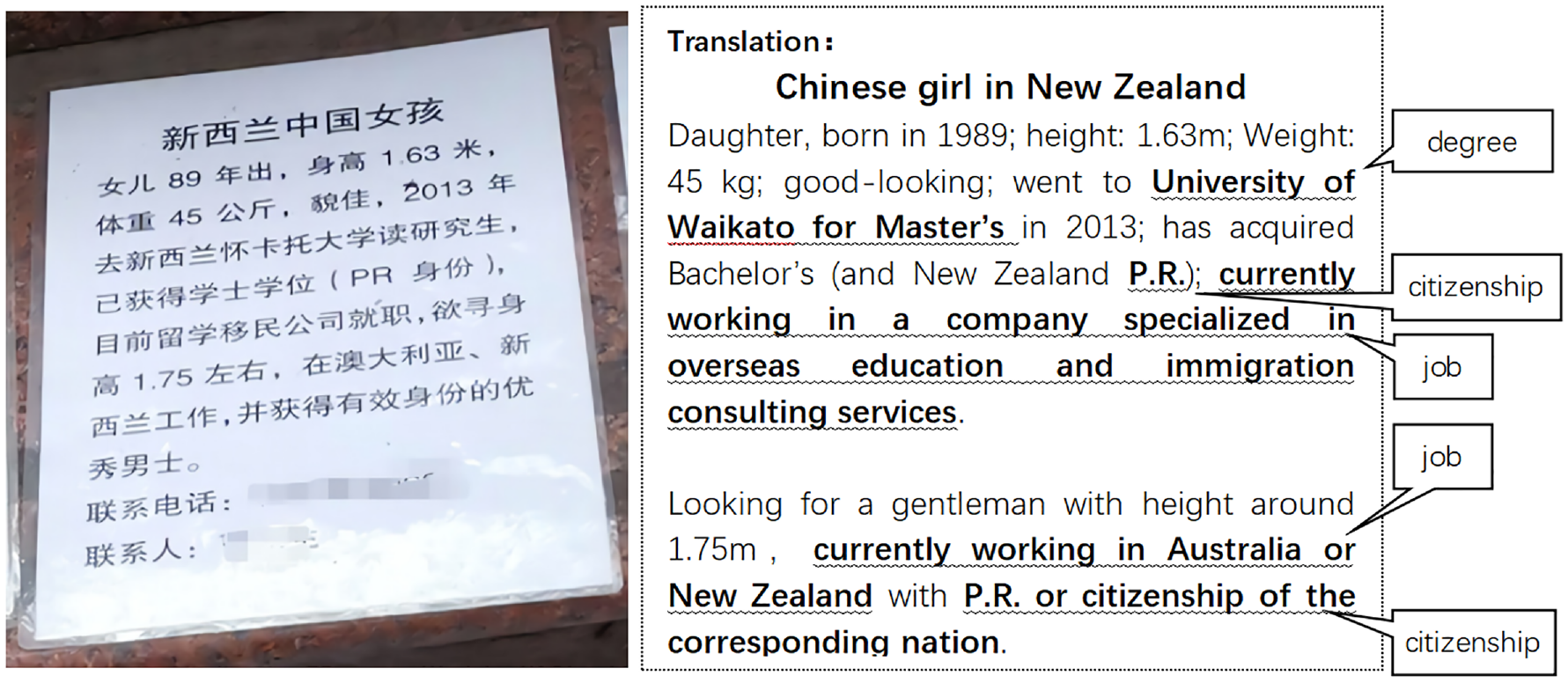
Example of how the poster is coded (photo taken and translated by the authors).
The poster above may be divided into two sections, namely the self-introduction and looking for. Information related to English competence were spotted, underlined, and marked with corresponding codes. As can be seen from the translation, the total count of mentions concerning the candidate’s English proficiency in this poster was 5.
The Role of English Competence in China’s Matchmaking Market
On the whole, the analysis of the sampled posters revealed that English proficiency in the matchmaking market is much more frequently regarded as institutionalized cultural capital by marriage candidates than as embodied cultural capital (205 mentions vs. 7 mentions), but none of the candidates viewed English as objectified cultural capital. In addition, English also serves as a gatekeeper of matchmaking opportunities.
English as a Form of Institutionalized Cultural Capital
According to the statistics in Table 2, English competence mostly functions as a form of institutionalized cultural capital in the matchmaking market in People’s Park (n = 205, 96.7%). As shown in Table 2, the largest proportion of mentions seemed to stress the role of English through candidates’jobs (n = 105, 49.5%). This includes posters advertising candidates’ work experience in English-speaking countries (n = 58), as employees of multinational companies in Shanghai (n = 42), and as teachers of English and English-Chinese translators (n = 5). In the second place were mentions of candidates’ English proficiency by advertising his or her degrees (n = 55, 26%), including those obtained from academic institutions in English-speaking countries (n = 51), and those in English and translation studies acquired from universities in China (n = 4). A considerably smaller percentage of the mentions concerned the candidates’ attainment of citizenship of English-speaking countries (n = 28, 13.2%), such as permanent residence in Australia or New Zealand, green cards in the USA, and so on. Also mentioned were the candidates’ acquisition of English-related certificates including CET-6, 2 TEM-8, 3 SIA-advanced, 4 and CFA, although these mentions were relatively fewer in number and proportion in relation to the citizenship category (n = 17, 8%).
Types of Mention of English Competence in the Matchmaking Market.

In addition, there were other features worth noticing apart from the above statistics. First, in the sampled posters the mentions of certificates for high-stakes English tests such as the TEM-8 significantly outnumbered mentions of low-stakes tests like the CET-6 (9 mentions of TEM-8 vs. 3 mentions of CET-6). Second, marriage candidates frequently incorporated more than one type of mention in their posters. In fact, 47 out of the 114 posters included at least two types of mention of English competence in a single poster, accounting for 41.2% of the sample in this study. There were many instances where the candidate’s English-related jobs, degrees, certificates, and citizenship were promoted together. Figure 3 is a typical example of how several types of mention were used simultaneously.
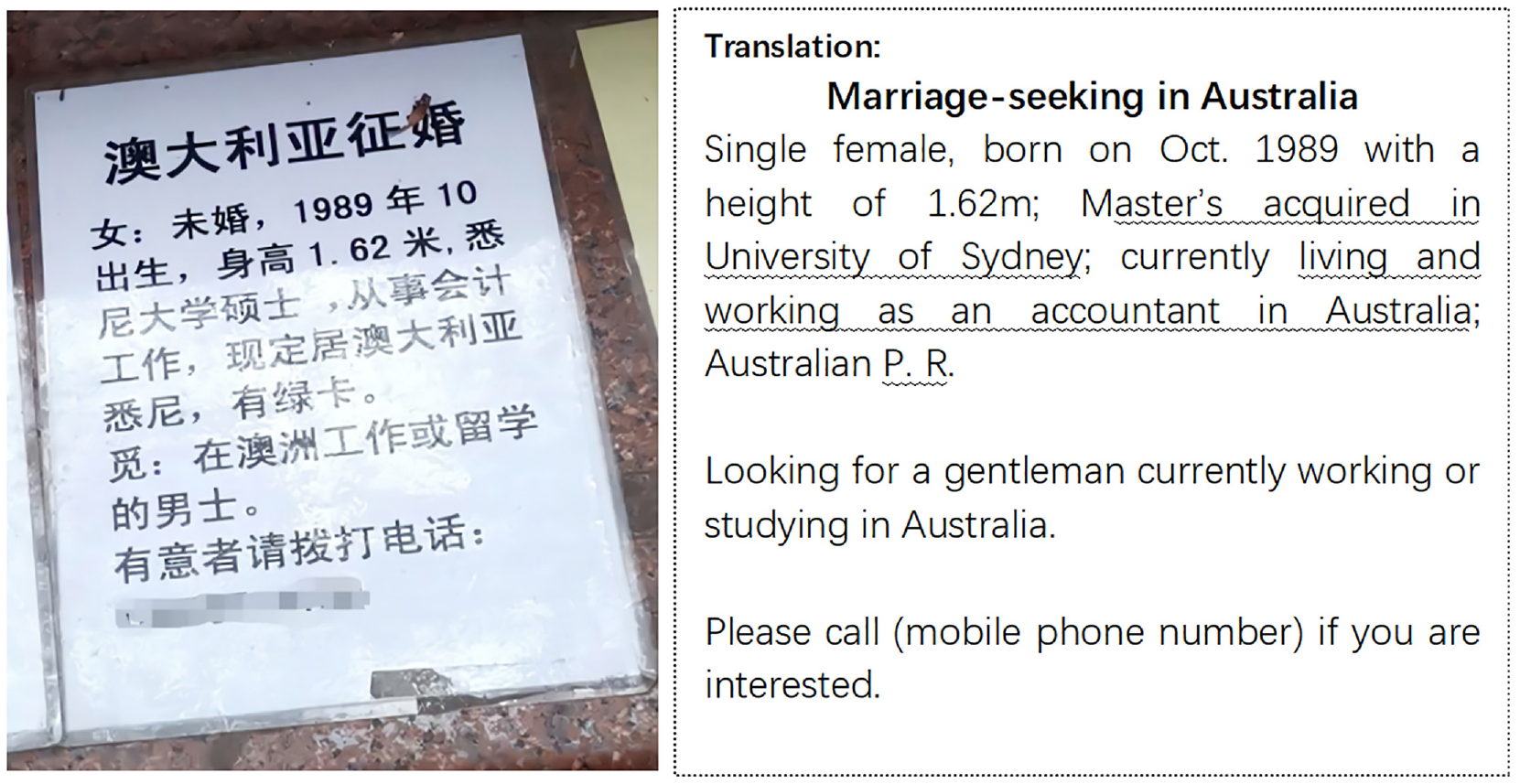
Poster showing multiple types of mention of English competence (photo taken and translated by the authors).
As shown above, three types of mention of English competence may be identified in this poster: degree (Master’s from University of Sydney), job (currently working as an accountant in Australia), and citizenship (Australian PR holder). These may all be regarded as a demonstration of this candidate’s English competence.
It is not surprising that most candidates chose to advertise their English as a form of institutionalized cultural capital, since this is the form of cultural capital with the most reliable and measurable value by which a “seller” can demonstrate worth to the “buyer” in market exchanges. It can also be compared against the measures of cultural capital advertised by other people (Bourdieu, 1986a). In addition, an institution’s recognition of one’s cultural capital actually legitimizes its value and facilitates its conversion into economic capital (Bourdieu, 1986a). Since marriage itself is arguably a resource exchange practice, by advertising English-related jobs, degrees, certificates, and citizenship in a combined manner the marriage candidates are able to describe their cultural capital gains in quantitative terms and “sell” themselves to potential “buyers.”
Another reason for the candidates’ preference for institutionalized cultural capital over the other two forms is probably due to its symbolic effect. The institutionalized form of cultural capital, when compared with the objectified or embodied forms, is marked by its officialness and legitimacy. Since “symbolic capital is nothing but economic or cultural capital as soon as they are known and recognized” according to particular “schemes” (Lebaron, 2014, p. 6538), the aggregate measure of one’s institutionalized cultural capital contributes to the “symbolic strength relations that reproduce and reinforce the strength relations which constitute the structure of the social space” (Bourdieu, 1987). That is to say, for those advertising their success in high-stakes English tests such as TEM-8, English perhaps serves as a symbol of their intelligence, learning capability, and education background. On the other hand, for those mentioning work experience, citizenship and degrees gained in native English-speaking countries, English may symbolize an in-depth understanding of sociocultural life in the “West,” a competence that facilitates their access to educational, vocational, and social opportunities and resources in such countries, which are usually valorized by Chinese as being more “developed” (Goodman, 2004).
English as a Form of Embodied Cultural Capital
Alongside the dominant presentation of institutionalized cultural capital in the marriage market, a much smaller category was the direct mention of the candidate’s English competence (n = 7, 3.3%), suggesting that English proficiency was more infrequently presented as a form of embodied cultural capital. Specifically, two posters mentioned that the candidates were “excellent in English” with another two looking for “someone with English skills,” while a further three posters came with an English translation. Figure 4 is an example of a matrimonial poster written in both Chinese and English.

Bilingual poster (photo taken by the authors).
A text analysis of this poster reveals several indirect mentions of the candidate’s English proficiency, that is, English as an institutional form of cultural capital, such as “Australian citizenship,”“hold Australian CPA,”“TEM-8,” and “Master’s at Melbourne University,” but the fact that it is translated into English could also be seen an direct presentation of the candidate’s English competence, stressing the role of English as a form of embodied cultural capital for this unmarried single.
English as a Gatekeeper of Matchmaking Opportunities
One of the most significant findings emerging from the analysis related to the gatekeeping effect of English proficiency in the matchmaking market. Many posters specified an English requirement for prospective partners, either implicitly or explicitly (n = 27, 23.7%). A number of candidates with life experience in English-speaking countries expressed their preference for somebody with a similar education and work experience (n = 25, 21.9%). This preference for similarity is probably not surprising, since people with cultural similarities, including similarity in English proficiency, are more likely to come from the same social class (Bourdieu & Randal, 1993), leading to a mutual confirmation of each other’s worldviews, lifestyles, and tastes and thereby facilitating the establishment of a long-term relationship. What did surprise us, however, was that a small number of candidates (n = 2, 1.7%) made no mention of their own English competence in their self-introduction, but still expected their prospective partners to have English skills. A typical example is presented below in Figure 5.

Poster that shows the gatekeeping effect of English (photo taken and translated by the authors).
The above poster shows that this male candidate did not include any information concerning his own English competence in his self-introduction, but nevertheless he specified that he was looked for someone with English skills. This may be regarded as an intensification of the gatekeeping effect of English proficiency in the matchmaking setting.
The above findings clearly demonstrate the fact that people who lack English competence may be deprived of the opportunity to form a match with those who are seeking a partner with such proficiency, whereas candidates possessing this kind of linguistic cultural capital might gain access for further contact. Cases like this exemplify the role of English as a gatekeeper for matchmaking opportunities, or possibly as a means to judge and differentiate people in terms of their socioeconomic status, which is a serious consideration when it comes to matchmaking and marriage practice (Sun, 2012). This partially echoes previous studies in China (Bolton, 2006), which discovered the gatekeeping effect of English for individuals wishing to gain access to various educational, economic, and professional opportunities and resources. English is regarded as a compulsory skill for talents in the 21st century, is seen a sign of an individual’s distinction, and is viewed as a powerful and magical tool that may bring greater opportunities for those who have it (Hu & Alsagoff, 2010).
Discussion and Conclusion
This paper presents an investigation of the role of English competence in the matchmaking market in People’s Park in Shanghai. It attempts to sketch the ways in which English is advertised and required by marriage candidates through an examination of matrimonial posters. Based on qualitative data and categorization, English competence was found to be mentioned in five thematic categories, namely JOB, DEGREE, CERTIFICATE, CITIZENSHIP, and DIRECT MENTION. In analyzing these categories, the study places emphasis on how English is transformed into different types of cultural capital to facilitate candidates’ negotiations of their social class and positions in the matchmaking market.
Our study has revealed how candidates perceive English competence in the matchmaking market. We found that a substantial majority of candidates in the market considered English as a form of institutionalized cultural capital, while a small number valued English as embodied cultural capital, although none regarded it as objectified cultural capital. Furthermore, bachelors/spinsters also used English as a gatekeeper to seek potential partners with similar socioeconomic status, and to exclude “disqualified” matches from establishing further contact; this echoes other findings related to the gatekeeping effects of English in education, job hunting, and promotion in China (Bolton, 2006; Hu & Alsagoff, 2010). These popular beliefs and practices in the matchmaking market to a large extent contribute to the glorification of English, promoting it from a mere tool of communication to an indicator of individual prestige, a demonstration of professional ability, and a proxy for the potential for upward social mobility.
The mentions of English proficiency on the matrimonial posters reflect the ideology of English held by the general public in China. Although at the macro level English is idealized as an indispensable resource to facilitate the country’s modernization, to enable international communication, and to tell China’s story well, popular ideology at the micro level seems to deviate from the official ideological characterization associated with nation building. Members of the public, as individual language planners, have their own way of making sense of the official ideology in accordance with their private agendas, turning English into a stepping-stone to maximize the symbolic and material profit of the marriage transaction (Wang & Fang, 2019).
This study also contributes to the understanding of the commodified nature of English proficiency in the Chinese matchmaking context. It seems that English competence, along with a candidate’s age, income, occupation, and so on, has already become a commodity tagged with a purchase price, that may be advertised and traded in the marriage market. Candidates are ranked based on their price value, and only those with “money” and realistic marriage strategies can really afford to play this social game (Bourdieu, 1977). However, we cannot help but wonder what marriage and matchmaking practice should really involve. While this is a philosophical question awaiting an answer, we believe that marriage and matchmaking should certainly involve much more than the candidates’ age, height, income, occupation and, most of all, English language proficiency. The marriage market in People’s Park shows us a matchmaking culture that objectifies the bachelors/spinsters, treating them as products and properties while neglecting their role as actors with personal agency. This is probably one of the reasons why the success rate of matchmaking in this and similar markets is very low (Zhang & Sun, 2014).
Due to time and resource constraints, the present study is limited in two aspects. First, the only source of data for this research came from matrimonial posters, with a lack of data elicited from other sources for evaluation and comparison. This would allow a more comprehensive understanding of the research question. Second, matrimonial posters, as a form of linguistic landscape in a public space, could also be approached from a social semiotic perspective (Kress, 2010). Future research into the role of English in the Chinese marriage market could elicit data from multiple sources in order to strengthen the validity and reliability of the findings (Creswell & Poth, 2016), and a social semiotic analysis of posters in addition to text and thematic analyses could be incorporated in order to address how English is really perceived and valued in the marriage market in China.
Footnotes
Acknowledgements
The authors acknowledge the support from the Centre for Language Planning and Global Governance at Tongji University, Shanghai, China. We would like to thank the anonymous reviewers and the editor for their comments and suggestions during the peer review process. Any remaining errors are our own.
Declaration of Conflicting Interests
The author(s) declared no potential conflicts of interest with respect to the research, authorship, and/or publication of this article.
Funding
The author(s) received no financial support for the research, authorship, and/or publication of this article.
Ethic Statement
Not applicable

Notes
Data Availability Statement
The datasets generated during and/or analyzed during the current study are available from the corresponding author on reasonable request.