




Abstract
The carrying and use of knives by young people represents significant public and political concerns in the United Kingdom and educational interventions have the potential to promote behavioural change in relation to knife crime behaviours. Here, we first describe the creation of a novel virtual reality immersive film –RELOADED– designed to educate young people about the dangers of carrying knives. Co-created with secondary-school students, RELOADED explores how one victim’s story can enable stronger emotional connections and better understandings about knife crime in young people. Next, we conducted a preliminary qualitative assessment of engagement with RELOADED among students (n = 16) and teachers and professionals (n = 6) in a school environment, with a view to understanding whether RELOADED can be deployed to improve attitudes towards knife crime in young people. Thematic analysis of interview data identified five inter-connected themes relating to engagement with the environment, the role of the individual, the importance of support networks, the inevitability of knife crime, and the significance of a true story. Our findings underscore the potential of VR and immersive storytelling in fostering understanding among young people concerning complex social issues, such as knife crime.
Introduction
The carrying and use of knives by young people represents significant public and political concerns in the United Kingdom (Squires, 2009). For instance, in the year ending December 2024, cases of police-recorded knife crime rose by 2% compared to the previous year, with a total of 54,587 offences recorded (Office for National Statistics, 2025). It is estimated that knife-related violence costs the National Health Service £2.9 billion a year (Bellis et al., 2012; Lam et al., 2019), while indirect costs are much greater, including loss of psychological, physical, and social function to the individual, diminished community cohesion, and loss of economic productivity (Malik et al., 2020). As a result, tackling knife crime is now a priority for the United Kingdom government (Her Majesty’s Government, 2018), with public health approaches being valued over criminal justice routes (Grimshaw & Ford, 2018; Her Majesty’s Inspectorate of Probation, 2022). The former has focused on initiatives aimed at understanding risk factors, motivations, and psychosocial aspects of knife crime (Astrup, 2019; Browne et al., 2022; Grimshaw & Ford, 2018), but just as important is educating young people about the dangers of knives (Ponsford et al., 2019).
Educational interventions have the potential to promote behavioural change in relation to knife crime behaviours (Browne et al., 2022; Wilkinson et al., 2024). Such educational interventions typically adopt a “norms approach,” in which young people’s beliefs around perceived norms of carrying a knife are challenged. Relatedly, educational interventions may use real life stories to illustrate the impacts and consequences of carrying knives (e.g., Home Office, 2018). A key aim here is to change attitudes about knife carrying in order to prevent or reduce the involvement of young people in violence. In this sense, knife crime educational interventions differ from other forms of intervention, such as media campaigns, in that the provision of information is tailored and delivered to young people, typically in settings where young people attend, such as schools and community centres.
To date, however, most educational interventions have utilised face-to-face contact approaches, such as workshops delivered by health professionals in school. Although such interventions can be effective, particularly in building empathy as a protective factor against violence (England & Jackson, 2013; Gavine, 2014), methods requiring face-to-face contact can be difficult to roll out widely (e.g., because of the high cost). Other research has examined the effectiveness of fear-based anti-knife crime campaigns, which have typically utilised knife-related imagery. However, evaluations of such campaigns have suggested that the use of knife-related imagery risks perpetuating negative stereotypes among young people, has the potential to negatively impact mental health, and has low efficacy (Hobson et al., 2022).
A more cost-effective interventionist method relies on the use of simulations and film. Thus, one study described a two-part workshop involving a simulation showing a patient journey of a young man stabbed in the abdomen, as well as a discussion with viewers about the role of knives from a personal and community perspective (Tribe et al., 2018). Qualitative data from workshop participants indicated that the intervention was successful at providing a space in which young people could learn about consequences of knife crime and that it promoted positive changes in participants’ knife-related behaviour between 4 and 6 weeks later. Other work has shown that a fictional film about a family devastated by knife-related violence combined with a workshop-based discussion successfully improved knife-related attitudes in 13-to-15-year-olds (Gilbert & Sinclair, 2019). However, there remains scope to develop innovative educational tools to “immunise and protect” (Astrup, 2019) young people from becoming embroiled in knife crime (Her Majesty’s Inspectorate of Probation, 2022).
An alternative method that shows promise is the use of emerging creative technologies, such as Augmented Reality (AR) and Virtual Reality (VR). The latter is a technology that generates virtual immersion in a digital environment through the use of computer graphic simulation that allows users to immerse themselves in an interactive 3-dimensional world with different types of sensory and emotional experiences. That is, VR provides a multisensory environment that allows the user to explore, engage, and emotionally connect with the environment around them (Greuter et al., 2018; Parameswaran & Gaedtke, 2021; Patel et al., 2019). One particular benefit of VR in terms of its educational potential is its ability to disrupt conventional narrative structures, including the way stories are told, thereby promoting greater educational efficacy. Indeed, VR is increasingly used as an educational tool in diverse fields, including in criminal justice practice (Cornet & Van Gelder, 2020).
The Present Work
Here, we report on the development and evaluation of a novel immersive VR film designed to improve attitudes towards knife crime in young people. Specifically, the VR immersive film –RELOADED– leverages innovative creative practice workflows within an interdisciplinary landscape to maximise the creativity and efficiency of producing stories for meaningful, impactful, and attitude-changing experience. In the following sections, we begin by describing the development of RELOADED, focussing on the co-creation of this VR film with young people. Next, we present the findings of a preliminary qualitative evaluation of how a select group of young people, as well as professionals in a school setting, experienced engaging with RELOADED. While this evaluation was necessarily exploratory, we wanted to know to what extent RELOADED could be deployed to improve attitudes towards knife crime in young people.
Development of RELOADED
The project to develop RELOADED adopted an immersive narrative approach to co-create a VR film about knife-related violence with school students, with the use of VR seen as an effective means to trigger preventative attitudinal change in the user experience. The possibility of scoping and co-creating prototype immersive experiences with young people was crucial to design more participatory and effective interventions able to provide a counter-narrative to the fear culture surrounding knife crime. The scoping took the form of a series of co-creation workshops with schools in Chelmsford (Essex) in the United Kingdom to collate and analyse qualitative data based on semi-structured discussions with school participants, with the aim of testing various technological solutions for the development of the VR immersive film. They were initially shown a film created by a student of film production at Anglia Ruskin University, who himself was a victim of knife crime, and then asked for their opinions and experience regarding the carrying of knives within the local area. The students helped to create a more relevant and contemporary understanding of such experiences, particularly within the area local to the school (see Figure 1).
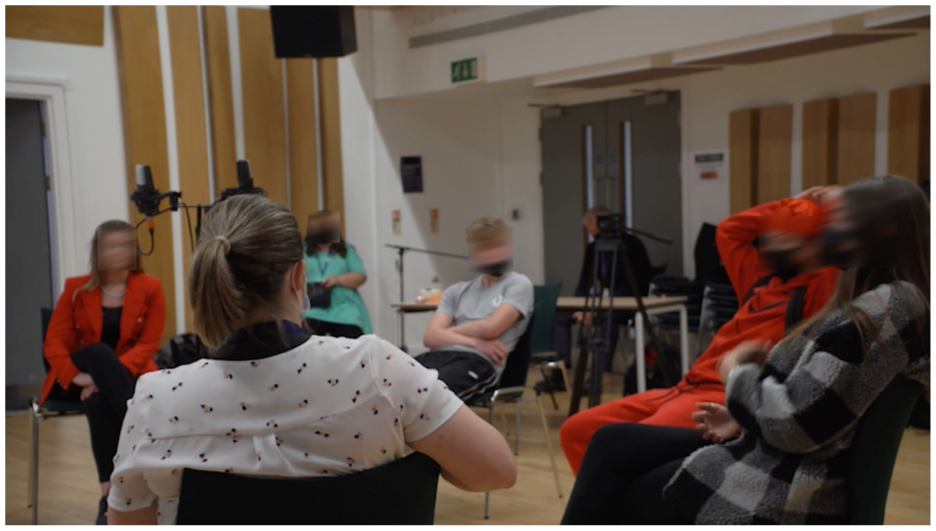
Co-creation workshops with secondary-school students at Anglia Ruskin University.
This preliminary feedback helped in selecting key narrative elements to be considered during the production of the VR immersive film, including: (1) Information about specific places and the importance of having a location-based experience; (2) Change of perspective to better relate with/immerse in the personal stories of the characters; (3) The importance of support networks (i.e., family and school); (4) Individual versus groups, and sense of isolation when surrounded by people; and (5) The significance of engaging/relating with a true story/personal experience.
RELOADED integrates 360° videos of real places, familiar to the target audience (14–16-year-olds in Chelmsford), and hyper-real representations of characters/actors filmed during the production phase of the VR experience (see Figure 2). The 360° videos of real places were captured using an Insta360 Pro camera (8K 3D resolution at 30 frames/sec), while the final VR experience was presented using Meta Quest 2 VR headsets. Attention is a critical factor in the effectiveness of immersive environments. In our study, while the participants did not have free navigation of the 360° scenes (i.e., their position was fixed at the centre of the scene), they could look around and visually explore the 360° environments. We used ambient sound and audio clues to attract the viewer’s attention to specific aspects and/or actions happening in the immersive space. These auditory elements are crucial in directing attention and enhancing the overall immersive experience, ensuring that participants engaged with the key components of the scene.

Integration of 360° videos of real locations with hyper-real silhouettes of characters/actors.
This combination of “real” and “hyper-real” visualisations and sounds has been previously shown to be an effective approach (Galeazzi et al., 2023; Patel, 2020), helping young people to emotionally connect to the immersive narrative through the integrated use of familiar places and hyper-real silhouettes of the characters, and allowing them to feel more immersed in the story represented in the VR film. The project was designed in a way that allows, after preliminary background research and co-creation activities, extensive user testing and evaluation to create an experience which will have the desired impact.
Evaluation
Participants and Procedures
To evaluate this version of the VR immersive film (see Figure 3), RELOADED was shown to 16 secondary-school students, 3 of whom had been part of the original co-creation team, as well as 6 teachers and other professionals with responsibilities for safeguarding within the school (one of whom was also a co-creator). The group of teachers and professionals were recruited opportunistically from the school setting, while participation from among students was facilitated through direct requests by the school’s pastoral manager. A description of the sample is provided in Table 1. We were guided by the recommendations of Malterud et al. (2016) regarding sample size, which is based on how much information the sample “holds.” This includes sampling specificity, the theoretical background and objectives of the project, depth and breadth of the interviews, and our analytic approach (see below). Because a determination of the level of information held requires ongoing evaluation, two members of the research team (the first and final authors) consulted regularly during the interviewing phase to discuss their experiences of the interviews, to understand the level of information held by the sample, and to agree completion of data collection.

Participants experiencing the VR immersive film.
Description of the Participants in the Present Study.

Note. S = student; T = teacher or other professional; CC = was a co-creator within original project.
Each participant viewed RELOADED individually through a VR headset in a quiet school setting. Next, participants took part in one-to-one interviews with trained researchers, with the interview covering 5 broad themes: (1) First impressions of the film: likes/dislikes, emotional connexion, what was powerful/effective?; (2) Technical aspects of the film: what worked/didn’t work: sound/visual/voiceover; (3) Intended audience: advice on age range of audience, who would benefit most, are stereotypes avoided?; (4) Evaluation: important messages from the film, what would you change?; (5) Perception and attitude: could the film change perceptions regarding knife crime? A full interview schedule is provided in Appendix.
All interviews were conducted on school premises in a quiet setting. There were two interviewers with each interviewee, and each interview was video recorded. Individual interviews lasted between 10 and 30 minutes. The videos were then transcribed, at first, automatically within Adobe Premiere Pro 21 software. The resulting transcripts were then checked line-by-line against the original recordings and any errors corrected.
Ethics
Ethics approval for this project was obtained from the relevant institutional ethics panel at the second author’s institution. Considering the focus of our research, ethical considerations of the potential risks to participants were a priority during the preparation phase. At all times during the study, it was clarified with participants that they had the right to withdraw without prejudice. Information sheets were included with the written consent forms provided to participants prior to the commencement of the study. These information sheets outlined the purpose of the project and stated what would occur during participation. At the beginning of each interview session, prior to watching the VR film, this information was reiterated by the researchers verbally, and the film’s content and the use of the VR headset were discussed. Consent forms were signed by participants prior to the study or, in the case of those under 18 years, by their parent or guardian. The consent form included items to clarify that those signing and/or participating had been informed of the project, understood its aims, and that they were aware that they were able to leave the project at any time.
Analysis
The data was analysed through a thematic analysis process as outlined in Kiger and Varpio (2020) and Braun and Clarke (2022), whereby themes and repeated patterns of meaning were systematically identified across individual interviews. The thematic analysis of data was also underpinned by a critical-realist paradigm (Bhaskar, 2008; Elder-Vass, 2022). This paradigm allows for the perspectives of all participants to be considered as valid contributions to the development of knowledge in relation to our research questions. It also allows for participants’ responses to be positioned within existing literature, as interpreted through the lens of the researchers’ knowledge and experience.
The transcribed interviews were analysed using a data-driven, bottom-up approach to theme identification, following Braun and Clarke’s (2022) 6-step framework. First, immersion in the data began by a researcher (the first author) being involved in the interviews and checking transcriptions line-by-line; this researcher also began making observations on the data. Next, this researcher read each transcript several times over to identify and code findings that were relevant to our research question and study aims. Codes were identified as latent rather than semantic (Kiger & Varpio, 2020), providing a “patterned response or meaning” (Braun & Clarke, 2006, p. 82) to the information contained within the data. Next, codes were analysed and consistent findings were clustered into meaningful patterns of data that the researcher identified as emergent themes. This was done by the same researcher for all transcripts, while a third of transcripts was also coded by the final author. The full research team then met to discuss these themes in a consensual manner; this process occurred several times over and, in between meetings, themes were reviewed, revised, and further synthesised based on research question. Next, the full research team met to define and label themes, as well as to create overarching labels that were eventually used in this paper.
Various steps were taken to ensure the trustworthiness and credibility of our data (Nowell et al., 2017). First, prior to coding, the research team discussed various approaches to thematic analysis. We agreed upon a deductive thematic analysis approach to ensure consistency in the analytic process. In the early phases of thematic analysis, the first author took detailed notes about the development of codes and potential groups of codes into broader subthemes and themes. These notes, as well as the codes that were generated, were iteratively discussed by the research team, as well as between coders, to understand discrepancies in interpretations (which we resolved consensually) and to generate themes and subthemes.
Results
Overview
Five significant themes emerged as critical to producing an emotional response in the viewer. The various themes and the subthemes are identified in Table 2. Interviewees are identified by a letter (S for student, T for Teacher/Teaching staff) and a number. The letters CC after the numbers indicate here and elsewhere which interviewees were co-creators.
Themes and Subthemes of Analysis.

Engagement With Environment
Two factors were highlighted during the interviews as particularly significant to the immersive experience of the film: the sensory isolation of the VR viewing experience and the locality of the settings used within the film.
The VR Experience
When describing the act of watching the film through a VR headset, interviewees identified primary emotional states, mainly incorporating those of subjective experience. There was a sadness and the inability to escape (S2) and a realism (S11; S12CC) of being trapped in a story in which viewers have no agency. The VR headset enclosed them in a fixed space, which emphasised feelings of fear and dread. One interviewee explained at length her physiological responses to the film, including a heart rate increase.
I haven’t been in a situation exactly like that, but I have at the same time when I’m surrounded by people bigger than me, it’s just, you can’t do anything. And you don’t know what’s going to happen. It’s really scary. (S9)
Several of the interviewees expressed the belief that using the VR itself was a novelty, that it captured their attention due to it being a new experience. In the previous research session, where advice was sought regarding the film’s construction, one of the co-creators acknowledged that if watching the film on a screen in assembly, he would “just try and take the piss out of it to make my mates laugh” (this was a comment from interviewee S14CC during a previous focus group discussion). Therefore, the VR created a private space for the viewer, enabling a lesser regard for other audience members. However, the nature of watching the film on a headset also created solitude, which could in some ways be oppressive, a sense of being “stuck.” This sense of being stuck was echoed in most interviews:
Because then it’s right in front of you. You can see it… you can’t really look away or anything. So you’re always drawn to what’s going on. (S5)
In “having” to look, students were essentially forced to consider the narrative. Interviewee S5 provides an identification of space being an imposing factor within the VR, echoing the sentiments of interviewee S11 in being forced to look at what is in front of them, and not being able to look elsewhere. However, rather than focussing on being trapped, the next utterance indicates that the student is “drawn” to what is going on, a more active description. In being “drawn,” there is a motivation to look, an underlying need to consider what is going on in front of him.
In the next extract, interviewee S2 inhabits their role as observer, watching the incident, but placing themselves within the role of victim in connecting to a potential alternative outcome (i.e., escaping or going to the police): “Watching him get stabbed and, you know, he couldn’t really escape it…he couldn’t really go to the police.” Instead of noting that he didn’t escape or that he didn’t go to the police, the use of a modal suggests that a decision-making process is displayed, modified by the intensifier “really” to signify the underlying sense of closed circumstances. Such immersion with VR enables this existence in a trapped space and identifies the process by which the protagonist finds himself in a potentially life-threatening incident.
When considering the teachers’ responses, they echoed what students said with more attention given to the difference with other learning spaces.
… kind of takes you out from where you currently are and something not that, something the students wouldn’t be used to, you know, like an assembly or a classroom. (T5)
Interviewee T5 identifies a similar movement in space that is highlighted by the students, though also noting the alternatives as an “assembly or a classroom,” thereby highlighting the institutional environments where students would normally view such films. The use of VR becomes an active process of “tak[ing]” them out of such spaces, to fully immerse within the role of observer.
The Locations as Settings
While placing a viewer in a VR enabled them to be cut off from their own physical space, the evaluation identified the strong emotional impact of using familiar background locations of local areas which students would recognise. As outlined previously, these locations were selected during the initial co-creation period and used because of their relevance to the topic matter.
I just saw everything I see on a weekly basis. (S7) … so it was like déjà vu. It was really weird. (S9)
Interviewee S7 identifies her own place within the story. Her use of “everything” establishes the familiarity of the scene while also the closed nature of that world. She formulates a link between the film and her everyday existence, both occupying the same geographical space. This contrast of the familiar and the different is what was striking about the film and led to a personal involvement. Such an experience could be jarring, as noted by interviewee S9 who described the experience as “really weird.” She goes a step closer in not only identifying with the geographical location within the film but also with the experience of the protagonist himself, that it created a feeling of “déjà vu.” It was therefore not only the setting which evoked an emotional response, but intrinsically, the location coupled with a scene of violence and intimidation. Though she frequently identified that the film did not contain exactly the same circumstances as an incident she had previously experienced, the geographical setting was similar enough to elicit such a response.
The downside with using such familiar settings is that it will not evoke the same recollection and engagement in everyone. Interviewee S11 had recently moved from London to the school and admitted that “I only recognized one place…I’m kind of new here.” This identification of a particular geographical area may potentially limit the impact of a film for a wider audience, though further research would be required to confirm. Introducing an element of the familiar within the film reformulated the narrative from a potentially isolated experience of one person into something which students could see occurring within their everyday lives. This resonance was integral to the success of creating an emotional connexion to the film’s narrative. Interviewee S7 identified the location as common to her everyday experience. Interviewee S5 takes this point further, in that the use of these locations draws into focus the reality of the events shown in the film.
I was kind of shocked because… as I said, I go through those estates and I don’t really see it happening, but it is happening. (S5)
Identifying a reaction of “shock” modified by “kind of” indicated a low-level surprise reaction to the locality of the film. The interviewee initially casts doubt on what occurs by stating that he frequently inhabits the area with nothing happening, and does not witness any events similar to those depicted. However, the use of “really” implies a hesitancy, an implication that this is not the complete truth, which is further validated by the declarative “but it is happening” to imply that while he may not be a witness, watching the film in VR and being closed within that environment, has created the impression that these events do occur.
The Role of the Individual
Using the VR headset is an isolating experience, and used in conjunction with a narrative which deals with the fall-out of a betrayal enables viewers to connect with the protagonist and consider alternative strategies for dealing with such situations. The VR experience also enabled viewers to identify context, most significantly, the role of the individual in the carrying of knives, and the greater ethnographic demands and impacts on these individuals.
Isolation
Isolation was a significant component of the emotional response, and the students identified with the role of the protagonist as an outsider. Throughout the narrative, the consequences of the protagonist’s actions are both caused by and cause further loneliness.
And it kind of ended. He was alone… (S2)
Interviewee S2 establishes that one major consequence of the knife attack was that the protagonist was left alone, outside of his friendship group. Such consequences establish an important emotional cost, that involvement in these groups may ultimately lead to isolation (see Figure 4). Interviewee S10 identified that the loneliness of the protagonist was the emotional aspect of the film she found most powerful and enabled her to focus on the narrative. The nature of adolescent friendships and friendship groups was exemplified with gang life providing a form of validation and friendship. Interviewee S8 identified this point as a significant aspect of the film, one which he particularly liked, “how he felt like he was accepted, and it went a bit out of control.” The statement “a bit out of control” includes the mitigator “a bit” to restrict the lack of control. Interviewee S8 stated how such events are not necessarily the protagonist’s fault but a recognisable pattern for this type of incident.

Graphic representation of sense of isolation in the VR immersive film.
During interviews, it was felt by one interviewer important not to use the term “gang” in order to minimise the creation of otherness, that students would dismiss such ideas as not being relevant to themselves. It also helped to avoid any issues which “gang” can imply, a term which has been “mis-conceptualised and misused by the media, politicians and policy makers” (Alexander, 2008, p. 2). Instead, the focus was on friendship groups and the validation that such groups provide. As the teachers and other professionals confirmed, validation is at the centre of why students are drawn to these groups, particularly if such validation is missing from their day-to-day life. Interviewee T5 noted that students themselves often do not want to be associated with gang life:
…it’s not the students that want to be part of a gang. It’s sometimes students that just want a friend. And so they make a friend, and then that friend kind of leads them down the wrong path.
In wanting a friend, interviewee T5 implies that a student can be vulnerable should that friend lead them onto “the wrong path.” However, having been led down this path, students provided mixed responses as to an appropriate course of action.
Individual Responsibility
The difficulties surrounding who to trust led to several students identifying with an individualistic outlook, that the responsibility for removing yourself from these groups lies largely with the self. Two of the co-creators argued that this self-reliance is an integral element of removing yourself from these circumstances. Interviewee S13CC explained the need to be aware of betrayal and that “you’ve got to focus on yourself and what’s best for you at that time and age.” Interviewee S12CC goes further, identifying that this betrayal means not only that focus should be on your own needs but that in actuality, “you only really have yourself.” While autonomy is important, an asserted responsibility for themselves in these circumstances seems inherently problematic. While using the VR environment creates these feelings of isolation and individualism, it is hoped that instead of creating a sense of complete self-reliance, forming a greater awareness of critical thinking and autonomy will ensure students consider where to find help in these circumstances.
Support Networks
The students provided mixed responses regarding what support networks are available to those who find themselves in similar situations to the protagonist. However, during the interviews, there were discussions regarding which support networks would be most helpful for young people.
The Family
One major element of support already evident within the film is shown as the mother figure that appears subsequently to the stabbing event and explicitly assumes the role of a loving supportive figure. This moment was significant for students, who all placed themselves in the role of child, and responded accordingly.
I think it shows that after everything his mum would still be there and support him. (S16)
The use of the mother figure to create this feeling of support also helped to instil hope at the end of the film, that “you’re never alone” (S1) with someone to talk to and help to clarify what is “really important in life” (S13CC). Interviewee S11 even identified that despite the pull of gang life and the validation this provides, people in these situations still have a “soft spot” for their mother and might be more likely to listen to them if the mother advised against taking potentially harmful courses of action such as carrying a knife. As such, the mother character is an idealised version of maternal acceptance and love. This identification provided emotional resonance with students’ own lives, or perhaps, what they would expect in the lives of others. Interviewee S8 identified that for him the image of the mother was “relatable” because he made an emotional connexion between his own life and those of his friends, and this was the most “impactful” point of the film. This unconditional love is seen as the scaffolding for any support which the protagonist may receive subsequent to the film’s contents.
The School
After watching the film, the students were asked to identify other support networks beyond the mother figure. The potential for the protagonist’s school to be featured was mentioned frequently, and it was often discussed why school was not mentioned during the film. Students hypothesised why:
Because from what it looked like from his experience that the teachers just kind of treated him wrong, never believed in him, could lower his, um, just lower his self-esteem and think that he’s not worth it, which is why he might go into all of the… (S8)
In this extract, interviewee S8 compiles a hypothetical context for the protagonist’s behaviour. To do this, he explains the reason why the protagonist may have sought validation: low self-esteem or that “he’s not worth it.” In the context of engaging with support networks, the fact that teachers have treated him “wrong” suggests that they would be a poor resource for advice and help. The immersive experience of the VR helps the interviewee to make meaning from a set of circumstances and attempt to identify the best potential course of action for the protagonist.
Friends and peers who are not involved within this life were also offered as a potential source of support. Again, it was seen as problematic what help could be provided. The VR provided an insight into the friend as an observer, with students placing themselves in this role of potential support. In using the VR headset, interviewee S9 responded:
So it’s like you’re literally there. It’s like I’m your friend and I can’t do anything about it, you know what I mean?
This powerlessness links with feelings of isolation as the interviewee identifying herself as a “friend” and thereby linking herself as potentially in a position of support for the protagonist, she feels a powerlessness, a lack of autonomy. However, such powerlessness identifies the restrictions felt by students.
Inevitability
While some interviewees had strong reactions such as shock or surprise, many students also stated they felt the narrative contained a sense of inevitability. This reaction to knife carrying was present even during the co-creation stage, that these actions were unpreventable. Students expressed that some people, in differing circumstances, find themselves in this position, and are not always able to avoid a violent outcome. As interviewee S15 comments on having viewed the film:
I always thought it was the same-old, same-old. Drugs getting involved. And then if you mess up once, you end up getting stabbed or killed.
Interviewee S15 also described the film as “the same old people turning against you and stuff,” the commonality of the story, which was universal to the point of banality, that is, “same old.” This is echoed by interviewee S3 who identified his first impression on viewing the film as displaying a “waste of a life, waste of time.” However, interviewee S15 underlines this sense of banality, not just through the repetition of “same-old” but by providing an example of what occurs: getting involved with drugs, “messing up” and then being stabbed or killed. Such a projected timeline is pessimistic, leading from drugs as an entry point to death as a potential exit with the idea that committing a mistake just once can lead to such a punishment.
Despite this despondency, some interviewees, including interviewee S3, noted that the film may be able to change the perceptions of those in younger age groups:
Well it depends how deep you’re into that sort of life, because people who are like 20, are quite old. It’s not the right age. I’m not sure if it would be able to turn them round completely, but people just getting into that life, would have just started. (S3)
This observation echoes that of previous research with an older age group who carry knives and their reasons for carrying such weapons, including a lack of support from the authorities (Palasinski & Riggs, 2012). The current study suggests that such views begin earlier, within pre-adolescence or during adolescence, potentially due to the influence of these older adults, and the networks which form around them.
Within the initial co-creation process, students also expressed scepticism that such violent incidents are preventable and that any real-world change was possible. The distinction made at that point was societal and the money issues which surround a young person’s life, highlighted by interviewee S14CC in the previous focus group discussions during the co-creation process:
There’s a lot of poverty. If you don’t have it [money], you want it and you will do anything for it.
To interviewee S14CC, the focus on knives provides a limited view, and such crimes stem from ongoing issues within society.
On viewing the film, the co-creators continued to show a similar belief that the broader contextual circumstances make such crimes inevitable. Interviewee S13CC said he felt a sense of regret, a mix of emotions concerned with feeling sorry for those who carry knives and involve themselves within drug supply and gang life. Another co-creator, S14CC, identified how the film made him feel “weary” and “it wasn’t anything new really.” While this paper has considered the role of the individual and wider support networks for dealing with knife crime related situations, there are concerns that such persistent feelings of the inevitability of violence is overwhelming for young adults.
The Significance of a True Story
Though co-creators were aware that the film was based on actual events before viewing, most students were not made explicitly aware of this until they were interviewed afterwards. Their responses indicated that such validity of the film’s narrative enhanced their emotional engagement and provided the basis for a deeper conversation regarding motivation of the protagonist and the context for their actions.
Responses to the Reveal
A significant part of the VR experience for the students was engaging with a true story. One interviewee in particular (S6) seemed reticent in engaging in the interview process after watching the film and only engaged further when they were informed that the victim of the story was one of the interviewers. His initial question was founded on the emotional response, asking if it was “scary” to be stabbed. By his own admission, it might have changed how he had perceived the film if he had known it was a true story before watching it. This was echoed by other interviewees like S8, who said, “If it’s at the end you kind of regoing through what you’ve just watched then it stays in your head cause you think.”
Providing Context
Though the film was based on a true account, the details were amended slightly for dramatic purposes, to ensure the film had a clear narrative arc. However, students advised providing even greater detail regarding the background of the protagonist and the context in which he lives. While the scene of the protagonist’s stabbing is impactful, the emotional connexion with the character must exist beforehand for viewers to draw any wider significance from this event. This is argued by interviewee S11 in the context of news media.
…when you’re watching the news and obviously it sugar-coats the person would just say like, a 16-year old person got stabbed or something and it doesn’t say, like, the meaning behind it. How does a younger person learn from it and like, look at it and be like, he did this and that, which led him to do this? (S11)
Realism plays an important role in ensuring that the film can be used as a learning tool, when it shows students a real-world possibility of what could occur in their own lives. Interviewee S11 takes this point further by referencing a generic news report, where information regarding the loss of life is shown, but the victim’s identity is missing from any subsequent details. Students confirmed that such an identity was important to the process of forming any sort of emotional connexion to the story and thereby making it relevant to their everyday lives. Interviewee S11 also highlights the obvious gap left by only focussing on the aftermath of events without giving sufficient space to explore what led up to such an aftermath. In watching a true-life story in VR, the background is provided (albeit in an edited way) to what led to the stabbing itself. Without the context for the protagonist’s actions, knife crime becomes something which is “other,” a macabre force which is not something eminently controllable (Williams & Squires, 2021a).
Victim or Perpetrator or Both?
The fact that the protagonist is carrying a knife is a crucial element of the film, casting him as both victim and potential perpetrator. However, students varied in their responses to this element of the narrative, identifying it as an important component in how they formed meaning from the experience. Interviewee S2 identified that “I think making a mistake is more natural because you would in that situation” but that this could cause issues for whether viewers would place blame for the stabbing incident on the protagonist as it would be a question of “who would understand and who would not really understand why you would do that in the first place.” As such, interviewee S2 describes an underlying issue, whether viewers would place the blame on the protagonist and identify his role as potential perpetrator. This observation underlines the concept that there is “the perfect victim,” one who is a victim in the truest sense that they have no potential cause for blame or accountability.
However, the issue of blame and the lack of clarify for the roles of victim or perpetrator provided an important adjunct to the film, adding plausibility and an important connexion for the students. Some responses noted the personal responsibility of the individual.
… if he didn’t, he he didn’t like carry a knife or had a knife next to him he will not get stabbed… It only had the time he got stabbed, and it was after, it was all okay… so like, when he got stabbed, he might have done it again, because he was okay. It wasn’t that deep. (S10)
On this point of the film, the emotional connexion is tested, as some students saw that the victim was at fault, and it was sometimes difficult for them to see beyond that into the wider context. Being part of the VR experience helped the viewer become part of the world of the story, as described earlier with location and with the isolation of being an observer. However, as can be shown within interviewee S10s response, some messages appeared to lead to confusion. As with “sugar coating,” there is also a danger of only engaging with these motivations on an individual level, rather than considering why the protagonist didn’t feel safe. It was one of the co-creators of the film who identified these issues in more detail as regards contextual constraints when asked if the film would change attitudes towards carrying a knife:
Yes, but no, if you get me… if you are, you’re saying that you’re selling kilos of coke and then obviously so if people know you have kilos of cocaine on you, obviously they’re going to want to rob you and you have got to protect that product. And if you don’t, if you’re letting people rob you, you’re in debt with money and that’s your life on the line. You need something to protect you if you get what I’m saying. (S13CC)
In identifying the larger context of the situation, interviewee S13CC makes an important point regarding the practicalities of drug dealing and the need for protection. While the individual circumstances are different, this impression of the film indicates a level of moral ambiguity that some students were able to identify clearer than others. This may be due to past experiences in their own lives or the lives of others of which they have some knowledge.
Significance of the Aftermath
Such ambiguity became less of a problem however when the students were made aware that one of the interviewers was the victim and the film was based on an incident within his own life. Through this revelation, it was obvious there had been a change in circumstances for the protagonist and this instilled in students the idea of hope for those who find themselves in those situations. While individual responsibility and possible areas of support may exist, having the victim identify the events after the film was important, as it provided an ending where his circumstances improved. This was particularly significant when students were asked what they would do to change the end of the film.
… talking about how it’s not too late and how you can switch your life around, giving an example of what you’ve done or just anyone’s done to their life after something like that’s happened to them… (S9)
Such positivity may have been identified as a narrative framing device, to provide closure on a set of circumstances, but also was identified as particularly inspirational for those who find themselves in similar circumstances. One of the co-creators specifically identified how critical knowledge of the victim was to how viewers define potential outcomes of the story.
…especially when you survived it and everything, I think that can put a large impact because if I was ever in that situation and I had survived, I don’t know how I’d react. (S12CC)
While the film provided a clear narrative regarding a factual incident, students responded enthusiastically to the possibility of discussing the issues covered by the film with the victim themselves.
Discussion
In this paper, we report on the co-creation and preliminary qualitative evaluation of RELOADED, a novel immersive VR film designed to improve attitudes towards knife crime in young people. Our evaluation, alongside the broader co-creation process, provides a useful example of how immersive storytelling and VR can be used to develop a safe educational environment. Although the benefits of VR in this regard have been discussed previously (e.g., its ability to provide safe learning environments that would otherwise involve risk, generating ecologically valid virtual alternatives for real-life situations; Cornet & Van Velder, 2023), we believe RELOADED is the first immersive film that was specifically co-created as an educational tool aimed at challenging beliefs around knife crime and potentially leading to behavioural change in young people. Our qualitative evaluation further identified five important themes emergent following engagement with RELOADED, namely: engagement with environment, the role of the individual, support networks, inevitability and the significance of a true story.
The use of VR had two major impacts: first, creating a space away from the current environment, and thereby locking the viewer into the narrative, and; second, using locations identified by the co-creators and participants as significant in terms of drug-dealing and potential violence during the co-creation process. These two effects of using VR created a closed space for students to construct an emotional response in line with their own experiences of these environments. While these environmental changes helped to create an initial emotional impact with students, it is the narrative itself which opened up a dialogue with students about their opinions and awareness of knife crime. That is, in contrast to other interventionist formats, such as workshops, where opportunities for disengagement are greater (Wilkinson et al., 2024), the use of VR provided a personal or private space for viewers, in which the narrative of RELOADED was centred. In this sense, it could be argued that top-down effects, namely the background narrative to our scenario – were important in enhancing emotional experiences (Mühlberger et al., 2012; Peperkorn & Mühlberger, 2013).
At the same time as allowing viewers to feel a sense of being “cut-off” from their own physical space, the use of VR and background locations that would have been familiar to viewers also engendered a degree of emplacement. This emplacement appeared to heighten the emotional response to the film, allowing some participants to feel a closer relationship between their immersive experience and their everyday existence. Indeed, the use of familiar locations allowed viewers to reformulate the narrative around their own personal experiences, thus creating a deeper emotional connexion with the film’s narrative and generating heightened affective responses (Tasci & Knutson, 2004). At the same time, however, this may limit the impact of the film for viewers who are not familiar with the location. This is something that could be established in future research by examining the impact of RELOADED in different settings across the United Kingdom, as well as through quantitative research that examines the impact of factors such as place familiarity on emotional outcomes (e.g., Nam et al., 2024).
As regards the role of the individual, the immersive film effectively evoked the sense of isolation felt by those victims involved in such circumstances and how this isolation was as integral to the consequences of such attacks as the physical pain caused by the knife crime incident itself. Students also identified a personal responsibility for individuals when finding themselves in such situations. Such feelings of isolation and an individualist turn may be problematic in the sense that it may blunt effective collective responses to knife crime, with viewers instead relying on themselves. One way to buffer against this may be through the use of complementary workshops, where microsystems encompassing the viewer’s family, school, and broader community can be leveraged to help viewers navigate opportunities and challenges. Indeed, previous work has shown that the pairing of a film on the impact of knife crime with professional-led discussions can be effective at reducing aggressive attitudes and promoting empathy (Gavine, 2014).
In fact, any subsequent discussion regarding support networks in our interviews led to an identification of potential groups who would provide help in such circumstances, including the family and professionals working in education. However, there was a reluctance to involve those within law enforcement, with adults themselves influencing such decisions. This is consistent with previous work showing that there is limited trust among young people towards those in authority and that low levels of trust may be related to knife tolerance (Palasinski et al., 2019). Thus, bringing together these different opinions regarding support networks is crucial to developing the critical thinking skills of students and enables them to identify the role that both the individual and their context play in the resulting crimes which occur. Of particular note in our interviews was the central figure of mothers: the narrative of the mother in RELOADED helped to make the experience more relatable and impactful and is also something that could be leveraged in other interventions, allowing young people to take confidence from “protectors” when risks arise (Marfleet, 2008).
One important finding was how students felt a sense of inevitability of incidents surrounding knife-related attacks. These conclusions led to feelings of sadness and powerlessness. While students were unclear about whether watching the film would prevent such crimes, forming a connexion with a real-life incident and its aftermath was crucial, moving beyond just raising awareness, and actually enabling the students to form opinions regarding the set of circumstances that lead to carrying a knife. Likewise, providing a context was integral to the use of the immersive film as an educational tool and students examined the background of the protagonist to explore ideas regarding victimhood and where responsibility for such actions lie. It was also determined that any discussion with students was enhanced by knowledge regarding the victim’s subsequent actions following the events depicted in the immersive film.
However, one important caveat here was the role of the protagonist as both a victim and a perpetrator of knife crime, which appeared to result in some ambiguity in emotional connections with said protagonist. In reality, perpetrators of knife crime are likely to be victims themselves (Bailey et al., 2020); that is, there is often a crossover between victims and offenders in terms of social characteristics, risk factors, and aetiological linkages that are different from “pure offenders” and “pure victims” (Jennings et al., 2012). This likely reflects a dynamic that, when the likelihood of being victimised increases, there is an elevated risk of committing a violent offence, including knife crime (Diagle & Muftic, 2019; Golding & McClory, 2008), such as when knives are carried for protection rather than causing harm (Eades et al., 2007). Helping young viewers to understand these issues and, importantly, how to break out of victim-perpetrator cycles may be important.
Of course, it is also important to acknowledge that, while it was co-created by young people, RELOADED is focussed on helping viewers to understand the context and impact of knife crime. As a standalone intervention, a fuller evaluation is necessary to determine the extent to which RELOADED can help reshape and reframe knife crime attitudes among young people. However, it is also possible that focussing on behaviour deterrence may be insufficient (O'Connor & Waddell, 2015), especially as individual circumstances, experiences, understandings, and need are likely to vary. Instead, multi-faceted approaches may hold out value for knife crime interventions, especially if they can be directed at young people at an early stage (McNeill & Wheller, 2019). In this context, VR films like RELOADED may be able to play an important role in educating young people about the impact of knife crime, especially in view of its high emotional impact and relatively low cost.
Limitations and Future Directions
The themes identified in this paper provide an overview of the emotional impact of the VR experience and a starting point in moving forward when considering how to manage engagement with young people on this important topic. Nevertheless, there are number of limitations of the present work that should be considered. First, although the co-creation element was a strength of the project, the use of students and staff from the same school as the co-creators may have introduced potential response biases, such as more favourable responding. In fact, the inclusion of some co-creators in the evaluation may have introduced response biases, particularly if these individuals were more likely to respond in favourable ways about RELOADED. While we did not see any evidence of this and have highlighted quotations by co-creators, this is something that should be borne in mind when considering our results. In a similar vein, sampling was limited to a single school, which limits the generalisability of our findings and potentially introduces an element of self-selecting bias. The method of selecting participants for interviews may have also limited the perspectives that were accrued in our interviews. In the future, therefore, it will be important to examine the extent to which the present findings are replicable in other student populations, either from the same school or in other schools in the same locality.
Second, the present work was concerned only with qualitative experiences as expressed through one-to-one interviews, which may not provide a comprehensive account of viewers’ experiences. One way to extend this in future work would be by collecting additional data that may provide a fuller account of viewers’ experiences during the immersive experience. Such data may include heart rate or skin conductance measures, which would provide indices of the degree of negative affect (e.g., stress). In a similar vein, it will be important to assess the extent to which engagement with RELOADED is able to alter attitudinal, cognitive, and behavioural outcomes (e.g., empathy, intentions to carry knives, knowledge about knife crime), a task suited to quantitative research methods.
In future work, it may also be valuable to examine whether the use of self-avatars inside the immersive VR system affects viewers’ experiences. This is not something we allowed our participants to create, but there is some research to suggest that the use of self-avatars may aid viewers’ cognitive processes and promote a greater degree of presence in a VR system (Steed et al., 2016). Indeed, it may also be useful to assess viewers’ degree of presence in future work, particularly as the effectiveness of a VR experience is strongly affected by the sense of presence of the viewers involved. Finally, it should be noted that the present work was limited to qualitative experiences solicited immediately after viewing RELOADED and, in future work, it may be useful to assess longer-term outcomes as a result of viewing the immersive film.
Conclusion
These limitations notwithstanding, the present work suggests that the use of immersive VR storytelling may offer a novel way of challenging attitudes, and potentially supporting behavioural change, towards knife crime in young people. While the use of RELOADED as a tool in and of itself needs to be evaluated in more diverse populations and using additional methodologies, as outlined above, other researchers and practitioners may find the overall framework here useful for creating idiosyncratic stimuli that leverage a sense of emplacement. Specifically, the use of a co-creation framework can help to ensure that the voices, experiences, and understandings of young people are meaningfully embedded in any intervention – important tasks that ensure those who are most affected by the lived realities of knife crime are not marginalised (Williams & Squires, 2021b). This, in turn, can help heighten the efficacy of such interventions, particularly to the extent that they connect with viewers’ lived experiences outside of the VR system.
Footnotes
Appendix
Acknowledgements
The authors would like to extend their sincere thanks to the members of the RELOADED team who contributed to the co-creation of the VR film: Professor Shreepali Patel, Professor Rob Toulson, Liam Conway, Yegor Chmilewsky, Ugne Jurgaityte, Marques Hardin, Mike Exarchos, Jack Rutherford, Marcin Maciolek. A special thanks to Hylands School and Chelmer Valley High School in Chelmsford for their invaluable involvement in the co-creation and evaluation stages of this research. Additionally, we would like to express our deep gratitude to the Chelmsford City Council and Essex Police for their constant support throughout the project.

Ethical Considerations
Prior to the start of the project, we applied for and received ethics approval to conduct the proposed research from the School Research Ethics Panel at Anglia Ruskin University. All research adheres fully to the British Psychological Society’s Code of Ethics Conduct (2018), as well as the Declaration of Helsinki (2013). For all data collection, participants (including co-creators) were provided with an information sheet that informed them of their rights and requirements.
Consent to Participate
All participants provided written informed consent prior to taking part in the research and were debriefed following the conclusion of the relevant data collection phase.
Consent for Publication
All participants provided consent for the publication of anonymised data collected during one-to-one interviews and focus groups. Faces in Figures 1 and 3 have been blurred so that they are no longer identifiable. We also confirm that the subjects provided informed consent for their images to be published.
Author Contributions
All authors conducted the study and worked on the manuscript.
Funding
The authors received no financial support for the research, authorship, and/or publication of this article.
Declaration of Conflicting Interests
The authors declared no potential conflicts of interest with respect to the research, authorship, and/or publication of this article.
Data Availability Statement
Data sharing not applicable to this article as no datasets were generated or analysed during the current study.