




Abstract
In the educational context, virtual reality (VR) can be defined as a set of diverse hardware and software technologies that can be used to provide the experience of immersion in the learning process. This study aimed to investigate the connection between VR and emotions that can motivate students to be more active in the didactic process. A group of 99 participants was involved and watched three short individual VR sessions using Oculus glasses. We monitored participants’ moods (using the SUPIN/PANAS questionnaire) and we also gauged their self-esteem (SES questionnaire). Participation in VR sessions increases the intensity in learners’ emotions. The increase or decrease in emotions depends on whether they are positive or negative. First and foremost, we observed changes in the intensity of positive emotions which, after VR intervention, increased significantly in relation to the initial measurement, compared with the intensity of negative emotions during the post-test. The results show that VR significantly modifies learners’ emotions, contributing to the reinforcement of positive emotional states, and in the case of those with low self-esteem, it also decreases negative emotional states. In conclusion, VR can be used as a didactic tool to facilitate the teaching-learning process at various levels. It makes it possible not only to practice skills in simulated, safer conditions and illustrate presented material, but also to make the didactic process more attractive, thereby influencing learners’ emotions positively.
Introduction
The information age has seen nearly all aspects of life transformed, including education. The development of new technologies has altered the educational environment radically, and greater access to information and communication technology (ICT) has provided new opportunities to use them in didactics. The concept of “smart education” promotes the wide and general use of technologies as “mind tools” or “intellectual partners” (Gros, 2016). It is defined in more detail through the concept of technology-enhanced learning (TEL) in relation to the use of ICT in the process of teaching and learning (Kirkwood & Price, 2014). The idea quickly began to focus on mobile technologies in the education process (Zhu et al., 2016).
In the previous studies, ICT was considered a tool enabling learning in any time and place (Collis, 1996). Currently, evolution of the role of ICT is emphasized, new technologies possibly even replacing teacher/trainer in the educational process.
In yet another approach (Balter, 2017), TEL is based on the synergy of technology and pedagogy, rather than on the technology itself. Independent of whether the approach is pragmatic or synergistic, the changes connected to the implementation of ICT in the educational process require changes in methodology and teaching strategies. These changes certainly lie beyond simple implementation of new tools in the educational environment (Kinshuk et al., 2016). New technologies can be perceived as innovative when they have the potential to support, facilitate, and stimulate development, as well as increase the efficacy of the learning process (Spector, 2016). This implies that conducting research into new technology’s efficacy is a necessity.
Augmented reality (AR) and virtual reality (VR) offer examples of innovative technologies that can be used in education (Kinshuk et al., 2016). One can find the possible ways of using VR in physiotherapy (among others) in the research of Józefowicz-Korczyńska et al. (2014). The authors of this study point out that VR can help in exercising balance, improving gross motor skills, instruct correct therapeutic exercise performance. This corresponds with the results of other studies, which point out that illustrations of presented in VR are as efffective as face to face demonstrations of exercises performed by a trainer (Spinosa et al., 2020).
AR supplements the real world with virtual elements, and VR leads one into a three-dimensional (3D) computer-generated environment in real time. The development of this technology makes it possible to perceive the created world using nearly all the senses, leading to the stimulation of recipients’ behaviors, as well as emotions (Delgado-Mata & Aylett, 2003).
The three-dimensional environment is created through a display screen placed on a person’s head (in our research, the Oculus). The image displayed for each eye is different, as in binoculars, and is analogous to how we perceive the real world. As a result, we receive a convincing sense of immersion, also called presence, which makes one view the virtual world as real (Ahn et al., 2018).
In the educational context, VR can be defined as a set of various technologies (hardware and software) that can be used to generate the effect of an immersive experience in the learning process (Hussein & Nätterdal, 2015).
From a meta-analysis conducted by Merchant et al. (2014) comprising a comparison of the use of games, simulations, and VR in education, it can be concluded that all three tools significantly increase learning efficacy among grade school and university students.
A broad usefulness of VR in education and therapy is discussed in reference sources in medical and health sciences (de Ribaupierre et al., 2015; Guo et al., 2016; Marks et al., 2017). In the research on the opportunities to employ VR in emotional and social skills training among children with spectrum of autism it has been demonstrated that VR training influences the increase in emotion expression and regulation, as well as developing the ability of social adaptation and interaction after the training (Yuan & Ip, 2018).
VR has also been used in research with the participation of persons with diagnosed schizophrenia. In these explorations VR was employed to verify the competences to recognize emotions in facial expressions (Virtual Reality Program for Facial Emotion Recognition [VR-FER]). Research with the use of VR has made it possible to measure the emotion factor and it has confirmed that it is lower in persons with schizophrenia (Souto et al., 2013).
In studies on mobility rehabilitation it was discovered that VR significantly increases the motivation of patients with movement disorders (as well as the control group) to participate in rehabilitation exercise (Brütsch et al., 2010).
Social Anxiety Disorder therapy was also effectively supported by VR, especially in the therapy of fear of public speaking (Cristea et al., 2016).
VR was employed to support the effectiveness of hypnosis in decreasing the sense of pain in cleaning burn wounds (Patterson et al., 2006). VR has also proven to be effective as a distractor in painful medical procedures (Gershon et al., 2004), or increasing the quality of life of patients with fibromyalgia syndrome, who experience chronic pain (Herrero et al., 2014).
In the aforementioned research VR and its influence was used to increase positive affect (PA) in therapy and rehabilitation. However, numerous studies indicate that it can also be employed in didactics. In medicine VR simulations were used in the training of future surgeons. Experiments with this tool were conducted in laparoscopy skills training. At the same time, doctors’ attitude to such innovative, virtual educational trainings was analyzed (Rosenthal et al., 2008). It can be concluded that VR is an effective educational tool in medical sciences (de Ribaupierre et al., 2015; Guo et al., 2016; Marks et al., 2017), education in biology (Ahn et al., 2018), remote training for paramedics, and general science school subjects (Makransky & Lilleholt, 2018).
Our study aimed to verify connections between VR and emotions that can motivate students to increase their activity within the didactic process.
Analysis of reference sources pertaining to research on the connection between VR and emotions allows one to notice that changes in emotions are measured either with the use of biomarkers (objective factors) or with the use of psychological tests (subjective factors). The following objective measurements are employed: monitoring the pulse (Oliveira et al., 2020), and monitoring skin conductibility and temperature (Quazi et al., 2012). A portable encephalograph (EEG; Suhaimi et al., 2018), an electrooculogram (EOG), or an electromyogram (EMG; Torres-Valencia et al., 2014) are used.
In the research which investigated the correlation of objective (heart rate) and subjective measurement (questionnaires with the scale of pleasure, domination, agitation, presence understood as experiencing a place, as well as concentration and relaxation) cohesiveness of both the measurements was presented, and the hypothesis of the realness of the emotions experienced in VR was formulated (Oliveira et al., 2020). However, what was crucial for us was not only to measure the strength of the stimulation, but also the type of the emotion. That is why we have decided to employ tests rather than biomarkers. The fact that the results connected with agitation are discoverable to a comparatively similar degree by biomarkers as well as psychological tests has made it possible for us to forgo using the former.
Theoreticians and researchers of emotions point out that there is a clear connection between motivation and cognitive processes (Lazarus, 1991). Each positive emotion leads to a particular working mode of the cognitive system, which means that certain signals are easier to process, and readiness to act is significantly increased. Positive emotions lead to, among others, increased enthusiasm and willingness to work; negative emotions, in turn, cause decreased effectiveness and quality of the processes of concentration (Mathews, 1990, 1993; Oatley & Johnson-Laird, 1987, 1996).
What is also crucial to the didactic process is that emotions may have significant influence on memorizing the learning material, because they play a major role in memory processes. Emotions may accompany the memorizing of certain information, that is, they may influence the coding process. What is more, the emotions which we experience when remembering may influence that which we remember (Parrot & Spackman, 2005; Usher & Neisser, 1993; Wagenaar, 1986). According to the neuropsychological theory of positive affect emotions are connected with all cognitive processes, including perception, concentration, and memory, as well as thinking (Ashby et al., 1999). Positive emotions broaden the scope of verbal associations (Isen et al., 1985), increase language fluency (Greene & Noice, 1988), and have positive impact on creative thinking and creative problem solving (Isen et al., 1987), promoting the use of heuristics in connection with the mentioned processes (Mackie & Worth, 1989).
Apart from the neuropsychological theory of positive affect the socio-cognitive model of R.Pekrun ought to be mentioned. According to the model, emotions are not only related to the final result, but also to the entire process of learning. What can be significant during the didactic process are, for example, excitement increasing with learning about something or mastering a skill, boredom when listening to instructions, or anger when obstacles are encountered during a task (Pekrun, 2006).
Clinicians and researchers point out that VR can also be used in order to regulate emotions (Colombo et al., 2021). We have assumed that this function of VR may be employed not only in clinical practice, but also in education. We believe that using VR as a didactic means may change the students’ emotions. That is why we have formulated the following main hypothesis:
H: The use of VR in class has positive influence on students’ emotions
Clinical studies show that the use of VR leads to, among others, improved mood, and that it reinforces positive emotions, motivation, and sense of agency (Herrero et al., 2014). That is why that following detailed hypothesis has been formulated:
H1: After using VR students will experience more positive emotions
Results of the meta-analysis show that VR leads to relaxation and stress reduction. What is crucial is that this does not only pertain to patients, but also to representatives of social groups which may be particularly prone to stress (e.g., nurses), especially during the pandemic (Nijland et al., 2021). We have assumed, therefore, that as a result of the use of VR the students’ negative emotions would be reduced (Riches et al., 2021). The second of the assumed detailed hypotheses was:
H2: After using VR students will experience fewer negative emotions
The tasks which are satisfying in themselves, which generate positive emotions, which are engaging, are connected with internal motivation (Manoharan et al., 2020). People with low self-esteem, in turn, experience negative emotions more frequently, which is why their ability to act (motivation and energy) is decreased (Baumeister et al., 2003; Lachowicz-Tabaczek & Śniecińska, 2008). Taking into account the possible intermediary link between self-esteem in the influence of VR on emotions the following hypotheses have been formulated:
H3: Low self-esteem reduces the influence of VR on students
Data and Methods
Design and Settings
This research was conducted in April 2019 at Wroclaw Medical University in Poland. It was assumed that virtual reality would influence emotions which participants experience, increasing positive emotions and decreasing negative ones. In the research, the intermediation of participants’ self-esteem also was investigated. Before the research, the physiotherapy students filled out a self-esteem questionnaire. Subsequently, the participants attended a lecture on virtual reality, and their emotions were measured simultaneously. The next research stage comprised lessons on the same subject. However, during these lessons each student could participate in three short VR sessions. After these classes, the students’ emotions were measured as well.
Study Participants
The research group (n = 99; 80.8% females) was selected from among physiotherapy students (students of the final year of Bachelor’s and Master’s studies, aged 24–26) at Wroclaw Medical University in Poland. The study subject was selected because of the high potential for these students to use VR in future professional work. Those with underlying medical conditions, such as frequent vertigo episodes or fear of VR, were excluded from the research. Other demographic variables of the sample were not controlled.
Research Tools
Before the experiment, the participants were asked to fill out the Self-Esteem Scale (SES) questionnaire developed by Morris Rosenberg in 1965. A Polish adaptation by Dzwonkowska et al. (2007) was used. The tool aims to measure general self-esteem, treated as a trait rather than as a temporary state. The scale, designed to measure youths and adults’ self-esteem, comprises 10 statements, including five negatively worded statements. Answers are provided on a 4-point scale, with results falling within the 10 to 40 range.
Psychometric tests show that the Polish version of the tool is characterized by a high level of reliability (Cronbach’s alpha = .81–.83), and its theoretical accuracy has been confirmed (Dzwonkowska et al., 2007).
The Positive and Negative Affect Schedule (PANAS) questionnaire, developed by Watson and Clark (1999), was employed during the pre-test and post-test. A Polish adaptation of the tool (SUPIN, Skala Uczuć Pozytywnych i Negatywnych), developed by Brzozowski et al. (2010), was used. The tool is characterized by a high degree of reliability: the Cronbach’s alpha coefficients range from .73 to .95, depending on the version and the sample type. The scale consists of 10 positive emotions: “Attentive, Active, Alert, Excited, Enthusiastic, Determined, Inspired, Proud, Interested, Strong.” These emotions adhere not only to mood, but also to feeling motivated, interested, inspired, being pro-active. Such emotions can be especially important in the process of education.
The tool is designed to measure the intensity of positive and negative affect. An abridged version (20 questions) which aimed to measure current emotional states was employed. The research participants noted the intensity of each of the 20 emotions experienced while filling out the questionnaire. The intensity of the emotions was noted on a 5-point scale.
Measurement Procedure
A didactic experiment was conducted, in which the intervention comprised three short individual VR sessions with the use of the Oculus glasses (the equipment used was comprised of a laptop computer, Oculus Rift Pro goggles and their accessories, Oculus movement sensors, Oculus Touch movement controllers; Photo 1).

Researcher prepares the VR equipment.
The study participants (N = 99) filled out the SES questionnaire. Subsequently, classes on the topic of VR were conducted in the form of a lecture and a multimedia presentation. The pre-test (SUPIN) then was carried out to investigate the research subjects’ current emotional states. Subsequently, classes on the same subject were carried out with the use of VR, and emotions were measured again in a post-test using the SUPIN questionnaire (Figure 1).

Research timeline.
In the course of the lecture as well as later, during the VR experience, two areas of the use of VR in the work of physiotherapists were presented. The first encompassed teaching physiotherapists with VR, the other pertained to VR games in therapy.
The game 3D Organon VR Anatomy was selected to present exercises in knowledge acquisition for physiotherapists. The game is a functional anatomy atlas in which one can move bones, muscles, blood vessels, organs, and other anatomical structures in 3D. It is intended for students of medicine and related subjects, as well as healthcare workers, and people generally interested in human anatomy (Medis Media Pty Ltd, 2021).
The next example included three types of games which may serve to flex muscles and were characterized by high level of engagement of the players. A popular VR game Epic Roller Coasters was presented as an example. The “Classic” version was used. It is a simulation of a rollercoaster ride, and the experience is mild enough for the game to be played by adults as well as children and seniors (B4T Games, 2021). During this game, some participants may experience problems with maintaining the balance of body, thus during the immersion it is advised to sit down or be secured but the researchers (Photo 2).
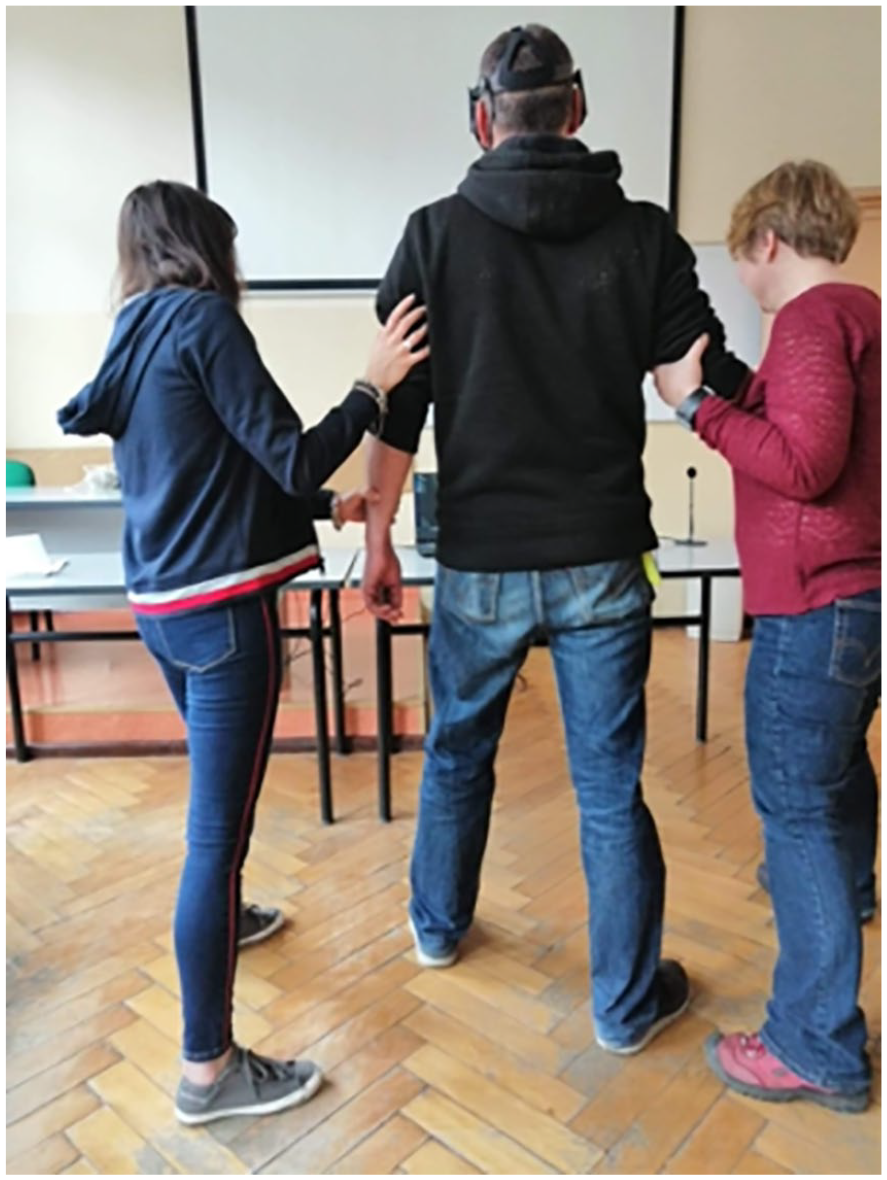
Participant is secured by the researchers during Epic Roller game.
The final example was comprised of exercises which can be employed in therapy in order to relax muscles and generally facilitate relaxation. For this purpose, the application The Blue was discussed and used. It is a simulation of being submerged in a quiet ocean which makes it possible to see sea life on various depths (WEVR, 2021).
During the exercises the following sequence was used: the students tested out the Epic Roller Coasters game first. This is the game with the highest level of emotional engagement. Subsequently, the students experienced the relaxing The Blue. The last application to be used was 3D Organon VR Anatomy, which was cognitively engaging. The above sequence was employed to avoid a direct influence of emotional agitation on research results (Photo 3).

Participants during VR immersion.
The lecture and the VR sessions were conducted on the same day. After the lecture the students had a 15-minute break, after which they could see what all the pieces of VR equipment described in the lecture look like. Subsequently they had the opportunity to participate in the preparation and configuration of VR equipment before the individual sessions. Finally, they experienced the VR sessions discussed above.
Ethical Considerations
Hereby presented research results, conducted within the topic classified in the Simple system with the number: STM.E025.18.020. The study protocol was approved by the Bioethics Committee of the Wroclaw Medical University in Poland (no. KB-571/2018).
Statistical Analysis
Data analysis was carried out using the IBM SPSS 25.0 statistical package. A mixed-design ANOVA model was applied in a 2 × 2 × 2 research plan. The between-object factor was self-esteem (low vs. high), and the within-object factors in the model were the repeated measurement (before and after manipulation) of intensity of two emotions (positive vs. negative). Post hoc comparisons were made with the Bonferroni significance correction. The hypotheses were tested against the assumed statistical significance threshold of p < .05.
Results
The comparison of the intensity of emotions during the pre-test and post-test, with the factor of self-esteem and indicator of emotions (±) considered, indicated significant interaction effects only
Comparisons of the Intensity of Emotions in 2 (Emotions: Positive vs. Negative) × 2 (Measurement: Before vs. After) × 2 (Self-Esteem: Low vs. High) Model.

Note. The table summarizes the significance and effect sizes for all effects of the 2 × 2 × 2 mixed ANOVA model; for each combination of levels, the obtained means and standard deviations are presented within the effect. In the post hoc section, within an effect, were indicated significant differences between subgroups denoting groups with indexes (A, B, a, b, I, and II).
p < .05.**p < .01.
We observed that the intensity of emotions during the pre-test and post-test changed when the indicator of emotions was considered (Figure 2). Positive emotions in the second measurement increased significantly relatively to the initial measurement while negative emotions level remained almost unchanged over time (Figure 2). It is worth adding that negative emotions level within both measurements was lower than the level of positive emotions.

Initial and final levels of positive and negative emotions.
We also observed the interaction between emotions and self-esteem: in participants with low self-esteem, the difference between the level of negative emotions and the level of positive emotions was smaller than in people with high self-esteem (Figure 3).

Interaction between self-esteem, and positive and negative emotions.
Furthermore, the third-level interaction occurred: after the classes conducted with VR, the level of positive emotions increased (compared with the pre-test measurement), in those with low self-esteem, as well as in those with high self-esteem. In the case of negative emotions, we observed that among participants with low self-esteem, the intensity of these emotions significantly decreased, reaching the lower level presented by participants with high self-esteem (Figure 4).
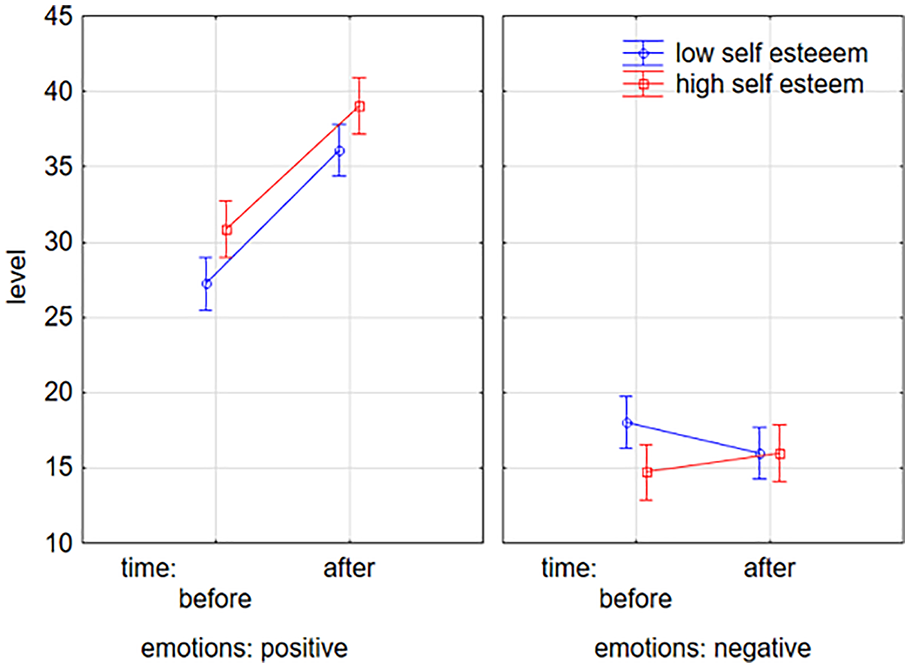
Intensity of emotions in the pre-test and the post-test with account for the factor of self-esteem and the sign of emotions—tertiary interaction.
Discussion
With this paper, the authors aimed to investigate how learners’ emotions change under the influence of VR. The emotions reportedly aroused in classes without the use of VR were less intense than those reported by the participants of the VR sessions. Furthermore, what was observed was not only an increase in positive emotions, but also a decrease in negative emotions reported by the participants with low self-esteem. It is an important finding concerning VR as a teaching resource in education. Thanks to this technology, classes can be made more attractive to students.
We assumed that positive emotions are connected to motivation, which has a strong basis in reference sources (Baumeister et al., 2003; Brütsch et al., 2010; Lachowicz-Tabaczek & Śniecińska, 2008; Manoharan et al., 2020). It has been noted that emotions are key in motivational processes (Ford, 1992). A close link between emotions and motivation during the learning process also has been indicated by more recent research (Wirawan et al., 2019).
As can be concluded from the review of reference sources listed below (Herrero et al., 2014; Oliveira et al., 2020; Rupp et al., 2016) VR environments in scientific research were correlated repeatedly with PANAS tests, which also were used in our research. The present research, as well as the research discussed in the introduction, (Brütsch et al., 2010; Cristea et al., 2016; Oliveira et al., 2020; Quazi et al., 2012; Souto et al., 2013; Suhaimi et al., 2018; Torres-Valencia et al., 2014; Yuan & Ip, 2018) confirms that a significant connection exists between VR environments and the intensity of experienced emotions, as reported by research participants. However, any correlations between the VR environment and self-esteem were seldom (Roche et al., 2019). In our research, it was demonstrated that high self-esteem may reinforce VR’s efficacy in influencing emotions.
It should be noted that in the case of VR, the type of device used holds no significant importance. In the research correlating reported experienced emotions (PANAS tests) with VR devices such as smartphones, Google Cardboard, and Oculus Rift DK2, a marginal effect from the type of device was detected on positive affect, but no effect on negative affect (Rupp et al., 2016). However, in other research, it was demonstrated that the intensity of reported experienced emotions depends on the VR environment’s design. On the basis of measurements of galvanic skin conductance, blood volume pulse, and body temperature, it was demonstrated that significant differences existed between environments such as sunsets and rollercoasters (Oliveira et al., 2020). In our research, we employed stimulating sessions, such as Epic Roller Coasters, as well as relaxing ones, such as The Blue, or the cognitively engaging Organon VR Anatomy, which made it possible to decrease the influence of VR environments’ specificity on the emotions that the simulations cause.
The effectiveness of learning is measured first and foremost with final results in knowledge, skills, and competences. The didactic means employed during the learning process make it possible to illustrate the learning material in order to make it easier to memorize. However, an important aim of didactic means is to diversify the teaching process, so that the participants are engaged and interested. Our research has shown that the influence of VR in this area can be significant.
Study Limitations
All the research participants were young, so we do not know whether VR’s influence on the increase in positive affect and decrease in negative affect would be sustained in other age groups. However, research conducted by Roberts shows that the influence from the presentation of VR simulations can increase emotions in seniors as well (Roberts et al., 2019).
It needs to be emphasized that positive emotions may influence students’ intrinsic motivation and their increased engagement. What has not been investigated, however, is if this results in higher learning effectiveness. It is also worth it to investigate and monitor other variables directly linked to learning motivation, such as self-efficacy. It ought also to be noted that in the research psychological tests, rather than biomarkers, were used to control emotions.
Both during research as well as during using VR in education, one must remember that VR users may experience side effects, usually mild ones, which quickly wear off (Nichols and Patel, 2002). Among these side effects the most common are nausea and confusion (Cherniack, 2011). Furthermore, users who experience, for example, fear of heights, may also experience it during VR sessions. During this study, the participants were informed about all possible effects. Besides mild side effects among some of the participants (mild dizziness, temporary difficulties in maintaining the balance of the body) there were no serious side effects of VR immersion.
Practical Implications
The research shows that VR can be a didactic tool that not only makes it possible to simulate reality to understand it better, but also to make the learning process more attractive. By influencing emotions, VR can influence students’ motivation to become more engaged in lessons and use the technology in their future own professional practice.
Conclusion
Compared with the classes conducted with methods that do not employ VR, the level of positive emotions increases in classes on the same subject conducted with this tool. An increase in positive emotions was observed both in those with low or high self-esteem. In the case of negative emotions, it was observed that in those with low self-esteem, the intensity of negative emotions decreases, reaching the level presented by those with high self-esteem. Thus, VR can be an effective teaching resource that makes it possible to transfer information, conduct simulations, and improve students’ moods.
Footnotes
Acknowledgements
Special thanks to all physiotherapy students from the Wroclaw Medical University participated in the study. There were no other contributors to the article than the authors as well as there was no writing assistance required. The certificated English language services were provided.
Author Contibutions
Study design: L.Ś., E.J.R., J.R., and M.K.Z.; Data collection: L.Ś. and M.K.Z.: Data analysis: L.Ś. and M.K.Z.; Manuscript writing and revisions for important intellectual content: L.Ś., E.J.R., J.R., and M.K.Z.
Declaration of Conflicting Interests
The author(s) declared no potential conflicts of interest with respect to the research, authorship, and/or publication of this article.
Funding
The author(s) disclosed receipt of the following financial support for the research, authorship, and/or publication of this article: This study was supported by the Ministry of Health subvention according to number of STM.E025.18.020 from the IT Simple system of the Wroclaw Medical University.
Ethical Approval
The study protocol was approved by the Bioethics Committee of the Wroclaw Medical University in Poland with the permission number of KB-571/2018. All participants gave written informed consent after a thorough explanation of the procedures involved.
