



Abstract
Disaster management has gained significant attention at both the international and local levels. This study explores power dynamics and examines the role of stakeholders at various governance levels in ensuring disaster risk reduction (DRR) and climate change adaptation (CCA) resilience among vulnerable communities. The study was conducted in Anloga and Ada East in Volta and Graeter Accra Regions of Ghana. It employed a mixed method approach for data collection. Qualitative participants (national, regional, district and community leaders) were purposively sampled while quantitative respondents (household heads) were systematically sampled. The qualitative data was analysed manually using the thematic approach and the quantitative using SPSS Version 21. Two proportions z-test was used to test for the significance of association or differences among the variables. The study revealed that policies, regulations and action plans were often employed as DRR and CCA strategies using a bottom-up approach. Visibility of disaster volunteer groups, relief support and capacity building of community members, which are key DRR and CCA activities at the local level, recorded a low ‘Yes’ response of less than 50% and a significant test for proportion among the two districts of p < .0001. It provides insights that can inform policy and interventions aimed at enhancing multi-stakeholder coordination, community empowerment and sustainable disaster management. It contributes to addressing the unexplored nexus between global frameworks, national institutions, and community-level stakeholder participation in disaster risk reduction and climate change adaptation management in Ghana.
Keywords
Introduction
Globally, climate change-related disasters, from rising sea levels, storm tides, storm surges and coastal flooding, are becoming more frequent and severe, threatening the well-being, livelihoods, and security of humans. Disaster risk reduction has therefore become a critical pillar in the global sustainable development discourse, particularly following the adoption of the Sendai Framework for Disaster Risk Reduction (2015–2030). The frequency and intensity of climate-related disasters (Clark et al., 2025; Kristian & Fajar Ikhsan, 2024; Okunola, 2024) underscore the urgent need for inclusive and multi-stakeholder approaches in managing disasters (Bradshaw, 2024; Quarantelli, 1998; UNDRR, 2019). Effective DRR & CCA calls for collaboration among diverse stakeholders, including governments, non-governmental organisations and local communities, to ensure that strategies are context-specific, sustainable and socially inclusive (Aitsi-Selmi et al., 2016; Drabek & McEntire, 2002). However, translating DRR & CCA frameworks into effective national and community-level actions remains a challenge, especially in developing countries.
In Ghana, DRR is mainly coordinated through the National Disaster Management Organisation (NADMO), working in partnership with governmental, non-governmental actors at the national, regional, district and community levels. Despite the existence of national policies and institutional frameworks, the country continues to face frequent disasters, particularly along the eastern coast of Ghana, resulting in displacement, loss of livelihoods and damage to infrastructure (Aboagye & Sharifi, 2024). Although national guidelines exist, the effectiveness of DRR hinges mainly on the role of stakeholders at the national, regional, district and community levels. Communities, particularly those in disaster-prone areas such as the eastern coast of Ghana, are often the most vulnerable (Appeaning Addo et al., 2018) and, therefore, the most critical actors in building resilience. However, their role in DRR is often underestimated (Agyapong et al., 2022).
Despite the increasing emphasis on multi-stakeholder engagement in DRR & CCA globally, there remains a disconnect between policy-level frameworks and their practical implementation at national and community levels. In Ghana, although NADMO and its partners have developed strategies aligned with the Sendai Framework, challenges persist in stakeholder coordination, resource allocation and local participation. This gap between policy and practice not only undermines the effectiveness of DRR & CCA initiatives but also perpetuates community vulnerabilities to recurrent hazards.
Previous studies on DRR have extensively examined global frameworks and national-level policies (Kelman, 2020; UNDRR, 2019). However, less attention has been paid to the dynamics of stakeholder collaboration in bridging the divide between global directives, national institutional structures and localised community actions. While some studies highlight the role of international partners in DRR using the participation theory, few have, using the stakeholder theory, assessed how stakeholders at multiple levels interact, share responsibilities and align strategies for effective DRR at the local level. Stakeholders’ participation in DRR, although critical to enhance societal resilience (AL-Fazari & Kasim, 2019; Bingöl et al., 2025), has revealed limited studies on the roles of stakeholders in DRR in several countries.
The eastern coast of Ghana is vulnerable to natural hazard, including floods, storm tides and storm surges (Appeaning Addo et al., 2018), resulting in frequent disasters. This vulnerability has been exacerbated by climate change and rising sea levels. Although government interventions, such as the Ada and Keta Sea Defence projects, have been implemented along Ghana’s eastern coast, erosion remains a serious challenge (Angnuureng et al., 2023; Appeaning Addo et al., 2018; das Neves et al., 2023). This situation highlights the need for effective disaster management in the region. Such management requires evidence-based input from stakeholders to guide progress towards achieving desirable outcomes and impacts.
The purpose of this study is to examine the role of stakeholders regarding policy formulation and implementation, resource mobilisation and allocation, awareness creation and sensitisation, relief support, and capacity building for effective DRR & CCA among vulnerable communities along the eastern coast of Ghana.
This study is significant for both academic and practical reasons. Academically, it contributes to the growing body of literature on DRR & CCA by addressing the underexplored nexus between global frameworks, national institutions and community-level stakeholder participation in Ghana. Practically, the study provides insights that can inform policy and interventions aimed at enhancing multi-stakeholder coordination, community empowerment and sustainable disaster management.
Literature Review
Disaster, Disaster Risk Reduction and Climate Change Adaptation as Concepts
The definition of disaster varies across contexts, depending on the researcher’s focus (Donovan et al., 2023; Panebarco, 2025; Quarantelli, 1998; Quarantelli & Perry, 2005). Similarly, there are different ways in which disasters are managed (AL-Fazari & Kasim, 2019). Key considerations include fatalities, injuries, causation, geographic context, event relevance and financial impact (USAID, 2011). In this study, disaster is defined according to UNISDR (2009), as ‘a serious disruption of the proper functioning of a community or society, resulting in widespread human, material, or environmental losses and impacts that exceed the ability of the affected community or society to cope using only its own resources’. And disaster risk is the ‘potential loss of life, injury, or destruction or damage of assets which could occur to a system, society or a community in a specific period of time’ (UNISDR, 2009).
Disaster Risk Reduction (DRR) and Climate Change Adaptation (CCA) are two concepts designed to address vulnerability to climate change-related hazards, leading to increased resilience among affected communities (Dias et al., 2020). While DRR ensures the minimisation of disaster risk and the prevention of new occurrences, CCA involves adjusting to current situations or anticipated impacts from climate change hazards to lessen harm and maximise opportunities. However, these concepts have traditionally been addressed separately (Nemakonde & Van Niekerk, 2023; Thomalla et al., 2006). Although they operate at different levels, including distinct policy goals, institutions and various funding agencies and organisations, they do overlap (Birkmann & von Teichman, 2010; Djalante & Thomalla, 2012). Both DRR & CCA represent complex human systems and technologies designed to alter behaviours and characteristics in individuals or groups to lessen the impacts of climate change (Nelson, 2010). The Intergovernmental Panel on Climate Change (IPCC) (2012) indicated that both DRR & CCA share common objectives: (1) managing hydrometeorological hazards by reducing vulnerability and exposure, increasing resilience, and facilitating risk transfer and sharing; (2) reducing the impacts of climate change-related disasters and associated risks; and (3) promoting proactive, holistic and long-term approaches to disaster management. However, there are differences in the technical language used and the methodologies applied during their implementation. Additionally, institutional, financial and political barriers often hinder cross-disciplinary and integrated collaboration between these two programs (Gero et al., 2011).
Both DRR & CCA management face challenges globally. Common obstacles include ineffective planning, inadequate logistics, people’s perceptions and behaviours, and a lack of coordination and collaboration. Additionally, DRR & CCA programs often lack funding from international or local partners, leaving local institutions responsible for seeking financial support to implement these initiatives. According to Forino et al. (2015), while state actors are generally tasked with ensuring DRR & CCA, non-governmental organisations (NGOs) and communities play important roles in coordinating and managing these activities.
Earlier studies by (Babanawo et al., 2022; Mattah et al., 2023, 2024) on the impact of climate change-related disasters along the eastern coast of Ghana emphasise the need for integrating disaster risk reduction and climate change adaptation. It also calls for collaboration among stakeholders (Forino et al., 2017; Nemakonde & Van Niekerk, 2023) to maximise resource use for DRR & CCA .
Stakeholder Involvement in Disaster Risk Reduction and Climate Change Adaptation (DRR & CCA)
Stakeholders in DRR & CCA include a variety of entities, ranging from state agencies (Owi et al., 2025), non-governmental organisations (NGOs) and public-private partnerships, communities and individual households (Forino et al., 2015). Abderhalden et al. (2025) stated that, despite the large scope of stakeholder involvement in DRR & CCA, its implementation is challenged (Malalgoda et al., 2015; Mashi et al., 2020). Atanga, (2020) in their study on community participation in flood management in Accra, stated that although community leaders participated in flood management, it was unclear if they were involved in the strategic decisions of the Assemblies. Nkombi and Wentink (2022) indicated that, public participation in disaster management allows communities to engage in activities that enhance their resilience to hazards and related disasters.
Collaboration of stakeholders at various levels of governance can improve the implementation of DRR & CCA programs, minimise overlapping of roles, improve resources mobilisation and allocation as well as capacity building of stakeholders (Forino et al., 2015, 2017). Capacity-building according to the United Nations, develops and strengthens skills, abilities, and processes to enable stakeholders effectively manage DRR & CCA challenges and build resilient towards disasters.
Theoretical Underpinning
The study is grounded in the Sendai Framework and underpinned by the stakeholder theory. The Sendai Framework emphasises reducing disaster risk by addressing exposure and vulnerability. Endorsed by the UN General Assembly after the 2015 Third UN World Conference on Disaster Risk Reduction (DRR), the Framework advocates for measures that target the three dimensions of disaster risk: exposure to hazards, vulnerability and capacity, and the characteristics of hazards. Its goal is to prevent the creation of new risks, reduce existing risks and enhance resilience.
Stakeholder theory, Freeman (1984), is built on the idea that organisations should create value not only for shareholders but for all stakeholders. Stakeholders are define as any individuals or groups that can influence or are affected by the achievement of specific objectives (Lange et al., 2022; Stoney & Winstanley, 2001). Over the years, several core principles have emerged to guide its application (Mahajan et al., 2023). The key principles of stakeholder theory according to (Lange et al., 2022; McGahan, 2021) include: (1) Stakeholder Identification whereby relevant stakeholders are mapped out based on: Power (ability to influence outcomes), Legitimacy (perceived appropriateness of their involvement) and Urgency (degree to which stakeholder claims require immediate attention). (2) Stakeholder Salience, which recognises that not all stakeholders have the same influence or importance, therefore, decision-makers must prioritise stakeholders based on their salience attributes (3) Stakeholder Interests: which means that each stakeholder may have different interests, therefore, understanding and balancing these interests is important. (5) Value Creation and Sharing: which implies that organisations should not only serve shareholders but create shared value for all stakeholders. (6) Stakeholder Engagement: which emphasises communication and consultation with stakeholders rather than one-way influence (7) Accountability: implying that organisations are accountable and responsible not just to shareholders but to all stakeholders. (8) Dynamic Relationships imply that stakeholder relationships are not static; they evolve. Therefore, continuous engagement and reassessment are necessary (Amis et al., 2020; McGahan, 2021).
The Stakeholder Theory is relevant to disaster management because it: broadens participation and ensures inclusivity, clarifies roles and strengthens accountability, aligns resources for more effective preparedness and response, and builds trust for long-term resilience. The limitations of the theory include power imbalances whereby national agencies may overshadow local voices; fatigue resulting from over-consultation without visible action which erodes trust; and competing mandates (Bridoux & Stoelhorst, 2022; Mitchell et al., 1997) between stakeholders. The Stakeholder Theory was chosen over other theories, such as participation and systems theory, because it does not just map people in terms of participation but also weighs their power, legitimacy and urgency, thus providing a better guide for engagement strategies. Besides, the stakeholder theory recognises all those affected by or capable of influencing decisions, as argued by Mahajan et al. (2023).
By employing the theory, the study emphasises that effective management of DRR & CCA in the Eastern Coast of Ghana requires collaborative partnership roles of various actors at the national level, regional, district and community levels, using strategies such as policy formulation and implementation, resource mobilisation, and capacity building including the relief support, assistance and awareness creation, as captured in the conceptual framework (Figure 1). Thus, the study examines the role of different stakeholders at different levels of governance who can effectively address the wicked problem of climate-related disasters in the target areas. Exploring the power dynamics, the study further examines the extent to which the stakeholders have their experiences and knowledge, voices and views captured in decision-making processes regarding the management of DRR & CCA in the Eastern Coast of Ghana.

Conceptual framework for the study.
Methodology
Study Area
The study was conducted in nine communities of two district assemblies (Anloga and Ada East districts) of south-eastern Ghana, as earlier reported in Mattah et al. (2023, 2024). The communities were all situated 5 km west and east of the River Volta estuary. The area is prone to severe coastal erosion, typically caused by storm surges and tidal waves, primarily due to climate change-related impacts. The area has been described by Appeaning Addo et al. (2018) as a hotspot of coastal vulnerability. Figure 2 is the map of the study area.
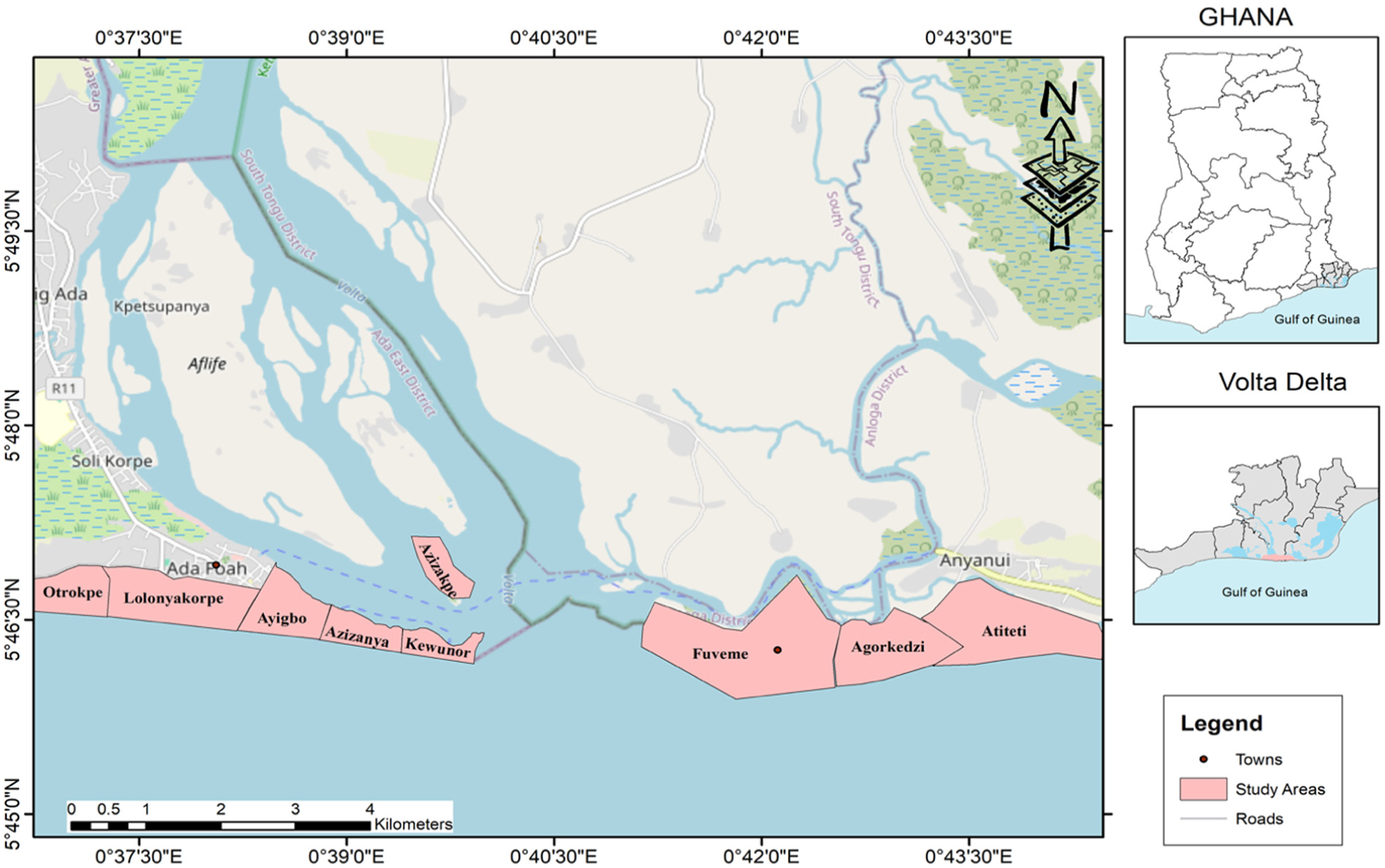
Map of the study area.
Research Approach, Design and Data Collection
The study employed a mixed-method approach, combining both qualitative and quantitative data through an exploratory sequential design. It involved initially collecting and analysing qualitative data, followed by gathering and analysing quantitative data (QUAL + quant), as outlined by Mattah et al. (2023, 2024). Through in-depth interviews and focus group discussions (FGDs) involving community leaders and members, qualitative data were collected. An in-depth interview guide and a focus group discussion guide were developed and validated for data collection. Guided by the theoretical framework, the instruments addressed various issues, including disasters, support during those disasters, policy formulation and implementation, stakeholder involvement, resource mobilisation, collaboration with partners, capacity building for stakeholders, and the formation of disaster volunteer groups in the study communities. In line with stakeholder theory and the Sendai Framework, interviews were also held with identified stakeholders, including local government officials, specifically staff from the NADMO, and selected members of the District Assemblies. In total, 16 in-depth interviews were conducted. This included five community leaders and nine Local Assembly staff members from the Ada East and Anloga Districts. One NADMO officer each was interviewed at both the regional and national levels. The community leaders were selected based on recommendations from experts located at the district offices. The criteria for selecting community leaders and government officials included their involvement in local governance, participation in community disaster risk reduction (DRR) programs, and their experience with issues related to climate change. NADMO officials and local government staff were chosen based on their roles and responsibilities within their respective offices. A total of five focus group discussions (FGDs), each consisting of an average of eight participants, were conducted among selected communities. The FGD groups included both females and males, as the issues being discussed were relevant to both genders (Figure 3).

Flowchart of data collection.
The data sources comprised both primary and secondary data. Secondary data was collected from medium-term plans and national policy documents, including the National Disaster Management Plan and the Climate Change Policy Document. Primary data was obtained through in-depth interviews, focus group discussions and questionnaires.
A structured interview instrument combining closed- and open-ended questions was developed, pre-tested and utilised for quantitative data collection among selected household heads in the chosen communities. To select the household heads, housing structures were first identified using systematic sampling, progressing from the western side of the communities to the eastern side as field enumerators moved in a zigzag pattern. In southeastern Ghana, communities are located along the coast, extending in an east-west direction. In each housing structure, the head of the first household encountered was engaged if available; if not, any adult (above 18) household member who was available and could respond to the questions was engaged. The questions were primarily based on the analysis of qualitative data collected earlier. In total, 310 questionnaires were administered to selected households across nine communities, including Fuveme, Agorkedzi and Atitteti in the Anloga District, as well as Ayigbo, Kewunor, Azizanya, Azizakpe, Lolonyakope and Otrokpe in the Ada East District. Tables 1 and 2 depict the average age, education level and gender distribution of participants.
Age and Educational Distribution of Respondents.
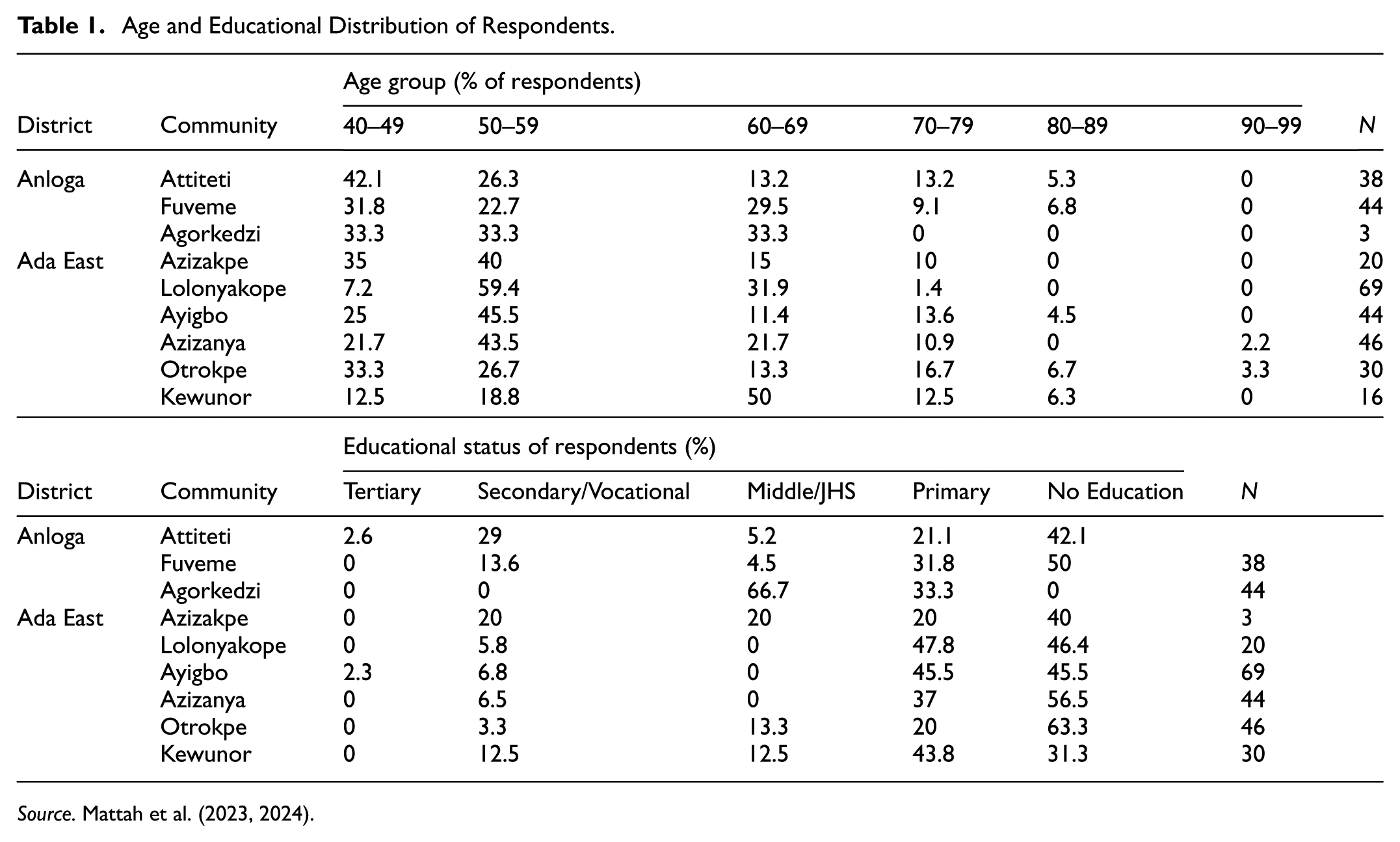
Source.Mattah et al. (2023, 2024).
Gender Distribution of Participants.
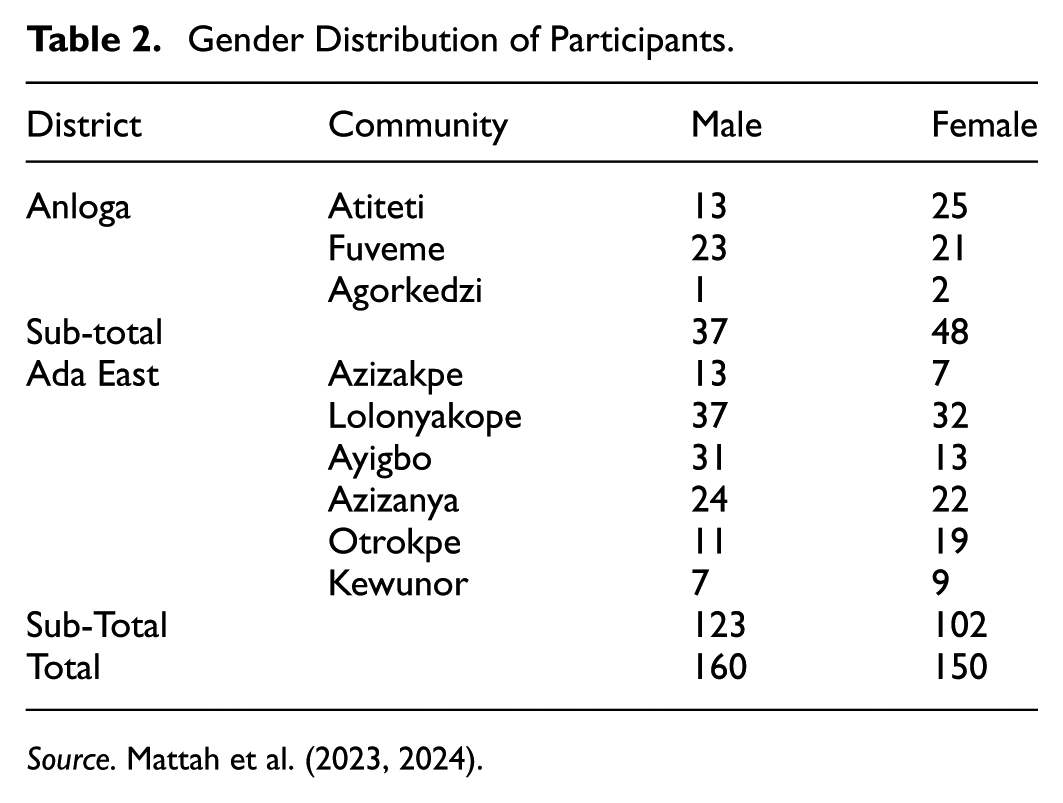
Source.Mattah et al. (2023, 2024).
Questions asked during the quantitative data collection bordered issues on DRR & CCA strategies as they pertain to the national, regional and district levels, national and district medium-term plans, community cooperation in disaster risk reduction, DVGs, assistance to disaster victims and capacity building of communities, among others.
Ethical clearance was obtained from the Institutional Review Board before the commencement of data collection. Following the IRB guidelines, informed consent was sought from all participants before commencement of every interview or focus group discussion (FGD) session during the data collection process. The participants were assured of the confidentiality of the data for research purposes.
Data Analysis
The qualitative data were analysed manually using a thematic approach, in which various themes were generated from the transcribed reports from the in-depth interviews and FGDs, which were copiously read several times. Quotes or extracts from the interviews supported the interpretations and explanations provided (Mensah & Mattah, 2023). Specifically, discrete quotations illustrated different perspectives, embedded quotations prepared the reader for a shift in emphasis, and longer quotations exemplified more complex understandings (Creswell, 2012).The quantitative data were analysed using the Statistical Package for Social Sciences (SPSS) Version 21. The analysis involved descriptive statistics, and two proportions z-test were employed to test for significance association or differences among the variables.
Results
Disaster Risk Reduction Strategies in Ghana
Table 3 summarises the strategies identified in this study that are used at the different levels of the disaster management continuum to reduce disaster risks. It highlights the various institutions (stakeholders) involved and their respective roles. In Ghana, policy formulation and implementation structure operate at three levels: National, Regional and Local. All the levels have different stakeholders operating, and they can effectively support DRR & CCA if given the opportunity and the needed room to operate. The findings show the importance of the Sendai Framework and the stakeholder theory in the process of DRR & CCA in Ghana. The principle of stakeholder identification and engagement is critical to avoid the manifestation of individual stakeholder interest. This is because there are several stakeholders in the field of DRR & CCA and calls for collaboration at all levels to of governance to ensure salience, accountability and value creation.
Disaster Risk Reduction and Climate Change Adaptation Strategies at Various Levels and Key Implementing Institutions in the Country.

Source. Compiled by authors during stakeholder interviews.
Role of the National Stakeholders
The stakeholder theory, as applied to disaster management, suggests that the various levels of governance interact for the purpose of effective disaster risk management. Findings revealed the existing of national stakeholders who had collaborations with international stakeholders. An example is the collaboration between the NADMO and some international partners, such as the US and China governments, for capacity building and the Japanese for logistics support.
A respondent at the NADMO head office indicated that ‘Our international partners also support policy formulations and implementation through funding and technical support, including capacity building’.
Furthermore, at the national level, the study identified NADMO as the official coordinating agency for disaster management in Ghana. Its role involves collaborating with both national and international organisations to develop disaster risk reduction (DRR) policies and plans, as well as gathering resources for disaster management activities
Findings indicate that although NADMO holds this mandate, it works in conjunction with various institutions such as the Ministry of Environment, Science, and Technology, and the National Development Planning Commission at the national level. Together, these entities formulate and coordinate policies, programs, and plans aimed at creating a supportive environment for disaster risk reduction (DRR) and climate change adaptation (CCA) in the country. Examples of such initiatives include, but are not limited to, the National Climate Change Policy (NCCP), the National Climate Change Action Plan (NCCAP), the National Medium-Term Plan (NMTP), the National Disaster Management Plan (NDMP), Standard Operating Procedures (SOPs) and sector Medium-Term Plans (MTPs). This collaboration among the various stakeholders confirms the principle of stakeholder engagement as espoused by the stakeholder theory.
Additionally, NANDO oversee the establishment of disaster management desks at various levels, the creation of rapid response centres in selected districts across the country, and the formulation of a national disaster technical committee for effective disaster management.
An interview with an official from the Climate Change Department at the NADMO Head Office on how they collaborate with relevant institutions in the country for resource mobilisation revealed that, by their mandate, they are allowed to work together with any institution to achieve their aims and objectives of managing disasters in the country.
‘When we need the services of a particular institution, either national or international, by our mandate, we collaborate with them through official communication’.
‘Together with our international partners, Rapid response centres have been established in 10 districts across the country with well-equipped modern communication gadgets. When something happens, it is communicated immediately to the national office’.
This confirms the Sendai Framework and the stakeholder theory on capacity building through collaboration for effective disaster management.
Role of Regional Stakeholders
Interviewing the contact person at the regional office, the next hierarchical structure of governance mentioned that the standard operating procedures (SOP) of the 2010 national disaster management plan outline the institutional structure, procedures, and mandate for their operations.
Further explanation indicated that the Regional Coordinating Council (RCC) serves as a liaison between the national and the District Assemblies (DAs). At the regional level, it was revealed that the RCC accounts for the national level, while the MMDAs report to the RCC on the formulation and implementation of DRR & CCA issues. This is in consonance with the principle of accountability and transparency as emphasised by the stakeholder theory. The interviewee stated that disaster management at the regional level is a replica of what happens at the national level. Identified strategies at the regional level included the establishment and development of the capacity of focal persons, forming a regional disaster technical committee, and coordinating with relevant stakeholders.
The primary role of the RCC is to coordinate the formulation and implementation of the District Medium-term Plans (DMTPs). Reports from the districts on the implementation of the DMTPs, which include disaster management issues, are routed through the regional offices to the national level. Similarly, inputs into the formulation of the NMTPs are routed through the national institutions to the regional offices and vice versa. During an interview with a NADMO senior staff at the Greater Accra regional office, it was stated that, apart from their core mandate, of coordinating and managing major disasters in the region, they also identify and map major disaster-prone areas for surveillance, coordinate, and monitor DRR activities such as tree planting, public education and sensitisation on DRR issues in the region, including basic schools. The RCC council also support the District Assemblies with relief items for disaster victims during disaster events.
‘Apart from awareness creation, we also identify flood-prone areas, the cause of these floods, and how to mitigate them. Usually, we do this in collaboration with the district assemblies. Together with the Forestry Commission and the district assemblies, we coordinate and collaborate on tree planting, which was initiated and launched by the President of Ghana. To mitigate climate change and deforestation in a district, we will undertake tree planting with coordination from the regional office. The office will arrange for the Forestry Commission to deliver seedlings for this activity’.
The Role of the District Assemblies in the Study Area
Findings of the study indicated the need for stronger stakeholder collaboration and engagement at this level to ensure value creation and sharing of resources, and information among the DAs and the affected communities. The District Assemblies, by their mandate stipulated in the Local Governance Act, 2016 (Act 936), are the implementers of government policies at the local level. Both interviews at all the levels (national, regional and district levels) and extracts from the District Medium Term Plans (DMTPs) and the Annual Action Plans at the NADMO district offices indicated that the country’s focus on DRR & CCA is cent red on educational and capacity building programs, relief support, awareness creation and sensitisation of the citizens on disaster issues. Further discussions with the NADMO district directors in the two districts revealed that their main activities include forming and training disaster volunteer groups, educating community members on disaster preparedness, and providing relief items to individuals affected by disasters.
‘We have an annual action plan which outlines our activities for the year, and based on our budget allocation, we prioritise our activities. Most of our activities focus on training communities and forming disaster volunteer groups. We also, together with the district assembly, mobilise relief items which we use to support affected communities during and after disaster occurrences’.
Formulation and Establishment of Disaster Volunteer Groups
The concept of Disaster Volunteer Groups (DVGs) is enshrined in the Sendai Framework for Disaster Risk Reduction 2015 to 2030. DVGs are designed to reduce disaster impacts among vulnerable communities by selecting and training community members in Disaster Risk Reduction (DRR) skills. These volunteers serve as the first point of contact during disasters, especially in the absence of NADMO staff.
Findings from Focus Group Discussions (FGDs) revealed mixed perceptions about DVGs. The idea gained more traction in Ada East District than in Anloga District. Communities such as Fuveme/Agorkedzi and Atitteti in Anloga reported that DVGs were absent and emphasised their preference for government intervention through sea defence construction rather than forming volunteer groups. Social capital was often relied upon for mutual assistance during crises. As one participant stated:
‘We do not have the volunteer groups here, but we help each other when the need arises’.
‘The volunteer groups are not here. Our focus is for the sea defence structure to be constructed’.
‘If the sea defence structure is constructed, there will be no more disaster occurrences and the DVGs will not be needed’.
In Ada East, communities such as Azizakpe and Kewunor mentioned that DVGs had been inaugurated only weeks before the study. However, members were unclear about their roles, and official training had not yet been conducted. The Azizakpe chief explained:
‘When the NADMO team came to me with the idea, I suggested some names to them, but they are not yet functional. NADMO is yet to train them so that they can be functional’.
A DVG member confirmed:
‘We have volunteer groups here; the group have just been formed. The NADMO officials took our telephone numbers and said they would get back to us. I am also a member. We are a four (4) member team formed last four months’.
In Lolonyakope and Ayigbo, the Assemblyman asserted that DVGs were operational and had received basic DRR training, though logistical and financial constraints limited their effectiveness:
‘The DVGs were commissioned approximately two months ago. Before their commissioning, they underwent training for their roles in case of a disaster. During the training, three NADMO officials took them through different issues on disaster prevention’.
A household survey revealed low visibility of DVGs, particularly in Anloga, where over 90% of respondents were unaware of their existence Figure 4. In Ada East, awareness was higher at about 38%, compared to 3.5% in Anloga. Statistical analysis confirmed significant differences between the districts z = 5.10, p < .00001 for ‘Yes’ responses.

Number of respondents aware of DVGs in their communities.
Further questioning indicated limited clarity on DVG roles. Among respondents who recognised DVG activities, reported roles included compiling lists of affected individuals (16%), contacting NADMO offices (13.8%), and recording disaster victims (0.1%). A test of proportion showed significant differences between districts regarding the role of contacting NADMO (z = −3.06, p < .002) Figure 5.

Perceived role of DVGs in the study area.
Assistance to Disaster Victims Within the Study Area
The participants were also asked if they had ever received any form of assistance or support in the form of relief items from either NADMO, the District Assembly, the Parliamentary member of the area or any philanthropist. Figure 6 represents beneficiaries of relief items in the form of either food or non-food during or after a disaster event in the study area. The proportion of people who had received support in both districts was below 50%. In contrast, over 50% of respondents in the Ada East district had never received support, and almost 50% (47%) of respondents in the Anloga district were unaware of the relief items available for disaster victims. In the in-depth interviews and focus group discussions, participants from the Anloga district reported that the last time they received relief items was in 2016. This was after their communities were heavily impacted by storm tides, which destroyed their coastline, properties and livelihoods. The test for the proportion of respondents who answered ‘Yes’ regarding receiving support at Ada East and Anloga was significant, with z = −4.38, p < .0001. For those who answered ‘No’, z = −3.09, p < .002.

Number of respondents supported with some relief items.
Capacity Building of Community Members on Disaster Risk Reduction and Climate Change-Related Activities
Capacity building is a key component of the Sendai Framework. The second priority of the disaster risk reduction framework aims to enhance disaster risk governance. To ensure successful disaster risk reduction, training and awareness creation are essential for individuals, institutions and the entire nation’s citizens to achieve this milestone. During the interviews with the NADMO district officers, it was revealed that awareness creation and community sensitisation through training workshops among affected communities were one of their key mandates.
While some participants reported having undergone training during the community leaders’ interview, the overall numbers were low. The Fuveme assemblyman stated that, although he was aware of sensitisation programs, he had never participated in such training. However, the community leaders at Agorkedzi and Atitteti mentioned that they had benefited from such training. They indicated that an NGO organised the training, and they were educated on the negative impact of sand mining along the beaches and the killing of the sea turtles.
They indicated that an NGO organised the training, and they were educated on the negative impact of sand mining along the beaches and the killing of the sea turtles. The household survey indicated that Anloga had no training records (Figure 7). Ada East documented that nearly 30% (20.9%) had received some form of training, with a significant z = −4.60, p < .0001. Although there was a difference between the ‘No’ responses of Anloga (89%) and Ada East (79%), the test of proportion z = 2.04, p < .41 was not significant at 0.05%.

Beneficiaries of DRR & CCA related training at the district level.
Figure 8 is a breakdown of the beneficiary communities in Ada East. Four out of the six communities benefited from some DRR & CCA training in their communities. The communities were Lolonyakope, Agorkedzi, Azizakpe and Otrokpe (39.1, 33.3, 30 and 20%), respectively, in descending order. The individuals who benefited from the training reported that it enhanced their understanding of disaster risk reduction and climate change adaptation issues.

Beneficiaries of DRR & CCA related training at community level.
Role of the Community
At the bottom of the hierarchical structure of governance, as gleaned from the conceptual framework informed by the stakeholder theory, are community-level stakeholders. Although the communities are at the receiving end, the FGDs and interviews revealed that community members were much involved in the formulation of policies through their assembly members, community forums and unit community meetings. The district assemblies involve communities in capacity-building activities, awareness-raising and sensitisation programs. Community members volunteer to support disaster victims by providing social support and assisting NADMO in compiling names of those affected. It should be noted that from the stakeholder theory-informed conceptual framework, social support is one of the strategic roles of stakeholders in managing effective DRR & CCA
The assemblymen at both districts indicated that they convey information to and from the assembly to their community members formally through unit community meetings and community meetings. They also interact with their community members informally to solicit and give out information.
‘Every information we receive from the district assembly, we share with our constituents’. ‘We also receive the inputs of our community members and send them to the assembly meeting’.
Discussion
This section analyses the study’s results in relation to the Sendai Framework for DRR and stakeholder theory. The Sendai Framework (United Nations, 2015) and stakeholder theory (Freeman, 1984; Mitchell et al., 1997) recognise the role of various stakeholders in disaster risk reduction. In this context, the Framework promotes shared responsibility between state and non-state agents. It also supports inclusive disaster risk management processes that align with the principles of stakeholder theory. The stakeholder theory emphasises effective decision-making that considers the diverse interests of stakeholders (Freeman, 1984). Identification of stakeholders, and cognisance of the power dynamics at the various levels of governance of disaster management becomes critical to achieve DRR & CCA in the Eastern Coast and Ghana due to the large scope of players in the field DRR & CCA as observed in similar studies (Abderhalden et al., 2025; Forino et al., 2015, 2017). This is in line with the principles of the stakeholder theory. The findings indicates that all the different categories of stakeholders played distinct roles in ensuring effective DRR & CCA management however, their roles are interdependent (Forino et al., 2015). While the government agencies and ministries were identified to be in charge of national policy formulations to achieve international objectives (Mashi et al., 2019) the RCC at the regional level is responsible for the coordination for both policy formulation and implementation by the MMDAs at the local levels. It was confirmed that, the district assemblies, NADMO offices at the districts, and other government agencies play a crucial role in the implementation of DRR & CCA through the activities outlined in the medium-term plans and action plans (Atanga, 2020; Malalgoda et al., 2015). This finding is consistent with that of Atanga (2020), which established that awareness creation was one of the key strategies used by NADMO to prepare flood-affected communities in anticipation of reducing risk. It also affirmed that DVGs help NADMO identify areas at risk of flooding in communities. On the contrary, these strategies were revealed to have minimal impact among communities in the study area. Although Ada East recorded some successes in terms of the formation of disaster volunteer groups, support for disaster victims and some form of training, there is a need for substantial improvement. Findings confirm that the DAs solicited the inputs of the communities; however, due to financial and logistics constraints, the number of communities engaged is minimal, signifying inadequate consultation during the preparation of the medium-term plans. This was contrary to the principle of adequate consultation as required by the stakeholder theory.
Findings indicate some stakeholder collaboration, but stronger inter-agency coordination and knowledge integration are needed to prevent role overlap, enhance transparency, and improve information sharing for effective DRR and CCA (Lange et al., 2022; McGahan, 2021). Achieving this requires participatory decision-making and joint implementation by all stakeholders (Nkombi & Wentink, 2022).
Additionally, building the capacity of local stakeholders would make them more active agents in DRR & CCA management, rather than being passive recipients of assistance. It became evident that although disaster management was adequately mainstreamed, there were implementation challenges at all levels (Abderhalden et al., 2025; Kranjac-Berisavljevic et al., 2019) due to limited logistics and financial support. Notably, a similar finding, in this regard, was made by Baidoo (2018). It should be noted, however, that although several external sources of funding for DRR & CCA are available, the local communities lack the technical capacity to access the funds, compelling them to depend on the central government budgetary allocation. This conforms with Atanga (2020), where community involvement in DRR strategic planning was limited to the provision and receiving of information from the district assemblies. Therefore, capacity building for local stakeholders, especially the district assemblies and communities, should include exposing them to access to multiple sources for funding for DRR & CCA operations, instead of just at the receiving end, in line with AL-Fazari and Kasim (2019) and Atanga (2020) observations.
The evidence suggests that stakeholder theory offers a valuable framework for assessing stakeholder engagement in DRR, based on power, legitimacy and urgency. From the analysis, it can be argued that the governmental agencies have formal power and legitimacy, but they often fail to act promptly or urgently due to bureaucracy and resource constraints. On the contrary, the communities demonstrate urgency because they directly bear the brunt of the effects of the disasters; nonetheless, they have little formal power and legitimacy in policy development and implementation, as observed (Atanga, 2020). This suggests a need to bridge the DRR & CCA management gap between the governmental agencies and non-state actors at the community level, by amplifying community voices while offering technical expertise and policy advocacy. In this connection, researchers and NGOs are encouraged to assist, as they are better positioned to do this, by the nature and focus of their endeavours.
Limitations of the Study and Further Research
The study was conducted in only the Volta River Estuary at the Eastern Coast of Ghana limiting the scope of generalisability. Similar research could be undertaken to encompass the whole coastal area of the country to improve the scope of generalisability. It focused on the role of stakeholders regarding policy formulation and implementation, resource mobilisation and allocation, sensitisation, relief support and capacity building for effective DRR & CCA in disaster-vulnerable communities along the eastern coast of Ghana. Future studies should analyse the link between climate-related disaster displacement and human mobility in the Volta Estuary
Conclusions
The study set out to examine the role of stakeholders in effective DRR & CCA in disaster-vulnerable communities along the eastern coast of Ghana. The underlying theory model was the stakeholder theory. The main findings were that: National stakeholders set frameworks, policies, and provides resources. The Regional stakeholders coordinate and adapt national policies to district realities. Implementation of plans, and engagement of communities, are done at the district level while the communities act as the frontline, applying indigenous knowledge. These levels form a multi-scalar disaster risk management system in Ghana’s Volta Estuary. The summative findings, recommendations and conclusion are as follows:
Policies and plans were formulated to align with international DCC & CCA goals; however, funding challenges persist We recommend that key stakeholders such as NDPC, MEST and NADMO should collaborate and seek donor funding from international organisations such as the World Bank for the implementation of these policies.
There was a wide range of institutions, such as the NDPC, NADMO, MEST, EPA, MMDAs, involved in the formulation and implementation of DRR & CCA policies and plans, resulting in overlapping roles and responsibilities. We recommend proper collaboration and coordination among the key stakeholders to minimise duplication of activities and overlapping mandates to conserve resources.
The implementation of most DRR & CCA policies and plans by the government is mainstreamed through the MTPs of the MMDAs/DAs. Governments’ budgetary allocation to the MMDAs is, however, limited, causing resource constraints for the implementation of DRR & CCA activities. Government should increase it budget allocation for DRR & CCA while the other stakeholders (NDPC, NADMO, MEST, EPA, MMDAs) seek for funding from NGOs, International donors and local industry players.
The DVGs were found to be a handy tool for DRR & CCA, however, their visibility was low. In some cases, their capacity was not built, and they were not provided with logistics to empower them to properly function. The MMDAs should collaborate with NADMO to provide the needed logistics and to build the capacity of the volunteer groups.
Relief support was observed to be absent or low during and after disaster events. Therefore, it is recommended that NADMO and the MMDAs should collaborate to raise funds from philanthropists and industry players to increase their efforts in providing support for disaster victims in a proactive manner.
Awareness creation and sensitisation of communities on DRR & CCA by the MMDAs was also reported to be low. NADMO and MMDAs should intensify education on DRR & CCA to raise the awareness level of the community members.
In conclusion, despite the acknowledged limitations, the study shows that achieving effective management of DRR & CCA in the Eastern coast of Ghana requires a stakeholder-centric governance framework anchored on the tenets of the Sendai Framework and Stakeholder theory.
Footnotes
Acknowledgements
The authors wish to acknowledge all the participants of this study for their time and contribution of knowledge.

Ethical Considerations
Ethical clearance was obtained from the institutional review board of the University under which this research was conducted.
Consent to Participate
Informed consent was acquired from all subjects who participated in the study, following the University’s institutional review board guidelines.
Funding
The authors received no financial support for the research, authorship, and/or publication of this article.
Declaration of Conflicting Interests
The authors declared no potential conflicts of interest with respect to the research, authorship, and/or publication of this article.
Data Availability Statement
The data collected for this paper forms part of the correspondent authors' PhD thesis data. All the available data has been presented here.