




Abstract
This study investigates the influence of home-based parental involvement on secondary school students’ academic achievement, accounting for factors including gender, grade, repetition, siblings, parental literacy, working in paid jobs, family resources, school type, and location. It focuses primarily on four activities at home, namely (a) discussing school performance, (b) eating meals together, (c) encouraging children to get good grades, and (d) talking about future education with children at varying frequency levels. It uses Hierarchical Linear Modeling (HLM) to assess the associations between these activities and academic outcomes. The findings reveal that activities such as discussing a child’s performance, eating meals together, and encouraging children positively correlate with test scores. In contrast, frequent discussions regarding future educational plans are negatively associated with academic achievement. These results underscore the nuanced influence of home-based parental involvement on educational outcomes, providing evidence to inform targeted parental engagement strategies in the context of developing countries.
Introduction
Secondary education serves as a critical bridge between primary education, post-secondary education, and the labor market, playing a pivotal role in equipping students with essential 21st-century skills (World Bank, 2005). However, UNESCO (2019) reports that only one in two young people worldwide complete secondary education, and fewer than half attain minimum proficiency in reading and mathematics by the end of primary schooling. This highlights the significant global shortfall in achieving Sustainable Development Goal 4 (SDG 4), which aims to ensure inclusive, equitable, and quality education and promote lifelong learning opportunities for all.
Cambodia’s long-term vision is to become a high-income country by 2050, with its latest national strategy, the Pentagonal strategy, clearly identifying human capital development as the top priority. To realize this Cambodia Vision 2050, the government recognizes the need for continued improvement of human resource development, ensuring economic resiliency, social development, technological adaptation, and innovation (The Royal Government of Cambodia, 2023). However, Cambodia’s secondary school completion rate has stagnated over the past decade (World Bank, 2022), and recent data from the Ministry of Education, Youth and Sports (MoEYS) reveals that the completion rate for lower secondary and upper secondary are still at 55.7% and 35.0% respectively (MoEYS, 2025). Not only is the enrollment rate low in secondary education, but the dropout rates are also high, 15.5% for lower secondary education and 13.7% for upper secondary education in academic year 2023 to 2024 (MoEYS, 2025).
Furthermore, learning performance is another critical issue in Cambodia. According to the Southeast Asia Primary Learning Metrics (SEA-PLM) 2019 report, the performance of Cambodian Grade 5 students in reading, writing, and mathematics was relatively low compared to other countries in the region (UNICEF & SEAMEO, 2020). Only 11% of students in reading and 19% in mathematics met the minimum proficiency levels set by SDG 4.1.1b. For secondary school students, Program for International Student Assessment (PISA) data show a slight improvement in basic proficiency between 2017 and 2022, with reading proficiency increasing from 7.5% to 7.9% and mathematics from 9.9% to 12% (MoEYS, 2024). Despite this progress, Cambodia scored the lowest among the participating countries in PISA 2022.
UNICEF (2008) highlighted that the lack of resources (parental education, family wealth, household size, working status of parents) was the main factor affecting Cambodian students’ academic success as measured by low enrollment, high dropout, and high repetition rates. Furthermore, a lack of parental care and attention, combined with instances of domestic violence, frequently results in children fleeing their homes and dropping out of school, emphasizing the importance of parental involvement in improving child attendance and academic achievement in Cambodia (UNICEF, 2018).
Eng et al. (2016) found that, in Cambodia, when parents pay more attention to their children’s studies, it is highly unlikely that their children will drop out of school. In line with this, Nguon (2012)’s study on Cambodian secondary school students found that parental involvement in their children’s education significantly outweighs financial resources in terms of impact on academic achievement, regardless of socioeconomic status. More importantly, Nguon noted that economic capital alone does not necessarily correlate with improved educational outcomes. This highlights the role of parental involvement in children’s learning, particularly in the Cambodian context, where economic capital is limited.
While there are some empirical studies on the effect of parental involvement on student learning, few studies in developing countries and none in Cambodia have focused on the specific forms of home-based parental involvement. This study contributes to literature on the topic by using nationally representive PISA-D data and hierarchical modeling to examine the associations of these home-based activities and academic performance of 15-year-old Cambodian secondary school students.
Literature Review
Parental Involvement and Student’s Learning
Parental involvement is a broad concept, and it is challenging to draw a definitive conclusion about its meaning. Throughout a child’s learning process, parents are often the first people to make a big difference in their lives. Parents play a crucial role in the development process both educationally and socially, and regardless of their social background, their involvement is found to be more important than their economic capital (Nguon, 2012). It is generally accepted that parental involvement can be categorized into two types: home-based and school-based. Home-based involvement, also referred to as indirect involvement, encompasses interactions between parents and students outside of school. In contrast, school-based involvement, or direct involvement, refers to parents’ engagement in activities within the school environment (Boonk et al., 2018; Driessen et al., 2005; Epstein, 2010; Wang & Sheikh-Khalil, 2013).
Parental involvement is found in many studies in developed countries to favorably influence children’s learning. For example, in the case of Singapore, before 1998, parental involvement was underrated; however, it was then widely promoted by schools and communities, and it has contributed to the huge success of the Singaporean education system (Khong & Ng, 2005). In Japan, various forms of parental involvement are usually provided by Japanese parents, which brings about consistent academic performance from the children (Holloway et al., 2008). Proof from the United States also showed a positive correlation between parental involvement and the student’s test scores (Hastings & Weinstein, 2008). Those developed countries acknowledged the necessity of parental involvement, which results in better education quality.
At the secondary level, Desforges and Abouchaar (2003) argued that parental involvement declines as children progress into middle school. However, Boonk et al. (2018) challenged this assertion, observing that the frequency of parental involvement does not decrease when children enter secondary school but instead shifts from direct to indirect involvement. Fute et al. (2024) investigated how parenting styles affect adolescents’ academic achievement within a Chinese cultural context, and the finding revealed that parental involvement serves as a significant partial mediator to the learning achievement, in particular, parental emotional acceptance was a positive factor for academic achievement, while rejection and overprotection had negative effects. In addition, Yu et al. (2022) noted that the academic performance of junior high school students can be enhanced by not only increasing the family cultural capital, but also by fostering parent support for academic participation, elevating educational expectations for students’ development, and cultivating students’ positive learning attitudes. Boonk et al. (2018) found that parental involvement changes in nature at the secondary education level, with a shift from school-based (direct) involvement to home-based (indirect) involvement, leading to a reduction in parents’ presence within the school environment. Furthermore, older children benefit from typical indirect parental involvement, which is more common at the secondary level, including parent-child educational discussions, parents holding high expectations/aspirations, and academic encouragement and support from parents (Boonk et al., 2018).
This involvement is generally seen as beneficial to student learning and development, yet the impact of parental involvement on academic outcomes has yielded mixed results. While a number of research has demonstrated that parental involvement is positively correlated with students’ academic outcomes (Castro et al., 2015; Chen & Gregory, 2010; OECD, 2023), there are also many studies suggesting its negative effects (Altschul, 2011; Núñez et al., 2015) or insignificant relationships (Perkins et al., 2016) with students learning. This inconsistency highlights the complexity of parental involvement, which varies across contexts and types of involvement.
According to the Organization for Economic Co-operation and Development (OECD)’s countries, higher-performing children with strong parental indirect involvement tend to get high test scores (OECD, 2023). Chen and Gregory (2010) found that students with more academically supportive parents received greater attention from teachers, leading to higher achievement. Similarly, Strayhorn (2010) found that students whose parents have high educational expectations may achieve high academic achievement. In addition, Wang and Sheikh-Khalil (2013) reported parents who communicated the importance and value of education and discussed future goals with their children encouraged greater behavioral and emotional engagement in academics, resulting in improved performance.
On the other hand, Choi et al. (2015) found that school-based involvement is not linked to better math scores among grade 10 students, but parental guidance and aspirations strongly influence academic performance. Conversely, Perkins et al. (2016) found no relationship between parental guidance, support in non-school activities, and student learning outcomes. Some studies even report negative correlations; Núñez et al. (2015) found that when parents monitor homework through controlling efforts—such as pressuring or punishing children for incomplete tasks—it negatively affects test scores in math, language, and social science. Similarly, Altschul (2011) reported that frequent discussions about school-related issues can negatively impact students’ reading, math, science, and history performance.
Parental Involvement and Students’ Learning Performance in Cambodia
In Cambodia, family members have a strong bond since people tend to live in extended families in a collective society. Nguon (2012) noted that Cambodian parents often receive assistance from their extended family networks; for example, having grandparents in the same household increases the likelihood that parents would have time to participate in home-school activities. This extended family system can offer emotional and material support to children, improving their academic achievement. Moreover, the extended family members can also monitor the children’s progress indirectly in the case of the absence of parents. This intergenerational living arrangement influences the dynamics of parental involvement in schooling.
On the other hand, cultural attitudes can be barriers to parental engagement in Cambodia. Eng et al. (2014) stated that Cambodian parents tend not to pay much attention to their children’s study due to their cultural belief that it depends on their fate or destiny. Moreover, because of the traditional gender role values, extolling males’ achievements over females’ is common among Cambodian parents (Eng et al., 2010). Cambodian girls struggle more with cultural and familial messages, and those negatively influence their decisions to stay in school (Inman et al., 2019).
Regarding school support in Cambodia, School Support Committees (SSCs) are required for each school based on the official MoEYS guidelines; however, the majority of committee members were not involved in the school technical affairs, and among the provincial and district educational authorities, they also did not intervene (Nguon, 2011). Nguon (2012) also stated that an effort from the National Education for All Committee (NEAC) encouraged schools to involve parents and communities in school management to improve education quality. The small interaction between school and parents can also be a part of low quality in education in Cambodia. However, regardless of social background, Cambodian parents appear to be actively involved in their children’s studies at home and school. For example, they support private tutoring (Wang & Ogawa, 2022), they participate in school events as community members (Nguon, 2012), and 88% of them attend parent-teacher meetings regularly (UNICEF, 2018). Moreover, according to MoEYS (2024), 40% of 15-year-old students reported that their parents regularly discuss how well they are doing at school; 67.3% reported that their parents eat dinner together; 66.5% reported that their parents regularly encourage them to get good grades; 56.5% reported that their parents talk to them about their future education several times a month or more often, hinting that there is indirect involvement from parents to student’s learning.
According to Chea and Ogawa (2020), students’ academic achievement in secondary school was less affected by supply-side factors than demand-side factors; however, parental involvement was not examined in the study, although family work was found to influence students’ learning negatively. An existing study particularly focused on parental involvement within Cambodia on tenth-grade students, and it was found that parental resourcing and involvement become a crucial strategy for enhancing education quality (Nguon, 2012). However, the study could not identify the types of parental involvement or frequency of involvement that influence students’ learning. Therefore, there is a need to understand better how the frequency of specific parental activities correlates with students’ academic achievement, particularly in a developing country like Cambodia.
In short, there is limited empirical studies on the effects of specific parental involvement on secondary school student learning in Cambodia. However, based on the existing studies in other countries, the study anticipates that the three types of home-based involvement (discussing school performance, eating meals together, and encouraging children to get good grade) are positively correlated to learning outcomes in the context of Cambodia.
The Current Study
The purpose of this study is to investigate the influence of home-based parental involvement on academic success of secondary school students in Cambodia using PISA-D data for the analysis. It utilizes the test scores of three subjects, reading, math, and science, to measure the student’s academic achievement. The study looks into the influences of four types of home-based of parental involvement namely, (a) discussing how well their children are performing at school, (b) eating meals with children, (c) encouraging children to get good grades, and (d) talking about the future education with children, on Cambodian secondary students’ academic achievement. It uses the frequency of parental involvement at a varying level to ascertain its relationship with students’ academic performance.
Method
Data
This study uses the PISA for Development (PISA-D) data conducted in 2017 to analyze the relationships between home-based parental involvement and students’ learning outcomes measured by test scores in reading, math, and science subjects. Cambodia was one of the eight countries participating in the PISA-D project 2017. A total of 170 schools were sampled, with 5,162 15-year-old students chosen from the sample schools to participate in the learning assessment. After data cleaning through listwise deletion (where observations missing values are dropped), the final sample for the analysis comprises 3,774 students. Table 1 provides definitions of the variables used in the study, and Table 2 presents descriptive statistics, including the mean, standard deviation, minimum, and maximum values of all the variables analyzed in the study.
Definitions of the Variables.
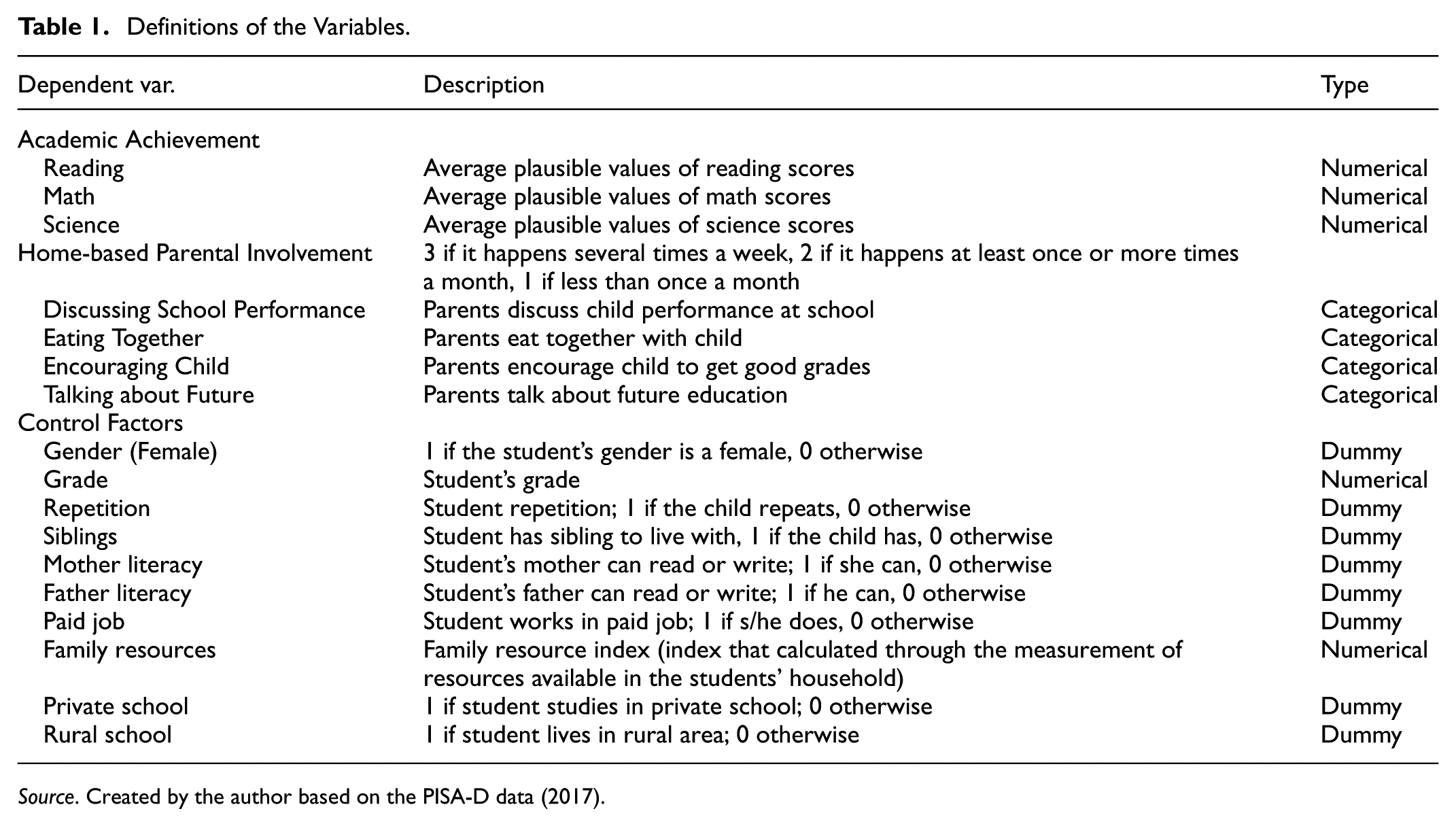
Source. Created by the author based on the PISA-D data (2017).
Descriptive Statistics.

Source. Created by the author based on the PISA-D data (2017).
Measure
Academic Achievement: Like most of international learning assessments, PISA-D employs the Item Response Theory (IRT) approach to impute plausible values for each subject. Each student was assessed using 1 of the 12 possible versions of the booklets prepared based on a common pool of 195 test items. In the PISA-D, 10 plausible values are estimated using different models. The study measures academic achievement by the mean of the 10 plausible values for each subject—namely reading, math, and science.
Home-based Parental involvement: In the student questionnaire, each student was asked to report how often do their parents or someone in their family engaged in (a) discussing school performance, (b) eating meals with them, (c) encouraging them, and (d) talking about future with them in five levels of frequency (never, less than once a month, once or twice a month, once or twice a week, and several times a week or daily). The frequency of these activities was then re-coded into three levels, (a) less than once a month, (b) at least once a month, and (c) several times a week. The recoding into three simplified categories was intended to avoid sparse data bias and to align with the key threshold identified in the literature. As shown in Figure 1, Cambodian parents or family members are more likely to eat main meals with their children and encourage them to achieve good grades. However, they less frequently discuss their children’s school performance or engage in conversations about their future education.

Home-based parental involvement in Cambodia.
Table 3 provides an overview of the average subject scores by the four main parental involvement activities and its assigned frequency. The results suggest that the more often family members eat together, the higher scores of readings, math and science are. Similar patterns are found the frequency of encouraging children to get good grades. However, in this simple mean comparison, the relationship between average test scores and discussing school performance and talking about the future is less clear.
Average Subject Scores by Parental Involvement Activity and Frequency.
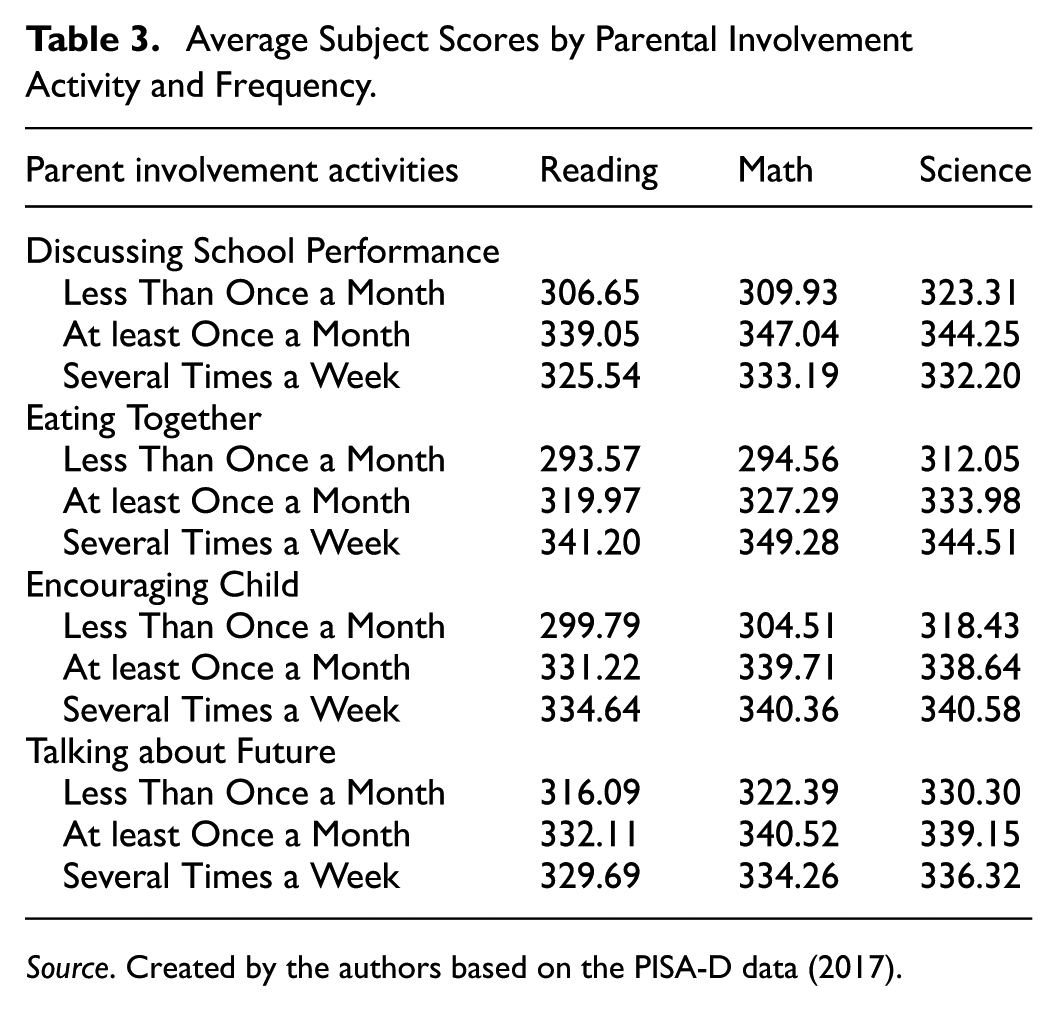
Source. Created by the authors based on the PISA-D data (2017).
Econometric Model
This study follows Glewwe et al. (2011)’s education production function, where the learning outcomes are subjected to school, personal, and family factors (including home-based parental involvement) on students’ learning achievements. To account for the hierarchical nature of the data, the study employs the two-level Hierarchical Linear Modeling (HLM), as this approach can capture the residual variance at each level and incorporates both the school and student levels within a multilevel structure. To confirm whether the model is appropriate, the empty model (null) was tested for any significance between school variables. The two-level empty model can be expressed as follows:


where

where γ is the intraclass correlation (ICC), ranging from 0 to 1;

where
Results
The result of the null model, shown in Table 4, indicates that the Intraclass Correlation Coefficients (ICC) in the three subjects are statistically different from zero at 0.36, 0.38, and 0.32, respectively. This implies that more than 30% of the differences in the test scores can be explained by the between-school differences. This shows that schools matter a lot, that if students switched schools, their scores could change significantly. It also confirms that Hierarchical Linear Modeling (HLM) is more appropriate for the analysis. Overall, the model analyzed data from 3,774 students from 169 schools, thoroughly examining how school and individual characteristics influence performance in each subject.
Intraclass Correlation Coefficients (ICC) in Reading, Math, and Science.

Source. Created by the author using PISA-D data.
Note. Standard errors in parentheses.
p < .01.
The influences of the control variables on reading, math, and science scores vary, as shown in Table 5. Females had much better reading scores by 10.71 but lower math scores by 7.60 compared to males. Reading, math, and science scores rise with each extra grade level by 16.14, 20.21, and 14.20, respectively. Grade repetition lowers performance by 8.81, 3.51, and 4.80, respectively. A positive link exists between having siblings and increasing reading by 5.04, math by 12.17, and science by 2.22. While the mother’s literacy has a humble positive correlation, contributing 4.19 in reading, 7.44 in math, and 4.73 in science, the father’s literacy is favorably related by 6.74, 14.04, and 7.31, respectively. Students who work in paid jobs do worse in reading, math, and science, decreasing by 8.28, 4.82, and 8.73 points, respectively. Family resources moderately impacted score growth (+2.41 in reading, +5.55 in math, and +1.09 in science). Attending a private school considerably influenced test performance, improving reading by 30.14, math by 32.70, and science by 17.42. Finally, rural school attendance is associated with poorer results in all disciplines, including reading (14.86), math (18.04), and science (6.35).
Regression Result on Each Home-Based Parental Activity.

Source. Created by the author using PISA-D data.
Note. Standard errors in parentheses.
p < .1. **p < .05. ***p < .01.
Table 5’s Model (1), (3), and (5) present the regression results of the four types of parental activities on the students’ academic achievement without any controlling for any factors for the reading, math, and science, respectively. In the model (2), (4), and (6), controlling factors, including gender, grade, grade repetition, siblings, mother literacy, father literacy, working paid job, family resources, studying at private school and rural school, are incorporated into the models. After adding these controlling factors, the ICC significantly decreased—from 0.346 to 0.121 for reading, from 0.370 to 0.139 for math, and from 0.306 to 0.140 for science. The decrease in the ICC after adding those controlling factors indicates that the proportion of total score variation explained by differences between schools has decreased, and student-level factors now play a more substantial role in explaining the remaining variation in scores. Furthermore, while the statistical significance of the variables of interest remains unchanged, their magnitudes become smaller.
Discussing children’s school performance at school is found to be positively correlated with academic achievement in all three subjects when it is done moderately. Those who reported discussing their school performance with their family at least once a month have higher test scores in reading, math, and science than those who discuss less than once a month by 8.49, 10.35, and 4.69 points, respectively. All the positive coefficients are statistically significant at the 1% level. However, the results are inconsistent and statistically insignificant in most cases when discussion is held several times a week.
Having meals together has a strong and significant association (at 1% level) with academic achievement measured by the test scores of the three subjects. Compared to the baseline of parents eating together less than once a month, the coefficient of eating together at least once a month for reading, math, and science is 9.17, 14.73, and 12.48, respectively. Moreover, the coefficient increases to 24.43, 29.10, and 18.31 when eating together several times a week. The effect of eating meals together appears to be the strongest among the four types of home-based parental involvement examined in this study. Moreover, it remains strongly correlated with academic achievement even after controlling for other factors, including family resources.
Similarly, parental involvement in encouraging children to get good grades is also positively associated with academic performance and is statistically significant at a 1% level. (p < .01), with the coefficients once or twice a month (10.60, 9.85, and 6.01) and several times a week (11.83, 10.06, and 8.25). Since both degrees of encouragement frequency are statistically significant, it implies that the more frequently parents encourage their children to have good grades, the more favorable the influence on their child’s learning.
Unlike parental involvement mentioned earlier, parental involvement through discussion about children’s future education is found to have a negative association with the test scores of all three subjects. Even after controlling for other factors, the coefficients are statistically significant, between 5% level and 1% level for reading and 1% for math and science. Furthermore, the results also suggest that the more frequent the discussion on future education, the stronger the negative association with test scores. When the discussion is at the frequency of at least once a month, the negative coefficients for reading, math, and science subjects are 4.31, 6.77, and 6.70, respectively. Yet, when the frequency increases to several times a week, the negative coefficient increases to 9.17, 14.48, and 10.23.
Discussion
This study investigated the relationship between home-based parental involvement and students’ academic achievement, as measured by standardized test scores of three subjects. Alongside the variables of interest related to home-based parental involvement, we controlled for relevant factors such as gender, grade, grade repetition, siblings, mother literacy, father literacy, paid work, family resource, private school, and rural school for potentially confounding influences.
Before discussing parental involvement, it is important to acknowledge the influence of control variables. Females are doing better than males in reading, and males outperform females in math, and grade plays a significant role in students’ learning achievement in the analysis, consistent with Chea and Ogawa (2020). However, a recent study conducted by Chea et al. (2024) suggests females perform better in Khmer and mathematics in secondary school. Repetition is found to have a negative correlation with the three test results, aligning with Lamote et al. (2014). Living with siblings is positively correlated with all the students’ test scores, which aligns with Hughes et al. (2018), and it shows that siblings can influence beneficially and indirectly to each other’s learning performance. Mother and father literacy are positively associated with student learning performance in all the three subjects at various levels, which is comparable to the study of Cano et al. (2018). Paid work is found to be harmful to the student’s learning outcomes, although family resources can play a significant influence in helping students attain higher test scores, aligning with Chea and Ogawa (2020), which further emphasized that this is based on the students’ location. Students at private schools had a far greater influence on their exam results than public school students. This is comparable to the study of Holloway et al. (2008), which found that private schools gave greater resources to students’ learning experiences. Pupils in a rural area have a negative correlation with learning results, and according to Inman et al. (2019), socioeconomic status, communal supports, and conventional gendered expectations are some markers of rural students’ poor performance.
Regarding the four different types of home-based parental involvement, “Parents discussing children’s school performance” is found to be positive and significant with the students’ learning achievement when it is done once or several times a month, yet when it is done several times a week, it turns out to be insignificant. On a moderate level, regular discussion enables parents to learn about their children’s academic strengths and struggles. Thus, understanding their interests, challenges, and learning styles allows parents to give personalized assistance, leading to better performance (Li & Guo, 2023). This finding is consistent with Choi et al. (2015) and Wang and Sheikh-Khalil (2013), indicating that school-related conversations positively correlated with academic achievement.
“Parent eating meals together with children” has a positive association with students’ achievement, and a child’s academic performance increases in line with the frequency of parents eating with them, highlighting the possible benefits of frequent family meals. Utter and Denny (2016) found that when parents and adolescents had time for meals together, it had multiple benefits, including eating healthier, feeling better, and having improved relationships. However, OECD (2023) stated that, on average, across OECD nations, 8% of students reported not eating at least once a week in the last 30 days owing to a lack of funds to buy food. Family meals provide an opportunity for relaxation and stress reduction and contribute to a sense of security and stability, thereby indirectly fostering the students’ learning performance.
Parental encouragement is positively associated with the students’ learning results, and the more often it occurs, the more probable it is that the child will perform better, according to Chen and Gregory (2010) and Boonk et al. (2018). Due to their cultural belief that their children’s education depends on their fate or destiny, Cambodian parents typically do not give their children much attention when it comes to their studies (Eng et al., 2014). However, acknowledging the challenges of learning and offering emotional support can likely inspire students to do well in their studies. Encouragement, which does not have to be a prize; a word of praise is sufficient, can also signal to students that they are on the right track. According to Perkins et al. (2016), teenagers’ views of their parents’ participation may be more predictive of academic performance than parents’ estimates of their involvement.
In this study, “Parent talking about future education” is the only parental involvement that is found to have a negative correlation with the students’ test scores, contrasting to the study of Castro et al. (2015) and Wang and Sheikh-Khalil (2013). Parents’ ambitions are important in their teenage children’s educational success, and discussing their potential career paths with children might help them break down their long-term objectives into smaller goals (Castro et al., 2015). Wang and Sheikh-Khalil (2013) indicated that parents who discussed future goals with them encouraged them to engage in their academic work both behaviorally and emotionally. Nonetheless, the analysis demonstrates that “talking about future education” frequently can have a negative influence. Repeated discussions on future schooling can be seen as a lack of trust in the child’s current performance. Furthermore, it might be viewed as a type of monitoring and excessive levels of achievement-oriented management, which can be detrimental to academic progress and serve as a distraction, resulting in inferior academic accomplishment (Karbach et al., 2013). It is important to note that these findings reflect correlation rather than causation; parents may often emphasize their future concerns when their children are not doing well at school.
The research yielded various outcomes across the four major parental activities addressed in the study. It supports Boonk et al. (2018)’s observation that the impact of parental involvement varies depending on the nature of the involvement. It discovered that the frequency of involvement can considerably influence children’s learning results, particularly parental activities like eating together and encouragement. Higher levels of engagement in such activities had an even more significant positive impact, emphasizing the regularity. It is also critical that parents provide a comfortable setting in which their children may develop their academic motivations without being invasive or domineering (Karbach et al., 2013).
Conclusion
This study examines the influence of various forms of parental involvement on academic achievement, using test scores in reading, math, and science subjects among secondary school students in Cambodia. The finding indicates that parental involvement is necessary to secondary students’ learning process aligning with the conclusions of Li and Guo (2023) and Chen and Gregory (2010); however, at this education level, parental involvement activities that function as monitoring or appear overly achievement-oriented may negatively influence students’ learning (Karbach et al., 2013). This finding also supports Boonk et al. (2018)’s observation that the impact of parental involvement on students’ learning varies by the type of involvement, and that at secondary education level, parents’ indirect involvement is consistently associated with students’ learning results.
In addition, it also provides insight into the effect of other individual and household factors on a student’s academic performance. At the individual level, female students do better than males in reading, whereas males surpass females in math. Since only 15-year-old students were surveyed, grades have significantly influenced learning achievement, as predicted. It is also interesting to find that siblings can benefit from each other’s learning performance, implying that siblings might assist with the learning process. Mother and father literacy positively correlates with all three subjects’ scores. Furthermore, private school students have a more significant influence on test scores than students in public schools, as private schools in Cambodia allocate more resources to their students’ educational experiences. Students’ learning achievement in rural areas is negatively correlated, and this may be attributed to various factors such as their financial situation, community support, and traditional gendered expectations.
Among the four types of home-based parental involvement, three forms of involvement, namely discussing child’s school performance, eating meals together, and encouraging children to attain a better grade, have positive correlations with student’s learning. In contrast, discussing future education has a negative association with learning performance, although it does not necessarily mean that the discussion on future education causes poor performance. As a limitation of the study, it should be noted that although this study tried to control for confounding factors, the findings on the effects of home-based parental involvement on student learning in Cambodian secondary schools are correlational rather than causal relationships. Also, home-based engagement in the PISA-D data was self-reported by students. Self-report data is commonly subject to social desirability bias, which can lead to measurement errors. As the study has established the associations between home-based engagement and student learning, future studies can dive deeper to examine the nuanced nature of these relationships using qualitative approaches, or use more rigorous approaches to establish the causal relationships. In addition, as the government of Cambodia has put forward digital transformation following the COVID-19 pandemic, it is important to investigate how parental support and monitoring of digital devices influence learning outcomes.
In conclusion, this study contributes to a deeper understanding of the complicated interaction of home-based parental involvement and academic performance in Cambodian secondary schools. It highlights the importance of parental involvement in the home environment, and how various types and frequencies of different parental activities are associated with students’ learning achievement. It underscores the critical role parents play in their children’s development as learners, particularly in the setting of Cambodia.
Footnotes

Ethical Considerations
This study uses secondary data from the publicly available and anonymized PISA 2018 dataset. Ethical approval for data collection and management was obtained by the Ministry of Education, Youth and Sport (MoEYS) of Cambodia.
Consent to Participate
This study used secondary data that are fully anonymized and publicly available.
Funding
The authors disclosed receipt of the following financial support for the research, authorship, and/or publication of this article: This work was supported by Global Network Program and the Japan Society for the Promotion of Science under KAKENHI Grant Numbers JP22H00079, including coverage of the Article Processing Charge.
Declaration of Conflicting Interests
The authors declared no potential conflicts of interest with respect to the research, authorship, and/or publication of this article.