




Abstract
High levels of parental/guardian involvement in their children’s education are often associated with a number of educational, social, and even psychological benefits. These include higher rates of school attendance, greater communication with the school or education provider, better social adjustment, and higher levels of academic achievement including in the development of literacy skills. However, despite this, research from the Arab world on the relationship between parental involvement and children’s development of English language literacy skills has tended to report mixed results, with this also being the case in the Sultanate of Oman. To explore this issue within the Omani context, the current study examined the potential benefits, challenges, and practices of Omani parents as these relate to their children’s English language studies. A two-section Likert-type response scale questionnaire was administered to 391 parents of students in the country’s public school system. The first questionnaire section related to participants’ attitudes about parental involvement in their children’s English studies while the second explored the frequency with which parents engaged in activities related to their children’s English classes. Results indicate that Omani parents are generally aware of the importance of their involvement in their children’s development and believe that they should be involved in a number of home- and school-based activities. However, despite this, their actual level of involvement in their children’s English language studies was somewhat limited.
Introduction
The type and level of parental/guardian involvement in their children’s schooling has often been posited as one of the most important factors associated with educational success. High levels of parental involvement have been linked with a number of favorable outcomes including higher rates of school attendance, more support for home learning, greater communication with the school or education provider, and higher levels of social adjustment and academic achievement (Berthelsen & Walker, 2008; Clark, 2007; Moon & Ivins, 2004). Clark (2009) adds to this list the development of greater cognitive competence among learners, enhanced problem-solving skills, and fewer learner behavioral problems at school. These potential benefits, moreover, are in evidence across all levels of schooling and not just during the early grades of a child’s formal education.
Emerson, Fear, Fox, and Sanders (2012) state that parental involvement can be defined as the building of partnerships between families, schools, and communities that increase parental awareness of the benefits of engaging with their children’s education while also developing the skills for this to occur. Berthelsen and Walker (2008), offering an overview of the work of scholars including Reynolds and Clements (2005), Ho and Willms (1996), and Dimock, O’Donoghue, and Robb (1996), maintain that parental involvement can be viewed in terms of parental behavior toward, and expectations of, their children’s schooling and the actions they subsequently take in this regard either at the school or at home. This perspective can be argued to encompass such constructs as parents participating at their children’s schools, communicating with the school, discussing with their children what they have done during school time, and supervising schoolwork at home.
For Dimock et al. (1996), parental involvement may be related to a number of dimensions including the choice of schools that the parents make, their involvement in the formal structures that influence school decision making, and in teaching and learning either at the school or at home, communication with teachers outside of formal meetings, and other forms of communication with the school. Although there are many avenues through which parents can become involved in their children’s education, a number of scholars have offered guiding principles to make this engagement more effective.
Literature Review
Principles of Effective Parental Engagement
Emerson et al. (2012) offer several principles for effective parental engagement in their children’s schooling. The first of these is academic socialization, which refers to those parental behaviors that have a demonstrably positive influence on children’s learning and academic outcomes. This is naturally a very broad area, though the authors highlight how the main aim of academic socialization is to develop learners’ abilities over time to independently establish and assess their goals, to take responsibility for their actions, and to learn from both their successes and their failures. Emerson et al. claim that academic socialization can be achieved through parents communicating expectations regarding education to children, highlighting both the value and the enjoyment that can be gained through learning, discussing relevant learning strategies and styles, establishing a connection between schoolwork and events happening in the child’s world, making the home learning environment stimulating, encouraging children to develop educational goals and to make preparations to meet those goals, and engaging in activities that build their sense of autonomy and academic capabilities.
Parental role construction, Emerson et al. (2012) continue, refers to the role parents choose to play in their children’s education and is often closely linked with parental beliefs about the efficacy of their involvement in this area. It may be developed autonomously or through the school’s encouragement to participate, and is often considered one of the most important factors linked to children’s academic success. The authors claim that this principle is influenced by a number of factors, including parents’ beliefs about what educational outcomes for their children are appropriate and desirable, about who is responsible for helping their children achieve these outcomes, and about what people, including teachers, family members, and other parents, expect from them as a parent.
The final principle of parental involvement Emerson et al. (2012) offer is parenting style. This is an area associated with both academic success and psychological well-being. For example, the authors claim that parents who expect high levels of academic achievement yet are emotionally distant may actually cause their children to develop low self-esteem which, in turn, leads to lower levels of academic achievement. However, parenting styles that encourage communication between parents and children, that set limits and rules and seek to understand bad decisions, not only contribute to higher levels of emotional well-being but also encourage the development of a child’s autonomy and sense of responsibility. These parenting styles can, therefore, contribute to academic achievement.
In addition to these principles, the Family-School and Community Partnerships Bureau (2011) maintains that parental involvement must be systemic, integrated, and sustainable to have a positive impact on children’s schooling. That is, involvement should be systemic in that parental engagement is seen by institutions as a core educational goal due to its strong links with school readiness and academic achievement. It must also be integrated into education structures and processes, including teaching and learning, community involvement, professional development, and issues of evaluation and accountability. Finally, the author states that parental engagement should be sustainable in that adequate resources are provided for the implementation of strategies to increase parental involvement that can positively affect students’ well-being and academic success.
Australia’s Department of Education and Training (DET; 2001) offers a number of suggestions to put in place appropriate processes to ensure that parental involvement can result in benefits for children, the school, and the wider community. These include
Creating a profile of the families comprising the school community;
Developing 3-year plans for parent involvement;
Identifying which school staff will be responsible for fostering parental involvement;
Regularly surveying parents to gauge their level of satisfaction with their involvement and the processes that support it;
Holding training sessions for parents to inform them of ways to be involved;
Holding workshops that examine achievement with parental involvement and look for ways to increase that involvement in coming semesters/years.
While these ways of enhancing the effectiveness of parental involvement have been discussed in terms of their potential general benefits, research has also highlighted the links between parental involvement in children’s education and the development of learners’ literacy skills.
Parental Involvement and Literacy Skills
Clark (2009) claims that both mothers and fathers have an important, if somewhat different, influence on the development of their children’s literacy skills. That is, although both mothers and fathers generally interact with their children in similar ways, Clark states that fathers often use more difficult vocabulary with their children such as more abstract words. Moreover, mothers and fathers often employ different vocabulary altogether and, therefore, between them, help expose children to a wider range of words. For instance, mothers often use language to describe emotions while fathers are more prone to offer explanations. It is for these reasons that the involvement of both parents in their children’s schooling can offer a number of benefits to the development of their literacy skills.
Clark (2009) continues that, despite the potential benefits associated with parental involvement as offered above, only a handful of studies have explicitly examined the link between this involvement and children’s literacy development. However, despite this, the author claims that a number of scholars, such as Durkin (1966) and Lloyd (1999), have suggested that higher levels of parental involvement in their children’s reading, including through spending time reading with them, monitoring, and evaluating their reading, were linked with higher levels of reading development. These were trends that Clark highlighted in relation to the involvement of fathers, although the author notes that children often consider their mothers to be the ones who initially taught them to read.
Clark (2007) maintains that, of all academic skills children develop at school, it is actually reading that is the most sensitive to issues of parental involvement. She states that parental involvement with reading activities at home has an important influence on reading achievement, in addition to language comprehension, interest, and attitudes toward reading and even on class attentiveness. Parental involvement in this skill can take many forms, including promoting the value of reading as a worthwhile and valuable activity while also making available reading resources including books, magazines, and newspapers, and reading to their children.
In terms of the link between parental involvement and children’s literacy development, the International Association for the Evaluation of Educational Achievement (IEA; 2014) offers a direct correlation between the level of parental involvement and student reading achievement. In an investigation covering more than 50 education systems from around the world, the IEA reports positive relationships between the level of parental involvement and achievement on the Progress in International Reading Literacy Study (PIRLS) reading test that was administered to samples of Grade 4 students from around the world. The report features data from the Gulf Cooperation Council (GCC) nations of Oman, Kuwait, the UAE, Qatar, and Saudi Arabia. Interestingly, while this general trend of increased parental involvement being associated with higher level reading skills on the PIRLS holds true for the United Arab Emirates (UAE) and Qatar, in Oman and Kuwait the results are mixed. That is, in both countries medium levels of parental involvement are linked with better reading test achievement scores than higher levels of parental achievement. In addition, in Kuwait, higher levels of parental involvement are associated with lower reading levels.
Clark and Hawkins (2010) identify four main aspects of parental involvement that contribute directly to children’s literacy development. The first is access to physical resources, with the authors stating that children who have access to their own books read more often and enjoy reading more than those who do not. Moreover, having access to other reading resources, such as newspapers and magazines, was also correlated with higher levels of reading attainment. Parental encouragement to read was another aspect of involvement associated with learners’ reading enjoyment and attainment. Clark and Hawkins state that children who get a lot of encouragement to read from their parents tend to report enjoying reading more and also to read more outside of class than those who do not. They also hold more positive attitudes toward reading and performed better than expected for their age on reading attainment tests. An almost identical pattern of increased enjoyment, better attitudes, and heightened reading attainment was also in evidence in relation to children who often saw their parents reading.
The final aspect of parental involvement in their children’s schooling identified by Clark and Hawkins (2010) as contributing to the development of literacy skills is talking about what children are reading. Clark and Hawkins found that young people who talk about what they are reading with their parents everyday generally enjoy reading much more than those who never discuss this part of their education. Moreover, children who never talk about what they are reading with their parents are more likely to believe that reading is boring and tend to rarely read outside of the classroom. These children are also more likely to score below the expected level for their ages on reading achievement tests.
Factors Influencing Parental Involvement
A number of factors may be related to the level and type of involvement parents have with their children’s education. Hoover-Dempsey and Sandler (1995) acknowledge that a model of parental involvement commonly assumed in the literature consists of two dominant contributing factors. The first of these is parent factors, which include socio-demographic variables and other, more dynamic, variables including parental attitudes, and so on. The second contributing factor involves school variables, including those status variables that characterize schools and more dynamic variables including teacher behaviors and so on. Hoover-Dempsey and Sandler claim that this model, although widely accepted, fails to take account of the reasons why parents become involved in the education of their children and how such involvement leads to positive educational outcomes.
In seeking to address these questions, Hoover-Dempsey and Sandler (1995) offer what they describe as a causal and specific model of parental involvement featuring five interlinked layers. The first layer is “parental involvement decision” and relates to those variables that influence the parents’ positive decision to become involved in their children’s education. Factors highlighted in the model include parents’ construction of the parental role and their sense of self-efficacy in helping their children succeed—both of which are informed by such variables as parents’ direct experiences, emotional arousal, and the verbal persuasion they encounter. Other important factors here include general opportunities and demands for parental involvement as expressed by their children and their children’s schools. These factors combine to influence the next layer of the model: “parents’ choice of involvement forms.” This is an area that is directly affected by a number of variables, such as parents’ specific skills and knowledge, the demands of their families and jobs in terms of time and energy, and the specific invitations and demands for involvement from children, schools, and teachers.
The parents’ choice of forms of involvement, according to the model, then affects the next layer of “mechanisms through which parent involvement influences child/student outcomes.” This is influenced by both closed- and open-ended instruction, the modeling of school-related behaviors and attitudes including asking questions about school, reviewing homework, communicating with teachers, and reinforcing specific aspects of school-related learning. This layer, in turn, influences “tempering/mediating variables,” which include the parents’ use of involvement strategies that are developmentally appropriate and the “fit” between school expectations of parental involvement and parental involvement actions. These mediating variables contribute to the final layer of Hoover-Dempsey and Sandler’s (1995) model: “child/student outcomes.” These outcomes encompass the skills and knowledge that children develop at school due to their parents’ involvement and the sense of efficacy they have for doing well in school.
Clark (2007) offers an adaptation of Hoover-Dempsey and Sandler’s (2005) model of the process of parental involvement. In this model, the three main factors that contribute to parental involvement are identified as parents’ motivational beliefs, parents’ perceptions of invitation for involvement from others, and parents’ perceived life contexts. In relation to the first factor, Clark states that “parents are at the most fundamental level motivated to become involved by their sense of self-efficacy” (p. 2), or their belief that their involvement will have a positive impact on their children’s academic success. Perceptions of involvement relate to the belief that the school, the teachers, and their children have expressed an interest in involving parents in the education process and, in this way, relate to the beliefs of organizations such as the Family-School and Community Partnerships Bureau (2011) and DET (2001) that school systems must be in place to make parental involvement as smooth, active, and meaningful as possible. The final factor offered by Clark as contributing to parental involvement is that of perceived life context, which relates to how parents’ knowledge and skills, and the input they believe the involvement requires in terms of time and energy, is viewed by parents.
The models of parental involvement offered by Hoover-Dempsey and Sandler (1995) and Clark (2007) highlighted above feature a number of variables that may be influential in determining the nature and level of involvement parents choose to have in their children’s education. With direct reference to parental involvement and the development of literacy skills, the IEA (2014) reports that, across the 50 educational systems examined around the world, those schools that experienced higher rates of parental involvement tended to have more students with parents who had a university-level education, thereby suggesting a link between involvement and socio-educational status. Interestingly, this level of correlation holds true for the Arab Gulf nations and emirates of Dubai and Saudi Arabia though becomes more confused when examined in Abu Dhabi, Qatar, and Oman.
Clark (2009) examines the potential link between parental involvement and socio-economic status and notes that a number of researchers have suggested there is a positive link between children’s levels of literacy development and their father’s work literacy practices. Although the initial supposition here may be that children whose fathers engage in more literacy practices at work are more involved in their children’s education and hence can exert more of a positive influence in the area, Clark maintains that it may not be the use of literacy skills at work by fathers itself that affects the literacy development of children, but rather “the way in which job-related literacy impacted on the home literacy environment where children’s development was being fostered that made a difference” (p. 13). In either case, this research implies that those fathers who have white-collar jobs (and hence are often middle class and/or upwardly mobile) tend to have children with better developed literacy skills hence suggesting a link between socio-economic status and the development of these skills.
Clark (2007) also highlights how parental involvement is perhaps most important for those children whose mothers have less education. The author offers research conducted for the Harvard Family Research Project, which reported that increases in family involvement were associated with higher levels of literacy achievement for families from low socio-economic backgrounds and that such involvement has the greatest impact on children who were deemed as “at risk” of educational failure. Moreover, families who were initially uninvolved with their children’s schooling and then become more involved exerted a positive influence on their children’s literacy development. Finally, the research project claims that this involvement did not have to necessarily be extensive to have a positive influence on literacy development, with meaningful improvement noted for even one or two additional involvement activities each year.
Moon and Ivins’s (2004) examination of barriers to parental involvement in children’s education in the United Kingdom reported the influence of the variables of gender, work situation, school level, and perceived responsibility for their child’s education. In particular, the authors noted that women were more likely to be involved in their children’s education with men less likely to help with homework and to be involved in activities such as fund-raising, school trips, and so on. Parents who worked part-time or who were employed in a school were also more likely to be involved, while parents of children in primary schools and parents or carers who believed that responsibility for their children’s education partially or largely lies with them reported higher levels of parental involvement. In terms of socio-economic status, however, Moon and Ivins report that parents in households where the primary breadwinner worked in unskilled manual labor were slightly more likely to claim that they felt very involved in their children’s education than other social classes. However, despite these claims, the authors note that parents in such households were only likely to participate more in helping with dinner duties and in school trips than parents in other socio-economic groups.
Parental Involvement, Literacy, and Arab Learners
Although the studies cited above offer a number of potential benefits to, and variables influencing, the level of parental involvement in children’s schooling, Al-Barwani, Albeely, and Al-Suleimani (2012) note that much of the research is focused on Western societies which have different expectations about children’s levels of independence and of the involvement of families in the decisions that affect their children. For these reasons, it may be problematic to apply findings from studies conducted on Western learners to Arab countries, as suggested by the somewhat contradictory results related to Oman and certain other Gulf nations reported in the IEA (2014) research above.
Moosa, Karabenick, and Adams (2001) took one step toward addressing the relative dearth of topic-based research on Arab learners by examining teachers’ perceptions of Arab parental involvement in elementary schools in the United States. The authors report a widely held belief among teachers that Arab parents in the United States tend not to be involved in their children’s education. This is a result which participants believed may be due to matters of culture and tradition. However, despite these beliefs among teachers, a number of participants also noted the barriers that these parents experienced toward higher levels of involvement, including a lack of confidence with their English language skills, and family demands on mothers including looking after younger children at home. Finally, a number of teachers believed that Arab parents considered the school as solely responsible for their children’s education and that they were, subsequently, less likely to participate.
However, despite these beliefs held by teachers, Moosa et al. (2001) note that most Arab parents reported regularly attending parent–teacher conferences and almost all of the Arab mothers claimed they would be willing to participate in their children’s education if requested to do so. The authors claim that this mismatch of perceptions between teachers and Arab parents in the United States may be due to a lack of teachers’ cultural knowledge about appropriate forms of communication for interacting with Arab families. Moosa et al. offer the example of mothers who agree to participate in a school activity when directly requested out of politeness though who fail to attend and are then characterized as disinterested. For these reasons, the authors state that it is necessary for teachers of Arab students in English as a second language (ESL) contexts to experience professional enrichment opportunities to develop culturally relevant skills.
Moving away from ESL contexts to the situation in Oman, Al-Barwani et al. (2012) highlight how, even as Arab countries experience rapid changes in the face of globalization, families in the region largely remain paternalistic and extended families continue to be involved in decisions regarding children. For these reasons, Al-Barwani et al. state that parental involvement, at least at the elementary school level, enjoys a long tradition in Oman, with open channels of education existing between schools and families on issues of behavior, academic progress, and so on. The authors sought to examine whether this is also the case in higher education institutions. In their examination of parents’ attitudes toward involvement in higher education, the authors reported that Omani parents believed they continued to play a major role in their children’s education, with this being expressed through financial and moral support, keeping track of academic progress, communicating with teachers, helping solve academic and social problems, and even helping select their children’s colleges and specializations. Moreover, despite the potential importance of the variables offered above in mediating levels of involvement, Al-Barwani et al. reported that parents’ gender, level of educational attainment, the number of children they have, socio-economic status, and education levels did not affect their beliefs about the importance of involvement.
Still within Oman but focusing on kindergarten, rather than tertiary-level, learners, Al-Qaryouti and Kilani (2013) examine the level of participation of 314 Omani parents in terms of the following involvement practices: availability of materials, home activities, parents’ attitudes, and visits to their children’s classes. The authors note that studies conducted on Arab learners, such as those by Abdulrahman (1986), Ahmad (1991), and Al Daisiti (1991), suggest that the learners’ families’ cultural background and/or socio-economic status were associated with children’s readiness to read and write. After acknowledging this link, Al-Qaryouti and Kilani explored whether the level of parental support for children’s reading and writing was associated with parents’ educational and economic levels, gender, birth order, and child’s level in the kindergarten.
Findings indicate that there is a link between parents’ educational levels in three of the four participation practices featured, with the only exception being in the number of visits to the kindergarten. In terms of socio-economic status, the researchers report that parents with middle, as opposed to low or high, income levels tended to more enthusiastic about literacy practices and hence provided more stimulation for the development of their children’s literacy skills. Gender and birth order, however, were not found to be related to parents’ levels of involvement in the four practices. Finally, the authors note that, as children progress through kindergarten levels, parents tended to express greater interest in participating in the development of their emergent literacy skills.
Al-Harrasi and Al-Mahrooqi (2014) examine the nature of Omani parents’ involvement in their children’s education in a study of 40 Omani parents. After acknowledging the potential impact of social reasons that may hinder such involvement—such as family size, number of adults, and parents’ levels of education, cultural factors associated with parents’ and teachers’ ideas of appropriate forms of participation, and economic factors associated with the abilities of both schools and parents to encourage parental involvement—the authors sought to examine the ways in which Omani parents are involved in their children’s education, their attitudes toward family involvement and their effect on their children’s academic performance, and the reasons Omani parents highlight as potentially hindering participation.
Al-Harrasi and Al-Mahrooqi (2014) claim that most Omani parents believe participation in their children’s schooling to almost exclusively involve at-home activities, such as helping with homework and discussing issues related to school. However, the authors report that Omani parents usually do not believe that they should be involved in school-related activities, either because they thought teachers to be competent and to not need any input, or because they do not view school-related activities as important. However, despite the somewhat limited nature of this involvement, participants did, nonetheless, maintain that parental involvement contributes positively to the academic performance of their children and that higher levels of involvement were associated with greater motivation among learners and better behavior.
Although these findings largely follow those offered in the literature from both the Arab world and beyond, the authors note that some of the barriers to parental involvement highlighted above are not applicable to the Omani context. That is, Al-Harrasi and Al-Mahrooqi’s (2014) findings suggest, “Parents here do not consider such social reasons as having big families, having many children, not feeling qualified to offer help, or not having enough time as hindrances to their involvement” (p. 281). In addition, parents believed that, although Omani teachers are highly competent, they retained the right to question teachers and administrators about educational decisions. They also maintained that their jobs did not affect their level of involvement in their children’s education, and that Omani schools have the processes in place to encourage involvement.
Method
Research Questions
While the above research highlights the nature and type of parental involvement in their children’s education, in addition to the potential benefit of increased levels of involvement, as of yet very little research has been conducted that exclusively focuses on parental involvement in their children’s education in English. Although the studies cited above, focusing on the link between parental involvement and literacy, suggest that higher levels of involvement are most likely associated with the development of learners English language skills, this is a supposition that is yet to be explored within the Omani context. Moreover, results relating to Arab and/or Omani participants offered above often report contradictory findings or results that would not be suggested from the research from the Western world. For these reasons, the current research sought to explore the link between Omani parental involvement in their children’s school-based English language education by examining the following questions:
Questionnaire
To explore this issue, two sections from a questionnaire inquiring into parental attitudes toward English in Oman—itself part of a nationwide investigation into challenges associated with learning English in the country—were analyzed. The first of these sections related to participants’ attitudes about parental involvement in their children’s English learning. This section was divided into five parts: benefits of involvement, parent involvement activities, personal reasons for non-involvement, teacher-related reasons for non-involvement, and school/administration’s reasons for non-involvement. The second section explored the frequency with which parents engaged in eight activities related to their children’s English language learning.
Sample
The questionnaires were administered to 391 parents of students in the Omani public school system. All background variables were affected to a certain degree by missing data. As a result, most of the demographics featured here tally anywhere between 2% and 16% under 100%. Of the participants who completed the demographic section of the questionnaire, 149 were male (37.3%) and 233 were female (58.3%) while remaining participants did not indicate their gender. Participants were drawn from the following governorates: Muscat (n = 56, 14.0%), Al-Batinah South (n = 40, 10%), Al-Batinah North (n = 37, 9.3%), Al-Buraimi (n = 49, 12.3%), Al-Dhahira (n = 48, 12.0%), Al-Dakhilia (n = 42, 10.5%), Al-Wusta (n = 15, 3.8%), Al-Sharqiya North (n = 29, 7.3%), Al-Sharqiya South (n = 62, 15.5%), and Dhofar (n = 13, 3.3%). Across these governorates, 167 participants lived in cities (41.8%) while 207 (51.8%) lived in villages.
In terms of parents’ levels of education, eight participants (2.0%) did not receive any formal education, 11 (2.8%) had finished primary school, 19 (4.8%) had completed preparatory schooling, 116 (29.0%) had graduated from secondary schools, 164 (41.0%) held college diplomas or bachelor’s degrees, and 19 (4.8%) had master’s degrees or doctorates. The vast majority of participants (n = 249, 62.3%) were currently working while 137 (34.3%) were not employed. Parents reported having between one child and more than 11 children, with the number of children in each family as follows: one (n = 13, 3.3%), two (n = 46, 11.5%), three (n = 63, 15.8%), four (n = 67, 16.8%), five (n = 75, 18.8%), six (n = 43, 10.8%), seven (n = 23, 5.8%), eight (n = 27, 6.8%), nine (n = 14, 3.5%), 10 (n = 4, 1.0%), and 11 or more (n = 4, 1.0%). Participants had the following numbers of children currently in school: none (n = 20, 5.0%), one (n = 74, 18.5%), two (n = 90, 22.5%), three (n = 68, 17.0%), four (n = 89, 22.3%), five (n = 30, 7.5%), six (n = 11, 2.8%), and seven (n = 7, 1.8%). Respondents reported having the following number of children in Grade 11: none (n = 322, 80.5%), one (n = 62, 15.5%), two (n = 4, 1.0%), three (n = 1, 0.3%). The number of children in Grade 12 was reported as follows: none (n = 312, 78.0%), one (n = 71, 17.8%), and two (n = 6, 1.5%).
Twenty-five respondents (6.3%) reported a total family monthly income of less than 300 Omani rials (OR), 75 (18.8%) had an income between 300 and 500 OR, 103 (25.8%) made between 501 and 1,000, while 159 (39.8%) made more than 1,000 OR a month. In terms of frequency of involvement in their children’s school studies, 226 participants (56.5%) reported always being involved, 58 (14.5%) were usually involved, 68 (17.0%) were sometimes involved, 12 (3.0%) were seldom involved, while six (1.5%) reported never being involved. When asked about their level of participation in their children’s English studies, 133 (33.3%) were always involved, 84 (21.0%) were usually involved, 92 (23.0%) were sometimes involved, 43 (10.8%) claimed to be seldom involved, while 22 (5.5%) stated that they were never involved. Although 391 participants returned questionnaires, only around 386 of these were completed with enough information to include in data analysis.
Results
The first section of the questionnaire of interest here related to parental attitudes toward involvement in their children’s English school studies. Participants were asked to indicate on a 5-point Likert-type response scale their level of agreement with a series of items across five categories. Responses ranged from strongly agree to disagree and had a middle option of neutral. Interpretations of item and category means are
strongly agree if 1.00 < average < 1.79;
agree if 1.80 < average < 2.59;
neutral if 2.60 < average < 3.39;
disagree 3.40 < average < 4.19;
strongly disagree 4.20 < average < 5.00.
Overall means for the five questionnaire categories from this part of the questionnaire are
Benefits of involvement—1.50;
Parent involvement activities—1.51;
Teacher-related reasons for non-involvement—3.00;
Personal reasons for non-involvement—3.15;
School/administration reasons for non-involvement—3.27.
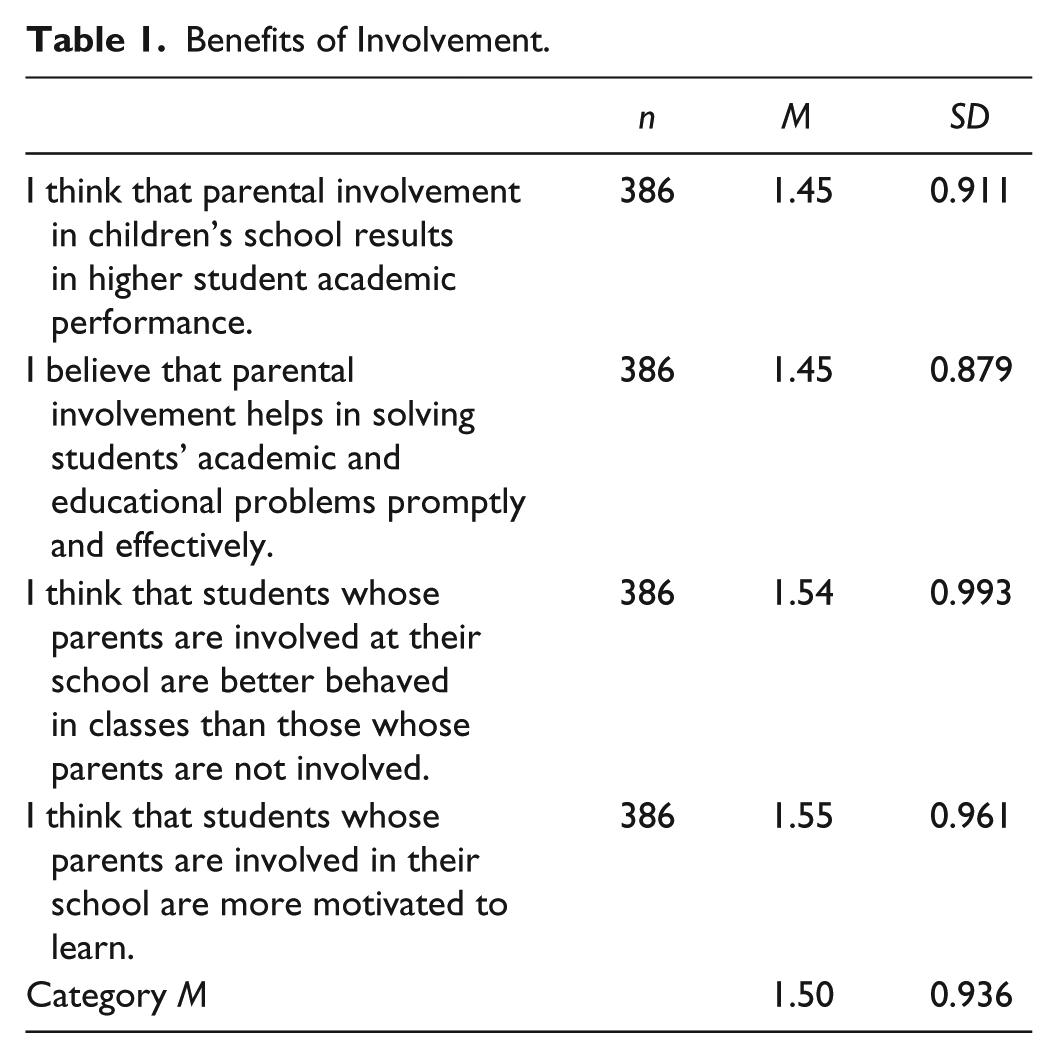
Table 1 features the first response category from this part of the questionnaire: benefits of involvement (M = 1.50). Parents strongly agreed with each of the four items relating to the potential benefit of parental involvement in their children’s schooling. The two items that received the highest levels of agreement were “parental involvement in children’s school results in higher student academic performance” and “parental involvement helps in solving students’ academic and educational problems promptly and effectively.” Both these items recorded means of 1.45. Participants also strongly agreed that “students whose parents are involved at their school are better behaved in classes than those whose parents are not involved” (M = 1.54) and that “students whose parents are involved in their school are more motivated to learn” (M = 1.55).
Benefits of Involvement.
Closely linked with this apparent awareness of the benefits of parental involvement, participants also strongly agreed with each of the items related to involvement activities (M = 1.51; see Table 2). Respondents strongly agreed that parents should “go to school even when their children are not in trouble” (M = 1.30). They also maintained that they should “discuss issues related to school with their children at home” (M = 1.33) and “supervise their children when doing their homework” (M = 1.44). While they also stated strong levels of agreement with the belief that “Parents should collaborate with teachers in preparing teaching materials” (M = 1.70), the response mean for the item, “Parents should get involved in school-related activities” (M = 1.79), was on the border between agree and strongly agree.
Parent Involvement Activities.

In relation to factors that may hinder parental involvement in their children’s schooling, Table 3 indicates that parents remained neutral about all items associated with whether teacher-related factors may contribute to their non-involvement (M = 2.98). That is, participants neither agreed nor disagreed with the statements, “I think that secondary school teachers’ heavy schedules don’t give them time to meet with parents” (M = 2.67) and “Teachers at my children’s schools are not trained well to deal with parents” (M = 2.87). They were also neutral in response to items about whether their involvement was considered valuable and appropriate by teachers: “I do not feel that teachers appreciate my involvement” (M = 3.01) and “I do not think that I should question teachers about their teaching” (M = 3.09). Finally, participants were neutral about whether “teachers know best about their students so I do not need to be involved” (M = 3.30).
Teacher-Related Reasons for Non-Involvement.

Table 4 indicates that parents were largely neutral about the influence of personal reasons on non-involvement (M = 3.15). In fact, of the 13 items associated with this category, 11 received response means placing them within the neutral response range, while participants only stated disagreement to two items. That is, parents did not believe that their responsibilities negatively affected their involvement in their children’s schooling, with neutral responses to “I have so many responsibilities which prevent me from getting involved with my children’s education” (M = 2.85) and “I do not discuss school issues with my children because I do not have enough time” (M = 3.25). With specific reference to family responsibilities, participants were neutral in response to the statements that they do “not get involved enough at my children’s schools because I have a big family to take care of” (M = 2.99) and “do not help my children much with their homework because I have many children” (M = 3.29). They also did not see work as interfering with their involvement in their children’s schooling with neutral responses to the following items: “I work for long hours so I do not have time to visit my children’s schools” (M = 2.95) and “I feel so exhausted after work that I do not help my children with their homework” (M = 3.18). The school level and school regulations were also not identified by participants as having an influence on their level of involvement, with neutral means recorded for the following items: “I only get involved at elementary schools” (M = 2.88) and “I do not get involved much with my children’s schools because I do not understand the school system and rules” (M = 3.06). Participants also remained neutral about whether they do not help their “children with their homework because I want them to be independent” (M = 2.91), while also being neutral about whether their children’s learning was the sole responsibility of teachers: “I do not help my children much with their homework because I do not feel qualified enough to do so” (M = 3.24) and “I believe that teachers are the only ones responsible for their students’ academic performance” (M = 3.32). In fact, the only items parents disagreed with from this part of the questionnaire related to the lack of importance of parental involvement. That is, they disagreed with the items, “I do not get involved in my children’s schools because I do not think that will make a difference” (M = 3.40) and “I do not believe that parental involvement in school matters is important” (M = 3.57). The level of disagreement expressed here appears to confirm trends reported in the previous parts of the questionnaire.
Personal Reasons for Non-Involvement.
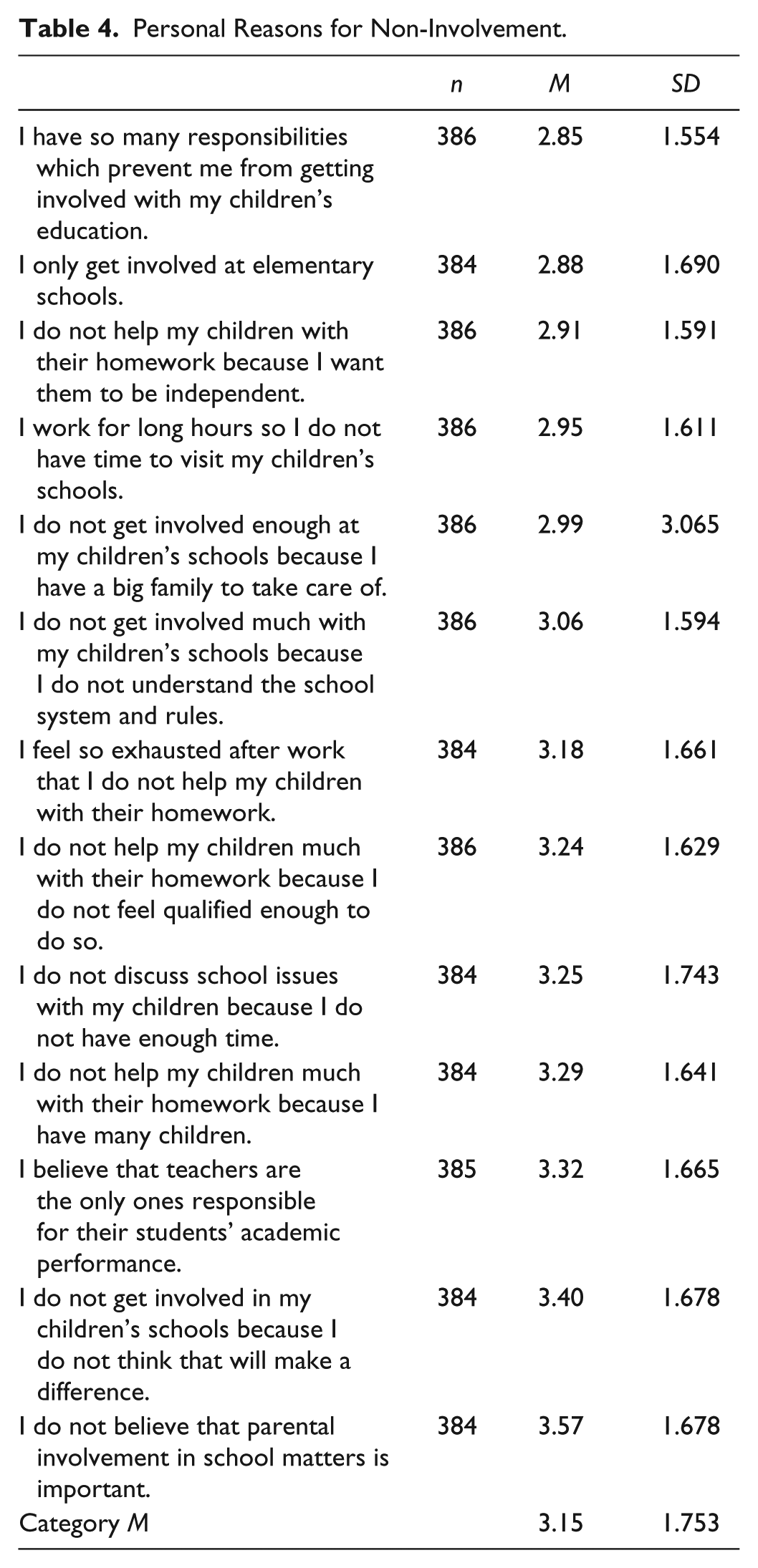
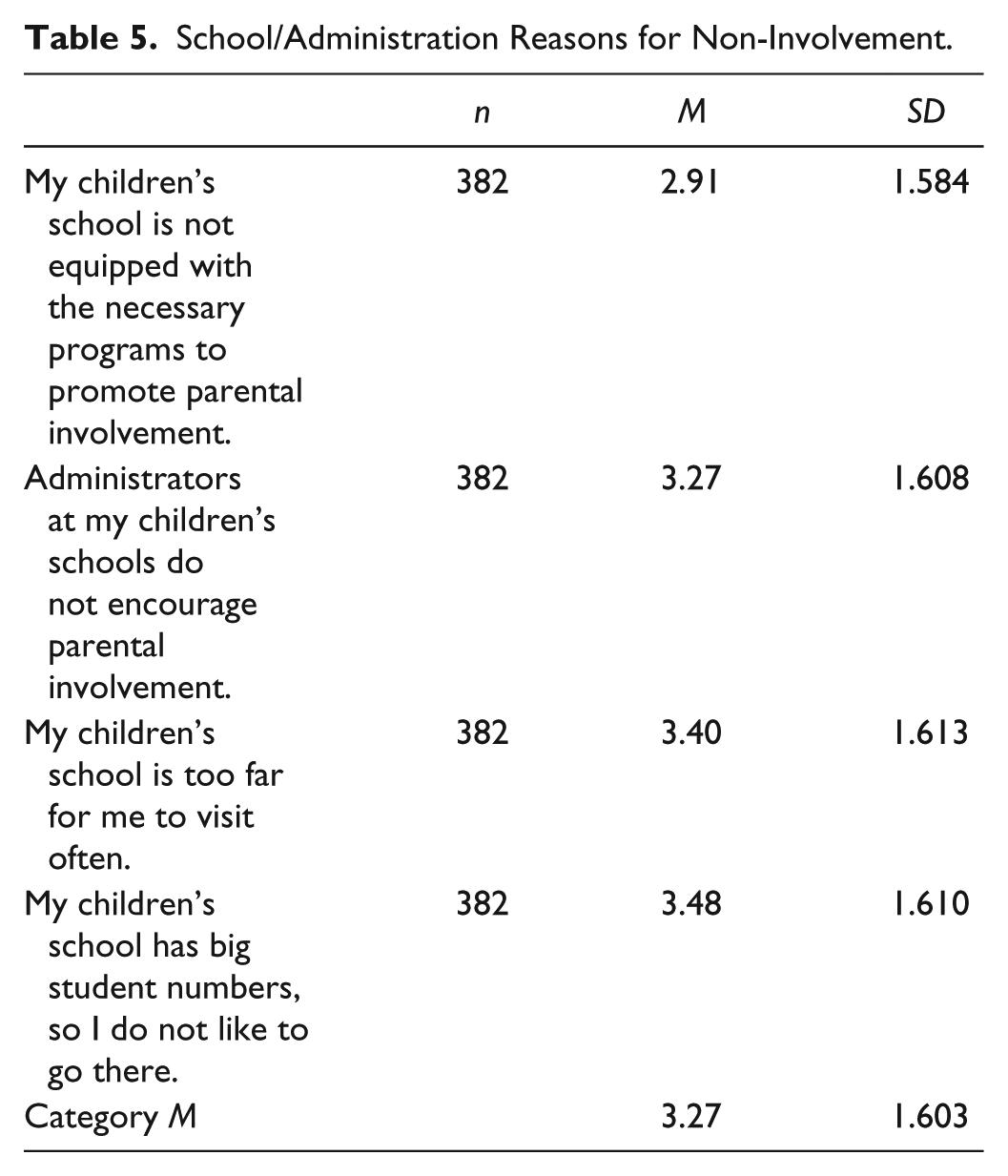
Table 5 features reasons for parental involvement associated with school/administration reasons (M = 3.27). Participants were neutral about two of the four items from this category. These were “My children’s school is not equipped with the necessary programs to promote parental involvement” (M = 2.91) and “Administrators at my children’s schools do not encourage parental involvement” (M = 3.27). They stated disagreement with the remaining items regarding the influence of distance and class size on their involvement: “My children’s school is too far for me to visit often” (M = 3.40) and “My children’s school has big student numbers, so I do not like to go there” (M = 3.48).
School/Administration Reasons for Non-Involvement.
The final questionnaire section asked participants to indicate how frequently they were involved in their children’s English studies. Item means for this part of the questionnaire were interpreted as
never if 1.00 < average < 1.79;
rarely if 1.80 < average < 2.59;
sometimes if 2.60 < average < 3.39;
often 3.40 < average < 4.19;
always 4.20 < average < 5.00.
Table 6 indicates that parents were not always engaged in any of the eight activities featured on this part of the questionnaire and were only often involved in one. This was encouraging “my children to do their best in learning English” (M = 3.74), even though they believed that they were only sometimes “involved in my children’s English studies” (M = 3.07). Participants stated that they were also sometimes involved in three specific activities related to their children’s English learning. These were “I supervise my children when doing their English homework” (M = 3.19), “I encourage my children to use and practice their English around the house and beyond the classroom” (M = 3.05), and “I meet with the English teacher to inquire about my children’s progress” (M = 2.86). However, they only rarely participated “in school activities that involve the use of English to motivate my children to practice the language” (M = 2.38) or “hired a private tutor to teach my children English” (M = 1.98).
Frequency of Parental Involvement in Children’s English Studies.

Discussion
This article sought to explore the attitudes and practices of Omani parents toward parental involvement in their children’s schooling. In doing so, it explored the following research questions.
Participants highlighted a number of potential benefits of involvement in their children’s schooling. They believed that their involvement not only contributed toward higher levels of academic achievement for their children, but also allowed them to help solve any academic and educational problems that their children may face. In this way, participants here showed similarities in attitudes to the parents of Omani tertiary students reported by Al-Qaryouti and Kilani (2013). Participants also highlighted their belief that parental involvement is associated with better behavior among their children at school and higher levels of motivation to learn. In this way, Omani parents displayed an awareness of some of the academic, psychological, and social benefits of increased levels of parental involvement as highlighted by scholars including Al-Harrasi and Al-Mahrooqi (2014), Berthelsen and Walker (2008), Clark (2007), and Moon and Ivins (2004). Moreover, these findings also lend support to Al-Barwani et al.’s (2012) contention that parental involvement in children’s education is widely practiced in Oman and enjoys a long tradition.
The Omani parents featured in this research strongly believed that they should be involved in a number of activities associated with their children’s schooling, or what Hoover-Dempsey and Sandler (1995) describe as choice of involvement forms. These included the school-related activities of making visits to their children’s school and getting involved in other school-related activities including preparing materials for use at school. Moreover, participants stated that at home they should discuss school matters with their children while also supervising homework. Interestingly, Al-Harrasi and Al-Mahrooqi (2014) maintain that parents in Oman tend to limit their involvement in their children’s education to home activities, such as the last two involvement activities listed here. However, the authors continue, these parents tend to be more reluctant to actually attend their children’s school to assist with activities. This is a belief that was not supported by the first questionnaire section, although the relative infrequency of parental involvement activities, at least as they relate to English studies, reported in the final part of the questionnaire may lend some support to this supposition.
The current research explored three main areas as potentially contributing to the non-involvement of Omani parents: teacher-related factors, personal reasons, and school/administration reasons. Omani parents’ responses indicated that they did not consider any of these factors to negatively affect their levels of involvement in their children’s schooling. For instance, they were neutral about whether teachers’ heavy workloads and lack of training in dealing with parents had an impact upon their involvement, while also being unsure about whether they had the right to question their children’s teachers’ decisions because “teachers know best.” The level of neutrality could be argued to offer a small amount of support for Al-Harrasi and Al-Mahrooqi’s (2014) findings that, although Omani parents acknowledge that teachers are generally competent and well-trained, they still believe they have the right to question teacher decisions, even though a lack of firm agreement or disagreement here leaves this matter open to debate.
Parent participants also did not believe that either their work- or family-related responsibilities decreased their level of involvement in their children’s schools. In findings that may lend support for Al-Harrasi and Al-Mahrooqi’s (2014) research, results here suggest that parents were neutral about whether having a big family had any influence on their level of involvement. Moreover, they also did not identify working long hours and feeling exhausted from their work as important factors. Personal reasons related to the school itself, such as its distance from home and the school level, were also not considered important factors in non-involvement by participants. Respondents, moreover, did not agree that they felt unqualified to be involved and, in fact, stated disagreement with the idea that only teachers are responsible for their children’s education and that their involvement would not make a difference. This, again, is a finding that was suggested by Al-Barwani et al.’s (2012) belief that the traditional patriarchal nature of Omani families supports the input of the extended family in all important matters relating to their children.
Factors related more specifically to school and school administration were also not considered to have an important influence on parental involvement. That is, parents were neutral about whether their children’s schools had the necessary programs to facilitate their involvement and also about whether school administrators encouraged such engagement. DET (2001) highlights the importance of schools creating structures and training staff to enable parents to participate in an effective manner, so the neutral response range here may suggest that Omani schools could put more systems in place to facilitate parental involvement. This is a practice that is strongly recommended by Family-School and Community Partnerships Bureau (2011) to positively affect students’ well-being and academic success.
Despite parents’ awareness of the importance of parental involvement in their children’s schooling and their belief that very few personal, teacher- or school-administration-related barriers exist to their involvement in their children’s formal schooling, participants claimed to only be often involved in one activity related to their children’s English language learning: encouraging them to do their best with English. Moreover, participants stated that they were only sometimes involved in their children’s English studies, despite the fact that 56.5% of participants claimed to always be involved in their children’s general education.
In terms of their English studies, parents stated that they occasionally supervised their children’s homework, encouraged them to use English at home, and met with their children’s English teachers to discuss their academic progress. Interestingly, two of these three involvement activities are related to the home, which tends to support Al-Harrasi and Al-Mahrooqi’s (2014) supposition that most Omani parents limit their participant to home-based activities, despite recognizing the importance of school-based activities as highlighted above. Moreover, Omani parents here claimed that they were rarely involved in their school activities related to English, and that they were not likely to find a private English tutor for their children. This former finding, in particular, may be associated with parents’ neutral attitudes as to whether the school and its teachers are welcoming of their participation in such activities, and about whether the structures are in place to encourage their participation.
Conclusion
The current study sought to examine attitudes toward, and practices associated with, Omani parents’ involvement in their children’s education with a specific focus on those practices related to English language learning. Results here indicate that Omani parents are generally aware of the importance of their involvement on their children’s academic, social, and even psychological development. Moreover, they believe that parents should be involved in a number of home- and school-based activities, such as visiting their children’s schools even when their children are not in trouble and being actively involved in other school activities, even though their actual level of involvement in their children’s English language studies was somewhat limited. Participants tended to be neutral about the nature of any personal, teacher, school, or administration obstacles to their involvement in their children’s education, although the implication exists that schools could do more to create and staff systems that actively seek to encourage their participation, at least as far as English language classes are concerned. The establishment of these systems in line with the advice of DET (2001) could function to inform parents about the benefits of increased levels of participation and appropriate channels for such participation. In this way, parents who may be reluctant to participate can see that their input is valued, hence increasing their level of self-efficacy in contributing to their children’s development of English language as highlighted by Emerson et al. (2012). Hence, parental involvement at the school level can be systemic, integrated, and sustainable, as recommended by the Family-School and Community Partnerships Bureau (2011). With more specific reference to English, the creation of higher levels of dialogue between schools, parents, and the wider community is one way to overcome the often-reported limitations of English language learning within Oman. This is an important goal of educational reforms in the country, and the springboard for the current nationwide investigation on which this current research is based, and is one that could benefit from the establishment of clearer pathways for Omani parental involvement in their children’s English studies.
Footnotes
Declaration of Conflicting Interests
The author(s) declared no potential conflicts of interest with respect to the research, authorship, and/or publication of this article.
Funding
The author(s) disclosed receipt of the following financial support for the research, authorship, and/or publication of this article: This work was supported by His Majesty Sultan Qaboos’s Annual Trust Fund for Strategic Research, Oman, under Grant SR/ART/ENGL/12/01).