




Abstract
The current study addressed the variations of parental involvement according to the home location and the gender of adolescents, considering the mother’s education. Through a cross-sectional design, variations in parental involvement were analyzed with 1,079 mothers and their adolescents between 11 and 14 years old (mean age = 12.88, SD = 0.98) in Colombia, registering the home location, gender of adolescents, educational level of mothers, and the perceived parental involvement at home and at school. The data were analyzed through a multivariate general linear model and multiple linear regression. In the results, there were no significant differences in direct effects of home location and gender of adolescents in involvement, but they were found in the interaction, where less parental involvement of mothers is dedicated to girls in urban areas compared with girls in rural areas and boys in urban areas. It was possible to establish that the interaction between variables seems to be related to the educational level of the mothers. The findings supported a situated approach to parental involvement in the case of mothers, where factors associated with parents and adolescents are relevant in specific settings.
Introduction
Parenting emerges as a set of social behaviors placed in specific surroundings that facilitate certain types of activities or hinder others (Bradley, 2019). The social and physical environment penetrates the efforts of parents to care for their children, affects what they do and how they do it. This is clear when considering the availability of resources or the lack of means to guarantee the survival, well-being and learning of children. Parenting practices, as behaviors, arise from ongoing transactions between the parents and the environment, each one shaping the other over time and through time (Lerner et al., 2015). Thus, situational factors such as home location or sociodemographic status influence actions of parents, a social contribution to understand the performance of adolescents (Kinas Bueno et al., 2016; Tudge & Rosa, 2020).
Parents and their adolescents live in homes that can be in at least two types of settings: rural or urban. The definitions of the term rural are offered from two perspectives, one geographical and the other social; the first focused on population density; distance; and specific characteristics of the economy, occupational use of land and landscape; the second, emphasizes the perception, identity, values, and lifestyles of residents, associated with education and limited job opportunities (Gadsden & Dixon-Román, 2017; Oncescu & Giles, 2012). On the other hand, the urban zones have been defined by demographic, ecological, historical, legal, economic, sociological criteria (Oncescu & Giles, 2012), explained in part by the variety of disciplinary interests, but fundamentally by the complexity of the nature of the city; therefore, urban spaces are conceived as more energetic, not very traditional, advanced, and modern.
In this way, life in rural or urban areas has a different impact on parents’ behavior with respect to their adolescents. Previous research studied the culturally universal aspects of parenting (LeVine, 1988), pointing out that in rural areas there is a high infant mortality rate, as well as a demand for unskilled child production, in addition to the fact that the family practices are considered mainly quantitative, since they focus their objective on fertility; while urban practices are more qualitative, prioritizing the preparation of the child for a challenging demand for qualification, with low mortality rates and greater parental investment. On the other hand, challenges parents face in urban areas include time constraints, work/life imbalance, common high-pressure situations, and complex interactions around financial issues (Hendriati & Okvitawanli, 2019). Similarly, in rural areas it is difficult to delegate parenting tasks, considering that there may not be an institutional support network that complement psychosocial development of youth (Charry & Maestre, 2013), which shapes parent-child bonds. As stated by LeVine (1988), the aspects of the environment and the impact on life depending on whether it is in urban or rural areas threaten or facilitate the objectives that parents have for their children.
Thus, in rural areas parents tend to pay less attention to caring for their children in contrast to parents in urban areas (Hossain, 2018). In rural areas, boys often accompany their parents in agricultural work, while rural families may have higher educational expectations for their girls (Agger et al., 2018). In this sense, for parents in urban areas, education is a precious asset to function in city communities, for both boys and girls (Gadsden & Dixon-Román, 2017). Likewise, in urban areas, adolescents tend to be more closely monitored by their parents than in rural areas (Bradley, 2012).
The understanding of traditional formulas as adaptive practices to situational factors is proposed, recognizing the idea that each type of society will implement an optimal parental strategy in response to the demands of the environment (Bradley, 2019). In this way, parenting practices operate together from the perspective of parents, as well as their girls and boys, corresponding with their environment, in a reciprocal and complex process that incorporates multiple factors (Martínez & García, 2012). The parent-child relationship in terms of parental involvement could be influenced by a set of factors such as the characteristics of the child and the environment, where physical, social, cultural determinants shape the concrete circumstances in which adolescents are socialized (Kinas Bueno et al., 2016).
Parenting practices can be considered contributions to the development of children, so that their relevance extends even into adolescence (Benner et al., 2016). One of the practices that has received the most attention in the specialized literature is parental involvement, which is defined as the set of efforts by parents to actively get involved in the educational experiences of their children (Morales-Castillo, 2022), including manifestations of direct interaction, accessibility, and responsibility (Phares & Rojas, 2018). In this context, direct interaction refers to the behaviors of parents that express a total commitment to their children, accessibility implies that parents are available to their children, and responsibility includes the supervision that is needed with the children.
Reports of positive effects of parental involvement are common (Boonk et al., 2018; Castro et al., 2015), although their manifestations can be varied (Gan & Bilige, 2019). In this way, parental involvement in the educational field can be expressed as open manifestations from school or from home (Petridou & Karagiorgi, 2018; Tan et al., 2020), so that school-based involvement is related to attendance at activities specific to the school environment, such as dialoguing with teachers or being part of the school government, while home-based involvement includes actions by parents to participate in the education of their adolescents from home, such as supervising the completion of activities, support them in difficulties related to the daily school life or dialoguing about academic life. Previous studies have suggested the differential importance of the manifestations of involvement, so that involvement in school could be positively associated with the performance of children in families with specific conditions (Lareau, 2019), although it has been suggested that home-based involvement could be more relevant as the children go through adolescence (Morales-Castillo & Aguirre-Dávila, 2018).
There are studies that present different perspectives regarding parental involvement. For example, involvement has been evaluated without distinguishing between mothers and fathers or focusing solely on the participation of one of the two groups (Otani, 2019). However, mothers spend more time with their children than fathers (Phares et al., 2009), their involvement has more predictive power in the performance of adolescents (Hsu et al., 2011) and provide more support and comfort (Chung et al., 2020; Paquette, 2004; Rogers et al., 2009) which makes it relevant to focus on the involvement of mothers. An example of this could be found in Latin American countries such as Colombia, where parenting is usually delegated to mothers, especially in rural areas (Aguirre-Dávila & Salcedo, 2016). Likewise, other factors to understand the expressions of involvement include the educational level of the mothers, which could be associated with the possibility of getting involved in the education of their children (Shumow & Miller, 2001).
In this context, there may be differences in the way parents relate to their sons and daughters. For example, Ratelle et al. (2017) identified that the parents of the girls reported being more involved and providing greater structure than the parents of the boys. Similarly, boys may receive less support and supervision from their family than girls (Kristjánsson & Sigfúsdóttir, 2009). Parents monitor their adolescent daughters more closely, even when they have more reason to monitor their sons and they are more restrictive with their daughters’ freedom to go out alone, choose friends, make decisions about money, and decide how to spend free time (Kaplan Toren, 2013). Despite this, other studies have not found significant differences in parental involvement according to the gender of the children (Garbacz et al., 2018), which raises some concerns. Considering the above, it is possible that involvement of parents could depend on different aspects, but this demands a comprehensive approach to get a clearer picture.
Differences in the relationship of parents with boys and girls have been linked with the characteristics and trends associated with the former and the latter in the framework of specific social regions (Kapetanovic et al., 2020; Rodríguez & Cortés, 2017). In this way, it is possible that the characteristics of adolescents constitute a factor that shapes the deployment of parental actions in a situated frame, that is, under specific conditions.
Previous works in the Colombian context have pointed out the need to expand knowledge about parenting of mothers in both urban and rural populations (Tilano et al., 2018). In the same way, there has been suggested that exist differences in the care that mothers dedicate to children according to their gender (Chiu, 2021; Hossain & Atencio, 2017; Puyana, 2003), even though some studies have posed that there are no significant differences in the parenting of mothers related to that variable (Garbacz et al., 2018). Likewise, parental involvement has not been sufficiently documented in Latin America, especially considering the home location of families and the gender of adolescents.
Considering the above, this question arises: Are there differences in the parental involvement related to the home location and the gender of adolescents? Faced with this question, the following hypotheses are proposed: (H1) There are significant differences in the parental involvement according to the home location (rural vs. urban); (H2) There are significant differences in the parental involvement according to the gender of the adolescents (boys vs. girls); (H3) There are significant differences in the parental involvement considering the interaction between the home location and the gender of the adolescents.
Method
Participants
The target population inhabited the Sabana Centro province (department of Cundinamarca), in the metropolitan area of Bogotá, the capital city of Colombia. At the time of the study, there were 166 schools in the region (55 public, 111 private), where 62.48% of all students were enrolled in public schools. The sample of the present study met the following inclusion criteria: mothers with their children between 11 and 14 years old enrolled in the seventh grade of secondary education. The final sample consisted of 1,079 mothers (mean age = 38.62, SD = 6.708) with early adolescents (mean age = 12.88, SD = 0.98) studying in public (75.35%) and private schools. Regarding the maximum educational level of the participants, 17% of the mothers reported not having completed school studies, 7.86% had incomplete primary school studies, 9.87% completed primary school studies, 13.36% incomplete high school studies, 30.22% completed high school studies, 19.47% non-university technical/technological studies, 13.11% professional studies at the undergraduate level, 4.89% graduate studies at the specialization level, .96% postgraduate studies at the master’s level, and .09% graduate studies at the doctoral level.
48.03% of mothers reported having a monthly income lower than USD 261.18, while 39.46% reported receiving between USD 261.19 and USD 785.43 monthly, and 12.51 received more than USD 785.44 per month. 75.72% of mothers reported being engaged in a relationship. The adolescents surveyed included girls (44.4%) and boys, inhabitants of rural (42.5%) and urban areas. Table 1 details the percentage distribution of the sample according to its characteristics and location.
Percentage Distribution of the Sample According to its Characteristics and Location.

Instruments
The mothers completed a sociodemographic survey that allowed a characterization of them and their living conditions, including age, highest educational level attained, marital status, monthly income level, and home location. For the classification of the location, it was proposed that the mothers consult the categorization provided by the local authorities to the sector of their housing. Mother’s education level was coded, considering the classification of educational levels of the Ministry of National Education of Colombia (1994), thus: 1 = No studies, 2 = Incomplete primary, 3 = Complete primary, 4 = Incomplete high school, 5 = Complete high school, 6 = Non-university Technical/Technological studies, 7 = Professional/Undergraduate Education, 8 = Specialization, 9 = Master’s Degree, 10 = Doctorate. Adolescents report their age and gender.
Perceived parental involvement was reported by adolescents scoring eight items distributed in two subscales: school-based involvement (SI) and home-based involvement (HI). To the question “How much does your mother do these things?,” participants had to score the following items for school-based involvement: “Attend meetings with teachers,” “Participate in assemblies or parent meetings,” “Apply to participate in the Parents Council,” and “Go to deliveries of school reports,” while for home-based involvement the items were: “Encourage yourself when you have difficulties at school,” “Be aware that you do the homework”, “See that you do your school work well”, and “Help you take things at school in stride”. Scores were assigned using a four-option Likert-type scale, from “Never, almost never” to “Always, almost always.” A confirmatory factor analysis showed an adequate fit of the proposed model for the subscales (CFI = 0.937, GFI = 0.968, RMSEA = 0.071, SRMR = 0.0416) with all items loading significantly (p < .001) in the corresponding factors. The scores of the items corresponding to each expression of involvement were added to obtain total scores. Higher scores indicate greater involvement in each subscale. Reliability indicators (SI: Cronbach’s alpha = .626, omega = .656; HI: Cronbach’s alpha = .776, omega = .776) were found that can be considered adequate (Katz, 2011).
Procedure
All the activities carried out complied with the ethical standards established for research with human participants. In this sense, this study had a favorable concept from the Institutional Reviewer Board of the Faculty of Human Sciences (Universidad Nacional de Colombia), and the participants filled out an informed consent to authorize the reserved and anonymous use of the data provided.
The National Ministry of Education provided electronic access to a database of all formally registered schools in the Sabana Centro province of the department of Cundinamarca, in the central region of Colombia, part of the metropolitan area of the capital, Bogotá. Schools that had basic secondary education were selected, and an email was sent to them with a letter on behalf of the research group explaining the objectives of the study and its implications. Through telephone calls, appointments were made with the directors of the schools to address concerns and specify the application of instruments.
At the beginning of the second semester of the academic year, 30 schools accepted to participate in the study and agreed to mediate in sending the instruments to the homes of seventh-grade students. The research team, together with the teachers, gave the adolescents a letter of introduction, questionnaires, and the consent for them to be filled out by the mothers at home; when the mothers finished them, they sent them back to schools through the adolescents. The teachers collected the questionnaires from the mothers, and the questionnaire for adolescents was applied in 1 hr of class with the support of the research team.
Data Analysis
A confirmatory factor analysis has been developed using the maximum likelihood estimation method to verify the validity in the structure of the instrument to measure parental involvement. The fit of the model has been evaluated by observing the comparative fit index (CFI) and the goodness of fit index (GFI) where values greater than 0.90 indicate a good fit, as well as the root mean square error of approximation (RMSEA) and the standardized root mean squared residual (SRMR) where values lower than 0.08 indicate a good fit (Hair et al., 2019).
Descriptive statistics have been calculated to establish the distribution of the data, where the values of skewness and kurtosis close to zero suggest normality (George & Mallery, 2016; Katz, 2011), also calculating the bivariate associations between the quantitative variables with the use of Pearson correlations, to rule out the collinearity of the variables. To analyze the possible differences between the groups established according to the gender of the adolescents and the home location, a two-factor analysis of variance (gender × location) has been carried out with a multivariate general linear model, where mother’s education was included as a covariate, using the SPSS program version 26 (IBM Corp., 2019). To confirm the value of the education of mothers at the Home Location × Gender of adolescents crossing, a multiple linear regression was run with School-based and Home-based involvement as dependent variables.
Results
Table 2 shows the descriptive statistics of the manifestations of involvement according to the gender of the children and the home location, where a distribution close to normality is suggested for the quantitative variables considering the values of asymmetry and kurtosis.
Descriptive of the Expressions of Involvement According to the Home Location and the Gender of Adolescents.

In addition, mother’s education level had a mean of 5.07, a standard deviation of 1.614, skewness values of 0.087 and kurtosis of 0.280, suggesting normality in the distribution of the variable, and it had a small and significant correlation with School-based involvement (r = .096, p < .01) and with Home-based involvement (r = .090, p < .01). The mean differences between the involvement scores is analyzed by observing the results of the calculated model.
According to Table 3, there are no significant differences according to the home location for School-based involvement (F(1) = 1.930, p = .165), and Home-based involvement (F(1) = 2.074, p = .15), so the first hypothesis is rejected. Similarly, there are no significant differences according to the gender of adolescents for School-based involvement (F(1) = 0.044, p = .834), and Home-based Involvement (F(1) = 0.024, p = .877), so the second hypothesis is rejected.
Results of the Two-Factor Model: Home Location × Gender of the Adolescents.
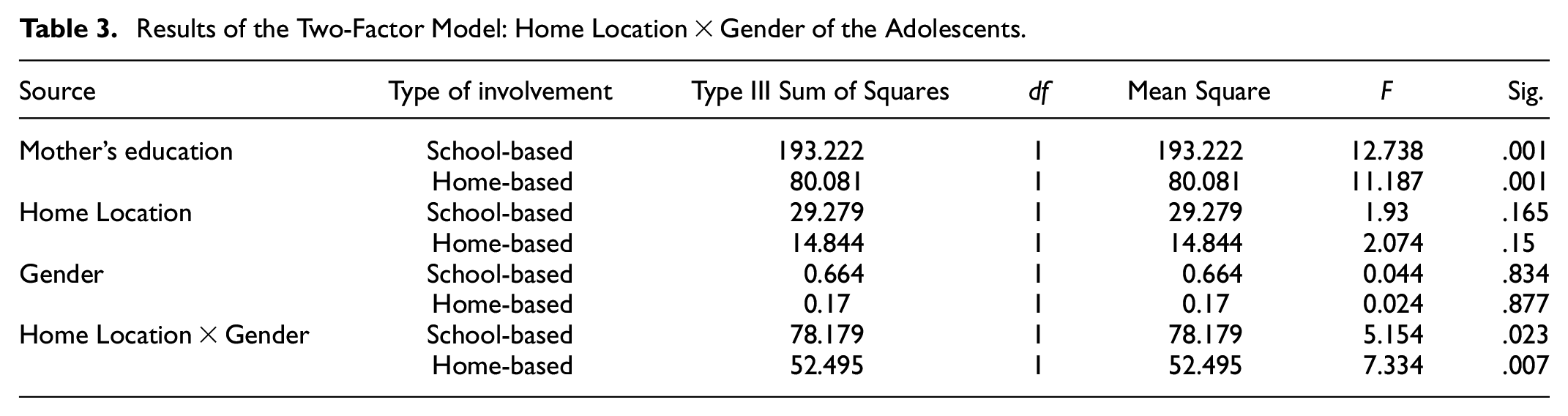
As Table 3 indicates, there are differences in parental involvement considering simultaneously the location of the home and the gender of adolescents for both School-based (F(1) = 5.154, p = .023) and Home-based involvement (F(1) = 7.334, p < .01), so the third hypothesis is accepted. As Figure 1 suggests, the interaction between home location and gender of adolescents shows that less School-based involvement is dedicated to girls in urban areas compared with girls in rural areas and boys in urban areas. In the same way, greater School-based involvement is dedicated to boys in urban areas compared with boys in rural areas, and girls in rural areas receive more School-based involvement than rural boys.

Comparison of means for School-based involvement considering two factors: Home Location (Urban/Rural) ×Gender of the adolescents (Boys = Thick line; Girls = Thin line; Observed global mean = Dotted line).
Following Figure 2, differences in School-based involvement are replicated in Home-based involvement considering both the home location and the gender of adolescents, where there is less home-based involvement with girls in urban areas compared with girls in rural areas and boys in urban areas. In the same way, there is a greater Home-based involvement dedicated to boys in urban areas compared with boys in rural areas, and girls in rural areas receive more Home-based involvement than boys in rural areas.

Comparison of means for Home-based Involvement considering two factors: Home Location (Urban/Rural) ×Gender of the adolescents (Boys = Thick line; Girls = Thin line; Observed global mean = Dotted line).
According to Table 3, the mother’s education level is valuable to understand the differences in the parental involvement for both school-based (F(1) = 12.738, p < .001) and home-based involvement (F(1) = 11.187, p < .01). In addition, in the comparison of the educational level of mothers according to the location of the home, an ANOVA indicated that there are significant differences (F(1) = 63.296, p < .001), so that urban mothers have higher educational levels in comparison with mothers in the rural areas The results of the linear regression model presented in Table 4 show that the mother’s education is a significant variable to explain school based involvement (β = .111, p < .001) and home-based involvement (β = .104, p < .01), in contrast to the non-significant values of the home location and the gender of the adolescents.
Linear Regression Models with School-Based and Home-Based Involvement as Dependent Variables.

Discussion
Parenting can be understood as a conjunction of situational and personal factors of the agents implicated (Bradley, 2019; Lerner et al., 2015; Morales-Castillo, 2020). In this study, considering the main effects of the home location and the gender of the adolescents, the differences in parental involvement are clear when analyzing an interaction with the covariation of mother’s education. Thus, the results do not support differences in the involvement considering only the home location or the gender of the adolescents, as previous studies have suggested (Garbacz et al., 2018; Hossain, 2018).
There are reasons to suggest that the conditions in which mothers live can facilitate or hinder the forms of participation in the educational life of their adolescents (Lareau, 2019), and previous work has proposed that the location in which parenting takes place affects the goals of parental actions in the relationships between parents and adolescents, which generates different consequences in the socialization process (Aguirre-Dávila & Salcedo, 2016; Hossain, 2018). However, it might be difficult to argue that living in a rural area rather than an urban area per se explains most of the differences in the relationship between parents and children (Bradley, 2012). Thus, factors such as particular economic, social, or physical environments could be more likely determinants of the behavior and development of those who inhabit particular places (Bradley, 2019).
Likewise, even though the relationship between parents and adolescents of the same gender may be stronger, parental involvement could be associated with other aspects, regardless of the gender of the adolescents (Otani, 2019). For example, it has been suggested that parental involvement depends on the expectations that mothers have toward their sons and daughters and the roles that have been imposed by culture (Lee, 2014), that is, they are mediated by other variables than gender.
This study proposes the interaction of home location and the gender of adolescents to explain parental involvement, so that parenting is defined by a repertoire of actions shaped by multiple forces (Tudge & Rosa, 2020). Education is fundamental for life in urban areas, considering the cultural sophistication required for a competent performance, which places schooling in a central place for this type of society (Gadsden & Dixon-Román, 2017), and if boys show lower levels of academic performance than their female peers (Marc Jackman & Morrain-Webb, 2019), their educational process will demand greater interest on the part of their parents. In the case of rural areas, parents emphasize a work orientation in boys, implying a lower interest in the educational process for them in these settings (Agger et al., 2018).
Thus, the exceptional academic performance of the girls (Parker et al., 2018) could be associated with the differential way of parental involvement (Chiu, 2021). Parents tend to be involved more closely with their daughters (Kaplan Toren, 2013; Ratelle et al., 2017), which in traditional societies such as rural ones could facilitate the preservation of values and roles, where women are usually dedicated to household management (Aguirre-Dávila & Salcedo, 2016; Hossain, 2018), but in urban areas, characterized by the limited availability of time for private life (Hendriati & Okvitawanli, 2019), less participation in the educational life of daughters when they tend to excel academically could be understandable.
According to the findings, mother’s education has shown a contribution to the interaction of the home location and the gender of adolescents when parental involvement is addressed, which appears as coherent when establishing that education of mothers has an effect on parenting (Cui et al., 2019) and the quality of parenting practices is affected proportionally according to the mother’s educational level (Aguirre-Dávila & Salcedo, 2016). In the studied sample, mothers in urban areas have higher educational levels than mothers from rural areas, which could be related to a certain understanding of the educational system and its dynamics (Cui et al., 2019), and to understand the performance of their sons and daughters and their needs (Chiu, 2021).
The widespread educational difficulties in rural areas influence people’s development in several ways (Echazarra & Radinger, 2019), and parents are no exception to this. Nevertheless, despite what has been described, for mothers in rural areas, even without having a high educational level, available knowledge allows them to offer their children experiences that favor their development in relation to the specific demands of their reference environment (Bradley, 2019). Since work orientation is more important than academic orientation in boys (Agger et al., 2018), the provision of parental involvement in the academic life of the boys could denote less importance, ensuring the activation of intuitive scripts circulating in rural settings (Charry & Maestre, 2013; LeVine, 1988).
Urban life offers both parents and children ease of access to services such as education (Hendriati & Okvitawanli, 2019), providing multiple options that entail particular ways of understanding reality from the parent-child relationship in urban communities (Gadsden & Dixon-Román, 2017). For example, previous studies have indicated that more educated mothers describe the development and needs of their children in more complex ways (Zurayk et al., 1982), which may benefit the integral well-being of their children even in adolescence (Cui et al., 2019).
Limitations
About the limitations of the present study, it is relevant to consider the characteristics of the sample, including the ages of the adolescents, which could restrict the extrapolation of conclusions. Similarly, the results presented must be analyzed in light of the nature of the design, which suggests a preliminary approach to the variables. Likewise, it is necessary to consider the characteristics of the enrollment of the participants, voluntary and without payment, which could affect the randomness of the sample. In addition, other variables were not considered such as ethnicity, cultural origin, birth order, number of children in the household, academic performance, public or private schooling, job occupation of mothers and socioeconomic status, suggesting reading the reported findings cautiously.
Implications
The findings presented have relevant implications for the development of a situated conceptualization of parenting practices, where different factors such as home location, gender, and mother’s education, interact in the emergence of specific parental actions such as parental involvement. In this way, the scenario in which parents and children act affects the relationship considering both the characteristics of the parents and those of the children, a crossroad on which it is necessary to continue deepening. In addition, considering the role of mothers’ education and that it is a variable that can be intervened, unlike the home location and the gender of the adolescents, the possibility of strengthening the parenting practices from parental training is suggestive, especially when it is analyzed the educational performance in rural settings.
Recommendations
For future works, it is recommended to analyze the variables studied in other countries and ethnic groups to analyze the nature of relations between variables in different contexts. Furthermore, studies could consider longitudinal-type designs to analyze variations associated with time. Given that cognitive aspects may be involved in the relationship between parents and adolescents (Morales-Castillo, 2020), it could be relevant to include an analysis of parental beliefs, motivations and expectations involved in the interaction with adolescents. Additionally, despite the perception of parenting practices reported by youth tends to correlate with the parental report (Huang et al., 2019), approaches with multiple sources of information are advisable to avoid bias in the findings.
Footnotes
Acknowledgements
The authors acknowledge the schools and teachers that generously supported us with the distribution and collection of the instruments: Colegio Cafetal, IED San Gabriel, Gimnasio Virtual San Francisco Javier, IED Diosa Chia, IED La Balsa, Liceo Edad de Oro, Nuevo Liceo Los Pinos, Colegio Psicopedagógico Campestre, Colegio Padre Manyanet, Colegio Jorbalan, IED Las Margaritas, Colegio Cooperativo de Cogua, IED Parcelas, IED Enrique Pardo, Colegio Mayor de Inglaterra, Colegio San Francisco de Sales, IED Presbítero Carlos Garavito, IED Alfonso Lopez, Colegio Cooperativo de Sopó, IED José de San Martín, Liceo Campestre San Jorge, Gimnasio First Step, Colegio Bilingüe Lerner & Klein, Gimnasio Campestre Reino Britanico, IED Industrial de Tocancipá, IED Técnico Comercial de Tocancipá, Colegio San Paulo, IED La Granja de Zipaquirá, IED Guillermo Quevedo Zornoza
Declaration of Conflicting Interests
The author(s) declared no potential conflicts of interest with respect to the research, authorship, and/or publication of this article.
Funding
The author(s) disclosed receipt of the following financial support for the research, authorship, and/or publication of this article: This work was partially supported by the Fundación CeiBA [contract signed on January 4, 2016 and ended on May 5, 2020].
Ethics statement
All the activities carried out in the current study complied with the ethical standards established for research with human participants. Informed consents were filled out by all the participants.
