



Abstract
This corpus-based study investigates translation error types in Russian-Chinese bidirectional translation by native Chinese speakers through quantitative analysis of 206 competition entries from the 16th Global Russian-Chinese Translation Competition. Addressing typological and translational gaps in Russian-Chinese and Chinese-Russian pairs, the study employs a tripartite error taxonomy (formal, semantic, and pragmatic aspects) to examine directional asymmetry in error distributions. These error distributions reveal significant directional effects (χ2 tests, p < .001): Russian-to-Chinese translation direction exhibits more semantic errors (68.67% vs. 57.09%) due to decoding challenges in Russian’s synthetic features, while Chinese-to-Russian translation direction shows more formal errors (35.68% vs. 21.41%), reflecting morphological encoding challenges in Russian’s inflectional morphology due to L1 negative transfer. Based on these, the study concludes three findings. Firstly, typological differences between Russian inflectional morphology and Chinese analytic morphology can cause formal translation errors. Secondly, conceptual differences between western and eastern cultures can cause semantic translation errors. Thirdly, communicative and rhetorical differences can cause pragmatic translation errors. These findings demonstrate that semantic errors persist as the primary translation challenge across two directions. The study findings can contribute to translation studies by providing empirical evidence for directionality effects in Slavic-Sino language pairs and deepen theoretical understanding of translation directionality in language pairs with distinct and typological features.
Plain Language Summary
This study looks at the mistakes that Chinese translators often make when translating between Russian and Chinese. Using a collection of 206 translation samples from a major international translation competition, the research analyzes errors in two directions: from Russian to Chinese and from Chinese to Russian. The study finds that translators face different kinds of challenges depending on the direction of translation. When translating from Russian to Chinese, the main problems are understanding the meaning (semantic errors), especially with words and sentences. When translating from Chinese to Russian, the main issues are with grammar and form, especially how Russian words change (morphology) and how Chinese speakers handle Russian grammar rules. The study also shows that cultural differences and the way the two languages are structured (for example, Chinese being more straightforward and Russian using more word changes) make translation more difficult in certain areas. These findings help us understand why translation between these two languages is challenging and suggest ways to improve translator training, such as focusing on grammar for Chinese-to-Russian translation and on understanding meaning and style for Russian-to-Chinese translation.
Keywords
Introduction
In recent years, the demand for Russian-Chinese bidirectional translation in Chinese-Russian cooperative exchanges has surged dramatically. However, the typological differences between Russian and Chinese are highly likely to trigger translation errors. Currently, research on translation errors exhibits three typical characteristics.
First, scholars mainly focus on comparisons between English and Chinese while neglecting the Russian-Chinese language pair. Second, the research methods rely on qualitative analysis, lacking quantitative analysis. Third, scholars’ theoretical explanations for the motivations of translation errors have not integrated typological differences and cognitive processes. This indicates that for native Chinese speakers, their Russian-Chinese bidirectional translation practice has long lacked precise guidance for avoiding translation errors.
Therefore, this study attempts to adopt quantitative methods to analyze the distribution of Russian-Chinese bidirectional translation errors by native Chinese speakers, summarize the types of translation errors, and integrate typology, second language acquisition, and cognitive linguistics to conduct in-depth interpretations of the motivations of these error types, thereby providing empirical evidence for avoiding common error types in Russian-Chinese bidirectional translation.
Literature Review
Translation Direction
Translation direction constitutes an important research subject in both translation theory and practice. However, current research about translation directions exhibits a significant imbalance in language-pair selection. Among Chinese researches, English-Chinese bidirectional translation dominates the research field, which is largely attributable to the available corpora and the global status of English. Specifically, M. Wang (2017) reviewed prior studies on translation directionality, categorizing research on “translation directionality” into three phases: the native-language conventions, the challenges to conventions, and the empirical translation investigations. The most important points are that empirical studies about translation directionality remain scarce, and the scope of research is largely confined to literature.
A same directional imbalance persists in international scholarship, where dominant researches concentrate on language pairs such as English-French and English-Arabic. For instance, legal research about translation directionality centers on Arabic-English translation, while medical research predominantly investigates Chinese-English translation errors of “Traditional Chinese Medicine” (Clemens, 2022; Dymova et al., 2024). Translation errors in less commonly taught languages remain fragmented, with Slavic-Sino translation error motivations yet to be systematically revealed.
The above imbalance causes two major limitations: the theoretical construction of translation errors overly relies on Indo-European common language pairs; there is a lack of a generalized and systematic explanatory framework for translation errors in less studied language pairs with distinct and typological features (e.g., Chinese and Russian).
On this basis, only a handful of scholars have conducted preliminary explorations in the fields of Russian-Chinese translation errors. First, Gu (2014, 2015) provided a precise definition of the concept of “mistranslation” through semantic theory, revealed the causes of translation errors from a semantic perspective, and effectively constructed a three-dimensional mistranslation identification criterion covering formal, semantic, and pragmatic dimensions. Scholars such as Трофимова and Тюкина (2015) elaborated on the cultural and cognitive barriers that native Russian speakers are prone to encountering when translating Chinese idioms through psycholinguistic experiments. Second, from the perspective of second language acquisition, L. Wang (2021) explained the causes of translation errors by native Chinese speakers in Chinese-Russian translation with the help of markedness theory. From the translator’s perspective, Guo (2017) took the multilingual translations of “The Nobility’s Nest” as the research object, classified and explained the causes of unintentional and intentional translation errors in literary translation. M. Chen (2008) emphasized from the perspective of cognitive linguistics that translators and cognitive factors are the key to the formation of translation errors. With the advancement of national cooperation and machine technology, scholars such as Варина (2021) and Злобина et al. (2025) focused on the distribution characteristics of translation errors in Chinese-Russian political and machine translations, revealing that language structure and cultural load have a significant impact on translation errors.
The above studies indicate that linguistic typology, translators, cognition, and culture may be the key factors affecting the occurrence and distribution of translation errors. However, existing studies are often based on case analysis of translations or a single translation direction.
Therefore, the types and motivations of translation errors in Russian-Chinese bidirectional translation are key areas urgently requiring breakthroughs.
Translation Errors
The Connotation and Denotation of Translation Errors
In the Chinese academic research, systematic achievements have been made in the terminological standardization of translation errors. Xie (1994) and Tan (1986) first included misinterpretations in understanding within the category of translation errors. The types of mistranslation research can be classified into four types.
In terms of the translation process, translation errors can be divided into errors in comprehension, conversion, and expression (Garbovskiy, 2007; Komissarov, 2001, p. 424; Shan, 2014). In terms of the translator’s subjectivity, translation errors can be divided into errors in intention and un-intention (Q. Wang, 2009; Zeng, 2015). In terms of the translation effects, translation errors can be divided into errors in positivity and negativity (Zheng, 2012). In terms of the translation content, translation errors can be divided into errors in categories such as literature, science, technology, and terminology. Gu and Huang (2016) divided translation errors into dynamic and static categories. The dynamic categorization is based on the translation process, while the static categorization follows the semiotic division, comprising formal, semantic, and pragmatic errors. The dynamic and static categorization facilitates clear tracing of the motivations underlying translation errors.
Research by European and American scholars highlights domain-specific characteristics in translation, with their categorization covering: translation errors in the implicit and explicit conversion of obligation terms in legal contexts (Chan, 2017); translation errors of culture-loaded terms in Traditional Chinese Medicine (Feng et al., 2024); and translation errors in political contexts, which has five main tendencies, including subtle tampering in direct quotation, deliberate omission of chunks, imprecise indirect quotation, tampering with the cornerstones of direct quotation, and defacing the source of quotation (Dymova et al., 2024). And Clemens (2022) puts forward “bombast mistranslation,” revealing the development of mistranslation typology.
Therefore, mistranslation is an extremely common phenomenon. Moreover, the academic community has reached a certain consensus on the criteria for mistranslation classification. It is generally acknowledged that mistranslation or translation errors should be classified into three types: formal, semantic, and pragmatic errors, and systematically interpreted from four dimensions, namely linguistic typology, translators, cognition, and culture, so as to trace the origins of its motivations.
Causes of Translation Errors
Mounin (1963) argues that all linguistic units possess inherent characteristics. Constrained by factors such as the language, translator, cognition, and culture, it is difficult for the connotations of translated content to be completely identical, which constitutes the fundamental cause of the high frequency of translation errors.
The causes of translation errors are complex, including both intra-translational factors and extra-translational factors.
For instance, implicit obligation terms in Arabic legal contexts often lead to semantic conversion errors when translated into English, as English tends toward explicit expression (Zidan, 2015). The tense asymmetry between Old English and Tetum also poses formal challenges in translation (Maia et al., 2022).
Translators lacking awareness of terminological standardization in fields such as Traditional Chinese Medicine are prone to translation errors (Clemens, 2022; Dymova et al., 2024). Historical information gaps may lead translators specializing in medieval texts to reconstruct archaic meanings through a contemporary mindset (Burton, 2002). Hietaranta (2014) identifies cognitive differences as another contributor to translation errors. The language and translator belong to intra-translational factors.
Bassnett and Lefevere (1998) mentioned in their “cultural turn” that the translation process is consistently influenced by ideology and other conditions within the target culture. Consequently, Bassnett (2007) emphasized that translated and semantic content still needs to possess cultural connotations.
In Tehran, translation errors in multilingual signage have revealed lax enforcement of foreign language education (Mohebbi & Firoozkohi, 2021). The political manipulation of discourse may render translation a casualty of diplomatic maneuvering (Keshavarz & Alimadadi, 2011). Dymova et al. (2024) demonstrate that mistranslation is often employed as a manipulation tool for public opinion. Technological factors further impact translation accuracy. For example, machine translation, due to insufficient training data and a lack of contextual information, exhibits higher semantic uncertainty in translating short sentences (Wan et al., 2022). The cognition and culture belong to extra-translational factors.
Due to the multiple causes of translation errors, the proportion of different mistranslation types will also change accordingly. As indicated by the mentioned studies, some current researches focus on formal errors and their motivations, while others concentrate on semantic and pragmatic errors as well as their respective motivations. Based on the previous classification of mistranslation types in academic circles, this study argues that all three types of errors are of great significance, and their motivations need to be systematically explored within the same text type.
Impact of Translation Errors
The cross-domain transmissibility of translation errors amplifies its negative effects. In the legal domain, mistranslation of obligation terms can fundamentally alter textual and legal validity. For example, mandatory rules can be misinterpreted as advisory ones (Hidayat & Hasyim, 2024). In the cultural domain, introduction mistranslation in scenic spots disrupts cultural imagery, impeding international visitors’ comprehension of cultural meanings (Wen & Deng, 2016), while mistranslation in public signs directly undermines information dissemination and intercultural exchange. In the literary domain, discrepancies in rendering the “Five Elements Theory” of Traditional Chinese Medicine in “Dream of the Red Chamber” have triggered conceptual confusion within the international academic community (Min et al., 2024). The mistranslation of original works further negatively influences readers’ reception of information (Dong, 2022). In the historical domain, mistranslation of Latin terms can even distort perceptions of historical figures (Hosington, 2014).
Nevertheless, mistranslation also exhibits a “bombast” dimension. Clemens (2022) argues that it may generate new meanings, offering new perspectives for intercultural dialogue. Cui (2023) highlights how creative treason in literary translation can facilitate translation dissemination and cross-cultural exchange. Ait Kharouach (2024) further emphasizes that despite the risks of misunderstanding, mistranslation can still promote cultural diversity in world literature dissemination.
Mistranslation exerts a dual impact, encompassing both positive and negative effects, toward which scholars hold divergent attitudes. Some scholars emphasize the need to avoid errors, while others attach importance to the cultural meaning regeneration and widespread dissemination of errors. For the purpose of this study, it is argued that in the teaching practice of Russian-Chinese bidirectional translation, translators should be guided to prioritize error avoidance. When translators reach a fairly high level of proficiency, the regeneration of cultural meaning and the effect of meaning dissemination should be further considered in future research.
Strategies for Translation Errors Mitigation
The academic community has established a multi-level mistranslation mitigation system, with specific measures encompassing translation strategies, translator-capacity building, translation standards and norms development, technological tool innovation, and translation process optimization.
In terms of translation strategies, promoting the three-dimensional (linguistic, cultural, and communicative dimensions) transformation theory has been recommended to enhance the translation accuracy in scientific and technical texts (H. Chen, 2024). For addressing translation errors in Chinese classics, dual strategies targeting both internal and external factors have been proposed to improve translation accuracy and dissemination effectiveness (Zhang & Ge, 2024).
Regarding translator-capacity building, strengthening interdisciplinary knowledge is essential. This means that legal translation should be integrated with legal reasoning analysis (Soriano, 2020). In medical translation, translators should receive training in medical terminology (Almahasees & Husienat, 2024). Public communication translation demands that translators possess cross-cultural awareness (L. Chen & Liu, 2024). In machine translation, the ability to use modern technology to find appropriate expressions for referents in the target language should also be developed (Z. Wang, 2024). In political and philosophical translation, the translator’s subjectivity can determine the final stance of translations (Zhao, 2024).
Translation standards and norms development includes promoting professional and terminological standardization, such as establishing international standards for the terminology of Traditional Chinese Medicine (Ye et al., 2021), advocating philological research methods in historical translation and reconstructing original contexts through multi-version collation (Bistué, 2016). Translation audit mechanisms are also implemented in the political domain, such as the US-Japan negotiation case highlights the necessity of third-party translation verification (Takahashi, 2021).
Besides, technological tools innovation and process optimization involve developing auxiliary tools, such as the algorithms detecting speech ambiguity and terminological databases (Folaron, 2012), creating efficient tools of mistranslation detection and correction through artificial intelligence integration, adopting team translation and multi-round proofreading mechanisms, and promoting translator involvement in lexical, syntactic, discursive, and cultural dimensions during post-editing. This approach can achieve deep integration of machine translation and translators’ post-editing to enhance the whole quality.
The collaborative development of algorithm optimization and translator competence is the key to achieving extensive and precise elimination of translation errors, respectively. Therefore, this study aims not only to conduct an extensive investigation into the quantity and distribution of errors through quantitative research but also to trace the causes of translators’ mistranslations and accurately identify the influencing factors of errors. Ultimately, it provides empirical references for future algorithm optimization and translator training.
To sum up, preliminary achievements have been made in relevant research on mistranslation regarding its definition, classification, motivation, and mitigation. However, research gaps still exist. First, most studies have focused on the most common language pairs within the Indo-European language family. Second, there is a lack of empirical comparison of mistranslation types across bidirectional translation. Finally, academic discussions on the motivations of mistranslation are fragmented and remain at a superficial theoretical level.
Given the multiple causes of mistranslation, mistranslation research should quantify error types and their distribution proportions through empirical studies, and systematically explain the motivations of mistranslation by integrating multiple factors such as linguistic typology, translator, cognition, and culture, so as to provide more precise and practical guidance for Russian-Chinese or Chinese-Russian translation practice. Therefore, focusing on Russian-Chinese bidirectional translation by native Chinese speakers, this study proposes the following research questions.
What distribution patterns do translation errors exhibit in Russian-Chinese bidirectional translation?
Why do different distribution patterns emerge across different translation directions?
What are the motivations underlying the occurrence of translation errors?
Research Method
This study adopts the threefold classification of mistranslation—formal, semantic, and pragmatic—proposed by Gu (2025). Form refers to the surface form of language, encompassing grammar, phonology, and spelling. Formal errors refer to those committed when translators misunderstand the grammatical structure of the source language, incorrectly handle its phonological structure, produce target language expressions that violate linguistic norms, or improperly convert its punctuation system. Semantic errors denote errors arising from translators’ failure to accurately grasp the meaning of linguistic units (e.g., words, phrases, clauses, sentences, and discourses) during source language comprehension. Specifically, semantic errors include cultural omission, logical omission, encyclopedic knowledge omission, and terminology omission. Pragmatic errors refer to translators’ failure to truthfully reflect the communicative purpose embedded in the target language, including stylistic errors, rhetorical errors, and cultural errors (Huang & Li, 2007, pp. 228–242).
Construction of Translation Error Typology
Forms, semantics, and pragmatics are the three overarching categories of translation errors, within which secondary classifications can be further made, as follows (see Table 1).
Classification of Translation Error Typology.

At the formal level, this typology distinguishes among phonetic errors, grammatical errors, and punctuation errors. Phonetic errors include errors of proper nouns such as personal names, place names, and brand names. Grammatical errors involve inaccuracies in words, phrases, and sentences, like misidentification of homomorphous words, incorrect assignment of word class, synonym confusion, misinterpretation of phrase grammatical relations, misunderstanding of fixed collocations, and erroneous parsing of sentence components. Punctuation errors manifest in the inconsistent use of quotation marks, dashes, exclamation marks, which causes misinterpretations.
Semantic errors include inaccuracies at the lexical, phrasal, clausal, sentential, and textual levels. Lexical errors include misinterpretation of word meanings, incorrect word choice, confusion of synonyms and antonyms, and mistranslation of idiomatic expressions. Phrasal errors include misunderstanding the overall meaning of a phrase. Clausal errors are mainly based on the logic of clauses, which is caused by the omission of clauses, the mistranslation of clauses, and wrong clausal sequences. Sentential errors include information addition, information omission, component-level mistranslation, semantic redundancy, and logical errors within sentences. Textual errors manifest as insufficient semantic reference, inappropriate synonym cohesion, and semantic incoherence.
Pragmatic errors relate to rhetorical, contextual, and cultural dimensions. Rhetorical errors include rhetorical inaccuracies in word, sentence, and text like pragmatic misinterpretation of words, metaphorical misinterpretation, disruption of thematic and rhematic components, loss of visual effects, and logical inconsistencies in text organization. Contextual errors include misinterpretations of textual and cultural contexts like neglect of text coherence, inadequate explanation for unfamiliar culture, misunderstandings of historical or cultural contexts, and deviations from social or cultural norms. Cultural errors include misinterpretations of material culture, behavioral culture, and ideological culture, such as neglect of cultural customs, behavioral norms, and deeper cultural connotations. Each type of translation error example can be found in the Appendix.
Data
The corpus employed in this study is from the literary translation works of the 16th Global Russian-Chinese Translation Competition, which is part of the “Russian Literature and Art” Literary Translation Award. The corpus includes the bidirectional translation works of a total of 103 contestants. All these contestants are native Chinese speakers, and they majored in Russian. They have received systematic education and relevant training, are currently either enrolled in educational programs or have already graduated, and possess a solid foundation in the Russian language and translation capabilities. The overall translation quality is relatively stable.
The corpus is constructed based on the Chinese-to-Russian and Russian-to-Chinese directions. The first part consists of 103 Chinese-to-Russian translations of “The Bouncing Game,” while the second part consists of 103 Russian-to-Chinese translations of “Dad Didn’t Die (Папанеумер).” The source texts for both directions were carefully selected by the competition committee to ensure comparability in genre, complexity, and length. Specifically, both the Chinese and Russian source texts are approximately 800 words long, providing a normalized basis for the subsequent analysis of translation errors. In total, there are 206 translation samples.
Corpus Annotation Procedure
The corpus annotation procedure consists of four stages: selection of annotators, annotators’ training, distribution of translation samples, and inter-rater reliability testing. First, we selected two professional Chinese-Russian and Russian-Chinese translators as annotators. Both annotators are professors in Russian-Chinese Translation and have over 5 years of practical translation experience. They are native Chinese speakers with near-native proficiency in Russian, having resided in Russian-speaking countries for more than 10 years. This background ensured they possessed the necessary linguistic sensitivity and cultural awareness to accurately identify and classify nuanced translation errors in the literary corpus.
To further standardize their judgment and minimize individual bias, we provided them with comprehensive training on the system of translation error typology and annotation rules. The training utilized UAM Corpus Tool (O’Donnell, 2008) as the annotation tool. The training session lasted for 10 hr, covering the definitions and illustrative examples for each error category in the typology. Practical exercises on sample texts were conducted to ensure consistent understanding and application of the annotation criteria before formal coding began.
Following successful completion of the training, the 206 translation samples were randomly divided into two groups, with 103 samples in each group. This stratified division ensured the inclusion of both Russian-to-Chinese and Chinese-to-Russian translation directions in each group. To evaluate inter-rater reliability, we designated 40 overlapping translation samples. These samples were annotated by the two annotators.
The consistency of annotations was assessed using Cohen’s kappa coefficient. The results demonstrated an exceptionally high level of agreement between the two annotators, with a Cohen’s kappa coefficient of .91, indicating substantial inter-rater reliability (Cohen, 1960). For the limited number of instances where initial annotations diverged, the two annotators engaged in a discussion to review the specific text and the applied coding rules until a consensus was reached. This adjudication process not only resolved the initial disagreements but also served to further calibrate the annotators’ understanding of the coding scheme, thereby enhancing the overall consistency of the entire dataset. This validates the reliability of the annotation process and the subsequent analysis.
Statistical Analysis
To examine the differences in error type distributions between the two translation directions, we employed Pearson’s chi-square tests of independence. For each error category comparison (e.g., rhetorical vs. cultural errors under the pragmatic dimension), the data were organized into 2 × 2 contingency tables, which cross-tabulated the frequency counts for the Russian-to-Chinese (R-C) and Chinese-to-Russian (C-R) directions. The chi-square statistic (χ2) and its significance level are reported in the results tables.
Furthermore, to assess the magnitude of the observed associations, we calculated the phi (φ) coefficient as the measure of effect size for each significant result, using the formula
Severity Assessment of Translation Errors
To enhance the analytical depth of this study, a severity assessment was performed on the identified translation errors using the Multidimensional Quality Metrics (MQM) framework, a well-established system for translation quality evaluation (Lommel et al., 2014). In line with conventional severity classifications, errors were categorized into three levels: Minor, Major, and Critical. This three-tier classification applies uniformly to pragmatic, semantic, and formal mistranslations. Critical errors are defined as those reflecting a fundamental deviation from the core message or communicative intent of the source text, resulting in severe distortion of information or complete communicative breakdown, with potential consequential repercussions. Major errors involve substantial deviations that lead to loss of key information, disruption of logical relationships, or significant misinterpretation, thereby considerably undermining comprehension and credibility. Minor errors refer to localized inaccuracies in details that have limited impact on overall understanding, credibility, or fluency, though they may detract from reading experience or perceived professionalism.
The two expert annotators who performed the initial error annotation were also responsible for the severity assessment, ensuring consistency with the established error typology. To guarantee the reliability of the severity ratings, the two annotators independently evaluated the severity of errors within a randomly selected subset of the corpus. The inter-rater reliability was calculated using Cohen’s kappa coefficient, which indicated a high level of agreement (Cohen’s kappa = .92). Any discrepancies in the initial severity ratings for this subset were resolved through discussion until a consensus was reached. This adjudication process further calibrated the annotators’ judgments before they proceeded to complete the severity assessment for the entire corpus.
Results
Error Patterns in Russian-to-Chinese Translation
Table 2 presents the distribution and severity of translation errors in 103 Russian-to-Chinese translation samples. The total number of errors (N) is 3,750, with the distribution of error types demonstrating a hierarchical pattern characterized by semantic errors as the dominant category. Semantic errors constitute the primary source of mistranslation (68.67%), reflecting great challenges in cross-linguistic meaning transfer. Within this category, critical errors are the most prevalent (54.91%), followed by minor (24.82%) and major errors (20.27%). Formal errors account for 21.41% of the total, manifesting as the absence of formal equivalents in Chinese for Russian grammatical categories, such as case markers and aspects. The severity distribution of formal errors is relatively balanced, with minor errors comprising 39.35%, critical errors 38.85%, and major errors 21.79%. Pragmatic errors account for 9.92%, which can cause ineffective communication and rhetorical mismatches, with critical errors representing the highest proportion (50.81%), followed by minor (26.08%) and major errors (23.12%). Overall, critical errors constitute the majority of total errors (51.07%), indicating that a significant portion of mistranslations has substantial impacts on translation quality.
Statistics of R-to-C Translation Errors (by Dimension and Severity).

Note. Due to rounding, the percentages may not sum up to exactly 100%. The same note applies hereafter.
Error Patterns in Chinese-to-Russian Translation
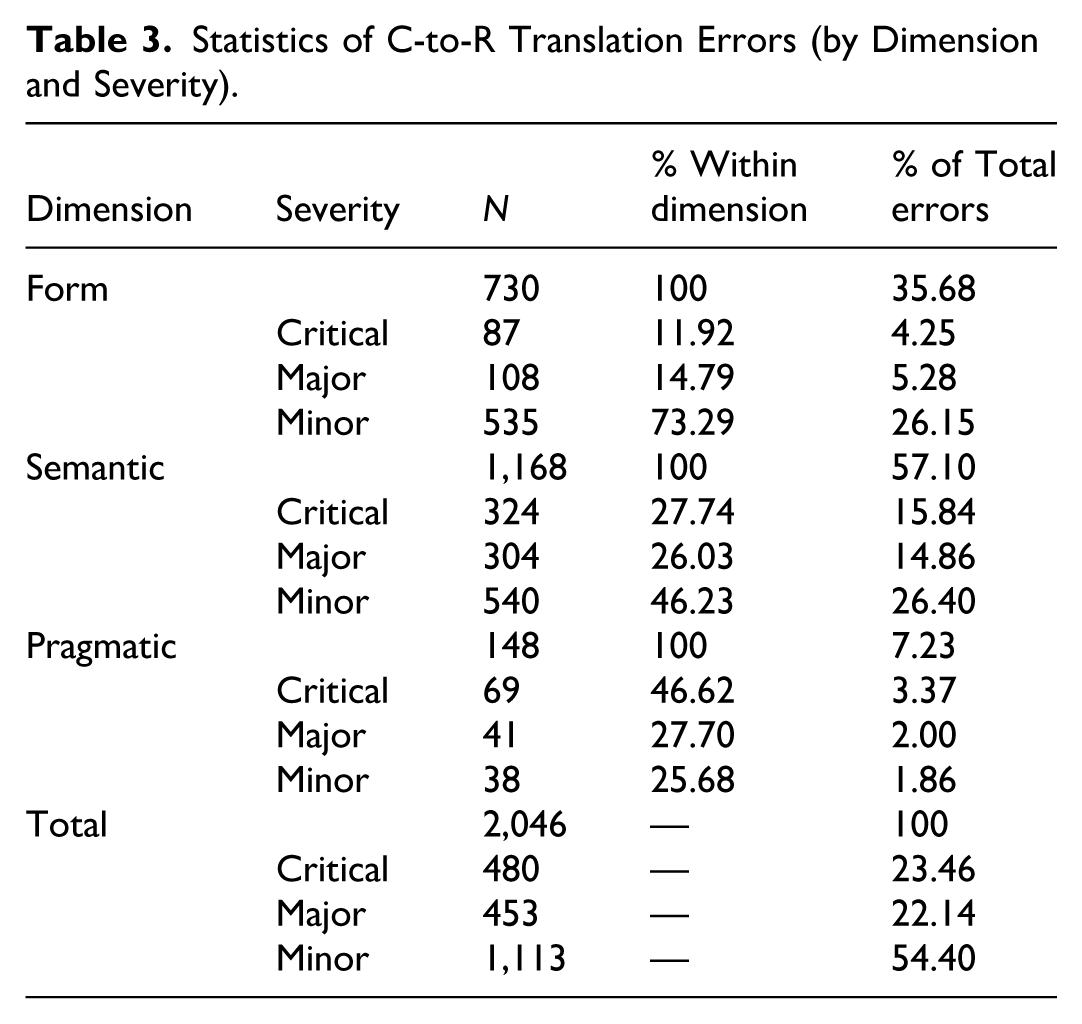
Table 3 presents the distribution and severity of translation errors identified in the Russian-to-Chinese translation samples. The total number of errors (N) is 2,046. The distribution of error types also exhibits a semantic-dominant pattern with semantic errors accounting for 57.10% of the total. Within this category, minor errors are the most frequent (46.23%), followed by critical errors (27.74%) and major errors (26.03%). This dominance reflects the asymmetry between Chinese and Russian conceptual systems. Formal errors, which represent a significant percentage of 35.68%, highlight the writing difference between the Chinese logographic system and the Russian phonetic system. In terms of severity, formal errors are predominantly minor (73.29%), with major and critical errors accounting for 14.79% and 11.92%, respectively. Pragmatic errors, though comparatively rare at 7.23%, are dominated by critical-level mistakes (46.62%), while major and minor errors make up 27.70% and 25.68%, respectively. This shows that translators have lower sensitivity to implicit pragmatic rules, such as cultural taboos and rhetorical intentions. Overall, minor errors constitute the largest proportion across all error types (54.40%), underscoring their significant impact on translation quality.
Statistics of C-to-R Translation Errors (by Dimension and Severity).
Comparison of R-to-C and C-to-R Translation Directions
According to the chi-square test in Table 4, semantic errors dominate the translation errors in both directions, followed by formal and pragmatic errors. Meanwhile, the distribution of these three types of errors shows a statistically significant difference across translation directions (p < .001). Specifically, the proportion of formal errors in Chinese-to-Russian translation (35.68%) is significantly higher than that in Russian-to-Chinese translation (21.41%, χ2 = 138.49), with a small effect size (φ = .155). The proportion of semantic errors in Russian-to-Chinese translation (68.67%, χ2 = 77.60) is significantly higher than that in Chinese-to-Russian translation (57.09%), also demonstrating a small effect size (φ = .116). And the proportion of pragmatic errors in Russian-to-Chinese translation (9.92%, χ2 = 11.70) is significantly higher than that in Chinese-to-Russian translation (7.23%), with a small effect size (φ = .045).
Comparative Statistics of Errors.

Note. ***p < .001. Applies to all tables.
Form Dimension
Table 5 reveals directional differentiation. At the phonetic level, the mistranslation percentages in the Russian-to-Chinese and Chinese-to-Russian directions are 15.44% and 16.58%, respectively, with no significant difference between the two (χ2 = .37). However, at the grammatical level, the mistranslation percentage in the Chinese-to-Russian direction (75.34%) is slightly higher than that in the Russian-to-Chinese direction (71.48%), but the difference is not statistically significant (χ2 = 2.91). At the punctuation level, the mistranslation percentage in the Russian-to-Chinese direction (13.08%) is significantly higher than that in the Chinese-to-Russian direction (8.08%), which is also statistically significant (χ2 = 9.98, p < .01), with a small effect size (φ = .081).
Comparative Statistics of Form Dimension.

Semantic Dimension
As shown in Table 6, at the word level, the percentage of translation errors in the Chinese-to-Russian direction (53.77%) is significantly higher than that in the Russian-to-Chinese direction (46.41%), and this difference is statistically significant (χ2 = 17.42, p < .001), with a small effect size (φ = .068). At the phrasal level, the percentage of translation errors in the Russian-to-Chinese direction is 13.48%, which is relatively close to that in the Chinese-to-Russian direction (12.16%), with no statistically significant difference (χ2 = 1.23). At the sentential level, the percentage of translation errors in the Russian-to-Chinese direction (37.75%) is significantly higher than that in the Chinese-to-Russian direction (33.05%, χ2 = 7.68, p < .01), showing a small effect size (φ = .045). At the paragraph level, the percentage of translation errors in the Russian-to-Chinese direction (1.32%) is significantly higher than that in the Chinese-to-Russian direction (0.26%), and this difference is also statistically significant (χ2 = 9.29, p < .01), though the effect size remains small (φ = .050). However, at the textual level, the percentages of translation errors in both directions are extremely low, namely 1.05% for the Russian-to-Chinese direction and 0.77% for the Chinese-to-Russian direction, with no statistically significant difference (χ2 = .65).
Comparative Statistics of Semantic Dimension.

Pragmatic Dimension
Table 7 reveals significant differences in errors across translation directions. At the rhetorical level, the percentage of translation errors in the Russian-to-Chinese direction is 90.32%, compared with 43.24% in the Chinese-to-Russian direction, and this difference is statistically significant (χ2 = 132.20, p < .001), with a large effect size (φ = .504). At the contextual level, the percentages of translation errors in the Russian-to-Chinese and Chinese-to-Russian directions are 5.11% and 3.38%, respectively, with no significant difference observed (χ2 = .72). At the cultural level, the percentage of translation errors in the Chinese-to-Russian direction is 53.38%, which is higher than that in the Russian-to-Chinese direction (4.57%), and this difference is also statistically significant (χ2 = 167.56, p < .001), demonstrating a large effect size (φ = .568).
Comparative Statistics of Pragmatic Dimension.

Cross-Directional Universalities and Diversities in Error Types
This study, through detailed error types, provides empirical universalities and diversities for translation directionality studies.
The universalities are reflected in that semantic errors consistently dominate in both translation directions and occur at both the lexical and sentential levels. The diversities manifest in formal errors and pragmatic errors: specifically, the percentage of grammatical errors is higher in the Chinese-to-Russian direction, while the percentage of punctuation errors is higher in the Russian-to-Chinese direction; additionally, the percentage of cultural errors is higher in the Chinese-to-Russian direction, whereas the percentage of rhetorical errors is higher in the Russian-to-Chinese direction.
Discussion
Translation errors are essentially the result of the combined effects of language, translator, cognition, and culture. Therefore, based on the distribution characteristics of translation errors, this section elaborates on the motivations underlying the occurrence of errors from the multiple perspectives of language, translator, cognition, and culture.
Motivations of Error Directionality
In the Russian-to-Chinese translation direction, semantic errors dominate, attributed to the differences in linguistic typology and culture between Russian and Chinese. As an inflected language, Russian relies on explicit morphological categories such as case, aspect, and gender to convey semantic content, whereas Chinese, as an analytic language, expresses semantics through word order. Coupled with cultural differences between Russian and Chinese, these two factors render native Chinese speakers prone to errors in lexical meaning selection. Formal errors account for 21.41%, as the grammatical morphological categories of Russian have no direct counterparts in Chinese. Pragmatic errors represent 9.92%, stemming from native Chinese speakers’ failure to correctly comprehend the rhetorical functions, context, and cultural norms of the source language (Russian).
In the Chinese-to-Russian translation direction, semantic errors remain predominant due to the asymmetry between the Chinese and Russian conceptual systems. Meanwhile, the negative transfer of native Chinese speakers’ Chinese expressive habits is highly likely to trigger Russian semantic collocation errors. Formal errors account for 35.68%, given that Chinese characters constitute an ideographic system, whereas Russian is a phonetic system. Additionally, when native Chinese speakers have insufficient acquisition of Russian’s inflectional system, they tend to omit necessary explicit morphological markers. Pragmatic errors make up 7.23%, as native Chinese speakers are more sensitive to obvious issues such as grammatical and lexical errors and proactively avoid such mistakes.
Motivations of Universalities and Diversities in Error Types
Overall, the impact of translation direction effect on mistranslation can be explained by native language transfer and linguistic typology.
Formal errors show significant differences across translation directions, with a higher proportion observed in the Chinese-to-Russian direction. This is because native Chinese speakers face the difficulty of continuously producing inflected vocabulary during Chinese-to-Russian translation, resulting in greater translation complexity. In contrast, in the Russian-to-Chinese direction, native Chinese speakers, being more familiar with their mother tongue, do not need to continuously produce inflected vocabulary, which reduces translation difficulty.
Semantic errors also exhibit significant differences across translation directions, with a higher proportion in the Russian-to-Chinese direction. This stems from the differences in linguistic typology and culture between Russian and Chinese, requiring native Chinese speakers to fully and accurately decode the conceptual meaning of Russian.
Pragmatic errors show slight differences across translation directions, with a marginally higher proportion in the Russian-to-Chinese direction, attributed to the asymmetry between the Russian and Chinese rhetorical systems that makes it difficult for native Chinese speakers to accurately grasp the rhetorical strategies in the source language.
In general, the hierarchical difference in error proportions—semantic errors > formal errors > pragmatic errors—exists in both translation directions. The motivations are reflected in the difficulty of generating Russian inflectional morphology in the Chinese-to-Russian direction and the challenge of fully understanding Russian concepts and rhetorical strategies in the Russian-to-Chinese direction.
Linguistic Motivations of Errors
Linguistic motivations can give rise to formal, semantic, and pragmatic errors. Differences in morphological changes, cohesive devices, and writing symbols between Russian and Chinese are highly likely to result in the frequent occurrence of translation errors.
Formal Errors
Transfer includes both positive and negative transfer (Jarvis, 2000; Ringbom & Jarvis, 2009). Due to the differences in linguistic typology between Russian and Chinese, negative L1 transfer is highly likely to be induced. The inflectional morphology of Russian poses a significant challenge for native Chinese speakers during the translation process. Consequently, negative L1 transfer from Chinese leads to a high proportion of formal errors among translators. For instance, in the Chinese-to-Russian direction, the formal error percentage reaches as high as 35.68%, much higher than the 21.41% in the Russian-to-Chinese direction—among these, grammatical errors are the most frequent, with the grammatical error percentage in the Chinese-to-Russian direction reaching 75.34%, significantly higher than the 71.48% in the Russian-to-Chinese direction. The cognitive essence of such negative L1 transfer lies in that when the complex formal and grammatical structures of Russian exceed the translator’s working memory load, the brain automatically adopts the “principle of least effort” from the translator’s native language for simplification, resulting in the intrusion of Chinese grammar into the translation output.
Semantic Errors
For the semantic content of translation, it is a significant challenge for translators to achieve a completely accurate matching of semantic concepts between Russian and Chinese. Since words, segments, or sentences can only have definite and complete meanings when placed in a specific context, context serves as the fundamental frame of reference for meaning, and semantics is the integration of lexical meaning and contextual meaning (Yuan, 2004, p. 80). However, cultural differences between Russian and Chinese may render the contextual frame of reference ineffective.
For example, in the Russian medical expression “Зрениеупалодоминусвосьми” (from Папанеумер, paragraph 17), a contestant translated it as “vision dropped to minus eight degrees,” reflecting the translator’s lack of familiarity with the cultural and terminological context of Russian medical discourse. The Russian term “минусвосемь” was misinterpreted within the semantic field of temperature rather than that of ophthalmology. When “минусвосемь” is not in the medical context, its meaning is inevitably misinterpreted in cross-linguistic transfer. The accurate translation should be “800 degrees of myopia.”
In fact, context sometimes cannot precisely “assign” word meaning. In interlingual translation, it is more challenging to conduct a precise “perfect assignment” of word meanings in the source and target languages. The translation process inevitably results in semantically permissible variations, leading unavoidably to a certain degree of “meaning loss” (Newmark, 1981, p. 7).
From a cognitive perspective, relevance theory posits that context serves as the optimal relevance field for semantic information. Only by correctly understanding the context of the source language can translators achieve accurate matching between the semantic information of the source language and the target language. For instance, a sentence from the Chinese source text in the competition—“nanhai de shenti rengran xiezhe” (“the boy’s body was still tilting”; from The Bouncing Game, paragraph 4)—was translated into Russian as “Теломальчикавсеещебылонаклонным”. In Chinese, the word “xiezhe” (“be tilting”) conveys a dynamic posture, whereas the Russian adjective “наклонным” has a static quality, thereby losing the dynamic meaning present in the original text.
The impact of cognition on translation is also reflected in its influence on translators’ lexical meaning selection. The number of word meanings determines the length of semantic chain in a word. The longer the semantic chain, the more challenging the translation becomes, as the translator must select one meaning node from the chain. To determine which meaning node represents the appropriate and correct meaning, the translator must conduct a diachronic analysis of the word meanings from an etymological perspective, as well as a synchronic analysis from a pragmatic perspective. The former is primarily aimed at clarifying how semantic and historical changes have influenced the word’s meaning, while the latter requires identifying which meaning node aligns best with the given context. Both approaches are indispensable (Zhou, 2004, p. 74).
The difficulty posed by polysemous words in translation largely stems from the fact that, in many cases, the various word meanings form a continuum rather than separate categories. There is no completely distinct boundary between one meaning and another, and the word meanings listed in dictionaries are relative (Komissarov, 2007, p. 37).
For example, in the Russian source text of the competition, the phrase “вырастилдочь-закладчицу” (from Папанеумер, paragraph 12) provides a compelling case of culturally embedded humor. In this phrase, the word “закладчица,” derived from “закладчик” (originally meaning “pledgor” or “pawnshop clerk”), carries a metaphorical connotation rooted in the black-market transactions of Russia’s economic transition in the 1990s. In contemporary Russian slang, however, it has come to specifically denote a “drug mule”—someone who conceals and transports illegal narcotics. In the source text, the word is used with self-deprecating humor, not as a literal occupational label, but as the father’s wry and resigned commentary on his daughter’s involvement in what he perceives as “illicit activity”—namely, bringing sweets to her diabetic father. If the word is translated as “the daughter of a petty thief,” it would be excessively derogatory. This would lead to the father’s self-deprecating humor being mistakenly rendered as an accusation of real illicit activity. While “закладчик” denotes a “drug mule,” it is used in a family context as a metaphor to teasingly describe the daughter’s act of hiding sweets.
Pragmatic Errors
Pragmatic errors also stem from native Chinese translators’ cognitive biases toward Russian. Sun’s “Four-in-One Pragmatic Translation Perspective” (2008, p. 151) posits that pragmatic translation equivalence requires the cross-cultural coordination of deixis, the cooperative principle, the politeness principle, and speech acts. Pragmatic errors arise precisely from insufficient coordination in these four aspects. Inflectional morphological changes in Russian—such as case, tense, and aspect—are not only manifestations of rich grammatical forms but also reflections of pragmatic meanings, including emotion, attitude, and social identity. Therefore, when translators attempt to transfer the pragmatic functions encoded in Russian’s inflectional morphology to the isolated morphological structure of Chinese, they must rely heavily on the flexible use of Chinese word order and rhetorical strategies to achieve equivalent reader responses between the source language and the target language. It is important to note that pragmatic equivalence is not limited to formal equivalence. Its fundamental goal is to achieve “equivalent reader responses between the source language and the target language.”
For instance, this is the description of the father’s smile in the Russian source text: “улыбнулсямневовсе 32 зуба” (from Папанеумер, paragraph 5). In Russian, the hyperbolic numeral “вовсе 32 зуба” serves as an intensifier that conveys warmth, intimacy, and joviality. One contestant translated this literally as “smiled at somebody with all 32 teeth,” which fails to convey the rhetorical effect and results in a loss of the original’s expressive nuance. This violates the politeness principle. While an alternative translation like “grinned broadly” may successfully evoke a comparable emotional response in Chinese, it sacrifices the metaphor about teeth number that is integral to the Russian expression.
Cultural Motivations of Errors
In addition to linguistic motivations, culture is also a crucial factor contributing to translation errors. Different cultures possess distinct ideological foundations, worldviews, and values (Xiao, 2001, p. 38), and the asymmetry between the Russian and Chinese cultural systems imposes higher demands on translators’ competence. From a cultural perspective, Nida (1981, p. 14) defines “cultural presupposition” as “the beliefs and concepts shared by a group in a specific society, existing in the form of implicit assumptions,” whose core characteristic is “sharedness.” Common types of cultural factors leading to errors are categorized into cultural vacancy, cultural conflict, and cultural dislocation.
Cultural Vacancy
Cultural vacancy refers to translators’ omission of the historical information associated with linguistic signs.
For instance, in the Chinese source text the phrase “gei liangmao qian ba” (“please give me 0.2 yuan”; from The Bouncing Game, paragraph 9), translated as “Дайдвацента” (“give me two cents”), constitutes a pragmatic error. The phrase “liangmao” (literally “two dimes”) refers to a small-denomination currency unit circulating in China during the last century. Translating it as “cents” (the contemporary U.S. monetary unit) not only distorts the monetary value but also erases the historical and economic context of China.
Cultural Conflict
Cultural conflict refers to translators’ omission of the ideological information associated with linguistic signs.
For instance, the phrase “Был«порядочным», работалвбольницесанитаром” (from Папанеумер, paragraph 24), where “санитаром” carries the ideological connotation of a low-income occupation in the post-Soviet era. However, some translated versions generalize it as “sanitary worker,” erasing the ideological implications tied to economic standing and the associated social stigma during Russia’s economic transition in the 1990s. When contestants fail to decode the ideological meanings of source-language symbols, they will produce pragmatic errors.
What’s more, in the Russian source text, the phrase “ЗабралавбольницуУмирать” (from Папанеумер, paragraph 33) includes the verb “умирать,” an imperfective form that conveys Russian ideological perceptions of death—as a process of suffering and struggle, emphasizing the agony of the dying process. But it was mistranslated as “dai dao yiyuan qushi” (“took her to the hospital and then she passed away”). The Chinese verb “qushi” (“pass away”) is perfective and neutral. Its use can lose the processual meaning inherent in the Russian imperfective verb. In Russian, death is encoded as a dynamic and prolonged experience, differentiated through verb aspect: the perfective “умереть” (“to die, denoting the result”) and the imperfective “умирать” (“to be dying, denoting the process”). This aspect distinction reflects an ideological philosophy in which death is confronted as a painful and transformative journey, both physically and spiritually. In contrast, Chinese ideology tends to abstract death as an endpoint in the process of life. This can cause pragmatic errors.
Cultural Dislocation
Cultural dislocation refers to translators’ mismatch of the cultural information associated with linguistic signs.
It is caused by negative L1 transfer. For example, the Russian source text constructs a sad memory of the daughter regarding her father’s moment of death through the precise timestamp “Папаумервовторник, 03.06.2014, в 3 часаночи. Безоднойилибездвухминут” (“dad died on Tuesday, June 3, 2014, at three o’clock in the morning and one or two minutes before three o’clock”). This precise timestamp carries significant ritualistic weight, reflecting the daughter’s acute awareness of the exact moment of loss. However, when it was translated into Chinese as “lingchen sandian zuoyou” (“around three o’clock in the morning”), the precise timestamp is lost, thereby reducing the ritualistic intensity embedded in the source text.
Similarly, in the Russian description of the funeral scene, “Какого-тодругогопокойниканарядиливпапинсвадебныйкостюм, свадебныетуфлииположиливгроб” (“Some other deceased was dressed in dad’s wedding suit, his wedding shoes, and laid in the coffin”) uses the passive voice “нарядили” (“were dressed”). However, this passive construction was mistranslated in Chinese as an active verb “chuanzhe” (“was wearing”), thereby conveying the absurd meaning. Furthermore, the indefinite pronoun “какого-то” (“some/any/a certain unspecified”) creates an ambiguous reference, which was mistranslated as the definite pronoun “ling yige” (“another”). This misinterprets the author’s sad expression and constitutes a pragmatic error.
With the rapid advancement of artificial intelligence technology, intelligent translation tools—through large-scale corpus training and deep learning—can now effectively circumvent a substantial number of translation errors at the levels of formal conversion and semantic selection. However, their utility remains limited when it comes to deep-seated translation errors rooted in cultural presuppositions. Nevertheless, the powerful pattern recognition capabilities of AI have provided translators with unprecedented large-scale assistance in identifying and avoiding such errors, significantly reducing the probability of mistranslation caused by linguistic typological differences and cognitive disparities.
The interplay of language and culture offers insights for translation teaching and human–machine collaboration: by strengthening layered training in form, semantics, and pragmatics, students’ foundational skills can be solidified; by leveraging AI technologies to build cultural databases, students’ cultural knowledge can be expanded; and through case-based teaching methods, translators’ comprehensive translation competence can be enhanced. Thus, with the support of AI, translators—equipped with foundational and comprehensive skills as well as cultural knowledge—can engage more swiftly in translation practice, thereby improving the quality of cross-linguistic translation.
Conclusion
Based on a corpus-based quantitative analysis method, this study systematically examined the error distribution of 103 native Chinese translators in Russian-Chinese bidirectional translation. By constructing a three-dimensional error classification system (formal, semantic, and pragmatic), and conducting quantitative annotation and statistical tests on 206 participating translations from the 16th Global Russian-Chinese Translation Competition, this study reveals a significant directional asymmetry in Russian-Chinese bidirectional translation. The findings indicate that the universality of translation errors lies in the percentage gradient difference of semantic errors > formal errors > pragmatic errors, which exists in both translation directions.
The diversity of translation errors is divided into the following three aspects. Formal errors account for a higher proportion in the Chinese-to-Russian direction, due to the difficulty for native Chinese translators in the continuous output of inflectional vocabulary when translating from Chinese to Russian. Semantic errors have a higher proportion in the Russian-to-Chinese direction, resulting from the differences in linguistic typology and culture between Russian and Chinese that requires native Chinese translators to fully and accurately decode the conceptual meaning of Russian. Pragmatic errors occupy a slightly higher proportion in the Russian-to-Chinese direction, as the asymmetry between Russian and Chinese rhetorical systems makes it difficult for native Chinese translators to accurately grasp the rhetorical strategies in Russian.
In formal errors, minor-level errors represent the most severe issue in C-to-R translation. In both semantic and pragmatic errors, critical-level errors represent the most severe issue in R-to-C translation. Error severity profiles differ markedly by direction: while critical errors dominate R-to-C outputs, minor errors are most common in C-to-R, pointing to differing failure patterns—conceptual in R-to-C, and formal and stylistic in C-to-R.
Overall, the linguistic and translator-related motivations for errors are reflected in two aspects: the difficulties in the Chinese-to-Russian direction lie in the continuous inflectional morphology generation of Russian and L1 negative transfer; the cognitive and cultural motivations in the Russian-to-Chinese direction are rooted in the comprehensive understanding of Russian concepts and rhetorical strategies.
The theoretical significance of this study is also reflected in three aspects. It verifies the existence of translation directionality in the typologically distinct language pair (Slavic-Sino languages) through empirical data, providing new cross-linguistic family evidence for the theory of translation directionality. It integrates theories such as typology, culture, L1 negative transfer in second language acquisition, and working memory load in cognitive linguistics into motivation explanation, offering a multi-dimensional interpretive path for the mechanism of translation errors. It constructs and validates a set of error classification systems suitable for Russian-Chinese bidirectional translation, providing operational error judgment criteria for subsequent related research. Incorporating severity as an analytical dimension enriches existing error typologies. The findings reveal that certain error types—especially pragmatic and semantic ones—tend to manifest as critical, suggesting that error categorization systems that overlook severity risk underestimating the functional impact of translation failures.
At the practical level, this study has important implications for translation teaching and translator training. On the one hand, the findings suggest that in Russian-Chinese translation teaching, we should strengthen the comparative training of semantic decoding and conceptual systems, especially focusing on cultural vacancies, cultural dislocations, and cultural conflicts in the Russian-to-Chinese translation process. On the other hand, in Chinese-to-Russian teaching, we should enhance the output training of Russian morphosyntactic rules, particularly the accurate use of inflectional categories such as tense, aspect, and case. In addition, the conclusions also provide a reference for artificial error analysis in the optimization of machine translation systems, helping to improve the accuracy and naturalness of Russian-Chinese bidirectional machine translation. For quality assurance, the results advocate for severity-weighted evaluation frameworks. Revision efforts should prioritize critical errors—particularly in semantic and pragmatic dimensions—as these have the strongest negative impact on fidelity and functionality.
However, this study still has some limitations. Firstly, the corpus used in the study is entirely from the same literary translation competition, with a relatively single text type. In the future, it can be expanded to news, technology, law and other types of texts to test whether the error distribution is affected by text style. Secondly, although this study reveals the directional differences in error distribution, the discussion on translators’ cognitive processes is mainly based on theoretical deduction. In the future, eye-tracking and other research methods can be combined to directly observe the cognitive load and decision-making processes of translators in bidirectional translation. Thirdly, future research could track the same translators over an extended period to investigate how their error patterns and cognitive strategies evolve with increasing experience and training, thereby uncovering the developmental trajectory of translation directionality effects. Fourthly, the sample size, while sufficient for the current comparative analysis, is constrained by the number of participants who completed both translation tasks in the competition. Future research with larger and more diverse samples would be valuable to further verify the generalizability of these findings. Finally, this study focuses on translators whose native language is Chinese. In the future, translators whose native language is Russian can be included for comparison, so as to more comprehensively reveal the interactive influence of native language and directionality in bidirectional translation.
In summary, through quantitative analysis and theoretical explanation, this study systematically reveals the error patterns and motivations in Russian-Chinese bidirectional translation, which not only deepens the theoretical understanding of translation directionality but also provides useful references for practice-oriented translation teaching and technical application. Future research can be further expanded in terms of corpus diversity, translation visualization, and translator group comparison to construct a more comprehensive motivational explanation for Russian-Chinese bidirectional translation errors.
Footnotes
Appendix
Typology and Examples of Mistranslation Systems.

| Error dimension | Error sub-category | Specific error type | Example |
|---|---|---|---|
| Form | Phonetic | Name | У Ленина сократовский лоб.
|
| Place | Токио
|
||
| Brand and company | 日本的“东芝”电器在中国销量不错。
|
||
| Grammatical | Lexical | Вот уже который месяц я получал письма…
|
|
| Phrase or group | Каждый невольно задумался о роковой зависимости жизни счастия человека от случайностей и пустяков.
|
||
| Sentence | Прочитав хорошую книгу, человек становится умнее, культурнее, жизнь вокруг себя начинает лучше видеть.
|
||
| Punctuation | — | Россия вчера по существу прекратила эксплуатацию орбитального комплекса «Мир».
|
|
| Semantic | Word meaning | Misunderstanding | В Москве состоялась официальная презентация нового руководства Китая.
|
| Incorrect selection | Но давай начнём с самого начала, начнём с азов.
|
||
| Synonym and antonym | Город спит, но уж водовозы выехали, и где-то на далекой фабрике свисток будит рабочих.
|
||
| Idiom | Не было ни одного открытого дома, ни одной невесты.
|
||
| Phrase meaning | — | «Партийная организация и партийная литература»
|
|
| Sentence meaning | Omission | Истина жизни всегда найдётся в обычно йискучной повседневной жизни.
|
|
| Addition | Но полученные таким методом алмазы стоили очень дорого.
|
||
| Mistranslation of components | Старься вместе со мной, лучшее ещё впереди.
|
||
| Repetition | Как бы трудно ни отрывался человек от привычного места, а есть в самой дороге утешение, и надежда.
|
||
| Logical error | За дождём не видно было ни моря, ни неба.
|
||
| Paragraph meaning | Omission of sentences | Одно и то же явление, одного и того же человека люди воспринимают по-разному. Мы видим мир не таким, каков он есть, а таким, каковы мы сами.
|
|
| Mistranslation of small clauses | Чтобы оправдаться в собственных глазах, мы нередко убеждаем себя, что не в силах достичь цели. На самом деле мы не бессильны, а безвольны.
|
||
| Sentence mistranslation | Идеалом греков было иметь здоровый дух в здоровом теле. Поэтому они не восторгались тем человеком, который был только атлетом, как и таким, кто, наоборот, преуспел во всем, но спортом не занимался.
|
||
| Text meaning | Insufficient semantic coherence | Сколько живут ещё города? Многим из них уже десятки или сотни лет.
|
|
| Synonymous connection | Польша получит право покупать ежегодно 14 миллиардов кубометров российского газа. Сейчас потребности республики в этом виде энергоносителя немного превышают 10 миллиардов кубометров.
|
||
| Lack of continuity | Всё это понять, понять всё дело хозяина- не в моей власти. Но делать его волю, написанную в моей совести,-это в моей власти, и это я знаю несомненно
|
||
| Pragmatic | Rhetorical | Rhetorical word and sentence | Империалисты пытаются держать под своей властью освободившиеся страны.
|
| Text rhetoric | В осажденном городе выдающийся советский композитор Д. Шостакович написал свою знаменитую «Ленинградскую симфонию», которая была впервые исполнена в Ленинграде тогда же, в дни блокады.
|
||
| Contextual | Text context | Он [Берлиоз] успел повернуться на бок, бешеным движением в тот же миг подтянув ноги к животу, и, повернувшись, разглядел несущееся на него с неудержимой силой совершенно белое от ужаса лицо женщины-вагоновожатой и ее алую повязку. |
|
| Cultural context | Когда его [современного человека] одолевают загадки вселенной, он углубляется в физику, а не в гекзаметры Гезиода. (Б. Пастернак,《Доктор Живаго》)
|
||
| Cultural | Material | Я бы хотел, чтобы вы приехали к нам на Алтай. Отведать нашего хлеба и соли.
|
|
| Behavioral | Они вошли в её дом, как к себе в хату, прямо в комнаты, в шапках, в черных шинелях.
|
||
| Ideological | Он ведь наш Кощей, за рубль — целковый удавится.
|
Note. In the Example column, the first sentence is the source text, the second is the initial erroneousc translation, and the third is the revised translation.

Ethical Considerations
This article does not contain any studies with human or animal participants.
Author Contributions
JuG: Writing—original draft & review.
JiG: Validation, Writing—review & editing.
LL: Data curation, Writing—original draft.
WW: Conceptualization, Writing—review.
Funding
The authors disclosed receipt of the following financial support for the research, authorship, and/or publication of this article: This work was supported by Innovation training program of Henan Students (S202510459179), Research Project on the High-Quality Development of Foreign Language Education Empowered by Digitalization and Artificial Intelligence (WYJZW-2025-10-0217), Henan Province High-Level Talent Internationalization Training Program (GCC2025007), Postgraduate Education Reform Project of Henan Province (2023SJGLX133Y), and Postgraduate Education Reform and Quality Improvement Project of Henan Province (YJS2024JC09, YJS2025AL15).
Declaration of Conflicting Interests
The authors declared no potential conflicts of interest with respect to the research, authorship, and/or publication of this article.
Data Availability Statement
The datasets generated and analyzed during the current study are available from the corresponding author on reasonable request.