




Abstract
Workplace Experience Learning (WEL) has recently been introduced into Ghana’s pre-tertiary Technical and Vocational Education and Training (TVET) curriculum to provide learners with hands-on exposure to industry practices. This study explores the lived experiences of learners who participated in the inaugural implementation of WEL, focusing on how they interpret, adapt to, and derive meaning from their placements. Guided by Situated Learning Theory and employing a phenomenological research design, in-depth interviews were conducted with 22 learners from a pre-tertiary TVET institution in Kumasi. The findings reveal a wide range of experiences. While some learners reported meaningful engagement and clarity about their career paths, others faced significant challenges, including mismatches between their training and placement, logistical difficulties, and lack of academic recognition for their participation. Many participants highlighted the absence of mentorship, inadequate industry-school coordination, and structural inequities as barriers to effective learning. Nonetheless, some learners noted gains in soft skills such as communication and time management, even in placements that lacked technical relevance. The study underscores the need for structured placement mechanisms, formal industry partnerships, logistical support, and the integration of WEL into assessment frameworks. It concludes that although WEL holds transformative potential, its success depends on stronger institutional coordination, context-sensitive policy implementation, and deliberate support systems. The findings offer actionable insights for policymakers, educators, and industry partners aiming to enhance the quality and equity of workplace learning in Ghana’s evolving TVET landscape.
Keywords
Introduction
In an era defined by technological disruption and shifting labor market demands, the ability of education systems to produce skilled, adaptable, and work-ready graduates has become a cornerstone of national development. For low- and middle-income countries (LMICs) such as Ghana, this imperative is particularly urgent given the demographic pressures of a growing youth population and persistently high levels of underemployment. Recent labor statistics suggest that nearly 60% of Ghanaian youth face underemployment or work in roles unrelated to their training (World Bank, 2020). Within this context, Technical and Vocational Education and Training (TVET) has been positioned as a strategic vehicle for poverty reduction, industrial productivity, and inclusive economic transformation (UNESCO, 2016). However, for TVET to be truly effective, it must go beyond classroom instruction and provide learners with meaningful exposure to the world of work.
Workplace Experience Learning (WEL) represents one such intervention. WEL is defined here as a learning concept in TVET that takes place at the company’s workplace and within work-processes as well as in traditional formal learning venues of the TVET system (Dehnbostel & Schröder, 2017). It offers learners the opportunity to engage in authentic, hands-on learning within real work environments, thereby enabling them to apply technical knowledge, develop soft skills, and cultivate professional dispositions. In doing so, WEL helps bridge the persistent gap between school-based learning and labor market realities (Billett, 2015; OECD, 2018a). In the Ghanaian context, the term pre-tertiary TVET refers to formal vocational and technical education offered at the secondary level, specifically for learners in grades 10 to 12 who progress from the 9 years of basic education. At this stage, Ghana operates a bifurcated secondary education system: grammar or general secondary schools, which are managed by the Ghana Education Service (GES), and technical and vocational institutions overseen by the Ghana TVET Service (GTVETS). While grammar schools emphasize academic and theoretical instruction as preparation for tertiary pathways, pre-tertiary TVET institutions focus on equipping learners with industry-relevant skills, practical competencies, and occupational identities that facilitate both immediate employability and further vocational studies. As outlined in Ghana’s Education Strategic Plan 2018 to 2030 and the Commission for Technical and Vocational Education and Training (CTVET) Harmonized Curriculum Framework (CTVET, 2021; Ministry of Education, 2018), pre-tertiary TVET occupies a distinctive position within the national education system, bridging compulsory basic education, and higher technical or university-level training.
For pre-tertiary TVET learners in Ghana, typically aged 15 to 18, this form of experiential learning is especially transformative, offering early access to workplace cultures, professional networks, and career decision-making pathways. Moreover, WEL aligns directly with Sustainable Development Goals 4 (Quality Education) and 8 (Decent Work and Economic Growth), both of which emphasize the integration of practical learning and skills development in education systems.
The theoretical foundation for WEL is rooted in the Situated Learning Theory (Lave & Wenger, 1991), which posits that learning is most effective when it occurs within the social and material contexts in which knowledge is applied. This theory has shaped apprenticeship models in countries such as Germany, Switzerland, and Australia, where dual training systems blend classroom instruction with workplace immersion to produce competent and confident graduates (Euler, 2013). In Sub-Saharan Africa, and particularly in Ghana, the adoption of similar models has been advocated as a way to reduce the skills mismatch that impedes youth employability and industrial innovation (Akoojee et al., 2019; Darvas & Palmer, 2014). The introduction of WEL at the pre-tertiary level in Ghana is thus part of a broader national strategy to enhance the relevance of TVET and elevate its public perception.
However, the implementation of WEL in Ghana’s pre-tertiary TVET sector is fraught with challenges. These include lack of institutional preparedness, resource provisioning, and coordination mechanisms necessary for its effective delivery. Unlike tertiary learners who are more autonomous, pre-tertiary learners require structured supervision, psychosocial support, and logistical facilitation, needs that many schools and industries are currently ill-equipped to meet (Amedorme & Fiagbe, 2020a). Additionally, policy constraints, such as those introduced by the Free SHS/TVET initiative, limit schools’ ability to charge fees or allocate funds for transport, accommodation, or placement coordination. These gaps risk turning WEL into a symbolic rather than a substantive learning experience, undermining its potential impact.
A review of existing scholarship reveals two major research gaps. First, while numerous studies have examined workplace learning in Ghana, the focus has been predominantly on tertiary institutions such as polytechnics and technical universities (Akomaning et al., 2019a; Boateng, 2021). These studies, while valuable, overlook the unique developmental and educational needs of adolescents in pre-tertiary settings. Given the cognitive, emotional, and social differences between tertiary and pre-tertiary learners, it is problematic to generalize findings across these groups. The current study therefore addresses a critical gap by focusing specifically on pre-tertiary TVET learners and their lived experiences of workplace learning.
Second, although policy documents such as Ghana’s Education Strategic Plan (ESP 2018–2030) and the CTVET Harmonized Curriculum Framework emphasize the importance of school-industry collaboration, there is limited empirical evidence on how these partnerships function in practice at the pre-tertiary level. Implementation challenges, ranging from poor coordination to inadequate monitoring, remain underexplored. This study seeks to fill that gap by providing fine-grained, phenomenological insights into how learners experience the micro-level realities of WEL, including the support systems, institutional arrangements, and industry practices that shape their engagement.
These issues are further compounded by Ghana’s socio-economic geography. Learners in rural and peri-urban areas often face greater logistical and financial barriers to participating in WEL, such as long commuting distances and the lack of nearby industries aligned with their training. As a result, the WEL experience is unevenly distributed, with potentially serious implications for educational equity and social mobility.
Against this backdrop, this study explores the lived experiences of pre-tertiary TVET learners who participated in the inaugural implementation of WEL in Ghana. Adopting a phenomenological research design, the study aims to uncover how learners interpret, navigate, and make meaning of their workplace experiences. By foregrounding learners’ voices, the research seeks to generate actionable insights for policymakers, school leaders, and industry stakeholders seeking to make WEL more effective, inclusive, and sustainable.
Accordingly, the study is guided by the following research questions:
What are the lived experiences of pre-tertiary TVET learners who participated in the WEL program?
What challenges do learners encounter during their participation in the WEL?
What measures can be taken to enhance the effectiveness and relevance of the WEL for pre-tertiary TVET learners?
Literature Review
Empirical Review
Introduction to Workplace Learning in the TVET
Workplace learning is increasingly regarded as a cornerstone of effective Technical and Vocational Education and Training (TVET), particularly in preparing learners to successfully transition from education to employment. Globally, workplace-based learning interventions, including internships, apprenticeships, and cooperative education, are used to cultivate job-specific competencies, soft skills, and occupational identity (Billett, 2015; Organization for Economic Co-operation and Development [OECD], 2018b). In many developed economies, such models are systematically embedded into national education frameworks as part of dual training systems that emphasize both theoretical and practical components (Euler, 2013; Winch, 2013).
In Sub-Saharan Africa, the urgency of workplace learning has been heightened by high youth unemployment, skills mismatches, and dynamic labor market expectations. Akoojee et al. (2019) argued that TVET systems in the region must evolve from purely school-based training to include more robust real-world experiences that develop employability and adaptability. Recent studies across Kenya, Rwanda, and South Africa echo this position, noting that structured workplace learning is positively associated with youth confidence, job-readiness, and post-graduation employment outcomes (Mkwanazi & Makoelle, 2022; Mutua et al., 2023; Uwizeyimana & Rukundo, 2021).
In Ghana, the introduction of workplace experience learning (WEL) reflects a policy effort to align school curricula with industry demands (CTVET, 2021). WEL at the pre-tertiary level, however, is a relatively recent initiative and differs significantly from tertiary-level internships. Given that pre-tertiary learners are generally adolescents (15–18 years), WEL presents unique developmental, pedagogical, and logistical challenges (Amedorme & Fiagbe, 2020b; Oppong et al., 2022). Thus, there is a growing need for research that examines how these younger learners experience and interpret their exposure to workplace environments.
Lived Experiences in Workplace Learning
Understanding the lived experiences of learners during workplace engagements is central to assessing the pedagogical and developmental value of such programs. Phenomenological studies suggest that learners experience a spectrum of emotions, ranging from enthusiasm and pride to confusion and insecurity, as they enter unfamiliar workspaces (Mikkonen et al., 2017). These experiences are particularly formative during adolescence, contributing to identity formation, career orientation, and the internalization of workplace norms (Smith & Betts, 2000).
In Ghana, Akomaning et al. (2019a) observed that learners in technical universities derive value from internships in terms of career clarity and confidence. However, these benefits are often compromised by supervision gaps and poorly aligned placements. Extending this to the pre-tertiary level, Oppong et al. (2022) highlight how learners’ maturity levels and emotional resilience affect their adaptation to work contexts, suggesting a need for more structured mentoring.
African studies from Nigeria and Uganda have corroborated these findings. Ezeanya and Udu (2021) found that Nigerian secondary-level TVET learners often felt unprepared and unsupported during industrial training, leading to feelings of marginalization. Similarly, a recent Rwandan study by Uwizeyimana and Rukundo (2021) documented how limited industry mentorship reduced learners’ sense of belonging and self-efficacy during workplace learning. These insights underline the critical role of structure and supervision in shaping learners' affective and cognitive responses to the WEL.
Challenges in Implementing Workplace Experience Learning
The implementation of WEL at the pre-tertiary level faces a range of operational, structural, and pedagogical challenges. Chief among them is the mismatch between learners’ areas of study and the industries in which they are placed. This misalignment often stems from the limited availability of appropriate industry partners, especially in rural or under-industrialized areas (Darvas & Palmer, 2014). As a result, learners may find themselves assigned to settings with minimal relevance to their academic specialization, thereby diluting the intended experiential value of WEL.
Ghanaian studies have highlighted how weak placement systems, uncoordinated school-industry linkages, and lack of placement officers result in ad hoc or irrelevant placements (Amedorme & Fiagbe, 2020b). This problem is not unique to Ghana. In Kenya, Mutua et al. (2023) reported similar concerns, noting that TVET learners placed in misaligned roles struggled to connect school learning with workplace expectations, ultimately undermining both motivation and competence development.
Logistical barriers further compound the challenges of WEL implementation. Transportation difficulties, lack of accommodation, and financial constraints frequently discourage participation, especially for learners from rural or low-income households (Oppong et al., 2022). In Nigeria, Okey and Ekene (2021) found that only 32% of vocational learners could complete industrial training due to affordability issues. These barriers are intensified in Ghana by the policy restriction on charging fees under the Free SHS/TVET program, limiting institutional flexibility to support student logistics (World Bank, 2018).
Another recurring challenge is the lack of academic recognition for WEL participation. In many pre-tertiary institutions, WEL is not integrated into formal grading systems, resulting in student apathy or low commitment. Billett (2015) argues that without clear assessment mechanisms, workplace learning remains undervalued in the educational hierarchy. This critique is echoed by Mkwanazi and Makoelle (2022), who recommend that African TVET systems explicitly link workplace learning to credentialing and academic progression to enhance legitimacy and student motivation.
Finally, the institutional capacity to manage WEL remains a serious constraint. Schools often lack dedicated placement officers, clear partnership agreements, or standardized monitoring tools. A study in South Africa by Msimanga and Mavuso (2023) emphasizes the need for schools to formalize their engagement with local industries, using memoranda of understanding and structured placement frameworks to ensure consistency and mutual accountability.
Measures for Enhancing WEL Effectiveness
To improve the effectiveness of WEL, several scholars have called for a holistic and context-sensitive approach. First, structured placement mechanisms must be developed to ensure alignment between student programs and industrial placements. This requires not only institutional commitment but also sustained engagement with local and regional industry players. Mulder (2017) and Akomaning et al. (2019b) argue that such structures enhance the pedagogical integrity of workplace learning and reduce placement mismatches.
Recent African research supports this view. In Rwanda, Uwizeyimana and Rukundo (2021) found that formalized industry-school partnerships significantly increased placement quality and student satisfaction. Similarly, in Kenya, Mutua et al. (2023) reported that the presence of placement coordinators improved student supervision and reduced dropout rates during workplace learning.
The second strategy involves integrating WEL into national and institutional assessment frameworks. When WEL contributes to continuous assessment and final grades, learners treat it with seriousness and reflect more deeply on their learning experiences. Tools such as reflective journals, industry supervisor evaluations, and structured debriefing sessions can provide robust, triangulated assessment data (Akomaning et al., 2019a; Billett, 2015). Msimanga and Mavuso (2023) emphasize that such assessment practices also serve to standardize expectations between school and industry.
Third, student support systems must be significantly strengthened. This includes pre-placement orientations, psychosocial support, and in-placement monitoring. Drawing from Situated Learning Theory (Lave & Wenger, 1991), the presence of mentors or “legitimate peripheral participants” is key to enabling learners to assimilate into workplace communities and gradually acquire relevant practices. Billett (2015) further highlights that guided participation and feedback loops enhance confidence and competence.
Finally, policy alignment and financial investment are critical. WEL can only succeed if national TVET strategies provide funding for transportation, accommodation, and supervisory logistics. Okey and Ekene (2021) recommend targeted government subsidies for industrial attachment in Nigeria, and similar suggestions have emerged from Ghana’s policy circles (CTVET, 2021). Without such support, well-intentioned reforms risk exacerbating inequalities and privileging learners who live near industries or come from higher-income households.
Summary of Gaps in African Literature
While African studies offer valuable insights into WEL implementation, there remains a lack of focus on pre-tertiary learners. Much of the existing literature addresses tertiary-level learners, with limited exploration of the distinct developmental and logistical challenges faced by adolescents in pre-tertiary TVET settings. This represents a significant oversight, given the growing policy attention toward WEL at this level.
In addition, research from under-represented contexts is limited. While countries like Kenya, Rwanda, and South Africa are frequently studied, there is a notable scarcity of empirical work from other regions, particularly West Africa beyond Ghana and Nigeria. This concentration restricts the generalizability and contextual diversity of current findings.
Another key gap is the limited availability of longitudinal data. Most studies rely on cross-sectional methods and do not track the long-term impact of WEL experiences on career trajectories, skill retention, or employment outcomes. This shortfall impedes efforts to understand the sustained value of workplace learning.
Furthermore, many studies neglect the influence of gender roles and geographic disparities. Issues affecting girls or learners in rural areas, such as safety concerns, travel logistics, and cultural expectations, are often underexplored, despite their influence on participation and outcomes.
Finally, assessment practices remain underexamined. There is a lack of detailed inquiry into how WEL can be credibly assessed and integrated into the formal academic system at the pre-tertiary level. Without this, WEL risks remaining marginal in the broader educational framework.
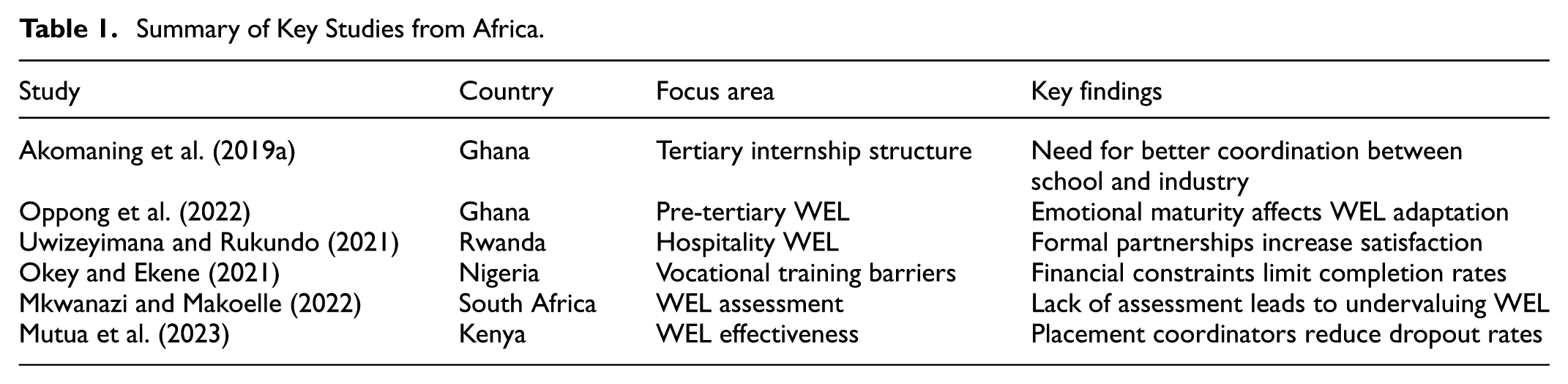
Summary Table of Key Studies
This synthesis supported the need for deeper, regionally diverse, and student-centered research into workplace learning in Ghanaian pre-tertiary TVET systems (Table 1).
Summary of Key Studies from Africa.
Theoretical Framework
This study is grounded in Situated Learning Theory (Lave & Wenger, 1991), which offers a powerful lens for understanding how learning occurs in real-world contexts, particularly in vocational and workplace-based education. The theory posits that learning is most effective when it takes place in the same context in which it is applied, emphasizing the significance of authentic social environments and practices. According to Lave and Wenger (1991), knowledge is not merely acquired through formal instruction but is constructed through participation in social and cultural activities, which they term “legitimate peripheral participation.” In this model, novices begin their learning journey by engaging at the periphery of a professional or vocational community and gradually move towards fuller participation as they acquire experience, skills, and confidence.
Within Situated Learning Theory (Lave & Wenger, 1991), three elements are particularly relevant to the context of Workplace Experience Learning (WEL): mentorship, industry relevance, and assessment integration. First, mentorship is central to the process of legitimate peripheral participation, where novices require guidance from more experienced practitioners to gradually acquire expertise. Second, industry relevance reflects the importance of authentic contexts, as learning is most meaningful when tasks mirror the real practices and tools of a professional community. Third, assessment integration, while less explicitly addressed in the original formulation of SLT, connects to the notion of participation being legitimized by recognition within the community of practice; learners’ contributions gain value when acknowledged and evaluated. These three elements, drawn directly from the logic of SLT, therefore informed the deductive coding framework of this study, ensuring theoretical alignment in the interpretation of learners’ lived experiences. The relevance of Situated Learning Theory to Workplace Experience Learning (WEL) is direct and compelling. WEL provides learners with the opportunity to engage in authentic, real-world tasks that mirror the expectations and operations of industry. In the context of pre-tertiary Technical and Vocational Education and Training (TVET) in Ghana, the theory explains how learners can develop vocational identities, practical competencies, and contextual understanding not merely by reading or observing but by participating meaningfully in the activities of skilled practitioners. The workplace becomes a living classroom where knowledge is not abstract but embodied, practiced, and negotiated within a community of workers.
Moreover, the theory underscores the importance of interaction and mentorship in the learning process. In the WEL environment, learners benefit from the guidance of workplace supervisors and facilitators who serve as more experienced “others,” helping them to navigate the routines, language, values, and expectations of their chosen fields. This aligns with Billett’s (2015) expansion of the theory in vocational contexts, where he emphasizes that the workplace should not only serve as a site of task performance but also as a pedagogical space where learning is planned, scaffolded, and reflective. Thus, SLT provides a solid theoretical foundation for examining how learners experience, interpret, and benefit from WEL in ways that classroom instruction alone cannot replicate.
Conceptual Framework
The conceptual framework that informs this study is constructed around the interplay of three core components: institutional design, student experience, and contextual enabling factors. These elements collectively shape how workplace experience learning is implemented and experienced within pre-tertiary TVET settings in Ghana. First, the institutional design encompasses the policy structures, operational mechanisms, and organizational practices through which WEL is integrated into the school curriculum. This includes the extent to which schools have formalized partnerships with industries, the systems in place for coordinating placements, the presence of orientation, and debriefing sessions, and the role of assessment in motivating learners and validating their experiences. The effectiveness of this domain depends largely on the institutional leadership’s capacity to interpret national policy into actionable school-level programs, supported by resources, personnel, and monitoring tools.
Second, the framework highlights the student’s lived experience as central to understanding the success or limitations of WEL. Learners bring to the program their expectations, anxieties, backgrounds, and aspirations, which interact dynamically with the realities of the workplace. Their experiences, whether positive or challenging, provide valuable insights into how learning occurs outside the classroom. This includes their exposure to new technologies, workplace cultures, professional role models, and feedback mechanisms. The phenomenological lens adopted in this study places the student’s voice at the center of analysis, capturing the nuances of how WEL shapes their identity, learning and career orientation.
The third dimension focuses on the enabling and hindering contextual factors that either facilitate or obstruct the implementation of WEL. These include logistical elements such as transportation, accommodation, and parental consent, as well as broader socio-economic and geographical disparities. For instance, learners from rural or low-income backgrounds may face greater obstacles in accessing quality placements, while industries in urban centers may be more prepared to receive and mentor learners. Additionally, gender, age, and prior exposure to work environments can influence how learners adapt and benefit from their placements.
By connecting these three domains, institutional infrastructure, student experience, and contextual conditions, the conceptual framework provides a holistic lens for examining WEL as a dynamic, multi-level phenomenon. It also allows for the identification of leverage points where interventions can be made to enhance program effectiveness, equity, and sustainability. Ultimately, this framework guides the study’s analysis of how learners experience WEL, the challenges they face, and the structural reforms needed to improve the program’s relevance and impact in the Ghanaian TVET landscape.
In practice, the Workplace Experience Learning (WEL) initiative in Ghana’s pre-tertiary TVET institutions has been implemented in several interrelated phases. First, learners are identified and oriented by their schools, often through brief pre-placement sessions that introduce workplace expectations, professional conduct, and logistical arrangements. Second, learners are placed in industries or enterprises that are expected to reflect their field of study, although in reality, mismatches sometimes occur due to limited availability of relevant industry partners. Third, learners undertake the placement period, typically lasting 6 weeks, during which they are expected to observe, participate, and gradually adapt to workplace routines. During this phase, the level of supervision and mentorship varies significantly depending on the host industry’s capacity and commitment. Fourth, learners return to their schools at the conclusion of the placement, where in some cases debriefing sessions are held, though formal assessment of the experience is not systematically integrated into the curriculum. These phases, that is, orientation, placement, workplace immersion, and post-placement reflection, thus provide the practical context within which WEL operates, and they directly shape the institutional, experiential, and contextual dimensions (Figure 1).
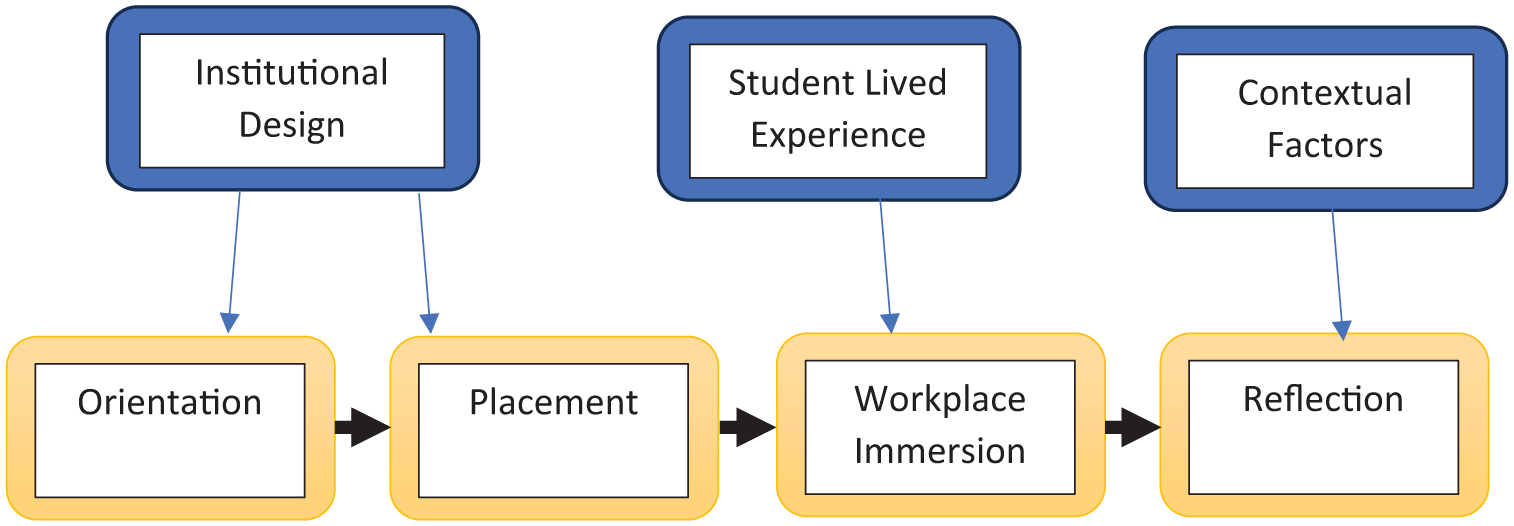
Conceptual framework for the study.
Methodology
Research Design
This study adopted the hermeneutic (interpretive) phenomenology design, drawing on Van Manen’s (2016) approach to explore the lived experiences of learners undergoing WEL in pre-tertiary TVET institutions in Kumasi. Van Manen emphasizes interpretive reflection and thematic analysis of persona narrative to uncover meaning structures embedded in experience. to understand the lived experiences of learners participating in the WEL program. Phenomenology is particularly suited for exploring subjective experiences, as it seeks to uncover the essence of participants’ perspectives (Moustakas, 1994). This design aligns well with the study’s focus on exploring learners’ perceptions and meanings attached to their participation in workplace learning.
Participants Diversity
The participants in this study consisted of 22 learners purposively selected from a pre-tertiary TVET institution in Kumasi, Ghana. Inclusion criteria required that learners had participated in the WEL Program during the specified academic year, with confirmation provided through duly completed WEL forms endorsed by the institutions where they undertook their placements. Additionally, participation was contingent upon the submission of parental consent forms and the learners’ agreement to take part in individual interviews of approximately 30 to 45 min in duration. Care was taken to ensure diversity across key demographic and educational variables, including gender, geographical background (urban, peri-urban, and rural), and program type (technical vs. vocational). This diversity was essential for capturing a broad spectrum of experiences and for understanding how contextual and identity-related factors shaped learners’ engagement with the Workplace Experience Learning (WEL) program.
Gender was considered a particularly important dimension, given the gendered nature of some vocational and technical tracks in Ghana. Both male and female learners were represented in the sample, allowing for insights into whether and how gender roles and expectations influenced access to placements, supervision styles, or comfort in workplace environments. Although no overt gender-based discrimination was reported by participants, subtle differences emerged. For instance, some female learners expressed initial discomfort being placed in male-dominated industrial settings, while others reported being positively mentored in environments that supported gender inclusivity.
The participants also came from diverse geographical settings, including urban, peri-urban, and rural areas. These distinctions were relevant in shaping access to industrial placements. Learners from urban and peri-urban backgrounds generally had more exposure to industries and were more likely to be placed in companies that aligned with their field of study. In contrast, learners from rural areas faced greater logistical challenges, such as limited availability of relevant industries nearby and increased difficulty in commuting or finding accommodation during the placement period. These disparities highlighted the structural inequities that can influence the effectiveness and inclusiveness of WEL implementation.
Finally, the sample reflected a balance between learners enrolled in technical programs (e.g., electrical installation, mechanical engineering) and those in vocational tracks (e.g., catering, garment making). Differences in placement experiences were observed along this axis as well. Technical program learners often reported challenges related to industry specialization and placement relevance, whereas vocational learners sometimes found placements more readily but expressed concern over the repetitive or observational nature of their assigned tasks, which they felt limited active learning.
Data Collection
In-depth interviews were the primary data collection method. The data collection tool, a semi-structured interview guide, was developed through a systematic process to ensure alignment with the study’s objectives and theoretical foundation. First, the research questions and the principles of Situated Learning Theory served as the primary basis for generating broad thematic areas, including learners’ expectations of the Workplace Experience Learning (WEL) program, the challenges encountered during placement, and suggestions for improvement. Drawing on existing literature on workplace learning and TVET (e.g., Akomaning et al., 2019b; Oppong et al., 2022; Uwizeyimana & Rukundo, 2021), the researchers identified recurrent issues such as mentorship, placement relevance, assessment, and logistical barriers, which were then translated into guiding questions. The guide was piloted with a small group of learners outside the main sample to refine the clarity, sequencing, and cultural appropriateness of the questions. Feedback from this pilot, as well as consultations with two experts in qualitative research and TVET education, informed revisions that enhanced the tool’s validity. The final guide balanced open-ended prompts with flexible probes, allowing for both consistency across interviews and the exploration of unanticipated themes that emerged from participants’ narratives.
Open-ended questions explored areas such as participants’ expectations, challenges encountered, and suggestions for improving the WEL program. Interviews were conducted in a quiet and comfortable setting to ensure that the participants felt at ease. Each interview lasted approximately 45 to 60 min and was audio-recorded with the consent of the participants. Supplementary data were collected through field notes and reflective journals maintained by the researcher, capturing non-verbal cues and contextual factors during the interviews.
Data Analysis
Thematic analysis was conducted following Braun and Clarke’s (2006) six-phase approach, which allowed for a systematic and rigorous interpretation of the data. First, the researchers familiarized themselves with the transcripts through repeated reading while noting initial impressions. Second, an initial round of open coding was undertaken, combining deductive codes derived from the research questions and Situated Learning Theory (e.g., “mentorship,”“industry relevance,”“assessment integration”) with inductive codes that emerged from participants’ narratives (e.g., “emotional detachment,”“peer solidarity,”“adaptive coping”). Third, related codes were collated into preliminary themes, which were then reviewed and refined to ensure internal coherence and distinction from other themes. Fourth, themes were defined and named in ways that captured their essence and relevance to the study’s research questions. NVivo software was employed to manage and organize the coding process, enhancing consistency and transparency. Finally, representative extracts were selected to illustrate each theme in the findings. This stepwise process ensured a balance between theoretical alignment and openness to new insights grounded in participants’ lived experiences.
Trustworthiness
To ensure trustworthiness, the study adopted Lincoln and Guba’s (1985) four criteria of credibility, transferability, dependability, and confirmability, operationalized in concrete ways. Credibility was enhanced through triangulation of three data sources namely, interview transcripts, researcher field notes, and reflective journals, which allowed for cross-verification of findings. Member checking was conducted by returning preliminary themes to selected participants for feedback, ensuring that interpretations accurately reflected their perspectives (Moustakas, 1994). Dependability was strengthened through a double-coding process, where two researchers independently coded a subset of transcripts and compared results; discrepancies were discussed and resolved, with the final codebook applied consistently across all data (Miles et al., 2014). Inter-coder agreement was calculated in NVivo, yielding a strong Kappa coefficient of .82. Confirmability was supported by maintaining an audit trail that documented coding decisions, theme development, and reflexive notes on researcher assumptions. Finally, transferability was addressed by providing thick descriptions of participants’ contexts, enabling readers to judge the applicability of findings to similar TVET settings (Shenton, 2004). These practices collectively ensured methodological rigor and strengthened the reliability and validity of the study’s conclusions.
Ethical Considerations
Since the study involved learners who were below the age of 18, ethical approval was first obtained from the researchers’ institutional review board before going to the field. Participants were then provided with detailed information about the study’s purpose, procedures, and potential risks. Informed consent was obtained from all participants who were 18 years, and for those under 18, consent forms were signed by their guardians before they were included in the study. Confidentiality was maintained by anonymizing all identifying information, and participants were assured of their right to withdraw from the study at any point without repercussions. Special care was taken to create a supportive environment, ensuring that the participants felt respected and valued throughout the research process.
Positionality of the Researcher
As a mathematics educator at a pre-tertiary TVET institution in Ghana, the researcher occupies a dual position that is both insider and observer. This positionality significantly influenced the research design, data collection, and interpretation processes. Having worked closely with learners who participated in the inaugural implementation of the Workplace Experience Learning (WEL) program, the researcher brought to the study a deep understanding of the institutional environment, curriculum expectations, and the socio-educational dynamics that shape learners’ learning experiences.
This proximity to the research context offered several advantages. First, it facilitated the establishment of trust and rapport with the participants, enabling them to speak openly about their experiences. Learners were more willing to share their perceptions, challenges, and reflections, knowing that the researcher had an informed appreciation of their educational journey. Second, the researcher’s familiarity with the institutional structures and stakeholders involved in WEL implementation provided valuable insights into how policies are translated into practice at the school level. These insights enriched the interpretation of the findings, particularly regarding logistical challenges and assessment practices.
However, the insider position also posed potential risks of bias, particularly in the interpretation of student narratives or in the framing of challenges that may reflect systemic shortcomings within the researcher’s own institution. To mitigate these risks, reflexive practices were employed throughout the study. This included maintaining a research journal to document personal assumptions and reactions during data collection and analysis, as well as engaging in member checking with participants to validate the authenticity of interpreted meanings. Additionally, peer debriefing and feedback from external colleagues were sought to enhance analytical rigor and ensure the trustworthiness of the findings.
Overall, the researcher’s professional background provided both an informed lens and a reflective stance, enhancing the study’s depth while maintaining the integrity required for qualitative inquiry. This positionality, rooted in practice and reflective analysis, served to bridge the gap between policy discourse and the lived realities of learners navigating the evolving landscape of WEL in Ghana’s TVET system.
Findings
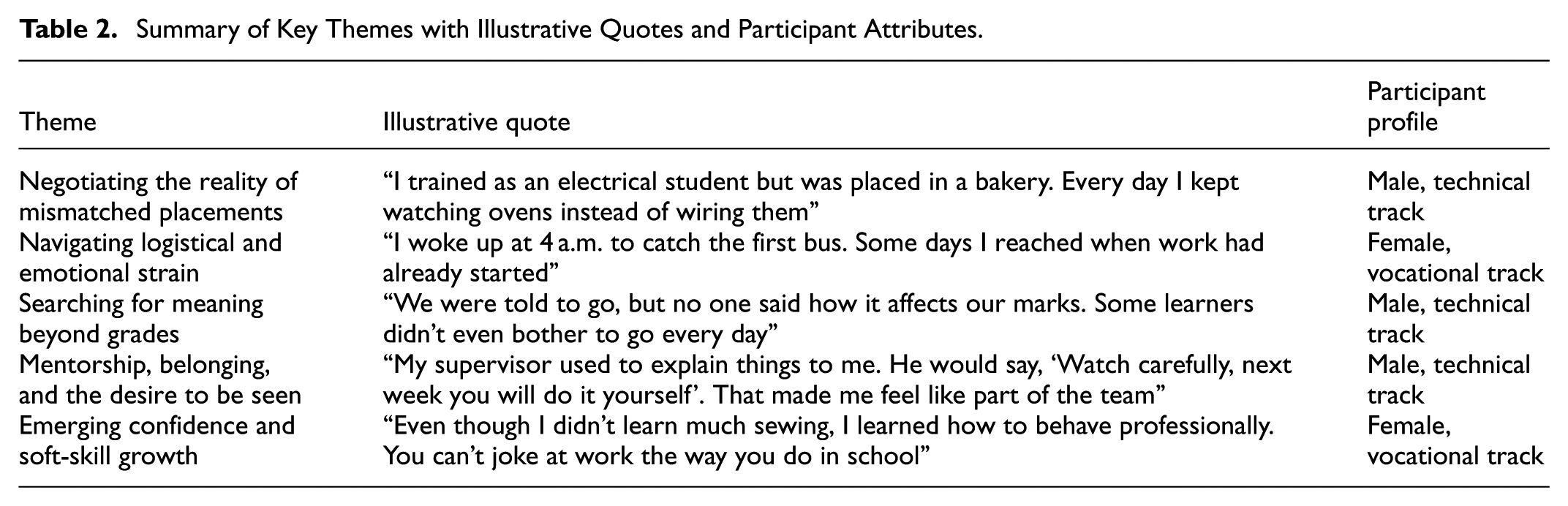
In the reporting of qualitative findings, all participant names have been replaced with pseudonyms to ensure confidentiality and protect the identities of the individuals involved. The findings from the in-depth interviews with 22 pre-tertiary TVET learners are presented under five interrelated themes that emerged through phenomenological analysis. These themes capture the essence of how learners lived, interpreted, and made sense of their participation in the Workplace Experience Learning (WEL) program. Each theme combines descriptive and interpretive accounts to reveal both the diversity and the shared meaning structures that characterized learners’ experiences. Table 2 provides an overview of the key themes and illustrative participant quotes.
Summary of Key Themes with Illustrative Quotes and Participant Attributes.
Negotiating the Reality of Mismatched Placements
A dominant theme in participants’ narratives was the disconnect between their area of study and the work assigned during placement. This mismatch evoked frustration, confusion, and, for some, reluctant acceptance.
I trained as an electrical student but they put me in a bakery. Every day I just kept watching ovens instead of wiring them. It felt pointless. (Yaw, Technical—Electrical Installation) They said it was a catering company, but I ended up serving food at the front desk, not in the kitchen. I felt like an extra hand, not a learner. (Rita, Vocational—Catering) At first, I was angry. I wanted to complain, but later I thought maybe it’s still teaching me discipline. I learned to adapt even if it wasn’t what I expected. (Kwaku, Technical—Plumbing) We were told it’s part of learning, but how do you learn something that’s not your field? I just observed and tried to pick some ideas. (Afia, Vocational—Garment Making)
These stories portray WEL as both an opportunity and a missed promise. The mismatch disrupted learners’ sense of purpose, limiting their ability to participate authentically within a community of practice. Yet, their accounts also reveal a process of adaptation—an evolving effort to find meaning despite systemic constraints. Phenomenologically, this theme embodies a tension between expectation and acceptance, reflecting how learners reconstruct meaning when faced with institutional limitations. Within Situated Learning Theory, such mismatches restricted legitimate participation, keeping learners at the periphery of their intended vocational communities.
Navigating Logistical and Emotional Strain
Almost all participants highlighted the logistical difficulties of participating in WEL, particularly transportation, cost, and fatigue. These daily struggles shaped their emotional engagement and sense of belonging.
I woke up at 4 a.m. to catch the first bus. Some days I reached when work had already started. I felt embarrassed walking in late. (Ama, Vocational—Tailoring) Transport alone was a problem. My mother had to borrow money sometimes, and I felt guilty, like I was stressing the family. (Samuel, Technical—Mechanical) There were days I wanted to quit because of the distance. My feet would hurt, but I kept going because I didn’t want to fail my teachers. (Esi, Vocational—Catering) It was not just tiredness. Sometimes I felt lonely because I was the only student there. No one to talk to or ask for help. (Kwabena, Technical—Electronics)
These accounts reveal how structural conditions—distance, cost, and isolation—shaped the lived experience of WEL. For many, the journey to the workplace became symbolic of a deeper emotional journey marked by perseverance and fatigue. Phenomenologically, the sense of physical struggle mirrors the learners’ psychological labor of belonging. In the context of Situated Learning Theory, such logistical and emotional barriers hindered active engagement, constraining the social interaction necessary for legitimate participation.
Searching for Meaning Beyond Grades
Learners frequently expressed uncertainty about the academic relevance of WEL, since it did not count toward formal assessment. This ambiguity led to mixed responses—some disengaged, while others sought intrinsic motivation.
We were told to go, but no one said how it affects our marks. Some learners didn’t even bother to go every day. (Michael, Technical—Welding) If it counted towards our grade, I would have been more serious. Right now, it feels like something we just do and forget. (Akosua, Vocational—Garment Making) Even without marks, I think I learned things about how work life is. You can’t be lazy there; people are watching. (Kojo, Technical—Auto Mechanics) I realized it’s not only about school marks. It’s about how you see yourself. I started to feel more confident after a few weeks. (Grace, Vocational—Catering)
These reflections illustrate a gradual shift from external to internal meaning-making. While some participants equated value with grades, others discovered personal growth and professional awareness. The phenomenological essence of this theme is the search for legitimacy—learners yearning for their efforts to be recognized, either institutionally or personally. Within Situated Learning Theory, assessment represents symbolic recognition within a community of practice; its absence left learners uncertain of their standing, undermining motivation and perceived value.
Mentorship, Belonging, and the Desire to Be Seen
Learners consistently emphasized the role of mentorship in shaping their sense of belonging. Those who received guidance felt validated and confident; those left unsupervised felt invisible and peripheral.
My supervisor used to explain things to me. He would say, “Watch carefully, next week you will do it yourself.” That made me feel like part of the team. (Selorm, Technical—Electrical) The madam there treated me like her daughter. She told me stories about how she started her business. I learned more from her than from any book. (Mary, Vocational—Catering) In my place, nobody talked to me. They were busy. I just sat and watched until closing time. I felt useless. (Ebenezer, Technical—Carpentry) When my teacher visited once, everything changed. They took me seriously after that. It showed me that someone cared. (Abena, Vocational—Fashion Design)
The longing to be seen and guided was deeply emotional. Learners associated mentorship with human connection, trust, and acknowledgment. From a phenomenological lens, mentorship represented the bridge between isolation and belonging. In Situated Learning Theory, mentors serve as experienced practitioners who facilitate the learner’s movement from peripheral observation toward authentic participation. Their absence disrupted this process, leaving many learners stranded at the margins of the workplace community.
Emerging Confidence and Soft-Skill Growth
Despite mismatches and logistical challenges, most participants described developing personal growth and soft skills—confidence, communication, and teamwork.
I learned to talk to customers politely and manage my time. Before WEL, I was shy, but now I can face people. (Naana, Vocational—Catering) Teamwork was the biggest lesson. In class we work alone, but in the workshop you depend on others. (Richmond, Technical—Welding) I became more patient. Work doesn’t always go as you plan. That’s something I’ll carry with me. (Emmanuel, Technical—Plumbing) Even though I didn’t learn much sewing, I learned how to behave professionally. You can’t joke at work the way you do in school. (Ama, Vocational—Garment Making)
These experiences highlight WEL as a site of self-discovery rather than mere skill acquisition. Learners articulated a new sense of maturity and professional identity emerging from their participation. Phenomenologically, this theme represents transformation—the movement from being a student to becoming a worker. Within Situated Learning Theory, this reflects partial progression from peripheral involvement to legitimate participation, achieved not only through technical tasks but also through socialization into workplace norms.
Essence of the Experience
Across these five themes, the essence of learners’ lived experience can be described as “struggling toward belonging.” WEL was simultaneously empowering and constraining: a process marked by mismatched placements, logistical barriers, and inconsistent mentorship, yet also by resilience, self-discovery, and growing professional confidence. Learners’ journeys were shaped as much by emotional and social negotiation as by technical learning.
Through a phenomenological lens, WEL emerged as a space where young learners grappled with the meaning of work, legitimacy, and identity within imperfect structures. In the language of Situated Learning Theory, their stories represent partial and uneven participation in communities of practice—struggles for inclusion that, despite challenges, ignited moments of authentic learning and personal transformation.
Discussion
The findings of this study expose systemic implementation challenges in Ghana’s Workplace Experience Learning (WEL) program. When situated within the broader discourse of TVET in low- and middle-income countries (LMICs), these challenges reflect both shared constraints and context-specific nuances. This section analyses the implications of the findings in relation to the study’s three research questions (RQs), critiques the national policy framework, and re-engages with Situated Learning Theory.
Mismatched Placements and Global Skill use Gaps
The mismatch between learners’ training and placements undermined the authenticity required for effective learning. SLT emphasizes “legitimate peripheral participation” (Lave & Wenger, 1991), where novices develop skills by engaging in authentic tasks within a community of practice. However, learners assigned to unrelated industries could not meaningfully participate, echoing Billett’s (2015) warning that workplace affordances shape learning opportunities. Similar misalignments have been documented in Kenya (Mutua et al., 2023) and India (Rai & Agarwal, 2018), highlighting a common implementation weakness in LMICs.
Structural Inequities and the Policy-Practice Divide
Logistical challenges disproportionately affected rural and peri-urban learners, creating inequitable access to WEL. Although the CTVET framework seeks inclusivity, its centralized planning often neglects ground-level disparities. Tikly (2013) similarly noted that African TVET policies frequently overlook local constraints. Within SLT, participation is shaped not only by social interaction but also by the material conditions of learning. Long commutes and lack of accommodation eroded learners’ ability to engage fully, showing that structural inequities can obstruct authentic participation.
Disconnected Assessment and Motivation
Learners’ perception of WEL as irrelevant to their grades reduced commitment. This aligns with studies in South Africa (Mkwanazi & Makoelle, 2022) and Nigeria (Okey & Ekene, 2021), where workplace learning was undervalued without formal assessment. From an SLT perspective, assessment represents recognition by the community of practice. Without it, participation feels unofficial and unmotivating. Integrating WEL into continuous assessment would legitimize learners’ contributions and align motivation with program goals.
Mentorship and Legitimate Participation
The absence of mentorship weakened learners’ sense of belonging in workplaces. SLT highlights mentorship as crucial for moving from peripheral to full participation. Yet many Ghanaian learners reported “being left on their own.” This mirrors findings in Rwanda (Uwizeyimana & Rukundo, 2021) and Nigeria (Ezeanya & Udu, 2021), where lack of supervisor engagement diminished learners’ confidence. Billett (2015) further stresses that guided participation is essential for competence development. Without mentors, WEL risks becoming observational rather than participatory.
Towards Context-Sensitive Reform
The findings show that while WEL has transformative potential, its success depends on structured placements, logistical support, academic integration, and strong mentorship. Promising practices piloted by some schools—including teacher check-ins, assessment tools, and mapping of local industries—should be scaled up. International lessons (International Labour Organization (ILO), 2020) suggest that decentralized, school-level partnerships yield better alignment than top-down policies alone.
Conclusion and Recommendations
Conclusion
This study examined the inaugural implementation of Workplace Experience Learning (WEL) in Ghana’s pre-tertiary TVET institutions, focusing on learners’ lived experiences, the challenges encountered, and possible pathways for improvement. Through phenomenological inquiry with 22 learners, the study uncovered a complex picture.
First, learners whose placements aligned with their training areas reported motivation, career clarity, and affirmation of their chosen fields. However, mismatched placements, experienced by nearly half of participants, limited the authenticity of learning, leaving learners frustrated, and underutilized. Second, structural inequities, especially transportation and accommodation challenges, disproportionately affected rural and peri-urban learners, constraining equitable access to WEL. Third, the absence of academic recognition and assessment mechanisms diminished learners’ commitment, while the lack of mentorship weakened their sense of belonging in workplace communities. Despite these challenges, many learners gained soft skills such as punctuality, communication, and teamwork, indicating that WEL holds promise even under imperfect conditions.
Theoretically, the study demonstrates both the relevance and the limitations of Situated Learning Theory in resource-constrained contexts. SLT assumes that learners gradually progress from peripheral to full participation in authentic communities of practice through mentorship and guided participation. In Ghana’s WEL, however, mismatched placements and absent mentors often disrupted this process. The findings therefore suggest that SLT must be adapted to account for contexts where industry-school collaboration is weak and where structural inequities limit authentic participation. In such environments, institutional scaffolding, through structured placements, academic integration, and monitoring, is not an optional enhancement but a necessary condition for learning.
Overall, this study shows that WEL has transformative potential for pre-tertiary TVET learners in Ghana, but its effectiveness depends on context-sensitive implementation. Unless deliberate efforts are made to align placements, provide logistical support, integrate WEL into assessment, and ensure mentorship, the program risks becoming symbolic rather than substantive.
Recommendation
To ensure that the Workplace Experience Learning (WEL) program achieves its transformative objectives, a phased, collaborative approach is necessary. This section presents realistic and context-sensitive recommendations, organized by feasibility into short-term, medium-term, and long-term priorities. Furthermore, each recommendation is situated within a broader framework of stakeholder responsibility, recognizing the critical roles that schools, the Commission for Technical and Vocational Education and Training (CTVET), industry partners, and parents or guardians must play in successful implementation.
In the short term, actions that require minimal structural overhaul but can significantly enhance WEL’s effectiveness should be prioritized. Chief among these is the integration of WEL into academic assessment frameworks. Schools should immediately begin incorporating performance during placements into continuous assessment by adopting tools such as reflective student logs, supervisor evaluation forms, and end-of-placement reports. CTVET, as the regulatory body, can support this effort by issuing national guidelines that standardize these assessment practices across schools. In parallel, schools should introduce structured orientation programs to prepare learners for professional environments, while assigning facilitators or teacher-mentors to conduct weekly check-ins with learners during placements. These mentors will provide emotional and academic support, helping to resolve emerging challenges in real time. Schools can also begin to map industries within their locality that align with their academic offerings and initiate preliminary partnerships through informal agreements. Basic digital tracking tools, such as spreadsheets or local databases, can be introduced to monitor placements and student feedback even before a full digital system is developed.
Over the medium term, efforts should shift toward institutionalizing and scaling these initial steps. Formalizing partnerships with industries through memoranda of understanding will be crucial. These agreements should include provisions for mentoring, clear expectations of student roles, and mechanisms for evaluating workplace performance. Schools will require designated placement officers or liaison personnel who are trained to manage these relationships and coordinate placements effectively. Concurrently, schools should conduct needs assessments to identify and address logistical challenges, especially those related to transportation and accommodation for learners placed at a distance from their homes. CTVET’s role at this stage will involve building institutional capacity by providing training for teachers, placement coordinators, and industry mentors. Industry partners, for their part, should commit to hosting learners consistently and offering structured learning experiences. Parents and guardians also play an important role, particularly in granting consent and, where possible, supporting learners logistically and emotionally throughout the placement period.
In the long term, sustainable implementation will require policy reforms and resource mobilization. Government support, especially through CTVET and the Ministry of Education, must move beyond issuing directives and invest in systemic solutions. These include the provision of subsidies or stipends to assist learners with accommodation and transportation, particularly those from rural or low-income households. A national digital platform for WEL management should also be developed to centralize data collection, monitor placements, and support real-time decision-making. Importantly, WEL should be fully integrated into the national TVET curriculum as a compulsory and examinable component. This will require not only curriculum revisions but also alignment with national labor market strategies to ensure that the skills learners develop are demand-driven. Parents, schools, and industry partners should be engaged in policy dialogues to ensure that reforms are grounded in practical realities and benefit from grassroots insights.
Importantly, while this study is situated in Ghana, the findings have broader relevance for other low- and middle-income countries (LMICs) implementing or considering similar workplace learning models in TVET. The challenges of logistical inequities, placement mismatches, and disjointed school-industry coordination are common across many LMIC contexts. As such, the recommendations presented, such as structured placements, integrated assessment, and stakeholder collaboration, may be transferable and adaptable to comparable settings facing similar constraints.
Stakeholder-Specific Actions
Table 3 outlines the roles of key actors in implementing the WEL reforms:
Stakeholder-Specific Actions.

Implications for Policy and Practice
The findings of this study point to three critical implications for policy and practice in Ghana’s pre-tertiary TVET sector. First, the short-term integration of WEL into continuous assessment is urgent if learners are to perceive the program as academically meaningful. Without this, participation risks remaining symbolic. Second, medium-term reforms must prioritize institutional capacity-building through trained placement coordinators, structured industry partnerships, and needs-based logistical support, particularly for rural and low-income learners. Third, in the long term, WEL must be fully institutionalized as an examinable component of the national TVET curriculum, supported by government subsidies and a centralized digital monitoring system. For practice, this means that schools, industries, and parents cannot operate in isolation; sustained collaboration and accountability mechanisms are needed to ensure that workplace experiences are not only available but also equitable and pedagogically sound. These implications extend beyond Ghana, offering a roadmap for other LMICs seeking to implement workplace learning in resource-constrained settings.
Limitations of the Study and Implications for Future Research
While this study provides meaningful insights into the lived experiences of learners in Ghana’s inaugural Workplace Experience Learning (WEL) program at the pre-tertiary sector, several limitations should be acknowledged. First, the study’s sample was limited to 22 learners from a single pre-tertiary TVET institution in Kumasi. Although efforts were made to include diverse participants across gender, geographical background, and program type, the findings may not be fully generalizable to other regions or institutions in Ghana. Second, the research design was cross-sectional, capturing learners’ experiences at a single point in time. This limits the ability to assess the long-term impact of WEL on learners’ career trajectories, skill retention, or employment outcomes. Third, while the study incorporated multiple data sources (interviews, field notes, reflective journals), it relied primarily on self-reported data, which may be subject to recall or social desirability bias. Finally, the study focused exclusively on learners’ perspectives; the views of other key stakeholders, such as industry supervisors, school coordinators, and policymakers, were not examined, potentially overlooking systemic and operational factors that influence WEL implementation.
These limitations suggest several productive avenues for future research. First, longitudinal studies are needed to track the sustained effects of WEL on learners’ employability, career choices, and professional development. Second, multi-stakeholder investigations that include industry partners, school administrators, and policymakers could provide a more holistic understanding of the structural and relational dynamics that shape WEL effectiveness. Third, comparative studies across different geographical and institutional contexts within Ghana, particularly between urban and rural settings, would help identify context-specific barriers and enabling factors. Fourth, research that examines the role of gender, socio-economic status, and disability in shaping access to and outcomes of WEL is essential for advancing equity in TVET. Finally, future studies could explore innovative assessment models and digital tools for monitoring and evaluating WEL, contributing to more evidence-based policy and practice.
Supplemental Material
sj-docx-1-sgo-10.1177_21582440251411964 – Supplemental material for Workplace Experience Learning at the Pre-Tertiary TVET Level in Ghana: A Phenomenological Study
Supplemental material, sj-docx-1-sgo-10.1177_21582440251411964 for Workplace Experience Learning at the Pre-Tertiary TVET Level in Ghana: A Phenomenological Study by Derick Folson and Francis Kwadwo Awuah in SAGE Open
Footnotes
Acknowledgements
The researchers acknowledge the crucial contributions of the principal and his assistants for opening their doors to the researchers for the conduct of this study in their premises. To all the parents/guardians who agreed to allow their wards to participate in the study, we are eternally grateful. Finally, we acknowledge the learners for providing candid responses to interview questions without fear.

Ethical Considerations
Since the study involved a human participant, ethics approval was secured from the Humanities and Social Sciences Research Ethics Committee at the College of Humanities and Social Sciences, of the Kwame Nkrumah University of Science and Technology (KNUST) with reference number HuSSREC/AP/57/VOL. 3.
Funding
The authors received no financial support for the research, authorship, and/or publication of this article.
Declaration of Conflicting Interests
The authors declared no potential conflicts of interest with respect to the research, authorship, and/or publication of this article.
Data Availability Statement
The datasets generated and analysed during the current study are qualitative in nature and consist of audio-recorded interviews, verbatim transcripts, researcher field notes, and reflective journals collected from pre-tertiary TVET learners who participated in the Workplace Experience Learning (WEL) programme in Ghana. Due to the ethical requirements of the study, including the protection of participants' anonymity, the involvement of minors, and the confidentiality agreements approved by the institutional review board, these data are not publicly available.
Anonymised excerpts of the data that support the findings of this study are included within the article. Additional de-identified data may be made available by the corresponding author upon reasonable request and subject to ethical approval, participant consent provisions, and compliance with institutional and national research ethics guidelines.
Supplemental Material
Supplemental material for this article is available online.
References
Supplementary Material
Please find the following supplemental material available below.
For Open Access articles published under a Creative Commons License, all supplemental material carries the same license as the article it is associated with.
For non-Open Access articles published, all supplemental material carries a non-exclusive license, and permission requests for re-use of supplemental material or any part of supplemental material shall be sent directly to the copyright owner as specified in the copyright notice associated with the article.
