




Abstract
The development of cultural intelligence is considered a crucial attribute for global leaders as it allows them to go through and work effectively in diverse cultural environments. Previous studies have shown that this intelligence, which can be measured through the Cultural Quotient (CQ) concept, is primarily developed through the experiences of individuals interacting with other cultures. However, there is a lack of research on how this occurs during an intercultural experience. This study aims to answer the following question: how situated learning contributes to the development of Cultural Intelligence (CQ) during international experiences? The research method was netnography. Using a mobile application, we followed 12 undergraduate management students during 6 months of their academic international exchanges in five different countries. We collected archival data, extracted data, and field note data. The main findings indicate that CQ primarily develops through everyday activities and interactions with locals and foreigners of various nationalities. Close relationships, friendships, trigger events, and the materiality of culture are critical factors in the development of CQ, particularly in the motivational and cognitive dimensions. In conclusion, the development of CQ is considered an essential factor for cross-cultural management success, as it provides the knowledge, skills, and abilities to effectively communicate, adapt and lead in a culturally diverse environment.
Plain language summary
This study aims to answer the following question: how situated learning contributes to the development of Cultural Intelligence (CQ) during international experiences? The research method was netnography. The main findings indicate that CQ primarily develops through everyday activities and interactions with locals and foreigners of various nationalities. Close relationships, friendships, trigger events, and the materiality of culture are critical factors in the development of CQ, particularly in the motivational and cognitive dimensions. In conclusion, the development of CQ is considered an essential factor for cross-cultural management success, as it provides the knowledge, skills, and abilities to effectively communicate, adapt and lead in a culturally diverse environment. In terms of practical implications, our study provides valuable insights into the developmental process of Cultural Intelligence (CQ) during international exchange experiences. This, in turn, offers a pathway for enhancing and nurturing the effectiveness of situated learning in these contexts. For instance, while higher education curricula often prioritize academic pursuits, our research findings underscore the significance of intercultural learning occurring predominantly beyond formal academic settings. Consequently, there is a compelling case for fostering and recognizing diverse social interactions and activities as integral components of this learning journey. As research limitations, the data collected is based on the participants’ reports about their experiences. Therefore, possible response biases may exist. Despite the advantages of collecting data via the use of mobile devices in different cultural settings, this form of collecting data can bring limitations to the research, such as unclear validity and accuracy of data and the lack of involvement of researchers in the field. Besides, although there were no differences in the experiences reported by students according to their gender, the number of male and female participants in the research is not balanced.
Keywords
Introduction
An increasing number of individuals cross geographical and cultural boundaries to reach job opportunities, study, and leverage their careers. It has motivated many scholars to research and better understand the concept of cultural intelligence, also called the Cultural Quotient (CQ). CQ is “an individual’s capability to act and manage effectively in culturally diverse settings” (Ang et al., 2007). CQ studies have been growing, involving issues such as cultural exchanges (Varela & Gatlin-Watts, 2014), global mindsets and global leadership (Ramsey et al., 2017), study programs abroad (Holtbrügge & Engelhard, 2016; Iskhakova et al., 2022; Lambert Snodgrass et al., 2021), factors that influence the career of expatriates (Presbitero & Quita, 2017), and cultures as learning laboratories (Mosakowski et al., 2013).
Several studies posit the importance of fostering cultural intelligence (CQ) through international experiences, given its direct correlation with students’ achievements in both academic and professional domains (Iskhakova et al., 2022; Ott & Michailova, 2017; Peng et al., 2015; Wildman & Griffith, 2022). International experiences can influence components of CQ because working and living in other cultures provide individuals with learning opportunities to increase their cultural consciousness, awareness, and knowledge, examine their cultural assumptions, and actively engage in thinking and reflecting before and during interactions (Şahin et al., 2014). In this sense, the interpretation or creation of meaning through everyday activities can be called Situated Learning, which is an integral and inseparable dimension of the social practices of individuals in everyday life (Lave & Wenger, 1991).
Through the literature review, we found that CQ studies approach the preparation of individuals to go abroad (Earley & Peterson, 2004; Eisenberg et al., 2013; Holtbrügge & Engelhard, 2016; Presbitero & Quita, 2017). Some researchers interview individuals in an intercultural environment (Adair et al., 2015; Ang & Inkpen, 2008; Rosenblatt et al., 2013). Other studies measure individuals’ CQ before and after an intercultural experience (Alexandra, 2018; Ng et al., 2009; Presbitero, 2016; Şahin et al., 2014).
Tools used to assess the development of CQ focus on the learning outcomes measured after the intercultural experiences of individuals. Recent studies that address the development of CQ during international exchanges (Iskhakova et al., 2022; Lambert Snodgrass et al., 2021) highlight this—the data is collected before and after intercultural experiences, rather than “during,” confirming this knowledge gap: how CQ is actually developed in everyday life experiences during intercultural experiences? Thus, the call for longitudinal inquiries to meticulously chart the evolution of CQ during intercultural experiences (Şahin et al., 2014) within authentic cross-cultural contexts is still compelling.
Considering this gap, we adopt a perspective rarely found in previous studies: We attempted to understand how CQ is developed during real intercultural experiences. The research assumption is that the development of CQ is more effective and meaningful when it occurs in environments that resemble the situations in which the knowledge and skills related to it will be applied. Based on the theory of Situated Learning (Brown et al., 1989; Lave & Wenger, 1991), we assume that everyday life activities in international experiences for the development of CQ contrast with traditional educational models that emphasize abstract and decontextualized learning in classroom settings (Brown et al., 1989; Lave & Wenger, 1991). Situated learning is learning based on authentic activities, meaning ordinary practices of a culture (Brown et al., 1989). Therefore, the article intends to answer the following research question: “How situated learning contributes to the development of Cultural Intelligence (CQ) during international experiences?”
To answer this question, we conducted a study with 12 management undergraduate students who experienced an international academic experience for 6 months, living in five different countries. We followed the students through an online community accessed via mobile devices, which allowed us to observe and analyze the development of CQ in Situated Learning.
Our study has shown that cross-cultural exchanges create valuable opportunities for networking and relationship-building, which are essential for global leaders. We summarize the research results in a framework that generates an understanding of how CQ develops during an international academic experience, suggesting how this form of learning can be further stimulated.
Ott and Iskhakova (2019) critically analyzed and evaluated the use of the “international experience” construct within the specific context of developing CQ and found that the existing knowledge on the construct of international experience is fragmented, uses inconsistent terminology and does not uniformly rely on any underlying conceptual framework. In this sense, the framework proposed in this article can inform practitioners and researchers that design cross-cultural educational programs and serve as a basis for future research on this subject (Iskhakova et al., 2022; Ott & Iskhakova, 2019; Wildman & Griffith, 2022).
The framework provides valuable insights into the developmental process of CQ during international exchange experiences. It offers a pathway for enhancing and nurturing the effectiveness of situated learning in these contexts. For instance, while higher education curricula often prioritize academic pursuits, our research findings underscore the significance of intercultural learning occurring predominantly beyond formal academic settings. Consequently, a compelling case exists for fostering and recognizing diverse social interactions and activities as integral components of this learning journey.
Theoretical Foundations
Cultural Intelligence
Cultural Intelligence, also called Cultural Quotient (CQ), encompasses the factors that enable individuals to act effectively in intercultural contexts (Ang & Van Dyne, 2008; Earley & Ang, 2003; Ng & Earley, 2006). CQ was defined by Earley and Ang (2003) as a construct that captures an individual’s characteristics, capabilities, and skills to interact effectively in new intercultural contexts.
Ott and Michailova (2018) claim that individuals who develop a high level of CQ tend to have successful intercultural interactions and become effective global leaders. Alexandra (2018) states that CQ is a construct with a grounded and comprehensive theoretical framework.
Many positive and desirable outcomes of individual action in intercultural contexts have been associated with CQ. According to Alexandra (2018), among the results, we can highlight better judgment and decision-making (Ang et al., 2007), creative collaboration (Chua et al., 2012), cross-cultural negotiation effectiveness (Imai & Gelfand, 2010), and work performance (Chen et al., 2012).
Almost a decade after Earley and Ang (2003) conceptualized CQ as a multidimensional construct, Van Dyne et al. (2012) expanded this conceptualization to include subdimensions for each of the four major dimensions: metacognitive, cognitive, motivational, and behavioral CQ. The result was a four-dimensional model with 11 subdimensions, as discussed next, based on Ang and Inkpen (2008), Ang and Van Dyne (2008), Eisenberg et al. (2013), Livermore (2013), Ott and Michailova (2018), and Van Dyne et al. (2012).
Motivational CQ is the initial dimension of CQ development. It refers to an individual’s ability to begin, maintain, and sustain learning and functional behaviors in intercultural contexts (Ang & Inkpen, 2008; Van Dyne et al., 2012). Individuals with high motivational CQ tend to be interested in learning new cultural configurations and peculiarities, becoming more confident in an intercultural situation. Motivational CQ encompasses three subdimensions (Van Dyne et al., 2012): Intrinsic Interest (valuing intercultural experiences), Extrinsic Interest (appreciation of tangible and personal benefits that can be gained through culturally diverse experiences), and Self-efficacy (self-confidence to perform tasks in intercultural situations).
Cognitive CQ refers to the objective knowledge (of economic, political, and legal aspects, as well as social customs and traditions) and subjective knowledge (beliefs and values) of a culture (Ang & Inkpen, 2008; Van Dyne et al., 2012). It is considered critical because an individual with high cognitive CQ can identify and understand similarities and differences in cultural contexts, resulting in more accurate interpretations and expectations regarding different cultures and effective interactions. It has two subdimensions (Van Dyne et al., 2012): Culture-General Knowledge (knowledge of the universal elements that constitute a cultural environment); Context-Specific Knowledge (knowledge of a specific cultural context and how to interact effectively in this context).
Metacognitive CQ encompasses individuals’ strategies to interact in intercultural contexts (Ang & Inkpen, 2008; Van Dyne et al., 2012). It refers to a high cognitive process that induces individuals to critically analyze their knowledge and cultural assumptions, reflecting on their actions before and during intercultural interactions, which helps them create appropriate strategies for the context. The three subdimensions of metacognitive CQ are (Van Dyne et al., 2012): Planning (strategic preparation before an intercultural experience); Awareness (always being aware of what happens to oneself and others), and Checking (a review or analysis of assumptions and adjustment of mindsets, making a comparison between perspective and reality during intercultural interactions).
Behavioral CQ refers to the proper behavior of individuals in an intercultural context, to the ability to display verbal and nonverbal actions appropriate to cultural values. Individuals with high behavioral CQ have greater behavioral flexibility (Ang & Inkpen, 2008; Van Dyne et al., 2012). They can change behavior according to the cultural demands of the environment, making counterpart individuals comfortable during intercultural interactions (Van Dyne et al., 2012). Behavioral CQ is critical because it involves a visible feature in intercultural interactions. It is divided into three subdimensions: Flexibility in verbal behavior (in the tone of voice), Flexibility in non-verbal behavior (in communication without words—gestures, facial expressions, and body language), and Flexibility in speech acts (in the way individuals appropriately communicate specific types of messages such as requests, invitations, apologies, gratitude, disagreement, expressed based on local standards).
High levels of CQ allow individuals to verify the accuracy of their cultural assumptions and adjust their strategies to meet the demands of cultural contexts (Van Dyne et al., 2012). Ramsey et al. (2017) state that individuals who act in the global market and have high levels of CQ may exert transformational leadership because they can understand the differences between other cultures and adjust their behavior accordingly. This flexibility, obtained through high levels of CQ, enables individuals to learn effectively and, consequently, adapt to the changes and needs of their sociocultural environment. We attempted to understand how CQ can be developed through the concept of Situated Learning, which is explained next.
Cultural Intelligence and Situated Learning
Lave (1988), aiming to research the use of in situ arithmetic, followed individuals’ daily lives in different contexts and situations beyond the classroom, such as when they were comparing prices, going to the supermarket, and cooking, situations in which they used mathematics outside the academic context. It gave origin to the conceptualization of Situated Learning.
Lave and Wenger (1991) explained that learning is an integral and inseparable dimension of the social practices of individuals in everyday life and involves a process of interpretation of everyday practices. Therefore, the concept of Situated Learning shifts attention from information processing to the processes of social participation and interaction, which provide and sustain the learning context (Gherardi et al., 1998; Houde, 2007; Lave & Wenger, 1991). Social interactions are essential for Situated Learning because the more individuals interact and cooperate, the more they learn, make sense, and practice what they have learned. Practice and learning are, therefore, in constant interchange (Fox, 2006; Gherardi, 2009).
Several references (e.g., Erez et al., 2013; Rosenblatt et al., 2013) indicate that the development of CQ occurs mainly through individuals’ experiences in contact with other cultures, although many of them do not refer directly to the concept of Situated Learning. Other studies directly approached these two concepts.
Zhu et al. (2013) propose a situated cultural learning approach focused on students’ active learning in specific cultural contexts, involving five learning processes within communities of practice. It includes integrating cultural contexts, authentic actions, facilitation, and building a collaborative learning community.
Mosakowski et al. (2013) investigated whether some cultural contexts are more effective at stimulating cultural learning, relying on interviews with international students after an intercultural experience. Other studies created formal educational activities with intercultural interaction (primarily online) for CQ development. They sought to measure, at specific times (before, during, and after activities), this development and the effect of specific variables on it, for example, Erez et al. (2013) and Rosenblatt et al. (2013).
In sum, most of the previous studies on CQ and Situated Learning are based on formal educational environments created in the research context; most are quantitative, variance studies that assess the level of CQ development and intervening variables. Contrary to these studies, our research is focused on understanding the process of CQ development through Situated Learning following a naturalistic, processual, and qualitative approach. The method adopted is explained next.
Method
We adopted Netnography as a method (Kozinets, 2002) because the research required following research subjects daily, in individual intercultural experiences in different countries. The research subjects were undergraduate management students from a university in the South of Brazil, all Brazilians. Their management course aims to develop global leadership by offering a six-month international academic exchange program.
We presented the research to the undergraduate course coordinator, who showed interest in starting an online community to follow the 13 students in their international experiences and 12 of them volunteered to participate in the study, signing a TERM OF FREE AND INFORMED CONSENT (TFIC). The online community they participated in on the Line® platform was closed; only the students that gave their consent, two professors of the undergraduate course that supported the international exchange, and the researchers could access the community data.
These students went to five different countries: Belgium, Spain, Portugal, South Korea, and Canada. In these five countries, they spread among eight universities, as shown in Table 1.
Students’ Profiles and Destination.

Source. Research Data.
Although the research sample is small (<30), it is vital to notice that we adopted a purposive sample, which is usual in ethnographic research (Higginbottom, 2004) since we selected a group to be studied according to the experience of interest to our research (students participating in an intercultural exchange experience). We accessed almost the total of students in the selected group, which is also recommended in ethnographic studies (Higginbottom, 2004). The sample size was appropriate to allow us to collect detailed data on the participants’ intercultural experience and to conduct the document gathering (a large volume of posts in their online community), analyzing them in depth.
We collected the data through an online community accessed via mobile devices because the use of mobile devices in ethnographic studies allows collecting contextual data and capturing evidence on everyday life social behavior directly through the research participants, with the advantage of providing an unobtrusive interference (Muskat et al., 2018).
We created an online community in an existing mobile application to follow the CQ development process. Line® is a platform with a timeline that enables video, text, photo sharing, voice and video calls, text, and voice chat. So, the research subjects could share information throughout the international experience, in different ways, from different places. The participants were free in their forms of interaction, and participation was voluntary.
Ethnography studies suggest that ethnographers act as participants to establish favorable and cooperative field relations with the researcher and gain a deeper understanding of the social and cultural context of the research site (Geertz, 1988; Myers, 1999; Van Maanen, 2006). In a netnography, the researcher must act as a participant to fully understand and contribute to online communities. Costello et al. (2017) argues that active netnography, which involves the researcher participating in online communities, allows for the co-creation and continuity of narrative in online spaces. Kozinets et al. (2018) and Morais et al. (2020) note that participant observation is the primary method for data collection in netnography, and the researcher must be a layman regarding the object of study.
For this reason, the article’s first author was a participant-observer in the online community (Kozinets, 2010), and the second author followed the process without interacting with the students. We followed the community for six (6) months, from August 8, 2018 to February 14, 2019, with an average of 1 hr of daily observation. Netnography has three different data collection types (Kozinets, 2010): archival data, extracted data, and field note data. We collected all the types of data as follows.
Archival data is data that researchers capture directly from an online community, coming directly from the community members (Kozinets, 2010), without any involvement or participation by the researchers. We captured weekly all the data generated by the participants within the Line® platform, from the timeline posts (videos, photos, and texts) and chat interactions (photos, videos, texts, and voice messages). All data were stored respectively in specific folders of each research subject in an NVivo® software database.
The extracted data are data in which community members interact with the researchers, such as interviews, chat or instant messaging, and researcher comments in members’ posts (Kozinets, 2010). In the participant researcher’s interactions with the online community, she always sought to behave as a group member, commenting on the posts.
Field note data encompass the notes the researchers took while observing the online community. They are reflective notes about interactions and their meanings, about members and the community (Kozinets, 2010). The researcher who acted as participant-observer started field notes from the first contact with the research subjects and kept making it daily even when there was no online community interaction. Field notes were also made at the end of the interviews about the interaction with the research participants, their languages (e.g., slang), the relations between their answers and the research question, and the student’s involvement with the intercultural context, among other elements.
We also conducted three semi-structured interviews, two online, through a video call in Line®, while the students were at the beginning of the international experience and one in the middle. The third (last) interview occurred face-to-face after students returned to Brazil. Each interview lasted 45 min on average, totaling 27 hr of recording.
All research data were recorded and organized in a single NVivo® database. We then performed an analytical coding considering theoretical categories from the literature. The theoretical categories related to Situated Learning were interpretation of daily practice and social participation and interaction. The theoretical CQ categories encompassed the four dimensions: Motivational CQ, Cognitive CQ, Metacognitive CQ, and Behavioral CQ.
Due to the amount of data collected, the critical incident analysis technique was also applied. According to Flanagan (1954, p. 1), “By an incident is meant any observable human activity that is sufficiently complete in itself to permit inferences and predictions to be made about the person performing the act (…) the purpose or intent of the act seems fairly clear to the observer and where its consequences are sufficiently definite to leave little doubt concerning its effects.”
The critical incidents observed are situations strongly linked to the development of CQ. We selected them according to the following criteria: (1) the situation was explained in a post in the online community and was evidently related to intercultural learning; (2) the author of the post also spontaneously commented on the situation as relevant to his/her intercultural learning during the interviews and (3) the post about the situation received at least three likes and comments from other students, that in some way recognized the intercultural learning involved or commented about a similar situation they have lived in the country they were. Some of these critical incidents will be shown later in the article to illustrate relevant Situated Learning episodes related to the development of CQ dimensions.
Results
Situated Learning During the International Experience
In Table 2, we start the analysis by summarizing the number of references coded (in the NVivo® database) related to the theoretical categories of Situated Learning. It is important to clarify that although the categories in Table 2 are closely interlinked in practice, they will only be considered separately for analytical purposes.
Number of References Coded in Situated Learning Categories.

Source. Research Data.
The “interpretation of everyday practice” (Lave & Wenger, 1991) was the category most evidenced in the data. To illustrate this practice performed by the students abroad, Figure 1 presents a critical incident in which a student was in a situation already familiar to him (a soccer game), but the experience allowed him to understand the local culture better.

Critical incident 1.
As described in Figure 1, the situated everyday practice led Student 3 to learn more about his culture and the one in his living context. During the second interview, he explained that it was not a simple soccer game; he learned about the history of the place where he was, experienced the team’s strength and people (Catalans) demonstrating their passion for their place and identity.
As shown in Table 2, participation and social interaction was the second most mentioned element of Situated Learning (Lave & Wenger, 1991). The more individuals interact and cooperate, the more they learn and practice what they have learned (Fox, 2006; Gherardi, 2009). As an example of this practice, Student 5 commented, in the second round of interviews: I was always shy, but there comes a time that you need to communicate, isn’t it?! We realize that no one will help you, not even in the supermarket. I spent a month without eating meat because I didn’t know how to order meat in the supermarket. I was ashamed to talk, and then, when I finally talked to the Butcher, he said the name of all meats, and he was so nice to me… Then I thought: why I didn’t do it a month ago?
Student 3 also emphasized the importance of participating and interacting socially during the second round of interviews, commenting on activities performed with foreign colleagues and friends. He highlighted the experiences during volleyball games: “Volleyball has helped us a lot to make friends and strengthen the relationship with them (…), and then you see and learn about the competitiveness of an American, understand why German people are so competitive…”
Also, regarding the importance of social participation and interaction, student 6 reported her experiences in the student residence abroad during the second round of interviews. She described the constant learning: “When I cook, when I do my chores, I will always talk to someone, we will share some knowledge, some life experiences, it’s very different, it’s very cool.” Finally, the critical incident shown in Figure 2 reports a social interaction in a remarkable intercultural experience, in which an everyday life practice and artifact provided the student the opportunity to reflect on cultural diversity.

Critical incident 2.
In sum, situated intercultural learning happened gradually. The students inserted themselves in the intercultural context, interpreting and creating meanings for their living experiences. These interpretations made them more aware of social practices and interacted more actively with others. New relationships, especially close friendships, generate the feeling of belonging to the local environment, as will be analyzed later in section “Students’ Perceptions Throughout the Intercultural Experience.”
The Development of Cultural Intelligence (CQ) Dimensions
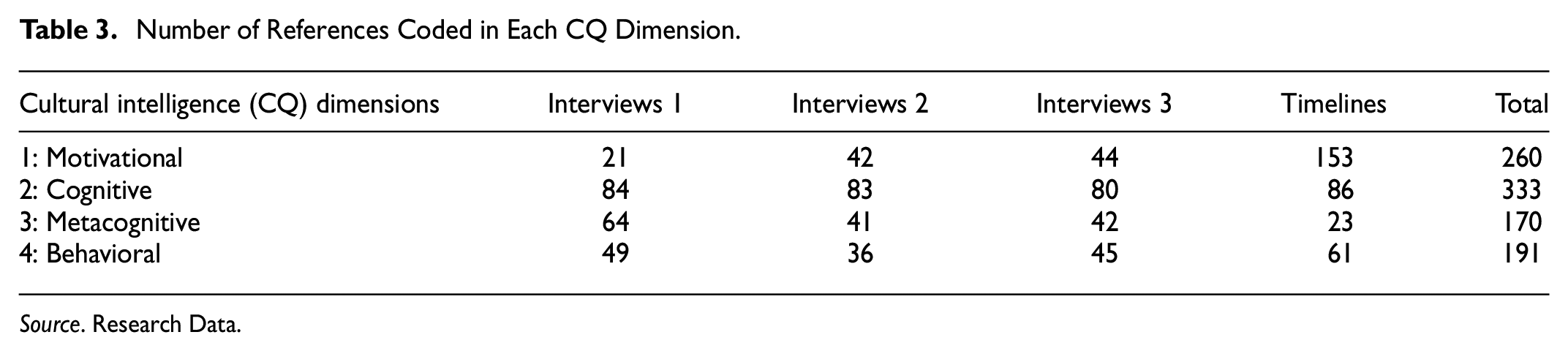
To summarize the data, we present, in Table 3, the number of references coded (in NVivo®) in each one of the CQ dimensions. One can observe that “Cognitive CQ” and “Motivational CQ” are the most evident.
Number of References Coded in Each CQ Dimension.
Source. Research Data.
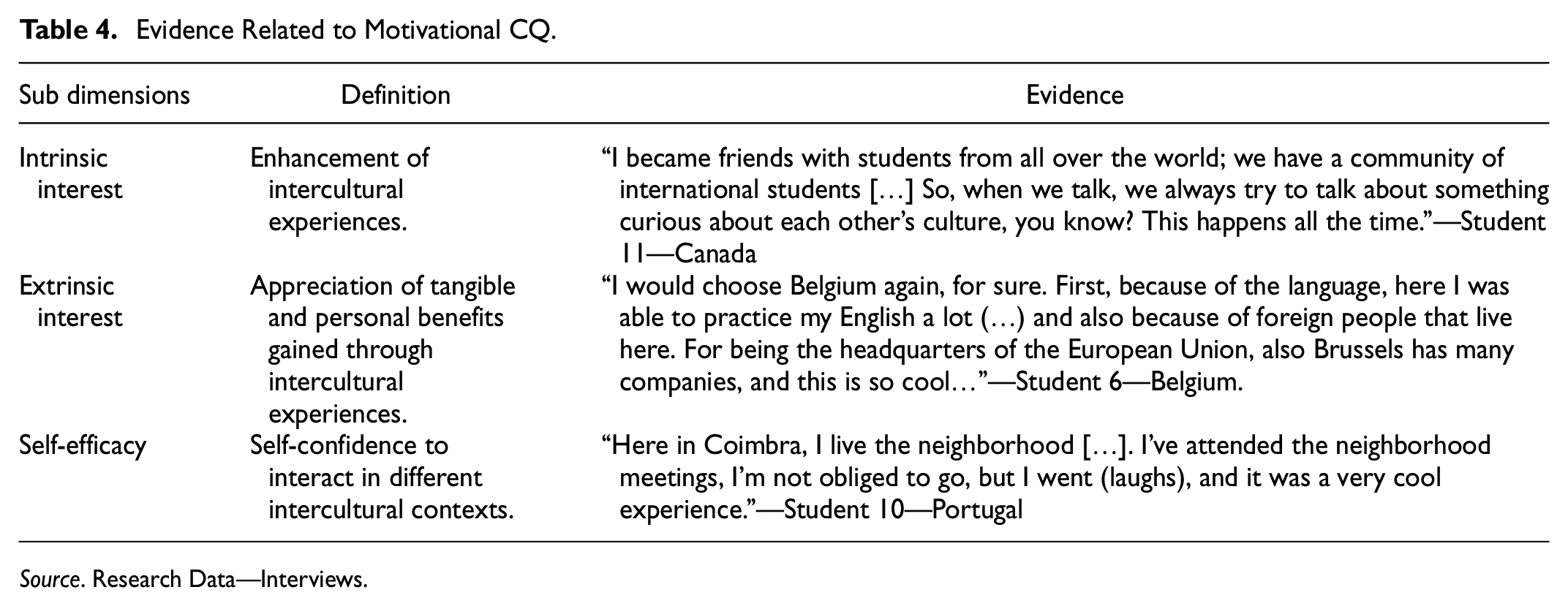
Motivational CQ is considered the initial dimension for CQ development. As the name implies, it encompasses the motivations of individuals to seek new knowledge about intercultural contexts and multicultural interactions, and it creates confidence in the individual to be and act in an intercultural environment (Ang & Inkpen, 2008; Van Dyne et al., 2012). Motivational CQ comprises three subdimensions: Intrinsic Interest, Extrinsic Interest, and Self-efficacy (Van Dyne et al., 2012). Table 4 presents practical examples of students’ experiences related to these subdimensions in their local contexts.
Evidence Related to Motivational CQ.
Source. Research Data—Interviews.
The experiences reported in Table 4 are also connected to the second dimension of CQ to be analyzed—Cognitive CQ. This dimension refers to knowledge about a culture, leading individuals to identify and understand differences and similarities in intercultural contexts, resulting in compelling interpretations and interactions (Ang & Inkpen, 2008; Van Dyne et al., 2012).
The experiences and everyday practices lead the students to learn about the culture in which they were inserted, either through perceptions of people’s behavior or by acquiring historical knowledge about the place or peculiarities of the context.
Knowledge about cultures can be general or context-specific; these are the two subdimensions of Cognitive CQ (Van Dyne et al., 2012). Table 5 provides evidence of the development of these subdimensions by the students.
Evidence Related to Cognitive CQ.

Source. Research Data—Interviews.
The third dimension of Cultural Intelligence, Metacognitive CQ, is related to situations in which individuals reflect on their actions before and during intercultural interactions, creating appropriate strategies (Ang & Inkpen, 2008; Livermore, 2013; Van Dyne et al., 2012). Table 6 provides some evidence about how the students faced situations in which they had to reflect on their conduct in the local culture and adapt to it.
Evidence Related to Metacognitive CQ.

Source. Research Data—Interviews.
These practical examples of the development of Metacognitive CQ also relate to the last dimension, Behavioral CQ. It refers to the individual’s proper behavior/action in an intercultural context, such as verbal and nonverbal actions (Ang & Inkpen, 2008; Livermore, 2013; Van Dyne et al., 2012). Individuals with high Behavioral CQ could change behavior according to their environment, making their counterpart comfortable during intercultural interactions.
Behavioral CQ is also divided into three dimensions: Flexibility in verbal behavior, Flexibility in nonverbal behavior, and Flexibility in communicating specific types of messages (Van Dyne et al., 2012). Figure 3 shows a critical incident that exemplifies the flexibility to interact pleasantly with the counterpart.
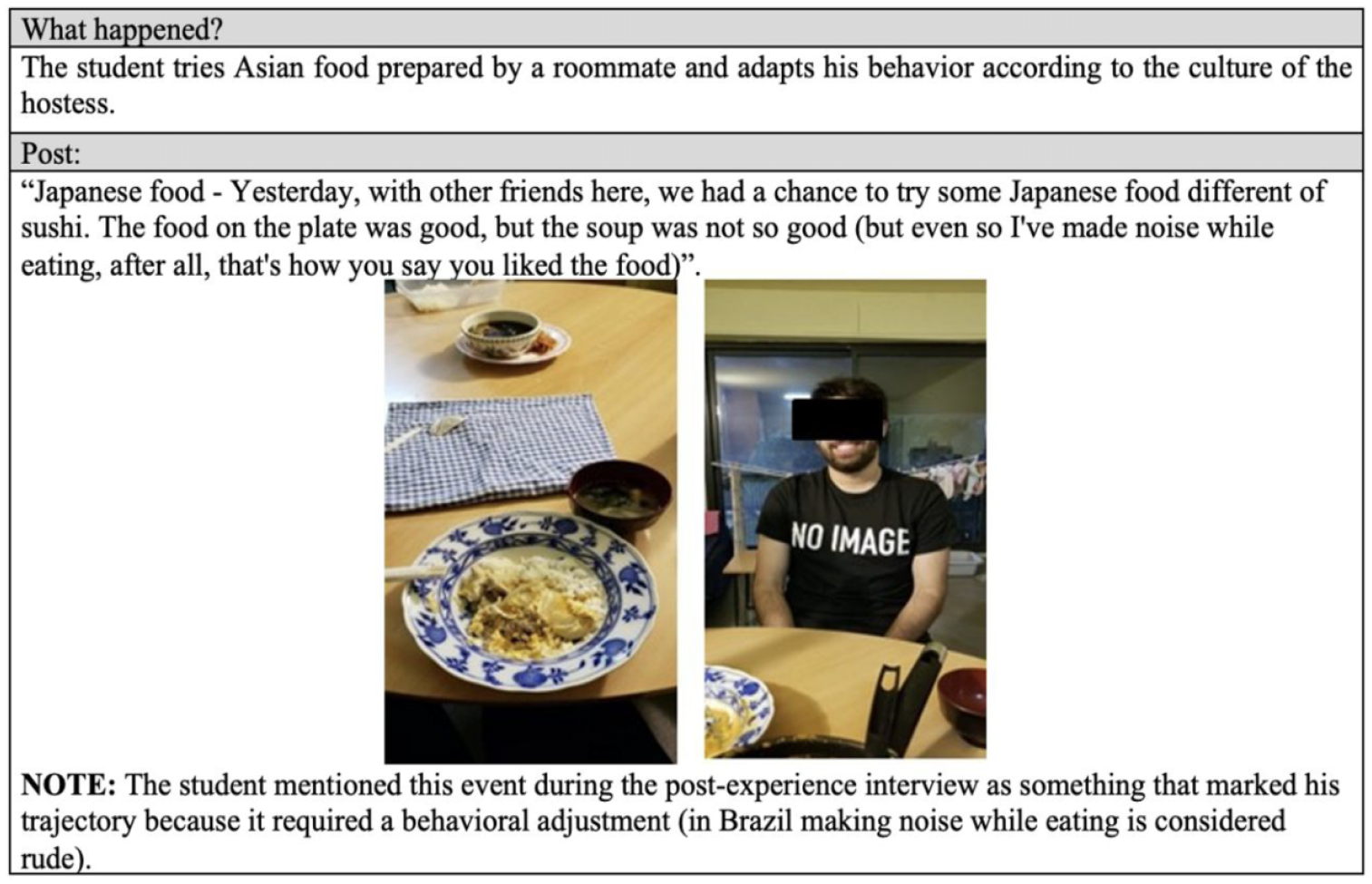
Critical incident 3.
In Figure 3, the student adapted his behavior to please his Asian colleague according to her culture. With this simple gesture, he demonstrated being satisfied with the counterpart’s hospitality and making the interaction comfortable.
In the same token as the previous ones, this incident also evidences the materiality and embodiment of the culture. The students reported the plates, gestures, places, and tangible artifacts imbricated in every situation. An example of it can be seen in a reflexive post made by Student 10 (Figure 4).

Reflecting on the experience—the materiality of the culture.
Students’ Perceptions Throughout the Intercultural Experience
This section explores how students initially conceived having an international experience, how the experience unfolded according to them, and the changes in their understanding of the intercultural experience over time. Table 7 summarizes the subjects’ perceptions of the intercultural experience, in the beginning, during, and after it, based on data from the interviews conducted with them at these three points.
Students’ Perception Throughout the Intercultural Experience.

Source. Research Data—Interviews.
According to data in Table 7, for four students, especially those with no previous experience living abroad, the beginning of the process was difficult, and, little by little, they adapted, and it became gradually easier. However, even for subjects with previous intercultural experience and self-confidence in intercultural interactions, experiencing a new culture can be challenging in many situations, as pointed out by Student 10: This business of understanding between the lines of the conversation is tricky. Four Portuguese women and I living in the same house. Initially, it wasn’t easy, because you know: you arrive, very Brazilian, exchange ideas, talk about everything and such. And I like cooking a lot, so I’ve made food for everyone, and I saw that there was always a barrier; the girls were very reserved. Then I found out that this is not how you make friends: first, there is a conversation, then you let them alone for a week, then another conversation. But you only cook for someone if you’re already intimate with the person… I spent a month here just getting beaten [laughs]. Then I’ve talked to other Brazilians who had been here, and they said: “Man, you’re doing everything wrong, they think you were hitting on them!” But how so?! “Yes man, you’re cooking for them!” I was terrified, my God!!!
Despite some cultural barriers to interaction, friendships were the factor that helped most of the students to cope with challenges and difficulties, which highlights the importance of close personal interactions and support. A curious fact is that some students with little previous intercultural experience could adapt easily. Students 3 and 5, who were in Spain, for example, did not feel so confident when they arrived in the intercultural environment; they acted more cautiously and observed more before interacting.
It was also evident that some students “deconstructed” their previous thoughts and views in the new cultural context. Many were confident about interacting at the beginning of the experience, but they reviewed their ideas and behaviors throughout the process, feeling the need to change. The moment they realized it, they sought to learn and develop themselves.
Even so, in the interview after the experience, all of them recognized that they still had aspects related to CQ that they needed to improve, making the Metacognitive CQ issue evident. In Table 7, we can see that the dimensions of CQ the students indicated they still needed to develop were mainly related to Motivational and Behavioral CQ and, in fewer cases, Metacognitive CQ. The aspects related to these dimensions are diverse: improving intercultural communication, motivating themselves to learn more about other cultures and live new experiences, and further developing the ability to listen and understand their counterparts, as illustrated by the following reflections at the end of the experience: (…) I felt a bit difficult to have exactly my personality speaking in another language. (Student 1) I think going more out there, you know? Like going more into things, sometimes I stayed at home and didn’t go, I don’t know… I felt insecure… (Student 6) (…) I feel that I don’t have such great empathy, sometimes I can’t put myself in the person’s shoes to understand her. (Student 8)
In short, the data suggests that the development of CQ happened differently for each of the subjects, depending on their personality, previous experiences, attitudes, motivations, and the relationships and experiences lived in each environment. Unanimously, however, they were aware that they needed to continue developing this intelligence. The experience seems to have made them more conscious of the complexity of intercultural interactions.
Discussion
CQ development is critical for global leaders working internationally (Ramsey et al., 2017; Van Dyne et al., 2012). Several studies state that the development of CQ occurs mainly through the experiences of individuals in contact with other cultures (Alexandra, 2018; Caligiuri et al., 2022; Rosenblatt et al., 2013; Zhu et al., 2013, 2017). However, rare studies show how this occurs during intercultural experiences.
The framework presented in Figure 5 seeks to synthesize the main research results. It suggests that the intercultural context (especially informal settings, friendship relations, trigger events, and materiality) provides the basis for Situated Learning. It occurs through the participation and social interactions of individuals, allowing them to interpret everyday practices and, consequently, developing the CQ dimensions—motivational, cognitive, metacognitive, and behavioral (Ang & Van Dyne, 2008; Earley & Ang, 2003; Ng & Earley, 2006), with emphasis on the development of the first two.

Developing CQ in situated learning.
Regarding the Motivational dimension (Ang & Inkpen, 2008; Livermore, 2013; Van Dyne et al., 2012), students’ desire to seek new experiences and interact in specific intercultural contexts was evident based on their curiosity and interest. The analyzed data (e.g., see Table 4) shows their motivation to engage in social interaction with people from different nationalities and participate in everyday activities in the intercultural context (for instance, neighborhood meetings).
Regarding the cognitive dimension of CQ (Ang & Inkpen, 2008; Livermore, 2013; Van Dyne et al., 2012), the students were challenged to distinguish the main differences and similarities in the cultural contexts in which they were living. Concerning Metacognitive CQ (Ang & Inkpen, 2008; Livermore, 2013; Van Dyne et al., 2012), throughout the process, the students analyzed themselves and considered which aspects should be improved concerning intercultural interactions, even after the intercultural experience had finished.
As shown in Table 5, they compared social practices in the intercultural context with practices in their own cultural context (for instance, playing “secret Santa” or taking academic tests), realizing the different meanings of these practices in the different cultures. Throughout the process, the students analyzed themselves and considered which aspects should be improved concerning intercultural interactions, for example, how they talk, laugh, or behave in social events, even after the intercultural experience has finished.
Several events showed that students had to review how they communicate, act, and interact in situated intercultural contexts through practice and social interactions. This result corroborates a recent study by Caligiuri et al. (2022), which highlights the importance of developing self-awareness, planning, and premeditating before acting, receiving feedback, tracking progress, and having opportunities for frequent reflection on one’s actions during and after intercultural experiences to learn effectively.
These experiences and learning through social interaction in the intercultural context can be directly linked to the concept of Situated Learning (Lave & Wenger, 1991). CQ’s development occurs in various interactions and social participation in daily activities: having dinner with others, going around on public transportation, drinking chimarrão, playing volleyball, walking around the city, and participating in cultural and sports events. These participations and interactions allowed subjects to interpret everyday practices (Lave & Wenger, 1991), one of the most prominent elements of Situated Learning, revealing specific aspects crucial to the development of CQ.
First, considering the participants’ everyday interactions, we realized that most did not happen in formal settings, such as the academic environment, but in informal settings and diverse social groups, such as volleyball games and soccer stadiums (see Figure 1—Critical Incident 1). Caligiuri et al. (2022) emphasize that for cultural experiences to be meaningful and enriching, it is essential to have high-quality interactions with colleagues from different countries and cultures. Our study showed that the most remarkable intercultural experiences and interactions mentioned by students did not just happen with local foreigners or formally designated social groups such as university classmates but with foreigners from other cultures and diverse groups, such as roommates and neighbors, among others.
Second, participants also highlighted the importance of closer interpersonal relationships for deepening intercultural understanding, such as reported by student 3 about the volleyball game and the experience of student 6, while cooking with her colleagues in the student residence. Closer friendships eased the students’ difficulties, as reported in Table 7, which boosted cultural intelligence development. Situated Learning via processes of social participation and interaction stood out in these deeper bonds of friendship. Fox (2006) and Gherardi (2009) stated that learning is an exchange involving interpersonal interactions and everyday practices, but this study highlights the importance of closer interpersonal relationships in developing CQ.
Third, we observed that, especially in these closer interactions, students learned more in adverse situations, such as the difficulty of communicating in another language or adapting to a different eating habit, for example, as reported in Figure 3, in which the student made noise while he was eating to show that he liked the meal (although actually, he did not). These experiences of coping with difficult situations confirm the importance of the so-called trigger events (Reichard et al., 2015), which are discrete intercultural occurrences (usually difficult situations) that challenge core individual beliefs and facilitate the development of CQ. Reichard et al. (2015) explained that cross-cultural experiences can generate engagement in a new situation or display radically different cultural norms (trigger event). These events require the individual to draw upon cognitive or social resources, which broaden the individual’s perspective on the situation. These trigger events evidence situated learning since it is based on authentic activities, meaning ordinary practices of a culture (Brown et al., 1989). It encompasses causal histories, practice situations, emergent problems, and dilemmas.
Social ties, such as friendships, can help the individual to engage and learn more from the trigger events (Reichard et al., 2015) since, through friendship connections, individuals can exchange different points of view and obtain support to adapt themselves to the intercultural context and find ways to deal with difficult situations, which was confirmed in our research (see evidence about it in Table 7).
A fourth element that stands out in the data analysis is the materiality of culture embedded in intercultural experience (see Figure 4—Reflecting on the experience—the materiality of the culture). The four dimensions of CQ consider abstract and subjective concepts such as motivation, cognition, and metacognition (Ang & Van Dyne, 2008; Earley & Ang, 2003; Ng & Earley, 2006). However, the everyday observations of Situated Learning during the intercultural experience highlighted the importance of the material elements present in the situated context and the interactions in which the CQ development occurs.
The materiality of culture was evidenced in our data since students frequently reported about different foods, places, body gestures, movements, colors, materialized symbols, aesthetic forms, dress codes, and architectural genres. They highlighted these elements when they talked about their intercultural experiences, gaining prominence in critical incidents mentioned by the participants (see Figures 1–3).
Although the CQ literature does not ignore materiality, highlighting the importance of gestures and body communication in intercultural interactions or mentioning episodes related to adaptation, for example, to food, transport, and other material elements in intercultural interactions (Earley & Ang, 2003), the materiality of everyday objects and places seems to appear in the current literature mainly as a background.
However, this materiality stood out in the situated intercultural experiences we observed in the students’ daily lives. Several objects appear intertwined with social interactions. It leads to the idea of heterogeneous networks resulting from the interaction between human and nonhuman elements that constitute reality, proposed, for example, by the Actor-Network Theory (Callon, 1986; Latour, 2005; Law, 1992).
As Van der Duim et al. (2013) pointed out, discussing ANT in tourism studies, we enact heterogeneous associations between technologies, bodies, imaginations, memories, and materials, bundled together whenever we travel. These heterogeneous associations are evident in the data analysis presented here, suggesting the need for a socio-material approach to studying CQ development. By analyzing only the before and after an intercultural experience, this socio-material imbrication is not evident, but these heterogeneous relationships become more apparent following the situated intercultural experiences.
Conclusion
The results contribute to a better theoretical-empirical understanding of CQ development. These results suggest that this development is complex; each new intercultural experience demands intensive learning. Learning occurs in interaction with local foreigners and foreigners from different cultures, especially outside the academic setting. The more intense the social interactions (primarily through friendships), the more learning and development of CQ occurs, especially in challenging events for the individuals (trigger events), making them question their cultural values and points of view. The results also showed that developing CQ through intercultural exchanges prepares students for global leadership by improving their knowledge, skills, and abilities to effectively communicate, adapt, and lead in a culturally diverse environment.
Based on the research results, we can also propose a set of practical implications and guidelines for international education regarding the development of CQ and global leaders.
First, most studies in the literature consider the development of CQ during formal educational activities, while the research results highlight the importance of informal settings in promoting this development. Therefore, formal/academic activities should be mixed with informal events and experiences in informal and varied settings to promote a broader range of social interactions (for instance: in cultural, recreational activities, sports, and games, among others).
Second, while formal educational activities emphasize scheduled interactions and formal roles, the study results indicate that friendship and more close relationships are also essential for developing CQ. Although friendships are spontaneous and time-demanding, some activities can help promote them, such as long-term collaborative projects, informal interactions in online networks, and social activities, as previously suggested.
Third, the research results emphasize the importance of trigger events for the development of CQ, those events that bring difficulties, conflicts and/or challenge cultural values and assumptions, as already pointed out by Reichard et al. (2015). Considering market pressures for formal educational activities to run smoothly, we need to remember the importance of promoting practical and challenging situations that allow the confrontation of different assumptions and points of view, stimulating learners to solve them collaboratively.
Finally, the materiality imbricated in the intercultural context and social interactions, as shown in the research results, challenges us to go beyond formal and close educational environments and think about experiences that can allow students to immerse themselves in different cultural settings, having bodied, situated, and an esthetic, rich intercultural experiences.
As research limitations, the data collected is based on the participants’ reports about their experiences. Therefore, possible response biases may exist. Despite the advantages of collecting data via the use of mobile devices in different cultural settings, this form of collecting data can bring limitations to the research, such as unclear validity and accuracy of data and the lack of involvement of researchers in the field (Muskat et al., 2018). Besides, although the sample was purposive and almost the total of students in the studied group was accessed, and a large volume of documents was analyzed, the study relied on a small number of respondents from one nationality. Besides, although there were no differences in the experiences reported by students according to their gender, the number of male and female participants in the research is not balanced. We also considered a small sampling of encounters between the students and individuals from other countries. Besides, we have not compared the data from the research participants with data from individuals who did not have intercultural experiences.
Nevertheless, we hope that our research can inspire similar studies in the future that follow other learner groups in diverse intercultural contexts to deepen understanding of CQ development through Situated Learning. For example, following global managers during their work abroad, aiming to understand how CQ development occurs in organizations. Future research may also further explore the role of materiality in intercultural experiences and its role in the development of CQ. Therefore, we suggest adopting socio-material approaches to understand the CQ development process further.
Footnotes
Declaration of Conflicting Interests
The author(s) declared no potential conflicts of interest with respect to the research, authorship, and/or publication of this article.
Funding
The author(s) received no financial support for the research, authorship, and/or publication of this article.

Data Availability Statement
Data sharing not applicable to this article as no datasets were generated or analyzed during the current study.