



Abstract
This study examines the significant characteristics and potential implications of the Kyaukphyu Seaport project, addressing the following research question of the study: ‘What are the significant characteristics and potential implications of the Kyaukphyu Seaport project and how will it impact the region and beyond?’ This study employs qualitative research that combines a comparative case analysis with in-depth interviews. Using four theories—geoeconomics, infrastructure-led development, environmental justice, and collaborative governance—as an integrated framework, this study focuses on eight key aspects: regional connectivity, geopolitical impact, economic impact, infrastructure development, environmental concerns, social impact, political instability, and debt risk. A comparative analysis of three seaports: Kyaukphyu, Colombo, and Hambantota, with 12 selected articles (n = 12), was conducted, along with in-depth interviews with 15 stakeholders (n = 15) concerning the Kyaukphyu Seaport Project. The findings highlight the strategic importance of the Kyaukphyu Seaport in enhancing regional connectivity and promoting economic development in Myanmar and other countries in the region. Nevertheless, the findings also recognise geopolitical challenges, domestic political conflicts, the necessity for socio-environmental impact assessments, proper financial management, coordination with local communities, and effective media management to address narratives surrounding projects led by Chinese enterprises. This study recommends effective coordination among the Myanmar government, Chinese investors, and communities to ensure successful implementation and adherence to the national development framework.
Plain Language Summary
Numerous scholars and political elites assert that the Kyaukphyu Seaport, located at the confluence of the Bay of Bengal, presents a strategic opportunity for Myanmar and the surrounding region with the potential to evolve into a regional commercial hub. The development of the port is currently spearheaded by Chinese enterprises; however, its full realisation has been impeded by several challenges, including political instability, local protests, insufficient cooperation between Myanmar’s government and Chinese investors, environmental concerns, and other potential risks. If fully actualised, the Kyaukphyu Seaport is projected to offer benefits to both Myanmar and China, as well as to the countries in the region. Myanmar is anticipated to function as a regional commercial hub, stimulate the tourism sector, increase local employment, and contribute to the national economic development. For China, its access to the Indian Ocean would benefit landlocked Yunnan Province and reduce its reliance on the extended maritime route through the Malacca Strait. By securing access to the Indian Ocean, China could enhance its energy security and expand its strategic influence over the Indo-Pacific region, thereby raising concerns among regional rivals, such as India, Japan, and Australia. Consequently, it is essential to conduct a comprehensive analysis to ascertain the potential significance and implications of the Kyaukphyu Seaport project. This study investigates the strategic importance and potential outcomes of the Kyaukphyu Seaport Project in Myanmar, highlighting how improved connectivity can yield substantial economic and geopolitical benefits. Employing a qualitative research methodology, this study integrates a comparative case analysis with Sri Lanka’s seaports using 12 selected documents and conducts in-depth interviews with 15 key stakeholders with expertise and knowledge regarding the Kyaukphyu Seaport project to evaluate its potential and implications for the region and beyond. By comparing the Kyaukphyu Project with the analogous seaport developments of Colombo and Hambantota ports, this study offers valuable insights into the challenges and opportunities associated with the infrastructure development of seaports in other developing countries. This study employs key theories such as geoeconomics, infrastructure-led development, environmental justice, and collaborative governance as an integrated theoretical framework to examine not only geopolitical and economic aspects but also environmental and social considerations related to the project, focusing on critical elements such as regional connectivity, geopolitical impact, economic impact, infrastructure development, environmental concerns, social impact, political instability, and debt risk. Based on findings from a comparative analysis and in-depth interviews, this study identifies potential obstacles and advocates for increased collaboration among Myanmar’s government, Chinese investors, and local communities to ensure the successful completion of the Kyaukphyu Seaport project and its sustainable development.
Introduction
Myanmar’s coastal region has witnessed significant investments in new port projects in Japan, China, India, and Thailand driven by strategic interests. On the other hands, Myanmar collaborates with neighbouring countries on deep-sea port projects, offering direct access to the Indian Ocean linking with their land-locked regions. India is developing the Sittwe Port on Myanmar’s western side, whereas Thailand has established the Dawei Port at its southern end (Oosterwegel, 2018). Meanwhile, China started implementing the Kyaukphyu Seaport project located south of the Sittwe Township. This underscores Myanmar’s strategic importance, functioning as a bridge between Southeast Asia and the Indo-Pacific and as a gateway to the Indian Ocean. Among other seaports, the Kyaukphyu seaport, developed by China, has significant geopolitical implications. This project has drawn international attention, as it provides China with strategic access to the Bay of Bengal. The project gained prominence after President Xi Jinping endorsed 33 agreements with Myanmar for infrastructure and economic initiatives, including the Kyaukphyu Seaport (Lwin, 2020a).
The Kyaukphyu Seaport project was designed to construct seaports, rail infrastructure, pipelines, and an Industrial Zone for deep-sea connectivity to the Bay of Bengal and the Indian Ocean (Irrawaddy, 2022b). This project may improve China’s regional integration and benefit Myanmar’s Rakhine State and other regions. The United States Institute of Peace for Myanmar (USIP, 2018) assumes that the project should be initiated to enhance commercial relations, strengthen inter-regional economic integration, facilitate China’s naval manoeuvres, and enable strategic participation (USIP, 2018). The USIP (2018) also noted potential similarities with Sri Lanka’s Hambantota Port (USIP, 2018) which is attributed to the seaport crisis due to the absence of a coherent long-term governmental strategy for port development (Sternagel, 2018). The Kyaukphyu Seaport project also faces challenges in port infrastructure development owing to political conflicts, public awareness, collaboration, debt, environmental concerns, social displacement, transparency, and geopolitical considerations (Rotterdam, 2016).
The Kyuakphyu Seaport and its SEZs represent a significant Chinese initiative, offering three primary advantages: first, it functions as a commercial centre fostering Myanmar’s economic development; second, it provides China with a strategic route to the Indian Ocean, shortening transportation lanes that can avoid its strategic weakness in the Malacca Sea Lane; and third, it facilitates regional connectivity and economically benefits neighbouring countries. However, the Kyaukphyu Seaport project is anticipated to have strategic implications (Irrawaddy, 2022a). This may escalate rivalries among regional powers, increasing geopolitical tensions while posing potential socio-environmental risks. In addition, some scholars argue that the Kyaukphyu Seaport serves China’s interests predominantly by advancing its strategic objectives and regional influence and highlighting the potential social and environmental risks associated with the project (Rotterdam, 2016). Some also claim that the Kyaukphyu Seaport would probably face similar social, environmental, and financial issues as the Hambantota Seaport in Sri Lanka (Lwin, 2018).
Given the contradictions in the existing literature, further research is needed to explore the significant characteristics of the Kyauphyu Seaport and its potential implications for Myanmar, China, and the broader region. Addressing the primary research question (RQ): ‘What are the significant characteristics and potential implications of the Kyaukphyu Seaport project and how will it affect the region and beyond?’ This study employed a qualitative approach, comprising a comparative analysis of Sri Lankan seaports and in-depth interviews with key stakeholders. Previous research has focused on Myanmar’s deep-seaports as regional logistics hubs, emphasising their role in reducing dependence on traditional routes such as the Strait of Malacca (Thein & HuaLong, 2020). Some studies have examined the development of Kyaukphyu Seaport, particularly with regard to environmental and social assessments (Aung, 2020). However, comprehensive evaluations of the geopolitical, social, and economic implications of the Kyaukphyu Seaport and its SEZs projects remain to be conducted. This study substantially contributes to the existing body of knowledge on port projects, regional development, and connectivity.
Literature Review
Background of Kyaukphyu Seaport
Infrastructure development and economic reforms were crucial to Myanmar’s trade capabilities and regional connectivity. Dawei, Kyaukphyu, and Sittwe have emerged as significant nodes in Myanmar’s trade network, contributing to economic development and regional integration (Min & Kudo, 2012). Kyaukphyu Seaport project aims to establish deeper connectivity between Myanmar and China through a deep seaport and SEZs in Rakhine and beyond. The SEZ covers approximately 4,300 acres on Ramree Island, and includes housing, industrial zones, and ports. It spans 520 ha, with 20 ha located in ports, 100 ha in housing and 400 ha in industrial parks. The facility features a 480 m long quay, a 150 m long jetty for 5,000 t vessels (Min & Kudo, 2012), a 29.7 mm waterway, 600,000 m3 tank liquid storage, and advanced facilities.
The oil and gas pipeline project initiated by China in 2009 led to a collaboration between the Kyaukphyu deep-seaport and a special economic zone. The deep-seaport, valued at $7.3 billion, and the SEZ, at $2.7 billion, are to be constructed and operated by CITIC under a 50-year agreement, extendable by 25 years (Zaw, 2018) with 70% vs 30% between China and Myanmar. However, after the framework agreement was negotiated and signed in 2018, China held 51% of its industrial zone, with the Burmese government accounting for 49%. CITIC and 42 private Myanmar companies constructed an industrial area under Myanmar Kyaukphyu Special Economic Zone Holding Public Company Limited (Lwin, 2020b).
In November 2020, the Kyaukphyu Special Economic Zone (SEZ) and Deep Seaport Co. Ltd. reached an agreement to develop the port of Ramree Island. The agreement covers the construction of a bridge connecting the Maday Island Port, road network, and deep-sea port. As Kyaukphyu Seaport project includes a deep seaport and industrial zone for various industries, thier implementation may enhance Myanmar’s trade and employment, boost regional development, and significantly influence China’s Yunnan Province growth (Irrawaddy, 2021). Despite Myanmar’s instability, China’s investment indicates a calculated risk, reflecting China’s strategic goals and Myanmar’s geopolitical significance in the region (Aye, 2024). Although Myanmar and China planned to restart Kyaukphyu Seaport project, the conflicts unprecedentedly slowed the progress of its implementation (Figures 1 and 2).

Kyaukphyu deep seaport and special economic zone.

Map of the Kyaukphyu Special Economic Zone area.
Overview of Kyaukphyu Seaport
As Myanmar is a crucial land bridge between ASEAN and India that offers economic and security benefits, the Kyaukphyu Seaport is strategically important for regional connectivity and trade. It has also become critical for China, Myanmar, and neighbouring countries (Htun et al., 2011). Kyaukphyu’s development is significant for China’s Belt and Road Initiative (BRI) as it enhances trade routes and connectivity (Htee, 2021). Its location provides China with direct access to the Indian Ocean, boosting trade routes with Asia, Africa, and Europe (Poling, 2018) and promoting regional economic growth by offering a more efficient route for imports and reducing transportation time and costs (Narinjara, 2023). With the Kyukphyu seaport project, local people are hopeful, emphasising skill development for the younger generation.
Kyaukphyu Seaport can accommodate ships of up to 300,000 deadweight tons (DWT) and features modern facilities including deep-water berths, container terminals, and oil storage tanks, offering Myanmar economic growth opportunities by accessing international markets and attracting foreign investment (Poling, 2018). The Asian Development Bank (2019) reported that Myanmar is expected to receive $6.5 billion in tax revenue from Kyaukphyu Seaport and $7.8 billion from its SEZ. Once fully operational, the Kyaukphyu SEZ is expected to increase Myanmar’s GDP by $3.2 billion annually (Asian Development Bank, 2019). The port’s location will centralise trade, connect the country to global markets, facilitate cross-border goods movement, attract investment, and create businesses and jobs.
During the Kyaukphyu deep seaport signing ceremony, General Mya Tun Oo, Union Minister of Transportation and Telecommunication, emphasised the project’s aim to create job opportunities for locals, contributing to socioeconomic development (Narinjara, 2023). He stated that ‘the project will create jobs, stimulate growth in surrounding industries, and attract foreign investment into Myanmar’ (Narinjara, 2023). Deep seaport development will enhance transportation via high-speed railways connecting Kyaukphyu, Myanmar, to Kunming, China, facilitating Chinese exports, and boosting Myanmar’s economy with capital, expertise, and technology. In addition, deep seaport development improves employment and livelihoods, creating over 100,000 new jobs annually, whereas SEZs offer employment opportunities by establishing industrial and fishery parks (Asian Development Bank, 2019). Therefore, Kyaukphyu’s development has been crucial to Myanmar’s growth, with the expected benefits for many years.
Kyaukphyu Seaport reduced China’s dependence on the Strait of Malacca (Kodaka & Nitta, 2017). The strategic location of Kyuakphyu Seaport enables efficient energy supply transfer, improves energy security for both nations, and serves as an oil transportation hub while providing access to the Indian Ocean and Southeast Asian markets, which are crucial for Myanmar’s economy and China’s energy security (CSIS, 2018). On the other hand, the Kyuakpphyu SEZ enhances infrastructure, benefits tourism, local economies, businesses, and job creation by increasing accessibility and promoting cultural exchange. Constructing a transport and communication infrastructure promotes engagement among people from different regions and cultures, facilitating development through cooperation (Hlaing, 2023).
However, the implementation of the Kyaukphyu Seaport project faces obstacles. Local people urge addressing concerns regarding land acquisition, resettlement strategies, and SEZ bylaws (Myint, 2017). Some media outlets sensationalise the project, depicting local tensions, land grabs, insufficient compensation, environmental degradation, and foreign workers taking jobs (Chau, 2019). Progress has been hindered by communication breakdowns and failure to engage locals (Lwin, 2019). Morris (2021) suggested that Chinese investments in Myanmar require careful management of governance, social and environmental concerns, and geopolitical implications and recommended risk management strategies with transparency and inclusivity (Morris, 2021).
Critics view the deep seaport as part of China’s plan to secure a direct trading route to the Indian Ocean, potentially encircling India and increasing tension. V. Sharma (2024) suggested that Chinese projects in Pakistan, Bangladesh, Myanmar, and Sri Lanka could extend their geopolitical strategies to include India’s influence in South Asia (E. Sharma, 2019). Some scholars have argued that Kyaukphyu Seaport project send mixed signals for economic and military purposes, specifically securing access to the Indian Ocean and strategically positioning it in the Bay of Bengal. The USIP (2018) argues that China may be trying to counterbalance India and its regional allies, including the United States (USIP, 2018), while the latter counters the rise of China in the region. Meanwhile, India has been working to establish a direct shipping route to the Myanmar border, enhancing relations to balance China and increasing strategic implications in the Bay of Bengal (NITTA, 2019).
On the other hand, Myanmar’s political crisis poses significant challenges to project implementation, leading to policy, regulation, and funding changes and causing delays or cancellations (Aye, 2024). Clashes between government forces and insurgent groups have made Rakhine State volatile, causing unease in China (Irrawaddy, 2023). China is working to bridge the gap between the Myanmar government and ethnic armed organisations (EAOs) to restore peace and stability (Latt, 2022), providing a better environment for investors and an opportunity to design adaptable infrastructure models.
Environmental and social concerns raised by local populations constitute an additional consideration for implementation of the Kyaukphyu Seaport project. Chinese companies conduct social and environmental impact assessments (SEIA), while local committees and organisations advocate SEIA to protect communities and uphold global standards, emphasising transparent decision-making in projects (Times, 2018). Some media view these criticisms as emphasising the need to engage local stakeholders in large-scale initiatives to minimise adverse impacts and ensure fair advantages (Development Media Group, 2022). Hlaing (2023), a Union Minister, encourages the consideration of environmental impact assessment (EIA), social impact assessment (SIA), political impact assessment (PIA), and strategic impact assessment (SIA) to identify beneficial projects, minimise losses, and make informed decisions.
Additionally, the local media accuses Kyaukphyu residents of land confiscation under the project, thus affecting farmers (Naing, 2022). Community members urge the government to halt the project until issues regarding land acquisition, resettlement strategies, and SEZ bylaws are resolved (Myint, 2017). Htee (2021) assumes that land laws enable unimpeded business and government operations but ignores customary ownership, eroding trust in investments beyond Kyaukphyu projects (Htee, 2021). However, Sternagel’s (2018) survey found that Kyaukphyu’s urban residents were optimistic about socioeconomic projects, whereas rural residents expressed uncertainty (Sternagel, 2018). Many locals expect the project to bring about jobs and innovation, and improve their quality of life.
In summary, the Kyaukphyu Seaport project was designed to establish a shipping hub connecting China’s Yunnan Province with Myanmar’s Kyaukphyu, thereby facilitating access to the Indian Ocean. This initiative is anticipated to yield geopolitical and socioeconomic benefits for both countries, as well as for the broader region. However, if not managed appropriately, the project may pose potential geopolitical, economic, social, and environmental risks that can extend beyond the immediate area.
Background of Colombo Seaport
Often called the ‘Jewel of the Indian Ocean’, Sri Lanka’s capital, Colombo, has evolved into the country’s political, economic, and cultural hub (Routing, 2023). Sri Lanka’s Colombo port, strategically located on the east-west main sea route, is a pivotal South Asian transshipment hub. The Sri Lanka Port Authority-SLPA relies on it as its primary revenue source because Colombo is currently Sri Lanka’s sole container port. Located in Colombo’s commercial district, the port faces traffic congestion due to container transport vehicles. The Colombo Seaport is the most efficient logistics hub in South Asia and the only deep-sea port facilitating transshipment services between the East and West for feeder ports (Park & Dossani, 2020), serving the region’s biggest powerhouses.
Over a century ago, the British constructed a Modern Port of Colombo. In 1913, the Colombo Port Commission planned the layouts of most cities. After gaining independence, the Colombo port underwent significant changes, particularly after the creation of the Sri Lanka Ports Authority in 1980 (Gunawardena & Ariyawansa, 2017). The port’s strategic location amidst trade routes and its major transformation in handling containerised cargo during the 1980s and the 1990s made it more attractive to mainline operators than any other port in the Indian subcontinent. As a result, the port began a large-scale expansion project costing US$1.2 billion in 2008, which was expected to significantly boost its capacity and capabilities.
The Government of Sri Lanka (GOSL) has identified the expansion of Colombo Port as a way to meet the increasing demand for services in the international shipping industry (Gunawardena & Ariyawansa, 2017). The Colombo Port project aims to accommodate over 280,000 people and will serve as a special economic zone, financial hub, and a modern service-driven city (Gunawardena & Ariyawansa, 2017). The progress of land reclamation construction as part of the port project by the China Merchants Group (CMG) has been observed worldwide. This groundbreaking development is poised to drive the growth of Sri Lankan’s economy and infrastructure (Routing, 2023).
Background of Hambantota Seaport
The port of Hambantota has developed into a hub for activities beyond its immediate area. Its growth is closely tied to the surrounding urban centre. The port has the potential to transform Sri Lanka into a distribution centre for the South Asian region, where transshipment hubs typically dominate. While ports in South Asia are viewed as competitors to the Hambantota port, ships passing through the silk route take longer to reach their destinations, depending on their distance from the route. However, Sri Lanka’s newly built Magampura Port in Hambantota could alter this scenario by offering shorter shipment times and cheaper freight charges because of its proximity to the Chittagong Port, the country’s primary export market (Kumara & Weerakoon, 2014).
The Hambantota seaport development plan was initially conceptualised by former Prime Minister Ranil Wickremesinghe in 2002. The programme’s primary objective was to provide employment opportunities for more than 25,000 people in the impoverished Hambantota district. Proposals for port areas include the establishment of oil refineries, petrochemical industries, coal-powered thermal power stations, and desalination plants. Unfortunately, due to an untimely change in government 2 years later, the project never came to fruition (Kotelawa, 2017). The port’s initial phase began in November 2010, at a construction expense of USD 361 million. The EXIM Bank of China covers 85% of this expenditure, at an interest rate of 6.3%. However, the port has received only 44 ships since 2015, which is below the anticipated amount (Kotelawa, 2017). Located in Sri Lanka’s southern province, the port of Hambantota is approximately 10 nautical miles from the east-west sea routes.
Port development commenced in 2008, aided by loans from the China EXIM Bank, which covered 85% of the Phase 1 costs, whereas the SLPA funded the remaining 15%. Despite these efforts, unforeseen cost increases and lower-than-anticipated profits plagued port development (Kavirathna et al., 2021). In 2017, the SLPA leased the Hambantota Port in Sri Lanka to the China Merchant Port Holdings Company over a lengthy 99-year period. Following this agreement, two public-private partnership companies were established to manage the port’s various operations (Kavirathna et al., 2021). First, Hambantota International Port Group (Pvt) Ltd. (HIPG), focuses on planning, operations, and commercial management. In contrast, Hambantota International Port Services (Pvt) Ltd (HIPS) manages security functions and common user facilities (Kotelawa, 2017). Despite these challenging circumstances, Kotelawa (2017) believes that collaboration between China and Sri Lanka is fair treatment for future benefits (Kotelawa, 2017).
Overview of Colombo and Hambantota Seaports
Following the lease agreement between the Ministry of Ports and Shipping, SLPA, and China Merchants Port Holdings Company Ltd., critics labelled this as China’s debt-trap diplomacy. Others view this as China’s effort to assist Sri Lanka in avoiding debt for strategic geopolitical positioning (Kotelawa, 2017). This move has caused concern and apprehension among the global community (Pasricha, 2022). E. Sharma (2019) claimed that the Hambantota deal was critical for China because of its strategic location on oil and trade routes to Africa and Europe (E. Sharma, 2019). Patrick (2017) concludes that the port deal could impact Sri Lanka’s sovereignty and regional geopolitics, particularly in India, suggesting that China’s investment is a strategic move to gain leverage in the Indian Ocean Region, raising concerns in India and affecting regional balance (Patrick, 2017).
Although scholars have narrated the ‘debt-trap diplomacy narrative’ regarding the port of Hambantota, little evidence supports this claim. Elapata (2020) argues that Sri Lanka’s debt issues are complex, with only 6% of its GDP owed to China and 39% to International Sovereign Bonds (Elapata, 2020). E. Sharma (2019) assumed that debt trap criticism ignores corruption and mismanagement of public funds by Sri Lanka (E. Sharma, 2019). Gangte (2020) contends that Sri Lanka’s debt crisis stems more from internal macroeconomic challenges than from Chinese loans, arguing that it is ‘not made in China’, pointing out that Chinese loans constitute a small portion of Sri Lanka’s total debt, with international sovereign bonds being a more significant concern (Gangte, 2020).
Many scholars believe that Sri Lanka’s location caused India to become increasingly wary of China’s growing presence. Some Indian analysts suggest that Sri Lanka’s promise of no military presence in China may help alleviate India’s concerns (Kotelawa, 2017). The United States, India, and other countries aim to stop China’s rise, influencing Sri Lanka through their interaction with the BRI (E. Sharma, 2019). Merk (2017) contends that commercial ports serve as economic and geopolitical instruments, prompting enquiries into investment motivations (Merk, 2017). Furthermore, he suggests that Hambantota’s development incited tensions, with India perceiving it as strategic encirclement. China refutes allegations that it imposes political conditions on its aid to Sri Lanka or pursues political gains from its investments, claiming that it has supported Sri Lanka’s progress without hidden agendas (Pasricha, 2022).
Despite the negative narratives propagated by international outlets, scholars, and analysts, it is evident that China’s companies have made substantial progress in the implementation of various projects in Sri Lanka. Evidence points to the fallacy of such narratives and underscores the importance of objectively evaluating these companies’ progress in pursuit of their objectives. In 2014, the China Harbor Engineering Company Ltd. (CHEC) began construction of the Colombo Port City project, the largest Chinese investment in Sri Lanka. By 2019, the project had been completed by reclaiming 269 ha of land from the Indian Ocean (Routing, 2023).
PricewaterhouseCoopers (PWC) estimated that the Colombo port city project could bring over $9.7 billion in foreign direct investment to Sri Lanka, creating more than 400,000 job opportunities for local residents (China Daily, 2023). According to China Daily (2023), Colombo Port City project encompassing 269 ha of reclaimed land was developed, incorporating the latest sustainable and smart city designs (China Daily, 2023). It was also stated that environmental protection, energy efficiency, resource conservation, and emissions reduction were established as overarching goals in the project design phase (China Daily, 2023). However, Gunawardana and Edirisinghe (2021) argued that port infrastructure expansion poses environmental challenges that require a balance between economic growth and sustainability (Gunawardana & Edirisinghe, 2021).
Sri Lanka has also received significant foreign investment from the China Merchants Group (CMG) for the Colombo Port Project. This investment, estimated at a construction cost of $392 million, marked the country’s first major influx of foreign investment since the economic crisis (AFP, 2023) . The project involves the development of a large logistics complex at the port, which will expand the CMG’s total investment in Sri Lanka to over $2 billion. As a result, the CMG will become the largest foreign investment enterprise in the country. This CMG investment highlights the growing interest of foreign investors in Sri Lanka’s economic potential. It is expected to positively impact a country’s economic growth and development positively (AFP, 2023).
The China Machinery Engineering Corporation (CMEC) provides 24/7 water supply for approximately 71,000 local residents through water supply and sewage projects. The CMEC is also dedicated to constructing the Attanagalla Water Plant, which aims to provide clean water to 600,000 individuals residing in 42 villages (Wen, 2018). However, some scholars argue that the China-Sri Lanka deal raises national security and domestic stability concerns, including corruption allegations and a pro-China tilt. This investment has advanced China’s interest in the Indian Ocean Region and supported its BRI. Gunawardana and Edirisinghe (2021) contended that the Colombo port faces challenges such as oil price changes, rupee devaluation, competition from the Hambantota port, Indian port expansion, Chinese influence, the Kara Canal Project, the Sethusamudram project, maritime terrorism, and trafficking (Gunawardana & Edirisinghe, 2021).
The literature indicates that Colombo and Hambantota share similar characteristics as both are strategically situated in the Indian Ocean and serve as shipping hubs for international trade and commerce. Although Chinese state-owned enterprises have constructed and developed both ports, their progress and potential differ. While Colombo port is in the process of transforming into a mega shipping hub, Hambantota is facing challenges in its development. These differences warrant a comparative analysis with the Kyaukphyu Seaport in this study.
Theoretical Framework
The Kyaukphyu Seaport Project involves major infrastructure development, with economic and strategic impacts. Researchers have analysed the geopolitical, economic, social, and environmental impacts of the BRI. Interpretations differ; some critics present it as an extension of Chinese state power and geoeconomic influence which may lead to social-environmental problems and debt dependency, whereas others view it as fostering regional socioeconomic development through infrastructure.
The theoretical framework of this study is integrated into four theories: geoeconomics, infrastructure-led development, environmental justice, and collaborative governance. These four theories act as the prism of analysis through which the Kyaukphyu Seaport project is placed in order to understand the project’s geopolitical, economic, social, environmental, and governance dimensions. Combining the four theories in a single framework provides a holistic account of how the Kyaukphyu Seaport can affect Myanmar and the region as a whole.
Geoeconomics Theory
Geoeconomics refers to the employment of economic means by nations to implement strategic advantages (Scholvin & Wigell, 2018). It lists economic tools such as infrastructure as a way of advancing geopolitical ambitions. It is a strategy to create strategic objectives based on joint investment and trade as well as the development of infrastructure (Blackwill & Harris, 2017). According to Shahzad (2022), geoeconomics is a method of achieving political objectives through economic means, involving activities that facilitate the movement of goods, enhance productivity, and foster prosperity (Shahzad, 2022). When these economic activities are used to exert power over others, beyond their inherent benefits, they are transformed into geoeconomics. Csurgai (2017) argues that geoeconomics encompasses geopolitical considerations, economic intelligence, strategic analysis, and foresight, equipping nations with means to attain market dominance and safeguard critical sectors (Csurgai, 2018). Beeson (2018) posited that China initiated a geoeconomic influence through the BRI (Beeson, 2018). If fully realised, the BRI will establish China as a central figure in regional production processes, enhancing China’s economic and geopolitical significance.
As part of China’s BRI, the Kyaukphyu Seaport serves as a resource hub, allowing China to extend its influence to the Indian Ocean while sitting at a perfect location in Southeast Asia. This complements the BRI framework and facilitates China’s achievement of regional connectivity, maritime security, energy stability, and continental significance. In this context, geoeconomics theory accounts for China’s infrastructure investments, with the Kyaukphyu Seaport being designed to create infrastructure networks that secure resources and trade routes across the Indian Ocean (Wigell et al., 2018). Although China’s economic influence aided Myanmar’s development, it potentially drew the nation into its geopolitical sphere. Baldwin (2020) posited that leveraging economic power for geopolitical objectives potentially affects the political and economic sovereignty of the recipient countries (Baldwin, 2020). From this perspective, the Kyaukphyu Seaport has emerged as a key element of China’s geoeconomic strategy in Southeast Asia.
Infrastructure-Led Development Theory
Infrastructure-led development theory posits that investments in large-scale infrastructure drive economic growth and modernisation in developing nations. The theory suggests that investing in infrastructure can lower the costs of economic activities, enhance labour productivity, and improve connectivity, driving economic growth (Agénor, 2010). According to Fourie (2006), infrastructure offers several advantages to both economic growth and equity (Fourie, 2006). Nonetheless, he points out that empirical studies of infrastructure have several significant limitations. Njoh (2009) asserts a positive relationship between transportation infrastructure and development, suggesting that this link may be stronger in developing countries (Njoh, 2009). Guild (2000) pointed out that adequate productive activity is essential for taking advantage of complementary relationships, as no investment in core infrastructure can compensate for disadvantaged locations (Guild, 2000).
In Myanmar, the Kyaukphyu Seaport represents a critical initiative to stimulate economic growth by enhancing connectivity, promoting trade, and attracting foreign investment. According to Crescenzi and Iammarino (2018), infrastructural investments reduce regional disparities, stimulate industrialisation, and connect countries to global trading networks (Crescenzi & Iammarino, 2018). By implementing the Kyaukphyu Seaport project, Myanmar consolidated relations with regional countries and the global community to stimulate trade and appeal to foreign investments. However, Myanmar’s reliance on foreign aid, particularly China, for infrastructure development raises questions about its sustainability. Baldwin (2020) argues that while specific projects might bring about initial growth, they can establish reliance on foreign forces that affect national policies (Baldwin, 2020). The Kyaukphyu Seaport exemplifies this dual nature of growth while potentially increasing Myanmar’s dependence on Chinese influence. Although infrastructure investment aids in development, governance and benefits must be managed to avoid negative long-term implications.
Environmental Justice Theory
Environmental justice theory focuses on the equitable allocation of environmental hazards and advantages for marginalised persons. According to this theory, vulnerable groups often face disproportionate environmental burden. Environmental Justice examines the impact of infrastructural projects on communities, highlighting that environmental hazards must not be borne disproportionately by less-fortunate citizens (Bullard, 2005). Environmental justice theory assumes that a project should not overburden less fortunate groups or neighbourhood residents (Baker, 2019). Major infrastructure development demands that the underlying principles of sustainability and environmental justice theory be assessed adequately. The possibility of changing land use and environmental degradation could be a consequence of the construction of the Kyaukphyu Seaport facilities.
Under sustainability principles, developmental activities must guide ecological preservation initiatives. Associating justice with sustainability may not be optimal; however, without justice, sustainability is difficult (Poelhekke & Van der Ploeg, 2015). This supports the focus on justice in sustainability efforts, noting that these initiatives are not black or white. The environmental justice theory highlights the risks to locals and the Kyaukphyu Seaport ecosystem through land degradation, pollution, and livelihood interruption. This theory stresses that development projects must consider the environment and prevent community development, without mitigation or compensation. Bullard (2005) and Sze (2020) argued that environmental justice should be integral to infrastructure construction, so marginalised communities do not bear neglect costs (Bullard, 2005; Sze, 2020). This study applies the environmental justice theory to explore whether the Kyaukphyu Seaport project meets international environmental standards and involves urban communities in environmental decision-making.
Collaborative Governance Theory
Collaborative governance theory focuses on the cooperation between the government, private investors, and communities in managing complex development projects. This theory has been applied in natural geography, resource management, environmental studies, and the humanities, focusing on water management and land protection programmes. Cai (2015) outlines three types of collaborative governance: the first is initiated by governmental organisations, the second is a process of negotiation, and the third is characterised by multi-agent hybrids (Cai, 2015). According to this theory, effective decision-making occurs through clear processes that are open to making decisions, involving broader participation and engaging them (Ostrom, 2010). It provides a model for handling complex projects involving stakeholders, such as governmental agencies, private sector organisations, local communities, and international agencies, to advance political, economic, and social progress (Ostrom, 2010).
Ansell and Gash (2008) further characterised collaborative governance as a model that promotes joint action, shared responsibility, and mutual respect among stakeholders (Ansell & Gash, 2008). Sun (2017) defined collaborative governance as a social entity operating through cooperation, where parties equally engage in decision-making and implementation to optimise shared benefits (Sun, 2017). Ansell and Gash (2008) identified critical factors in the collaborative process, including face-to-face dialogue, trust-building, and the development of commitment and shared understanding (Ansell & Gash, 2008). For the Kyaukphyu Seaport, this theory implies that successful implementation requires collaboration among Myanmar’s government, Chinese investors, and local communities. This theory addresses local resistance and protests, claiming that collaborative governance structures can resolve conflicts, build trust, and secure stakeholders’ interests, thus providing a framework for Myanmar and China to involve stakeholders for long-term success (Emerson & Nabatchi, 2015).
Integrated Into a Single Theoretical Framework
These four theories are interconnected and contribute to the creation of a comprehensive model for studying the Kyaukphyu Seaport. Geoeconomics and infrastructure-led development theories are linked through Chinese infrastructure investments that enhance Myanmar’s growth while extending China’s geopolitical influence. The environmental justice theory emphasises balancing development with environmental protection, ensuring that local communities do not bear unequal environmental risks. Collaborative governance theory presents the governance framework needed to foster collaboration among Myanmar, China, and local stakeholders for socially responsible implementation. The integration of these theories presents a three-dimensional perspective of the Kyaukphyu Seaport and shows how it affects Myanmar, China, and the region.
Although a combination of the four theories can be formulated into a format for comprehending the dynamics of the Kyaukphyu Seaport project, theories are interconnected in the following ways:
Geoeconomics and infrastructure-led development: China’s strategic investment in Myanmar’s infrastructure, such as the Kyaukphyu Seaport, was driven by geoeconomic motives, while contributing to Myanmar’s development.
Infrastructure-Led Development and Environmental Justice: Infrastructure investments are expected to enhance the development of the economy; however, environmental justice theory maintains that developments are socially and environmentally just and do not expose any community to more harm than others.
Collaborative governance mediates both political and social spaces and focuses on the participatory nature of decisions that deal with the geoeconomics, development, and environmental interests of stakeholders.
This framework provides an overview of the seaport at Kyaukphyu and how investments by China, the development plans of Myanmar, and local feelings about environmental justice and governance are complementary to each other (Figure 3).

Theoretical framework.
Research Design and Method
This study employed a comparative analysis combined with in-depth interviews that allows the study to advance the understanding of the seaport project. The research design incorporated a systematic literature review and in-depth qualitative interviews. This study employed a systematic review for comparative analysis, incorporating 12 selected documents (n = 12) pertaining to the seaports of Kyaukphyu, Colombo, and Hambantota, published within the past 5 years. The documents were selected systematically and procedurally based on the defined criteria such as ‘search engine’, ‘related title’, ‘keywords’, ‘research scope’, ‘relevance to the study’, ‘inclusion criteria’, and ‘exclusion’.
The in-depth interviews used purposive sampling to select 15 stakeholders (n = 15): five government officials from the relevant departments, three scholars, and seven business owners. This study aims to provide comprehensive insights into the Kyaukphyu Project by integrating policy, academic, and business perspectives. The interviews were inductive and semi-structured, allowing participants to flexibly focus on key themes. Semi-structured questionnaires with closed- and open-ended questions were used to elicit the information. The research notes underwent textual analysis to extract key themes from participants’ accounts. Before adopting questionnaire, a pilot interview was conducted with two participants similar to the target population.
The questionnaire was developed based on a literature review and theoretical framework to meet the study objectives. Questions covered economic, geopolitical, environmental and social dimensions, including: ‘What geopolitical ramifications do the Kyaukphyu Seaport have, particularly concerning China, India, and the wider region?’‘In what ways will the project contribute to Myanmar’s economic development and infrastructure?’‘Which obstacles might impede the project’s economic advantages?’‘How can the initiative ensure local workforce involvement and active participation?’‘What are the most critical environmental issues associated with the Kyaukphyu Seaport project?’ The interviews were documented with participants’ consent to ensure anonymity.
Thematic analysis was employed for both the comparative analysis and in-depth interviews (Clarke & Braun, 2017). Codes were derived from the attributes of the texts in the documents and the responses of the participants from the in-depth interviews. QDA Miner Lite 4.0 facilitated the coding and categorisation of responses, enabling the identification of recurring themes. This methodology ensures replicable and verifiable research, with transparency in data collection and analysis. The findings from in-depth interviews and comparative analysis provide a comprehensive understanding of the significance, implications, opportunities, and risks associated with the Kyaukphyu Seaport project and its SEZs.
The study adhered to the ethical guidelines for human participant research. Participation was voluntary and participants could withdraw at any time without penalties. Interviews were conducted in private with no sensitive topics, maintaining minimal research risk. Data were anonymised to prevent personal identification. The risk to participants did not outweigh the potential social impact. Informed consent was obtained using an information sheet detailing the study’s purpose, risks, and privacy safeguards. Written consent was obtained from the participants, with privacy safeguards exceeding IRB standards. To protect anonymity during peer review, the authors removed the identifying materials and used pseudonyms (Figure 4).

Research design.
Comparative Analysis
Research Questions, Participants and Coding
The primary aim of this study was to identify the key characteristics of the Kyaukphyu Seaport and their potential impacts in the future. Consequently, a comparative analysis was undertaken involving two Sri Lankan ports, Colombo and Hambantota, to discern the differences and similarities pertinent to the Kyaukphyu Seaport and provide recommendations for its successful completion. These ports were selected based on four criteria: all three seaports were constructed by Chinese state-owned enterprises; all are strategically positioned in the Indian Ocean region; they are all part of China’s BRI projects; and many scholars predict that the Kyaukphyu Seaport may receive similar treatment from Chinese operators, potentially leading to a debt trap. This analysis centred on the question: ‘What are the differences and similarities between the Kyaukphyu Seaport and the two Sri Lankan ports, Colombo and Hambantota?’
The most challenging aspect of this analysis is the selection of relevant studies for a systematic review of the existing knowledge concerning the three seaports. The authors searched peer-reviewed papers and official reports examining the developments and geopolitical, socio-economic, political, and governance impacts of the three seaports based on a theoretical framework. In searches through ‘Google Scholar’, ‘Crossref’, ‘JSTOR’, ‘Scopus’, and ‘ResearchGate’, the authors used keywords including ‘Kyaukphyu Seaport and SEZs’, ‘Hambantota port’, ‘Colombo port and city’, ‘Myanmar ports’, ‘Sri Lanka infrastructure’, ‘regional trade hubs’, ‘shipping hubs’, ‘geopolitical influence of ports’, ‘Chinese investments in Sri Lanka’, and ‘BRI port projects’.
The authors follow selection procedures, dismissing abstracts of documents disqualified based on ‘inclusion criteria’ and ‘exclusion criteria’, which included the ‘relevance and quality’ of works to the present study. The study mainly selected studies published between 2020 and 2025 to ensure alignment with the current developments. Table 1 presents the selection criteria for the documents. After removing duplicates, titles and abstracts were screened, and the selected studies were examined. Eventually, the study selected four articles for each seaport, totalling 12 documents (n = 12) that met the defined criteria. Table 2 presents the characteristics of the documents used for the thematic analysis.
Criteria of Document Selection.

Note. The documents related to three seaports were screened and selected as per these criteria.
Demographic Characteristics of Selected Documents.

Note. The selected documents were thematically analysed and used for comparative analysis.
The study conducted a thematic analysis of the texts, beginning with the process of ‘coding’ and culminating in the ‘development’ of themes, thereby ensuring transparency, consistency, and replicability. A description-focused coding strategy was employed during the coding process, in conjunction with the qualitative software QDA Miner Lite 4.0, following Braun and Clarke’s thematic analysis approach (Braun & Clarke, 2019).
Analysis and Results
After systematically proceeding to thematic analysis, the study adopted the theme ‘The strategic characteristics and potential implications of the Kyaukphyu, Colombo, and Hambantota seaports’, sharing similar characteristics, presenting opportunities and risks for the region and beyond. Documents D1, D2, D3, and D4 highlight their strategic locations as shipping hubs in the Indian Ocean, contributing to trade while exacerbating the regional rivalries between China and India (Chu et al., 2024; Kyi Sin, 2021; Sandhi Governance Institute, 2024; Thein & HuaLong, 2020). In contrast, D2, D9, and D12, the geopolitical rivalries, involved Kyaukphyu and Hambantota (Awad & Todkar, 2021; Kyi Sin, 2021; Ranaweera, 2020), with India expressing concerns over China’s maritime activities in the Indian Ocean, Myanmar’s economic ties with China, and Sri Lanka’s leasing of Hambantota into China (Gangte, 2020). These challenges highlight the need for a diplomatic balance and positive regional relationships. D9 and D12 suggest that Sri Lanka should balance its relationships with both India and China, while maintaining Colombo as a neutral, competitive hub (Awad & Todkar, 2021; Ranaweera, 2020).
These three seaports were intended to drive structural transformation and industrialisation. The Kyaukphyu Seaport is expected to significantly impact Myanmar’s economy, whereas Colombo aims to enhance Sri Lanka’s role as South Asia’s financial hub (Asian Development Bank, 2019). The potential need to promote infrastructure affects all three ports, which require substantial investments in deep-water facilities, container hubs, oil storage depots, and logistics parks (D4 and D6; Gunawardena et al., 2023; Sandhi Governance Institute, 2024). Improvements in infrastructure and the successful completion of projects are expected to boost international supply chains and inter-regional trade efficiency.
Differentiation exists among the three seaports: Kyaukpyu has a higher profitability potential than Hambantota, which faces low traffic and operational challenges, whereas Colombo has a high potential to become a mega shipping hub (Gunawardena et al., 2023). Kyaukpyu’s vessel-handling capacity and the proposed development plans for the SEZ make it more promising than Hambantota, which lacks progress despite an increase in Chinese investment (Kotelawa, 2017). On the other hand, Colombo Port has demonstrated superior performance, surpassing both ports because of its position as a transshipment hub and its critical link in global trade (Wijesundara, 2022).
The implementation of Kyaukphyu Seaport was stalled because of Myanmar’s political conflict, particularly in Rakhine. Document D2 emphasised that strategic tensions between regional powers and Myanmar’s conflicts are key factors delaying the development of the Kyaukphyu Seaport and its SEZ (Kyi Sin, 2021). Conversely, Documents D5 and D7 highlight that Sri Lanka has maintained greater political stability, presenting no major obstacles to the Colombo port’s expansion (Mishra, 2024; Wijesundara, 2022), whereas Hambantota continues to face governance issues, mainly criticism of poor management and insufficient public participation (Kotelawa, 2017).
However, the Kyaukpyu and Hambantota ports face land acquisition issues, whereas all three seaports face environmental issues (Awad & Todkar, 2021; Chu et al., 2024). D3, D4, and D6 highlight the need for a comprehensive environmental and social impact assessment (ESIA; Chu et al., 2024; Gunawardena et al., 2023; Sandhi Governance Institute, 2024). Colombo’s port city development needs to promote sustainable planning through urban and architectural features, address land reclamation challenges, and use eco-friendly technologies.
Documents D3 and D4 find that Kyaukphyu may lead to loan dependence (Chu et al., 2024; Sandhi Governance Institute, 2024), whereas D2 underscores Chinese loans as an insignificant issue (Kyi Sin, 2021). Although scholars assume that Hambantota risks debt traps from ‘China-dept diplomacy’, D10 asserted that Haematoma’s 99-year lease to China resulted mainly from Sri Lankan government financial mismanagement and loose fiscal policy (Gangte, 2020). Document D6 shows that China’s loans enabled Colombo Port City’s commercial foundation without major loan burdens, whereas D10 suggested that foreign investments in Sri Lankan ports require proper financial management and planning (Gangte, 2020; Gunawardena et al., 2023).
Most documents indicate that these three seaports have significant potential to contribute to the socioeconomic development of their respective countries. The Kyaukphyu seaport supports infrastructure and economic development by integrating Myanmar into the global supply chain (Asain Development Bank, 2019). The Colombo Port, as a transshipment hub, reflects the principles of urban economic development through port infrastructure. However, Hambantota’s performance indicates a need for effective infrastructure governance (Kotelawa, 2017).
Some documents D3, D4, and D6 prove that the Kyaukphyu and Sri Lankan ports need to balance economic growth with both environmental and social concerns through social and environmental impact assessment (SEIA; Chu et al., 2024; Gunawardena et al., 2023; Sandhi Governance Institute, 2024), whereas others emphasise that the success of seaports depends on good governance, transparency, local participation, and political stability. The Colombo Seaport highlights the importance of coordinated decision making and financial responsibilities, whereas Hambantota necessitates improved institutional arrangements for foreign investments and community relations. Document D3 highlights foreign investors’ need for corporate social responsibility (SCR) in projects (Chu et al., 2024), whereas document D7 proves the need for communication with the local community (Mishra, 2024).
Documents D1, D2, and D4 prove that the successful implementation of the Kyaukphyu Seaport and its SEZs will lead to economic development in Myanmar by boosting trade, improving infrastructure, stimulating commercial activities, creating jobs, and attracting foreign capital (Kyi Sin, 2021; Sandhi Governance Institute, 2024; Thein & HuaLong, 2020). However, D8 and D10 also suggested that efficient port operations require solving governance problems and political turmoil. Evidence from Hambantota suggests that better management systems are required to address obstacles to stakeholder participation and corruption risks, along with risk-prevention needs (Gangte, 2020; Pasqual, 2024).
In summary, similar to Sri Lanka, Myanmar benefits from its geopolitical advantages, while offering alternative maritime routes because of its position in the Indian Ocean. However, it may face challenges that could heighten rivalries among regional powers, driven by the concerns over China’s significant economic and potential geopolitical influence in the region through the Kyaukphyu Seaport (Beeson, 2018). Like the Colombo Port and City, successful operations depend on productive relationships with local communities, strong governance, and stable political conditions. The Hambantota Port shows the need for environmentally conscious policies that enhance social justice in development projects while Colombo achieves improvements. Kyaukphyu can learn from Colombo Port’s development to enhance its advantages, while learning from Hambantota Port to reduce potential risks (Gunawardena et al., 2023). In contrast to Sri Lanka, the unstable political environment in Myanmar significantly hinders the successful implementation of the Kyaukphyu Seaport project, necessitating an urgent political resolution. Furthermore, similar to the Hambantota project, the Kyaukphyu Seaport requires a collaborative governance framework to effectively address the potential social and environmental risks associated with the project (Ansell & Gash, 2008). Table 3 shows the similarities and differences between the Kyaukphyu, Colombo, and Hambantota seaports.
Comparison Between Kyaukphyu, Colombo, and Hambantota Seaports.
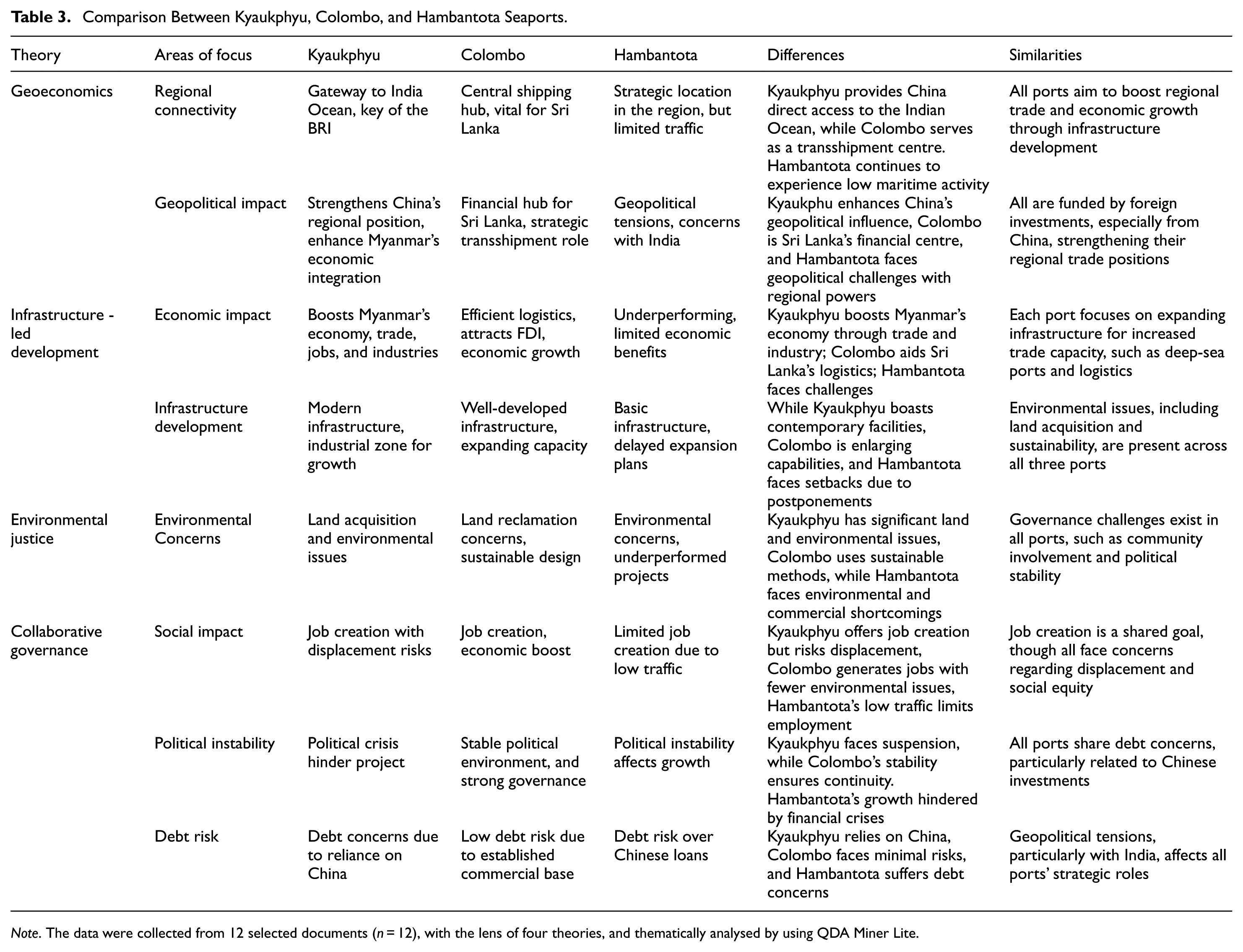
Note. The data were collected from 12 selected documents (n = 12), with the lens of four theories, and thematically analysed by using QDA Miner Lite.
In-Depth Interview
Research Questions, Participants and Coding
This analysis assessed the significance of the Kyaukphyu Seaport and examined its implications and opportunities to provide policy recommendations to Myanmar and China’s governments, Chinese investors, and local communities. Research questions include RQ1: What are the significant characteristics and implications of the Kyaukphyu Seaport Project? RQ2: What are the potential opportunities and risks associated with the Kyaukphyu Seaport Project? To address these questions, thematic analysis was used to code the responses of 15 participants (n = 15).
Among the 15 participants who engaged in in-depth interviews, six were female. The participants’ ages predominantly ranged from 40 to 50 years, with a majority (seven out of 15) possessing master’s degrees. Notably, Participant P4, aged 28, was the youngest individual with a master’s degree and was employed within a pertinent governmental department. In contrast, Participant P6, 78 years of age, was the oldest participant and served as a senior scholar who contributed significant knowledge and experience to the in-depth interviews. Each participant was engaged in an in-depth interview lasting between 15 and 20 min. Table 4 presents demographic characteristics. To guide and facilitate smooth conduct of in-depth interviews, an interview chart was developed to align questions with research objectives, and Table 5 presents interview chart for in-depth interviews.
Participants’ Demographics.

Note. Participants were purposely selected for the in-depth interview.
Interview Chart.

Note. The chart was prepared to conduct in-depth interviews with the 15 stakeholders.
The study conducted the analysis process, beginning with text coding and culminating in theme development in a transparent and replicable manner. This was accomplished through interpretation-focused coding using QDA Miner Lite 4.0. To develop codes, identify categories, and formulate themes, this study followed Braun and Clarke’s (2019) systematic qualitative coding procedure (Braun & Clarke, 2019). Through systematic coding and categorisation, the study thematically analysed interview transcripts, identified categories from codes, and developed themes for RQ1 and RQ2. Ultimately, the study developed two themes: first, ‘Significant characteristics and potential implications of the Kyaukphyu Seaport Project’, addressing RQ1; second, ‘Potential opportunities and risks that may result from the Kyaukphyu Seaport Project’, effectively solving RS2. Figure 5 illustrates the codes derived from the thematic analysis of participant transcripts, as developed using QDA Miner Lite.

Distribution of codes.
Analysis and Results
These themes encapsulate the key characteristics of the Kyaukphyu Seaport, including its potential impact, opportunities, and challenges. This analysis offers a well-rounded understanding of its influence on Myanmar and broader regions. The participants’ reactions provide evidence for the two themes and explain why seaport development has been dual in nature. Many participants indicated the importance of the Kyaukphyu Seaport because of its aspirational value in regional connectivity.
Table 6 presents key thoughts from the participants that reflects the first theme, ‘Significant characteristics, and potential implications of the Kyaukphyu seaport project’. Many participants assumed that the Kyaukphyu Seaport was anticipated to enhance regional connectivity, positioning Myanmar as a critical link between China and global sea routes in the Indian Ocean as well as the Indo-Pacific region (Htee, 2021). Most participants also believed that the Kyaukphyu Seaport was projected to have a significant impact on socioeconomic development by facilitating infrastructure expansion, attracting Chinese investments, and creating employment opportunities (Poling, 2018). Furthermore, participants P2, P4, P6, P7, and P8 contended that it enhanced energy security through vital oil and gas pipelines, while simultaneously fostering trade and economic growth in Myanmar and the broader region. P7 stated, ‘As a shipping hub, Kyaukphyu Seaport will help Myanmar’s economic and nearby areas by increasing trade’.
Key Thoughts on Characteristics and Potential Implications of Kyuakphyu Seaport.

Note. The codes were extracted from the responses of participants (n = 15), and developed by QDA Miner Lite 4.0.
Nevertheless, participants expressed concerns regarding the effects of this project on regional competition, particularly with India, Australia, and Japan, as well as the obstacles presented by Myanmar’s political instability (Oo et al., 2024), which could impede project implementation and deter foreign investment. Regarding to political instability, P14 remarked, ‘I believe political conflicts are a big reason for delaying projects in Myanmar, especially the Kyaukphyu seaport’. Some participants believed that there was a potential for ecological degradation and local population displacement (Naing, 2022). Participants further proposed that the Myanmar government and Chinese investors systematically conduct social and environmental impact assessments to mitigate socio-environmental risks (Chu et al., 2024). Additionally, they emphasise the importance of involving local communities in key projects to alleviate public concerns (Myint, 2017). P14 stated, ‘I think both the local government and Chinese investors should often do SEIA. This will help prevent and fix possible social and environmental issues’. He also said, ‘Work with the local community, as they will suffer at first hand’. These insights reflect the characteristics and potential impacts of the Kyaukphyu Seaport and its SEZs.
Similarly, Table 7 reflects second theme ‘Potential opportunities and risks that may result from the Kyaukphyu Seaport project’. All participants indicated that the Kyaukphyu seaport project had potential advantages and disadvantages, requiring strategies to maximise benefits while minimising risks. Some participants suggested that, given the strategic position of the Kyaukphyu Seaport in the region, Myanmar should seek to balance its relations among regional powers to mitigate potential geopolitical tensions (Kyi Sin, 2021). Conversely, others recommend that Myanmar diversify its partnerships to reduce excessive dependence on a single country. P6 stated that ‘China was a close and friendly neighbour. However, we should also think about working with other countries for foreign investments’.
Potential Opportunities and Risks Regarding the Kyaukphyu Seaport Project.

Note. The code was extracted from the in-depth interviews (n = 15) and developed by QDA Miner Lite 4.0.
However, most participants did not anticipate that Myanmar would experience a debt trap because of Chinese loans (USIP, 2018). Participant P3 stated, ‘We will not fall into China’s debt trap. We paid fair interest to the loans. Both sides made a fair deal, including financial management’. This clarification addresses concerns about Myanmar’s financial entrapment, assuring that project terms are fair and that financial ties to China reflect normal international cooperation for major projects (Oo & Dai, 2024). Participants P6, P9, P14, and P15 contented that if the project aligns with Myanmar’s national development objectives through inclusive planning, its economic potential can be maximised (Hlaing, 2023). Meanwhile, many participants suggested that employment in the local workforce should be increased through vocational training programmes and transparent hiring policies to mitigate social unrest surrounding Kyaukphyu Seaport and SEZs projects (Chu et al., 2024). The participants suggested that cultural heritage preservation and sustainable tourism policies should facilitate cultural exchange while preserving local identity. They also emphasised the influence of media narratives on foreign investments, particularly regarding Chinese projects like the Kyaukphyu Seaport, which shapes public attitudes negatively (Oo & Dai, 2025).
The participants’ reflections offered a comprehensive perspective of the Kyaukphyu Seaport, corroborating the two identified themes. Overall, the Kyaukphyu Seaport project can generate advantages and disadvantages, requiring strategies to maximise benefits while minimising risks. Diversified partnerships will enable regional connectivity, while working together with regional countries, benefiting local stakeholders (Crescenzi & Iammarino, 2018). If aligned with Myanmar’s development objectives through inclusive planning, its economic potential can be maximised. Employment of locals should increase through vocational training and transparent hiring to mitigate social unrest (Baker, 2019). Maintaining diplomatic neutrality can help alleviate geopolitical tensions with neighbours (Scholvin & Wigell, 2018) and emphasise Myanmar’s role as a trade centre. Political instability necessitates improved governance, transparency, and international cooperation to attract investment and facilitate effective projects. Furthermore, social environmental assessments (SEA), community engagement, and sustainable development practices need to be introduced to mitigate environmental degradation and displacement (Ostrom, 2010). Without these measures, the Kyaukphyu Seaport project cannot fully realise its potential while managing associated risks.
Discussion
In the first phase, the study analysed 12 (n = 12) selected documents and conducted interviews with 15 participants to identify the key characteristics and potential impacts of the Kyaukphyu Seaport. It aimed to provide policy recommendations for implementing the Kyuakphyu Seaport and its SEZs. Within the theoretical framework, a comparative analysis was conducted among three seaports—Kyaukphyu, Colombo, and Hambantota—to identify similarities, differences, and potential impacts of the Kyaukphyu Seaport. The theme, ‘Similarities and Differences in Significant Characteristics and Potential Impacts of the Three Seaports’ was developed as central to the comparative analysis.
The participants emphasised the strategic locations of all three seaports in the Indian Ocean, presenting both opportunities and risks. These seaports have significant charactjeristics that could transform them into regional shipping hubs, facilitating transshipment roles in trade and economic growth through regional connectivity. Documents D1, D3, D6, and D10 highlight that seaports contribute to socioeconomic development by promoting regional hubs, creating jobs, and boosting tourism and trade while enhancing regional trade and supply chains (Gunawardena et al., 2023). However, D2, D9, and D12 indicate that these seaports could exacerbate regional tensions because of their strategic location in the Indian Ocean, attracting strategic rivalries among regional powers, especially China and India (Kyi Sin, 2021).
The development of the Colombo port and urban area suggests the potential for the Kyaukphyu deep-seaport and its SEZs to emerge as regional shipping hubs, facilitating trade in the region, including the Lancang-Mekong area. D1, D2, and D4 asserted that Kyaukphyu promised to advance Myanmar’s national development and generate employment for local communities through infrastructure projects (Narinjara, 2023). However, the Kyaukphyu and Hambantota seaports have high potential to face social and environmental risks, including land acquisition, social equity issues, and marine pollution. Document D5 elaborated on sustainability risks and emphasised the need for local engagement in project implementation in Colombo City (Wijesundara, 2022). Document D3’s ethnographic survey of social impacts in Kyaukphyu further underscores the importance of social and environmental impact assessments and cooperation with local communities.
A comparative analysis revealed the issue of ‘China-debt trap diplomacy’ in Chinese projects. Document D10 analysed Hambantota’s 99-year lease to China and concluded that it resulted from the Sri Lankan government’s financial mismanagement and weak fiscal policies. Overbudgeting foreign investment loans contributed to Sri Lanka’s decision to lease the port of Hambantota to China (Gangte, 2020). Drawing on these lessons, Myanmar’s government should adopt sound financial policies for Kyaukphyu Seaport and other foreign projects. Since Myanmar and China revisited the Kyaukphyu seaport and SEZ, the risk of a debt trap appears minimal. Participant 8 showed the influence of media narratives on Chinese investors’ Colombo project spearheads, indicating the need for proper media management in the future (Oo & Dai, 2025).
Two critical factors distinguish the Kyaukphyu Port from Sri Lanka’s ports. First, the Kyaukphyu Seaport offers a more direct maritime route for China’s oil tankers, bypassing the longer Malacca Strait (CSIS, 2018). This strategic location may generate geopolitical tensions among major regional powers, including India, Australia, Japan, and the United States. Second, political conflicts within Myanmar impede foreign investments and delay projects, including those related to the Kyaukphyu Seaport (Aye, 2024). Document D2 provided statistical evidence showing that the intersection of the ‘strategic position of Kyaukphyu’ and ‘political crisis in Myanmar’ hinders the implementation of the Kyaukphyu deep-seaport and SEZs projects and potential foreign investments (Aye, 2024).
In summary, this comparative analysis not only offers valuable insights into the three seaports, but also provides critical evaluations that assist in formulating policy recommendations for the successful development of the Kyaukphyu Seaport. In-depth interviews were conducted to investigate the significant characteristics and implications of the Kyaukphyu Seaport and SEZs projects. Through systematic thematic analysis, the study identified two primary themes: ‘Significant characteristics and potential implications of the Kyaukphyu seaport project’ and ‘Potential opportunities and risks that may arise from the Kyaukphyu Seaport project’. These themes were central to the analysis.
Many participants perceived that Myanmar had enhanced its strategic importance through the CMEC, providing direct access to the Indian Ocean without navigating the congested Strait of Malacca (CSIS, 2018). This development has significant implications for trade and energy security in both the countries. Participant P2 stated, ‘The Kyaukphyu Seaport benefits not only Myanmar but also China’. Conversely, P7’s assertion, ‘The strategic sea line provided by Kyaukphyu may increase strategic tension in the region, indicated that such positioning may engender potential tensions among regional powers’ (V. Sharma, 2024). On the other hand, participants P7, P8, P9, and P11 argued that the Kyaukphyu Seaport had the potential to become a shipping hub, contributing to trade and economic growth. P8’s remarks, ‘I think the Kyaukphyu Seaport has the potential to become a shipping hub in this region’, confirmed this argument.
Seaport development can significantly enhance Myanmar’s economy by improving regional accessibility and attracting foreign direct investment (FDI). Kyaukphyu’s global economic integration is expected to boost Myanmar’s exports and market opportunities, thereby increasing its economic value. The participants indicated that seaports were pivotal in transforming Myanmar’s economy into a modern industrial trading system (Min & Kudo, 2012). Trade connections between China, India, and Southeast Asia are expected to drive investment growth. Participants also claimed that the Kyaukphyu Seaport and its SEZs would promote Myanmar’s socioeconomic development by securing energy transportation, boosting trade, enhancing infrastructure, and providing employment to local communities (Lwin, 2020c). Participant P15’s assessment of the Kyaukphyu Seaport project offers opportunities: `I believe it will promote Myanmar’s socioeconomic development, provided that we create a better economic environment’, further underlining participants’ claims. Meanwhile, some participants suggested that the Myanmar government and Chinese enterprises should collaborate to meet basic developmental needs, while participants P2, P4, P6, P8, P9, P13, and P14 recommended that projects should align with the ‘national development framework’.
A few participants expressed concerns about the Kyaukphyu Project’s environmental and social implications, highlighting the potential losses of fishing grounds, land acquisition, and job displacement (Naing, 2021). Participants P6, P8, and P15 noted that ‘the Kyaukphyu residents sometimes staged protests against the Kyaukphyu Seaport project for different reasons, particularly land acquisition issues’. Additionally, P9 said that ‘Sometimes, some local people may have lost their jobs because they lacked skills’. These remarks underscore public concerns regarding the socio-economic risks associated with the Kyaukphyu Seaport project. Therefore, the participants advocated for the Myanmar government and Chinese investors to consistently undertake ‘social, economic impact assessments’ (SEA) to mitigate potential environmental risks and address possible misunderstandings among governmental entities, investors, and local communities (Times, 2018). In addition, participant, P8 suggested that Kyaukphyu ‘project developers should replicate the sustainable technology applications used in Colombo port development’.
Some participants argued that the issues stemmed from a lack of transparency by the Myanmar government and Chinese companies as well as insufficient consultation with the local community in executing key projects (Hlaing, 2023). They suggested that effective communication with the local community is likely to mitigate many of these problems. P8 stated, ‘I think, lack of transparency and coordination with local communities would be a fundamental reason for the local concern’. Participants P7, P8, and P14 proposed that effective communication among the government, Chinese investors, and locals, along with transparency in decision making, is essential for maintaining public trust in the infrastructure operations of the Kyaukphyu Seaport project (Morris, 2021).
Critics have expressed concerns that Myanmar might face a situation like Sri Lanka’s Hambantota, in which control was lost in China because of unpaid loans. However, most participants disagreed that the Kyaukphyu Seaport and its SEZs projects would lead to a debt trap. Participant P14 stated, ‘I think it is not a debt trap. Instead, it is a big chance if we work well with China to build the Kyaukphyu Seaport’. Some participants suggested that Myanmar should avoid overreliance on a single country and diversify its partnerships with other nations (Oo & Dai, 2024). Participants P1, P2, P3, P4, and P5 expressed confidence that Myanmar would benefit from the Kyaukphyu Seaport Project. Participants P7 and P14 recommended learning from the ‘Hambantota’ incident to ensure effective financial governance and fiscal policy management.
Political instability is a significant impediment to Myanmar’s progress, particularly in terms of delaying projects and deterring foreign investments. Participants agree that ongoing conflicts between Myanmar and ethnic armed groups continue to obstruct the completion of the Kyaukphyu Seaport and its SEZs projects (Aye, 2024). Participant P14 remarked, ‘We need to stop fighting in our country, or our projects will not improve’. In addition, some participants indicated their concerns that media outlets would emphasise the negative aspects of Chinese projects, such as potential debt increases, environmental pollution, and exploitation by political elites (Oo & Dai, 2024). Participant P5 noted, ‘I assume, media often exaggerates and misrepresents issues, leading to descriptions that are very different from the real situation’. The participants emphasised media management and stakeholder engagement to gain citizen support. They proposed that media coverage presents Kyaukphyu as an opportunity for international trade, employment, and infrastructure improvement rather than external influence.
In conclusion, a comparative analysis and in-depth interviews provided insights into the significant characteristics and potential implications of the Kyaukphyu Seaport. By triangulating these analyses with existing knowledge, this study provides policy recommendations for the successful completion of the Kyaukphyu Seaport and its SEZs.
Conclusion
Two analytical methods identified critical findings for policy recommendations in examining the characteristics and implications of the Kyaukphyu Seaport and its SEZs projects. Similar to the Colombo and Hambantota seaports, Kyaukphyu’s strategic location presents opportunities and challenges. The Kyaukphyu Seaport, like Colombo, has the potential to become a regional shipping hub, contributing to trade and economic growth through enhanced regional connectivity (Htee, 2021). Like the Sri Lankan ports, its strategic position intensifies competition among regional powers, particularly between China and India (Kyi Sin, 2021). Consequently, the Myanmar government should adopt a foreign policy that balances the relations among these powers (NITTA, 2019).
The successful development of the Kyaukphyu Seaport, as observed in Colombo, holds a significant potential to contribute to the socioeconomic advancement of the local community through enhanced port infrastructure, logistics, and modern facilities, providing employment for local residents (Narinjara, 2023). However, environmental concerns, such as land acquisition, displacement, and loss of fishing grounds, may escalate if socio-environmental impact assessments (SEIA) are not conducted transparently with local communities (Times, 2018). Unlike Hambantota, Kyaukphyu faces lower financial risks because of fair financial agreement and low interest rates on loans, and proper fiscal policy on foreign investments. Learning from Hambantota’s challenges, Myanmar should implement sound financial management and ensure that investments align with national development to mitigate project obstacles (Sandhi Governance Institute, 2024).
This study emphasises that nationwide political conflicts in Myanmar and strategic competition among regional powers may constrain the completion of the Kyaukphyu Seaport project (Aye, 2024). By circumventing the Strait of Malacca, China’s efforts to reduce reliance on this congested route may enhance energy security for both countries (CSIS, 2018), while potentially contributing to regional tensions. Consequently, Myanmar’s government must implement foreign policies to facilitate regional collaborations. This study highlights how media intentions may exacerbate public concerns regarding Chinese enterprise-led overseas projects in Colombo and Hambantota (Pasqual, 2024). Therefore, recommends that Myanmar’s government and Chinese enterprises prioritise effective media management for Chinese projects, including the Kyaukphyu Seaport (Oo & Dai, 2025).
Overall, the Kyaukphyu Seaport presents Myanmar with great opportunities and threats that need to be properly managed. Although the project has the potential for economic growth, regional connectivity, and energy security, the government of Myanmar still needs to address the challenges of political stability, governance, environmental sustainability (Aye, 2024), and social equity, so that the benefits of the project supersede the risks. However, the government is vital in ensuring that there are strong risk management strategies, the involvement of local communities (Hlaing, 2023), and the creation of clear governance structures that would enable the realisation of the long-term potential of the Kyaukphyu Seaport. Myanmar also needs to be proactive in the management of geopolitical relationships to counter the adverse effects of external pressure (V. Sharma, 2024) and to become one of the primary stakeholders in the Indo-Pacific trade network.
This study has limitations, including the limited sample size, potential selection bias, and the absence of quantitative data. There is inadequate discussion of the environmental and social effects and insufficient comparison between the BRI projects. Future research could be enhanced through stakeholder interviews and surveys, utilisation of quantitative methods, comprehensive impact assessments, increased cross-comparisons with other BRI projects, analysis of long-term sustainability and debt effects, evaluation of alignment with Myanmar’s development goals, and exploration of mitigation strategies. In addition, future research should also address gaps in environmental and social impact assessment, comparisons with other BRI projects, and sustainability analyses and financial management. This would facilitate the identification of refinements to strategies for realising the potential of this transformative infrastructure development. If properly governed, this could become vital to Myanmar’s future and enhance its position on trade relations and geopolitical landscapes.
Footnotes
Acknowledgements
The authors would like to express their sincere gratitude to Professor Dai Yonghong, Dean of College of International Studies for his guidance, and to the teachers from School of Media and Communication at Shenzhen University, for their support throughout this research project.

Ethical Considerations
This study was conducted in accordance with the ethical guidelines of the Declaration of Helsinki approved by Ethics Committee of Shenzhen University. Due to the nature of the study, and the absence of personal data utilisation, the study was deemed exempt from Ethics Committee approval from Shenzhen University was not required, as the research did not involve sensitive personal data.
Consent to Participate
The study adhered to the ethical guidelines for human participant research. Therefore, the necessary consent was made between authors and the participants before the conduct of research. Informed consent was obtained using an information sheet detailing the study’s purpose, risks, and privacy safeguards. Written consent was obtained from the participants, with privacy safeguards exceeding IRB standards. According to the consent, participation was voluntary and participants could withdraw at any time without penalties. Interviews were conducted in private with no sensitive topics, maintaining minimal research risk. Data were anonymised to prevent personal identification. The risk to participants did not outweigh the potential social impact. To protect anonymity during peer review, the authors removed the identifying materials and used pseudonyms.
Author Contributions
Conceptualisation, Oo and Dai; methodology, Oo; software, Oo; validation, Oo and Dai; formal analysis, Oo; investigation, Oo and Dai; resources, Oo; data curation, Oo and Dai; writing—original draft preparation, Oo; writing—review and editing, Oo; visualisation, Oo; supervision, Dai; project administration, Dai; funding acquisition, Dai All authors have read and agreed to the published version of the manuscript.
Funding
The authors disclosed receipt of the following financial support for the research, authorship, and/or publication of this article: This work was supported by the major project entitled ‘Study on the Impact of the situation in the Bay of Bengal Region on the Safety of China’s East Data and West Computing Project’ (Project No.22ZDA181), funded by the ‘National Social Science Foundation in 2022’.
Declaration of Conflicting Interests
The authors declared no potential conflicts of interest with respect to the research, authorship, and/or publication of this article.
Data Availability Statement
Data will be provided upon the request to correspondence author.