




Abstract
While the spread of artificial intelligence (AI)-generated images becomes inevitable, many universities started to pay attention to developing their art students’ visual literacy in this regard. In this case, these students’ visual literacy for AI-generated images becomes an important area of investigation. This study examines whether attitudes of Chinese art students towards AI will affect their visual literacy for AI-generated images and investigates the mediating role of AI-specific creative self-efficacy (AI-Specific CSE) therein. A total of 418 valid self-reported responses were collected from art students at a Chinese university. The results showed that AI attitudes had a directly positive impact on these students’ visual literacy with AI-specific CSE working as a positive mediator. These findings suggest the great importance of psychological factors in art students’ visual literacy development and offer some pedagogical implications for university leaders and teachers. Beyond this study, broader educational suggestions were also given to cultivate the future artists to use AI tools more critically for their creative process.
Plain Language Summary
AI has greatly changed art students’ way of creating in their artistic practices. Nowadays in China, many higher institutions start to focus on training art students regarding their AI-related ability to create. In such a case, visual literacy for AI-generated images, which is about how students understand and explain the given images generated by AI, becomes an important ability to explore. In this study, visual literacy for AI-generated images is especially explored regarding students’ ability to interpret the literal, symbolic, and cultural meanings from the visuals. For example, if art students have strong visual literacy, they are more likely to recognise colours and shapes, which further helps them better grasp the underlying intentions and potential cultural cues behind the AI-generated images. As visual literacy for AI-generated images is important, its influencing factors, including art students’ AI attitudes and their AI-specific creative self-efficacy (AI-specific CSE) (i.e., the self-confidence regarding their ability to use AI tools for creative practice in artistic creation) were explored. Via the three self-report questionnaires to measure the above three key constructs, the results show that AI attitudes can directly affect the visual literacy for AI-generated images with AI-specific CSE partially explaining the above relationship. Thus, the importance of fostering art students’ AI attitudes and AI-specific CSE is highlighted for developing their visual literacy, with pedagogical implications offered to Chinese universities.
Introduction
In China, through platforms such as Xiaohongshu and Douyin, images generated by artificial intelligence (AI) have rapidly integrated into daily life and shaped new visual style trends (Zhe & Srijinda, 2024). In response to this change, Chinese universities such as Xi ’an Jiaotong-Liverpool University and the Academy of Arts and Design at Tsinghua University have begun to introduce AI tools like Midjourney and Canva into their art courses (Qian, 2024). These courses encourage students to explore new ways of combining art and technology. Visual literacy, namely the ability to interpret, analyse and create meaning from visual information (Ünal, 2024), is an important core skill for art students (Danış, 2021). For art students, if they have strong visual literacy for AI-generated images, they can be good at understanding visual language, discovering latent information (Danış, 2021), and making well-considered creative decisions in artistic creation (Ünal, 2024). This ability may help art students become more reflective AI users in their creative practices (C. Wang, 2024). Therefore, it is valuable for higher education to explore Chinese art students’ visual literacy for AI-generated images and its influencing factors.
In an AI-supported learning environment, a positive relationship between students’ attitudes towards AI and their visual literacy has been noted by some studies both in art field (C. Wang, 2024) and outside the art field (Saklaki & Gardikiotis, 2024; Ünal, 2024). Their results commonly show that students who have more positive feelings towards AI tools usually have stronger visual literacy. In the art field, this link can be evident because students’ AI attitudes can influence their willingness to try using digital tools in their creations (Hwang & Wu, 2025). This greater exposure to AI tools further gives students more opportunities to evaluate and analyse AI-generated images (i.e., visual literacy for AI-generated images). Despite these insights, the impact of attitudes towards AI on their visual literacy for AI-generated images among Chinese art students has not been fully studied, and there are still significant research gaps in this field.
Moreover, creative self-efficacy (CSE), an important art learning concept (Unal & Tasar, 2021), might help explain the above relationship. Generally, CSE refers to how confident students are in their own ability to generate creative ideas and artistic works (Tierney & Farmer, 2002). Social cognitive theory proposes that general CSE is an important construct affecting students’ motivation and behaviour during their task performance (Bandura, 2000). In this study, AI-specific CSE refers to students’ confidence level in using AI tools to apply their creative abilities for artistic creation. Unlike general CSE, the AI-specific CSE is more domain-focused and emphasises the students’ self-confidence level to apply creativity in AI-supported contexts. Previous studies have found that students with positive attitudes towards AI often report higher levels of AI-specific CSE (Saritepeci & Durak, 2024), which may, in turn, help them develop stronger visual literacy for AI-generated images (Unal & Tasar, 2021). Yet, this mediating role of AI-specific CSE has not been fully examined, especially in the setting of Chinese art universities, where AI is becoming a regular part of creative learning (Hwang & Wu, 2025).
Given these gaps, this study seeks to explore if AI-specific CSE mediates the relationship between attitudes towards AI and visual literacy for AI-generated images among Chinese art students. Drawing on the active learning theory (Bonwell & Eison, 1991) and social cognitive theory (Bandura, 2000) (the details will be discussed in the Literature Review Section), it proposes that positive attitudes towards AI encourage students to engage more deeply in AI-assisted creative activities. Such engagement enhances mastery experiences, strengthens AI-specific CSE, and ultimately fosters higher visual literacy through more critical and reflective AI-generated visual analysis. This study is significant from three perspectives. First, it focuses on art students, a group increasingly exposed to AI technologies but still underexplored in the literature. Second, it treats students’ AI attitudes, AI-specific CSE, and visual literacy as domain-specific constructs (Denee et al., 2024; Grassini, 2023; Unal & Tasar, 2021) within AI-supported artistic creation. This perspective provides a practical understanding that can inform more tailored instructional practices. This study also draws on active learning theory and social cognitive theory to explain how students’ views about AI may shape their creative confidence and visual understanding. Together, the framework shows how motivational and cognitive constructs interact in AI-supported art learning environments.
Literature Review
The Impact of Attitudes Towards AI on Visual Literacy for AI-Generated Images
Attitude describes an individual’s general feelings and beliefs towards a particular topic (Ajzen, 2014). Attitudes towards AI in this study refer to the general feelings and beliefs towards AI tools such as Midjourney or Canva used in art students’ artistic practices. Despite the popularity of this concept in the recent educational field, the way it is conceptualised varies from scholar to scholar. For example, some scholars conceptualise students’ AI attitudes by mainly focusing on their negative aspects such as AI anxiety or perceived threat (Kieslich et al., 2021; Y. Y. Wang & Y. S. Wang, 2022), while other scholars like Grassini (2023) break this concept into different dimensions such as perceived usefulness or social impact. Although these ways of conceptualisation have their own values, they might not be suitable for this study for two reasons. Firstly, the first two conceptualised ways mainly focus on the negative attitudes but ignore the positive ones of students. Secondly, the later conceptualisation (Grassini, 2023) attempts to explore multiple dimensions of AI attitudes and thus might not capture students’ overall evaluations and feelings towards AI tools. This study adopts Stein et al.’s (2024) conceptualising framework that believes students’ AI attitudes are holistic and single-dimensional by taking into account both their positive and negative feelings towards AI. This comprehensive perspective is beneficial in capturing the complex but overall attitudes of students when using AI tools in creative design (Stein et al., 2024).
Visual literacy was first proposed by Debes (1969), who introduced this term as an individual’s ability to interpret, analyse and create meaning from visual information. From this definition, it can be seen that visual literacy generally includes two interrelated abilities: decoding and encoding. Specifically, decoding is about ‘deconstructing’ such as understanding and interpreting the meaning of a visual message, while encoding is more about ‘applying’, which is to create visual material to convey information effectively (Ünal, 2024). While both abilities are important in art education, this study only explores the ‘decoding’ ability; this is because with the recent rise of AI-generated images, decoding has become particularly foundational, as students must first interpret AI outputs before they can encode them. Accordingly, this study defines visual literacy for AI-generated images primarily in terms of the decoding aspect: how students interpret and analyse the meanings from AI-generated images. Based on Y. H. Wang and Liao’s (2023) framework, this study looks at decoding ability in three parts: explicit meaning, allegorical meaning, and symbolic meaning. Explicit meaning refers to what can be seen directly, such as text or colour. Allegorical meaning points to the hidden story or metaphor behind the image. Symbolic meaning relates to the specific cultural or social symbols shown. In this study, art students with strong visual literacy can notice clear visual details first, then move on to find deeper messages or symbols in AI-generated images.
In the current body of research, while some studies outside the art domain have examined the impact of students’ attitudes towards AI tools on their visual literacy, the attention paid to this issue in the field of art education remains limited. One relevant study by C. Wang (2024) used a mixed-method approach to explore Chinese high school students’ attitudes towards using AI in painting. Qualitative results show that students who hold a more positive attitude towards AI are better at appreciating and grasping the essence of AI-generated images, thereby enhancing their creative thinking. Similarly, Ünal (2024) observed a positive association between attitudes towards AI tools and visual literacy among 188 secondary school students in Turkey (in a non-art context). That study further suggested that students who view AI positively are more inclined to engage with digital content, thereby improving their comprehension of visual information. Although these studies did not specifically focus on art students or visual literacy for AI-generated images, they highlight the potential influence of attitudes towards AI on visual literacy.
Drawing on active learning theory (Bonwell & Eison, 1991), students develop higher-order cognitive skills when they actively engage in learning, and such engagement is often shaped by their attitudes. Therefore, Chinese art students with more positive attitudes towards AI are likely to engage more deeply with tools such as Midjourney, allowing them to interpret and analyse AI-generated visuals more effectively – the essence of visual literacy. In light of the discussion above, the study assumes that:
The Mediating Role of AI-Specific CSE
The idea of self-efficacy originates from Bandura’s social cognitive theory (2000), which basically means how much people believe in themselves and their ability to get certain tasks completed. Building on this foundation, Tierney and Farmer (2002) introduced the notion of general CSE, which is about how confident someone feels about being creative in a particular area. In art education, CSE reflects how confident students feel about their creative potential and their ability to use imagination in artistic work (Suherman & Vidákovich, 2025). In this study, AI-specific CSE relates to how confident students feel about generating creative ideas and solutions when using digital tools in art. This confidence influences whether and how they experiment with different AI approaches in their artistic work.
So far, only a few studies have examined how attitudes towards AI relate to AI-specific CSE.
Some research, however, has found a positive link between attitudes towards AI and AI self-efficacy. For instance, Naiseh et al. (2025) examined how people from the UK and Arab regions differ in their AI self-efficacy and attitudes towards using AI. Their findings showed a positive relationship between attitudes towards AI and AI self-efficacy. This suggests that students with more positive attitudes towards AI have higher self-confidence in using them (Suherman & Vidákovich, 2025). However, Naiseh et al.’s (2025) work, as well as other related studies (e.g., Bergdahl & Sjöberg, 2025; Bewersdorff et al., 2025), have not explored how these attitudes affect AI-specific CSE in art education, which is a gap to address.
From a theoretical perspective, active learning theory (Bonwell & Eison, 1991) suggests that when students have positive attitudes, they tend to engage more actively in their learning; social cognitive theory (Bandura, 2000; Yin et al., 2022) adds that experiences gained through this engagement can boost their confidence in their abilities. Based on these ideas, when Chinese art students hold positive attitudes towards AI, they are more likely to use AI tools in their creative work. Their successful experiences with these tools can then increase their confidence in using them for artistic creation (AI-specific CSE). In light of the discussion above, the study assumes that:
Some recent empirical evidence in the education field suggests that students’ general CSE can significantly influence their visual literacy. For instance, Suherman and Vidákovich (2025) examined 869 Indonesian secondary students and found that higher general CSE predicted stronger environmental literacy, which is reflected in their greater ability to analyse and evaluate their surroundings, including the visual information. A systematic review by Unal and Tasar (2021) further supported the above finding, revealing that educational interventions focused on strengthening general CSE positively impacted students’ creative outputs, including visual literacy. Suggested by social cognitive theory (Bandura, 2000), self-efficacy can facilitate ability development by supporting students’ motivation and behaviour. Accordingly, as a domain-specific form of self-efficacy, higher AI-specific CSE (i.e., their greater confidence in using AI tools to generate creative solutions for artistic creation) among Chinese art students may support their deeper engagement with AI-generated visuals motivationally and behaviourally. This, in turn, enhances their visual literacy for AI-generated images. In light of the discussion above, the study assumes that:
While the discussions of previous studies and theoretical perspectives suggest a potentially close link among AI-specific CSE, attitudes towards AI, and visual literacy for AI-generated images, direct empirical evidence remains limited. Given this gap, the present study proposes that AI-specific CSE plays a mediating role between Chinese art students’ attitudes towards AI and their visual literacy of AI-generated images. Specifically, students with more positive attitudes towards AI are expected to demonstrate higher AI-specific CSE, which in turn enhances their visual literacy for AI-generated images within the artistic design process.
This positive mediation of AI-specific CSE can be suggested from the lenses of active learning theory and social cognitive theory. According to social cognitive theory, mastery experiences can greatly increase students’ self-efficacy like AI-specific CSE, which in turn sustains motivation and promotes effective behaviours leading to higher task achievement (Bandura, 2000). Taken together, as suggested by active learning theory, Chinese art students who hold positive attitudes towards AI tools (e.g., Midjourney or Canva) are more possible to engage actively and effectively with these digital tools in their artistic creation processes. These successful, hands-on experiences (i.e., mastery experiences) further strengthen their confidence in using AI tools for artistic creation (i.e., AI-specific CSE), thereby improving their ability to analyse and interpret AI-generated visuals (i.e., visual literacy for AI-generated images). Given this, the study assumes that:
Conceptual Framework
This study constructed a conceptual framework based on the aforementioned four assumptions, as illustrated in Figure 1. In this model, attitudes towards AI function as the exogenous variable, visual literacy for AI-generated images as the endogenous variable, and AI-specific CSE as the mediating variable. As discussed in the literature review, attitudes towards AI are conceptualised as a first-order construct that reflects students’ overall evaluations, including both positive and negative attitudes, of using AI tools (e.g., Midjourney and Canva) in artistic creation. Similarly, AI-specific CSE is treated as a first-order construct focusing on students’ self-confidence in their creative abilities when using AI tools. In contrast, visual literacy for AI-generated images is modelled as a second-order construct, encompassing three first-order dimensions: explicit meaning, allegorical meaning, and symbolic meaning. This construct captures students’ ability to analyse and interpret AI-generated images across these three levels of meaning.

Conceptual framework of the study.
Methodology
Population and Sampling
This study was carried out at an art-oriented university for two main reasons. First, most students at this institution are art students majoring in fields such as sculpture or ceramics; also, this university has modern digital design facilities such as AI design laboratories. These elements make the university a suitable place to find participants related to the study topic. Second, the school recently added new compulsory courses, such as Creative Design with Digital Tools or Visual Communication Technology. These classes teach students to use image-based software in their creative work. Students can draw on public image resources or upload their own sketches and text prompts to generate new visuals. Because these courses are still new, it is useful to examine how art students view digital tools, how confident they feel about using them in creative work, and how well they interpret computer-generated images. At this university, art students typically attend 18 to 20 lessons per week, primarily including art theory and project-based learning courses, where they are expected to produce creative works for summative assessment. This hands-on pedagogical setting, with opportunities for experimentation and instructor feedback, allows students to explore and apply AI tools in their artistic practice; this environment also provides an authentic context for data collection.
The inclusion criteria for this study were (1) Chinese nationality and (2) undergraduate students enrolled in art-related majors. Especially, participants were limited to Chinese nationality only to ensure a shared cultural and educational background, including their prior exposure to art and design curricula. As the key focus of this study is the curricular environment of an art-oriented university, limiting the sample in this way helps to reduce extraneous variability and ensures more comparable responses across participants.
To reach participants, the researcher contacted the class tutors responsible for students majoring in arts and sought their assistance in distributing the survey. With their support, the electronic questionnaire was disseminated via class group chats commonly used for academic communication. Although class tutors assisted in disseminating the survey link, their role was strictly limited to distribution. To minimise any potential perception of pressure, the research clearly informed students that their participation in this survey was completely voluntary and anonymous, which means that their tutors will not know who in the class has taken part in the survey or not; not taking part in the survey will not affect their academic performance or their relationship with their tutors. At the same time, there were no any forms of reward and penalty upon their participation. The survey was administered online. The whole data collection process lasted approximately two months.
A total of 469 responses were received. After a thorough screening process, 51 responses were excluded due to incompleteness or invalid entries. As a result, 418 valid questionnaires were retained for data analysis. Of these 418 respondents, 203 (48.6%) were male and 215 (51.4%) were female. As for academic year, 141 students (33.7%) were in Year 1, 108 students (25.8%) in Year 2, 116 students (27.8%) in Year 3, and 53 students (12.7%) in Year 4.
Ethical Considerations
This study strictly followed the principles of the Declaration of Helsinki established in 2000. Before the implementation of data collection, the ethical waiver was obtained from the university the study was conducted on. Also, the participant information sheet regarding the research aims, procedures, benefits, and potential risks was introduced, and all participants were required to sign written consent forms before starting to complete the survey.
Efforts were also made to limit the potential risks of harm to participants. First, students’ participation was totally anonymous and voluntary, with students explicitly informed of their right to withdraw at any time. Second, data confidentiality was maintained by assigning numerical codes to all responses and removing identifying or irrelevant information during analysis and reporting. Third, the questionnaire only included items exploring students’ perceptions (i.e., their attitudes towards AI, AI-specific CSE, and visual literacy) and did not contain any sensitive questions. As the risks were minimal, the potential benefits outweighed them because the study might provide a nuanced understanding of students’ engagement with AI in art and design education, which can contribute to developing more effective pedagogical practices.
Research Instruments
Attitudes Towards AI
Attitudes towards AI were measured by adapting the 12-item scale from Stein et al. (2024). This is originally the 5-point Likert scale that includes both positively and negatively worded statements. To ensure the consistency, students’ responses on the negatively worded statements were reverse coded first before the actual data analysis. Generally, there are two reasons why this scale is selected by this study. First, Stein et al.’s scale allows a holistic assessment of participants’ AI attitudes, which aligns with the study’s conceptualisation mentioned in the Literature Review section. Additionally, when developing this scale, Stein et al. (2024) had tested this scale in three separate participants, and the results all confirmed the reliability and validity of this scale (Stein et al., 2024). To make this more relevant to art and design students (i.e., the focus of this study), some slight adjustments were made by adding some contextual descriptions to the items; more details regarding the original and modified items were presented in Appendix B. Participants rated each item using the 5-point Likert scale, where 1 indicated ‘strongly disagree’ and 5 indicated ‘strongly agree’.
AI-Specific Creative Self-Efficacy
Students’AI-specific CSE was measured with a 6-item scale adapted from Karwowski (2011). Originally designed as a 5-point Likert scale, the participants of this study also use this scale (1 indicated ‘strongly disagree’ and 5 indicated ‘strongly agree’) to rate each item. The primary reason for choosing this scale is that it has been widely validated in the educational research (Karwawski, 2011; Saritepeci and Durak, 2024), which makes it a valid and reliable measure to capture students’ CSE using AI tools. The details regarding its original and modified items were presented in Appendix B.
Visual Literacy for AI-Generated Images
Students’visual literacy for AI-generated images was measured by a 30-item scale adapted from Y. H. Wang and Liao (2023). This 7-point Likert scale evaluates three dimensions of visual meaning: allegorical meaning (12 items), explicit meaning (10 items), and symbolic meaning (8 items). The reason for choosing this scale is that its conceptualisation of visual literacy and its three measured subdimensions are highly consistent with the framework of this study (see Figure 1). Furthermore, Y. H. Wang and Liao (2023) verified this scale, and the results showed that it had good reliability and structural validity. This supports its valid use in this research. Once again, the details regarding its original and modified items were presented in Appendix B. Participants rated each item using a 7-point Likert scale, where 1 represented strong disagreement and 7 represented strong agreement.
Notably, this study used different Likert scales (5-point vs. 7-point) for three reasons. First, the original scale designs were retained, as their developers had already validated the appropriateness of the response formats. For example, Stein et al. (2024) confirmed the reliability and validity of a 5-point Attitudes towards AI scale across their three consecutive studies (N1 = 490; N2 = 150; N3 = 298). Similarly, Y. H. Wang and Liao (2023) employed both 6-point and 7-point Likert formats when developing the Visual Literacy scale, and their empirical comparisons showed that the 7-point version provided stronger psychometric properties. Based on such thorough investigations, this study retained the original scale formats rather than altering them, since arbitrary changes in the number of response options may affect how respondents interpret and react to items (Henseler et al., 2015). Second, because the study tested the mediating model (Figure 1) using Partial Least Squares Structural Equation Modelling (PLS-SEM), it was not necessary to unify the scales; this is because variance-based PLS-SEM can accommodate both 5-point and 7-point measures without affecting results (Hair et al., 2019). Third, to ensure that the measures used in this study met the required psychometric standards, reliability and validity were examined and confirmed to be satisfactory. The detailed results are reported in Section ‘Validity and Reliability Assessment’.
Data Analysis
Smart PLS 4 was employed as the major analytical tool to test the reliability and validity of the measurement model and the four research hypotheses. Especially, this study adopted PLS-SEM via Smart PLS 4 to examine the mediating effect of AI-specific CSE on the relationship between attitudes towards AI and visual literacy for AI-generated images for three reasons. First, the initial assessment of normality using SPSS 27 indicated that the key constructs did not fully meet the assumption of normality. Specifically, Table 1 presents the normality results. Skewness and kurtosis values ranged from −0.662 to −0.020, within the acceptable threshold of ±2, suggesting no severe deviations from normality (Pallant, 2020). However, all Kolmogorov–Smirnov test p-values were below .05, indicating a violation of normality (Cheah et al., 2020). Considering these mixed results, data normality cannot be strictly assumed. As a variance-based, non-parametric technique, PLS-SEM is well-suited for exploring relationships among constructs without requiring normally distributed data (Hair et al., 2019).
Normality Results for Key Variables.

Note. AAI = attitudes towards AI; AI-specific CSE = AI-specific creative self-efficacy; VL for AIGI = visual literacy for AI-generated images.
Second, PLS-SEM is appropriate for exploring complex or less-studied relationships. Unlike covariance-based SEM (CB-SEM), which is ideal for well-established theoretical and empirical models, PLS-SEM allows investigation of emerging relationships (Hair et al., 2019), such as those in the underexplored context of AI in design. Third, as noted in Section ‘Research Instruments’, this study employed different Likert scales (5-point and 7-point) for the measurement of constructs. PLS-SEM is particularly suitable here because it allows the direct analysis of constructs measured on different scales without requiring standardisation. In summary, PLS-SEM was adopted to test the proposed mediation model with the relevant details presented in the subsequent section.
Results
Validity and Reliability Assessment
The initial assessment of attitudes towards AI construct revealed that one item (AAI3) had a factor loading of 0.498, falling below the commonly accepted threshold of 0.50, and was therefore removed from further analysis (see Appendix A for the outer loadings of all items). Following this refinement, Table 2 presents the updated results, including the outer loadings, Cronbach’s alpha, composite reliability, and Average Variance Extracted (AVE) values for each construct. Specifically, both the attitudes towards AI and AI-specific CSE constructs had factor loadings higher than .5; this indicates both constructs had satisfactory indicator reliability (Hair et al., 2020). Internal consistency reliability for the above two constructs was also satisfactory, as reflected in Cronbach’s alpha and composite reliability values greater than .70 (Pallant, 2020). Additionally, the AVE values for attitudes towards AI (0.511) and AI-specific CSE (0.533) were above the 0.50 threshold. This suggests that the convergent validity for both constructs was confirmed (Cheah et al., 2020).
Outer Loadings, Internal Consistency Reliability, and AVE Values for Key Constructs.

Note. AAI = attitudes towards AI; AI-specific CSE = AI-specific creative self-efficacy; VL for AIGI = visual literacy for AI-generated images.
As for visual literacy for AI-generated images, it was modelled as a second-order construct with three lower-order dimensions: explicit meaning, allegorical meaning, and symbolic meaning. As shown in Table 2, all lower- and higher-order components had outer loadings above .50, indicating satisfactory indicator reliability. Internal consistency reliability values, as measured by Cronbach’s alpha and composite reliability, ranged from .896 to .953, well above the .70 threshold and thus demonstrating strong reliability. Additionally, all AVE values exceeded .50, confirming adequate convergent validity for both the dimensions and the overall construct.
Table 3 presents the HTMT values for all relevant constructs. Specifically, all Heterotrait-Monotrait ratio of correlations (HTMT) values for AI attitudes, AI-specific CSE, and visual literacy for AI-generated images ranged from .244 to .809. As these values were below the recommended threshold of .85, the discriminant validity for each construct was confirmed (Henseler et al., 2015).
HTMT Values for Discriminant Validity Among Key Constructs.

Note. AAI = attitudes towards AI; AI-specific CSE = AI-specific creative self-efficacy; VL for AIGI = visual literacy for AI-generated images.
SEM Results
Before exploring the relationships among students’ attitudes towards AI, AI-specific CSE, and visual literacy for AI-generated images, it is important to check for multicollinearity among the predictors. High multicollinearity can affect the accuracy of path estimates and reduce the reliability of the model (Hair et al., 2020). Table 4 shows the Variance Inflation Factor (VIF) values for the predictors, namely attitudes towards AI and AI-specific CSE, which are both 1.368. These values are below the recommended 3.0 threshold (Cheah et al., 2020); this indicates that collinearity is not an issue, and predictors are sufficiently independent for hypothesis testing.
VIF Values for Predictor Variables of Visual Literacy.
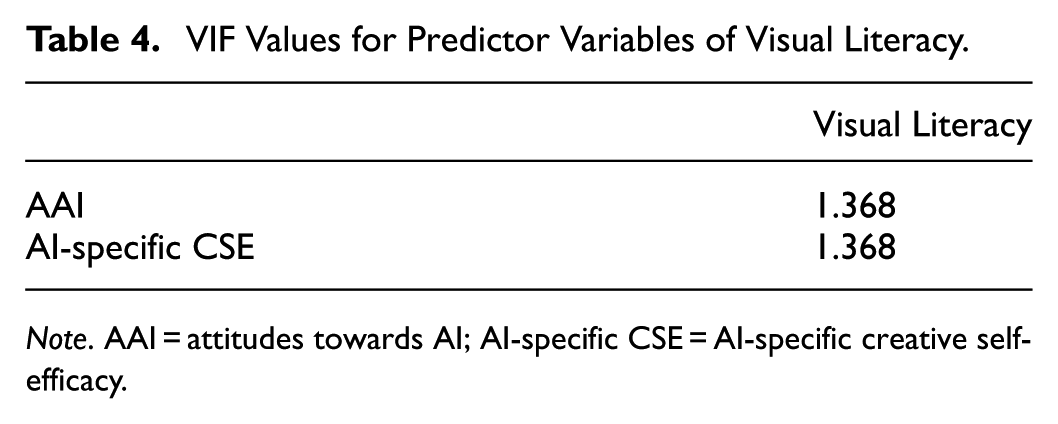
Note. AAI = attitudes towards AI; AI-specific CSE = AI-specific creative self-efficacy.
To further examine the structural model, a bootstrapping procedure with 5,000 samples at a 0.05 significance level was conducted to evaluate the significance and relevance of SEM effects (see the visualised results in Figure 2). For additional details, refer to the results in Appendix C, which provides the SmartPLS output visualizations. Table 5 presents the results of different path analyses among attitudes towards AI, AI-specific CSE, and visual literacy for AI-generated images. Specifically, attitudes towards AI and AI-specific CSE both demonstrated significant direct effects on visual literacy for AI-generated images, with attitudes towards AI showing slightly stronger predictive power (β = .385, t = 8.807, p < .001, 95% CI [0.229, 0.472]) than AI-specific CSE (β = .350, t = 7.995, p < .001, 95% CI [0.264, 0.437]). Furthermore, attitudes towards AI also had a significantly positive effect on AI-specific CSE (β = .519, t = 14.352, p < .001, 95% CI [0.448, 0.590]), indicating a strong predictive relationship. These findings suggest that Hypotheses 1, 2, and 3 are supported.

Path and Significance Results of the SEM Model.
Different Path Effects.
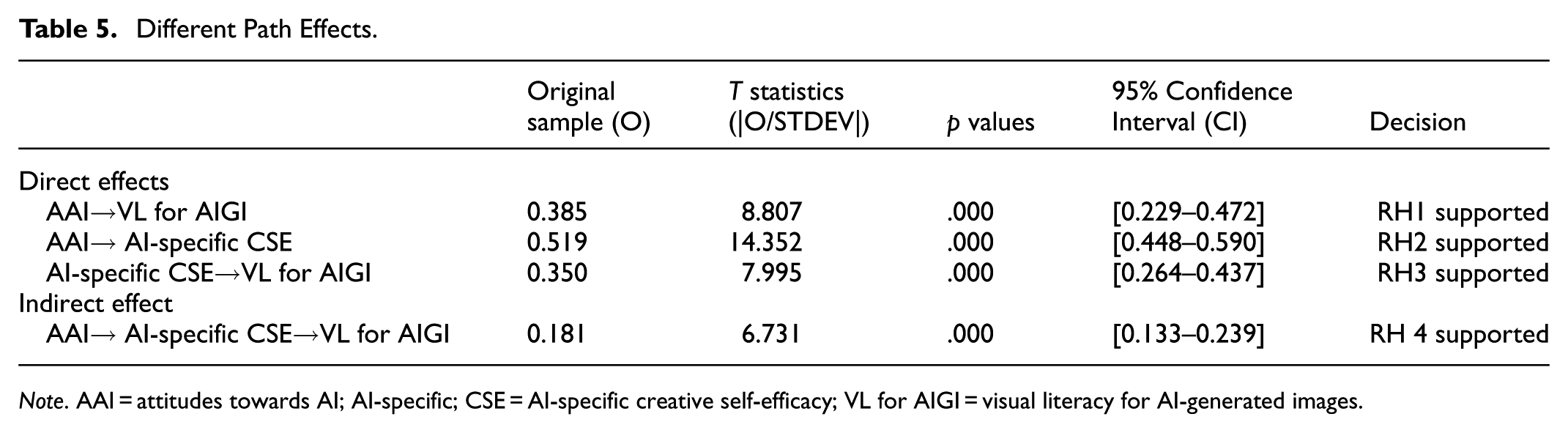
Note. AAI = attitudes towards AI; AI-specific; CSE = AI-specific creative self-efficacy; VL for AIGI = visual literacy for AI-generated images.
The mediating role of AI-specific CSE in the relationship between attitudes towards AI and visual literacy for AI-generated images was further examined using the bootstrapping approach in Smart PLS 4. Zhao et al. (2010) introduce that full mediation is present when the indirect effect is significant, but the direct effect is not. In contrast, complementary mediation occurs when both the direct and indirect effects are significant and have the same directional influence. As shown in Table 5, AI-specific CSE demonstrates a complementary mediating effect in the relationship between attitudes towards AI and visual literacy for AI-generated images (β = .181, t = 6.731, p < .001, 95% CI [0.113, 0.239]). Based on this result, Research Hypothesis 4 is supported.
Lastly, the explanatory and predictive power of the model was assessed using the coefficients of determination (R 2 ) and predictive relevance (Q 2 ). As presented in Table 6, the R 2 value for AI-specific CSE is 0.269, indicating a weak level of explanatory power, while the R 2 value for visual literacy for AI-generated images is 0.410, suggesting a level approaching moderate (Hair et al., 2019). The Q 2 values for AI-specific CSE and visual literacy for AI-generated images are 0.139 and 0.126, respectively, both above zero. This indicates that the model has acceptable predictive relevance for these constructs.
Coefficient of Determination (R 2 ) and Predictive Relevance (Q 2 ) for Endogenous Constructs.

Note. AI-specific CSE = AI-specific creative self-efficacy; VL for AIGI = visual literacy for AI-generated images.
Discussion
H1: Attitudes Towards AI Significantly Affect Visual Literacy for AI-Generated Images Among Chinese Art Students
The study’s first hypothesis was also supported, which aligns with the results of studies conducted by Ünal (2024) and C. Wang (2024). These studies indicated that positive attitudes towards AI among Chinese art students can foster the development of their skills related to reflective and visual thinking, particularly in the context of interpreting AI-generated images. This finding provides empirical support for active learning theory, which posits that a positive attitude plays a key role in facilitating active self-learning and enhancing learners’ abilities (Bonwell & Eison, 1991; Sukkar et al., 2022). However, given the closely positive link, it is important to note that if schools and learning environments promote negative or indifferent attitudes towards AI in design, this may hinder students’ development of visual literacy for AI-generated content. While AI-generated creation has already been widely adopted on social media platforms and increasingly integrated into university classrooms in China (Jia & Tu, 2024), fostering positive and informed attitudes towards AI becomes rather essential.
H2: Attitudes Towards AI Significantly Affect AI-Specific CSE Among Chinese Art Students
The results of this study support Hypothesis 2, aligning with previous findings by Naiseh et al. (2025), which also reported that positive attitudes towards AI significantly enhance general CSE. Similarly, this study found that students who held more positive views towards the use of AI in artistic design exhibited greater confidence in their creative ability through AI tools. This indicates that Chinese art students who view new AI tools as opportunities rather than threats are more likely to effectively use these tools in their creations. They not only regard these tools as auxiliary tools for design but also believe that they can actively support and enhance creative strategies in the process of artistic creation.
H3: AI-Specific CSE Significantly Affects Visual Literacy for AI-Generated Images Among Chinese Art Students
The research results support Hypothesis 3, showing that students’ AI-specific CSE has a significant positive impact on their ability to interpret AI-generated images. Although Suherman and Vidakovich (2025) and Unal and Tasar (2021) studied non-Chinese students, they also found that general CSE can predict the outcomes of visual literacy. This study shows that Chinese art students who are more confident in their creative skills by using AI tools tend to analyse and understand AI-generated images more effectively. In other words, believing in one’s own creative ability can enhance students’ skills in interpreting visual content, especially in tasks that require inferring or understanding symbolic meanings from AI-generated visual images. This aligns with Jia and Tu (2024), who found that people with higher general CSE handle complex tasks better, such as making sense of complex designs or turning abstract ideas into artistic work.
H4: AI-Specific CSE Significantly Mediates the Relationship Between Attitudes Towards AI and Visual Literacy for AI-Generated Images Among Chinese Art Students
The research results also support Hypothesis 4 and are consistent with the findings of Saritepeci and Durak (2024). These results suggest that CSE is a key mediating factor linking AI attitudes to visual literacy. Focusing on the AI-supported art learning context, the study’s result similarly points to AI-specific CSE as a critical mediating variable between students’ attitudes towards AI in design and their visual literacy for AI-generated images. This identified relationship provides empirical evidence for active learning theory (Bonwell & Eison, 1991) and social cognitive theory (Bandura, 2000), which together help explain the mechanism through which positive attitudes can lead to mastery experiences and, consequently, higher AI-specific CSE. The enhanced self-confidence, in turn, can further foster students’ motivation and active engagement, ultimately contributing to positive outcomes such as the development of visual literacy for AI-generated images. However, despite this significant mediation effect, the influence remains highly context dependent. Without sufficient pedagogical support or access to AI-related training and resources, students’ positive attitudes may not translate into actionable AI-specific CSE and their visual literacy for AI-generated images.
Implications
The findings of the study have some implications for AI-supported art education in Chinese universities. First, as the research identified AI-specific CSE as a bridging role between art students’ AI attitude and their ability to understand and interpret AI-generated images, art teachers should provide students with opportunities to use AI tools in their creative practices. This approach can bring students more mastery experiences in integrating technologies into their artistic design, which can help build their AI-specific CSE (Bandura, 2000). In addition, teachers are suggested to give more praise to students for their work that is created by their artistic ideas and AI tools. The justification behind this approach is also the idea from social cognitive theory (Nob, 2021) that social persuasion, like teacher encouragement, can also increase students’ self-confidence level like AI-specific CSE. This increased confidence can also further motivate students to combine the AI tools into their creative practices in the future.
Secondly, this study also implies the need to develop students’ positive attitudes towards AI, as this can directly affect their visual literacy for AI-generated images. To do so, university leaders might consider providing students with specialised training programmes that teach them both art-related and AI-related knowledge. This action can be supported by the collaboration between art departments and other departments like computer science or engineering. For instance, such training projects can take the form of joint teaching sessions where both art teachers and computer science teachers are invited to share their own expertise. This can enhance both students’ AI competence and art competence, which can further make them think of AI tools positively for their artistic creation process. This statement could be supported by the Technology Acceptance Model (TAM), which indicates that users’ attitudes towards a given technology are primarily influenced by two perceptions: perceived usefulness and perceived ease of use (Davis et al., 2024). When students, through such training, come to see AI tools as both helpful in enhancing their creative design outcomes and easy to integrate into their design workflow, they are more likely to develop positive attitudes towards these tools in design, which can contribute to the development of their visual literacy for AI-generated images.
While the above initiatives offer practical pedagogical implications for university leaders and teachers regarding how to foster art students’ AI-specific CSE and positive attitudes towards AI, a broader perspective is needed to understand the other AI-related dimensions of students’ AI engagement in art education. While the current findings represent only an initial step towards developing AI-integrated art curricula in Chinese higher education, greater research and teaching attention should be directed towards fostering students’ critical AI literacy, a concept that emphasises being well-informed about both the opportunities and risks of AI use, as well as its ethical and social implications (C. Wang & Z. Wang, 2025). On one hand, university educators should stay updated with the rapidly evolving landscape of AI tools to ensure that the technologies integrated into art education remain relevant and forward-looking (Chan & Hu, 2023). Such awareness can help students develop adaptive skills and a deeper understanding of how emerging AI systems function, enabling them to integrate these technologies more effectively into their artistic practice. On the other hand, more focus should be placed on topics such as privacy, trust in technology, and ethical awareness. These areas strongly influence students’ creative independence and sense of authorship in their artistic work (Chan & Hu, 2023; Liu et al., 2025). For instance, students should be taught regarding intellectual property and the need for transparency in generated content from AI. This knowledge can help them apply technology responsibly in their creative projects. Incorporating these elements into art curricula can better prepare the next generation of artists and designers.
Limitations and Recommendations for Future Studies
Three limitations are identified along with the recommendations for future studies.
First, the findings are highly context-dependent, as the study focused on a single institution. Given China’s vast regional diversity, the availability and application of AI tools in universities may vary considerably across different economic and educational contexts. For example, in metropolitan areas such as Shanghai, where digital technologies are highly developed. Thus, as these art students from Shanghai universities may come into contact with more AI tools during the creative process, their attitude towards AI may be more positive, and their level of AI-specific CSE may also be higher compared to students in less developed areas like Lanzhou. Based on this, the present study has limited generalisability. Future research could include multiple universities across different regions of China to provide a more comprehensive understanding of AI attitudes, AI-specific CSE, and visual literacy for AI-generated images among Chinese students at large.
Second, the study used self-reported data, which could be influenced by response biases, including the tendency to provide socially desirable answers. In particular, visual literacy involves the objective ability to understand and evaluate visual information. Assessing these skills through actual performance tasks (e.g., analysing a specific AI-generated image) rather than relying solely on self-reports can provide a more accurate reflection of students’ abilities. Based on this, future studies could incorporate performance-based measures instead of self-reported data to assess visual literacy for AI-generated images more reliably, which provides a more accurate evaluation of students’ competencies.
Third, the cross-sectional design restricts insights into how these relationships change over time. Future research could carry out longitudinal studies to examine the development of AI attitudes, AI-specific CSE, and visual literacy for AI-generated images among art students as they continue to use AI tools. This approach not only provides more compelling evidence for causal relationships but also enables a deeper understanding of learners’ perception of AI-assisted learning and the application methods of these tools in real-world educational contexts.
Conclusion
Overall, this study empirically indicates that in the context of AI-supported art education, attitudes towards AI can positively affect AI-specific CSE, which can in turn increase visual literacy for AI-generated images among Chinese art undergraduates. All four hypotheses were supported, which also offers empirical validation for social cognitive theory and active learning theory. The findings highlight the importance of integrating AI-related training into art and design curricula to foster students’ AI-specific CSE and to cultivate more positive attitudes towards AI in creative design. These developments can ultimately contribute to students’ enhanced ability to interpret and evaluate AI-generated images - a core component of visual literacy. Furthermore, this study highlights the need for future research and pedagogical attention to cultivate other essential aspects, such as students’ critical AI literacy, including awareness of ethical, social, and authorship issues. Embedding these elements into future art curricula will help prepare the next generation of artists and designers to engage with AI technologies effectively and responsibly.
Footnotes
Appendices
Detailed Outer Loadings for All the Items in Key Constructs; Attitudes Towards AI in Design, Creative Self-Efficacy, And Visual Literacy for AI-Generated Images.

| Constructs | Items | Outer loadings |
|---|---|---|
| AAI | AAI1 | 0.772 |
| AAI2 | 0.670 | |
| AAI3 | 0.498 | |
| AAI4 | 0.610 | |
| AAI5 | 0.727 | |
| AAI6 | 0.693 | |
| AAI7 | 0.589 | |
| AAI8 | 0.842 | |
| AAI9 | 0.775 | |
| AAI10 | 0.794 | |
| AAI11 | 0.618 | |
| AAI12 | 0.689 | |
| AI-specific CSE | AI-specific CSE 1 | 0.850 |
| AI-specific CSE 2 | 0.859 | |
| AI-specific CSE 3 | 0.749 | |
| AI-specific CSE 4 | 0.554 | |
| AI-specific CSE 5 | 0.721 | |
| AI-specific CSE 6 | 0.590 | |
| VL for AIGI | VL1 | 0.684 |
| VL2 | 0.781 | |
| VL3 | 0.892 | |
| VL4 | 0.828 | |
| VL5 | 0.728 | |
| VL6 | 0.838 | |
| VL7 | 0.689 | |
| VL8 | 0.910 | |
| VL9 | 0.898 | |
| VL10 | 0.848 | |
| VL11 | 0.642 | |
| VL12 | 0.703 | |
| VL13 | 0.616 | |
| VL14 | 0.820 | |
| VL15 | 0.871 | |
| VL16 | 0.883 | |
| VL17 | 0.746 | |
| VL18 | 0.785 | |
| VL19 | 0.578 | |
| VL20 | 0.868 | |
| VL21 | 0.737 | |
| VL22 | 0.610 | |
| VL23 | 0.860 | |
| VL24 | 0.832 | |
| VL25 | 0.877 | |
| VL26 | 0.670 | |
| VL27 | 0.796 | |
| VL28 | 0.806 | |
| VL29 | 0.511 | |
| VL30 | 0.710 |
Note. AAI = Attitudes toward AI; AI-specific CSE = AI-specific creative self-efficacy; VL for AIGI = visual literacy for AI-generated images.

Ethical Considerations
This study was conducted in accordance with the principles outlined in the Declaration of Helsinki. Prior to the commencement of the research, ethical approval was obtained from the Academic Committee of the School of Design and Art at Jingdezhen Ceramic University (Approval Number: JCU20250613). The study did not involve minors or sensitive issues, and thus no significant ethical concerns were identified.
Consent to Participate
The study was conducted from September 10 to October 12, 2024. Written informed consent was obtained from all participants prior to their involvement in the research.
Consent for Publication
This study did not involve the publication of any identifiable personal data, images, or videos from individual participants.
Funding
The author received no financial support for the research, authorship, and/or publication of this article.
Declaration of Conflicting Interests
The author declared no potential conflicts of interest with respect to the research, authorship, and/or publication of this article.
Data Availability Statement
The data supporting the findings of this study are available from the corresponding author upon reasonable request via email.