




Abstract
Teaching and learning in Ghana’s Senior High Schools (SHSs) are guided by a centralized curriculum, teaching syllabus, textbooks, assessment criteria, and examinations, yet rural–urban disparities exist in educational resources provision, which significantly affect teaching and learning processes and student achievement in the SHSs, particularly those on the Visual Arts program. To understand the factors that cause rural–urban differentials in student performance in different SHSs in Ghana, we adopted a qualitative–quantitative research approach with interview, observation, and questionnaire administration to examine teaching and learning of Visual Arts in six public SHSs: two each in rural, peri-urban, and urban settings in metropolitan Kumasi. Findings from data sourced from 120 students (66 males; 54 females), 17 teachers (15 males; two females), and 24 Visual Arts lessons revealed that unlike Visual Arts education in urban SHSs, student achievement in rural and peri-urban schools is hampered by lowered criteria for admitting students into Visual Arts, large class sizes, lack of studio facilities, insufficient specialist teachers, and instructional time for teaching elective Visual Arts subjects, adoption of ineffective teaching strategies, setting of low academic standards, and inadequate funding for teaching practical lessons. Unlike rural and peri-urban SHSs, urban schools organize speech and prize-giving days to motivate students, and effectively collaborate with Visual Arts students to mount art exhibitions to showcase their creativity. Improving the quality and distribution of social infrastructure, educational facilities, and qualified teachers, and actively monitoring educational standards in rural and peri-urban SHSs could raise academic achievement for students in all parts of Ghana.
Introduction
Ghana’s efforts at raising the living standards of its citizens and ensuring economic growth have left a legacy of extreme disparities in development in terms of the demographic and settlement pattern, distribution of social infrastructure, and levels of economic activity. This has resulted in substantial differences between urban and rural settings with regard to the distribution and quality of educational facilities and manpower, just as levels of utilization of resources and access to tertiary education also differ slightly between urban and rural schools (United Nations International Children’s Emergency Fund [UNICEF], 1990 as cited in Siaw, 2009). Consequently, rural schools in Ghana lack good infrastructure and facilities, have low enrollment, less qualified teachers, and fewer textbooks and other teaching and learning materials whereas urban schools are generally over-staffed with qualified teachers, are over-enrolled, are better funded and monitored, and have better infrastructure and adequate resources to work with (Opoku-Asare, 2000, as cited in Umude, 2012). The disparities in teacher–student ratios, human resource capacity, provision of educational infrastructure, and other facilities in rural and urban schools contribute significantly to varying students’ academic achievement and educational opportunities in different parts of Ghana (Education Review Committee Report, 1994, as cited in Opoku-Asare, 2000; The President’s Committee on Review of Education Reforms in Ghana, 2002).
Secondary education in Ghana occurs in Junior and Senior High Schools (JHSs and SHSs). Transition from JHS to SHS is determined by grades obtained in the Basic Education Certificate Examination (BECE). BECE also determines the elective program a student is admitted to pursue in SHS—those who obtain good BECE grades are compelled to pursue science while those who make weak grades go into Visual Arts even if they wished to do otherwise (Asihene, 2009; Evans-Solomon, 2004). Irrespective of a student’s program of study and the location of his or her school, all third-year SHS students in Ghana write the West Africa Senior Secondary Certificate Examination (WASSCE) that is organized and graded by the West Africa Examinations Council (Adinyira, 2012; Osei-Mensah, 2012). All things being equal, SHS students in urban, peri-urban, and rural SHSs should do well in school and in WASSCE and participate in higher education. Nonetheless, rural–urban differentials in the quality and quantity of educational resources adversely affect teaching, learning, and WASSCE achievement for students in rural schools, which makes it difficult for many parents to accept admission in rural schools for their children (Adinyira, 2012; Banson, 2010).
To counteract challenges encountered with the then card-system admission of qualified BECE holders across Ghana’s SHSs and vocational institutions based on aggregated BECE scores in the students’ best six subjects, the Ministry of Education (MOE) and Ghana Education Service introduced the Computerized School Selection and Placement System (CSSPS) that placed students in SHS programs based on raw BECE scores in all subjects. Interestingly, many parents refuse CSSPS placement in rural schools for their children and do everything to bring them back into the urban SHSs where they believe their children would make it to university (Adinyira, 2012; Asihene, 2009; Siaw, 2009).
CSSPS admissions is further challenged by placement in Visual Arts, a program perceived nationwide as “fit” only for low BECE achievers (Adinyira, 2012; Asihene, 2009; Evans-Solomon, 2004) because students admitted into Visual Arts are usually those whose BECE grades fall below the acceptable grades for admission into their preferred science, general arts, or business program (Evans-Solomon & Opoku-Asare, 2011). This is unfortunate because not all JHS students have opportunity to study any Visual Arts subjects for lack of specialist teachers (Agyenim-Boateng, 2011).
Knowing that Visual Arts (the authors’ field of specialization) has the ability to directly translate secondary education into a consistently economic return (Rihani, 2006) for personal and national development makes it necessary to investigate the tangible and inferential factors that cause differentials in student achievement in different geographic settings.
Method
The study used a qualitative–quantitative research approach with observation, interview, and questionnaire administration to gather and analyze field data from six out of 18 public SHSs that offer Visual Arts in Metropolitan Kumasi. Based on the Ghana Education Service Approved Classification of School Clusters (June 2008), the sample comprised two schools each in rural, peri-urban, and urban settings in Ashanti Region. Sample selection was guided by proximity, authorization, and availability of Visual Arts as elective program of study. Different instruments were combined for purposes of triangulation (Hesse-Biber, 2010; Leedy & Ormrod, 2005) to verify by examining teaching and learning of various Visual Arts subjects in those schools to ascertain the factors that contribute to differentials in student achievement in these geographical locations. In line with much qualitative study and for ethical considerations, the sampled schools are only identified as Schools A, B, C, D, E, and F and represented the different settings as follows: Schools A and B are urban schools, C and D are peri-urban schools, E and F are rural schools.The study respondents were a random sample of 120 Visual Arts students (66 males; 54 females) and 18 teachers (15 males; three females). Of the 120 students, 64.3% were aged 15 to 18 years; 34.7% were 19 years or older. Only students and teachers who attended classes on the days of observation and those who consented to participate in the study constituted the sample. The teachers and students answered a self-administered 34-item questionnaire that sourced data on socio-demographic characteristics, motivation, teaching processes, and attitudes toward lessons. The return rate for 138 copies of questionnaire administered was 96.4%.
Additional data were gathered through informal interviews and direct observation of classroom activities over 12 weeks to filter the questionnaire responses. Overall, 30 visits of 20- to 45-min observation per visit in each school provided a holistic view of teaching and learning processes across the six schools based on the following indicators: learning methods and frequency of lessons including practical activities. Poor record keeping and unwillingness to release official documents by some school heads limited the amount and accuracy of some data collected on teachers, students, and WASSCE results. Where this occurred, estimated numbers replaced actual figures, but this did not seriously affect the issues of concern to the study.
Discussion of Findings
Age of Teachers
The 17 study respondents comprised a majority of 41% relatively young teachers aged 31 to 40 years and 35% 51-year-olds or above. This shows the six schools have enough relatively older teachers to serve as role models for the younger Visual Arts teachers and their students. Figure 1 depicts the presence of adequate numbers (65%) of 31- to 50-year-old adult figures to serve as academic role models for the pupils.

Age of teacher respondents.
Teachers’ Education
All 17 participating teachers have university education: Nine (or 52.9%) hold bachelor’s degrees in the relevant subjects with two having additional postgraduate diplomas; six (representing 35.3%) hold master’s degrees. By Ghana Education Service (GES) standards, all 17 teachers have the basic qualification required for teaching in high schools, which is a bachelor’s degree (Asihene, 2009; Owusu-Afriyie, 2009). In principle, the sampled schools have adequately qualified teachers to ensure good teaching and learning of Visual Arts, but how qualifications ensure effective teaching, however, lies outside the objectives of this study.
By location, Table 1 shows that four (or 66.6%) of the six urban teachers and two (40%) of the five peri-urban teachers have master’s degrees while five (83.3%) of the six teachers in the rural areas have bachelor’s degree only. The urban schools therefore have better qualified teachers with higher degrees than the peri-urban and rural schools whose highest qualification is the postgraduate diploma.
Teachers’ Education and Qualifications.

Source. Fieldwork (2009).
Table 1 supports the assertion that urban schools have more highly qualified teachers than peri-urban and rural schools. They are more likely to ensure effective teaching that motivates their students to learn and do well than their colleagues in the rural and peri-urban schools. Whether urban school students experience better teaching than their peers in the peri-urban and rural schools is another researchable issue.
Teachers’ Work Experience
The resource situation in an educational institution is a major determinant of secondary school performance (Adedeji & Owoeye, 2002). Table 2 shows that most of the teacher respondents have classroom teaching experience ranging from less than 3 years up to 20 or more years; a significant 70% of them have more than 10 years’ teaching experience.
Location and Teachers’ Work Experience.

Source. Fieldwork (2009).
The number of teachers aged above 51 years (35% of 17 respondents in Figure 1) is significant in terms of length of classroom teaching experience acquired, but the worry is that this group of teachers would soon retire from active teaching service, leaving another large population (65%) of 40- to 59-year-old teachers if GES does not post any younger teachers to the schools in the subsequent years. It is not clear whether teaching experience translates into effective teaching.
Of the three locations, the urban schools have most of the teachers who have more than 10 years’ classroom teaching experience followed by the peri-urban schools while the rural schools have most of the less experienced (4-10 years) teachers. Only one teacher in the rural setting has between 11 and 20 years’ teaching experience. Most significantly, Table 2 shows a fair distribution of the most experienced (21+ years) teachers across the three settings. As Orlich, Callahan, and Gibson (2001) posit, experienced teachers are able to manage the learning environment more effectively to enhance student teaching. Whether these teachers’ experience in the classroom has been gathered in the same school was, however, not investigated.
Length of teaching experience could be the factor that differentiates student achievement in urban school classrooms and WASSCE from peri-urban and rural schools in Ghana. The premise is that experienced teachers have a good understanding of their subject matter, know their students, and have good rapport with them; they also bring to the classroom pedagogic and subject-related knowledge that teachers rarely possess at the start of their careers (Butt, 2008).
The length of years a teacher has served in the classroom suggests acquisition of much knowledge and expertise in sharing, coaching, and mentoring younger colleagues, besides their active involvement in decision making and using their rich teaching experience to help the less experienced teachers to raise academic achievement for their students. Thus, the more experienced teachers would have built up a bank of lesson activities from which they can quickly select for different classes, instinctively knowing which activities will work best in which situations (Butt, 2008).
Although there is a relatively fair distribution of teachers who have taught for 11 to 21 or more years in the three geographic settings, the disparity between the number of experienced teachers with more than 10 years’ teaching service is obvious—83%, 80%, 50%, respectively, in the urban, peri-urban, and rural schools. This variation has significant direct consequences for effective teaching that positively influences student learning and achievement in school.
Instructional Hours
The teaching syllabus for Visual Arts (MOE, 2008, 2010) stipulates five instructional periods per week for teaching the practical components of the various Visual Arts subjects. However, the questionnaire and interview responses indicated that not all the teachers adhere to this time schedule. As Table 3 shows, 12 (70.6%) of the 17 teachers were teaching between 11 and 20 periods per week (one period = 40 min), while four (23.5%) were teaching more than 21 periods a week. The correlation between location of school and the number of instructional periods assigned to a teacher shows no significant differences except for the single teacher who had between seven and 10 teaching periods per week in the rural area, considering the presence of less experienced teachers. The majority (60%) of peri-urban teachers had 16 to 20 periods per week.
Location and Number of Teaching Periods.

Source. Fieldwork (2009).
The fact that 70.6% of the 17 teachers had 11 to 20 periods a week but four (or 23.5%) teachers (two urban; two rural) had more than 21 periods a week suggests that the majority of the teachers have sufficient time to teach both the theory and practical aspects of the subjects as the syllabus demands.
With regard to teaching periods per week, 13 (or 76.5%) of the 17 teachers affirmed they have adequate time for lesson delivery, but four (representing 23.5%) responded otherwise. Except for this minority figure, four out of 17 is significant to suggest that most of the schools allot six periods for the number of Visual Arts subjects taught; the least number of periods specified in the syllabus is five periods. This implies that a large majority of teachers have enough hours to teach their assigned subjects per week.
Nonetheless, the student interviews raised critical issues concerning teacher use of instructional hours. In the urban schools, 23.1% of the students indicated their teachers do not fully utilize all the contact hours. The likelihood for a teacher to fully utilize instructional hours was rated highest by 86.5% of students in peri-urban schools, 84.8% in rural schools, and 76.9% in urban schools. Presumably, the urban schools are collegial schools that have established learning goals and a positive school culture that enables their students to achieve academically (Ankomah, 2002; Fleischman & Osher, 2005).
Considering that urban schools admit the crème of BECE holders (Adinyira, 2012; Asihene, 2009; Opoku-Asare, Agbenatoe, & deGraft-Johnson, 2014), they probably consider their students intelligent enough to research what they are taught and learn on their own as individuals and groups to extend the knowledge they gain from their teachers. However, non-conformance to standard teacher professional responsibility for managing student learning in school could sabotage the urban students’ motivation for attending classes regularly and working hard to obtain the best WASSCE grades.
Teaching of Practical Skills
Active engagement is key to academic achievement (Cornett, 2003), and practice is critical to skills learning, especially in vocational education (Kochhar, 2004). The Visual Arts curriculum therefore emphasizes active engagement of students in practical activities to enable them understand the demands of the specialized subjects very well and also acquire the relevant knowledge, technical skills, competencies, and attitudes for individual and national development (MOE, 2008, 2010, 2013). Although the curriculum specifies a minimum of five practical lessons per term, the student interviews revealed that 69.9% of the 120 were being engaged in one, two, or three practical lessons per term; 50.5% of them were getting a single practical lesson per term.
On the whole, 25% of them were having five or more practical lessons per term, but as Table 4 shows, the tendency for students to have a single practical lesson per term is highest in rural schools followed by urban and peri-urban schools with 67.9%, 25.8%, and 32.4% questionnaire responses, respectively. This discrepancy is quite significant in terms of student achievement on the Visual Arts program and their preparation for WASSCE. It is essential therefore that all Visual Arts teachers plan the learning situations to include practical activities so learning becomes more meaningful to the students.
Location and Number of Practical Lessons Per Term.

Source. Fieldwork.
Given the curriculum requirement for schools to allocate 6 hr of instructional time to practical skills acquisition (MOE, 2008), neglecting to teach practical lessons in Visual Arts has the potential to negatively affect the overall performance of all Visual Arts students. Because teaching methods used determine the frequency of interaction between teachers and students (Gray, Griffin, & Nasta, 2005), providing activity-based teaching is more likely to make the subject matter of Visual Arts more meaningful to the students and enable them to develop their creative potentials. Well-selected teaching methods also improve on good working relations between teachers and students (Rowe & Stephanou, 2007). The heads of the various Visual Arts department must ensure that all teachers include practice in every teaching situation so they can promote interest and successful learning for their students.
Teaching of Specialized Subjects
Personal experience of teaching in SHS confirms Owusu-Afriyie’s (2009) finding that highly qualified specialist teachers in the various Visual Arts disciplines are hard to find in some schools. The study revealed that majority (57%) of the teacher respondents were teaching their specialized disciplines whereas 43% were teaching subjects they had not specialized in. By location, only 25% of teachers in the peri-urban area were teaching their specialized subjects; the large majority of them (75%) were teaching subjects other than the ones they specialized in. Although all the urban schoolteachers and 50% of those in the rural area were teaching their specialized subjects, 50% of the rural schoolteachers were teaching other subjects.
Having 50% of Visual Arts teachers teaching subjects outside their specialized academic areas creates the impression that these teachers are so versatile they fit in multiple subject areas. Students in urban schools are therefore more likely to experience effective teaching because their teachers have specialized skills and content knowledge in those subjects. Students in rural schools run the risk of being deficient in the knowledge and skills required for high achievement in WASSCE.
Table 5 shows graphic design, picture-making, textiles, ceramics, and sculpture as the elective subjects offered by the six schools. Given that General Knowledge in Art (GKA) is a core subject that is studied by all Visual Arts students, the most popular subject combinations noticed in Table 5 are graphic design-with-textiles (offered by 40 respondents or 34.5% of the 120 sampled students) and graphic design-with-picture-making, which is offered by 27 respondents or 23.3% of the respondents.
Location and Combination of Elective Subjects Studied by Students.

Source. Fieldwork (2009).
Note. GKA = General Knowledge in Art.
As seen in Table 5, the large majority (21 or 63.6%) of the 33 students in the rural schools study ceramics with graphic design while 36.3% offer textiles or picture-making with graphic design. In the urban setting, all 44 students offer three elective subjects: graphic design and picture-making-with-sculpture or textiles. As the interviews revealed, the urban schools place no restrictions on students’ choice of a third elective subject, which ensures greater freedom and variety to the disadvantage of their peers in the other settings. By inference, the peri-urban and rural schools place serious limitations on their students in terms of the knowledge, technical skills, and competencies they can acquire from the subject combinations, which could also limit the motivation those students brought to the program (Curzon, 1996; Kochhar, 2004; www.etln.org as cited in Siaw, 2009) and their mobility into higher education via WASSCE.
Because SHS graduates need good WASSCE grades in two elective subjects to complement GKA and the core curriculum of English, integrated science, and mathematics to pursue visual arts education in the university (Opoku-Asare & Siaw, 2015), it is clear that Visual Arts students in urban schools can achieve this target with two of their three elective subjects to the disadvantage of their peri-urban and rural peers.
Logistics Support
The Visual Arts teaching syllabus provides topics to be covered each term and recommends five instructional periods of 40 min per week for the teaching and learning of practical skills and two periods per week for art history, appreciation, and general concepts in art (MOE, 2008, 2010, 2013). The questionnaire, however, revealed a relative lack of logistics in nearly every school. Lack was measured by availability of resources such as art studio, working tables, and funding for practical lessons. Although the observation and interview revealed that each school had some working tables, art studio, and funding, the urban schools had relatively more access to relevant logistics than the peri-urban and rural schools. The student respondents cited working tables as the most available logistic with a significant majority (63.7%) of them indicating they have no working tables in their schools. Like the students, majority of the teachers (58.8%) reported lack of working tables in their schools.
The scenario suggests that the further away a school is from the urban area, the least likely it is to have the most basic of all resources needed in Visual Arts departments—working tables. This is underlined by the number of “Yes” questionnaire responses on availability of this facility, which reduced from 20 (50%) in the urban schools to 14 (36.8%) in the peri-urban to seven (20%) in the rural schools (see Table 6). Working tables represent the least available resource in the rural schools. It was learned that lack of working tables compel students to work on classroom desks, dining hall tables, and other unused tables sitting on the school compounds.
Alternatives to Working Table.

Source. Fieldwork (2009).
It is seen from Table 6 that 77.0% of the student respondents were using their classroom desks for practical art works; dining hall tables (14.8% of responses) and unused tables on the school compounds (8.2% responses) served as other alternatives to working tables, respectively. Classroom desks also came up as the most used alternative (50.0%) for teachers’ practical classes. Like the students, dining hall tables came up as the second most important alternative to art room working tables. This shows that teachers and students frequently use classroom desks for art making. Empirical research (Agbenatoe, 2011; Opoku-Asare et al., 2014; Siaw, 2009) attests to classroom desks being rough and unsuitable for producing quality art works.
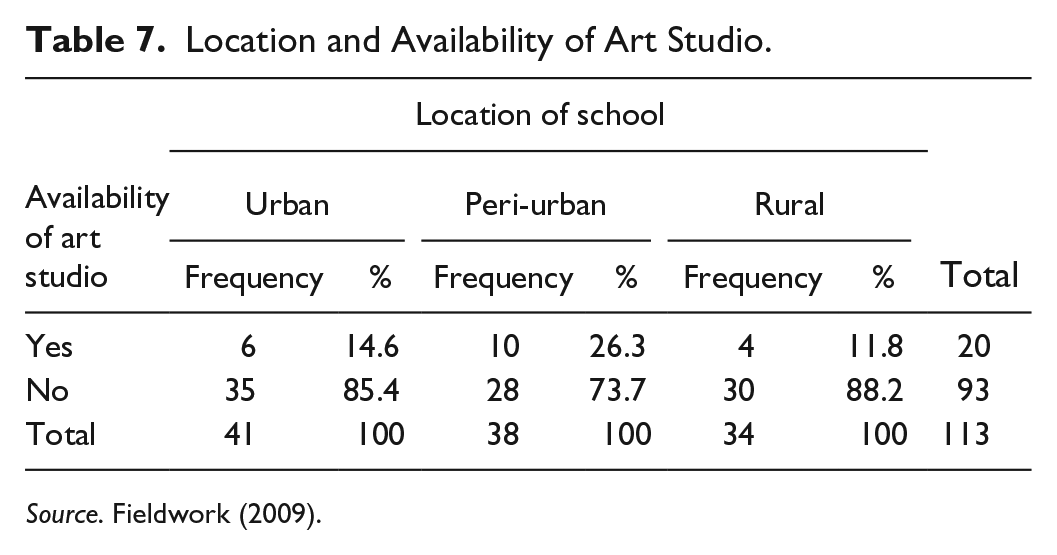
Although 17.7% of the students reported they had access to art studios in their schools, an overwhelming 82.3% of them indicated otherwise. Similarly, a significant majority (76.5%) of teacher respondents also cited lack of art studios in their schools. To some extent, the study indicates that location of a school influences the availability of art studio; the ranking of responses designating art studio as “the most” to “the least available” facility ranged from peri-urban to urban and rural schools, respectively, as seen from Table 7. The peri-urban schools recorded the “most available” (26.3%) art studio response followed by the urban schools with 14.6% responses. Like the supply of most school infrastructure, the rural areas recorded the “least available” art studio with 11.8% responses.
Location and Availability of Art Studio.
Source. Fieldwork (2009).
In dealing with lack of art studios, the alternative working area for art production was classroom space, within school but outside the classroom, and home spaces. The indication is that in the absence of art studio, majority of the students (87.1%) do their practical works in their classrooms followed by home spaces and outside classroom school spaces with 6.5% responses, respectively. None of the teachers worked at home in response to the lack of art studio in their schools. As an alternative, 84.6% of the teachers reported using classroom space for practical works they do in school.
According to the student respondents, the least provided logistic in their schools is funding; only 13.4% of them indicated that their schools provide funds for running the Visual Arts program. It emerged that nearly all the schools (86.6% responses) do not provide funds for the Visual Arts departments; the majority of the teacher respondents (58.8%) confirmed this assertion. The affirmative responses to the question on funding for Visual Arts education were 10.8% and 11.8%, respectively, in the peri-urban and rural areas, which shows no significant variations. The urban schools are relatively better funded as this item received 17.1% affirmative responses.
School heads as instructional leaders have the responsibility to ensure that financial, logistic, and other budgetary resources required for running programs of study are provided; they must also actively monitor teacher efficiency and teaching effectiveness. Empirical studies in Ghana show that Visual Arts students pay for art supplies as part of school fees, but some school heads are not willing to provide any budgetary support for effective teaching and learning of Visual Arts, including field trips (Agbenatoe, 2011; Owusu-Afriyie, 2009). Thus, lack of funding for teachers’ demonstration lessons and students’ practical works negatively affects skills acquisition on the Visual Arts program.
The questionnaire responses revealed alternative sources of funding for Visual Arts as monetary contributions by teachers and students to purchase the requisite tools and materials for practical lessons. The responses indicated that majority (71.3%) of the 120 students and 66.6% of the 17 teachers make personal financial contributions to provide the relevant tools and materials purposely to get some practical work done to enable the students learn.
Location and Motivation
What motivates teachers and students to produce meaningful change in school settings and also helps individuals to accept their environments is an important factor in the educational enterprise. In this respect, the learning environment should be designed to be safe and supportive for both learner and teacher (Wheeler & Richey, 2005). In measuring the motivation of teachers and students in the respective geographic locations, speech- and prize-giving days were identified as a significant highlight of the culture of secondary schools in Ghana.
Speech- and prize-giving days are happy occasions that schools use to acknowledge the efforts of teachers and students in public and to celebrate excellence in academic performance and good behavior. Students in the urban schools (94.9%) happily reported a number of occasions when the Visual Arts department was privileged to showcase their artworks at exhibitions they were requested to mount during their schools’ speech- and prize-giving days, whereas 94.4% of the students in the peri-urban and rural schools had seen no speech days in their schools. The interviews, however, revealed that more than 50% of the student respondents had not had speech days organized in their schools.
On the issue of being appreciated by their heads of schools, 53.3% of the 120 student respondents confirmed that neither the Visual Arts program nor its students are appreciated by their school heads, which corroborates, to a large extent, the findings of Owusu-Afriyie (2009) and Siaw (2009) that heads of SHSs in Ghana do not appreciate the contribution of Visual Arts departments. However, the questionnaire responses show that this feeling about the Visual Arts department being less appreciated by school heads was highest in the rural schools as 72.7% of the teachers’ responses in the rural schools indicated. The feeling that heads of schools appreciate the Visual Arts program and its students was highest among the peri-urban students with 61.1% affirmative responses. This suggests school heads in peri-urban locations being more appreciative of Visual Arts.
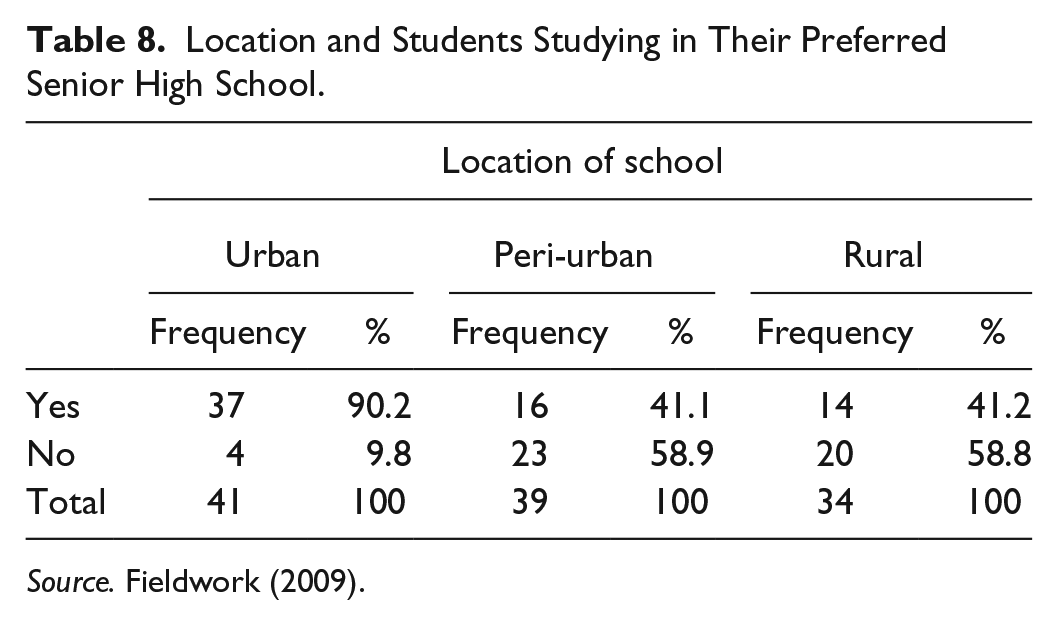
The extent to which students study in their prefered schools is also important in motivating students. The interviews indicated that 41.1% of the student respondents were not studying in their preferred choice of SHS. Most of the respondents in the peri-urban and rural schools were not studying in their preferred schools either (see Table 8).
Location and Students Studying in Their Preferred Senior High School.
Source. Fieldwork (2009).
Table 8 also shows that for both the peri-urban and rural schools, majority of the respondents (58.9% and 58.8%, respectively) did not plan to study in their current schools. Contrary to this, an overwhelming majority (90.2%) of the urban school respondents indicated they were studying in their preferred schools.
Studying the preferred program is also important in motivating students to put in their best efforts. In assessing the extent to which the respondents were pursuing Visual Arts by choice showed that although in the minority, 47 of the student respondents (representing 41.2% of those interviewed) had not intended to study Visual Arts. The responses given in the different locations showed no significant variations on the issue. However, the interviews revealed that the likelihood for a student to be studying Visual Arts as their preferred program is highest in peri-urban schools where 84.6% of the respondents indicated that they were in Visual Arts by choice.
On whether or not the respondents were happy studying Visual Arts, the questionnaire responses indicated that an overwhelming majority (96%) of the 120 students were happy with Visual Arts, suggesting a general good feeling in the three locations and a liking of the program. By location, however, only 7.3% of the respondents in the urban schools indicated they did not like Visual Arts.
On whether Visual Arts students feel “bad” or inferior in the company of their school mates on the general arts, science, and other elective programs, some of the general responses were as follows: “no bad feelings at all,” “I’m in Visual Arts by choice and this is the program that will give me a career so why should I feel bad about being a Visual Arts student?” “I came here with BECE grades that were better than some of my school mates and I am learning skills that can help me set up business after school,” and “students in Visual Arts can become employers in future so why should we feel bad?” A significant 81% of the respondents felt good in the presence of their peers in non-Visual Arts programs.
This notwithstanding, 19% of the students reported feeling intimidated in the presence of other school mates simply because they are studying Visual Arts although in the minority, this perception is quite significant in terms of motivation for good performance. By location, 28.1% of the respondents in rural schools emerged as students who feel the most intimidated in the presence of students who offer programs other than Visual Arts. This may be attributed to the fact that rural schools generally get to admit JHS graduates who make weak BECE grades into the Visual Arts departments.
On how students in other departments behave toward Visual Arts students, 71% of the respondents said their school mates do not treat them well. Again, the rural area emerged as the area where their school mates behave badly toward Visual Arts students, using a response frequency of 82.8% as the basis.
Being happy about one’s school was found to be an important motivating factor for student achievement. Interestingly, 64.6% of the 120 respondents reported being happy with their schools although 41.0% of them were not in their preferred choice of school; 35.4% of them reported being unhappy about their school and therefore being less likely to be motivated to do well. To some extent, location has some correlation with students being happy with their school; the questionnaire responses revealed that 82.5% of students in urban schools and 50.0% of students in the rural schools reported being happy with their schools.
Using housing on the school compound as motivation for excellence in teaching, 58.8% of the 17 teachers reported that living off-campus is a disincentive to effective teaching. Half the urban schoolteachers had on-campus accommodation as compared with 40.0% of their colleagues in the peri-urban and 33.3% in rural schools. Although on-campus accommodation is generally not adequate to house all SHS teachers, 76% of the respondents indicated their schools do provide transportation to motivate those who live off-campus to at least get to school early in the mornings. Accommodation near a school was also identified as a major problem for rural teachers in particular (Yeboah, 2014). Without their own means of transport, the teachers reported going through stressful moments while commuting to and from school each day. Obviously a teacher who is stressed over transportation might be unable to give off his or her best especially during the early morning periods.
Shelter is a major human need so providing on-campus accommodation or close by the school would motivate teachers to get to school early. When teachers are relieved of the problem of shelter, food, and clothing, there is a possibility of them giving out their best in teaching (Orstein, 1995, as cited in Curzon, 1996; Mankoe, 2002). Due to this, a significant number of teachers were dissatisfied with the schools they work in.
In assessing teachers’ satisfaction with their function as teachers, only 12% of the respondents reported being dissatisfied with teaching as their career. The likelihood for these teachers to be dissatisfied with their work as teachers was high in the rural areas (16.7% responses) while 10% of teachers in the peri-urban schools reported being dissatisfied as teachers. However, all the urban schoolteachers reported being satisfied as teachers.
Lesson Preparation and Planning
The uncertainties, complexities, and strains of the classroom require some order and control, which can be achieved through planning and careful preparation of lessons so that teachers can modify the curriculum to fit the unique characteristics of each particular class (Airasian, 1996, as cited in Boafo-Agyemang, 2010). The key to good teaching and achievement of sustained educational progress lies in purposeful class management and effective preparation and planning (Butt, 2008). With regard to pre-lesson preparation by the sampled teachers, 90% of the students believed their teachers prepare well for the lessons they teach.
By location, however, the questionnaire responses showed some variations in students’ perception of their teachers’ preparation for classes. Overall, 97.4% of students in urban schools, 92.3% of those in peri-urban settings, and 78.1% of those in the rural schools, respectively, believed their teachers prepare adequately before coming to the classroom to teach.
Students’ Entry Grades
Performance results provide a means to hold teachers and schools accountable for the components of each and every grade (Bell, 2012). Entry grades also offer a sort of motivation for students (Ohuche & Akeju, as cited in Siaw, 2009); students who start with good grades in a course tend to strive hard under intrinsic motivation while low-grade students strive to improve their performance under extrinsic motivation (Okumbe, 1998, as cited in Siaw, 2009). Yet, as Table 9 shows, Visual Arts students in peri-urban and rural schools mostly enter SHS with weak BECE grades.
Basic Education Certificate Examination Results of Selected Schools From 2002-2007.

Note. * = No records.
Table 9 shows that 72 (67.3%) of 107 students admitted into the urban schools in 2002 made good BECE grades (distinction) as against 31 average grades (BECE 13-24) while the rural schools admitted 51 students with Grades 13 to 24. The rural schools admitted students with the highest average grades while the urban schools recorded the highest number of weak grades. The data also reveal that the urban schools admitted only four (3.7%) students with BECE Grade 25 and above. The scenario corroborates the assertion that schools in urban settings tend to take candidates with good grades (Oakes & Guiton, 1995; Page, 2007) suggesting that the quality of entry grades influence academic performance in school although this varies in relation to a schools’ location. Because urban schools receive good BECE candidates, their output tends to be better than the peri-urban and rural schools, which receive the majority of students with weak BECE grades.
Teaching Method
Tackling examinable topics among other factors helps in effective teaching and learning (Noguera, 2004). The study revealed that the urban schoolteachers spend little time with their students, but because they tackle examinable materials, they manage to get their students to produce good works for WASSCE. The classroom observation also revealed that urban schoolteachers instruct their students on how to answer examination questions after tackling the respective topics. Asked why they do this, one teacher said, “not all topics in the syllabus are examined so wasting time on un-examinable questions is not appropriate since we have little time to teach.” The rural teachers felt obliged to cover every topic cited in the Visual Arts teaching syllabus and only teach their students how to answer examination questions at the latter part of their final year, which may be too late for some students.
The observation also revealed that some teachers go to class early and leave early, or go late and leave on schedule, or they simply extend their teaching beyond their allotted time. Teachers in rural schools in particular were seen going to class without any textbook, and their lessons were also usually unplanned, which is contrary to the demand for teachers to carefully plan procedures and activities that their students will undergo (Singh & Rana, 2004). The teachers often used the latter parts of their lessons, or they used the tail end of their allotted instructional time for chatting and doing things that were unrelated to the lessons. This attitude can minimize students’ performance and achievement (Crocker, 1991 as cited in Siaw, 2009; Tomlinson & McTighe, 2006; Wiggins & McTighe, 2005).
Teachers’ Response to Lessons
Most of the student respondents indicated that their teachers have an encouraging attitude to lessons with 88% of them reporting that their teachers respond well to the lessons they teach. However, as Table 10 indicates, 11.7% of them indicated that their teachers do not have a good attitude to lessons but having 59.5% responses affirming the teachers’ responsiveness to lessons is encouraging. By location of schools, 64.1% and 60.0% responses, respectively, from the peri-urban and urban settings indicate positive teacher response to lessons. Yet, as Table 10 depicts, about a third of the total responses from the rural schools (34.4%) indicate that their teachers’ response to lessons was “not encouraging.” This suggests that teachers in rural schools are less likely to motivate their students to achieve good results.
Location and Response of Teachers to Lessons.

Source. Fieldwork (2009).
In further assessing the influence of teachers’ attendance to class as motivation for students, 84% of them reported being motivated by teachers’ attendance to class but 16% reported that is no motivation. By location, not much significant variation shows in how teachers’ attendance to class motivates students. Location is most likely to be a motivation for students in the urban areas where 80% reported being motivated by their teachers’ attendance to school.
Expectation and Students’ Background
The questionnaire and interview responses revealed that less is expected of rural school students than those in urban areas. Because students in rural and peri-urban schools were admitted with weak BECE grades, their teachers perceive them as too weak academically to expect much from them. Nonetheless, setting realistic expectations for students help to improve the learning processes, but expectation should not be too high to frustrate students (Wheeler & Richey, 2005).
The questionnaire responses on entry grades for the respective schools revealed that majority of the urban school students attended private schools while the rural and peri-urban students were mostly products of public schools. This corroborates Adedeji and Owoeye’s (2002) finding that the background of a student is a major contributing factor to teaching and learning processes and also serves as a spring board for further education.
Teacher Competency
Good teaching involves skills in running classes, managing discussions, handling questions and answers, and explaining and organizing practical works, which require professional skills, intelligence, and sensitivity on part of the teacher (Squires, 2002). The study found that the majority of peri-urban teachers and half the rural schoolteachers were not teaching subjects in their areas of specialization mainly because the schools lacked qualified teachers for many subjects.
As Addae-Mensah (2000) posits, manpower development in the school situation depends heavily on getting the right type of subject teacher for the full duration of a course or program. Because many teachers have no specialized education in the subjects they were teaching, they may lack the requisite technical skills for facilitating understanding of the essentials of the particular subjects. This can have negative consequences for student learning and achievement.
As the study found, a teacher with an MFA degree in sculpture was found teaching textiles in a peri-urban school. Without background knowledge in textiles, this teacher had much difficulty pronouncing the names of parts of the loom (the topic) as well as pointing out their location on the available broadloom. This was not so in the urban schools where all the teachers were teaching in their specialized subject areas. The scenario may be the key contributory factor that makes urban school students excel academically, which corroborates Brunner’s (1966 as cited in Curzon, 1996) assertion that people come out best when they are put to do what they can do better.
Because learning has more to do with one’s ability to organize and use ideas and skills to address a problem, teachers ought to teach what students need to know, understand, and be able to do. Consequently, Armstrong (2009) suggests that teachers must understand the different levels of intelligences and endeavor to identify the intelligence strengths of their students so they can reinforce their specific intelligences when teaching new materials. The idea is that teaching to students’ strengths as the theory of multiple intelligences (Gardner, 1999) indicates helps to meet students’ learning needs and engage them toward higher student achievement.
School Culture
School culture and climate are the most noticeable areas of school environment that embrace a philosophy of positive behavior, interventions, and supports (Wheeler & Richey, 2005). In Ghana, speech days are very important occasions for celebrating teachers and students publicly and to also canvass community support for schooling improvement. Although organized annually in the urban schools, speech- and prize-giving days hardly occur in rural and peri-urban schools. However, the urban schools give the Visual Arts departments opportunity to decorate their schools, exhibit their creativity, and sometimes produce souvenirs for speech days, which makes the Visual Arts students feel part of their schools, which increases their self-confidence and self-esteem (Amabile, 1983; James, 1996; D’Andrade, 1984, as cited in Siaw, 2009).
School records are necessary to inform teachers and the planning of teaching, yet the study revealed that the rural schools lack proper record keeping, which makes the administrators seem inefficient. This situation adversely affected data collection for this study as estimated data substituted for accurate data in many respects.
Large class sizes with overcrowding and poor ventilation were noticed in the rural and peri-urban school classrooms, which made the students feel uncomfortable. The seating arrangement of straight rows of desks with little or no passage way in-between them also made the students sit closely to each other. This prevented the teachers from reaching students at the back of the classrooms to supervise their work or check disruptive behavior. Personal experience of teaching in secondary school rather shows that noisy students prefer sitting at the back of classrooms and often disrupt lessons with bad behaviors. Where the teacher is limited by space and is unable to provide individual attention, students who are unattended to tend to disturb the class and distract the attention of other students during lessons (Squires, 2002). This underscores Jolivette, Scott, and Nelson’s (2000) idea that the level of distractibility within the classroom, the density of class size, and social interaction with specific students or staff serve as a potential barrier to performance. This situation was prevalent in the peri-urban and urban schools.
Conclusion and Recommendations
As the theory of general stratification specifies, educational achievements are normally attributed to ability, aspiration, and opportunities, which are interrelated. Opportunity without ability is useless but aspiration can be nurtured where opportunity exists (Addae-Mensah, 2000), implying that ability can be fully exploited only where equal opportunities exist in a given society. Visual Arts teachers must therefore develop personal interest in what they do because commitment will bring a meaningful educational enterprise, which can help students to learn and acquire advanced skills in the higher education Visual Arts.
Effective teaching essentially concerns how best to bring about desired pupil learning by some educational activity (Kyriacou, 1995), which implies using quality instructional activities and organizing the learning experience in a sound and appropriate way to achieve quality learning, by considering such student characteristics as ability, prior learning, and motivation. Without background knowledge and qualification in the respective Visual Arts subjects, the teachers are more likely to have little or no idea of the methods of teaching that are appropriate for arts teaching. The teachers may also lack the technical competence to demonstrate the nature of creative arts that helps students to go beyond school teaching (James, 1996).
Because effective teaching depends on both the learner and the teacher (Amissah, Sam-Tagoe, Amoah, & Mereku, 2002), the method of teaching teachers adopt must be activity-oriented enough to enable them fulfill the objectives of the Visual Arts curriculum, which basically implies equipping the students with creative skills and competencies in art production and appreciation (MOE, 2008).
Qualified professional teachers, heads, and supervisors are therefore needed to promote effective teaching and learning to raise academic achievement for students in secondary schools. Effective learning demands that teachers carefully plan the procedures and activities that their students will undergo and implement them as they vary behavior, major the subject matter, and teach to meet the needs and interests of each individual.
The school culture must also emphasize speech- and prize-giving days as the occasion helps to advertise the school to elicit community and stakeholder support to boost educational development. A school culture with an aesthetically pleasing environment can positively influence students’ decision making and motivation for excellence; hence, all SHSs must be encouraged to create orderly and pleasant school compounds, and possibly compete for prizes that focus on continuous improvements toward enticing applicants to accept placement in all SHSs, at least on account of the aesthetic experience.
It is critical that the government of Ghana establishes the necessary conditions that will enable all citizens to develop to their highest potentials. Although attractive facilities such as laboratories, libraries, and instructional materials are a major contributing factor to high academic achievement in the school system, resources and textbooks in the library seem to have little impact on students’ academic achievement when students’ background as a variable is taken into account (Adedeji & Owoeye, 2002).
Recruiting qualified teachers for the respective Visual Arts subjects and providing regular in-service education and training for teachers could encourage effective teaching that induces successful learning to bridge the gap between schools and student achievement in urban, peri-urban, and rural schools in Ghana. It is also critical that the GES enforces active monitoring and supervision of teaching and learning processes in all schools toward sustaining quality educational outcomes for all Ghanaians.
Footnotes
Declaration of Conflicting Interests
The author(s) declared no potential conflicts of interest with respect to the research, authorship, and/or publication of this article.
Funding
The author(s) received no financial support for the research and/or authorship of this article.