




Abstract
Concept maps are widely used across disciplines as a graphical tool for organizing and representing knowledge. While the effectiveness of concept maps as a learning tool to organize subject knowledge is well-documented in the literature, there is scant research on concept maps as a visual tool to augment L2 learners’ multimodal communication skills. This study examined the impact of concept mapping as a learning and communication tool on the multimodal communicative competence of English as a foreign language (EFL) learners. In this exploratory study, two groups of learners (n = 40 each) engaged in integrated listening-speaking tasks with a top-down approach to concept mapping (observing expert concept maps) or a bottom-up one (creating concept maps); and students’ ability to communicate ideas with verbal reports and concept maps as the visual aid (viz. multimodal communicative performance) was measured before and after the pedagogical intervention. The results provided evidence that concept mapping facilitates EFL learners’ multimodal communicative competence, in terms of visual literacy, verbal delivery and the verbal-visual coherence, regardless of the approach. Moreover, creating concept maps from scratch is particularly conducive to active cognitive processes of information selection and organizing, as well as the ability to synchronize visual and verbal modes of communication.
Introduction
Multimodality has gained prominence in second/foreign language (SL/FL) education and research over the past two decades. Higher education institutions, in particular, have witnessed a notable shift toward multimodal communication, which has prompted the emergence of novel academic assignments, evolving multimodal genres, and the concomitant demand for learners to acquire new literacies to function effectively within these communicative contexts (Khabbazbashi et al., 2023). In response, many L2 educators advocate for pedagogical approaches that attend to “the increasing complexity and inter-relationship of different modes of meaning” (New London Group, 1996, p. 78), including linguistic, visual, auditory, spatial, gestural, and behavioral modes. Scholars further argue for the importance of extending instruction beyond linguistic competence to encompass multimodal communicative competence, emphasizing the value of language tasks that engage learners in diverse and integrated forms of meaning-making (Coccetta, 2018; T. D. Royce, 2007; Stein, 2000).
Recognizing the need for a cohesive pedagogy aimed at fostering multimodal communicative competence, the present study investigated the effects of using concept maps as visual communication tools to enhance oral presentations. A concept map (CM) is a graphical representation of a network of interrelated concepts, employed to structure and visualize an individual’s conceptual understanding. Originally developed within the domain of science education, concept mapping has since gained widespread application across disciplines as a tool for teaching, learning, and assessment (Novak, 1990). While typically utilized to organize disciplinary knowledge, concept maps also hold pedagogical value in the development of language skills. As inherently visual representations, concept maps complement verbal information, thereby facilitating more effective communication through what T. Royce (2002) terms visual-verbal synergy. Given the increasing emphasis on multimodal literacy in academic contexts, it is pedagogically sound to instruct language learners in the use of concept maps as visual aids to support and enhance spoken discourse.
The pedagogical efficacy of concept mapping (CM) has been extensively documented across a variety of academic disciplines, particularly with regard to its role in facilitating the acquisition of disciplinary knowledge (see Machado & Carvalho, 2020; Schroeder et al., 2018, for meta-analyses). Within the field of SL/FL education, a growing body of empirical research similarly attests to the positive impact of CM on multiple dimensions of language learning, including listening (Karimi et al., 2020; Roozbeh et al., 2016), reading (Jiang & Grabe, 2007; Liu, 2014; Liu et al., 2010), writing (Lachner et al., 2017; Liu, 2011; Yang, 2015), vocabulary acquisition (Jackson et al., 2011; Liu, 2016), and even learner motivation (Hsu, 2019). While these studies provide robust evidence for the utility of CM in enhancing discrete language skills, the present study represents one of the first empirical attempts to examine the effects of concept mapping on multimodal communicative competence—as opposed to the performance of discrete language skills. In this study, concept maps were employed as visual communication tools to support oral presentations, thereby functioning as integral components of multimodal communication rather than merely as teaching or learning tools. Accordingly, student-generated CMs were analyzed in conjunction with their corresponding verbal protocols to explore how CM use mediates learners’ performance in multimodal communication tasks.
Furthermore, despite promising outcomes reported in existing research, most studies have focused exclusively on either teacher-generated or student-generated maps. Relatively few have explicitly distinguished between teacher-constructed and student-constructed concept mapping, with the exception of Soleimani and Nabizadeh (2012). There remains a notable gap in empirical research directly comparing these two approaches, especially within SL/FL contexts. It was assumed that observing expert-generated CMs and constructing CMs independently engage learners in distinct cognitive processes, potentially resulting in differential learning effects. To address this gap, the present study explicitly distinguished between these two approaches to CM in order to investigate their respective impacts on EFL learners’ multimodal communicative performance. The following research questions were formulated:
(1) What are the effects of concept mapping on EFL learners’ multimodal communicative competence?
(2) How do various approaches to concept mapping affect EFL learners’ multimodal communicative competence?
Literature Review
Multimodal Communicative Competence
The advent of technology has revolutionized the ways we communicate, most notably by allowing the combination of multiple modes of meaning making to serve communication purposes. It is therefore necessary to redefine a language learner’s communicative competence and to reconsider the adequacy of the language pedagogy that focuses on decontextualized skills. In addition to the four language skills, language learners nowadays also need to develop a broader set of literacies to be able to understand and produce texts/contents in the digital age (Jewitt & Kress, 2003). T. Royce (2002) introduced the term multimodal communicative competence to refer to the “ability to understand the combined potential of various modes for making meanings” (p. 192). Multimodal communicative competence goes beyond the traditional linguistic view of communicative competence to advocate the need to develop multimodal literacies, particularly visual literacy alongside linguistic literacy (T. D. Royce, 2007). A working definition of multimodal communicative competence adopted in this study refers to an individual’s ability to interpret and construct meaning through the strategic orchestration of multiple semiotic modes—particularly verbal and visual—to enhance communicative effectiveness. This includes, for example, the use of images to concretize abstract ideas or the use of diagrams to make structural relationships visible. The study also acknowledges the communicative challenges faced by lower-proficiency learners, who may struggle to articulate complex ideas using verbal means alone. Integrating visual modalities—such as images and diagrams—can effectively scaffold verbal communication by making abstract concepts more tangible and enhancing message clarity. Whereas spoken language unfolds linearly and may limit the audience’s ability to grasp the overall message in real time, visual representations offer a simultaneous overview, enabling the audience to better understand the main ideas and the organizational structure of the message.
Considerable efforts have been devoted to examine language learners’ multimodal composing in the past two decades: Smith et al. (2021) provided a systematic review of 70 empirical studies on digital multimodal composing (DMC) in secondary classrooms; Zhang et al. (2023) followed up with a meta-analysis of 60 DMC studies in tertiary L2 settings. Zhang et al. (2023) pointed out that while most studies examined learner perceptions of multimodal composing, relatively few looked into learner performance. Also, in these DMC studies, video projects considerably outnumbered visual ones. The present study aimed to fill the gap by exploring the effects of concept maps as a visual aid to augment verbal communication on EFL learners’ multimodal communicative performance.
Theoretical Perspectives on Concept Mapping
Concept mapping is conducive to learning, with its pedagogical value grounded in a convergence of theoretical perspectives. Drawing on Paivio’s (1990) dual-coding theory, information processed through both visual and verbal modalities is more likely to be retained, as dual representations increase the likelihood of encoding content into long-term memory. The construction of multimodal ensembles engages learners through visual and verbal (oral and written) channels, thereby activating multiple cognitive resources. This perspective is further supported by Mayer’s (2009) cognitive theory of multimedia learning, which posits that meaningful learning requires active cognitive engagement—specifically the processes of selecting, organizing, and integrating information. The task of creating concept maps inherently prompts learners to engage in these cognitive operations, thereby fostering deeper conceptual understanding and meaningful knowledge construction. Moreover, when employed as a communicative tool, concept maps function as visual scaffolds that help reduce extraneous cognitive load (Sweller et al., 2011) and enhance both comprehension and communicative effectiveness. By externalizing key ideas and their interrelationships, they facilitate more efficient information processing and support the clearer articulation of complex concepts.
In this study, the task of creating concept maps served as a form of pushed output (Swain, 2000), requiring learners to engage their cognitive faculties to process linguistic input (encoding) and to reconfigure it using semiotic resources into coherent textual and visual representations (recoding). Additionally, the study incorporated a further output dimension by requiring learners to use their self-constructed concept maps as scaffolds during oral presentations. This integrated task was intentionally designed to elicit pushed multimodal output, thereby maximizing opportunities for both language production and cognitive engagement.
Concept Mapping for Multimodal Communicative Competence
Despite extensive pedagogical and research interest in concept mapping (CM) within language education, most empirical studies to date have primarily focused on its application to the development of reading and writing skills. Comparatively fewer investigations have examined CM’s role in enhancing speaking performance, and to date, no empirical studies appear to have explored its impact on learners’ multimodal communicative competence. Among the limited studies addressing speaking performance, Ghonsooly and Hosienpour (2009) demonstrated that CM contributed to greater fluency in EFL learners’ speech by reducing disfluencies such as repetitions, restarts, and repairs, and by shortening pausing time—benefits attributed to the cognitive scaffolding afforded by visual representations. Similarly, Seyed Erfani and Saeedi Farjam (2015) reported statistically significant improvements in speaking proficiency following CM interventions, although no marked differences were observed in learners’ perceptions of its self-regulatory utility. Other studies have further confirmed CM’s efficacy in enhancing the accuracy and complexity of learners’ oral production (Kazemi & Moradi, 2019), as well as in improving speaking and listening proficiency, critical thinking, and reducing anxiety (Chen & Hwang, 2020).
Collectively, these findings offer robust support for CM’s positive influence on speaking performance, encompassing fluency, accuracy, complexity, and affective factors. However, these studies have largely conceptualized oral communication as a unimodal and decontextualized skill, failing to address the increasingly multimodal nature of contemporary language use. Accordingly, a critical gap remains in understanding how CM can support the development of multimodal communicative competence—that is, learners’ ability to integrate and orchestrate multiple semiotic resources to achieve communicative goals. This study seeks to address this gap by extending the pedagogical use of concept mapping beyond discrete linguistic competencies to the integrated, semiotically rich domain of multimodal communication. As one of the first empirical investigations in this area, it provides evidence of CM’s effectiveness in developing EFL learners’ multimodal communicative competence and contributes to the growing body of research on its pedagogical value.
Methodology
This study aimed to explore the effects of concept mapping as a learning tool as well as a communication tool to facilitate EFL learners’ multimodal communicative competence. Students’ multimodal communicative competence was elicited by their multimodal ensembles consisting of verbal reports and a concept map as the visual aid. Among the six major task types of digital multimodal composing (DMC) in Zhang et al.’s (2023) meta-analysis (i.e., blog, poster/brochure, presentation, multimodal essay, digital story, and video project), a combination of poster/brochure (concept maps) and presentation was opted to be the multimodal ensembles under study.
Participants
The study used a convenience sampling of two intact classes (N = 40 each) of a compulsory Freshman English course at a Taiwanese university. This course consisted of two contact hours per week. Students enrolled in the course majored in five broad disciplinary areas, including business management, engineering, law, natural sciences and social sciences, excluding English majors lest their training on language skills confounded the results. Participants’ English proficiency was at the CEFR A2-B1 levels.
Procedures
The pedagogical intervention began with a training session tailored to prepare students with the understanding of concept mapping as a learning tool and a visual aid; it also provided hands-on opportunities for them to practice creating concept maps. During the training session, the teacher/researcher introduced the concept of concept mapping, presenting various formats—such as spider maps, causal chains, and hierarchical structures—to expand students’ representational repertoire. Templates for these formats were accessible via visual design platforms such as Canva, Visme, and XMind. The training session also covered how concept maps can be used to support language learning and learning in general. Subsequently, the teacher/researcher demonstrated how to construct a concept map from scratch using the think-aloud technique. This involved visually representing her thought process on the screen while simultaneously verbalizing her cognitive steps, thereby modeling how to externalize the mental processes involved in concept mapping. For instance, after reading or listening to a text, the teacher mentally identified the discourse structure, organizing it into three main ideas, each accompanied by subsections, examples, or supporting details. She articulated this structure aloud while mapping it visually using a tree diagram, thus illustrating how to translate textual understanding into a coherent visual representation.
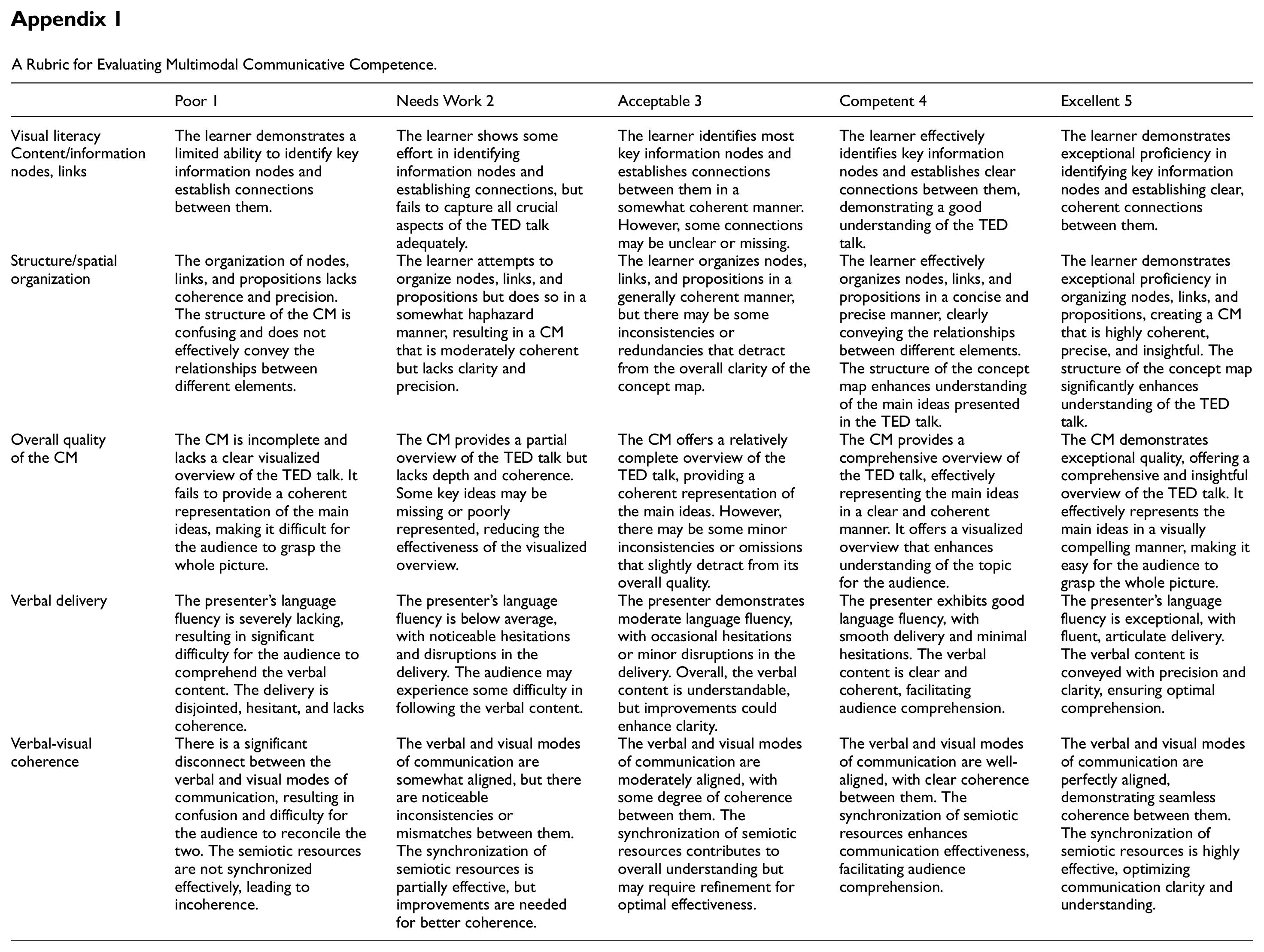
Having demonstrated the process of constructing a CM, the teacher/researcher proceeded to introduce a rubric of criteria for evaluating multimodal communicative performance (see Appendix), to familiarize students with the anticipated learning outcomes. The same rubric was used for the teacher/researcher and raters to assess students’ multimodal ensembles created before and after the intervention. Then students were asked to use the rubric to evaluate sample expert and novice CMs, so that they would have a clear sense of what was expected in creating their own multimodal ensembles. The rubric was piloted and refined in the previous academic year, and the novice samples used in the training session were gathered from the previous year’s class.
The pedagogical intervention spanned 4 weeks, implementing three sessions of integrated listening-speaking tasks (see Figure 1). The prescribed textbook for this particular course is “Keynote” (Stephenson et al., 2017), a series of English language teaching coursebooks tailored around TED talks. The TED talks in the textbook were used as the listening input materials in the intervention. The integrated listening-speaking task required students to watch a designated TED talk before class; they were asked to take notes and familiarize themselves with the content of the speeches, in preparation for the output activity in class. During class time, they were asked to work in groups to summarize the talk and produce verbal and visual outputs, in the format of a 3-min oral report augmented with a concept map as the visual aid, viz. the multimodal ensemble. The task design reflects the flipped classroom approach, in which students first engage with new content independently before class (input phase), and then use class time to apply what they have learned through interactive and productive tasks that involve both visual and verbal output.

The procedure of the pedagogical intervention.
Two intact classes were randomly assigned into a top-down group (N = 40) or a bottom-up group (N = 40). Both classes received the same pedagogical intervention by the same instructor, only with various forms of concept-mapping tasks. Both groups previewed the assigned TED talks before class. During class time, the top-down (TD) class was given the structure of an expert concept map with blanks to be filled in, and students worked in groups of four to fill in the blanks and completed the expert CM (see Figure 2). Then they gave a short talk summarizing the TED talk using the completed CM as the visual aid.

An expert CM for the top-down group.
In contrast, the bottom-up (BU) group was required to work in groups to create their own concept maps from scratch, whereby the students co-constructed a new understanding of the talk through negotiation of meaning with peers. They were also asked to give a short talk summarizing the TED talk with their CMs as the visual aid. In both classes, students used concept mapping as a learning/thinking tool to organize their understanding of the input materials and subsequently as a visual aid to complement speaking practices.
Data Collection and Analyses
Measurements on students’ multimodal communicative performance were taken at two points in time: before and after the pedagogical intervention. Students’ performance was elicited by their multimodal ensembles (see Figure 3), in the format of a video recording consisting of 3-min verbal protocols summarizing a TED talk and a concept map as the visual aid. The TED talks used for pre-study and post-study data collection were different from those in the textbook; they were chosen by the teacher/researcher based on the relevance of the topics to students’ life experiences and the organization of the speeches. Specifically, the teacher/researcher would purposefully select a speech characterized by a well-structured format that could be easily visualized into a concept map. For instance, Grant's (2016) TED talk “The surprising habits of original thinkers” can be segmented into three primary points, each accompanied by supporting details and real-world examples.
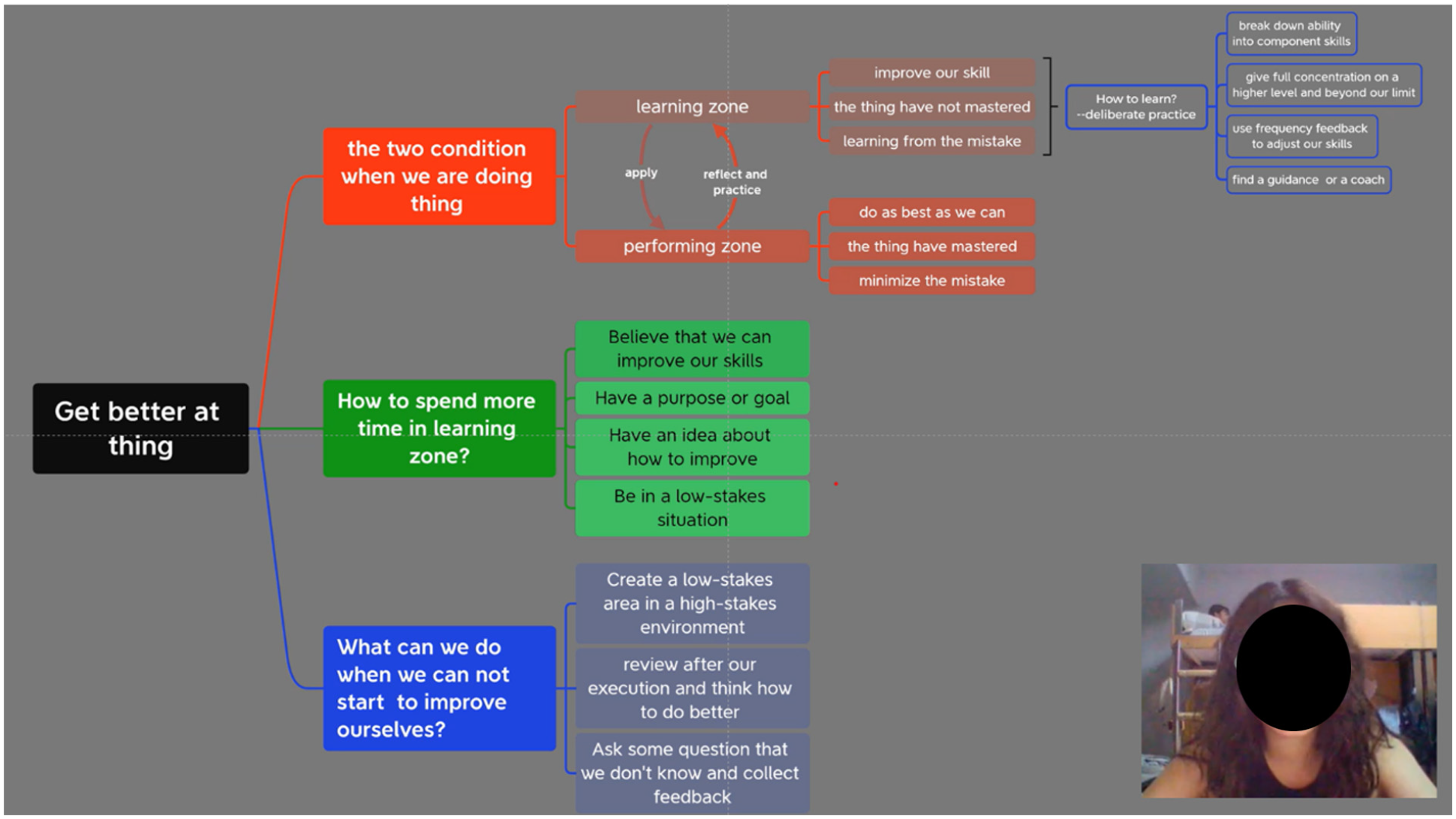
A screenshot of a student multimodal ensemble.
A Purpose-Built Rubric for Evaluating Multimodal Communicative Competence
Students’ multimodal ensembles were measured by verbal delivery, visual literacy, and the verbal-visual coherence (see Appendix for the rubric). Following Cañas et al.’s (2015) criteria for assessing the quality of concept maps, a learner’s ability to use a concept map to visually represent and communicate ideas, viz. visual literacy, was assessed with three criteria: content, structure and the overall quality of the concept map, each of which was assessed on a scale of 1 to 5 (1 being poor; 5 being excellent). The criterion “content” is concerned with the extent to which the learner is able to identify key information nodes and define the links or connections between the nodes in the assigned TED talk. The criterion “structure” is associated with the extent to which the learner is able to organize the nodes, links, propositions concisely and precisely based on their relationships (hierarchical, causal or sequential). The overall quality of the concept map deals with the extent to which the learner is able to provide a complete, visualized overview of the TED talk, in a way that is easy for the audience to see the whole picture. Taken together, the three criteria “content,”“structure” and “overall CM” were used to assess a learner’s visual literacy.
In this study, multimodal communicative competence was measured by the combined holistic presentation performance, which inevitably tended to be dominated by the visual mode of communication, so the verbal delivery was purposefully assessed by subjective audience perception of the presenter’s language fluency, instead of objective linguistic measures (e.g., the number of words per minute, the number of pauses). The verbal delivery was also assessed on a scale of 1 to 5 (1 being poor; 5 being excellent), based on the raters’ perceived fluency of the speaker. Finally, the evaluation also took into account the coherence between verbal and visual communication modes, viz. how students synchronized semiotic resources to optimize communication. The verbal-visual coherence was assessed on a scale of 1 to 5 (1 indicating poor coherence; 5 indicating excellent coherence). As Zhang et al. (2023) pointed out, multimodal ensembles served as a medium for understanding learners’ use of multimodal resources; when evaluating learners’ multimodal products, not only their linguistic performance, but also design features in other modes should be considered.
Student CMs were assessed by experienced EFL teachers along with their oral delivery to determine how well the ideas were communicated. In addition to the researcher, two experienced EFL teachers were recruited as raters. To ensure inter-rater reliability and consistency in applying the assessment rubric, the 3 raters jointly evaluated 40 multimodal ensembles created by the previous year’s class during the pilot study. These standardization meetings served to familiarize the raters with the assessment criteria, clarify rubric descriptors, and resolve any discrepancies through discussion. The collaborative evaluation process allowed the raters to align their interpretations and synchronize their standards prior to rating the actual study data. Inter-rater reliability check was performed using intraclass correlation (ICC = .807), indicating substantial agreement among raters.
Each student’s pre- and post-intervention multimodal ensembles were evaluated by three independent raters based on the five criteria, each rated on a five-point scale. The average scores were used for analysis. As the data did not follow the normal distribution, nonparametric tests were employed: the Wilcoxon signed-rank test was conducted to examine within-group differences before and after the intervention (RQ1), while the Mann–Whitney U test was used to compare performance between groups before the intervention (RQ2). In addition, a nonparametric equivalent of ANCOVA, viz. Quade’s ANCOVA test, was run to compare students’ post-study performance across groups (RQ2), using their pre-study performance as the covariate, the post-study performance as the dependent variable and the various forms of concept mapping as the independent variable. The data were analyzed using IBM SPSS Statistics (Version 26).
Results
The descriptive statistics of student performance in their multimodal ensembles are tabulated in Table 1. The data did not follow the normal distribution, so nonparametric tests were conducted; medians instead of means are reported (means are also provided).
Descriptive Statistics of Students’ Pre-Post-Study Performance.

Note. Means are in brackets.
Pre-Study Performance Across Groups
In terms of students’ baseline multimodal performance, the Mann-Whitney test confirmed that there was no significant difference in the entry level across groups (see Table 2). That is, the two groups did not have any marked difference in their visual and verbal literacy skills before the pedagogical intervention. As students may not have had the experience of creating concept maps and using them as visual aids to support oral presentations, the two groups were comparable on all the evaluation criteria prior to the pedagogical intervention.
Pre-Study Performance Across Groups.

Note. Means are in brackets.
Pre- and Post-Study Comparisons Within Groups
To answer the first research question: what are the effects of concept mapping on EFL learners’ multimodal communicative competence, student performances before and after the intervention were compared within groups. Since the study lacked a control group (viz. one without the CM training), the students’ performances were assessed within groups, comparing their performance before the intervention with their own performance afterward, to understand the effects of concept mapping activities on their multimodal communicative performance. The Wilcoxon signed-rank test was performed to compare the multimodal communicative performance within groups to see if the students made any progress after the training.
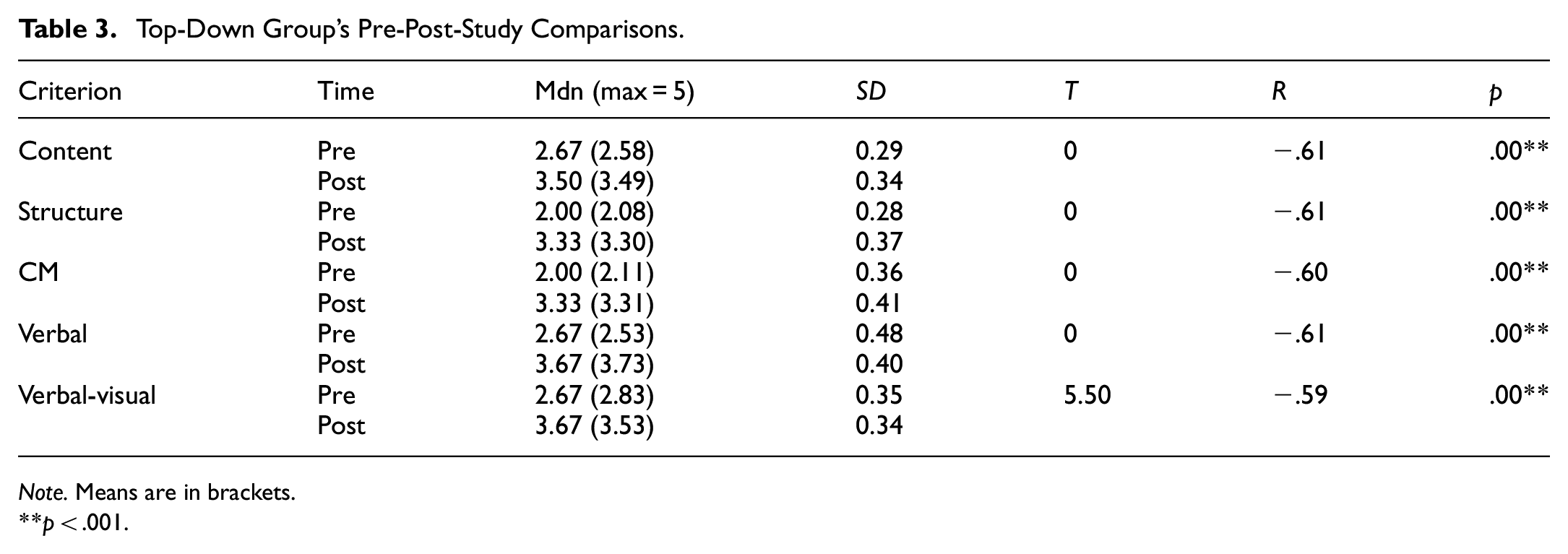
As for the top-down group, results showed that the pedagogical intervention had significant effects on all the criteria (see Table 3). The training enhanced the TD group’s performance in general, in terms of the content (pre-study Mdn = 2.67, post-study Mdn = 3.5; T = 0, p < .001, r = −.61), structure (pre-study Mdn = 2, post-study Mdn = 3.33; T = 0, p < .001, r = −.61), overall CM (pre-study Mdn = 2, post-study Mdn = 3.33; T = 0, p < .001, r = −.60), verbal delivery (pre-study Mdn = 2.67, post-study Mdn = 3.67; T = 0, p < .001, r = −.61), and the verbal-visual coherence (pre-study Mdn = 2.67, post-study Mdn = 3.67; T = 5.50, p < .001, r = −.59). According to Cohen’s (1988) rule of thumb for interpreting effect sizes: r = .1 (small effect); r = .3 (medium effect); and r = .5 (large effect), the training had large effects on the performance of the top-down group on all the criteria. The results showed that the top-down approach to concept mapping facilitated learners’ visual literacy skills, verbal literacy skills, and verbal-visual coherence.
Top-Down Group’s Pre-Post-Study Comparisons.
Note. Means are in brackets.
p < .001.
In regard to the bottom-up group’s performance, results demonstrated that the training had statistically significant effects on all the criteria (see Table 4). The findings showed that the training facilitated the BU group students’ multimodal communicative performance. In terms of the content, the BU group increased from a median score of 2.67 to 3.67 after the training (T = 12, p < .001, r = −.59). The median score on the structure went from 2 to 3.67 (T = 0, p < .001, r = −.62). The score on the overall CM also increased from a median of 2 to 3.33 (T = 0, p < .001, r = −.61). Students’ verbal delivery performance improved from a median score of 2.5 to 4 (T = 0, p < .001, r = −.60). The score of the verbal-visual coherence in their multimodal ensembles also increased from a median of 2.67 to 3.67 (T = 3, p < .001, r = −.60). The training also had large effects on the performance of the BU group on all the five criteria, suggesting that the bottom-up approach to concept mapping was also conducive to the development of visual literacy skills, verbal literacy skills, and verbal-visual coherence.
Bottom-Up Group’s Pre-Post-Study Comparisons.

Note. Means are in brackets.
p < .001.
Compared with the pre-study performance, both groups made significant progress on all the criteria as a result of the pedagogical intervention, showing that concept mapping activities facilitated visual and verbal communication skills, regardless of the forms of concept mapping.
Post-Study Performance Across Groups
To address the second research question: how do various approaches to concept mapping affect EFL learners’ multimodal communicative competence, post-study performances were compared across groups. A nonparametric equivalent of ANCOVA, viz. Quade’s ANCOVA test, was run to compare students’ post-study performance across groups, using their pre-study performance as the covariate, the post-study performance as the dependent variable and the various forms of concept mapping as the independent variable. The descriptive statistical data of the two groups’ post-study performance and the Quade’s ANCOVA results are shown in Table 5.
Post-Study Performance Across Groups.

Note. Means are in brackets.
p < .05.
The results showed that there were significant differences between the two groups on three criteria: the content, structure, and verbal-visual coherence. In contrast, students did not differ in their performance on the overall quality of CMs and verbal delivery after the training.
As noted earlier, both the TD and BU groups demonstrated statistically significant progress in visual and verbal literacy skills, albeit to varying degrees. Regarding the overall quality of concept maps (CMs), both groups achieved a median score of 3.33 in their ability to represent the overarching structure of the assigned talk. The difference between the groups did not reach statistical significance (F(1,78) = 0.64, p = .43), suggesting that both approaches led to comparable improvements in the ability to visually outline the input information. In other words, in terms of externalizing the big picture in mind, observing expert-generated CMs proved to be as effective as constructing CMs from scratch.
Also, the two groups did not differ in their verbal delivery performance (BU group Mdn = 4.00; TD group Mdn = 3.67; F(1,78) = 3.16, p = .08), indicating that various approaches to concept mapping did not have different effects on students’ oral delivery. It is reasonable to suggest that the lack of a significant difference across groups may be attributed to the nature of the distinction between the two approaches—specifically, how learners engaged with the CM tool (i.e., observing CMs vs. creating CMs). Throughout the pedagogical intervention, both groups were provided with equal opportunities to practice oral reporting, with minimal explicit instruction targeting oral delivery as a discrete language skill. This instructional parity may help explain the absence of a statistically significant difference in post-intervention performance.
Among the five criteria for evaluating multimodal ensembles, the BU group outperformed the TD group on the content, structure and the verbal-visual coherence. The BU group scored a median of 3.67 on the content, while the TD group scored 3.50, with F(1,78) = 5.63, p = .02, suggesting that the BU group outperformed their counterparts on identifying the key information nodes and defining links from the input materials.
Moreover, the BU group had significantly better performance on the structure of their concept maps (Mdn = 3.67) than that of the TD group (Mdn = 3.33, F(1,78) = 8.66, p = .004), implying that the former exhibited better ability in spatially organizing information nodes and links according to their relationships.
In terms of the verbal-visual coherence, a statistically significant difference was found in the post-study performance across groups (F(1,78) = 5.12, p = .03). The result showed that the BU group had a higher degree of awareness that verbal presentation and visual representation should go hand in hand to achieve the purpose of multimodal communication, as opposed to being two separate channels of communication.
Discussion
This paper aimed to investigate the effects of concept mapping as a communication tool (top-down or bottom-up approach) on EFL students’ multimodal communicative competence. Students’ multimodal ensembles were examined to uncover the ways in which the pedagogical use of CMs as a communication tool facilitate their communication performance. This section provides a qualitative interpretation of the results, contextualizing the quantitative data through engagement with relevant empirical studies and illustrative examples of student work. Based on these findings, the research questions can now be addressed as follows.
The Effects of Concept Mapping on Multimodal Communicative Competence
Research question 1 refers to whether and how concept mapping activities lead to changes in multimodal communication performance. Compared with the pre-study performance, both groups made significant progress on all the criteria (viz. content, structure, overall CM, verbal delivery, and verbal-visual coherence) as a result of the pedagogical intervention, showing that concept mapping activities facilitated visual and verbal communication skills, irrespective of the forms of concept mapping.
The findings of this study align with previous research demonstrating the positive effects of concept mapping (CM) on English language learning across various domains (Chen & Hwang, 2020; Jackson et al., 2011; Jiang & Grabe, 2007; Karimi et al., 2020; Lachner et al., 2017; Liu et al., 2010; Roozbeh et al., 2016; Yang, 2015). While earlier studies have established CM’s utility in enhancing language proficiency, the present study extends this line of inquiry by situating CM within the framework of multimodal communicative competence. By foregrounding the multimodal nature of meaning-making, this study underscores CM’s potential not only as a cognitive-organizational tool but also as a scaffold that enables learners to coordinate and interpret diverse communicative modes in contextually appropriate ways.
Prior to the intervention, students performed below expectations, as evidenced by scores lower than three across all criteria. A close examination of the pre-study multimodal ensembles revealed that many student CMs did not adhere to established visual design principles (e.g., top-to-bottom or left-to-right organization), which resulted in confusion or distraction for the audience. Additionally, some students failed to align the flow of their verbal reports with the layout of their CMs, treating the visual mode as a separate and disconnected component. Figure 4 shows a student CM with lower scores on the criteria structure and overall CM: while the student was able to identify information nodes in the assigned TED talk, but s/he did not seem to organize them hierarchically to show the relationships between the information nodes, nor did s/he make good use of the spatial organization to provide a clear outline of the talk. Given the randomly scattered information nodes and poor spatial organization, the speaker faced challenges in synchronizing verbal delivery with visual presentation, while the audience encountered difficulties in processing both visual and verbal information simultaneously, resulting in less effective communication. This is in line with Veronese et al.’s (2013) observation that students’ problems with concept maps were related to difficulties in spatial organization, resulting in concept maps that were difficult to interpret and review. Before the pedagogical intervention, several students were observed using mind maps as a means of circumventing the cognitively demanding task of conceptually restructuring input information and spatially organizing information nodes into hierarchical relationships. After the training, both groups made considerable progress in visual literacy skills, as evidenced by statistically higher scores on the visual-literacy-related criteria and fewer occurrences of mind maps with randomly dispersed information nodes.

A student concept map with lower scores on the structure and overall CM.
In addition to improvements in visual representation, it is noteworthy that the verbal–visual coherence in students’ multimodal ensembles also increased significantly. This suggests that students became more attuned to the integration of the two semiotic modes and made more deliberate efforts to synchronize them—an indication of developing multimodal communicative competence. Through repeated practice, it is likely that students became more proficient at visualizing their thinking and organizing it in ways that supported and guided their spoken delivery, thereby achieving a higher level of intermodal coherence.
The Effects of Various Approaches to Concept Mapping on Multimodal Communicative Competence
Research Question 2 concerns the effects of various approaches to concept mapping on EFL learners’ multimodal communicative competence. The findings revealed statistically significant differences between the two groups with respect to three specific criteria: content, structure, and verbal–visual coherence. However, no significant differences were observed in students’ performance regarding the overall quality of the concept maps (CMs) or their verbal delivery following the instructional intervention.
Schroeder et al.'s (2018) meta-analysis found that when concept maps were used as a learning tool for studying disciplinary knowledge, creating CMs yielded greater benefits than studying pre-constructed ones. These benefits were primarily related to the retention and acquisition of content knowledge. In contrast, the present study conceptualized concept maps as a communication tool designed to support multimodal communicative performance. Within this framework, the various approaches to concept mapping were found to produce differential effects across distinct criteria.
The BU group outperformed their counterparts in identifying information nodes and delineating relationships between nodes. This advantage may be attributed to the process of constructing concept maps from scratch, which necessitated repeated engagement with the input, iterative filtering of information, and collaborative interaction with peers. The bottom-up approach likely facilitated a deeper level of cognitive processing (Craik & Lockhart, 1972), enabling learners to develop a more comprehensive understanding of the input. This, in turn, allowed them to more effectively identify and visualize key content and its structural organization. The findings also provide empirical support for the active cognitive processes described by Mayer (2009), particularly the selection and organization of information. Furthermore, they align with Wu et al.’s (2016) findings, which demonstrated that concept mapping promotes higher-order cognitive engagement. The BU group also exhibited a more advanced ability to spatially organize information nodes and their relational links, as reflected in higher scores on the structure criterion. This suggests that constructing concept maps supports the development of literacy skills related to identifying and producing discourse structure (Jiang, 2012).
Creating CMs from scratch is also conducive to achieving the visual-verbal coherence of multimodal communication, as can be explained by dual coding theory (Paivio, 1990). The process of constructing CMs required the use of both verbal and visual mental codes, giving students extensive practice in synchronizing semiotic resources throughout the task. This approach likely facilitated a more advanced understanding of intersemiotic complementarity—defined as the coordinated functioning of modes to construct meaning (T. Royce, 2002)—as observed in their multimodal ensembles. This capacity is closely linked to the development of multimodal literacy (Kessler, 2022). Furthermore, constructing CMs provided learners with the opportunity to design visual structures that reflected the content and organization of their oral reports. This process not only reinforced the coherence between the visual and verbal modes of communication but also fostered a deeper understanding of how different semiotic resources work together to enhance meaning. By shaping the visual layout of their CMs to complement their verbal discourse, learners were able to use one mode to structure and reinforce the other—an essential aspect of multimodal literacy.
With regard to students’ ability to map out the big picture, the findings suggest that constructing CMs is as effective as examining expert CMs. While the identification of information nodes and the delineation of links between them reflect cognitive processing, the ability to synthesize a holistic understanding of information may be regarded as a manifestation of metacognitive awareness. The results indicate that both approaches to concept mapping are equally effective in facilitating this metacognitive dimension. Crucially, the act of concept mapping enables learners to move beyond the mere reproduction of factual content, engaging instead in higher-order metacognitive processes such as the meaningful organization of information, synthesis of diverse ideas, and articulation of complex conceptual interrelationships (Novak & Cañas, 2008). This process of externalization aligns closely with the principles of visible thinking (Ritchhart et al., 2011), which emphasize making students’ reasoning, assumptions, and conceptual development observable and open to dialog. The present findings offer empirical support for the affordances of concept mapping in fostering visible thinking, regardless of whether the maps are constructed by students or provided by experts.
In terms of verbal delivery, both groups demonstrated improvement following the intervention; however, no statistically significant differences were observed between them. These findings are partially consistent with those of previous studies (Chen & Hwang, 2020; Ghonsooly & Hosienpour, 2009; Kazemi & Moradi, 2019; Seyed Erfani & Saeedi Farjam, 2015), which have shown that concept mapping can be effectively employed as a pedagogical tool to enhance EFL learners’ speaking performance. It is important to note, however, that while these earlier studies primarily conceptualized speaking performance through the lens of discrete linguistic features, the present study contributes to the literature by demonstrating that concept mapping can support verbal delivery as an integral component of multimodal communication, regardless of the specific CM format in which learners were trained. This finding may be attributed to the fact that both groups were provided with comparable opportunities to engage in oral reporting tasks throughout the pedagogical intervention, which likely contributed to their parallel gains in verbal delivery. Notably, explicit instruction in oral delivery features—such as pronunciation and intonation—was intentionally minimized. This decision was grounded in the theoretical framework of multimodal communication, which emphasizes the communicative affordances of integrating verbal and visual semiotic resources. Rather than privileging native-like phonological accuracy, the pedagogical intervention foregrounded the functional deployment of multiple modes to achieve communicative effectiveness (Kress, 2010). This approach aligns with the view that successful communication in contemporary contexts often depends more on the strategic orchestration of semiotic resources than on adherence to native-speaker norms (Pennycook, 2010; Stein, 2007).
Overall, the development of students’ visual and verbal literacy skills represents a meaningful learning outcome, indicative of emerging multimodal communicative competence. These findings underscore the pedagogical value of integrating concept mapping into language instruction, as such practices not only foster traditional language skills but also promote learners’ ability to construct and communicate meaning through multiple modes. The observed gains in both verbal delivery and visual organization suggest that students are beginning to engage more strategically with semiotic resources, a defining feature of communicative competence in digitally mediated contexts. As learners develop the capacity to integrate linguistic, visual, and spatial modes in purposeful ways, they become better equipped to navigate diverse communicative contexts, both within and beyond the classroom.
Conclusions
Concept mapping has been proven to be beneficial for facilitating content knowledge across academic disciplines; in the field of SL/FL learning, a huge body of empirical evidence has also substantiated the efficacy of concept mapping in the development of four language skills. This study is among the first to explore how EFL learners engaged with integrated listening-speaking tasks using concept maps, and how their engagement led to the development of multimodal communicative competence, viz. verbal and visual literacy skills, as opposed to decontextualized language skills. The findings contribute to the existing literature by highlighting the positive effects of concept maps as both a learning tool and a communication tool for enhancing EFL learners’ multimodal performance. This study responds to the scholarly call for advancing language learners’ multimodal communicative competence (Coccetta, 2018; Jewitt & Kress, 2003; Kessler, 2022; T. D. Royce, 2007), and provides empirical support for the affordances of concept mapping in fostering visible thinking (Ritchhart et al., 2011).
Furthermore, the study extends prior research by distinguishing between two pedagogical approaches to concept mapping—top-down and bottom-up—and demonstrates that both are generally effective in enhancing verbal and visual literacy skills. More importantly, the bottom-up approach was confirmed to have the added value of fostering active cognitive processes, as evidenced by learners’ enhanced ability to identify information nodes and relationships between nodes, organize nodes and links, and align verbal and visual modes of communication. More importantly, the bottom-up approach was confirmed to have the added value of fostering active cognitive processes, as evidenced by learners’ enhanced ability to identify information nodes and relationships between nodes, organize nodes and links, and align verbal and visual modes of communication.
One limitation of the study is the relatively small sample size, comprising 80 EFL learners at the pre-intermediate proficiency level. While this study purposefully focused on pre-intermediate learners—who may particularly benefit from the use of non-verbal modes to complement and enhance spoken messages—future research could address this delimitation by incorporating a larger and more diverse sample, including learners at varying proficiency levels, to improve the generalizability of the findings. Additionally, this study focused only on visual and verbal modes of communication. Future research may incorporate a wider range of semiotic modes—such as gestures, facial expressions, posture, intonation, and other paralinguistic features—to better capture the embodied and prosodic dimensions of interaction.
Given the advent of technology and the proliferation of communication modes nowadays, it is now impossible to make sense of texts without a clear idea of the meanings associated with each semiotic resource (Kress, 2000). While most L2 teachers have been professionally trained to use multimodal pedagogy to optimize germane cognitive load for learning, it is equally important to raise language learners’ awareness of using multiple semiotic resources to optimize communication. The study has implications for language teachers to sensitize students to the prevalence of multimodal communication in today’s world, to provide specific and systematic training on multimodal communicative competence, and to offer opportunities to practice orchestrating multiple semiotic resources to achieve effective communication. L2 teachers may usefully introduce various visual tools (concept map, knowledge map, infographic, etc) to add to students’ repertoire to strengthen their multimodal communicative competence.
Footnotes
Appendix
A Rubric for Evaluating Multimodal Communicative Competence.
| Poor 1 | Needs Work 2 | Acceptable 3 | Competent 4 | Excellent 5 | |
|---|---|---|---|---|---|
| Visual literacy Content/information nodes, links |
The learner demonstrates a limited ability to identify key information nodes and establish connections between them. | The learner shows some effort in identifying information nodes and establishing connections, but fails to capture all crucial aspects of the TED talk adequately. | The learner identifies most key information nodes and establishes connections between them in a somewhat coherent manner. However, some connections may be unclear or missing. | The learner effectively identifies key information nodes and establishes clear connections between them, demonstrating a good understanding of the TED talk. | The learner demonstrates exceptional proficiency in identifying key information nodes and establishing clear, coherent connections between them. |
| Structure/spatial organization | The organization of nodes, links, and propositions lacks coherence and precision. The structure of the CM is confusing and does not effectively convey the relationships between different elements. | The learner attempts to organize nodes, links, and propositions but does so in a somewhat haphazard manner, resulting in a CM that is moderately coherent but lacks clarity and precision. | The learner organizes nodes, links, and propositions in a generally coherent manner, but there may be some inconsistencies or redundancies that detract from the overall clarity of the concept map. | The learner effectively organizes nodes, links, and propositions in a concise and precise manner, clearly conveying the relationships between different elements. The structure of the concept map enhances understanding of the main ideas presented in the TED talk. | The learner demonstrates exceptional proficiency in organizing nodes, links, and propositions, creating a CM that is highly coherent, precise, and insightful. The structure of the concept map significantly enhances understanding of the TED talk. |
| Overall quality of the CM | The CM is incomplete and lacks a clear visualized overview of the TED talk. It fails to provide a coherent representation of the main ideas, making it difficult for the audience to grasp the whole picture. | The CM provides a partial overview of the TED talk but lacks depth and coherence. Some key ideas may be missing or poorly represented, reducing the effectiveness of the visualized overview. | The CM offers a relatively complete overview of the TED talk, providing a coherent representation of the main ideas. However, there may be some minor inconsistencies or omissions that slightly detract from its overall quality. | The CM provides a comprehensive overview of the TED talk, effectively representing the main ideas in a clear and coherent manner. It offers a visualized overview that enhances understanding of the topic for the audience. | The CM demonstrates exceptional quality, offering a comprehensive and insightful overview of the TED talk. It effectively represents the main ideas in a visually compelling manner, making it easy for the audience to grasp the whole picture. |
| Verbal delivery | The presenter’s language fluency is severely lacking, resulting in significant difficulty for the audience to comprehend the verbal content. The delivery is disjointed, hesitant, and lacks coherence. | The presenter’s language fluency is below average, with noticeable hesitations and disruptions in the delivery. The audience may experience some difficulty in following the verbal content. | The presenter demonstrates moderate language fluency, with occasional hesitations or minor disruptions in the delivery. Overall, the verbal content is understandable, but improvements could enhance clarity. | The presenter exhibits good language fluency, with smooth delivery and minimal hesitations. The verbal content is clear and coherent, facilitating audience comprehension. | The presenter’s language fluency is exceptional, with fluent, articulate delivery. The verbal content is conveyed with precision and clarity, ensuring optimal comprehension. |
| Verbal-visual coherence | There is a significant disconnect between the verbal and visual modes of communication, resulting in confusion and difficulty for the audience to reconcile the two. The semiotic resources are not synchronized effectively, leading to incoherence. | The verbal and visual modes of communication are somewhat aligned, but there are noticeable inconsistencies or mismatches between them. The synchronization of semiotic resources is partially effective, but improvements are needed for better coherence. | The verbal and visual modes of communication are moderately aligned, with some degree of coherence between them. The synchronization of semiotic resources contributes to overall understanding but may require refinement for optimal effectiveness. | The verbal and visual modes of communication are well-aligned, with clear coherence between them. The synchronization of semiotic resources enhances communication effectiveness, facilitating audience comprehension. | The verbal and visual modes of communication are perfectly aligned, demonstrating seamless coherence between them. The synchronization of semiotic resources is highly effective, optimizing communication clarity and understanding. |

Ethical Considerations
This study was approved by the Human Research Ethics Committee of National Cheng Kung University and conducted in accordance with the NCKU Governance Framework for Human Research Ethics (112-264).
Consent to Participate
Informed consent was obtained from all participants, and measures were taken to ensure anonymity, confidentiality, and voluntary participation throughout the research process.
Funding
The author disclosed receipt of the following financial support for the research, authorship, and/or publication of this article: This work was supported by the National Science and Technology Council, Taiwan [Grant number MOST 111-2410-H-390-008 -].
Declaration of Conflicting Interests
The author declared no potential conflicts of interest with respect to the research, authorship, and/or publication of this article.
Data Availability Statement
The data can be obtained by sending a request e-mail to the author.