




Abstract
This study investigates how Saudi National Identity (SNI) is performed through citizen-authored multimodal texts commemorating the 94th Saudi National Day. It introduces the Multimodal Hermeneutic-Cultural Discourse (MHCD) Model—a novel triadic framework integrating Cultural Discourse Studies (CuDS), visual grammar, and philosophical hermeneutics—to analyze how meaning emerges across visual and verbal modes. Fifteen image-caption pairs were purposively selected and examined across five thematic domains: heritage and ancestral continuity, gendered kinship and relational identity, faith and moral vision, unity and national power, and youth and futurity. Visual features such as traditional dress, ritual gestures, spatial icons, and collective presence express cultural memory as embodied practice. Verbal texts reinforce belonging through speech acts that commemorate ancestry, affirm shared values, and project futurity—evident in expressions like “our roots,” “for God and the nation,” and “the future is in our hands.” The hermeneutic synthesis reveals that meaning is not inherent in image or text alone, but arises through their dialogic convergence. Findings demonstrate that Saudi identity is actively performed through multimodal composition as a lived, ethical, and future-oriented discourse. This study contributes to multimodal discourse analysis by offering a culturally grounded model for interpreting vernacular nationalism and highlights the expressive agency of ordinary citizens in shaping national belonging through symbolic participation.
Plain Language Summary
This study introduces the Multimodal Hermeneutic-Cultural Discourse (MHCD) Model, a new analytical framework that integrates Cultural Discourse Studies, visual grammar, and philosophical hermeneutics to interpret how Saudi citizens express national identity through image-title-caption compositions. Using this model, the study analyzes fifteen visual-textual artifacts created by citizens, grouped into five main themes: heritage, gendered kinship, faith, unity, and futurity. In the visual dimension, heritage is expressed through traditional garments, architecture, and symbolic objects; gendered kinship appears through intergenerational arrangements and shared space; faith is visually represented via modest dress and color symbolism; unity is embodied in synchronized public displays; and futurity is illustrated by children in modern, aspirational environments. In the verbal dimension, both titles and captions are key to expressing cultural values. Heritage is evoked through references to ancestry and origin. Gendered kinship is affirmed through inclusive language celebrating both sons and daughters. Faith is invoked through moral and religious phrases such as “for God and the homeland.” Unity is emphasized through phrases about collective alignment and shared direction, while futurity is articulated through aspirational statements that place youth at the center of the nation’s development. In the hermeneutic dimension, meaning arises from the interaction between image, title, and caption. For example, a child in traditional dress becomes a symbol of cultural continuity when the accompanying title and caption frame the image in terms of family legacy. A fireworks display or a modern shopping mall becomes a sign of national ambition only when verbal components connect it to visions of Saudi Arabia’s future. Across all five themes, the MHCD Model reveals that Saudi identity is not merely represented but actively performed through culturally embedded signs.
Keywords
Introduction
This study advances the Multimodal Hermeneutic-Cultural Discourse (MHCD) Model, a triadic theoretical framework developed to interpret citizen-authored expressions of Saudi national identity (SNI) (Figure 1). Drawing from Shi-xu’s (2005, 2009, 2022) Cultural Discourse Studies (CuDS), Kress and Van Leeuwen’s (2006, 2021) social semiotic framework of visual grammar, and the hermeneutic philosophies of Gadamer (1975) and Ricoeur (1981, 1991), the model provides an integrative lens for analyzing how ordinary citizens construct belonging, memory, and national ethos across visual and verbal modes. Through this framework, national identity is viewed not as fixed, but as a culturally situated discourse enacted through symbolic and affective practices.
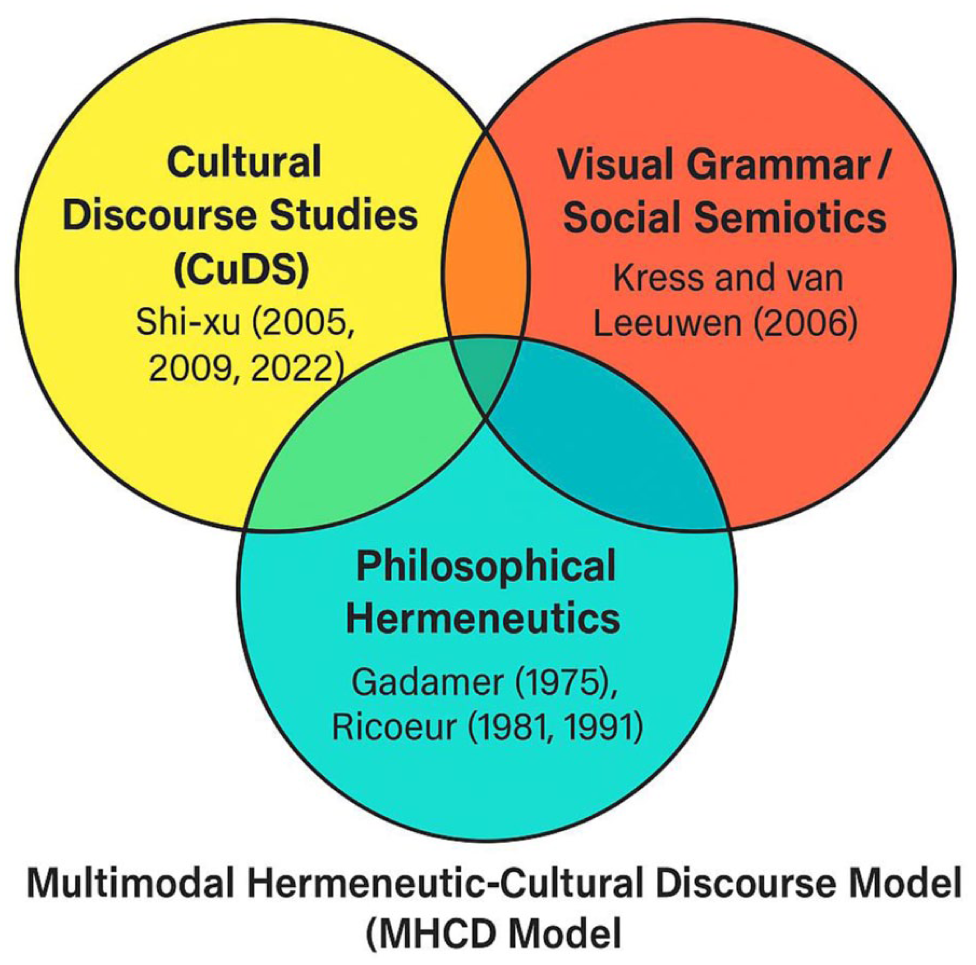
The multimodal hermeneutic-cultural discourse (MHCD) model.
Building on this model, the study conceives national identity not as an inherited essence but as a symbolic formation—historically layered, culturally situated, and discursively enacted. It materializes in ritualized expressions where memory, power, and aspiration are made visible through shared signs: parades, traditional attire, emblems, gestures, and commemorative language. These multimodal enactments position the nation not simply as an imagined political community, but as an affective discourse field in which past, present, and projected futures are narratively interwoven. In the Saudi context, where rapid modernization intersects with enduring traditions, identity assumes heightened symbolic intensity—amplified through ceremonial display and collective performance.
Although Critical Discourse Analysis (CDA) offers powerful tools for investigating language in its sociopolitical context (Fairclough, 1989, 1995; Van Dijk, 1995), it often imposes Western-centric frameworks that marginalize indigenous systems of meaning (Shi-xu, 2005, 2010). In response, Shi-xu’s (2005, 2009) frameworks—Cultural Discourse Studies (CuDS) and the Cultural Approach to Discourse (CAD)—offer an alternative paradigm centered on discursive sovereignty, pluriversality, and culturally situated communicative ethics. The MHCD Model builds on this shift by privileging vernacular meaning-making in contexts such as Saudi National Day, where symbolic acts are deeply embedded in indigenous ethical and historical logics.
This study is situated within this transformative turn, engaging with the ways in which SNI is discursively and visually articulated by ordinary citizens during the 94th Saudi National Day celebration. As scholars such as Anderson (1991), Guibernau (1996), and Smith (1991, 2002) have shown, national identity is not prediscursive; it must be continuously narrated and symbolically reaffirmed through shared signs, public rituals, and historically anchored representations. These enactments encode a collective imaginary that projects both cultural continuity and political legitimacy.
In Saudi Arabia, National Day functions as a heightened site of semiotic activity, where traditional and modern symbols converge to stage a culturally charged performance of national belonging. As Beus (2001) observe, the endurance of national identity depends on the periodic renewal of its emblematic forms. Huntington (2004) further emphasizes that such expressions must be interpreted in relation to the normative frameworks and historical imaginaries they are meant to sustain.
Building on this semiotic perspective, contemporary expressions of SNI must also be understood within the broader sociocultural transformation inaugurated by Vision 2030. This ongoing project has rearticulated the meanings of heritage, modernity, and civic participation by expanding public visibility for women and youth, revitalizing cultural traditions, and promoting new forms of national representation. Within this reconfigured landscape, National Day celebrations operate not merely as ceremonial events but as participatory arenas in which citizens symbolically negotiate continuity and change, appropriating state narratives while generating vernacular interpretations of belonging.
To ground these theoretical claims in lived practice (Espinosa Zárate, 2023; Shi-xu, 2022), this study applies the MHCD Model to a corpus of 15 multimodal texts—each comprising an image, title, and caption—created by Saudi citizens during the 94th National Day. Unlike state-directed or media-curated portrayals, these vernacular compositions reflect grassroots participation in the national celebration. Rather than merely depicting identity, they enact it through the integration of visual design and written reflection, offering rare insight into how ordinary individuals mobilize symbolic resources to affirm and transmit shared cultural meaning. Within the MHCD framework, these texts are treated not as passive representations but as intentional enactments of belonging, situated within the commemorative horizon of the National Day. In doing so, the model contributes to a methodological reorientation that foregrounds situated meaning-making and reframes discourse as dialogic, embodied, and collectively authored. Accordingly, the study addresses the following research questions:
By attending to the interpretive logic of everyday symbolic acts, this study offers a reimagining of SNI as a choreographed formation of belonging—fluid, agentive, and plural. It positions visual-verbal composition not as ancillary, but as central to how collective affiliation is authored from within, contributing a theoretically generative model for language-focused inquiry attuned to the aesthetics of shared meaning-making.
Literature Review
From Critical Discourse Analysis to Cultural Reorientation
CDA has long constituted a foundational paradigm for examining the interrelations of language, power, and ideology. Rooted in the work of Fairclough (1989, 1992a, 1992b, 1995) and extended by scholars such as Van Dijk (1987, 1995), Wodak (2001), and Billig (2003), CDA interrogates how discourse reproduces hegemonic structures, particularly through the construction of in-group/out-group dichotomies and the naturalization of social inequality. Its interdisciplinary scope—drawing from linguistics, sociology, and semiotics—has rendered it methodologically expansive and widely applicable (Weiss & Wodak, 2003).
Nevertheless, its epistemological orientation has drawn sustained critique. As Shi-xu (2022) argues, CDA frequently enacts a form of analytic universalism, deploying Eurocentric interpretive frameworks that occlude culturally specific symbolic systems and communicative values. This epistemic asymmetry has catalyzed a paradigmatic realignment, prompting scholars to seek models attuned to the ontologies and semiotic practices of non-Western contexts. Within this shift, CuDS and CAD emerge not as supplementary alternatives but as critical correctives—foregrounding discursive sovereignty, epistemological plurality, and culturally embedded modes of knowing.
Toward Situated Meaning in Discourse Studies
CuDS and CAD reconceptualize discourse not as a neutral medium of communication but as a culturally situated performance of meaning. Developed by Shi-xu (2005, 2009, 2010, 2022), CuDS advances a decolonial epistemology that privileges symbolic specificity, ethical positionality, and pluriversal logic. Similarly, CAD rejects homogenizing frameworks in favor of analytic models grounded in local lifeworlds, normative traditions, and historically sedimented communicative practices.
This reorientation finds resonance in Donal Carbaugh’s Cultural Discourse Theory (CDT), which treats communication as a culturally configured enactment of identity, place, and moral order. From its ethnographic roots (Carbaugh, 1987, 1988, 1996) to its mature articulation (Carbaugh, 2007), CDT has offered a robust vocabulary for understanding discourse as a site of cultural reproduction and negotiation. Scholars such as Unger (2006), Scollo (2011), and Scollo and Milburn (2018) have extended this perspective, calling for discourse analytic approaches that are both interculturally reflexive and contextually grounded.
Operationalized in this study through the CAMPHC model (Shi-xu, 2024), CuDS provides a structural framework for examining how citizen-authored discourse enacts Saudi national identity within culturally intelligible horizons.
Reframing Meaning: Visual Semiotics and Multimodal Discourse
The reconception of discourse as intrinsically multimodal has reoriented theoretical inquiry across linguistics, semiotics, and discourse studies. Kress and Van Leeuwen’s (2006, 2021) Grammar of Visual Design, extending Halliday’s (1978) systemic functional linguistics, posits images as semiotically structured texts that realize representational, interactive, and compositional meanings.
This foundational shift has generated calls for integrative frameworks attentive to the co-articulation of verbal, visual, and gestural modalities. Earlier theorists working within sociolinguistics and CDA construed multimodality through predominantly structural and ideological lenses (Blommaert, 2005; Chouliaraki & Fairclough, 1999). While these perspectives established an important critical lineage, subsequent research has re-envisioned multimodality through culturally and hermeneutically grounded approaches informed by CuDS (Shi-xu, 2005, 2022) and supported by culturally situated analyses of discourse and representation (El Falaky, 2016; Rani & Samjetsabam, 2024). Within this reorientation, multimodal discourse analysis functions not as a corrective to logocentrism alone but as a culturally embedded mode of inquiry, enabling the interpretation of meaning as orchestrated across image, layout, typography, and spatial form (Jewitt, 2009; Machin, 2013).
Here, visual semiotics is not ancillary but central—particularly in cultural and national discourse, where spatial design, visual icons, and embodied formations actively construct collective identity and public memory.
Hermeneutics and the Dialogics of Meaning
Hermeneutic philosophy has profoundly shaped discourse studies by reframing meaning as interpretive emergence rather than textual fixity. Gadamer (1975) foregrounds understanding as a dialogic event—a historically mediated encounter between interpreter and text, structured through the hermeneutic circle’s recursive movement between part and whole (George, 2020). In multimodal contexts, this framework underscores the temporality and positionality inherent in decoding culturally embedded signs.
Ricoeur (1981, 1991) extends this tradition by theorizing interpretation as symbolic mediation. His concepts of distanciation and narrative identity position texts—visual and verbal alike—as semi-autonomous artifacts that refigure lived experience through emplotment, metaphor, and reappropriation across horizons (Kearney, 2004; Pellauer & Dauenhauer, 2021).
Recent scholarship in intercultural hermeneutics and multimodal analysis (e.g., De Mul, 2011; Espinosa Zárate, 2023; Müller et al., 2013; Wrogemann, 2016) has emphasized that interpretation is not merely textual but situated—an act mediated by layered signs, historical imaginaries, and participatory understanding. Such perspectives are critical for analyzing vernacular multimodal texts, where identity is not stated but staged through culturally resonant symbolic assemblages.
Introducing the MHCD Model: A Triadic Framework for Multimodal Identity Discourse
The convergence of CuDS, visual semiotics, and philosophical hermeneutics reveals an under-theorized intersection in discourse analysis: the need for a framework that can account for how identity is performatively enacted across verbal, visual, and interpretive domains. While each tradition offers incisive analytic tools, their synthesis remains insufficiently developed—particularly in relation to non-Western, citizen-authored texts, where meaning is deeply embedded in localized symbols, affective registers, and commemorative practices.
To address this theoretical lacuna, the present study advances the MHCD Model—a structurally tripartite paradigm that integrates these distinct but complementary traditions. Drawing on CuDS, the model attends to how verbal texts enact identity through culturally resonant speech acts, ethical positioning, and historical reference (operationalized through Shi-xu’s [2024] CAMPHC model—an acronym for Communicators, Act, Medium, Purpose, History, and Culture—which constitutes a micro-analytic substratum of CuDS, providing the linguistic scaffolding upon which the MHCD Model’s multimodal-hermeneutic synthesis is constructed).
It incorporates Kress and Van Leeuwen’s visual grammar to elucidate the compositional logic and semiotic orchestration of images. Finally, it engages Gadamerian and Ricoeurian hermeneutics to interpret meaning as an emergent, dialogic process shaped by temporal mediation, narrative emplotment, and the convergence of symbolic forms.
Theoretical Foundations
Cultural Discourse Studies: Discourse as Cultural Performance
CuDS, as developed by Shi-xu (2005, 2009, 2022), reconceptualizes discourse as a culturally saturated symbolic practice rather than a neutral linguistic transaction. Within this paradigm, meaning is not extracted from discourse but emerges from within cultural logics, affective rhythms, and social imaginaries. In this study, CuDS is employed not as a thematic lens but as a structural logic guiding the interpretation of participant-authored captions. The CAMPHC model—proposed within Shi-xu’s CuDS tradition (Shi-xu, 2005, 2022, 2024) and encompassing Communicators, Act, Medium, Purpose, History, and Culture—serves as a key analytic heuristic for unpacking how identity is staged linguistically within culturally situated discourse. These discursive acts are not epiphenomena; they are constitutive of how SNI is collectively imagined and vernacularly performed.
Social Semiotics: The Visual as Symbolic Choreography
Visual analysis in this study departs from formalist universality, reorienting Kress and Van Leeuwen’s (2006, 2021) grammar toward culturally embedded modes of visual signification. Rather than applying abstract compositional categories, the reading isolates symbolically charged elements that function as vernacular enactments of national identity. Within the MHCD framework, the photograph becomes a semiotic intervention: an authored gesture through which identity is visually articulated, affectively mobilized, and situated within the commemorative temporality of the 94th National Day. In this sense, the visual is approached as a form of choreography—a dynamic orchestration of symbolic resources through which cultural identity is enacted and made visible.
Hermeneutics: The Dialogic Ethics of Interpretation
This study draws on philosophical hermeneutics, particularly the dialogical tradition advanced by Gadamer (1975), who conceives understanding as an event—historically mediated and emergent within a dynamic encounter between interpreter and text. The hermeneutic circle, wherein part and whole continuously illuminate each other, offers a conceptual grammar for interpreting multimodal texts within both immediate and broader symbolic horizons.
Here, meaning is not retrieved but co-constructed across modalities: caption and image operate not as referential supplements, but as dialogic partners whose interplay generates a surplus of meaning irreducible to either mode alone. Hermeneutics inhabits this surplus, reading identity as performative, iterative, and symbolically encoded.
Ricoeur (1981, 1991) deepens this orientation by foregrounding symbolic mediation and distanciation, whereby texts gain semiotic autonomy and become open to reconfiguration across cultural-historical contexts. His notion of narrative identity—the idea that selfhood is discursively emplaced through emplotment and metaphor—renders identity intelligible as a storied construct.
Together, Gadamer and Ricoeur provide the hermeneutic infrastructure of the MHCD Model, enabling a culturally situated interpretation of citizen-authored texts as dialogic enactments of SNI.
Methodology
Research Design
This study adopts a qualitative, interpretive design that synthesizes CuDS, social semiotics, and hermeneutics to analyze multimodal texts through context-sensitive, dialogic, and meaning-oriented inquiry.
Data Collection and Corpus Context
The corpus comprises fifteen multimodal texts—each including a photograph, a title, and a caption—created by Saudi citizens during the 94th National Day, celebrated on September 23, 2024. Composed within the lived temporality of the event, these texts function not merely as commemorative artifacts, but as situated performances of national identity authored in the moment of celebration.
The corpus comprises fifteen multimodal artefacts produced by Saudi citizens during the 94th Saudi National Day. These artefacts were purposively selected to reflect diversity in location, time of day, and gender participation, capturing the heterogeneity of vernacular identity performances. The sample balances representational breadth with interpretive depth, allowing manageable yet comprehensive analysis within the MHCD framework. What distinguishes the dataset is its synthesis of grassroots visual composition and intentional verbal framing, revealing how Saudi identity is enacted through citizen-led symbolic expression during a ritualized moment of public belonging.
Analytic Procedure
The analysis unfolded in three recursive phases. First, the visual materials were examined through a context-sensitive heuristic grounded in social semiotics and national aesthetics. Attention was given to how meaning is visually orchestrated through attire, gesture, spatial alignment, and ceremonial symbolism. Each image was approached as a culturally inscribed act of visual narration, situated within the affective and commemorative temporality of the 94th Saudi National Day.
Second, the accompanying verbal texts—titles and captions—were analyzed through Shi-xu’s (2024) CAMPHC model, operationalized here as the CuDS-based linguistic dimension of the broader MHCD framework. In practical terms, each caption was deconstructed into six analytical components corresponding to the CAMPHC schema—identifying the Communicator (voice or speaker positioning), Act (speech function), Medium (linguistic form or channel), Purpose (communicative intent), History (temporal and intertextual references), and Culture (embedded value systems and symbolic meanings)—to enable systematic interpretation within the MHCD framework. This lens revealed how language performs identity through communicative intent, historical positioning, and symbolic alignment with shared sociocultural logics.
Finally, the visual and verbal layers were synthesized through Gadamerian and Ricoeurian hermeneutics. Using the hermeneutic circle and the principle of symbolic mediation, the analysis allowed meaning to emerge dialogically from the interplay of modalities, the historical moment of production, and the interpreter’s situated horizon of understanding.
Thematic Clustering and Symbolic Mapping
To structure the interpretive analysis, the corpus was organized into five thematic clusters, each corresponding to a distinct axis of SNI as enacted during the 94th National Day celebration. These clusters reflect the symbolic domains through which participants articulated identity: (1) heritage and ancestral continuity, (2) gendered kinship and relational identity, (3) faith and moral vision, (4) unity and national power, and (5) youth and futurity.
To capture the interplay between verbal and visual signifiers within each cluster, a Cultural Symbolism Matrix was developed. This matrix enabled a systematic mapping of key symbolic elements—such as dress, space, posture, metaphor, and cultural reference—across modalities. It also facilitated cross-comparative insight into how multimodal texts choreograph belonging, transmit memory, and project aspirations. Through this framework, the study traces how citizen-authored image-caption compositions perform SNI not merely as representation, but as embodied, affective, and dialogically situated discourse.
Ethical Consideration
Verbal informed consent was obtained from all contributors, including those who took the photographs, appeared in them, or authored the accompanying texts, as well as from the legal guardians of any children depicted. Participation was fully voluntary, with all individuals informed of the study’s academic purpose, assured of anonymity, and guaranteed culturally respectful, scholarly use of their contributions. The study upholds ethical standards of transparency, respect, and non-exploitation in handling culturally sensitive multimodal data.
Analysis and Interpretation
The analysis advances through three interdependent phases reflecting the integrative logic of the MHCD Model: a visual reading that traces recurrent symbolic motifs, a verbal examination that elucidates their linguistic reinforcement, and a hermeneutic synthesis that unites both within a shared interpretive horizon. This sequential configuration ensures analytic precision while sustaining the dialogic interdependence of the visual and verbal modes.
Visual Analysis by Thematic Cluster
This section addresses RQ1 by examining how SNI is visually enacted through citizen-authored imagery. Within the MHCD framework, the analysis interprets recurrent motifs as cultural performances of belonging across five thematic clusters.
Heritage and Ancestral Continuity: A Component-Based Visual Synthesis
Appearing in the 15 multimodal texts, heritage emerges as the most recurrent visual theme, underscoring its centrality to citizen-authored representations of the 94th Saudi National Day. The visual articulation of heritage in these texts does not manifest as a monolithic emblem but as a palimpsestic, semiotically intricate discourse. Framed through the MHCD model, these visuals transcend static commemoration; they constitute choreographed performances of cultural remembrance, encoded through corporeal gestures, spatial aesthetics, ritual scenography, and emblematic artefacts. Departing from atomistic image analysis, this section assembles recurrent visual tropes into hermeneutic constellations—each encoding heritage as a temporally layered, affectively resonant, and publicly inscribed mode of national self-articulation.
A foundational visual feature is traditional dress, which materializes heritage on the body as a form of semiotic continuity. Across Figures 2 to 10, men and boys are attired in the thobe (also spelled thob, thawb, or dishdasha), a traditional long robe worn by men, typically white but also available in darker shades during colder weather, accompanied by either the plain ghutra or the patterned shemagh. The ghutra (a traditional white headscarf), typically worn during religious observances and formal occasions, evokes ceremonial purity and spiritual decorum, while the shemagh (a checkered headdress in red and white), historically rooted in Bedouin pastoral life, functions both as protection against the desert and as a tribal signifier. These head coverings are secured with a black igal (also spelled egal or iqal), a doubled cord traditionally worn by men in Saudi culture to hold the ghutra or shemagh in place. These garments thus visually encode both Islamic moral heritage and tribal masculine identity, refracted through contemporary patriotic performance.

قدام قصر شبرا

يوم الوطن.. والفرحة تعمّ كل مكان

الراية دايم مرفوعة

الراية والخيل والخيالة

الخيالة يشيلون الراية

تحس كأنك ترجع بالزمن، بس وانت واقف بعزّ اليوم

رقصة رجال

الصقر حاضر.. والناس متجمّعة

كلنا صف واحد
In Figures 2, 9, 10, 11, women and girls appear in black abayas, hijabs, niqabs, or green embroidered dresses ornamented with gold. The abaya is a long, loose-fitting black cloak traditionally worn over other clothing to ensure modesty in public settings. The hijab is a headscarf that covers the hair, neck, and sometimes the shoulders, serving as a marker of both religious observance and cultural decorum. The niqab is a face veil that conceals the lower part of the face, leaving only the eyes visible, and is often worn in conjunction with the hijab to achieve full coverage in accordance with specific interpretations of modesty. These garments evoke visual references to regional aesthetics and female modesty drawn from Hijazi, Najdi, and Bedouin traditions. Such attire exemplifies the intergenerational transmission of cultural identity, where clothing functions not merely as display but as a form of embodied pedagogy.
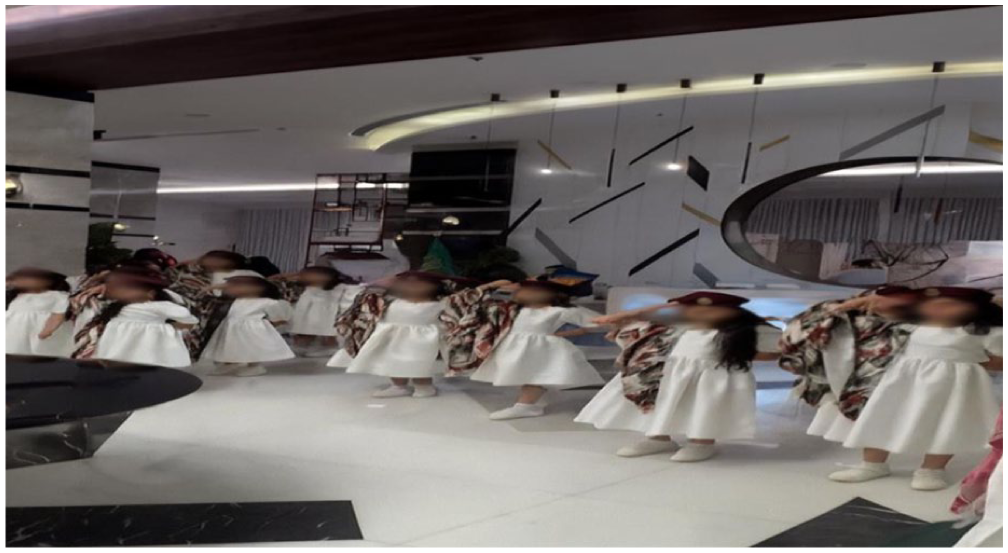
فرحة البنات ما تتوصف الله يحفظ هالوطن
Integral to this sartorial expression is the green-and-white chromatic palette, which permeates the corpus as a visual refrain (Figures 2–6 and 8–14). Green—long associated with Islam due to its Qur’anic references to paradise and its historical adoption by the Prophet’s descendants—serves as a spiritual and civilizational anchor, linking national identity to religious heritage. White, symbolizing ritual purity and peace, has also been central in Islamic aesthetics and ceremonial attire. In the context of SNI, their recurrent presence in flags, garments, horses, and balloons signifies not only loyalty to the state, but a reactivation of deeply embedded religious and political heritage, especially since the green-and-white flag was institutionalized with the unification of the Kingdom in 1932. As such, this color scheme functions as a visual genealogy, inscribing collective memory through chromatic symbolism.

تذكرة للمستقبل

الليلة غير والنار تلون السما

العرضة الجيزانية غير
Ritualized gestures and bodily formations further animate heritage as lived performance. In Figure 11, young girls perform a synchronized salute—a civic gesture deeply embedded in school rituals and public commemorations, indexing disciplinary allegiance and moral socialization. In Figures 4, 5, 6, 8, and 14, the body becomes a site of ancestral choreography: boys ascend a weathered staircase (Figure 4), equestrians process through city streets bearing flags (Figures 5 and 6), and lines of men perform traditional ‘Arḍah and folk dances (Figures 8 and 14). These movements recall martial, celebratory, and religious rituals, practiced across generations, transforming gesture into a mnemonic modality—a way of remembering through rhythm, posture, and public participation.
Spatial anchoring and architectural memory also ground these visual performances in specific geocultural imaginaries. Figure 2 positions two children before Shubra Palace in Taif, an edifice tied to the Hijazi royal lineage and symbolic of early state formation and Ottoman-influenced architecture. Figure 4 foregrounds mountainous terrain—iconic of the southwestern tribal regions—signifying resilience, topographical belonging, and historical resistance. Figure 15, set in a modern hotel, evokes Najdi heritage through earth-toned textiles and symmetrical interior design, with the traditional majlis (seating arrangement) exemplifying how heritage can be rendered mobile and adaptive, finding space even within contemporary architectural forms. These backdrops are not ornamental—they are semiotic anchors, rooting commemorative acts in historically resonant space.

قعدة من ريحة الماضي
In several images (Figures 2, 8, and 10), real palm trees appear alongside children and families, evoking oasis life, agricultural sustenance, and the enduring symbolism of fertility and rootedness in Arab-Islamic and Bedouin traditions. In Figure 4, cacti—native to arid regions—function as ecological signifiers of resilience, self-sufficiency, and adaptation to harsh desert conditions, visually aligning with the ethos of survival embedded in Bedouin heritage. Figure 16 introduces a modern military element: an armored tank painted in desert camouflage, blending into the landscape while drawing upon the chromatic and topographic codes of the desert environment. Together, these features construct a geo-symbolic landscape, where vegetation, terrain, and military aesthetics converge to materialize a heritage of endurance, environmental attunement, and territorial belonging.

الدرع بلون الأرض
In tandem with dress and space, a range of ritual artifacts and cultural objects visually encode tradition. Figure 3 features a dallah (a traditional metal coffee pot), qahwa or gahwa (lightly roasted Arabic coffee often spiced with cardamom), and dates (tammr)—archetypal signs of Bedouin hospitality and tribal ethics of generosity. In Saudi culture, qahwa and tammr are commonly offered to guests as a gesture of welcome, while the dallah has come to symbolize not only the act of serving but also the broader values of honor, generosity, and communal identity. Figure 7 depicts ceremonial weaponry, with twin swords signaling tribal honor, defensive pride, and the warrior ethos of the early Kingdom. The emblem in Figure 12—the palm tree and crossed swords—operates as a condensed theology of sovereignty and sustenance, with the palm invoking agricultural fecundity and the swords recalling defensive independence. These objects are material semiotics: cultural memory rendered tangible through metal, fabric, and gesture.
Animal symbolism recurs as a potent expression of heritage. In Figures 5, 6, and 9, Arabian horses and falcons foreground mobility, loyalty, and survival, all deeply rooted in Bedouin and tribal life. The horse, central to pre-modern warfare and prestige, now becomes a moving archive of nobility, traversing cityscapes to assert the continuity of tribal valor. In Figure 9, the falcon—once a vital tool in desert hunting—becomes a living heirloom, recontextualized as a symbol of aristocratic discipline and ecological knowledge, with a child’s extended hand visualizing the intergenerational passage of such traditions.
Finally, images depicting communal presence and intergenerational gathering (Figures 3, 9, 10, 13) crystallize heritage as a social and affective formation. Families draped in flags, elders beside children, women and men in shared spaces—all signify heritage as a collective enactment, where cultural continuity is affirmed through embodied proximity, kinship, and synchronized participation. These images translate the abstract idea of the nation into a lived scene of relational belonging, in which tradition is felt, held, and witnessed together.
In sum, the multimodal features explored here—dress, color, gesture, space, artifact, animality, and community—together construct a dense symbolic network in which heritage is not archived but performed. Through the MHCD model, each image is understood not as representation but as hermeneutic event—a vernacular articulation of belonging that fuses past with present, tradition with embodiment, and memory with national pride. Heritage, in these visual texts, is not what is behind the viewer—it is what moves through them.
Gendered Kinship and Relational Identity
Representations of gendered kinship appear in four of the analyzed visuals, highlighting how national belonging is constructed through visible relations of care, proximity, and shared participation. The visual construction of SNI across the selected corpus is articulated through the spatial and symbolic alignment of both male and female figures within intergenerational and gendered kinship formations. Rather than presenting gender as a set of discrete identities, the images foreground a relational model in which national belonging is constituted through co-presence, role differentiation, and mutual visibility across genders. In Figure 11, a group of young girls perform in synchronized formation, visually encoding feminine cohesion through affective mirroring and disciplined proximity. This all-female configuration constructs kinship as an intra-gendered relational system, suggesting that SNI is internalized through collective socialization among girls as future cultural participants. In contrast, Figure 2 stages a gendered dyad: a boy and a girl appear side by side in equal prominence, signaling that national identity is co-authored through complementary gendered roles. Neither figure dominates; rather, their spatial pairing communicates differentiated belonging within a unified national frame.
This principle is expanded in Figures 9 and 10, which depict men, women, boys, and girls occupying shared commemorative spaces. These configurations do not isolate genders but integrate them into horizontally aligned, interdependent groupings—publicly performing the familial logic upon which SNI rests. Adult males and females appear in visible proximity, often accompanied by children of both sexes, thereby rendering gendered relational identity as the foundational structure through which the nation is socially imagined. Across all four figures, identity is not a solitary possession but a socially co-produced presence, choreographed through intergenerational proximity and gendered balance. Within the MHCD framework, these images demonstrate that SNI is enacted through gendered kinship not as a metaphor, but as a lived configuration—where to belong is to appear within culturally legible gendered relationships that affirm the social architecture of the nation.
Faith and Moral Vision
The theme of faith and moral vision emerges across all figures in the visual corpus, not through overt religious instruction but through a constellation of culturally embedded signs that collectively inscribe SNI within an Islamic moral horizon. In every image, this vision is expressed through consistent visual codes that ground national identity in religiously inflected ethical values. Most salient is the recurring code of reserved and modest dress, observable across all figures, where male and female participants appear in fully covered forms, reflecting a culturally sanctioned ideal of bodily decorum. This sartorial discipline does not merely comply with custom but symbolically asserts a public ethic rooted in religious modesty and moral self-regulation. Similarly, the green-and-white color scheme, present in virtually all images—whether in flags, decorations, or spatial framing—visually anchors the state within a Qur’anic semiotic register: green connoting paradise, renewal, and righteousness, and white symbolizing purity and sincerity. The Saudi flag, appearing in many of the figures, prominently bears the Shahāda (Islamic declaration of faith), projecting divine legitimacy as central to national identity. The crossed swords, also visible in various images either as part of the flag, emblems, or ceremonial accessories, function as metonymic markers of justice, strength, and the moral imperative to defend truth. Across the corpus, these signs do not operate in isolation; rather, they collectively produce a coherent visual discourse in which SNI is imagined as ethically bound to its Islamic foundations. Within the MHCD model, this interplay of visual elements constructs the nation not merely as a political entity, but as a moral project grounded in divine alignment, ethical restraint, and spiritually authorized public life.
Unity and National Power
Depictions of unity and collective strength appear in three of the analyzed visuals, each translating national power into choreographed movement and spatial alignment. In Figure 5, national unity is rendered through the disciplined alignment of riders moving in coordinated formation, their collective motion embodying cohesion and forward direction. Power is inscribed in the structured configuration of bodies and symbols, where the repetition of color, rhythm, and movement conveys the state’s capacity to marshal order and project sovereign presence through public ritual. In Figure 16, unity emerges from the convergence of military and civilian elements: as the armored vehicle advances, its earth-toned surface visually echoing the surrounding landscape, citizens lining the road mirror its trajectory and affirm its significance. Here, power is not static but mobilized—asserted through technological force and reinforced by visible civic assent. In Figure 10, power takes the form of institutional precision, expressed through the marching soldiers whose uniformity signals discipline and national readiness. Unity is established through spatial coherence, as the soldiers’ movement unfolds in visual parallel with the observing public, producing a shared orientation toward the same civic ideal. Across these images, national power is articulated through structured movement and controlled visibility, while unity is enacted through alignment, continuity, and the mutual recognition of state presence and public loyalty.
Youth and Futurity
Depictions of young participants and forward-oriented symbolism appear in 10 of the 15 multimodal texts, highlighting the prominence of generational continuity within the corpus. Across the visual corpus, the theme of youth and futurity is not rendered as abstract aspiration or latent potential, but as an embodied, visible, and materially situated reality. Within the MHCD framework, these images do not merely reference the future—they visually stage it, grounding national futurity in the presence, placement, and symbolic alignment of youth. Through recurring features such as architectural modernity, directional motion, engineered infrastructure, and civic symbolism, youth are positioned as central agents in a national narrative of development, ambition, and transformation.
A dominant modality through which futurity is articulated in the visual corpus is architectural and infrastructural modernity, rendered through both the embodied presence of youth and symbolic spatial projection. Figures 2, 3, 11 depict children situated within or adjacent to high-functioning, aesthetically refined environments that visually position them within the nation’s aspirational horizon. In Figure 11, young girls are poised within a marble-clad hotel interior, their placement conveying composure and spatial entitlement. Figure 2 captures children at the threshold between Shubra Palace—a symbol of historical rootedness—and a row of modern cars, visually occupying the interstice between inherited legacy and technological emergence. In Figure 3, boys are immersed in a technologically advanced airport terminal, surrounded by polished infrastructure and streamlined design. These environments are not passive settings but curated expressions of civic futurity in which the youth are already implicated.
Even in the absence of human figures, as in Figure 15, a modern hotel interior—characterized by chromatic restraint, geometric equilibrium, and meticulously orchestrated design—functions as a stylized projection of futurity, where Najdi heritage is recontextualized within a contemporary aesthetic. Figure 13 builds on this spatial imaginary by capturing a vertical spectacle: fireworks erupting above a crowd encircled by parked modern vehicles, visually constructing an axis of aspiration that moves from grounded civic infrastructure to illuminated national celebration. Finally, Figure 9 depicts children navigating a vast commercial mall, further reinforcing the image of youth as participants in spaces of consumer modernity and civic belonging. Across these varied scenes, the future is not merely anticipated—it is spatialized, inhabited, and symbolically choreographed through architectures of mobility, modernity, and national vision.
Complementing this spatial logic is the recurring motif of directed movement and bodily advancement. Figures 4 and 6 employ forward motion as a visual grammar of progression. In Figure 4, three boys ascend a rugged stone staircase, their upward movement forming a clear metaphor for advancement through national space. In Figure 6, horseback riders bearing the Saudi flag move through an illuminated urban landscape—an image that links heritage to urban futurity through youthful momentum. These visual dynamics render futurity as kinetic: not a static vision, but a lived trajectory enacted through posture, pace, and directional orientation.
A different register of futurity emerges through state-directed symbolic forms. Figure 12, which displays a symbolic ticket to Neom, literalizes the future as destination—an engineered promise within Saudi Arabia’s Vision 2030 framework. Vision 2030 also visually anchors Figure 8, where national performance is reframed through futurity-oriented signage, and Figure 14, in which a traditional dance is performed within a modern civic venue. Across these images, national transformation is not suggested; it is declared—rendered in symbols, stages, and planned urban imaginaries. Even when youth are not visually present, the symbolic infrastructure is calibrated for them: a future built to be entered, occupied, and expanded by the next generation.
Finally, civic alignment and public visibility situate youth within national rituals of belonging. In Figure 10, boys and girls stand among adults at a military parade, sharing visual space with uniformed soldiers and national emblems. Their co-presence affirms that youth are not spectators of national life but integrated participants within its ceremonial rhythms. The image renders futurity as a relational and public condition—youth visibly aligned with institutional structures and symbolic authority, already present in the visual choreography of the nation.
Taken together, these visual texts form a coherent discourse in which youth and futurity are neither abstract nor deferred. They are spatially embedded, symbolically coded, and materially supported. The future is not imagined from a distance—it is inhabited, structured, and rendered legible through the forms, spaces, and gestures that bind youth to the national project. Within the MHCD model, these images materialize Saudi futurity as a visible order: embodied in young figures, constructed through designed environments, and mobilized through the visual logic of national progression.
Verbal Analysis by Thematic Cluster
Responding to RQ2, this section analyzes the verbal components—titles and captions—using Shi-xu’s CAMPHC model to uncover how linguistic acts articulate heritage, gender, faith, unity, and futurity as discursive realizations of identity.
Heritage and Ancestral Continuity
Appearing in 7 of the 15 multimodal texts, the data reveal how language enacts cultural memory. The verbal expressions clustered under the theme of heritage and ancestral continuity demonstrate how SNI is not merely represented but actively performed through culturally situated discourse. Using Shi-xu’s CAMPHC model, the analysis reveals that the individually curated commemorative titles and captions serve as localized communicative acts embedded in historical consciousness, familial lineage, and ritualized memory. Heritage, in this context, is not a passive aesthetic but an agentive speech domain—one in which memory is enacted, belonging is claimed, and values are ritually reaffirmed.
In Figure 2, the caption invokes جدتي (“my grandmother”) to construct identity through maternal memory, positioning the speaker within a multigenerational lineage. Here, the Communicator is not neutral but culturally embedded—a familial narrator who claims authenticity through proximity to ancestral voice. The Act performed is commemorative: it reanimates intergenerational ties through a reference to traditional jewelry. The Purpose is to validate cultural continuity via embodied practices, while the History dimension emerges in the reference to inherited aesthetic forms that signify Hijazi memory. The Culture is embedded in the very invocation of dress and memory, aligning femininity, ancestry, and place.
In Figure 4, the declarative phrase هذي أرضنا وإحنا أهلها (“this is our land, and we belong to it”) enacts a sovereign linguistic claim over national space. The Act is one of territorial affirmation, in which the speaker aligns self and nation through the performative syntax of possession. The Communicator speaks on behalf of a collective “we,” positioning identity within the grammar of entitlement. The Purpose is to assert rootedness as an ethical and ontological condition. Additionally, the title الراية دايم مرفوعة (“The flag always raised”) signals discursive permanence through symbolic repetition, activating the Medium as a vehicle for timeless national reference. The Culture dimension here is tightly interwoven with spatial memory and patriotic symbolism.
Figure 5 reinforces discursive durability through its triadic title, الراية والخيل والخيالة (“The flag, the horse, and the riders”), where the parallel structure of national symbols compresses a dense semiotic field into verbal form. The caption’s use of عاداتنا اللي ما تتغير (“our traditions that never change”) reinforces the Act of preservation, whereby speech becomes a form of cultural conservation. The History dimension is embedded in the invocation of inherited ritual objects, and the Purpose is not only to affirm identity but to stabilize it across time. Notably, the invocation دام عزك يا وطن (“may your glory endure, oh homeland”) transforms the Medium into a cultural blessing—a ritual utterance that fuses national pride with devotional address.
In Figure 15, the title قعدة من ريحة الماضي (“A Setting with the Scent of the Past”) prefigures the speaker’s orientation toward heritage as a sensory and emotional experience. This title functions as a culturally grounded Medium that condenses affective memory into a familiar idiom, signaling an intimate, lived relationship with the past. The verbal reference to مجلس جدك (“your grandfather’s majlis”) anchors the speech act in the material semiotics of domestic lineage, transforming a contemporary setting into a genealogically resonant interior. Here, the Communicator is positioned as a culturally embedded narrator who invokes النقشات (“the patterns”) not merely as décor but as mnemonic signs of intergenerational presence. The Act is one of symbolic reterritorialization, whereby ancestral space is recovered and restored through verbal invocation. The Culture dimension is inscribed through the domestication of memory, in which traditional aesthetics serve not as visual artifacts but as discursive gateways to familial identity.
Figure 7 adds hermeneutic depth by staging heritage as temporal simultaneity. The juxtaposition ترجع بالزمن. . . بعزّ اليوم (“going back in time. . . in the pride of today”) produces a linguistic synthesis of past and present. The Act is reflexive: it invites recognition of history as both continuity and re-entry. The references to أصلنا (“our roots”) and اللي بدوا المسيرة (“those who began the journey”) directly activate the History dimension. The Purpose is moral reorientation, clarifying that تراثنا مو بس في الشكل (“our heritage isn’t just about appearance”)—but resides in values, remembrance, and cultural fidelity. The Medium here takes on a corrective function, repositioning heritage beyond superficial forms.
In Figure 8, the phrase التراث اللي تربّينا عليه (“the heritage we were raised on”) casts tradition as formative pedagogy. The Act performed here is testimonial: a declaration of cultural endurance carried forward through socialization. The Communicator voice is communal, signaling identity formed through collective historical instruction. The phrase باقي وما تغيّر (“still alive, unchanged”) extends the Purpose of the utterance to assert durability. In this caption, History is not just referenced—it is embodied and declared unbroken. The Culture is configured around ritual dance, masculine honor, and performative pride.
In Figure 9, the phrase أيام الطيبين (“the good old days”) becomes a cultural chronotope—condensing time, morality, and communal joy. The falcon, described as standing بكل هيبة (“with full dignity”), becomes a verbal emblem of tribal nobility. The Act is one of nostalgic invocation, intended to restore a symbolic order grounded in dignity and relational gathering. The Culture dimension emerges through the interweaving of affect (الفرحة), social harmony, and ceremonial language. The Communicator performs the role of witness to moral time, linking present pride with ancestral ethos.
Ultimately, the verbal expressions within this cluster disclose heritage as a living discourse—a site where memory, language, and moral vision converge to sustain identity across generations. Rather than functioning as static reflections of cultural tradition, these utterances enact a performative continuity that is affectively charged, linguistically anchored, and culturally intelligible.
Gender and Familial Belonging
In 4 of the 15 multimodal texts, the verbal data clustered under the theme of gendered kinship and relational identity foreground a discursive logic in which national belonging is realized through relational presence, affective intimacy, and ethical proximity. Rather than operating as a fixed binary, gender in these utterances emerges as a morally coded modality of social integration—one that binds the private grammar of family life to the public ethos of nationhood.
In Figure 11, the caption’s expression فرحة البنات ما تتوصف (“the girls’ joy can’t be described”) elevates female affect into a symbolic index of national pride. The speaker, operating as a Communicator within a culturally intimate register, aligns emotional visibility with patriotic virtue. The caption continues: أنا من هالوطن، وأنا فخره الجاي (“I’m from this nation, and I’m its future pride”), where the girls are discursively voiced as active national agents. Here, the Act is assertive and prospective, constructing femininity not as passive beauty but as a trajectory of national promise. The Purpose is pedagogical: to affirm girls as future carriers of national honor. The Culture dimension is richly expressed through the fusion of elegance (أناقتهم) and synchronicity (بكل انسجام), suggesting that gendered grace is harmonized with civic dignity.
Figure 2 offers a gender-paired portrayal in its caption, where a boy and girl are presented in reciprocal focus. The reference to الولد رافع علامة السلام (“the boy held up a peace sign”) and البنت لابسة فستان تراثي (“the girl wore a traditional dress”) configures gender not as hierarchical distinction but as coordinated representation. The Medium is balanced and symmetrical, assigning symbolic roles to both children within a unified frame. The Act is commemorative, grounded in the History dimension through the invocation of أساور ذهب مثل اللي كانت تلبسها جدتي (“gold bracelets like the ones my grandmother used to wear”). This intergenerational linkage performs a genealogical gesture, extending femininity across time while positioning both children as affective bearers of memory and tradition.
In Figure 9, the title الصقر حاضر.. والناس متجمّعة (“The falcon is here. . . and everyone’s gathered”) introduces a communal register. The caption emphasizes البنات والاولاد متجمّعين (“girls and boys are gathered together”), activating the Communicator’s voice as one of affective collectivism. The Act performed is one of togetherness, where gendered distinction is retained yet framed within mutual presence. The Purpose is to model civic celebration through spatial and emotional inclusivity. The phrase تحس إنك وسط يوم من أيام الطيبين (“it feels like one of the good old days”) invokes the History dimension, aligning the present with a morally charged past marked by simplicity, joy, and gender harmony. The Culture dimension is embedded in the description of هيبة (dignity) and فرحة (joy), where both emotions are shared across gendered experience.
Figure 10, while not explicitly gendered, contributes to this cluster through its invocation of collective embodiment. The title كلنا صف واحد (“We’re all one line”) and the phrase الناس واقفة وراهم (“the people stand behind them”) eliminate differentiation in favor of syntactic unity. The Medium here is grammatically flattened and inclusive, constructing a civic space where gender disappears into collective ritual. The Act performed is one of alignment—between civilians and soldiers, individuals and symbols—reinforcing the Purpose of national unity through undifferentiated presence. The line الكل واقف لله ويوم الوطن (“everyone stands—for God and for the nation”) binds the vertical orientation of bodily stance with moral intent, synthesizing the Culture and History dimensions within a theologically anchored discourse of pride.
Faith and Moral Vision
In 4 of the 15 multimodal texts, the verbal expressions associated with this cluster enact faith not as abstract ideology but as a culturally situated discourse of moral affirmation and spiritual invocation. These utterances reveal how Saudi citizen-authors linguistically choreograph divine alignment and patriotic devotion as mutually reinforcing. Faith is not described; it is discursively performed through individual lexical choices that function as culturally intelligible acts of supplication, praise, remembrance, and moral duty.
In Figure 5, the invocation دام عزك يا وطن (“May your glory endure, O homeland”) exemplifies a speech act of supplication in which the communicator appeals to divine will for the preservation of national strength. The use of دام (“may it endure”) draws directly from the register of religious blessing, transferring its force onto the secular signifier of الوطن (“the homeland”). The Act is thus not descriptive but ritualistic, while the Medium is a culturally embedded form of duʿāʾ. The Purpose is to frame national existence as morally contingent upon divine favor—a vision further anchored in cultural norms of public reverence.
Figure 7 deepens this moral logic through the verbal memory of ما نسينا أصلنا (“We have not forgotten our origins”) and اللي بدوا المسيرة (“those who began the journey”). These expressions function as commemorative acts that foreground the History dimension, constructing Saudi identity as a lineage of ethical inheritance. The word أصلنا (“our origins”) carries both genealogical and theological resonances, indexing purity, continuity, and rootedness in moral tradition. Here, the Communicator positions the nation as morally accountable to its past, while the Purpose is to legitimize present pride through ancestral fidelity. These expressions are also culturally anchored in the Arab-Islamic concept of silat al-raḥim (kinship preservation), which is both familial and ethical in nature.
In Figure 8, the caption كل حركة فيها هيبة وفخر (“Every movement carries dignity and pride”) elevates ritual performance into moral discourse. The word هيبة (“dignity” or “majestic presence”) is especially significant, as it invokes a culturally valorized trait associated with religious leaders, tribal elders, and righteous rulers. Its pairing with فخر (“pride”) constructs an evaluative Medium in which embodied acts become signs of moral status. The Act here is to moralize the national celebration through stylized cultural performance. The repetition of باقي وما تغيّر (“still alive, unchanged”) contributes to the History dimension, reinforcing a narrative of ethical permanence grounded in continuity and resistance to moral dilution.
Figure 10 presents the most explicit intertwining of faith and nationalism. The phrase الكل واقف لله ويوم الوطن (“Everyone stands—for God and for the nation”) linguistically aligns theological and civic allegiance through syntactic parallelism. The word لله (“for God”) constitutes a theocentric anchor for the Act of standing, which becomes both a spiritual and patriotic gesture. The Communicator, constructed as الكل (“everyone”), evokes collective moral unity, and the Purpose is to reframe the national day as a devotional occasion. The Medium here draws from the structure of Islamic khutbah discourse, where allegiance to God and leadership are pronounced in coordinated succession. In this way, the Culture dimension is saturated with Islamic ritual logic, while the act is one of bodily submission and discursive alignment.
Across these figures, individual words such as دام (“may it endure”), عز (“glory” or “honor”), أصلنا (“our origins”), هيبة (“dignity” or “aura of majesty”), فخر (“pride”), لله (“for God”), and المسيرة (“the journey”) are not decorative—they function as culturally preferred mediums through which national identity is authorized, remembered, and discursively consecrated. Each lexical item operates within a culturally intelligible repertoire of speech that draws on religious, genealogical, and moral registers. These expressions fulfill communicative purposes shaped by local histories and ethical expectations, constructing Saudi patriotism not as a neutral civic sentiment but as a faith-infused discourse of belonging and legitimacy. Within the MHCD model, and interpreted through the lens of Shi-xu’s CAMPHC framework, these utterances reveal a Saudi-specific discourse in which spiritual invocation, genealogical fidelity, and embodied dignity converge to perform the nation as ethically continuous, theologically sanctioned, and culturally intelligible.
Unity and National Power
The verbal texts in this cluster construct unity and national power as culturally legitimized forms of collective alignment and symbolic strength. The Communicator across all figures speaks in a plural voice, invoking a unified national subject. In Figure 5, the expressions الخيل عز (“the horse is pride/power”) and الراية والخيل والخيالة (“The flag, the horse, and the riders”) perform an Act of symbolic consolidation, aligning national emblems into a coherent tableau of honor and force. The Medium is triadic and rhythmic, culturally resonant in style, while the Purpose is to affirm strength as visible, continuous, and worthy of collective reverence. The phrase دام عزك يا وطن (“May your glory endure, O homeland”) reinforces this function through the Medium of patriotic invocation.
Figure 16 furthers this discourse through المدرعة. . . كأنها جزء من الأرض اللي تحميها (“The armored vehicle. . . like it’s part of the very land it protects”), where the Act is metaphorical embodiment. The armored machine is discursively fused with الأرض (“the land”), naturalizing power as internal, native, and protective. The History dimension is activated through the implied narrative of territorial defense, positioning strength as ethically grounded in place.
In Figure 6, unity is visualized linguistically through يشيلون الراية (“they carry the flag”) and كأنك تشوف عزّ الوطن قدامك (“It’s like you’re watching the pride of the nation before you”). The Act here is one of immediate affirmation—pride (عز) becomes visually present, carried and embodied. The Medium is declarative and visual, while the Purpose is to frame national strength as participatory and honorific. Culture is expressed in the elevation of public performance into a sign of national order.
Figure 10 delivers the clearest Act of alignment through the title كلنا صف واحد (“We’re all one line”) and the clause العسكر قدّام، والناس واقفة وراهم (“The soldiers march ahead, and the people stand behind them”). The Act performed is spatial and rhetorical alignment, constructing unity not through hierarchy but through synchronized roles. The Communicator invokes a civic collective that is cohesive in structure and movement. The word صف (“line”) serves as a medium of metaphorical flattening—citizens and soldiers are unified in symbolic stance. The Purpose is to represent civic order as mutual and morally equalized. The Culture and History dimensions are evident in the imagery of parade and positioning, invoking a legacy of discipline and cohesion.
Across these texts, lexical items such as عز (glory or national pride), الراية (the flag), يشيلون (they carry), صف (line or rank), الأرض (the land), and واقف (standing) function as culturally embedded mediums for expressing power and unity.
Youth and Futurity
The verbal construction of youth as carriers of national futurity is articulated through gender-specific references to boys and girls across seven captions. In Figure 11, the imagined utterance “أنا من هالوطن، وأنا فخره الجاي” (“I’m from this nation, and I’m its future pride”) positions girls as self-authoring Communicators of national identity. The Act is declarative and future-oriented; the Medium is the imagined speech of young girls within a celebratory setting; and the Purpose is to linguistically encode girlhood as a source of emerging national pride.
In Figure 2, the caption highlights the presence of both a boy and a girl, described respectively as “الولد رافع علامة السلام وهو مبتسم” (“the boy was smiling and holding up a peace sign”) and “البنت لابسة فستان تراثي فيه لمسات خضراء” (“the girl wore a traditional dress with green accents”). While the overall tone is reflective, the verbal inclusion of both genders as central figures positions them as the Medium through which youth are made visible in a heritage setting. Their mention as focal participants in the national scene constructs their presence as linguistically relevant to the generational movement from tradition toward future identity.
Figure 3 constructs boys as the emotional core of civic celebration, where the narrator exclaims “قلبي مليان فخر” (“my heart was full of pride”), directed at “الأطفال لابسين الثياب والغتر، رافعين الأعلام ومبتسمين” (“the children wearing thobes and ghutras, holding the flags and smiling”). Here, the Communicator is an adult national voice affirming youthful visibility; the Act is affective witnessing; and the Purpose is to make boys the symbolic center of national pride during public festivity.
In Figure 4, the caption states: “الأولاد لابسين لبس الوطن ورافعين الراية” (“the boys are dressed in national attire and holding up the flag”), aligning boyhood with performative expressions of allegiance. The Act is representational affiliation with the nation; the Medium is national dress; and the Purpose is to position boys as aspirational figures of disciplined national identity.
In Figures 5 and 6, the verbal texts encode futurity through references to young riders whose presence signifies forward-looking national pride. In Figure 5, the expressions “الخيالة الفرحة باينة بملامحهم” (“the joy is clear on the riders’ faces”) and “الخيل عز” (“the horse is pride”) linguistically construct the riders as youthful participants in a tradition that is not static, but enduring and vital. The Act here is the affirmation of pride through youthful engagement; the Medium is the riders themselves, named as joyful bearers of cultural value; and the Purpose is to suggest that national tradition remains alive through its renewal by youth. In Figure 6, the caption “الفرسان ماشيين على خيولهم ورافعين الراية، كأنك تشوف عزّ الوطن قدامك” (“the riders move along on their horses, raising the flag—it’s like you’re watching the pride of the nation before you”) verbally positions the riders as the visible manifestation of national advancement. The Act is linguistic projection of national pride into motion; the Medium is the image of youth in coordinated movement; and the Purpose is to explicitly affirm the future as already unfolding through disciplined, youthful performance.
Finally, in Figure 12, futurity is explicitly verbalized through: “نيوم مو بس مشروع، تحسها حلم قاعديننشوفه يصير قدّامنا. المستقبل هنا، بيدنا” (“Neom isn’t just a project—it feels like a dream we’re watching come to life. The future is here, in our hands”). The Communicator speaks from a generational “we”; the Act is visionary affirmation; the Medium is the symbolic ticket to Neom; and the Purpose is to construct youth as discursive agents of national transformation. The phrase “بيدنا” (“in our hands”) encapsulates a verbal ideology of empowerment, suggesting that the nation’s future is not only anticipated—but actively possessed by its boys and girls.
Multimodal Synthesis: Hermeneutic Integration of Image and Text
Addressing RQ3, this final phase performs the hermeneutic synthesis central to the MHCD model, uniting visual and verbal modes through Gadamerian and Ricoeurian interpretation to demonstrate how meaning emerges dialogically between seeing and saying.
Meaning across the corpus is not produced by image or verbal component in isolation, but by the interpretive act that holds both together. The visual presents compositional structure—gesture, alignment, clothing, spatial relations—while the verbal, through title and caption, provides temporal, affective, or ideological anchoring. Understanding arises through negotiation: the viewer must determine how the verbal reframes the visible, and how the image supports, extends, or challenges what is named. Using the Cultural Symbolism Matrix, symbolic elements across visual and verbal modes were mapped and aligned, enabling their dialogic integration within a hermeneutic frame.
This relational structure is consistent, though realized through different strategies. In one example, boys appear beneath national flags. The visual offers composure and patriotic context, but no specific claim. The accompanying title identifies them as “dressed in the attire of the homeland,” transforming their clothing into a verbalized sign of belonging. In another instance, riders advance on horseback, composed and forward-facing. The verbal component—“you see the pride of the nation before you”—assigns symbolic value to movement. In both cases, meaning does not reside in either mode; it emerges through alignment. The verbal repositions the visual; the visual limits or intensifies the verbal’s force. Interpretation lies in how the viewer resolves the intermodal claim.
Figure 12 articulates the corpus’s hermeneutic structure with formal clarity. Visually, the image presents a hand holding a ticket, composed without symbolic density or contextual anchoring. The gesture remains semantically indeterminate. Its redefinition occurs through the verbal assertion—“المستقبل هنا، بيدنا” (“The future is here, in our hands”)—which reframes the object as a signifier of collective futurity and the hand as a site of national agency. This transformation, however, is not intrinsic to either mode. It is contingent on their alignment and the viewer’s interpretive resolution of the tension between visual minimalism and verbal insistence. The verbal posits authorship; the image withholds confirmation. Meaning is realized only through the synthesis of these modalities. When coherence is achieved, the multimodal act performs national possession. Where it falters, the claim remains suspended. In both cases, the figure exemplifies the corpus’s central logic: identity is not depicted, but constituted through the viewer’s integration of verbal claim and visual form.
Conclusion
This study applied the Multimodal Hermeneutic-Cultural Discourse (MHCD) Model—an original integrative framework that draws on Cultural Discourse Studies (CuDS), visual grammar, and philosophical hermeneutics—to analyze how Saudi National Identity (SNI) is constructed through citizen-authored multimodal texts. By examining the interrelation between visual composition and verbal discourse, the MHCD Model foregrounds national identity not as a fixed representation but as a culturally saturated, interpretively emergent discourse. Grounded in this model, the study addressed three guiding research questions, each corresponding to a distinct semiotic dimension.
In response to RQ1, SNI is visually enacted through layered semiotic features that render cultural memory as embodied tradition. Heritage is expressed through attire, color, gesture, space, and artefacts, transforming the visible body and environment into living archives of faith, lineage, and territorial belonging. These visual performances turn national celebration into an aesthetic pedagogy—an everyday semiotic practice through which citizens reaffirm identity as shared memory.
Turning to RQ2, the accompanying verbal texts articulate SNI through culturally embedded acts of remembrance, allegiance, and futurity. Captions and titles perform national belonging linguistically: they commemorate ancestors, encode gendered participation, invoke divine legitimacy, and proclaim generational continuity. The verbal mode thus transforms celebration into discourse, performing the nation as a moral narrative rooted in genealogy, faith, and collective aspiration.
Addressing RQ3, identity emerges through hermeneutic synthesis: meaning is not contained in image or text alone, but in their dialogic relation. The MHCD Model reveals that coherence arises through interpretive negotiation, where viewers integrate visual forms and verbal utterances into culturally intelligible wholes. This hermeneutic process underscores that citizen-authored texts are not mere depictions of pride but interpretive events in which the nation is continually reimagined.
Beyond describing representational patterns, these findings are significant for three reasons. First, they reconceptualize national identity as a vernacular hermeneutic practice, showing how ordinary citizens participate in the interpretive reproduction of culture. Second, they demonstrate the analytic power of the MHCD Model in uniting semiotic, cultural, and philosophical perspectives, offering a transferable framework for multimodal studies in other national and intercultural contexts. Third, the study contributes to broader debates in cultural discourse analysis by evidencing how identity formation in the digital age depends on dialogic co-creation between individuals and collectives, past and future, word and image.
Taken together, the study demonstrates that SNI is not merely captured but culturally composed—performed through an intricate choreography of image and word, heritage and futurity, ritual and narration. In methodological terms, the MHCD Model provides a new lens for understanding how meaning is not simply represented but hermeneutically enacted through multimodal citizenship. While the analysis is based on a limited corpus of 15 artefacts, its purpose is interpretive rather than statistical. The study privileges depth of cultural insight over breadth of generalization, positioning the MHCD Model as a transferable theoretical framework rather than a predictive one.
Looking ahead, the proposed MHCD Model offers scope for further research beyond the present context. Future studies could apply it to cross-national or digital multimodal data to explore how citizen-authored expressions of identity operate across different cultures, languages, and media environments. Longitudinal applications may also trace shifts in symbolic participation across successive national celebrations, thereby extending the model’s empirical reach and consolidating its relevance to multimodal and cultural discourse inquiry.
Footnotes
Acknowledgements
The authors would like to acknowledge Deanship of Graduate Studies and Scientific Research, Taif University for funding this work. Their commitment to advancing academic inquiry has been instrumental in enabling this study.

Ethical Considerations
This study adheres to the ethical principles outlined in the Declaration of Helsinki and its subsequent amendments and was conducted in full accordance with the ethical standards and research policies of Taif University (Saudi Arabia) and Tanta University (Egypt). The research involved ordinary citizens who voluntarily and verbally consented to share their multimodal texts (images, titles, and captions) for academic analysis. All ethical principles—including informed consent, transparency, respect, and scholarly integrity—were rigorously upheld throughout the research process.
Consent to Participate
Verbal informed consent was obtained from all contributors, including those who created the visual content, appeared in the photographs, or authored the associated titles and captions. In cases where children were depicted, consent was also obtained from their legal guardians. All participants were fully informed of the academic purpose of the study, assured of anonymity, and guaranteed that their contributions would be used respectfully and non-exploitatively within a scholarly framework. Participation was entirely voluntary. Verbal consent was deemed culturally appropriate and ethically sufficient under institutional guidelines, as participants were fully briefed, not part of a vulnerable group, and not exposed to risk.
Consent for Publication
Informed consent for publication was obtained from all participants who voluntarily contributed their multimodal texts (images, titles, and captions) for academic analysis. Each contributor was fully informed about the study’s purpose, scope, and publication process, and consented to the inclusion of their materials in scholarly dissemination.
Author Contributions
The authors contributed equally to all major aspects of this study, ensuring a collaborative approach at every stage of the research process. The authors have approved the final version of the manuscript and are accountable for all aspects of the work, upholding the integrity of the research by ensuring that all questions related to accuracy or integrity are appropriately addressed. Their equal contribution reflects a shared commitment to the quality and ethical standards of this research.
Funding
The authors disclosed receipt of the following financial support for the research, authorship, and/or publication of this article: This work was supported by Taif University and the Deanship of Graduate Studies and Scientific Research at Taif University.
Declaration of Conflicting Interests
The authors declared no potential conflicts of interest with respect to the research, authorship, and/or publication of this article.
Data Availability Statement
All data analyzed in this study—including the images, titles, and captions—are included within the article. The data were contributed with informed consent and have been fully anonymized to protect participant privacy. No personally identifying information has been disclosed.
Permission to Reproduce Material from Other Sources
In accordance with the principles of fair use, the copyrighted material included in our article is used solely for the purposes of criticism, review, or scholarly analysis. The excerpts quoted are limited in scope, are not substantial, and are necessary to support the critical arguments presented in the research. As such, explicit permission to reproduce these excerpts is not required under the fair use/fair dealing provisions.