




Abstract
Based on the data of prefecture-level cities in China from 2012 to 2020, this paper discusses the impact of Sino-US trade frictions on foreign direct investment (FDI) divestment in China. We find that Sino-US trade frictions will significantly reduce the scale of foreign direct investment, and slow down the growth rate. Our conclusion is still robust after the exclusion of endogenous and robust tests. Furthermore, we reveal that the learning, division of labor, and sharing mechanism generated by virtual agglomeration in the urban supply network is an important way for Sino-US trade friction to impact FDI in China. While improving the level of urban division of labor and market sharing, Sino-US trade friction has a negative impact on the exchange and learning between cities in the supply network node. We also observe that virtual agglomeration promotes the community interaction of FDI between node cities, and the geographical spatial distance in the dimension of urban agglomeration still plays an important role in economic activities.
Keywords
Introduction
Foreign direct investment (FDI) has become a vital force in driving the transformation of China’s scientific and technological achievements into real productive forces. However, the escalating trend of trade protectionism, exacerbated by the COVID-19 pandemic, may perpetuate the issue of foreign capital withdrawal in China (Boylan et al., 2021). Particularly in the current era, production networks are widely distributed. This makes the risks of trade protectionism more far-reaching and faster-moving (Yeung & Coe, 2015). Meanwhile, urban supply networks, built on supply chains, have reduced cities’ reliance on geographical proximity. Instead, these networks create a virtual agglomeration in intangible network spaces, fostering inter-city connections (Shen & Zhang, 2024). The benefits of agglomeration, such as improved information transparency, deeper industrial division of labor, and shared resource elements (Lin et al., 2011), enhance the business environment for foreign investment. Within the urban supply network, the overlaying effects of geographical spatial agglomeration and network virtual agglomeration underpin the community interaction effect of FDI among cities. Therefore, exploring the mechanism of trade protectionism on FDI from the perspective of urban supply networks, as well as the impact of virtual agglomeration within urban supply networks on the community interaction of FDI within urban clusters have important theoretical and practical significance.
Recent Chinese policy has underscored the need to strengthen endogenous economic forces and improve the resilience of supply chains. The 2022 plan on modern logistics, issued by the State Council, called for enhanced coordination among logistics hubs and accelerated networking. The 2023 central economic work conference emphasized the development of new drivers of foreign trade and investment, while the 2024 government work report further stressed leveraging strengths, addressing weaknesses, and improving competitiveness of industrial and supply chains, alongside renewed efforts to attract foreign investment. In this context, how does trade protectionism impact China’s inward integration of foreign capital? What role does the urban supply network play in the transmission of this shock? Will the withdrawal of foreign capital in one city within the network trigger a contagion effect? Answering these questions is pertinent to the steady advancement of measures to enhance the economy’s endogenous forces and the effective linkage between domestic and international markets.
The interconnection network among economic agents is an important feature in the context of information technology progress. This means that individuals could make relevant economic decisions according to their own network characteristics based on embedding the interconnection network. However, classical geographical agglomeration theory highlights two key limitations when studying economic interconnections between cities. Geographical distance between economic entities inversely correlates with their connectivity. Furthermore, the diminishing returns of agglomeration may partially counteract its advantages. Against this background, virtual agglomeration in network space offers significant advantages. It overcomes geographical distance limitations and reduces the negative externalities of economic activities. Currently, with the prevalence of trade protectionism, the resources and capabilities of a single city are insufficient to resist the withdrawal of foreign capital caused by the reflow of industries to developed countries. However, direct cooperation exists between supply chain entities, through resource integration and sharing, enables a shift from individual value capture to co-creation of supply chain value (Vial, 2021). Specifically, this article argues that urban supply networks can reduce the impact of geographical distance on economic connections, allowing cities to form virtual agglomerations in network space. Further, through learning, matching, and sharing mechanisms generated by network externalities, cities can achieve complementary investment location advantages and thus enhance the overall attractiveness of cities to foreign investment. Existing research on network externalities faces two major issues. First, there is a lack of substantial points of interest connection within urban networks, making network characteristics and effects difficult to measure. Second, under the influence of geographical distance, cities farther apart are less likely to coordinate economic decisions, preventing urban networks from fully realizing their potential.
This article explores the impact of trade protectionism, as reflected in the Sino-US trade dispute, on FDI withdrawal from China, with the mechanism from the dimension of the city supply network. In doing so, the marginal contributions of this article are primarily reflected in the following aspects. First, from the perspective of indicator calculation, inter-city commercial, and trade exchanges are regarded as points of interconnected interests within city networks. The in-closeness centrality and weighted in-degree centrality of the city network are used to represent the effects of inter-city associative learning and market sharing, while the degree of specialization reflects the division of labor matching effects among cities. Second, in terms of research methodology, this study employs social network analysis to characterize features of the urban supply chain network, thereby making the relational attributes between cities within the network concrete. Lastly, from a theoretical standpoint, this article integrates the learning, matching, and sharing mechanisms produced by agglomeration into the analysis of urban supply networks. It examines the transmission mechanism through which trade protectionism affects the withdrawal of FDI, analyzing from the perspective of network agglomeration.
Theory and Hypotheses
Before developing the theoretical framework, it is useful to provide some descriptive evidence on the relationship between U.S. trade protectionism and China’s inward FDI. Figure 1 plots the city-level averages of “trade shocks induced by the Sino–US trade friction” and “FDI performance” over the period 2012 to 2020. The figure shows a clear inverse correlation between the escalation of trade frictions and FDI inflows, particularly after 2018 when trade tensions intensified. This descriptive pattern suggests that U.S. trade protectionism may play a role in reducing FDI inflows into China. However, whether this correlation reflects a causal effect, and through what mechanisms such an effect might be transmitted remains an open question. The following subsections develop the theoretical arguments and hypotheses.

Trends of trade protectionism shocks and FDI performance in Chinese cities, 2012 to 2020.
Trade Protectionism Shocks and FDI Divestment in Host Countries
As an important production element with high liquidity, capital allocation has always been a topic of great interest. Classical international trade theories interpreted the factors influencing international capital flows from perspectives such as monopolistic advantages, product life cycles, and marginal industrial expansion. Based on these, Dunning’s (1977) eclectic theory of international production further identified ownership advantages, internalization advantages, and locational advantages as the fundamental factors affecting FDI. With the rise of new economic geography, economic geographic factors such as geographical distance, trade costs, and industrial agglomeration have gained scholars’ attention (Fujita et al., 2001).
The driving force behind the location selection of foreign enterprises stems from the pursuit of maximizing capital returns. The factors influencing their choice of location can be summarized into three main aspects: factors of production, market conditions, and institutional environment. The cost of utilizing labor and capital factors directly impacts the profitability of economic entities. An increase in wages and financing constraints within a country or region, leading to higher costs of factor utilization, will diminish its attractiveness to external capital (Blanc-Brude et al., 2014). Meanwhile, a larger market size facilitates foreign investors in leveraging economies of scale, thereby enhancing resource utilization efficiency. The corresponding improvement in market infrastructure can reduce private production costs. The increase in output efficiency and the reduction in production costs will collectively boost the return on foreign investment (Sugiharti et al., 2022). When enterprises engage in cross-border investments, it is essential for them to acquire information about the operational environment of the target destination to mitigate investment risks and uncertainties. Consequently, the host country’s investment in emerging information technology infrastructure plays a pivotal role in attracting foreign capital (Liu & Wang, 2024). Furthermore, in the context where optimizing the business environment has become a new advantage in competition for investment, the quality of the business environment is a significant factor influencing FDI motivations, and the institutional environment will have differential impacts on the investment decisions of foreign investors with different investment objectives. The agglomeration effect enhances the information perception, division of labor, and resource acquisition capabilities of economic entities, thereby granting them a competitive advantage in attracting capital. The trade protectionist measures undertaken by the US have disrupted the supply networks of Chinese cities, altering the spatial organization of production among them. This has also impacted the learning, matching, and sharing mechanisms that different cities have developed based on domestic supply networks, thereby significantly influencing their ability to attract foreign investment. As a result, the attractiveness of host cities to foreign investors is likely to decline.
Therefore, this article proposes hypothesis 1:
The Role of Urban Supply Networks
In terms of learning mechanisms, the recent U.S. trade protection measures primarily target Chinese manufacturing enterprises. Stronger firms are focusing on enhancing their innovation capabilities while restricting the spillover of their proprietary knowledge and technologies, thereby maintaining their competitive edge in innovation and increasing their long-term returns (Cappelli et al., 2023). In contrast, weaker enterprises may be eliminated from the market or need to reduce innovation activities and hold more liquid cash assets to cope with market uncertainties (Roper & Turner, 2020). The weakening of learning mechanisms among market entities will lead to a decline in the interconnectedness between cities. This, in turn, will further hinder the ability of different cities to perceive and learn from tacit knowledge and external trade policies, thereby diminishing the attractiveness of cities to foreign direct investment.
In terms of the matching mechanism, to mitigate the external market risks arising from U.S. trade protectionism, domestic enterprises have leveraged the supply network as a virtual platform. This enables the distribution of tasks among network nodes and promotes vertical specialization within the production chain, allowing each production entity to focus on its specific segment of the manufacturing process (Gereffi, 2018). The clusters formed within the supply network furnish the relevant entities with essential infrastructure, labor, and intermediate goods necessary for production (Sturgeon, 2003). By optimizing production processes, these clusters enhance export competitiveness and mitigate risks associated with external markets, thereby attracting an influx of foreign investment.
In terms of the sharing mechanism, in a supply network structured around the core of supply and marketing relationships, the distribution of goods in nodal cities is not confined to local markets. The trade protectionist measures adopted by the US will disrupt the export channels of Chinese cities, making it challenging for these nodal cities within the supply network to reconstruct their sales pathways solely through their own resources and capabilities. At this juncture, various cities are inclined to leverage the shared supply and distribution network, integrating and sharing trade information and sales channels across different urban areas. This approach aims to reduce trade costs and expand market scale (Jing et al., 2023). The sharing of market information among nodal cities within urban supply network clusters can, to a certain extent, mitigate inventory risks caused by external market shocks, thereby enhancing the attractiveness for foreign direct investment. Therefore, this paper proposes the following hypotheses:
Spatial Allocation of FDI Within City Clusters Under the Context of Supply Network Agglomeration
Social network connections form the foundation for peer effects among economic entities. The greater the number of economic entities interconnected within a social network, the more influential the network becomes. This enhanced connectivity strengthens the ability of network participants to access information, thereby improving their capacity to utilize data from other entities within the same network to optimize economic decision-making. Information, as a critical resource, plays a vital role in foreign investment decisions in China. However, with numerous cities and significant disparities in economic development across the country, the issue of information asymmetry is pronounced, which substantially limits the willingness of foreign investors to invest in China.
Based on agglomeration theory, the learning, matching, and sharing mechanisms within urban supply networks will generate economic linkages and transmissions among the nodal entities of the network. This facilitates various forms of collaboration between economic agents located in different spatial contexts. Firstly, the learning mechanisms play a crucial role in enabling economic agents to make informed decisions under conditions of risk. In the face of information asymmetry in the host country’s investment environment, foreign investors are incentivized to leverage supply networks to facilitate the transfer of investment information across different cities, thereby overcoming information barriers. Secondly, vertical friction within the supply chain will increase decision-making costs for relevant entities (Li et al., 2009). However, by leveraging the matching mechanisms of urban supply networks to facilitate production division between upstream and downstream enterprises, the interconnectedness among cities will be strengthened. Finally, the supply network provides node cities with supply chain resources, enabling the sharing of these resources to foster collaborative decision-making among foreign investment entities.
Digital transformation will expand the geographical distribution of economic entities (Li et al., 2023), forming network clusters that transcend geographical boundaries (Li & Bathelt, 2018), thereby further highlighting the role of network externalities. The network externality is generated through the “learning mechanism” that facilitates the diffusion of knowledge and technology within the network, and the “matching mechanism” that efficiently connects collaborators within the network (Lin & Sun, 2022). Moreover, the sharing mechanism of resource elements formed through the “borrowing” of market scale and service functions among cities is also a significant pathway for the generation of network externalities (Zhao et al., 2022).
Urban supply networks formed based on supply chains can gather information on market scale, institutional environments, etc., from different cities. Through behaviors such as communication and negotiation during transactions, information about relevant enterprises is acquired (Cai & Szeidl, 2018). After foreign direct investment enters the urban supply network, the reduction in information acquisition costs will enhance its investment willingness. During the investment process, investors make decisions by referencing the effective information of peer investment entities and responding based on their existing decisions, thereby fostering interactions among entities within the community. In urban supply networks, nodal cities exhibit network externalities, and similar community interactions are also present within urban agglomerations. The virtual agglomeration stemming from the urban supply network, combined with the geographical agglomeration of urban clusters, generates a compounded effect of community interactions.
Methodology
Model Specification
Baseline Regression Model
This study explores the impact of Sino-US trade frictions on urban FDI in terms of both the scale of foreign investment and the growth rate of foreign investment. Following Mao et al. (2022), it establishes the baseline models as illustrated in Equation 1:

where, FDI it is the dependent variable, which takes two forms: lnfdiit is the actual amount of FDI utilized by city i in year t, and rate it is the growth rate of the actual amount of FDI utilized by city i in year t; TFit captures the impact of Sino-US trade frictions on city i in year t; Xit represents various control variables, which specifically include the gross regional product (lngdp), the year-end balance of loans from financial institutions (lnloan), the revenue from postal and telecommunication services (lnpos), the proportion of fiscal expenditure to gross regional product (gov), and the number of international internet users (lnnet), reflecting the economic development, financial development, and communication development levels of the city, as well as the government’s influence on the regional economy and the level of city information infrastructure; α0 and β0 are the intercept terms; α and β are the coefficients to be estimated; λ i represents city fixed effects; μ t denotes time fixed effects; ε it is the random error.
Spatial Effect Test
This article analyzes the spatial effect of the impact of U.S. trade protection on China’s manufacturing industry on China’s foreign divestment. First, we conducted Likelihood Ratio (LR) tests and Wald tests to examine whether the Spatial Durbin Model (SDM) could be reduced to a Spatial Lag Model (SLM) or a Spatial Error Model (SEM). The test results strongly rejected the null hypothesis, indicating that the SDM is a more appropriate specification. Second, this study is concerned not only with the local effects of independent variables (direct effects), but also, more importantly, with their spatial spillover effects on peripheral regions. The SDM is capable of capturing both the local effects of independent variables and the influence of neighboring regions’ independent variables on the local dependent variable (i.e., indirect effects), which aligns most closely with our research objectives. In contrast, commonly used spatial econometric models such as the Spatial Autoregressive Model (SAR) and the Spatial Error Model (SEM) do not allow for such a detailed decomposition of spillover effects. Therefore, through a combination of statistical testing and theoretical justification, we have demonstrated that the Spatial Durbin Model (SDM) is the optimal choice compared to other alternative models. The SDM as shown in Equation 2:

Where Wij is the spatial weight matrix, this article uses the spatial adjacency matrix (W1) and geographical distance matrix (W2), and the remaining variables are consistent with the benchmark regression model.
Data and Variables
This article discusses the transmission mechanism through which trade policy uncertainty affects FDI from the perspective of urban supply networks. To this end, it matches supply chain data from the CSMAR database to the city level, thus forming urban supply network data, and further analyzes the transmission mechanism. In terms of the source of urban data, taking into account the availability of data and its compatibility with urban supply networks, this paper selects data from 214 prefecture-level cities in China for the years 2012 to 2020 as the initial sample. The variables chosen for this study primarily derive from the China City Statistical Yearbook, complemented by data from the Statistical Bulletin of National Economic and Social Development of cities. The remaining few missing data points are filled using interpolation methods.
For the source of supply network data, this article selects the supply chain data segment from the CSMAR database, choosing companies related to the supply chain database from 2012 to 2020 as research samples, and processes the data as follows: (1) Exclude samples of enterprises having supply and sales relationships within the same city; (2) Exclude samples of enterprises located in municipalities directly under the central government; (3) Exclude samples with missing values or outliers. On this basis, trade data from different enterprises are matched to the city level, thus forming urban supply network data.
Dependent Variables
The dependent variable (fdi) represents the actual amount of foreign capital used in the year, reflecting the scale of urban FDI. Given that this data is measured in tens of thousands of U.S. dollars, this article converts it into billions of Chinese Yuan (RMB) based on the exchange rate of the respective year, and performs deflation adjustments. The growth rate of FDI, rate, is calculated based on the deflation-adjusted data.
Independent Variable
The core explanatory variable is trade protectionism shocks (TF), which is constructed from the interaction term between a dummy variable for Sino-US trade frictions and the proportion of manufacturing employment in a city’s workforce, reflecting the degree to which the city is affected by Sino-US trade frictions. According to Ju et al. (2024), the identification of the effects of Sino-US trade frictions on Chinese industries reveals that during this large-scale trade conflict, the US specifically targeted Chinese manufacturing with additional tariffs, affecting a wide range of manufacturing subsectors. Therefore, for Chinese cities, the larger the proportion of manufacturing in the economic structure, the more severe the negative impact of the additional tariffs imposed by the US.
Control Variables
The control variables specifically include the gross regional product (lngdp), the year-end balance of loans from financial institutions (lnloan), the revenue from postal and telecommunication services (lnpos), the proportion of fiscal expenditure to gross regional product (gov), and the number of international internet users (lnnet). These variables, respectively, reflect the level of economic development of the city, the development of the financial sector, the development of the telecommunications industry, as well as the influence of government on the regional economy and the level of the city’s information infrastructure.
We also construct several indicators related to learning (Learn), division of labor (Division), and sharing (Share) to capture possible mechanisms, which will be analyzed in section “Mechanism Analysis: The Role of Urban Supply Networks.” The descriptive statistical information on the main variables utilized in our analysis is presented in Table 1.
Descriptive Statistics.

Empirical Results
Baseline Results
The baseline regression of this article examines the impact of Sino-US trade frictions on urban FDI from the perspectives of scale and growth rate, with the results presented in Table 2. Columns (1) and (3) of Table 2 indicate that Sino-US trade frictions (TF) have a negative effect on both the scale of FDI (fdi) and its growth rate (rate). Upon incorporating control variables in columns (2) and (4), the results demonstrate that the impact of Sino-US trade frictions on the scale and growth rate of China’s FDI is significantly negative at the 10% level. This suggests that the trade protection measures taken by the US against the Chinese manufacturing industry have led to the withdrawal of FDI from China and will slow down the growth rate of FDI, hindering China’s efforts to enhance the utilization of foreign capital and obstructing China’s channels for capital liberalization.
Sino-US Trade Frictions and FDI.
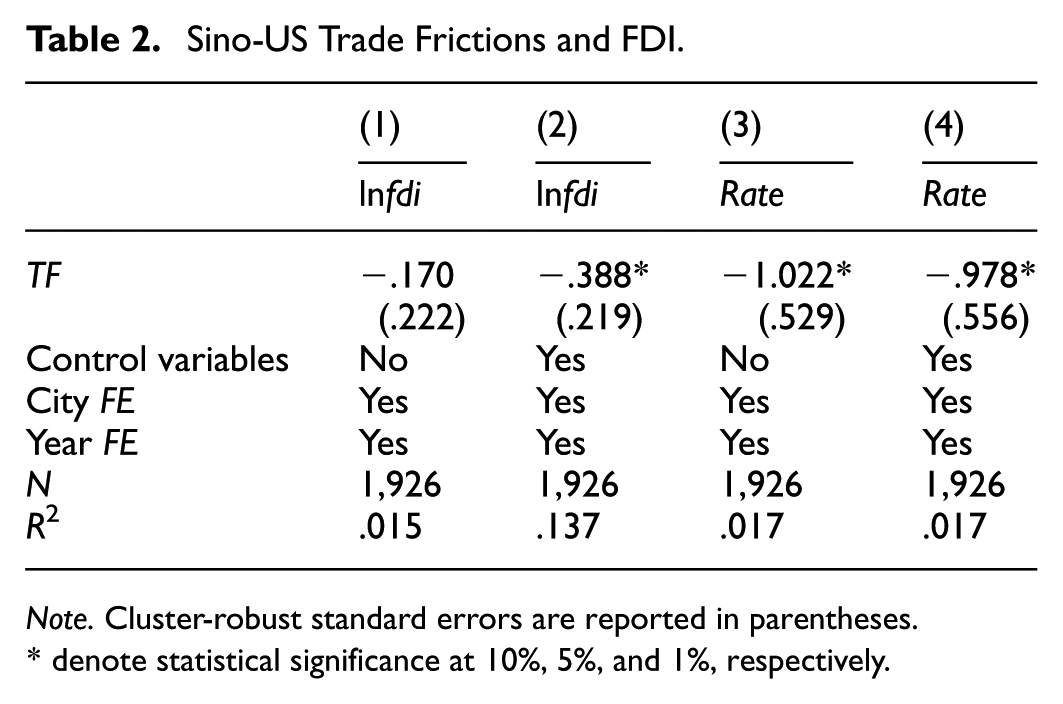
Note. Cluster-robust standard errors are reported in parentheses.
denote statistical significance at 10%, 5%, and 1%, respectively.
Robustness Tests
Endogenous Elimination
The adverse impacts on the development of urban manufacturing industries can negatively affect local foreign direct investment (FDI). Simultaneously, the withdrawal of FDI from a city may impose constraints on the growth of its manufacturing sector. To mitigate the interference of reverse causality between these two factors on the research findings, it is essential to address and control for such potential biases in the analysis. This article uses urban river density (River) as an instrumental variable. Considering the time-invariance of urban river density, it further incorporates the lagged data of US trade policy uncertainty (LTFt − 1) to form their interaction term (River × LTFt − 1). The selection of instrumental variables must satisfy two principles: relevance and exclusivity. On the one hand, urban river density significantly influences the spatial distribution of regional manufacturing industries, thereby determining the extent to which a city is affected by trade protection shocks. This establishes a strong correlation between the two. Moreover, as a variable reflecting the natural geographical conditions of a city, river density does not directly affect foreign investment in the local area except through its impact on industrial layout, thus meeting the exclusivity requirement. On the other hand, the vast majority of China’s exports to the US consist of manufactured goods, creating a strong correlation between U.S. trade policy uncertainty and the extent of shocks experienced by China’s manufacturing sector. Additionally, this impact may exhibit a time lag. However, apart from influencing the development of China’s manufacturing industry, the lagged term of U.S. trade policy uncertainty cannot directly affect the current level of foreign direct investment in Chinese cities, thereby satisfying the exclusivity requirement. To further strengthen the instrumental variable, considering that before 2018, when the Trump administration imposed additional tariffs targeting the Chinese manufacturing sector, China’s manufacturing industry would not have been subject to such extensive trade shocks. Therefore, this paper includes a dummy variable for Sino-US trade frictions (DV), where the dummy variable takes the value of 1 for the year 2018 and onwards, and 0 otherwise, thus constructing the instrumental variable (River × LTFt − 1 × DV). Moreover, the Hausman specification test confirms the presence of endogeneity in the core explanatory variable, thereby justifying the use of the instrumental variable approach to obtain consistent estimators. The results are shown in Table 3.
Regression Results of the IV.
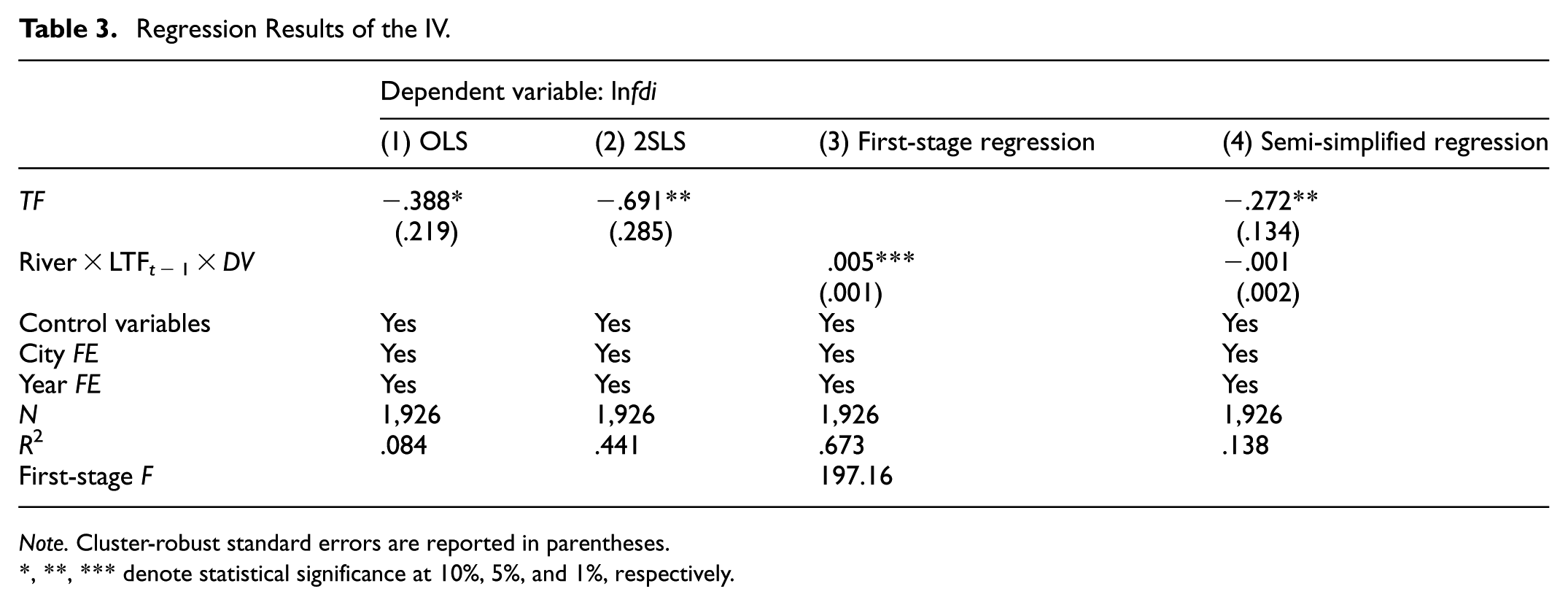
Note. Cluster-robust standard errors are reported in parentheses.
, **, *** denote statistical significance at 10%, 5%, and 1%, respectively.
The OLS and 2SLS estimation results presented in columns (1) and (2) of Table 3 validate the negative impact of Sino-US trade frictions on FDI. Additionally, column (3) of Table 3 reports the first-stage regression results of the 2SLS, where the coefficient of the instrumental variable River × LTFt − 1 × DV is positive at the 1% significance level. The first-stage F-statistic is 197.16, well above the critical value of 10, indicating no issue of weak instrumental variables. The positive coefficient of River × LTFt − 1 × DV implies that, given the city’s river density, greater uncertainty in U.S. trade policy will lead to a greater degree of current trade protection impact on China’s FDI. Column (4) of Table 3 reports the estimation results of the semi-simplified regression, which adds the instrumental variable River × LTFt − 1 × DV to Equation 1 as an independent variable. The underlying logic of the semi-simplified regression is that if the instrumental variable is uncorrelated with the error term of the original equation, then adding the instrumental variable to the original equation should yield an insignificant coefficient estimate. In column (4), the coefficient of River × LTFt − 1 × DV is not significant, corroborating that the instrumental variable satisfies the exogeneity condition.
Eliminating Interference from Other Policies
The study period selected for this article is from 2012 to 2020. During this time, the implementation of other related policies may introduce bias into the estimated impact of Sino-US trade frictions on FDI. In April 2015, the State Council issued the “Special Administrative Measures for Foreign Investment Access (Negative List)” for Free Trade Zones, which initially applied to four pilot free trade zones in Shanghai, Guangdong, Tianjin, and Fujian. As the policy was extended, the scope of cities subject to this “Negative List” continued to expand. The “Negative List” could potentially have a crowding-out effect on FDI and be confounded with the FDI divestment effects caused by trade frictions during the same period. That is, the results of this study may simultaneously encompass the impact on FDI of both the Sino-US trade frictions and the “Negative List” policy.
To eliminate interference from the “Negative List” policy, this paper excludes cities involved in the distribution areas of the Free Trade Zones under “Negative List” control from the existing research sample and reexamines the data. The regression results, as shown in column (1) of Table 4, indicate that the overall policy effect of the Sino-US trade frictions on cities is negative but not significant. However, after incorporating control variables in column (2), the overall policy effect is significantly negative at the 10% level, thereby reinforcing the robustness of the conclusion that Sino-US trade frictions have a negative impact on the FDI divestment from cities.
Robustness Checks.

Notes. Cluster-robust standard errors are reported in parentheses. In the robustness check involving the replacement of the dependent variable, the new outcome measure (number of foreign-invested firms) exhibits count-data nature. Accordingly, a Poisson regression model is employed instead of the standard OLS specification.
, **, *** denote statistical significance at 10%, 5%, and 1%, respectively.
Replace the Dependent Variable
The selection of variables can significantly impact the results of regression estimation. To avoid bias in the regression estimates caused by differing criteria for selecting the dependent variable. We employ the number of foreign-invested enterprises as a substitute dependent variable. This approach allows for a more comprehensive analysis of the impacts on FDI by considering both the financial scale and the quantity of foreign-invested enterprises, thereby providing a dual perspective on the influences affecting foreign direct investment. Consequently, columns (3) and (4) of Table 4 replace the dependent variable with the number of foreign investment enterprises. The results indicate that the conclusions of the baseline regression remain robust, namely, that the impact of Sino-US trade frictions will lead to the FDI divestment from cities.
Change the Empirical Test Method
To demonstrate the spatial features of our data, we apply Moran’s I index to test for spatial autocorrelation in city-level FDI. The Moran scatterplots (Figure 2) show positive and significant spatial autocorrelation, indicating that cities with higher FDI tend to cluster geographically. This evidence confirms that FDI is not randomly distributed across cities and supports the use of spatial econometric models in our analysis.

Moran scatterplots of city-level FDI.
Column (1) of Table 5 reports the regression results of Equation 4. At the same time, the basic conclusion that the impact of U.S. trade protection will lead to the FDI divestment in China remains unchanged, and the impact of U.S. trade protection on China’s urban manufacturing industry has no significant impact on foreign direct investment in spatially adjacent cities. The above conclusions show that although urban foreign direct investment can achieve self-reinforcing effect, there is no significant transfer of foreign direct investment between cities caused by the impact of US trade protection in China. Column (2) of Table 5 replaces the weight matrix with the geographical distance matrix, and the above conclusions still hold. To sum up, the spatial spillover effect of the impact of U.S. trade protection on FDI in Chinese cities is not obvious.
The Spatial Spillover Effects of FDI Under U.S. Trade Protectionism.

Note. Cluster-robust standard errors are reported in parentheses.
, **, *** denote statistical significance at 10%, 5%, and 1%, respectively.
Heterogeneity Analysis: Based on International Sister City Networks
The exchange platforms and mechanisms established by international sister cities have strengthened investment cooperation between China and overseas partners. However, during the Sino-US trade frictions, the investment “disruption effect” and “diversion effect” stemming from the US’ trade protection actions may lead to the reflow or transfer of foreign capital within China to other countries. The shift in capital flow within international city networks caused by Sino-US trade frictions will have heterogeneous impacts on the development of FDI in Chinese cities with varying levels of international influence, becoming a significant uncertain factor for China’s continued attraction of FDI.
Establishment of Sister City Relations with the US
According to data released during the fifth Sino-US Sister Cities Conference held in November 2023, China and the US have established 284 pairs of sister province-state and sister-city relationships, playing a significant role in promoting cooperative development between cities of both nations. Sister cities engage in more investment and commercial activities with each other. Therefore, during the Sino-US trade frictions, Chinese cities that have established sister-city relationships with the US may experience a greater impact on FDI, leading to heterogeneous effects of Sino-US trade frictions on FDI between cities “with established sister city relations with the US” and those “without established sister city relations with the US.” Accordingly, this article organizes a list of Sino-American sister cities as announced by the foreign affairs offices of each province, categorizing all sample cities based on whether they have established sister city relations with the US. It then explores the heterogeneity of the impact of Sino-US trade frictions on the two groups of cities, with the analysis results shown in Table 6.
Heterogeneity Tests: Whether to Establish “Sister Cities” with the US.

Note. Cluster-robust standard errors are reported in parentheses.
, *** denote statistical significance at 10%, 5%, and 1%, respectively.
Results from columns (1) and (3) indicate that Sino-US trade frictions lead to the FDI divestment from cities that have established “international sister city” relations with the US, and this effect is significant at the 1% level. However, the impact on FDI in cities without “international sister city” relations with the US is not significant. Columns (2) and (4) introduce control variables, and the conclusions largely align with those in columns (1) and (3). In this round of Sino-US trade frictions, promoting the reflow of manufacturing is one of the main objectives of the U.S. trade protection measures against the Chinese manufacturing sector. Cities that have established “international sister city” relations with the US have relatively more investment activities and cooperation with the US, and US capital has a greater influence locally. The trade protection measures have led to a clear FDI divestment from cities with “international sister city” relations, whereas in other cities, the influence of U.S. capital is relatively smaller, and the disruption caused by U.S. trade protection measures to the normal development of local FDI is correspondingly less.
Number of International Sister City Relationships
As three major economies closely linked with China’s trade activities, bilateral investment cooperation with the European Union, ASEAN, and the US plays a crucial role in China’s international capital allocation. Among the 214 sample cities, those that have established “international sister cities” with EU member states, ASEAN member states, and the US are 101, 38, and 89, respectively. The establishment of “international sister cities” reflects a city’s overseas cooperation network. Under the backdrop of Sino-US trade frictions, foreign capital is more likely to leverage these cooperation networks for mobility, and the greater the number of major economic entities with which a city has established friendly relations, the more conveniently it can diversify its investment markets, indicating higher capital liquidity. Thus, from the perspective of the number of major economic entities with which a city has established friendly relations, this paper examines the impact of the scale of cooperation networks on the flow of urban FDI under the backdrop of trade policy uncertainty. In the sample cities of this study, cities that have not established “international sister cities” with any of the three major economies, those that have established “international sister cities” with only one, and those that have established with multiple economies number 73, 75, and 66, respectively, with the group regression results shown in Table 7.
Heterogeneity Tests: Whether to Establish Sister-City with Major Trading Economy.

Note. Cluster-robust standard errors are reported in parentheses.
denote statistical significance at 10%, 5%, and 1%, respectively.
Results from columns (1), (3), and (5) of Table 7 suggest that Sino-US trade frictions are more likely to cause a reduction in FDI in cities with a broader network of overseas cooperation. After adding control variables in columns (2), (4), and (6), the results largely remain consistent, corroborating the same conclusion. A possible explanation is that the more major economic entities a city cooperates with, the more channels it has for international capital circulation. When facing external trade shocks, foreign capital can more conveniently shift markets among economies. In contrast, cities with fewer established overseas cooperation relationships may be more susceptible to “market lock-in” due to factors such as market cultivation depth and limited capital circulation channels, limiting the negative disturbance effect of external shocks on FDI.
Mechanism Analysis: The Role of Urban Supply Networks
Mechanism Testing Strategy
As can be deduced from the theoretical analysis section above, trade policy uncertainty will impact domestic urban supply networks, and the agglomeration effects generated by the urban supply networks will be disrupted by Sino-US trade frictions. These agglomeration effects primarily influence FDI through three mechanisms: learning, matching, and sharing.
This paper constructs a city-level supply network based on firm supply chain data. The cities and trade volumes associated with firms and their upstream and downstream partners are identified using raw data from the CSMAR supply chain database. To account for differences in administrative levels and to align with the discussion on virtual agglomeration, trade data related to municipalities directly under the central government and provincial capitals are excluded, as are trade activities within the same city. On this basis, social network analysis is employed, treating cities as network nodes and inter-firm trade volumes as trade flows between the corresponding node cities, which are then aggregated at the city level. Through this process, a trade matrix between different prefecture-level cities in China is established, thereby forming a city-level supply network.
Based on the literature inspiration (Zeng et al., 2022), in constructing the urban supply network based on supply chain data, this paper further uses three indicators as mechanism variables: in-closeness centrality (Learn), degree of specialization (Division), and weighted in-degree centrality (Share), to reflect the inter-city knowledge exchange, industrial division of labor, and market sharing, among node cities within the urban supply network. Specifically, in-closeness centrality is selected to reflect the interconnectedness between cities; it is measured by calculating the sum of the shortest paths from all other nodes in the network to a particular node, indicating the ease with which other nodes can reach this point. The higher the in-closeness centrality of a point, the closer its connection with other nodes, suggesting the city is likely to learn from information transmitted through the network. The degree of specialization follows the approach of Chen et al. (2020), selecting the industry with the most employment as the city’s specialized advantage industry, and measuring it using the ratio of the employment share of that industry in the city to the national employment share of that industry. The article uses the weighted in-degree centrality of different node cities’ trade volumes in the urban supply network, which is calculated by summing the number of connections a node has with other nodes, weighted by the trade volume between cities, reflecting the city’s market sharing situation.
Within the directed supply network, Iab denotes the procurement value from supplier city “b” to client city “a,” representing inbound logistics to city “a,” whereas Oab indicates the sales value from supplier city “a” to client city “b,” reflecting outbound logistics from city “a.” Through this methodological refinement, a directed 214 × 214 inter-city supply network matrix was constructed for 2012 to 2020, precisely delineates logistics linkages between cities. A schematic representation of the urban supply network is provided in Appendix Figure A1.
We analyze the mechanisms of the impact of Sino-US trade frictions on FDI, constructing the model as shown in Equation 3:

In the equation, the dependent variable Mit includes Learn, Division, and Share, respectively. In this way, it embodies the learning, labor of division, and sharing mechanisms of the impact of Sino-US trade frictions on FDI in cities that achieve virtual agglomeration within the urban supply network. β is the key coefficient to be estimated, and the settings for control variables and other indices remain consistent with those of the baseline regression.
Learning Mechanism of Urban Supply Networks
Regarding the learning mechanism through which Sino-US trade frictions impact FDI, existing literature has already explored the influence of supply network learning mechanisms on investment. The existence of social networks provides a pathway for economic entities to exchange and disseminate information among each other. Cooperative relationships between individual nodes within supply networks facilitate the propagation of relevant knowledge, technology, and other information along the supply network, offering channels for associative learning among node entities, thereby inducing a vertical imitation effect within the supply network. The social network relationships could induce a certain degree of investment convergence effect among network members. For investment behaviors driven by information, the accuracy of information and the cost advantage brought by these informal channels are more pronounced within social network relationships. Thus, this paper focuses on discussing the role of Sino-US trade frictions on the supply network’s learning mechanism, with Table 8 reporting the impact of Sino-US trade frictions on the learning mechanism of urban supply networks.
The Impact of Sino-US Trade Friction on the Learning Mechanism of Urban Supply Network.

Note. Cluster-robust standard errors are reported in parentheses.
denote statistical significance at 10%, 5%, and 1%, respectively.
The regression results from column (1) of Table 8 show that overall, Sino-US trade frictions tend to decrease the in-closeness centrality of node cities within the urban supply network, that is, reducing the interconnectedness between cities and diminishing economic activity learning exchanges. To verify the causal relationship between Sino-US trade frictions and the interconnectedness between cities, following the approach outlined above, this study uses the interaction term (River × LTFt − 1 × DV) of urban river density (River), the lagged term of U.S. trade policy uncertainty (LTFt − 1), and a dummy variable for Sino-US trade frictions (DV) as an instrumental variable. The 2SLS estimation results in column (2) of Table 8 indicate that the coefficient of TF is significantly negative at the 1% level, reinforcing the validity of the regression estimation results of the mechanism action. Regarding the OLS and 2SLS regression estimates, the observed results may be attributed to the following mechanism: U.S. trade protection measures targeting China’s manufacturing sector have reduced export volumes in Chinese cities. To counteract these negative effects through technological innovation, developed cities may have implemented protective measures for technological innovation in manufacturing to maintain their competitive advantage. However, this strategy has increased the difficulty of technology acquisition for other cities, thereby reducing their motivation for technological innovation in manufacturing products. Consequently, this dynamic has weakened inter-city technological exchange and learning within China, providing empirical support for Hypothesis 2a.
Column (3) reports the first-stage regression results of the 2SLS, where the coefficient of the River × LTFt − 1 × DV is significantly positive at the 1% level, and the first-stage F-statistic is 197.16, exceeding the critical value of 10, indicating no weak instrumental variable issue; column (4) reports the estimation results of the semi-simplified regression. After introducing the instrumental variable into the original equation, the coefficient estimate is not significant, suggesting that the instrumental variable is uncorrelated with the error term of the original equation, corroborating that the instrumental variable satisfies the exogeneity condition.
Division Mechanism in Urban Supply Networks
Concerning the division of labor mechanism through which Sino-US trade frictions impact FDI, existing literature has explored the effect of supply network learning mechanisms on investment. Vertical specialization primarily targets supply chain cooperation with upstream and downstream enterprises, facilitating the establishment of a tiered supplier chain cooperation system among firms (Lin & Sun, 2022), which will further affect FDI. Specifically, specialized division of labor can effectively enhance the production efficiency and scale of economic entities and spur technological innovation, thereby improving their capacity to absorb FDI (Rodriguez-Clare, 1996; Suyant & Salim, 2010). Thus, this paper focuses on discussing the role of Sino-US trade frictions on the division of labor mechanisms within supply networks, with Table 9 reporting the impact of Sino-US trade frictions on the division of labor mechanisms in urban supply networks. The application of the 2SLS method in Table 9 identifies the causal effect of Sino-US trade frictions on the specialization of cities with varying geographical conditions for manufacturing development and different degrees of trade interactions with the U.S. manufacturing sector.
The Impact of Sino-US Trade Friction on the Division Mechanism of Urban Supply Network.
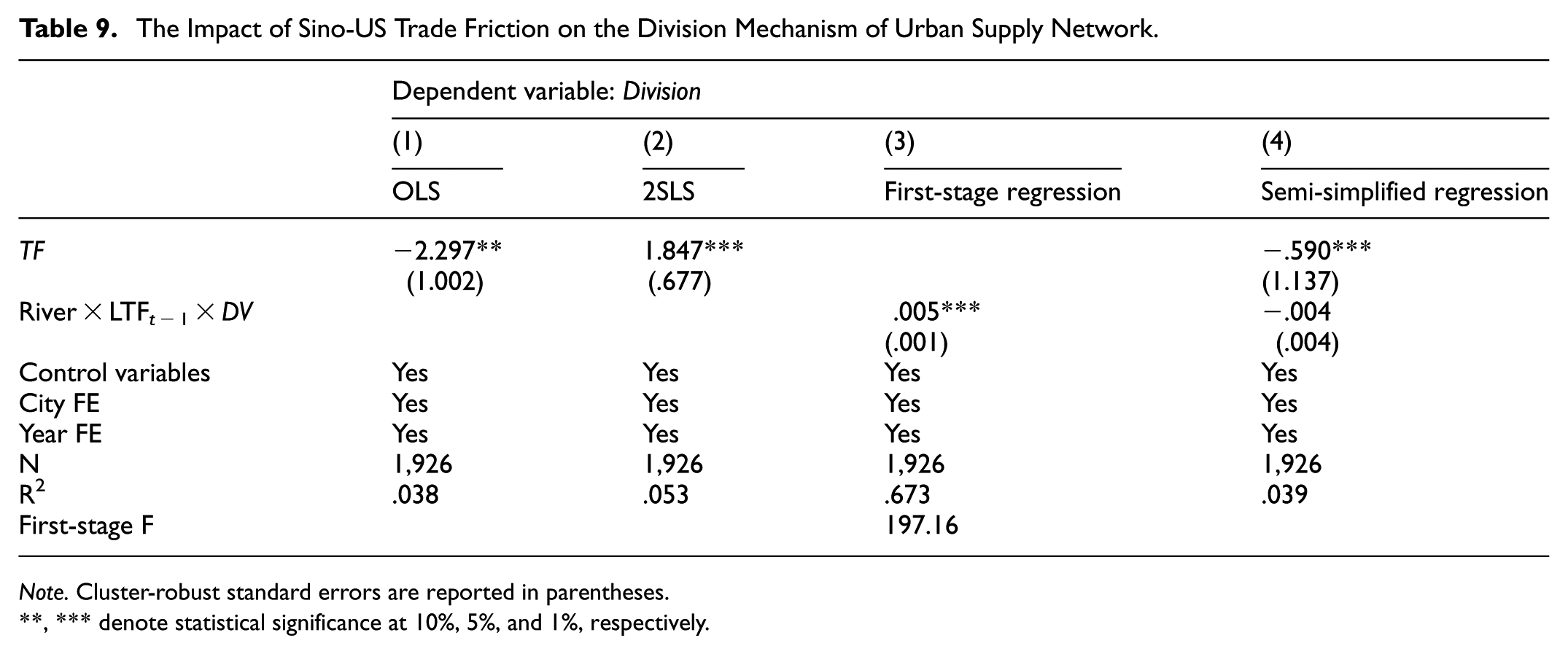
Note. Cluster-robust standard errors are reported in parentheses.
, *** denote statistical significance at 10%, 5%, and 1%, respectively.
The regression results from column (1) of Table 9 indicate that, overall, Sino-US trade frictions tend to reduce the specialization level of node cities within the urban supply network. However, the 2SLS estimation results in column (2) show that the coefficient of the TF is significantly positive at the 1% level, contrary to the coefficient of the OLS estimation method in column (1). This suggests a certain degree of reverse causality problem, where some node cities, due to their lower level of specialization and insufficient core competitiveness in international trade, may suffer more severe external trade policy uncertainty shocks. Regarding the OLS and 2SLS regression estimates, the observed results may be attributed to the following mechanism: The US trade protection measures targeting China’s manufacturing sector have reduced export volumes in Chinese cities. To counteract these negative effects through productivity enhancement, urban manufacturing production has increasingly focused on improving production efficiency through specialization and division of labor, thereby providing empirical support for Hypothesis 2b.
Column (3) reports the first-stage regression results of the 2SLS using the interaction term (River × LTFt− 1×DV) of urban river density (River), the lagged term of US trade policy uncertainty (LTFt− 1), and a dummy variable for Sino-US trade frictions (DV) as the instrumental variable. The coefficient of the instrumental variable (River × LTFt − 1 × DV) is significantly positive at the 1% level, and the first-stage F-statistic is 197.16, above the critical value of 10, indicating no weak instrumental variable issue; Column (4) reports the estimation results of the semi-simplified regression. After introducing the instrumental variable (River × LTFt − 1 × DV) into the original equation, the coefficient estimate is not significant, suggesting that the instrumental variable is uncorrelated with the error term of the original equation, corroborating that the instrumental variable satisfies the exogeneity condition.
Sharing Mechanism of Urban Supply Networks
Regarding the division of labor mechanism by which Sino-US trade frictions impact FDI, there is no shortage of research on the influence of supply network learning mechanisms on investment in existing literature. Against a backdrop of “administrative division,” the degree of economic integration between cities is low, unable to form a unified large market, and the market size is limited. The formation of supply networks, however, strengthens the transmission and sharing of market information between cities, expanding the potential market size of cities. Market size is particularly important for attracting FDI. Nielsen et al. (2017) noted that the larger a region’s market size, the more likely it is to become a destination for foreign investment. Therefore, this paper focuses on discussing the role of Sino-US trade frictions on the sharing mechanism of supply networks, with Table 10 reporting the impact of Sino-US trade frictions on the sharing mechanism of urban supply networks.
The Impact of Sino-US Trade Friction on the Sharing Mechanism of Urban Supply Network.

Note. Cluster-robust standard errors are reported in parentheses.
, *** denote statistical significance at 10%, 5%, and 1%, respectively.
The regression results from columns (1) and (2) of Table 10 indicate that overall, Sino-US trade frictions tend to increase the weighted in-degree centrality of node cities within the supply network, that is, promoting market sharing between cities. Regarding the OLS and 2SLS regression estimates, the observed results may be attributed to the following mechanism: US trade protection measures targeting China’s manufacturing sector have reduced export volumes in Chinese cities. To mitigate these negative effects through export market diversification, cities have placed greater emphasis on acquiring additional market resources through shared export channels. Specifically, the U.S. trade protection measures have prompted Chinese cities to facilitate export market diversification through market resource sharing, thereby providing empirical support for Hypothesis 2c.
Column (3) presents the first-stage regression results of the 2SLS, selecting the same instrumental variable as above, with the coefficient of the instrumental variable (River × LTFt− 1×DV) being significantly positive at the 1% level, and the first-stage F-statistic exceeding the critical value of 10, indicating no weak instrumental variable problem. Column (4) of Table 9 reports the estimation results of the semi-simplified regression, where after introducing the instrumental variable (River × LTFt− 1×DV) into the original equation, the coefficient estimate is not significant, suggesting that the instrumental variable is uncorrelated with the error term of the original equation, substantiating that the instrumental variable satisfies the exogeneity condition.
Further Analysis: Community Interaction Analysis of FDI Under Dual Agglomeration
Building upon the baseline regression analysis of the impact of Sino-US trade frictions on urban FDI and the analysis of the underlying mechanisms, this article further investigates the role of virtual agglomeration within urban supply networks in the economic geography of city clusters. The study examines whether the learning, division of labor, and sharing among node cities in urban supply networks lead to homophily imitation effects or comparative effects in FDI between cities. Models are constructed as shown in equations 4 and 5.


In these equations, HIE it represents the absolute difference between FDI in city i in year t and the average FDI level within the city cluster (homophily imitation effect), and HCEit represents the absolute difference in FDI between city i in year t and the FDI in the central city of the city cluster (homophily comparative effect). The core independent variables include Learn, Division and Share. The coefficients η and θ are to be estimated, with control variables and other indices settings consistent with the previous sections.
FDI Community Interaction Within City Clusters Under Supply Network Virtual Agglomeration
City clusters play a critical role in enhancing resource allocation efficiency and promoting regional coordinated development. With the restructuring of industrial spatial organization within supply networks through digital technology, a form of “virtual agglomeration” emerges, triggering community interaction effects within city clusters, significantly influencing foreign investment location decisions. Therefore, this paper conducts an empirical analysis on the foreign investment community interactions generated by the learning, matching, and sharing mechanisms of “virtual agglomeration” among supply network node cities within city clusters, as shown in Table 11.
Foreign Investment Community Interaction in Urban Agglomerations Under Virtual Agglomeration of Supply Network.
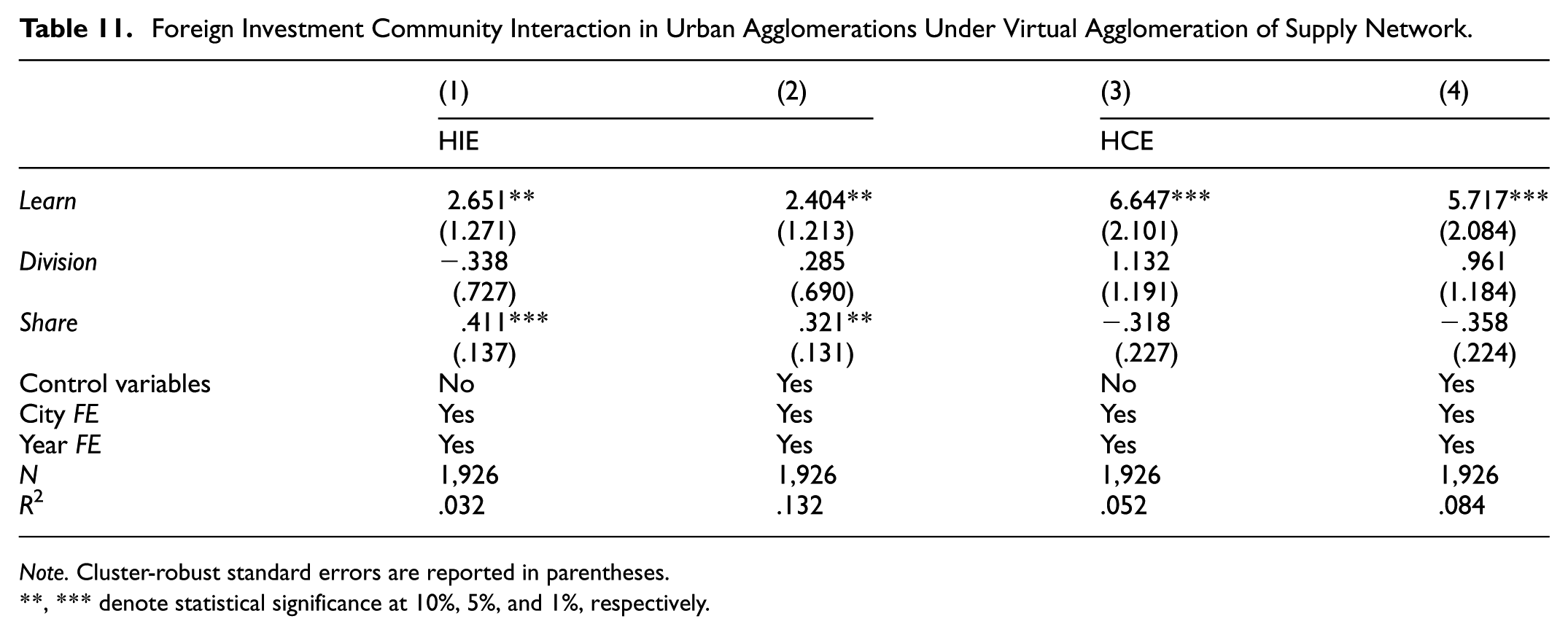
Note. Cluster-robust standard errors are reported in parentheses.
, *** denote statistical significance at 10%, 5%, and 1%, respectively.
Results from columns (1) and (2) of Table 11 indicate that, when the dependent variable is the HIE of city foreign investment, regardless of whether control variables are included, the coefficient of the mechanism variable Learn is positive at the 5% significance level. This suggests that enhanced imitative learning between cities overall leads to a widening gap between the individual city FDI scale and the average level within the city cluster, indicating a polarization phenomenon in FDI within the city cluster. The coefficient of the mechanism variable Division is not significant, indicating that specialized division of labor between cities does not significantly cause an imitation effect in FDI within the city cluster. After including control variables, the coefficient of the mechanism variable Share is positive at the 5% significance level, suggesting that market sharing between different cities expands the gap in FDI scale between cities and the city cluster average. From the results of columns (3) and (4), when the dependent variable is the HCE of enterprise investment, regardless of whether control variables are included, the coefficient of the mechanism variable Learn is positive at the 1% significance level. This implies that enhanced imitative learning between cities leads to “bandwagon” FDI converging towards central cities within the city cluster, thereby increasing the disparity in FDI scale between the central and peripheral cities, that is, the appearance of a “Matthew effect” where FDI concentrates towards central cities. The coefficient of the mechanism variable Division is not significant, indicating that specialized division of labor does not produce a comparative effect in FDI between different cities within the city cluster. Similarly, the coefficient of the mechanism variable Share is not significant, meaning that market sharing does not produce a comparative effect in FDI between different cities within the city cluster.
In summary, although the externalities of network under the background of virtual agglomeration within urban supply networks are conducive to attracting FDI to cities, the polarization phenomenon of FDI caused by the new spatial organization model of virtual agglomeration among different cities should still be given attention, that is, the “zero-sum game” between cities of varying developmental stages within the city cluster.
Heterogeneity Test of FDI Community Interaction Within City Clusters from a Geographical Distance Dimension
Although the digital economy has led to “virtual agglomeration” of economic entities, which significantly impacts economic activity, the current stage of digitalization in the economy and society still needs improvement, and enhancing information transparency and alleviating group irrationality cannot detach from the force of geographical space. To explore the specific role of geographical distance during the process where virtual agglomeration in supply networks affects the homophily effect on foreign investment, this paper classifies all cities based on their spatial relationship with the central city within the city cluster. They are categorized into “cities adjacent to the central city,”“cities not adjacent to the central city,” and “non-city cluster cities,” and an empirical test was conducted on the heterogeneity of the homophily effect on foreign investment due to learning, matching, and sharing behaviors in the city supply network, as shown in Table 12.
Heterogeneity Test of the Interaction of Foreign-Funded Communities in Urban Agglomerations.

Note. Cluster-robust standard errors are reported in parentheses.
, **, *** denote statistical significance at 10%, 5%, and 1%, respectively.
The results indicate that based on the learning mechanism, while the enhancement of interconnectedness between cities significantly promotes the imitation effect of foreign investment in “cities not adjacent to the central city within the city cluster,” it also expands the FDI gap between non-city cluster cities and city cluster cities. This suggests that there is still considerable opacity in the investment market environment information within the city cluster. The information provided by increased city interconnectedness is insufficient for foreign investors to make optimal investment decisions. Hence, external capital opts for a relatively less risky imitation investment strategy. As resources and factors aggregate towards the central city, other cities within the city cluster fail to effectively catch up with the central city in attracting FDI. Additionally, the enhancement of city interconnectedness has led to a significantly wider gap between FDI in “non-city cluster cities” and both the average and highest levels within the city cluster, highlighting the issue of coordinated development within the city cluster’s radiating range.
Based on the division mechanism, the widening gap in FDI between the central city and other cities within the city cluster may be because economic linkages are tighter within the city cluster, there is a more mature division of labor mechanism, and high-end industry resources tend to aggregate in the central city, leading to corresponding location choices for FDI. This “siphon effect” is more evident in the sample group of “cities not adjacent to the central city within the city cluster.” However, due to the limited radiating range of the division of labor mechanism within the city cluster, the sample group of “non-city cluster cities” does not exhibit a significant widening of the FDI gap caused by division of labor.
Based on the sharing mechanism, the increase in the weighted in-degree centrality of city trade volume reflects the enhanced market sharing between cities. While overall market sharing within the city cluster widens the FDI gap between city cluster cities and the city cluster average, it narrows the gap with the central city, indicating that market sharing has enhanced the attraction of other cities within the city cluster for foreign investment, achieving their catch-up with the central city in attracting FDI. Similarly restricted by the central city’s radiating range, “non-city cluster cities” cannot effectively share markets with the central city, losing the attractiveness of market size location for foreign investment. This leads to industrial development lag in “non-city cluster cities,” thus widening the gap between them and the city cluster’s FDI level.
Conclusion and Policy Implications
The trade protectionism has long influenced global investment patterns and remains a central topic in international economics. In the digital era, increasing inter-city connectivity, formed through production and distribution linkages, has given rise to urban supply networks that transcend geographical limitations. These networks foster a new spatial organization model known as virtual agglomeration. This paper examines the role of such networks on the impact of trade protectionism on FDI withdraw, focusing on the learning, matching, and sharing mechanisms embedded in urban supply networks. Therefore, based on constructing urban supply networks using supply chain data, this paper examines the impact mechanism of external trade protectionism on FDI and conducts empirical tests using city panel data from 2012 to 2020.
Conclusion
The study reveals that external market trade protectionism, exemplified by Sino-US trade disputes, influences China’s FDI through the learning, matching, and sharing mechanisms embedded within urban supply networks. This finding complements existing research on the impact of trade policies on FDI (Gauvin et al., 2014; Steinberg, 2019) and corroborates the view that virtual agglomeration effectively connects supply and demand parties. By mitigating information asymmetry in transactions, it enhances a nation’s international competitiveness, thereby attracting FDI (Desbordes & Wei, 2017; Enguang, 2023).
Sino-US trade frictions exert a notable investment destruction effect on cities that have close trade cooperation with the US, while the investment diversion effect is more evident in cities with broader international network connections. This validates that the trade destruction and deflection effects identified in international trade frictions (Shen et al., 2021) are similarly reflected in international investment activities.
Additionally, geographical distance still plays a significant role in economic activity (Akerman et al., 2022), with both geographical and virtual agglomerations significantly impacting the homophily effect of FDI between cities.
Policy Implications
Firstly, it is essential to optimize the knowledge and technology spillover mechanisms within urban supply networks to enhance inter-city specialization and market sharing. Cities should fully leverage national policies promoting logistics and information infrastructure to establish knowledge-based supply chains grounded in production and sales linkages. Efforts should focus on strengthening intellectual property protection, expanding knowledge-intensive service markets, and removing barriers to inter-city knowledge and technology diffusion from both the supply and demand perspectives. Additionally, by utilizing the supply network’s advantages in disseminating production and sales information, cities can better identify their positions within the division of labor, expand their potential market reach, and contribute to a coordinated national production and sales system. These improvements will enhance the positive externalities of urban economies and reduce vulnerability to FDI divestment caused by external trade uncertainties.
Secondly, optimize the knowledge and technology supply network spillover mechanism to enhance specialization and market sharing among cities. Cities should fully leverage the policy opportunities presented by national information infrastructure development to strengthen their capacity for sensing and processing external information, thereby facilitating the acquisition of knowledge, technology, and development experiences from other cities. Simultaneously, cities should identify their competitive industries based on industrial information from different nodes of the supply network and engage in specialized division of labor with other cities, while sharing market information on this basis. By fostering innovative knowledge exchange and learning, a knowledge and technology supply chain based on supply-demand relationships can be established. Leveraging the advantages of the supply network in disseminating production and sales information, the efficiency of inter-city division of labor and matching can be improved. Through information sharing, the potential market scope of cities can be expanded, achieving a balance between supply and demand in the national production and sales network. This approach helps mitigate the impact of international trade protectionism on the development of the manufacturing sector.
Thirdly, cities should implement policies that facilitate investment access and encourage the diversification of international trade and cooperation. Leveraging urban supply networks to support information flow, industrial coordination, and market integration will help cities build new investment linkages. Enhancing support services for foreign enterprises, including industrial chain alignment and institutional environments, can foster communities of interest that bind domestic and international capital more closely. This strategy will improve resilience against external shocks and promote long-term stability in foreign investment flows.
Lastly, ensuring the free flow of elements within the supply network, driving urban collaborative development through the aggregation of these elements. Policymakers should strengthen coordination among cities, promote the complementary development of industries in network nodes, and seek collective optimization of regional benefits. Urban clusters, in particular, should be supported as key platforms for regional cooperation. Ensuring the effective operation of coordination mechanisms within urban clusters will facilitate the diffusion of agglomeration effects and transform supply networks into high-efficiency, risk-sharing, and benefit-aligned cooperative systems.
Limitation and Further Research
This study examines the impact of Sino-US trade friction on foreign direct investment (FDI) in Chinese cities, but it has several limitations. First, the study employs city-level data from China spanning 2012 to 2020. However, since the U.S.-China trade friction intensified primarily after 2018, the relatively short time frame may limit the ability to capture long-term effects. Second, the use of prefecture-level data could obscure inter-city heterogeneity, potentially introducing bias into the estimates. The analysis of heterogeneous effects across different types of cities remains insufficient. Third, while the article highlights a significant trend of foreign capital withdrawal due to trade tensions, the underlying mechanisms and specific pathways remain underexplored. For instance, the sectors most affected by foreign divestment and its linkage with global supply chain positioning in China warrant further investigation. Finally, the policy implications could be strengthened by considering their broader applicability to other developing economies, thereby enhancing the relevance of the findings for policies aimed at improving foreign investment attractiveness in similar contexts.
Future work could incorporate additional post-2018 years as more data become available to capture longer-term FDI withdrawal dynamics. Moreover, combining city-level supply-network indicators with firm- or industry-level supply-chain data may help identify which sectors or network positions are most affected by trade protectionism.
Footnotes
Appendix

Ethical Considerations
Not applicable.
Consent to Participate
This study does not involve human participants, individual-level data, or identifiable personal information. Therefore, consent for participation was not required. All data used are obtained from publicly available secondary databases (CSMAR supply chain database).
Author Contributions
Weikang Zeng: Writing – review & editing, Writing – original draft, Visualization, Validation, Supervision, Software, Resources, Methodology, Formal analysis, Data curation, Conceptualization. Shu Wang: Writing – review & editing, Validation, Conceptualization. Kunyan Zhu: Writing – review & editing, Resources, Methodology, Formal analysis, Data curation. Lili Ma: Supervision, Project administration, Funding acquisition.
Funding
The authors received no financial support for the research, authorship, and/or publication of this article.
Declaration of Conflicting Interests
The authors declared no potential conflicts of interest with respect to the research, authorship, and/or publication of this article.
Data Availability Statement
The datasets used or analyzed during the current study are available from the corresponding author on reasonable request.