



Abstract
Among the four macro skills in English language learning, writing plays a critical role in indicating students’ overall English proficiency. It is an essential skill, as essay writing is usually a key component of both national and international examinations. This study aims to examine English teachers’ perspectives on Grade 12 students’ underperformance in English essay writing in national examinations in Cambodia. It utilizes a qualitative case study approach and draws on in-depth interviews with 18 Grade 12 English teachers from various high schools across Cambodia. The findings revealed 10 key challenges contributing to Cambodian Grade 12 students’ underperformance or failure in English essay writing. These challenges included (a) students’ poor English backgrounds, (b) a lack of understanding of essay organizational structures, (c) limited English vocabulary, (d) difficulties with English grammar, (e) negative attitudes toward English essay writing, (f) English as an elective subject, (g) a lack of regular essay writing practice, (h) the limited quality of Grade 12 English teachers, (i) a lack of extensive English reading habits, and (j) other factors related to the education system. The study also identified several recommendations for improving students’ performance in English essay writing, such as improving students’ English language proficiency, making English a core exam subject, increasing essay writing practice, enhancing the quality of Grade 12 English teachers, and improving the overall education system. The study concludes with practical implications for concerned stakeholders in Cambodian general education and offers suggestions for future research.
Keywords
Introduction
Writing is one of the most important productive skills that can be used to assess students’ English proficiency (Ayana, 2020; Toba & Noor, 2019). It plays a significant role in education and can increase students’ English writing ability, one of the central goals of English education (Al-Khazraji, 2019). According to Bulqiyah et al. (2021), many English as a Foreign Language (EFL) students find English writing crucial for fulfilling their academic requirements. However, as Ayana (2020) and Ma (2020) noted, when students are required to write essays, especially English essays, they often face many challenges. These included the production of faulty sentences, mechanical errors, dangling and misplaced modifiers, wrong use of grammatical structures, and incorrect word choices.
In the Cambodian context, English is taught and used as a foreign language (Hum & Heng, 2024) and serves as a common medium of instruction at the tertiary level (Heng, 2017; Lin et al., 2023). English essay writing plays a pivotal role in high-stakes examinations, including in the national Grade 12 exams (Oeun & Heng, 2025). The Grade 12 examinations are administered annually by the Ministry of Education, Youth and Sport (MoEYS). There are seven subjects for each study track–science and social science–in the exams, with English being one of them (MoEYS, 2015). The English subject in the national exams has four sections: Reading (10 points), Grammar (15 points), Vocabulary (15 points), and Writing (10 points). The writing section usually requires students to write an essay of at least 80 words. Common essay topics that have appeared in past Grade 12 exams included: (a) Write an essay on “What Makes a Good Parent” for at least 80 words (appeared in the 2015 exam), (b) Write an essay for at least 80 words about “Your Goals in the Future” (appeared in the 2021 exam), and (c) Write an essay about “The Importance of the English Language” for at least 80 words (appeared in the 2025 exam). It is interesting to note that writing is one of the key sections that could boost students’ overall English scores if they could write an essay well (Em & Mao, 2024). As the requirement is to write only at least 80 words, students may be able to get a good score for the writing section without much difficulty if they have a decent writing skill. As Chan and Srun (2016) pointed out, English essay writing is one of the most important skills students need to develop, particularly when they transition to higher education, where written assignments are a major component of academic work.
Based on the first author’s experience as a teacher of English and a scorer of the English exam papers in the national Grade 12 exams in Cambodia for over a decade, many Grade 12 students, particularly those who fail the English subject, do not know the essay writing format well. They tend to write essays that contain only a single paragraph without a topic sentence, have unclear supporting sentences, and end with an improper concluding sentence. Some students are not even aware of what an English essay should entail at all. According to Oshima and Hogue (2006), a standard English essay typically has at least five paragraphs, including one introductory paragraph, at least three body paragraphs, and one concluding paragraph. However, many Cambodian Grade 12 students do not write essays that meet these basic essay structures, contributing to their poor performance in the English subject, particularly in the essay writing section (Oeun & Heng, 2024, 2025).
Since the introduction of a major structural reform to the national Grade 12 examination to improve the quality of the exam process and the overall general education system in Cambodia in 2014, the overall number of students passing the national Grade 12 exams has gradually increased (Bredenberg, 2018). However, there are still many students who fail the English subject, even among students who receive an overall grade A for their national exams. According to MoEYS (2014), for example, in the academic year 2013 to 2014, 74.40% of the students who passed the national Grade 12 exams failed the English subject, while in the academic year 2018 to 2019, 86.33% of those who passed the national exams failed their English subject (MoEYS, 2019). In 2022, the rate was 89.05% of those who passed the exams (MoEYS, 2022). These figures indicate that students have low English proficiency. Although students’ failure in the English exam may not be directly linked to their limited English essay writing skills, research has highlighted various challenges Cambodian students faced in writing English essays (Oeun & Heng, 2025). Moreover, according to the first author’s extensive experience marking national exam papers, many students often turned in their English exam papers without writing anything, while the majority wrote a single paragraph rather than a full essay required by the exam question for the writing section. As a consequence, they tended to perform poorly in the English subject in the English exam.
In light of this situation, it is important to examine the key challenges contributing to Grade 12 students’ underperformance or failure in English essay writing in the the national exams in Cambodia. Moreover, since there appears to be limited empirical study exploring why many Cambodian Grade 12 students fail the English subject, including in essay writing, in the national exams (see Oeun & Heng, 2025 for a review of related challenges), there is a need for empirical research into this topic to better understand the key challenges and identify strategies or suggestions to improve students’ performance in English essay writing. The present study, therefore, seeks to address this knowledge gap by examining Cambodian students’ underperformance in English essay writing from the perspectives of Grade 12 English teachers, who are key stakeholders with firsthand knowledge and experience of the issue. In addition, it seeks to provide recommendations for improving students’ essay writing performance. The study has two main objectives: (a) to identify the key challenges contributing to Grade 12 students’ underperformance in English essay writing in national examinations in Cambodia, and (b) to provide recommendations for improving Grade 12 students’ performance in English essay writing in national examinations in Cambodia. To achieve these research objectives, two research questions are proposed:
What are the key challenges contributing to Grade 12 students’ underperformance in English essay writing in national examinations in Cambodia, as perceived by Grade 12 English teachers?
How can these challenges be addressed to improve Grade 12 students’ performance in English essay writing in national examinations in Cambodia from the perspectives of Grade 12 English teachers?
Literature Review
Defining Essay Writing
Essay writing has been defined in different ways based on its function. According to Zemach and Rumisek (2003), an essay is a group of three-to-five paragraphs with three main parts–introduction, body, and conclusion–that has one main idea. Saputra (2023) argued that essay writing is a process of academic writing that contains at least five paragraphs about a single main idea. Likewise, an essay is defined as a piece of writing that has several paragraphs about one topic (Oshima & Hogue, 2006) and a document with a defined structure (Andersson et al., 2007). Good essay writing consists of three main parts, including an introductory paragraph, body paragraphs with two or more paragraphs, and a concluding paragraph (Marue & Pantas, 2019; Oshima & Hogue, 2006; Zemach & Rumisek, 2003).
The introductory paragraph often moves from general to specific ideas, creating a thesis statement at the end of the paragraph that connects to the body (Oshima & Hogue, 2006, 2007). The body paragraphs are often written with at least three paragraphs, each of which has one topic sentence supported by two or three major supporting sentences and a concluding sentence (Boardman & Frydenberg, 2008). However, Oshima and Hogue (2006, 2007) argued that each paragraph of the body does not need to have a concluding sentence, as it can be optional. Lastly, the concluding paragraph is the last section that is used to conclude the essay, remind the reader of the key points, and particularly leave the reader with final thoughts on the topic (Oshima & Hogue, 2006, 2007).
Understanding the National Grade 12 Exam in Cambodia
The national Grade 12 exam in Cambodia is held annually between the months of August and October. The exam takes two full days. On the first day of the exam, students take four subjects, while on the second day, there are three subjects to take. There are seven exam subjects for both the science- and social science-track students. The exam score for each subject ranges from 50 to 125 points, and it takes from 60 to 150 min for students to complete each exam subject. Key information about the national Grade 12 exam, including the duration and score for each subject, is provided in Table 1.
Key Information About the National Grade 12 Exam in Cambodia.
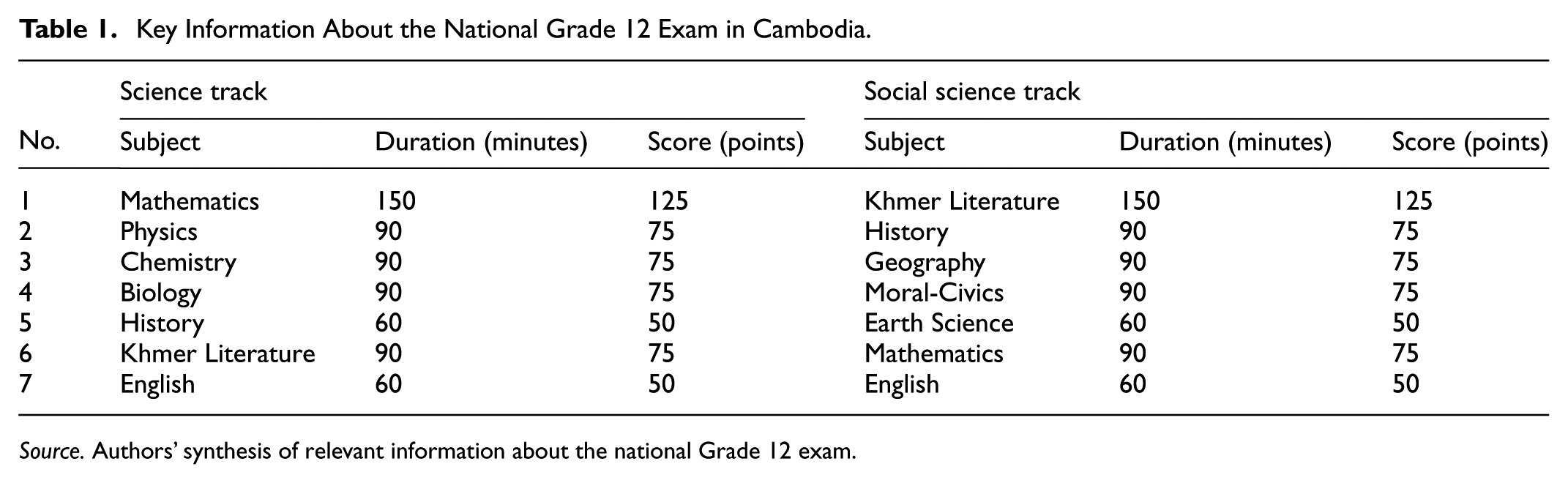
Source. Authors’ synthesis of relevant information about the national Grade 12 exam.
As previously mentioned, the English exam in the national Grade 12 exam in Cambodia has four sections, including Reading, Grammar, Vocabulary, and Writing. In the reading section, students are usually asked to complete a reading passage with some given vocabulary. For the grammar section, various grammatical aspects, such as tenses, are tested. The vocabulary section requires students to complete sentences with a choice of four words provided for each sentence. Finally, the writing section, the last section of the exam, usually asks students to write an essay of at least 80 words. The suggested topics for essay writing are usually common topics such as the roles of women in society, how to reduce road accidents, and the advantages and disadvantages of mobile phones (see Em & Mao, 2024 for the actual exam papers from 2007 to 2023).
Students have 60 mins to complete the English exam that has a total score of 50. The English exam is usually scheduled for the last session of the first day of the national exam since the exam reform introduced in 2014 (Bredenberg, 2018). The English subject is considered an elective exam subject for both the science- and social science-track students (Soeung, 2020). According to Oeun and Heng (2024), this means that if students receive a score of 25 or below out of the total score of 50 for their English exam, this score will not be added to the overall exam score. Such a score will also not affect the overall exam score either. However, if students receive 26 or above for their English exam, they will receive an extra score added to their overall exam score (i.e., if their English exam score is 26, students receive one extra score added to their overall exam score; if 27, they receive two extra scores, and so on.)
Challenges EFL Students Encounter in Essay Writing
Previous research has shown that students, particularly EFL ones, often face many challenges in writing English essays. In the Indonesian context, for example, Marue and Pantas (2019) found that high school students could not write descriptive essays well due to challenges related to grammatical problems, limited vocabulary, poor word choice, spelling mistakes, and difficulties in idea development. In the Philippines, Pablo and Lasaten (2018) showed that many high school students struggled to write academic essays because they encountered many challenges, including their inability to generate ideas well, limited knowledge of essay organizational structures, insufficient vocabulary, poor English grammatical competence, and a lack of knowledge of citation practices.
In Pakistan, Akram et al. (2020) found that many secondary school students faced challenges in their essay writing, leading them to produce English essays with low quality. Key challenges included a lack of motivation and confidence; inadequate learning resources; insufficient teacher feedback; limited individualized attention; inadequate English writing practice; first language interference; limited vocabulary; limited knowledge of choosing essay topics; and issues with grammar, coherence, punctuation, paraphrasing, and spelling (Akram et al., 2020). Other challenges facing Pakistani students were related to the influence of first language (L1) on second language (L2) learning, limited proficiency in essay structure, and limited exposure to English vocabulary (Shah et al., 2023).
In Malaysia, Darus and Subramaniam (2009) showed that high school students had difficulties related to grammatical mistakes, weak vocabulary, and sentence structure errors. Ghabool et al. (2012) also revealed that Malaysian secondary school students could not write good essays, as they faced problems related to (a) conventions (e.g., line formatting, sentence completeness, writing length); (b) punctuations (incorrect use of question marks, colons or semicolons, apostrophes, and commas); and (c) language use (limited vocabulary and poor grammatical structures). Overall, these studies showed that there are many challenges faced by EFL students in writing English essays.
Challenges Cambodian EFL Students Encounter in Essay Writing
In the Cambodian context, research examining the challenges students face in English essay writing remains scarce (Oeun & Heng, 2025). To the best of our knowledge, studies focusing specifically on the challenges encountered by Cambodian Grade 12 students in writing English essays are even more limited. Despite this, a few studies are worth mentioning. A study by Sor et al. (2017), for example, found that the key challenges faced by Cambodian Grade 12 students in writing English essays or compositions were related to limited understanding of English grammar, inadequate vocabulary knowledge, and insufficient English writing practice. Three main types of errors were identified, including grammatical, lexical, and syntactic errors. Among these errors, grammatical errors were the most common, followed by syntactic errors (Sor et al., 2017). Similarly, Em and Nun (2022) reported that many Cambodian Grade 12 students did not even know what English essay writing is. The students said that essay writing is not included in the core English textbook but appears in the national Grade 12 exam; as a result, many students perform poorly in the essay writing section due to their limited knowledge about essay writing.
Likewise, Oeun and Heng (2024) argued that Grade 12 students with limited knowledge of essay organizational structures may not be able to produce well-structured English essays, which partly contributes to their failure in the English subject in the national Grade 12 examinations in Cambodia. Oeun and Heng (2024) further argued that weak grammar competence and limited vocabulary are key reasons for Cambodian students’ poor performance in the English subject in the national exams. Similarly, Hem (2017) noted that many Cambodian students often find it difficult to write English essays because they tend to misunderstand the basic principles of essay organization. Specifically, students tend to neglect the basic essay structure–an introduction, a body, and a conclusion. They often write an introductory paragraph that lacks a clear thesis statement, body paragraphs that have just one paragraph without a clear topic sentence or major and minor supporting sentences, and particularly a very long and ambiguous concluding paragraph.
A recent review by Oeun and Heng (2025) shed additional light on the issue concerning English essay writing. Five key categories of challenges facing Cambodian students in writing English essays were identified. These challenges included “students’ poor English backgrounds from the lower levels, their lack of understanding of essay organizational structures, their limited English vocabulary, their difficulties with English grammar, and their negative attitudes toward essay writing” (p. 473). These five categories of challenges provide a useful framework to examine the challenges faced by Cambodian students in writing English essays. Therefore, a conceptual framework for the present study is developed based on these categories of challenges (see Figure 1). However, it is important to note that while the review by Oeun and Heng (2025) provides valuable insights into the challenges Cambodian students encounter in English essay writing, empirical research on this topic remains limited in the Cambodian context. The present study seeks to address this knowledge gap and adds to the existing body of knowledge on the topic. In particular, the study is significant in that it provides empirical evidence on the key factors underlying Cambodian Grade 12 students’ underperformance in English essay writing. It also offers research-informed recommendations to enhance students’ English essay writing performance.

Conceptual framework guiding the study.
Methodology
Research Design
This study utilized a qualitative case study approach as an investigative tool (Denscombe, 2010) to explore the key challenges contributing to Grade 12 students’ underperformance or failure in English essay writing in the national exams in Cambodia. There are two main reasons for selecting the case study approach. First, a case study is appropriate for seeking an in-depth understanding of a phenomenon (Ellinger et al., 2005). Second, as Denscombe (2010) noted, the case study approach offers several advantages, one of which is the ability to focus on one or a few instances to understand complex social situations.
Research Setting and Participants
This study took place in Cambodia, a country in Southeast Asia, bordering Thailand, Vietnam, and Laos. The participants included 18 Grade 12 English teachers who were purposely selected for the study. The participants came from different high schools in nine provinces and the capital city, Phnom Penh, in Cambodia. The provinces included Kandal, Kampong Cham, Tboung Khmum, Siem Reap, Kep, Kampot, Takeo, Pailin, and Oddor Meanchey. This ensures diverse backgrounds of Grade 12 English teachers who can provide a good representation of different high school contexts across Cambodia.
A purposive sampling technique was utilized to select the participants for the study. As Tongco (2007) noted, purposive sampling is a type of non-probability sampling that is effective for data collection in qualitative research. Three main criteria guided the selection of participants for this study. First, all participants were qualified to teach English at a high school level because they had completed their teacher training at the National Institute of Education (NIE), Cambodia’s best teacher education institution. Second, they were current Grade 12 English teachers, so they were well-suited to discuss key challenges contributing to Grade 12 students’ underperformance in English essay writing in the national exams and offer potential recommendations to improve the situation. Third, the participant selection was motivated by reasons of convenience, as most of the participants invited for interviews were former classmates of the first author. The remaining were the first author’s friends or acquaintances.
Based on the above criteria, 18 teachers (4 females) were invited to participate in the study. All of them accepted the invitation despite some delay in their responses. Fourteen of them were trained at NIE in 2011 (they were the first author’s former classmates who were in the same cohort when they were teacher trainees at NIE), while the remaining four were trained at NIE between 2014 and 2018. Nine teachers held master’s degrees (two females), while nine had bachelor’s degrees (two females). All participants had taught English for at least 7 years. Table 2 provides demographic information of the participants.
Demographic Information of the Participants (n = 18).

Data Collection
Semi-structured interviews were used to collect data for this study. Prior to conducting the interviews, the first author obtained a permission letter signed by the principal of the school where he worked. As there was no institutional review board (IRB) in the study context, this institutional permission was considered equivalent to IRB approval. All participants provided their written informed consent before participating and were informed of the study objectives, procedures, the voluntary nature of participation, data confidentiality, and their right to withdraw at any time without any negative consequences or penalty. No personal identifying information was retained in the manuscript. The interviews, mostly conducted online, posed no risk of harm to the participants. The procedures used in this study followed the ethical principles outlined in the Declaration of Helsinki (World Medical Association, 2024). To protect the participants’ identities, they were coded as T1 to T18 (T = teacher). Before each interview, the participants were informed about the purpose of the study and were assured of the anonymity and confidentiality of their responses.
Two key questions formed the focus of the interviews: (a) the key challenges contributing to Grade 12 students’ underperformance in English essay writing and (b) suggestions for improving their English essay writing performance (see Appendix). Several probing questions were also employed in the interviews. The interviews were conducted in both face-to-face and online formats, with 14 interviews having been conducted online using Telegram and Messenger. All interviews were carried out in English, as both the interviewer (the first author) and the participants are fluent in English (they are all English teachers). Each interview lasted between 20 and 30 mins and was audio-recorded with written consent from the participants.
Data Analysis
The interview data were transcribed verbatim and analyzed using thematic analysis. Braun and Clarke (2006) proposed six steps for thematic analysis, which include (a) familiarizing ourselves with the data, (b) generating initial codes, (c) searching for themes, (d) reviewing themes, (e) defining and naming themes, and (f) producing the report. The analysis was guided by the conceptual framework developed from Oeun and Heng’s (2025) study. During the coding process, both deductive and inductive coding were used (Gibbs, 2007). The deductive coding was guided by the conceptual framework, while the inductive coding was based on the interview data. To avoid confirmation bias, the researchers engaged in extensive discussion with one another during the analysis with the aim to identify any themes beyond those in the conceptual framework so that this study can contribute to advancing knowledge in the field.
The data coding was conducted by the first author, with guidance and clarification from the co-author. The discussion and clarification process helped to ensure the validity and trustworthiness of the coding and analysis. Any disagreements or issues that arose during the coding and analysis stage were discussed and resolved by the researchers over voice messages and video calls via Telegram. Through this iterative process, 10 themes emerged regarding the perceived challenges contributing to students’ underperformance or failure in English essay writing, five of which were informed by the conceptual framework, while the other five themes emerged from the data via inductive coding. The data analysis also produced five themes related to the recommendations to improve Cambodian students’ performance in English essay writing. These findings are presented and discussed in the following sections.
Findings
Key Challenges Contributing to Cambodian Grade 12 Students’ Underperformance in English Essay Writing in National Exams
The first research question sought to identify the key challenges contributing to Cambodian Grade 12 students’ underperformance or failure in English essay writing in the national examinations. Based on the analysis of the interview data with the 18 Grade 12 English teachers, 10 major challenges were identified, as shown in Table 3. They are presented in this section.
Key Challenges Contributing to Cambodian Students’ Underperformance in English Essay Writing.

Students’ Poor English Backgrounds
Many participants agreed that one of the major challenges leading to Grade 12 students’ underperformance in English essay writing is students’ poor English backgrounds. They mentioned that many students, particularly those from rural areas, do not receive adequate English instruction in primary school, even though English is introduced in Grade 4. Several teachers shared their thoughts as follows:
Many students in rural areas never self-study English at home because their parents do not know English. (T10) Most students’ English proficiency is very poor from primary school […]. They struggle with reading, grammar, vocabulary, and essay writing. (T1) Students do not know English because they are not rich, so they cannot afford private English classes. (T3) Many students from lower to upper secondary levels do not have time for the English subject. (T12)
Lack of Understanding of Essay Organizational Structures
Many teachers pointed out that a lack of understanding of essay organizational structures is a key factor contributing to Grade 12 students’ underperformance in English essay writing. As one teacher (T14) said, “My Grade 12 students have poor essay writing skills and limited knowledge of essay organizational structure, so when they are required to write an essay for a monthly test, they cannot identify the three main parts of an essay–introduction, body, and conclusion; that is, they follow Khmer essay structure.” Other teachers also highlighted students’ limited understanding of essay structure:
My students cannot write an English essay well because most of them do not recognize a thesis statement in the introductory paragraph that leads to the body paragraphs. They simply follow the Khmer writing style. (T6) Many Grade 12 students, based on my experience scoring English exam papers annually, write what they think without following the essay organizational structure. (T10)
Limited English Vocabulary
About half of the participants (e.g., T1, T2, T5, T6, T7, T8, T15, T17, and T18) emphasized students’ limited English vocabulary as a key factor contributing to students’ failure in English essay writing. As one teacher (T18) mentioned, “Many Grade 12 students, including my students, do not know a lot of English vocabulary. They find it difficult to translate each word into Khmer, so when the national exams come, they cannot choose the correct words in the reading and vocabulary sections of the exam paper.” Another teacher (T8) expressed a similar concern, stating that most Grade 12 students, particularly those from rural areas, including her students, have limited vocabulary knowledge, so they are unable to choose the right words during the national exams. The teacher further mentioned that, based on her experience marking English national exam papers, many students do not seem to care much about vocabulary-related sections, including both reading and vocabulary tasks. This contributes to their overall underperformance in the English subject.
Difficulties With English Grammar
Many teachers reported that students’ difficulties with English grammar also contribute to their failure in English essay writing. As one of them said, “When I mark students’ English exam papers, they use a mixture of tenses, such as present simple, future simple, and past simple, without following grammar rules” (T15). The participants also mentioned students’ difficulties with English grammar related to subject-verb agreement, sentence structures, and types of sentences in writing. Two teachers highlighted this issue as follows:
Many of my students, in particular students in the social science track, are careless about English and do not understand English grammar well. They often fail the grammar section in the monthly test. (T2) Many of my students do not appear interested in studying English grammar in the class, so when they take a monthly test focusing on grammar, over 90% of them fail the test. For science-track students, many of them are better. (T6)
Negative Attitudes Toward English Essay Writing
Another main challenge perceived to have a significant impact on Grade 12 students’ failure in English essay writing is their negative attitudes toward essay writing. Many participants mentioned that Cambodian students, particularly those in rural areas, do not like studying how to write paragraphs and essays, even though their teachers try to teach them. Several participants shared their concerns as follows:
Many students in rural areas, including those in my classes, never produce a good paragraph or essay because they find it hard to learn it. They simply do not like it. (T17) Most of the students do not care about this task. In fact, they are willing to accept a score of zero because they do not like essay writing. (T11) Students are not interested in essay writing in class. They do not care about it, so they cannot pass the writing section in the national exams. (T7)
English as an Elective Exam Subject
Six out of the 18 participants identified the status of English as an elective subject in the national examinations as a key factor contributing to Cambodian Grade 12 students’ failure in English essay writing. They argued that when English is not a core exam subject, students tend to not care or devalue its importance. Students also tend to believe that they can still get an overall grade A in the exams even though they fail the English subject. As one of the participants (T11) noted, “How can students pass the English subject, including essay writing, in their national exams when they think that this subject is not important, especially even when they fail the English subject, it does not affect their overall exam score?” The participants also believed that English is an elective exam subject in students’ minds all the time, so they always ignore it. As two teachers mentioned:
When English is not introduced as a core exam subject like other major exam subjects, there is no way to draw students’ attention to English. MoEYS will continue to face such a massive failure in this subject forever. (T7) One important thing is that students perceive English as not a core subject exam; that is, its scores do not contribute to their overall exam results. (T16)
Lack of Regular Essay Writing Practice
Another key challenge believed to contribute to Grade 12 students’ poor performance in English essay writing is a lack of regular essay writing practice, both in school and at home. Some participants mentioned that most students do not like practicing essay writing, which results in their inability to develop ideas for writing an essay during the national exams. For example, three teachers expressed similar concerns:
My Grade 12 students do not really pay attention to writing skills, especially essay writing, because they think that they are not capable of doing it, even during the monthly tests. (T3) My students give me a blank page when I ask them to practice writing an English essay in class. (T13) Many students do not pay much attention to learning how to write English essays, either in class or at home. (T18)
Limited Quality of Grade 12 English Teachers
The participants also mentioned the limited quality of Grade 12 English teachers as a factor contributing to students’ underperformance in English essay writing. Two teachers (T12, T13), for instance, frankly shared that some Grade 12 English teachers, including themselves, had never attended any professional development activities, such as seminars, workshops, or English Language Teaching (ETL) conferences organized by MoEYS or other institutions. One of them specifically emphasized that the limited quality of Grade 12 English teachers can significantly contribute to Cambodian students’ failure in the English subject, including in essay writing, in the national exams. As he noted:
Some Grade 12 English teachers are not qualified. They have low English language proficiency, both in terms of English teaching and essay writing skills. Some are not even sure of what essay writing is. (T13)
Lack of Extensive English Reading Habits
A lack of extensive English reading habits among students was also mentioned by the participants, although only a few of them raised this issue. One teacher (T15), for example, stated that Grade 12 students fail English essay writing in the national examinations because of their lack of extensive English reading habits. This means that students do not engage in regular reading, either at school or at home. As a result, their English knowledge is limited, including knowledge about grammar, vocabulary, ideas for writing, essay organization, and writing styles. As she said:
Frankly speaking, many of my students are too lazy to read English in class or at home. They said they had no time for this subject, as it is not a core exam subject, so they do not care about reading it at all. (T15)
Other Factors Related to the Education System
Many participants agreed that a range of factors related to the education system also contribute to Cambodian Grade 12 students’ failure in English essay writing in the national exams. One teacher said that “MoEYS must take into account some major variables, such as the absence of English essay writing in the English textbook, the misalignment between exam content and students’ actual abilities, the limited two hours per week for English class time, and the scheduling of the English subject as the last session in the national exams” (T4). Other participants echoed similar concerns, highlighting issues related to an outdated English curriculum, large class sizes, limited teaching materials, and inadequate teaching time for the English subject. As some of them explained:
I find it difficult to teach my students English, especially essay writing, due to the lack of an LCD and other teaching aids because when I want to give them a model essay, I cannot write it on the board. (T11) There are only two hours per week allocated for the English subject in Grade 12, so it is hard for me to teach English essay writing effectively. The time is too limited. (T10) I find it difficult to teach my students essay writing effectively because there are between 50 and 60 students per class. (T12) Since the English exam is scheduled as the last session of the examination day, most students feel too lazy to complete the writing task, resulting in their failure in essay writing. (T1)
Overall, this study identified various interrelated challenges contributing to Grade 12 students’ failure in English essay writing in the national examinations in Cambodia. Although these challenges appear to be varied and seem to be common challenges faced by EFL students in general, not specifically Grade 12 students, it is worth noting that these challenges were raised by the participants and largely aligned with the existing literature on this topic. Overall, these challenges can be classified into 10 categories, such as (a) students’ poor English backgrounds, (b) a lack of understanding of essay organizational structures, (c) limited English vocabulary, (d) difficulties with English grammar, (e) negative attitudes toward English essay writing, (f) English as an elective exam subject, (g) a lack of regular essay writing practice, (h) the limited quality of Grade 12 English teachers, (i) a lack of extensive English reading habits, and (j) other factors related to the education system.
Recommendations for Improving Cambodian Grade 12 Students’ Performance in English Essay Writing in National Exams
The second research question aimed to examine recommendations for improving Cambodian Grade 12 students’ performance in English essay writing in the national exams in Cambodia. The data analysis revealed five key categories of recommendations, as shown in Table 4 and explained below.
Recommendations for Improving Cambodian Grade 12 Students’ Performance in English Essay Writing.

Improving Students’ English Language Proficiency
The participants suggested that it is important to improve students’ English language proficiency, especially from the lower education levels. They emphasized the importance of supporting students to build English language ability from early grades to help them better prepare for higher grades, especially in Grade 12. As one teacher stated:
All stakeholders should encourage and support students to study English from lower levels to the higher ones. (T18)
Another teacher similarly stressed the importance of encouraging and supporting students to improve their English language proficiency. She said that:
To help students get more exposure to English and be able to pass the English subject, including essay writing, in the national Grade 12 exams, parents must encourage and send their children to private English classes, and students themselves need to try their best to engage in learning English from primary school onward. (T15)
Making English a Core Exam Subject
Many participants suggested that English be made a core exam subject like other subjects in the national Grade 12 examinations. They argued that the current status of English as an elective subject in the exams (the English subject’s score does not affect the overall exam score) makes students have low motivation to improve their English, resulting in their poor performance in the English subject in the national exams. One teacher, for example, recognizing the issue concerning the fact that English is an elective exam subject, said that “The government, through MoEYS, must assign English as a core exam subject. The English exam score must affect students’ overall exam score; otherwise, the high failure rate in the English subject will never be decreased” (T10). Other teachers shared similar suggestions:
If English becomes a compulsory exam subject, all students will try their best to study it as they do for Math, Khmer, Physics, Chemistry, and so on. (T7) Most Grade 12 students pay little attention to English because they know that its score does not affect their overall exam score [due to the status of English as an elective exam subject]. (T2) MoEYS must introduce English as a core exam subject in the Grade 12 national curriculum; otherwise, the high failure rates in the English subject will persist. (T16)
Increasing Essay Writing Practice
Increasing essay writing practice is another key suggestion from the participants. Some teachers emphasized the need to regularly practice essay writing, either in class or at home, to help students become more familiar with essay structure and increase their interest in essay writing, which will gradually improve their English knowledge, particularly essay writing skills. This will help them receive better scores in the English subject in the national exams. As two participants commented:
Teachers should explain the essay format and provide more model essays to their students, helping them understand essay writing better. This will help them enjoy essay writing and work harder on it. (T12) Teachers need to motivate, force, and even put more pressure on students to practice writing essays so that they can work harder on improving their English essay writing skills. (T3)
Enhancing the Quality of Grade 12 English Teachers
Another suggestion emphasized by the participants is the need to enhance the quality of Grade 12 English teachers, particularly regarding English essay writing skills. They argued that when teachers are not competent, it is unlikely that they can help their students improve their English proficiency in general and essay writing skills in particular. One teacher (T10) noted that “MoEYS has to ensure that there are well-trained English teachers from primary to upper secondary school levels, especially in Grade 12; otherwise, when students reach high school, they will not be sufficiently proficient in English.” Other teachers also highlighted the need to improve the quality of English teachers, especially Grade 12 English teachers:
Teachers must have real English competence themselves so that they can teach their students to improve their English proficiency, particularly in essay writing. (T13) Grade 12 English teachers have to enhance their English proficiency by attending seminars, workshops, and conferences, especially ELT conferences. (T6)
Improving the Education System
Many participants stressed the need to address the broader systemic issues within the Cambodian education system to improve the overall education quality, which will in turn help students enhance their English proficiency, including essay writing skills. They suggested revising the English curriculum, incorporating essay writing into the core textbooks, providing adequate learning resources, reducing class sizes, and increasing English instruction time. Their suggestions are illustrated in the following quotes:
MoEYS must revise the English curriculum to be consistent with students’ abilities, update the textbooks to include essay writing, provide adequate learning resources to students, and limit class sizes to about 30 students per class. (T14) MoEYS should regularly train Grade 12 English teachers to improve their essay writing skills and encourage them to focus on teaching essay writing. (T13) MoEYS should increase English teaching hours to at least three or five hours per week for Grade 12, reduce the number of students from 50 and 60 students to around 30 students per class for Grade 12, and provide adequate teaching materials. (T9) MoEYS should not put the English subject in the last session of the national exams since students may have negative attitudes toward the English subject, and they might feel hungry by that time. (T1)
Overall, the present study identified five important recommendations suggested by Grade 12 English teachers to improve students’ performance in English essay writing in the national exams in Cambodia. It is important to note that these recommendations appear to focus on the broader issues concerning students’ underperformance in English exams in general rather than deal directly with students’ poor performance in essay writing. These recommendations were perhaps suggested by the participants who were classroom practitioners with a deep understanding of the real problems behind students’ underperformance in English essay writing. Overall, the recommendations for helping Cambodian students improve their English essay writing performance focus on (a) improving students’ English language proficiency, (b) making English a core exam subject, (c) increasing essay writing practice, (d) enhancing the quality of Grade 12 English teachers, and (e) improving the education system.
Discussion
Key Challenges Contributing to Cambodian Grade 12 Students’ Underperformance in English Essay Writing in National Exams
This study identified 10 key challenges contributing to Cambodian Grade 12 students’ underperformance in English essay writing in the national exams. These challenges include (a) students’ poor English backgrounds, (b) a lack of understanding of essay organizational structures, (c) limited English vocabulary, (d) difficulties with English grammar, (e) negative attitudes toward English essay writing, (f) English as an elective exam subject, (g) a lack of regular essay writing practice, (h) the limited quality of Grade 12 English teachers, (i) a lack of extensive English reading habits, and (j) other factors related to the education system.
These findings are in line with Oeun and Heng (2025), who have, through their review of previous research, found five key challenges faced by Cambodian students in English essay writing. The five challenges included factors such as (a) students’ poor English backgrounds from the lower levels, (b) a lack of understanding of essay organizational structures, (c) limited English vocabulary, (d) difficulties with English grammar, and (e) negative attitudes toward essay writing. However, the present study extends the categories of key challenges facing Cambodian students in English essay writing by adding five more challenges, including (a) English as an elective exam subject, (b) a lack of regular essay writing practice, (c) the limited quality of Grade 12 English teachers, (d) a lack of extensive English reading habits, and (e) other factors related to the education system. These additional categories of challenges highlight the role of motivation in language learning (Dörnyei, 1998), the role of repeated engagement or deliberate practice with the disciplinary conventions or genres (Kellogg, 2008; Swales, 1990), and the role of teachers in influencing students’ learning outcomes (Hattie, 2012).
In addition, the findings of this study highlight the various challenges faced by Cambodian students when it comes to English essay writing. These challenges may have contributed to their underperformance in the writing section in the English exam in particular and their poor performance in the English subject in the national Grade 12 exam in general. Since there is limited existing research with which this study can be compared, the findings reported in the present study address the knowledge gap and advance our understanding of the challenges facing Cambodian Grade 12 students. These findings corroborate previous research by Song (2014) and Lay et al. (2017), who found that many students from rural areas in Cambodia have poor English backgrounds because they tend to skip English classes and do not seriously engage in self-study, which contributes to their underperformance in the English subject in the national exams. The present study also supports Hem’s (2017) argument showing that Cambodian students or writers could not write good English essays because they lack knowledge of essay organizational structures. It also supports Sor et al. (2017), who found that Cambodian Grade 12 students had difficulty in writing English essays due to their limited knowledge of English grammar and vocabulary as well as their insufficient essay writing practices.
Moreover, the present study shows that the challenges contributing to students’ underperformance in English essay writing are beyond the grammatical, lexical, and syntactic errors that students commonly make, as found by Sor et al. (2017). This study’s findings highlight critical issues potentially contributing to students’ failure in the English subject in the national exams. In this respect, they support Oeun and Heng’s (2024) synthesis of key factors contributing to Cambodian students’ failure in the English subject in the national Grade 12 exams. Such factors, which are confirmed by this research, include five major factors, such as (a) English being an elective subject, (b) limited teacher quality, (c) students’ poor English backgrounds, (d) students’ lack of motivation, and (e) other issues concerning the education system (e.g., outdated curricula and textbooks, insufficient instruction time for English, misalignment between English exam papers and the content of the English textbooks, and large class sizes). In addition, insights reported in this research align with Oeun and Heng’s (2025) findings about Cambodian students’ negative attitudes toward essay writing and Yim’s (2012) findings about the negative attitudes toward learning English among low-achieving students.
Furthermore, this study brings to the foreground the various factors and issues confronting the Cambodian education system, which have been found to contribute to students’ failure in the English subject in general (Oeun & Heng, 2024; Soeung, 2020) and in essay writing in particular (Em & Nun, 2022; Oeun & Heng, 2025). Key contributing factors to students’ underperformance in the English subject, confirmed by this study and aligned with previous research, include issues related to English being an elective exam subject (Oeun & Heng, 2024; Soeung, 2020), Grade 12 English teachers’ limited quality (Oeun & Heng, 2024; Sun, 2019), outdated curricula (Tweed & Som, 2015), insufficient English instruction time (Bray et al., 2016; Oeun & Heng, 2024), inconsistency between the content of exam papers and English textbooks (Em, 2022; Em & Nun, 2022; Sok, 2019), and large class sizes (Oeun & Heng, 2024; Sun, 2019).
The present study adds to the existing body of literature on the challenges EFL students encounter in English essay writing. It supports earlier findings in different national contexts, such as Albania (Sogutlu & Veliaj-Ostrosi, 2022), Indonesia (Marue & Pantas, 2019), Malaysia (Darus & Subramaniam, 2009), the Philippines (Pablo & Lasaten, 2018), and Pakistan (Akram et al., 2020; Shah et al., 2023). In particular, this research supports Akram et al. (2020) and Sogutlu and Veliaj-Ostrosi (2022) regarding students’ limited understanding of essay organizational structures that prevents them from writing high-quality essays. This study also supports Akram et al. (2020)’s findings regarding the lack of regular writing practice, which is a key factor contributing to students’ poor performance in essay writing.
Recommendations for Improving Cambodian Grade 12 Students’ Performance in English Essay Writing in National Exams
This study identified several key recommendations offered by Grade 12 English teachers to improve students’ performance in English essay writing in the national exams in Cambodia. As the participants suggested, it is essential to strengthen students’ English language proficiency, particularly from the early grades. The participants also stressed that all Grade 12 students should work harder on their English by engaging in self-study or attending private English classes. These suggestions align with Aji et al. (2023), who suggested that all stakeholders, especially students themselves, should put in efforts to improve their English language proficiency to achieve better English exam outcomes.
The teachers also recommended making English a core exam subject. This is a critical issue that requires policy change or commitment from MoEYS to improve the current situation in which many students fail the English subject. This recommendation has been emphasized by Oeun and Heng (2024), who suggested that one of the best approaches to make students pay more attention to English is to make English a core exam subject in the national Grade 12 examinations. If English remains an elective subject in the exam (Soeung, 2020; Tes & Heng, 2024), it will be extremely hard to encourage Grade 12 students to prioritize English, which will result in their underperformance in the English subject and in essay writing in the national exams.
This study identified another recommendation in relation to the need to increase opportunities for Grade 12 students’ essay writing practice, as regular writing practice is strongly believed to enhance students’ familiarity with essay structure and content. This recommendation concurs with Oeun and Heng (2025), who suggested that students, in order to build their writing skills, should practice essay writing as much as possible because the more they practice, the better they will be with essay writing. Morgan (2016) has also noted that consistent practice is key to mastering any language skills. Thus, regular writing practice will help students improve their performance in essay writing in the national exams (Oeun & Heng, 2025).
Another recommendation concerns the need to enhance the quality of Grade 12 English teachers. This is a critical suggestion, as qualified English teachers throughout the school system, especially in Grade 12, are essential for helping students develop their English proficiency, including essay writing ability. As Shahzada et al. (2012) and Shahzad et al. (2011) argued, qualified and well-trained English teachers should be appointed for teaching English because teachers who are well-trained, professionally skilled, and qualified in the subject matter are more likely to effectively support their students to improve their English proficiency. This suggestion aligns with Sok and Heng’s (2024) argument about the need to improve the quality of teachers in Cambodian education. They suggested a set of recommendations for improving the quality of Cambodian teachers, such as making the teaching career more appealing, increasing teacher salaries, providing professional development programs, enhancing the quality of teacher training programs, and improving the quality of teacher trainers.
The final recommendation is about the need to improve the education system to address key issues related to the English curriculum, teaching and learning resources, class sizes, and English teaching time. These recommendations require structural reforms to the general education system to be successful, and they align with previous research by Em and Nun (2022) and Oeun and Heng (2025), who suggested that MoEYS and other concerned stakeholders consider introducing reforms or mechanisms to support both students and teachers so that Cambodian students’ language learning outcomes can be enhanced.
Conclusion and Implications
This study has identified 10 key challenges contributing to Cambodian Grade 12 students’ underperformance or failure in English essay writing in the national exams in Cambodia. These challenges included (a) students’ poor English backgrounds, (b) a lack of understanding of essay organizational structures, (c) limited English vocabulary, (d) difficulties with English grammar, (e) negative attitudes toward English essay writing, (f) English as an elective exam subject, (g) a lack of regular essay writing practice, (h) the limited quality of Grade 12 English teachers, (i) a lack of extensive English reading habits, and (j) other factors related to the education system.
The study has also identified several key recommendations for improving Grade 12 students’ performance in English essay writing in the national exams in Cambodia. These recommendations included (a) improving students’ English language proficiency, (b) making English a core exam subject, (c) increasing essay writing practice, (d) enhancing the quality of Grade 12 English teachers, and (e) improving the education system. These key recommendations can provide pathways for concerned stakeholders to support Cambodian Grade 12 students to improve their performance in the English subject and in essay writing in the national exams.
In light of the findings, the present study has three key implications. First, recognizing the various challenges contributing to students’ failure in English essay writing, it is crucial for key stakeholders, such as students, teachers, school principals, parents, and other actors (e.g., the community), to work collaboratively to improve students’ writing skills and English proficiency as a whole. In particular, students, with support from their teacher, should regularly practice completing past exam papers, especially the writing section, to better prepare for the national exams. Parents should increase their engagement in their children’s English language learning journey, while other stakeholders, including schools and the community, should ensure the availability of the necessary resources and support required to help teachers perform better in their efforts to support Grade 12 students.
Second, this study offers valuable insights for MoEYS and policymakers regarding the need to revise the English curriculum and update English textbooks to include sufficient and well-structured lessons on essay writing, ensuring alignment with students’ learning needs and proficiency levels. Moreover, MoEYS should provide English teachers with regular professional development opportunities, at least twice a year, to improve their pedagogical knowledge and skills so that they can better teach and support their students. As Heng and Sol (2022) argued, to improve Cambodia’s general education, it is essential to enhance teacher quality. Although the education ministry has made significant efforts to improve the quality of Cambodian teachers, a lot more needs to be done (Heng & Sol, 2022; Sok & Heng, 2024).
Third, MoEYS may consider the possibility of making English a core national exam subject so that both teachers and students will pay greater attention to English, which will potentially increase students’ success in the English subject in school and national exams. Although making English a core exam subject may cause problems concerning education inequity, particularly for rural students, as they often lack access to adequate learning resources and qualified English teachers who can support them in developing their English proficiency, having English as an elective subject sends an unintentionally wrong signal to students and concerned stakeholders, such as teachers, school principals, and parents, that English is not really important. As a result, they tend to pay little attention to it, which will in turn perpetuate the persistent underperformance of Grade 12 students in the English exam subject. This is a critical issue that warrants serious policy consideration and collective commitment to find solutions to address this problem.
Finally, due to its qualitative nature, this study has some limitations. As a qualitative case study, its findings are context-specific and therefore cannot be generalized to other settings in Cambodia; hence, the findings should be interpreted with caution. The study explored only the perspectives of a limited number of Grade 12 English teachers and did not include insights from other key actors, such as school principals, parents, policymakers, or students. The study also did not employ a quantitative or mixed-methods approach that may have provided more representative and comprehensive data. In addition, as most interviews were conducted online, this mode of data collection might have impacted the depth of the discussion, which may have, in turn, affected the richness of the findings. In light of these limitations, future research should consider employing quantitative or mixed-method research designs with larger and more diverse samples. Findings reported in this study could serve as a foundation for developing a survey instrument to build on this study to shed additional light on how to help Cambodian students succeed in their essay writing and high-stakes English exams. Future research should also consider an experimental research design or a combination of multiple data collection methods, such as focus group discussions and analyses of exam papers and English textbooks, to establish a deeper and more nuanced understanding of the issues and challenges concerning Cambodian Grade 12 students’ failure in the English subject and in English essay writing in the national exams. Such research is vitally important, as its findings can have significant policy implications and can inform the development and implementation of appropriate interventions to help Cambodian students achieve success in high-stakes examinations in particular and improve their English language proficiency in general.
Footnotes
Appendix
Acknowledgements
The authors are grateful to the anonymous reviewers and editor of the journal for their constructive feedback on an earlier version of this article. The authors would also like to thank the teachers who participated in this study.

Ethical Considerations
Approval to conduct research was granted by the institutions involved. The procedures used in this study are in accordance with the principles of the Declaration of Helsinki.
Consent to Participate
All participants provided their written informed consent before participating in the study. Participants were informed of the study objectives, procedures, voluntary nature of participation, data confidentiality, and their right to withdraw at any time without any negative consequences. No personal identifying information was retained in the manuscript.
Author Contributions
Saem Oeun: Conceptualization, Investigation, Formal Analysis, Visualization, Writing—Original Draft, Writing—Review & Editing. Kimkong Heng: Conceptualization, Formal Analysis, Visualization, Writing—Original Draft, Writing—Review & Editing.
Funding
The authors received no financial support for the research, authorship, and/or publication of this article.
Declaration of Conflicting Interests
The authors declared no potential conflicts of interest with respect to the research, authorship, and/or publication of this article.
Data Availability Statement
The data that support the findings of this study are available from the corresponding author upon reasonable request.