




Abstract
Examinations have a significant impact on well-being as they provide qualifications for entry into further education and employment. Research suggests that students with dyslexia experience greater challenges than their counterparts. This article explored the views of eight students with dyslexia, the challenges they face, and what they believe could make national examinations “fairer.” The Maltese educational system has a Secondary Education Certificate (SEC) at the end of compulsory education (16 years) and Matriculation (MATSEC) for postsecondary schooling (18 years). Narrative interviews and a thematic approach using discourse analysis presented participants’ voices in prose and strophes. Narratives evidence difficulties and abilities. Students criticized the unnecessary examination stress and anxiety caused by misunderstanding and lack of knowledge about dyslexia. Youth referred to “fairness” of examinations, which they equated with “sameness.” They believe that examinations could be fairer by being given compensatory measures without compromising the examinations’ objectives.
Keywords
Concerts, presentations, sports events, examinations, and/or tests can increase stress levels. This is the mind’s preparation for the test or performance and is referred to as facilitative stress, as opposed to debilitating stress which impedes performance (D. Burton & Naylor, 1997; Carver & Scheier, 1988; Hanton, Neil, Mellalieu, & Fletcher, 2008; Spielberger, 2010). Repeated unsuccessful stressful situations can have negative effects (Burden, 2008), and prolonged stress has been linked to significant physical and mental health consequences (Crocker & Knight, 2005). Several studies have shown that high-stress levels influence personal, social, and academic development and can negatively affect self-worth (e.g., D. Burton & Naylor, 1997; Pajares & Schunk, 2001; Zeigler-Hill, Besser, & King, 2011). This study explored how unnecessary stress, due to challenges accessing print and the presentation of tests and examinations, affects Maltese youth with a profile of dyslexia.
Defining Dyslexia
The British Dyslexia Association (2019) defines dyslexia as a specific learning difficulty which mainly affects the development of literacy and language related skills. It is likely to be present at birth and to be life-long in its effects. It is characterized by difficulties with phonological processing, rapid naming, working memory, processing speed and the automatic development of skills that may not match up to an individual’s other cognitive abilities. (para.1)
These difficulties may place the dyslexic student at a disadvantage on traditional forms of assessment (Peer & Reid, 2002) and create greater anxiety (Carroll & Iles, 2006). Students with dyslexia may, in fact, have to spend more time and effort on their work than nonstudents with dyslexia, leading to feelings of incompetence as they believe themselves to be less capable than their peers (Kannangara, 2015).
Stress, Examinations, and Dyslexia
We live in a test-conscious, test-giving culture in which the lives of people are in part determined by their test performance (Sarason, Davidson, Lighthall, Waite, & Ruebush, 1960). This makes paramount that assessment practices are fair and equitable (O’Neill, 2017). Pettifor and Saklofske (2012) regarded this as a core value of respect for the dignity and well-being of students. This is fundamental to the thesis of this article. Examinations generate some level of stress and anxiety for all students. For students with dyslexia, this emotional turmoil is increased as their dyslexia may put them at a disadvantage in test situations (Burden, 2008; Kannangara, 2015; Zeidner, 1998).
The lack of acknowledgment for and understanding of literacy challenges by examination boards and examiners increases stress and creates a further hurdle. This can be compared with sitting for an exam writing with the hand you are not used to or sitting for an examination in a very cold or hot room. Within such a framework and without diminishing the effect that examination stress may have on all students, this article presents the national examination process experiences of 16- to 18-year-old Maltese youth with dyslexia whose aim is to continue postsecondary and tertiary education.
Presenting the Context
Malta was a British colony between 1800 and 1964 (Falzon, 2012), and the Maltese Educational System is based on the British system (Sultana, 1999). It presently is more traditional when it comes to entrance into the only university, University of Malta (UM). Furthermore and unfortunately, not much seems to have changed in these last 30 years (e.g., Antonelli et al., 2014; Cassady & Johnson, 2002; Salend, 2011). The UM is responsible for designing and administering an examination for the end of compulsory education—Secondary Education Certificate (SEC). SEC leads to eligibility for postsecondary education and examinations for entrance into university—Matriculation (MATSEC). MATSEC is comparable with the International Baccalaureate (Cataldi, Siegel, Shepherd, Cooney, & Socha, 2014; International Baccalaureate, 2019), the American Scholastic Assessment Tests (Frey & Detterman, 2004; SAT Registration, 2019), and the British Advanced Level Examinations (Gov.UK, 2017). To be eligible to read courses at the UM, candidates must not only have the MATSEC qualifications but also have the SEC passes in English, Maltese, and Mathematics. This is obtained through national examinations held at the end of compulsory secondary school education (15- to 16-year olds). Candidates may also enter UM using the maturity clause at 23 years of age (UM, 1997, 2013, 2015), in which case, they may not need to have SEC or MATSEC certificates.
The other comparable national institute, Malta College of Arts, Science and Technology (MCAST) is, however, much more inclusive and understanding of different intelligences (Gardner, 1999), as evidenced in their policies and prospectus. These highlight the diverse methods of assessment available for students, the entry requirements, and the support offered to students through a specialized unit (MCAST, 2017) and as noted by MCAST students (Antonelli et al., 2014).
On March 24, 2017, the UM issued a press release (UM Newspoint, 2017) where it noted that it had approved a change in its regulations that “will facilitate admission of applicants who are not in possession of all the qualifications at SEC Level as a result of conditions falling within the Autism Spectrum, and of applicants with other recognised Specific Learning Difficulties” (para. 1). Although this is an enormous breakthrough and the beginning of a refreshing change in philosophy, much more needs to be done. In fact, a report by the Maltese Ombudsman for Education (Farrugia & Commissioner for Education Office of the Ombudsman, 2017) describes the UM’s system of assessment and access to it as “Ultra-conservative” where “reluctance to make bold political decisions impact negatively on the decisions of the ADSC [ACCESS Disability Support Committee] and MATSEC Board” (p. 40). Examination access arrangements (EAA) granted, as detailed in the UM (2015) guidelines, are still stringent and not respectful of students’ profiles and challenges. In addition, sentence reading comprehension (ADSC and the Directorate of Quality and Standards in Education, Ministry of Education, Employment and the Family, 2011a, 2011b), using the Suffolk test content (Hagley, 2002) for English and a similar design for Maltese, is used to conclude whether candidates would be given EAAs, when sentence reading comprehension is a different skill from paragraph reading (Falzon, 2011; UM, 2015). The UM gives EAA at the SEC and MATSEC level. However, if candidates achieve a Grade 3 or above in English SEC, they would need to be reassessed and may not necessarily be given extra time for MATSEC (UM, 2015).
This leads to upset youths who are aware that they are capable of passing their examinations but are struggling because they are not given the appropriate EAA (Antonelli et al., 2014; Bishop, 2001; Kannangara, 2015), which they are trained for at school. Elliott and Marquart (2004) noted that such EAA would not lead to better grades but to reduced anxiety and access to examinations. They stress the need for “explicitly teaching the students strategies for checking over their work or providing them with other accommodations that address their specific attention, motivational, or academic difficulties [and not simply] the provision of extra time alone” (p. 363). They conclude that the use of extended time does not serve to invalidate or excessively inflate examination scores but rather provides students with a more positive testing experience and facilitates improved performance by reducing test anxiety and creating opportunities to utilize good test-taking strategies . . . “lead[ing] them to feel more motivated to take the test” (p. 365).
As professionals working in the field, and parents of youth with dyslexia ourselves, we have experiences of families either emigrating or sending their children to study in universities abroad, mostly the United Kingdom. For example, one Maltese student with dyscalculia whom we know wanted to further her education was aware that she would never get the Mathematics SEC (GCSE-equivalent) result. The family emigrated to the United Kingdom where she successfully completed her Advanced Level program and is now reading a law degree.
Debilitating Stress
The attribution theory explains that stress levels are the accumulated experiences of success or failure at mastering particular tasks (e.g., Dunn & Sahlender, 2007; Korn, Rosenblau, Rodriguez Buritica, & Heekeren, 2016; Weiner, 2008). These experiences affect one’s belief in one’s ability to succeed in specific situations or to be able to accomplish a task (self-efficacy) or otherwise (e.g., Bandura, 1993, 1997; Hampton & Mason, 2003; Zimmerman, 2000). Covington (1992) explained that when “the belief in personal efficacy flourishes, so does imagination, flexibility, and compassion; and when this belief is comprised, so is a major share of humanity” (p. 73). Success leads to facilitative stress which helps one face challenges with confidence with a belief in the necessary set of skills and abilities needed to face up to the task at hand. Alternatively, repeated failure sends signals leading to debilitating stress (Försterling & Harrow, 1988). Research findings evidence that the development of self-worth is closely associated with academic success and with the ability to do well at school (Burden, 2008; Covington, 1984; Kannangara, 2015; Pajares & Schunk, 2001).
Covington (1992) reported that students often liken esteem to academic ability, and then regard and “despair of one’s worth” (p. 16) when they do not do well during the assessment. Students with a profile of dyslexia regularly have to address tasks that can be extremely difficult for them actually or perceptually (Burden, 2008). These tasks may include reading, spelling, writing, organizing, or mathematics and often lead to low self-esteem and low academic self-concept (Burden & Burdett, 2005). Due to these characteristics, Falzon and Camilleri (2010) noted that students with dyslexia may also experience emotional challenges, present depressive behavior, or withdraw due to loneliness, isolation, or feeling excluded. Constant school failure, due to lack-of-easy access to print (Burden & Burdett, 2005; Kannangara, 2015), make them feel a minority with regard to ease of reading and writing. Likewise, Peer and Reed (2002) argued that traditional formats of assessment and examinations can disadvantage students with dyslexia.
Test Anxiety
Test anxiety is generally experienced when students are in an assessment context and is generally thought to be the cause of academic failure and not the effect. This is also usually associated with the stakes associated with test results as success in examinations opens the door for further studies or employment (Lotz & Sparfeldt, 2017). Literature conceptualizes test anxiety as dependent on environmental and social dimensions, manifesting itself in three ways: as a personality trait, as an emotional state, and as a clinical condition or syndrome. The environmental dimension includes access to the examination, the content of the examination, and the mode of performance. The social dimension is how examinees perceive they will be judged or evaluated and the effect of the results on one’s life (Putwain, 2007). The degree of the stressfulness of any event depends on one’s assessment of the event’s importance, the resources one has, the ability to manage stressful situations, and the nature of other events in one’s lives. Hence, stress involves aspects of emotion and cognition (e.g., Lazarus, 1999; Spielberger, 2010; Sung, Chao, & Tseng, 2016).
Test anxiety in students with a profile of dyslexia
Whereas meta-analyses of the literature indicate that the correlation between self-esteem and a profile of dyslexia is complex (Burden & Burdett, 2005; Gibson & Kendall, 2010), research findings concur that a low academic self-concept in students with a profile of dyslexia is, more often than not, attributed to external rather than internal factors (e.g., Glazzard, 2010; Humphrey, 2002; Humphrey & Mullins, 2002). Burden and Burdett’s (2007) research with students attending specialist schools for students with a profile of dyslexia evidences more control of external factors and learning by students with dyslexia. They concluded that positive social constructions can help diminish levels of stress and anxiety.
Stress increases in situations over which there is little or no control. All students can experience overwhelming stress and exhibit signs of anxiety. However, persons with dyslexia are particularly vulnerable (e.g., R. F. Burton & Hinton, 2004; Green, 2014; Kannangara, 2015) due to test conditions that do not allow them to perform at their best—as if one were to ask students to do the examination without their prescriptive glasses. Unnecessary stress may be caused by restricted time, presentation of paper, size of print, and the way in which questions are asked.
Repeated experiences of self-doubt and self-recrimination, due to lack of understanding and labeling, negatively affects self-esteem (Armstrong & Humphrey, 2009), cultivating negative feelings and a sense of worthlessness. This, in turn, weakens tolerance and resilience to different tasks (e.g., Hinshaw, 1992; Ott, 1997; Shehu, Zhilla, & Dervishi, 2015). Green (2014) noted that “[s]tudents need to feel valued whether they have special educational needs or not. The effect [that] confidence and one’s self-concept have on learning is real factors that need to be recognized and acknowledged” (p. 8).
Research indicates that, in spite of hours of intervention, many individuals with dyslexia refer to years of frustration and failure, because progress can be slow. This leads to emotional fragility and vulnerability. Furthermore, students with dyslexia are exposed to situations during learning and performance where they are expected to succeed without the proper support or training they are entitled to. Others are compared with siblings or classmates and being told that better was expected of them. This not only adds to self-doubt and self-recrimination but also to feelings of embarrassment and shame. As a consequence, students with dyslexia tend to be very fearful of making mistakes in public and can become withdrawn and even depressed (e.g., Alexander-Passe, 2015; Gibson & Kendall, 2010; Glazzard, 2010). Alexander-Passe (2015) explained that siblings with and without dyslexia indicate difference sources and manifestations of stress. He noted that students with dyslexia perceive peers’ feelings for them. This leads to stress when interacting with peers, poor academic self-concept, emotional discomfort, more likelihood of misbehavior, more academic stress, and poor academic self-concept.
Riddell and Weedon (2006) noted that “traditional forms of assessment are fundamentally discriminatory and . . . the onus lies with the institution to find new forms of assessment which will no longer penalise students with learning difficulties” (p. 58). Research is already addressing such alternatives. For example, Farrugia, Commissioner for Education Office of the Ombudsman (2017) and Makeham and Lee (2012) argued that the use of iPod recording of an examination paper should be accepted regardless of profiles or challenges of students. This should be regarded as a choice, inasmuch as one chooses to write with blue or black pens.
Method
The main aim of the research was to present the perspective of students with a profile of dyslexia with regard to their experiences of national examinations. We wanted to explore their views regarding national examinations, whether these affected their performance and stress levels, what they regarded as fair examinations, anxiety during examinations, and how this experience affected their self-esteem and self-worth.
Philosophical Underpinning of the Methodology
Our philosophical, academic, and political alliance with inclusive education, social justice, and equity led us to adopt an emancipatory qualitative approach (Goodley, 2004; Oliver, 1992, 2004). The research question further begged a qualitative design because it is open ended, inductive, and insightful and represents participants’ voices (Chetcuti, Falzon, & Camilleri, 2016).
As parents of youth with dyslexia who have lived examination stress with our children, we cannot exclude the passion that went into this research, which was perhaps one of the reasons why we chose a narrative approach (Bochner, 2001). Presentations of narratives “are not so much academic as they are existential, reflecting a desire to grasp or seize the possibilities of meaning which is what gives life its imaginative and poetic qualities” (Bochner, 2002, p. 262). Speedy (2008) explains that narrative inquiry should “illustrate and suggest [not] explain and evaluate” (p. 142), as well as “evoke surprise and perceive events and experience with a different lens which can act as an agent for change” (Antonelli et al., 2014, p. 6). Narratives should “compel . . . [and] touch readers . . . offering details that linger in the mind” (Bochner,1997, p. 434). The purpose of this research is to raise awareness of such experience, so that students with dyslexia may have the opportunity to sit for examinations equitably (Joint Council for Qualifications, 2016; Makeham & Lee, 2012).
This article utilized autoethnography and the narrative, using interviews as the research tool. Autoethnography helps participants and researchers understand the meaning given to their experiences (Chang, 2008) and how “motivated actions arise from and reflect back on these experiences” (Brewer, 2000, p. 11). Narratives and autoethnography allow for empathy and sensitization to particular populations (e.g., Ellis, Adams, & Bochner, 2011; Michelson, 2011; Tillmann, 2009). They also provide space for minority groups to narrate otherwise untold stories (C. Smith, 2005). In the case of this research, autoethnography was also utilized because personal experiences were given a voice for the better understanding of these experiences (e.g., Ellis, 2009; Ellis et al., 2011; Wall, 2006, 2008).
We wanted to honor “the existence of alternative stories on one event, the existence of more than one interpretation of the world and the thought that the self has more than one view” (Zeeman, Poggenpoel, Myburgh, & Van Der Linde, 2002, para. 2). Antonelli et al. (2014) noted that “In our attempt to present these narratives, we are both interpreting and allowing the readers to create their own meaning of the youngsters’ experiences through the voices of the youngsters [themselves]” (p. 6). Our aim was to give these eight participants the space and the opportunity to contribute with a narrative that is emotional, real, and reflective of their experiences (Denshire, 2006; Speedy, 2008) such that “their stories . . . will light up part of [our lives] and leave the rest in darkness” (Winterson, 2004, p. 134).
It was deemed appropriate to adopt a “discourse-based” design—narrative—given the link between language and identity construction (Benwell & Stokoe, 2006). Narrating one’s experiences is the culmination of past successes and failures as perceived by the self through feedback from one’s environment (Reynolds, Wetherell, & Taylor, 2007; Taylor & Littleton, 2006; B. Smith & Sparkes, 2008). A discourse-based design allows one to become both active and reflexive (Taylor & Littleton, 2006). Such narrative research can enable powerful and provoking narrations of experiences, which leads to possibilities for deeper understandings (e.g., Feldman, Skoldberg, Brown, & Horner, 2004; Lai, 2010; Speedy, 2004). The data’s meaning is unreservedly elicited from the participants’ voices (e.g., Labov, 1997; Langdridge, 2004; Polkinghorne, 2005). Benwell and Stokoe (2006), Lawler (2008), Kraus (2006), Murray (2004), and Ricoeur (1991) argued that it is through our narratives and stories that we reflect on our experiences and construct our very identities.
The Participants and the Recruitment Process
The research presents the voice of these eight youth with a profile of dyslexia who had just either sat for the Maltese Secondary Education Certification (SEC) which is held at the end of compulsory school at age of 15 to 16 years or the National Matriculation Certification (MATSEC) which is a certification for postsecondary and university education (Government of Malta, 1991; Sultana, 1999; UM, 2013). The youth had to present a formal assessment of dyslexia. In the local context, such assessments are carried out by educational psychologists or specialists in dyslexia. Furthermore, the Malta Dyslexia Association was the gatekeeper for recruitment.
Given (a) these inclusion criteria, (b) the focus of the research question, and (c) possibilities for best access to a variety of experiences and data (Mertens, 2010), participants were recruited using a purposive sampling through snowballing (Bailey, 1994; Voicu & Babonea, 2011). To account for homogeneity and biased profiles (Penrod, Preston, Cain, & Starks, 2003), we preferred “a combination of purposive and snowball sampling” (Zapata & Shippee-Rice, 1999, p. 137) to ensure diverse experiences within a population with a similar profile (Corbett, 1999; Papadopoulos, 2000). Within this context, we were aware that, although this may generate depth in understanding, the scope remains “limited to the confines of the accessed network of participants” (Penrod et al., 2003, p. 102).
The Research Tool
Individual semistructured interviews were carried out. Following Cohen, Manion, and Morrison (2007), the interviews were based on a number of open-ended questions that were determined beforehand and developed into an interview schedule to ensure consistency. Notwithstanding, the participants were encouraged to speak openly and to discuss other topics they wanted to share.
The youth’s voices inspired us to present some of the data in the poetic form (Bochner, 1997; Speedy, 2005). We humbly present these narratives and, in a context where we are aware that we are interpreting the stories by putting them in themes, we also want to leave readers free to create their own meanings. Leading semistructured interview questions are presented in Figure 1.
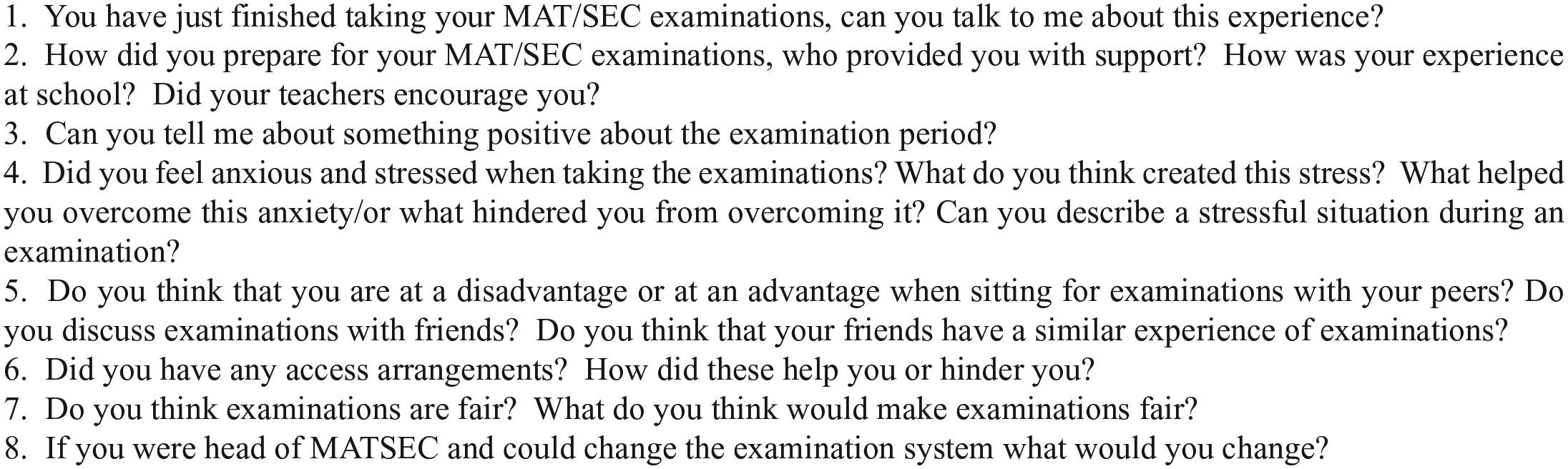
Semistructured interview questions.
Data Collection Procedure
The interviews were audio recorded and later transcribed verbatim. They were carried out individually or in pairs depending on participants’ preferences. Two of us were present during each interview. The interviews were carried out in either our offices or at the participants’ home, according to their preference.
Ethical Considerations
All ethical considerations as proposed by the American Psychological Association (APA)—beneficence and nonmalfeasance, fidelity and responsibility, integrity, justice, respect for rights, and dignity (APA, 2002, 2010a, 2010b)—were taken into account to ensure a principle-based approach to ethics in research where we adhered to moral principles (Wiles, Heath, Crow, & Charles, 2005). In line with the ethical requirements of the UM, approval was sought from and granted by the UM’s Research Ethics Committee (UREC). A letter of invitation and information, as well as consent forms, were provided for parents and the youth participants in Maltese and English. These documents included an overview of the present study, and indicating inter alia, information about the right to withdraw at any point from the study and a form asking for parents’ permission for participants who were under 18 years of age. Our contact details were included in the information sheet, and once participants accepted to participate, arrangements to carry out the interview at a time and place of their choice were processed. On the day, the purpose and outline of the study were explained to all participants and the withdrawal principle was reinforced. The informed consent form was then completed and signed.
Data Analysis
Data analysis used a narrative-discursive approach (Taylor & Littleton, 2006), where we located discursive themes or patterns (Reynolds et al., 2007) from within and across participants’ narratives (Spencer, Ritchie, & O’Connor, 2003). We wanted to elicit patterns across narratives, where established meanings became clear (Taylor & Littleton, 2006). Andrew came to the interview with a drawing (Figure 2) to express his pain and frustration about examination challenges in relation to the medium of access and output. These data present the participants’ own voices in poetic and prose form. The strophes allow readers to capture participants’ feelings and emotions. We embraced, adapted, and employed Spencer et al.’s (2003) analytical framework to complete the thematic analysis of the participants’ narratives.

Youth with dyslexia and examination stress.
Findings and Discussion
The youth narrated their recent experiences of the end of compulsory education (SEC) and pretertiary education (MATSEC) examinations (Government of Malta, 1991; Sultana, 1999; UM, 2013): Exams are a necessary evil You do need to test people’s academic skills and their knowledge In some form or other. Exams as a concept are not bad It is the way we handle them in Malta It is the way we set them The whole system It is a sort of mentality Everything is for the exam This detracts from the actual joy of learning Learning in Malta has become a means to an end Teachers teach how to pass the exam Rather than teach the subject This is the greatest tragedy The greatest negative of exams. (Luigi)
The youth valued examinations and were adamant that they did not want any preferential treatment, that they wanted to be certified for what the examination’s objectives stipulate, and that their marks should truly reflect their knowledge and skills of the particular subject being examined. Indeed, parents of candidates with special educational needs also assert that they do not want their children’s certificates to lose their educational currency. Nor do they wish their children to gain unfair advantages over other candidates (Farrugia & Commissioner for Education Office of the Ombudsman, 2017).
The youth’s narratives are presented in themes and subthemes (Table 1), where applicable.
Themes Elicited.

Theme 1: Sense of Fairness, Fair Play, and Social Equity
Youth participants were perplexed and upset that students with dyslexia have to experience unnecessary anxiety when what they are requesting neither affects examination objectives nor puts them at an advantage (Elliott & Marquart, 2004). Our premise that we must not forget that “exams are stressful for everyone not only for those who have a profile of dyslexia” (Susanna) and that one “can imagine that every child is anxious and nervous . . . but [having a profile of dyslexia] adds fuel to the fire . . . when there is something else” (Samuel) was echoed by the participants. Susanna added that she was “not talking about dyslexia-friendly . . . I think examinations should be young-people friendly . . . we are a still young . . . if you give a comprehension . . . it should be something that is relevant.” Luigi explained that “[t]he complaints I told you are complaints that everyone who has done examinations has experienced . . . so it isn’t isolated to people with dyslexia.” Bennett (2015) celebrated changes being made toward fair play and reflects that perhaps the most interesting example of qualitative change is the embedding of accessibility features directly into test delivery . . . universal tools (available to all students) include[ing] English glossary, highlighter, spell-check . . . and zoom. Designated tools include masking, colour contrast, text-to-speech (for all items except reading passages), and glossary translation . . . . Among the accommodations are text-to-speech . . . and closed-captioning (for listening items) . . . which allow students to show what they know. People with dyslexia are affected to a greater degree by these issues as the verbal-visual print is more of an obstacle and a hindrance. (p. 374)
This, Bennett argues, makes “their lives twice as difficult” (p. 374). The youth participants did not view dyslexia as a disadvantage in their lives: Dyslexia is neither ability nor a disability It is something that is There are positives and there are negatives to it Each of them outweighs the other It does hinder you in our scholastic system Finding work, Going to school . . . But it does have its up-sides The Creative Side Problem Solving The way you take in information It changes the way your brain is wired It is not a good thing It is not a bad thing It is OK to have Nothing is wrong with you You just have a few more steps to take. (Samuel)
Participants perceived dyslexia as a stumbling block when it comes to sitting for examinations because “I used to be very worried because I used to think that how I perform in the exam is going to affect my whole life” (Fabian), but . . . if you give them help you are not giving them something extra but you are giving them what they need to start off at par with the others who are not dyslexic. (Fabian)
In a national petition for the use of different media and presentations, Falzon and Camilleri (2014) noted, In assessing what media to use for an examination, one needs to look at the aims and objectives of the particular examination. In this document, we have taken the History SEC as an example. The aims and objectives of the History SEC, as well as its content, never indicate that reading and writing per se are required to pass History SEC. Why is it then such an issue and such a waste of human and financial resources for our system and for families to conclude whether candidates should sit for History orally, in typewritten format or handwritten format? This choice should be as basic as the choice of individuals wearing or not wearing their prescriptive glasses for examinations. (p. 1)
We further argue that even if we include writing—or rather the production of texts, which will be read by others in a different space and time—the use of different media of expression should also be another option to consider. Furthermore, writing ability—the ability to transfer thoughts into communicative language—has nothing to do with the ability of standard spelling or the use of fingers of hands to produce a text (Makeham & Lee, 2012; Riddell & Weedon, 2006).
Discretion and privacy
Participants felt that examination boards should be more respectful of their privacy. Strategies they found disrespectful included being sent to a central location, identification through different colors and name calling. “For our listening comprehension [the paper] is pink . . . and then when you go for the exam and there are other students whose paper is not pink . . . it’s very embarrassing . . . that is a label” (Valeria). Sasha indicated that “they come into the corridor and start shouting . . . these the ones with special needs?”
The examination human and ergonomic environment
The physical setting, management, and running of the examinations were also a source of stress for the youth participants and can be regarded as affecting fairness and equity (Ysseldyke & Algozzine, 1979). Matthew was negatively affected by a number of logistical issues which were, at best, absurdly not in place during his sitting and should have been addressed for the benefit of all students: Not enough light on the paper . . . I took my own rough paper . . . plain white paper so I could write on it before I write on the actual exam paper . . . so not to mess it up . . . the old woman came and told me . . . that I’m not allowed to bring any rough . . . I asked her what I was supposed to use as rough she told me to write on the table . . . it’s true . . . . (Matthew) I hate it that the exam is in a big hall . . . I am a panic station . . . Because I see all those other students . . . When we are in a room of about ten . . . I still panic but it is better than a hall with loads of people . . . . (Robert)
Valeria experienced the effect of lack of sensitivity and possible training of human personnel. She explained that, in spite of the fact that she had been granted extra time as an EAA when she “went in for my Home Economics Exam . . . there was an old man [the examination invigilator] . . . as soon as I walked in he told me ‘you don’t have any extra time’ and I said ‘I don’t have any extra time? But I do have extra time and I showed him the report with the allowance given to me by MATSEC’”: It was the first exam And I was already panicked And he told me ok . . . you have extra time . . . And I was relieved But then he spends the whole exam walking around me and making sounds . . . . I was going to explode and then when the normal time was up he came up to collect the papers and he told me time is up . . . “No, I have thirty minutes extra time” He kept on insisting that I had no extra time He took the paper from me My mother phoned MATSEC but they didn’t really do anything With the extra time I could have done better. (Valeria)
Participants also expressed concern that during examination sessions, the behavior of invigilators, coordination issues, and the environment increased their level of anxiety. They noted that this would have affected all students but, given the already increased anxiety, youth participants noted that such disturbances had a stronger effect on their performance during the exam: The invigilator stayed walking with high heels . . . tick . . . tick . . . tick . . . it was very distracting . . . repetitive noises are very annoying. (Susanna) Youth-participants also referred to lack of resources and adequate facilities. I spent two hours Just waiting for them To bring a laptop . . . You panic . . . What am I going to do If they don’t bring the laptop for me . . . This is all you need . . . The last straw . . . I stayed thinking I am not going to pass. (Susanna)
Theme 2: Academic Self-Concept and Stress
The literature refers to lower Academic Self-concept in students with dyslexia. This is often due to the medium of learning and performance and the emphasis placed on literacy during the learning and testing process (Alexander-Passe, 2015; Burden, 2008). Participants were upset, angry, and perplexed as to why Examination Boards are not distinguishing between actual examinations’ objectives, how a student may access examination and how a student can show what they know. Valeria noted that although her request to have the Mathematics graph lines blue instead of black was not acceded to, the Examination Board itself sent her the examination timetable on a differently colored paper (pink) to that of her friends (Yellow) who had no EAA. She considered this rather tongue-in-cheek, as the administration was using strategies Valeria had been denied.
Matthew was not given a reader and poetically expressed his stress level with regard to his Academic Self-concept: I was a bit scared Disappointed Frightened It was too challenging I did not know the outcome Like I was always revising in my mind . . . like what’s going to happen If I am going to read a word wrong[ly] And I cannot understand it properly That’s it The fact that I did not have a reader Caused a bit of extra stress a very dark stage of depression . . . during the exams and a bit after . . . when I got everything F-Fail [because] just the pure stress . . . the pressure . . . the idea that I was never going to succeed in life because I couldn’t get these damn marks . . . . (Samuel)
Unnecessary stress
When they were not given the EAA they were entitled to, which EAA had previously been given to them by their schools and recommended by professionals in the field, participants expressed disbelief, heightened anxiety, anger, and frustration and were deep hurt at not being understood and given the appropriate conditions, so that they could show their full potential during examinations. They were further upset because youths in other countries were given such EAA (Baird et al., 2001; Douglas, McCall, Pavey, & Nisbet, 2009; University of Oxford, 2017). They were very pragmatic that EAA would not assure them a pass but a level-play with their cohort, just like their peers “not judging a long jump with a high jump” (Samuel): If I had been given the concessions and I would have still failed I would have really been ashamed of myself Because that shows that I was ignorant That I didn’t put my mind to it entirely. If I [had been] given the concessions And I got the results which I think I deserved, I would have been pleased. Before the exam, I would have felt less nervous, I would have been calm, cool and collected Because I was confident with myself with my subjects (Samuel). If I had had more help during the exam I would have done better, At school, I was trained in one way And then When they didn’t give me the things that they should have given me It was difficult for me. (Valeria) Traumatised I was scared I couldn’t even breathe (Robert)
Susanna’s experience, on the other hand, was very positive because she was given the concessions she had requested: The extra time also helps because you say in your head I have an extra half an hour And what I don’t manage to do in the two hours I can catch up in extra time. You challenge yourself and try to finish in the earliest time possible Because the Access Arrangements are not going to be always with you But it is a great help.
Theme 3: Examinations and Perceived Abilities
Youth participants were particularly upset as they are very aware that their knowledge and abilities are not being reflected in the results of their national examinations, even if they have a profile of mild dyslexia. Andrew stated, “I know that the marks do not really reflect my true potential. A pity (Sighs), but there is nothing you can do.” Luigi added, “I myself, fortunately, have very limited dyslexia and I find that rather than hindering me as a whole, what dyslexia does is simply reduces my grades slightly.” Susanna reflected that although it is true that examinations cause undue stress and that the lack of adequate EAA lead one to “blank [ed] literally, I was looking at the paper, I know the answers, but my mind couldn’t function . . . and all those pressures, it’s scary, you spend about two days before not sleeping” and lower examination marks are a nuisance, she was aware that she views dyslexia positively “because you are capable of doing things that other people can’t. You think outside the box, not like everyone else . . . we think in a different way, more than other people.”
Luigi was very philosophical when reflecting on his MATSEC examination. He noted that whereas he was given extra time during his SEC examinations, he was then denied this EAA during his MATSEC because he performed well in his English SEC Examination. To note is that Luigi is bilingual and exceptionally bright and as he was given the extra time during his SEC examination, he achieved his deserved good mark (Bishop, 2001; Zuriff, 2000). This then became a liability for his MATSEC EAA. Luigi reflected that he felt penalized for doing his best and that if he had had extra time (during his MATSEC examinations), my level of anxiety would probably have been less as I would have had more time to work with and I found that in [SEC] level, even if I did not use that extra time, it being there at the back of my mind—that I had that extra 15 minutes—helped calm me down a lot . . . having those extra 15 minutes in Maths and Physics I would have been able to complete a whole other question . . . I would have gotten the question right . . . it would mean a difference in grade.
Assessing what students don’t know
Youth participants were very critical of the way papers are constructed, how questions are phrased, the amount of detailed information required as if “they want to catch you out” (Andrew) rather than encourage students to “show them what we know” (Andrew). Luigi angrily shared, Exams papers not being set correctly Being set in such a way That they penalise the student And try to catch him out On the things that [they] don’t know Rather than on things [they] know
Andrew echoed this anger and frustration and reflected that examination papers should make students share what they know and not be faced with what they do not know. He reflected that “it’s the approach” that was the problem. Fabian, Robert, and Susanna reflected, [Exams] always have a twist Like Physics We never know what they want They give you a sentence you know you have done it a thousand time But the play of words. You never really understand what they’re after. (Robert) The presentation is good But sometimes the questions were written In too elaborate a way I am not saying that you use baby talk But you do not need to have questions written In such a complicated way For example the London [Examination Board Examinations] They were short and simple And you could understand them. (Fabian) Written in a complication way You do not understand what you need to do. (Susanna)
Parents of students with disabilities similarly suggest greater use of “oral” examinations to replace some “written” ones, as well as the wider use of multiple choice tests. They cite the example of “comprehension” tests where students know the answers but find it difficult to express them in written form. They claim that the continental “viva voce” (oral) examination approach is a more valid one to overcome their children’s needs (Farrugia & Commissioner for Education Office of the Ombudsman, 2017).
Theme 4: The Support
When participants discussed what EAA would support them during examinations, they were very respectful of their friends and that they in no way wanted an advantage over other candidates but simply wanted a level playing field. Fabian explained, “because . . . if I have glasses but if someone else has no glasses, it only means that one has glasses for extra help, so are you then going to leave them without arrangements?” Susanna regarded this as a right which would not infringe on other students’ rights as she “believe[s] that if something is my right, I should get it. If I need something why shouldn’t I be given it, especially since I would not be affecting anyone else? I am not going to take any money from you, all I need is a laptop for the exam.” Participants were aware that examination and fairness is a very complex issue and that examinations will always put students at some level of disadvantage. Gipps and Stobart (2009) noted, We argue that 21st-century assessment will need to take ever more account of the social contexts of assessment and to continue the movement away from seeing fairness simply as a technical concern with test construction. Fairness in assessment involves both what precedes an assessment (for example, access and resources) and its consequences (for example, interpretations of results and impact) as well as aspects of the assessment design itself. (p. 105)
EAA
A number of EAA relevant to their needs were referred to. These include extra time, enlarged print, use of colored print of paper, use of the reader, alternative means of producing written work such as typing, voice-text technology aid (Table 2; Mogey, Cowan, Paterson, & Purcell, 2012). It should be noted that the university’s EAA Board only grants enlarged print for visually impaired students, and colored paper is not included as an EAA (UM, 2015).
Youth’s Recommended Examination Access Arrangements.

Stein (2001) noted that the talents of persons with dyslexia are often “described as holistic rather than linear; taking in the whole problem or scene statically at once and seeing possible solutions, rather than being confined to the conventional modes of thought that are small scale, sequential in space, time or logic” (p. 30). There is also a whole body of literature referring to diverse thinking and creativity in persons with dyslexia (e.g., Cockcroft & Hartgill, 2004; Everatt, Steffert, & Smythe, 1999; West, 1991). These data are poignantly summarized by Luigi, who reflected within the context of multiple intelligences and equity (Gardner, 1999): It was more a question of not having enough time to finish . . . I feel that personally, time limits hinder me extremely . . . I understand the arguments which are made in favour of time limits where, in the work environment, you . . . have deadlines . . . it is a valid reason but I feel that the way that exam papers are set, how they are written . . . in an unfair way . . . [all students are] literally racing against when trying to complete the questions.
The youth were aware of the difficulty of setting a fair paper that caters for the needs of different abilities and intelligences: It is hard to set a fair and good exam That tests the students appropriately And is also fair. (Luigi) Modernise the way they think examinations should be held They should be more open about different skills About different learning schemes And looking at different ways Of how they can present their examinations. (Matthew)
The MATSEC board stipulates specific assessment tests to be used by psychologists and specialist in Specific Learning Difficulty (SPLD). One of them is the Suffolk Reading Scale (Hagley, 2002) which has been standardized for the Maltese community. Samuel rationalized the incorrect use of such a tool to determine EAA: So we went to a psychologist . . . I believe I scored barely above the minimum I needed to get help [a reader] . . . I think by a few points . . . The tests were stupidly made. You were given a line of text like the sentence you have there . . . sorry, you were given words and you had to read the words and then you were given sentences . . . In an English exam, you have an entire composition in front of you. You have 150 words to get through. Whereas in the test you are given a word individually and I can pause and think to read it . . . it’s like judging a long jump with a high jump . . . it was very not well thought out . . . and because of that . . . I was denied the help needed . . . that ruined the exams for me. One . . . they couldn’t read my handwriting for sure . . . I can promise that . . . because even when I was done and went back . . . I don’t even know what that is . . . and two . . . because the spelling was bad . . . they weren’t actual words.
Sentence reading comprehension is a different ability requiring different skills (e.g., accuracy versus accuracy, fluency, and automaticity) from paragraph reading. Ironically, the measures used are very often a liability for students whose intellectual ability make them excellent candidates for university learning (Falzon & Camilleri, 2014). The successful performance on tests often depends on students’ ability to read, decode, comprehend, and respond to written text . . . [Students may be] unfairly disadvantaged by achievement tests that place a heavy burden on reading skills . . . text-based language that is straightforward, concise, and uses everyday words to convey meaning [plain language]. The goal of plain language editing strategies is to improve the comprehensibility of written text while preserving the essence of its message. (Hanson, Hayes, Schriver, LeMahieu, & Brown, 1998, p. 2)
Samuel was frustrated because he could compare with a different experience at the MCAST: MCAST is much more friendly than MATSEC . . . The first day I went to MCAST I was told by this very nice man that If you ever need anything for your exam Reader or scribe Come to this office two weeks before your exam And we’ll have them there for you . . . MCAST have offered me help . . . And when I asked for it they gave it to me . . . It’s more supportive . . .
Paper setting
Presentation of examination papers is another obstacle encountered by the youngsters, especially as the font used is Times New Roman and is often too small (e.g., O’Brien, Mansfield, & Legge, 2005; Rello & Baeza-Yates, 2013; Zorzi et al., 2012). Andrew explained that the paper . . . the things were spaced . . . but the English was a bit crammed . . . In physics . . . the paper was awkward . . . I worked past papers from 2006 till now . . . and then the paper was completely different which . . . when you see it . . . it is a bit of shock . . . the paper is not so packed sometimes the wording of the questions is complicated. (Fabian)
Evidence-based research indicates that the font used, the size of print, the benefits of left justified print affect access to print (e.g., Aziz, Husni, & Jamaludin, 2013; Jainta, Jaschinski, & Wilkins, 2010; Stiff, 1995). Likewise, Crisp, Johnson, and Novaković (2012) report that their findings emphasized the already accepted importance of ensuring that information [on examination papers] provided is clear, well-spaced and clearly labeled . . . use of bullet points may be advantageous in breaking up information and this also encourages better spacing of a page . . . important in relation to how those with dyslexia may have mild difficulties with short-term memory and possible deficits relating to visual pathways . . . thus may experience challenges with navigating through long sections of text. (p. 834)
Ironically, this was also demonstrated in a report issued by the UM’s MATSEC Support Unit (2017). For the 458 respondents participating in Part 1 of this study, Verdana was viewed as the most readable font while Times New Roman, which is the typeset currently used in MATSEC examinations, was viewed as the least readable one. These observations hold true irrespective of respondents’ “age, gender and condition as differences between respondents grouped using these factors were minimal” (p. 11).
Theme 5: The Youth Recommend
Modernise the way they think examinations should be held . . . They should be more open about different skills . . . And different learning schemes . . . And looking at different ways Of how they can present their examinations . . . . (Matthew) Obviously, the exam should not amount to your total grade on its own so in my opinion, you should have a certain amount of coursework or assignments that reflect your work and the effort you’ve done throughout the year. Obviously, if we are still going to have exams . . . qualified people who know what they are doing need to be employed to set the exams. It is hard to set a fair, good exam that tests the student’s appropriately and is also fair. (Luigi) If MATSEC doesn’t think that there is anything wrong with their examinations system . . . they should sit down and take all their exams themselves . . . they should put themselves in somebody else’s shoes . . . I would have more researchers at MATSEC to try and make the system better . . . . (Samuel)
Recommendations for Practice
These students’ narratives present key messages for examination boards, educators, and policymakers. They strongly recommend a change in the current form of examination systems, to “ensure that all students have improved opportunities to demonstrate their learning” (Scott, Webber, Lupart, Aitken, & Scott, 2014, p. 67). Participants argue that changes and transformation of the examination system require substantial: . . . effort and resources to be put into effect. Nevertheless, there are many minor changes and adjustments that could be easily implemented and these would have a significant impact on the learning success and achievement of children who experience challenges. (Scott et al., 2014, p. 63)
Participants expressed awe and frustration that their suggested minor changes and simple adjustments are not already available. These include changing the color of the examination paper, using larger and more dyslexia-friendly fonts, including oral and practical examinations together with written examinations, allowing the use of technology such as computers and having the examinations in a familiar setting such as the students’ own school. Such minor adjustments would minimize unnecessary discomfort and relieve extra strain on human and financial resources of examinations boards. Above all, such minor changes would not taint examination objectives.
However, the youth participants believe that, in the long term, there needs to be a complete transformation of the examination system, to ensure “fairness” and their well-being. Sarah suggested involving students themselves in the decision-making process and putting the individual needs at the heart of all assessment practices. This is a shift to “a participatory justice” (Cribb & Gewirtz, 2003) based on human rights and extended to children’s rights, providing them with “opportunities to participate meaningfully throughout the decision-making processes” (Elwood & Lundy, 2010, p. 346). Sarah, like Elwood (2013), argues that examination boards should “actively support and embed the consultation and participation of young people’s views” (p. 108) in any decision making about examinations. This is a radical shift from current views of assessment from “something that is being done to students to something that is being done with and for the students” (Klenowski, 2009, p. 89).
The Emperor’s New Clothes?
These findings make one reflect on serious issues of access to education, the validity of examinations, and social equity (Walker, 2003). Furthermore, it presented voices of youth who understood that social justice (e.g., Barclay, 2010; Riddell, Tinklin, & Wilson, 2005; Soler, 2009) does not mean getting an advantage but be treated with equity. Without a long-term plan, it is highly unlikely that examination boards will be able to prepare papers and examinations that meet the accessibility and usability needs of all individuals. Greater awareness and expertise of the special needs of different individuals would help in making examinations accessible to different types of learners and abilities (e.g., Chen, Keong, Teh, & Chuah, 2016; Edyburn, 2010; Maceri, 2003).
These youth do not want an advantage, they just want what they refer to as a level playing field (English & Steffy, 2001). In a context where the literature suggests that one can never get a level playing field in assessment (e.g., Elliott & Marquart, 2004; Gipps & Stobart, 2009; McArthur, 2016), the youth want to be given the opportunity to be able to show what they know and can do. They want to, like other youth, work hard for their success but want to be given the same opportunities when sitting for examinations, in the sense that the examination objectives are not negatively affected by choice of access to examinations (Chen & Keong, 2016).
The report issued by the Maltese Ombudsman, Commissioner of Education (Farrugia & Commissioner for Education Office of the Ombudsman, 2017), reiterates what the youth have voiced in this study. In this report, parents of children with “special needs” (p. 1) believe that the ADSC and MATSEC Boards can do more to help their children prove their true potential, obtain better examination results, and proceed to tertiary education. Farrugia and Commissioner for Education Office of the Ombudsman (2017) acknowledges the efforts of these two university entities to provide proper EAAs to candidates. He interprets the results of this study as a need for UM to adopt a more liberal approach to the EAAs it offers. Farrugia’s recommendations include larger and appropriate fonts—currently available only for visually impaired candidates (UM, 2015), the use of colored paper, quieter venues, and the presence of better-trained personnel in examination halls. Furthermore, Farrugia and Commissioner for Education Office of the Ombudsman (2017) stressed for more availability and use of electronic technologies. He advocated and stressed that the UM takes a bolder and a more innovative approach to examinations in order to make the whole assessment process fairer to all, irrespective of profiles of challenges. This is in line with literature which repeatedly refers to challenges with regard to fairness of assessment processes (Gipps & Stobart, 2009), as “[i]f practice does not change in the direction of congruence with research, the future of assessment looks bleak” (Ysseldyke & Algozzine, 1979, p. 10). 35 years on, the same concern still dominates our educational and political experiences: “[F]airness and equity is increasingly important considering the impact of globalisation, heightened awareness of educators of the diversity among students in their classrooms and the increased expectations of society that educators will address the learning needs of all students” (Scott et al., 2014, p. 68). Luigi encapsulates this political and social justice recommendation from a personal experience perspective: It is argued that genius is the fruit of imagination. Yet a person’s intellectual capacity is based on a single exam: with a structured set of rules everyone must comply too; where everyone is expected to recite their noted back to an examiner.
Providing a fair and equitable assessment process is a concern not just for students with dyslexia but for all students. These participants made it clear that they do not want to be advantaged and were sensitive to the challenges any student faces in examinations. This leads us to conclude to rethinking the whole assessment procedure. Perhaps, it is time to go beyond dry test scores and consider a “universal and flexible model for assessment . . . [with] greater emphasis [on] school . . . student and parent ‘voice’,” thus enabling a more homogeneous, flexible, and fairer system (Woods, Parkinson, & Lewis, 2010, p. 39).
Footnotes
Declaration of Conflicting Interests
The author(s) declared no potential conflicts of interest with respect to the research, authorship, and/or publication of this article.
Funding
The author(s) received no financial support for the research, authorship, and/or publication of this article.
