




Abstract
The cultures of China’s ethnic minorities, with their rich histories, languages, customs, and artistic expressions, form a vital part of Chinese civilization and global cultural heritage. In the digital era, preserving and revitalizing these traditions is increasingly important. This study investigates how Artificial Intelligence Generated Content (AIGC) influences consumer engagement with minority cultures. A questionnaire survey was conducted with 1,005 Chinese respondents to examine three core aspects: (1) the effects of different content production modes (User-Generated Content, Professionally-Generated Content, and AIGC) on consumer behavioral intention and cultural experience; (2) the influence of AIGC content types (functional, emotional, and entertainment) and application scenarios (entertainment, service, and commercial); and (3) the mediating role of flow experience in these relationships. Data were analyzed using PLS-SEM, Pearson correlation, multiple regression, and bootstrapped mediation analysis. Results show that AIGC in service and commercial contexts significantly enhances engagement, with emotional and entertainment content, particularly in PGC formats, enriching cultural experiences. Flow experience mediates most of these relationships. These findings highlight the potential of AIGC to support the digital preservation and interactive transmission of ethnic minority traditions.
Introduction
Artificial Intelligence refers to “programs, algorithms, systems, and machines that display intelligence” (Shankar, 2018). Driven by advances in deep learning, computing power, and big data, AI technologies are being increasingly integrated into various sectors. Among them, AIGC (AI generated content) technology has recently emerged as a transformative force in creative industries (Bengesi et al., 2023). AIGC not only enables the reconfiguration and digital enhancement of traditional artworks, but also significantly heightens audience engagement and attention (B. Gao et al., 2023), signifying its growing influence in content production and presentation.
Culture represents the most fundamental, enduring, and intrinsic force in the development of a nation. In today’s globalized world, approximately 3,000 ethnic groups exist across more than 200 countries and regions, with the vast majority of nations composed of multiple ethnic communities (State Council Information Office, 2009). In China, academic studies on ethnic minorities have yielded abundant results and have made notable contributions to the development of minority cultures. However, study on the protection and inheritance of ethnic minority culture is still limited (Z. Zhang, 2023), the methods of cultural protection are relatively simple (Farjami & Türker, 2021), mainly through traditional methods such as written records, audio or video interviews, and video recordings, only collect the actual situation of physical objects (J. Lu et al., 2024).
More structured approaches, including the renovation of ethnic museums, the incorporation of ethnic culture into school curricula, and the promotion of culturally themed tourism, have been partially implemented. Nevertheless, China’s traditional cultural heritage continues to face a critical risk of loss and disconnection from modern life (14th Five-Year Plan for the Protection of Intangible Cultural Heritage, 2021). In this context, it becomes imperative to keep up with the development of the times and constantly explore new ways and means to enable members of the nation and the general public to actively and spontaneously develop the nation’s unique culture.
With the iterative development of global technology, the digital content consumption has become widely embraced by consumers. In response, industries have actively adapted to evolving demands, placing increasing emphasis on technologies that effectively capture user acceptance and engagement (Wang et al., 2025). The emergence of AI technology on the basis of User-Generated Content (UGC) and Professionally-Generated Content (PGC) provides a new choice model for consumers (C. Wang, 2023).
These content production modes UGC, PGC, and now AI-generated content (AIGC) have demonstrated distinct influences on consumer perceptions and behavioral responses (Watts et al., 2021). Compared with traditional media formats, technologically integrated content offers more dynamic forms of interaction and fulfills consumers’ growing preference for personalized experiences (Meier et al., 2024), Furthermore, the application of AI in scene-based services enhances user immersion by embedding cultural content within interactive and contextual environments (Zhao et al., 2022).
Both tangible and intangible aspects of traditional culture continue to resonate with consumers. Cultural experiences, however, are no longer perceived as passive or symbolic engagements. They also carry significant potential for economic development, heritage preservation, and industry innovation. Despite these developments, existing research on consumer purchase behavior and experience with ethnic minority cultural products, especially those embedded in digital or AIGC formats, remains scarce. The literature lacks both theoretical integration and systematic empirical analysis, particularly in cross-cultural contexts (H. Zhang, 2010). Addressing this research gap is essential for understanding how technology mediates cultural participation and consumer decision-making in the digital age.
The protection and transmission of minority cultures are essential for preserving cultural diversity at both national and global levels. These cultures enrich the collective heritage of humanity and play a vital role in promoting cross-cultural exchange, mutual understanding, and trust among diverse communities. Such interactions are fundamental to achieving harmonious coexistence in a pluralistic world. Technological development has enriched the presentation of traditional content, but at the same time, the factors influencing audience consumption behavior have become more complex.
Against this backdrop, the present study explores how consumers experience and respond to AIGC, based on representations of ethnic minority cultures.
The research focuses on three key dimensions: (1) the mode of content production and dissemination (User-Generated Content, Professionally-Generated Content, and Artificial Intelligence-Generated Content); (2) the type of AIGC communication content, distinguishing between functional and entertainment-oriented formats; and (3) the application scenarios in which AIGC content is delivered, including entertainment, service, and commercial contexts. Secondly, based on previous research and actual conditions, this study proposes a mediating variable of flow theory. To investigate whether this factor moderates the cultural experience of ethnic minorities and the consumption intention of AIGC consumers. Accordingly, the study proposes the following research questions: First, does the mode of content production namely User-Generated Content (UGC), Professionally-Generated Content (PGC), and Artificial Intelligence-Generated Content (AIGC) influence consumers’ cultural experience of ethnic minority content and their intention to engage with AIGC-based products?
Second, does the type of AIGC communication content (i.e., functional vs. entertainment-oriented) affect consumers’ cultural experience and their behavioral intention to consume AIGC?
Third, do different application scenarios of AIGC such as entertainment, service, and commercial contexts impact consumers’ cultural experience and their intention to engage with AIGC content?
Fourth, does Flow Theory play a moderating role in the relationship between consumers’ cultural experience and their intention to consume AIGC?
This study argues that the dissemination of China’s minority cultures in the digital age is not only about cultural preservation and ethnic identity but is increasingly reflected in consumers’ behavioral preferences toward cultural products and content in both real-world and digital settings. Especially with the advancement of AIGC (artificial intelligence-generated content) technology, minority cultures can be digitally reconstructed through visual, audio, and interactive forms, making them more appealing and immersive (X. Gao et al., 2024). This re-creation not only enhances the efficiency of cultural dissemination but also influences consumers’ cognitive, emotional, and behavioral responses when encountering related cultural products.
In response to these challenges, this study defines “consumer behavioral intent” as: whether consumers are willing to experience, purchase, or actively disseminate content or products related to minority cultures with the assistance of AIGC technology. “Minority cultures” refer to cultural expressions such as ethnic art, language, beliefs, and festivals that are recreated or interpreted in AIGC media. By integrating content type, technological medium, and psychological mechanisms (immersive Flow experience), this study constructs a comprehensive pathway: cultural content → AIGC re-creation → Flow immersive experience → consumer behavioral intent, to reveal new mechanisms in cultural dissemination within contemporary expression and market interaction (M. Li et al., 2024).
To deepen the theoretical understanding, this paper systematically extends the “immersive experience” theory (Flow Theory) to the context of digital cultural dissemination, filling the interdisciplinary gap in research on the interactive mechanisms between AIGC technology and cultural content. The study constructs a “content generation, user experience behavioral intent” pathway model to reveal how AIGC plays a key role in promoting the acceptance, re-identification, and behavioral transformation of minority cultures (Xinyu et al., 2024).
Practically, the study offers multi-dimensional recommendations for cultural creators, AI developers, and policymakers, such as prioritizing the deployment of emotional or entertainment-oriented AIGC content in commercial and service scenarios to enhance user immersion and stimulate cultural participation. This audience-centric strategy not only facilitates the digital preservation and dissemination of intangible cultural heritage but also provides theoretical support and empirical evidence for cross-cultural exchange and the transformation and upgrading of the cultural and creative industry (Wu, 2025).
Theoretically, this study enriches the interdisciplinary understanding of digital cultural dissemination by integrating Flow Theory with AIGC application scenarios, thereby bridging the gap between consumer psychology and technology-driven cultural production. Practically, the research offers a decision-making framework for stakeholders to design immersive and culturally sensitive digital experiences, which can enhance cultural identity, drive user engagement, and foster the sustainable development of minority cultural industries in both domestic and international markets.
Literature Review
Technology Iteration Reconstructs New Ideas for the Consumption of Traditional Culture of Ethnic Minorities
The development of the digital technology era has not only continuously promoted the cultural industry, but also injected innovative vitality into traditional culture. The advent of the PGC (Professionally Generated Content) era marks a major shift between content creation and traditional communication methods. The emergence of PGC has made the dissemination of content more accurate, and the ability to understand audience preferences and behaviors through data analysis can improve the relevance of content (Malthouse et al., 2013), which in turn establishes a closer relationship with consumers, enhances consumers’ sense of identity and engagement with information, and increases their willingness to consume (Burgess & Green, 2009; Jenkins, 2006). The emergence of UGC (User Generated Content) has given ordinary consumers greater voice and creativity (Kaplan & Haenlein, 2010). Compared with PGC, UGC is characterized by being more personalized, emotional, reflecting real life and personal experience, enhancing consumer resonance. Its stronger interaction mode and engagement experience promote direct communication between the product and consumers and enhance consumers’ willingness to spend and brand loyalty (Bruns, 2008; Z. Ma et al., 2022; A. A. Pathak & Kaushik, 2024). The rise of AIGC has brought revolutionary changes to the content creation model, and at the same time, it has also reshaped the landscape of content dissemination. AIGC (Artificial Intelligence Generated Content) is significantly different from UGC and PGC in terms of communication and content presentation. Through advanced algorithms and machine learning techniques, AIGC is able to quickly generate high-quality content, outpacing human creators in productivity and scale (Anantrasirichai & Bull, 2022). This kind of automatically generated content is not only diverse in form, but can also be personalized to meet the needs of different consumers (Lei & Xing, 2024). However, at present, there are relatively few studies on AICG and consumer consumption intentions and behaviors in China, and more research on the impact of emerging technologies in a large field such as AI on consumers (Han, 2019). However, there are limited studies on AI technology from the perspective of consumer acceptance technology (Wang, Zhang, et al., 2024). Moreover, some studies have found that the application of AI in a specific environment may not have the same beneficial effect (S. J. Shi et al., 2024), so if we want to examine the argument of AIGC for consumers, we can only rely on previous research, indirect and preliminary understanding (L. Ma, 2024).
The organic combination of UGC and PGC solves the problem of one-way reception of content by the audience in traditional communication, and promotes the acceptance and inheritance of traditional culture by consumers in different ways in the dissemination of traditional culture. Bennett (2011) found that UGC provides a platform for ordinary users to share their personal understanding of traditional culture, making traditional culture more accessible and acceptable among the younger generation, stimulating interest, and promoting a sense of participation, thereby promoting the modern re-creation of traditional culture (Zhang et al., 2025). PGC, on the other hand, has professionally interpreted and promoted traditional culture through high-quality documents, documentaries, and cultural products, thereby enhancing its authority and influence (Koutromanos et al., 2023). The emergence of these two modes of production has enabled consumers to not only engage with traditional culture in an entertaining way, but also to understand its value and significance at a deeper level (Y. Li & Zhao, 2016). The advent of AI technology can analyze user preferences and generate personalized cultural content, especially virtual reality experiences, interactive applications, and digital art, which can effectively attract young people’s interest in traditional culture (Karterouli et al., 2021). AI lowers the barrier to cultural participation by automating and integrating large amounts of cultural data, making traditional culture easier to disseminate and share. Making complex traditional cultures more visible and understandable enhances consumers’ sense of identity and emotional connection . By analyzing consumer behavior, the data constructs consumer interest portraits and pushes personalized content for them, so that consumers’ experience of content can change from “let me see” to “I want” and finally “I recognize” (Zhang et al., 2024). Not only that, the interactive nature of AI technology enables consumers to actively participate in the creation and transmission of culture, encouraging them to share their personal stories and experiences, further promoting the active transmission of traditional culture (N. Wang et al., 2019). It not only injects new vitality into the dissemination of traditional culture, but also promotes cultural diversification and sustainable development.
National culture is the result of the long-term accumulation of national history. It forms the foundation of a nation’s current experience and serves as a pillar for its future development. In this context, the digital age introduces transformative potentials for cultural expression and communication. UGC, PGC, and AIGC represent three distinct modes of content production. Investigating their respective effects on public acceptance of ethnic minority culture and cultural consumption behavior is both theoretically significant and practically relevant (X. Huang et al., 2023; Niu, 2025). These modes differ in technical architecture, interactivity, and narrative engagement, all of which affect consumer cognition, emotional involvement, and identity formation (R. C. Pathak et al., 2025; Yu et al., 2024).
First, exploring the structural characteristics of each content mode helps us understand how to enhance the dissemination efficiency of minority cultures in an era of information overload. Studies show that while PGC ensures credibility and professional appeal (X. Huang et al., 2023), UGC fosters authenticity and emotional proximity among audiences (Atf et al., 2024). AIGC, with its algorithm-driven personalization and scalability, can dynamically align cultural narratives with user values and behavioral profiles (Ding et al., 2025; J. H. Han & Bae, 2022).
Second, the analysis of cultural acceptance and consumption willingness across these three production modes reveals not only technological influence but also the socio-psychological mechanisms of cultural experience (Babadoğan, 2024; Bögel & Upham, 2018). This perspective provides an empirical basis for market-oriented cultural communication strategies and supports adaptive policymaking in cultural industries.
Findings in recent studies affirm that when technologies are appropriately integrated into cultural narratives, they strengthen emotional resonance and collective memory, and can thus promote sustainable preservation and intergenerational transmission of intangible cultural heritage (Kasemsarn & Nickpour, 2025; Perera et al., 2024). Digital tools also provide cultural workers and policymakers with new paradigms to design more inclusive, diversified communication channels for ethnic minorities (Higgins et al., 2023).
Ultimately, when supported by participatory technology frameworks and consumer-centered content strategies, traditional cultures can evolve and thrive in contemporary society. This digitally mediated reactivation of cultural practices not only revitalizes ethnic identity but also contributes to the broader goal of cultural pluralism and national cohesion. Based on this, the study proposes
The Impact of AIGC Application on Traditional Cultural Acceptance Behavior
In the era of digital media, consumers receive more and more diverse types of information and are more and more interactive (Chen & Zhi, 2021). The type of market has shifted from audience demand to the market of ideas, and the pursuit of spiritual content has become an inevitable (C. Wang, 2023). Studies have found that different types of information have an impact on consumer behavior (Behnke et al., 2024). Different scholars have different definitions of content types, and content types are roughly divided into functional, emotional, entertaining, social, and informational (Sardar et al., 2024). Functional information often provides practical knowledge or guidance that can effectively meet consumers’ information needs and facilitate decision-making and action . The accuracy and clarity of this information tends to increase consumer trust, making them more inclined to act on advice. In contrast, entertainment information focuses on attracting attention and providing pleasure, and it increases the rate of sharing information by enhancing consumer engagement through humor, storyline, or visuals (M. Eisend, 2017). Emotional messages promote emotional connection and brand loyalty by elicit emotional resonance with the audience, such as sympathy, happiness, or nostalgia (Ladhari et al., 2017). The study also found that informational content boosts consumer engagement in the pre-consumer stage, while entertainment content increases consumer engagement in the post-consumer stage (Kim et al., 2019). Sardar et al. (2024) pointed out that different content attributes affect consumers’ purchase intention, and consumer participation plays a mediating role in content characteristics and purchase intention. Information often strengthens consumers’ sense of identity and makes them more willing to engage with relevant content or social activities. Therefore, it is of great significance to understand the communication characteristics of these different types of information and their impact on consumers to develop effective communication strategies. Therefore, the study further proposes
On the other hand, the different presentation methods of scenes not only affect consumers’ sense of experience and participation, but also affect the way consumers process information, so that they may rely more on emotional, practical or commercial interests when making decisions (Yin & Qin, 2024). The scene is a situation constructed in a specific spatio-temporal environment for specific participation themes to interact and connect in a specific way, and the spatiotemporal environment, participating subjects, and interaction methods are indispensable participation elements (Z. Ma & Lv, 2023). O. Duralia (2024) proposes that in the entertainment scene, the content is usually interesting and interactive, aiming to attract the audience’s attention and provide a pleasant experience, thereby promoting consumers’ active participation and information sharing. This kind of scene can enhance emotional resonance and increase consumers’ identification with the brand or content. In contrast, the service scenario emphasizes practicality and functionality, and provides an efficient service experience while meeting the specific needs of consumers (Bitner, 1992). Compared with the first two, commercial scenarios are also one of the types that have long emerged, influencing consumers’ purchase decisions through advertising, promotion and other means (Guo et al., 2020), and the paradigm research of application scenarios is helpful to standardize their personalized application in various fields. Understanding the differences in the application of different scenarios is essential to developing an effective content distribution strategy. Based on this scenario analysis, the study proposes
The linkage between content and scene innovation can promote the deep integration of consumer sensory experience and communication content (Zhan et al., 2023). With the support of artificial intelligence technology, it can help to enhance the sense of presence of content and bring consumers a new interactive experience (Sun et al., 2024). In China, many studies on AIGC focus on AIGC-related technological innovations, application fields, and its risk and ethical challenges, but ignore consumers’ consumption willingness and propensity in the process of AIGC development and application (Li et al., 2024). In the era of digital economy, AI has become an important driving force to promote the transformation and productivity of enterprises, and unlike traditional computers, AI has powerful algorithms and interaction mechanisms, which can conduct deeper interaction with audiences in different application scenarios. There may be new breakthroughs in AIGC’s capabilities in the future. At this stage, the dimension of China’s exploration of the impact of AIGC communication content and scenario application on consumers should be further expanded, and the impact on consumers’ behavioral willingness needs to be further verified.
Application of Flow Theory in the Presentation of AIGC Technology
The term “Flow Theory” was first coined in 1975 by United States psychologist Csikszentmihalyi. It refers to a state of mind in which oneself is naturally caught up in what one is doing like a stream of water. That is, when people are engaged in a certain daily activity, they are fully engaged and focused on the corresponding situation, filtering out other feelings that are not relevant (Biasutti, 2011).
Flow theory is studied in many fields such as psychology, art, sports, science, sociology, etc., and with the development of computer technology, flow theory has expanded to the study of human interaction and influenced the development of virtual reality (Zeng, 2015). Such technology is also widely used and researched in different spaces, such as museums, media art spaces, exhibition spaces, theme parks, healing spaces, and actively studies the value and model of flow theory input in space design. Flow-oriented design means making great use of space and stimulating the imagination. The introduction of flow theory design can greatly improve the sense of authenticity and experience, and the virtual reality presented in this way will coordinate the elements of reality and art to provide users with a realistic and perceptual experience (Z. Zhou & Yoon, 2024). Characterized by its deep immersion and full engagement with the character, immersive experiences are highly recognized for their positive psychological effects (Hang et al., 2024), and the significant effects of flow theory on user experience have also been found in the field of design in the field of artificial intelligence (Bae & Park, 2022).
Flow experience functions not only as a direct psychological outcome of high-quality digital content interaction but also as a mediating mechanism that connects external digital stimuli such as content format, informational richness, and contextual delivery with users’ cognitive and emotional responses. Recent research demonstrates that users in a flow state engage in deeper information processing and experience heightened emotional resonance, which strengthens content identification and significantly enhances behavioral engagement (W. W. Dong et al., 2023; Fang, 2024; Qin et al., 2023). As such, the flow mechanism offers a theoretical lens to understand how various cultural and technological variables may indirectly influence consumption intentions and cultural identity formation.
Empirical evidence further supports that flow states, particularly within contexts like livestreaming e-commerce or immersive virtual reality, amplify perceived enjoyment, time distortion, and attentional focus. These factors in turn predict users’ emotional and cognitive alignment with content stimuli (Song & Lu, 2024). Moreover, users experiencing flow are more likely to derive perceived value and satisfaction, two key predictors of sustained engagement and loyalty across digital platforms (Park et al., 2023). These findings reinforce the indirect effect role of flow experience and validate its function as a conduit through which content design and digital features impact downstream psychological and behavioral outcomes.
Recent scholarship also reveals that the degree and nature of flow experience modulate how users interpret and respond to digital content. D. Zhou et al. (2025), for example, emphasized that variations in cognitive immersion and emotional resonance within flow states significantly influence how users evaluate content quality and cultural relevance. Similarly, Z. Zhang et al. (2024) demonstrated that flow experience mediates the relationship between perceived algorithmic evaluation and service performance in the gig economy. Their study underscores how differentiated cognitive and affective processes, shaped by contextual factors such as viability challenges, impact user engagement and task outcomes.
Furthermore, studies have found that differences in the degree and type of flow experience will also have an impact on the experiencer’s perception of receiving the content (Samira et al., 2023), and Thomas and Baral (2023) also found that the flow theory design is conveyed through different paths, and the experiencer’s actions, cognition, and emotions will have different impacts. This leads to
The introduction of AIGC technology has even been continuously upgraded, providing users with a completely different flow experience from the past. It is of great value to investigate the application of flow theory in the design of AIGC technology, and to mediate the influences on the contact, feeling and effect of experiencers, and to design AIGC technology-related applications in the future (Figure 1).

Conceptual model of AIGC influence via mind theory.
Methodology
Population and Sampling Method
The population targeted in this study comprised Chinese digital content consumers who have been exposed to cultural representations of ethnic minorities, particularly in digital contexts involving Artificial Intelligence-Generated Content (AIGC). To enhance the representativeness of the findings and reduce sampling bias, a stratified random sampling method was employed. This approach stratified the population by four key demographic variables: geographical region, gender, age group, and ethnicity, ensuring proportional representation of diverse subgroups within the population. Such a sampling strategy is particularly suitable for studies aiming to generalize findings to a broader heterogeneous population (Alawadh et al., 2024).
The sample size consisted of 1,005 valid respondents, drawn from a widely used Chinese online survey platform during the period from September 1 to September 10, 2024. The final sample included 134 individuals identifying as ethnic minorities, with gender representation comprising 453 males and 552 females. The sample skewed younger, with 69.8% of respondents aged 18 to 25 and 73.0% possessing a university degree or higher. Additionally, to account for geographical diversity, the sample included participants from both urban and rural regions, with a notably high proportion from Sichuan Province, a region known for its ethnic heterogeneity.
The data collection adhered to ethical research standards. Participants were informed of the purpose and potential risks of the study and provided written informed consent. The principles of voluntary participation, anonymity, and confidentiality were strictly followed throughout the data collection process, which was previously detailed in the results section and is here appropriately relocated under methodology in accordance with reviewer feedback.
The high internal consistency and construct validity of the survey instrument (Cronbach’s α = .935; KMO = 0.951) further confirm the robustness of the data collection process.
Measures
To assess Chinese consumers’ perceptions, behaviors, and psychological engagement with ethnic minority cultural content in AI-generated digital contexts, the study employed a structured questionnaire composed of six key constructs. All scales were scored on a 5-point Likert scale (1 = strongly disagree; 5 = strongly agree). Unless otherwise noted, all items were adapted from existing literature or developed based on validated conceptual frameworks. Cronbach’s alpha values for all subscales exceeded the .85 threshold, indicating high internal consistency.
Content Production Mode
This 9-item scale was adapted from prior studies on digital content typologies and user engagement patterns (Leng et al., 2024; Ntoa et al., 2021; Zhang, 2024). It measured participants’ attitudes toward three content production models: Professionally Generated Content (PGC), User Generated Content (UGC), and Artificial Intelligence Generated Content (AIGC). Items assessed browsing habits, engagement (like/comment/share), and trust in different sources.
AIGC Communication Content
Based on information classification theory, this 9-item scale measured how users perceive AIGC-generated content across three dimensions: functional, emotional, and entertainment (Cover et al., 2024; Tang, 2023). Items were specifically contextualized to content related to ethnic minority intangible cultural heritage (ICH). Sample items include beliefs about value, relevance, resonance, and engagement.
Application Scenarios of AIGC
This 9-item scale categorized users’ willingness to use AIGC in entertainment (e.g., gaming, museums), service (e.g., government services, writing tools), and commercial (e.g., virtual live-streaming, AI endorsements) contexts. Based on use case taxonomies in emerging AI adoption literature (Kim, 2024; C. Wang, 2023; Zhan et al., 2023).
Flow Theory
Flow theory refers to the immersive experience in which the audience’s attention is highly invested in a certain thing, and the time perception is unbalanced (Doğan et al., 2024), referring to the “Flow State Scale” (FSS) compiled by Australia scholars Jackson and Marsh in 1996. The adapted 3-item version focused on immersion, time distortion, and attentional absorption while engaging with ethnic minority content online.
AIGC Consumption Intention
Adapted from Silva-Paz et al. (2024), this 3-item scale assessed users’ willingness to purchase, experience, or follow products/services that apply AIGC. It captures consumer purchase behavior in the context of AI-enhanced digital environments.
Ethnic Minority Cultural Experience
This 3-item scale was developed based on the framework by R. Lu and Li (2024) to evaluate how exposure to ethnic minority ICH via digital platforms fosters interest, engagement, and recognition of cultural distinctiveness. It captured the cognitive and emotional engagement of users in online cultural interaction.
Data Analysis Procedures
To systematically examine the proposed research hypotheses and validate the conceptual framework, a multi-step data analysis strategy was employed. Each step was theoretically driven and methodologically justified to ensure robustness, coherence, and empirical rigor across all stages of the study.
Step 1: Reliability and Sampling Adequacy Evaluation
To establish the foundational quality of the dataset and measurement instruments, descriptive statistics were used to summarize demographic characteristics of the sample, ensuring representativeness and diversity. Internal consistency of all constructs was evaluated through Cronbach’s alpha, while the Kaiser-Meyer-Olkin (KMO) test was used to confirm sampling adequacy for factor-based analyses. This step was essential to ensure the psychometric robustness of the scales before proceeding to structural modeling.
Step 2: Measurement Model Assessment via PLS-SEM
To assess the reliability and validity of latent constructs, the measurement model was evaluated using Partial Least Squares Structural Equation Modeling (PLS-SEM). Metrics including Composite Reliability (CR), Average Variance Extracted (AVE), Cronbach’s alpha, and Dillon-Goldstein’s rho were computed. The use of PLS-SEM at this stage was particularly appropriate due to its suitability for exploratory models and complex constructs involving psychological and behavioral dimensions. This analysis ensured that all measurement indicators reliably reflected their underlying theoretical constructs, thus reinforcing the construct validity of the research model.
Step 3: Correlation and Regression Analyses for Hypothesis Testing
To preliminarily understand the linear associations between the key variables, Pearson correlation analysis was conducted. This was followed by multiple linear regression analyses to evaluate the predictive effects of content production modes (UGC, PGC, AIGC), AIGC content types (functional, emotional, entertainment), and application scenarios (entertainment, service, commercial) on two key outcomes: AIGC consumption intention and ethnic minority cultural experience. The regression approach allowed for the isolation of unique effects within multivariate settings and addressed potential confounding relationships, thus providing clarity on the direct influence of independent variables on outcome variables.
Step 4: Mediation Analysis to Examine Psychological Mechanisms
To investigate the internal psychological process linking external stimuli (content type, production mode, scenario) to consumer response, flow experience was tested as a mediating variable. Mediation was assessed using bootstrapping (5,000 samples, 95% CI) as recommended by Hayes, which allowed for non-parametric estimation of indirect effects without assuming normal distribution. This step was critical to uncover the cognitive-affective pathways through which immersive digital content influences cultural engagement and consumption behavior, thereby deepening the theoretical contribution of the study.
Taken together, these four steps ensured a methodologically rigorous, theoretically grounded, and empirically validated examination of how AIGC-based digital content influences consumer behavior and cultural perception through psychological immersion.
Results
Measurement Model Evaluation
The reliability and validity of the measurement model were evaluated using several statistical indicators, including Composite Reliability (CR), Average Variance Extracted (AVE), Cronbach’s alpha, Dillon-Goldstein’s rho (DG.rho), and eigenvalue decomposition. As presented in Table 1, all constructs surpassed the commonly accepted thresholds CR and Cronbach’s alpha values above .70, AVE values above .50, and DG.rho values above .80 indicating strong internal consistency and convergent validity. Additionally, principal component analysis confirmed the unidimensionality of each construct, as the first eigenvalue (Eig.1st) was substantially larger than the second eigenvalue (Eig.2nd), eliminating concerns of multidimensionality. Collectively, these results affirm that the measurement model possesses robust psychometric properties and provides a sound basis for the subsequent structural model analysis.
Measurement Model Reliability and Validity.

The structural model was evaluated using path coefficients, factor loadings, and reliability statistics. Standardized path coefficients (β) were analyzed to assess direct relationships among constructs. As shown in Figure 2. flow experience (“Mind_theory”) significantly predicted both AIGC consumption intention (β = .512) and ethnic minority cultural experience (β = .890), indicating a strong mediating effect.

PLS-SEM path model.
Among the antecedents, entertainment information had the strongest influence on flow experience (β = .339), followed by functional information (β = .171), emotional information (β = .034), and entertainment scenarios (β = .215). Service and commercial scenarios had relatively weaker effects (β = .031 and β = .030, respectively).
Interestingly, no significant direct paths were found from UGC, PGC, or AIGC production modes to behavioral or cultural outcomes. These results reinforce the central role of psychological immersion in mediating the effects of content attributes on behavioral intention and cultural engagement.
Correlation Analysis of Content Production Mode, Information Type of AIGC Communication Content, Application Scenarios, AIGC Consumption Intention, and Ethnic Minority Cultural Experience
In this study, the Pearson analysis method was used to determine the relevance of each index in the dimension of content production mode to AIGC consumption intention and ethnic minority cultural experience according to the data results. The results of the analysis are shown in the following table:
From the results of Table 2, it can be seen that the correlations between UGC, PGC and AIGC and AIGC consumption intention were 0.488, 0.537, and 0.727, respectively, and p < .01, indicating that the correlation between the variables was significant. The correlations between functional, affective and entertainment information and AIGC consumption intention were 0.403, 0.543, and 0.526, respectively, and p < .01, indicating that the correlation between each variable and AIGC consumption intention was significant in the dimension of AIGC communication content. At the same time, the correlation coefficients between entertainment scenes, service scenarios, and commercial scenarios and AIGC consumption intention were .583, .674, and .844, respectively, and p < .01, indicating that each variable in the AIGC application scenario dimension had a significant correlation with AIGC consumption intention. Based on this, it can be seen that the variables in three dimensions, including content production mode (UGC, PGC, AIGC), AIGC dissemination content (functional information, emotional information, entertainment information), and application scenarios (entertainment scenarios, service scenarios, commercial scenarios), have an impact on AIGC consumption intention.
Correlation Analysis of Content Production Mode, AIGC Content, and Application Scenarios with Consumption Intention and Cultural Experience.

At the level of .01 (two-tailed), the correlation is significant.
Meanwhile, the correlations between UGC, PGC, and AIGC and ethnic minority cultural experience were 0.563, 0.655, and 0.572, respectively, and p < .01, indicating that the correlation between the variables was significant. Secondly, the correlation between functional, affective and entertainment information and ethnic minority cultural experience were .652, .726, and .738, respectively, and p < .01, indicating that the correlation between each variable and ethnic minority cultural experience was significant in each AIGC communication content dimension. Finally, the correlation coefficients between the entertainment scene, the service scenario, and the commercial scene and the cultural experience of ethnic minorities were .678, .608, and .528, respectively, and the p was <.01, indicating that the variables in the application scenario dimension of AIGC had a significant correlation with the cultural experience of ethnic minorities. Based on this, it can be seen that the variables have an impact on the cultural experience of ethnic minorities in three dimensions: content production mode (UGC, PGC, AIGC), AIGC dissemination content (functional information, emotional information, entertainment information) and application scenarios (entertainment scenarios, service scenarios, commercial scenarios).
From the data results, it can be seen that each variable has an impact on the consumption intention of AIGC and the cultural experience of ethnic minorities in three dimensions: content production mode, AIGC communication content, and application scenarios, which effectively verifies
Regression Analysis of Content Production Mode, Information Type of AIGC Communication Content, Application Scenarios, AIGC Consumption Intention, and the Cultural Experience Ethnic Minorities
In this part, multiple linear regression method will be used to analyze the causal relationship between the consumers’ AIGC consumption intention and ethnic minority cultural experience from the content production mode, information type of AIGC communication content, and application scenarios.
As can be seen from Table 3, the multiple regression analysis results of AIGC consumption willingness as the dependent variable are meaningful with the content production mode, AIGC dissemination content, and application scenarios as independent variables. and R2 = .755, good goodness of fit. F = 340.756, p < .001, indicating that the regression equation is significant.
Regression Analysis of Content Production Mode, AIGC Information Type, Application Scenarios, and Consumption Intention.a

R2 = .755. F = 340.756. p < .001.
Dependent variable: consumption intention.
The VIF was less than 5 and the tolerance was greater than 0.2, indicating that there was no multicollinearity between the variables. The significance of the three variables was less than 0.05, indicating that the AIGC (β = .151, p < .001) in the dimension of content production mode, the service scenario (β = .112, p < .001) and the commercial scenario (β = .608, p < .001) had a significant positive impact on the public’s AIGC consumption intention.
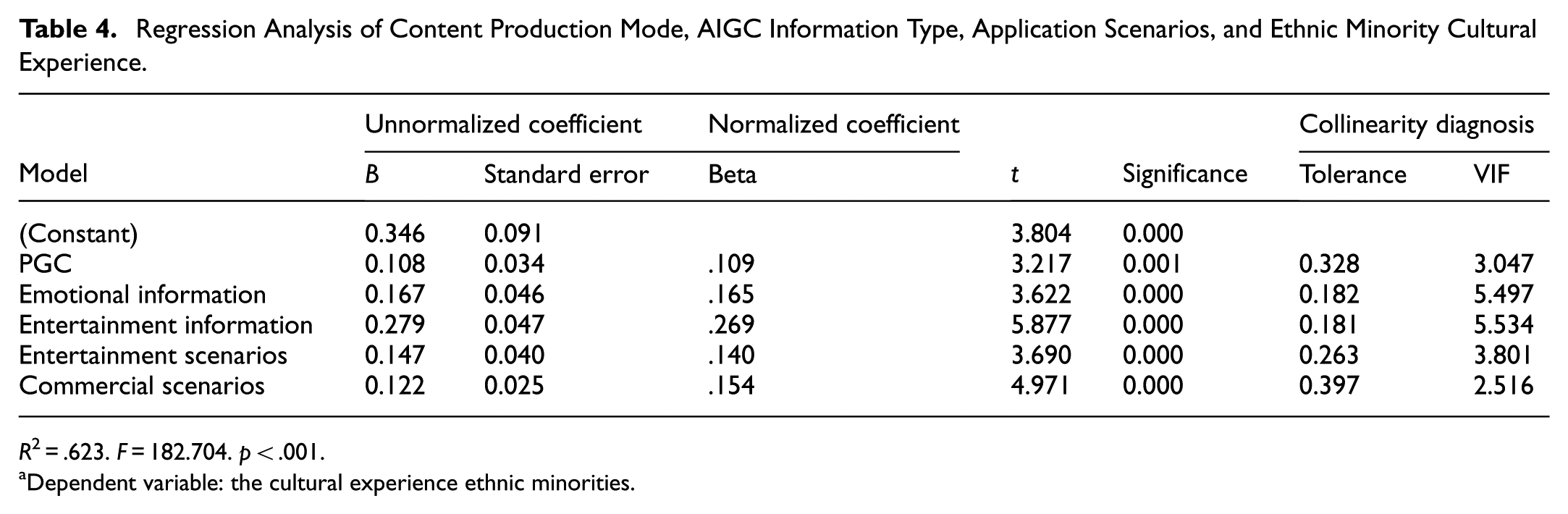
Table 4 shows multiple regression analysis with content production mode, AIGC communication content, and application scenario as independent variables, and AIGC consumption intention as dependent variables are meaningful. R2 = .623, indicating that the regression model had good goodness of fit, and F = 340.756, p < .001, and the regression equation was significant.
Regression Analysis of Content Production Mode, AIGC Information Type, Application Scenarios, and Ethnic Minority Cultural Experience.
R2 = .623. F = 182.704. p < .001.
Dependent variable: the cultural experience ethnic minorities.
The significance of the five variables in the three dimensions was less than 0.05, indicating that PGC (β = .109, p < .001) in the dimension of content production mode, emotional information (β = .165, p < .001) and entertainment information (β = .269, p < .001) in the dimension of content dissemination by AIGC, as well as entertainment scene (β = .140, p < .001) and business scene (β = .154, p < .001) in the dimension of application scenario < .001) The five variables had a significant positive impact on the cultural experience of ethnic minorities.
In summary, AIGC and its application in service scenarios and commercial scenarios have a significant positive impact on the consumption intention of the public’s AIGC, while the variables such as PGC, emotional information, entertainment information, entertainment scene and commercial scene have a significant positive impact on the cultural experience of ethnic minorities.
The Mediating Effect of Flow Theory
From the analysis of correlation data, it can be found that there are significant correlations between the variables under the three dimensions of content generation mode, AIGC communication content and application scenarios, and the public’s intentions to consume AIGC and the experience of ethnic minority culture. However, flow theory may affect the final decision-making behavior of users during the user experience process, so flow theory is introduced as a mediating variable. The Bootstrap method recommended by Hayes was used to test the mediating effect of flow theory, and the number of bootstrap sessions was set to 5,000, and the confidence interval was 95%, and the data results were as follows.
Based on the data results(Table 5), the indirect effects of flow theory are 0.0941 and 0.2650, respectively, and the 95% confidence intervals of Bootstrap are [0.0251, 0.1626] and [0.1557, 0.3654], respectively. However, if the confidence interval is [−0.1017, 0.0176] and the interval includes 0, the mediating effect is not established.
Analysis of the Mediating Effect of Flow Theory on AIGC Consumption Intention.

Table 6 shows that the indirect effects of flow theory are 0.4888, 0.5242, and 0.4754, respectively, when the content production mode, AIGC communication content, and application scenarios affect the cultural experience path of ethnic minorities. And the 95% confidence intervals of Bootstrap are [0.4349, 0.5247], [0.4438, 0.5994], [0.4181, 0.5382], respectively, and the interval does not include 0, indicating that the intermediary is established.
Analysis of the Mediating Effect of Flow Theory on the Cultural Experience of Ethnic Minorities.

The results of this data solve the fourth research question, in the content production mode, AIGC communication content, and application scenarios on the public’s AIGC consumption intention, and the cultural experience of ethnic minorities, flow theory has a mediating role in the content production mode, AIGC communication content, and AIGC consumption intention, and ethnic minority cultural experience. However, in the application scenario influence path, flow theory only mediates the cultural experience of ethnic minorities, but does not mediate the consumption intention of AIGC.
Discussion and Conclusion
Summary of Findings
This study empirically examined how AIGC technology influences consumer behavioral intention and ethnic minority cultural experience within digital environments. Drawing from a sample of 1,005 Chinese respondents obtained through stratified random sampling, the research analyzed the effects of three core dimensions content production mode (UGC, PGC, AIGC), AIGC content types (functional, emotional, entertainment), and application scenarios (entertainment, service, commercial) on two outcome variables: behavioral intention and cultural experience. The analytical strategy employed advanced methods, including PLS-SEM path modeling, multiple linear regression, Pearson correlation analysis, and bootstrap-based mediation testing. This methodological rigor ensured both statistical reliability and theoretical coherence.
The findings show that AIGC is dominant in influencing behavioral intention, particularly in service and commerce-oriented digital scenarios. This suggests algorithmic content is most persuasive when embedded in goal-driven or transactional contexts. Conversely, PGC had a more substantial effect on enhancing users’ engagement with ethnic minority culture, underscoring its value in conveying depth, authenticity, and cultural nuance (Xinyu et al., 2024). Among AIGC content types, emotionally expressive and entertainment-focused content were most effective in fostering both intention and experience, reflecting the importance of affective engagement in digital cultural interfaces (Zhang et al., 2024).
Notably, the study identified flow experience as a key mediating mechanism explaining how content configurations shape cognitive-cultural and behavioral responses. This mediation effect was consistently significant across most pathways, particularly for content type and production mode. Still, it was absent in the application scenario-to-intention pathway, where direct situational cues appeared to override immersive psychological processing. However, the study also recognizes that a high level of technological provision does not always yield better outcomes. The mere application of emerging technologies or interactive features does not inherently promote positive user attitudes (Choi et al., 2022). The efficacy of flow experience in such learning environments is intricately tied to the quality of interaction (Doğan et al., 2024). Furthermore, while AIGC technology continues to evolve, its novel deployment in specific environments does not automatically translate into more favorable learning effects (W. Shi et al., 2025). Collectively, these results offer empirical validation for all proposed hypotheses while also cautioning against over-reliance on technological novelty without contextual alignment.
Theoretical Contributions
This study contributes to the theoretical literature in three major ways. First, it extends Flow Theory beyond its conventional domains of marketing and gaming into the relatively underexplored territory of digital cultural engagement. By positioning flow as a mediating cognitive-affective mechanism, the study confirms that immersion not only enhances user enjoyment but also deepens cultural interpretation and behavioral activation. This application marks a significant theoretical expansion of flow’s domain, suggesting its relevance in socially significant and identity-forming contexts such as ethnic cultural heritage (Z. Huang et al., 2024).
Second, the study proposes and validates an integrative model that connects digital content production paradigms (UGC, PGC, AIGC) with layered psychological responses and behavioral outcomes. Unlike earlier models that examined these elements in isolation, this framework foregrounds the interplay between production logic, content perception, and user cognition. In doing so, it clarifies how different forms of digital mediation influence affective immersion and behavioral response through distinct psychological routes. This theoretical positioning fills a critical gap in literature concerning AIGC’s influence on cultural re-identification and digital heritage consumption (A. Gao, 2024).
Third, the research reconceptualizes AIGC not merely as a technological innovation but as a cultural interface, a platform through which values, traditions, and identities are rearticulated digitally. It highlights AIGC’s role in shaping cross-cultural narratives and user experiences by linking digital communication technologies with the affective and cognitive dimensions of cultural psychology. This reconceptualization provides a novel theoretical bridge between AI systems, human engagement, and cultural meaning-making, contributing to a broader understanding of how technological environments reshape human interaction with intangible cultural heritage (H. Dong, 2025; Yi, 2025).
Practical Implications
The study yields a set of actionable recommendations for digital content developers, AI system designers, cultural institutions, and policy stakeholders. First, emotionally and entertainment-centered AIGC content should be prioritized in campaigns and platforms aimed at promoting minority cultures, as this type of content most effectively triggers user engagement and immersive response. Incorporating adaptive narrative elements, esthetic enhancements, and emotionally resonant imagery into AI-generated cultural content can elevate the user’s experiential quality, making intangible cultural expressions more relatable and memorable (Liu et al., 2024).
Second, hybrid models that combine the narrative authenticity of PGC with the generative flexibility and scalability of AIGC are particularly promising. Such configurations allow for culturally rich storytelling while benefiting from the efficiency and personalization capabilities of AI. Policymakers and funding agencies should actively support these collaborative models, especially initiatives led by ethnic minority creators or community representatives. These efforts would not only enhance representation but also promote digital inclusivity and equity (Chiang et al., 2025).
Third, AIGC platforms should be designed with user-centered and culturally adaptive principles. To enhance flow and cultural resonance, systems must consider user segmentation by age, region, ethnicity, and technological literacy. To optimize engagement, features like personalized content delivery, multilingual support, interactive learning modules, and feedback loops should be integrated. However, as highlighted by recent literature, technological enhancement alone does not guarantee user satisfaction or learning efficacy. The quality and relevance of interaction play a pivotal role (Choi et al., 2022; Doğan et al., 2024). For digital natives in particular who play a central role in shaping and disseminating digital culture, such inclusive and context-aware design approaches can significantly strengthen the emotional and cultural impact of AIGC experiences (Liang & Ren, 2025).
Despite the study’s contributions, several limitations must be acknowledged. The sample was limited to Chinese digital users, which, while appropriate for the research context, constrains the generalizability of findings to other cultural or national settings. With the rise of technologies like AIGC, prior research has emphasized the importance of cross-cultural sampling to enhance the validity of consumer behavior models in distribution contexts (Nguyen et al., 2021; Rai et al., 2023; Yoon-Joo & Ahn, 2021). The reliance on self-reported survey data may also introduce common method bias, suggesting the value of incorporating behavioral or physiological measures in future work. Additionally, the cross-sectional design prevents the examination of temporal shifts in AIGC engagement or cultural perception over time. Finally, although the study highlights flow experience as a key mediator, it does not explore potential moderators such as digital literacy, prior cultural exposure, or AI trust, which could provide deeper insight into user variability. Future research should consider cross-cultural comparisons, longitudinal tracking, and extended models to address these gaps and build on the present study’s framework.
Footnotes

Ethical Considerations
The procedures used in this study adhere to the tenets of the Declaration of Helsinki.
Consent to Participate
The potential risks associated with this study were clearly explained to all participants prior to obtaining written informed consent. The study was conducted in accordance with the ethical standards of the Declaration of Helsinki and the APA Ethical Principles of Psychologists (Section 8.05). Given the nature of the research, which involved an anonymous online questionnaire with no sensitive or intrusive questions, formal ethical approval was not required by Xihua University. Participants were informed of the study’s purpose and their right to withdraw at any time. Informed consent was obtained before participation. No personally identifiable information was collected, and all responses were treated with strict confidentiality. The study followed the principles of voluntary participation, data anonymity, and protection of participant welfare throughout the research process.
Funding
The authors disclosed receipt of the following financial support for the research, authorship, and/or publication of this article: Li Bing Research Center, Sichuan Provincial Key Research Base of Social Sciences: Ethnic exchanges, exchanges, and integration from the perspective of cyberspace in the era of intelligent media. LBYJ2024-015. The Digital Culture and Media Research Base: Research on the application of AIGC technology and the communication of ethnic culture: focusing on the experience, consumption and inheritance of ethnic minority culture. SC24DCM15.
Declaration of Conflicting Interests
The authors declared no potential conflicts of interest with respect to the research, authorship, and/or publication of this article.