




Abstract
This study addresses a critical gap in the existing literature that predominantly examines corporate governance and market mechanisms as determinants of corporate social responsibility (CSR) while overlooking inter-firm interactions. By analyzing panel data from Chinese A-share listed companies (2011–2023) through a peer effect lens, we systematically investigate how peer firms’ CSR engagements influence focal firms’ CSR adoption and subsequent stock price crash risks. Our empirical results demonstrate a pronounced peer effect on CSR behavior that is particularly amplified by industry leaders’ CSR initiatives. Meanwhile, we uncover a central paradox: this same peer CSR engagement, while exhibiting positive spillover, significantly elevates stock price crash vulnerability, a counterintuitive finding that challenges conventional wisdom. Robustness checks employing alternative model specifications and subsample analyses confirm the stability of the results. To mitigate endogeneity concerns, we implement an instrumental variable approach using the density of religious institutions in firms’ headquarter cities as an exogenous CSR determinant. The persistent significance of our findings across methodologies underscores the dual-edged nature of CSR peer effects. This study provides novel insights for optimizing CSR implementation strategies and informs regulatory frameworks for sustainable capital market development. It also advocates policy interventions that guide industry leaders to standardize CSR practices and incentivize corporations to adopt value-driven CSR initiatives that reconcile social impact with strategic value creation.
Plain Language Summary
This study finds that when Chinese listed companies decide on their social responsibility activities (e.g., charitable donations or environmental projects), they are significantly influenced by what other firms in their industry are doing-a “follow-the-crowd” or peer effect. This tendency is especially true when industry leaders increase their social spending. However, this peer-driven adoption of social responsibility has a surprising downside: it increases the risk of a sharp, sudden drop in firms’ stock price. We show that when firms imitate their peers, their social responsibility practices often become superficial and are used to mask underlying problems. This condition creates a fog of misleading information in the market, allowing negative news to build up unseen until it is suddenly released, triggering a stock price crash. Our results suggest that for the healthy development of capital markets, companies must be encouraged to adopt social responsibility for its genuine value rather than merely following industry trends.
Keywords
Introduction
Recent high-profile corporate incidents in China, including Dripping Travel’s ride-hailing safety controversy, JiuGui Liquor’s plasticizer contamination event, and Changsheng Biologicals’ vaccine quality scandal, have ignited widespread societal scrutiny. The prolonged stock depreciation observed in JiuGui Liquor and Changsheng Bio post-crisis has particularly intensified academic and regulatory attention toward corporate social responsibility (CSR) commitments. Current scholarly investigations into CSR determinants predominantly concentrate on corporate governance structures (Khan et al., 2013; Velte, 2023; Zaman et al., 2022), market mechanism dynamics (Awawdeh et al., 2022; Nofsinger et al., 2019), and executive behavioral characteristics (Cacioppe et al., 2008; Xu & Ma, 2022), but they systematically neglect interorganizational interaction mechanisms within business ecosystems.
This analytical gap is particularly salient when considering the institutional dynamics of China’s evolving capital markets. Corporate actions are fundamentally embedded within socioeconomic networks where isomorphic pressures exert substantive influence (Xie et al., 2023). An example is the Shanghai Stock Exchange’s 2008 mandatory CSR disclosure policy that triggered a cascading adoption effect, with voluntary reporting entities increasing from 518 to 2,211 in 2009–2023 per Runling Global Responsibility Ratings (RKS), representing 65% of A-share market capitalization with a 12.7% compound annual growth rate. The exponential diffusion of CSR practices invites critical interrogation of the underlying drivers, that is, whether they reflect genuine organizational citizenship or constitute strategic responses to institutional isomorphic forces. Academic discourse bifurcates markedly between agency theory interpretations, which conceptualize CSR as managerial self-interest vehicles exacerbating information asymmetry (Y. Kim et al., 2014; Y. Liu et al., 2025) and consequently amplifying stock crash vulnerability through distorted market perceptions (Dai et al., 2019; Zhou et al., 2021), versus stakeholder value paradigms, which demonstrate CSR’s instrumental efficacy in reducing capital costs via reputation signaling (Yao et al, 2022) and enhancing debt restructuring capacity through relational capital formation (Uyar et al., 2024; Wu & Hu, 2019), ultimately attenuating crash risks through improved market confidence mechanisms (Fang, 2023; Hawn & Ioannou, 2016; Zaman et al., 2021).
Hence, this study aims to examine the precise impact of CSR peer influence on firms’ stock price crash risks. This study empirically investigates the presence of a CSR peer effect and its impact on stock price crash risks among publicly listed companies from 2011 to 2023. The findings reveal the following (1) CSR fulfillment involves a noticeable peer effect, indicating that a company’s CSR practices are significantly influenced by those of its peers, leading to a trend of alignment in CSR practices among companies. (2) Industry leaders and followers shape companies’ CSR practices, with leaders having a stronger impact. (3) The CSR peer effect contributes to an increased risk of stock price crash and raises the likelihood of a stock price crash occurring. This result suggests that the CSR peer effect aligns with the managerial agency perspective by increasing firms’ stock price crash risks.
This study significantly advances existing scholarship through three critical dimensions of theoretical extension. First, building upon prior investigations that predominantly examined CSR adoption through isolated organizational lenses, whether driven by external market coercions (Nofsinger et al., 2019) or internal governance configurations (Bizjak et al., 2008; Hsu & Chen, 2023), we pioneer an industry-level analytical framework that systematically deciphers the reciprocal dynamics of CSR convergence through peer-driven behavioral contagion mechanisms. This paradigm shift not only broadens the conceptual boundaries of CSR research but also empirically substantiates how strategic interdependence among industry participants shapes collective sustainability practices. Second, extending beyond conventional peer effect scholarship, which has concentrated on financial decision convergence in executive compensation (Parsons et al., 2018; Shu et al., 2024), reputational herding (Kaustia et al., 2023), and capital structure alignment (J. Liu et al., 2023; Shen et al., 2014), we establish substantive evidence of institutional isomorphism in nonfinancial CSR domains, thereby redefining the theoretical parameters of peer influence mechanisms to encompass ethical governance dimensions. Third, diverging from the predominant crash risk literature’s emphasis on governance deficiencies (Fu et al., 2024; J. B. Kim et al., 2019), our analysis uncovers the paradoxical market destabilization effects inherent in CSR conformity, demonstrating how peer-induced symbolic compliance strategies amplify information asymmetry through standardized disclosure rituals. These interconnected contributions collectively equip stakeholders with an integrated analytical framework for evaluating peer contagion risks and provides regulators with evidence-based criteria to differentiate substantive CSR commitments from strategic legitimacy-seeking behaviors.
The rest of the paper is structured as follows: Section “Literature review and research hypotheses” covers the literature review and research hypotheses. Section “Research design” discusses the research design, including the sample selection, data sources, and empirical model design. Section “Empirical analysis” presents the empirical results, analyses, robustness tests, and addresses endogeneity issues. Section “Discussion” provides a discussion of the empirical results, linking findings to theoretical frameworks and existing literature. Section “Conclusions and policy implications” summarizes the key findings, theoretical contributions, and policy implications. Section “Limitations and avenues for future research” describes the research limitations and avenues for future research.
Literature Review and Research Hypotheses
Theoretical Polarization and Meso-Level Blind Spots in CSR Scholarship
Rooted in sociological inquiry, the conceptual framework of peer effects was initially postulated by Manski (1993) to explain the behavioral synchronization mechanisms through which social ecosystems cultivate conformity in decision-making patterns under conditions of information asymmetry and environmental volatility. Building upon this theoretical foundation, corporate finance scholarship has progressively expanded its analytical scope beyond traditional proxy voting studies to elucidate peer-driven dynamics in strategic financial operations. The pioneering work of Leary and Roberts (2014) empirically demonstrated that industry peers exert a substantially stronger influence than firm-specific characteristics on shaping capital structure decisions, fundamentally reorienting conventional financing theories. Subsequent investigations by Cronqvist et al. (2012) delineated the geographical dimensions of misconduct propagation, revealing that spatial proximity significantly elevates financial malfeasance propensity when neighboring firms share operational scale or executive demographic profiles. This spatial contagion paradigm was further substantiated by Parsons et al. (2018), who identified self-reinforcing cycles of ethical erosion within localized corporate clusters. Complementing these findings, Kaustia and Rantala (2015) revealed a marked temporal interdependence in equity issuance decisions, establishing that firms demonstrate strategically responsive behavior in aligning their financing activities with their successful industry counterparts. The architecture of peer effects manifests across multiple financial domains, including isomorphic compensation benchmarking (Bizjak et al., 2008), disclosure ritualization (Seo, 2021; Shroff et al., 2017), refinancing herding behavior (Billett et al., 2023), and dividend policy convergence (Alabdullah & Zubon, 2023; Angelidis & Ibrahim, 2004), collectively illustrating how organizational decisions become embedded within inter-firm mimetic networks.
CSR has garnered substantial academic scrutiny, with the prevailing scholarship bifurcating into two antithetical theoretical frameworks rooted in divergent philosophical foundations. The agency theory paradigm, as articulated by Ramanna (2020), conceptualizes CSR engagements as managerial rent extraction mechanisms, wherein executives strategically appropriate reputational benefits while externalizing the associated risks and compliance costs onto shareholders, thereby engendering a fundamental misalignment of incentive structures. This principal–agent discord manifests most acutely in environments characterized by weak corporate governance and opaque disclosure practices. Conversely, neoclassical economic critiques, exemplified by Barauskaite and Streimikiene (2021), posit CSR as a non-value-enhancing diversion of scarce resources, contending that such discretionary expenditures distort capital allocation efficiency while exposing firms to regulatory overreach and activist shareholder interventions, which are particularly detrimental to industries operating within razor-thin profit margins or commoditized markets. Counterbalancing these perspectives, empirical investigations delineate CSR’s multifarious value creation pathways: socially conscious consumer cohorts demonstrably confer pricing premiums and patronage loyalty to ethically positioned firms (Coelho et al., 2023; Sarfraz et al., 2023), capital markets systematically attenuate financing costs through enhanced disclosure credibility and risk mitigation signaling (Yao et al., 2022), and reputational capital accumulation fosters organizational resilience against exogenous shocks through stakeholder forbearance mechanisms (Tangngisalu et al., 2020). This theoretical plurality underscores CSR’s context-contingent efficacy, wherein performance outcomes are mediated by industry-specific dynamism, institutional governance architecture, and competitive landscape configurations. Crucially, extant research remains circumscribed by its predominant focus on firm-level antecedents and outcomes and largely neglects the meso-level institutional isomorphic pressures and interorganizational imitation dynamics that permeate strategic CSR decision-making, a critical gap when juxtaposed against the peer effect paradigms prevalent in adjacent corporate finance scholarship.
Industry Peer Effects in CSR Adoption: Tripartite Institutional Mechanisms
CSR adoption exerts significant intra-industry peer effects driven by three institutional mechanisms: agency conflicts, environmental uncertainty mitigation, and competitive isomorphism. From the agency theory perspective, industry-wide CSR investments enable managerial opportunism by providing strategic camouflage for self-serving resource allocations (Ramanna, 2020). Executives align social initiatives with peer firms to obfuscate discretionary expenditures behind collective normative benchmarks, transforming CSR into an institutionalized, legitimizing shield that externalizes agency costs across industry networks. Environmental uncertainty amplifies this dynamic through cognitive cascades: when managerial career risks escalate because of volatile operating conditions, peer firms’ aggregated CSR commitments establish sector-specific “safe harbor” thresholds (Cronqvist et al., 2012). This institutionalized risk-sharing mechanism reduces individual accountability by normalizing socially acceptable investment levels, thereby effectively socializing operational risks through mimetic isomorphism. Competitive pressure reinforces adoption patterns through dual market channels. In product markets, rivals’ CSR positioning erodes nonconforming firms’ consumer attractiveness and talent acquisition capacity while capital markets systematically penalize CSR laggards through elevated financing constraints and valuation discounts (Yao et al., 2022). Signaling theory elucidates the equilibrium outcome: firms strategically mirror industry norms to circumvent adverse selection penalties in factor markets while capturing reputation premiums through differentiated stakeholder engagement (Sarfraz et al., 2023). These self-reinforcing mechanisms propagate CSR practices through structural coupling with peer behavioral patterns, creating path-dependent adoption trajectories in which social strategies adapt to dynamically evolving industry standards rather than reflecting isolated organizational choices. The resultant peer effect manifests as the systemic integration of CSR into competitive logic, driven by the interplay of reputational economics, cognitive anchoring, and market discipline. Based on the above analysis, this study proposes Hypothesis 1:
Dual Pathways of CSR Peer Effects: Leadership Influence and Follower Innovation
The emergence of peer effects in CSR adoption within industries is contingent upon firms’ hierarchical positions and strategic motivations. Lieberman and Asaba (2006) empirically established that under conditions of high environmental uncertainty and ambiguous organizational objectives, firms exhibit pronounced mimetic tendencies toward industry peers characterized by larger operational scale, superior financial performance (e.g., higher return on assets [ROA] or profit margins), or elevated market status. This behavioral pattern stems from leaders’ perceived informational advantages in interpreting regulatory trends and stakeholder expectations, as well as their capacity to absorb CSR implementation risks. Through longitudinal analysis, Adhikari and Agrawal (2018) further confirmed that structurally disadvantaged firms, particularly those with smaller market shares or weaker balance sheets, mechanically replicate industry leaders’ CSR policies to mitigate learning costs, align with institutional norms, and avoid reputational penalties. The inherent valuation ambiguity of CSR investments, as framed through agency theory debates, amplifies this vertical imitation dynamic: when executives face uncertainty about whether CSR expenditures enhance or erode shareholder value (e.g., through potential regulatory benefits versus short-term profit dilution), they disproportionately benchmark decisions against observable leadership practices, thereby propagating top-down peer effects (Hypothesis 2a).
Nevertheless, the institutional mechanics of imitation have critical boundary conditions. Posen et al. (2023) empirically demonstrated that firms with severe resource constraints (e.g., limited R&D budgets or thin management bandwidths) exhibit diminished capacity to replicate complex CSR architectures, even when leadership models are available. Concurrently, the legitimacy theory perspective of King and Whetten (2008) reveals that follower firms occupying peripheral market positions often face intense pressure to justify differentiation rather than conformity. This paradox catalyzes alternative peer effect pathways: strategically disadvantaged firms frequently pioneer novel CSR initiatives, such as community-specific philanthropy or supply chain transparency innovations, to circumvent competitive asymmetries and cultivate unique brand identities. Successful differentiation through such CSR entrepreneurship generates horizontal imitation waves, as peer followers emulate demonstrably effective models that combine social impact with measurable competitiveness gains (e.g., customer acquisition rates and investor confidence indices). The growing societal valuation of CSR commitments across the consumer, investor, and regulatory domains further amplifies this bottom-up contagion mechanism (Hypothesis 2b).
The Interplay of CSR Peer Effects and Stock Price Crash Risks: An Information-Based Framework
The extant literature on stock price crash risks, grounded in agency theory, often characterizes CSR as a managerial tool for reputation engineering that may undermine shareholder value (Carran et al., 2023; Karpoff, 2021). This view is particularly salient in emerging markets such as China, where firms may use strategic philanthropy to obscure misconduct, thereby eroding valuation anchors and amplifying crash risks (Ying et al., 2024). We extend this logic by arguing that when CSR adoption is driven by mimetic isomorphism, that is, the imitation of industry peers, it often results in symbolic compliance. This strategic posturing not only distorts value creation but also critically impairs the corporate information environment in a manner that predisposes firms to crashes.
The crucial yet underexplored link between CSR peer effects and crash risks is informational isomorphism. As investors cannot directly observe managerial intent, which is a fundamental condition of information asymmetry (Jensen & Meckling, 1976), they must infer firm quality from observable signals such as CSR disclosures. A strong peer effect fosters homogeneity, leading to standardized, ritualized reporting that converges toward an industry template (Chen et al., 2025). This “cookie-cutter” approach triggers a self-reinforcing cycle of opacity. First, the collective legitimacy conferred by industry-wide conformity lowers managers’ perceived risk of withholding firm-specific bad news because their actions are camouflaged by prevailing norms (Ramanna, 2020). Second, this homogeneity erodes the informational value of disclosures, complicating investors’ ability to differentiate substantive performers from symbolic adopters (H. Zhang et al., 2024). The resulting analytical paralysis impedes the market’s ability to price firm-specific risks in a timely manner and thus causes the accumulation of negative information, which is a key antecedent of stock price crashes (Hutton et al., 2009). The eventual revelation of concealed bad news manifests as a sharp price correction.
Paradoxically, reputational capital theory suggests that CSR can serve as a credible signal of quality, foster investor trust, and stabilize ownership structures, thereby potentially mitigating crash risks (Feng et al., 2022). This condition presents a theoretical contingency: the impact of the CSR peer effect likely depends on whether imitation reflects agency-driven opportunism or the diffusion of authentic value-creating practices. Recent evidence suggests that in institutional environments where mimetic pressures dominate, peer effects are more likely to produce strategic conformity than genuine commitment (Chen et al., 2025).
Resolving this tension requires shifting the empirical focus from CSR levels to the intensity of the peer effect. A firm’s sensitivity to peer CSR behavior provides a measurable indicator of its dependence on institutional legitimacy rather than substantive commitment (Ding et al., 2024). Recent evidence confirms that such peer-driven conformity is systematically associated with deteriorations in the information environment, manifesting as both increased earnings management (Banerjee et al., 2024) and reduced textual uniqueness in corporate disclosures (H. Zhang et al., 2024). This pattern aligns more closely with the opacity-enhancing mechanisms of agency theory than with the transparency-enhancing predictions of reputational theory. The resultant informational risks are not trivial, with studies finding that the visual embellishment in sustainability reports—a form of symbolic conformity—directly increases crash risks by creating a façade that masks underlying issues (Wang et al., 2025). Consequently, we hypothesize that the dominant market consequence of CSR peer effects in our research context is an increase in crash risks.
Research Design
Model Specification
To empirically examine the manifestation of CSR peer effects (Hypothesis 1), we formulate the following econometric specification:

where
To investigate the mechanisms underlying CSR peer effects (Hypothesis 2), we operationalize an empirical testbed building upon the structural identification frameworks developed by Leary and Roberts (2014) and Seo (2021), specifically adapting their approaches for measuring industry dynamics and market equilibria.

where
To investigate the predictive association between corporate social responsibility (CSR) peer effects and stock price crash risk (CrashRisk), as formally operationalized in Hypothesis 3, we implement the following econometric specification:

where
Variable Selection and Description
Dependent variables
This study investigates two dependent variables: corporate social responsibility (CSR) and stock price crash risk (CrashRisk). For CSR, we utilize the standardized assessment outcomes derived from the Rankins CSR Ratings system, in which elevated CSR scores reflect enhanced CSR performance. For stock price crash risk, we quantify crash risk by implementing the methodological framework established by Hutton et al. (2009) and employing two distinct metrics: the negative return skewness coefficient (NCSKEW) and asymmetric volatility ratio (DUVOL). The computational specifications of these measures are described below.
First, the weekly idiosyncratic returns of individual stocks are derived through regression estimation between the security’s weekly returns and the corresponding market returns, as specified in Equation 4:

where
Second, after deriving the weekly idiosyncratic return of the individual stock (

In Equation 5, n is the number of weeks that stock i is traded in year t.
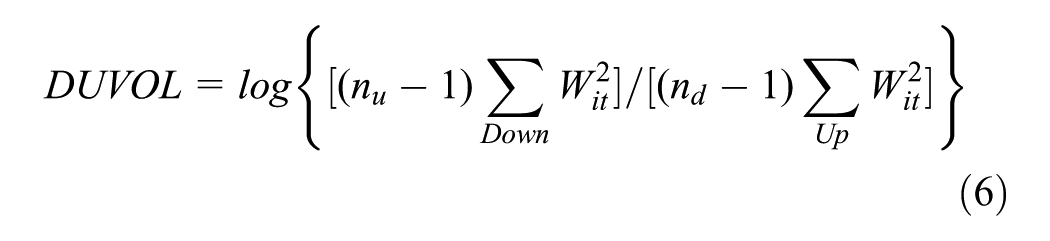
In Equation 6, the upward frequency parameter nu quantifies the cumulative weekly counts in which a stock’s return exceeds the upper threshold of average returns (Up) while the downward frequency parameter nd captures the corresponding weekly occurrences in which the security’s performance falls below the lower bound of average returns (Down).
Explanatory Variable
Our core explanatory variable is peer firms’ CSR engagement (CSRIND), methodologically constructed as the cross-sectional average of CSR performance across all same-industry counterparts, explicitly excluding the focal firm’s measurements.
Control Variables
We select other indicators at the level of listed companies as control variables. The specific definitions and measurement methods for the variables are listed in Table 1.
Variables and Definitions.

Data Sources and Descriptive Analysis
Data Source
This study employs a sample of Chinese A-share listed firms spanning 2011 to 2023, a period that commenced after the critical policy digestion phase (2009–2010) subsequent to the 2008 CSR disclosure mandate. This selection allows for the analysis of more stabilized corporate practices using data sourced from the CSMAR database. The sample construction follows a rigorous screening protocol. First, firm–year observations with fewer than 30 weekly stock return records are excluded to ensure the measurement validity of the stock price crash risk variable. Second, firms in the financial and insurance sectors are excluded because of their fundamentally dissimilar accounting standards and capital structures. Third, we remove firms under special treatment (ST) or delisting-warning (*ST) status, as well as those belonging to industry–years with fewer than 13 observations, to mitigate the influence of financial distress and ensure estimation stability. Fourth, observations with missing values for key financial or corporate governance variables are discarded. Subsequently, all continuous variables are winsorized at the 1st and 99th percentiles to alleviate the impact of outliers. The application of these filters yields a final balanced panel dataset comprising 4,421 firm–year observations.
Descriptive Statistics of Key Variables
Table 2 presents the descriptive statistics of key variables. The CSR (CSR) metric exhibits a mean value of 39.130 with a standard deviation (SD) of 12.220, suggesting both relatively modest adoption levels and significant heterogeneity in implementation across firms. The substantial dispersion (evident from the range between maximum and minimum values) reflects inconsistent prioritization of CSR initiatives among enterprises. Regarding stock price crash risk, the negative mean values of NCSKEW (−0.354, SD = 0.641) and DUVOL (−0.243, SD = 0.451) align with conventional market expectations while their differential SD values highlight distinct volatility patterns in the sample. The observed variations across all metrics collectively underscore divergent corporate behavioral tendencies within the dataset.
Statistical Description of the Main Variables.

Results of Correlation Analysis
The results of the correlation analysis shown in Table 3 indicate that the correlation coefficient between NCSKEW and DUVOL is 0.865 with a significance level of 1%, indicating that the two measures of stock price crash risk have a high degree of consistency; therefore, these two indicators may adequately serve as a measure of stock price crash risk. The correlation coefficients between the two indicators characterizing stock price crash risk (NCSKEW and DUVOL) and CSR are −0.079 and −0.082, respectively, and are significant at the 1% level. As shown in Table 3, the correlation coefficients between the two main variables in the model setup above are less than 0.5, which indicates that the problem of multiple covariation between the variables in the regression model is weak and that multiple covariation is not a serious issue.
Results of Correlation Analysis.

The Inter-Industry Distribution of CSR
A cross-industry analysis of CSR distribution (classified according to the Securities Industry Classification Guidelines, with manufacturing subdivided into secondary sectors while others retained at primary levels) reveals significant heterogeneity in sample representation and mean CSR indices. Table 4 indicates substantial cross-sector divergence, where mining achieves peak performance (μ = 45.510) relative to culture/sports/entertainment’s sectoral minimum (μ = 35.871), revealing the differential institutional prioritization of sustainability mandates. The manufacturing sector’s numerical dominance contrasts with niche industries’ limited participation, thereby collectively illustrating the fragmented adoption patterns of CSR frameworks across industrial ecosystems.
Descriptive Statistics of CSR by Industry.

Empirical Analysis
Existence Test of CSR Peer Effect
To examine Hypothesis 1 regarding CSR peer effects, we employ Model (1) and conduct multivariate regression analysis using peer firms’ CSR scores (CSRIND) as the key predictor. The results are presented in Table 5. Columns (1) and (2) use CSR performance as the dependent variable. The baseline specification in Column (1) incorporates CSRIND with year and industry fixed effects while Column (2) augments this framework with additional firm-level controls. Both specifications yield statistically identical coefficients for CSRIND (β = .353, p < .01), demonstrating robust peer spillover effects whereby a one-unit increase in peers’ CSR performance elevates focal firms’ CSR engagement by 35.2 basis points. The stability of the effect magnitude across model specifications, coupled with maintained statistical significance, conclusively validates the existence of CSR peer effects, as posited in Hypothesis 1.
Existence Test Results for CSR Peer Effects.

Note. The t-statistics are in parentheses.
p < .10. **p < .05. ***p < .01.
To further verify the CSR peer effect, this study performs a robustness test to assess the consistency of the results based on the four subcomponents of monolithic (M), content (C), technological (T), and industry (I) in the CSR rating data provided by RKS. The results are displayed in Columns (3) to (6) of Table 5. The outcomes indicate that all four subcomponents of CSR in peer firms (CSRIND) have significant impacts on each CSR subcomponent, thereby providing additional evidence of the presence of CSR peer effects. This result suggests that a company’s adherence to CSR principles is influenced not only by internal factors such as size and corporate governance but also by the CSR activities of its peers.
According to the CSRC’s hybrid disclosure framework (mandatory and voluntary CSR reporting), listed Chinese firms can be divided into two disclosure regimes. Our classification based on disclosure mandates, namely, mandatory disclosure cohort (MDCSR) and voluntary disclosure cohort (VDCSR), yields critical insights, as shown in Columns (7) and (8) of Table 5. The analysis reveals statistically significant CSR spillover effects across both regimes (MDCSR:β = .283, p < .01; VDCSR:β = .412, p < .01), confirming that peer influence operates regardless of regulatory compulsion. Crucially, the coefficient magnitudes reveal stronger imitation dynamics in the voluntary cohort, with VDCSR firms exhibiting 45.6% greater responsiveness to peer CSR strategies than their mandatory counterparts. This systematic variation underscores how regulatory environments moderate the peer effect intensity through institutional constraints. Ultimately, these bifurcated results confirm the pervasive nature of CSR peer effects while exposing the nuanced role of regulatory regimes in shaping corporate mimicry patterns.
Motivations for the CSR Peer Effect
To answer the question of which types of firms are mainly imitated by CSR behaviors (Hypothesis 2), our study draws on existing research (Posen et al., 2013; Vollero et al., 2022), which grouped firms according to their asset size and defined firms in the top 10% of the industry in terms of their asset size as industry leaders (CSRST10) and firms in the bottom 10% of the industry in terms of their asset size as industry followers (CSRSB10). The measurement results are shown in Table 6.
Industry Characterization of CSR Peer Effects.

Note. The t-statistics are in parentheses.
p < .10. **p < .05. ***p < .01.
The estimation results show that industry leaders and followers have different levels of influence on a company’s CSR behavior. The coefficient of industry leaders (CSRST10) is 0.170, which is significant at the 1% level, while the coefficient of industry followers is 0.069, which is significant at the 5% level. At the same time, the coefficient of industry leaders and its significance level are greater than that of industry followers; hence, CSR fulfillment by industry followers is more likely to mimic that of industry leaders. To verify the above conclusion, this study further expands the scale of industry leaders and followers by defining the enterprises in the top 50% and bottom 50% of industry asset size as industry leaders (CSRST50) and industry laggards (CSRSB50), respectively. The estimation results show that the coefficients of the peer effects of industry leaders (CSRST50) and industry laggards (CSRSB50) are 0.442 and 0.345, respectively, indicating that the influence of industry leaders is significantly higher than that of followers in the formation of CSR peer effects. In conclusion, both industry leaders and followers have different degrees of influence on a company’s CSR behavior, but industry leaders have greater influence.
To ensure the robustness of the findings, this study further distinguishes between industry leaders and constant industry followers based on firms’ profitability. Specifically, we define industries with the top 10% of firms’ profits as industry leaders (CSRRT10) and those with the bottom 10% of profit margins as industry followers (CSRRB10). As shown in Columns (3) and (4) of Table 6, the coefficient of CSRRT10 is 0.056, with a significance level of 10%, indicating that industry leaders have a significant impact on firms’ CSR behavior. At the same time, we further define firms with profits in the top 50% and bottom 50% as industry leaders (CSRRT50) and industry laggards (CSRRB50), respectively. The empirical results show that the coefficients of CSRRT50 and CSRRB50 are 0.424 and 0.342, respectively, which are significant at the 1% level, suggesting that companies tend to choose industry leaders as a reference in fulfilling CSR. This conclusion is consistent with the fact that industry leaders are more important than industry followers. Moreover, the result is consistent with that of the grouping by asset size, indicating the robustness of the findings.
Overall, we note a significant peer effect of CSR, which converges to the industry mean. However, locally, the effect of the tendency to follow industry leaders is more significant among copycat firms, confirming Hypothesis 2a.
The Impact of CSR Peer Effect on Stock Price Crash Risk
Table 7 shows the regression findings on the influence of peer company CSR on companies’ stock prices.
Regression Results for CSR Peer Effects on Stock Price Crash Risk.

Note. The t-statistics are in parentheses.
p < .10. ***p < .01.
The results reveal a significant positive correlation between the two proxies (NCSKEW and DUVOL) for stock price crash risk and CSRIND, indicating that the CSR practices of peer firms have a notable impact on a company’s stock price crash risk. This result highlights the “instrumental” rather than “value-based” nature of CSR in terms of market stability, with such practices intensifying stock price crash risks that can transcend from the industry level to individual companies. Therefore, in the event of industry-wide risks, companies within the sector are typically unable to address the issue alone, underscoring the importance of enhancing their understanding of CSR.
Our robustness analysis delves deeper into whether internal control and institutional investor systems in the Chinese capital market can mitigate the risk of stock price crashes attributed to CSR. We include additional variables directly related to stock prices, such as market return (RET), stock return volatility (SIGMA), and monthly average excess turnover rate (HSL), in the original model; the estimation results are presented in Columns (1) and (2) of Table 7. Additionally, we examine the impact of the proportion of shares held by the largest shareholder (TOP1); the results are shown in Columns (3) and (4) of Table 7. These results confirm the robustness of our previous findings and underscore the significant influence of peer firms’ CSR activities on stock price crash risks. Furthermore, our findings suggest that the current internal control and institutional investor systems in China’s capital market may not be fully effective in governing such risks. In addition, the current quality control measures and external institutional shareholding supervision may not effectively prevent stock price crashes resulting from “instrumental” CSR practices.
Mitigating Endogeneity Concerns
This study may suffer from the endogeneity problem of reverse causality. On the one hand, the better fulfillment of social responsibility by peer firms helps inspire other peer firms to fulfill their social responsibility; on the other hand, if a listed company’s CSR is high, then the industry’s social responsibility is also often relatively high. Therefore, to mitigate the effect of the endogeneity problem, we analyze the number of religious places (TEMPLE) in the prefecture-level city where the listed company’s industry is located as an instrumental variable, thereby satisfying the basic assumption of strict exogeneity. On the one hand, local religious culture influences CSR, and the degree of religiosity is positively correlated with the management’s attitude toward CSR; on the other hand, the number of places of worship is not directly linked to the socially responsible behavior of the firm itself, that is, it is independent of the firm itself and is shaped by history (Angelidis & Ibrahim, 2004). We use a two-stage least squares model for the analysis while considering the possibility of a 0 value for TEMPLE. The analysis is based on the logarithmic value of the original data after adding 1. The econometric models are as follows:
The First-stage regression model:

The Second-stage regression model:

where
Results of Endogeneity Analysis.

Note. The t-statistics are in parentheses.
p < .10. ***p < .01.
Discussion
The CSR Peer Effect: Widespread Adoption and Hierarchical Influence
Our empirical findings paint a complex picture of CSR in China’s capital markets, revealing its dual-edged nature driven by peer influence. Our confirmation of the robust intra-industry CSR peer effect (H1) extends the established paradigm of peer effects from traditional financial domains (Leary & Roberts, 2014) to the socioethical sphere of corporate conduct. This convergence is not monolithic but hierarchically structured, with industry leaders exerting a disproportionately strong demonstration effect (H2a). A recent study by Chen et al. (2025) provided granular support for this mechanism, demonstrating significant herding in corporate environmental, social, and governance (ESG) practices among Chinese firms, driven by informational cascades and competitive isomorphism. However, the most critical finding of our analysis lies in the paradoxical market outcome of this behavioral convergence: the amplification of stock price crash risk (H3). This counterintuitive finding challenges the prevailing stakeholder theory narrative and necessitates a deeper theoretical exploration into the motivations and manifestations of peer-driven CSR.
Symbolic Imitation as a Catalyst for Crash Risk
The positive association between CSR peer effects and crash risk offers compelling empirical support for agency theory (Ramanna, 2020). We posit that when CSR adoption is primarily motivated by mimetic isomorphism rather than genuine stakeholder commitment, it readily devolves into a form of symbolic management. In this context, the peer effect provides collective camouflage, legitimizing superficial compliance and enabling managers to withhold bad news under the guise of industry-standard responsible practices (Y. Kim et al., 2014). The ritualized and homogeneous disclosures that accompany such peer-induced initiatives create a “façade of responsibility,” which ironically exacerbates information asymmetry by hindering external investors from differentiating substantive performance from symbolic gestures. This interpretation is directly corroborated by the work of X. Zhang et al. (2024), who established a direct link between ESG greenwashing—a quintessential form of symbolic action—and heightened stock price crash risk in China. The subsequent accumulation and eventual sudden release of concealed negative information thus manifests as a heightened vulnerability to catastrophic price declines.
Underlying Motivation Determining whether CSR Mitigates or Amplifies Risk
Our findings provide a contextual framework to reconcile the long-standing theoretical schism in CSR literature, a tension recently underscored in the comprehensive review by Gillan et al. (2021). The stakeholder value paradigm, which posits a risk-mitigating effect of CSR, likely holds true in institutional environments where CSR is intrinsically motivated and strategically integrated (Bhattacharya et al., 2021). Conversely, our evidence indicates that in markets characterized by strong isomorphic pressures, such as China’s transitioning economy, the peer-driven, instrumental form of CSR predominates, thereby activating the agency problem. This delineation between substantive and symbolic CSR is critical. Supporting this view, N. Liu et al. (2024) empirically demonstrated the heterogeneous impact of CSR on firm risk, showing that substantive actions reduce risk while symbolic actions amplify it. Therefore, the economic consequences of CSR are not universal but are critically contingent on its underlying motivation. This study unequivocally demonstrates that the “why” behind CSR adoption (mimetic pressure versus authentic commitment) is as consequential as the “what” in determining its impact on market stability.
Failure of Existing Governance Mechanisms to Curb Risks from Imitative CSR
Another disquieting insight from our analysis is the apparent ineffectiveness of conventional governance mechanisms, specifically internal controls and institutional investor supervision, in mitigating the crash risk inherent in CSR peer effects. This failure reveals a significant governance blind spot tailored to the modern era of symbolic conformity. Standard monitoring systems appear ill-equipped to identify and discipline a particular form of opacity engendered by peer-approved, symbolic CSR. Mimicking industry norms is often perceived as a low-risk, legitimate strategy by both managers and monitors, allowing the underlying agency issues to remain unchecked. This governance shortcoming is highlighted in recent research by Wang et al. (2025), who suggested that while internal controls are vital, they may be inadequately calibrated to address the risks stemming from sophisticated symbolic practices such as ESG washing. Consequently, governance frameworks must urgently evolve beyond traditional financial metrics and develop the ability to identify and discourage homogeneous, nonsubstantive strategic practices that undermine genuine market transparency.
Conclusions and Policy Implications
Key Findings and Theoretical Contributions
This study empirically investigates CSR peer effects among Chinese A-share listed companies (2011–2023) and reveals a consequential paradox. We document three central findings. First, a significant intra-industry peer effect propels CSR convergence, underscoring the social embeddedness of corporate responsibility strategies. Second, this mimicry is hierarchically structured, with industry leaders exerting a disproportionately strong demonstration effect compared with followers. Third, and most critically, such peer-driven CSR adoption amplifies rather than mitigates stock price crash risk. This counterintuitive result strongly aligns with agency theory, suggesting that peer-induced CSR often serves as an instrument for symbolic legitimacy, obscuring true performance and accumulating hidden risks, thereby heightening information asymmetry and market fragility.
The results offer several key theoretical contributions. First, they extend the literature on peer effects beyond financial and strategic domains by establishing that the mechanisms of informational herding and institutional conformity profoundly shape CSR adoption in the socioethical realm. Second, the findings reconcile a longstanding theoretical tension in CSR research. While CSR can be value-creating, evidence from this context demonstrates that when its adoption is predominantly driven by mimetic pressures, it aligns more closely with agency theory. Herein, the CSR peer effect functions as a vehicle for symbolic management, fostering a façade of responsibility that exacerbates information asymmetry and facilitates bad news hoarding, thereby precipitating crash risk. Finally, the analysis reveals a critical blind spot in corporate governance, as conventional monitoring mechanisms prove ineffective in curbing the crash risk induced by such symbolic strategies. This result underscores the need for governance theories to account for the unique informational opacity created by homogeneous, symbolic practices.
Policy Implications
Our conclusions have direct and actionable policy implications for multiple stakeholders aimed at harnessing peer effects for stability and substantive CSR. A multifaceted approach is necessary to counteract the risk-enhancing nature of symbolic CSR mimicry.
Shifting From Form to Substance
Regulatory bodies should transition from a uniform approach to a differentiated supervision framework that prioritizes the substantiveness of CSR over its mere existence. Specifically, they can refine disclosure guidelines to compel firms to report on the unique value creation logic and stakeholder engagement processes underlying their CSR initiatives, thereby discouraging ritualistic conformity and promoting authentic, tailored practices.
Exemplars and Scrutiny for Industry Leaders
The roles of industry leaders, with their disproportionate influence, must be strategically managed. Policymakers and industry associations should proactively cultivate and publicize positive exemplars of innovative, value-driven CSR. Concurrently, enhanced scrutiny should be applied to leading firms with high CSR scores but concurrent red flags, such as earnings opacity, to prevent them from setting a benchmark for risk-concealing, symbolic compliance.
Governance Against Mimetic Blind Spots
Corporate boards and institutional investors must strengthen their mechanisms to address this specific governance failure. Boards should integrate an evaluation of CSR’s strategic alignment and potential risk implications into their oversight mandates, particularly for initiatives that appear mimetic. Institutional investors must move beyond surface-level ESG metrics and engage in deeper dialogue with management to differentiate substantive commitments from herd-following behavior.
Cultivating a Value Creation Culture
A systemic solution requires reshaping the fundamental perceptions of CSR across the business ecosystem. A concerted effort from regulators, educators, and media is needed to champion the view of CSR as integral to long-term value creation. By rewarding firms that integrate social and environmental objectives with their core business strategies, the ecosystem can align corporate citizenship with sustainable financial performance and market health.
Limitations and Avenues for Future Research
Although this study provides robust evidence of the CSR peer effect and its link to stock price crash risk in China, it has several limitations. We seek to frame these limitations not as weaknesses but as necessary steps to refine and extend our understanding of this complex phenomenon.
First, regarding the empirical identification of peer effects, our study, in line with a significant body of extant literature, employs a contemporaneous modeling framework. We recognize the compelling theoretical appeal of establishing a more precise temporal sequence in which a firm’s observation of prior peer behavior precedes its own CSR commitments. However, the practical implementation of such a design encounters considerable data constraints because the process of firms gathering, interpreting, and strategically responding to peer CSR information is continuous and largely unobservable with standard archival data. A promising avenue for future research is to leverage high-frequency data events, such as the exact timestamps of CSR report releases across firms, to construct more dynamically lagged peer measures or even employ network-based diffusion models. We believe that this approach would allow us to more finely disentangle the temporal cascade of peer influence and further bolster causal inference in subsequent studies.
Second, our operationalization of the peer effect relies on industry classifications to define peer groups. This approach offers clarity and comparability but simplifies the complex, multidimensional nature of real-world competitive and mimetic landscapes. Future studies could greatly enhance the precision of peer effect measurements by defining peer groups through alternative, potentially more salient channels, such as product market similarity, geographic co-location, or shared institutional investor bases. The application of sophisticated social network analysis to map the actual flow of managerial attention and influence regarding CSR practices represents an exciting frontier.
Finally, while we diligently address endogeneity concerns through an instrumental variable strategy, the quest for definitive causal identification is perpetual, and unobserved, time-varying factors could potentially remain. To further bolster the causal claims in this line of research, we plan to explore quasi-experimental settings in our future work. The ideal scenarios are exogenous shocks that differentially affect firms’ propensity to mimic CSR. Promising candidates include the staggered introduction of regional CSR disclosure mandates or other regulatory changes, which could be analyzed using a difference-in-differences design to provide more compelling evidence and further validate the proposed core mechanisms.
By transparently outlining these limitations and the research opportunities they inspire, we hope that our work not only represents a meaningful investigation into a critical paradox but also serves as a foundational platform for future scholarship to build upon, refine, and extend our understanding of the intricate interplay between corporate social conduct, informational dynamics, and market stability.
Footnotes

Author Contributions
Conceptualization, H.Z.; Methodology, H.Z.; Data, C.C.; Software, H.Z.; Formal analysis, C.C.; Writing—original draft, C.C. & F.H.; Writing—review & editing, F.H.; Visualization, F.H. All authors have read and agreed to the published version of the manuscript.
Funding
The authors disclosed receipt of the following financial support for the research, authorship, and/or publication of this article: Haijun Zhang acknowledges financial support from the Academic Construction and Quality Improvement Project of Chaohu University (Project No. XWZ202406), the Anhui Provincial Philosophy and Social Sciences Planning Project (Project No. AHSKQ2022D023), the Key Scientific Research Project of the Anhui Provincial Department of Education (Project No. 2022AH051692), and the High-level Talent Research Start-up Project of Chaohu University (Project No. KYQD-202209).
Declaration of Conflicting Interests
The authors declared no potential conflicts of interest with respect to the research, authorship, and/or publication of this article.
Data Availability Statement
The raw data used in the empirical analysis section of our paper can be obtained from corresponding authors.