




Abstract
The use of literary devices, especially figurative language, often poses challenges for literary translators. Existing research still lacks (1) theory-driven analyses grounded in actual translation choices and (2) sufficient attention to linguistic factors influencing how different types of figurative language are translated. To address these gaps, we pose three core research questions: (1) How has figurative language been translated in actual literary texts? (2) What patterns emerge in the translation of different types of figurative language? (3) What linguistic factors may possibly account for the variation in translation choices across different types of figurative language? This article adopts systemic functional linguistics as the theoretical framework, and examines translation choices for figurative language used in six Chinese literary texts and their English translations. Our analysis reveals considerable variations in the translation choices adopted among different types of figurative language. We propose relating the tendency to retain or omit a certain type of figurative language to the language stratum with which the type is more strongly associated. In broad terms, the likelihood of making translation shifts decreases when a certain type of figurative language is more closely related to relatively high strata. The current study makes a preliminary step towards a systematic investigation of the translation of figurative language, and more importantly, it introduces an SFL-based stratal perspective to elucidate possible linguistic motivations underlying translators’ decisions across different types of figurative language.
Keywords
Introduction
Literary translation, distinguished from technical translation, emphasizes the aesthetic and stylistic effect by using a range of literary devices, such as simile, irony and imagery (Classe, 2000; Koster, 2014). This distinctiveness often poses challenges for literary translators, as stated in the translator’s postscript in The Three-body Problem (the award-winning English translation of the Chinese sci-fi novel Santi): “The obvious difficulties, such as differences in linguistic structure and cultural references, are actually relatively easy to resolve. [. . .] But there are more subtle issues involving literary devices and narrative techniques” (Liu, 2016, p. 432).
Among several devices for literary works, the current study specifically focuses on figurative language, which is also commonly referred to as “figure of speech” or “rhetorical device.” The term “figurative language” is adopted here to reflect a broader scope of analysis, encompassing figurative expressions that can be examined across different language strata and functional dimensions. This contrasts with the more specific terms “figure of speech” or “rhetorical device,” which typically denote particular types or instances of figurative expression. Some commonly known types of figurative language include simile, metaphor, personification, hyperbole, parallelism, and alliteration. See a detailed introduction to figurative language in section “Theoretical Foundations.”
Research on translating figurative language generally falls into two categories. The first category consists of studies with broad research objectives that briefly mention translation strategies for figurative language. For instance, Epstein (2014) has provided a comparative historical analysis of figurative language translations in children’s literature. In another study, Dorst (2024) has compared human and machine translations of metaphors in the era of artificial intelligence. Although both studies have offered some methods for translating figurative language, these suggestions lack a comprehensive, theory-driven exploration.
The second category comprises studies that elaborate on translation strategies for figurative language with specific examples, such as Landers (2001), Hu and Li (2009) and Feng (2017). Broadly, scholars have proposed two main strategies: (1) retaining the source text’s figurative expressions as closely as possible and (2) employing techniques such as adaptation and addition to clearly convey the essential meaning. Whether the translation should be rendered literally or freely would largely depend on the type of figurative language at stake. For example, Chen (2017) argues that in Chinese-to-English translation, the literal strategy is often appropriate for metaphor, parallelism, and hyperbole, whereas devices such as antithesis and puns require a freer approach.
Nevertheless, two critical gaps remain in existing research. First, the extent to which figurative language in literary translations should be rendered literally or freely remains unclear. While scholars like Teilanyo (2007) contend that literary translators should do their utmost to retain the figurative level (arguing that alteration constitutes a literary disservice to the source text, source culture, and target audience), all such proposals—whether advocating for literal or free translation—are not grounded in a systematic investigation of actual translation choices for figurative language. Second, the linguistic factors that motivate translation shifts have been understudied: in the previous research, varied choices for translating different types of figurative language were mainly interpreted in terms of the similarities and differences of the types of figurative language between the source language and the target language, rather than deeper linguistic drivers.
Against this background, this article examines translation choices for the figurative language used in six Chinese literary texts and their English translations, deploying systemic functional linguistics (SFL) as the theoretical framework (see a detailed introduction to SFL in section “Theoretical Foundations”). Following SFL scholars such as Kim (2009), Matthiessen (2014) and Li and Yu (2021), we adopt the term “translation choice” rather than the more traditional terms “translation strategy” or “translation technique.” This preference reflects our view that language use—in both source and target texts—involves a continuous process of making meaningful choices.
To address the gaps in existing research, we pose three core research questions:
(1) How has figurative language been translated in the selected literary texts?
(2) What patterns emerge in the translation of different types of figurative language?
(3) What linguistic factors may possibly account for the variation in translation choices across different types of figurative language?
These three questions will be answered in sections “Data Analysis: Overview of Translation Choices” (Q1) and “Discussion: Translation Choices in Relation to Language Strata” (Q2–Q3).
Theoretical Foundations
Figurative Language in English and Chinese
Figurative language refers to language that deviates from literal meaning to convey a non-literal or evocative message (Ivie, 2010; Quinn, 1995). Such creative wording is frequently used in literature like fiction and drama, aiming to achieve emphasis, enhance clarity, and convey sentiment. The types of figurative language discussed in our study include simile, metaphor, rhetorical question, repetition, and reduplication (the exclusion of other types will be explained in section “Data and Methods”). This section will present definitions of these types of figurative language as well as similarities and differences in the use of these types between Chinese and English. It is on the basis of these definitions and comparisons that the criteria for the identification of translation shifts are established in the current study (see section “Data Analysis: Overview of Translation Choices”).
A simile, in both languages, refers to an explicit comparison in which one thing is likened to another (Li, 2018; Zeiger, 1978). It has three components: the tenor (the object or person being described), the vehicle (the object or person being compared to), and the simile marker, such as 像 (xiang“like”) or 如 (ru“like”) in Chinese and like or as in English. Likewise, a metaphor is also embodied with a comparative nature between two things, but such a comparison is implicit with no lexical markers. English and Chinese are largely similar in their choice of the vehicle of a certain tenor, but variations do occur. For example, the Chinese equivalent of as timid as a rabbit is 胆小如鼠 (danxiao ru shu“as timid as a rat”). This can be explained in terms of the cultural difference between the two languages: rabbits in Chinese are often characterized as lively and lovely while rats are those timid and annoying (Li, 2018, p. 15).
A rhetorical question is used to make a statement without expecting an answer (Chen, 2017; Zeiger, 1978). In both English and Chinese, this type of figurative language has two main subtypes: unanswered rhetorical questions (also conceptualized as “epiplexis” and “erotesis”; e.g., In these over 8,000 hurried days, what has been left to me besides hesitation?) and self-answered questions (also conceptualized as “anthypophora” or “hypophora”; e.g., Why should our days go by never to return? Perhaps they have been stolen by someone). Rhetorical questions are used to make a point rather than to solicit an answer from the listener/reader.
Repetition is a literary device in which certain lexical items are repeated in order to achieve emphasis and express emotion (Chen, 2017; Ruse & Hopton, 1992). For example, the word 一定 (yiding“must”) has been repeated twice in the text 你一定见过他,一定听过别人谈起他 (ni yiding jianguo ta, yiding tingguo bieren tanqi ta“you must have seen him; must have heard others talking about him”). There is one major difference between Chinese and English in their use of repetition: in Chinese, it is common to repeat every key word whereas in English, it is more common to choose synonyms or to omit part of the repeated words so as to avoid redundancy and keep the text concise (Chen, 2017, p. 311). This distinction will be exemplified in section “Discussion: Translation Choices in Relation to Language Strata.”
Reduplication is used for emphasis and enhancement of phonological beauty. This literary device can be seen from both the sound system and the writing system. In Chinese, reduplication often involves the repetition of a certain character/syllable (one character is pronounced as one syllable), such as 热浪滚滚 (re lang gungun“hot-wave-roll-roll”). In contrast, most English words consist of multiple syllables, and monosyllabic words are rarely reduplicated in the way they are in Chinese; instead, reduplication in English is often found in the rank of morpheme in the writing system (or phoneme in the sound system; American Heritage Publishing Company, 2006; Chen, 2017). For example, the word drip-drop reduplicates both phonemes of [dr] and [p]. As can be seen, the device of reduplication shows a stark contrast between Chinese and English.
Language Strata in SFL
The current study adopts systemic functional linguistics (SFL) as the theoretical framework, for two main reasons. First, SFL views language use as a process of making meaningful choices. In translation, this perspective is particularly relevant as translators decide whether to make similar or different linguistic choices compared to the source text, aiming to convey the meanings they want target language readers to understand. Building on this SFL-informed view, the present study employs the concept of “translation choice” (Matthiessen, 2014; Munday, 2012). Second, SFL offers a range of analytical tools and concepts that enable a systematic and comprehensive account of linguistic choices. These theoretical tools are valuable for text analysis, which is long recognized as crucial in translation studies (Chen et al., 2022; Kim et al., 2021; Munday, 2016; Nord, 2005). Below we introduce one key SFL concept which is particularly pertinent to this study: language strata. This concept, as section “Discussion: Translation Choices in Relation to Language Strata” will show, can account for systematic tendencies in the translation of different types of figurative language.
The term “strata,” in the SFL model, refers to different levels of language. These levels are proposed as a way of explaining the different kinds of patterns that can be identified at each level. This study primarily focuses on three language strata, namely phonology/graphology, lexicogrammar, and semantics (Figure 1; see Halliday & Matthiessen, 2014, p. 26).

Language strata in context (adapted from Halliday & Matthiessen, 2014, p. 26).
Phonology and graphology constitute the expression plane. Many languages (including Chinese and English) have two modes of expression, that is, the sound system (spoken language) and the writing system (written language). In the case of spoken language, phonology is concerned with “the organization of speech sound into formal structures and systems” (Halliday & Matthiessen, 2014, p. 25), and graphology can be defined along similar lines for written language. Lexicogrammar and semantics constitute the content plane. Lexicogrammar is concerned with construing meanings through choices in wording and its key unit is the clause; semantics is concerned with making meanings in the discourse across the whole text. Figure 1 shows a further stratum of context above the strata of language, as a fundamental concept of SFL is to consider language within social contexts.
Data and Methods
The data for this study constitute six Chinese literary texts and their English translations. Initially (as a pilot study), we concentrated on one of these texts, Congcong, and its five English translations. This text was chosen for three reasons: its frequent use of figurative language, the opportunity to compare multiple English translations, and the established quality of those translations (see detailed information on the translators and publication information in Table 1). Following our preliminary analysis of Congcong, we expanded our dataset to test if the patterns observed are more generally applicable. In this, we aim to minimize the possible influence of genres and translators’ backgrounds on the translations. The current dataset thus encompasses three primary literary genres: drama, fiction, and nonfiction (two texts for each genre). Poetry is excluded due to the specificity of poem composition and its translation (e.g., Ma & Wang, 2021). In order to include translators from a variety of backgrounds, we chose texts translated by these three groups of translators:
Native Chinese speakers: This group includes the translators of ST2 and four of the translators of ST1 (TT1, TT2, TT4, TT5);
Native English speakers: This group includes the translators of ST4 and ST6 as well as one of the translators of ST1 (TT3);
Bilingual experts: The translators of ST5 are a native English speaker and a native Chinese speaker working collaboratively; the translator of ST3 is a Chinese American who is fluent in both the source and target languages.
The Selected Chinese Literary Texts and Their English Translations in the Data.

This study employs a mixed-methods design. The data analysis was conducted manually through the following steps. First, the selected Chinese source texts and their English target texts were compiled into a parallel corpus. Then, instances of figurative language were identified in the Chinese texts. At this stage, the types of figurative language identified include simile, metaphor, personification, hyperbole, irony, metonymy, alliteration, and parallelism. To enable meaningful comparison in subsequent analysis, we narrowed our focus to instances of simile, rhetorical question, repetition and reduplication; the other types were excluded, as the number of instances found in the selected literary works was too limited to generate sufficient comparison. For each of the 4 types of figurative language, we extracted 20 Chinese-English pairs from each of the 6 STs and their TTs (that is 4 * 20 * 6 = 480 instances). However, simile in ST6 and rhetorical question in ST4 are exceptions, as these devices occur infrequently in the original texts. Therefore, a total of 440 (480 − 20 − 20) instances of figurative language were identified in the data. Note that a clause adopting two or more figurative devices (e.g., simile and reduplication) was counted twice or more (e.g., simultaneously as an instance of simile and an instance of reduplication). Next, translation choices for these instances were analyzed using a qualitative content analysis approach, which involved systematically categorizing the translation choices applied to each figurative expression. We then proceeded to compare the frequency of choices in translating different types of figurative language and interpreted the varying tendencies from an SFL perspective. From the next section, the findings will be presented.
Data Analysis: Overview of Translation Choices
This section presents the translation choices for figurative language observed in the selected texts, thereby addressing the first research question outlined in the Introduction. As depicted in Figure 2, figurative language in the Chinese texts can be translated with or without a shift.

Overview of translation choices for figurative language.
The category of ‘no shift’ means a translation choice of maximal equivalence, as exemplified in Example 1. The resemblance between the tenor 周围的世界 (zhouwei de shijie“surrounding world”) and the vehicle 口袋 (koudai“sack”) in the Chinese source text is retained in the English target text; the simile marker 像…般 (xiang. . .ban“like”) is translated into its approximately equivalent lexis like.
(1)
ST3:
她
顿时
感到
周围
的
世界
像
个一
口袋
般
收紧
ta
dunshi
gandao
zhouwei
de
shijie
xiang
yige
koudai
ban
shoujin
she
suddenly
feel
around
world
like
one
sack
like
tighten
“She suddenly felt the world around her tightening like a sack.”
TT3:
She felt the world around her closing in like a sack being drawn shut.
It is also intriguing to note that in several instances, the translators retained the original figurative language while adding other types of figurative language, thereby altering the rhetorical impact in the translated texts, as exemplified in Example 2. The Chinese text employs a simile, comparing 人们 (renmen“people”) to 太阳下的小草 (taiyang xia de xiaocao“grass under the sun”). The English translation preserves this simile and also adds alliteration. Alliteration refers to the figurative device where two or more adjacent words all start with the same letter or sound (Online Oxford English Dictionary); in this case, it repeats the initial consonant(s) in the lexical item sun-scorched. The combined use of simile and alliteration in Example 2 creates vivid imagery and introduces a rhythmic flow to the translated text. Note that such cases were not analyzed as a shift of adding figurative language, as we focused on in what way a given type of figurative language (simile in the case of Example 2) in the source text has been translated, and hence it was identified as “no shift” in terms of the adoption of simile in translation.
(2)
ST5:
人们
都
像
晒
在
太阳
下
的
小
草。
renmen
dou
xiang
shai
zai
taiyang
xia
de
xiao
cao
people
all
like
bask
at
sun
under
little
grass
“People are all like little grass basking in the sun.”
TT5:
It is the sort of weather that makes people feel like sun-scorched blades of grass.
Now we move on to look at the category of “shift.” The notion of “translation shift,” first put forward by Catford (1965, p. 73), means “departures from formal correspondence in the process of going from Source Language (SL) to Target Language (TL).” In our study, it specifically refers to changes in figurative language from the original text to its translation. To determine whether changes occur, we referenced the definition of each type of figurative language. In the case of a simile, as introduced in section “Theoretical Foundations,” the focus lies on the semantic likeness between the tenor and the vehicle, with an explicit simile marker. It was considered as retaining the simile in the original text as long as the semantic likeness between the tenor and the vehicle could also be found in the translation, regardless of whether the tenor and the vehicle in the translation were indeed those in the original (e.g., the translation as timid as a rabbit for 胆小如鼠 danxiao ru shu“as timid as a rat” is not considered as a shift), or whether the simile marker in the translation was indeed that in the original. In the case of repetition, the emphasis lies in the recurrence of certain lexicogrammatical elements. Rhetorical questions present a more complex case. Lexicogrammatically, we need to examine whether the translation preserves (a) the interrogative form alone (for unanswered rhetorical questions) or (b) an interrogative clause followed by a declarative clause (for self-answered rhetorical questions). Semantically, we need to further analyze whether the translated version is also intended as a statement in the specific context. Regarding reduplication, the focus is on the repetition of elements at the phonological and/or graphological stratum. Thus, a translation is classified as no shift as long as it preserves such repetition, regardless of changes in other strata.
Under the category of “shift,” three options have been observed. The most distinctive option is unsurprisingly omitting a certain use of figurative language in the text, as illustrated in Example 3. Here the mood particle 么 (me) and the question mark at the end of the clause indicate an interrogative clause (traditionally known as a question) in the Chinese original text. It uses an unanswered rhetorical question to make a statement rather than solicit an answer. The English translation shifts from an interrogative mood (rhetorical question) to a declarative mood, changing the lexicogrammatical realization while preserving the speech function of statement through the modal must. In this way, the rhetorical question is omitted.
(3)
ST5:
这
两
年
你
不是
存
点
钱
么?
zhe
liang
nian
ni
bushi
cun
dian
qian
me
these
two
year
you
save
a little
money
“Haven’t you saved some money in these 2 years?”
TT5:
You must have saved quite a bit these last 2 years.
In addition to “omission,” we also observed “partial omission” in instances of repetition. In other words, the Chinese figurative language is partly maintained and partly shifted into non-figurative language. For instance, in Example 4, the lexical items 去 (qu“go”) and 来 (lai“come”) are repeated three times. TT1-2 retains the repetition twice in the first two clauses, whereas the last clause was rendered from 来去的中间 (laiqu de zhongjian“between what is gone and what is to come”) to the transition in between. It is worth noting that this translation shift is not applicable to instances of simile, rhetorical question and reduplication in our data. However, we speculate that this shift of “partial omission” might be relevant in cases involving parallel structures in larger corpora.
(4)
ST1:
去
的
尽管
去
了,
来
的
尽管
来
着;
qu
de
jinguan
qu
le
lai
de
jinguan
lai
zhe
go
always
go
come
always
come
去
来
的
中间,
又
怎样
地
匆
匆
呢?
qu
lai
de
zhongjian
you
zenyang
de
cong
cong
ne
go
come
between
further
how
swift
swift
“What is gone is always gone, what is to come is always coming; between what is gone and what is to come, how swift is it?”
TT1-2:
What is gone is gone, what is to come keeps coming. How swift is the transition in between!
Another option involves transforming one type of figurative language into another. This choice is particularly frequent in instances of simile and reduplication. We first present Example 5, which involves a simile in Chinese.
(5)
ST3:
疯狂
如同
无形
的
洪水,
将
城市
淹没
其中
fengkuang
rutong
wuqing
de
hongshui
jiang
chengshi
yanmo
qizhong
madness
like
invisible
flood
city
drown
within
‘Madness, like an invisible flood, drowned the city.’
TT3:
A flood of madness drowned the city.
In Example 5, the Chinese compares the tenor 疯狂 (fengkuang“madness”) to the vehicle 洪水 (hongshui “flood”), marked by 如同 (rutong“like”). The English translation, however, omits the simile marker and combines the vehicle and the tenor into a nominal group, that is, a flood of madness. Consequently, the explicit simile in the original text is rendered as a metaphor in the target text.
Example 6 demonstrates a translation shift from reduplication to two other devices: alliteration and rhyme. Rhyme involves the repetition of identical or similar sounds at the ends of words, typically at line endings in poetry (Online Oxford English Dictionary; see the definition of alliteration in Example 2). In Example 6, the Chinese characters 算 (suan“calculate”) and 相 (xiang“observe”) are reduplicated for rhythmic beauty and vividness of literary language. The English target text omits the reduplication of characters; instead, it employs alliteration through the repeated consonant [f] in fortunes and features, and rhyme via the shared [d] coda in told and read.
(6)
ST6:
怎
能
不
多
算
算
命、
相
相
面
呢?
zen
neng
bu
duo
suan
suan
ming
xiang
xiang
mian
ne
how
can
more
calculate
calculate
fate
observe
observe
face
“How could one not do fortune-telling and face-reading frequently?”
TT6:
Of course scads of people want their fortunes told, their features read.
In the next section, we examine the patterns of the translation choices introduced above and interpret them through the SFL-based concept of “language strata.”
Discussion: Translation Choices in Relation to Language Strata
This section addresses the second and third research questions outlined in the Introduction, discussing the distributions of translation choices in our data, and associating the patterns of shifts in different types of figurative language with language strata.
Table 2 presents the numbers and proportions of translation choices for the four types of figurative language in our data. Three major findings can be seen. First, similes are predominantly retained in translation. It is also interesting to find that all seven cases of “type shift” involve a change from simile to metaphor. This shift can be considered a “minor shift” compared to the complete omission of similes, as the figurative comparison is preserved despite the omission of the explicit simile marker. The instances of “no shift” and “minor shift” together account for nearly 90% of the cases. Second, instances of reduplication are strong candidates for omission. Specifically, all the 120 instances are shifted, with 111 instances of reduplication omitted in the translations. The other nine instances are shifted to other figurative devices, reflecting the translators’ endeavor to retain the use of figurative language to some extent. Third, rhetorical questions and repetition are subject to some degree of shift, with rhetorical questions being more likely to be retained and repetition more likely to be altered. These three patterns are consistent across all six ST-TT pairs analyzed (although the detailed breakdown of each pair is not shown in Table 2 due to space limitations). In other words, instances of simile, rhetorical question, repetition, and reduplication form a cline from the strongest to the weakest candidates for retention in translation.
Numbers and Proportions of Translation Choices for Types of Figurative Language.
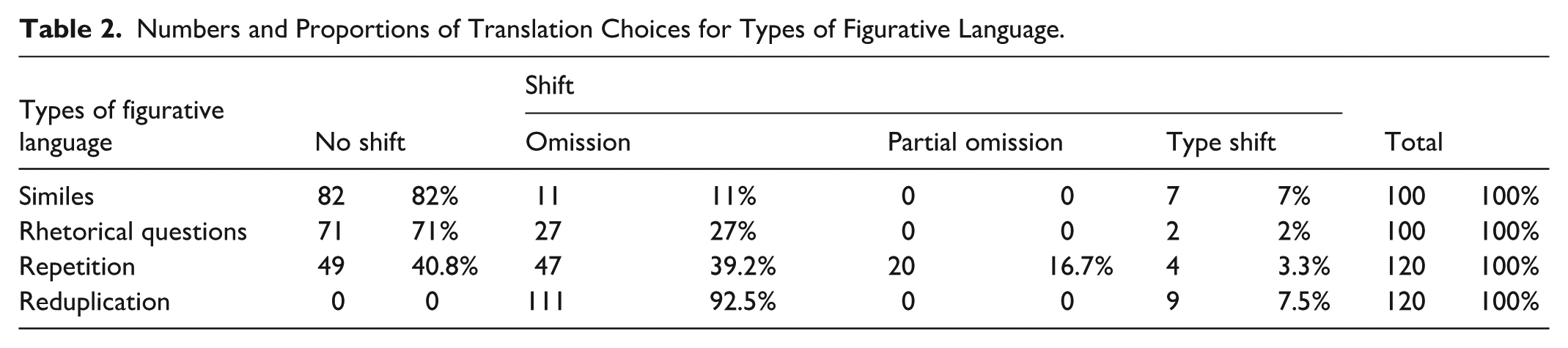
It was proposed that different tendencies in the translation of different types of figurative language could be explained in terms of the similarity of figurative language between English and Chinese (e.g., Chen, 2017). This proposal can indeed provide plausible explanations for the patterns that instances of simile are strong candidates for retention, whereas instances of reduplication are strong candidates for omission. However, it remains unclear why instances of repetition and rhetorical questions were retained less frequently in our data.
In this, we reference the SFL literature and propose that the tendency to retain or omit a certain type of figurative language could be related to the language stratum with which the type is most closely associated. According to Matthiessen (2001, 2018), Matthiessen et al. (2021), stratification is one dimension in the environments of translation (see also Halliday, 2009), and the general principle is that “the wider the environment of translation, the higher the degree of translation equivalence; and the narrower the environment, the higher the degree of translation shift” (Matthiessen, 2001, p. 78). Broadly speaking, the environment becomes wider when we move from the expression plane to the content plane and further to context. To put it another way, the differences between languages decrease when we move up the strata (Matthiessen, 2007). This means that the type of figurative language which is more closely associated with higher strata is more likely to be retained in translation. It is worth noting that figurative language can be simultaneously analyzed according to its lexicogrammatical structure, semantic meaning and context of situation/culture, yet a certain figurative device in most cases has its stratal emphasis according to its definition. In the current case, simile, rhetorical question, repetition and reduplication form a cline ranging from those whose translation is more strongly shaped by the wider environment to those governed more by the narrower environment. The rest of this section will introduce different stratal emphases of the four types of figurative language and elaborate on the influential factor of strata on the translation of the different types of figurative language.
The use of simile is more closely tied to the higher strata of context as well as semantics in the content plane. Semantically, similes involve an analogical relationship between the tenor and the vehicle, and both Chinese and English often exhibit a high degree of similarity at this level. Contextually, although limited cultural overlap may lead to different lexicogrammatical choices for vehicles, such differences are rare between Chinese and English, and no instances appear in our data. Consequently, the original similes are largely preserved in their English translations, and this choice of “no shift” maintains the poetic and aesthetic qualities of the literary texts. It is important to note that while semantic resemblance is the primary focus, simile is also linked to the stratum of lexicogrammar, particularly in the use of simile markers. Variations in marker choice were not counted as shifts, but, as mentioned above, instances where simile markers were omitted were classified as a shift from simile to metaphor, reflecting a fundamental change in the type of figurative language. Seven such cases in our data were categorized as “type shift” (e.g., Example 5).
Rhetorical questions are closely related to both the semantic and the lexicogrammatical strata within the content plane. Determining whether a rhetorical question has been shifted in translation depends on two criteria: first, whether the interrogative lexicogrammatical form is preserved; and second, whether the speaker or the writer’s intent to make a semantic statement remains clear. Although Chinese and English exhibit significant semantic similarities, their resemblance diminishes at the lexicogrammatical level. This difference may account for the relatively modest retention of rhetorical questions in English translations.
Repetition is more closely associated with the stratum of lexicogrammar in the content plane, though it also engages the expression plane through its contribution to rhythmic and phonological patterning. What is at stake for this type is whether the specific lexical items are repeated. As mentioned above, the similarity between Chinese and English decreases at the stratum of lexicogrammar, which likely accounts for the relatively low retention rate of repetition in translation, despite the similarity in the definition of repetition between the two languages. For instance, in Example 4 above, the threefold repetition of 去 (qu“go”) and 来 (lai“come”) in Chinese has been reduced to a double repetition in the English translation. The partial omission reflects a cross-linguistic difference in the use of repetition: English tends to omit a part of the repeated lexis while Chinese prefers to retain repetition, as mentioned in section “Figurative Language in English and Chinese.” While this translation choice diminishes the intensifying force of the original, it aligns more closely with English stylistic preferences.
Reduplication is most closely associated with the expression plane. The way reduplication works in Chinese is that the character (one character is pronounced as one syllable) is repeated twice or more, while the experiential meaning is the same as that expressed by a single character. By contrast, English words often consist of multiple syllables, and thus rarely reduplicate in the way Chinese characters do. Therefore, in most cases, the form of reduplicated Chinese syllables/characters is often omitted in the English translation, with only the meaning preserved in the target text.
Despite significant differences in the expression plane between Chinese and English, we observed that in translating instances of reduplication, translators made efforts to retain the use of figurative language in one way or another (the choice of ‘type shift’ taking up 7.5%). In addition to Example 6 above, Example 7 further illustrates this observation. The Chinese character/syllable 零 (ling“zero”) has been repeated in the phrase 孤零零 (gu lingling“alone-zero-zero”). This instance of reduplication has been translated as all alone, where the initial letter a or a similar vowel sound [ɔː/ə] is repeated, employing the literary device of alliteration.
(7)
ST4:
我
是
孤
零
零
一
个
人。
wo
shi
gu
ling
ling
yi
ge
ren
I
be
alone
zero
zero
one
person
“I am alone.”
TT4:
In fact, of course, I was all alone.
The discussion above explains the patterns in translation choices for different types of figurative language from the perspective of language strata. However, we are not suggesting that stratification is the sole factor influencing these translation choices. Rather, we propose that stratification, as one dimension of the environments of translation, could be considered together with other factors (see e.g., Kim, 2009 on the interplay of different possible factors; Zuraikat & Rawashdeh, 2019 on cultural differences) to provide more comprehensive explanations for the observed translation patterns.
Conclusion
This article explores a range of choices for translating Chinese figurative language into English. In response to the first research question, we have identified choices of retention and (partial) omission of the original figurative language, as well as type shifts (a specific type of figurative language is altered to another) in the translated texts. These type shifts indicate the translators’ efforts to preserve the use of figurative language, even though not in the original form. Notably, even in instances where the original figurative language is retained, other types of devices may be added, which subsequently influence the rhetorical impact of the figurative language in translation.
Regarding the second research question on the patterns of different translation choices, we have found considerable variation in retention rates across different types of figurative language. However, this variation cannot be adequately explained by cross-linguistic similarity in figurative types between English and Chinese, as suggested in prior studies. Instead, in response to the third research question, we argue that a figurative type’s tendency to be retained or omitted is highly likely to be related to the language strata (a core concept in SFL) with which it is most closely associated. In broad terms, the likelihood of translation shifts decreases when a certain type of figurative language is more closely related to relatively high strata, as cross-linguistic similarity increases at higher strata. This SFL-based stratal interpretation fills a key gap in existing research: it not only provides a clearer and more systematic linguistic motivation for observed translation choices but also offers a more robust explanatory framework than previous approaches.
A potential limitation of this study lies in its corpus size: the 440 instances extracted from six Chinese-English text pairs restricted our analysis to four types of figurative language (other types were excluded due to insufficient data for valid comparison). Despite this constraint, the study makes two critical contributions: it makes a preliminary step towards a systematic investigation of the translation of figurative language, and more importantly, it introduces an SFL-based stratal perspective to elucidate possible linguistic drivers of translation choices—addressing a long-standing lack of theory-driven explanations in the field.
For future research, we recommend three main directions. First, a larger corpus and additional language pairs should be introduced to examine whether the SFL-based stratal interpretation can be generalized to other types of figurative language and cross-linguistic contexts. Second, given the powerful capabilities of AI-supported translation tools (e.g., DeepL, TranslatePress, and Bing AI), future studies could investigate the impact of these tools on translating figurative language in literary works, with SFL serving as the underlying theory for evaluating translation quality. Third, beyond figurative language, other literary devices—such as narrative perspective—warrant investigation through the SFL-based framework.
Footnotes

Ethical Considerations
Not applicable.
Consent to Participate
Not applicable.
Author Contributions
Xueying Li: Conceptualization, Methodology, Validation, Formal analysis, Investigation, Resources, Data Curation, Writing—Original Draft, Writing—Review & Editing, Visualization, Project administration; Funding acquisition. Yi Jing: Validation, Formal analysis, Investigation, Resources, Data Curation, Writing—Review & Editing, Visualization, Project administration, Funding acquisition.
Funding
The authors disclosed receipt of the following financial support for the research, authorship, and/or publication of this article: This work was supported by Hangzhou Dianzi University under Grant (KYS115621067); Guangdong Planning Office of Philosophy and Social Science under Grant (GD24YWY11); Fundamental Research Funds for the Central Universities under Grant (HIT.HSS.202318); and Humanities and Social Science Fund of Ministry of Education of China under Grants (24XJC740007 and 24YJC740021).
Declaration of Conflicting Interests
The authors declared no potential conflicts of interest with respect to the research, authorship, and/or publication of this article.
Data Availability Statement
The data are available from the corresponding author on reasonable request.