




Abstract
This research sought to examine the impact of electronic portfolio -based writing instruction on the second language writing performance and writing self-efficacy of Chinese English as a foreign language (EFL) learners. A total of 64 participants were divided into two groups, an experimental group (n = 31) and a control group (n = 33). The experimental group was given electronic portfolio-based instruction via Edmodo platform, while the control group received only traditional in-class writing instruction without the use of Edmodo. Two sample IELTS tasks and Writing Self-efficacy scale were administered to collect the quantitative data. Further, semi-structured interviews were carried out with participants in the experimental group to gather qualitative data on their perceptions and experiences with electronic portfolio-based writing instruction. The results of paired samples t-tests and ANCOVAs indicated that electronic portfolio-based writing instruction significantly improved global writing performance and its underlying components, namely content, organization, language use, vocabulary, and mechanics, as well as the writing self-efficacy of Chinese EFL learners. Qualitative results revealed several themes, including increased motivation, improved feedback, enhanced collaboration, improved writing skills, and increased writing self-efficacy. Overall, the study demonstrates that electronic portfolio can be a valuable tool for EFL writing instruction and has a positive impact on writing performance and writing self-efficacy for Chinese EFL learners.
Plain Language Summary
In this study, we wanted to see how using electronic portfolios in writing instruction would affect Chinese students learning English as a foreign language. We had a total of 64 participants, split into two groups: one group used electronic portfolios through the Edmodo platform, while the other group received traditional in-class writing instruction. We measured their writing performance and self-confidence before and after the study. We also interviewed the participants in the electronic portfolio group to get their thoughts and experiences. The results showed that the electronic portfolio-based instruction significantly improved the students’ overall writing performance and specific aspects like content, organization, language use, vocabulary, and mechanics. It also increased their confidence in their writing abilities. The interviews revealed that the students were more motivated, received better feedback, collaborated more effectively, and felt their writing skills had improved. This study shows that using electronic portfolios can be very helpful for teaching English writing to Chinese students, improving their writing skills and self-confidence.
Introduction
In the digital era, technology has become increasingly employed in the teaching of English as a foreign language (EFL) with the aim of improving students’ learning outcomes (Chang, 2005; Fithriani, 2021; G. Z. Liu et al., 2023; Yu & Trainin, 2022). The integration of technology in language classrooms has been shown to enhance learner engagement and motivation, and maximize learning outcomes in various language skills such as writing (Fithriani, 2021; Kessler, 2020). As technology tools, digital portfolios are a technological tool that can aid students in developing self-regulation and self-learning skills, which are often the primary goals of most syllabuses (Zheng & Barrot, 2022). Additionally, e-portfolios can be utilized in pedagogical settings as a means of authentic and reliable assessment (Barrot, 2021; González-Mujico, 2020). An e-portfolio is a collection of artifacts, including audios, videos, images, and texts, that can be gathered and structured in a variety of formats to reflect learners’ development over time (Barrett, 2000; Bo & Nguyen, 2023). The use of e-portfolios can help students think more clearly about their learning and practice writing skills more freely (Aghazadeh & Soleimani, 2020; R. Lam, 2022). With an e-portfolio, students can share their knowledge, academic training, and career aspirations with peers, teachers, parents, or even future employers, providing them with a platform to showcase their growth and progress. Moreover, teachers who utilize e-portfolios have a better understanding of their students’ learning and evaluation and become more engaged with the students’ learning process (Fathi & Rahimi, 2022; R. Lam, 2022).
In recent years, written English has taken on increasingly important roles due to globalization. It has become a vital source of information in various fields, and as a means of global communication, writing has become an indispensable aspect of language mastery (Wang et al., 2013). However, teaching English writing is widely considered to be one of the most challenging skills for both teachers and students to master (Sumarno, 2019). Process writing, in particular, is often given limited time in class, which hinders students’ ability to build up their writing portfolios. Consequently, practitioners rarely employ process writing in class, and students are hesitant to invest a significant amount of time into their writing (Fathi & Rahimi, 2022). Nevertheless, with the rise of online applications, students are now able to manage their time more efficiently while working on process writing tasks, either individually or in groups, making them more convenient and user-friendly (Rahimi & Fathi, 2021; Zou & Xie, 2019).
One popular technology-based instruction tool is Edmodo that provides an interactive platform for teachers to deliver lessons and activities, as well as for students to engage in collaborative writing tasks. The use of Edmodo has been shown to enhance students’ motivation and engagement in writing tasks (Fathi & Rahimi, 2022). However, the use of Edmodo, as an electronic writing portfolio platform, in second language (L2) writing instruction has not been widely researched, despite its potential in enhancing the writing skills of EFL learners. Additionally, there is limited research that has used a mixed methods approach to investigate the impact of electronic portfolio-based writing instruction via Edmodo on L2 writing performance and writing self-efficacy. Writing self-efficacy plays a fundamental role in language learning, as it encompasses learners’ beliefs and confidence in their capacity to effectively perform writing tasks (Han & Hiver, 2018; Pajares, 2003). In this research, writing self-efficacy is concerned with EFL learners’ individual judgments about their competence to excel in writing activities, both in terms of their capability to produce well-structured and coherent texts and their confidence in overcoming writing challenges (Al-Hawamdeh et al., 2023). Including an investigation of writing self-efficacy in this study holds significant value, as it offers us valuable insights into how learners perceive their own writing abilities and how these perceptions might be influenced by the use of electronic portfolio-based instruction.
The purpose of this study is to fill the gap in the literature by examining the effect of electronic portfolio-based writing instruction on the L2 writing performance and writing self-efficacy of Chinese EFL learners. Through the use of quantitative and qualitative data, this study provides a comprehensive and nuanced understanding of the impact of electronic portfolio-based writing instruction on EFL learners. Furthermore, this study provides practical implications for EFL educators and language teacher trainers on how to use Edmodo to enhance the writing skills of EFL learners. The findings of this study might also provide insights into the integration of technology in language learning and contribute to the advancement of technology-enhanced second language writing instruction.
What is the effect of electronic portfolio-based writing instruction on the second language writing performance of Chinese intermediate EFL learners?
What is the effect of electronic portfolio-based writing instruction on the writing self-efficacy of Chinese intermediate EFL learners?
What attitudes and perceptions do Chinese intermediate EFL students hold regarding the integration of electronic portfolios with Edmodo in their writing course?
Literature Review
Theoretical Background
The current research is based on the social constructivist theory of learning by Vygotsky (1984). According to Vygotsky, a student’s cognitive development is enhanced through interactions with more capable peers. This interaction leads to the internalization and autonomous functioning of higher forms of consciousness, a process referred to as the “zone of proximal development” (ZPD). To reach their ZPD, Vygotsky argues that students need collaborative assistance, or “mediation,” from more capable peers through other-regulation. This can occur in pair or group work activities where students take on both the role of less capable and more capable individuals.
Previous research has indicated that other-regulation can have a significant impact on language learners’ abilities. For example, Kim (2008) conducted a study in which students who engaged in collaborative tasks showed better acquisition of second language vocabulary than those who completed individual tasks. Similarly, Teng (2021) investigated the effects of interactive whiteboard technology on EFL students’ writing performance and found that students who used the annotation tool demonstrated greater improvement than those who did not. Additionally, Rahimi and Fathi (2021) conducted a study on online wiki-mediated collaborative writing and discovered that peer writing mediations, particularly in the areas of content, organization, and language use, were beneficial for improving the EFL students’ writing performance and self-regulation. The present study aims to explore the impact of electronic portfolio-based writing instruction on the writing performance and self-efficacy of Chinese EFL learners. This study follows Vygotsky’s social constructivist theory by having both electronic portfolio-based and conventional writing portfolio classes involve co-constructive writing activities. The goal is to compare the effects of these two kinds of teaching on the EFL learners’ writing performance.
Electronic Portfolio
Web applications have had a significant impact on our lives and education, and e-learning has emerged as a key byproduct of these advancements, particularly in language learning and teaching. According to various studies, online language learning can increase student engagement, participation, and motivation, allowing learners to express their personal interests, develop their own learning settings, and showcase their characters, leading to improved language proficiency (Blake, 2011; Lei et al., 2022; Sagarra & Zapata, 2008; Tao & Gao, 2022).
In the realm of language learning, the electronic portfolio (e-portfolio) has emerged as a technology-based tool worth exploring. Essentially, an e-portfolio is an online archive of a student’s course assignments, which can encompass various forms of media and content that can be shared on the internet. Bakkar and Al-Bassam (2001) suggest that e-portfolios function as a folder to preserve a learner’s progress during a course, while Barrett (2006) defines them as a collection of a student’s works that reflect their development over time. Al-Ahmed and Osman (2006) provide a more nuanced definition, stating that e-portfolios serve as a form of self-assessment for learners to become aware of their performance. Research has demonstrated that e-portfolios have a range of positive effects on language learning (R. Lam, 2020, 2022). For instance, Jones and Shelton (2011) highlight the significance of e-portfolios in promoting student self-reflection, a critical element in fostering autonomy and critical thinking (R. Lam, 2018). Additionally, as learners shift from a traditional learning setting to a self-directed one, e-portfolios can help them identify their strengths and weaknesses and enhance their reflective writing skills (Mujico & Lasagabaster, 2019; Nakata, 2011).
Edmodo as a Learning Platform
The integration of technology into education, including EFL teaching and learning, has been a result of the Industrial Revolution. One approach to optimize education is blended learning, which combines offline and online interactions. A range of new media technologies has been implemented in EFL contexts to facilitate blended learning, including Web-Based Distance Learning (WBDL), Learning Management System (LMS), Mobile-Assisted Language Learning (MALL), Computer-Assisted Language Learning (CALL), and Social Network Sites (SNSs).
Edmodo is an online social networking site (SNS) that has recently attracted attention from educational researchers due to its secure and safe environment for educators and students. Unlike other social networking sites, Edmodo was created specifically as a learning platform for schools, instructors, students, and regions. It offers a range of features to support learning processes, including quizzes, assignment submissions with due dates, and online libraries. Teachers can set up virtual classes, small groups, or academic circles and invite students using a class code or email addresses. The platform also allows for content development, course management and administration, learner tracking, and formative/summative assessment. Studies have shown that Edmodo-based instruction can lead to higher student achievements (Ahmad & Iksan, 2021; Sumarno, 2019) and positive perceptions of the platform, especially in language learning (Barrot, 2021; Sumarno, 2019). Digital devices, including Edmodo, have been found to have a positive impact on the learning process overall. Thus, Edmodo provides a secure and pedagogical learning platform for EFL teachers and students to collaborate and learn remotely, with a variety of opportunities for participation in the learning process (Fathi & Rahimi, 2022).
The use of portfolios as a tool for authentic assessment has been a common practice for several years, and with the rapid advancement of web technology, electronic portfolios have become increasingly popular in various educational and business contexts (Chau & Cheng, 2010; Perlman et al., 2011). E-portfolios provide students with the ability to store and manage a wide range of information, including graphics, sound, digital video, and text (Wright et al., 2002). Additionally, e-portfolios offer a unique advantage to students by showcasing their technological proficiency, which can be particularly beneficial in their job search (R. Lam, 2020).
Edmodo, a learning management system (LMS) platform, has seen a rise in usage for both fully virtual and hybrid language teaching contexts worldwide (Vijayakumar & Viswanathan, 2018). Research has shown that the adoption of Edmodo in EFL contexts positively influences students’ language learning and skill development (Bo & Nguyen, 2023; Fithriani, 2021; R. Lam, 2020; Ma’azi & Janfeshan, 2018; Wichadee, 2017). One of the benefits of Edmodo is its ability to enable students to submit their written work to their teachers without face-to-face interaction, providing a flexible learning environment for both students and teachers (Fathi & Rahimi, 2022). Furthermore, through collaboration with other learners throughout the week, teachers can encourage students to be more creative and motivated, resulting in an increase in their self-efficacy, success, and a reduction in writing anxiety (Evenddy & Hamer, 2016; Manowong, 2016). The effectiveness of Edmodo as a social network in different online language classes has been examined by various researchers worldwide (Fathi & Rahimi, 2022; Janfeshan, 2022; Ma’azi & Janfeshan, 2018; Safdari, 2021).
Self-Efficacy in Writing
Based on social cognitive theory (Bandura, 1977), self-efficacy is defined as an individual’s belief and judgment about their own ability to accomplish specific goals at a certain level. People who are self-efficacious set challenging goals, and are strongly committed to achieving them, exert efforts to reach them, show persistence in pursuing them despite difficulties, and recover their sense of confidence if they fail (Bandura, 1994; Tsiakyroudi, 2018; Zimmerman, 2002). It is Pajares’s (2003) contention that mastery experience plays the most important role in influencing self-efficacy perceptions, arguing that success enhances self-efficacy, while failure undermines it. Therefore, individuals’ self-efficacy in writing is determined by how confident they are in writing a certain type of text. According to Schunk and Swartz (1993), self-efficacious writers believe in their writing skills and choose to write more frequently and persist with writing tasks. Also, according to some researchers (Pajares & Valiante, 1996; Shell et al., 1995; Tsiakyroudi, 2018), students’ intrinsic motivation to write and writing performance were associated with their self-efficacy levels. Students who are self-efficacious in a writing course are more likely to select writing tasks and retain an interest in completing them or in other words, self-efficacy beliefs are strongly correlated with students’ performance on writing tasks (Bandura, 1977; Tsiakyroudi, 2018).
Writing self-efficacy constitutes a pivotal determinant in the language learning process and writing pedagogy. As a psychological construct rooted in social cognitive theory (Bandura, 1977), it pertains to learners’ perceptions and judgments of their own writing capabilities, exerting a profound influence on their engagement, effort, and persistence in writing tasks, ultimately shaping their overall writing performance (Han & Hiver, 2018). Learners harboring higher levels of self-efficacy are inclined to embrace challenging writing assignments, set ambitious goals, and dedicate the necessary effort to accomplish them, thus demonstrating a greater propensity for success in their writing endeavors (Zimmerman, 2002). Conversely, students with lower self-efficacy may shy away from demanding writing tasks, often revealing a lack of confidence in effectively expressing their ideas through writing (Pajares, 2003).
To foster an optimal writing environment, effective instruction should take cognizance of learners’ self-efficacy beliefs. Educators can play a pivotal role by providing opportunities for students to experience successful writing endeavors and offering constructive feedback, which in turn enhances their writing self-efficacy and nurtures a sense of competence and assurance in their writing abilities (Bandura, 1994; Schunk & Swartz, 1993). Furthermore, encouraging self-reflection and the use of metacognitive strategies during the writing process can significantly contribute to the development of writing self-efficacy, facilitating learners’ awareness of their strengths and areas for improvement (Zimmerman, 2002). The integration of technology, such as electronic portfolios and online platforms like Edmodo, offers a promising avenue for creating a conducive environment in which students can showcase their writing accomplishments and receive feedback from peers and instructors, thereby fostering heightened self-efficacy and motivation in the realm of writing (Alsmari, 2019; Tsiakyroudi, 2018).
With regard to the effect of Edmodo-based writing instruction on the writing self-efficacy of EFL learners, several studies have been carried out. For example, Saine and West (2017) investigated the impact of virtual interactions between instructors and high school writers on learners’ self-efficacy beliefs of writing instruction. In this study, 36 high school writers were recruited as the participants. The results indicated that candidates took advantage of this online writing platform experience and their beliefs were affected by nine specific experiences. Also, Alsmari (2019) examined the effect of using Edmodo on fostering EFL Saudi students’ paragraph writing abilities. Their findings indicated that students’ writing abilities improved significantly after integrating Edmodo into the writing class. Moreover, Edmodo provided students with a way to enrich their knowledge, motivated them to learn, measured and tracked their progress during the term, promoted students’ self-efficacy, motivation, and enabled autonomous learning. Similarly, Tsiakyroudi (2018) explored the influence of the Edmodo educational social network on Greek EFL learners’ writing motivation. A number of 11 students including 8 boys and 3 girls were selected to be the participants of this study. The findings of this study revealed that Edmodo can be a valuable tool to enhance, foster, and maintain students’ writing motivation. In another study, Nguyen and Nguyen (2019) investigated the effect of blended learning including the use of Edmodo on fostering students’ writing. The results showed that students had a positive perception of Edmodo and they also demonstrated a sense of self-efficacy and confidence with respect to their English writing abilities.
Second Language Writing Performance
Writing proficiency plays a crucial role in the acquisition of a second language, particularly within the context of L2 learning (Hyland, 2019). The ability to express oneself effectively in writing is not only essential for academic success but also for facilitating clear and meaningful communication. L2 writing encompasses a comprehensive evaluation of a learner’s written output in a non-native language (Kroll, 1990). It involves the assessment of various elements that collectively contribute to the excellence of the written work, including content, organization, language use, vocabulary, and mechanics. A well-developed piece of writing reflects coherence, clarity, and depth of ideas, effectively showcasing the writer’s language proficiency and communicative competence (Weigle, 2007). The content aspect of writing refers to the substance and ideas conveyed in the text. It entails the ability to articulate a clear thesis or main point, supported by relevant and coherent arguments or evidence (Jacobs et al., 1981; Silva & Matsuda, 2012). Proficient writers can effectively convey their thoughts and opinions, providing well-structured and engaging content that captivates the reader (Hyland, 2019).
Effective organization is another critical component of L2 writing. It ensures a logical flow of ideas, with smooth transitions between paragraphs and sections (Weigle, 2007). A well-organized piece of writing allows the reader to follow the writer’s train of thought effortlessly, enhancing the overall readability and understanding of the text (Jacobs et al., 1981). Language use in writing entails grammatical accuracy, appropriate syntax, and word choice that reflect the writer’s language proficiency (Jacobs et al., 1981). Proficient language use ensures that the writer effectively communicates their intended message without any ambiguity or confusion, showcasing their mastery of the language (Silva & Matsuda, 2012). Vocabulary proficiency is another significant factor contributing to L2 writing. The richness and precision of the language used in the written text influence the overall impact and persuasiveness of the writer’s work (Jacobs et al., 1981). A diverse and well-selected vocabulary enhances the writer’s ability to express complex ideas and convey nuanced meanings. Lastly, mechanics encompass the correct usage of spelling, punctuation, and grammar conventions (Hyland, 2019; Jacobs et al., 1981). These elements play a crucial role in enhancing the readability and presentation of the written work. An adept writer demonstrates a keen eye for detail, ensuring that the text is free from errors that could distract or impede the reader’s comprehension (Silva & Matsuda, 2012).
Overall, L2 writing performance constitutes a multifaceted construct that evaluates various components of writing proficiency, including content, organization, language use, vocabulary, and mechanics. The mastery of these elements is vital for EFL learners to effectively communicate their thoughts and ideas, making it a key focus of our study on the impact of electronic portfolio-based writing instruction on language learners’ writing abilities and self-efficacy. By exploring and understanding these facets, we aim to shed light on the implications of electronic portfolio-based instruction for enhancing the writing performance of EFL learners.
Previous Studies
Online learning heavily relies on technology to facilitate collaboration and improve writing performance among learners (Cahyono, 2022; M. Zhang, 2022). Collaboration is shown to contribute to the development of content, organization, language use, and self-regulation in writing (Cahyono, 2022; Rahimi & Fathi, 2021). However, factors such as learners’ attitudes and self-efficacy in writing also need to be considered in writing instruction (Boykin et al., 2019; Cahyono, 2022). Web-based collaborative writing can facilitate learners’ writing performance and self-directed learning, but teachers should still encourage learners to participate in collaborative activities (Cahyono, 2022; Chen et al., 2022; Fathi et al., 2021). Anwar (2021) noted that the use of Edmodo in combination with collaborative writing helps learners work together and interact with one another. By establishing a cooperative relationship in collaborative writing, students can focus on the interaction during various stages of the writing process and develop a realistic writing task. Teachers should encourage students to participate in the development of their own and peers’ writing and use online collaborative writing as inspiration (Chen et al., 2022; Hamp-Lyons & Heasley, 2006). Pajares (2003) argued that writing ability refers to how well students can complete a writing assignment, and e-portfolios can enhance learners’ writing as they align with learner-centered approaches. Learners can reflect on their work through e-portfolios and be encouraged to practice writing more often (Fathi & Rahimi, 2022).
Studies have shown that Edmodo improves writing ability and students have a positive attitude toward it (Barrot, 2021; Bo & Nguyen, 2023; Farahian & Avarzamani, 2018; Karami et al., 2018; Masaeli & Chalak, 2016). Edmodo enables learners to be more active in their learning, leading to improved writing quality (Fathi & Rahimi, 2022; Hosseinpour et al., 2019; Ma’azi & Janfeshan, 2018). Other studies have also shown positive attitudes toward Edmodo-enhanced instruction (Mokhtar & Dzakiria, 2015; Safdari, 2021; Yunkul & Cankaya, 2017). Edmodo enhances communication skills and L2 learning effectiveness, and motivates learners toward L2 learning and writing proficiency (Mokhtar & Dzakiria, 2015; Safdari, 2021; Tsiakyroudi, 2018). The use of e-portfolios has also been shown to improve writing skills (Karami et al., 2018; R. Lam, 2020, 2022; Masaeli & Chalak, 2016). In a study by Karami et al. (2018), e-portfolios were found to have a significant impact on students’ writing proficiency and gender did not impact their use. The study by Khodashenas and Rakhshi (2017) showed that e-portfolios improved students’ motivation to write and their writing performance. The use of educational technology has been shown to have a positive impact on writing performance EFL students. In a mixed-methods study by Fathi and Rahimi (2022), the use of Edmodo-supported writing portfolios was found to have improved writing performance compared to paper-based portfolios, with the Edmodo group outperforming the paper-based group. The qualitative data also showed positive perceptions toward the Edmodo-supported course and the students’ microgenetic development of writing content and language use. Cahyono (2022) investigated the attitudes of second-year undergraduate students in an Essay Writing course at a university in Indonesia toward ELMS-assisted collaborative writing and learning engagement. Results showed positive attitudes toward ELMS-assisted collaborative writing, with students engaged in peer-to-peer learning, providing feedback, and developing creativity. The study highlights the impact of positive attitudes and learning engagement on successful ELMS-assisted collaborative writing. Safdari (2021) found that the use of the Edmodo had a positive impact on the writing accuracy of EFL learners. The study, which included 63 participants, showed that the Edmodo group had significant improvement in writing accuracy compared to the control group who received conventional writing instruction. Additionally, the participants in the experimental group had positive perceptions toward the effectiveness of Edmodo in improving writing accuracy, including its ability to promote collaboration, motivation, and engagement.
In a recent study, Al-Hawamdeh et al. (2023) made a comparison between portfolio-based assessment and summative assessment with respect to their effects on various aspects of EFL learners’ writing, such as complexity, accuracy, fluency (CAF), self-efficacy, learning anxiety, and autonomy. The findings indicated that portfolio-based assessment led to advancements in writing CAF and also contributed to heightened levels of self-efficacy and autonomy among learners. Furthermore, Fathi et al. (2020) explored the impact of portfolio-based writing instruction on EFL students’ writing performance and anxiety levels. The results revealed positive outcomes in terms of writing performance while reducing writing anxiety. The portfolio-based approach fostered an inclusive and supportive learning environment, instilling confidence in the students’ writing abilities.
In the realm of speaking assessment, Subiana et al. (2022) examined the utilization of Flipgrid as an electronic portfolio. Their study demonstrated the potential efficacy of Flipgrid as a powerful tool for speaking assessment, providing students with a platform to demonstrate their language proficiency and communicative skills effectively. Additionally, Gebrekidan and Zeru (2023) delved into the effects of portfolio-based assessment on EFL students’ conceptions and approaches to writing. The study revealed that the portfolio approach positively influenced students’ perceptions of writing, encouraging them to adopt more strategic and reflective approaches to their writing tasks.
Collectively, these studies affirm that portfolio-based writing instruction yields positive outcomes in various aspects of EFL learners’ writing performance, encompassing quality, accuracy, fluency, and self-efficacy. The interactive and collaborative nature of electronic portfolios facilitates heightened student engagement and nurtures a supportive learning environment, thereby contributing to marked improvements in language learning outcomes.
The extant literature substantiates an expanding body of research that underscores the favorable influence of electronic portfolio-based instruction on various facets of EFL learners’ writing performance and self-efficacy. Notwithstanding these encouraging findings, the present study endeavors to make a distinctive scholarly contribution by adopting a mixed methods approach, thereby engendering a more comprehensive comprehension of the impact of electronic portfolio-based writing instruction on Chinese intermediate EFL learners. Through the judicious amalgamation of quantitative and qualitative data, this study delves meticulously into the learners’ attitudes and perceptions concerning the assimilation of electronic portfolios with Edmodo in their EFL writing course, thus illuminating the intricate nuances and intricacies of their encounters with this pedagogical approach.
Methodology
The current study followed an explanatory sequential mixed-methods design (Ivankova et al., 2006) in which the quantitative data was analyzed first and then followed by the analysis of qualitative data. The purpose of the study was to investigate the effect of electronic portfolio-based writing portfolios on the writing performance and self-efficacy of EFL students. The study first collected and analyzed quantitative data to gain an understanding of the impact of Edmodo on students’ writing abilities and efficacy perceptions.
Participants
This study was carried out in Guangzhou, Guangdong province in southern China. The students of two intact classes in a big language academy were invited to take part in the research as the study participants. As such, a number of 64 intermediate Chinese EFL students formed the participants of this quasi-experimental study. One of the classes was randomly assigned as the experimental group (n = 31) who were taught based on electronic portfolio-based instruction and the other class was assigned as the control group (n = 33), who were instructed conventionally. The age of the participants ranged from 19 to 26 and their average English learning experience was about 9 years. The two classes had enrolled in a writing coaching course which intended to prepare the EFL students for the IELTS exam. In terms of the general English proficiency level, the two groups were reported to be intermediate (B1) as determined by the language academy’s placement test given before the experiment. The course was an intensive writing course which aimed to enhance writing skills of the Chinese EFL students to get better scores on IELTS.
In this study, various criteria were considered to ensure the formation of comparable and homogeneous groups among participants. The inclusion criteria involved selecting students currently enrolled in the language academy’s writing coaching course, which was designed for IELTS preparation. Eligible participants were required to be Chinese EFL students at an intermediate level with 5 to 10 years of English learning experience. To achieve a balanced distribution of language proficiency, the participants’ scores on the institution’s placement test were taken into account. Only those who achieved an intermediate level (B1) were included in the study. Moreover, students with prior experience in electronic portfolio-based instruction were deliberately excluded from the sample to minimize the potential for bias.
Ethical considerations were given meticulous attention in this study. Before gathering data, we obtained informed consent from all participants, ensuring they were aware of the voluntary nature of their involvement. Additionally, participants were guaranteed anonymity and confidentiality of their responses during the entire research process.
Measures
Writing Performance Test
Chinese EFL learners’ writing competencies in English were evaluated using two IELTS writing tasks adapted from “Collins writing for IELTS” (Williams, 2011). The pre-test task required students to write an essay expressing their viewpoint on the potential negative impact of media coverage of celebrities on children. They were instructed to support their opinion with relevant examples from personal knowledge or experience, with a minimum essay length of 250 words and a time limit of 40 minutes.
The post-test task focused on the contribution of car use to global warming and its adverse effects on people’s health and well-being. Students were asked to propose solutions to discourage car usage and to justify their answers with supporting examples from their knowledge or experience. The essay was required to be a minimum of 250 words, and the time allotted was 40 minutes.
Writing evaluation utilized the 100-point scale developed by Jacobs et al. (1981), with 50 points dedicated to content and organization, 25 points to language use (primarily syntax), 15 points to vocabulary, and 10 points to writing mechanics. Scores were equally distributed between global writing quality and language use, and to ensure accuracy, an independent and trained rater cross-checked the researcher/instructor’s marks. The students’ writing tests from both groups were randomly assigned to the raters to avoid bias, and Cohen’s Kappa inter-rater reliability test was used to compare the marks given by the two raters. The Cohen’s Kappa test (L. M. Hsu & Field, 2003) demonstrated a high level of agreement between the raters (κ = .89), indicating consistent and reliable scoring.
Writing Self-Efficacy Scale
Participants’ self-efficacy in writing competencies was assessed using a 7-item self-report scale developed by Han and Hiver (2018). This scale aimed to measure the perceptions of L2 writers regarding their confidence in performing written English tasks across different aspects. The questionnaire items were specifically designed to gauge the participants’ beliefs in their ability to effectively engage in various writing activities.
The scale demonstrated high internal consistency, with reliability indices of 0.83 and 0.80 in the pre- and post-tests, respectively, as determined by Cronbach’s Alpha formula. A high Cronbach’s Alpha value indicates that the scale items are internally consistent and collectively measure the intended construct accurately. The participants were asked to rate their level of confidence in each item on a Likert scale, typically ranging from 1 (low confidence) to 5 (high confidence). The scale items encompassed various dimensions of writing self-efficacy, such as idea generation, organization, language use, revision skills, and overall writing proficiency.
Semi-structured Interviews
Semi-structured interviews (see Appendix) were conducted to explore the attitudes and perceptions of nine EFL students regarding the integration of electronic portfolios with Edmodo in their EFL writing course. The sample size of nine participants was determined based on both willingness and data saturation, which ensures that enough information was gathered to provide a comprehensive understanding of the research topic (Saunders et al., 2018). The interviews were designed with flexibility to allow participants to articulate their thoughts freely. To ensure a diverse range of perspectives, students with varying levels of writing test scores were purposefully selected to participate.
The interviews were voluntary, and all participants willingly engaged in individual interviews conducted in their native language. Each interview session lasted between 25 and 35 minutes. Throughout the interviews, a digital recording method was employed to capture the conversations, which were subsequently transcribed for analysis. In addition, to enhance the credibility and rigor of the findings, member checking techniques were applied to verify the accuracy and authenticity of the collected data. This approach involved sharing the interview transcripts with the participants, allowing them to review and validate the content to ensure the fidelity of their responses. Such verification contributes to the trustworthiness and validity of the qualitative data collected during the semi-structured interviews.
Procedure
The purpose of the program was to improve L2 writing skills of the participants. The program lasted for about 3 months and the students of both groups received 45-hour writing instruction and completed six writing tasks during the course. The two classes were taught by a PhD student in applied linguistics who was an experienced writing instructor. The principles of process-oriented writing approached were applied to both classes. During the course, the students were introduced to various types of paragraphs, were given tasks, and completed writing assignments. The students in both groups were required to write the first draft of each task; they were given feedback on the first draft; and they revised their tasks and wrote the next and final drafts.
For the purpose of this study, an Edmodo class was first constructed for the experimental group whose participants were explained on how to use electronic portfolios for writing purposes. To this end, the website (https://www.edmodo.com) was introduced to the students and they were taught on how to post online materials. During the course, the students were provided with explanations regarding different paragraph types, how to writing these paragraphs, how to develop ideas and outline an essay, and how to write an introduction, body, and conclusion sections of an essay.
Writing tasks and sample paragraphs were given to the students of both groups in each session and the students could ask questions or discuss writing tasks. The instructor also provided the students with useful online resources or websites on Edmodo so as to aid the participants in doing the writing tasks more effectively. The students were asked to share useful materials, exchange ideas or experiences, and give feedback by publishing their posts on Edmodo.
The students were required to do brainstorming on the topic, outline their ideas, and organize their essays inside the classroom. These activities were usually carried out in groups during the class time. Afterward, the participants were requested to upload their writing tasks on Edmodo in a given folder. They were then asked to give peer feedback, comments, and editing with regard to the uploaded writing assignments. The teacher also monitored the feedback and comments and could provide his own comments to help the writers to prepare a higher quality tasks in subsequent drafts. Having received peer mediations and comments, the students revised their drafts and uploaded the second drafts in the given folder on Edmodo. Ultimately, the participants were expected to revise their essays in light of the given remarks and feedback and post their final draft on Edmodo.
For the control group, the same principles of process-oriented writing approach were applied. The control group received 45-hour writing instruction and completed six writing tasks during the course, taught by the same instructor. Writing tasks and sample paragraphs were given to the control group in each session and the students could ask questions or discuss writing tasks. The instructor also provided the students with useful online resources or websites so as to aid the participants in doing the writing tasks more effectively. The students were required to do brainstorming on the topic, outline their ideas, and organize their essays inside the classroom. Afterward, the participants were requested to submit their writing tasks to the instructor via email or hard copy for feedback. The instructor would provide feedback, comments, and editing to help the writers to prepare a higher quality task in subsequent drafts. Having received feedback from the instructor, the students revised their drafts and submitted the second drafts to the instructor for feedback again. Ultimately, the participants were expected to revise their essays in light of the given feedback and submit their final draft to the instructor. However, unlike the experimental group, the control group did not receive instruction on using electronic portfolios for writing purposes, and they did not have access to online resources or websites on Edmodo.
Data Analysis
The writing performance of EFL students in both the electronic portfolio-based and conventional writing portfolio groups was evaluated using continuous marks. Pre- and post-test data normality was confirmed through the Kolmogorov-Smirnov test (p > .05), indicating a normal distribution without outliers. Paired samples t-tests assessed within-group changes from pre- to post-test. Furthermore, one-way ANCOVA analyzed the impact of different writing portfolio instructions on students’ writing performance, treating electronic portfolio-based and conventional writing portfolio instructions as independent variables, and post-test scores as the dependent variable with pre-test scores as covariates. ANCOVA is preferred over ANOVA as it adjusts for pre-test differences, yielding more accurate results (Johnson & Christensen, 2004). Besides overall writing performance, the study also analyzed specific components of writing (content, organization, language use, vocabulary, and mechanics). For the semi-structured interview data, thematic analysis with open and axial coding, followed by cluster labeling and inter-rater reliability checks, were conducted.
Results
Quantitative Results
First, the researcher conducted a descriptive analysis (mean and standard deviations) of the pre- and post-tests of EFL students in writing skills as well as its components and writing self-efficacy.
Table 1 shows the descriptive statistics for measures related to writing performance and self-efficacy of EFL learners in the experimental and control groups before and after the intervention. The results indicate that although the two groups had similar mean scores before the intervention, the experimental group showed higher scores in both writing performance as well as its components (i.e., content, organization, language use, vocabulary, and mechanics) and self-efficacy after the intervention compared to the control group.
Descriptive Statistics of All the Variables.

After conducting descriptive statistics, paired-samples t-tests were performed to examine the significance of the differences between the pretest and posttest scores. Table 2 presents the results of paired samples t-tests for the experimental group. The results indicated that for all pairs of variables, there were significant differences between the pre-test and post-test scores for the experimental group, as indicated by the t-values and p-values (all p < .001).
Paired Samples t-Test for the Experimental Group.

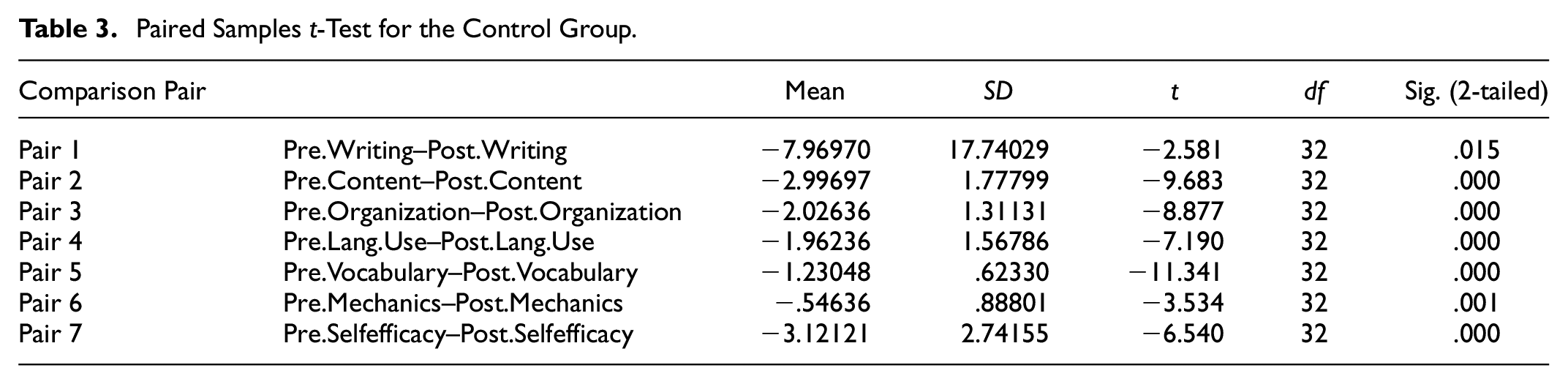
Likewise, the results of the paired-samples t-test for the control group (as seen in Table 3) indicate that there were significant differences between the pre- and post-test scores for all pairs of variables. Specifically, the control group showed improvement in their writing performance, content, organization, language use, vocabulary, mechanics, and writing self-efficacy scores after the intervention.
Paired Samples t-Test for the Control Group.
After that, to determine the significance of these differences, one-way ANCOVAs were used to compare the Edmodo-based and traditional collaborative writing groups in improving the students’ writing performance and self-efficacy. Before conducting the ANCOVAs, checks were run to ensure that data met the criteria for normal distribution, linearity, homogeneity of variances, and reliable measurement of the covariates.
As shown in Table 4, the ANCOVA results for scores on content indicated a significant effect of group on the post-test scores after controlling for the pre-test scores [F(1, 61) = 31.991, p < .001, partial eta squared = .344]. This suggests that there was a significant difference in content scores between the two groups, with the experimental group that received the electronic portfolio-based instruction outperforming the control group in terms of content.
ANCOVA Results for Scores for Content.

As indicate in Table 5, there was also a significant difference between the groups in terms of improving the EFL learners’ organization skills [F(1, 61) = 85.734, p = .00, partial eta squared = .584]. This indicates that the Edmodo-based collaborative writing instruction was more effective than the traditional approach in enhancing the EFL participants’ organizational writing skills.
ANCOVA Results for Scores for Organization.

Table 6 presents the ANCOVA results for scores for language use. The results indicate that a significant difference existed between the electronic portfolio-based collaborative writing group and the traditional group in improving the EFL learners’ language use scores [F(1, 61) = 40.86, p = .00, partial eta squared = .40], suggesting a relatively large effect size of the electronic portfolio-based collaborative writing instruction on language use.
ANCOVA Results for Scores for Language Use.

The ANCOVA results for scores for vocabulary (Table 7) also indicated that the difference between the Edmodo-based collaborative writing group and the traditional group in improving the EFL learners’ vocabulary scores was statistically significant [F(1, 61) = 148.052, p = .000, partial eta squared = .708]. This implies that the Edmodo-based collaborative writing group was more effective than the control group in enhancing the EFL participants’ vocabulary scores.
ANCOVA Results for Scores for Vocabulary.

As shown in Table 8, there was a significant difference between the electronic portfolio-based and traditional writing instruction groups in improving the mechanics of writing [F(1, 61) = 38.519, p = .000, partial eta squared = .387]. This indicates that the electronic portfolio-based writing instruction was more effective than traditional writing instruction in enhancing the mechanics of writing among the EFL learners.
ANCOVA Results for Scores for Mechanics.

Finally, with regard to global writing scores, the results of the first ANCOVA (see Table 9) showed that there was a significant difference between the Edmodo-based and traditional collaborative writing groups in improving the students’ global writing performance [F(1, 61) = 51.52, p = .00, partial eta squared = .43]. This indicates that Edmodo-based writing instruction substantially contributed to enhancing global writing performance of the participants.
ANCOVA Results for Global Writing Scores.

Concerning the effect of electronic portfolio-based instruction on the writing self-efficacy of the participants, the ANCOVA results (see Table 10) revealed that there was a significant difference between the Edmodo-based and traditional collaborative writing groups in enhancing the students’ writing self-efficacy [F(1, 61) = 17.27, p = .00, partial eta squared = .21]. The Edmodo-based group was more effective in developing the students’ writing self-efficacy.
ANCOVA Results for Writing Self-Efficacy.

In conclusion, the quantitative results suggest that electronic portfolio-based writing instruction had a positive impact on both the global writing performance and its underlying components, namely content, organization, language use, vocabulary, and mechanics, as well as the writing self-efficacy of Chinese EFL learners.
Qualitative Results
The qualitative data analysis from semi-structured interviews revealed several themes that emerged regarding the participants’ perceptions and experiences with using Edmodo for their second language writing instruction. The themes that emerged from the interviews are listed in Table 11 and include increased motivation, improved feedback, enhanced collaboration, improved writing skills, increased writing self-efficacy, and flexibility and convenience.
Themes and Sample Excerpts from Semi-Structured Interviews.

Participants reported that using Edmodo increased their motivation to write in their second language, finding the platform engaging and interactive, which boosted their willingness to participate in writing activities. Additionally, students appreciated receiving more timely and useful feedback on their writing, which they found beneficial for their writing development. They valued the ability to receive feedback from both their classmates and the teacher.
Moreover, employing Edmodo enhanced participants’ ability to collaborate with their classmates and teacher, as they appreciated the platform’s facilitation of communication and collaboration, leading to improved writing skills. Participants reported that using Edmodo also helped them improve their second language writing skills through collaboration, timely feedback, and engagement, providing valuable opportunities for skill development.
Furthermore, using Edmodo increased participants’ writing self-efficacy, making them feel more confident in their writing abilities and recognizing their progress in writing development. Finally, participants appreciated the flexibility and convenience of using Edmodo for their writing instruction. They valued the ability to complete writing tasks on their schedule and access Edmodo from any location, offering a more convenient alternative to traditional in-person writing instruction.
Overall, the qualitative results suggest that using Edmodo for second language writing instruction positively impacted Chinese EFL learners’ motivation, feedback, collaboration, writing skills, writing self-efficacy, and convenience. These findings highlight the potential benefits of using online platforms such as Edmodo for L2 writing instruction.
Discussion
In this study, we explored the impact of electronic portfolio-based writing instruction on Chinese EFL learners’ L2 writing performance and writing self-efficacy. The results demonstrated a significant improvement in students’ L2 writing performance with the use of electronic portfolios, which is consistent with previous research by various scholars (e.g., Alsmari, 2019; Barrot, 2021; Bo & Nguyen, 2023; Farahian & Avarzamani, 2018; Hosseinpour et al., 2019; Kongsuebchart & Suppasetseree, 2018; R. Lam, 2020, 2022; Y. W. Lam et al., 2018; Mills & Chandra, 2011; Okumura, 2017; Safdari, 2021; Tsiakyroudi, 2018). This improvement in L2 writing performance can be attributed to the application of Vygotsky’s social constructivist theory, which highlights the role of social interactions and collaborative learning experiences in enhancing learning. Edmodo, as a collaborative writing tool, provided valuable opportunities for students to engage with peers, exchange feedback, and support each other in their writing (Loncar et al., 2021; Nguyen & Nguyen, 2019; R. Zhang & Zou, 2021). Such social interactions and collaborative writing experiences likely contributed to the positive outcomes in L2 writing performance.
Moreover, the use of electronic portfolios and peer feedback acted as scaffolding tools, assisting learners in developing their writing skills. Constructive feedback from peers, coupled with the electronic portfolio platform, allowed students to progressively refine their writing abilities (R. Zhang & Zou, 2021), building upon their existing skills and enhancing overall writing performance. The implementation of the Edmodo learning platform proved highly beneficial in enhancing students’ writing performance, creating a supportive and collaborative learning environment. This fostered increased cooperation and collaboration among students, heightening motivation and, consequently, proficiency in L2 writing. These findings align with previous research, such as Mokhtar and Dzakiria’s (2015) assertion that motivated online writing leads to improved knowledge and performance.
Previous research also supports the positive impact of Edmodo’s quiz feature on students’ ability to recognize topic sentences and supporting details (R. Lam, 2020; Y. W. Lam et al., 2018; Nami, 2022; Okumura, 2017). The comment box feature facilitates brainstorming and collaboration among students, while the platform’s immediate feedback is noteworthy. Participants in the Edmodo group could upload and revise paragraph writing assignments iteratively, enhancing their awareness of the writing process (Boykin et al., 2019). Edmodo’s user-friendly and secure environment also empowered less active learners to become more engaged, autonomous, and confident (Zheng & Barrot, 2022). It can be argued that the implementation of electronic portfolio-based writing instruction facilitated meaningful interactions, feedback exchange, and efficient progress in writing performance, drawing from Vygotsky’s (1984) social constructivism. Learners’ flexibility to revise assignments and provide feedback without time constraints fostered a sense of autonomy and responsibility (Alsmari, 2019; Boykin et al., 2019). Edmodo’s collaborative learning platform fostered students’ interest in writing and created a supportive environment for peer assistance (Anwar, 2021; Fathi & Rahimi, 2022), resulting in enhanced English writing performance. Integration of multimedia and access to various types of content on the internet, coupled with teacher guidance and interaction with peers, contributed to effective scaffolding (Y. W. Lam et al., 2018; Mills & Chandra, 2011; Nami, 2022). Also, the positive effect of electronic portfolio-based instruction on writing performance aligns with principles of collaborative learning (Safdari, 2021; Tsiakyroudi, 2018). Collaborative tasks offer psychological benefits and empower L2 learners to understand individual and group learning better (Kongsuebchart & Suppasetseree, 2018).
The second aim of this study was to investigate the impact of electronic portfolio-based writing instruction on the writing self-efficacy of Chinese EFL learners. The results demonstrated a substantial improvement in writing self-efficacy among the participants (Alsmari, 2019; Bandura, 1994; Nguyen & Nguyen, 2019; Pajares & Valiante, 1996; Saine & West, 2017; Schunk & Swartz, 1993; Shell et al., 1995; Tsiakyroudi, 2018). Electronic portfolio-based instruction fostered autonomy and a higher sense of responsibility, enhancing overall writing competence (Alsmari, 2019). The student-centered approach deepened engagement through feedback, practice, and comment exchange (Anwar, 2021; Fathi & Rahimi, 2022). Multimedia resources on Edmodo enriched learning experiences and boosted confidence (Y. W. Lam et al., 2018; Nami, 2022; R. Zhang & Zou, 2021), empowering participants and enhancing writing self-efficacy.
Furthermore, electronic portfolio-based instruction positively influenced both writing performance and self-efficacy (Boykin et al., 2019). Student-centered approaches and technology-enhanced platforms promoted motivation and empowerment (Zheng & Barrot, 2022). Improved self-efficacy contributed to language learning strategies and motivation (Alsmari, 2019; Khodashenas & Rakhshi, 2017; Masaeli & Chalak, 2016). Vygotsky’s (1984) social constructivist theory supports the observed enhancement in L2 writing self-efficacy. Edmodo’s collaborative platform facilitated peer interactions, feedback, and reflective thinking (Okumura, 2017; Rahimi & Fathi, 2021; Tsiakyroudi, 2018), positively influencing self-efficacy development (Zimmerman, 2000).
Additionally, electronic portfolios empowered learners to set goals, monitor progress, and reflect on writing performance (Fathi & Rahimi, 2022; R. Zhang & Zou, 2021; Zheng & Barrot, 2022), positively impacting self-efficacy (Phillips & Gully, 1997). Intrinsic motivation, writing performance, and self-efficacy are strongly associated (Pajares & Valiante, 1996; Shell et al., 1995; Tsiakyroudi, 2018). Edmodo bridged students with teachers and peers, fostering increased motivation and writing self-efficacy (Bandura, 1994; Nguyen & Nguyen, 2019; Saine & West, 2017; Schunk & Swartz, 1993; Tsiakyroudi, 2018; Zimmerman, 2002). The collaborative and interactive nature of Edmodo empowered learners, resulting in enhanced self-efficacy and writing performance (Bandura, 1994; Nguyen & Nguyen, 2019; Saine & West, 2017; Schunk & Swartz, 1993; Tsiakyroudi, 2018; Zimmerman, 2002).
Additionally, qualitative data collected through semi-structured interviews revealed several themes regarding the participants’ perceptions and experiences with using Edmodo for their L2 writing instruction. These themes included increased motivation, improved feedback, and enhanced collaboration, improved writing skills, and increased writing self-efficacy. The findings of this study add to the existing literature on technology-enhanced EFL writing instruction by providing empirical evidence of the positive impact of using Edmodo as a writing instruction tool. The results are consistent with previous research that has shown that technology can increase motivation and engagement in L2 writing (X. Liu & Wang, 2017; Yousefifard & Fathi, 2021; H. Zhang et al., 2014). The participants in this study reported finding the Edmodo platform engaging and interactive, which increased their motivation to participate in writing activities and write in their second language. The results also support the idea that technology can provide more timely and useful feedback in second language writing instruction (Loncar et al., 2021). Participants in this research reported that they received more timely and useful feedback on their writing when using Edmodo than traditional writing assignments. The ability to receive feedback from their classmates and teacher in real-time was perceived as beneficial for their writing development. This is in line with previous research that has shown that technology can provide more opportunities for peer feedback, which can enhance the quality of feedback in L2 writing instruction (Bakla, 2020; Stapleton & Radia, 2010). The present outcomes also highlight the potential of technology to enhance collaboration in EFL writing instruction. As reported by the participants, using Edmodo made it easier for them to collaborate with their classmates and teacher on writing projects. The platform facilitated communication and sharing of ideas, which improved their writing skills. This is consistent with previous research that has shown that technology can provide more opportunities for collaboration in L2 writing instruction (H. C. Hsu, 2019; R. Zhang & Zou, 2021).
Conclusions
The outcomes of this research indicated that electronic portfolio-based writing instruction had a significant impact on the writing performance as well as its underlying components (i.e., content, organization, language use, vocabulary, and mechanics) and writing self-efficacy of Chinese EFL learners. The qualitative data further supports these findings, with participants reporting increased motivation, improved feedback, enhanced collaboration, improved writing skills, increased writing self-efficacy, and heightened flexibility as a result of using electronic portfolios for their writing instruction.
These findings may have several implications for both theory and practice. Theoretically, the results support the growing body of literature on the effectiveness of technology-based writing instruction in L2 language learning. The results contribute to the understanding of how technology-based writing instruction can impact the writing performance and writing self-efficacy of EFL learners Additionally, the results underscore the importance of timely feedback and collaboration in second language writing instruction. Pedagogically, teachers and instructors can use electronic portfolios to facilitate communication, collaboration, and feedback between students and teachers, leading to improved writing performance and writing self-efficacy. The results of this study also suggest that technology-based writing instruction can be an engaging and enjoyable way for students to learn writing in EFL contexts. Writing teachers might help learners develop their self-efficacy beliefs and use electronic portfolios as a means of promoting their writing self-efficacy.
Although this study provides valuable insights into the impact of electronic portfolio-based writing instruction, there might be several limitations to be taken into account. First, the sample size in this study was relatively small, and the results may not be generalizable to larger samples in other EFL contexts. Larger projects with more diverse samples are needed to validate the results of this study and to further examine the impact of electronic portfolio-based writing instruction on L2 writing performance and writing self-efficacy. Second, the study only focused on writing performance and writing self-efficacy, and did not examine other potential outcomes of technology-based writing instruction, such as motivation or attitude toward technology. To paint a more comprehensive picture of the benefits of technology integration, subsequent research could encompass a more holistic assessment of various outcomes related to the learners’ engagement and experiences.
Third, the current study exclusively utilized Edmodo as the chosen technology-based writing instruction tool, without comparing its outcomes to those of alternative tools available in the educational landscape. Conducting comparative studies that juxtapose electronic portfolio-based writing instruction using Edmodo against other technology-based writing instruction tools would yield valuable insights into the relative effectiveness of different platforms within the specific context of EFL education. Such investigations could shed light on the unique affordances and limitations of various tools, guiding educators, and researchers toward more informed decisions in implementing technology-enhanced pedagogies. Lastly, although the selection of the Jacobs et al. (1981) rubric was underpinned by its established reliability and validity, as corroborated by previous scholarship (Weigle, 2007; Winke & Lim, 2015), it is prudent to acknowledge the availability of more recent rubrics that may offer improved applicability to contemporary language assessment practices. To ensure the continued validity and relevance of our findings, future studies are encouraged to consider the adoption of updated rubrics in the evaluation of writing performance. Embracing more contemporary assessment tools will not only bolster the rigor of research outcomes but also facilitate greater alignment with evolving standards in language education evaluation.
Footnotes
Appendix
Declaration of Conflicting Interests
The author(s) declared no potential conflicts of interest with respect to the research, authorship, and/or publication of this article.
Funding
The author(s) disclosed receipt of the following financial support for the research, authorship, and/or publication of this article: This work is supported by the Undergraduate Education and Teaching Reform Key Project of Zhejiang Gongshang University, named “Research on the Innovative Teaching Model of Foreign Language Education Enabled by Generative Artificial Intelligence”, and by Subject Construction and Management Project of Zhejiang Gongshang University, named “Research on the Construction Path of the Discipline System of Foreign Language Education enabled by Artificial Intelligence”.
Consent to Participate
Informed consent was obtained from all the participants in this study.

Data Availability Statement
Data will be made available on request.