




Abstract
Physician shortages particularly affect German rehabilitation facilities, which increasingly rely on foreign-trained physicians (FTP). While essential for workforce stability, FTP face integration and career-related challenges that increase turnover risks. Evidence on FTP retention in rehabilitation remains scarce. This study examines whether professional biographical characteristics and career-related job satisfaction predict FTPs’ intention to leave German rehabilitation facilities. We conducted a cross-sectional online survey in spring 2022 among FTP working in German rehabilitation departments. A total of 142 FTP formed the analytical sample. Logistic regression was performed with turnover intention as the outcome and two predictors: years worked in the department and a career-related satisfaction index. Odds ratios (ORs), 95% confidence intervals (CIs), and p-values were calculated. Of 142 FTP analyzed, 26 (18.3%) intended to leave the field. Only 3.8% of those with turnover intention had worked more than 4 years in their department compared to 38.8% without such intention. Physicians planning to leave reported lower satisfaction with research, training, and career opportunities. Regression analysis showed turnover intention was negatively associated with years spent in the department (OR: .74; 95% CI [.56, .90]) and with higher career-related satisfaction (OR: .35; 95% CI [.20, .57]). Early-career physicians and those with lower career-related satisfaction are at higher risk of turnover. Despite limitations such as the cross-sectional design, self-reported data, and possible selection bias, the findings highlight the importance of career development and job satisfaction. Targeted strategies are needed to strengthen retention and ensure continuity of rehabilitation care.
Plain Language Summary
Germany faces a shortage of physicians, especially in rehabilitation medicine. To fill this gap, many rehabilitation facilities employ foreign-trained physicians (FTPs). These doctors are essential for patient care, but they often face challenges such as language barriers, bureaucratic hurdles, and limited career opportunities. Many consider leaving their jobs or even leaving Germany. This study explored which factors predict FTPs’ intention to leave rehabilitation medicine. In 2022, 142 foreign-trained physicians working in German rehabilitation departments completed an online survey. The study examined their professional background and satisfaction with career and training opportunities. Results showed that 18% of participants planned to leave rehabilitation. Those who intended to leave were usually younger, had worked in their department for fewer years, and were less satisfied with their career prospects. Physicians with higher career satisfaction and longer employment were significantly more likely to stay. The findings suggest that both career development and stable working conditions are crucial for retention. Interpreting the results through Herzberg’s Two-Factor Theory, the study shows that motivational aspects (such as career satisfaction and recognition) promote staying, while poor structural conditions (like temporary contracts or heavy workload) increase the desire to leave. Strengthening professional development, mentoring, and long-term career pathways could help keep foreign-trained physicians in rehabilitation, ensuring stable, high-quality care for patients in Germany.
Keywords
Introduction
According to recent analyses by the WHO, the size of the health and care workforce in Western Europe has increased by 26% between 2010 and 2020. In terms of medical doctor density per 10,000 people in Europe, Germany ranks 9th out of 51 countries (WHO Regional Office for Europe, 2022). However, there are still significant disparities in physician density, both locally and in terms of specialties, even in high-income countries (Lafortune et al., 2019). In Germany, this issue particularly affects general medicine, public health service, and rehabilitative medicine (Arentz, 2017; Jansen & Marquardt, 2024; Kaduszkiewicz et al., 2018). This problem is expected to worsen in the future due to the aging population and the upcoming retirement of a generation of physicians (Friedrich-Ebert-Stiftung, 2015; Robert Bosch Stiftung, 2021). As a solution, rehabilitation facilities are recruiting foreign-trained physicians (FTP) to address the shortage.
According to previous research, currently, one out of three physicians in rehabilitation facilities is foreign-trained (Marquardt et al., 2023). This does not include foreign-born physicians or those who have migrated at some point in their life cycle (Jansen & Marquardt, 2023). The strategy of filling staff shortages with FTP entails several challenges: inadequate language and communication skills for establishing a doctor-patient relationship (Chen et al., 2011; Wright et al., 2012) as well as for interprofessional communication (Bourgeault et al., 2010), a lack of knowledge about the national healthcare system and disease and therapy concepts (Klingler et al., 2018; Klingler & Marckmann, 2016; Michalski et al., 2017), unfamiliarity with localized forms of professional collaboration (Jansen et al., 2015) and country-specific bureaucratic processes (Jansen et al., 2018), and additional problems with social integration of FTP into their new living environment (Hänel et al., 2018). However, the biggest challenge with this strategy is the risk of high physician turnover and subsequent discontinuity in patient care (Jansen et al., 2024).
A high turnover rate has negative consequences for both the financial and social capital of an organization (Bodla & Hameed, 2009), as well as the morale of the remaining workforce and the organization’s reputation (Winterton, 2004). The process of recruiting new healthcare workers is expensive and time-consuming, resulting in a drain of funding for healthcare organizations (Misra-Hebert et al., 2004). Therefore, it is important to explore ways to reduce turnover and improve retention (Brook et al., 2019). The focus on healthcare workers’ intention to leave is strongly recommended, since literature suggests a high implementation rate (De Vries et al., 2023; Mobley et al., 1979).
The reasons why FTP leave the destination country are diverse: For example, the quality of the working relationship with the supervisor is important (Braun et al., 2021; Brugha et al., 2021; Byrne et al., 2021; Heponiemi et al., 2018). Studies have also found that a positive working environment—characterized by high staffing, effective governance and task coordination, and control of work pace—is associated with a low turnover rate. Furthermore, high life satisfaction in a new place, favorable citizenship status, and personal reasons like family ties contribute to low turnover intentions among migrants (Becker & Teney, 2020; Brugha et al., 2016; Heponiemi et al., 2018). Additionally, employment-related factors such as favorable contracts and career training opportunities significantly reduce turnover intention. On the contrary, increased threats and violence from patients and a high level of workplace discrimination are linked to a higher likelihood of turnover intention (Byrne et al., 2021; Eneroth et al., 2017; Heponiemi et al., 2018). Authors of another study discovered that psychosocial factors can also be associated with turnover intention: Increased distress and sleep problems are linked to a greater intention to change professions, while higher job control is associated with a decreased intention to switch careers, even after accounting for the influences of gender, age, and employment sector (Heponiemi et al., 2008).
To date, most of the existing literature has focused on FTP in acute care hospitals or primary care settings, with considerably less attention paid to rehabilitation medicine. International studies have highlighted the importance of organizational support, supervisory relationships, and integration measures as determinants of retention, whereas German research has mainly emphasized language barriers, bureaucratic challenges, and contract conditions (Al Achkar et al., 2023; Jansen & Marquardt, 2023; Klingler et al., 2018). However, systematic quantitative analyses that specifically address the turnover intentions of FTP in the rehabilitation sector remain scarce. Moreover, few studies have combined biographical characteristics with career-related satisfaction as predictors of turnover intention in this context. This gap underscores the need for targeted research that addresses the unique challenges of rehabilitation facilities, which rely heavily on foreign-trained staff but differ in organizational structure and career pathways compared to acute care. Against this background, our study focuses specifically on the turnover intention of FTP in German rehabilitation facilities.
In previous work, we identified several career- and employment-related aspects associated with FTPs’ intention to leave German rehabilitation facilities (Marquardt et al., 2023). In an explorative subgroup analysis of FTP with and without turnover intention from the quantitative questionnaire study “Medical professionals with a foreign degree in German rehabilitation facilities—a quantitative cross-sectional study (FTP-quant),” two main categories of characteristics were most strongly associated with turnover intention: professional biographical aspects and job satisfaction, especially regarding career options (Jansen et al., 2024).
FTP with turnover intention were significantly younger and have worked in Germany and in their current medical institutions for a shorter time than FTP without turnover intention. They are less likely to have a specialist title or management responsibilities, indicating an earlier career stage, and are more likely to have a fixed-term employment contract. In terms of work-related satisfaction, FTP with turnover intention are generally less content than FTP without turnover intention, for example with career prospects, the bureaucracy, the nature of the tasks, working hours, and the institution’s location (Jansen, Haenel, & Klingler, 2018; Jansen & Haenel, 2020; Jansen, Schmidt, & Marquardt, 2024).
The aim of this study is to provide a more in-depth understanding of how these different aspects relate to the intention to leave German rehabilitation facilities. This study is essential for several reasons. First, it aims to provide a deeper understanding of the multifaceted factors influencing FTPs’ intentions to leave German rehabilitation facilities. By identifying the specific elements that contribute to turnover intentions, we can gain insights into the complexities that impact retention strategies within the German rehabilitation system.
Furthermore, understanding the relationship between professional biographical characteristics and career-related job satisfaction is crucial, as FTP with and without intentions to leave the rehabilitation field differ significantly with regards to these factors (Teney et al., 2017). By exploring these elements in a multivariate context, the research seeks to develop tailored interventions that address the unique needs and concerns of FTP, ultimately improving retention rates.
To conceptually frame our study, we refer to Herzberg’s Two-Factor Theory, which distinguishes between motivational and hygiene factors influencing job satisfaction and turnover (Giroux, 1960; Hellman, 1997). Although the present analysis was not originally designed as a theory-driven test, this framework helps contextualize our findings by linking individual and organizational determinants of turnover intention. In our study, factors such as career satisfaction and professional recognition can be viewed as motivational aspects supporting retention, whereas structural conditions such as contract type and workload represent hygiene factors whose absence may increase turnover intention. This conceptual framing provides a coherent theoretical background for understanding the predictors of turnover intention among foreign-trained physicians in German rehabilitation facilities.
This study has practical implications for policymakers and rehabilitation facility administrators. Enhancing retention of FTP is vital for maintaining a stable workforce, improving the quality of care provided to patients, and fostering a more inclusive work environment. This research will contribute to a more effective and responsive rehabilitation system in Germany, benefiting both workers and the individuals they serve.
To provide a comprehensive understanding of FTP’s motivation for turnover, we investigated whether professional biographical characteristics and career-related job satisfaction, which previously most strongly differed between FTP with and without the intention to leave the field of rehabilitation, also predict turnover intention in a multivariate setting.
Based on previous evidence and exploratory findings, we expected that (1) shorter employment duration and earlier career stages would be associated with higher turnover intention; (2) lower levels of career-related satisfaction would be linked to higher turnover intention; and (3) when considered jointly, professional biographical characteristics and career satisfaction would explain a substantial proportion of variance in turnover intention among foreign-trained physicians working in German rehabilitation facilities.
These expectations guided our analysis and informed the selection of predictors, within an exploratory, cross-sectional design.
Methods
Study Design
In the spring of 2022, we conducted a quantitative cross-sectional study in two stages, focusing on both departmental and individual levels (Figure 1). The study invitation materials for both survey components were distributed jointly to all 2,965 rehabilitation departments in Germany that are quality-assured by the German Pension Insurance (DRV). Departments could participate in the paper-based or electronic departmental survey, and were also encouraged to forward the survey flyer and link to their foreign-trained physicians (FTP).

Flow of participants.
No incentives were offered. Although aggregate data on foreign-trained physicians in Germany are available from primary sources such as the German Medical Association (Bundesärztekammer) and the Federal Statistical Office (Destatis), no register or database provides a defined sampling frame from which individual FTP in rehabilitation medicine could be directly identified and contacted. Therefore, recruitment was conducted via rehabilitation departments participating in the German Pension Insurance's (DRV) quality assurance program, which covers more than half of all rehabilitation facilities in Germany. As no official statistics on FTP in German rehabilitation were available, the exact population size could not be determined, and no systematic random sampling was possible. Instead, an open recruitment approach was employed, in which all FTP in the contacted departments could participate. After 4 weeks, a reminder was sent to department heads who had not yet responded, with another set of flyers.
In total, 673 departments returned the departmental survey (response rate 22.7%), and 157 FTP participated individually in the anonymous online FTP survey. Because both survey components were disseminated simultaneously and the FTP survey was fully anonymous, it cannot be verified whether all FTP respondents were affiliated with departments that also participated in the departmental survey. However, all departments had the opportunity to distribute the FTP survey materials, ensuring equal access to participation.
For the purpose of this study, only data from the second stage (FTP survey) were analyzed.
Participants
The study included FTP currently working in inpatient and outpatient rehabilitation departments across Germany. FTP were defined as individuals who have obtained their medical degree outside of Germany and are practicing medicine in the country. Physicians trained outside the EU typically require a 2-year process for recognition of their degree, while those who have obtained their medical degree in an EU country are granted direct approbation to practice medicine in Germany.
Outcome
The explorative FTP survey was specifically designed for the German rehabilitative setting, based on qualitative pre-studies. The turnover intention section of the survey addressed several key aspects, including turnover intention itself, the direction of potential turnover, and, in cases where turnover was linked to residency requirements, the subsequent interest in returning to work in rehabilitation.
For analysis purposes, a binary variable for turnover intention was created. The turnover intention group included all FTP who stated intentions to leave their current job in order to work outside of the rehabilitation field. The group without turnover intention consisted of FTP with no intention to change their current job as well as FTP with intentions to work at another rehabilitation facility in Germany. Furthermore, this group included FTP who intended to leave their current job for a specialist medical training, but considered to resume work in rehabilitation afterwards.
Analysis
We performed subgroup analysis, comparing FTP with and without turnover intention on a range of variables. Descriptive and subgroup comparisons included socio-demographic characteristics (gender, age, nationality), professional-biographical factors (German specialist title, leading role, length of stay in Germany, length of employment in department), and regional characteristics (BIK classification). Chi2 tests were used for categorical variables, or Fisher’s exact test when expected frequencies were below five. Career-related job satisfaction was assessed with 3 items from a 5-point Likert-scale question asking: “How satisfied are you with the following aspects of your current professional situation?” (1 = unsatisfied, 5 = satisfied). The items referred to (a) career opportunities, (b) further and advanced training opportunities, and (c) research opportunities. A principal component analysis confirmed a one-factor solution explaining 77% of the variance (factor loadings .84–.91; communalities .71–.83). Internal consistency was good (Cronbach’s α = .85). For each participant, a mean index was calculated and compared between groups.
For the multivariate analysis, the outcome variable (Y) was turnover intention, and the primary predictors (X), selected based on exploratory findings from a qualitative pre-study, were years worked in the department and the mean career-related job satisfaction index. Multivariate analysis was then conducted using logistic regression to examine turnover intention using these two key predictors. Due to the small sample size, only these variables were included to avoid overfitting, and only participants with complete data were analyzed. From the regression analysis, we estimated odds ratios (ORs), corresponding 95% confidence intervals (CIs) and p-values. Statistical analyses were conducted in R 4.2.2.
Results
Figure 1 shows the participant flow chart.
Of the 157 FTP who participated in the survey, 15 were excluded due to missing data on key variables. Missing data were handled via list wise deletion. Comparisons between excluded and included participants showed similar distributions across sociodemographic and career-related variables, suggesting that the exclusion did not bias the analytical sample. The final analytical sample comprised 142 FTP in our analysis: 26 FTP with turnover intention (18.3%) and 116 FTP without turnover intention (81.7%). The descriptive characteristics of the two groups are summarized in Table 1. A higher proportion of FTP in the turnover intention group was male (65.4%), though the difference is not statistically significant. However, age differed significantly between the groups (p = .001): two thirds of FTP in the turnover group were between 26 and 35 years old, whereas in the group without turnover intention, only one-third fell within this age range. Regarding important career steps, a smaller proportion of FTP with turnover intention held a German specialist title (19.2%) compared to those without turnover intention (34.4%), though this difference was not statistically significant. However, there was a significant difference in leading roles (p = .044): 15.5% of FTP without turnover intention held a leadership position compared to none of FTP who intended to leave rehabilitation.
Descriptive Characteristics of FTP with and without Turnover Intention.
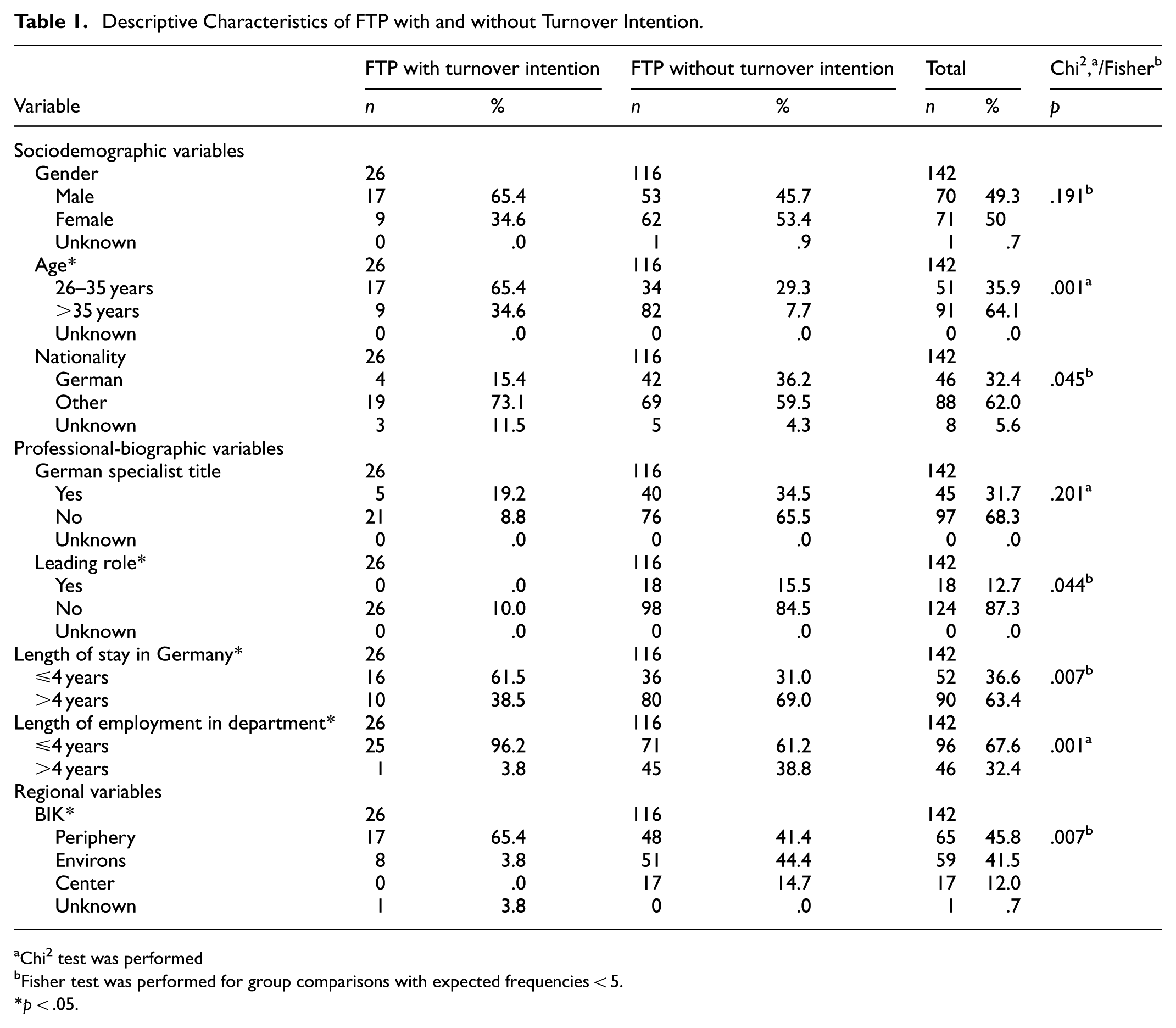
Chi2 test was performed
Fisher test was performed for group comparisons with expected frequencies < 5.
p < .05.
Other significant differences included nationality and migration history. A larger proportion of FTP without turnover intention held German citizenship (p = .045), and the time since migration to Germany also differed significantly (p = .007). Two-thirds (66.7%) of FTP without turnover intention had lived in Germany for more than 4 years, compared to only 38.5% in the turnover intention group.
Work experience within their current rehabilitation department followed a similar pattern. Only 3.8% of FTP with turnover intention had been working in their department for more than 4 years, which was a significantly lower proportion than in the group without turnover intention (38.8%, p = .001).
Another significant difference was found in the regional location of the rehabilitation facilities (BIK classification, p = .007). Among FTP with turnover intention, the majority worked in peripheral, rural areas (65.4%) and no rehabilitation department was located in city centers. In contrast, 14.7% of FTP without turnover intention worked in city-center facilities.
Finally, the career-related job satisfaction index (α = .85) was lower among FTP with turnover intention (mean = 2.1, SD = 1.0) compared to those without turnover intention (mean = 3.3, SD = 1.2; Table 2).
Mean Values of Career-Related Satisfaction Items and Index.

Despite the small size of the group with turnover intention, we were able to identify significant relationships using a logistic regression (Table 3). The length of employment in the rehabilitation department as a professional biographical variable and the career-related job satisfaction, were both significantly linked to the intention to leave or stay in German rehabilitation.
Logistic Regression Results.

Note. Model fit: χ2(2) = 38.78, p < .001; LLdiff = −19.39; Nagelkerke R2 = .38; AUC = .83. Data: FTP survey 2022, n = 142; dependent variable: turnover intention (1 = FTP with turnover intention, n = 26; 0 = FTP without turnover intention, n = 116).
The intention to leave was negatively associated with the number of years spent in the department (OR: .74; 95% CI [.56, .90]) and with higher career-related job satisfaction (OR: .35; 95% CI [.20, .57]). For each additional year spent in the department, the likelihood of being in the group without turnover intention increased by 1.35 times. Additionally, for each 1-point increase in career-related job satisfaction (on a 5-point Likert scale), the probability of being in the group without turnover intention was 2.87 times higher.
Model fit and discrimination statistics further support the robustness of these findings. The likelihood-ratio test comparing the model to the null model was significant (χ2[2] = 38.78, p < .001), indicating that the model provides a significantly better fit than a model with no predictors. The model explained 38% of the variance in turnover intention (Nagelkerke R2 = .38), and the area under the receiver operating characteristic curve (AUC) was .83, reflecting good discrimination between FTP with and without turnover intention.
Discussion
This study offers essential insights into the retention of FTP by assessing the professional biographical characteristics, career-related job satisfaction and the intention of FTP to continue their work in German rehabilitation facilities. The findings highlight a critical relationship, revealing that both the length of employment within a facility and the satisfaction that FTP derive from career-specific aspects significantly correlate with their intention to remain in their roles. This underscores the importance of not only individual attributes but also the institutional environment in shaping turnover intention.
Our analysis built on previous research, which has shown that professional biographical characteristics—such as the number of years in practice and the nature of one’s career path—were instrumental in predicting turnover. Our results from multivariate regression analysis reinforce earlier conclusions (Jansen et al., 2024), illustrating that the career-related satisfaction of FTP acts as a strong motivator for their decisions concerning employment stability. These findings emphasize how critical it is that healthcare institutions consider these personal indicators when devising strategies aimed at employee retention.
Interpreted through the lens of Herzberg’s Two-Factor Theory, these results suggest that motivational factors such as career satisfaction and professional recognition promote retention, while structural conditions such as contract type or workload—representing hygiene factors—may increase turnover intention when perceived as inadequate.
These findings are consistent with previous research that highlighted the role of career-related opportunities and contract conditions for retention (House et al., 2022; Jansen & Marquardt, 2023; Lu et al., 2023).
Employment-related and career-related aspects have been consistent themes across various international studies on retention. Our research aligns with findings from several German-speaking publications (Becker & Teney, 2020; Braun et al., 2021; Peter et al., 2020) as well as studies from Ireland (Brugha, McAleese, et al., 2016; Brugha, Clarke, et al., 2021). However, compared to other topics in the study of retention, opportunities for development among health professionals have not been frequently addressed.
Previous studies described a specific group of FTP who viewed their work in rehabilitation as a temporary stop in their career trajectories (Becker & Teney, 2020). This group is characterized by a desire for career advancement and has often been labeled as “career-oriented climbers.” Such individuals transition frequently to new opportunities that they perceived as more valuable for a career within the acute care setting. Rehabilitation environments that offer unique attributes—such as supportive cultures, interdisciplinary teams, and extended patient interactions—could serve as compelling factors for retention, particularly for those who value a more family-friendly atmosphere.
In contrast to previous international studies on retention of FTP in acute care, our analysis concentrated on structural and career-related aspects. Other factors such as workplace relationships, supervisory support, or family situation—which have been identified in the literature as important for physician retention (Becker & Teney, 2020; Braun et al., 2021; Byrne et al., 2021; De Vries et al., 2023; Eneroth et al., 2017; Heponiemi et al., 2018; Koch et al., 2020)—were not examined in this study and therefore cannot be evaluated with our data.
At the same time, international research indicates that turnover intentions are shaped by a broader set of factors, which only partly overlap with our findings. While our results highlight the primacy of career satisfaction and employment duration as drivers of turnover intention among FTP in German rehabilitation facilities, the international literature offers a more nuanced and sometimes contradictory view of key influencing factors. Recent scoping reviews and meta-analyses suggest that determinants of turnover intention vary significantly by country, institutional context, and healthcare setting (Owusu & Gregar, 2021; Ren et al., 2024).
For instance, several international studies emphasized the quality of working relationships and organizational support as major predictors of retention among foreign-trained health professionals—sometimes even outweighing contract type or career-related variables. A recent review identified the quality of the work environment and interpersonal relations as decisive in lowering turnover intention among FTP in multiple high-income countries, with personal integration and workplace discrimination also playing key roles (Can et al., 2022; Dræbel et al., 2024; Heponiemi et al., 2018; Yolci et al., 2022). These aspects were less pronounced in the present study, contrasting with the robust evidence for the protective effect of high-quality supervision and collegial cooperation found elsewhere. This divergence could reflect contextual factors unique to the German rehabilitation sector, such as more standardized team interactions or distinctively structured career pathways.
Further, there is also debate over the extent to which compensation, job benefits, and training satisfaction impact turnover intention in healthcare. Some studies in non-European settings found that generous compensation, benefits, and tailored training programs substantially lowered turnover intention, especially in private healthcare environments. However, other studies proposed that these financial and developmental factors are only effective when coupled with supportive organizational cultures and meaningful work. The Job Demands-Resources (JD-R) Model underline that the balance between job demands and the available resources (including social support) determined burnout and the likelihood of turnover—not just contractual or career factors alone (Jung et al., 2023; Owusu & Gregar, 2021; Özdemir, 2024).
Another source of conflicting evidence concerned structural or cultural discrimination. Studies showed that FTP faced systematic barriers to advancement and social integration, which increased the likelihood of turnover, even if objective job conditions appeared favorable. In Germany, qualitative work with stakeholders pointed to language barriers, subtle forms of exclusion, and skepticism toward foreign credentials as persistent concerns—factors that may not always be captured quantitatively but can accelerate FTP attrition (Dræbel et al., 2024; Klingler et al., 2018; Tangermann & Grote, 2018).
The prevalence and key drivers of turnover intention also differs considerably across global regions (e.g., Asia vs. Europe vs. North America), reflecting the varying degree of economic development, workforce shortages, and health system pressures. For example, in some Asian countries, migration motives, and unstable healthcare infrastructure predominate, while in affluent European countries, subtle institutional barriers are more relevant (Kreienbrink, 2014; Ren et al., 2024). Taken together, these divergent findings underscore the importance of a context-sensitive interpretation of retention strategies. While our study elevates career satisfaction and employment status as crucial factors in the German rehabilitation context, policy approaches should also incorporate best practices from the international literature, including measures to improve social integration, minimize discrimination, enhance organizational support, and tailor interventions to the unique motivations and challenges faced by FTP (Dræbel et al., 2024; Klingler et al., 2018; Owusu & Gregar, 2021).
While burnout symptoms such as emotional exhaustion have been highlighted in the literature as substantial drivers of physician turnover (Hämmig, 2018; Vandenbroeck et al., 2017), our study found no such correlations. The rehabilitation setting presents distinct challenges and experiences compared to other medical contexts, suggesting a need for context-sensitive approaches when dealing with retention issues.
Our results furthermore showed that FTP with shorter periods of employment at their current facility are more inclined to leave their current job. Fewer years of employment suggest an early-career stage. Younger FTP may have found roles in rehabilitation unfulfilling if they aspired toward a career in acute clinical settings (Becker & Teney, 2020).
A possible explanation for these results lies in the cumulative advantages that longer-serving physicians have acquired over time. Extended service is often associated with greater access to stable contracts, leadership roles, and institutional support systems, which in turn enhances job satisfaction and strengthens professional identity (Jansen & Marquardt, 2023). Longer-serving FTP are also more likely to have built local networks and developed familiarity with bureaucratic processes, thereby reducing stressors that typically affected newcomers (Klingler et al., 2018; Tangermann & Grote, 2018). In contrast, physicians at earlier career stages frequently face fixed-term contracts, limited career progression opportunities, and fewer support structures, all of which can contribute to frustration and higher turnover intention (Faisal & Naushad, 2021; Owusu & Gregar, 2021). This highlights the importance of targeted measures such as mentoring programs, structured onboarding, and clear career pathways to help early-career FTP integrate more effectively and experience similar levels of satisfaction as their longer-serving colleagues (Steven et al., 2008).
In light of these results, it is clear that strategies aimed at enhancing FTP retention in German rehabilitation facilities must adopt a comprehensive approach.
This recommendation is in line with approaches that view turnover intention as shaped by attitudes, norms, and perceived control (Ajzen, 1991). This includes creating clear pathways for professional development as well as actively fostering an environment of career-related satisfaction, particularly targeting the needs of early-career practitioners. The evolving dynamics in the field, shaped by new generations of healthcare professionals increasingly focused on research and career development opportunities, underlines the necessity for rehabilitation facilities to adapt to these shifting priorities.
In addition, our findings open up several avenues for continued research. Comparative studies across different healthcare sectors and geographic contexts could help to determine whether the predictors of turnover intention identified here—particularly career satisfaction and employment duration—are equally relevant in other settings, or whether alternative determinants became more salient. Longitudinal designs would further allow for the examination of how turnover intentions evolves over time, especially during critical early-career transitions. From a practical perspective, the results underline the importance of targeted policy interventions that address career-related satisfaction among early-career physicians. Developing structured career pathways, investing in professional development, and strengthening organizational support systems appear particularly promising strategies to improve retention in the rehabilitation sector.
Furthermore, there is a pertinent need to establish structural solutions that catered to the aspirations of FTP seeking diverse career opportunities within Germany’s healthcare landscape, rather than solely relying on the appeal of rehabilitation roles to encourage retention (Jansen & Peppler, 2025).
Beyond the practical implications for healthcare management, this study also contributes conceptually by emphasizing the need to integrate workforce retention research more systematically into broader debates on health system sustainability and equity. Our findings suggest that the interplay between institutional structures and individual motivational factors requires a multidimensional analytical approach that bridges organizational behavior, migration studies, and health services research. Future studies could therefore benefit from mixed-method or longitudinal designs that capture the dynamic processes underlying career satisfaction and turnover decisions over time. In particular, comparative analyses across different healthcare sectors and regions would help clarify whether the mechanisms identified in rehabilitation medicine are generalizable or context-specific. Such work would not only extend the theoretical understanding of physician retention but also inform targeted interventions and policy frameworks to strengthen workforce stability in diverse healthcare settings.
While our study provides valuable insights, it is essential to acknowledge its limitations, particularly the small and potentially non-representative sample size. Although we included all rehabilitation departments participating in the quality assurance program of the German pension insurance (DRV), covering more than half of all German rehabilitation facilities, very few FTP responded in the second stage. One major challenge in recruitment was the difficulty of reaching FTP with turnover intention, who may have been less motivated to participate. In addition, as recruitment was conducted via department heads, concerns about privacy may have discouraged participation, despite the survey being anonymous.
The small number of participants also limited the range of variables we could include in the regression analysis. Nevertheless, we argue that the key indicators—professional biographical characteristics and career-related satisfaction—offer meaningful insights into factors influencing turnover intention among FTP. Given the exploratory nature of the study, these findings nevertheless provide valuable contributions to understanding the issue, even if they may not fully represent the broader FTP population. Future research could examine more explicitly how attitudes, norms, and perceived control interact with career-related aspects in shaping turnover intentions (Ajzen, 1991).
Conclusion
This study highlights the critical factors influencing the retention of foreign-trained physicians (FTP) in German rehabilitation facilities. Our findings show that shorter employment duration and lower career-related job satisfaction are strongly associated with higher turnover intention. These results emphasize the importance of creating attractive and sustainable working conditions for FTP, particularly by strengthening career development opportunities and improving job satisfaction. For rehabilitation facilities and policymakers, developing strategies that address these aspects is essential to stabilize the workforce, ensure continuity of care, and secure the long-term provision of high-quality rehabilitation services in Germany.
Beyond the practical implications, the study also contributes conceptually by linking career-related satisfaction and employment structures to established models of job retention, such as Herzberg’s Two-Factor Theory. Future research should further explore these dynamics using longitudinal and mixed-method approaches, allowing for a more comprehensive understanding of how satisfaction, integration, and institutional factors evolve over time. Strengthening these lines of inquiry will not only deepen theoretical understanding but also support evidence-based workforce planning and policy in rehabilitation medicine and beyond.
Footnotes
Acknowledgements
The authors have no acknowledgments.

Ethical considerations
This study was conducted in accordance with the Declaration of Helsinki. The Ethics Committee of the Charite—Universitätsmedizin Berlin (Ethikausschuss 3 Campus Benjamin Franklin) approved the study protocols considering all relevant guidelines with the study reference number EA4/005/22. All methods were carried out in accordance with relevant guidelines and regulations.
Author Contributions
Conceptualization: EJ and MM. Methodology: MM and FB. Investigation: EJ and MM. Formal analysis: MM; Cross-checked by FB. Writing – original draft: EJ and MM. Writing – review & editing: EJ, MM, and FB. Funding acquisition: EJ and MM.
Funding
The authors disclosed receipt of the following financial support for the research, authorship, and/or publication of this article: This study was funded by the DRV-Bund (German pension insurance association) 2021–2022 0421/40-64-50-84.
Declaration of Conflicting Interests
The authors declared no potential conflicts of interest with respect to the research, authorship, and/or publication of this article.
Data Availability Statement
The datasets generated and/or analyzed during the current study are available from the corresponding author on reasonable request. The data are not publicly available due to data protection regulations.