



Abstract
Students’ leadership is recognized as a vital aspect of the 21st-century skillset and core competencies. Research specifically focusing on leadership cultivation among middle school students, namely those in the middle school stage (grades 7–9), remains scarce. This study examines the cultivation of leadership among Chinese middle school students through a leadership course called ‘Little General Class.’ It analyzes students’ learning outcomes from this course and draws insights for students’ leadership development during the middle school stage. A mixed-methods design was employed. Quantitative data were collected using the Leadership Skills Inventory, administered before and after the two-round leadership course to assess changes in students’ leadership scores. Qualitative data were gathered through observations, self-report surveys, student homework, and interviews to identify students’ learning outcomes in greater depth. The quantitative findings show that students’ leadership skills have not been significantly improved. However, an analysis of the qualitative data reveals that students have achieved learning outcomes in various aspects, such as acquiring theoretical and practical knowledge regarding leadership and class management, enhancing team spirit and social responsibility, and setting new goals while leading by example. Additionally, one-third of the students reported an increase in leadership or management abilities. Based on the experiences and lessons from Little General Class, this study provides insights into effective leadership training for middle school students and underscores the importance of leadership development at this educational stage.
Keywords
Introduction
Student leadership is increasingly recognized as a crucial component of 21st-century competencies, attracting widespread global attention (Voogt & Roblin, 2010). The rising complexity of economic, social, and environmental issues calls for adaptable leaders equipped with a diverse and sophisticated skill set. Moreover, in today’s organizations with the feature of flat structures, digital collaboration, and interconnected networks, leadership is no longer the sole responsibility of top executives. Instead, it is distributed across various levels, emphasizing the need for leadership capabilities among all members, including students (McCauley & Palus, 2021). The Chinese Ministry of Education has underscored the importance of fostering students’ core competencies, including leadership, as outlined in its national document since 2014 (Ministry of Education of the People’s Republic of China, 2014). In other countries, educational policies increasingly prioritize empowering students to engage in decision-making processes and drive positive changes within their school communities, aiming to enhance active citizenship and civic responsibility as students transition into adulthood (Lavery & Coffey, 2021). Dempster and Lizzio (2007) emphasize the decline of general civic participation that may contribute to a diminishing interest in community leadership, thus underscoring the significant need to develop the leadership skills of students who will eventually become adult citizens.
There is a consensus in the literature that leadership can be both taught and developed (Coffey & Lavery, 2018). Educational institutions serve as ideal environments for students to conceptualize leadership, refine their leadership skills, and gain practical experience in leadership roles (Bonesso et al, 2024). Students often report that they develop leadership skills through assuming formal leadership roles in sports, clubs, classrooms, student councils, and house activities, or by participating in dedicated leadership training programs in schools (Wright et al., 2023). Studies also reveal that effective leadership programs enhance interpersonal and communication skills, as well as abilities such as goal setting, planning, and evaluation (Wallin, 2003). Moreover, serving as student leaders has been shown to improve academic performance in both the short and long term (Deng et al., 2020).
Though the pivotal role of schools and benefits of developing leadership among students has been acknowledged, research specifically focusing on leadership cultivation among middle school students, namely those in the middle school stage (grades 7–9), remains scarce (Bowman, 2013; Coffey & Lavery, 2018). Most studies tend to target older student populations, such as those in higher education (Bonesso et al., 2024; Irwin & Posselt, 2022), and some on senior high school students (Bates et al., 2020), assuming that leadership is primarily the domain of senior students. Additionally, other research often centers on the leadership of teachers and principals (Brandon et al., 2018; Zhang et al., 2023; Zheng et al., 2016). Consequently, there is limited exploration into how schools can provide effective leadership training programs or platforms for middle school students. However, student leadership development in middle schools plays a crucial role in bridging the gap between leadership experiences at the primary school level and those exercised at the senior secondary level and beyond (Coffey & Lavery, 2018). Therefore, there is a pressing need to investigate leadership development initiatives tailored specifically for middle school students.
This study seeks to address this gap by examining the cultivation of leadership among middle school students from grade 7 to 9. Focusing on a leadership course implemented at a Chinese middle school as a case study, the research analyzes students’ learning experiences and outcomes from the course. By evaluating both quantitative and qualitative data pertaining to students’ learning outcomes, this study aims to determine whether the course effectively enhances students’ leadership skills and how students articulate their gains and feedback regarding the course. Drawing from students’ feedback, this study also explores ways of improvement for the leadership program.
Literature Review
Importance and Need of Early Leadership Development
Leadership development in early adolescence is increasingly recognized as a crucial component of holistic education. Research indicates that middle school represents a formative period during which students begin to form a sense of identity, self-efficacy, and social awareness (Eccles & Roeser, 2011; Lavery & Coffey, 2021). Developing leadership skills at this stage can foster confidence, learning autonomy, and holistic development (Coffey & Lavery, 2018; Deng et al., 2020). Student leadership may be even more important during the middle years than in other stages of schooling. However, it has not been valued or prioritized as much as it should be during this critical period. The existing literature predominantly focuses on leadership development for students in higher education or, to a lesser extent, in high schools, rather than in middle schools (Bonesso et al., 2024; Holder & Pursley, 2023; Meyer & Rinn, 2022). As a result, middle school students remain relatively understudied.
Few scholars, such as Coffey and Lavery (2018), Lavery and Coffey (2021) and Bowman (2013), specifically address students in the middle years (aged 10–15 years old) or in middle schools. Bowman (2013) emphasizes that leadership is a shared responsibility, and no individual can remain on the sidelines. For middle school students who are tomorrow’s leaders, the core lesson in 21st-century leadership is about exercising influence rather than seeking control. Coffey and Lavery (2018) argue that leadership development for middle school students should differ from that for high school or college students because the needs of young adolescents are distinct from those of older adolescents. Students in the middle years seek ‘self-discovery’, and schools aim to foster their understanding of themselves as individuals. The concept of student leadership in middle school thus focuses more on development rather than the execution of leadership skills, which contrasts with literature emphasizing that senior secondary students should exercise leadership and receive support from schools in this regard.
Theoretical Frameworks for Youth Leadership
According to Melendez (1996), leaders are individuals who possess vision, communicate effectively, make sound decisions, and demonstrate intelligence. They are dedicated to serving others, embody honesty and integrity, show kindness, and frequently view themselves as educators (p. 293). A variety of well-established leadership theories provide frameworks for understanding effective leadership such as Trait Theory, Situational and Contingency Theories, Transformational Leadership and Behavioral Theory. Behavioral Theory analyzes the specific actions and behaviors of leaders, emphasizing that effective leadership stems from identifiable and teachable practices (Stogdill, 1974). This study adopts the Behavioral Theory framework, as it seeks to investigate perceived or aspired behavioral changes in student leaders.
Numerous researchers have contributed to the development of Behavioral Theory. In the 1940s, scholars at the Ohio State University, including Stogdill (1948), conducted the first in-depth studies on this theory. Later, in the 1960s, Likert (1961) and other researchers from the University of Michigan further explored how leaders function in small-group settings. Generally, Behavioral Theory is categorized into two dimensions: Task-oriented Behavior and Relationship-oriented Behavior. Task-oriented Behavior pertains to a leader’s ability to accomplish objectives and deliver results, while Relationship-oriented Behavior focuses on how leaders interact with their followers, fostering comfort and engagement. Crucially, leaders can exhibit both sets simultaneously, and no single style fits all situations.
Townsend and Carter (1983) applied behavioral leadership theory to youth leadership development by identifying specific leadership skills that students can cultivate. Through a survey of high school Future Farmers of America (FFA) members, they delineated five key leadership skill domains: Working with Groups, Understanding Self, Making Decisions, Communicating, and Leading Others. These domains integrate the Ohio State leadership framework's task-relationship dichotomy: ‘Making Decisions’ aligns with task-oriented leadership (initiating structure), ‘Communicating’ reflects relationship-oriented leadership (consideration and support), while ‘Working with Groups’ and ‘Leading Others’ encompass both task and relational behaviors. ‘Understanding Self’ pertains to self-awareness and personal responsibility, often categorized under ‘maintenance’ skills. This framework, later developed into Leadership Skills Inventory (Townsend & Carter, 1983), has been instrumental in assessing self-perceived leadership competencies among youth, such as high school FFA members (Rutherford et al., 2002; Townsend & Carter, 1983), college women (Thorp et al., 1998), and 4-H Club participants (Boyd, 1991). Townsend and Carter’s (1983) leadership theory served as the theoretical framework of this study.
School-Based Leadership Programs
School-Based Leadership Programs can manifest in various forms. It may target elected student leaders or encompass the entire student population within a school. For elected student leaders, leadership development can take the form of a school camp or a leadership in-service day (Hine, 2013; Wright et al., 2023). For the overall student population, it may entail a leadership curriculum, extracurricular activities (e.g. sports, clubs), and involvement in the student council (Blackwell, 2007; Kiersch & Peters, 2017). It is highly recommended that schools provide positive student leadership opportunities and experiences for all students (Wright et al., 2023).
Various benefits for students involved in school-based leadership are reported in the literature. For example, students taking leadership roles in schools have increased test scores, political popularity in the classroom and are more likely to take initiative (Anderson & Lu, 2017; Deng et al., 2020). Leadership training develops students’ leadership skills (Hine, 2013) as well as their capability to serve others (McNae, 2011). It enhances interpersonal and communication skills, along with skills such as goal setting, planning, and evaluation (Wallin, 2003). Students could ‘influence the attitudes, opinions, and actions of others, leading to increased school spirit, attendance, and student recognition’ (Wallin, 2003, p. 68). They make great contributions to the school community and affect change (Coffey & Lavery, 2018). Other empirical studies have reported that young people who participate in school-based leadership roles (e.g. acting as team leaders) can adjust to work better, earn higher salaries, and obtain more managerial positions compared to those who did not, after they become adults (Wright et al., 2023).
Effective leadership programs are typically student-centered, practice-oriented, emphasize learning and support, and are committed to continuous improvement. Eich (2008) identify 16 attributes of high-quality leadership programs, organized into three clusters: (a) participants engaged in building and sustaining a learning community; (b) student-centered experiential learning experiences; and (c) research-grounded continuous program development. Grunwell (2015) established a theoretical model of student leadership development which includes seven characteristics of effective programs: a culture of learning and support, the importance of practice and practical application, reflection and self-directed learning, immersion in the program, group process, flexibility vs. consistency, and ongoing development. The attributes of high-quality programs serve as a guideline for successful school-based leadership initiatives.
A review of the literature reveals a scarcity of English-language research specifically addressing student leadership programs in China, whereas numerous studies focus on this topic in Western countries (Larson et al., 2020; Meyer & Rinn, 2022). Wu and Bao (2013) analyzed the effects of individual characteristics, socioeconomic status, and political engagement on Chinese university students’ attainment of leadership roles. Anderson and Lu (2017) examined the effects of random assignment to classroom leadership positions in a Chinese secondary school. However, these studies did not focus on specific leadership development programs or training in Chinese schools.
Student Perspectives on Leadership Development
While extensive research explores the impact of students’ leadership programs in Western countries from the perspective of teachers and administrators (Coffey & Lavery, 2018; Skalicky et al., 2020), relatively few studies investigate the impact from students’ viewpoints (Dempster & Lizzio, 2007). There is still a need to explore students’ feedback and perspectives on leadership programs in order to inform teachers’ instruction, empower students, and improve leadership programs (Conner, 2021; Dempster & Lizzio, 2007). The following are research investigating the experiences and outcomes of secondary school leadership programs from students’ perspectives, highlighting both benefits and limitations.
Hine (2013) found that student leaders gained valuable skills and collaboration experience, though programs faced challenges such as limited involvement of younger leaders and balancing academic demands. Similarly, Meyer and Rinn (2022) reported that leadership programs fostered students’ career identity and psychosocial development, particularly in environments that emphasized supportive leadership cultures. However, they also noted a lack of in-depth examination of specific psychosocial skills within domain-specific contexts, which limited the insights available for effectively structuring and implementing such programs. Wright et al. (2023), drawing on a large international sample, revealed that formal leadership roles or training did not necessarily increase leadership self-efficacy. However, students with such experiences reported a more nuanced understanding of leadership and greater self-awareness of its complexities. Wright et al. (2023) highlighted the need for more inclusive leadership opportunities. Collectively, these studies examine students’ feedback of school-based leadership programs, underscoring the developmental potential while also pointing to areas in need of further refinement and support.
Summary
While existing literature highlights the benefits of leadership development in middle school, high school, and beyond, several important gaps remain. First, leadership development at the middle school level is still relatively under-researched. Second, student voices are significantly underrepresented. Additionally, there is a noticeable lack of English-language research focused on student leadership development in China, especially studies that capture Chinese students’ perspectives on the impact of school-based leadership programs.
This study will address this gap by exploring the impact of a leadership development course for Chinese middle school students through students’ perspectives. The research questions are as follows: First, does the course significantly enhance students’ leadership scores? Second, what specific learning outcomes do students achieve through the course? Third, in what way can the leadership program be improved? The answers to these questions could provide insights into students’ leadership development during the middle school stage, both in China and globally.
Methodology
This research utilized a convergent mixed methods design to leverage the strengths of a pretest-posttest survey with complementary qualitative in-depth data so as to attain a more comprehensive understanding of students’ learning outcome of the leadership class. A convergent mixed methods design includes collecting and analyzing both qualitative and quantitative data concurrently, ensuring that once the data is gathered, results from both strands can be compared and connected based on shared elements in the data collection methods (Fetters & Tajima, 2022). It merges the broadly applicable and externally valid findings of quantitative data with the rich, contextual insights of qualitative data (Creswell & Plano Clark, 2018). The advantages of one data type frequently compensate for the limitations of the other. The quantitative data of this study were collected using the Leadership Skills Inventory before and after the leadership course to evaluate changes in students’ leadership scores. And qualitative data were primarily collected through self-report surveys and students’ essay assignments, supplemented by observations and interviews to assess learning outcomes.
Ethical considerations regarding the protection of participants were thoroughly addressed prior to conducting the study. Informed consent was obtained from the school principal and involved teachers before data collection. Student participants were verbally informed about the study’s purpose, procedures, and data usage before agreeing to participate. Their right to withdraw from the study at any time was also clearly communicated. To ensure confidentiality, only pseudonyms were used in the publication of the research, preventing the identification of individual participants. The primary author maintained the privacy and confidentiality of all participants and stored the research data in accordance with Institutional Review Board (IRB) policies. Throughout the research process, efforts were made to minimize any potential risk of harm to the participants. For example, the researchers carefully designed the self-report surveys and interview questions so that they would be perceived as reflections on learning feedback and outcomes, rather than judgments of how well the participants studied.
Context
This study focused on the Little General Class (referred as LG class hereafter), a course designed for selected student leaders at General Road Middle School in central China. General Road Middle School is situated in the suburban area of W city, with most students coming from lower-middle-class families. It has a total student population of around 1,200, spanning grades 7 to 9. The educational quality of General Road Middle School is average among all middle schools in the local school district, with approximately 94% of its graduates admitted to high schools or vocational high schools. The initiative behind the LG Class was to provide leadership training for student leaders, such as class monitors and student council chairs. The principal of General Road Middle School envisioned these student leaders as role models in both learning and behavior who could assist teachers with class management. Through the principal’s efforts and a partnership with a university, the LG Class was launched.
General Road Middle School has conducted two rounds of the LG Class in two different semesters. Each round includes 34 student leaders selected from grades 7 and 8. Students who participate in one round cannot join another round of the LG Class. The first round, launched in the spring of 2023, lasted for 9 weeks, with a 45-min class held weekly. The second round, launched in the fall of 2023, lasted for 10 weeks, with an additional class at the beginning for a course-starting ceremony and interaction between old and new students. The curriculum of the LG Class was scheduled either on the seventh class period of Friday or Monday afternoon when other non-LG Class members were self-studying or participating in class meetings. This ensured that the LG Class did not disrupt students’ regular classes. The teaching staff comprised a team of teachers from General Road Middle School and the partnering university. The course content of each round of the LG Class included three courses on leadership theories, two courses on student leader roles in class management, two team-building activity courses, one field trip to a local museum, and a final course for certificate distribution and group interviews, as shown in Table 1.
Course Content of First Round Little General Class.

Participants and Sampling
This study included 68 middle school students who participated in a two-round leadership program (LG Class), with 34 students per round. Participants were selected as follows. First, the initial selection applied purposive sampling method. The school principal instructed head teachers from 17 classes in grade 7 and 8 to nominate two student leaders or role models from each class, resulting in 34 participants per round. This approach qualifies as purposive sampling, as participants were deliberately chosen based on specific criteria such as leadership or exemplary behavior. Second, the final sample was selected using cluster sampling. For the research, cluster sampling was applied because all nominated students from the two rounds of the LG Class were included as participants.
All the participants were from grades 7 and 8. The first round of the LG Class consisted of 19 boys and 15 girls, with an average age of 13.5 years old, while the second round included 17 boys and 17 girls, with an average age of 13.4 years old.
Instruments
Data collection from students involved various methods. To answer RQ 1, whether the course significantly enhanced students’ leadership scores? A leadership questionnaire was developed and administered. To answer RQ 2 and 3, what specific learning outcomes do students achieve through the course and in what way can the leadership program be improved? Self-report surveys, essay homework collection, focused interviews and observation were conducted. The following are instruments used in data collection.
Leadership Questionnaire
The leadership questionnaire comprised 44 items, encompassing questions related to demographic information (n = 7), past experiences in leadership roles and training (n = 6), and a 21-item Leadership Skills Inventory (LSI). Carter and Townsend’s Leadership Skills Inventory was originally created in 1980 (Townsend, 1981) and later revised (Townsend & Carter, 1983). This study adopted Li’s (2013) version of the LSI because this instrument aligns well with our understanding of adolescent leadership and demonstrates robust reliability and validity among Chinese participants (reliability coefficients between .64 and .81). Li translated the revised LSI (Townsend & Carter, 1983) into Chinese and made minor adjustments in wording to suit the comprehension level of Chinese teenage students. It comprised five subscales—working with groups, understanding self, communicating, decision-making, and leading others. Responses were recorded using a five-point Likert scale, with higher scores indicating a greater degree of conformity.
Self-Report Survey and Essay Homework
The self-report survey featured five open-ended questions designed to elicit students’ general feedback on the LG Class, their understanding of leadership concepts, and the application of leadership skills in class management as student leaders. Sample questions included inquiries about defining terms such as ‘leadership’, ‘peer education’, ‘management skill’, ‘team influence’, ‘teachers’ helper’, and ‘General spirit’. Additionally, students were asked to identify their most and least favorite class sessions of the LG Class and provide explanations. They were also prompted to offer insights into how they could excel in daily class management and enhance their role as class leaders in the future. Additionally, students were tasked with composing an 800-word essay, sharing their learning experiences and providing feedback.
Interview Protocol
Semi-structured focused interviews were conducted in the classroom setting. An interview protocol was devised to guide the discussions, featuring questions addressing students’ perceived gains from the course, suggestions for improving the curriculum, personal goals set by students, and desired changes, particularly concerning learning approaches, class management techniques, and lifestyle adjustments.
Data Collection and Analysis
This study employed a convergent mixed-methods design, involving the simultaneous collection and analysis of both qualitative and quantitative data (Fetters & Tajima, 2022). Data collection spanned the entire duration of the first and second rounds of the LG Class, from May to December 2023 (see details in Figure 1). Several days before the start of the first-round LG Class in May 2023 and the second-round LG Class in October 2023, students completed the leadership questionnaire to provide pretest data. After each 2-month program concluded, the same questionnaire was readministered in July 2023 (first round) and December 2023 (second round) to collect posttest data. To encourage candid responses, the first-round questionnaires were anonymized, whereas the second-round questionnaires included students’ real names to allow for paired t-test comparisons.
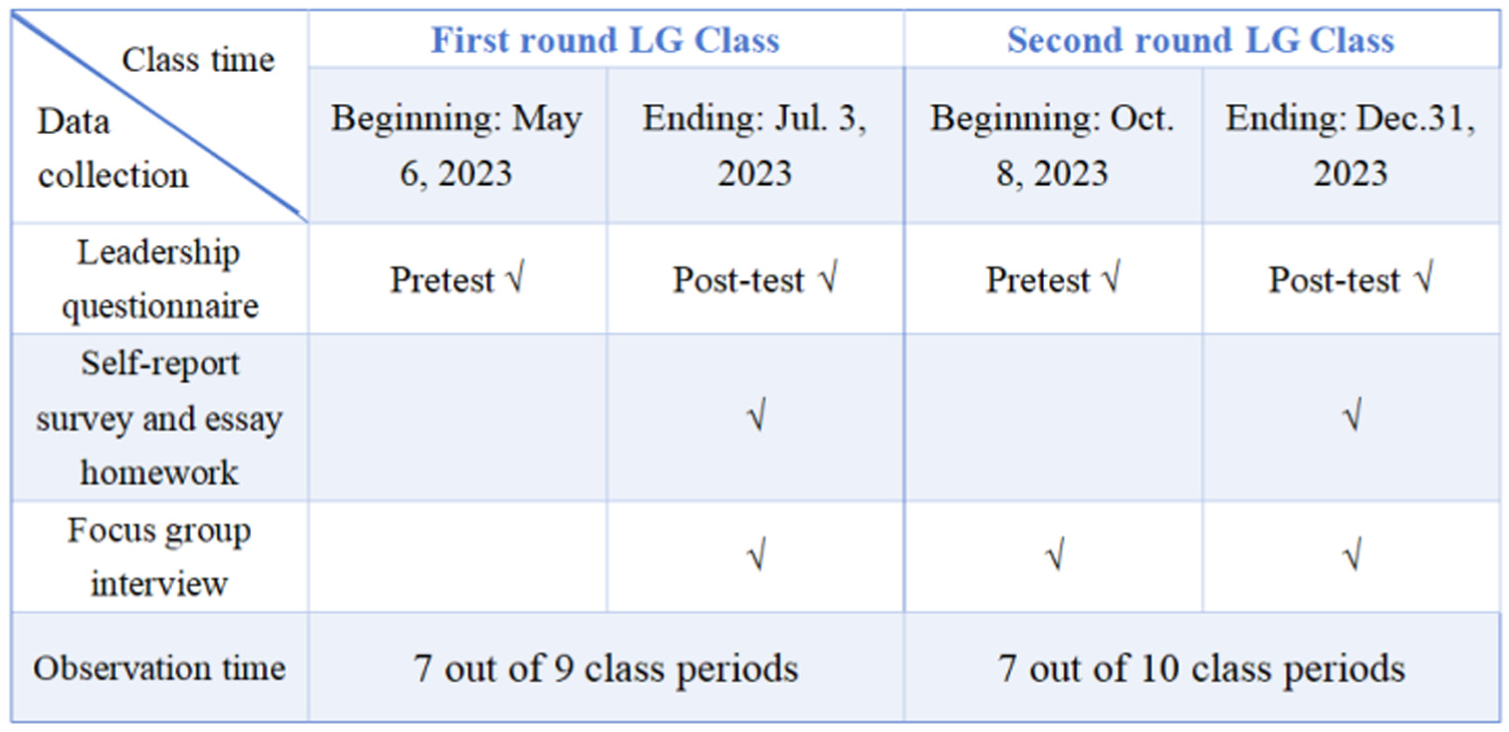
Data collection procedure.
Upon completing each round in July and December 2023, students also submitted a self-report survey and an 800-word essay assignment to offer qualitative feedback. Additionally, focus group interviews were conducted three times: once immediately after the first round (July 2023), again in October 2023 at the start of the second round, and finally after the second round concluded (December 2023). Each interview involved 26 to 34 students and lasted approximately 20 min.
To triangulate data, classroom observations were conducted throughout both rounds. The first researcher observed 7 out of 9 sessions in the first round and 7 out of 10 in the second round, documenting detailed field notes. The first researcher’s role varied who taught one leadership-theory class, co-led a museum field trip with three other teachers, and facilitated the final session (certificate distribution and group interviews). During remaining classes, the first researcher acted solely as a passive observer at the back of the room, refraining from participation.
Since the questionnaire was collected anonymously in the first round LG Class, paired t-test analysis was not feasible. Instead, an independent t-test was conducted using SPSS to compare the pretest and posttest data of students’ leadership scores. In the second round LG Class, paired t-test analysis was executed to compare the pretest and posttest data. Content analysis was employed to analyze the qualitative research data obtained from self-report surveys, students’ essay homework, interview transcripts and observation notes (Merriam, 2009). During content analysis, the researchers examined common themes, patterns, topics, symbols, and shared mindsets as described by the middle school students. They created major codes that included students’ learning outcomes, course attendance, satisfaction, and suggestions from the students.
Ensuring Validity and Reliability
To ensure validity and reliability, the mixed-methods design incorporated the following strategies. Regarding the quantitative phase, a standardized protocol for administering the leadership questionnaire was applied to minimize measurement error. And the internal consistency of the inventory was assessed using Cronbach’s α(>.9). Regarding the qualitative phase, triangulation of multiple data sources (self-report surveys, homework analyses, interview transcripts, and observation notes) strengthened credibility. Researchers also conducted member checking to validate interpretations with participants. In addition, researchers explored whether quantitative results were cross-validated with emergent qualitative themes. For example, researchers checked whether the leadership components that students reported through open-ended surveys and essay assignments aligned with those measured by the Leadership Skills Inventory. This integration followed established mixed-methods practices to enhance convergent validity (Creswell & Plano Clark, 2018).
Findings
The findings are presented in alignment with the research questions. To address RQ1, a comparison of pre- and post-test student leadership scores on the Leadership Skills Inventory (LSI) was conducted. To answer RQ2, a qualitative analysis of student learning outcomes is provided. Additionally, course satisfaction, student suggestions, and attendance rates are reported to give a comprehensive overview of the LG Class and identify areas for improvement. This information will help answer RQ3.
Comparison of Pre- and Post-Tests of Student Leadership
Thirty-four pre-test questionnaires were distributed in the first-round LG Class, with 29 responses, resulting in a response rate of 85%. Twenty-seven post-test questionnaires were distributed, with 27 responses, resulting in a response rate of 100%. The scale reliability of the Leadership Skill Inventory was good for both time waves (αT1 = .908, αT2 = .936). The questionnaire was filled out anonymously by students, so independent sample t-tests could only be conducted on the pre- and post-tests of the questionnaire. Although the average score of the post-test of leadership was higher than the average score of the pre-test of leadership (Mpre-test = 84.17, SD = 9.6; Mpost-test = 87.04, SD = 11.26), the t-test result was not significant (t = −1.027, p > .05). Further t-tests were conducted on the pre- and post-tests of various dimensions of leadership, and it was found that the t-test results of the pre- and post-tests of various dimensions of leadership were not significant (p > .05).
Thirty-four pre-test questionnaires were distributed for the second-round LG Class, and all 34 were collected, resulting in a response rate of 100%. Thirty-four post-test questionnaires were distributed, and 32 were collected, resulting in a response rate of 94%. The questionnaire was filled out by students using their real names. After comparing and analyzing the data, it was found that only 26 students completed both the pre-test and the post-test questionnaires. Eight students withdrew from the LG Class during the learning process, so they only filled out the pre-test. The class teacher also recommended six new students to continue taking the LG Class course, so these six students only filled out the post-test questionnaire. Excluding invalid data from students who only filled out the pre-test or post-test questionnaires, the following is a statistical analysis of the complete pre-test and post-test questionnaire results filled out by 26 students.
A paired sample t-test was used to analyze whether there is a significant difference in the pre- and post-test scores of the leadership questionnaire. The results showed that there was no significant difference in the total score of student leadership between the pre- and post-tests (Mpre-test = 94.04, SD = 9.23; Mpost-test = 92.54, SD = 9.32, p > .05). Further t-tests were conducted on the pre- and post-tests of various dimensions of leadership, and it was found that the results of the t-tests for each dimension of leadership were not significant (p > .05), as shown in Table 2. Based on the quantitative results, it reveals the answer to the first research question: the course did not significantly enhance students’ leadership scores.
Paired Sample T-Test Result of the Pre- and Post-Test Scores of the Leadership Questionnaire in the Second-Round Little General Class.

Qualitative Analysis of Student Learning Outcomes
The qualitative data collected from this research revealed more complex findings. The first-round LG Class collected 29 students’ self-report surveys and 26 student essay assignments. The second-round collected 30 students’ self-report surveys and 23 student essay assignments. By conducting text analysis on these surveys, student assignments, and three focused interview records, we deeply explored the learning outcomes of students and comprehensively analyzed the effectiveness of course implementation. Research has found that the students of the LG Class primarily experienced four learning effects as follows.
Increased Leadership or Management Abilities
Increased leadership or management abilities were reported by 35% of the students (24 out of 68). The self-report surveys collected from the first and second-round LG Class showed that 10 students clearly stated that their gains included improved leadership abilities and other comprehensive skills. Lu stated, ‘My persuasiveness, leadership skills, communication abilities, and teamwork have all greatly improved. I now approach tasks more thoughtfully and have made significant progress’. Zhu also shared, ‘I have developed a stronger ability to lead others and cope with difficult situations. At the same time, I have gained greater self-awareness, improved self-management, and enhanced other comprehensive skills’.
Among the above 10 students, 5 students expressed that their confidence had also improved and their relationships with class members had become more harmonious. Zou said, ‘This course has made me more confident and determined in myself’.
Another 14 students mentioned that they had improved their self-management and class management abilities. For example, Wang said, ‘After taking the LG Class, my leadership, management skills, and teamwork abilities have all improved to a certain extent. I am more proficient in managing the class’. Zhan also shared, ‘Through training, I learned how student leaders should manage classes, and I learned about the various abilities and responsibilities a leader should possess’. Qi also mentioned, ‘It taught me how to better manage my class and improve myself. I learned what it takes to be a qualified class leader, how to develop effective class management plans, and how to support teachers in managing our classmates’.
From the above quotes, it is evident that the students reported gaining a variety of skills, including self-awareness, self-management, class management, communication, teamwork, and the ability to lead others. These are all integral components of leadership as outlined in Townsend and Carter’s (1983) leadership theory.
Acquired Theoretical and Practical Knowledge Related to Leadership and Class Management
Though only 35% of the students clearly claimed an increase of leadership or management abilities, the majority students did express having learned theoretical and practical knowledge related to leadership, such as the connotation of leadership, the characteristics of leading role, leadership culture and practical knowledge of applying leadership to class management. Forty students clearly explained the meanings of terms such as ‘leadership’, ‘management ability’, ‘peer education’, ‘team role’, ‘teacher assistant’, and ‘general spirit’. Other students explained two to four of these terms, indicating that more than half of the students have a clear understanding of leadership-related vocabulary. Among all students, 21 expressed that they had deepened their understanding of leadership, learned relevant knowledge and skills, and applied these knowledge to class management practice. These data indicate that students have a good grasp of theoretical and practical knowledge related to leadership. Like Yuan shared, ‘The first class taught by our principal had the deepest impact on me. I learned what leadership is, the connotation and elements of leadership, and the principles of leadership’. Xia gave a detailed explanation,
In my opinion, the spirit of a general includes ‘wisdom, courage, ambition, and understanding of strategy.’ A general needs to lead others. Leadership skill is the ability to manage oneself and guide others. As students of the LG Class, we are cultivating our leadership skills. I have come to understand the essence of leadership skills and the specific ways to acquire them.
It is worth noted that the practical training in the LG Class has enabled the students to learn practical knowledge of applying leadership to class management. Students were free to express themselves in the two seminar courses of the LG Class, sharing their experiences and challenges in class management, and jointly exploring how to use leadership knowledge to solve practical problems. Zhan shared, ‘I initially thought my responsibility was to help teachers collect homework. Through learning, I realized that an English class representative played a significant role, and I became more interested in this position. I will continue to improve myself, take a good lead, and better serve my classmates’.
The students reported having learned to be capable assistants to teachers in class management and student leaders. In the self-report survey, 36 students elaborated on more than three specific methods to ‘do a good job in daily class management and play the role of class leaders’, while other students briefly explained one to two related methods. Wang shared, ‘We should have good personal qualities and lead by example; seek advice from others, and honestly accept good suggestions from our classmates; care for our classmates and share their worries; treat others equally and justly’. Yu shared,
This training has taught me how student leaders should manage their classes effectively. First, as leaders, we need to improve our problem-solving, communication, and leadership skills. It’s important to stay calm, think clearly when faced with challenges, and avoid becoming flustered … Second, we should humbly learn from others and use our strengths to compensate for our shortcomings in real-life situations. Third, I believe maintaining a positive attitude is essential. All successful turnarounds require a willingness to learn and a positive mindset … Finally, leadership is not a one-person effort. To truly improve the class, we need to cultivate a strong sense of teamwork—just like a general relies on their army.
In Wang and Yu’s reflection, they demonstrate thoughtful consideration of class management and the role of student leaders. They discuss the importance of communication, teamwork, empathy, problem-solving, humility, and emotional coping skills. These abilities are key components of effective leadership and other related comprehensive skills (Townsend & Carter, 1983). Reflecting deeply on how to become a good student leader can help prepare them for future leadership roles.
The leadership questionnaire showed that 93% of the participants have served as student leaders in primary or middle school, and 73.2% had more than 1 year of experience as student leaders. However, 89.3% of the students had never taken leadership courses before; 43% had never been exposed to leadership-related books or learning materials. Despite limited learning opportunities, 94.6% were willing to improve their leadership skills. The LG Class has expanded their thinking, enhanced their theoretical and practical understanding of leadership, and met their learning needs to enhance leadership.
Enhanced Team Spirit and Social Responsibility
Each round LG Class has two on-campus team activities and one off-campus field trip. The destination of field trips for the two rounds of LG Class were W city Revolution Museum and Urban Planning Museum respectively. Students reported having enhanced their team spirit and social responsibility during those activity courses and field trips, as Li mentions, ‘I felt the power of unity and cooperation in activities, and actively practice leadership in activities’. During the field trip to Revolution Museum, students truly felt the importance of unity and cooperation, as well as the charisma and dedication spirit of Chinese revolutionary leaders. In the second field trip to the the Urban Planning Museum, students have deepened their understanding of urbanization and decided to make some contribution. Zhou shared, ‘I feel my eyes were opened. I saw the prosperity of my hometown. I am so proud to be a citizen in this city and am determined to study hard and contribute to the construction of my city and China’. The trip has broaden their horizon and draw their attention from single academic focus to their social responsibility.
Activity courses are more popular among students due to their differences in content and format compared to regular subject courses, as students shared, ‘I am very happy in the team-activity courses and the field trip. And I am inspired a lot’.
Set New Goals and Lead by Example
Setting up higher goals and deciding to be role models was the last common theme revealed. Over half of the students demanded more of themselves academically and aimed at achieving better grades. They also sought to have better emotional control, self-discipline, and interpersonal communication. They were also willing to take on more leadership and management roles in class. The leadership questionnaire showed that 91.1% of the students are willing to continue serving as class leaders. They talked freely about their goals and plans in the focused interview.
I want to study hard and get into the top 5 in the class.—Li I have decided to control my emotions well in life, not throw tantrums, and not let negative emotions affect my relationships with classmates. Instead, I will express my emotions rationally.—Fang Although I am currently only a health commissioner [a less important student leader role], I want to be the representative of the Chinese subject in class, leading everyone in learning and assuming the role of a leader.—Zhu
It can be seen that leadership training not only provides students with knowledge about leadership, but also stimulates their inner drive. They felt the expectations placed on them by the school and spontaneously set ambitious goals. They aspired to improve their abilities in all aspects and set an example in both learning and class management.
Summary
To sum up, an analysis of the qualitative data reveals that students have achieved learning outcomes in various aspects. One-third of the students self-reported an improvement in leadership and management abilities, including self-awareness, self-management, class management, communication, teamwork, and leading others. The majority claimed to have learned and reflected on both theoretical and practical knowledge related to leadership and class management, preparing them to become more effective student leaders in the future. They had also enhanced team spirit and social responsibility. Over half of them set up higher goals and were more motivated to be good student leaders.
Course Feedback and Areas for Improvement
Course Feedback and Attendance Rates
Except for the nine students who did not submit the self-report survey, almost all other students believe that ‘the classes are very interesting’, and they really like this teaching style. ‘All the courses have benefited me a lot, and each teacher has his own unique characteristics’. ‘I have learned different things in each class’, etc. Overall, the LG Class had high satisfaction rates. Some students also proposed suggestions for the course. For example, one student suggested that teachers should complete all teaching content within 45 min and dismiss classes on time. Another student hoped the teacher could allow them to take notes freely.
Although most students have high satisfaction with the course, there is still an issue of uneven attendance in each class. On average, about five to six students are unable to attend each class due to various reasons, resulting in a classroom attendance rate of about 82%. In the leadership post-test questionnaire of the second-round LG Class, a survey question on the frequency and reasons for absences was added. The results showed that out of 32 students who filled out the questionnaire, only 20 students never missed classes, 7 students missed only 1 class, 2 students missed 3 to 5 classes, and 3 students missed 6 to 7 classes. Because the class time for the LG Class was the seventh period on Monday or Friday, which was usually a self-study period or class meeting period, students reported that they were absent from some courses due to personal reasons or class obligations (such as having to attend class meetings).
Additionally, the headteacher of the LG Class noted that eight students left the class midway, discontinuing their leadership training, either by choice or at the request of their homeroom teachers. Subsequently, some homeroom teachers recommended six new students to join the LG Class. Through conversations with the headteacher and several homeroom teachers, the researchers found that, although the LG Class program had strong support from the principal, some homeroom teachers in grades 7 and 8 did not fully support the program. They recommended students with lower academic performance, inadequate learning attitudes, or limited leadership experience to participate in the LG Class. During important class meetings, some homeroom teachers also required LG Class students to miss the leadership sessions in order to attend the class meeting.
Further discussions with teachers revealed that some homeroom teachers did not recognize the value of leadership training, believing that academic coursework was more important. Consequently, they refrained from recommending student leaders with exemplary character and academic performance to join the program and did not fully support students in attending all LG Class sessions.
Areas for Program Improvement
Areas for program improvement include securing full support from homeroom teachers, enhancing collaboration between the LG class headteacher and homeroom teachers, and regularly gathering students’ feedback throughout the program. They are discussed in details as follows.
First, the leadership program can only succeed with the support of homeroom teachers, who select students from their classes to join the LG class. The Little General (LG) Class is a group for selected student leaders or role models, typically those who demonstrate exemplary behavior, academic performance, or leadership abilities. When homeroom teachers recommend students with lower academic performance, inadequate learning attitudes, or limited leadership experience, these students are more likely to quit the program or have poor attendance. Additionally, homeroom teachers should encourage students to attend the leadership class. If a scheduling conflict arises between the LG class and class meetings, priority should be given to students’ attendance in the LG class.
Second, the headteacher of the LG class, who is responsible for class management, should maintain open communication and collaboration with homeroom teachers. In case of scheduling conflicts, the LG class headteacher could adjust class timing to ensure higher attendance. The headteacher can also share information about the LG class, such as class content and students’ performance, to keep homeroom teachers informed about program activities and student progress.
Finally, student feedback should be gathered consistently throughout the program, particularly from those considering dropping out. Guidance and support should be provided as needed, and necessary program adjustments should be made based on this feedback.
Discussion and Conclusion
Discussion
This study adopts a mixed-method approach, combining both qualitative and quantitative research. The quantitative data reveals that the LG Class did not result in a statistically significant change in students’ self-evaluation of leadership skills. However, the qualitative data demonstrates more complex and detailed gains that students achieved through the leadership course. This aligns with Wright et al.’s (2023) study on a broader global sample, which found that while students’ leadership self-efficacy did not show statistically significant improvement from holding formal leadership roles or receiving leadership training, they did gain a more profound understanding of leadership. Several factors could explain the conflict of this study. First, the small sample size (n = 68) may have contributed to the lack of statistical significance. Second, the subjective learning outcomes revealed by the qualitative data may not yet have translated into measurable leadership skills, or they may be difficult to quantify.
Nevertheless, the qualitative and quantitative methods serve complementary purposes. While the quantitative data focuses on measurable changes in leadership skills, the qualitative data provides deeper insights into individual subjective achievements, learning processes, and aspirations that may not be captured through numerical measures. Thus, although the quantitative analysis suggests no broad statistical difference, the qualitative data reveals deeper, process-oriented changes in students’ leadership development.
The design philosophy of the LG Class was to provide theoretical leadership training and practical guidance of being student leaders and teachers’ assistants in class management. The course content is highly related to the learning outcomes shared by students. The leadership skills reported by students in the LG Class, such as self-management, class management, communication, teamwork, and leading others, align with the leadership competencies defined by behavioral leadership theorists (Stogdill, 1974; Townsend & Carter, 1983). LG Class students emphasized both relational behaviors, such as empathy, communication skills, and team spirit, and task-oriented behaviors, such as class management and problem-solving. These acquired leadership skills also closely align with internationally recognized 21st-century competencies (Voogt & Roblin, 2010) and social-emotional learning (CASEL, 2013), highlighting the global relevance of the LG Class program.
While humility and self-management—reflective of Confucian values—were frequently emphasized by LG Class students, these qualities were integrated with globally valued leadership traits such as initiative and strategic thinking. The students’ reflections also echo the principles of servant leadership (Greenleaf, 1977), suggesting that even within a traditionally hierarchical educational context, middle school students can cultivate leadership through service and empathy.
Traditional leadership programs targeting older student populations (such as undergraduate and graduate students) have been criticized for their overreliance on cognitive training. They focused primarily on theoretical knowledge and mental processing abilities and limited the transfer of leadership behaviors to real-life situations (Allen et al., 2022). In contrast, Coffey and Lavery (2018, 2021) argue that leadership programs for secondary students should prioritize development over execution. This includes introducing leadership theories, fostering self-management skills, and helping students recognize their dual roles as learners and emerging leaders. Although the LG Class adopted a variety of instructional formats, it appears to have generated more cognitive outcomes than behavioral ones, as reflected in both the qualitative and quantitative findings. While the two seminar courses in the LG Class emphasized the delivery of practical class-management skills, students were not given extra guidance or coaching on the application of these skills in their daily class routines. From the perspective of Behavioral Leadership Theory, the study suggests that further efforts are needed to support students in translating theoretical leadership knowledge into observable leadership behaviors.
The class style of the LG Class varies from lectures, seminars to activity courses, encompassing leadership theories, practical applications, and engaging activities. The seminars, activity and field trip courses are very popular among students and generate fruitful learning outcomes. This reveals that such types of training are effective for leadership development. Jenkins (2012) reported that class discussion, whether in the form of true discussion or a hybrid of interactive lecture and discussion, is the signature pedagogy for undergraduate leadership education. This statement is also applicable to the findings of this study, particularly during seminar courses, where class discussions were found to be an effective instructional method for leadership courses.
Hine (2013) examined the perceptions and experiences of elected student leaders in leadership training events at a secondary school. He highlighted positive experiences for participating students, including increased confidence, learning leadership skills, making a positive difference, being role models, and receiving support from others. Overall, he asserts that student leadership is of considerable value to students’ personal growth and to the positive cultivation of school culture. This study is consistent with Hine’s findings and emphasizes the significant value of leadership development for middle school students. Increased confidence and leadership skills were observed in some participants, while over half of the students expected to make positive changes and serve as role models.
Hine further suggested that principals create, promote, and sustain leadership development opportunities for their students. Wallin (2003) also suggested that principals facilitate leadership development in rural schools. This study corroborates this suggestion and reveals that having support from principals alone is insufficient. It is also essential to gain support from other administrators and homeroom teachers. This study highlights a conflict: although students report high satisfaction with the LG class, attendance rates are only around 82%, and there are some dropouts. This low attendance is due, in part, to a lack of support from homeroom teachers, who may either withhold suitable student leaders from joining the program or discourage them from attending each LG class. Further investigation reveals that the principal did not actively promote the program or seek teachers’ support. Principals should actively promote the leadership program and ensure it receives widespread attention and backing throughout the school. Given the test-oriented education system and intense academic competition in China, promoting leadership development and holistic education in middle schools is both necessary and challenging.
Using Grunwell’s (2015) theoretical model of student leadership development to evaluate the LG Class, it is found that the program contains features such as the importance of practice and practical application, group processes, reflection, and consistency, reflected in the course content, instructional pedagogy, and homework. While the LG Class could be improved in other dimensions: a culture of learning and support, flexibility, self-directed learning, immersion in the program, and ongoing development. The LG Class should gain more support from the homeroom teachers to which all the student leaders belong, in order to develop a culture of learning and support for the students. It should also provide more self-directed learning resources, immersion opportunities during the program, and offer ongoing development after the program ends.
Significance of This Study
This research addresses a gap in the existing literature on leadership development among middle school students by examining a case study of a program in a Chinese school. First, it examines the educational practices of a suburban Chinese middle school, highlighting its innovations in holistic education and comprehensive practical activity courses. It challenges the test-oriented education system and intense academic competition in China, calling for a renewed focus on students’ leadership development and holistic education in practice, beyond mere slogans. Second, the findings shed light on students’ learning outcomes in a school-based leadership program and offer insights into the program from students’ own perspectives. This can help educators and program developers design more effective, student-centered leadership programs. At the school level, this research may contribute to the improvement and refinement of student leadership programs. More broadly, this study contributes to the growing body of research on adolescent leadership development across cultures, offering insights that may inform similar initiatives worldwide. The case program studied not only enriches the understanding of culturally embedded leadership training but also offers a potentially exemplary model for promoting student leadership in both local and global contexts.
Limitations and Directions for Future Research
Several limitations were identified in this research. For instance, the sample size was relatively small for quantitative data analysis. Qualitative data was primarily collected through open-ended questionnaires and students’ homework, with limited time allocated for focused interviews. Moreover, the qualitative findings relied mainly on student reflections and self-reported outcomes, which may be subject to bias, as students could unintentionally overestimate their progress or report what they believe teachers or researchers want to hear. To address this limitation, data triangulation was employed, including researcher observations and pre- and post-assessments. In the future, the sample size for quantitative analysis could be expanded, and additional time could be allocated for conducting in-depth interviews.
Future research can continue to explore ways to improve the LG Class curriculum. For example, expanding the curriculum resources and involving parents and the community in providing leadership training could be beneficial. It is also necessary to continuously assess the program’s impact on students and gather their feedback to drive ongoing improvements.
Implications and Conclusion
The present study offers several implications for fostering leadership development among middle school students in China and other countries. First, it is both necessary and beneficial to cultivate students’ leadership skills at the middle school level. Leadership programs in the form of comprehensive courses or activity courses are highly recommended. These courses could include team-building activities, field trips, student-leader seminars, and theory-based lectures. The programs should also emphasize students’ leadership practice in daily life, such as taking on leadership roles and responsibilities in class management or academic projects. Second, in test-oriented school systems with a strong emphasis on high-stakes examinations—such as those in certain Asian countries—teachers may prioritize academic achievement over leadership development, viewing the latter as secondary or unimportant. In such contexts, fostering students’ leadership skills becomes more challenging. Therefore, leveraging the principal’s influence and securing support from administrators and the broader teaching staff is essential. Implementing a reasonable reward mechanism can further encourage and acknowledge teachers who actively engage in student leadership training. It is also important to strengthen communication and collaboration between teachers leading the leadership programs and other faculty members. And finally, these programs should be student-centered, with consistent feedback gathered from students on course content, format, schedule, workload, and learning outcomes to support continuous improvement.
In conclusion, this mixed-method study explored students’ learning outcomes from the leadership course ‘LG Class’ and provided insights into students’ leadership development during middle school. While the quantitative findings did not reveal a significant increase in students’ leadership skills, the qualitative findings highlighted more subtle learning outcomes in various areas, such as acquiring theoretical and practical knowledge of leadership and class management, enhancing team spirit and social responsibility, and setting new goals while leading by example. This study advocates for students’ leadership development during middle school to cultivate well-rounded individuals and promote civic engagement.
Footnotes

Ethical Considerations
Prior to conducting the study, Normal College (Faculty of Education), Hubei University Scientific Research Ethics Committee in China approved the research protocol, including the consent procedure.
Consent to Participate
In the current study, all participants’ informed consent was achieved before the research data was collected.
Funding
The authors disclosed receipt of the following financial support for the research, authorship, and/or publication of this article: This work was supported by Shenzhen University of Information Technology under the Doctoral Research Project (No. SZIIT2025SK010), Wuhan Education Bureau under grant ‘Wuhan Compulsory Education School Entrusted Management Project (Wuhan Jiangjun Road Middle School and Hubei University, Normal College, No. 2022111002002013)’, and the Hubei Research Center for Quality Education in Primary and Secondary Schools under an open grant (No. 2020HBSZB15). We sincerely appreciate the support from the universities and organizations mentioned above. We also thank the teachers and students who participated in this study.
Declaration of Conflicting Interests
The authors declared no potential conflicts of interest with respect to the research, authorship, and/or publication of this article.
Data Availability Statement
The data supporting the results of the study can be obtained by contacting the corresponding author.