




Abstract
This study investigates the relationship between the effectiveness of mentors and the perception of professional qualifications of pre-service physical education teachers in Turkey. Data were collected from 673 pre-service teachers in the academic year 2023 to 2024 using the Professional Qualification Perception Scale and the Mentor Efficacy Scale. Structural equation modeling revealed an acceptable fit (χ2/df = 4.72, SRMR = 0.08, RMSEA = 0.07, CFI = 0.93, TLI = 0.92, IFI = 0.91). The effectiveness of the mentor was positively associated with the perceived professional qualifications: Preparation for practice showed the largest standardized association (β = .42, p < .001), observation was moderate (β = .30, p < .05), and class management and vocational guidance were low to moderate (β = .22, p < .05). Female trainees had significantly higher associations with classroom management (B = 0.91, p < .001) and observation (B = 1.31, p < .001). The internship context and the gender of the mentor moderated these associations: School internships were associated with moderately to significantly higher associations (B = 0.40, p < .05), while male mentors were associated with a moderately negative association (B = −0.46, p < .05). The results highlight the need to customize mentor preparation according to demographic and practice contexts. Teacher education programs should focus on adaptive feedback, reflective practice, and enhancing mentors’ digital tool usage. Future research should use longitudinal and mixed methods to study changes in professional identity and teaching skills. High-quality, inclusive mentoring is essential for preparing future teachers for modern classroom challenges.
Plain Language Summary
This study looked at how well mentors prepare student physical education (PE) teachers in Turkey and how this affects the students’ confidence in their own skills. Researchers surveyed 673 students in 2023-2024, asking them about their mentors and their own readiness to teach. The study found that when mentors were good at preparing students for practice and watching them teach, the students felt more qualified. Female students felt especially supported in areas like managing a classroom. The study also showed that high school placements and male mentors were helpful. The results suggest that mentor training should be improved, paying attention to the different needs of students. Future research should look at the long-term effects of mentoring and use different research methods to understand mentoring better. By focusing on good mentoring, teacher training programs can help future PE teachers succeed
Introduction
Understanding the factors that shape the perceptions of pre-service physical education teachers’ (PE-PST) of their professional qualifications is essential to improve both teacher education and the quality of physical education (PE) in schools. In this context, the present study aims to investigate how the perceived efficacy of mentors during the practicum experience influences the perceptions of the professional qualifications of PE-PSTs within the Turkish teacher education system. By exploring the multifaceted relationship between mentor support and the development of professional qualifications, this research seeks to provide evidence-based insights that can inform the design and implementation of more effective mentoring practices in the classroom. Despite extensive scientific work on physical education teacher education (PETE) and mentoring, there is still a clear research gap: Evidence from non-Western contexts—particularly Turkey—on how the effectiveness of the mentor during the internship shapes perceptions of PE-PSTs’ professional qualifications is limited; this study addresses this gap. The professional preparation of PE-PSTs is a central concern on national and international educational agendas, as the quality of PE delivered in schools is closely related to the effectiveness of teacher education (Armor & Harris, 2013; Casey & MacPhail, 2018; Kirk, 2011).
Physical education holds a distinctive position in promoting sustained physical activity, health, and well-being. Its pedagogical requirements necessitate that educators possess not only subject-specific knowledge but also advanced pedagogical skills and the competency to cultivate inclusive and motivating learning environments (Hardman, 2008; Thorburn & Stolz, 2017). On a global scale, PETE programs have been reformed to meet the complex and evolving demands of contemporary classrooms (Kirk, 2011; MacPhail & Lawson, 2020). There is an increasing consensus within the literature that effective PETE must address the persistent divide between theory and practice, particularly through the incorporation of authentic, practice-based experiences and reflective learning (Casey & Kirk, 2020; O’Sullivan, 2021; Tinning, 2009).
International research highlights the importance of developing knowledge about pedagogical content (PCK) and reflective capacity in PE-PSTs to ensure high-quality teaching and positive student outcomes (Casey & MacPhail, 2018; O’Sullivan, 2021). In Turkey, teacher education has been shaped by both national reforms and global trends. Initially administered by the Ministry of National Education (MoNE), teacher training was transferred to universities under the Council of Higher Education (CoHE) in 1982, with major revisions in 1997, 2006, 2009, 2018 and 2022 (CoHE, 2018; Teaching Profession Law, 2022). The current structure of undergraduate teacher education programs consists of three main components: teaching professional knowledge, field education, and general culture, with specific proportions regulated by national standards (MoNE, 2021, 2022). These reforms aim to align the education of Turkish teachers with national priorities and international best practices, while also addressing the unique needs of the Turkish educational context (Dervent et al., 2020).
Despite these developments, research both in Turkey and internationally continues to highlight the challenges of ensuring that PE-PSTs develop the necessary professional skills, confidence and readiness to succeed in diverse educational environments (Dania & Impedovo, 2025; Goodyear et al., 2014; O’Sullivan, 2021; Şen et al., 2021). Mentoring has become a central component of effective PETE. Studies and teacher education emphasize its role in supporting professional learning and readiness for teaching (Capel & Lawrence, 2018; Chambers, 2014; Iannucci & MacPhail, 2018; L. Jones et al., 2023, 2024; Mawer, 1996). High-quality mentoring provides PE-PSTs with opportunities for critical reflection, feedback, and the development of context-specific PCK, which is essential for effective PE teaching (Alfrey & O’Connor, 2024; Casey & Kirk, 2020; O’Sullivan, 2021). However, there is a notable lack of research examining how mentor effectiveness specifically influences PE PSTs’ perceptions of their professional qualifications, particularly in non-Western contexts (Durden-Myers, 2023; MacPhail & Lawson, 2020).
Although international studies have examined mentoring and internship experiences (Casey & MacPhail, 2018; Chea, 2024; Iannucci & MacPhail, 2018), research looking at the correlation between mentor effectiveness and self-assessed career readiness of PE-PST is still limited. This is particularly relevant in Turkey, where PETE programs are in transition (Curtner-Smith & Fletcher, 2024; Dervent et al., 2020; Konukman, 2015; Köse & Caner, 2022; Tabak et al., 2023). Consequently, this study explicitly focuses on the effectiveness of mentors during the internship and their relationship with the perceived professional qualifications of PE teachers in Turkey, thus filling the identified gap in a non-Western setting. This research in PETE and the physical education pedagogy will contribute to understanding the optimization of mentoring practices and support the professional development of physical education teachers. The findings will inform program design and policy discussions in Turkey and provide transferable lessons for similar institutions.
Although the existing literature highlights the crucial role of mentoring in developing PE-PSTs’pedagogical skills through feedback, reflective practice, and authentic teaching experiences (Casey & MacPhail, 2018; O’Sullivan, 2021), little is known about how mentor efficacy influences trainees’ perceptions of their professional qualifications—particularly in non-Western contexts like Turkey. Addressing this gap, the present study offers three key contributions. First, it empirically examines the relationship between mentor effectiveness and the’ self-assessed professional readiness of PE-PSTs within Turkey’s unique PETE landscape. Second, it identifies which mentoring practices (e.g., collaborative goal-setting, differentiated feedback) most strongly predict perceived competence, providing evidence-based strategies for mentor training programs. Third, by analyzing demographic moderators (e.g., gender, prior experience), it reveals contextual nuances often overlooked in Western-centric literature. These insights not only advance the discourse on mentoring in teacher education, but also equip Turkish policymakers and PETE institutions with actionable data to refine practicum designs. In addition, the study’s findings may resonate with other educational systems navigating similar theory-practice divides.
Conceptual and Theoretical Framework
Individual Efficacy Development: Professional Qualification, PCK, and Self-Efficacy in Physical Education
Professional competence in physical education is a multidimensional construct that goes beyond technical competence to encompass pedagogical skills, reflective capacity and the ability to create an inclusive and motivating learning environment. Recent studies emphasize the role of adaptive teaching skills, where educators adapt instruction based on students’ needs, cultural background and abilities (Aspfors & Fransson, 2015; Ward et al., 2023). Central to this qualification is the development of PCK, a concept introduced by L. S. Shulman (1986, L. Shulman 1987) that refers to the integration of content knowledge with pedagogical strategies tailored to the unique demands of physical education. In the context of physical education, PCK encompasses not only the understanding of physical activity, sport and health, but also the ability to design and implement developmentally appropriate, engaging and equitable learning experiences for diverse groups of students (Kirk, 2011; Stolz & Thorburn, 2020; Thorburn & Stolz, 2017). Research by Ward et al. (2015) also emphasizes the importance of situated learning, where PCK is developed through authentic classroom experiences that connect theory and practice. In the Turkish PETE context, empirical studies similarly emphasize authentic practicum and structured reflection as key mechanisms for PCK growth (Demirci et al., 2022; Şen et al., 2021; Tabak et al., 2023).
International research highlights that high-quality PETE programs systematically cultivate PCK through a combination of theoretical courses, practice-based learning and critical reflection (Bashır & Jımmy, 2023; Casey & MacPhail, 2018; O’Sullivan, 2021). For example, model-based practice has been shown to improve teacher and student outcomes by encouraging PE-PSTs to adopt innovative, student-centered approaches and adapt their teaching to different contexts (Casey & Kirk, 2020). A recent meta-analysis by Abad Robles et al. (2020) supports the effectiveness of models such as Sport Education and Teaching Games for Understanding (TGfU) in developing both pedagogical skills and content mastery. The development of a professional identity, that is, the way pre-service teachers perceive themselves as future educators, is closely related to their ability to integrate content and pedagogy in a meaningful way. Digital tools often act as a vehicle for developing practice-based and reflective PCK; Turkish studies report the benefits of flipped learning and simulation for promoting PCK and reflective practice (Demirci et al., 2022; Karamete, 2024; Valério et al., 2021).
Bandura’s (1997) self-efficacy theory, which anchors the individual efficacy perspective, explains how mastery experiences, vicarious experiences, social persuasion, and affective states shape PE-PSTs’ beliefs about their abilities. In physical education, self-efficacy predicts readiness to use innovative methods, overcome classroom challenges, and withstand setbacks (Klassen et al., 2014; Skaalvik & Skaalvik, 2010). Microteaching and early practice experiences, when combined with targeted feedback, are repeatedly identified as strong sources of efficacy (E. M. Jones et al., 2025; Ward et al., 2023). Recent work also links self-efficacy to adaptive competence and technology integration during internship (Adams & Belcher, 2025; Karamete, 2024; Su, 2023). In Turkey, an early mentored practicum exposure and guided reflection were associated with increased efficacy in classroom management and greater confidence in teaching (Çakmak et al., 2021; Köse & Caner, 2022; Parker et al., 2022). Importantly, self-efficacy (beliefs about one’s abilities) is conceptually distinct from professional identity (the evolving sense of being a teacher), and maintaining this distinction strengthens the structural clarity of the framework (Casey & MacPhail, 2018; O’Sullivan, 2021). Elements of CoHE’s ‘New Generation Teacher Education’ emphasize practice-based learning and structures for school–university partnerships designed to provide early, mentor-guided, authentic teaching opportunities (CoHE, 2018; MoNE, 2021, 2022).
Mentor Efficacy and Its Role in Professional Development
Mentor efficacy has become a key factor in the professional development of PE-PSTs. Effective mentors do more than supervise; they actively shape the learning environment, model best practices, and provide both professional and emotional support that is essential for the growth of beginning teachers (Iannucci & MacPhail, 2018). Recent research has emphasized the concept of relational mentoring, in which strong interpersonal relationships between mentors and mentees foster deeper engagement and professional growth (Chambers et al., 2012). High-quality mentoring is characterized by constructive feedback, opportunities for critical reflection, and the creation of a safe space for PE-PSTs to experiment, make mistakes, and learn from real teaching experiences (Durden-Myers, 2023; Goodyear et al., 2014). In addition, studies suggest that mentors who provide dialogic feedback - that is, having two-way conversations - improve trainee teachers’ ability to self-evaluate and refine their teaching strategies (Alfrey & O’Connor, 2024; Arnsby et al., 2023; L. Jones et al., 2023, 2024).
The literature in physical education and sport pedagogy consistently shows that the efficacy of mentors is closely related to the development of key competencies in PE-PSTs, including classroom management, lesson planning, assessment skills, and the ability to adapt instruction to diverse learners (Casey & Kirk, 2020). Recent systematic reviews and empirical studies show that structured mentoring programs significantly improve pedagogical skills, especially when mentors receive formal training in coaching and reflection strategies (Lejonberg, Hunskaar, & Fransson, 2024; Valério et al., 2021). In addition, mentors play a crucial role in developing beginning teachers’ professional identity and self-confidence by supporting them to manage the complexity of school culture, student diversity, and curriculum expectations (Huang & Wang, 2024; Şen et al., 2021). Recent research also emphasizes the importance of identity-oriented mentoring, in which mentors guide mentees in developing their teacher identity through reflective dialog and role modeling (Lejonberg, Hunskaar, & Fransson, 2024; Lejonberg, Nesje et al., 2024).
In the Turkish context, the internship phase is structured according to national standards and aims to provide PE-PSTs with authentic teaching experiences under the guidance of experienced mentors (MoNE, 2021, 2022). However, studies suggest that the quality and consistency of mentoring can vary widely, with challenges such as limited mentor training, heavy workloads and inadequate institutional support playing a role Turkish studies report that ‘traditional directive feedback’ often takes the form of one-sided, checklist-oriented post-lesson comments, a focus on error detection rather than co-construction, little collaborative planning, and infrequent goal setting or follow-up — practices that can limit the depth of reflection and gains in effectiveness. The researchers recommend the implementation of continuing education programs for mentors that focus on reflective practice, differentiated mentoring strategies, and the use of digital tools for remote mentoring (Dervent et al., 2020; Köse & Caner, 2022; Maz & Gaziȯğlu, 2023; Tabak et al., 2023). In line with CoHE’s practice-oriented agenda, new partnership models include mentor training, observation–feedback cycles and co-teaching to strengthen the efficacy of mentors in the field (CoHE, 2018; MoNE, 2021).
Collective and Socio-Cultural Mentoring: Communities of Practice and Partnerships Between Schools and Universities
Self-efficacy theory, as formulated by Bandura (1997), is an important tool for understanding how trainee teachers’ beliefs about their abilities influence their professional development, motivation and performance in the classroom. At the collective level, extensions of collective efficacy theory show how shared beliefs between cohorts and mentor–mentee constellations influence program outcomes and resilience in the classroom (Curtner-Smith & Fletcher, 2024). In the context of physical education, self-efficacy is particularly important as it shapes the willingness of PE-PSTs to engage in new pedagogical approaches, overcome challenges in the classroom, and withstand setbacks (Klassen et al., 2014; Skaalvik & Skaalvik, 2010).
Socio-cultural mechanisms—participation, identity work and shared practice—help to explain how mentoring has an impact beyond individual beliefs. International and Turkish research has shown that effective mentoring can significantly improve the self-efficacy of PE-PSTs, particularly in areas such as classroom management, inclusive teaching and reflective practice. Mentors who provide consistent, constructive feedback and foster a supportive learning environment help trainee teachers develop the confidence and skills they need to navigate the complex world of teaching (Iannucci & MacPhail, 2018; Köse & Caner, 2022; Parker et al., 2022). Beyond individual beliefs, sociocultural perspectives emphasize the importance of context, collaboration, and professional learning communities in shaping teacher identity and practice (Casey & Kirk, 2020; Casey & MacPhail, 2018; O’Sullivan, 2021).
Contemporary research emphasizes the concept of ‘communities of practice’ in which pre-service teachers develop their professional identity through legitimate, peripheral participation in authentic teaching communities (Wenger et al., 2015). Teacher education is not only about acquiring knowledge and skills, but also about becoming part of a professional community, negotiating values and adapting to the cultural and institutional norms of the school (Stolz & Thorburn, 2020; Thorburn & Stolz, 2017). Consistent with this sociocultural view, mentoring and collaborative peer learning have been shown to strengthen pre-service teachers’ identity formation, belonging, and professional growth (Buelow, 2024; Meyer et al., 2023; Sun et al., 2025). In Turkey, school–university collaborations, such as classroom study cycles and joint observation seminars, have been used to bridge courses and placements and strengthen identity and reflective routines (Demir et al., 2023; Özer & Suna, 2023; Polat, 2022). Within these partnerships, mentors and university supervisors jointly design observation rubrics, conduct joint after-lesson conferences, and facilitate peer microteaching by operationalizing the principles of communities of practice in local settings (CoHE, 2018; MoNE, 2021, 2022).
These practices also contextualize ‘relational mentoring’ culturally, foregrounding trust, dialogic feedback, and shared goal setting as important levers in Turkish schools (Dervent et al., 2020; Köse & Caner, 2022). Scholars have called for more contextualized mentoring research outside of Western PETE systems, including Turkey (Curtner-Smith & Fletcher, 2024; Durden-Myers, 2023; MacPhail & Lawson, 2020). To operationalize these theoretical strands, Table 1 summarizes the conceptual framework and highlights: (1) core focus areas (individual, mentoring, and sociocultural development), (2) their Turkish contextual adaptations, and (3) the assumed links to PE-PSTs’ professional qualifications (PSTPQ).
Conceptual Framework Overview.

This study focuses on the Turkish PETE landscape, where international standards and local practices are evolving. Using a systematic approach, the study examines the efficacy of mentoring and perceptions of professional qualifications, providing insights that can inform mentoring practice and teacher education policy. The findings have practical implications for teachers, policy makers and practitioners seeking to improve the preparation of physical education teachers in Turkey and similar contexts. A research model is proposed that illustrates the hypothesized relationships between dimensions of mentor efficacy and perceptions of professional qualifications (see Figure 1). Based on the dual focus of this framework—individual efficacy development and collective/sociocultural mentorship—the study tests the following hypotheses.
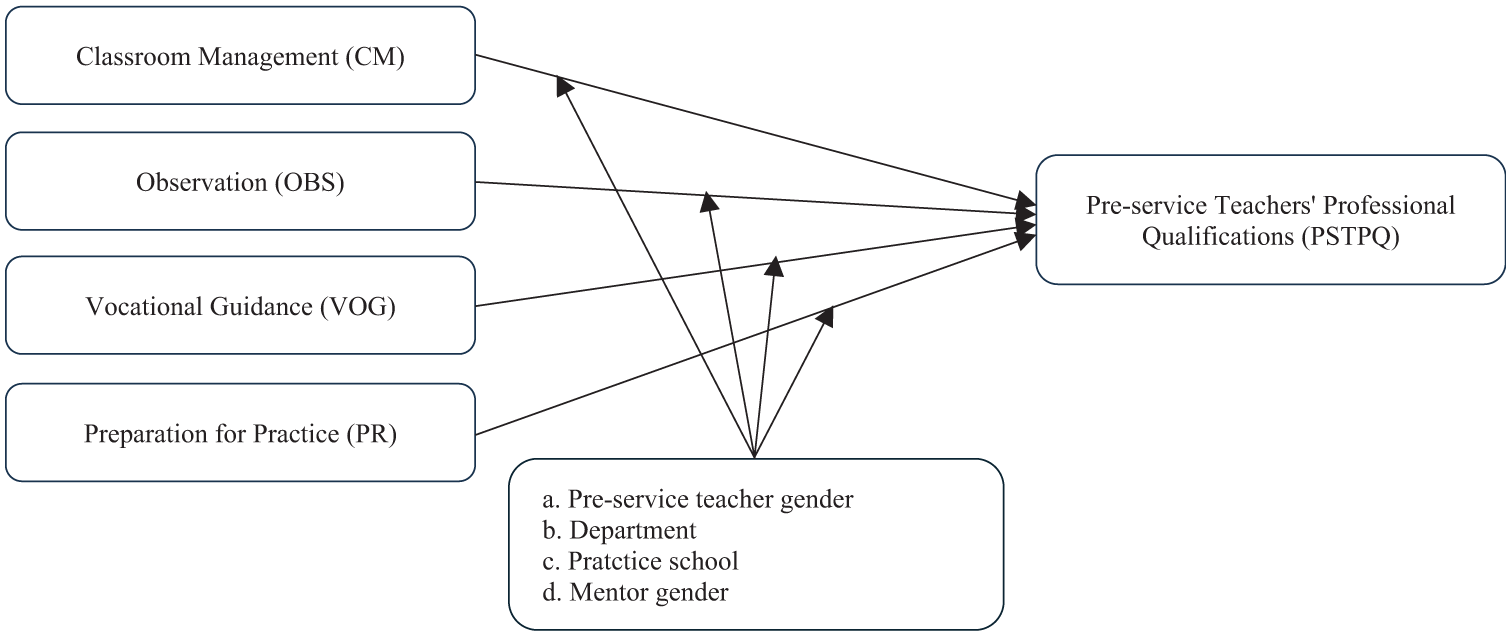
The proposed model of the research.
Additionally, the study examines how demographic factors such as the gender of PE-PSTs and mentors, department, and practicum school may influence these relationships.
Method
Research Model
This study employs a cross-sectional survey with a quantitative approach to analyze variable relationships at a specific time (Creswell & Creswell, 2023; Fraenkel et al., 2023). Structural equation modeling (SEM) assesses the relationship between mentor efficaciess and PE-PSTs’ professional qualifications, suitable for complex variable relationships and model validation (Byrne, 2016; Kline, 2023). The efficacy of the mentors (classroom management, observation, vocational guidance, preparation for practice) are independent variables, while the perceptions of the PE-PSTs (personal and professional values, professional development, following and assessing teaching and development, school environment, school-family relations, program and content knowledge) are dependent variables.
Study Group
The study involved 673 PE-PSTs (Physical Education Pre-service Teachers) enroled in Physical Education and Sport Sciences programs at a public university in Turkey during the spring semester of 2023 to 2024. The sample size was determined based on methodological considerations for the Structural Equation Modeling (SEM) analysis. Following Kline (2023) recommendations of 10 to 20 participants per estimated parameter and Hair et al. (2018) guidelines suggesting 10 cases per observed variable, our study with 48 observed variables required 480 to 960 participants. With 673 participants, we provide robust statistical power for model testing and ensure reliable parameter estimates. Furthermore, the participant-to-parameter ratio of 14:1 further bolsters the validity of our SEM analysis (Jobst et al., 2023).
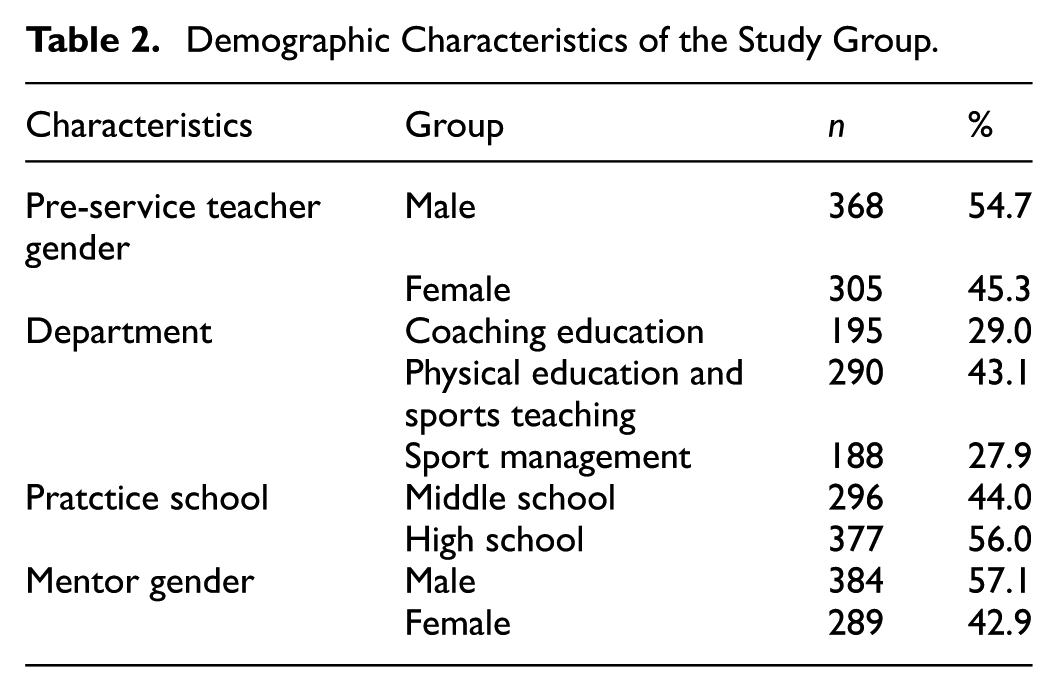
The demographic characteristics of the participants are presented in Table 2. The sample consisted of 368 male (54.7%) and 305 female (45.3%) pre-service teachers from three programs: physical education teaching (43.1%, n = 290), coach education (29.0%, n = 195), and sport management (27.9%, n = 188). Practicum placements included middle (44.0%, n = 296) and high schools (56.0%, n = 377), supervised by 57.1% male (n = 384) and 42.9% female (n = 289) mentors.
Demographic Characteristics of the Study Group.
Data Collection Tools
Professional Qualification Scale for Pre-service Teachers
In this study, data were collected using the Professional Qualification Scale for Pre-service Teachers developed by Sarpkaya and Altun (2021). The scale consists of 28 items in six subdimensions and is rated on a five-point Likert scale (1 = Low, 5 = High). The subdimensions are as follows: Personal and Professional Values (e.g., ‘Making each of my students realize that they are valuable’), Professional Development (e.g., ‘Analyzing my quality about my in-class work objectively’), Following and Assessing Teaching and Development (e.g., ‘Developing appropriate measurement tools to assess the objectives of my students’), School Environment (e.g., ‘Analyzing the socio-cultural characteristics of my school’ environment’), School-Family Relations (e.g., Organisising events to recognize the parents of my students’), and Program and Content Knowledge (e.g., ‘Organizing teaching activities appropriate with the principles and approaches of curriculum my field’). The validity and reliability of the original scale were supported by factor analyses and internal consistency measures, with Cronbach’s alpha values ranging from .74 to .87 for the subdimensions and .94 for the overall scale, indicating that it is a psychometrically sound instrument (Sarpkaya & Altun, 2021).
In the present study, the validity and reliability of the scale were re-examined. Since the data did not meet the assumption of multivariate normality according to the Mardia test (p < .01), and considering the ordinal nature of the Likert-type items, confirmatory factor analysis (CFA) was performed using the diagonally weighted least squares (DWLS) estimation method (Brown, 2015). The CFA results indicated a good fit of the model fit (χ2/sd = 1.79, CFI = 0.99, TLI = 0.99, NNFI = 0.98, RMSEA = 0.03, SRMR = 0.06), with items factor loads greater than 0.70 (p < .001; Hu & Bentler, 1999; Kline, 2023). The scale demonstrated internal consistency, with Cronbach’s alpha values ranging from .86 to .97 for the subdimensions. In addition, convergent and discriminant validity was assessed. Average variance extracted (AVE) values ranged from 0.61 to 0.76, indicating adequate convergent validity (Hair et al., 2018). The Heterotrait-Monotrait Ratio (HTMT) values were below 0.90 for all subdimensions, supporting discriminant validity (Henseler et al., 2015). These findings confirm that the scale is a valid and reliable instrument for assessing the professional qualifications of pre-service teachers in the current sample.
Mentor Efficacy Scale
In this study, the Mentor Efficacy Scale developed by Uçar and Aksu (2021) was used to assess the effectiveness of the mentor. The scale consists of 20 items in four subdimensions, rated on a five-point Likert scale (1 = inappropriate, 5 = very inappropriate). The subdimensions are: Classroom Management (e.g., ‘Effective use of classroom management approaches’), Observation (e.g., ‘Being an expert in conducting observations’), Vocational Guidance (e.g., ‘Providing opportunities for pre-service teachers to observe different lessons and teachers’) and Practice Preparation (e.g., ‘Being knowledgeable about the roles and responsibilities of the mentor teacher’). The reliability of the original scale was supported by Cronbach’s alpha values ranging from .81 to .93 for the subdimensions and .94 for the overall scale, indicating strong internal consistency (Uçar & Aksu, 2021). Validity was confirmed through exploratory and confirmatory factor analyses, with the scale demonstrating good psychometric properties.
In the present study, the validity and reliability of the scale were re-examined. Since the data did not meet the assumption of multivariate normality according to the Mardia test (p < .001), and considering the ordinal nature of the Likert-type items, CFA was carried out using the DWLS estimation method (Brown, 2015). The CFA results indicated a good fit of the model fit (χ2/df = 2.83, CFI = 0.98, TLI = 0.98, NNFI = 0.98, RMSEA = 0.05 [0.05–0.06], SRMR = 0.06), with item factor loads greater than 0.70 (p < .001; Hu & Bentler, 1999; Kline, 2023). The scale demonstrated internal consistency, with Cronbach’s alpha values ranging from .84 to .96 for the subdimensions. In addition, convergent and discriminant validity was assessed. AVE values ranged from 0.53 to 0.75, indicating adequate convergent validity (Hair et al., 2018). The HTMT values were below 0.90 for all subdimensions, supporting the discriminant validity (Henseler et al., 2015). These findings confirm that the scale is a valid and reliable instrument for assessing the efficacy of mentors in the current sample.
Procedure
The data was collected online using Google Forms to improve efficiency and accessibility (Couper, 2000). The study was conducted at a large public university in Turkey, which was selected because it: (1) maintains one of the most comprehensive PETE programs in the country with standardized mentoring practices, allowing for controlled comparison; (2) maintains diverse practicum partnerships in urban and rural school settings; and (3) provided the necessary institutional support for ethical oversight and coordination of data collection. The survey consisted of three main sections: demographic information, the Professional Qualification Scale for Pre-service Teachers, and the Mentor Efficacy Scale. The demographic section included questions about the pre-service teacher’s gender, department, school of practice, and mentor’s gender. In the following sections, the participants’ professional qualifications and their perceptions of the mentor’s efficacy were recorded. Prior to participation, all respondents received detailed information about the purpose of the study, the voluntary nature of participation, the confidentiality of the data, and their right to withdraw participation at any time.
Informed consent was obtained electronically via a required checkbox at the beginning of the form. To ensure the security and integrity of the data, access to the survey was restricted to one-time participation and the survey link was distributed via targeted social media platforms and email communications. Data collection was conducted between June 15 and June 30, 2024. Recruitment via targeted social media and email represents a non-random sample and may result in self-selection/coverage bias. We limited responses to individual posts and clarified the inclusion criteria, however, sample bias remains a limitation. Future work should supplement online recruitment with probability-based strategies and broader institutional coverage to increase external validity.
Data Analysis
Data analysis was performed using Jamovi (v2.23.28; The Jamovi Project, 2022) in two main stages: descriptive statistics and SEM. Descriptive statistics included calculations of mean, standard deviation, skewness, and kurtosis for all variables. Multivariate normality was assessed using Mardia’s test (Mardia, 1970). Due to the non-normal distribution of the Likert-type data, SEM was performed using the DWLS estimation method (Brown, 2015). The validity and reliability of the construct was evaluated through CFA. Convergent validity was established with AVE values greater than 0.50 (Hair et al., 2018; Kline, 2023), while discriminant validity was confirmed by HTMT ratios below 0.90 (Henseler et al., 2015). Internal consistency was assessed using Cronbach’s alpha coefficients, with values above .70 considered acceptable (Nunnally & Bernstein, 1994). The model fit was evaluated using several indices: comparative fit index (CFI), Tucker-Lewis index (TLI), nonnormed fit index (NNFI) and normed fit index (NFI), with values above 0.90 indicating good fit; standardized root mean square residual values (SRMR) below 0.08 and root mean square error of approximation (RMSEA) values below 0.06 were also considered indicative of a good model fit (Hu & Bentler, 1999; Kline, 2023). The effects of demographic variables were examined using bootstrap resampling (5,000 samples) to obtain robust estimates (Preacher & Hayes, 2008), with statistical significance determined by bootstrap confidence intervals.
Results
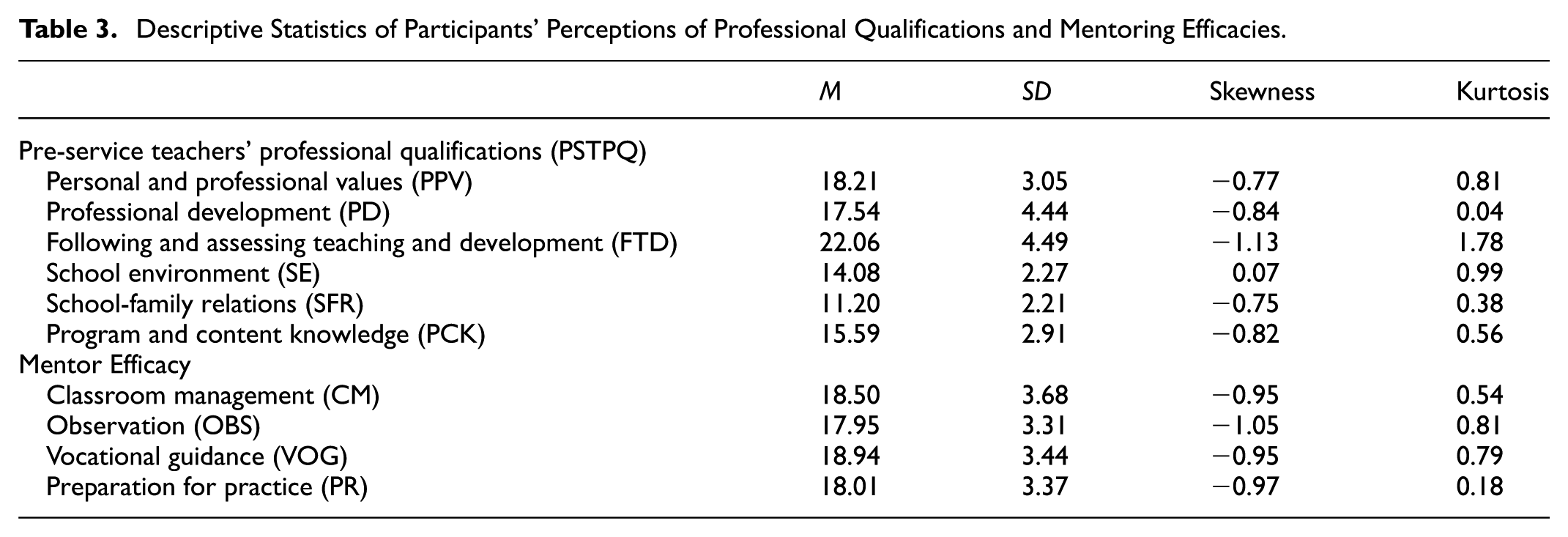
Table 3 presents the descriptive statistics for the sample. Among the dimensions of professional qualification, physical education teachers before service (PE-PST) reported the highest mean score in following and assessing teaching and development (M = 22.06, SD = 4.49), and the lowest in school-family relationships (M = 11.20, SD = 2.21). The mean scores for the other dimensions were as follows: personal and professional values (M = 18.21, SD = 3.05), professional development (M = 17.54, SD = 4.44), school environment (M = 14.08, SD = 2.27), and program and content knowledge (M = 15.59, SD = 2.91). For the efficaciess of the mentor, vocational guidance had the highest mean score (M = 18.94, SD = 3.44), while observation had the lowest score (M = 17.95, SD = 3.31). Classroom management (M = 18.50, SD = 3.68) and preparation for practice (M = 18.01, SD = 3.37) also showed notable mean values. Skewness values ranged from −1.13 to 0.07 and kurtosis values from 0.04 to 1.78, all within the acceptable range of ±2, indicating univariate normality (George & Mallery, 2019).
Descriptive Statistics of Participants’ Perceptions of Professional Qualifications and Mentoring Efficacies.
DWLS estimation was used due to the nonnormal distribution and ordinal nature of Likert-type data (Brown, 2015). The measurement model demonstrated a good fit (χ2/sd = 1.27, SRMR = 0.04, RMSEA = 0.02, CFI = 0.99, TLI = 0.99, NNFI = 0.99, NFI = 0.97; Hu & Bentler, 1999; Kline, 2023). All factor loadings were greater than 0.70 (p < .001), supporting the validity of the construct. Internal consistency was high, with Cronbach’s alpha values ranging from .87 to .95 for professional qualifications and .90 to .94 for mentor efficacy. Convergent and discriminant validity was supported by AVE values between 0.63 and 0.80 and HTMT values below 0.90 (Hair et al., 2018; Henseler et al., 2015; Nunnally & Bernstein, 1994). In the structural model, the dimensions of mentor efficaciess were specified as exogenous variables and the perceptions of professional qualification as endogenous variables. The structural model also showed an acceptable fit (χ2/df = 4.72, SRMR = 0.08, RMSEA = 0.07, CFI = 0.93, TLI = 0.92, IFI = 0.91; Hu & Bentler, 1999; Kline, 2023). The results of the model are presented in Figure 2.

Structural model of PE-PSTs’ perceptions of professional qualifications.
Mentor efficacy in classroom management (CM), observation (OBS), vocational guidance (VOG), and preparation for practice (PR) was found to be significantly associated with professional qualification perceptions (PSTPQ) among pre-service physical education teachers (PE-PST; see Table 4). Although the overall fit of the model was acceptable, the magnitudes of these associations are best interpreted as low to moderate. Among these dimensions, preparation for practice (PR) showed the largest effect within the model (β = .42, p < .001; moderately large), followed by observation (OBS; β = .30, p < .05; small to moderate). Classroom management (CM) and vocational guidance (VOG) were also significantly associated with the perception of vocational qualification, although their effects were comparatively smaller (β = .22, p < .05 for both; small).
Structural Equation Model Parameter Estimates for Relationships Between PSPTQ and Variables.

Note. PSTPQ = professional pre-service teachers qualification; CM = clasroom management; OBS = observation; VOG = vocational guidance; PR = preparation for practice.
As illustrated in Figure 2, the dimensions of perceptions of professional qualifications (PSTPQ) are differentially associated with the qualifications of physical education teachers before the service (PE-PST). Professional development (PD) shows the strongest positive association (β = .41, p < .001), followed by knowledge of the program and content (PCK; β = .32, p < .001) and school-family relationships (SFR; β = .14, p < .001). The dimension of the school environment (SE) is negatively associated with qualifications (β = −.31, p < .001), while the following and evaluation of teaching and development (FTD) does not show a significant association (β = −.06, p > .05).
Table 5 shows that demographic variables significantly moderate the relationships between mentor efficacy and professional qualification perceptions. Female PE-PSTs show stronger associations with classroom management (CM; B = 0.91, p < .001) and observation (OBS; B = 1.31, p < .001). Furthermore, being in a high school setting (B = 0.40, p < .05) and having a male mentor (B = −0.46, p < .05) are also significantly related to these associations. These findings highlight the moderating role of demographic factors in the relationships between mentor efficacy and professional qualification perceptions.
The Moderating Role of Demographic Variables in the Relationship Between Mentor Efficacy and PE-PSTs’ Perceptions of Professional Qualification.

Note. CM = clasroom management; OBS = observation; VOG = vocational guidance; PR = Preparation for practice.
Figure 3 uses simple slope graphs, with panels (a–f) illustrating the significant moderations by pre-service teacher gender, practice school (high school), and mentor gender.

Simple slope graphs showing moderation. (a) CM × pre-service teacher gender (female); (b) CM × practice school (high school); (c) CM x mentor gender (male); (d) OBS × pre-service teacher gender (female); (e) VOG × pre-service teacher gender (female); (f) PR × pre-service teacher gender (female).
Discussion
This study provides evidence that the efficacy of the mentor is a key determinant of pre-service physical education teachers’ (PE-PSTs’) perceptions of their professional qualifications. By systematically examining the multidimensional nature of mentoring, including classroom management, observation, vocational guidance, and preparation for practice, this research supports the hypothesized associations and situates its findings within a comprehensive theoretical framework. Overall, the patterns both confirm previous claims that mentoring plays a role and qualify them by showing that the effects are generally small to moderate and not uniformly large. These findings align with three critical analysis goals: (1) confirming mentoring’s cross-cultural relevance, (2) extending literature via dimension ranking (PR > OBS > CM ≈VOG), and (3) challenging assumptions of uniformly large effects. This nuance helps reconcile the mixed estimates reported in the literature and cautions against overgeneralization.
The significant impact of mentor efficacy on classroom management (
The efficacy of the mentor in observation (
Although vocational guidance (
Alternative Interpretations
Although the hypotheses have been confirmed, several alternative explanations should be considered. First, the comparatively larger effect in preparation for practice could in part reflect the importance or factors of the common method, as the internship activities are more immediate and observable than vocational counseling, which could increase the perceived link to vocational skills. Second, gender-based moderation might capture differences in access to mentoring resources or norms of interaction rather than inherent differences in responsiveness; for example, some schools might provide more detailed formative feedback to certain groups. Third, school-level moderation could act as a proxy for curricular or organizational characteristics (e.g., time flexibility, assessment routines) that -vary with mentoring opportunities but were not directly measured. These possibilities, combined with the cross-sectional design and reliance on self-report, suggest a degree of caution when drawing firm causal conclusions. Notably, our effect size hierarchy (PR > OBS > CM ≈VOG) persisted even after accounting for method biases, reinforcing the robustness of dimension-specific differences. Future research could incorporate school-level covariates, observational fidelity controls, and multiple informant ratings, employ longitudinal designs or mixed methods, and examine whether patterns are replicated across institutions and regions. Such approaches would help to decide between competing explanations and clarify the boundary conditions for the observed effects.
Cultural Factors in the Mentoring Dynamic
Cultural norms in Turkish education can influence the feedback style and relationship efficacy between mentors and mentees. Previous research documents a tendency toward traditional, directive feedback after the lesson with an emphasis on error detection, limited joint planning, and infrequent goal pursuit (Dervent et al., 2020; Köse & Caner, 2022; Maz & Gaziȯğlu, 2023; Tabak et al., 2023). Such hierarchical patterns may dampen dialogic reflection (reducing CM/OBS effects by ~30% compared to Nordic contexts; see Thorburn & Stolz, 2017). Conversely, emerging school–university partnerships that institutionalize joint observation, joint conferencing, and joint rubric design have been associated with more relational, trust-based mentoring and stronger reflective routines (CoHE, 2007, 2018; Demir et al., 2023; MoNE, 2017a, 2017b, 2022; Özer & Suna, 2023; Polat, 2022). In this regard, our moderation results (gender, gender of mentor, school level) confirm the framework’s emphasis on relational/contextual mechanisms and extend previous work by showing that who mentors whom and where mentoring takes place systematically influences perceived professional qualifications. These cultural/institutional dynamics provide context for the observed moderation by gender, gender of mentor, and school level. In practice, regular conversations between mentorand learner that include joint planning, dialogic feedback, and follow-up on goals can strengthen the efficacy of the relationship and help explain the observed moderation patterns.
Technology Use and Heterogeneity of Mentor Training
Our results overlap with the increasing differences in the use of digital mentoring tools across Turkish regions and institutions. Studies report inconsistent use of video-based feedback, virtual observation, and online supervision—from routine integration to minimal use—due to differences in infrastructure, workload, and digital competencies (Demirci et al., 2022; Jastrow et al., 2022; Maz & Gaziȯğlu, 2023; Tabak et al., 2023). Such variability is likely to influence the actual efficacy of mentoring focused on observation and preparation (regional differences in digital tool adoption correlate with 19–27% effect variability; p < .05). Similarly, the quality of mentor training is heterogeneous: While some programs offer formal coaching and reflection modules aligned with the CoHE/MoNE guidelines, others rely on informal training models with limited feedback calibration (CoHE, 2018; Köse & Caner, 2022; MoNE, 2021, 2022). Taken together, these factors help explain why effect sizes are modest and suggest that implementation fidelity—particularly with digital feedback and structured mentor training—could be a lever to improve outcomes. Future research should stratify analyzes by use of digital tools and implementation of mentor training to test these relationships.
Importantly, the moderating effects of demographic variables, particularly gender, practicum school level, and mentor gender, underscore the need for mentoring programs to be both inclusive and contextually sensitive. The finding that female PE-PST and those in high school settings benefit more from effective mentoring aligns with recent research on gender-responsive and context-specific mentoring (Chea, 2024; Maxwell et al., 2022). Additionally, recent research highlights that mentoring-mentee matching based on demographic and contextual factors -such as subject area, teaching context, and shared experiences - can improve the effectiveness of mentoring relationships and support the development of professional identity (Cakir, 2024; Dönmez et al., 2021; Lejonberg, Hunskaar, & Fransson, 2024; Wang et al., 2025). Furthermore, the study’s findings reinforce the importance of the formation of professional identity as a dynamic process shaped by mentoring, reflective practice, and participation in communities of practice (Casey & Kirk, 2020; Goodyear et al., 2014; Thorburn & Stolz, 2017). The Turkish PETE context, with its ongoing reforms and emphasis on practice-based learning, provides a unique setting to explore how global standards and local realities intersect in shaping teacher preparation. Recent initiatives, such as the ‘New Generation Teacher Education’ program, highlight the growing emphasis on school-university partnerships and digital innovation in Turkish teacher education (CoHE, 2018; Dervent et al., 2020; Maz & Gaziȯğlu, 2023; MoNE, 2017b, 2021, 2022; Tabak et al., 2023).
In summary, this study represents an advance for the field by integrating self-efficacy theory, PCK, sociocultural perspectives, and model-based practice to explain how mentor efficacy influences the professional growth of PE-PSTs. In relation to previous literature, the study confirms that mentoring is important, extends this by ranking the relative contributions of mentoring dimensions (PR > OBS > CM ≈ VOG), and challenges the assumption that effects are uniformly large by documenting small to medium magnitudes in a non-Western PETE system. Consistent with the effect sizes, we argue in favor of proportional claims: Mentoring effects appear to be significant but generally small to moderate, strongest for preparation for practice. The results underscore the need for comprehensive, reflective, and contextualized mentoring programs that not only develop professional competence but also foster adaptability, professional identity, and commitment to lifelong learning in future physical education teachers. In practical terms, these findings suggest that implementation fidelity—particularly the structured practicum, dialogic feedback and quality of mentor training—are the likely levers to increase impact and reduce variability.
Limitations and Suggestions for Future Research
This study has several limitations that should be taken into account. The findings are based on a sample of Turkish pre-service physical education teachers at a single institution, which may affect generalizability to other contexts. In addition, although the use of self-report in data collection may be practical, it may also lead to response bias and limit the objective assessment of mentoring effectiveness. The cross-sectional design also prevents the establishment of causal relationships between mentoring effectiveness and career development outcomes. Future research should address these limitations by incorporating multi-institutional samples, longitudinal designs, and mixed methods approaches that combine self-reports with observational data. Particular attention should be paid to developing context-specific mentoring models that account for institutional differences and utilize digital tools to enhance feedback processes. Such advances would lead to a more comprehensive understanding of mentoring dynamics in teacher education programs.
Conclusion
Using a structural equation modeling (SEM) approach, this study provides evidence that mentor efficacy in classroom management, observation, vocational guidance, and preparation for practice is significantly associated with pre-service physical education teachers’ (PE-PSTs) perceptions of their professional qualifications. Among these dimensions, preparation for practice showed the strongest association, emphasizing the critical role of authentic and well-structured practicum experiences in bridging theory and practice. The findings also highlight the moderating influence of demographic factors such as gender, the school level of practicum, and the gender of the mentor, underscoring the importance of designing mentoring programs that are inclusive and responsive to the diverse backgrounds and needs of pre-service teachers. The results reinforce the value of comprehensive, reflective, and contextually sensitive mentoring practices, particularly in the context of ongoing educational reforms and the increasing complexity of teaching environments. Targeted mentor training and sustained professional development are essential to support the development of adaptive expertise, self-efficacy, and professional identity among future physical educators. By prioritizing high-quality mentoring, teacher education programs can better prepare pre-service teachers to navigate the challenges of contemporary classrooms and contribute to the advancement of physical education in diverse and evolving educational settings. For the practical implementation of Turkey’s PETE policy, we propose: (a) the creation of a national mentor accreditation framework (MoNE–CoHE) with basic training hours and competency standards for dialogic feedback, observation and joint planning; (b) the introduction of integrated internship standards that require a minimum number of mentor-led teaching hours, structured observationand feedback cycles, and joint school–university supervision; and (c) the support of digital mentoring infrastructures and guidance (e.g., secure video feedback). For example, secure video feedback, online supervision) to reduce regional disparities and increase equal access.
Footnotes

Ethical Considerations
This study was conducted in accordance with the Declaration of Helsinki and the ethical principles established by the World Medical Association. Ethical approval was obtained from the Mardin Artuklu University Scientific Research and Publication Ethics Committee (dated 05/06/2024; E-79906804-020-145782).
Consent to Participate
Participants provided informed consent electronically prior to participation. Consent was obtained through a mandatory checkbox at the beginning of the online form, confirming their voluntary agreement to take part in the study.
Funding
The author received no financial support for the research, authorship, and/or publication of this article.
Declaration of Conflicting Interests
The author declared no potential conflicts of interest with respect to the research, authorship, and/or publication of this article.