



Abstract
The COVID-19 pandemic has caused mental health effects, and it is necessary to study how to deal with them. This study aimed to explain resilience levels, based on family coping and work-life balance in Latin America. This was a cross-sectional, quantitative, and correlational study with 8043 participants from seven countries, who were contacted through nonprobabilistic sampling of available subjects. The Family Crisis Oriented Personal Evaluation Scales, the Wagnild and Young resilience scale and the work-personal life questionnaire were applied. Reframing and passive appraisal contributed the most to explaining resilience in all countries. The country with the participants with the highest average in resilience was Chile and the lowest was Perú. Problem-focused coping strategies are positively related to resilience. It is suggested to include reframing and ways to achieve social support, such as coping strategies, in the design of public health and social welfare interventions aimed at generating family resilience.
Plain Language Summary
The COVID-19 pandemic has caused effects on mental health and it is necessary to study how to deal with them. For this reason, this study was carried out, which sought to explain resilience based on family coping and the balance between work and personal life in Latin America. We have the participation of 8,043 Latin Americans from seven countries. The Family Crisis Oriented Personal Evaluation Scales (F COPES), the Wagnild and Young resilience scale and the personal life-work questionnaire were applied. Results: Reframing and passive evaluation contributed the most to explaining resilience in all countries. The country with the highest average was Chile and the lowest was Peru. It is suggested to include reframing and ways to achieve social support, such as coping strategies, in the design of public health and social well-being interventions aimed at generating family resilience. !
Introduction
Once the rigid isolation measures were overcome by the Covid 19 pandemic, psychosocial effects appeared that needed to be studied and addressed (Balenzano et al., 2020; Conejo et al., 2020; Fuster et al., 2021; Recuero & Segovia, 2021; Vetrov & Cedeño, 2020). On the other hand, the pandemic increased the resilience of some people to cope with this adverse situation, as well as, others used positive and negative coping strategies, while others had to reconcile their personal and work life according to the new working conditions (Serrano-Ibáñez et al., 2023). Some people have continued to struggle since COVID, while others have developed resilience from the COVID pandemic.
Some authors define resilience as the ability to be resistant to adversity and to recover from critical situations, to face adverse events, cope with them and recover from their effects to return to normality (Castagnola et al., 2021; Rutter, 2006).
Wagnild and Young (1993) indicate that the degree of individual resilience facilitates a person's adaptation to adverse situations and is evidenced in two dimensions: 1) personal competence, evidenced in traits such as self-confidence, resourcefulness, independence, perseverance and decision making, and 2) acceptance of oneself and life, which involves characteristics such as adaptability, flexibility, balance and a stable outlook on life.
Cabrera-García et al. (2017) proposed that people with a high educational level showed more resilience specifically in social competence, as did people with higher economic income. Lundman et al. (2007) and Pinheiro and Matos (2012) found that resilience correlated with age, suggesting that older age is related to greater resilience.
Lazarus and Folkman (1984) and Cabrera-García et al. (2023) define coping strategies as the set of tools that people use to resolve difficult situations effectively. The strategies arise as a product of the interaction between the person and his or her family system and social environment. The evaluation of these coping strategies focuses on how the person responds to stress and manages personal and social resources when facing critical situations.
Studies by Forés Miravalles and Grané Ortega (2012), Gómez (2019), Morales Rodríguez (2018) and Ramírez Molina et al. (2018) have shown associations between resilience and coping strategies in crisis situations.
With respect to working from home (WFH) is defined as a set of work activities that a worker develops in different places, including the home (Nilles, 1997; Perez Perez et al., 2003; Vega et al., 2015), and is also known as telecommuting or teleworking.
The interaction between work and personal life is a relevant issue because these are the main activities of adulthood; they are interconnected and impact each other (Bhumika, 2020). The interaction between work and life outside work can lead to difficulty in achieving balance between these areas (Greenhaus & Beutell, 1985).
Ferreira and Gomes (2023) studied work-life balance, personal resilience and organizational support in Europe, and found that working from home has a negative influence on work-life balance, although remote work can reduce stress due to the possibility of flexibility, it can also disrupt the boundary between work and personal life. These authors state that although the literature has highlighted the importance of some resources in the work context, there are few studies focused on explaining individual resilience based on personal resources such as coping strategies and work-life balance. On the other hand, Gómez et al. (2021) had warned about the relevance of studying the work-life balance to prevent stress and burnout and the promotion of increased levels of resilience to cope with adverse events experienced by workers.
According to CEPAL/OIT (2023) the health crisis of 2020 showed that telework could operate in a complementary way to mitigate the contraction of employment and its effects. As a policy instrument, it facilitated the maintenance of employment relationships, and in several countries, it was legislated or activated by previous legal provisions. However, the transformation of Latin American labor markets requires policies, according to the needs of each country, that provide tools to both workers and companies to face the challenges and take advantage of the opportunities of innovation, digitalization and automation of production processes. Furthermore, policies must be accompanied by actions aimed at developing the care economy in the region as well as welfare services that improve the ways people face crises and adversities.
In Latin America, countries share some cultural, political and economic elements that can help explain the ways in which people face crises (Díaz Soto et al., 2019).
In conclusion, living conditions have changed after the pandemic, the conditions of confinement have generated changes in life skills and the literature reports that resilience is a determining factor in adjusting to these changes, so it is necessary to evaluate which variables can explain this resilient capacity. The cultural and political conditions of each country, coping strategies and working conditions may be important predictors, but in reviewing the literature there is no integrated study of the Latin American region that studies these variables as predictors of resilience. For this reason, the aim of this study was to explain the resilience levels, based on family coping strategies and work-life balance, in seven Latin American countries.
Thus, regarding the objective of this study, the following hypotheses are proposed:
Methods
Type of Study
This study was quantitative research, under an empirical-analytical paradigm, non-experimental, cross-sectional, and correlational scope (Hernández & Mendoza, 2018). It is non-experimental research because no modifications are made to the variables, cross-sectional because the variables were evaluated only once in time, and correlational scope because the aim was to establish the relationships between the variables of interest.
Participants
A total of 8,033 Latin American participants aged between 18 and 90 years (M = 37.01; T.D. = 15.96), including 5,963 women and 2,070 men, were contacted through nonprobabilistic sampling of available subjects residing in Argentina, Chile, Colombia, Ecuador, Honduras, México, and Perú. This sample size has, for each country, a confidence level of 95% and an error level of less than 5%. The distribution by country is shown in Table 1.
Distribution of Participants by Country.

Instruments
The Wagnild and Young (1993) Resilience Scale was used to evaluate resilience. It is a 14-item Likert-type scale instrument, from 1 = completely disagree to 5 = completely agree, which is grouped into two dimensions, personal competence and acceptance of self and life. According to the authors, these dimensions are added to obtain total resilience. This scale was translated into Spanish by Sánchez-Teruel and Robles-Bello (2015). Results for this scale were Cronbach’s α = .919, McDonald’s Ω = .920, and Greatest lower bound coefficient of .942.
The Family Functioning Personal Evaluation Scale in Crisis Situations (F-COPES, McCubin, 1980) was used to evaluate coping strategies. It is a 29-item Likert-type instrument with five independent coping mechanisms: three active strategies which are acquiring social support (ability of the family to actively participate in obtaining support from relatives, friends, neighbors, and extended family, 9 items), seeking spiritual support (family’s ability to acquire spiritual support, 4 items), and mobilizing family to acquire and accept help (family’s ability to seek out community resources and accept help from others, 4 items), a positive passive strategy called cognitive reframing (family’s ability to redefine stressful events and make them more manageable, 8 items), and a negative passive strategy called passive appraisal (family's ability to accept problematic issues while minimizing reactivity, 4 items). This instrument has validity data for Colombia (Cabrera-García et al., 2023) that found general reliability indices between .839 and .921. In the current study, this instrument had Cronbach’s α = .918, McDonald’s Ω = 919, and Greatest lower bound coefficient of .962 (acquiring social support α = .821, seeking spiritual support α = .902, mobilizing family to acquire and accept help α = .764, reframing α = .839, passive appraisal α = .712).
To measure work-life balance, the scale of Sandoval-Reyes et al. (2021) was used with four questions, such as “Since I am in remote work mode, the balance between my personal life and my work life has…” rated on the following scale: 1 = worsened, 3 = remained the same, 5 = improved. Participants were asked to compare remote work and their previous face-to face job. Additionally, three questions were created to measure work life with greater depth in the post-confinement period, such as “The separation of the world of work from my personal world has...” on the same scale. This questionnaire included seven questions and reported Cronbach’s α = .814, McDonald’s Ω of .820 and Greatest lower bound coefficient of .847.
Procedure
Following approval by the institution's research and ethics board, the application protocol was created in the Google Forms platform and distributed via institutional mailings and social media. Prior to the application of the questionnaire, the research groups in the different countries conducted a language review and the corresponding pilot study to ensure that each of the questions was understood in Spanish. Subsequently, the necessary adjustments were made to standardize the use of the language. This questionnaire consisted of three segments: informed consent, demographic data, and the scales. Participants were recruited through social and work networks, as well as through the official channels of the institutions of the members of the research teams in each country. Consent was obtained from all study participants. Between November 2021 and April 2022, data were gathered. The database was cleansed when the application window was finished, and statistical analyses were conducted commencing with the testing of assumptions. Then, one-way ANOVAs and MANOVAs were used to compare countries, age, gender and academic level and the correlations between variables, and multiple linear regression analysis was conducted to explain resilience. Resilience was included as a variable to be predicted, and the variables that reported significant correlations with resilience were included as predictor variables. The stepwise method was used for the inclusion/exclusion of variables, the principle of collinearity was verified, and there was no correlation of errors with the Durbin-Watson test. Version 19.1 of the statistical program Jasp was used to conduct the analysis. This study had ethical approval, linked to the project “Promoting and Mitigating Factors of Parental Stress in Parents in the Context of Covid-19 in Colombia, Argentina, Chile and Aruba”, approved and financed by the general research directorate of the Universidad de La Sabana.
Results
Significant Differences by Country in Resilience, Coping and Work-Life Balance
One-way ANOVAs were performed after Levene's test of equity of variances to confirm the assumptions of homogeneity, and Brown-Forsythe adjustment factors were applied where nonhomogeneity was discovered. Tukey's significant distance test was used for post hoc comparisons when significant differences between nations were detected with a 0.05 threshold. There were significant differences according to country. The participants from Chile had the highest average for resilience, while the participants from Perú had the lowest. For coping strategies, acquiring social support was highest in the participants from Honduras, México and Ecuador and lowest in participants from Chile and Perú. Reframing was highest for the participants from Honduras, México and Ecuador and lowest for participants from Perú, Argentina, and Colombia. Seeking spiritual support was highest in participants from México, Honduras and Colombia and lowest in participants from Chile. For Family mobilization, the highest values were in participants from México, Ecuador and Honduras and the lowest were in participants from Perú and Chile. For passive appraisal, the highest scores were for participants from Ecuador, Honduras and Perú and the lowest were the participants from Argentina, Chile, México and Colombia. Finally, the highest work-life balance was for participants from Ecuador and the lowest was for participants from Chile. Table 2 displays the statistical findings and important country comparisons, while Figure 1 displays these distributions graphically.
Cross-Country Comparison Analysis.

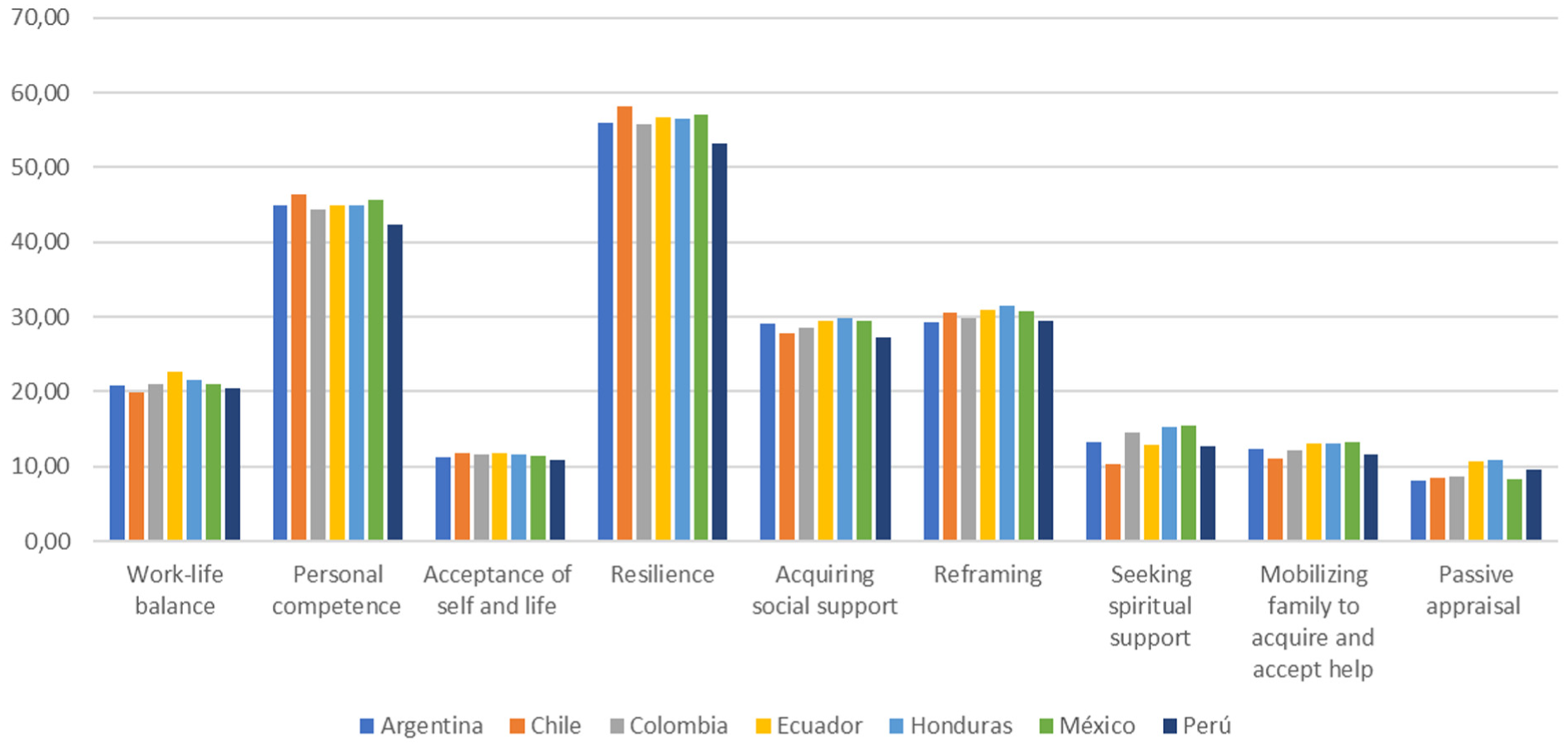
Results of variables by country.
Comparisons by Gender, Age, and Educational Level
Significant differences were found in personal competence, self- and life acceptance and total resilience, with men scoring higher in all three cases. For coping strategies such as acquiring social support, seeking spiritual support and mobilizing family to acquire and accept help, women had higher levels, while men had higher levels for passive appraisal. Work-life balance was statistically higher in men. Comparisons were made by country, finding the same differences in all cases. See Table 3.
Comparisons According to Gender.

M = Mean; SD = Standard deviation.
In terms of age, people 30 to 59 years old and 60 years and older showed higher levels of resilience and coping strategies, except for passive appraisal. People aged 18 to 29 years scored higher. This is an unfavorable strategy because the person thinks about the problem and does not act. People aged 60 years and older had higher levels of work-life balance, which may be due to the experience these people have acquired throughout their lives. See Table 4.
Comparisons by Age of Participants.

In terms of educational level, people with postgraduate degrees showed greater resilience, more positive coping strategies, and less passive appraisal as well as lower levels of work-life balance. See Table 5.
Comparisons by Educational Level.

To analyze the interaction effects between variables, multivariate analysis of variance (MANOVA) was conducted between gender and age, gender and educational level, and age and educational level. No interaction effect was found between age and educational level (p = .105) or between gender and educational level (p = .061). An interaction was found between gender and age (F = 3.435; Pillai = .018; p < .001), specifically in the variables of seeking spiritual support (sum of squares = 509.086; mean square = 254.543; F = 10.874; p < .001) and passive appraisal (sum of squares = 138.053; mean square = 69.026; F = 6.141; p = .002). Tables 6 and 7 show the post hoc analyses. Higher use of the strategy of seeking spiritual support was found in men and women aged 30 to 59 years and 60 years and older than in men and women aged 18 to 29 years. Likewise, the use of this strategy was more common in women aged 18 to 29 than in men of the same age. For passive appraisal, men and women 18 to 29 years of age used this strategy more than all other groups, with no difference between them. See Figures 2 and 3.
Interaction Effect Between Gender and Age in the Search for Spiritual Support, Post Hoc Comparisons.

Note. **p < .01. ***p < .001.
Interaction Effect Between Gender and Age for Passive Appraisal, Post Hoc Comparisons.

Note. *p < .05. **p < .01. ***p < .001.

Interaction effect between gender and age for seeking spiritual support.
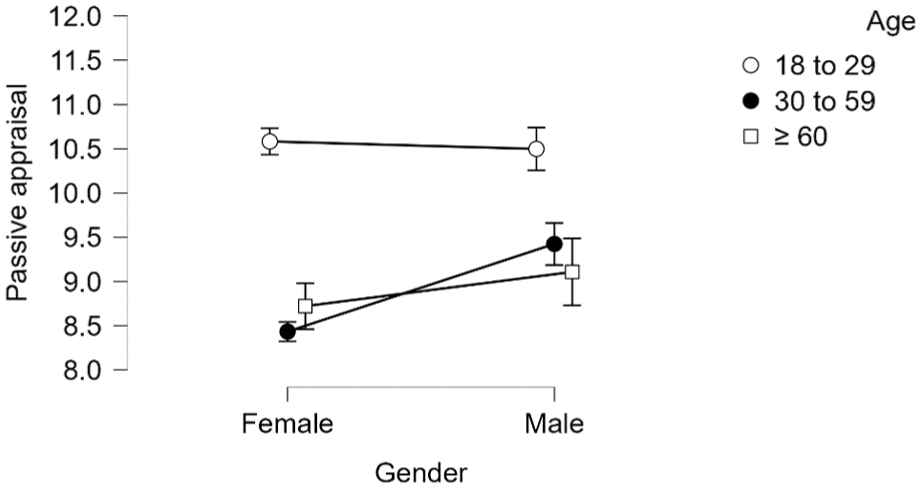
Interaction effect between gender and age in passive appraisal.
Correlations Among Different Variables by Country
Spearman's rho coefficients were employed in the correlation analysis to determine the connections between resilience, family coping, and work-life balance. As shown in Table 8, active coping strategies are statistically correlated with the resilience dimensions and their total scale (especially Reframing in all countries, Family mobilization to obtain and accept help in four countries, acquiring social support in four countries, and Seeking spiritual support in three countries), while Passive appraisal and Work-life balance do not show relationships with resilience (r < .30).
Correlations Between Variables by Country.

Note. 1 = personal competence; 2 = acceptance of self and life; 3 = general resilience.
p < .05. **p < .01. ***p < .001.
Explaining Resilience From Coping Strategies and Work-Life Balance by Country
Multiple linear regression analyses were conducted for each nation to determine the capacity of coping strategies to predict resilience. The findings show that in all countries, resilience is predicted by Reframing and Passive appraisal, and additionally, acquiring social support is provided in Argentina, Chile and Perú, and Seeking spiritual support for Argentina, Colombia and Honduras. The results are displayed in Table 9.
Predictive Models of Coping Strategies on Resilience.

Note. *p < .05. **p < .01. ***p < .001.
Discussion
The coping strategies that were more predictive of resilience for all participants were reframing and passive appraisal. These coping strategies involve thought rather than action and are related to indicators of resilience, personal competence, self-acceptance and general resilience. These findings contrast with those of Morán-Astorga et al. (2019), who found that active coping, humor, and religion, which are factors related to the mental health of individuals and families, are the strategies that better explain resilience.
According to Ajzen and Fishbein (2000), the theory of reasoned action explains that behavior is determined by three elements: 1) attitude toward the behavior, 2) subjective norm, and 3) perceived control over the behavior. These three components are related to the beliefs a person has about a behavior. Therefore, people behave or plan their behavior according to what they think and the beliefs they hold.
It should be noted that men are better at reconciling work and family life than women, which, as Quiroz-González et al. (2024) note, can be explained by the balance of roles in the home. In other words, this difference may be because traditional gender ideas that benefit men prevail in the culture and therefore affect women's work-family balance. In the same vein, Zaman and Shahid (2023) note that although both members of the couple contribute financially, the woman is the main contributor.
The results show that women use coping strategies, such as help-seeking, to cope with crises, in contrast to men who are less likely to seek help from others, that is, women’s actions are based on the support of family and social networks unlike men (Coppari et al., 2019).
On the other hand, this study found that resilience is associated with behaviors and thoughts that lead people to take an active role when facing adversity as occurs with cognitive reframing, which consists of identifying and modifying negative thoughts and emotions and seeking positive actions aimed at resolving the situation and controlling difficulties, while passive evaluation is a coping strategy that assumes the critical situation in a passive manner with avoidance or denial behaviors that lead to ignoring or tolerating the situation. This result coincides with the theory of Lazarus and Folkman (1984) and the studies of Meléndez et al. (2020), insofar as these authors posit that the inability to actively cope with stress is associated with different negative outcomes in the acquisition of resilience. Likewise, the results indicate that, when people are older, they tend to be more resilient and to use more strategies to seek support and help than younger people. This is consistent with the findings of Lundman et al. (2007) and Pinheiro and Matos (2012), who explain that resilience increases with age. This can be explained by the fact that older people acquire more experience and skills that allow them to face adversity with confidence.
Although these countries have similar cultural characteristics, families cope with the post-confinement period in different ways. While participants from some countries used techniques that focused on problem solving, others tried to create support systems. In addition to the techniques mentioned above, participants from Chile, Colombia, Honduras, and México emphasized social support and seeking spiritual support. Seeking social support is a predictor in Argentina, while mobilizing the family to seek help is a predictor in Ecuador. These are all action-oriented strategies.
The findings have important theoretical implications, as understanding the connections between a person's coping styles has been shown to facilitate the explanation of resilience. Regarding the coping strategies employed by parents of children with behavioral problems, Cantero-García and Alonso-Tapia (2018) found that a problem-focused coping strategy was positively associated with resilience. Similarly, Carrión-Abarca and Turpo (2022) found significant associations between resilience and coping mechanisms among mothers in Perú who experienced domestic violence during the epidemic.
The results suggest that cognitive reframing is a relevant indicator to consider for future studies. This is described as the result of a process that occurs in the face of certain circumstances that are perceived as stressful (Folkman & Lazarus, 1988a), specifically using instrumental, emotional or spiritual supports (Gómez, 2019) to construct a new attribution of meaning. This process of adaptive, healthy or good coping requires a significant temporary change that allows the deployment of new, psychologically healthy personal resources.
Chile showed the highest levels of resilience. Research conducted prior to the pandemic highlighted the connection between community and relational characteristics and individual resilience in Chile (Moreno, 2018; Moreno et al., 2019). In contrast, Perú presented the lowest level of resilience. Despite the lack of significant precursors of Peruvian household resilience in the context of the pandemic, researchers Gascón and Mamani (2022) studied the case of a rural community focused on tourism where resilience strategies emerged in an environment of social isolation. Given the paucity of information on the topic, it is conceivable that there is a theoretical gap in the justification for Perú's lower resilience scores.
According to research on coping mechanisms, Honduras, México and Ecuador obtained higher scores in acquisition of social support, reframing and family mobilization. In Latin America, few studies have been conducted on social support in family environment (Blanco et al., 2021; Medellín Fontes et al., 2012). Recent research has focused on the concept of cohesion (Gómez-Velásquez et al., 2021) or social support in families that have undergone family reframing due to migration experiences (Roque & Ramírez, 2013). Therefore, it is important to examine these coping mechanisms in difficult circumstances, particularly in Latin America and specifically in nations such as Chile, Perú, Argentina and Colombia, which showed lower scores (Roque & Ramirez, 2013).
Researchers in the field of religion and spirituality have suggested that individuals seek spiritual support to relieve stress by using this strategy (Reyes-Rojas et al., 2021). In this study, México, Honduras, and Colombia obtained better results when the spiritual support method was used. According to studies on spirituality and religion in these countries, people attach great importance to these issues (Beltrán, 2022; Camp, 2000; Motiño et al., 2021). On the other hand, Chile scored lower in seeking spiritual support, and this finding is consistent with studies on religion in this country, which show that Chileans distance themselves from religious institutions and have distrust (González, 2018), it can explain why Chileans use fewer this strategy to face adversity.
Participants from Ecuador report better results in work-life balance, however, this finding is contrary to the study of Ruperti-Lucero et al. (2021) who report a difference in this variable when analyzed according to gender, they report that women have more work overload related to household activities, this finding is relevant to study this variable widely. Research on Chilean workers has shown that there are still gender variations in the allocation of productive work care tasks, which may explain the imbalance in this area (Jiménez-Figueroa et al., 2017).
According to a study by Pavicevic and Herrera (2019), Chilean parents find it difficult to balance their responsibilities as caregivers and providers. In addition, it has been reported that telecommuting, when widely applied in the context of the COVID-19 pandemic, has caused an imbalance in the relationship between these two contexts due to co-located activities and increased working hours (Bjärntoft et al., 2021; Rodríguez-Modroño & López-Igual, 2021). This finding is consistent with the conclusions of Sandoval-Reyes et al. (2021), who found that the COVID-19 pandemic affected people's ability to balance work and family life.
According to Aguilar-Mendoza (2016), understanding people's coping mechanisms during and after these events is essential for understanding and developing resilience to extreme adverse events. This study is an interesting contribution to post-COVID-19 research as it takes into account variables that, although studied separately, are not usually included due to this level of skepticism.
Resilience is built throughout an individual's life cycle and is linked to coping mechanisms (Forés Miravalles & Grané Ortega, 2012; Gómez, 2019; Morales Rodríguez, 2018), making it an important factor to take into account when developing social policies and intervention programs to reduce mental health problems that may arise in response to adverse events with potentially traumatic consequences (Castagnola et al., 2021). It is important to consider how the characteristics of the individual, the environment, the family and the community favor or hinder their development (Forés Miravalles & Grané Ortega, 2012). Similarly, reframing is a factor that should be considered in family intervention and support processes in order to contribute to family wellbeing and mental health.
There are a few limitations to consider. Although the sample size, 95% confidence level, and low sampling error are positive aspects of this study, non-probability sampling has limitations with regard to its generalization potential. Although controlled circumstances for the participants' responses were limited because the surveys were administered remotely, the questionnaires nonetheless exhibited appropriate signs of reliability and internal consistency. On the other hand, this study focused on cultural factors, and did not delve into socioeconomic aspects, which should be explored in future studies. Other studies have advised taking into consideration demographic, psychological, and social factors, and mediating variables such as educational level, gender, household type, and family composition should be included to broaden the line of inquiry (Canal-Rivero et al., 2022; Masha'al, et al., 2022; Meyer et al., 2022).
Conclusion
Coping strategies, particularly reframing and passive appraisal, are significant predictors of resilience, suggesting that more extensive reframing and less reliance on passive appraisal strategies result in increased resilience. Due to the lack of literature on the subject, future studies should focus on determining the causes of regional disparities. Studies that incorporate additional variables pertaining to the cultural characteristics of each country should be conducted.
This study is among the first comparative studies in the Latin American region to conduct predictive analysis on resilience conditions about the ways that individuals dealt with confinement during the COVID-19 pandemic. It represents a significant academic contribution to research on mental health and well-being in this region. The implications of these findings provide a useful contribution to the development of public, private, and international cooperation intervention programs to enhance resilience through a more favorable evaluation of the negative events that families encounter (reframing) and activities by the entire family to seek support (as opposed to passive appraisal).
Footnotes

Ethical Considerations
This article is derived from the project “Factors that promote and mitigate parental stress in parents within the framework of Covid-19 in Colombia, Argentina, Chile and Aruba,” approved with code FAM-47-2020, and approved by the ethics committee of the Research Directorate of the University of La Sabana.
Funding
The authors disclosed receipt of the following financial support for the research, authorship, and/or publication of this article: The resources for this project originate from the project “Factors that promote and mitigate parental stress in parents within the framework of Covid-19 in Colombia, Argentina, Chile and Aruba,” approved with code FAM-47-2020, from the University of La Sabana.
Declaration of Conflicting Interests
The authors declared no potential conflicts of interest with respect to the research, authorship, and/or publication of this article.
Data Availability Statement
The data from this study are available upon request to the authors.