




Abstract
The growing number of working mothers, dual career couples, and working single parents raises concerns about the impact of work stress on family lifestyles and their ability to balance work and family obligations. The aim of this study is to examine the role of social workers in promoting work-life balance among working mothers at the University of Nigeria, Nsukka. The cross-sectional survey design involving the mixed-methods approach was adopted for the study. A total of 604 questionnaires were distributed to the participants; of those, 99.3% (n = 596) were correctly completed and returned, 0.7% were not, and eight were selected at random for IDI. Data were analyzed using the Statistical Package for Social Sciences (SPSS), while frequency and percentages were used to present the data. According to the study, 83.6% of working mothers experience work-related stress. The results also showed that working mothers’ stress levels depend on their level of education, the size of their family, and their income, as well as on their desire to publish in order to advance in their careers. The study concludes that, in order to reduce the stress experiences of working mothers, attention should be paid to their understanding of the stressors confronting them, while also recommending the establishment of an occupational social work office anchored by professional social workers, whose duties will be to offer professional advice on appropriate coping mechanisms to adopt while ensuring the welfare of university students and staff, particularly mothers.
Introduction
Many working mothers start families while still working, and others may need to return to work sooner than expected after or while giving birth (Jayita & Murali, 2009). A working mother, according to Sam (2013), is someone who works outside the house, particularly if she has young or school-aged children. The working mother is an institution within and of herself, juggling a good profession that allows her financial independence with effective parenthood while raising a child. Jayita and Murali (2009) noted that both of these professions are quite demanding, and it will be impossible to satisfy one without abandoning the other. Working mothers at the University of Nigeria, Nsukka, for example, are responsible for a variety of tasks such as caring for family members, managing domestic concerns, and keeping up with office work (Ikpeama, 2020).
Mothers who are non-teaching staff at the University of Nigeria, Nsukka, according to Ikpeama (2020), alternate between providing for their families and satisfying employment expectations at their workplaces, depending on management choices, whereas mothers who are teaching staff must manage their home activities and teaching jobs at the office (preparing lectures for students, undertaking research to improve their intellectual abilities, and professional growth through promotions) or they will fall behind. Most of these women use office hours to meet the needs of their families, especially those who have to drive their children to school. Some mothers work long hours and are unable to care for their families, particularly those pursuing advanced degrees and conducting research for publications to advance their careers and attain promotions. These responsibilities are a “must,” added to their primary professional responsibilities of lecturing, resulting in work overload. Such mothers must work after work hours or allow their work to pile up in order to meet these responsibilities. Even with her unwavering efforts, balancing several jobs and the influence of work pressures on one’s attitude and behaviour at home may result in “work-family overflow” (Younkin, 2010).
Obligations, working conditions, the environment, and other factors related to one’s job can all contribute to stress at work. There is widespread agreement that work-family conflict is mostly generated by workplace stress, which has a negative impact on both individual and organizational welfare (Uziel et al., 2019). Work-family conflict can arise as a result of long hours, inflexibility, and a less pleasant work environment, especially in the lives of professional women (Lupu et al., 2018). Most people conceive of stress as a collection of terrible conditions that either challenge or imperil a person’s ability to handle stress, resulting in either acute or chronic stress (Bliese et al., 2017). Academics believe that the impact of work stress is greater in developing countries and that it is exacerbated by a number of factors, such as political instability, social inequality, high illiteracy, a lack of social amenities, poor living conditions, and poverty (Chopra, 2009).
Working mothers’ motivations for working in paid employment are often inspirational, as many of these mothers are young and have spent years improving their skills, and as a result, they want to work in paid positions (Bhaumik & Sahu, 2021). The economic downturn, women’s involvement in career pursuits, and global advocacy for gender equality, as well as desires to achieve economic independence, and prove self-worth, have resulted in an increase in the number and percentage of women in the labor force (Agarwal & Lenka, 2015; Dimkpa, 2010). Perhaps even when mothers do not work outside the home, they are confronted with high levels of stress ranging from carrying out household duties, motherhood and wifehood. As a result, job and family responsibilities become more complex, and the unshared work load by these mothers’ spouses frequently causes stress (Maryam et al., 2010). Now that many of them are in paid jobs, they have not abandoned their roles in their families (Kayode et al., 2012). A study by Garg (2014) revealed that 70% and 60% of these women are engaged in paid employment in developed and developing countries, respectively. This implies that women combine two jobs at the same time: as paid employees and as mothers or wives, but the relationship between their reproductive roles is relatively incompatible because both roles are demanding (Adekola, 2010). These responsibilities cause some situations as overloading of roles and role conflict and may become a reason for stress.
According to the study by Higgins et al. (2010), individual coping skills may help in minimizing the connection between high job demands and family obligations. Allen et al. (2007) posit that coping strategies are an attempt to create situations that allow a person to continue working toward desired goals. Therefore, coping strategies can be said to be methods used by an individual, group, or an organization to mitigate the negative effects of stress. Lazarus and Folkman (1984) defined coping strategies as behaviors adopted by the individual in response to reduce the adverse effects of the appraised stressor, and thus proposed a model of two coping dimensions categorized as problem focused coping and emotion focused coping. Taking proactive steps to reduce, alter, or eliminate stressors is described as problem-solving coping. This approach is typically used when working mothers perceive the situation to be positive and convenient, whereas emotion-focused coping are characterized as demonstrating psychological endurance or tolerance of stressful encounters, such as avoidance, minimization, careful attention, and positive judgment, in order to reduce emotional suffering caused by the stressor. Working mothers uses this approach when they believe the situation is unavoidable and uncontrollable (Shueh-Yi & Cai, 2014).
Moreso, Akanji (2012) asserts that social workers engage in activities that will help to improve the quality of life of people who are struggling to carry out their daily responsibilities, relieve their distress, and achieve their goals. As such, working mothers must be educated on how to cope with stress because it is ingrained in their daily activities. According to Eisengart et al., (2006), providing information on active coping skills to mothers can help them improve their relationships in both formal and informal settings. According to Googins and Godfrey (1985), social workers now counsel employees on a wide range of personal, family, and social issues; also present corporate executives with policy positions on community relations; mediate disputes; develop and implement stress management programs; and assist corporations with issues such as layoffs and retirement. According to the authors, these and other initiatives demonstrate the social worker’s responsiveness and ability to identify and solve issues faced by working mothers as a result of excessive role expectations, which were previously ignored or underserved.
According to World Vision Australia (2024), social workers also use counseling to empower women by fostering self-esteem, decision-making, and social change. To them, counseling enables women to improve the health and socioeconomic development of their families, communities, and countries. Ensuring that women live safe, satisfied, and productive lives enables them to realize their full potential, actively engage in the workforce, raise healthy children, and contribute to sustainable economies. They also actively advocate for gender equality, engage in social change struggles, and serve as development workers, therapists, and as members of the United Nations, related agencies, and international organizations such as the International Association of Schools of Social Work (IASSW), the International Federation of Social Workers (IFSW), the International Council on Social Welfare (ICSW), and the Association of Social Work Educators of Nigeria (ASWEN; Lena, 2011). According to the author, social workers address both systemic disparities and individual women’s concerns.
To render the aforementioned services efficiently, Hanmer and Statham (1999) noted that in the past decade, the nature of teamwork and its membership have evolved significantly in all organizations, or institutions like the one under discourse. According to the authors, teams are now primarily composed of social workers, care staff, and other professionals from the same agency. These teams provide a variety of functions, including organizing work, giving responsibility, managing budgets, and potentially providing support and staff development. The shift from service-led to needs-led provision has led to a more appropriate definition of team membership. According to Hanmer and Statham (1999), different types of teams include workers from the same agency working together as administrative and budgetary units, staff groups with different fields of expertise and training, providing group care, multidisciplinary teams with different employers, and user- or caregiver-led organizations. These teams are important in gendered practice due to power issues raised. They can also include people from other professions, occupational groups, service users, caregivers, and other support networks. The importance of these teams in gendered practice cannot be overemphasized.
The study utilized person-in-environment fit theory by Lewin (1935), which suggests that stress has long acknowledged the significance of the individual and the environment in comprehending the origins and effects of stress. He looks at the relationship between an individual and his/her environment (P × E) to be able to understand and explain why people behave the way they do and then suggested that having an enabling or conducive environment will enhance the effective functioning of an individual in his/her environment. The P–E fit theory assumed that an individual is bound to experience a high level of stress when there is a disparity between the roles or job functions and an individual’s ability to carry out such expectations effectively. The theory therefore, explains why working mothers experience stress as a result of role conflict emanating from work place and family. Working mothers, face stress as a result of role conflict at work and home, as well as their inability to meet these responsibilities (Nagaraju & Nandini, 2013). However, when it comes to the well-being of working mothers, the demand–ability fit is critical. The theoretical assumption of Lewin was that working mothers must pay attention to the issues that cause them stress in order to cope, which necessitates access to relevant knowledge on appropriate coping strategies.
However, several studies have been done on work stress in Nigerian universities, including Work-family-conflict and family-work-conflict as correlates of job performance among working mothers and its implication for industrial social workers (Ajala, 2017), Occupational stress sources among university academic staff by Archibong et al. (2010), Gender influence of stress experience of University lecturers (Olatunji & Akinlabi, 2012), An overview of the effect of job stress on employees performance in Nigerian tertiary hospitals (Adetayo et al., 2014), Adenirann and Alabi’s (2022) Occupational stress and psychological health of university library personnel in Osun state, Nigeria, and Occupational stress and psychological health of some Nigerian graduate employees: the effect of work experience and education (Aderibigbe et al., 2020). Still, little research has been done on what social workers can do to help working mothers cope effectively and positively. In light of the foregoing, the current study sought to explore how working mothers manage with stress as well as the implications for social work practice considering mothers’ experiences with work stress. The study was guided by the following research questions: What coping methods do working mothers use to deal with work-related stress? What role can social workers play in reducing occupational stress among Nigerian working mothers in Nigerian Universities?
Methods
Design of the Study
The study employed a cross-sectional survey research strategy, in which data on specific variables of a study population were collected at a single point in time (Eboh, 2009). It allowed the researcher to describe the characteristics of the population by using a representative sample as the most adaptable and appropriate strategy for gathering data from a large population (Asika, 2001).
Study Area
The study employed a multi-stage cluster sampling strategy, with respondents drawn from the study’s faculties, departments, administrative units, and centers using purposive sampling, simple random sampling and systematic sample processes. The technique required multi-stage cluster sampling to cover the research region. The University of Nigeria Nsukka campus workforce was separated into two categories: teaching and non-teaching. The university employed 433 female lecturers in agriculture, arts, biological sciences, education, engineering, pharmaceutical sciences, physical sciences, social sciences, and veterinary medicine, as well as the school of general studies and institutes/centers. While the administrative unit had 442 non-teaching female employees, centers/institutes had 68, and some of the 9 faculties, including the University’s School of Post-graduate Studies (SPS) and School of General Studies (SGS), had non-teaching female staff (405) for a total of 915 non-teaching female employees.
Participants and Recruitment
The study’s data was gathered from August to November 2021. The poll included all female employees who were 18 years or older and had a child or children because they are best suited to contribute useful information on the subject. Given the sample size, two research assistants were hired and trained on the methodology and goals of the study. The research assistants were chosen because they were familiar with the subject matter and had a friendly demeanor. Using IDI criteria, the researchers interviewed “eight” experienced female leaders from various departments on the University of Nigeria’s Nsukka campus.
Procedures
There were two groups of staff at the University of Nigeria’s Nsukka campus: the teaching and non-teaching staff (433 and 915 respectively). The researcher picked 425 of the 433 academic female staff members on purpose, leaving eight out for IDI. The choice to choose all of the teaching staff was made since they are in short supply and are more likely to experience stress than their counterparts owing to the fact that their job functions encompassed both academic and administrative duties, as well as family commitments. Using simple random selection (SRS), the remaining respondents were drawn by vote from five administrative unit sections, including the Registry, Personnel, Students’ Affairs, Bursary, and Medical Center. The systematic sampling methodology (currency method) was used to choose a sample of 35 persons for each of the five Unit sections. Each member of the Units under study was assigned the digits (EA4282627) of a ten-naira note, and the researchers chose a random-start number “two” from the digits. The random-start number “two” chosen gave every member of the selected Units an opportunity to be picked while also explaining why others weren’t. As a result, the researchers were able to sample 175 respondents, and when combined with the 425 respondents from the teaching staff, they had a total of 600 respondents for the questionnaire distribution. Out of a total of 600 questionnaires issued to the participants, 99.3% (n = 596) were properly filled out and returned, while 0.7% were not returned, and eight were chosen at random for IDI, giving a sample size of 604.
The researchers used judgmental criteria to choose mothers who were considered to be more knowledgeable in the area of study in order to obtain qualitative data about the stress they experienced. We conducted in-depth interviews with eight additional female teaching staff (department heads) who refused to complete the questionnaire survey using an IDI guide with open-ended questions. These eight female department heads were carefully picked from four faculties where female department heads already existed. Arts, education, pharmaceutical sciences, and social sciences were among the faculties represented. To guarantee equitable representation, two female department heads were chosen from each faculty.
Data Analysis
Both quantitative and qualitative methods of data analysis were used in the research. The Statistical Package for the Social Sciences (SPSS) was used to process and evaluate the quantitative data. The findings were presented and described using descriptive statistics, such as percentages and frequency tables. This study used four point likert scale of “always,”“sometimes,”“undecided,”“rarely,” and “never” for Table 3 and a 5 point 4 point Likert scale of “high,”“medium,”“low,” and “very low” for Table 4. The audio recordings from the in-depth interviews were transcribed and analyzed verbatim. Following a meticulous iterative process of going through the transcripts to make sense of what was said and making sure the transcripts corresponded with the field notes, the qualitative data was coded and analyzed. This helped in sorting and grouping the data into units of corresponding ideas. As a result, appropriate themes pertaining to the study’s objectives were created from the coded transcripts. In order to complement the statistical data, phrases with contextual connotations were also noted and pulled out as illustration quotes.
Ethics
The informed (verbal) consent of the participants was obtained prior to their participation in the study.
Results
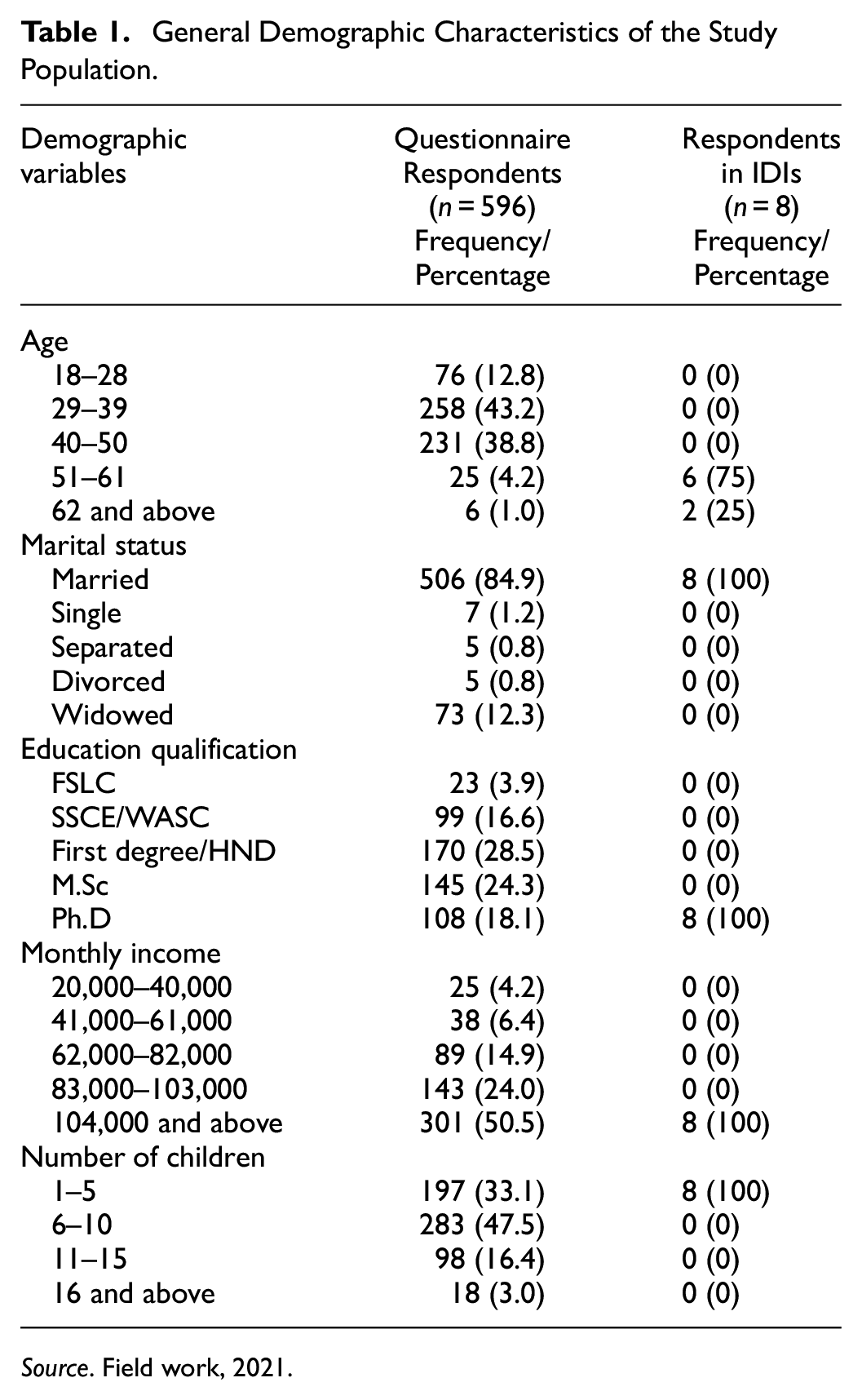
Table 1 shows that married women made up 84.9% of those who participated in the quantitative study and 100% of those who participated in the IDIs. The majority of those polled for their questionnaire survey have qualifications above SSCE/WAEC, with 28.5%, 24.3%, and 18.1%, holding First degree/HND, M.Sc, and Ph.D certificates, respectively. 50% of respondents to the quantitative survey and 100% of IDI participants in the qualitative study reported a monthly income of N104,000 and above. The majority of respondents to the quantitative survey (47.5%) and IDI participants in the qualitative research (0%), respectively, reported having 6 to 10 children who depend on them financially.
General Demographic Characteristics of the Study Population.
Source. Field work, 2021.
Views on the Knowledge of Work Related Stress
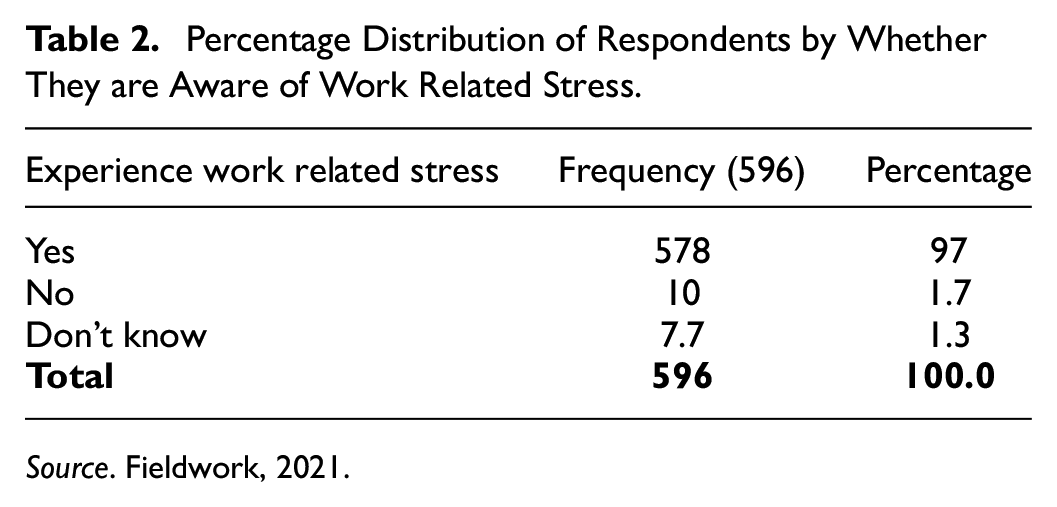
When asked if they are aware of work-related stress, 97% said they are, 1.7% said they are not, and 1.3% said they are unsure (Table 2). Given the prevalence of work-related stress, this is hardly surprising.
Percentage Distribution of Respondents by Whether They are Aware of Work Related Stress.
Source. Fieldwork, 2021.
In an in-depth interview, one of the participants expressed the following additional points of view: As a mother, the experiences of stress are bound to originate from one trying to build up her career to the level of becoming a professor in terms of carrying out research works and being a mother trying to meet up with family responsibilities of caring for your children, spouse, and extended family members that are dependent on you and all that. In all these ways, mothers are bound to experience some challenges in trying to meet up with these demands, which are detrimental to the woman’s health
Views on the Sources of Work Related Stress
Table 3 shows working mothers’ levels of agreement/disagreement on sources of work-related stress. According to the findings, 82.0% of respondents strongly agreed that job overload causes stress for working mothers; 9.4% agreed, 1.0% were undecided, 7.6% disagreed, and none agreed. Furthermore, 74.8% strongly agreed that having a large number of children makes it difficult for working mothers; 8.4% agreed, 9.6% were undecided, 5.9% disagreed, and 1.3% strongly disagreed. The argument that having a large number of children makes it difficult to work may be that, in the absence of social support and adequate spacing for childbirth, caring for high the children as well as her other work obligations may cause her to feel overburdened. Thus, the greater number of children you have, it leads to more responsibilities especially when combined with job.
Percentage Distribution of Respondents on the Sources of Work Related Stress.

Source. Fieldwork, 2021.
Again, 33.1% of respondents strongly agreed that having extended family members live with a working mother is stressful; 56.5% agreed, and 2.9% strongly disagreed. Furthermore, 60.6% of respondents strongly agreed that a lack of social support is a source of stress for working mothers; 20.1% agreed, 5.7% were undecided, 7.7% opposed, and 5.9% strongly disagreed. The majority of respondents (73.2%) strongly agreed that working mothers can become stressed as a result of long work hours, while 25.3% agreed, 1.5% was undecided, and none opposed or strongly disagreed with the premise. More specifically, 74.5% strongly agreed that low income can be a source of stress for working mothers, while 6.9% agreed, 2.0% were undecided, and 8.1% and 8.6% strongly disagreed. Furthermore, 40.8% strongly agreed, 45.8% agreed, 10.9% were undecided, and 1.2% and 1.3% opposed and strongly disagreed with the premise, respectively.
One of the participants in the in-depth interview offered an additional viewpoint: As I said, as an academic at this university, you must either publish or perish in order to develop, as well as fulfilling your role obligations at home and at work. Aside from that, there’s student immaturity, the attitudes of some of your co-workers you’ve discovered that some of them are difficult to cohabit with, and you need to comport yourself in the face of provocation, and so on. It’s a huge burden to carry around. Mothers who are unable to manage their time effectively may become ill or continue to work despite putting in extra effort. Some people will hire a housekeeper, who can make or break your household
Views on Effect of Work Related Stress
Table 4 demonstrated the extent to which the experiences of working mothers with work stress had an impact on their overall well-being, including their health, family, and job performance. According to the table, 29.2% of respondents reported having a high level of chronic headaches as a result of work-related stress, 55.0% reported having a moderate level of chronic headaches, and 7.9% reported having a low and very low level of chronic headaches, respectively. On the other hand, 68.1% reported having a high level of exhaustion, 15.9% a moderate level, 7.4% a low level, and 8.6% a very low level. Furthermore, 20.8% reported having a high level of low self-esteem, 57.7% reported a moderate level, 12.4% reported a low level, and 9.1% reported a very low level. According to the findings, 37.6% and 44.3% of respondents, respectively, indicated that their level of poor quality control was high and moderate. 10.6% of respondents reported a low level of poor quality control, while 7.5% reported a very low level.
Percentage Distribution of Respondents by the Level of Work Related Stress Working Mothers Have Experienced.

Source. Fieldwork, 2021.
Furthermore, 20.8% reported having a high level of low self-esteem, 57.7% reported a moderate level, 12.4% reported a low level, and 9.1% reported a very low level. According to the findings, 37.6% and 44.3% of respondents, respectively, indicated that their level of poor quality control was high and moderate. 10.6% of respondents reported a low level of poor quality control, while 7.5% reported a very low level. Similarly, 19.8% of respondents said that their inadequate attention to family needs was high, 65.9% said it was moderate, 7.2% said it was low, and 7.0% said it was very low. Again, 39.8% of respondents reported a high level of misunderstanding in the family, 42.4% reported a moderate level, 11.4% reported a low level, and 6.4% reported a very low level. Furthermore, 67.3% of respondents said their depression level was high, 15.7% said it was moderate, 7.9% said it was low, and 9.1% said it was very low. Finally, 39.6% of respondents reported having high blood pressure, 43.3% reported having moderate blood pressure, and 9.4% and 7.7% reported having low and very low blood pressure, respectively.
Working mothers are bound to experience stress in the pursuit of meeting their role responsibilities, which may have an impact on their lives, families, or workplaces.
Response aired by one of the in-depth interview participants also states that: Occupational stress has a lot of effects on working mothers. If you don’t have a housekeeper to assist you and you are doing all the family work alone, such as waking up earlier than 5 a.m. to get the children prepared for school and all that, you may end up coming to the office to sleep during working hours, and you won’t be able to do anything and may end up receiving either a query or being sacked. A mother must be able to draw a balance between what you ought to do and what you ought not to do
Another in-depth interview participant’s view: When these mothers return from work, they may not have time for their children; by the time they finish cooking, they may be napping while eating, let alone checking on their children while they are sleeping. Furthermore, some women may be so exhausted that they have no time for their husbands and are unable to meet their husband’s sexual needs as a result of their exhaustion. As a result, the man may seek out another woman to satisfy his sexual needs tomorrow, causing even more problems for his wife
Another in-depth interview participant’s view on working mothers’ social life: Certainly, it has an effect on the job performance of a working mother. As I always tell my friends, if you really want to be a practical academic, you must be anti-social to some extent because it is not whatever your friends or peers will go for that you will venture into. You are thinking of writing this paper, preparing this/that for your office thing, and then they are busy getting themselves ready, trying to appear at their best, and then going to a function. There is no way you can compete with them, so the effect is obvious
Views on Coping Strategies for Working Mothers
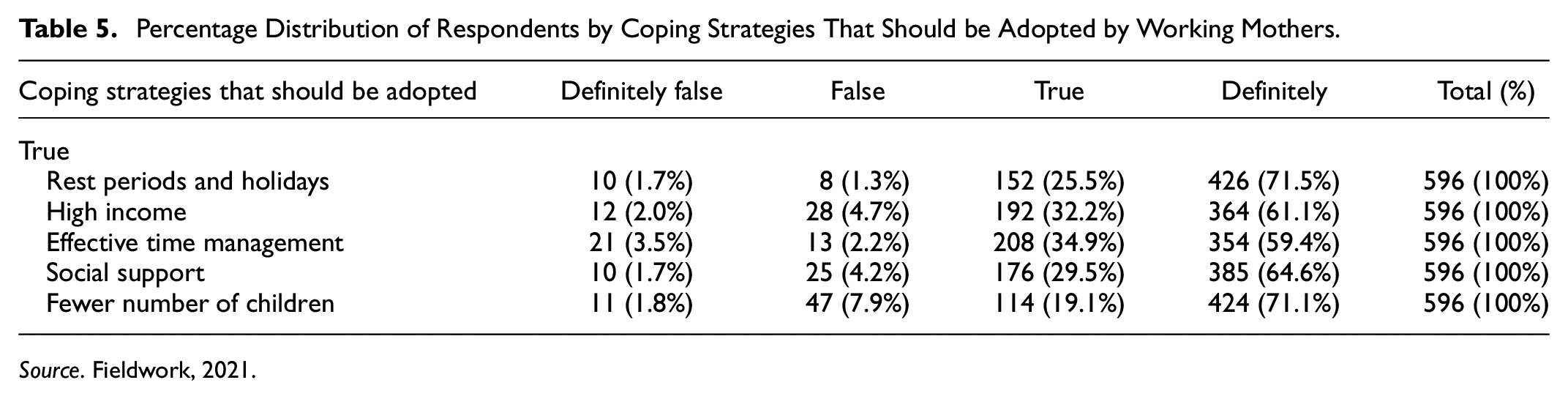
According to Table 5, the following percentages of respondents agreed that using the under-listed coping strategies will significantly reduce the stress that working mothers experience: rest and holidays (71.5%), high income earnings (61.1%), effective time management (59.4%), social support (64.6%), and fewer children (71.1%).
Percentage Distribution of Respondents by Coping Strategies That Should be Adopted by Working Mothers.
Source. Fieldwork, 2021.
One of the in-depth interview participants also said: As I stated earlier, working mothers face numerous challenges. You must conduct research and publish your work in order to advance. Students, lectures, class work, tutorials, and supervisions also come to mind. As a result, it is clear that it is a significant burden. We may occasionally enlist the assistance of family members, a driver, or a nanny
Another in-depth interview participant also aired her view: Mothers are the pillars of their households. They are responsible for their children, husbands, and houses, which is difficult enough without adding an office job to the mix. As a result, most women in developed countries are not allowed to work, especially when they are of childbearing age, because they believe they are already stressed enough to handle an office job. However, because we don’t have the same benefits as others, we’ve learned to manage our own workplace stress
In all of these discussions, it appears that a substantial number of respondents/participants support mothers’ efforts to minimize or reduce the level of stress she experiences, taking rest and holidays, engaging in paid work that will earn her a higher income, making efficient use of her time, soliciting for assistance, having fewer children she can comfortably care for, and finally, alleviating stress by splitting up their workload. Depending on the situation, mothers might also “enlist the services of family members, drivers, and nannies,” according to one of the IDI participants from the Faculty of Social Sciences.
Discussion
Working mothers at the University of Nigeria, Nsukka, have an appreciable knowledge of the effects of work stress among mothers, as a greater number of respondents indicated being aware of and having equally experienced work related stress. According to the Health and Safety Executive (2008), attention and body awareness influence the perception of stress symptoms. This emphasizes the fact that stress is unavoidable, particularly for mothers attempting to balance work and family obligations. Because of the well-known proverb that life is full of stress; even mothers’ day-to-day responsibilities may be difficult to fulfil (Adebiyi, 2011).
More so, work overload, large number of children, lack of social support, long working hours, and a low salary are all sources of stress for working mothers, according to the findings. These findings corresponded to the findings of these authors (Gholamzadeh et al., 2011; Lupu et al., 2018; Owoseni, 2013; Park & Kim, 2013; Younkin, 2010). Gholamzadeh et al. (2011) discovered that, among other things, high levels of responsibility are common work-related stressors. Working mothers have a lot of responsibilities, including taking care of the needs and requirements of both their family and their jobs, which may lead to stress that has an adverse effect on their health.
According to Uziel et al. (2019), workplace stress is widely recognized as a primary contributor to work-family conflict, with serious consequences for both organizational and employee health. Mothers are the pillars of their homes; they take care of their children and spouses and organise their homes, and this is difficult enough to add to their office work. According to the quantitative findings of the study, stress had a negative impact on working mothers’ job performance, including low self-esteem, absenteeism, and poor quality control. These findings corresponded to the findings of these authors (Ahsan et al., 2009; Olatunji & Akinlabi, 2012; Thabo-Fako, 2010; Uba-Mbibi & Nwamuo, 2013; Park & Kim, 2013; Anyanwu et al., 2015). Potential stressors for working mothers in an institution of higher learning include, but are not limited to, work overload, home-work interface, role ambiguity, and excessive job demand (Ahsan et al., 2009).
The findings from the quantitative study also highlighted certain coping strategies for working women, such as taking breaks and vacations, seeking social support, and having fewer children. These findings were similar to those of these authors (Akanji, 2012; Atinuke & Adesola, 2013; Marmot et al., 2006; Rotondo & Kincaid, 2008). Atinuke and Adesola (2013) identified coping mechanisms in Lagos State that included internal and external outsourcing of domestic responsibilities to housemaids, relatives, or drivers, among others; relaxation and weekend outings with family, and so on. In contrast, some mothers work day in and day out, most likely because they don’t have anyone to help them and aren’t financially secure enough to outsource either of their responsibilities at work or on other fronts. These mothers may not be able to use the aforementioned coping mechanisms and may be under a great deal of stress due to role conflict and ability misfit (Nagaraju & Nandini, 2013). As a result, they may need the assistance of social workers.
Interventions by social workers are required due to the global epidemic of work stress and its impact on the families of working mothers. According to the study’s findings, social workers could help working mothers manage their stress through counseling, teaching, crisis intervention, and case networking and conferencing. Social workers use all of these and other techniques to help working mothers cope with work stress. According to Ogundipe and Edewor (2012), social workers help people who are struggling to complete their daily tasks, alleviate their misery, and achieve their goals in order to improve their quality of life. As a result, working mothers must be educated on stress management since it is ingrained in their daily activities. In light of this, the person-environment theory posits that stress is caused by a mismatch between demand and ability. For instance, handling multiple roles such as attending to the needs and requirements of the family, taking care of the children, spouse, and other members of the family with unshared roles by the spouse, as well as trying to meet professional obligations at work, could result in role overload or conflict, which could be a cause of stress and demand-ability misfit. To cope, Lewin’s theoretical assumption stated that mothers must pay attention to the issues that cause them stress, which necessitates access to relevant knowledge on appropriate coping strategies. Therefore, providing information on active coping skills to mothers may help them improve their relationships in both formal and informal settings (Eisengart et al., 2006).
The findings of this study have significant policy and practice implications for Nigerian social workers. Working mothers are more likely to experience high levels of stress as a result of job-function mismatches caused by demand-ability misfits. As a result, many of these women may experience despair and anxiety if they are unable to control their stress. As such, governments must develop policies that will encourage Nigerians, particularly working mothers, to understand the effects of work stress and how to deal with it because they are more likely to be affected. On that note, occupational social workers will have a better understanding of the importance of always having an interface with working mothers about coping strategies to ensure work-family balance.
The study found, for example, that having a large number of children, as well as other extended family members who may be financially dependent on the working mothers, increased the working mothers’ feelings of work-related stress. As a result, social workers must advocate for proper family planning implementation by educating the public about the importance of family planning so that mothers can make an informed decision about how many children they can care for.
In Nigeria, social workers are critical for designing, implementing, monitoring, and sustaining work stress policies. Social workers, as policy experts, must be consulted about or included in the policy-making process. This is because, as generalists, social workers have knowledge that can help society address a wide range of social issues, including work stress among working mothers. The Nigerian government must recognize the social work profession by placing its members in appropriate positions in various offices, such as families, institutions, courts, and ministries, so that they can carry out their duties effectively. Other comparable professions, such as sociology and psychology, should not be used to replace social workers because they do not perform the same function.
Recommendations
The study recommends that the government and other stakeholders, such as policymakers, consider developing and implementing social policies that take into account the number of family members who live with working mothers. Working mothers would also be protected from having too many children to care for. Social workers could raise awareness or organize enlightenment programs for working mothers, to help them better understand job stress and how to cope with it. Despite the fact that the University Medical Centre has a social services unit anchored by medical social workers whose job descriptions are primarily focused on patients and patients’ relatives, there is also a need for an occupational social work office at the student affairs department anchored by adequate professional social workers whose job descriptions should focus on the welfare of students and staff of the university community, particularly mothers.
Moreover, governments and non-governmental organizations of the institution must also seek ways to reduce the amount of work stress experienced by working mothers, as the more stressors in the workplace, the higher the individual’s stress level. This can be accomplished by constructing well-equipped recreational centers in all institutions and communities and encouraging these mothers to visit those centers whenever they are feeling exhausted. Family members should also make an effort to assist working mothers with household responsibilities.
Strengths and Limitations
The researcher acknowledged a couple of limitations. First, participants were limited to mothers from a Nigerian university due to financial constraints; alternatively, a larger representative sample from other universities would have been perfect for generalization, which necessitates conducting further studies that include broader participants from different universities to authenticate generalizations. Nevertheless, because this is a qualitative study, the researcher focused on the entire narrative of the topic under study. Despite these limitations, the researcher strongly believes that the findings of this study remain valid.
Conclusion
The study evaluated how working mothers cope with stress in light of their experiences at the University of Nigeria, Nsukka, as well as the implications for social work practices. According to the study, a significant number of respondents claimed to be aware of and have personally experienced the effects of stress. The following factors also have an impact on working mothers’ stress levels: an excessive workload, a large number of children, a lack of social support, long working hours, a low income, a large number of dependents, and the desire to publish and obtain promotions. The study concludes that understanding the stressors that working mothers face can help them reduce their stress levels. As a result, social workers at the University of Nigeria, Nsukka, must regularly interact with these working mothers in order to inform them about the best management strategies or coping mechanisms to employ in order to achieve a work-family balance. They must also push for the establishment of an occupational social work office with qualified professional social workers whose main focus should be on university staff members, particularly working mothers.
Footnotes
Acknowledgements
The author gratefully acknowledged mothers from a Nigerian institution who participated in this study with no grudges.
Declaration of Conflicting Interests
The author declared no potential conflicts of interest with respect to the research, authorship, and/or publication of this article.
Funding
The author received no financial support for the research, authorship, and/or publication of this article.
Ethical Approval
There is no animal participation in the research. The informed (verbal) consent of the participants was obtained prior to their participation in the study.

Availability of Data and Materials
Data are available on request.