



Abstract
Facing supply shocks such as tightening global resource environments, weak agricultural economic value-added, and diminishing demographic dividends, enhancing agricultural resilience has become an essential path to ensure food security and sustainable social development. Based on provincial panel data from China spanning 2011 to 2020, this paper systematically examines the enhancement effect of local government governance capacity and its multidimensional heterogeneity on agricultural resilience through visualization, sensitivity analysis, and internal mechanism analysis. The research findings are as follows: First, local government governance capacity significantly enhances agricultural resilience, although its industrial prosperity dimension has not reached the expected significant level and exhibits complex dynamic connections across different economic and functional zones. Second, local governments can effectively improve agricultural resilience by introducing digital economy, with the risk resistance index increasing from 0.217 to 0.269 percentage points compared to traditional local government governance models, representing a substantial increase of 28.57%, while still showing high potential value for future development. Third, labor force quality has failed to optimize the effect of local governments on enhancing agricultural resilience, and has even triggered problems such as resource misallocation and inefficiency. This research has significant reference value for countries facing agricultural development challenges globally and provides new insights for achieving food security and sustainable agricultural development goals within the United Nations Sustainable Development framework.
Plain Language Summary
In the face of growing resource and environmental constraints, stagnating agricultural economic benefits, and a declining demographic dividend, improving agricultural resilience has become essential for ensuring food security and sustainable development. This study uses Chinese provincial panel data from 2011 to 2020 to analyze the role of local government governance capacity in enhancing agricultural adaptability through factor sensitivity and internal mechanism analysis. The main findings are: Local government governance capacity significantly influences agricultural resilience, but this effect varies across economic and functional regions, demonstrating complex and dynamic relationships. With the advancement of digital agriculture, local governments can enhance agriculture’s ability to adapt to risks by leveraging digital economies, improving resilience by approximately 28.57%, with indirect effects contributing 7.38%. The current labor force structure has not been optimized to support local governments’ efforts in improving agricultural resilience. Instead, it has led to resource misallocation and inefficiencies, weakening the effectiveness of resilience strategies. External factors, including economic, technological, and policy environments, amplify the regional heterogeneity of local governments’ efforts to enhance agricultural resilience. These findings offer valuable insights for countries facing similar agricultural development challenges. By understanding the role of governance, technology, and regional dynamics, this study provides new strategies for achieving the United Nations Sustainable Development Goals, particularly in ensuring food security and promoting sustainable agricultural development.
Introduction
In the context of global climate change, resource scarcity, and market uncertainty, building agricultural resilience has become a critical proposition for ensuring national food security and implementing rural revitalization strategies (Q. Yang et al., 2022). According to the United Nations survey data from 2021, the economic development of countries worldwide has suffered varying degrees of impact due to the COVID-19 pandemic. Specifically, the US economy contracted by 3.5% and the Japanese economy shrank by 5.3%; however, China, also ranking among the world’s top three economies, demonstrated contrary growth (with real GDP growth reaching 2.3%), which exemplifies China’s economic resilience (Muturi, 2023). This steady enhancement of economic resilience is largely attributed to the resistance capacity of China’s diversified systems (such as fundamental agriculture). As a global agricultural power, China plays a fundamental strategic supporting role in building economic resilience by safeguarding the baseline of food security, buffering employment fluctuations, supporting the operation of entire industrial chains, and driving policy innovation. Currently, the advent of the digital era presents both opportunities and challenges for China’s agricultural systems, with formal organizations playing a crucial guiding role. Since 2015, the “No. 1 Central Document” has repeatedly emphasized agricultural informatization, calling for the development of smart agriculture, the establishment of agricultural and rural big data systems, and the promotion of “Internet + Agriculture” integration and innovation. Data indicates that in recent years, the Chinese government has repeatedly adjusted modern agricultural development strategies, with the potential market size for smart agriculture expected to increase from US$23.2 billion (approximately 160 billion yuan) in 2019 to over 60 billion yuan by 2027, and is projected to account for approximately 30% of the global market by 2030. However, considering agriculture’s inherent vulnerabilities, relying solely on macroeconomic agricultural policies cannot ensure rational and effective resource allocation. Subsequently, Elinor Ostrom, based on polycentric governance theory, emphasized that local governments, as governance entities proximate to resources and communities, possess unique advantages in improving resource management efficiency and addressing complex challenges (Ostrom, 2009). Evidently, under the impact of uncertain factors such as economic contraction, market fluctuations, and climate change, local governments demonstrate distinctive governance advantages, determining their role and effectiveness in addressing such challenges and ensuring sustainable, high-quality agricultural development (Andrew & Goldsmith, 1998). Therefore, this article incorporates local government governance capacity into the examination framework for agricultural resilience improvement and attempts to address the following questions. First, has local government governance capacity effectively driven the improvement of agricultural resilience levels? Additionally, can the advent of the digital era enhance the governance benefits of local governments? Simultaneously, are the internal mechanisms and key external environmental factors in the government governance process conducive to enhancing agricultural resilience? Specifically, based on national functional zones and economic zone strategic divisions, what differences exist among local governments in their approaches to enhancing agricultural resilience?
Based on the above analysis, this paper makes three marginal contributions. First, it utilizes kernel density estimation to visualize agricultural resilience development trends in China for the first time, providing crucial data support for subsequent theoretical elaboration. Second, it constructs an analytical framework of “institutional advantages-digital empowerment-spatial coordination” to derive a comprehensive index of local government governance capacity and agricultural resilience, conducts integrated analysis of sensitivity factors, and systematically examines the diverse elements for enhancing agricultural production resilience in local government governance based on national economic and functional zone classifications. Third, it further explores the dynamic and complex relationships between digital economy and labor force quality by evaluating their intrinsic mechanisms and external environmental effects. This research not only enriches the application of resilience theory in local governance contexts, but also provides valuable Chinese experience for how local governments worldwide can effectively address challenges related to climate change and food security.
Literature Review
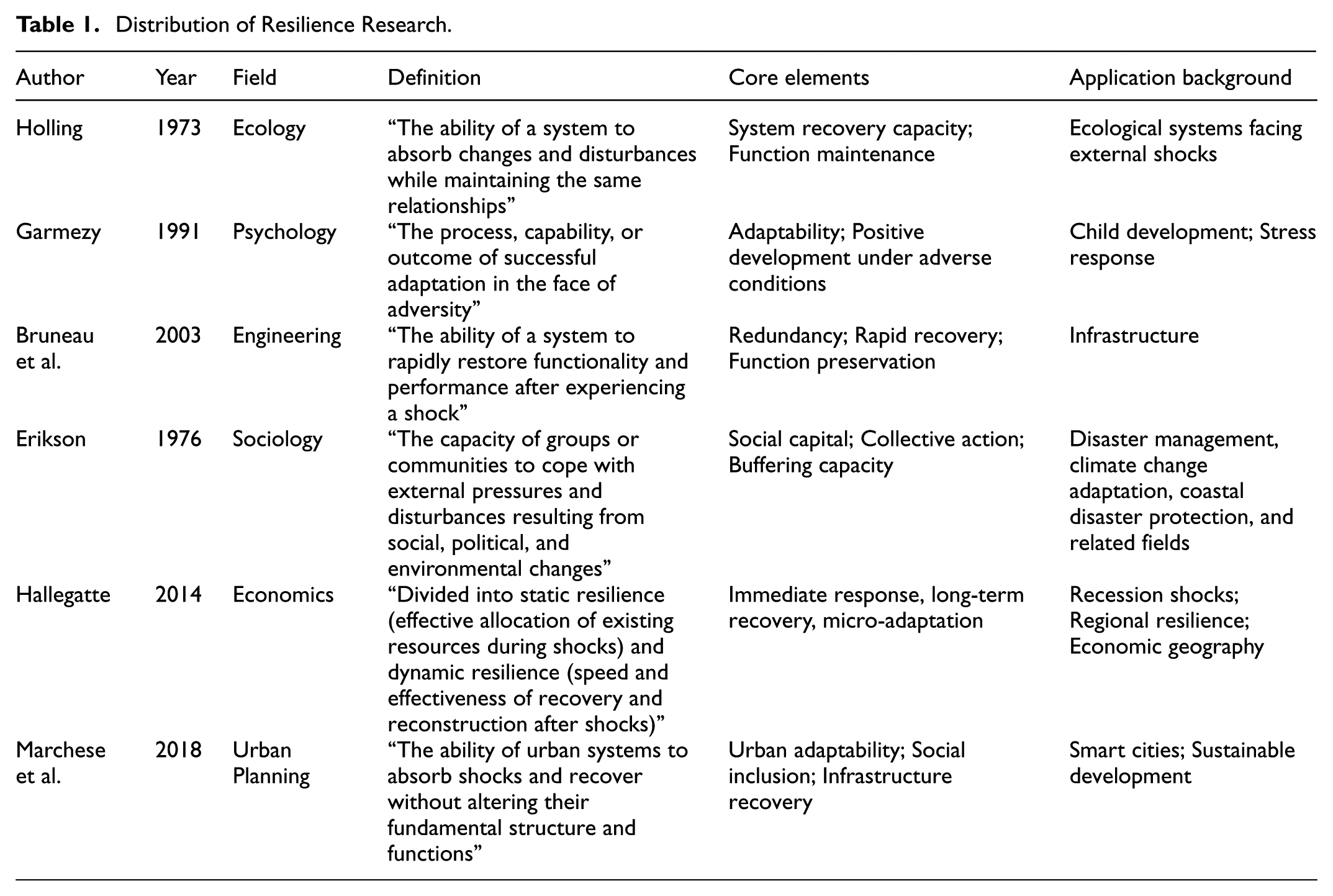
The concept of “resilience” originated in the field of physics and was later introduced to ecology by Holling (1973), who focused on analyzing the capacity of ecological systems to maintain, repair, and renew themselves after natural and anthropogenic disturbances. Subsequently, this concept gradually extended to fields such as economics and sociology (Urruty et al., 2016). By the end of the 20th century, international scholars conducted systematic and in-depth discussions of the “resilience” concept, primarily focusing on ecology, economics, and production domains (Alexopoulos et al., 2022; Cox & Hamlen, 2015; Feng et al., 2023), and provided detailed interpretations and elaborations of the concept based on the characteristics of specific fields (Table 1). Later, Briguglio et al. (2006), Boschma (2015), and Martin (2012) further articulated and expanded the concept, establishing a more standardized definition and constructing a comprehensive framework.
Distribution of Resilience Research.
This framework not only provided a rich theoretical foundation for other countries to understand and apply the concept of resilience but also offered a viable pathway for future research and practice. In recent years, in the face of global issues such as weak world economic recovery and frequent regional conflicts and turbulence, the application value of the “resilience” concept has become increasingly prominent across various domains. Chinese scholars’ research on “resilience” began relatively late, with content that remains somewhat singular and lacking in extensibility (Huang et al., 2021; Q. Zhou et al., 2021). As the foundation of China’s national economy, agricultural resilience directly relates to the country’s risk resistance capacity and sustainable development capability. In recent years, although China has actively promoted the transformation from an agricultural power to an agricultural stronghold, with significant improvements in overall agricultural resilience levels (Table 2), the conceptual definition of agricultural resilience in practical applications remains based on the social-ecological system (SES) resilience theory established by scholars such as Folke and Martin. As early as 1998, Folke employed the social-ecological system as an analytical framework to study the dynamic connections between ecosystems and institutions, proposing the concept of “social-ecological resilience” and emphasizing the enhancement of resilience through matching institutional and ecosystem dynamics (Berkes et al., 2000). Subsequently, the social-ecological resilience proposed by Folke no longer pursued system equilibrium but instead formed evolutionary resilience through disturbances triggering self-organization, learning, and adaptation (Walker et al., 2004). As an agricultural power, China’s prioritization of addressing risks such as climate change, natural disasters, and market fluctuations is a key factor in ensuring national food security and sustainable agricultural development. Consequently, research in the field of agricultural resilience has begun to receive widespread attention and is exhibiting a stage of unified development from multiple perspectives. At the theoretical level, based on concepts such as “evolutionary resilience,” there is an emphasis on the dynamic evolutionary capacity of rural governance and the embedding of resilience standards in policy design. For example, Wang, Zhao, Xiong (2022) enhanced policy diversity through a “bottom-up” governance model to address uncertainties (such as market fluctuations and climate disasters). Simultaneously, the research focus has gradually shifted toward practical issues. In the process of China’s agricultural industry transformation and upgrading, some scholars have revealed that capital-intensive industries such as energy, transportation equipment manufacturing, and metal products demonstrate stronger resilience, while labor-intensive industries such as textiles and clothing, paper making, and cultural, educational, and sports products exhibit weaker resilience (L. Ma et al., 2023). In the process of China’s agricultural industry transformation and upgrading, some scholars have revealed that capital-intensive industries such as energy, transportation equipment manufacturing, and metal products demonstrate stronger resilience, while labor-intensive industries such as textiles and clothing, paper making, and cultural, educational, and sports products exhibit weaker resilience (L. Ma et al., 2023). Methodologically, traditional research combining quantitative models (such as the entropy method) with qualitative cases (such as southern Jiangsu rural areas and Chongqing mountainous agricultural systems) highlights the bidirectional interaction between theory and practice, with particular emphasis on policy orientation, such as advocating for collaborative governance through government intervention and community participation in areas lacking administrative markets (Geng et al., 2024). Overall, China’s agricultural resilience research has formed academic characteristics of “localization of international theories, systematization of complex problems, and refinement of policy design,” providing a reference framework for rural revitalization strategies that combines theoretical depth with practical value. With the multidimensional focus on agricultural resilience research in academia, its concepts and connotations have become clearer and more explicit, providing new perspectives and theoretical tools for our subsequent research on how agricultural systems maintain their functionality under complex environmental pressures, how they rapidly recover after shocks, and how they enhance adaptability through change and learning.
Trends in Agricultural Resilience.
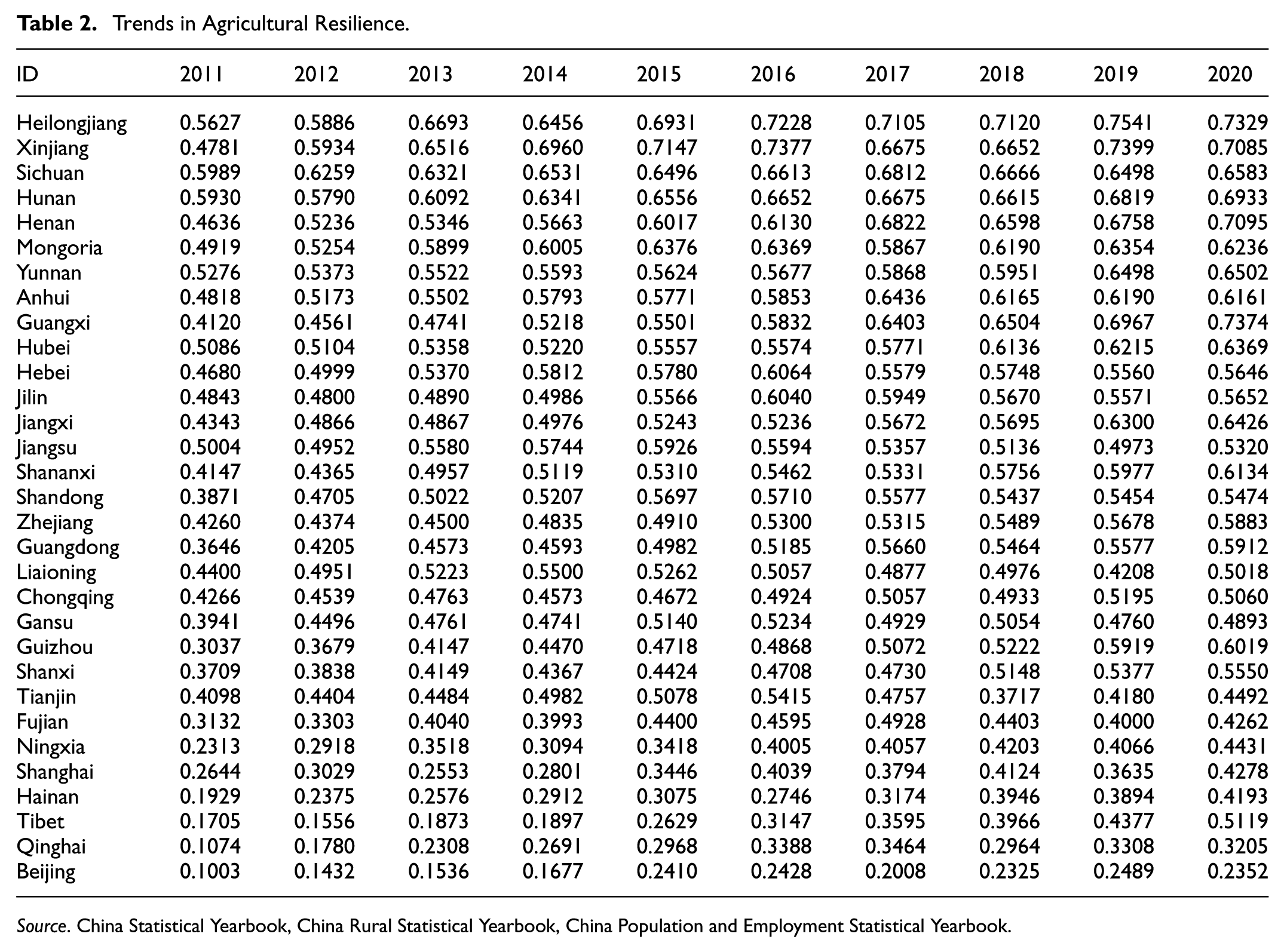
Source. China Statistical Yearbook, China Rural Statistical Yearbook, China Population and Employment Statistical Yearbook.
As the governing entity for high-quality and sustainable agricultural development, local governments continuously face systemic risks and uncertain shocks and disturbances from the external environment in a complex and changing macroeconomic context (Whiting et al., 2019). However, as early as the beginning of the 20th century, local governments assumed the function of providing basic services in the transition from agricultural to industrial society (Jones et al., 1978). Later, influenced by the Great Depression and war, Keynes proposed the theory of government intervention, which promoted local governments’ deep involvement in agricultural subsidies and price support (Gordon, 1990). With global post-war economic restructuring, Ladd (1990) believed that through industrial park construction, technology dissemination, and other methods, local governments’ role shifted from passive crisis response to proactive economic intervention (such as public-private partnership models). Moreover, with the rise of new public management theory, scholars such as Ostrom (1990) began to focus on collaborative governance between local governments and community organizations in natural resource management. At the beginning of the 21st century, global value chain theory (Gereffi et al., 2005) and multi-level governance theory (Olsson, 2003) further expanded research perspectives, emphasizing the bridging role of local governments in connecting local producers with international markets in the context of globalization. In recent years, with the advent of the digital era, research focus has gradually shifted toward local governments and smart agriculture transformation and upgrading, along with local governments’ adaptive adjustments and resilience building in the context of complex climate change (Karam et al., 2024). In this process, Aruleba and Jere (2022) argues that purposeless digital proliferation easily leads to ownership and privacy issues in the integration of digital technologies in rural areas. For instance, Wiseman et al. (2019) contends that the current state of multinational corporations jointly controlling agricultural data in agricultural markets tends to disrupt agricultural economic markets and environmental balance, erode farmers’ operational autonomy, and undermine agricultural resilience. Evidently, blind promotion of digital technology integration in agricultural systems easily generates structural contradictions between technology, institutions, and markets. Similarly, while excessive regulation or subsidies can accelerate transformation in the short term, they increase fiscal burdens and affect policy sustainability (Zheng et al., 2024). Consequently, compared to central government agencies that follow the New Weberian governance model, local governments, as key implementation entities for policy execution, should demonstrate more flexible governance elasticity between regulation and decentralization. This institutional characteristic enables local governments to more precisely grasp farmer demand structures and deeply understand market operational logic, thereby implementing differentiated adaptive policies to seek optimal balance points between strict regulation and flexible governance, thus constructing an innovative “sandbox regulation” model with distinctive farmer-specific characteristics. Reviewing this research evolution process, one can clearly see that the role of local governments has gradually developed from simple infrastructure providers to complex multi-functional coordinators, with research perspectives shifting from a singular focus on economic growth to a comprehensive balance of economic, social, and environmental factors, reflecting the deepening and expansion of global understanding of primary industry governance. In conclusion, the direct participation of local governments inevitably brings short-term or long-term promotional, integrative, and regulatory effects on agriculture.
In recent years, local governments worldwide, facing risks such as climate change, market fluctuations, and economic downturns, are gradually shifting their agricultural policy focus from merely pursuing yield growth to establishing more resilient agricultural systems (Alexopoulos et al., 2022). Early on, academia verified the feasibility of policy design and implementation, finding that effective local policies can enhance farmers’ climate resilience capacity (Davies et al., 2009). Later, Park and Liang (2024) argued that policy implementation effectiveness largely depends on local governments’ resource allocation and coordination integration capabilities. In this context, China, in the process of achieving its grain planting structure optimization objectives, collaborates with local governments to implement policies through means such as central subsidies, agricultural production services, and demonstration projects (G. Ren & Cui, 2024). Meanwhile, in places like India and Brazil, local governments enhance agricultural risk resistance capabilities by attracting private investment and introducing market mechanisms (Hao et al., 2023). With the advent of digitalization, Finger (2023) suggests that local governments, in enhancing agricultural resilience levels, can improve varieties, eliminate crop residues, and reduce carbon footprints through agricultural technological innovations (such as climate-smart agriculture and IoT) and promotional support (such as information and communication technologies), and disseminate and promote these contents, thereby strengthening agricultural sustainability and resistance. Simultaneously, some scholars believe that local governments’ risk early warning and management constitute important guarantees for agricultural resilience (Sharafi et al., 2020). For example, Spiegel et al. (2020) suggests that European risk management strategies need to shift from short-term shocks to long-term stressors to enhance the adaptive capacity of agricultural systems. Furthermore, informal social capital empowers local governments to cultivate favorable external environments, providing guarantees for agricultural social resilience (Beekman et al., 2009). In summary, existing research focuses on multiple mechanisms including policy formulation and implementation, resource allocation and coordination, technology promotion and innovation support, risk management and emergency response, and social capital cultivation, collectively constituting a multidimensional governance system for local governments to enhance agricultural resilience.
Theoretical Analysis and Research Hypotheses
The Impact of Local Government Governance Capacity on Agricultural Resilience
In the context of globalization, the Chinese government has empirically verified the positive role of formal organizations in addressing internal and external shocks such as economic downturns, ecological crises, public sector budget pressures, and market fluctuations, particularly in the highly vulnerable agricultural sector (Sun et al., 2021). Currently, the “downward-shifting” governance approach from the perspective of local governments, through precise policy implementation, resource integration, and flexible innovation, is becoming a key component in China’s agricultural modernization development (Chung, 2016). Subsequently, with the globalization of economy and trade, domestic and international challenges have gradually increased. Multi-dimensional issues resulting from economic development—such as environmental pollution, climate change, and market fluctuations—have become particularly prominent and represent critical issues that governments must address and mitigate in pursuing high-quality agricultural development, making the enhancement of agricultural resilience an urgent priority (Xie et al., 2022).
Research indicates that there is a close connection between local government governance capacity and high-quality agricultural development (Deichmann et al., 2016). The Rural Revitalization Promotion Law of the People’s Republic of China emphasizes that local governments should play a leading role in rural revitalization, specifically by using the governance outcomes of “industrial prosperity, ecological livability, rural civility, effective governance, and affluent living” as rigid criteria for measuring local government governance capacity. This framework emphasizes the complex dynamic relationship between local government governance and three aspects of agricultural resilience: resistance capacity, adaptive capacity, and transformative capacity, serving as an important foundation for systematically exploring the influences on agricultural resilience and its operational mechanisms (as shown in Figure 1). Among these, effective governance serves as an institutional foundation, establishing a multi-actor collaborative framework through policy instruments (such as industrial land quota allocation and ecological compensation mechanisms) and organizational innovations (such as rural elite councils), providing regulatory guarantees for the dynamic balance between industrial prosperity and ecological livability (Bodin, 2017; Q. Zhang et al., 2024). Rural civility, through the reproduction of local knowledge (such as traditional farming wisdom) and collective action norms (such as village rules and conventions), provides cultural legitimacy for industrial transformation (such as community recognition of organic agriculture) and activates endogenous drivers of affluent living through nostalgic economies (Gao & Wu, 2017; K. Ren & Wu, 2023; Y. Wang & Huan, 2023). The symbiotic relationship between industrial prosperity and affluent living is manifested in income diversification brought about by industrial chain extension (such as agricultural product processing enhancing household income resilience), which in turn strengthens farmers’ willingness to pay for ecological governance (such as increased willingness to participate in ecological compensation projects). This economic-ecological positive feedback loop achieves sustainability under the threshold constraints of ecological livability (Neves et al., 2020; Wang & Zhu, 2022). Evidently, the five dimensions of local government governance do not exist in isolation but form a complex adaptive network of “institutional driving—cultural adaptation—economic feedback—ecological balance.” Through this systemic interaction mechanism, the multidimensional heterogeneity of local government governance capacity transforms into comprehensive enhancement of agricultural resilience, forming a synergistic strengthening of economic, ecological, productive, and social resilience. Based on this, the article proposes hypothesis H1:
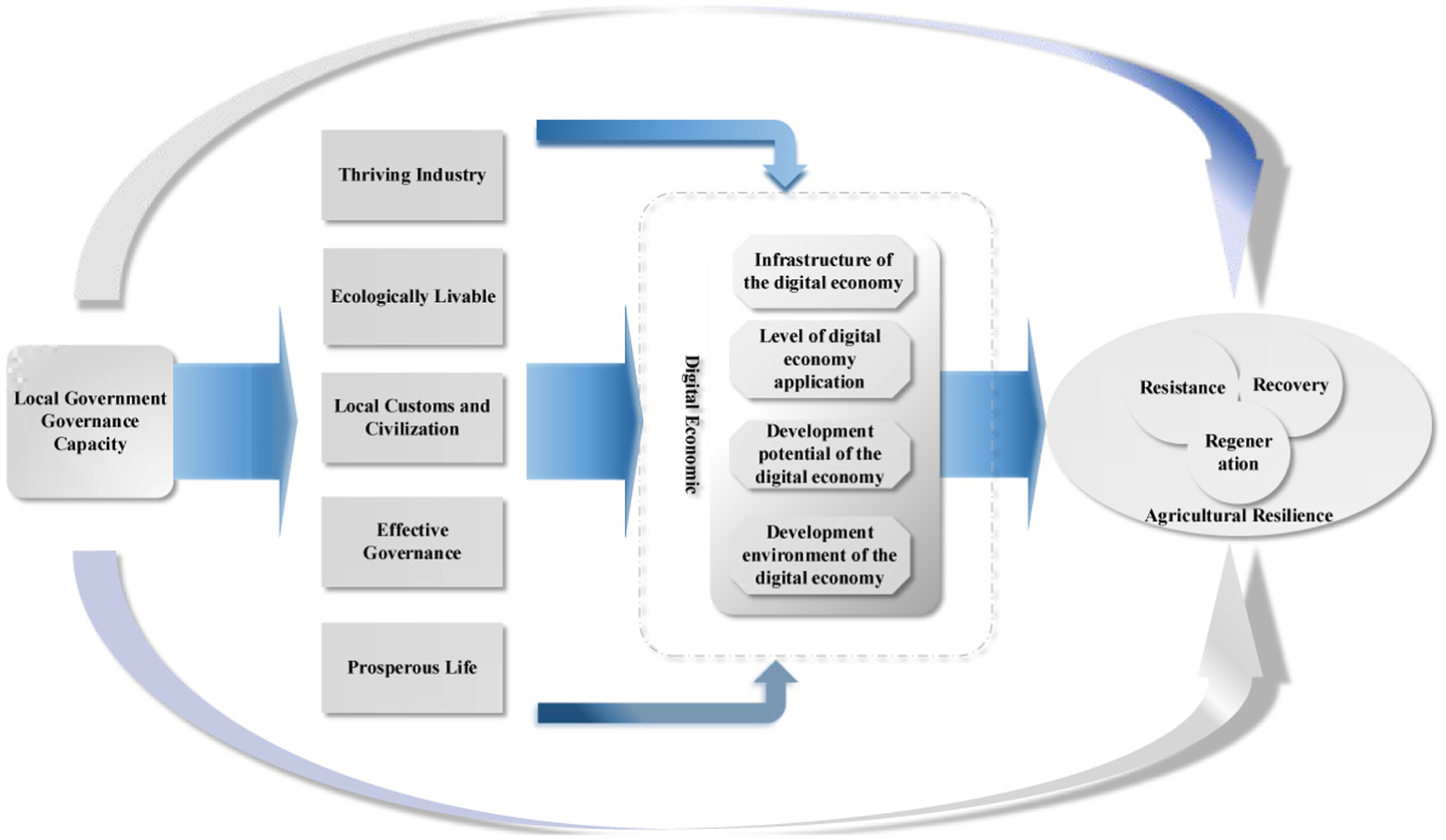
Theoretical analysis framework.
The Mediating Effect of Digital Economy
The advent of the digital wave has brought “new vitality” to local governments in achieving agricultural and rural modernization (Cai et al., 2023). Chinese agriculture has entered the 4.0 era, with development strategies no longer limited to traditional production models but integrating modern concepts and technologies (such as artificial intelligence, big data platforms, and remote sensing) to achieve precise management of agricultural activities including planting, fertilization, and irrigation, thereby enhancing risk resistance capacity, resilience, and innovation in the agricultural sector (Qiu et al., 2022). Nevertheless, the “large country with small farmers” paradigm remains China’s fundamental agricultural condition (Guo et al., 2023). Specifically, constraining factors such as small farm sizes, fragmented arable land resources, insufficient agricultural mechanization, and low qualification levels of agricultural personnel have led to gradient differences in technology adoption rates among farmers (Lin et al., 2023). In recent years, the government has attempted to increase technology adoption rates through guiding enterprise integration, farmer resource consolidation, agricultural machinery policy subsidies, and dynamic cultivation methods for new types of farmers (Clark et al., 2018; Hu et al., 2022; Tim et al., 2021; Z. Zhou et al., 2022). Simultaneously, within complex macroeconomic and social environments, local governments have begun to demonstrate vitality as policy implementers and resource allocators in “downward-shifting” governance, with their leadership and organizational capabilities playing a crucial role in promoting and regulating high-quality agricultural development. With the deepening of globalization and the information age, the penetration and application of digital technology in the agricultural sector has become an irreversible trend (Cai et al., 2023). In this process, the digital economy has rapidly emerged and, with the deepening degree of agricultural digitalization, has become a core driving force for agricultural modernization. As an emerging economic form, the digital economy can achieve systematic inclusive development through the organic integration of technology, markets, policies, and industries (Ahmad et al., 2021; Bukht & Heeks, 2017). Research has found that information network technology, as the foundation of digital economy operations, primarily focuses on building the hardware and network infrastructure required for agricultural digitalization. These infrastructures not only provide solid material guarantees for agricultural production but also promote the digital upgrade of the entire agricultural chain by enhancing the breadth and depth of information transmission, becoming an indispensable core support in the construction of agricultural digitalization systems (Xia et al., 2024). The application capability of the digital economy directly reflects the degree of deep integration of digital technology throughout the entire chain of agricultural production, processing, circulation, and sales (Ahmad et al., 2021). In this process, basic livelihood communication and financial services constitute key elements for promoting value realization of the digital economy in the agricultural sector. Meanwhile, long-term planning in aspects such as digital technology research and development, talent cultivation, and market expansion constructs a digital “reservoir.” This systematic arrangement not only provides continuous technical and human resource support for the digitalization process but also lays a solid foundation for the sustainable growth of the future agricultural digital economy. Additionally, a healthy external environment, including improved policies and regulations and farmers’ acceptance of digital technology, is viewed as a “greenhouse” for promoting digital economic development, creating a favorable atmosphere for the application and diffusion of digital technology. Evidently, digitalized foundational society, application level, development potential, and external environment are considered important components of the digital economy (Figure 1). Based on this, the article proposes hypothesis H2:
The Moderating Effect of Labor Quality
As a fundamental element of agricultural production, labor provides the government with inexhaustible momentum for achieving high-quality agricultural development (Byerlee, 1976). Chinese agriculture is in a critical stage of accelerating the transformation of development modes, optimizing economic structures, and converting growth drivers. It must adhere to agricultural supply-side structural reform as the main thread and modern industrial upgrading as the orientation, ensuring the coordinated development of both quality and quantity of agricultural labor production. Evidently, skilled agricultural and rural talent constitutes a vital force in promoting agricultural technological innovation and supporting rural development. From the perspective of human capital theory, agricultural labor, as a key production factor, directly determines the quality and resilience level of regional agricultural development through its knowledge level, skill structure, and innovation capacity (Bjerke & Johansson, 2022). Local government policy measures can only be effectively implemented through the understanding, transformation, and execution by high-quality labor. Multiple studies indicate that identical government governance inputs typically produce significantly better effects in regions with higher-quality labor compared to regions with lower-quality labor. Based on this, in regions with higher labor quality, farmers have stronger abilities to understand, accept, and implement government policies, enabling them to more effectively transform government policy, economic, and cultural support into practical actions that enhance agricultural resilience. From the perspective of technology diffusion theory, government-driven agricultural technological innovation requires knowledge diffusion networks to generate widespread impact. High-quality labor often serves as a key node in this network, capable of more rapidly adopting new technologies and demonstrating their application to surrounding farmers. Particularly when facing shocks such as climate change and market fluctuations, high-quality labor can better understand and implement government response strategies. Additionally, high-quality labor more readily facilitates the formation and accumulation of rural social capital, enhancing the self-organizing capacity and collective action efficiency of agricultural communities, thereby forming positive interactions with government governance and jointly improving agricultural resilience (Han et al., 2022). Based on this, the article proposes hypothesis H3:
Heterogeneity Analysis of Economic Regions and Functional Areas
China’s vast territory objectively presents imbalances in regional resource endowments, development levels, and cultural perspectives (Chi et al., 2022). Based on new economic geography theory, differences in economic levels represent the most intuitive mapping of China’s regional heterogeneity. Research indicates that differences in regional economic development levels directly lead to variations in local government fiscal capacity and available resources (Y. Wang et al., 2024). The gradient distribution of governance modernization levels (manifested in administrative efficiency, information system completeness, and professional specialization of personnel) affects the response speed and policy implementation quality of government responses to agricultural risks (Tong et al., 2024). Regional differences in agricultural modernization levels and industrial structures constitute different environmental conditions for governance capacity transmission mechanisms, while region-specific natural risk characteristics (such as low-temperature damage in the Northeast, drought in North China, and flooding in the South) require local governments to adopt differentiated governance strategies (Geng et al., 2024). These factors collectively form a complex pattern of regional heterogeneity in the impact of local government governance capacity on agricultural resilience. Additionally, as a major agricultural country, China has formed an industry structure dominated by grain production due to superior land resource endowments, favorable national policies, and well-developed agricultural infrastructure (L. Ma et al., 2024). Research has found that major grain-producing areas, due to receiving more policy support and resource allocation (such as benefit compensation mechanisms for major grain-producing areas and agricultural support protection subsidies), bearing more explicit food security responsibilities, and possessing more comprehensive agricultural production systems and higher degrees of specialization, enable equivalent levels of governance capacity to achieve greater agricultural resilience enhancement effects (D. Zhang et al., 2021). Non-main producing areas, constrained by resource limitations, tend to develop specialized agriculture and diversified operations (such as circular economy and green energy), to enhance their responsiveness to market fluctuations and changes in the economic environment, forming differentiated agricultural competitiveness (Barros et al., 2020). This analysis reveals that functional area differences must be fully considered when studying the relationship between government governance and agricultural resilience, providing a theoretical foundation for formulating differentiated agricultural policies. Evidently, local governments in the governance process, constrained by significant differences in economic foundations and functional positioning, may exhibit significant regional heterogeneity in their effectiveness in enhancing agricultural resilience. Based on this, the article proposes hypothesis H4:
Methodology
Data Sources
This study examines data from 31 provincial-level administrative regions in China (excluding Hong Kong, Macao, and Taiwan) from 2011 to 2020. The relevant data were primarily sourced from the China Statistical Yearbook, China Rural Statistical Yearbook, China Population and Employment Statistical Yearbook, and the EPS database. Due to the impact of the COVID-19 pandemic, data for certain years were missing, which were supplemented using linear interpolation methods. Specifically, for the missing data on Xinjiang’s primary industry gross output value and township cultural station data for 2019, we employed linear interpolation methods for supplementation. Based on comprehensive consideration of data characteristics and methodological applicability, both datasets exhibited relatively stable growth trends without significant cyclical fluctuations or structural breakpoints. Furthermore, the missing data point (2019) was situated between two known data points (2018 and 2020), satisfying the basic application conditions for linear interpolation. Additionally, compared to other complex imputation methods (such as multiple imputation, random forest imputation, etc.), linear interpolation offers advantages of high computational efficiency and fewer assumptions when handling single-year missing values in time series data, avoiding the risk of model overfitting. Finally, cross-validation tests using historical data indicated that prediction errors of the linear interpolation method were controlled within 5%, meeting the precision requirements of this research.
Variable Construction
Research on agricultural resilience has traditionally been a dynamic sustainability study encompassing multiple dimensions and broad domains. This study employs the entropy value method to measure variable dimensions and weights. Primarily, the entropy value method can avoid the randomness of subjective weighting, ensuring the credibility and scientific validity of indicator weights. Additionally, considering the diverse types and varying units of measurement among explanatory and explained variable indicators, the entropy value method demonstrates strong adaptability. Referencing Chen et al. (2019), this study uses the entropy value method in Python 3.11.5 to determine the weights of local government governance capacity and agricultural resilience indicators, specifically applying the entropy value method to standardize and assign weights to both local government governance capacity and agricultural resilience measures. The specific steps are as follows: m provinces and n indicators are selected, then
Firstly, through standardization processing, the influence of indicators’ dimensional units and positive/negative directions on evaluation results is eliminated. The processing formula for positive indicators is:

Negative indicators are treated with the formula:

Second, the weight of the j-th indicator is calculated for the i -th province:

Thirdly, the information entropy of the j-th indicator is calculated:

Fourth, the information redundancy of the j-th indicator is calculated:

Fifth, calculating indicator weights:

Sixth, a composite score is calculated:

Considering that both local government governance capacity and agricultural resilience exhibit spatial characteristics such as wide distribution, long cycles, and significant variations, it is necessary to further identify potential patterns or trends through smoothed probability distributions to reveal the concentration or diffusion of certain phenomena within geographic or social structures. Kernel Density Estimation (KDE), as a spatial analysis method, can effectively demonstrate the geographical distribution characteristics of agricultural resilience. This method requires no assumptions about distribution forms and is suitable for processing data with characteristics of wide distribution, long cycles, and significant differences. To this end, the study applies the Gaussian Function to obtain kernel density distribution (Parzen, 1962), displaying the dynamic evolutionary distribution, potential patterns, “hot spots” (high-value concentration areas), and “cold spots” (low-value concentration areas) across 31 provincial administrative regions, while providing a spatial dimensional framework for subsequent explanation of the relationship between local government governance capacity and agricultural resilience, thereby deepening the policy implications of research findings. The calculation formulas are shown in Equations 1 and 2:


Where
PSR theory (Pressure-State-Response) is a conceptual framework used for environmental management and sustainable development monitoring (Neri et al., 2016). It was initially developed by the Organization for Economic Cooperation and Development (OECD) in the early 1990s. The model was originally developed by the OECD for structuring its environmental policy and reporting work, with the premise that human activities exert pressure on the environment and affect environmental quality and natural resource quantity (“state”); society responds to these changes through environmental, general economic, and sectoral policies, as well as through changes in awareness and behavior (“social response”). Therefore, based on PSR theory (Pressure-State-Response) and the fundamental connotations of agricultural resilience, this study constructs a basic research framework for local government governance capacity and agricultural resilience, providing scientific, reliable, and long-term theoretical guidance and policy recommendations for formal organizations facing challenges in food security and high-quality agricultural development. The baseline regression model is:

In Equation 1,
i
represents the province;
t
represents the year;
Global digital transformation has provided agricultural systems with novel development pathways. Government departments can optimize governance efficiency and resource allocation pathways through digitalization, intellectualization, and informatization, effectively enhancing agricultural resilience levels (Zhao et al., 2023). To this end, this study constructs a mediating effect model to verify whether local governments can enhance agricultural resilience (AR) through the digital economy (D), with the specific formulas as follows:


By observing the coefficient of G (



The baseline regression in Equation 1 reveals the intrinsic relationship between local government governance capacity and agricultural resilience. Equation 2 analyzes the baseline regression results after incorporating the moderating variable (labor force levels). Equation 3 introduces the interaction term, which is the product of local government governance capacity and labor force levels. Through this model, the paper aims to thoroughly analyze the moderating effect of labor force levels on the relationship among the digital economy, government governance, and agricultural resilience, providing quantitative support and theoretical insights for the formulation of relevant policies.
Model Specification
Dependent Variable
The study selects the composite index of agricultural resilience (AR) as the dependent variable. Based on social-ecological system (SES) theory, agricultural resilience consists of three core attributes: resistance capacity, recovery capacity, and transformability. In practice, the “stability” of agricultural systems in response to short-term shocks manifests as the capacity to maintain basic functions, termed as resistance capacity. Additionally, the capacity to adjust production strategies, reallocate resources, and restore damaged functions following agricultural disasters is referred to as adaptive capacity. Simultaneously, the capacity of agricultural systems to achieve systemic reconstruction through technological, institutional, and management innovation is termed transformative capacity (Cannas, 2023; Rodríguez-Cruz et al., 2021). The research found that the weights of these three dimensions are relatively balanced but slightly skewed: resistance capacity (0.27), adaptive capacity (0.36), and transformative capacity (0.37; Table 3). Among these, resistance capacity is primarily manifested as static stock indicators and is prone to path dependency constraints in long-term resilience. This aligns with China's traditional emphasis on “stable production and secure supply,” yet overreliance on resistance capacity may lead to system rigidity and difficulties in adapting to climate change or market fluctuations. The weights of adaptive capacity and transformative capacity are similar and slightly higher than resistance capacity, validating that China’s current complex external environment—characterized by extreme weather changes, resource constraints, and market fluctuations—has exceeded the capacity of traditional response mechanisms, prompting a paradigm shift in Chinese government approach from “seeking stability” to “seeking change.” Evidently, resistance capacity, adaptive capacity, and transformative capacity comprehensively reflect the internal structural characteristics of agricultural resilience, consistent with the complex risk environment and development needs currently faced by China’s agricultural system.
Agricultural Resilience Indicator System.

Explanatory Variable
Table 4 employs a comprehensive index of local government governance capability (G) as the explanatory variable. Specifically, this paper follows Xu and Wang (2022) in using government governance performance as the reference standard for governance capability. Guided by General Secretary Xi Jinping’s important discourse on “agriculture, rural areas, and farmers,” the paper formulates phased plans around five core dimensions in local government governance: industrial prosperity (g1), ecological livability (g2), rural civility (g3), effective governance (g4), and affluent living (g5). Preliminary calculation results indicate that local government governance capabilities exhibit certain weight differences across various domains, with industrial prosperity having the highest weight, reflecting its importance as a core element of the rural revitalization strategy. Ecological livability and rural civility rank second, with both having equal weight proportions, demonstrating the emphasis local governance places on the coordinated development of ecological environment and cultural construction. The weights of effective governance and affluent living are relatively lower but do not significantly deviate from the overall development framework. In summary, the weight distribution of local government governance capabilities is relatively balanced, ranging between 0.18 and 0.23, preliminarily revealing local governments’ determination for coordinated development around “industrial prosperity, ecological livability, rural civility, effective governance, and affluent living,” particularly the modernization transformation and upgrading strategy led by industrial development, which aligns with the theoretical logic of rural revitalization based on industrial foundation.
Comprehensive Evaluation Index System of Local Government Governance.

Mechanism Variables
As shown in Table 5, referencing Wu et al.’s (2022) research, digital infrastructure (d1), digital economy application level (d2), digital economy development potential (d3), and digital economy development environment (d4) are used as measurement indicators for the digital economy. Through measurement, it is evident that the weighting of digital infrastructure construction is relatively low, while the digital economy application level has a higher weighting. This indicates that China’s digital economy infrastructure has already achieved initial scale, and the nation has begun to place greater emphasis on technology popularization and application. Additionally, the advent of the digital era has provided material guarantees for agricultural development. In particular, the rapid development of the digital economy has profoundly influenced labor market structure and employment patterns, making employment numbers and quality critical indicators for assessing regional economic health and social development levels. Consequently, the improvement of labor quality in the digital economy context has provided abundant talent reserves for the agricultural sector. Therefore, this paper designates “the interaction term between employment numbers and education level” as a proxy variable to deeply investigate how the depth and breadth of today’s labor force quality influence local government governance and agricultural resilience.
Comprehensive Evaluation Indicators for the Digital Economy.

Control Variable
To avoid endogeneity problems caused by omitted variables, this paper follows the approaches of Wu et al. (2022) and Q. Ma et al. (2022) by selecting the rural Engel coefficient (EC), land productivity (LP), and labor mobility index (LM) as control variables. Among these, the rural Engel coefficient represents the proportion of food expenditure to total expenditure for rural populations, reflecting farmers’ quality of life and consumption capacity; land productivity (LP) is an indicator measuring land output efficiency, directly related to the profitability and sustainability of agricultural production; and the labor mobility index (LM) reflects the mobility of labor between different regions or industries, particularly affecting employment opportunities and demand structures in production and economic sectors.
Results and Analysis
Kernel Density Index
The research reveals that agricultural resilience in Northeast China exhibits significant dynamic evolutionary characteristics in kernel density trends, generally following a developmental trajectory of “low-value dispersion—medium-value concentration—high-value differentiation” (Figure 2). In the early period (2011–2014), resilience values were primarily concentrated in the low-level range (0–0.5), with dispersed kernel density distribution and low peak values, indicating insufficient overall regional agricultural resilience. During the middle period (2015–2017), with the implementation of food security policies and the “Northeast China Revitalization Plan,” the peak of the kernel density curve gradually shifted toward the medium resilience value range (approximately 1.0), while the curve shape became steeper, reflecting improvements in agricultural resilience levels and narrowing regional disparities. In the later period (2018–2020), agricultural resilience further improved, with kernel density peaks shifting to higher-level ranges (1.5–2.0); however, the increased curve width indicates expanding regional differences, possibly related to uneven resource allocation and unbalanced economic development. Eastern China overall exhibits characteristics of “gradual improvement—regional concentration—resurgence of disparities.” From a temporal perspective, this process demonstrates distinct phases. In the middle period (2015–2017), resilience value distribution became concentrated with narrowing gaps, indicating significant effectiveness of policy support; however, in the later period (2018–2020), distribution width slightly increased again, suggesting intensified imbalance in regional resilience development. Agricultural resilience in Central China exhibits dynamic evolutionary characteristics of “overall improvement with coexisting regional convergence and divergence.” In the early period (2010–2014), resilience distribution was relatively dispersed with significant regional differences. In the middle period (2015–2017), policy support reduced resilience gaps, with more regions clustering at medium resilience levels. In the later period (2018–2020), resilience further improved, but the trend of regional differentiation showed signs of resurgence. Agricultural resilience in Western China demonstrates dynamic characteristics of “overall improvement, periodic concentration, and coexisting regional differentiation.” In the early period (2010–2014), overall agricultural resilience levels were low, with dispersed distribution and notable regional disparities; in the middle period (2015–2017), policy support significantly narrowed regional gaps; in the later period (2018–2020), resilience further improved, though trends of regional differentiation began to emerge.

Agricultural resilience development trend.
Local Government Governance Capacity and Agricultural Resilience
Using Stata16.0, STATA, and Matlab software to analyze the impact of local government governance capacity on agricultural resilience, the following results were obtained: Prior to data processing, correlation analysis revealed that relationships between variables generally ranged between 0.3 and 0.5 (<0.7), indicating moderate linear correlations among the data. Additionally, the Mean VIF value was 4.97 (<10), suggesting that no serious multicollinearity issues exist among the variables in the basic regression model, thus statistically confirming the independence of variables and the validity of the model. The research indicates:
As shown in Table 6, local government governance can effectively promote agricultural resilience levels, with prosperous living conditions, effective governance, and ecological livability all driving improvements in agricultural resilience (p < .01). Notably, although rural civilized customs positively affect agricultural resilience improvement, this relationship is significant only at the 10% level. A potential explanation is that accelerated urbanization has led to the outflow of young and middle-aged labor force, resulting in a population predominantly composed of middle-aged and elderly individuals who exhibit lower cultural literacy and deeply entrenched traditional perspectives. Moreover, traditional rural cultural development remains superficial. Grassroots officials primarily focus on economic development, creating a disconnection between cultural resources and traditional rural cultural construction, which fails to systematically enhance agricultural resilience. Furthermore, industrial prosperity, a core driver of economic development, has not demonstrated the significant effectiveness originally anticipated. This may be attributed to multiple institutional and structural constraints. First, existing land policies and property rights systems significantly restrict industrial development, with land-use regulations failing to meet the demands of integrated tertiary sector projects, while rural homestead use rights cannot enter market circulation, resulting in insufficient capitalization capacity for rural industries. Second, fiscal support policies lack stability, and rural property rights system reforms lag behind, leading to imperfect financing guarantee mechanisms, homogeneous financial product structures, and low agricultural insurance coverage, further inhibiting technological innovation investment in rural industries. Additionally, the blind pursuit of industrial-agricultural integration development has generated competition for water, land, and labor resources, causing soil and water resources to shift from food production toward higher economic value industries, creating chaotic industrial models that jeopardize the foundation of food security. The interactive effects of these factors collectively constitute profound barriers to rural industrial development.
Local Government Governance Capacity and Agricultural Resilience.

Note. *, **, and *** indicate significant at the 10%, 5%, and 1% levels, respectively.
Correspondingly, Indonesia’s restricted commercial land use rights and lack of legal protection for smallholder farmers reveal similar structural obstacles faced by developing countries at the institutional level (McCarthy et al., 2022). Finally, this study addresses potential endogeneity issues by utilizing GMM models to verify lagged-period results, confirming the direction of causal relationships and ensuring the robustness of model estimations (same below).
Analysis of the Mediating Effect of Digital Economy
In the process of China’s agricultural modernization transformation, government governance capacity has limited direct impact on improving agricultural resilience in traditional agricultural regions with relatively low digital technology penetration. This reflects the inherent limitations of traditional local government governance models when responding to external shocks such as climate change and market fluctuations. However, in local government governance practices, the deep integration of the digital economy provides strong support for enhancing agricultural resilience, with the agricultural resilience coefficient increasing from 0.217 to 0.279, a growth rate of 28.57% (Table 7). Specifically, for every 1 percentage point increase in digital economy development level, the agricultural risk resistance index improves by an average of 0.31%. Despite this significant increase, as a strategic policy with national focus and support, the coefficient of local governments utilizing the digital economy to improve agricultural risk resistance capability remains statistically low and fails to demonstrate high-yield effectiveness. Considering that the potential of the digital economy has not been fully realized, the essential issue is the structural contradiction between the “technology supply-led” logic of digital promotion strategies and the triple constraints of “institution—capability—environment” in underdeveloped regions. The fundamental reason lies in the insufficient coverage of digital infrastructure in rural areas, especially in underdeveloped regions, which constitutes a major obstacle. Research indicates that internet coverage in underdeveloped rural areas is 34.7 percentage points lower than in developed regions, and the gap in high-speed broadband penetration rate reaches 52.3 percentage points. This “hardware divide” directly limits the application depth of digital technology in agricultural production (Au, 2024). Furthermore, agricultural practitioners exhibit significant heterogeneity in digital literacy. For instance, in Anhui Province, only 48.1% of farmers can properly utilize 4G/5G mobile phones, and 17.5% of rural households lack home internet devices entirely (Y. Zhang, 2023). This “software divide” results in actual application efficiency far below expectations. Additionally, the transition from digital technology introduction to stable economic growth effects typically requires a 3 to 5 year adaptation period. China’s large-scale rural digitalization strategy commenced relatively late, with many regions, particularly underdeveloped areas, still within this adaptation phase (Leng & Tong, 2022). Finally, national digital agriculture demonstration projects in eastern regions maintain a dominant position, while underdeveloped rural areas receive relatively insufficient policy support (e.g., 5G base station density in eastern regions is 3.2 times that of western regions). This uneven resource allocation further exacerbates regional imbalances in digital agricultural development (Meng et al., 2024). This finding aligns with other Asian countries dominated by smallholder economies (such as Indonesia), reflecting common challenges among developing Asian nations (Keefe et al., 2024).
Mediating Effect Test Results.

Note. *, **, and *** indicate significant at the 10%, 5%, and 1% levels, respectively.
Furthermore, to avoid estimation bias from small samples and ensure the asymptotic properties of normal distribution assumptions in large-sample panel data, this study references Lu et al. (2024) in selecting the Sobel test to verify the robustness of the digital economy’s mediating effect. Specifically, the article employs STATA to conduct Sobel tests, enhancing the reliability and robustness of conclusions. Results indicate a significant mediating effect of the digital economy (p < .01). The direct effect of local government governance capacity on promoting agricultural resilience is 0.842, accounting for 92.64% of the total effect, while the indirect effect is 0.062, constituting 7.36% of the total effect. Consequently, hypothesis H2 is confirmed.
Analysis of the Moderating Effect of Labor Force Level
As shown in Table 8, the transformation and development of modern agriculture depend not only on policy support and institutional innovation but also require precise investment of high-quality human capital to effectively enhance agricultural risk resistance capabilities. Research indicates that local government governance capacity significantly enhances agricultural resilience, with a coefficient of 0.216. However, after incorporating labor force level as an external environmental variable, the enhancement effect on agricultural resilience decreased to 0.214, significant at the 1% confidence level, representing a decline of 0.93%. This contrasts with the typical pattern of “human capital enhancement promoting industrial development” commonly observed in developed countries, reflecting the uniqueness and complexity of China’s agricultural development. The potential explanations are as follows: First, labor migration under the rural-urban dual structure exhibits a “high-skill unidirectional outflow” characteristic. Research indicates that since 2024, college-educated individuals account for 18.6% of rural migrant workers, yet their employment is concentrated in non-agricultural sectors (reaching 89.3%), creating a siphoning effect where “rural human capital investment” benefits “urban industrial development.” This confirms the “human capital trap” theory in development economics, which posits that when human capital enhancement fails to align with industrial demands, it exacerbates factor allocation distortions (Teixeira & Queirós, 2016). Second, the spatial differentiation of labor migration amplifies the technological exclusion effect of the digital divide. Data reveal that China’s rural labor outflow has exceeded 290 million people in recent years, with cross-regional migrants accounting for approximately 60%, predominantly comprising young and middle-aged workers between 16 and 45 years. This long-term developmental pattern has resulted in the aging, feminization, and deskilling of the rural stay-behind population, leading to widespread aging and skill gaps among small-scale food producers.
Moderating Variables.

Note. *, **, and *** indicate significant at the 10%, 5%, and 1% levels, respectively.
Third, regional heterogeneity intensifies the non-linear relationship between governance capacity and agricultural resilience. In eastern China, labor migration issues are mitigated through capital-intensive facility agriculture (accounting for 31.2% of eastern agricultural output), yet this has prompted local governments to prioritize short-term yields over sustainable agricultural practices. Conversely, in central and western major grain-producing regions, labor outflow coupled with land fragmentation (e.g., only 4.7 mu per household in Inner Mongolia) has resulted in widespread land abandonment, leading to the idling of high-quality arable resources. Similarly, Asian countries such as India and Nepal have observed that labor migration exacerbates the loss of high-skilled rural labor force and diminishes agricultural productivity, validating the applicability of the “human capital trap” theory (Sunam et al., 2021). Consequently, Hypothesis H2 is not supported, with results presented in Table 8.
Heterogeneity Analysis of Economic Zones and Functional Areas
Table 9 demonstrates that in the process of local government governance, agricultural resilience development has significant effects in eastern, central, and western regions, while the effect in the northeastern region is not significant. The possible reasons are as follows: First, eastern coastal regions have implemented an “industry-prioritized, agriculture-subordinated” development strategy since the reform and opening-up, with an industrialization and urbanization-led growth model relegating agriculture to a subordinate position in local development strategies. This is accompanied by high opportunity costs of land, specifically manifested as secondary and tertiary industry development occupying substantial land resources, preventing efficient utilization of land as a high input-output resource. Data indicates that between 2015 and 2022, the proportion of agricultural land converted to construction land due to urbanization in eastern regions reached 12.7%, creating a vicious cycle of “land finance dependency-non-agricultural compression.” Additionally, eastern regions exhibit an evident “centralization” tendency in agricultural resource allocation. Although this resource allocation model may create “exemplars” of agricultural modernization in the short term, the concentration of excessively high-configured resources may impede local governments’ governance efficiency transformation in these regions. Second, western regions face resource and foundational condition constraints. Western regions possess unique advantages in specialized agricultural resources and ecological agricultural development. Many local governments actively explore the development path that “lucid waters and lush mountains are invaluable assets,” promoting the integrated development of agriculture with ecology, culture, and tourism, providing new ideas and directions for agricultural resilience construction. However, geographical environment and historical accumulation limitations have led to generally modest effectiveness. Research reveals that western regions highly depend on exogenous policy inputs, but complex terrain creates difficulties in advancing policies such as industrial integration and rural finance. Moreover, the proportion of agricultural practitioners with high school education or above in western regions is only 21.5%, lower than the 28.3% in eastern regions and 24.7% in central regions, creating higher initial barriers for local governments in western regions when implementing agricultural resilience enhancement policies. Third, the “Rise of Central China” strategy positions food security and agricultural modernization as core missions for central regions. Data shows that agricultural fiscal investment in the six central provinces averages 8.7% of total local fiscal expenditure, far exceeding the 3.2% in eastern regions, becoming the fundamental guarantee for agricultural resilience development. Additionally, central regions, as traditional agricultural production areas (such as Henan and Anhui), have effectively integrated government resources and market forces through their unique agricultural resource endowments. Furthermore, in the government performance evaluation systems of central regions, the weight of agricultural development and farmers’ income growth indicators is generally higher than in other regions, directly incentivizing local officials’ attention to and resource investment in agricultural resilience construction. Fourth, the northeastern region exhibits historical path dependency. Evidence indicates its economic type has degraded from “prosperity-balance” to “recession-recession,” with industrial structure rigidity causing sluggish policy responses (the marginal utility of the three-right separation of farmland is 42% lower than in western regions). Simultaneously, rural hollowing and declining ecological efficiency form a negative cycle (as evidenced by the lowest green welfare index in the Northeast), while fiscal transfer payments have failed to effectively activate endogenous momentum (as shown by the persistently low urban-rural-ecological collaborative development level in the Northeast). This reflects a systematic mismatch between the governance system and transformation demands, preventing effective enhancement of agricultural resilience (Li et al., 2022; Wang & Zhu, 2022). Similarly, high-quality agricultural development policies in developed countries (such as climate-smart agriculture) also face influences from high-level economic and social factors (Y. Q. Zhang et al., 2014).
Heterogeneity Analysis.

Note. *, **, and *** indicate significant at the 10%, 5%, and 1% levels, respectively.
Additionally, Table 9 results indicate that local governments demonstrate effectiveness in enhancing agricultural resilience levels in both major grain-producing areas and non-major grain-producing areas; however, the enhancement effect in non-major grain-producing areas is slightly higher than in major producing areas. This can primarily be attributed to the following factors: First, regarding the policy environment, major grain-producing areas are constrained by national food security strategic tasks, with policy systems emphasizing yield stability and assessment mechanisms centered on production volumes, forming a singular “task-oriented governance” model. This task-oriented governance causes local governments to focus more on short-term production targets while neglecting the long-term ecological protection and technological innovation necessary for enhancing agricultural resilience. Conversely, non-major producing areas, lacking such constraints, possess greater flexibility in policy design and implementation, making them more receptive to innovative agricultural practices (such as the promotion and application of circular economy and green energy industries in the agricultural sector). Second, regarding resource allocation, non-major producing areas face greater resource and environmental constraints, compelling their local governments to more actively explore resource-saving development paths such as water-saving agriculture and ecological agriculture. Meanwhile, the relatively abundant natural resource conditions and production factor inputs in major producing areas have conversely weakened the government’s sense of urgency to promote agricultural transformation. Evidently, local governments cannot enhance agricultural resilience solely by increasing resource inputs and strengthening governmental intervention; they must also establish differentiated governance mechanisms and policy systems tailored to the characteristics of different regional types. Similarly, Aassouli et al. (2023) conducted a comprehensive analysis of sustainable food governance in 41 Organization of Islamic Cooperation (OIC) countries, finding significant differentiation in food security policy implementation between major and non-major food-producing regions, demonstrating this discussion’s international applicability. Therefore, hypothesis H4 is confirmed.
Concluding Recommendations
Findings
This study constructs a multidimensional indicator system for local government governance capacity and agricultural resilience based on panel data from 31 provincial administrative regions in China spanning 2011 to 2020, reflecting the complex dynamic relationship between local governance and agricultural resilience. Research findings: First, China’s agricultural resilience development dividend has progressed from the initial risk resistance phase (0.27) to a new stage characterized by recovery (0.36) and innovation capabilities (0.37). Second, within the multidimensional governance perspective of local governments, industrial prosperity, a core driver of economic development, has not achieved its expected promotional effect. Third, local governments have further enhanced agricultural resilience through digital economy initiatives, with an increase ratio of 28.57%, though agricultural resilience still remains at a relatively low level, indicating the significant potential of digital technologies in promoting high-quality agricultural development. Fourth, in the absence of scientific planning and precise policy implementation, blindly elevating labor force quality may trigger a series of profound issues, including substantial rural population outflow, misalignment of traditional values, and imbalanced resource allocation. Fifth, insufficient policy-oriented resilience in eastern and northeastern regions, the complexity of ecological conditions, and the inertia of traditional development pathways collectively weaken both the depth and breadth of agricultural resilience enhancement. To achieve these objectives, policy adjustments and responses are necessary in the following aspects:
Policy Recommendation
First, establish an integrated trinity governance mechanism. Develop a local government-led comprehensive monitoring and early warning platform for food security and risk assessment that enhances forecasting capabilities for extreme weather events, pest and disease outbreaks, and market fluctuations to ensure food supply chain stability. Integrate these efforts with a “resilience-oriented” industrial development strategy that redirects industrial support policies from merely pursuing scale expansion toward enhancing climate adaptability and resource utilization efficiency, promoting climate-smart agricultural technologies, and strengthening smallholder farmers’ capacity to address multiple risks. Simultaneously, establish cross-departmental collaborative governance mechanisms that integrate resources from agricultural, environmental, and meteorological departments, organically combining food security objectives with climate adaptation strategies. This approach achieves dual enhancement of food production system sustainability and climate resilience, constructing a sustainable agricultural development pathway characterized by “governance-driven, industry-supported, resilience-enhanced” principles.
Second, construct a trinity digital agriculture development framework encompassing “infrastructure—capability building—governance model.” To address the “hardware gap” in underdeveloped regions, implement a hierarchical construction mechanism of “national leadership, provincial coordination, and county-township implementation,” prioritizing comprehensive coverage of basic digital infrastructure in underdeveloped areas while appropriately reducing access costs through the universal telecommunications service fund. Additionally, establish a “classified implementation, tiered cultivation” mechanism based on farmer heterogeneity, forming a three-tier talent support system comprising village-level digital instructors, township digital agriculture demonstration households, and county-level digital agriculture experts. Finally, local governments should transform traditional project-driven models to construct a progressive development pathway of “digital infrastructure—digital service platforms—digital ecosystems,” guiding orderly participation of various stakeholders to form a collaborative governance pattern characterized by government guidance, market leadership, and farmer co-construction, thereby enhancing overall agricultural system resilience.
Third, optimize the dynamic adaptation mechanism for agricultural labor. Establish a bidirectional matching mechanism between “agricultural demand and skill supply” to determine regional agricultural transformation directions (such as eastern facility agriculture, central intensive grain production, and western ecological agriculture), while jointly developing modular skill training systems with agricultural enterprises and vocational institutions, emphasizing enhancement of scarce skills including digital agricultural machinery operation, green cultivation techniques, and agricultural product cold chain management. Simultaneously, for stay-behind populations, continue to enhance technological inclusivity through the “learning-by-doing” model of “technology agents + cooperatives.” Finally, in major grain-producing regions, guide labor toward concentration in scale operation entities with supporting land transfer and mechanization policies. In ecologically vulnerable or severely aging regions, attract high-skilled labor backflow through hometown entrepreneurship incentives and ecological agriculture industrialization support to facilitate the transformation and upgrading of current demand-supply structures.
Fourth, in major grain-producing regions, policies should focus on enhancing agricultural production efficiency and sustainability, strengthening the application of agricultural technological innovations, such as promoting drought-resistant and disease-resistant varieties, intelligent agricultural equipment, and precision farming technologies. Simultaneously, intensify the development of agricultural risk management systems, including improving agricultural insurance mechanisms and establishing disaster emergency response systems to ensure agricultural production stability and farmer income security. In non-grain-producing regions, policy formulation should emphasize promoting agricultural diversification and the development of agricultural supporting industries, supporting the integrated application of emerging industries such as circular economy and green energy in the agricultural sector. Encourage local governments and enterprises to develop industries such as agricultural tourism and deep processing of agricultural products to enhance agricultural added value and market competitiveness.
Research Limitations and Future Prospects
Although this study conducted a systematic analysis based on panel data from 31 provinces in China spanning 2011 to 2020, certain limitations warrant attention. On the one hand, constrained by data availability, we were unable to incorporate the latest data after 2021, which may have compromised the real-time understanding of agricultural resilience evolution trends to some extent. On the other hand, while this study primarily focused on identifying the mechanisms through which local government governance capacity influences agricultural resilience and revealed the mediating role of the digital economy and the moderating effect of labor quality, it lacked practical exploration regarding how to construct differentiated resilience enhancement pathways and what combinations of governance strategies different provinces should adopt.
Future research could extend the time series to capture the latest developmental dynamics and employ configurational analysis methods such as QCA (qualitative comparative analysis) to explore multiple pathways through which different combinations of governance elements generate high agricultural resilience, identify optimal governance models under diverse regional contexts, thereby providing more targeted theoretical guidance and actionable practical solutions for local adaptation in enhancing agricultural resilience, while also contributing Chinese wisdom to sustainable agricultural development in other countries and regions globally.
Footnotes
Acknowledgements
We would like to express our sincere gratitude to the editor, the anonymous reviewers, and the institutions mentioned above for their support!

Ethical Considerations
Our research findings are derived from existing macroeconomic statistical data in China, and all data utilized in this study are publicly available online. This article does not contain any studies with human or animal participants. Therefore, our research does not require further ethics committee approval.
Consent to Participate
There are no human participants in this study, and therefore informed consent is not required.
Consent to Publication
The research data used in this article are derived from existing publicly available statistical sources.
Author Contributions
Xiaoli Zhou was responsible for summarizing the research approach, research content, and research methods; Mingyang Han drafted the initial manuscript; Yunxuan Wang handled data collection and processing.
Funding
The authors disclosed receipt of the following financial support for the research, authorship, and/or publication of this article: “Minzu University of China Interdisciplinary Project: Research on the Pathways of Digital Technology Empowerment for Ecological and Environmental Governance Modernization (2024JCYJ18)”.
Declaration of Conflicting Interests
The authors declared no potential conflicts of interest with respect to the research, authorship, and/or publication of this article.