



Abstract
In today’s dynamic business environment, organizations increasingly adopt empowering leadership to foster autonomy and flexibility. However, differentiated empowering leadership (DEL), which distributes authority unequally among employees, may inadvertently lead to negative consequences. This study examines the impact of DEL on knowledge hiding among Generation MZ employees, emphasizing the mediating role of knowledge-based psychological ownership and the moderating effect of task interdependence. Drawing on conservation of resources (COR) theory, we argue that employees who perceive an unfair distribution of authority may develop a defensive ownership of their knowledge, leading them to engage in knowledge hiding as a protective mechanism. Utilizing survey data from 393 employees across 94 teams in 12 Chinese firms, we employed hierarchical linear modeling (HLM) to test our hypotheses. The results indicate that DEL significantly increases knowledge hiding through heightened psychological ownership of knowledge. Additionally, task interdependence moderates this relationship, such that employees in highly interdependent tasks exhibit reduced tendencies to withhold knowledge. This study contributes to leadership and management literature by demonstrating how the perception of unequal empowerment influences employee behaviors. It highlights the paradoxical effect of psychological ownership, which, while traditionally associated with positive outcomes, can also drive detrimental behaviors like knowledge hiding. Furthermore, the study underscores the role of task interdependence as a mitigating factor, suggesting that fostering collaborative work environments can alleviate the adverse effects of DEL.
Keywords
Introduction
The accelerated transformation of the external environment surrounding enterprises has engendered elevated degrees of uncertainty and volatility. This dynamic environment presents considerable challenges for the dominant leadership paradigms, which frequently encounter difficulties in swiftly grasping and reacting to market variations (Janssen & Van der Voort, 2020). To navigate through this shifting business landscape, organizations are progressively decentralizing their hierarchical frameworks, thereby raising autonomy and flexibility. In this regard, empowering leadership has emerged as a prominent strategy that allocates authority to lower-tier members in order to enhance performance outcomes (Faulks et al., 2021).
Empowering leadership has emerged as a behavioral approach in leadership that actively disseminates authority among subordinates to augment their autonomy, decision-making capabilities, and sense of accountability (Amundsen & Martinsen, 2014). Empirical findings indicate that such empowerment may yield advantageous effects on organizations, including heightened creativity, increased knowledge dissemination, and fortified organizational commitment (Pearce & Sims, 2002; Xue et al., 2011; X. Zhang & Bartol, 2010). Nevertheless, empowerment is not exempted from its challenges. Various studies have argued that excessive empowerment can precipitate detrimental consequences, such as heavy burden or burnouts among members due to the intensified workload and accountability that accompany increased responsibilities (Humborstad & Kuvaas, 2013).
As the investigation of empowering leadership continues to attract substantial academic attention (Cheong et al., 2019; Kim & Beehr, 2020; Sharma & Kirkman, 2015), Sharma and Kirkman (2015) underscored the imperative for further empirical research, particularly concerning the application of empowering leadership to contemporary work settings. This necessity is particularly salient in light of the evolving dynamics associated with the new generation of employees.
This study focuses on the response mechanisms of “Generation MZ” employees. The term “Generation MZ” is widely used in East Asian management research to collectively refer to the Millennial generation (born between 1981 and 1996) and Generation Z (born between 1997 and 2012) (Dimock, 2019). Although these two cohorts differ in terms of formative experiences, they share significant similarities in digital literacy, global awareness, core values, and workplace expectations (Qiu et al., 2025; Wandhe, 2024), and together they constitute the largest and most dynamic segment of knowledge workers in today’s organizations (Elayan, 2022). Members of Generation MZ typically emphasize goal orientation, autonomy, and creative freedom, while placing high importance on organizational fairness and personalized leadership styles (Kyeong & Kim, 2024; Moon et al., 2024). Accordingly, this study adopts the term “Gen MZ” as a collective label to capture the common psychological reactions and behavioral patterns of this generational group when confronted with differentiated empowering leadership. Given the rising presence of Gen MZ in organizations, leaders who fail to acknowledge their heightened sensitivity to fairness, respect, and autonomy may risk motivational failures or even resistance. Therefore, understanding how Gen MZ employees perceive differentiated empowerment and what resource protection strategies they adopt has become a critical issue in contemporary leadership research.
Considering the constraints of organizational resources, it is imperative for leaders to judiciously and effectively allocate their authority across the organization (Lin et al., 2020). Consequently, the diverse skill sets of members and the need for tailored leadership approaches require differentiated allocation of authority among the organizational members, which is called differentiated empowering leadership (M. Li et al., 2016). Notwithstanding its benefits and necessities, differentiated empowering leadership may cause adverse consequences, including diminished organizational trust and perceptions of breaches of the psychological contract, particularly among Gen MZ, who regard the unequal distribution of power as unfair (Cheong et al., 2019; Humborstad & Kuvaas, 2013).
Young employees of the Gen MZ generation typically exhibit a strong sense of social comparison, individualistic tendencies, and heightened sensitivity to fairness, making them particularly sensitive to resource allocation within organizations (Gabrielova & Buchko, 2021; Moon et al., 2024). In the context of differentiated empowering leadership, if they perceive that they have been granted significantly less authority compared to others, they are likely to interpret this as differential treatment by the organization, thereby experiencing a sense of unfairness (S. L. Li et al., 2017). This generational trait amplifies their perception of “resource threat,” leading them to believe that their knowledge, rights, or role status are at risk of being exploited or marginalized.
Within the framework of conservation of resources (COR) theory, such perceived threats to resources activate individuals’ defensive coping mechanisms, prompting them to develop a stronger sense of control and ownership over their knowledge—referred to as knowledge-based psychological ownership. As a result, employees may intentionally hide or restrict the sharing of work-related knowledge to safeguard their uniqueness and influence within the organization, in order to prevent perceived resource loss. Cheong et al. (2019) also pointed out that it is precisely this heightened sensitivity to perceived inequity in empowerment that may trigger knowledge hiding behaviors, thereby exacerbating the negative effects of differentiated empowering leadership. Therefore, this study posits that Gen MZ employees’ knowledge hiding behavior is a resource defense response driven by their strong social comparison orientation, individualistic tendencies, and heightened sensitivity to fairness. It represents a strategic behavior they adopt in response to differentiated empowering leadership.
In the contemporary digital information era, knowledge has become an indispensable strategic asset, crucial for organizations striving to attain competitive advantage and ensure sustainable growth. Knowledge hiding, in other words, intentional concealment of work-related information, emerges from a variety of factors, including perceptions of inequity, absence of trust, and apprehension regarding adverse consequences (Khalid et al., 2018). Rather than constituting an overtly antagonistic act against the organization or colleagues, such behavior might be regarded as a passive expression of discontent, utilized as a mechanism to protect one’s job-related resources (Connelly et al., 2012). Being detrimental to organizational performance, knowledge hiding necessitates attention and mitigation. It may lead to considerable negative consequences, including diminished productivity, workplace discord, and the deterioration of social cohesion within teams (Iqbal et al., 2020; Khoreva & Wechtler, 2020).
The focus of this study is placed on how the power disparity engendered by differentiated empowering leadership amplifies psychological ownership of knowledge, which precipitates knowledge hiding. Knowledge-based psychological ownership refers to the sense of ownership and responsibility over their knowledge and information that an individual possesses (Wu et al., 2023). When Gen MZ employees perceive that they have been granted less authority or power relative to their contribution, or relative to others with similar contribution, they might develop a stronger sense of ownership over their work-related expertise as a strategy to protect what they consider valuable assets from being exploited. This intensified sense of ownership may culminate in knowledge hiding as a defensive strategy (Avey, Avolio, et al., 2009; Pierce et al., 2001).
While previous studies have emphasized positive effects of psychological for improving job performance and engagement (Avey, Avolio, et al., 2009; J. Li et al., 2015; Saeed et al., 2022), this study examines psychological ownership of knowledge as a detrimental factor that encourages knowledge hiding. This underscores the need for further investigation into the mediating role of knowledge-based psychological ownership to attain a deeper understanding to effectively manage knowledge hiding. By exploring the conditions under which psychological ownership shifts from a positive force to a negative one, organizations can develop an effective strategy to mitigate its negative consequences.
Although differentiated empowerment may induce feelings of relative deprivation among Gen MZ and lead to knowledge concealment, elevated levels of task interdependence can enhance trust and collaboration among team members, thus alleviating knowledge hiding. The intricacy and interconnectedness of tasks necessitate various levels of collaboration among team members to meet anticipated performance outcomes (Saavedra et al., 1993). As task interdependence increases, so does the requirement for team members to work together toward shared objectives, enhanced likelihood of information or knowledge exchange will directly or indirectly influence performance (Fong et al., 2018; Raveendran et al., 2020). Hence, investigating the moderating effect of task interdependence is crucial for understanding how to alleviate the adverse effects of differentiated empowering leadership and foster a more collaborative atmosphere.
Building on the above discussion, this study aims to examine how differentiated empowering leadership influences knowledge hiding behavior among Gen MZ employees (i.e., Millennials and Generation Z). As the core workforce in knowledge-intensive industries, this generational group is particularly sensitive to organizational fairness, autonomy, and personalized leadership styles. Against this generational backdrop, organizational leaders must adapt their management strategies to address the heightened awareness of work value and resource distribution among younger employees. To uncover the underlying behavioral and psychological mechanisms, this study introduces knowledge-based psychological ownership as a mediating variable and further explores the moderating role of task interdependence in this mediating process.
The data for this study were collected from 94 teams across 12 companies in China, involving a total of 393 Gen MZ employees. The sample covered a range of industries, including manufacturing (four firms), telecommunications (three firms), multimedia (three firms), and education and training institutions (two firms). A multi-source, multi-level matched questionnaire design was employed: team members assessed their perceptions of empowering leadership, task interdependence, and knowledge-based psychological ownership, while their direct supervisors evaluated the employees’ knowledge hiding behaviors. Data collection was conducted via “Credamo,” a leading online survey platform in China, with distribution facilitated by designated liaisons within each participating company. All participants were clearly informed that the survey was for academic purposes only and that their responses would be kept strictly confidential. This study investigates the following research questions:
Theoretical Background and Hypotheses
Conservation of Resources (COR) Theory
The conservation of resources (COR) theory posits that employees proactively acquire and preserve cognitive, emotional, and physical resources to cope with workplace stress and achieve professional goals (Bedi, 2021; Hobfoll, 1989). When employees perceive a threat of resource depletion, they may experience stress, leading to reduced work engagement and performance (Anasori et al., 2021; Demerouti et al., 2010). Within the context of differentiated authorization leadership, employees may perceive an imbalance in the delegation of work responsibilities, decision-making authority, and resource distribution, triggering concerns about resource loss. Particularly in team settings, when leaders grant certain employees more authority and support while limiting or restricting the authorization of others, such differentiated treatment may heighten perceptions of unfairness and psychological stress. In response to this resource uncertainty, employees may adopt knowledge-hiding strategies to safeguard their resources. Specifically, they may reduce information sharing, conceal critical knowledge, or limit collaboration to prevent further resource depletion and maintain a sense of control over their work (B. Hu et al., 2024; Lin et al., 2020; Song & Choi, 2024).
Differentiated Empowering Leadership
As organizations increasingly emphasize decentralization and employee autonomy, empowering leadership has become a vital managerial approach for enhancing employee engagement and sense of responsibility (Arshad et al., 2022; O’Donoghue & Van Der Werff, 2022). However, in practical settings, due to disparities in employee competencies and performance, leaders often find it difficult to allocate power equally. As a result, they tend to adopt DEL, which involves granting varying degrees of authority to team members based on their individual characteristics (Lin et al., 2022).
DEL promotes personalized and tailored empowerment strategies, which have been shown to enhance self-efficacy and performance among highly empowered employees (Hao et al., 2018; Zhao et al., 2024). At the same time, however, research also indicates that DEL may lead to adverse outcomes such as decreased trust in leadership (S. L. Li et al., 2017), worsened perceptions of organizational fairness (Dong et al., 2023), and reduced willingness to share knowledge (Song & Choi, 2024), especially in teams lacking structural diversity (B. Hu et al., 2024).
Given the dual effects of DEL, scholars have increasingly turned their attention to its underlying mechanisms and contextual boundary conditions (S. Li et al., 2019). This line of inquiry becomes particularly salient as Gen MZ emerges as a central segment of the workforce. This cohort exhibits heightened sensitivity to fairness and individual recognition (Kyeong & Kim, 2024; Moon et al., 2024), making their responses to DEL especially worthy of in-depth exploration.
Characteristics of Gen MZ
Recently, organizations have been concentrating on strategies to retain and inspire members of the new generations, Generation MZ. This group includes the Millennial generation, which encompasses individuals born from the early 1980s to the mid-1990s, as well as Generation Z, comprising those born from the mid-1990s to the early 2010s. Members of Generation MZ are currently playing vital roles in the workforce and carrying out essential functions within companies (Qiu et al., 2025; Yamane & Kaneko, 2021). It is imperative for managers to develop leadership and HR frameworks that align with the expectations and needs of these generations. Improving ongoing communication between supervisors and employees can enhance the overall productivity and engagement of Generation MZ employees (Walden et al., 2017).
Generation MZ exhibit remarkable digital skills and global awareness, setting them apart from earlier generations (Kim et al., 2022; Wandhe, 2024). These qualities bolster the organization’s capacity to innovate and remain competitive in the dynamic business environment. They also demonstrate strong individualistic inclinations while supporting for democratic principles (Anderson et al., 2017). Additionally, they hold significant expectations for fairness in the workplace and detest any inequitable treatment (Giha & Jaeryoung, 2022; Kyeong & Kim 2024). They desire their efforts and contributions to be fairly assessed and acknowledged. If they feel like being treated unfairly in comparison to their colleagues, they are likely to express discontent or consider leaving the organization (Moon et al., 2024). Such a sensitivity of Gen MZ to fairness imposes challenges for managers who intend to motivate and retain talented workers. This strong demand for fairness places considerable pressure on leaders to pay more attention to offering equitable policies, systems, and environment within organizations with transparency (Dhir et al., 2020). To mitigate individualistic traits and demotivation caused by unfair treatment, leaders have to design collaborative roles and engaging in team-building exercises. Positions that successfully integrate both collaborative and competitive aspects can cater to varied motivations and elevate the overall effectiveness of the team. It is essential to comprehend how differentiated empowering leadership might effectively affect knowledge sharing behaviors among Gen MZ to enhance organizational capabilities required for better performance.
The Relationship Between Differentiated Empowering Leadership and Knowledge Hiding
Differentiated empowering leadership (DEL) involves team leaders providing varying degrees of authority to different team members (S. L. Li et al., 2017; Lin et al., 2022). In most management practices, DEL is typically regarded as a resource optimization strategy grounded in performance and role requirements, aimed at enhancing overall team efficiency.
Existing research has shown that members of the Gen MZ generation generally exhibit stronger social comparison orientation, individualistic tendencies, and heightened sensitivity to fairness. They are particularly attuned to relative status differences and perceived equity in resource allocation within organizations (Anderson et al., 2017; Gabrielova & Buchko, 2021; Moon et al., 2024 ). These generational traits make them more likely to focus on “power disparities between self and others” when encountering DEL practices, thereby triggering cognitive and emotional fluctuations.
According to Attribution Theory (Weiner, 1985), individuals confronted with ambiguous or uncertain leadership behaviors tend to search for causal explanations, forming judgments about the legitimacy of leaders’ motives and actions. This attribution process not only influences emotional experiences but also directly shapes behavioral responses. For Gen MZ employees who are highly concerned with intraorganizational status differences and fairness in resource distribution, the absence of clearly communicated rationale for DEL—such as performance criteria or task-based justification—may lead them to attribute such differentiated treatment to subjective favoritism, opaque decision-making, or interpersonal bias rather than to objective organizational logic (Cheong et al., 2019; Han, 2019). These negative attributions can in turn activate defensive motivations, undermine organizational trust, and trigger a range of adverse coping behaviors.
Specifically, when employees perceive that they have been granted lower levels of empowerment, they may interpret this as a negative evaluation of their abilities or value by the leader. This perception can lead to cognitive dissatisfaction and emotional experiences of threat. According to the conservation of resources (COR) theory (Hobfoll, 1989), individuals tend to activate defensive mechanisms when they perceive threats to or potential loss of their resources, attempting to protect existing resources and prevent further depletion. Gen MZ employees with low empowerment may experience a sense of unfairness, leading to dissatisfaction, reduced organizational commitment, and even counterproductive work behaviors (Brant & Castro, 2019; Im & Joo, 2022). In such circumstances, knowledge hiding becomes a common self-protective strategy, aimed at preserving personal resources.
Notably, even in high-empowerment contexts, Gen MZ employees may, due to their distinct generational characteristics, experience concerns about their knowledge being replicated, their status being challenged, or their irreplaceability being diminished—giving rise to “replacement anxiety.” Under these conditions, they also tend to activate resource preservation mechanisms (COR theory, Hobfoll, 1989) in an effort to maintain their relative resource status and cognitive advantage. To prevent the loss of their “knowledge assets,” they may engage in strategic knowledge hiding by limiting the scope of knowledge sharing, thereby reinforcing their control and relative scarcity within the team (Anand et al., 2020; Huo et al., 2016).
Thus, knowledge hiding behavior does not stem solely from resource scarcity. Rather, it reflects a psychological adjustment and behavioral coping strategy among Gen MZ employees in response to differentiated empowerment—rooted in their heightened sensitivity to relative resource positions and their defensive motivations. Regardless of whether they are highly or minimally empowered, they may engage in knowledge hiding as a protective reaction.
Mediating Role of Knowledge-Based Psychological Ownership
Psychological ownership is the feeling that something is “mine,” which can apply to both tangible and intangible objects. It often aligns with legal ownership but can diverge, leading to unique perceptions and behaviors (Dawkins et al., 2017; Morewedge, 2020; Pierce et al., 2003). As a complex construct formed through the interaction between individual motivation and situational factors, psychological ownership can lead to both positive and negative outcomes (Pierce et al., 2001; Y. Zhang et al., 2020), such as enhanced performance, reduced deviant behavior (Peng & Pierce, 2015), and greater knowledge sharing (Han et al., 2010; Pittino et al., 2018).
Building on this concept, knowledge-based psychological ownership (KPO), as a domain-specific form of psychological ownership, refers to employees’ feelings of possession and control over the knowledge they have acquired, created, or invested in during their work—that is, the psychological state in which knowledge is experienced as “mine” (J. Li et al., 2015; Peng, 2013). It motivates individuals to perceive that the knowledge is theirs. This particular type of psychological ownership is inherently defensive, inciting a desire for exclusivity and control (Avey, Avolio, et al., 2009). Knowledge-based psychological ownership might hinder knowledge-sharing behavior through the moderating influence of organizational justice (Xinyan & Xin, 2006). Psychological ownership cultivates a sense of ownership among employees over knowledge, driving them to safeguard, defend, and exclude others from access to their knowledge to prevent replication (Peng, 2013).
Existing studies indicate that leadership influences the behaviors and attitudes of employees (Bass & Stogdill, 1990; Dewettinck & Van Ameijde, 2011). In light of the empirical research regarding the link between differentiated empowering leadership and knowledge-based psychological ownership, it is essential to investigate how differentiated empowering leadership impacts the knowledge hiding behaviors of Generation MZ through the lens of knowledge-based psychological ownership.
Conservation of resources (COR) theory indicates that individuals endeavor to sustain, protect, and accumulate resources, which may encompass personal attributes, objects, conditions, or energies, whether intrinsic or instrumental (Hideg et al., 2011). Differentiated empowering leadership, by offering unequal opportunities for decision-making and resource-control to members, generates a power imbalance within the group (S. L. Li et al., 2017). This leadership style fosters distrust and suspicion among team members, heightens work-related stress and a sense of crisis, undermines perceptions of fairness within the group, and engenders negative attitudes among members. This environment reinforces members’ tendencies toward self-protection and defensiveness, ultimately diminishing teamwork and effectiveness (Bruhn, 2012). When the distribution of power is viewed as inequitable, millennials, and Generation Z are particularly predisposed to view their tacit knowledge or work techniques as vital personal resources. In this biased setting, the ownership of these resources may act as a psychological safeguard to avert further potential resource depletion or devaluation within this detrimental cycle (Mehmood et al., 2023). Consequently, an individual with a pronounced sense of knowledge psychological ownership would be inclined to withhold essential knowledge to mitigate threats to their knowledge or the erosion of ownership, addressing needs for security, competitive advantage, effectiveness, and self-esteem (Ladan et al., 2017).
Therefore, based on the conservation of resources (COR) theory, the beneficial influence of knowledge psychological ownership on knowledge hiding can be interpreted as a mechanism of self-protection. By limiting knowledge sharing, individuals strive to reduce the risks associated with resource threats and retain control over their invaluable resources (Nguyen et al., 2022). These dynamics underscore how organizational inequity in a context of differentiated empowering leadership can elicit defensive behaviors aimed at safeguarding personal resources.
The Moderating Role of Task Interdependence
Task interdependence denotes the extent to which members of an organization depend on and collaborate with one another to effectively carry out and complete their assigned tasks (Liden et al., 1997). Key factors influencing task interdependence include the availability of resources within a group, the characteristics of the tasks, and the associated goals and rewards. When tasks are complex in nature and goals are set high, the significance of task interdependence amplifies, as it requires improved cooperation and communication among members to achieve their goals (Saavedra et al., 1993).
The degree of task interdependence affects the cooperative behaviors of members (Bachrach et al., 2006). Greater task interdependence fosters more vigorous collaboration and support among members, thereby enhancing the quality of task performance relationships with peers (Y. Zhang et al., 2022). Even amidst the uneven power dynamics, shared goals can diminish competitive tendencies among members and shift the mindset from “you and me” to “we.” Even when a collective success is spearheaded by a few dominant members, those with less authority may feel pleased with the accomplishments of their more powerful counterparts rather than envious (Weng et al., 2020).
Task interdependencies foster a reciprocal environment, transforming knowledge sharing into a form of social exchange (Bock et al., 2005). When members recognize that their tasks are interdependent, they perceive tasks performed as common objectives and support one another in a manner conducive to improvement of performance (Yasegnal & Tolla, 2025). In such a cooperative atmosphere, even those who possess knowledge-based psychological ownership may refrain from concealing information, as the completion and success of tasks hinge on effective collaboration and the sharing of knowledge (Staples & Webster, 2008).
In essence, within an environment characterized by high task interdependence, the need for cooperation implies that individual success is critical to team performance. This interdependence diminishes the effect of knowledge-based psychological ownership on knowledge concealing for Gen MZ, as sharing knowledge becomes vital for achieving shared objectives (Lee & Han, 2025). In teams characterized by significant task interdependence, where members rely heavily on each other to achieve their objectives, a collaborative environment that diminishes the tendency to hoard information tends to dominate, even in the face of differing degrees of empowering leadership. This interdependence establishes a framework where the perceived advantages of knowledge sharing surpass its risks, thereby alleviating the adverse effects of psychological ownership on knowledge concealment. Consequently, appreciating the significance of collective achievement can diminish the perceived individual worth of knowledge possession and promote greater openness and information exchange to enhance team efficiency and goal attainment in the contemporary era.
Building on this foundation, this study further proposes that task interdependence, as a key contextual factor, not only influences employees’ behavioral responses to resource asymmetry but also moderates the indirect effect of differentiated empowering leadership on knowledge hiding via knowledge-based psychological ownership. Differentiated empowerment creates structural disparities in access to resources and decision-making authority, prompting employees—based on their relative resource positions—to strengthen their desire to control personal knowledge resources in order to maintain their uniqueness and irreplaceability within the team. This control motivation may translate into a higher level of knowledge-based psychological ownership, which in turn leads to knowledge hiding behavior.
Task interdependence alters how employees react to knowledge-based psychological ownership by reshaping team collaboration demands and collective goal orientation. In high task interdependence contexts, collaboration pressure and shared performance goals reduce employees’ inclination to monopolize knowledge resources, thereby decreasing the likelihood of knowledge hiding. In contrast, in low task interdependence settings, employees operate more autonomously and are more likely to treat knowledge as an individual competitive asset, triggering defensive behaviors that increase knowledge hiding. Therefore, task interdependence plays a critical moderating role in the indirect pathway through which differentiated empowering leadership influences knowledge hiding via knowledge-based psychological ownership.
Based on the hypotheses presented above, we developed a conceptual model (seen as Figure 1).

Research model of study.
Method
Data Collection
This study employed the online survey platform “Credamo” to design and administer the questionnaire. Data collection was conducted in January 2024 through an online distribution approach. The target respondents were employees from knowledge-intensive enterprises located in South China, including manufacturing (four firms), telecommunications (three firms), multimedia (three firms), and education and training institutions (two firms). Based on the organizational size and industry characteristics of the participating firms, it was estimated that the total number of employees across the 12 companies ranged from approximately 3,000 to 3,500.
Given that this study required supervisor–subordinate matched data and spanned multiple industries and organizations, a combination of convenience sampling and purposive sampling was adopted. Convenience sampling facilitated efficient data collection, while purposive sampling ensured that respondents met the criteria for matched dyadic evaluation, which is suitable for surveys requiring organizational authorization and bi-directional ratings between supervisors and subordinates. This approach has been widely used in organizational behavior and human resource management research and is especially appropriate for field studies conducted under real-world constraints (Baruch & Holtom, 2008). It enables a balance between response rate, sample representativeness, and ecological validity.
Following Bartlett et al. (2001)’s guidelines on sample estimation, the study set a target of no fewer than 400 valid responses to satisfy the statistical requirements of structural equation modeling and multivariate analyses. A total of 447 employee questionnaires were collected, of which 393 were deemed valid, with corresponding matched evaluations from 94 supervisors. The final sample size not only exceeded the commonly accepted 10% threshold in organizational research but also struck a sound balance among data quality, the complexity of matched ratings, and available research resources.
The core respondents were young employees aged between 20 and 30 (i.e., Generation MZ), all under 40 years old. To ensure the integrity of the matched design, their immediate supervisors also participated in the survey. The sample structure encompassed multiple industries and hierarchical roles, which helps mitigate concerns regarding single-industry bias and same-source bias, thereby enhancing the external validity and generalizability of the findings (Rousseau & Fried, 2001).
The study’s design and implementation strictly followed the ethical guidelines of the Institutional Research Ethics Committee, which approved this research as an “exempt from review” study. The entire research process adhered to ethical standards and ensured participants’ rights to informed consent, privacy, and voluntary participation. Specific measures included: (1) the survey only collected subjective perceptions and behavioral intentions from employees and supervisors, without involving any physical or psychological intervention, thus posing minimal risk; (2) all responses were anonymous, and only the research team had access to the data, minimizing the risk of information leakage; and (3) prior to survey distribution, participants were fully informed of the study’s purpose and procedures, assured that their participation was entirely voluntary, and could withdraw at any time without any negative consequences.
To mitigate common method bias and ensure the validity, a leader-member cross-matching survey technique was used to gather sample data. In this study, principal component factor analysis was performed on the data results using SPSS 26.0. The results showed that the explanatory power of the first factor of the scale was 27.106%, far below the 40% criterion, indicating that the common method bias in this study was not severe.
In addition, to further eliminate the existence of common method bias, this study conducted a common latent factor test using AMOS. By comparing the fitting degree of the theoretical model with the model after adding method factors, it was determined whether there was a common method factor for each question. According to the calculation results, compared with the theoretical model, the chi square value of the model decreased by 4.839 and the degree of freedom decreased by 1 after adding the method factor. According to the table, when the degree of freedom is 1, the critical value of chi square is 3.841, and the chi square difference reaches a significant level. However, the change in CFI and TLI is less than 0.1, so it can be considered that there is no difference between the theoretical model and the common method latent factor. The questionnaire survey results exclude the interference of common method bias.
In this context, team members assessed their leader’s differentiated empowering leadership, knowledge-based psychological ownership, and task interdependence, whereas team leaders evaluated their members’ knowledge hiding behaviors. Due to regional limitations, we sent questionnaires to contact persons who distributed the survey to employees. The corporate contact persons received a briefing on the survey’s objectives, distribution methods, and the assurances of anonymity and confidentiality, along with explanations of the variables involved. The questionnaires for team leaders were sent directly to their business emails with guidance of managers.
The survey was disseminated across a total of 105 teams, which included 447 team member. In the end, data was gathered from 415 team members across 98 teams. After eliminating clearly problematic responses, 393 valid responses from team members across 94 teams were obtained. The response rate of leader questionnaires was 93.33%, while that of team member questionnaires was 92.84%. The validity rates for leader and team member questionnaires were 95.91% and 94.69%, respectively. The average age of the employees was 33.12 (SD = 4.63), while that of the leaders was 35.87(SD = 3.97). The findings indicated a minimal age difference between team leaders and subordinates. This is likely attributed to the fact that the companies surveyed are primarily situated in advanced industries, where Chinese firms prioritize skills (such as holding overseas doctoral degrees, achieving national competitions, or possessing specific technical certifications) over seniority for appointing leadership positions. A significant portion of the participants had a strong educational background (65.4% had either a university degree or attended junior college), and most were employed full-time (69.0%), which also shows characteristics of advanced industries The demographic distribution statistics concerning gender, educational attainment, and other relevant characteristics for both groups are presented in Tables 1 and 2.
Statistics of Employee Sample Data.

Note. N = 393.
Statistics of Leader Sample Data.

Note. N = 94.
Measures
In this study, the initial scales were developed in English and then translated into Chinese using the back-translation method recommended by Brislin (1980). In this process, bilingual individuals translated the items into Chinese and then back into English to ensure clarity and accuracy. All measurement items were evaluated on a 5-point scale.
Differentiated Empowering Leadership
Differentiated empowering leadership (DEL) refers to the allocation of different levels of authority to various team members by the leader, resulting in unequal distribution of job autonomy, leadership attention, and other work-related resources (J. Li et al., 2015). In this study, we measured DEL using the variation coefficient defined by Chan (1998). This coefficient divides the standard deviation of EL scores by the mean, utilizing 12 items from the empowering leadership questionnaire developed by Ahearne et al. (2005). Examples of specific survey items include, “My supervisor often involves me in decision making” and “My supervisor frequently consults with me on major decisions” (1 = strongly disagree; 5 = strongly agree, α = .86).
Knowledge Hiding
Knowledge hiding (KH) is defined as the intentional act of not sharing or concealing work-related knowledge when requested by other members (Connelly et al., 2012). To measure knowledge hiding, we selected 12 items utilized in the study by Connelly et al. (2012), which consists of three dimensions. Examples of the survey items include, “I pretend not to understand the question asked” and “I act as though I lack knowledge in the area” (1 = strongly disagree; 5 = strongly agree, α = .93).
Knowledge-Based Psychological Ownership
Knowledge-based psychological ownership (KPO) is mindset in which employees perceive that a certain knowledge or information belongs to them (Liu, 2012). To measure knowledge-based psychological ownership, we selected six survey items used in the study by Brown et al. (2014). Examples of the survey items include, “I sense that this knowledge is mine” and “I feel a very high degree of personal ownership for this knowledge” (1 = strongly disagree; 5 = strongly agree, α = .94).
Task Interdependence
Task interdependence (TI) refers to the degree to which group members rely on and cooperate with each other to efficiently perform given tasks (Campion et al., 1996). To measure task interdependence, we selected five survey items used in the study by Van et al. (2000). Examples of the survey items include, “I need information and opinions from my colleagues to do my job well” and “Team members need to communicate regularly about work-related issues” (1 = strongly disagree; 5 = strongly agree, α = .84).
Control Variables
In this study, the gender, age, and education of employees and leaders were selected as control variables for individual background information. These variables may influence individuals’ work attitudes and behaviors (Chi et al., 2019). Additionally, studies have shown that organizational factors such as position, work experience, team join and team establishment impact the performance of differentiated authorization management in the field of differentiated authorization research. For example, the length of time a team has been established may have a potential impact on organizational performance (J. Hu et al., 2018). The size of the team also influences leadership management styles and employee behaviors (Vaccaro et al., 2012). Therefore, the above variables will be included as control variables in the model.
Data Analysis
In the process of empirical analysis, this study first used descriptive statistical analysis methods to describe the distribution of sample data and the basic distribution level of variable scores in the questionnaire survey results, and used reliability and validity tests and common method bias tests to test the random and systematic errors in the questionnaire survey results. Due to the fact that different variables in this study belong to different hierarchical levels, such as differentiated authorization being a variable at the organizational level, while variables such as knowledge and psychological ownership exist at the individual level within the organization, this study uses a hierarchical linear model (HLM) analysis method to examine the impact relationships between variables. This analysis method can solve the problems of "ignoring group differences" that exist in traditional linear regression analysis.
Before conducting regression analyses, we tested for potential multicollinearity among the predictor variables. To check for multicollinearity, we examined variance inflation factors (VIF). All VIF values were below 2.0, indicating no multicollinearity (Hair et al., 2011).
Results
Descriptive Statistics and Correlational Analysis
Descriptive statistics, including the mean and standard deviations of each variable, were measured and presented in Tables 3 and 4. These tables also demonstrate the correlation coefficients between all pairs of measured variables.
Descriptive Statistics and Correlation Analysis (Individual Level).

Note. N = 393. KH = knowledge hiding; KPO = knowledge-based psychological ownership; TI = task interdependence.
p < 0.001. **p < 0.01. *p < 0.05.
Descriptive Statistics and Correlation Analysis (Team Level).

Note. N = 94. DEL = differentiated empowering leadership.
p < 0.001. **p < 0.01. *p < 0.05.
Correlation analysis is a statistical method used to study the relationship between two or more random variables that are on an equal footing. It serves as the premise and foundation for conducting regression analysis. The correlation coefficient (r) ranges between −1 and 1. When the correlation coefficient is negative, it indicates an inverse relationship between the variables, meaning that as the score of one variable increases, the score of the other variable tends to decrease. Conversely, when the correlation coefficient is positive, it indicates a direct relationship, meaning that as the score of one variable increases, the score of the other variable also tends to increase.
We conducted Pearson correlation analysis to show and compare the correlations between variables. The data in Table 3 indicate that there is a significant positive correlation between knowledge hiding and knowledge-based psychological ownership at the individual level, meeting the prerequisites for regression analysis. The data in Table 4 show that, at the team level, there is a significant positive correlation between the age and work experience of 94 leaders, while the positive correlation between education and team establishment also reaches a significant level. There is no significant correlation between the other variables.
Reliability of Constructs
Reliability, also known as dependability, refers to the credibility of a questionnaire. It mainly reflects the consistency, uniformity, reproducibility, and stability of the test results. Theoretically, a good measuring tool should yield consistent results when repeatedly measuring the same batch of subjects. However, in practical measurement, it is impossible to adopt such repeated measurement forms. Therefore, it is necessary to find reliability test standards from within the scale. There are many methods to measure the internal reliability of a scale. This paper uses Cronbach’s α coefficient to represent the internal consistency reliability of the scale, which is the most commonly used method in scientific research (Tavakol & Dennick, 2011). Cronbach’s α coefficient is a reliability test indicator proposed and formulated by Cronbach based on the reliability coefficient.
The higher the α value, the more consistent the results of each item in the questionnaire, indicating better internal reliability of the scale. When the α coefficient is lower than .6, it indicates low reliability, and the questionnaire may need to be revised or items with disputes should be screened out. A reliability higher than .9 indicates that the questionnaire data results are very stable, and a reliability between .7 and .8 indicates relative stability.
In this questionnaire survey, the reliability of the four variables reached .960, .939, .900, and .910, all of which meet or exceed .9, indicating that the stability and credibility of the questionnaire results are high.
The results of reliability test are presented in Table 5.
Reliability Test of the Questionnaire Survey Results.

Note. N = 487. DEL = differentiated empowering leadership; KH = knowledge hiding; KPO = knowledge-based psychological ownership; TI = task interdependence.
Confirmatory Factor Analysis
AMOS software was used to establish a confirmatory factor analysis model and compare the fit levels of the theoretical four-factor model with various competing models. The test results show that in the theoretical four-factor model, χ2/df = 2.625 < 3, CFI = 0.910 > 0.9, TLI = 0.903 > 0.9, RMSEA = 0.064 < 0.08, and SRMR = 0.049 < 0.08, indicating that the fit indices meet the analysis requirements. In contrast, the fit of the three-factor model, two-factor model, and one-factor model progressively worsened and did not reach the critical values. Therefore, the model demonstrates good structural validity and discriminant validity (See Table 6).
Confirmatory Factor Analysis Results.

Note. N = 487. DEL = differentiated empowering leadership; KH = knowledge hiding. KPO = knowledge-based psychological ownership; TI = task interdependence.
The results of confirmatory factor analysis are presented in Table 7. The composite reliability (CR) and average variance extraction (AVE) were used as the evaluation indicators for the aggregation validity of the questionnaire. When the CR is higher than .7 and the AVE is higher than .5, it indicates that the measurement content contained in the variable has consistent connotations, that is, the variable aggregation validity is good. On the contrary, it indicates that the directionality of the problem varies under the same variable. According to the standardized load value parameters calculated by confirmatory factor analysis, CR and AVE were calculated. The results showed that the CR values of all four variables in the model were above .8, and the AVE was above .5, indicating strong convergent validity of each variable.
Aggregation Validity Test.

Note. N = 487. DEL = differentiated empowering leadership; KH = knowledge hiding. KPO = knowledge-based psychological ownership; TI = task interdependence.
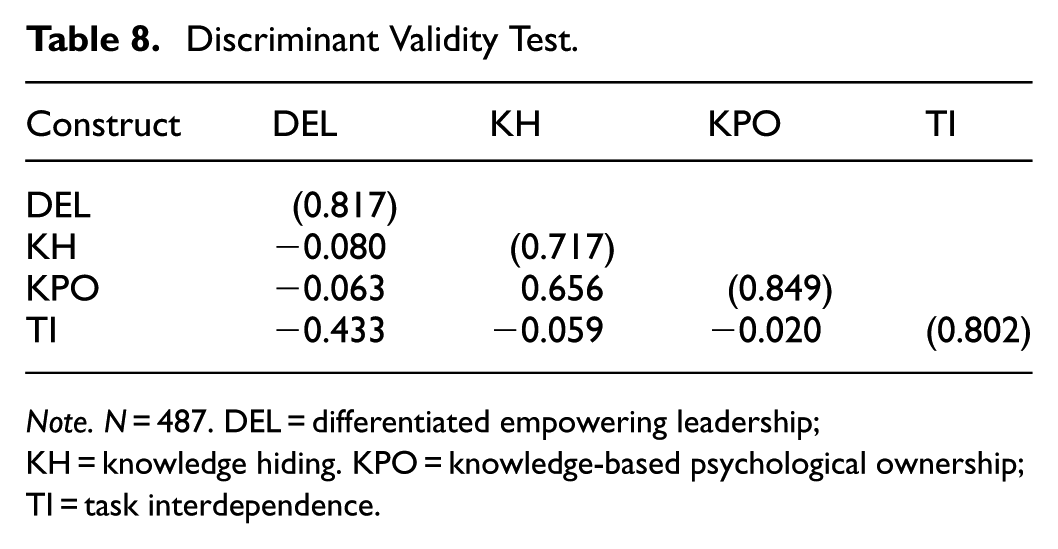
In the comparison of model discriminant validity, the relationship between the correlation coefficient between latent variables and the square root of the AVE of the variables themselves is usually used for judgment. When the correlation coefficient between two variables is lower than the square root of the AVE of these two variables themselves, it indicates that the correlation between variables is smaller than the aggregation of the variables themselves, that is, the model can effectively distinguish variables.
Based on the above principles, summarize the inspection parameters in the following Table 8. The diagonal positions in the table are the square root of AVE, while the rest are the correlation coefficient matrices between variables. According to the data in the table, the correlation coefficients between each variable are not higher than the values of the diagonal positions of the corresponding variables, indicating that the model has good discriminant validity.
Discriminant Validity Test.
Note. N = 487. DEL = differentiated empowering leadership; KH = knowledge hiding. KPO = knowledge-based psychological ownership; TI = task interdependence.
Hypothesis Testing
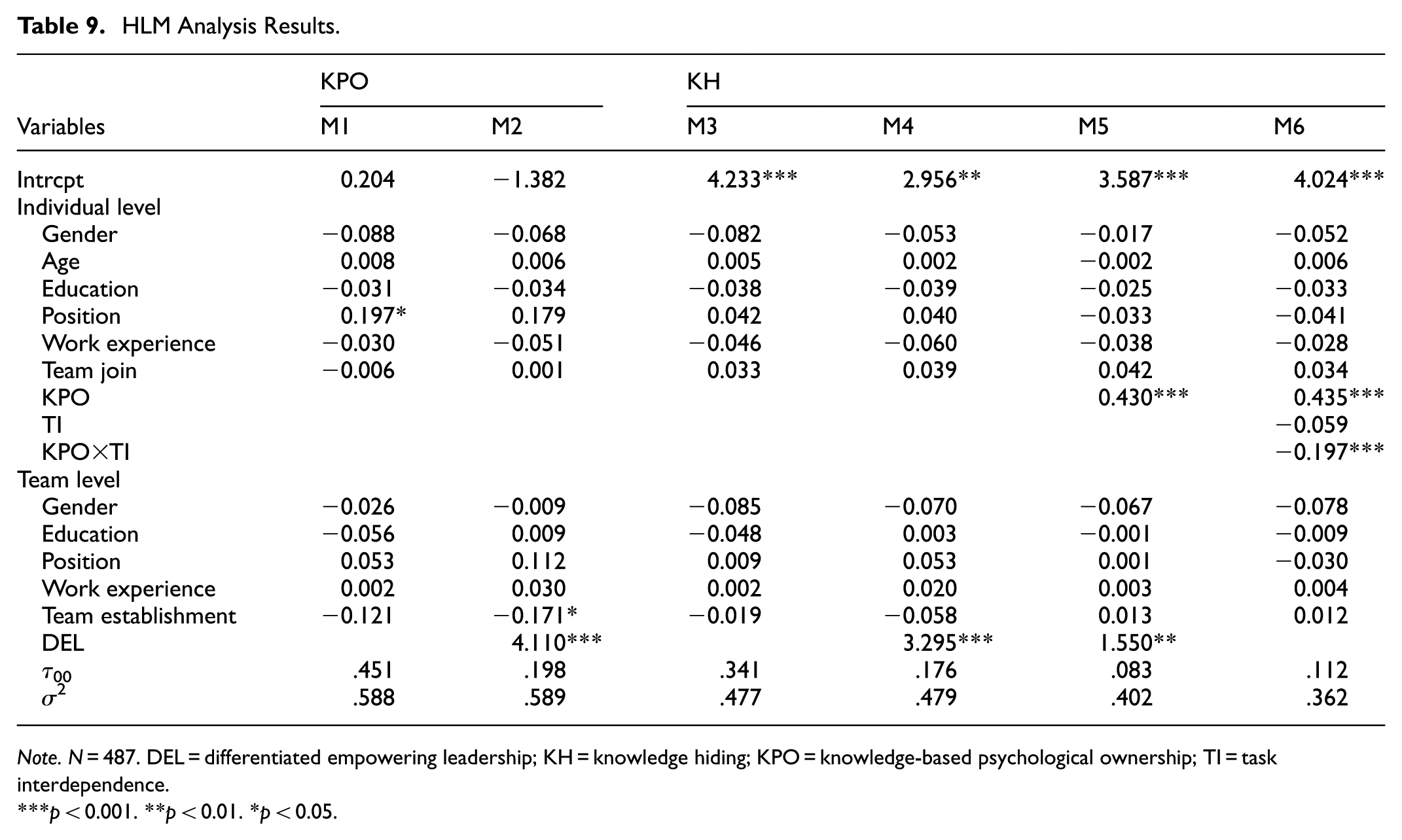
Based on the reliability and validity tests as well as the correlation analysis, we used HLM software to establish a cross-level regression analysis model to infer the hypotheses proposed earlier. The significance test of p < .05 was used as the critical value for hypothesis establishment. The calculation results of each parameter are presented in Table 9.
HLM Analysis Results.
Note. N = 487. DEL = differentiated empowering leadership; KH = knowledge hiding; KPO = knowledge-based psychological ownership; TI = task interdependence.
p < 0.001. **p < 0.01. *p < 0.05.
The calculation results of Model 4 in the table show that, after adding control variables, the group-level independent variable differentiated empowering leadership has a significant positive impact on knowledge hiding, with a regression coefficient γ = 3.295 and p < .001. Therefore, the original Hypothesis 1 is supported.
The calculation results of Model 2 in the table show that the group-level independent variable differentiated empowering leadership has a significant positive impact on the mediating variable knowledge-based psychological ownership, with a regression coefficient γ = 4.110 and p < .001. Therefore, the first half of the mediating relationship path coefficient is supported. In Model 5, the mediating variable knowledge-based psychological ownership has a significant positive impact on knowledge hiding, with a regression coefficient γ = .430 and p < .001. Therefore, the second half of the mediating relationship path coefficient is supported. The model has a significant mediating effect, with the mediating effect size in the model calculated to be 1.766. The bootstrap sampling result shows that the 95% confidence interval [1.257, 2.345] does not contain 0. At this point, the independent variable differentiated empowering leadership still has a significant positive impact on knowledge hiding, with a regression coefficient γ = 1.550 and p < .01. This indicates that the direct path relationship is established, and the mediating model shows a partial mediating effect, thus supporting Hypothesis 2.
The calculation results of Model 6 show that the interaction term of knowledge-based psychological ownership and task interdependence (KPO × TI) has a significant negative impact on knowledge hiding, with a regression coefficient γ = −.197 and p < .001. Therefore, the moderation effect hypothesis Hypothesis 3 is supported. Combined with the simple slope analysis results in Figure 2, it can be seen that as the task dependence score increases, the positive impact strength of knowledge-based psychological ownership on knowledge hiding gradually weakens.

Simple slope analysis of the moderating effect of task interdependence.
As shown in Table 10, further analysis on the size relationship of the mediating effect under different conditions of the moderator variable indicates that when the moderator variable value is relatively low (M − SD), the indirect effect size of the independent variable on the dependent variable through the mediator variable is 2.087, and the 95% confidence interval does not include 0. In contrast, when the moderator variable value is relatively high (M + SD), the indirect effect size of the independent variable on the dependent variable through the mediator variable is 0.471, and the 95% confidence interval includes 0. The difference between the two reaches a significant level.
Moderated Mediation Effect Test.

Note. N = 487.
p < 0.001. **p < 0.01. *p < 0.05.
Therefore, as the moderator variable value increases, the mediating effect size gradually decreases, indicating that the moderated mediation effect test results are valid, thus supporting Hypothesis 4.
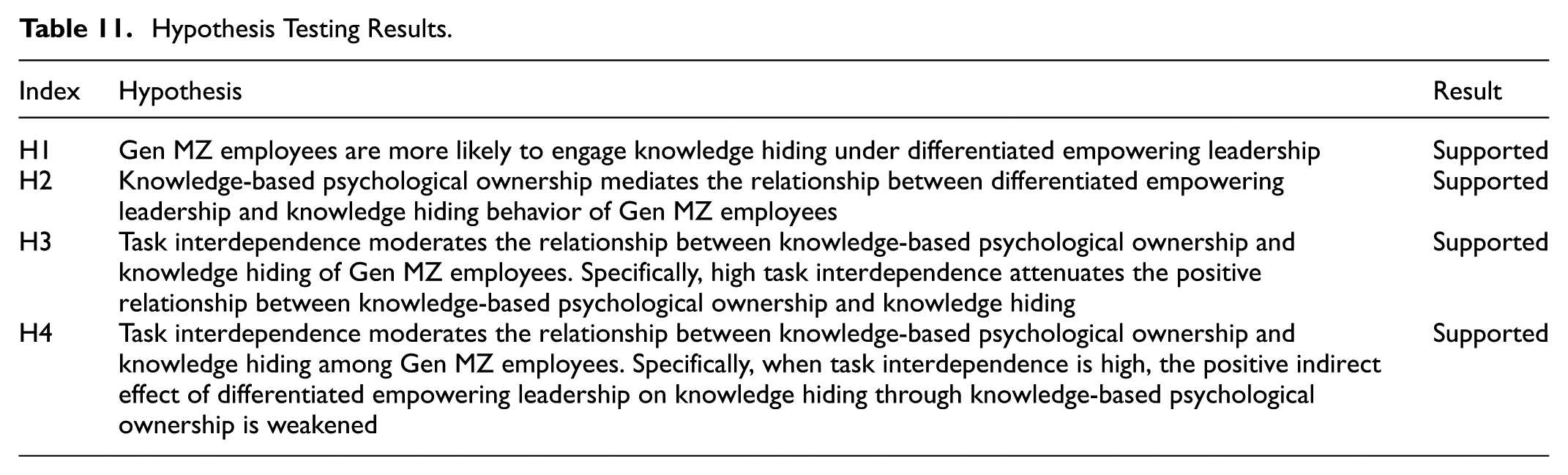
On the basis of descriptive statistics and reliability and validity testing of the data, this study used multi-level linear regression analysis to infer and statistically analyze the null hypothesis. The specific validation results of the hypothesis are shown in Table 11.
Hypothesis Testing Results.
Discussion
Based on the COR theory, the primary objective of this study was to determine whether there exists a connection between differentiated empowering leadership and knowledge hiding behavior among Gen MZ employees, and whether this relationship is influenced by knowledge-based psychological ownership. Additionally, this research sought to examine if the indirect effect is moderated by task interdependence. Our findings affirmed that the proposed links between differentiated empowering leadership and knowledge-based psychological ownership, as well as between knowledge-based psychological ownership and knowledge hiding among Generation Z were significant. Moreover, task interdependence serves to weaken the effect of differentiated empowering leadership on knowledge hiding via knowledge-based psychological ownership. In the following sections, we will elaborate on the theoretical implications of our results and provide practical suggestions for managers.
Theoretical Implications
This study is grounded in the conservation of resources (COR) theory (Hobfoll, 1989; Halbesleben et al., 2014) and incorporates Attribution Theory (Weiner, 1985) as a cognitive processing perspective to examine the relationship between Differentiated Empowering Leadership (DEL) and knowledge hiding behavior. It offers the following theoretical contributions to the fields of leadership behavior and knowledge management:
First, this study deepens the understanding of the relationship between differentiated empowering leadership (DEL) and employees’ knowledge hiding behavior. The results indicate that DEL significantly increases the tendency of Gen MZ employees to engage in knowledge hiding, which is consistent with the findings of Sun et al. (2022) and S. L. Li et al. (2017). Drawing on the conservation of resources (COR) theory, the unequal distribution of empowerment inherent in DEL triggers employees’ perceptions of “resource threat,” thereby activating their motivation for resource preservation and ultimately leading to knowledge hiding behavior (Hobfoll, 1989). Furthermore, this study incorporates Attribution Theory to explain the cognitive mechanism by which employees perceive DEL as a threat. Specifically, Gen MZ employees—due to their stronger individualism, heightened fairness sensitivity, and greater tendency for social comparison—are more likely to attribute the empowerment disparity to subjective favoritism or unfair treatment rather than to performance-based differentiation (Cheong et al., 2019; Han, 2019). Such negative attributions intensify their defensive motivation, which is eventually manifested as resource retention behavior. By introducing this cognitive processing perspective, the study expands upon existing research that primarily interprets the consequences of DEL through emotional or resource-based lenses, and enriches the cognitive theoretical foundation for understanding employee behavioral responses.
Second, this study empirically validates the mediating role of knowledge-based psychological ownership (KPO) in the relationship between DEL and knowledge hiding. While previous research has highlighted the positive effects of KPO—such as enhancing responsibility and work engagement (Han et al., 2010; Lee & Suh, 2015)—this study finds that under conditions of resource threat and negative attribution, KPO may trigger possessiveness and exclusivity (Peng, 2013). This, in turn, motivates employees to hide knowledge in order to maintain psychological control and ownership. This finding echoes the ongoing academic discourse on the “double-edged sword” nature of KPO and further demonstrates its situationally contingent influence on employee behavior (Khan et al., 2023).
Third, the study identifies and confirms the moderating role of task interdependence in the relationship between KPO and knowledge hiding. Results indicate that high task interdependence—by increasing collaborative demands and collective goal orientation—can alleviate employees’ anxiety about losing exclusive knowledge, thereby weakening the positive link between KPO and knowledge hiding. This aligns with Hoffmann et al. (2018), who found that collaborative structures reduce individualistic competition, and it supports COR theory’s assertion that contextual resources can buffer the effects of resource threats.
Fourth, through the empirical validation of a moderated mediation model, this study extends the application boundary of COR theory within multi-level organizational structures. Specifically, the findings show that under conditions of high task interdependence, the indirect effect of DEL on knowledge hiding via KPO is significantly weakened. This indicates that resource gains derived from cooperative task structures can effectively counteract the resource anxiety and negative attributions elicited by DEL, thereby reducing employees’ defensive resource behaviors (Halbesleben et al., 2014).
In sum, this study reveals how DEL influences Gen MZ employees’ knowledge hiding behavior through the lens of resource protection, while also introducing attribution theory to enrich the cognitive explanatory pathway. By doing so, it offers a psychological foundation for understanding how employees perceive and interpret differentiated empowerment. Furthermore, the study emphasizes the buffering function of contextual resources (i.e., task interdependence), demonstrating the theoretical robustness and practical relevance of a multi-theoretical integration approach in organizational behavior research.
Managerial Implications
From a practical standpoint, this research highlights crucial insights for both organizations and their managers: Firstly, managers must acknowledge that differentiated empowering leadership can result in a range of outcomes, including deviant behaviors, employee turnover, and an increase in knowledge withholding. Consequently, managers should understand the context and causal relationship when they notice a rise in knowledge hiding which could potentially lead to enhancements of performance. Additionally, they should be cautious of the consequences associated with differentiated empowering leadership and steer clear of such behaviors.
Secondly, since managers are often viewed as representatives of the organization (Koivisto et al., 2013; Levinson, 2009), the adverse effects of differentiated empowering leadership on knowledge hiding can result in considerable performance decline of the organization. Employees may blame the managers for inadequate supervision. Therefore, organizations ought to integrate considerations of differentiated empowering leadership with other organizational issues such as ethics, staff training, and disciplinary measures to prevent employees from being self-defensive and selfish. In addition to offering options for employees to resolve organizational problems in a constructive manner rather than resorting to defensive reactions, organizations should foster an atmosphere that encourages productive actions.
Thirdly, to mitigate the harmful impacts of differentiated empowering leadership, organizations should implement strict ethical standard during the recruitment process to select candidates who are less inclined to exhibit counter-productive behaviors. The research further indicates that individuals with propensities as team player are less prone to conceal knowledge, even in unjust environments, as they understand the significance of collective achievement. Therefore, prioritizing candidates who exhibit collaborative traits during hiring test could prove advantageous.
Fourthly, even under differentiated empowering leadership, employees’ counterproductive behaviors led by knowledge-based psychological ownership and knowledge concealment can be substantially alleviated if they perceive the organization as fundamentally fair. Thus, organizations should work toward improving employees’ perceptions of overall equity. In addition to systematic preventive strategies related to differentiated empowering leadership, initiatives to intensify the organization’s commitment to fairness through various means by top managers can be beneficial. C organizational intent can instill hope for positive change, even under differentiated empowering leadership.
Lastly, Gen MZ employees prioritize the importance of transparent and equitable management practices and take proactive steps to ensure that their contributions are adequately acknowledged. To reconcile individualistic tendencies with the collaborative nature of contemporary work, a balanced job design is vital. This entails creating clear job descriptions that delineate specific duties, facilitating personal accountability and acknowledgment. Aligning individual performance targets with team goals fosters ownership and a sense of purpose. Projects should integrate individual milestones with team collaboration, making personal contributions evident and appreciated. Performance metrics should equitably reflect both individual and team achievements through dual evaluations and peer evaluations. Recognition and reward systems that praise both individual excellence and team accomplishments can further inspire employees. This strategy respects the individualistic propensity of Gen MZ while it recognizes the interconnected aspects of modern work, accommodates varied motivations, and enhances overall team productivity.
Limitations and Suggestions for Future Research
Firstly, there is a need to address the issue of causality in knowledge hiding related to cross-sectional studies. For instance, it is unclear whether differentiated empowering leadership by supervisors leads to an increase in knowledge-based psychological ownership, or if supervisors are more likely to engage in differentiated treatment toward those with high knowledge-based psychological ownership. Similarly, other causal relationship issues between variables, such as the impact of subordinates’ knowledge hiding on supervisors’ differentiated empowering leadership, remain open. Although this study emphasizes the mediating effect of knowledge-based psychological ownership, a longitudinal design with time-lagged intervals in future research could provide clearer insights into causal relationships.
Secondly, the sample in this study was primarily drawn from knowledge-intensive enterprises located in South China, using a non-probability sampling method that combined convenience and purposive sampling. The target respondents were members of the MZ generation. While the sample offers strong ecological validity and practical representativeness, its regional, industrial, and generational characteristics may limit the generalizability of the findings. Therefore, we have explicitly acknowledged the cultural and organizational boundary conditions of this study in the discussion section. The conclusions are primarily applicable to managerial contexts involving specific regions, organizational types, and generational cohorts within China. Future research is encouraged to include more diverse samples across cultures and industries, or adopt probability sampling methods to enhance the robustness and generalizability of the model. Such efforts would deepen our understanding of the mechanisms through which differentiated empowering leadership (DEL) functions and expand the applicability of the findings across various organizational and cultural settings.
In addition, we fully recognize that cultural context—especially collectivist values—may play a critical role in shaping how employees interpret empowerment, fairness, and psychological ownership, as well as how they respond behaviorally. Chinese culture emphasizes relational orientation, hierarchical norms, and organizational loyalty, all of which may influence how employees perceive differentiated empowerment and justify knowledge hiding behavior. Therefore, the findings of this study should be understood as contextually embedded, rather than universally generalizable across all cultural settings. Future studies could incorporate cultural value variables (e.g., collectivism, power distance) as moderators, or adopt multi-country samples for cross-cultural comparison. Such directions would help further validate the mechanisms of differentiated empowering leadership and enhance the international relevance and theoretical extensibility of the present findings.
Lastly, future research could investigate which employees benefit from differentiated empowering leadership and confirm the resilience in response to the moderating effect of task interdependence perception. While low task interdependence perception leads to a significant increase in knowledge hiding through psychological ownership under differentiated empowering leadership, those with high Task Interdependence perception are hardly affected. Conversely, it is possible that employees who benefit positively under differentiated empowering leadership might react more resiliently if they already possess sufficient resources due to high task interdependence perception. This aligns with the conservation of resources (COR) theory, which explains that resource acquisition gains importance in resource loss situations.
Conclusions
This study, grounded in conservation of resources (COR) theory, constructs a cross-level model to examine how differentiated empowering leadership (DEL) influences knowledge hiding (KH) among Generation MZ employees through knowledge-based psychological ownership (KPO), and further investigates the moderating role of task interdependence (TI) in this process. The results indicate that DEL significantly reinforces employees’ sense of possession and defensive motivation toward knowledge resources, leading to a heightened tendency for KPO and the adoption of knowledge hiding as a coping strategy. Meanwhile, task interdependence exhibits a significant moderating effect: when employees perceive a high level of task collaboration, the positive impact of KPO on knowledge hiding is significantly weakened, suggesting that collaborative work structures help mitigate resource anxiety and behavioral withdrawal caused by unequal empowerment.
In sum, this study reveals the underlying mechanism through which DEL affects employees’ knowledge-related behaviors and highlights how KPO, under resource-threat conditions, may trigger defensive responses that inhibit knowledge flow within organizations. The findings also emphasize the critical role of contextual resources—particularly in highly interdependent teams, where shared goals and collaborative mechanisms can effectively buffer the negative effects of DEL. These insights contribute theoretical support for understanding the behavioral logic of Generation MZ employees characterized by heightened sensitivity and provide empirical guidance for organizations to optimize leadership styles and work design to promote knowledge sharing and team collaboration.
Footnotes

Ethical Considerations
This study was conducted in accordance with the Declaration of Helsinki. Ethical review and approval were waived for this study according to Article 34 of the Gachon University Institutional Review Board Standard Operating Guidelines. The entire research process adhered to ethical standards for human participant studies, ensuring data confidentiality, anonymity, and compliance with institutional and journal ethical codes. The survey only collected employees' and supervisors' subjective perceptions and behavioral intentions, without involving any physical or psychological intervention, thus posing minimal risk. All responses were anonymous, and only the research team had access to the data, minimizing the possibility of information leakage.
Consent to Participate
Prior to survey distribution, participants were fully informed about the study's purpose, procedures, and their rights as participants. They were assured that their participation was entirely voluntary and that they could withdraw from the study at any time without penalty or negative consequences. Completion and submission of the questionnaire were considered to indicate informed consent.
Funding
The authors disclosed receipt of the following financial support for the research, authorship, and/or publication of this article: This research is supported by the Gachon University research fund of 2023 (Grant number: GCU-202304970001).
Declaration of Conflicting Interests
The authors declared no potential conflicts of interest with respect to the research, authorship, and/or publication of this article.
Data Availability Statement
The data that support the findings of this study are available from the corresponding author upon reasonable request.