




Abstract
This study investigates how Syrian refugee students in Jordan employ figurative language including metaphors, similes, and imagery with metaphorical function to construct and negotiate their identities amidst displacement. While much existing research examines how refugees are portrayed by external actors, such as media or policymakers, little is known about how refugees themselves use such figurative resources to shape their own self-representations. Guided by the research question, ‘How do Syrian refugee students construct their discursive identities through figurative language?’, the study employs discourse analysis in its broadest sense, or what we term ‘Broad Discourse Analysis’ (BDA), as its analytical lens, viewing language as a socially embedded practice that shapes and reflects reality. Drawing on data from 111 undergraduate English Language and Literature students, the research explores figurative expressions as dynamic tools for meaning-making and resilience. The findings reveal four interrelated themes: Aspiring, Resilient, Intrinsic, and Constrained Identities. Figurative references, such as ‘stars’, ‘mountains’, ‘birds’ and ‘lantern fish’, discursively articulate participants’ aspirations, relational care and resistance to victimising narratives. By centring refugees’ own voices, the study challenges reductive portrayals, advances theoretical frameworks in discourse studies and refugee linguistics, and provides practical insights for education and policy to promote empowerment, agency, and integration.
Plain Language Summary
This study explores how Syrian refugee students in Jordan use creative language, such as metaphors, similes, and other figures of speech to describe themselves and their experiences. Instead of focusing on how others talk about refugees, the research centres on the students own words. Drawing on responses from 111 students, the study looks closely at four examples in detail, showing how figurative language helps them express resilience, hope, and strength, even in the face of hardship. The findings show that this type of language is not just decorative, it is a way for refugees to shape their identities, challenge stereotypes, and share their personal and cultural stories. The results suggest that education and policy should create more space for refugees to tell their stories in their own words, which can help promote dignity, agency, and inclusion.
Keywords
Introduction
The role of figurative language in identity construction has garnered increasing attention across disciplines, particularly in the context of migration and displacement. Language, especially metaphor, alongside related devices such as simile and imagery, offers a powerful means for individuals to negotiate complex identities, bridging personal experiences with broader sociocultural discourses (Tannen, 2007; Van Dijk, 1997). In the case of refugees, figurative language serves as a resource for self-expression and a mechanism for resisting reductive narratives that often dominate discussions about displacement. Recent studies highlight how metaphors, in particular, allow individuals to articulate resilience and agency, even in adverse circumstances, by reframing their realities in terms of growth and strength (e.g. Kranstuber & Leverenz, 2024; McKenzie et al., 2024; Meryan et al., 2025; R. A. Rashid et al., 2025b).
Despite this potential, much of the existing literature focuses on external representations of refugees, that is, how they are framed in media or policy discourses, rather than examining how refugees themselves use language to construct their identities. This oversight perpetuates portrayals of refugees as passive subjects of external narratives, overlooking their capacity for agency in shaping their self-representations. Furthermore, studies that engage with refugees’ language and identity often limit their scope to metaphors ascribed by others to represent the refugees (e.g. Porto, 2022; Yağan, 2020) or to discussions of language learning opportunities and barriers (e.g. Fakhouri & Lah, 2024; Svensson, 2024), neglecting the nuanced and creative ways refugees use figurative language to navigate their lived realities.
This study addresses these gaps by exploring how Syrian refugee students in Jordan employ figurative language, with an emphasis on metaphor, to construct their identities as displaced individuals. It contributes to a deeper understanding of how language functions as a tool for meaning-making, resilience and identity negotiation in displacement contexts. To guide this inquiry, the study poses the following research question:
How do Syrian refugee students construct their discursive identities through figurative language?
Literature Review
Education Provision for Syrian Refugee Students in Jordan
This section provides an overview of the education provision for Syrian refugee students in Jordan, highlighting the systemic efforts and barriers that shape their educational experiences. It situates the study within the broader socio-educational context, linking policy frameworks to the discursive construction of identity.
The Syrian refugee crisis started in March 2011, when Syrian authorities reacted violently to anti-government demonstrations, resulting in the onset of pervasive civil conflict throughout the country. Jordan has experienced a substantial influx of Syrian refugees due to the civil war in Syria. Approximately 1.3 million Syrians reside in Jordan (Karasapan, 2022), of which 611,473 are recognised as refugees (UNHCR, 2024). Most Syrians who have been registered as refugees reside outside of official camps in the northern and central regions of the country, while the remaining Syrians reside in one of the three official UNHCR camps (UNHCR, 2024).
Because of the significant influx of Syrian refugees in Jordan (Ministry of Planning and International Cooperation, 2017; UNHCR, 2017), over 100,000 students have been enrolled in public schools in neighbouring cities or in specially established schools for Syrian refugees in refugee camps (Culbertson & Constant, 2015). As of the 2022 to 2023 school year, 72.2% of 161,000 Syrians in Jordan attended a double-shifted school (UNHCR, 2024). Jordan, particularly the Ministry of Education, has made significant efforts to ensure that Syrian refugee students receive high-quality education. Akram et al. (2015) asserted that recruiting new educators is a vital initiative in Jordan designed to assist Syrian refugees facing educational challenges. Furthermore, the national educational system permits refugees to utilise educational services comparable to those offered to residents at no cost. The Jordanian Ministry of Education has partnered with many organisations (e.g. UNICEF) to guarantee the right to education for Syrian refugee children and to implement projects that meet their educational needs, thereby enhancing their enrolment and attendance at school. Similarly, Hawari (2020) pointed out that to motivate Syrian refugee students in Jordan to persist in their studies, they have been permitted to participate in distance education programmes facilitated by the Ministry of Education in collaboration with its educational partners.
Despite the significant efforts made by Jordan to promote education for Syrian refugee students, barriers continue to impede the education process. R. A. Rashid et al. (2025c) and Van Esveld and Martínez (2016) asserted that most educators teaching students in the afternoon shift lack specialised training. A double-shift system (morning and afternoon) was created to meet the increased need for school spaces. This might have been put in place as a temporary measure to include Syrian refugees in the national framework (Dryden-Peterson et al., 2017), making it easier for them to enter the formal education system and follow the Jordanian curriculum. According to Rossum et al. (2017), the primary challenges hindering Syrian refugee students in Jordan from attending education are the exorbitant cost of transportation, inadequate quality of teaching and learning environments, child labour participation and violence within schools.
Because of poverty and insufficient resources, two-thirds of refugees cannot access secondary education, and hardly 3% can enrol in university programmes despite the Jordanian government’s significant efforts (Khater, 2023). To facilitate Syrian refugee students’ access to higher education at Jordanian universities, Jordan’s educational authorities have made significant efforts to establish partnerships with donor countries to offer various scholarships that cover university expenses for numerous Syrian refugee students across diverse academic disciplines.
Figurative Language and Discursivity
Figurative language, encompassing metaphors, similes and imagery with metaphorical function, is central to the study of discursivity, functioning as a set of linguistic tools through which language constructs realities, negotiates identities and articulates social frameworks. Far from being mere rhetorical flourishes, figurative expressions are embedded in discourse as dynamic instruments of meaning-making, bridging personal experiences with broader socio-cultural contexts.
Theoretically, figurative language operates within the premise that language actively shapes reality rather than merely describing it. Cornelissen (2006) highlights the interpretative fluidity of metaphors, noting how their meanings shift across cultural and contextual boundaries. This adaptability applies equally to other figurative forms, making them especially significant in contexts of identity negotiation, where they enable individuals to reframe their circumstances and articulate nuanced self-representations.
Figurative language also serves a dual role in discourse: it enables individuality while fostering collective identity. Bamberg et al. (2011) emphasise the capacity of metaphors to navigate tensions between self and other, agency and structure and continuity and change, an insight that extends to similes and other figurative comparisons. Similarly, Moje and Luke (2009) argue that figurative framing intertwines literacy practices with identity formation, making these devices key tools for expressing and reshaping lived experiences. Filardo-Llamas and Roldán-García (2024) further expand on this by showing how metaphorical language challenges binary conceptions of identity, allowing for more fluid and inclusive representations.
Another critical function of figurative language lies in its capacity to resist reductive narratives. Walter and Helmig (2008) argue that metaphors do not merely reflect pre-existing realities but actively construct them, offering new perspectives and frameworks. This aligns with Peterssen and Soares da Silva’s (2024) work, which shows how metaphors in polarised political discourse construct ideological divides. Beyond these external frameworks, figurative expressions also function internally, allowing individuals to reframe adversity as resilience or transformation.
The socio-cultural grounding of figurative language further highlights its discursive power. Kulubekova et al. (2024) emphasise how cultural and historical forces shape the construction and reception of metaphors, highlighting their responsiveness to specific socio-political contexts. Cornelissen (2006) similarly argues for the importance of context in interpreting metaphor, suggesting that its meaning is contingent upon shared social and cultural frameworks. This contextual grounding applies to other figurative forms as well, allowing them to resonate deeply within specific communities while also enabling broader interpretative flexibility.
For the purposes of this study, ‘figurative language’ is understood in a broad, discourse-analytic sense to include metaphors, similes, and imagery that function metaphorically in participants’ narratives. Within this expanded category, metaphor remains the primary focus, given its centrality to identity work and discursive framing. This approach follows Cornelissen (2006) in recognising that metaphors in discourse may blend literal and figurative dimensions to construct meaning, while also acknowledging that other figurative forms can contribute significantly to the same processes.
Recent Studies on Figurative Language in Refugee Context
Existing scholarship on the use of figurative language in representing refugees predominantly focuses on metaphors ascribed to refugees by external agents such as media, policymakers, and educators. These studies provide valuable insights into how metaphors shape public perceptions, influence policy discourse, and construct collective attitudes toward refugees. However, this body of work tends to overlook how refugees themselves employ metaphors to construct and articulate their identities and lived experiences, leaving a critical gap in understanding the agency of refugees in their own discursive representations.
A recurrent theme in the literature is the use of water-related metaphors to describe refugee movements. Porto (2022) examines the prevalence of metaphors like ‘flow’ and ‘wave’ in Spanish press coverage of Syrian migration, revealing their dual function as descriptive and evaluative tools. The study finds that while such metaphors appear ideologically neutral, they often reinforce negative perceptions by embedding notions of uncontrollability and threat within the discourse. Similarly, Mujagić (2018) identifies the metaphor of ‘dangerous waters’ in news coverage from the UK, USA and Bosnia-Herzegovina, arguing that these metaphors rhetorically position migration as perilous, reinforcing exclusionary ideologies.
Other studies extend the analysis to metaphors used in host country contexts. Zibin (2020) analyses Jordanian politico-economic discourse and finds that metaphors in this context reflect a deep-seated tension between traditional hospitality and economic strain. For example, refugees are metaphorically framed as burdens or disruptions, revealing underlying socio-political struggles. This aligns with Abid et al. (2017), who compare metaphors in host and non-host countries’ online media. They note significant differences in how metaphors frame the ‘entry’ of refugees and the ‘burdens’ they impose, with host countries employing more overtly negative imagery.
In educational contexts, Yağan (2020) explores metaphors produced by Turkish school principals about war, asylum seekers, and Syrians. While some metaphors reflect pity and empathy, many reveal negative attitudes, particularly toward Syrians, illustrating the influence of institutional and societal biases on metaphor production.
While these studies contribute significantly to understanding the external discursive construction of refugees, they do not account for the voices of refugees themselves. By focusing on metaphors ascribed to refugees by external actors, the literature perpetuates a view of refugees as passive subjects of discourse rather than active participants in their narrative construction. This neglects the critical role of figurative language as a resource for refugees to assert agency, resilience, and identity amidst displacement. The present study addresses this gap by shifting the focus to how Syrian refugees use figurative language to represent themselves. This novel perspective contributes to the field by foregrounding the voices of refugees, challenging reductive representations, and offering deeper insights into how language functions as a tool for agency and meaning-making in contexts of displacement.
Identity, Identity Types and Models
Identity is a multifaceted and dynamic construct shaped by individual experiences, social interactions and broader cultural and political contexts. In discourse studies, identity is understood not as a fixed attribute but as an ongoing process of negotiation and performance (Bucholtz & Hall, 2005; Güven & Aldemir, 2025; Ooi & Othman, 2025). This perspective aligns with the focus of the present study, which examines how Syrian refugee students use figurative language to construct and negotiate their identities amidst displacement.
Bamberg et al. (2011) emphasise that identity is co-constructed through discourse, as individuals position themselves in relation to others and to larger sociocultural frameworks. This discursive approach highlights the role of language in mediating tensions between agency and structure, self and other, and continuity and change. Tannen (2007) further underscores how narrative discourse functions as a key site for identity construction, allowing individuals to weave personal experiences into socially recognisable stories.
Among the various models proposed to conceptualise identity in discourse, this study draws primarily on Bucholtz and Hall’s (2005) sociocultural linguistic approach, which views identity as the emergent product of linguistic interaction, grounded in five principles: emergence, positionality, indexicality, relationality and partialness. This framework accommodates both micro-level interactional choices and macro-level socio-political contexts. Other relevant perspectives, such as Davies and Harré’s (1990) Positioning Theory and De Fina and Georgakopoulou’s (2008) emphasis on small stories, inform specific aspects of the analysis, particularly in identifying how participants position themselves in relation to others and how identity shifts across contexts.
Scholars have also distinguished between different types of identity relevant to discourse analysis. Personal identity refers to self-understandings shaped by individual experiences and internalised values, while social identity reflects group memberships and shared characteristics within a community (Hall, 1996). Relational identity emerges through interactions and relationships with others (Tannen, 2007), and situated identity is tied to specific roles or contexts (Davies & Harré, 1990). These identity types often intersect and overlap, particularly in contexts of displacement, where individuals may negotiate multiple, sometimes conflicting, identity positions.
In the context of refugee experiences, identity work often involves balancing continuity with one’s pre-displacement self and adaptation to new sociocultural environments. Moje and Luke (2009) note that identity is closely tied to literacy practices, with language serving both as a marker of belonging and as a tool for reimagining one’s place in the world. For Syrian refugee students, figurative language offers a means of articulating complex identities that integrate personal histories, cultural heritage, aspirations and responses to socio-political constraints.
Identity Work as a Discursive Construct
Within sociolinguistics and discourse studies, identity work refers to the ongoing, situated processes through which individuals construct, negotiate, and sustain a sense of self in response to shifting social, cultural and institutional contexts (Brown, 2022; R. A. Rashid et al., 2016). Unlike static conceptions of identity, identity work highlights the performative and agentive dimensions of selfhood, emphasising how people engage symbolically and discursively to align internal self-conceptions with external expectations. It is not merely about ‘who’ someone is, but ‘how’ they enact and manage that identity across time, settings, and relationships. Identity work is particularly salient in contexts of disruption, such as forced migration, where individuals must navigate fractured life trajectories, imposed labels (e.g. ‘refugee’) and unfamiliar social structures (R. A. Rashid & Mohamad, 2019; R. A. Rashid et al., 2025b).
This conceptual lens is crucial for understanding refugee experiences, where identity is not only threatened by displacement but also actively reconstructed in response to it. Displaced individuals often face competing demands: preserving continuity with their past while adapting to the present and imagining a different future. Within this liminal space, language (particularly figurative language) emerges as a vital tool for identity work. Symbolic resources, such as metaphor, simile and imagery, offer more than stylistic embellishment; they provide a discursive space for expressing tension, resilience, transformation and agency (Atta, 2021; Granhenat & Abdullah, 2017; Tun & Khairuddin, 2024). As such, figurative language is deeply functional in identity negotiation: it enables participants to challenge externally imposed narratives, reframe adversity, and position themselves agentively within social discourse.
In the present study, identity work is conceptualised as a process that is both discursive and symbolic. Figurative expressions used by participants (e.g. metaphors of light, war, flight and confinement) are interpreted not only as narrative elements but as acts of self-positioning within broader sociocultural and ideological frameworks. This aligns with Bucholtz and Hall’s (2005) sociocultural linguistic model, particularly the principles of positionality, indexicality, and partialness, which view identity as emergent through interaction and contextually embedded. In adopting this view, we recognise that even brief figurative statements, such as ‘I am a prisoner’, ‘I am a lanternfish’ or ‘I shine like a star’, operate as compressed but potent discursive moves through which identity work is performed.
Moreover, figurative identity work allows speakers to reclaim authorship of their narratives. It enables Syrian refugee students to resist pathologising or victimising portrayals that often circulate in policy and media discourse. Instead, their use of metaphor serves as a form of symbolic resistance; redefining hardship in terms of growth, reframing marginalisation as resilience, and asserting dignity in spaces of precarity (Al-Ramahi & Rashid, 2024; Ibnu, 2022; Nordin et al., 2020). This interpretive stance is central to our analytical framework, Broad Discourse Analysis, which treats language as socially embedded and identity as interactionally constructed. Through this lens, identity work is not a peripheral concern but the central mechanism through which participants construct meaning, assert belonging and envision transformation.
Theoretical Framework: Broad Discourse Analysis
Discourse analysis in its broadest sense, or what we term Broad Discourse Analysis (BDA), is the theoretical lens for this study. Grounded in the work of several scholars, including but not limited to Billig and MacMillan (2005), Schiffrin (1996), Tannen (2007), and Van Dijk (1997) BDA conceptualises language as a socially embedded practice that both reflects and reshapes reality. As a theoretical framework, BDA offers a way of explaining how meaning is produced, negotiated, and contested in discourse, and how these processes are intimately tied to the construction of social identities. It is not simply an analytical method but a perspective on how language functions as a form of social action and identity work.
BDA is particularly relevant to identity studies because it positions discourse as a site where the self is actively constructed through interaction with others and with broader socio-political discourses. Van Dijk’s (1997) emphasis on the role of context underscores how linguistic choices, whether in extended narratives or in single, vivid metaphors, are shaped by social structures, power relations, and cultural histories such as displacement and marginalisation. Within this framework, even a short sentence containing a metaphor is treated as a narrative fragment– a condensed representation of selfhood that indexes personal histories, emotional states and social positioning.
Tannen’s (2007) work on narrative discourse further informs this perspective by showing how personal stories, however brief, serve as tools for identity construction. In this study, figurative expressions such as ‘I am a warrior’ or ‘I shine like a star’ are not seen as isolated tropes but as identity claims that connect the speaker’s lived experience to larger cultural narratives of resilience, hope, or struggle. Billig and MacMillan’s (2005) argument that everyday language is ideologically loaded reinforces this point: figurative language is a resource for negotiating one’s place within contested social realities, and thus becomes a powerful means of resisting reductive or victimising portrayals.
BDA’s integrative nature, that is, drawing from sociocultural discourse analysis, narrative analysis, and critical traditions, makes it particularly well-suited to analysing figurative language in refugee narratives. By moving fluidly between the micro-level (lexical and metaphorical choices) and the macro-level (discourses of migration, displacement, and identity politics), it captures how individual expressions are simultaneously personal and political. Schiffrin’s (1996) emphasis on the interplay between language, meaning and social structures aligns with this multilevel approach, ensuring that the analysis remains sensitive both to the immediate interactional meaning and to the broader socio-political frames in which these meanings circulate.
The deliberate use of the term Broad Discourse Analysis in this study signals a conscious choice to avoid confinement to a single analytical tradition, such as Critical Discourse Analysis (CDA), while still benefiting from its critical orientation. Instead, BDA here encompasses multiple strands of discourse analysis, enabling an interpretation of figurative language as a window into identity negotiation, even when the data take the form of short, potent metaphors rather than extended stories. This adaptability allows the framework to theorise identity not only as an ongoing narrative but also as something that can be crystallised in highly compressed, metaphorically rich expressions.
Methodology
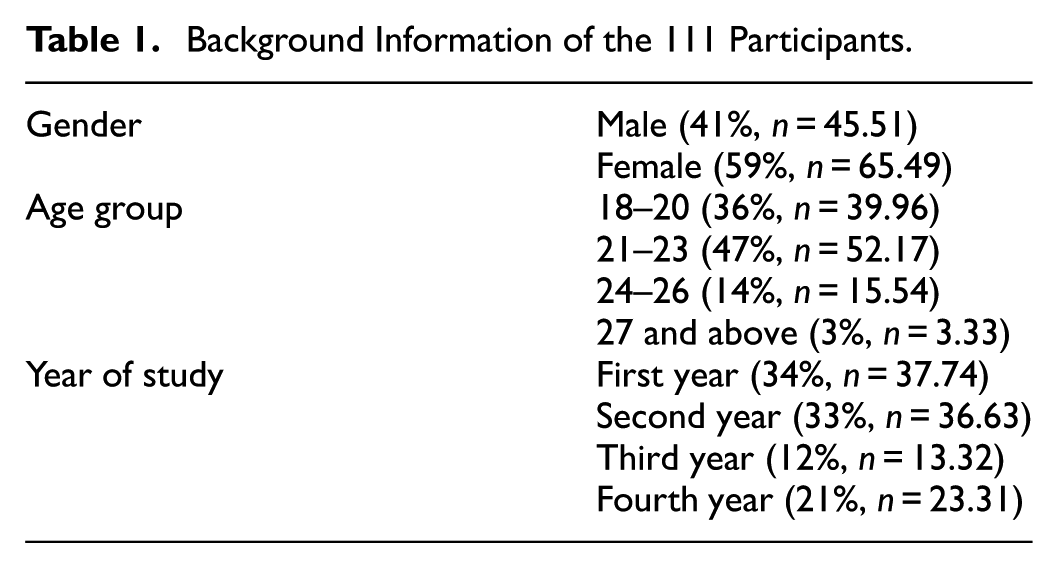
Informed by qualitative research principles, the study centred on participant voice and interpretive language analysis. It involved 111 Syrian refugee students, all are UNCHR-registered, pursuing a Bachelor’s degree in English Language and Literature at a university in Jordan. This population was purposefully chosen for their linguistic awareness and ability to engage deeply with figurative expressions, offering valuable insights into how language facilitates meaning-making and identity negotiation in displacement contexts. Background information, including gender distribution and year of study, is summarised in Table 1 for additional context.
Background Information of the 111 Participants.
Participants were asked to choose a figurative expression representing their identity as refugee students and provide a written explanation of its relevance to their experiences. The open-ended task was designed to encourage thoughtful and unconstrained responses. Participation was voluntary, and students were assured the task would not affect their grades. They were informed there were no right or wrong answers, fostering a judgement-free environment. A week was allotted for completion, and all 111 students participated, achieving a 100% response rate.
While follow-up interviews could have provided further elaboration on the meanings participants attached to their figurative expressions, this study was conducted within a pedagogical context and under institutional ethical guidelines that did not permit additional data collection beyond the classroom-based activity. The written self-reflections were produced as part of a scheduled class task, ensuring that all participants engaged equally and without pressure to disclose more than they felt comfortable sharing. In line with broad discourse analysis (BDA), these metaphorically rich statements were treated as narrative fragments that encapsulate identity work, even in their brevity. As Tannen (2007) and Van Dijk (1997) note, identity construction can be discerned from both extended narratives and condensed symbolic expressions. Thus, rather than seeking elaboration through direct questioning, the analysis interpreted the metaphors and other figurative expressions in relation to their discursive, cultural, and socio-political contexts, allowing for a rich exploration of identity without imposing additional demands on participants.
Ethical considerations were prioritised throughout the study. Participants received detailed information about the research’s purpose and scope, with informed consent obtained to ensure voluntary participation and confidentiality. Anonymity was maintained, and identifying details were removed before analysis. Ethical clearance was obtained from the Ethics Committee of the third author’s institution (Approval Number 1/3/2025).
Thematic analysis with a discursive focus was employed to examine how language constructs and negotiates identity. The analysis followed a multi-step process grounded in broad discourse analysis (BDA), enabling the interpretation of figurative expressions as identity work even in the absence of extended narratives. First, each participant’s written statement was examined for instances of figurative language, with an emphasis on metaphors and other symbolic expressions. Second, these figurative expressions were treated as narrative fragments (De Fina & Georgakopoulou, 2008), where even a single metaphor encapsulates positioning, stance and identity claims. Third, each fragment was analysed at the micro-level for its linguistic and semantic features (e.g. metaphor source domain, target domain, evaluative stance) and at the macro-level for its relation to broader socio-cultural discourses, following Van Dijk’s (1997) emphasis on context. Fourth, identity dimensions were theorised by considering how the figurative expression framed the self in relation to themes such as aspiration, resilience, or constraint, drawing on Tannen’s (2007) work on relational and narrative positioning and Billig and MacMillan’s (2005) insights into ideological language use. Finally, these micro- and macro-level interpretations were synthesised to link the figurative expression to one of the four overarching discursive identity dimensions identified in the study. This layered approach ensured that each metaphor was interpreted not as an isolated image, but as a discursive act situated within personal, cultural, and political contexts.
While the analysis included all 111 narratives, only 4 representative narratives are presented in the Findings section. This is due to word limits and the typical fine-grained nature of discourse analysis, which often requires close, detailed examination of selected excerpts. For ease of reference during analysis and discussion, the lines of each narrative have been numbered. This approach facilitates precise citation of specific phrases or images within the narratives while preserving the flow of the original student voice.
These narratives are introduced as Student 1, Student 2, Student 3, and Student 4, rather than using the label ‘Extract’, to foreground the participant as an active narrator rather than a passive source. The selection was based on thematic representativeness (each narrative exemplifies one of the four identified identity dimensions), narrative richness (figurative expressions and explanations that were particularly detailed and insightful), and diversity of perspectives (variation in gender, year of study, and figurative expression choice).
Findings
Four interrelated themes emerged: Aspiring Identity, Resilient Identity, Intrinsic Identity, and Constrained Identity. In total, of the 111 students who participated, all of them reflected Aspiring and Resilient identities, 85 reflected Intrinsic Identity and 97 reflected Constrained Identity. The four identities identified in this study were not mutually exclusive; several participants contributed data that related to more than one identity, reflecting the multifaceted nature of their experiences. This thematic overlap underscores the complexity of identity construction in the language learning context.
Far from mere linguistic devices, the figurative expressions embedded in these narratives discursively shape participants’ experiences, navigate constraints and articulate aspirations. Commonly recurring metaphorical expressions and figurative imagery, including stars, mountains, trees, butterflies, lanternfish, birds, river stones, prisoners and flowers, reveal the nuanced interplay between language and the socio-political realities shaping participants’ discursive identities.
Theme 1: Aspiring Identity
The Aspiring Identity reflects participants’ deep yearning for autonomy, self-determination, and an unfettered life. This identity is discursively constructed through metaphors highlighting hope, individuality, and limitless potential. These linguistic constructions illustrate participants’ psychological navigation of displacement, balancing aspirations for liberation with the constraints imposed by socio-political realities. Sample 1 is chosen as a representative example because it vividly illustrates how metaphors articulate aspirations amidst adversity.
Student 1
[1] The metaphor of stars resonates with me deeply.
[2] Stars shine brightly in the night sky, symbolising hope and dreams.
[3] Just like stars, I strive to be a source of light for others,
[4] offering guidance and inspiration when times are tough.
[5] I often find myself looking up at the stars, reflecting on my goals and aspirations,
[6] reminding me that even in dark moments, there is always a glimmer of hope.
[7] Stars also represent individuality; each one is unique,
[8] just like every person has their own story and experiences.
[9] I want to embrace my uniqueness and shine in my own way,
[10] contributing positively to the world around me.
[11] The vastness of the universe reminds me that there are endless possibilities ahead,
[12] encouraging me to reach for my dreams and never settle for less.
[13] In this way, I relate to the stars as symbols of aspiration and resilience.
(Saher/Male/4th Year)
Central metaphors in Saher’s narrative include the imagery of stars and the vastness of the universe, which he employs to construct an aspirational identity grounded in hope, individuality, and resilience. The imagery of stars (Imagery functioning metaphorically) serves as a discursive framework (Schiffrin, 1996) for constructing an Aspiring Identity rooted in hope, individuality, and resilience. Saher uses this imagery metaphorically to articulate his desire to inspire others, embrace his uniqueness, and pursue his goals despite life’s challenges. By describing stars as ‘shining brightly in the night sky’ (line 2), Saher employs natural imagery to symbolise light and hope in moments of darkness. This framing mirrors his emotional resilience, where ‘dark moments’ (line 6) are positioned as temporary conditions illuminated by the enduring presence of stars.
Saher’s aspiration to ‘be a source of light for others’ (line 3) is an explicit metaphor for guidance and care. It reflects relational framing, defined by Tannen (2007) as the process of constructing identity through relationships. This light metaphor positions Saher as someone who uplifts others during challenging times, fostering an identity centred on empathy and encouragement. The affective tone of the narrative invites the audience to emotionally connect with Saher’s journey and hopes.
Individuality emerges as a central theme through Saher’s claim that ‘each one is unique, just like every person has their own story and experiences’ (line 7). The phrase ‘just like’ signals a simile, aligning his uniqueness with the distinctiveness of stars. The statement draws on indexical positioning (Bamberg et al., 2011), framing uniqueness as integral to identity. ‘Shine in my own way’ (line 9) functions as a metaphor for authentic self-expression and agency (Austin, 1962), resisting homogenisation and emphasising authenticity as a source of strength.
The imagery of ‘the vastness of the universe’ (line 11) functions metaphorically to frame his future as open-ended and limitless. This spatial metaphor positions his aspirations as transcending immediate constraints, constructing an identity that is both enduring and aspirational. This aligns with expressions such as ‘reach for my dreams’ and ‘never settle for less’ (line 12), which, while not metaphorical per se, reinforce the forward-looking determination conveyed by the spatial framing.
The light of stars metaphor transforms resilience into a shared value, symbolising hope for Saher and those he seeks to inspire. Through these figurative framings, Saher normalises individuality, presenting uniqueness as an essential resource for contributing positively to the world.
Theme 2: Resilient Identity
The Resilient Identity highlights participants’ ability to endure, adapt, and grow despite their adversities. This identity is discursively constructed through metaphors that draw on natural imagery, repetition, and temporal framing to emphasise resilience, perseverance, and transformation. These linguistic choices reveal how participants situate their growth as deeply rooted in their identity, even as they navigate external challenges. Sample 2 demonstrates how a participant named Laila uses language to construct resilience and agency in the face of displacement.
Student 2
[1] I am one of many stories,
[2] I am the warrior who faced a lot to achieve his ambitions and dreams,
[3] I am the one who moved from the country where I was born and raised
[4] to another country to build a great future for myself,
[5] I am the one who did not give up despite the difficulty,
[6] I am a refugee who started from the beginning in a new country that I did not know,
[7] I was like a bird lost in the sky and fell in a new land, it was difficult at first
[8] and I saw new people, strange ideas and a life that did not resemble my old life,
[9] but I did not give up, I started making friends
[10] and started studying to be one of the diligent and distinguished students,
[11] so that my name would be known to everyone,
[12] so that everyone would see that being away from my country
[13] would not stand in the way of my dreams,
[14] but on the contrary it became a great incentive for me,
[15] I became one of the students
[16] whose names are always on the board of distinguished students,
[17] it was not easy but it was wonderful
[18] and I see myself as a distinguished example for all refugees not to give up,
[19] because life does not want to give up.
[20] Frustrated and lazy, but rather wants determination and diligence,
[21] and now the lost bird in the new country has become one of the strong ones in it
[22] until he returns to his country.
(Laila/Female/2nd Year)
Central metaphors in Laila’s narrative include the warrior and the bird lost in the sky, which she uses to depict her transformation from vulnerability to strength and to challenge stereotypes of refugee passivity. The metaphor of a warrior introduces the narrative, framing Laila as someone who actively confronts and overcomes adversity. This metaphor functions as an identity anchor (Bucholtz & Hall, 2005), serving as the foundation of her self-presentation. By describing herself as a warrior, Laila constructs an image of resilience and determination, positioning herself as an active agent in shaping her future. This framing challenges stereotypical portrayals of refugees as passive victims, instead presenting her as a figure who thrives despite hardship.
The metaphor ‘a bird lost in the sky’ (line 7; i.e. Metaphor with natural imagery) adds emotional depth, illustrating the disorientation and vulnerability experienced during displacement. Natural imagery (Schiffrin, 1996) here symbolises the psychological and emotional challenges of adapting to an unfamiliar environment. The transformation of this bird in line 21 –‘the lost bird…has become one of the strong ones’– extends the metaphor to construct a processual identity (De Fina & Georgakopoulou, 2008), where initial vulnerability becomes a catalyst for growth and empowerment. This evolution highlights Laila’s ability to turn challenges into opportunities for resilience.
The repeated phrase ‘I am the one’ functions as a discourse marker (Schiffrin, 1987), organising the narrative and signalling thematic focus. While not metaphorical, it reinforces Laila’s agency and creates rhythm in her storytelling. Each repetition foregrounds her ownership of experiences, building a cohesive and compelling account of perseverance. It also signals her commitment to overcoming obstacles, framing her identity as defined by persistence and self-determination.
Temporal framing structures the narrative into a progression from past struggles to present achievements and future aspirations. Phrases such as ‘it was difficult at first’ (line 7) and ‘now the lost bird…has become one of the strong ones’ (line 21) illustrate a dynamic timeline, portraying resilience as an evolving process. The use of contrapuntal narratives (Bamberg et al., 2011), contrasting ‘it was difficult’ with ‘it was wonderful’ (lines 7 and 17), balances hardship with reward, reframing displacement as transformative rather than purely traumatic.
Laila’s aspiration for recognition emerges in statements in lines 11 and 16, which construct a relational identity (Tannen, 2007) where personal success is tied to social acknowledgement. In line 13, she demonstrates the capacity to challenge societal narratives that depict refugees as powerless or constrained, aligning with narrative-building strategies discussed by Bamberg et al. (2011).
The concluding metaphor of the bird who ‘has become one of the strong ones’ (line 21) encapsulates Laila’s transformation, symbolising her growth from vulnerability to strength. This closing metaphor sustains her aspirational tone, as in line 18, and functions as an act of relational positioning (Davies & Harré, 1990) that invites solidarity, positioning her as a role model for perseverance. Her stated desire to ‘return to her country’ (line 22) extends this aspirational frame into a forward-looking vision that connects individual achievement to broader collective hopes.
Theme 3: Intrinsic Identity
The Intrinsic Identity captures participants’ introspection and their articulation of self-worth and visibility. This identity is discursively constructed through metaphors that emphasise hidden potential, resilience and personal value. By employing imagery of natural growth, light, and transformation, participants reframe displacement as an opportunity for discovering and asserting their intrinsic value. These metaphors serve as discursive tools for resisting marginalisation, reclaiming agency and navigating the tension between societal erasure and personal recognition. Sample 3 has been selected as it illustrates how metaphors construct an identity rooted in introspection, transformation, and self-worth.
Student 3
[1] I see myself like a river stone in my life,
[2] building my future and polishing my personality through the suffering and challenges.
[3] There was a seed of hope in my soul, since the time I came here,
[4] after I left all my dreams and my hopes behind me there..in Syria.
[5] I arrived and started looking for fertile soil for my seed.
[6] It was not easy at all, everything is different here in Jordan,
[7] but through the time I saw the stars again, carrying hope and shining for me from far.
[8] At one point in my life I was like a caterpillar,
[9] suddenly, I saw myself as a housewife with two children,
[10] for a moment l thought that the student had died and she never back again.
[11] However, I never gave up.
[12] Now, after I have stopped studying for five years, I’m back again, stronger and better.
[13] Now, I light up my own life like a lantern fish
[14] and write my own story with my own pen.
[15] Now, I am a mother when my daughters need me,
[16] I am a nurse when one of them gets sick,
[17] I am a housewife and a good chef,
[18] I am a caring sister and a kind daughter,
[19] a lovely wife and friendly student.
[20] But, it doesn’t matter how I am now, as much as it matters what I will be in the future.
(Mina/2nd Year/Bachelor of English)
Central metaphors in Mina’s narrative include the river stone, seed of hope and lanternfish, which she uses to frame resilience, self-discovery and the capacity to generate hope in challenging circumstances. Mina constructs an Intrinsic Identity by employing imagery of natural growth, light, and transformation. These include river stone, seed of hope, caterpillar and lanternfish, which anchor her journey in themes of resilience and self-discovery. Each functions metaphorically to frame the challenges of displacement as opportunities for empowerment and personal growth.
The metaphor of a river stone encapsulates resilience, portraying Mina as someone shaped and strengthened by the friction of challenges. The reference in line 2 reflects a metaphor of transformation, mapping external hardships onto a process of refining and enhancing inner strength. This mapping discursively links difficulty to personal growth. Similarly, the metaphor of a seed of hope (line 3) represents latent potential requiring nurturing conditions. The imagery of ‘looking for fertile soil’ (line 5; i.e. Imagery functioning metaphorically) illustrates Mina’s proactive efforts to create opportunities for renewal, even in the unfamiliar and often difficult context of Jordan. This interplay between metaphors of growth and resilience discursively constructs an identity that integrates struggle with optimism.
Light-based metaphors, such as ‘I saw the stars again’ (line 7; i.e. Metaphor with imagery) and ‘I light up my own life like a lantern fish’ (line 13) (Simile), serve as affective resources (Schiffrin, 1996), reframing struggle as an opportunity for illumination and empowerment. The metaphor of the lanternfish emphasises Mina’s agency, symbolising her ability to generate her own light in moments of darkness. This performative act (Austin, 1962) of self-illumination discursively reclaims her narrative from passivity, positioning her as the author of her own story.
Temporal structuring (Van Dijk, 1997) organises Mina’s narrative into a dynamic progression. Markers such as ‘since the time I came here’ (line 3), ‘now’ (line 12) and ‘in the future’ (line 20) highlight her journey from past struggles to present achievements and future aspirations. The juxtaposition of ‘I thought the student had died’ (line 10) with ‘I’m back again, stronger and better’ (line 12) forms a contrapuntal narrative (Bamberg et al., 2011), contrasting loss with renewal. This temporal progression situates Mina’s identity as fluid and evolving, resisting static portrayals of refugeehood.
Mina’s enumeration of roles –‘mother’, ‘nurse’, ‘housewife’, and ‘student’ (lines 15–19) – constructs a multi-faceted identity. This appositional structure foregrounds the intersectionality of her lived experience, showcasing her ability to navigate diverse roles within familial and social contexts. In line 14, Mina discursively claims her autonomy, rejecting externally imposed definitions and emphasising her intrinsic value. Finally, in line 20, she employs modal expressions to project a vision of continual growth and transformation. By shifting the focus from present limitations to future possibilities, Mina aligns her identity with an aspirational framework, resisting stagnation and embracing hope.
Theme 4: Constrained Identity
The Constrained Identity dimension explores participants’ lived experiences of systemic barriers, internal struggles, and feelings of powerlessness. These narratives are deeply rooted in metaphors of confinement, constraint, and emotional conflict. The metaphors reveal the emotional weight of these challenges while also illustrating participants’ attempts to reconcile their aspirations with the realities of their circumstances. Extract 4 is chosen to illustrate how metaphors construct an identity shaped by confinement and resistance.
Student 4
[1] I am a prisoner in this world. I can’t talk. I can’t do anything. I can’t say anything.
[2] Maybe I am a prisoner in my life
[3] If I want to do something. I thinking a lot if that’s right or wrong
[4] if that’s good or bad or…
[5] The only thing that I can’t passing is my self
[6] I feel that I prisoner in myself my brain control in my life.
[7] I’m not interested about anything just myself.
[8] My thoughts fighting inside my brain.
[9] Taking a bottle so yes I am a prisoner.
[10] The new life says you have a freedom. but I have nothing.
[11] I am a prisoner in this life when I see something bad
[12] And I can’t correct it when I see oppressed and I can’t help him.
[13] Our world is very dark.
(Yahya/male/4th year)
Central metaphors in Yahya’s narrative include imprisonment and darkness, which he uses to articulate experiences of constraint, internal conflict, and perceived hopelessness. The metaphor of being a prisoner discursively links external barriers and internal struggles, aligning with the theme of constraint and conflict. By employing repetitive structures, embodied imagery, and affective contrasts, Yahya conveys a sense of entrapment that is both externally imposed and internally perpetuated.
The repeated declaration, ‘I am a prisoner’ (lines 1, 2, 9, 11), functions as both a discourse marker (Schiffrin, 1987) and an explicit metaphor for confinement. This repetition builds rhythm and emphasises the pervasive nature of this identity, reflecting Yahya’s recurring experience of entrapment. The paratactic structures in ‘I can’t talk. I can’t do anything. I can’t say anything’ (line 1) reinforce this effect, with the fragmented form mirroring the restrictions he describes.
The narrative shifts from external to internal barriers with ‘I feel that I [am a] prisoner in myself’ (line 6), extending the imprisonment metaphor inward. This is an example of embodied imagery functioning metaphorically (Lakoff & Johnson, 2008), where the self is conceptualised as a confinement site. In the same line, ‘my brain controls my life’ uses personification to attribute oppressive agency to an internal organ, framing his mind as an externalised oppressor. The metaphorical phrase ‘thoughts fighting inside my brain’ (line 8) adds a layer of internal conflict, functioning as a contrapuntal narrative (Bamberg et al., 2011) that juxtaposes inner turmoil against external expectations of freedom.
Line 10 introduces an evaluative contrast (Martin & White, 2003) between societal ideals of liberty and Yahya’s lived reality: ‘The new life says you have freedom, but I have nothing’. This juxtaposition critiques the gap between public narratives of opportunity and his personal experience of deprivation. Similarly, ‘when I see something bad and I can’t correct it’ (line 11) situates his constraint within a moral discourse (Tannen, 2007), extending the imprisonment metaphor into the ethical domain and underscoring his frustration at being unable to enact change.
The concluding statement, ‘Our world is very dark’ (line 13), employs the metaphorical expression of darkness to encapsulate hopelessness and oppression. This affective stance (Bamberg & Georgakopoulou, 2008) invites empathy from the audience while reinforcing the sense of a constricted and bleak existence.
Yahya’s narrative thus performs multiple social actions: it constructs an identity of confinement through repeated metaphors of imprisonment and darkness, bridges internal and external dimensions of constraint, and situates his struggle within both moral and psychological frames. The cumulative effect is a cohesive and affectively charged account that critiques societal and mental barriers to freedom, while subtly engaging in a discourse of resistance.
Discussion
This study provides insights into the profound role of figurative language in shaping the discursive identities of Syrian refugee students, revealing how these individuals navigate their lived experiences of displacement and struggle through rich and evocative imagery. While detailed, fine-grained discourse analysis was conducted on the narratives of 4 focal participants, these cases were selected from a larger corpus of 111 student responses to represent the thematic breadth, diversity of figurative strategies, and range of identity positions expressed across the dataset. The thematic patterns in these four cases – Aspiring, Resilient, Intrinsic, and Constrained Identities – were also observed, in varying forms, across the wider dataset, lending analytic weight and representativeness to the focal analyses.
These findings must be understood within the broader socio-educational landscape of Syrian refugees in Jordan. Educational provision for this population is shaped by both progressive policy measures, such as double-shift schools, open access to public education, and partnerships with international organisations (Hawari, 2020; UNHCR, 2024), and enduring barriers, including undertrained teachers in afternoon shifts, transport costs, and limited higher education access (Khater, 2023; Van Esveld & Martínez, 2016). Such structural conditions inevitably influence how students position themselves discursively. For instance, metaphors of confinement or limitation (e.g. Yahya’s ‘prisoner’) can be read as indexing both personal and systemic barriers, while metaphors of aspiration (e.g. Saher’s ‘stars’) reflect the desire to transcend the constraints of a challenging educational and social environment.
The findings also strongly align with Bucholtz and Hall’s (2005) sociocultural linguistic framework, which views identity as emergent, relational and contextually grounded. Each figurative construction can be read as an act of positionality, situating the speaker within relational networks and sociocultural contexts, and as indexicality, linking their self-descriptions to larger discourses circulating about refugees. For example, personal identities were indexed through self-referential metaphors (e.g. ‘shine in my own way’) that foreground individuality, while social identities emerged in metaphors tied to collective belonging (e.g. ‘one of the strong ones’). Relational identities were embedded in imagery of guidance and care (e.g. ‘a source of light for others’), and situated identities were tied to specific roles or contexts (e.g. Mina’s ‘mother’ and ‘student’).
One of the study’s central contributions lies in demonstrating figurative expression as a form of discursive resistance. Across the dataset, participants employed metaphors, similes and imagery to frame themselves as resilient, resourceful and agentive. In both the focal cases and the broader corpus, enduring and dynamic symbols, such as trees, mountains, warriors, birds, resisted reductive portrayals of refugees as passive victims. This reframing aligns with Bamberg et al.’s (2011) observation that identity work often navigates tensions between self and other, agency and structure, continuity and change. Figurative language here functioned both individually and collectively, enabling participants to reclaim agency while also articulating a shared resilience that connected them to their peers.
In nearly all responses, figurative references to resilience or transformation were present, reinforcing McKenzie et al.’s (2024) argument that metaphors and related figurative forms can reframe hardship as growth. The present findings extend this argument by showing that such reframing was not an isolated creative act but a recurrent discursive resource across the cohort. This prevalence reflects what Schiffrin (1996) and Van Dijk (1997) describe as the socially embedded nature of discourse: even short, metaphorically framed statements function as compressed narratives (De Fina & Georgakopoulou, 2008), carrying complex meanings about past experiences, present struggles, and future aspirations.
Moreover, by explicitly adopting a Broad Discourse Analysis approach, this study situates figurative language within multi-scalar contexts, that is, linking micro-level linguistic choices to macro-level socio-political realities. This dual focus captures both the immediacy of participants’ self-expressions and the wider structural forces shaping those expressions. Cornelissen’s (2006) insight into the interpretive fluidity of figurative language is evident here: metaphors such as ‘stars’ or ‘prisoner’ shift in meaning depending on whether they are read in personal, educational, or societal frames.
Ultimately, the metaphors and other figurative forms used by these students illuminate the complex interplay between structural constraints, personal agency, and identity work in contexts of displacement. Whether expressing hope through images of light and flight or frustration through metaphors of darkness and confinement, participants engaged in active meaning-making that challenges reductive portrayals and asserts their place within both their host society and their imagined futures. This underscores figurative language not simply as a stylistic flourish but as a critical resource for resilience, belonging, and transformation in the refugee experience.
Implications
On a global scale, the findings underscore the urgency of recentering refugee narratives in policy and advocacy. The voices captured here, both in the focal cases and across the larger corpus, portray Syrian refugees as active agents with complex identities and aspirations. The figurative resources they employ disrupt paradigms that cast them as passive recipients of aid, highlighting their role as co-authors of their futures. This aligns with Walter and Helmig’s (2008) argument that figurative framing actively constructs alternative realities, offering platforms for agency.
Advocacy and policy interventions can leverage these insights by creating opportunities for refugees to narrate their experiences in their own terms. Community storytelling initiatives, participatory media projects and inclusive curriculum design could all draw upon the kinds of figurative strategies evident in this dataset to promote dignity and self-representation. Storytelling, poetry and figurative analysis could serve not only as language-learning tools but also as spaces for identity negotiation, trauma processing, and community building (Fakhouri & Lah, 2024; Moje & Luke, 2009). In policy terms, the figurative strategies identified here offer insight into the aspirations, frustrations, and values of Syrian refugee students which could inform advocacy, curriculum design, and integration initiatives.
For Syrian refugees specifically, this research highlights the importance of personal narratives in navigating displacement. The figurative expressions found across the dataset reflect not only individual struggles and aspirations but also shared strategies for resilience. These insights invite host communities and international stakeholders to create conditions where refugees can thrive rather than merely survive.
The broader relevance of these findings lies in the universality of figurative framing as a resource for coping, hope and identity work. Whether in contexts of migration, social marginalisation or personal adversity, the use of figurative language to frame one’s experience offers valuable lessons for fostering inclusive, empathetic and resilient communities.
Conclusion
This study has demonstrated how figurative language, particularly metaphor, alongside simile and imagery, functions as a powerful discursive resource for Syrian refugee students navigating the complex realities of displacement. Drawing on responses from 111 undergraduate students, and providing fine-grained discourse analysis of 4 illustrative cases, the research revealed 4 interrelated identity positions: Aspiring, Resilient, Intrinsic and Constrained. These identities were constructed through figurative framing that enabled participants to resist victimising narratives, articulate agency, and reimagine their futures. The focal narratives served not as isolated examples, but as representative cases that illuminated broader thematic patterns evident across the dataset.
By situating these findings within the lens of Broad Discourse Analysis (BDA), the study has shown how figurative language operates simultaneously at the individual and collective level, bridging personal experiences of hardship with wider sociocultural discourses of resilience, belonging, and hope. This dual function underscores the role of language not only as a communicative tool, but also as a means of identity negotiation, resistance and transformation.
The implications extend beyond theoretical insight. For educators, the findings highlight the importance of integrating creative and reflective linguistic practices into refugee language education to foster self-expression, healing and empowerment. For policymakers and advocates, they point to the need to design programmes and policies that recognise refugees as active agents with valuable perspectives, rather than passive recipients of aid.
While the findings provide valuable insights, it is important to acknowledge certain limitations. The study is limited to a single university context and a specific disciplinary group, that is, the undergraduate English Language and Literature majors, which may not fully capture the diversity of Syrian refugee experiences across academic fields. Additionally, the gender composition of the sample, while reflective of the population in this programme, may influence the thematic emphases and figurative resources observed. These factors, alongside the focus on UNHCR-registered Syrian refugees, suggest that the findings should be interpreted with caution when generalising to other refugee populations. Future research could broaden the scope to include participants from varied educational, disciplinary, gender, and linguistic backgrounds, further enriching the understanding of how figurative language functions in diverse displacement contexts.
Ultimately, this study reaffirms that figurative language is not decorative, but deeply functional, offering displaced individuals a means to narrate their journeys, negotiate their identities, and imagine their futures. In doing so, it provides insights into the enduring capacity of language to bridge divides, illuminate struggles and inspire transformation, both for individuals and for the communities they are part of.
Footnotes

Ethical Considerations
Ethical clearance was obtained from the Ethics Committee of Zarqa University, Jordan (Approval Number 1/3/2025).
Funding
The authors received no financial support for the research, authorship, and/or publication of this article.
Declaration of Conflicting Interests
The authors declared no potential conflicts of interest with respect to the research, authorship, and/or publication of this article.
Data Availability Statement
Data sharing not applicable to this article as no datasets were generated or analysed during the current study.