




Abstract
Innovation is a crucial pathway for China’s modernization and sustainable development. To gain a deeper understanding of China’s innovation system, this study uses Chinese national statistical data from 2001 to 2022, adopts time series analysis and employs the triple helix model to explore the specific mechanisms and relative impacts of the interactions among universities, industries, and the government. The primary focus of the analysis is on the interactions between FDI and R&D, the interplay of market and institutional factors, and enterprise innovation. A time-series analysis examines the innovation process’s short- and long-term effects. The results of the VECM analysis reveal that, in the long run. The interaction between foreign direct investment and R&D and the interaction between market and institutional factors on firm innovation exert significant positive impacts on enterprise innovation. These variables exhibit strong bidirectional interactions in the short term, particularly in the mutual reinforcement observed between enterprise innovation and the external environment. The variance decomposition analysis shows that, while enterprise innovation is primarily driven by internal factors in the short term, the influence of external factors on innovation gradually increases over time. These findings highlight the role of external factors in promoting enterprise innovation, especially in terms of policy incentives, legal environment, and foreign investment. Therefore, the government should continue to optimize the innovation environment and policy support to promote sustainable economic development. This study contributes to the field by applying dynamic analysis and quantitative research methods to better understand the evolving nature of China’s innovation ecosystem.
Introduction
Innovation capability determines the differences in the development levels of countries, while a robust innovation system plays a critical role in enhancing organizational competitive advantage (Samara et al., 2024). Over the past 30 years, China has transitioned from a traditional resource-driven economy to an innovation-driven economy, with the innovation system playing a fundamental role in enhancing total factor productivity (Wu, 2011). Therefore, the focus of the current research is on uncovering the impact of the innovation system on China’s successful transformation.
As the core driver of China’s innovation system, enterprise innovation is not only a crucial factor in promoting sustainable economic growth but also key to enhancing corporate competitiveness (Chen et al., 2024). However, enterprise innovation does not occur in isolation; it relies on the interaction and collaboration between different organizations (Hervás-Oliver et al., 2021). For example, establishing connections with external collaborators and forming research and development (R&D) cooperation strategies are part of an open innovation model that helps overcome barriers encountered during the innovation process (De Marchi et al., 2022), fostering knowledge transfer and innovation development. Furthermore, by combining expertise and resources with external partners, enterprises can effectively promote innovative solutions while reducing costs and risks (Strazzullo et al., 2025). In this context, the Triple Helix theory is highly effective in advancing this area. This approach emphasizes the importance of collaboration among various key actors, such as the public sector and private entities, for the development of innovation systems (Hernández-Trasobares & Murillo-Luna, 2020; Murillo-Luna & Hernández-Trasobares, 2023). This model is further refined into three main types: the “statist model,” the “laissez-faire model,” and the “balanced model” (Duan & Jin, 2022). In the statist model, the government plays a leading role, driving innovation through a robust intervention in university and industry activities (Cai, 2014).
There is a significant academic debate regarding whether government-led models promote innovation development (J. Wang, 2018). On one hand, neoliberals argue that under a state-led model, bureaucratization is likely to occur, hindering the creation of a fair competitive environment and preventing the most innovative individuals from standing out (Wade, 2018). They also argue that under centralized policymaking, the state is more prone to making mistakes. Consequently, a government-led innovation development model fails to provide a conducive environment for technological breakthroughs (Chi et al., 2021). On the other hand, scholars supporting nationalism often argue that a state-led innovation system can offer preferential support to key enterprises and strategic industries, thereby promoting sustainable innovation development (Shao et al., 2021; Tyce, 2020; Yigitcanlar et al., 2021).In contrast, the laissez-faire model reflects the characteristics of a free market economy, where universities, industries, and the government operate independently with little interaction (Larsen et al., 2018). In this model, the government’s role is limited to that of a regulator, and parties achieve innovation through market mechanisms and spontaneous cooperation. The balanced model is a middle state between the statist and laissez-faire models, emphasizing the synergy and mutual support among universities, industries, and the government (Cai & Lattu, 2022). In the ideal model, parties can collaborate as needed. For example, universities can participate in industry activities, businesses can cooperate with the government to formulate policies, and the government can support university research and innovation (Cai & Etzkowitz, 2020). The derived quadruple helix and quintuple helix models have also attracted attention.
Currently, research on applying the triple helix model in China’s innovation system mainly focuses on five areas: innovation and entrepreneurship (Natário et al., 2023), policy and governance (Leydesdorff, 2012), regional innovation systems (Momeni et al., 2019), institutional logic and cultural differences (Gachie, 2020), and developing small and medium-sized enterprises (Hilkenmeier et al., 2021). These studies demonstrate the triple helix model’s applicability in China’s regional context, providing theoretical support and empirical evidence for China’s innovation ecosystem. The literature mainly explores the interactive relationships within the triple helix model using case studies (Linton, 2024) or static models (Kang et al., 2019; Ye & Wang, 2019), lacking dynamic analysis of the interactions between universities, industries, and the government (Leydesdorff & Ivanova, 2016) and the impact of external factors on corporate innovation. In the Triple Helix model, the interactions among universities, industries, and governments are crucial mechanisms driving innovation. Specifically, the Chinese government plays a dominant role in the innovation system (Lundvall & Rikap, 2022), making the application of the Triple Helix model more fitting. Furthermore, external environmental factors, such as market intermediary organizations, legal frameworks, and foreign direct investment, also have a profound impact on the corporate innovation system. A favorable market and legal environment provides legal protection for innovation and encourages corporate efforts (Chen et al., 2022), while foreign direct investment promotes sustainable innovation capabilities through technological support, capital transfer, and advanced management practices (Boltayeva, 2024). Therefore, optimizing the external environment is also a key factor in driving corporate innovation.
If innovation is understood as a continuous process in which short-term outcomes are a foundation for medium- and long-term achievements, based on the complex interplay of various influencing factors, existing studies must incorporate interaction variables and conduct analyses from a time-series perspective. Time series analysis, especially the Vector error correction model (VECM), can effectively reveal the dynamic relationships and mutual influences among different variables. By analyzing short- and long-term dynamic changes, the relative impact of these interactions can be quantified, providing more precise policy recommendations. Based on this, this study proposes two research questions.
In the triple helix model, the interactions among universities, industries, and the government are crucial mechanisms for driving innovation (Boltayeva, 2024; Chen et al., 2022; Lundvall & Rikap, 2022). Analyzing the relative influence among interactive variables can reveal which interactions contribute more to the innovation system. This is important for understanding the key driving factors of the triple helix model and optimizing the cooperation among parties.
This study contributes to the literature by introducing time series analysis and employing the Vector Error Correction Model (VECM) to quantitatively examine the dynamic interactions within the enterprise innovation system, thus filling a gap in existing research. By utilizing the VECM model, this study effectively reveals both the short-term and long-term interactions among universities, industries, and governments within the Triple Helix model, while also analyzing how external environmental factors influence the development of corporate innovation. Another significant contribution of this study is the quantification of the relative impact of interactions between variables, thereby providing more tailored policy recommendations for policymakers, particularly on how to optimize the external environment to foster corporate innovation. Although this study focuses on China, which gives the research findings a certain regional specificity, it attempts to explore how the dynamic interaction mechanisms between universities, industry, and government can identify a path for sustainable corporate innovation development. Moreover, it offers insights into understanding the behavioral patterns of companies in other emerging markets (Chen et al., 2024). This is because emerging markets often face common challenges, such as rapidly changing market dynamics and relatively imperfect institutional frameworks (Fan & Liu, 2024). While there may be differences in specific implementations—for instance, Brazil addresses innovation development and social inequality challenges through public-private partnerships, and India relies on local communities and NGOs to drive local social innovation—the basic development models and adaptability may exhibit similarities (Choudhury & Shaw, 2024).
The remainder of the paper is structured as follows. Literature Review reviews the existing studies on the impact of interactions between universities, industry and government on corporate innovation. Materials and Methods describes the data and methodology used for analysis. Results present the results of an empirical analysis based on Chinese data, revealing the impact of the interactions among the various parties in the triple helix model on firm innovation, especially the differences in the short and long term. Discussion concludes and presents implications according to the results of the empirical analysis. Conclusion summarizes the main findings and limitations of this study and points out directions for future research.
Literature Review
Triple Helix Theory
With the transition from traditional linear innovation models to innovation system models, new innovation models emphasize the interaction among various organizational participants and coordination among different sectors, including government, industry, and universities (Midgley & Lindhult, 2021; Weerasinghe et al., 2024). The triple helix model and its variants are important tools for understanding innovation systems and promoting innovation and economic growth by explaining the dynamic interaction among participants (Hailu, 2024).
The quadruple helix model adds the public as the fourth dimension (Cai & Lattu, 2022; Morawska-Jancelewicz, 2022), highlighting that the innovation system should not be limited to universities, industries, and the government, but should also include broad public participation (Roman et al., 2020). The quintuple helix model further adds an ecological perspective (Carayannis & Campbell, 2021), underscoring the importance of the ecological environment for sustainable innovation development and calling for a balance between economic, social, and environmental development (Mineiro et al., 2021). Although the quadruple and quintuple helix models enhance the models’ comprehensiveness by adding more diverse perspectives, they also increase the complexity of coordination and management (Leydesdorff et al., 2014). The quadruple helix model emphasizes social participation; however, in practice, the enthusiasm for public participation is often low (Machado et al., 2024). This may be due to ineffective mechanisms to incentivize public participation in innovation activities.
The quintuple helix model’s pursuit of a balance between economic, social, and environmental aspects is also considered too idealistic and difficult to achieve in practice (Abdillah et al., 2022). Particularly in developing countries, the conflict between environmental protection and economic development is more pronounced, and there is a lack of relevant empirical research (Yazıcı, 2023). With its solid theoretical foundation, flexible structure, and extensive empirical research, the triple helix model has been widely recognized for its effectiveness and applicability in the innovation process (Leydesdorff & Meyer, 2006). Moreover, in the context of China’s innovation system and policy environment, the top-level design and policy guidance in the triple helix model are more aligned with the government’s key role in China’s innovation activities. For example, the government guides university and industry innovation development by formulating and implementing policies (Cai, 2014). Conversely, public participation in innovation is relatively low, in contrast with civil society in Western countries (Cai, 2014). Therefore, despite the theoretical comprehensiveness of the quadruple and quintuple helix models, considering the actual situation and China’s current social context, the triple helix model is the more effective innovation model due to its more suitable institutional environment and historical background.
In summary, this study organizes the specific factors of the triple helix interaction based on the theoretical foundation of the triple helix model.
Exploring Interaction Factors
University–Industry Interaction (U–I)
University–industry interaction (U–I) is a critical dimension of enterprise innovation (EI; Baleeiro Passos et al., 2023; Chang et al., 2022). When enterprises face innovation obstacles, such as issues with funding, human resources, of technical expertise (Santiago et al., 2017), they improve their innovation performance by acquiring external knowledge and technological resources (De Fuentes & Dutrénit, 2016). As essential sources of new technological knowledge in the EI process (Chistov et al., 2023), universities largely achieve this through knowledge and technology transfer, knowledge capital accumulation, and policy support and management mechanisms. First, universities cooperate with enterprises to transfer the latest research findings and technologies to the industry, thereby enhancing the innovation capabilities of enterprises (Li et al., 2018).
In long-term university–enterprise cooperation, the continuous accumulation of enterprise knowledge capital, especially enhancing human and relational capital, ensures the sustainable innovation capability of enterprises (Yin et al., 2023). Moreover, policy support and innovation management mechanisms further promote cooperation between universities and enterprises. Particularly in China, as an emerging economy, government intervention to guide resource allocation and economic activities is prevalent. For example, since the 1978 reform and opening up, the Chinese government has emphasized the cooperation between universities and industries to assist enterprises in sustainable innovation through reforms and policy measures, such as the “2011 Collaborative Innovation Center Construction and Development Plan” (the 2011 Plan). Closely integrating science and technology with the economy improves the commercialization capabilities of enterprise technology and enhances EI efficiency (Cheng et al., 2023).
Government–Universities Interaction (G–U)
The interaction between the government and universities can enhance the overall efficiency of the innovation system (G–U). Research shows that university–government interaction mainly manifests in the interplay between research and development (R&D) and foreign direct investment (FDI). Most scholars consider that FDI directly stimulates domestic enterprises’ innovation activities (Chen & Zhou, 2023; Huang & Zhang, 2020; Ramasamy et al., 2017; L. Wang et al., 2025). Nevertheless, more FDI can also inhibit local innovation capabilities, yet by improving FDI absorptive capacity through R&D, local innovation is enhanced (Rao et al., 2024; Zhang et al., 2023). In China, the government creates a favorable investment environment and attracts foreign capital inflows by formulating policies to attract FDI. For instance, China’s “National Medium- and Long-Term Science and Technology Development Plan (2006–2020)” explicitly encourages foreign enterprises to cooperate with local research institutions to promote technological innovation and industrial upgrading. As the primary sources of basic research and cutting-edge technology, universities play a decisive role in absorbing external information through their internal R&D learning effects (Arsanti et al., 2024). Universities facilitate effective technology transfer and localization by attracting international partners, participating in transnational research projects, and engaging in technological exchanges (Cai, 2014; Mancini & González, 2021). Therefore, through government policy guidance and university R&D capabilities, FDI can be closely integrated with local R&D activities, promoting technology spillover effects and enhancing innovation capabilities. The synergy between universities and the government, through the interaction of R&D and FDI, can create a combined force to improve efficiency of the overall innovation system.
Government–Industry Interact (G–I)
The interaction between the government and industry can form a favorable innovation ecosystem (G–I). The government engages in deep interaction with industry through policy tools, legal regulation, and incentive measures, promoting the integrated development of legal systems and market intermediary organizations. A sound legal institutional environment is crucial for developing market intermediary organizations. The government strengthens intellectual property protection by revising the Anti-Unfair Competition Law (2019) and the Patent Law (2020), thereby reducing the risks associated with corporate innovation. Additionally, through the “Mass Entrepreneurship and Innovation” policy, the government funds the construction of technology parks and promotes the transformation of research results through a series of incentive policies, including tax reductions. In terms of attracting foreign investment, the government has eased foreign investment entry restrictions through the Foreign Investment Law (2019), encouraging cooperation between foreign capital and local innovation enterprises. For example, in Shanghai, measures such as optimizing the business environment and reducing taxes have fostered in-depth collaboration between multinational corporations and local Chinese innovation firms. This collaboration accelerates product and service iterations by sharing resources, expanding markets, and conducting joint R&D, thus capturing the growth potential of emerging global markets. In conclusion, the government promotes the dynamic synergy between legal systems and market intermediary organizations through a three-pronged policy combination of “legal regulation—platform building—incentive compatibility,” providing stable institutional expectations for corporate innovation. It also lowers transaction costs (e.g., information asymmetry in technology transfer) and risks (e.g., intellectual property infringement), achieving an organic integration of government guidance and market-driven forces. At the same time, well-established intellectual property protection, transparent market rules, and effective regulatory mechanisms can ensure the operation of market intermediary organizations, promoting EI activities (Chatzinikolaou & Vlados, 2024). Market intermediary organizations play a bridging role in this process, connecting the government, enterprises, and universities, and facilitating the flow of information and resources (Feser, 2023). In China, this is mainly reflected in the emergence of new organizational structures such as science parks, incubators, and collaborative research centers (Noviaristanti et al., 2023), providing platforms for transforming external technology and knowledge, helping enterprises better adapt to market changes and competitive pressures (Alexandre et al., 2022). Therefore, the interaction between the development level of market intermediary organizations and the legal institutional environment can effectively promote technological innovation and industrial upgrading in China. This synergy enhances the innovation capabilities of enterprises and drives high-quality economic development overall. Therefore, the interaction between the legal institutional environment and developing market intermediary organizations jointly provides a conducive environment for establishing an innovation system (Alexandre et al., 2022).
In summary, in China’s innovation ecosystem, the interactions among universities, industries, and the government are crucial to promote technological innovation. These interactions help improve the innovation capabilities of enterprises and promote industrial upgrading and economic transformation. Therefore, this study considers the interactions among EI, FDI and R&D, the development level of market intermediary organizations, and the legal institutional environment as variables to be analyzed, to understand the roles and interrelationships of these variables in the innovation ecosystem from a more comprehensive perspective. To better address this issue, this study uses a time series analysis to explore how the interactions among EI, FDI and R&D (FDI–RD), the development level of market intermediary organizations and the legal institutional environment (MI–LS) influence each other, and whether the influences among these variables are the same (Figure 1. triple helix model of China’s innovation systems). This analysis identifies key elements and weak points in the innovation ecosystem, providing scientific evidence and empirical support for policy formulation and industrial development. Optimizing these key elements further enhances China’s overall innovation capability and economic competitiveness.

Triple helix model of China’s innovation systems.
Based on this, the study proposes the following research hypotheses:
Materials and Methods
Data
The data of this study covers a time series from 2001 to 2022, involving multiple variables such as EI, R&D funding of colleges and universities, FDI, the degree of development of market intermediary organizations, and the legal and institutional environment. Specifically, the internal expenditure data on EI and R&D funding of colleges and universities come from the China Science and Technology Statistical Yearbook, the data on developing market intermediary organizations and the legal system environment come from the marketization index, and the FDI data are obtained from the Chinese National Statistics Bureau provides. We adjusted the FDI and internal expenditure of R&D funding of colleges and universities using the price index in 2001 to ensure the consistency and comparability of the data. Finally, the obtained data set contains 66 observations, which are used to verify the validity and reliability of the model.
Methodology
Although econometric models are continually evolving, the Vector Error Correction Model (VECM) remains an effective tool in economics and management, particularly when analyzing time series data and exploring long-term and short-term dynamic relationships. Compared to other econometric models, VECM can handle non-stationary time series and effectively capture co-integration relationships, which is especially important for analyzing the long-term equilibrium relationships among variables in a system. For example, Mugabe et al. (2024) used VECM to explore the dynamic causal relationships between innovation diffusion, information and communication technology (ICT), and economic growth. Pradhan et al. (2024) applied VECM to study the long-term causal relationships between innovation, institutional quality, and economic growth in developing countries, and their results showed that innovation and institutional quality have long-term causal impacts on economic growth. In their study of innovation development in Bangladesh, Sultana and Abdullah-Al-Mamun (2024) used VECM to analyze the relationship between innovation and economic development and discussed how government innovation-oriented governance promotes sustainable economic development. Liu et al. (2024) used panel data cointegration tests and VECM to analyze the bidirectional co-integration relationship between corporate green innovation and overall corporate innovation, and their results indicated that green innovation has a significant causal effect on corporate innovation both in the short and long term.
It is evident that VECM, as a classical and powerful model, can effectively uncover dynamic causal relationships and is particularly suitable for analyzing complex innovation systems. Therefore, this study aims to utilize the VECM model to reveal the long-term co-integrating relationships and short-term dynamic adjustments among government, industry, and universities within China’s innovation system.
At first, we used the Dickey–Fuller (ADF test; Dickey & Fuller, 1979) and the Phillips and Perron (PP) test (Phillips & Perron, 1988) to verify the stationarity of the data. The test results show that all variables are nonstationary at the original level; however, after the first-order difference, all variables become stationary, which conform to the I (1) process. Subsequently, the Johansen cointegration test (Johansen, 1988) is used to confirm whether there is a long-term equilibrium relationship between the variables. The test results show a significant cointegration relationship between EI and FDI–RD and MI–LS, indicating a long-term equilibrium relationship between these variables. On this basis, we constructed a vector error correction model (VECM; Dickey & Fuller, 1979; Lütkepohl, 2005) to capture the long-term equilibrium relationship and short-term dynamic adjustment process between the variables.
Engle and Granger (1987) first introduced the concepts of cointegration and the error correction model, highlighting the importance of including error correction terms in models when there is a cointegration relationship between variables to capture long-term equilibrium information. Johansen (1988) further advanced the cointegration test and VECM estimation methods, establishing a more comprehensive multivariate time series analysis framework. Lütkepohl (2005) elaborated on the application and extension of VECM, offering extensive tools for empirical research in economics and finance.
In this study, we utilize the VECM model to analyze the dynamic relationships between corporate innovation (EI) and the interactive variables of FDI and the internal R&D expenditure in universities (FDI–RD; Khachoo & Sharma, 2017), and the interactive variable market intermediary organization development level and legal system environment (MI–LS; Perry, 2002; Siribuppa et al., 2019) The interaction variable is useful in explaining complex situations from an integrative perspective in various economic verification models (Lin & Park, 2023). The equation is expressed as follows when the primary variables are used:

Unit Root Test
Unit root testing is crucial to assess data stationarity in time series analysis (Schneider & Strielkowski, 2023). The presence of a unit root in a time series indicates nonstationarity, implying that the statistical properties of the series vary over time (Fowler et al., 2024). Stationarity is a fundamental assumption of time series models, such as ARIMA models (Chiang et al., 2024). Therefore, conducting unit root tests on time series data is essential. The Dickey–Fuller test (Dickey & Fuller, 1979) evaluates the presence of a unit root by testing if the coefficient in the regression model is equal to one. The basic form of the test is as follows:

Where, δ = 1 represents the unit root, t is the deterministic time trend where t = 1, 2 …T and ε t is the white noise error term. The testing procedure for the Augmented Dickey–Fuller (ADF) test is as follows:

Where,
Conversely, the Phillips–Perron (PP) test, introduced by Phillips and Perron (1988), offers significant advantages in addressing autocorrelation and heteroskedasticity. Like the ADF test, the PP test employs nonparametric methods to adjust the test statistics, enhancing its flexibility and robustness in practical applications by effectively handling autocorrelation and heteroskedasticity. The regression model used in the PP test is identical to that of the Dickey–Fuller test; however, the test statistic is modified. This adjustment allows the PP test to perform more effectively when dealing with complex data structures, making it particularly suitable for time series data exhibiting heteroskedasticity and autocorrelation. Unit root testing is a critical component of time series analysis, and employing multiple test methods can enhance the accuracy of stationarity assessments, providing a robust foundation for subsequent modeling (Elliott et al., 1992). Ng and Perron (2001) proposed a method for optimizing the selection of lag orders to further improve the efficacy of unit root tests.
Johansen Cointegration Test
According to the VAR and VECM models, the long-run equilibrium relationships among the variables indicate the existence of cointegration and causality (Masih & Masih, 1997). According to Engle and Granger (1987), if two variables are first-order integrated and cointegrated, they may have a causal relationship. This means the cointegration test can reveal whether the time series variables have a common trend and help avoid the “pseudo-regression” problem (Engle & Yoo, 1987). The cointegration test aims to reveal the long-term equilibrium relationship between variables. The lack of cointegration indicates that the variables can deviate arbitrarily from each other in the long run (Dickey et al., 1994). The maximum likelihood ratio test proposed by Johansen (1988) uses the trace and maximum eigenvalue statistics to detect cointegration. These two statistics test the existence of different numbers of cointegrating vectors (Johansen & Juselius, 1990).


Where,
The Results of VECM and Variance Decomposition
The VECM is particularly effective for analyzing long- and short-term dynamic relationships among multiple time series variables (Zhang & Xie, 2019), especially when these variables exhibit cointegration. VECM simultaneously accounts for short-term dynamic adjustments and long-term equilibrium relationships between variables by incorporating the error correction term. When cointegration exists, the error correction term reflects deviations from long-term equilibrium and indicates how short-term adjustments guide the variables back toward equilibrium (Engle & Granger, 1987; Lütkepohl, 2005). This feature is crucial for examining the impact processes between corporate innovation and the interactive variables FDI–RD and MI–LS.
Furthermore, VECM provides more comprehensive information. Analyzing the short-term dynamic results of VECM reveals how each variable adjusts when deviating from long-term equilibrium. Consequently, this study adopts the VECM model to elucidate the complex dynamic interactions among variables. In fact, the VAR model is typically used to determine the best lag order. The values of AIC or SC are primarily used to determine it, and the lower the value, the better. This study uses the AIC value to identify the ideal lag order, which is ultimately found to be two:
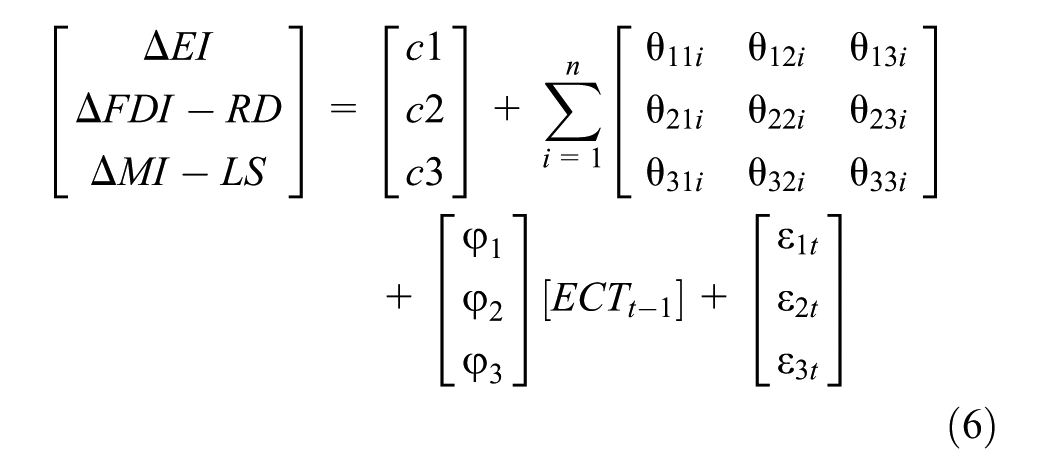
Where, Δ represents the first difference operator. The Variable
Results
This empirical analysis first examines the stationarity of time series variables, as this is a basic requirement for cointegration and causality tests. These tests help reveal the long-term relationship and causal mechanism between variables, thus providing a basis for policymaking. The unit root test results (Table 1.) for the variables EI, FDI_RD, and ML_LS, utilizing the ADF and PP methods, reveal varying degrees of stationarity. The ADF and PP tests confirm stationarity for the EI variable when the model includes both a constant term and a trend term. After applying the first-order difference, both tests consistently indicate stationarity across all models. In the case of FDI_RD, the initial sequence shows nonstationarity, as neither test reaches significance. However, after first-order differencing, the PP test indicates stationarity across all models, whereas the ADF test does not. This discrepancy underscores the PP test’s robustness in addressing issues of autocorrelation and heteroskedasticity. For the ML_LS variable, the original sequence remains nonstationary, with neither test achieving significance. Both tests indicate stationarity upon first-order differencing, but only under certain model conditions.
Results of the Unit Root Tests.

Note. ADF = augmented Dickey–Fuller test; PP = Phillips–Perron test; C = constant; CT = combination of constant and trend. The symbols ***, **, and * also indicate significance at the 1%, 5%, and 10% levels, respectively.
In summary, the PP test demonstrates superior robustness and effectiveness in handling autocorrelation and heteroskedasticity, particularly in differenced series. This makes the PP test more suitable for analyzing complex data structures, ensuring more reliable results in econometric modeling.
After first-order integration of the series, the Johansen maximum likelihood (ML) test was used to establish the cointegration relationship between the series. Table 2 presents statistics for the trace and maximum eigenvalues to reflect the outcomes of the Johansen cointegration test (Johansen and Juselius, 1990). The trace test findings can reject the cointegration null hypothesis (
Results of the Johansen Cointegration Test.
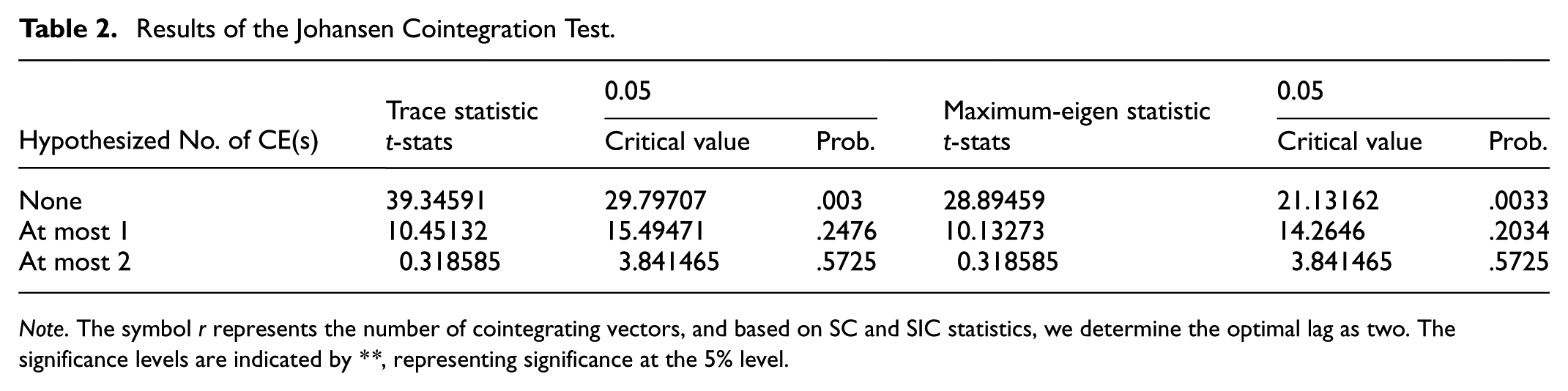
Note. The symbol r represents the number of cointegrating vectors, and based on SC and SIC statistics, we determine the optimal lag as two. The significance levels are indicated by **, representing significance at the 5% level.
Based on the cointegration results, VECM is applied to understand the direction of causality. The estimated results of VECM are reported in Table 3. Based on these results, we first considered the long-run equilibrium relationship based on whether the estimation coefficient of the error correction term (∅) negatively impacted the previous period (t−1). The findings demonstrated that the effects of FDI_RD and ML_LS on EI are all statistically significant (FDI_RD → EI; ML_LS → EI), implying that FDI_RD and ML_LS have mutually long-run effects on EI. However, there is no long-run impact of FDI_RD and EI on ML_LS or ML_LS and EI on FDI_RD. According to the results of the analysis, EI depends on internal R&D investment and technological progress and is significantly influenced by the external environment. Furthermore, the government’s active policy intervention in these areas has played a key role in promoting long-term EI.
Results of the VECM Test.
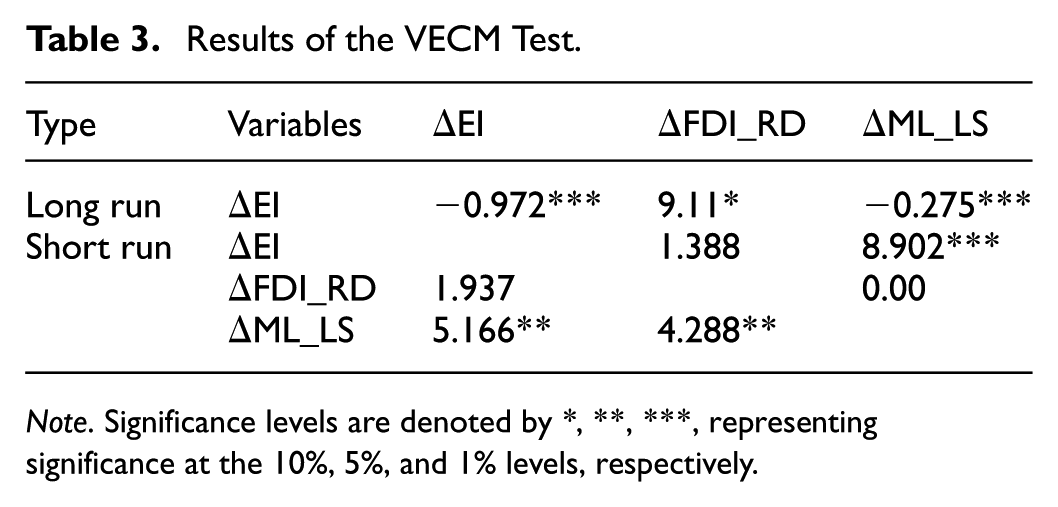
Note. Significance levels are denoted by *, **, ***, representing significance at the 10%, 5%, and 1% levels, respectively.
Second, the short-run dynamic results of VECM show ML_LS and EI affect interaction in the short term (ML_LS → EI, EI → ML_LS), and ML_LS affects FDI_RD in the short term (ML_LS → FDI_RD). This result shows developing market intermediary organizations and legal systems are important for promoting EI and attracting short-term foreign investment. This again demonstrates that the government plays a vital role in the innovation system.
Figures 2–4 shows the results of the variance decomposition test. First, for EI in the early stage, the fluctuation of DEI is completely explained by itself (100% in the first period), indicating that its short-term fluctuation mainly depends on its own factors. However, in the long run, the explanatory power of EI gradually decreases, falling to 76.105% in the 10th period, while the influence of FDI_RD and ML_LS gradually emerges and increases to 7.143% and 16.752%, respectively. For FDI_RD, its fluctuation is explained by itself (66.534%) and EI (33.466%) in the first period; however, over time, the impact of EI on FDI_RD gradually increases up to 49.789% in the 10th period, reflecting the significant role of growth in FDI in the long run. Finally, ML_LS is mainly explained by its own fluctuations in the short term (90.043% in the first period), but its explanatory power drops to 59.925% in the 10th period, while the influence of EI and FDI_RD increases to 21.866% and 18.208%.

Variance decomposition of EI.
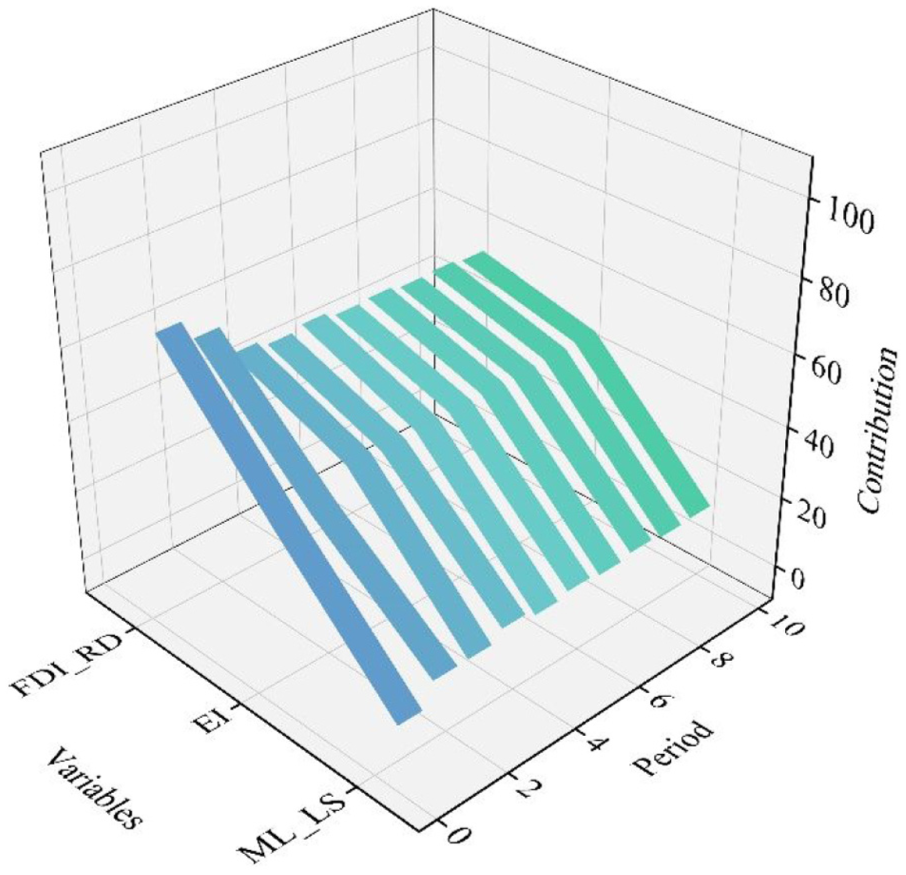
Variance decomposition of FDI–RD.

Variance decomposition of ML–LS.
In general, each variable is not only affected by its own fluctuations in the short term, but also affects each other in the long-term.
Discussion
This study uses time series analysis to reveal the impact of the interaction between universities, industry, and government on the innovation system under the triple helix model. This interaction has a long-term impact on the innovation system in the long run and shows a significant dynamic relationship in the short run. Using the VECM, we can describe these interactions’ specific mechanisms and effects in detail.
How Do Interactions Between Universities, Industry and Government Influence Each Other?
In the long run, FDI_RD and MI–LS significantly positively impact EI. Existing studies have shown that when the legal environment is stable, corporate innovation activities can be better supported and guaranteed (Zhao et al., 2022). However, this study further shows that the government and developing market intermediary organizations are essential drivers of corporate innovation. When the stability of the legal environment and developing market intermediary organizations jointly form a comprehensive innovation support system, it provides the necessary institutional guarantees and resource support for corporate innovation. This synergy can reduce the risk of corporate innovation activities and enhance innovation’s vitality in enterprises. Existing studies have shown that market intermediaries play an essential role in knowledge sharing and transfer (Feser, 2023), and a sound legal system ensures that innovation results can be effectively protected and disseminated, reducing uncertainty and risks in the innovation process (Su et al., 2023). These independent effects have been widely discussed and verified, but there is little direct discussion on the interaction between market intermediaries and the legal system environment to affect corporate innovation in existing research jointly. The results of this study show that the interaction between market intermediaries and the legal system environment jointly constructs a more optimized innovation ecosystem, and, under this synergistic effect, ensures the effective production and transfer of knowledge.
However, this study found that EI (EI) has no significant reverse effect on FDI_RD and ML_LS in the long run. This is different from the conclusions of some previous studies. For example, Yue (2022) pointed out that local enterprises’ innovation capability and technological level can affect the scale and quality of FDI. They believe that when local enterprises have higher absorptive capacity, foreign capital is more inclined to enter, further promoting technology transfer and innovation activities. The lack of reverse causality between EI and FDI_RD, as well as ML_LS, poses a challenge to the interactive nature of the Triple Helix model. This difference may be explained in China’s specific economic and policy environment. Unlike market-driven economies where corporate innovation can reshape dynamics, China’s top-down policy framework limits the feedback effects of EI on external factors. The Chinese government has guided foreign investment and built market intermediary organizations (Cai, 2014). Therefore, the innovation activities of enterprises may have limited impact on the long-term development of these external factors, and more depend on the government’s policy orientation and institutional arrangements.
In the short run, the VECM model shows that there is a significant two-way interactive relationship between EI and the development of market intermediary organizations and the legal and institutional environment (ML_LS). This relationship can be understood as the fact that the innovation activities of enterprises will bring about a resource agglomeration effect (Ren et al., 2024), quickly affecting the demand for relevant market intermediary organizations and the demand for the institutional environment. This rapid feedback mechanism makes the interaction between innovation activities and the external environment closer and more frequent. The VECM results also show that in the short run, improving market intermediary organizations and the sound legal and institutional environment significantly promote FDI and research and development (FDI_RD). First, during China’s economic transition period, policymakers tend to focus on improving the institutional environment in the short run to cope with the rapid flow of international capital and changes in market demand (Rodrik, 2000). Such improvements can significantly enhance the attractiveness of investing in a country or region in the short run. Especially in the field of R&D, foreign investors often pay more attention to the transparency of regulations and the convenience of cooperation with local enterprises (Mabillard & Vuignier, 2021). Therefore, rapidly establishing a sound market intermediary organization and improving the legal and institutional environment can quickly strengthen the confidence of foreign capital in the local market, thereby promoting foreign investment in the field of R&D.
Are the Effects Consistent Across Different Interaction Variables?
The variance decomposition results show that the mutual influences between EI, FDI_RD and ML_LS in the short term are not symmetrical. Specifically, the fluctuations of EI are mainly explained by its own factors, while the fluctuations of FDI_RD and ML_LS in the short term are less affected by EI. This inconsistency in the short-term interaction indicates that, although these variables are interrelated in a system, their short-term response speed and influence vary. This inconsistency can be explained by the dynamic capability theory (Teece et al., 1997), where enterprises tend to focus on optimizing internal processes and technological development in the initial stage, while improvements and investments in the external environment take time to have a significant impact (M. Wang et al., 2021).
Over time, the variance decomposition results show that the mutual influences between EI, FDI_RD and ML_LS gradually converge, as these variables contribute more and more to each other’s fluctuations. This long-term consistency reflects how optimizing the external environment and enhancing corporate innovation capabilities gradually increases foreign investment (Tulchynska et al., 2021), which in turn develops market intermediary organizations and improves the legal system. This synergy is consistent with the view of the triple helix model, according to which the interaction between government, enterprises and academic institutions can form a strong synergy in the long run to promote innovation and economic development (Kolade et al., 2022). In addition, the increase in the reaction force of EI on FDI_RD and ML_LS exhibits a more complex two-way interactive relationship. This shows that corporate innovation not only depends on the external environment but can also shape the development of the external environment. This finding challenges the traditional unidirectional causal relationship theory, revealing the complex two-way interactive relationship between corporate innovation and the external environment. As corporate innovation capabilities improve, foreign investors may be more inclined to increase investment in innovative enterprises or markets. Similarly, the long-term impact of FDI_RD on ML_LS also shows that foreign investment is not only attracted by the institutional and market environment, but also develops the local institutional and market environment through capital inflows and technology transfer.
In summary, in the short term, the interaction effects between EI, FDI_RD and ML_LS are inconsistent, the impacts between different variables are asymmetric, and the interactions are weak; however, over time, these interactions tend to become more consistent and form synergistic effects. This complex dynamic change reflects the complexity of the interdependence of internal and external factors in the innovation system and provides important inspiration for policy formulation and management practice.
The results of this study reveal the complex interactive relationship between EI, FDI and R&D (FDI_RD), and market intermediary organizations and the legal and institutional environment (ML_LS), providing essential insights for policymaking and enterprise strategic planning.
First, enterprises mainly rely on their resources and capabilities to promote innovation activities in the short term. This finding suggests that policymakers should increase their efforts to help enterprises improve their internal innovation capabilities through R&D investment and talent training to enhance their innovation competitiveness in the short term. Moreover, the weak impact of external factors in the short term also reminds enterprises to quickly accumulate and consolidate internal resources in the early stages to maintain their competitive advantage in the face of a rapidly changing market environment.
Second, the impact of the external environment on EI gradually emerges over time, reminding policymakers of the importance of improving the external environment by strengthening the construction of market intermediary organizations, improving the legal system, and promoting local R&D vitality by attracting foreign investment. The government should play a key role in this process, ensuring the stability and transparency of the institutional environment, thereby providing solid external support for EI.
In addition, the study found a two-way interactive relationship between EI and the external environment, indicating that EI is not only affected by the external environment, but also promotes optimizing the external environment. This finding challenges the traditional unidirectional causal relationship model and suggests that future policies and research should focus more on this interactive effect.
Conclusion
This study explores the interactive relationship between EI, FDI and R&D (FDI_RD), and market intermediary organizations and legal, institutional environment (ML_LS) through the VECM and variance decomposition analysis. The VECM results show that FDI_RD and ML_LS significantly positively impact EI in the long run. In contrast, in the short run, there is an essential two-way interaction between these variables, especially in the relationship between EI and the external environment, where the interaction is strong and mutually reinforcing in the short run. Variance decomposition results further show that although EI is mainly driven by its own factors in the short run, the impact of the external environment on EI gradually increases in the long run.
These findings emphasize that policymakers should focus on the balance between short-term and long-term strategies when promoting innovation. In the short run, the internal innovation capabilities of enterprises should be rapidly improved. In the long run, market intermediaries and legal systems should be continuously improved to support innovation’s sustainable development.
However, this study has some limitations. First, the study is not universal and mainly based on China’s economic and policy background. Second, although this study employs time series analysis, the relatively short time span of the data limits its ability to fully capture long-term economic fluctuations and policy changes. Future research could address this limitation by incorporating additional economic variables and using a longer time series to further extend the conclusions of this study. Additionally, future research can try to use nonlinear models to capture the complex dynamic relationships between variables and improve predictive ability. Overall, this study provides a new perspective on the complex dynamic mechanism of EI and proposes valuable suggestions for policy formulation and management practice.
Footnotes

Ethical Considerations
This study was conducted in accordance with the Declaration of Helsinki. Ethical review and approval were waived for this study as it involved an online, anonymous survey with adult participants, and no sensitive or identifiable personal data were collected.
Consent to Participate
Informed consent was implied through voluntary participation.
Funding
The authors received no financial support for the research, authorship, and/or publication of this article.
Declaration of Conflicting Interests
The author declared no potential conflicts of interest with respect to the research, authorship, and/or publication of this article.
Data Availability Statement
All relevant data are available from the authors on request.