



Abstract
This longitudinal study investigates individual differences in the academic trajectories of ethnic Hungarian students from non-EU countries in Hungarian higher education. Using administrative data from 1,041 students across 16 semesters and 4,155 semester-level observations, linear mixed-effects models with student-specific random intercepts and slopes were applied. Results show a modest but statistically significant positive trend in grade point average (GPA) over time, with an average increase of 0.036 GPA points per semester. Serbian students achieved significantly higher average GPAs than Ukrainian peers (β = .067, p = .049), while gender and settlement type had no significant effects. Academic performance varied by field of study, with students in pedagogy (β = .47, p < .001), art sciences (β = .41, p < .001), and humanities (β = .37, p < .001) performing best. Academic workload had a nuanced impact. Completed credits positively influenced GPA (β = .022, p < .001), while credits taken had a negative effect (β = −.019, p < .001). The model indicated substantial individual heterogeneity, with a random intercept variance of 0.343, slope variance of 0.002, and a strong negative intercept-slope correlation (−.80), suggesting that students with higher initial GPAs improved less steeply over time. The high conditional R2 (.71) versus marginal R2 (.23) highlights the predominance of individual differences. These findings underscore the need for context-sensitive, personalized support to promote academic success and integration among cross-border minority students with non-EU backgrounds, and demonstrate the value of longitudinal, multilevel approaches in understanding their diverse educational pathways.
Plain Language Summary
This study examines the university experiences of ethnic Hungarian minority students who have relocated from Serbia and Ukraine to pursue their academic studies in Hungary. By examining their grades over an extended period, our objective was not only to ascertain the average student's performance but also to discern the extent to which students vary in their academic progress. The findings revealed an improvement in students' grades over time, with Serbian students demonstrating higher grades compared to their Ukrainian counterparts. However, the most salient finding was that each student's academic trajectory was unique: some began with lower grades but demonstrated rapid improvement, while others began with higher grades and exhibited less change over time. The field of study and the number of courses completed or attempted by students also had a significant impact on their results. These findings indicate that a myopic focus on group means can obscure significant variations among students. The findings of this study indicate that institutions of higher education would be wise to consider the implementation of a more customized support system, one that takes into account the unique characteristics and learning pace of each student. The present study endeavors to assist educators and policymakers in comprehending the distinctive challenges and strengths exhibited by ethnic Hungarian minority students from neighboring countries. It underscores the significance of longitudinal student progress monitoring as opposed to the utilization of a singular measurement.
Keywords
Introduction
Higher education plays a crucial role in promoting social mobility, but its effectiveness varies across contexts. While education serves as an engine for economic growth and social capital development (Campbell, 2006), its impact on social mobility is influenced by factors such as socioeconomic inequality and cultural disparities (Arifin, 2017). In recent decades, international student mobility has attracted significant global attention as a pivotal component of higher education internationalization (Császár et al., 2021). In response to this growing phenomenon, educational institutions have devised a range of institutional strategies to motivate students to pursue education abroad, encompassing various forms of engagement from short-term tours to full degree programs (Rizvi, 2011). Student motivations often include personal development, cultural experiences, and career enhancement (Kehm, 2005). Alongside the impact of place and mobility on identity formation (Prazeres, 2013), the interplay between imagination, action, and privilege in shaping mobility patterns requires further exploration (Lipura & Collins, 2020). The domains of language proficiency and identity represent two discrete yet interconnected realms in which students pursuing academic endeavors in foreign nations often encounter challenges. These challenges can impact students’ overall experiences both in relation to their specific circumstances and in terms of broader implications for their personal development (Kinginger, 2015). A distinct category within international student mobility involves cross-border ethnic minority students (Krankovits, 2020; Zhang, 2020). A particular subset of this phenomenon is constituted by students who engage in kin-state migration, defined as the movement of individuals from an ethnic group living as a minority in one country to seek educational opportunities in their perceived ethnic “homeland” or kin state (Tátrai et al., 2017). In Central and Eastern Europe, this tendency is especially noticeable (Kocsis & Kocsisné Hodosi, 1998; Krankovits, 2020; Zorčič & Lukanović, 2023), mainly in Hungary, which attracts a significant number of ethnic Hungarian students from neighboring countries like Ukraine (Demeter et al., 2024; Pusztai & Márkus, 2018) and Serbia (Gabric-Molnar & Slavic, 2014; Kincses & Papp, 2020; Trombitás & Szügyi, 2019). The students possess native-level proficiency in the language of instruction, potentially mitigating a major barrier faced by other international students. A comprehensive understanding of the academic pathways of these distinct student groups is paramount for the evaluation of the efficacy of kin-state educational policies, the promotion of equitable opportunities, and the successful integration of these students into the Hungarian higher education system.
In addition to these factors, the unique context of cross-border ethnic minority students introduces other critical variables that can shape their academic pathways, particularly geopolitical instability and the role of social capital. Educational disruption due to geopolitical instability represents a critical factor affecting student mobility and performance. Research consistently demonstrates that armed conflict and political upheaval severely compromise educational outcomes through multiple pathways, including infrastructure damage, teacher displacement, curriculum interruption, and heightened psychological stress (Justino, 2016; Shemyakina, 2011). These disruptions can have lasting effects on academic preparation and performance, particularly for students transitioning between educational systems during periods of instability.
The grade point average (GPA) is a widely used indicator of academic performance and potential. It plays an important role in institution admissions, financial aid decisions, and future academic and career prospects. Research shows that factors such as high school GPA, and merit scholarships significantly influence college GPA (Mathies & Webber, 2009). However, students’ GPA is volatile over the years with no significant increase over semesters (Hassan & Al Yagoub, 2019), its evolution over time is not linear but shows a changing pattern over different periods (Reardon et al., 2007), in some cases following a quadratic trend (Rahsan et al., 2012). While numerous studies have investigated predictors of academic achievement among general or international student populations (DeBerard et al., 2004; Kéri, 2022; Perkins et al., n.d.; Wikström & Wikström, 2012) there is a comparative scarcity of research focusing specifically on the longitudinal academic trajectories of cross-border ethnic Hungarian students (Demeter et al., 2024; Papp & Zsigmond, 2021; Pásztor, 2018). A comprehensive review of extant literature reveals the presence of several factors that exert an influence on GPA. These factors include prior academic achievement, which is frequently identified as the strongest predictor (Binder et al., 2019; Casillas et al., 2012).
Other influential factors include demographic characteristics such as gender (Kumar, 2025; Sebok, 1971; Vera Gil, 2024) and socioeconomic background (Chevalère et al., 2023; Vadivel et al., 2023). However, gender effects on academic performance may be mediated through field of study selection, as disciplinary differences in grading standards and academic cultures can confound direct gender comparisons (Betts & Grogger, 2003). Additionally, the magnitude and direction of gender effects may vary across different student populations and institutional contexts, particularly among specialized groups such as cross-border minority students where migration and adaptation processes may create distinct academic challenges regardless of gender.
Contextual factors within the university environment also play a significant role. Differences in grading standards, academic demands, and teaching cultures across various fields of study are known to impact average performance levels (Betts & Grogger, 2003; Kember & Leung, 2011; Pham & Potochnick, 2024). Prior research has shown that field of study is associated with systematic differences in personality traits among students (Vedel, 2016; Verbree et al., 2021), nevertheless the predictive value of these traits for academic achievement appears to be consistent across different fields of study (Verbree et al., 2021). In addition to the consistent predictive role of personality traits, specific student behaviors that contribute to academic success, such as the number of credits taken and academic engagement, are also important. The student behavior, particularly academic workload and engagement (Kanwal et al., 2023), proxied by the number of credits attempted and successfully completed, is directly linked to semester outcomes. Research on credit load and academic success yields several key findings. Higher course loads are associated with better student performance and graduation rates (Cook, 2014; Slanger et al., 2015). Some studies show that an increase in credit load does not have a negative effect on students’ grades, even for lower-achieving students (Huntington-Klein & Gill, 2021). The extant literature indicates that part-time community college students who undertake an additional course are more likely to persist in their studies. The findings of this study demonstrate that, for full-time students, an increase in credits does not have a significant impact on persistence (Burridge et al., 2024).
Furthermore, the role of social capital and peer networks in minority student academic success has been well-documented in higher education research. Students from smaller ethnic or national groups may face additional challenges related to social isolation and limited co-ethnic support networks, which can negatively impact both academic performance and institutional persistence (Portes & Rumbaut, 2001). Conversely, larger minority group representation often facilitates the formation of supportive peer networks that enhance academic outcomes through shared resources, study groups, and social integration mechanisms.
In consideration of the findings, the subsequent investigation will examine the way these factors interact for ethnic Hungarian students from Ukraine and Serbia, as well as the progression of their effects over the course of several semesters. However, it is important to recognize that student performance is not fixed. It evolves over time, influenced by a complex interplay of individual, demographic, and contextual factors. To fully understand how these influences shape academic trajectories, particularly for cross-border ethnic Hungarian students, it is essential to move beyond single-point analyses and adopt a longitudinal perspective. Such an approach enables researchers to track changes in GPA across multiple semesters, revealing patterns of adaptation, persistence, or decline that may otherwise remain hidden. This shift from static to dynamic analysis also allows for investigation of how the impact of various predictors, such as prior achievement, credit load, or field of study, may intensify, diminish, or interact as students’ progress through their university careers. Addressing the limitations of cross-sectional approaches requires a longitudinal perspective and analytical methods capable of modeling individual change while accounting for the nested structure of the data (Herodotou et al., 2019). The importance of model diagnostics prior to performance decisions is therefore paramount (Hu et al., 2023). Linear mixed-effects models (LMMs), also known as multilevel or hierarchical linear models, provide a robust framework for analyzing such longitudinal data (Thompson et al., 2024). LMMs are a statistical framework that enables researchers to model two distinct components of a data set simultaneously. The first component is the average trajectory of change over time, also known as fixed effects. The second component is the individual deviations from this average trajectory, which are referred to as random effects. The utilization of LMMs allows for the capture of both population trends and individual heterogeneity. The improper modeling of correlated data may lead to an increased number of false positives or false negatives, underscoring the importance of accurate correlation modeling (Murphy et al., 2022). By incorporating random intercepts and random slopes for time, LMMs can estimate individual baseline differences and variations in the rate of change, offering a much richer understanding of developmental processes than traditional regression techniques (Chen et al., 2024). The strong negative correlation between initial performance and rate of change found in our analysis exemplifies the kind of dynamic insight uniquely provided by LMMs.
Despite the growing significance of kin-state migration in Central and Eastern European higher education, several critical gaps remain in our understanding of these students’ academic trajectories.
First, methodological limitations characterize much of the existing research. Previous studies on cross-border ethnic Hungarian students have predominantly employed cross-sectional designs (Demeter et al., 2025), which provide snapshots of academic performance but cannot capture the dynamic nature of student adaptation and development over time. This represents a significant limitation, as academic trajectories are inherently developmental processes that unfold across multiple semesters and years.
Second, there is a conceptual gap in how individual heterogeneity is understood and modeled in this population. While general international student literature acknowledges performance variability (DeBerard et al., 2004; Perkins et al., n.d.), studies specific to cross-border ethnic minorities have largely focused on group means and average outcomes, potentially masking substantial individual differences in academic pathways. The assumption of homogeneous trajectories within ethnic groups may obscure important patterns of divergence, convergence, or differential adaptation rates among students.
Third, a comparative analytical gap exists regarding the systematic examination of differences between specific kin-state student groups. Although ethnic Hungarian students from Serbia and Ukraine represent the two largest cross-border student populations in Hungarian higher education, no comprehensive longitudinal study has directly compared their academic performance trajectories while accounting for individual-level variation and institutional factors.
Finally, there is an analytical sophistication gap in the statistical approaches employed. The nested structure of longitudinal educational data—with repeated semester observations clustered within individual students—requires specialized analytical techniques to avoid biased estimates and incorrect inferences. However, previous research on this population has not employed linear mixed-effects models (LMMs) or other multilevel approaches capable of simultaneously modeling population trends, group differences, and individual heterogeneity.
The present study addresses these interconnected gaps by providing the first comprehensive longitudinal analysis using advanced LMM techniques to examine academic performance trajectories of Ukrainian and Serbian ethnic Hungarian undergraduate students within the Hungarian higher education system over an extensive 8-year period (2016/2017–2023/2024). By leveraging large-scale administrative data and appropriate multilevel modeling, we aim to:
a. quantify both average trends and substantial individual variability in academic pathways,
b. investigate systematic differences between the two largest cross-border student groups while accounting for confounding factors, and
c. examine the nuanced effects of academic workload alongside background characteristics and field of study within a rigorous longitudinal framework.
The objective of this study was to provide answers to the following hypotheses, which were derived from the theoretical background and prior empirical findings:
By analyzing a large administrative dataset using appropriate longitudinal methodology, this study contributes nuanced insights into the academic performance dynamics of two significant cross-border student groups in Hungary. The findings regarding citizenship differences, field-of-study effects, the impact of workload, and particularly the pronounced individual variability hold implications for institutional support services, academic advising, and policies aimed at fostering the successful integration and achievement of all students in diverse higher education settings
Data and Methods
Data Source and Sample
This research utilized longitudinal administrative data from multiple Hungarian higher education institutions, as provided by the Márton Áron Special College database (ELTE, 2024). The dataset encompasses student outcomes spanning from the 2016/2017 academic year to the 2023/2024 academic year, detailed by semester, thereby covering 16 consecutive semesters. The dataset specifically includes semester-level records for cross-border ethnic Hungarian students holding either Ukrainian or Serbian citizenship. Following necessary data cleaning and preparation procedures, the final analytical sample comprised 4,155 semester-level observations derived from 1,041 unique students affiliated with 18 distinct Hungarian universities. Within this sample, observations related to students with Serbian citizenship formed the majority, accounting for 3,104 records (74.7%), while those pertaining to Ukrainian students numbered 1,051 (25.3%). The sample exhibited a gender imbalance, with females representing 2,505 observations (60.3%) compared to 1,650 observations for males (39.7%). Regarding territorial origin, a slightly larger proportion of observations corresponded to students from urban backgrounds (N = 2,432, 58.5%) relative to those from rural areas (N = 1,723, 41.5%).
Measures and Variables
The student population demonstrated diversity across academic disciplines. Among the 12 identified fields of study, Medical and Health Sciences constituted the largest group (N = 1,169, 28.1%), followed by Humanities (N = 683, 16.4%) and Computer Science (N = 546, 13.1%). The primary outcome variable selected for analysis was the semester-wise weighted academic average, evaluated on a standard scale ranging from 2.00 to 5.00. This scale reflects the standard grading system used in Hungarian higher education. In this system, grades are assigned as follows: 5 (Excellent), 4 (Good), 3 (Satisfactory), 2 (Pass), and 1 (Fail). The grade of 2.00 is the minimum required to pass a course. Consequently, the 2.00 to 5.00 GPA range in our analysis encompasses the full spectrum of passing academic performance, where scores above 4.00 indicate a very good to excellent standing. The mean academic average observed across the entire sample was approximately 4.15, with a median value of 4.25. The progression of time within the study was operationalized using a numeric variable (semester_num), sequentially indexing the semesters from 1 to 16. Key predictors in the model included “citizen,” with “Ukrainian” as the reference category, and “gender,” using “woman” as the reference category. The analysis incorporated several control variables to ensure the robustness of the findings. The field of study is a system that categorizes students’ academic disciplines into 12 levels. The Agricultural Science discipline is used as the reference for this categorization. The type of settlement is indicative of the student’s home background, which is categorized as either “rural” (reference) or “urban.” The number of completed credits is a continuous measure of credits successfully earned in a semester, with a mean value of approximately 30.8. The number of credits taken is another continuous measure, representing the credits enrolled during the semester, with a mean value of approximately 32.4.
Analytical Strategy
The hierarchical structure of the data was defined based on the student’s Neptune code (student_id), a unique identifier that facilitates the nesting of observations within students, and the 18 universities that identify the institution attended. To appropriately analyze the longitudinal academic performance data while accounting for the inherent nested structure, which includes the semester observations within students, LMMs were implemented. Analyses were performed using the R statistical environment (Version 2024.12.1 Build 563), primarily leveraging the lme4 package (Bates et al., 2015). A systematic model-building process, utilizing maximum likelihood (ML) estimation for comparisons, was employed to evaluate several candidate models. This sequence included a null model, a main effects model encompassing all predictors, models incorporating interaction terms between the time variable and key grouping factors (citizen, gender), and a comprehensive model adding random slopes for time at both student and university levels. Model selection was informed by Likelihood Ratio Tests and information criteria (AIC, BIC), assessed via the performance package (Lüdecke et al., 2021). Findings from these comparisons suggested that the inclusion of time-based interaction terms did not significantly improve model fit over the main effects model. Furthermore, models incorporating university-level random effects exhibited singularity, indicating redundancy after accounting for student-level variation and fixed predictors. Consequently, a more parsimonious final model was selected for interpretation, estimated using restricted maximum likelihood (REML). This definitive model featured fixed effects for semester sequence, citizenship, gender, field of study, settlement type, completed credits, and taken credits. The random effect’s structure was specified as (1 + semester_num, student_id), thus including random intercepts and random slopes for the time variable across students to capture individual differences in initial performance and change over time. Significance testing for fixed effects employed t-tests with Satterthwaite-approximated degrees of freedom (Kuznetsova et al., 2017) at an alpha level of .05. Posthoc interpretation aids, including estimated marginal means, alongside model diagnostics and R2 estimations, were utilized to evaluate the final model structure. The R code generation and correction process involved the utilization of Perplexity AI.
It should be noted that a direct comparison of the academic performance of the students in this study to the general student population in Hungary is not feasible due to data availability constraints. At present, there is no publicly available, officially published national average GPA that could serve as a reliable baseline for all Hungarian higher education students. Academic performance data are managed at the institutional level and are not aggregated into a national benchmark for research purposes, a limitation also noted in other Hungarian studies that rely on institutional-level data (Takács et al., 2023) or systematic reviews (Kocsis & Molnár, 2025). Furthermore, even if a national baseline GPA were available, a direct comparison could be misleading. The ethnic Hungarian student populations from Serbia and Ukraine are not uniformly distributed across all fields of study and institutions in Hungary; they often show concentration in specific programs where grading standards may differ from the national average. As our own model demonstrates, the field of study is a significant predictor of GPA. Therefore, a meaningful comparison would necessitate a more complex statistical analysis, such as constructing a matched control group of domestic Hungarian students or adjusting for these confounding variables, which is beyond the scope of this study and the available data. Consequently, this study focuses on internal comparisons and longitudinal trajectories within the defined sample.
Results
Descriptive Statistics
The implementation of the linear mixed-effects modeling approach, as delineated above, yielded several salient findings regarding the longitudinal academic performance trajectories of Ukrainian and Serbian ethnic Hungarian students and the factors associated with their GPA. The ensuing sections will present these results, commencing with descriptive statistics that characterize the sample and key variables. These will be followed by the detailed outcomes of the final mixed-effects model. Descriptive statistics summarizing key variables across the entire study period, aggregated by citizenship and gender, provide initial insights into overall group performance patterns, while also reflecting underlying temporal dynamics observed across the individual semesters. Serbian students, on average, exhibited higher mean weighted academic averages compared to their Ukrainian counterparts. As shown in Table 1, Serbian women recorded the highest overall mean GPA at 4.26 (SD = 0.57), followed by Serbian men (mean = 4.14, SD = 0.57).
Aggregated Data for Descriptive Statistics.

Among Ukrainian students, women averaged a GPA of 4.08 (SD = 0.59), while men had the lowest overall average GPA at 3.77 (SD = 0.69). The general hierarchy—Serbian students demonstrating higher levels of academic performance in comparison to their Ukrainian counterparts, and female students exhibiting superior performance in relation to their male counterparts within each respective citizenship group—exhibited notable consistency over the course of the 16 semesters that were subjected to examination. The semester-level data revealed significant fluctuations and specific temporal patterns. While starting from different baseline levels, Ukrainian men frequently had an average below 3.7 in the early academic years, most of the groups had a gradual, albeit non-monotonic, increase in the mean GPA over time, particularly from the midpoint of the study period onwards. Groups like Serbian women showed periods of particularly strong performance, with mean GPAs frequently surpassing 4.5 in the semesters following the 2019/2020 academic year. The standard deviations, ranging overall from 0.57 to 0.69, highlight the substantial within-group variability that was present in nearly every semester. Academic workload and success remained stable across groups, with an average of 32.1 to 32.8 credits per semester. This stability was consistent both across groups and over time, indicating minimal systematic change in academic workload across semesters for any group. The mean number of credits completed per semester exhibited a consistent correlation with the number of credits taken, resulting in high mean credit completion ratios across the board. The overall means ranged from 0.91 for Ukrainian men to 0.96 for Serbian women. Semester-level data substantiated this pattern, with median credit completion ratios generally measuring 1.00 across all four groups in most semesters. This stability and high success rate in credit completion suggest that, despite differences in GPA, students across these groups generally manage their academic workload effectively throughout their studies in terms of course completion.
A methodological observation of significance is that, while these descriptive patterns may appear to suggest systematic group differences based on citizenship and gender, our multivariate linear mixed-effects modeling reveals a more nuanced picture. First, the apparent gender advantage for female students observed in these raw statistics does not persist as a significant predictor in the final model when accounting for field of study, individual student trajectories, and other covariates (see section “Discussion”). This suggests the descriptive difference is likely confounded by other factors. Second, while the effect of citizenship remains statistically significant in the final model, its practical magnitude (an estimated 0.067 GPA point advantage for Serbian students) is modest when contrasted with the substantial individual heterogeneity present in the data. As the random effects analysis will show, the between-student variance in baseline GPA (τoo = .34) is far greater than the differences attributable to group membership.
This underscores a central finding of our study: both apparent and statistically significant group-level effects are secondary to the powerful influence of individual student differences. Therefore, relying solely on descriptive comparisons can be misleading, as they may either reflect confounded relationships (in the case of gender) or overshadow the much larger story of individual academic pathways (in the case of citizenship).
Model Fit and Fixed Effects
The final linear mixed-effects model accounted for a substantial portion of the variance in semester-level weighted academic average. The marginal R2, indicating the variance explained solely by the fixed effects, was 0.23, while the conditional R2, reflecting the variance explained by both fixed and random effects, reached 0.71. This finding indicates that while the included predictors account for approximately 25% of the GPA variability, individual student differences captured by the random effects contribute to a substantially larger proportion of the overall variability. The fixed effects are further delineated in Figure 1 and Table 2. A statistically significant positive linear trend was observed over time, as indicated by the semester coefficient (Estimate = 0.036, SE = 0.003, p < .001). On average, if other factors remain constant, there was an observed increase in student GPA of approximately 0.036 points per semester.

Fixed effects estimates and 95% confidence intervals.
Fixed Effects Estimates (Refined Model).
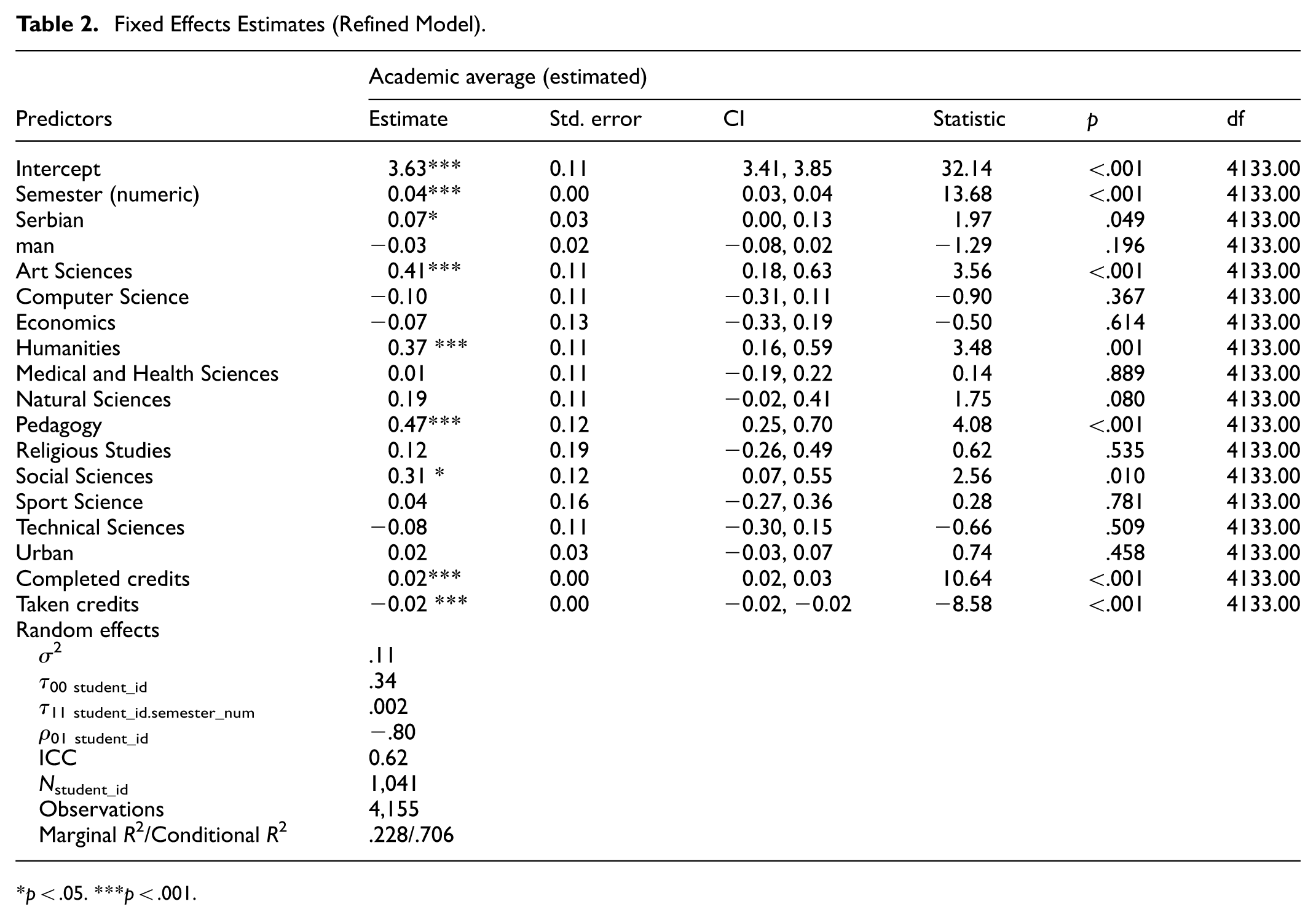
p < .05. ***p < .001.
In consideration of student demographics, a statistically significant effect of citizenship was identified. When other variables were controlled for, Serbian students exhibited a GPA that was approximately 0.07 points higher than their Ukrainian counterparts (SE = 0.034, p = .049). In contrast, no significant difference in academic performance was found between male and female students (Estimate = −0.03, SE = 0.02, p = .196) within this model. Furthermore, the student’s home settlement type did not demonstrate a significant association with GPA (Estimate = 0.02, SE = 0.03, p = .458). Academic performance varied significantly across different fields of study, relative to the reference category, Agricultural Science. Students in Pedagogy (Estimate = 0.472, SE = 0.116, p < .001), Art Sciences (Estimate = 0.408, SE = 0.115, p < .001), Humanities (Estimate = 0.374, SE = 0.108, p < .001), and Social Sciences (Estimate = 0.313, SE = 0.122, p = .011) exhibited significantly higher estimated GPAs. Natural Sciences showed a marginally significant positive association (Estimate = 0.192, SE = 0.109, p = .080). No statistically significant differences were observed for students in Computer Science, Economics, Medical and Health Sciences, Religious Studies, Sport Science, or Technical Sciences compared to Agricultural Science (all p > .10). In conclusion, both credit-related variables exhibited a strong correlation with academic performance. The number of completed credits exhibited a significant positive relationship with GPA (Estimate = 0.022, SE = 0.002, p < .001), suggesting that accumulating more credits is associated with enhanced academic achievement. In contrast, the number of credits taken exhibited a significant negative relationship (Estimate = −0.019, SE = 0.002, p < .001). This finding indicates that, when the number of completed credits remains constant, enrolling in a higher number of credits is associated with a slight decrease in GPA. This phenomenon may be indicative of the impact of increased workload or distributed effort.
Random Effects, Individual Student Variability
While the fixed effects provide insights into the average trends and group differences, the primary strength of the linear mixed-effects model lies in its ability to capture and quantify individual student heterogeneity through the random effects structure. The variance components estimated for the random effects at the student’s unique identifier level reveal substantial variability in academic trajectories among the students in the sample (Random Effects section in Table 2).
First, significant variation was observed in students’ underlying average performance levels, independent of the fixed predictors, as represented by the random intercepts. The estimated variance for these intercepts was substantial at 0.34 (τ00SD = 0.585). This indicates that, even after accounting for factors like citizenship, gender, field of study, and credits, students possess considerably different baseline academic propensities or average achievement levels throughout their studies. The magnitude of the standard deviation (0.585) relative to the GPA scale highlights the practical importance of these individual differences in baseline performance.
Figure 2 provides a detailed visualization of this heterogeneity through a caterpillar plot of the estimated random intercept deviations. Each symbol on the plot represents an individual student, ordered along the x-axis based on the magnitude of their estimated deviation from the overall average intercept, represented by the solid black zero line on the y-axis. The outline color of the symbols and their corresponding 95% confidence intervals indicate student citizenship. The blue color is indicative of Ukrainian students, whereas the yellow color signifies Serbian students. The shape of the symbol denotes whether the individual deviation is statistically significant at the p < .05 level. Triangles represent significant deviations, where the confidence interval does not include zero, while circles represent non-significant deviations. Furthermore, the fill color of the symbols provides additional information about the direction of significant effects. Green for significant positive, orange for significant negative, gray for non-significant, matching the legend. The wide vertical spread of points spanning a range of roughly −2.0 to +1.5 GPA points around the average, vividly illustrates the substantial variation in baseline performance levels captured by the random intercepts. Consistent with statistical expectations, significant deviations are concentrated primarily at the upper and lower extremes of the distribution, identifying students whose baseline performance is markedly different from the average. In contrast, many students, whose data points are concentrated near the zero line, demonstrate negligible deviations. These deviations, indicated by gray circles, suggest that their baseline performance closely aligns with the model’s prediction based on fixed effects alone. Despite the fixed effect difference in average GPA between citizenship groups, the visualization suggests no obvious systematic difference in the distribution or proportion of significant positive or negative random intercept deviations between Ukrainian and Serbian students. Both groups contribute individuals across the entire spectrum, including those with significant positive and negative deviations. This visualization underscores that population-level averages coexist with profound, statistically meaningful individual-level variability in baseline academic propensity, a key insight afforded by the mixed-effects modeling approach.

Visualization of random effect deviations between students.
Additionally, the model allowed the linear effect of time, which depicts the change in GPA per semester, to differ among students through random slopes. The analysis revealed significant variance for these slopes as well (τ11 variance = .002, SD = 0.047). This finding is crucial as it demonstrates that students not only differ in their average performance levels but also follow distinct trajectories over time. The rate of change in GPA from one semester to the next is not uniform across the student population. Some students exhibit faster rates of improvement, while others improve more slowly, and some may even show different patterns relative to the average positive trend identified by the fixed effect of semester variable. While the slope variance itself appears numerically small, its effect accumulates over the 16 semesters studied, potentially resulting in divergent long-term academic trajectories.
Furthermore, a strong negative correlation of −.80 was estimated between the random intercepts and the random slopes for time at the student level (ρ01). This correlation provides insight into the dynamics of academic achievement within this cohort and indicates that students estimated to have a higher baseline GPA tend to have significantly flatter or less positive slopes over time. High-achieving students demonstrate a reduced rate of improvement or a slight decline in their academic performance when compared to their average peers. This phenomenon may be attributed to the ceiling effect. Conversely, students with a lower estimated baseline GPA tend to exhibit significantly steeper positive slopes, suggesting a “catch-up” phenomenon where they demonstrate greater rates of academic improvement over the semesters. This negative correlation underscores a complex interplay between initial performance and subsequent academic development.
Figure 3 visually confirms this strong negative correlation between the estimated random intercepts and slopes. The representation of students in this study is delineated by their estimated intercept, deviation from the x-axis, and slope deviation from the y-axis. The allocation of students according to their citizenship is indicated by the color coding used in the figure. The clear downward trend of the point cloud, highlighted by the dashed linear trend line, vividly illustrates the estimated correlation of approximately −.80, consistent with the model’s ρ01. This provides compelling visual evidence for the “catch-up” dynamic. Students with a higher deviation from the baseline GPA are generally positioned lower on the y-axis, indicating a flatter or more negative slope deviation. Conversely, students with a lower deviation from the baseline GPA are typically positioned higher on the y-axis, reflecting a steeper positive slope deviation. Both Ukrainian and Serbian students appear distributed along this common trend line, suggesting this dynamic applies similarly across both citizenship groups. Finally, the residual variance was estimated at σ2 = .11. This component signifies the within-student variability in GPA from one semester to the next that remains unexplained after accounting for both the fixed effects and the individual student-specific trajectories. This residual variance may be attributed to unmeasured time-varying factors influencing performance, measurement error, or inherent stochasticity in academic achievement.

Correlation between the estimated random intercepts and slopes.
The substantial variances associated with both the random intercepts and slopes, along with their strong correlation, collectively underscore the importance of modeling individual heterogeneity. Their inclusion significantly contributed to the model’s overall explanatory power, as reflected in the high conditional R2 of .71, compared to the marginal R2 of .23 achieved by the fixed effects alone. This highlights that a large proportion of the variance in academic performance is attributable to stable and dynamic differences between individual students.
Model Diagnostics
Standard diagnostic procedures were conducted on the final model. A visual inspection of the residual plots indicated that the assumptions of linearity and homoscedasticity were reasonably satisfied. The distribution of residuals demonstrated approximate normality, with minor deviations observed in larger datasets. No significant data points were identified as exerting undue influence on the model estimates. Overall, the diagnostic checks confirmed the suitability of the linear mixed-effects model for the analysis.
Discussion
This study utilized linear mixed-effects modeling to investigate the longitudinal academic performance trajectories of Ukrainian and Serbian ethnic Hungarian undergraduate students within the Hungarian higher education system, addressing a notable gap in the existing literature which often lacks a dynamic, longitudinal perspective on these specific cross-border student populations (Demeter et al., 2024; Papp & Zsigmond, 2021; Pásztor, 2018). A comprehensive analysis of extensive administrative data spanning eight academic years has yielded findings that offer nuanced insights into average performance trends, group differences, the impact of academic workload, and, most crucially, the substantial individual heterogeneity underlying these patterns.
Consistent with our revised hypothesis 1 (H1), we found empirical support for both the expected average positive trend and the significant individual heterogeneity in academic development over time. First, regarding the average trend, a statistically significant positive linear effect of time on GPA was observed (β ≈ .036, p < .001). This finding aligns with the component of H1 positing adaptation and learning, suggesting that, on average, students tend to improve their academic standing as they progress. While confirming this general upward tendency, the modest magnitude of the coefficient indicates that the average improvement process is gradual. This finding offers an interesting nuance within the broader literature on GPA trajectories (DeBerard et al., 2004; Perkins et al., n.d.; Wikström & Wikström, 2012). Other longitudinal studies emphasize non-linear patterns (Hassan & Al Yagoub, 2019; Reardon et al., 2007) or potential quadratic trends (Rahsan et al., 2012). The findings indicate a significant yet modest positive linear trend, which may be indicative of a genuine, albeit gradual, average adaptation process within this specific cohort. This adaptation process is distinct from those observed in other contexts. Alternatively, the linear term might capture the overall direction of more complex individual processes averaged out (Rahsan et al., 2012; Reardon et al., 2007). Importantly, in support of the second component of Hypothesis 1 which explicitly anticipated individual variability, the analysis identified significant variance in the random slopes for time (τ11 variance = .002, SD = 0.047). This confirms the hypothesized substantial individual heterogeneity in the rate of GPA change, strongly suggesting that individual student trajectories are highly diverse and likely encompass varied patterns beyond the average linear increase. Furthermore, the strong negative correlation (−.80) between random intercepts and slopes (Figure 3) highlights a complex dynamic where initial performance levels relate to subsequent rates of change. Therefore, H1 is fully supported, the data confirms both the modest positive average trend and, significantly, the substantial individual variation around this trend, underscoring the necessity of the LMM’s random effect’s structure. The results emphasize that focusing solely on the average trend obscures the highly individualized nature of academic development, prompting future research to explore potential non-linear time effects or subgroup-specific trajectory patterns.
The analysis clearly supported hypothesis 2 (H2), which showed a statistically significant difference in academic performance by citizenship. Students of Hungarian nationality from Serbia showed higher estimated academic achievement compared to their Ukrainian counterparts, and this difference persisted even after rigorous control for time progression, field of study, gender, type of municipality and study load variables. The results demonstrate significant GPA differences across academic fields, align with findings from studies like Verbree et al. (2021) which also document variations in academic achievement levels between different fields of study. This finding can also be interpreted in the specific context of kin-state migration highlighted in the introduction (Krankovits, 2020; Tátrai et al., 2017; Zhang, 2020) where certain student groups often have a linguistic advantage over other international students (Kinginger, 2015). Despite accounting for numerous potential confounders available in the data, the model indicates a residual performance advantage associated with Serbian origin among ethnic Hungarians within the specific context of the Hungarian higher education system studied (Demeter et al., 2024; Gabric-Molnar & Slavic, 2014; Kincses & Papp, 2020; Pusztai & Márkus, 2018; Trombitás & Szügyi, 2019).
Several potential explanations warrant consideration for the observed performance gap between Serbian and Ukrainian ethnic Hungarian students, though our administrative data design limits definitive causal attribution.
Temporal and geopolitical factors may play a significant role. The study period (2016–2024) encompasses major geopolitical disruptions, most notably the Russian invasion of Ukraine in February 2022, which coincides with the latter portion of our observation window. Research consistently demonstrates that armed conflict severely disrupts educational systems and student performance (Justino, 2016; Shemyakina, 2011). Ukrainian students may have experienced increased psychological stress, family displacement, financial hardship, or interrupted preparation for Hungarian university admission due to ongoing conflict. Additionally, the deteriorating security situation in Ukraine since 2014 may have created cumulative educational disadvantages that manifest in Hungarian higher education performance.
Differential educational system preparation represents another plausible mechanism. Serbia and Ukraine maintain distinct secondary education systems with different curricular emphases, assessment methods, and academic standards. Serbian students may benefit from educational practices more closely aligned with Hungarian academic expectations, potentially facilitating smoother transitions. Moreover, the relative stability of Serbia’s educational infrastructure compared to Ukraine’s conflict-affected system may contribute to better academic preparation.
Social integration and support networks could also influence performance outcomes. The larger Serbian student population in our sample (74.7% vs. 25.3% Ukrainian) may create more robust peer support networks, reducing isolation and enhancing academic success through social capital mechanisms. Previous research indicates that minority student academic outcomes improve with stronger co-ethnic community presence (Portes & Rumbaut, 2001)
Importantly, these explanations remain speculative given our data limitations. The observed difference, while statistically significant, is practically modest (0.067 GPA points) and may reflect unmeasured selection effects regarding which students choose to migrate for education. Future research incorporating pre-migration academic records, conflict exposure measures, and qualitative data on student experiences could better illuminate these mechanisms.
The investigation yielded robust support for hypothesis 3 (H3), which posited a nuanced, inverse relationship between credit-related variables and semester GPA. As anticipated, the number of successfully completed credits exhibited a significant positive association with GPA (β ≈ .02, p < .001), reinforcing the intuitive link between demonstrated academic accomplishment and performance outcomes (Kanwal et al., 2023). This aligns with the basic premise that succeeding in coursework directly translates to higher grade averages. More compellingly, and central to the complexity addressed by H3, the number of taken credits displayed a significant negative association with GPA (β ≈ −.02, p < .001) after controlling the number of credits completed. This specific finding warrants careful consideration considering the extant literature referenced in the introduction, which presents a somewhat fragmented picture regarding the impact of academic workload. While several studies suggest that higher course loads can be positively associated with desirable outcomes like persistence or graduation rates (Burridge et al., 2024; Cook, 2014; Slanger et al., 2015), and some research even indicates that increased credit loads do not necessarily depress grades, even among lower-achieving students (Huntington-Klein & Gill, 2021), the result points toward a different dynamic concerning semester GPA within this specific population and analytical framework. The significant negative coefficient for taken credits in the model implies that, holding successful completion constant, the mere act of enrolling in additional courses exerts a discernible, albeit modest, downward pressure on the calculated GPA for that semester. This may reflect underlying mechanisms pertinent to resource allocation under increased academic demand. Potential interpretations include the dilution of study effort, where students must divide limited time and cognitive resources across a larger number of subjects, potentially leading to slightly lower performance in each. Alternatively, it could signify heightened academic stress or cognitive load associated with managing a heavier curriculum, which may subtly impair overall performance quality. This finding suggests inherent trade-offs between the quantity of academic commitments undertaken and the average quality of performance achieved within a fixed timeframe. While the practical impact of a single extra credit taken might appear small (a decrease of ~0.019 GPA points), this effect accumulates with larger course loads. Crucially, the capacity of our linear mixed-effects model to simultaneously estimate the effects of both taken and completed credits, while accounting for individual student differences, is paramount. This analytical strategy enables the disentanglement of potentially opposing forces: the unequivocally positive signal of academic success represented by completed credits versus the potential strain or resource constraint signaled by a higher number of taken credits. This sophisticated interplay, where taking on more academic responsibility might slightly penalize average grades even amidst high completion rates, could be masked in analyses employing cruder workload measures (e.g., only credits taken, or a simple ratio) or focusing solely on dichotomous outcomes like persistence rather than the continuous measure of GPA. Our findings thus contribute a specific, quantitative perspective to the ongoing debate on the effects of academic workload in higher education. We highlight that the relationship might be more complex than previously assumed, particularly when examining semester-level performance within diverse student populations like the cross-border groups we studied.
Beyond the main hypotheses, the significant impact of the field of study on GPA resonates with established literature emphasizing disciplinary differences in academic demands and grading cultures (Kember & Leung, 2011; Pham & Potochnick, 2024). The finding that certain fields like Teacher Training and Humanities are associated with higher adjusted GPAs compared to others like Computer Science or Technical Sciences warrants consideration in institutional assessments and student advising. A critical finding of this study is the absence of significant gender differences in academic performance within the final LMM model (β = −.03, p = .196), despite apparent disparities observed in descriptive statistics (Chevalère et al., 2023; Kumar, 2025; Sebok, 1971; Vadivel et al., 2023; Vera Gil, 2024).This discrepancy between descriptive and multivariate results requires careful interpretation and highlights the importance of appropriate statistical modeling. The descriptive statistics suggested substantial gender differences, with female students showing higher average GPAs across both citizenship groups. However, these apparent differences disappeared when accounting for field of study, individual student trajectories, and other covariates in the LMM framework. This pattern suggests that observed gender differences may be mediated through other pathways rather than representing direct gender effects on academic performance.Several mechanisms could explain this mediation. First, field of study selection may account for apparent gender differences, as women and men often concentrate in academic disciplines with systematically different grading standards (Betts & Grogger, 2003). Our model shows significant field effects, with pedagogy, humanities, and art sciences—fields with higher female enrollment—demonstrating elevated GPAs compared to technical fields with higher male representation. Second, the substantial individual heterogeneity captured by our random effects structure (conditional R2 = .71) may subsume gender effects, suggesting that individual differences far outweigh group-level gender patterns in this population. Third, the specific characteristics of cross-border ethnic minority students may attenuate gender effects typically observed in broader student populations, as the migration and adaptation processes may create more homogeneous academic challenges regardless of gender.
The results also highlight stark differences based on the field of study. The lower average GPAs in quantitative and technical disciplines (e.g., Computer Science, Technical Sciences) compared to fields like Pedagogy (β = .472) and Humanities (β = .374) aligns with existing literature on varying grading cultures across disciplines. This provides them a structural advantage in GPA-based evaluations. In contrast, students in quantitative and technical fields, including Computer Science and Technical Sciences, do not show similar advantages and may face stricter grading standards. This disparity suggests that students in STEM disciplines are at an increased structural risk of academic probation or scholarship loss due to more rigorous assessment cultures, a challenge that may be amplified for cross-border students navigating a new academic environment. Consequently, these findings question the equity of using a universal GPA metric for institutional evaluations. To ensure fairness, institutions should consider applying field-normalized assessment criteria, such as percentile ranks or adjusted GPAs, for competitive awards and scholarships, and provide discipline-specific academic support to mitigate these structural disadvantages.
This finding contrasts with broader literature documenting female academic advantages in higher education (Kumar, 2025; Vera Gil, 2024) and suggests that simple descriptive comparisons can be misleading without proper statistical controls. The absence of significant gender effects, after accounting for individual trajectories and field selection, indicates that intervention strategies should focus on individual-level support rather than gender-specific programming for this population.
Perhaps the most crucial insight comes from the random effects structure, confirming the importance of adopting LMMs for longitudinal educational data (Chen et al., 2024; Herodotou et al., 2019; Thompson et al., 2024). The substantial variance in both student-specific intercepts and slopes, along with their strong negative correlation, highlights profound individual heterogeneity. This negative correlation suggests a dynamic where students starting with higher GPAs tend to improve less rapidly over time, while those starting lower show steeper improvement trajectories. The high conditional R2 relative to the marginal R2 underscores those individual differences, both stable and dynamic, explain much of the variance in academic performance trajectories, far exceeding the explanatory power of the measured fixed predictors alone. This emphasizes the limitations of focusing solely on group averages and the necessity of considering individual pathways, while ensuring accurate modeling of correlated data structures and performing adequate model diagnostics (Hu et al., 2023).
Limitations and Future Directions
Our study period (2016–2024) encompasses significant geopolitical events, particularly the Russian invasion of Ukraine in 2022, which may have differentially affected student populations during our observation window. However, our administrative data lack measures of conflict exposure, family displacement, or other war-related stressors that could explain performance differences between Ukrainian and Serbian students.
We cannot account for when individual students migrated to Hungary or their pre-migration academic preparation, limiting our ability to distinguish between selection effects (who chooses to study abroad) and adaptation effects (how students adjust to Hungarian higher education). The differential representation of Serbian versus Ukrainian students in our sample may reflect systematic differences in migration patterns, preparedness, or institutional recruitment that influence our findings.
While this study benefits from its longitudinal design and advanced methodology applied to a large dataset, limitations inherent in administrative data remain. We lack information on psychosocial factors, pre-university achievement details beyond enrollment (Binder et al., 2019; Casillas et al., 2012), and finer nuances of student integration or identity challenges (Kinginger, 2015). While we acknowledge the limitation of not including direct SES measures, our model captures dynamic individual trajectories using a robust longitudinal design. The random effects structure accounts for unobserved heterogeneity, partially mitigating omitted variable bias. The absence of pre-university academic records prevents us from disentangling initial advantages from true growth. However, the random intercept variance (τ00 = .34) suggests substantial baseline differences, which future studies could link to entry qualifications. Potential selection biases regarding which students choose to study in Hungary cannot be ruled out.
A primary methodological limitation is the absence of a national GPA baseline for comparison. A thorough assessment of national educational statistics confirms that there is currently no publicly available, officially published national average GPA for all students in Hungarian higher education. Academic performance data are managed at the institutional level and are not aggregated into a centralized, citable benchmark for research (Kocsis & Molnár, 2025; Takács et al., 2023). This data infrastructure gap prevents a direct comparison of our sample’s performance against the broader Hungarian student population. Furthermore, even if such a baseline existed, a simple comparison would likely be misleading. Ethnic Hungarian students from Serbia and Ukraine are not uniformly distributed across all academic disciplines and institutions; they often concentrate in specific fields of study where grading standards may differ from a national average. As our model confirms, the field of study is a significant predictor of GPA. A robust comparison would therefore require a more complex statistical approach, such as creating a matched control group or adjusting for these structural differences, which is beyond the scope of the currently available data. This constraint underscores a systemic challenge in Hungarian higher education research and reinforces the value of our study’s focus on internal, longitudinal analysis. Expanding the analysis to include other student outcomes and potentially other kin-state student groups would also be beneficial.
Establishing national GPA benchmarks, incorporating conflict exposure measures for post-2022 Ukrainian students, and developing matched control groups with domestic Hungarian students would enhance comparative validity. Longitudinal studies tracking students from pre-migration through graduation could clarify the relative contributions of selection, adaptation, and external disruption to academic outcomes.
Conclusion
This study confirms a modest positive trend in GPA over time among ethnic Hungarian students from Serbia and Ukraine. However, it also reveals significant individual heterogeneity (Conditional R2 = .71 vs. Marginal R2 = .23), a performance gap favoring Serbian students (β = .067) and an inverse relationship between academic workload and GPA. These findings lead to the following policy recommendations. The substantial individual heterogeneity in academic trajectories necessitates a shift away from uniform support strategies. Institutions should use longitudinal data to implement early-warning systems that identify at-risk students. Personalized academic advising and targeted tutoring should be prioritized, particularly for students with low initial GPAs who, as indicated by the strong negative intercept-slope correlation (ρ = −.80), possess high potential for improvement. The performance disparity between Serbian and Ukrainian students requires targeted interventions. We recommend institutional needs assessments to identify the unique academic, social, and financial barriers for each kin-state minority group. This should inform the creation of tailored orientation, academic language support, and psychosocial services, especially for students from conflict-affected regions. The opposing effects of completed (β = .022) versus taken (β = −.019) credits highlight the risks of student overload. Academic advising should focus on guiding first-year students toward balanced course loads. Institutions could also consider more flexible curriculum structures to prevent excessive credit enrollment that may negatively impact performance. Significant GPA variations across fields of study demand context-aware evaluation. Institutions should foster dialogue on inter-departmental grading standards. For scholarships, honors, and admissions, a student’s GPA should be interpreted relative to their specific academic discipline to ensure equitable assessment.
Footnotes

Ethical Considerations
The study used fully anonymized administrative data in compliance with the General Data Protection Regulation (GDPR) and the principles of the Declaration of Helsinki. Researchers had no access to personally identifiable information. Ethical approval is not required because the study involved the secondary analysis of existing, de-identified data.
Author Contributions
József Demeter: Conceptualization, methodology, data analysis, visualization, manuscript drafting and revision.
Klára Czimre: Supervision, critical review, editing, and final approval of the manuscript.
Funding
The authors disclosed receipt of the following financial support for the research, authorship, and/or publication of this article: This research did not receive any specific grant from funding agencies.
Declaration of Conflicting Interests
The authors declared no potential conflicts of interest with respect to the research, authorship, and/or publication of this article.
Data Availability Statement
The data analyzed in this study were obtained from an anonymized institutional administrative database containing longitudinal academic records. Due to data protection regulations, the dataset is not publicly available.