




Abstract
Country image, an established yet dynamically evolving interdisciplinary field within commercial and media studies, profoundly influences global marketing and management. Despite its long-standing significance, a lack of systematic academic understanding has impeded both theoretical advancements and practical applications. This article addresses this gap by employing SciMAT to conduct a comprehensive analysis of 584 publications on country image over the past 30 years, mapping its research evolution. Findings reveal increasing thematic diversity, albeit with relatively low stability. Four core research clusters were identified: marketing in multinational business, destination studies in tourism management, diplomacy in public relations, and media studies in communication. Drawing on current research characteristics and challenges, this study proposes three key future research directions. This work aims to enhance both theoretical development and practical utility in country image research, thereby making a meaningful contribution to a field that has faced developmental obstacles.
Plain Language Summary
Country image research examines how countries are perceived globally, impacting sectors such as tourism and international business. While this field is gaining importance, it currently lacks a well-organized academic framework, which limits its effectiveness in real-world applications. In this paper, the authors analyze 30 years of research on country image using the SciMAT method, reviewing 584 studies to trace the evolution of this discipline. The analysis reveals a growing diversity of research topics, although these themes often lack stability. The study identifies four main areas of focus: Marketing in Multinational Business, Destination Studies in Tourism Management, Diplomacy in Public Relations and Media Studies in Communication. Additionally, the paper discusses current challenges in country image research and suggests three key directions for future studies. By addressing these areas, researchers can enhance both theoretical understanding and practical applications, thereby advancing this significant field.
Keywords
Introduction
The way individuals perceive the world profoundly shapes their actions (Bruner & Postman, 1949; Snyder et al., 1977). Kenneth Boulding, in his seminal work The Image: Knowledge in Life and Society, articulated “image” as an individual’s subjective apprehension of their surroundings, encompassing their worldview, sense of temporality and spatiality, and their perceived position within social structures. He posited that these images, constructed from information, could follow three trajectories: remaining static, being reinforced, or undergoing transformation. Crucially, as images evolve, so too do patterns of behavior. Boulding thus contended that “image” offers a powerful lens through which to understand human behavior and societal dynamics (Boulding, 1956). In a pivotal 1959 contribution, he extended this framework to international relations, introducing “country image” and conceptualizing inter-state perceptions as integral to these relationships (Boulding, 1959). This is widely considered the genesis of the country image concept.
In an increasingly globalized and media-saturated world, the strategic currency of country image has gained unprecedented traction. As Buhmann (2016) persuasively argues, “the image of countries is becoming more important compared to access to territory and raw materials.” Consequently, global leaders are placing greater emphasis on their nations’ international standing (İzmir et al., 2023; Revilla-Camacho et al., 2022). This focus has spurred the formalization of image and communication management practices (Buhmann & Ingenhoff, 2015; Martin & Eroglu, 1993; Tata & Prasad, 2015) and fueled the proliferation of quantitative metrics, indices, and rankings pertinent to country image and branding (Buhmann, 2016; Newburry & Song, 2018). The significance of country image extends far beyond public diplomacy, deeply influencing international relations (Sonnevend, 2019), marketing strategies (Pappu et al., 2007), and intergroup dynamics (Han & Nam, 2020). It critically impacts export performance, foreign direct investment flows, and the stability of international ties (Wee et al., 1993). Moreover, a country’s image underpins the vitality of its tourism sector, the allure of its domestic labor markets and educational institutions, and its broader geopolitical and economic leverage (Buhmann, 2016; Musienko et al., 2020).
The profound implications of country image have catalyzed a substantial body of scholarship exploring its conceptual underpinnings (see e.g., Roth & Diamantopoulos, 2009), measurement methodologies (Lopez-Jaramillo & Balabanis, 2019; Martin & Eroglu, 1993), antecedent factors (An & Feng, 2022; Balabanis & Lopez, 2022), and consequential effects (e.g., Laroche et al., 2005), leading to the development of increasingly sophisticated theoretical models. This has cultivated a rich interdisciplinary field, drawing insights from business research, political science, communication studies, and social psychology (Xu & Wen, 2024). Business research, in particular, has offered extensive contributions to the depth and breadth of country image studies (Lu et al., 2016). However, recent analyses suggest the field is encountering a period of relative stagnation, a phenomenon attributed to evolving technological and media ecologies, shifts in international relations, and changing social contexts. Lu et al. (2016) highlight a discernible decline in the impact of country image publications and their representation in premier academic journals, alongside persistent challenges related to replicability and the generalizability of findings. Given the dynamic and multifaceted nature of country image, there is a compelling need for more holistic and interdisciplinary inquiries (Xu & Wen, 2024). A rigorous, systematic literature review is therefore indispensable for charting the future course of country image research. Such a review promises a lucid and comprehensive synthesis of extant evidence, the identification of critical research lacunae, a scrutiny of methodological concerns, and a clarification of which questions have been sufficiently addressed, thereby precluding redundant research efforts (Poklepović Peričić & Tanveer, 2019).
Despite the fact that research on country image has been ongoing for over half a century, systematic reviews remain limited, and existing analyses frequently lack rigorous and detailed examinations of the research’s evolutionary characteristics (Dragoi, 2021; Gorostidi-Martinez et al., 2017). This gap impedes a comprehensive understanding of the field and the development of effective future strategies. In response to this situation, the current study utilizes SciMAT to conduct a systematic review of global country image research over the past 30 years. This approach will assist researchers in the fields of business and communication in achieving a deeper scientific understanding of country image studies, thereby enhancing market positioning, risk management, public relations strategies, cross-cultural communication, and national brand development. Additionally, it will promote the alignment of country image research with social development trends and facilitate the effective exchange of interdisciplinary knowledge.
The remainder of the article is organized as follows. Following a critical review of existing literature review articles on country image research, this study identifies gaps in the current body of knowledge and delineates the objectives and research questions. The methodology section details the data sources, specific methodological processes, and analytical parameters employed. Subsequent sections present the research findings and discuss significant future prospects for country image research. Finally, the study acknowledges its limitations and provides pertinent research recommendations.
Differentiating Country Image from Country of Origin Image and Highlighting Gaps
It is crucial at the outset to distinguish between “country image,” the central focus of this study, and the related yet distinct concept of “Country of Origin Image” (COI). While COI research, particularly within business and marketing, boasts a more extensive and established body of review literature, our primary concern here is with the broader, multifaceted notion of country image, which encompasses a country’s overall perception beyond product associations. A brief examination of the COI review landscape serves to underscore, by contrast, the relative scarcity and different trajectory of reviews dedicated specifically to the holistic concept of country image.
Indeed, the corpus of review articles on country of origin (image) from business and marketing perspectives has developed considerably, with a continuous influx of new contributions. For instance, Verlegh and Steenkamp (1999) employed a combination of narrative review and quantitative meta-analysis to demonstrate that country-of-origin effects exert a stronger influence on perceived quality than on consumer attitudes or purchase intentions, underscoring the need for further investigation into its symbolic and emotional dimensions. Dinnie (2004) provided a comprehensive review of country-of-origin research from 1965 to 2004, identifying key themes and suggesting future research directions, while also noting the predominance of quantitative studies focused on consumer durables and a pronounced anglocentric bias within the literature. Additionally, review articles related to COI encompass topics such as product evaluation (Emmanuel, 1997), consumer purchasing decisions (Kurmangali, 2019), industrial purchasing decisions (Dobrucalı, 2019), international marketing strategy and practice (Phau & Chao, 2008), the services marketing sector (Maurya & Gupta, 2015), and other relevant areas. Despite significant advancements in COI research, the topic remains contentious due to tensions in origin-related studies and an over-reliance on narrow theories that often fail to address broader ecosystem considerations. In light of this, Samiee et al. (2024) conducted a recent study examining 417 journal articles to highlight key contributions and proposed the use of paradox theory and multilevel modeling to strengthen the connection between future research, marketing strategy, and performance outcomes.
However, it is imperative to reiterate that country of origin or country of origin image, while an important related field, cannot be directly equated with the broader concept of country image that this paper investigates. Although consensus on a precise definition of country image remains elusive within contemporary academic discourse (Lu et al., 2019), it is evident that country image has evolved from an initial, narrower focus on product provenance (akin to COI) to encompass more diverse and complex dimensions. For instance, Martin and Eroglu (1993) define country image as “the total of all descriptive, inferential, and informational beliefs one has about a particular country,” while Verlegh (2001) describes it as “a mental network of affective and cognitive associations connected to the country.”
Literature reviews specifically addressing this broader theme of “country image” remain relatively scarce. A particularly notable contribution to the field is the literature review by Lu et al. (2016) published in International Marketing Review, titled “An Examination of the Status and Evolution of Country Image Research.” The authors reviewed 554 articles to evaluate trends and evolution of country image research, identifying both strengths and weaknesses within the field. They observe positive developments, including a decrease in U.S.-centricity, enhanced theoretical rigor, and greater methodological sophistication, along with a broader diversification of product categories examined. However, they also highlighted a decline in the popularity of certain research themes and a scarcity of conceptual articles, which may be contributing to the diminishing presence and influence of country image research in top-tier journals. This study provides valuable insights for understanding country image research more comprehensively. Additionally, other relevant review studies underscore the complexity and significance of country image across various contexts. For instance, Dragoi (2021) addressed the lack of consensus in definitions and measurement tools, aiming to develop a more comprehensive scale to assess country image’s impact on sectors such as tourism and investment. Chen and Lee (2023) investigated perceptions of China’s country image within the Belt and Road Initiative, focusing on self-construction and external perceptions while identifying influencing factors and research gaps. Meng (2020) emphasized country image as a crucial intangible asset linked to soft power, advocating for deeper theoretical exploration to enhance its construction and strategic relevance.
Compared to the well-developed body of review articles on COI, literature reviews focusing specifically on “country image” are not only limited in number but also appear to exhibit weaker overall impact. This disparity highlights three main issues regarding country image literature reviews. First, the insufficient quantity of these reviews hinders scholars in the field from advancing research and significantly enhancing innovation. Second, there is a lack of systematic and comprehensive analysis, particularly concerning the overall stages of research and emerging trends in country image studies. Third, the absence of necessary detailed descriptions obstructs a nuanced understanding of the field. For any academic domain, both important literature details and overarching characteristics are crucial for developing a comprehensive understanding, which in turn contributes to the scientific rigor of future research. Therefore, this study aims to review significant research on country image over the past 30 years. This article employs SciMAT software to conduct a thorough analysis of 584 core literature pieces on country image, utilizing trends in keyword frequency, strategic diagrams of thematic phases, and pathways of thematic evolution. By systematically reviewing key research in country image, this study analyzes thematic characteristics and research trends across different phases, thereby enhancing the understanding of academic knowledge flow in this field. The specific research questions addressed in this study include: (1) What are the key journals that publish research on country image? (2) What are the trends and characteristics of keyword evolution in related research? (3) How do thematic evolution trends and characteristics vary across different research phases? (4) What are the dynamic pathways of thematic evolution in country image research over the past 30 years? (5) What are the important future prospects for country image research?
Data, Methods, and Parameter Settings
Methods and Tools
Utilizing Bradford’s law and Egghe’s formula for calculating the number of core journals, Research Question 1 is examined. Bradford’s 1948 empirical law of scientific literature posits that scientific journals can be ranked by article productivity into a core set dedicated to a specific subject, along with surrounding groups that contain an equivalent number of articles. This distribution is uneven, with the number of specialized papers closely linked to the relevance of each journal to the subject (Brookes, 1969). Egghe’s formula for calculating the number of core journals is as follows:

In this formula,
Questions 2 to 5 primarily rely on the use of the SciMAT bibliometric analysis software. SciMAT is an open-source knowledge mapping analysis tool developed by Cobo et al. (2012) using Java. This tool includes the entire process of knowledge mapping analysis, from data preprocessing to the visualization of analytical results. It allows users to conduct research based on multiple bibliometric networks, providing visualization modules that utilize strategic diagrams, network clustering graphs, and evolutionary trend charts to aid researchers in interpreting results more effectively. SciMAT features three key attributes: (1) a robust data preprocessing module, (2) diverse bibliometric analysis methods, and (3) a guided parameter configuration functionality (López-Robles et al., 2021). Compared to standard literature metrics software such as CiteSpace and VOSviewer, SciMAT can automatically and manually clean data and use a cluster strategic map based on temporal analysis to locate clusters and determine the evolution trend of the research field. It is considered one of the leading software options for longitudinal temporal analysis in knowledge map visualization tools (Moral-Munoz et al., 2019; Nema et al., 2022; Xie et al., 2020).
While bibliometric analysis and literature visualization facilitate a clearer understanding of research themes and trends, relying solely on quantitative results often fails to capture the deeper value and characteristics of the relevant literature (Bornmann, 2014). This study will incorporate visualized results from the literature knowledge map, including trends in keyword frequency, thematic evolution strategic coordinates, clustering network diagrams, and thematic evolution pathways over different time periods. Each relevant literature piece will be examined in detail to accurately and comprehensively depict the current state and developmental trends of country image research in the global academic community.
Data Sources and Preprocessing
Using the Web of Science database, advanced searches were conducted covering the period from January 1, 1993, to December 31, 2023. The search query was: AB = (“Country Image” or “National Image”) and LA = (English) and DT = (Article or Review), yielding a total of 644 documents. To ensure the validity and accuracy of the final selection, each abstract was reviewed, and irrelevant documents were removed, resulting in 584 valid publications.
Data cleaning for the 584 documents was performed using SciMAT version 1.1.04. Initially, the “Group-set” function was utilized to automatically merge singular and plural forms of keywords using the “find similar words by plurals (automatic)” feature. Additionally, synonyms were manually consolidated using the “word group manual set” function—for example, merging “US” and “America” into “US,” and “national brand” and “national branding” into “national brand.” Finally, broad keywords that could obscure the interpretation of the analysis results, such as “image,”“country image,” and “national image,” were removed.
Analysis Parameter Settings
After conducting statistical analysis of relevant documents in the “Knowledge base” for authors, journal sources, etc., the “Periods manager” function was employed to establish time slices by adding document data for each period. The literature was divided into five-time frames: 1993 to 1999, 2000 to 2005, 2006 to 2011, 2012 to 2017, and 2018 to 2023. These intervals were chosen to balance the need for sufficient data points within each period for robust analysis against the desire to capture meaningful shifts in research focus over time. Shorter periods risked sparse data, while longer periods might obscure finer-grained evolutionary patterns. This segmentation allows for a longitudinal analysis of thematic development. Depth analysis of the literature was performed using the “Analysis” function with the following parameter settings:
The analysis unit was set to words, including Author’s words, Source’s words, and Added words, ensuring comprehensiveness and accuracy of results.
Frequency reduction methods were applied to streamline data across the five time periods, with reduction thresholds set at 1:1:2:3:3 and the co-occurrence matrix selected as the analysis matrix type. These graduated thresholds were iteratively determined to balance the inclusion of emerging themes with the filtering of transient noise.
Network reduction thresholds for the co-occurrence matrix were established at 1:1:1:2:2, applying a similar logic of graduated stringency as with keyword frequency. The Equivalence Index was used for network normalization due to its suitability for co-occurrence data (Callon et al., 1991; Cobo et al., 2011). The Simple Centers Algorithm was employed for clustering, chosen for its efficiency in identifying cohesive themes (Blondel et al., 2008). The maximum network value was set to 14 and the minimum to 2, values derived from iterative adjustments to ensure distinct and conceptually coherent themes, a common refinement practice in bibliometric mapping.
The h-index and total citation count for documents within each theme were selected. These are widely accepted metrics for assessing scientific impact and visibility (Hirsch, 2005), used here to evaluate theme prominence and development.
For thematic evolution analysis, Jaccard’s Index was chosen for the evolutionary map due to its effectiveness in comparing keyword sets across time periods. For intra-period thematic relationships, the Inclusion Index was selected for the overlap graph to assess the degree to which one theme’s keywords are related to another’s.
Results
Key Journals
The 584 publications on country image research are distributed across various academic journals in multiple disciplines, such as the International Marketing Review in the business category, Place Branding and Public Diplomacy in the field of diplomacy, Journal of Travel & Tourism Marketing in tourism studies, and International Communication Gazette in communication studies. Figure 1 presents journals with four or more publications related to country image research, totaling 23 journals. According to Egghe’s formula for calculating the number of core journals, the estimated number of core journals is approximately 7. However, due to three journals sharing the seventh position, the total number of core journals amounts to 9, as indicated in the dark blue area on the left side of Figure 1.

Key journals in global country image research.
Trends and Characteristics of Keywords
Figure 2 illustrates the overlapping map of keywords related to country image research across five distinct periods (1993–1999, 2000–2005, 2006–2011, 2012–2017, 2018–2023), arranged from left to right. The numbers within the circles represent the total number of keywords for each period, while the numbers above the parallel arrows indicate the retained keywords that are carried over to the next period. The values in parentheses reflect the stability index, which measures the continuity of themes between the two time intervals. The upward arrows from the circles signify the number of newly introduced keywords, while the downward arrows indicate the number of obsolete keywords.

Overlapping map of keywords.
Since 1993, the number of keywords relevant to country image research has consistently increased, indicating significant academic interest and the continual expansion of research topics. The number of new keywords across the five time periods has multiplied, yet remains smaller than the number of obsolete keywords, suggesting rapid changes in the research themes within the global academic community. In the period from 1993 to 1999, 12 publications across 9 journals generated 44 keywords. From 2000 to 2005, 15 publications in 12 journals produced 63 keywords. However, over 60% of the keywords from these two phases did not carry over to the subsequent period, indicating that these phases were exploratory stages in country image research, lacking a sufficient number of sustained themes. During the period from 2006 to 2011, 57 relevant publications appeared in 31 journals, resulting in 259 keywords, with 159 new keywords accounting for 61% of the total. This period established a solid foundation for future research, retaining 100 keywords. In the 2012 to 2017 phase, 160 publications across 65 journals produced 72 keywords, while from 2018 to 2023, 340 relevant publications across 199 journals generated 1,573 keywords. The number of obsolete keywords in these 2 periods was 620 and 1,314, respectively, indicating that the themes of country image research continue to evolve, with an expanding research landscape but relatively weak stability in themes. It is preliminarily concluded that the global research on country image remains in a state of ongoing development and transformation.
Strategic Coordinate Analysis
A strategic coordinate diagram was constructed to analyze the trend of thematic research in country image research across five time periods, using Callon’s centrality on the x-axis and Callon’s density on the y-axis. The centrality metric reflects the strength of a theme’s association with other topics, measuring its significance within the broader field of study. The density metric assesses the strength of connections among keywords within a network, indicating the level of development of the thematic area. In the graph constructed by the coordinate system, the numbers within the circles represent the total citation counts for each theme. In the first quadrant, themes exhibit high centrality and density, indicating they are important and well-developed topics for that period. The second quadrant features themes with high density but low centrality, representing marginal yet well-developed topics with weak connections to other themes. Themes in the third quadrant display both low density and centrality, typically representing emerging or gradually declining topics. The fourth quadrant contains themes with high centrality but low density, indicating they are significant but require further development (Basilotta-Gómez-Pablos et al., 2022).
Over the 30-year span from 1993 to 2023, research themes related to global country image have continually expanded, with content becoming richer and perspectives increasingly refined. The focal points of research have varied across different time periods (see Figure 3).

Strategic diagrams for the five periods.
1993 to 1999: Nascent Focus on Business and Product Evaluation
The initial period (1993–1999) was characterized by relatively sparse research on country image, with publications primarily exploring its role within the business sector, particularly concerning multinational companies and product trade. A central concern was the development of measurement scales and understanding how country image influenced product evaluations (e.g., Martin & Eroglu, 1993). Studies empirically demonstrated the impact of country image, often interacting with marketing variables like brand awareness, on market outcomes (Kim & Chuang, 1997). As globalization advanced, country image began to be recognized as a crucial cultural variable mediating between product perceptions and consumer evaluations in international trade (Lee & Ganesh, 1999). The perspective was largely centered on how country image affected commercial success.
2000 to 2005: Exploring Cognitive Mechanisms and Conceptual Distinctions
During 2000 to 2005, research significantly advanced our understanding of the cognitive mechanisms through which a country’s image influences consumers’ purchasing decisions for cross-border products. Key themes such as “Information” and “Model” became prominent, with scholars building on earlier frameworks to provide more comprehensive models of how country image impacts consumer cognitive processing (Knight & Calantone, 2000). The complexity of factors influencing country image, including cultural and demographic characteristics, was acknowledged (Hsieh et al., 2004). A significant development in this period was the increased effort to differentiate “country image” from the more product-centric COI, recognizing COI as rooted in the broader country image concept (Pereira et al., 2005). Scholars began to more precisely distinguish between related constructs like product country image (PCI), COI, product image (PI), and brand image (BI; Mossberg & Kleppe, 2005). Alongside this dominant business focus, research themes started to diversify, including examinations of how specific issues like genetically modified organisms or national cultural expressions (e.g., music) could shape country perceptions (Fujie, 2001; Knight et al., 2005). Notably, there was also an early interest in how nations, like China through its museums, strategically project their image globally (Shao, 2004).
2006 to 2011: Deepening Social-Psychological Insights and Scrutinizing Image Formation
The 2006 to 2011 period witnessed a more pronounced focus on global country image research, with an emphasis on its social-psychological underpinnings. Themes like “Perceptions” and “Animosity-Model” gained traction. Research integrated country image with concepts like perceived value and brand equity, and distinguished between its emotional (e.g., animosity, admiration) and cognitive dimensions (Knight et al., 2007; Pappu et al., 2007). A crucial shift occurred as scholars began to move from primarily examining the functions of country image to exploring its formation, investigating factors that shape or enhance it (Roth & Diamantopoulos, 2009; Samiee, 2010). The role of major international events, particularly the Olympics, in shaping country image gained significant attention. While the transformative power of such events was debated—with some studies suggesting positive impacts on host country image (Chung & Woo, 2011) and others finding mixed or even negative outcomes (Auruskeviciene et al., 2010)—the critical influence of media coverage in this process became evident (Wu et al., 2010). This period highlighted the complex, often inconsistent, influence of mega-events, contingent on media narratives and specific contexts (Heslop et al., 2010).
2012 to 2017: Diversification into Public Diplomacy, Tourism, and Conceptual Refinement
From 2012 to 2017, research expanded significantly into areas like tourism (“Destination”) and political science (“Public Diplomacy”), alongside the enduring theme of COI and a growing focus on China’s country image. These new areas garnered substantial attention and citations. A key conceptual contribution was the systematization of constructs like country image, reputation, brand, and identity, notably through Buhmann and Ingenhoff’s (2015)“4D Model,” which provided a framework for distinguishing these interrelated concepts. Research further refined the dimensions of country image, particularly differentiating between cognitive (beliefs about a nation’s attributes) and affective (emotional responses to a country) components, extending this distinction from tourism into marketing (Wang et al., 2012). Studies on China’s country image intensified, examining government initiatives and media portrayals (Bie & Billings, 2015). The understanding of media’s role deepened, recognizing its power in constructing a pseudo-environment that shapes public perceptions, distinct from objective reality (Xue et al., 2015).
2018 to 2023: Complex Models, Cultural Dimensions, and the Media-Sport-Diplomacy Nexus
The most recent period (2018–2023) exhibited a rich tapestry of research, with a proliferation of thematic clusters. While COI and destination studies remained prominent, new research avenues emerged, exploring the interplay between country image and “Folklore,”“Media,” and “Sport.” There was a discernible shift towards more complex model designs to understand the mechanisms underlying country image. For instance, studies employed structural equation modeling to examine multifaceted influences on consumer behavior (Xin & Seo, 2019) and the mediating/moderating roles of factors like destination familiarity (Chaulagain et al., 2019). Greater emphasis was placed on the cultural dimensions of country image, with investigations examining the intricate connections between music (Sigurdardottir et al., 2021), film (Whyke et al., 2021), cuisine (Aydin et al., 2021), artifacts (Chen & Wu, 2019), and poetry (Chen, 2020) in shaping country image. Two major highlights of country image research in this research period were public diplomacy and soft power, as well as the intersections of sports and media. Research indicates that effective management of country image is crucial for the success of a nation’s public diplomacy efforts (Ittefaq & Kamboh, 2022). Through initiatives like the Belt and Road policy (Ban & Pan, 2020) and Confucius Institutes (Hu et al., 2022), the Chinese government has actively sought to shape its country image abroad. However, some studies suggest that despite substantial investments in public diplomacy, these efforts have not significantly improved China’s country image; rather, they have primarily served to maintain and enhance the ruling party’s legitimacy domestically (Yang, 2020). From the perspective of media and sports research, media coverage and framing of major sporting events shape public perceptions of the host country’s image. For example, Dubinsky (2022) investigated how international media shaped America’s image through coverage of the Super Bowl during the COVID-19 pandemic. Analyzing 114 articles from 19 news outlets across 13 English-speaking countries, the study found that while international media celebrated American culture, they criticized its social norms, morals, and values, leading to a mixed country image. Furthermore, the study noted correlations and differences between traditional media and social media in their coverage of sports events (Oh et al., 2021). However, many host countries of major sporting events have not adopted effective strategies to address the evolving media landscape, particularly in managing related media narratives and channels (Hahm et al., 2019; Tasci et al., 2019). This has resulted in inconsistent evaluations of the impact of significant sporting events, such as the Olympics, on country image from a media perspective.
Dynamic Analysis of Research Thematic Evolution
The thematic path diagram illustrates the evolution of the global research field on country image (see Figure 4). SciMAT uses an inclusion index to assess the strength of associations among clusters across different periods. In Figure 4, each column represents a specific time period, arranged from left to right as follows: 1993 to 1999, 2000 to 2005, 2006 to 2011, 2012 to 2017, and 2018 to 2023. The size of the circles reflects the volume of literature associated with each keyword, while the thickness of the connecting lines indicates the strength of the relationships between keywords. Solid lines denote shared primary keywords between two clusters, whereas dashed lines represent secondary keywords. Overall, the content evolution of country image research has developed over time, with the continuous introduction of new themes and the ongoing differentiation of existing ones contributing to a diverse and complex trajectory in global country image studies. In each period, keywords that can form multiple evolutionary paths tend to cluster together, with over half of the thematic evolution paths comprising no more than three routes. Notably, the keyword related to “Destination” during the period of 2012 to 2017 demonstrates the strongest path evolution capability, generating a total of six distinct paths.
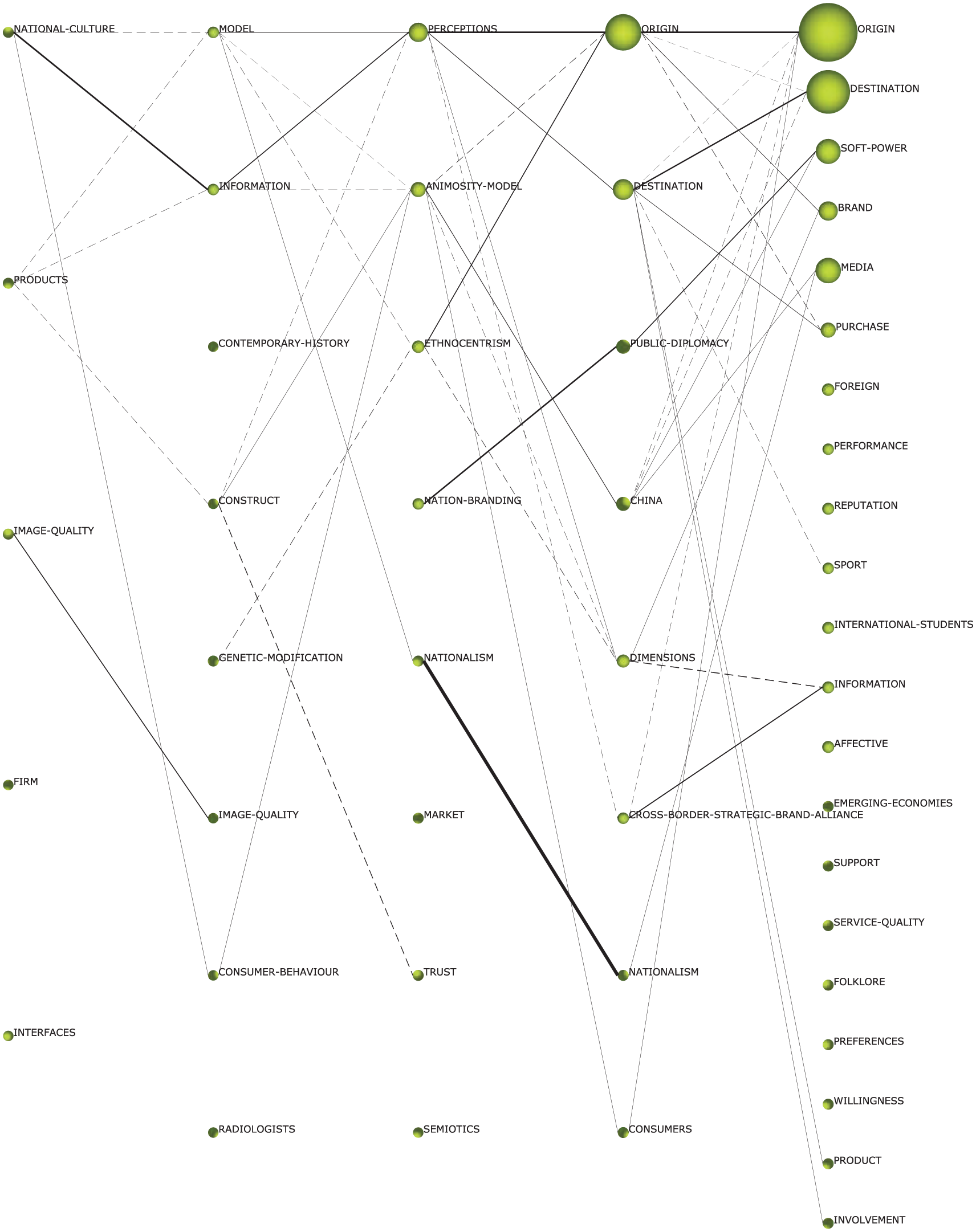
Evolution map of country image research themes.
A synthesis of these evolutionary pathways and the content of the associated literature reveals the emergence and consolidation of four major research streams since 1993. (1) Marketing in multinational business. This stream, arguably the most foundational and extensive, has consistently explored country image primarily through the lens of its impact on consumer behavior, product evaluation, and international branding strategies. (2) Destination studies in tourism management. Gaining significant traction, particularly from the middle period onwards, this stream focuses on how country image influences tourist perceptions, destination choice, and the marketing of tourism experiences. (3) Diplomacy in public relations. This stream investigates country image as a tool and outcome of diplomatic efforts, national branding initiatives, and the pursuit of soft power. (4) Media studies in communication. Increasingly prominent, this stream examines the role of various media platforms (traditional and new) in constructing, disseminating, and contesting country images, often at the intersection of major events or international relations.
Focusing on the specific pathways, the “marketing in multinational business” stream showcases several interconnected trajectories. Early themes like “National-Culture” and general “Model” building evolved through “Information” processing and “Consumer-Behavior” into more nuanced explorations of “Perceptions” and the “Animosity-Model.” These, in turn, frequently converged on the core concepts of country of “Origin” and “Brand” image in later periods (e.g., paths: National-Culture → Information → Perceptions → Origin → Origin, Brand; Model → Perceptions → Dimensions → Brand; Construct → Animosity-Model → Consumers → Origin). This indicates a progressive refinement from broad cultural considerations to specific marketing implications and consumer psychological responses. The emergence of “Cross-Border-Strategic-Brand-Alliance” also points to the application of country image in specific strategic contexts.
The “destination studies in tourism management” stream often branched from similar foundational themes like “National-Culture,”“Information,” and “Perceptions,” but specifically channeled into the “Destination” theme. This theme then expanded to incorporate related concepts such as “Purchase” (intentions), “Product” (tourism product), and “Involvement” in the most recent period (e.g., paths: National-Culture → Information → Perceptions → Destination → Destination, Purchase, Product, Involvement). This highlights a clear trajectory from general perceptions to specific tourism-related outcomes.
Pathways within “diplomacy in public relations” reveal a strong connection to national identity and strategic communication. Themes like “National-Culture” and later “National-Brand” evolved, often via considerations of “China” (as a prominent case study) or “Public-Diplomacy” itself, into the increasingly important theme of “Soft-Power” (e.g., paths: National-Culture → Consumer-Behavior → Animosity-Model → China → Soft-Power; National-Brand → Public-Diplomacy → Soft-Power). This illustrates a growing scholarly interest in the strategic deployment and impact of country image in international affairs.
Finally, “media studies in communication” pathways often shared early antecedents with other streams (e.g., “National-Culture,”“Model,”“Animosity-Model,”“China”) but distinctly evolved towards a focus on “Media” and its role, sometimes in conjunction with “Nationalism” or “Soft-Power” (e.g., paths: Model → Nationalism → Nationalism → Media; Animosity-Model → China → Soft-Power, Media). This signifies the recognition of media as a critical arena for both the construction and contestation of country images.
A striking observation from the final period (2018–2023) is that nearly half of the identified thematic keywords did not establish strong, direct associative paths from keywords in the immediately preceding stage. This suggests a significant influx of new research questions, theoretical framings, or empirical contexts, indicating a field that is not only maturing in established areas but also actively breaking new ground. This dynamism underscores the considerable potential for future country image research to continue generating novel associative themes, thereby further enriching and expanding the scholarly landscape.
Future Prospects for Country Image Research: An Integrated Agenda
The preceding systematic review and thematic evolution analysis have illuminated the trajectory of country image research over the past 3 decades, revealing both established streams of inquiry and emergent areas of dynamism. Key findings, such as the persistent centrality of marketing applications, the growing significance of destination branding, the increasing focus on public diplomacy and soft power, and the burgeoning interest in media’s role (particularly social media in the latest period), alongside the observed influx of new, less connected themes in the 2018 to 2023 period, directly inform the subsequent discussion of future research prospects. Specifically, the identified thematic gaps, methodological tendencies, and the rapidly evolving socio-technological context highlighted by this analysis necessitate a forward-looking agenda. The following key points for future investigation are therefore not arbitrary suggestions but are logically derived from the patterns, strengths, weaknesses, and evolutionary dynamics observed in the extant literature. This linkage ensures that future efforts are strategically positioned to build upon existing knowledge, address identified lacunae, and propel the field towards greater conceptual clarity, methodological rigor, and contemporary relevance. This study identifies several interconnected avenues for future investigation. Rather than isolated endeavors, these directions should be pursued within a cohesive framework that recognizes their synergies, ultimately fostering significant advancements in understanding the complex dynamics of country image in the 21st century. This integrated agenda emphasizes conceptual clarity, leverages the transformative potential of digital media and big data, champions methodological innovation through interdisciplinary and longitudinal approaches, and underscores the importance of contextual sensitivity through comparative research.
Foundational Clarity: Distinguish Clearly Between Country Image and Its Portrayal in Media
A cornerstone for future progress is the continued refinement and consistent application of core concepts. Clear conceptual definitions are vital for enhancing understanding, facilitating effective research design, boosting credibility, and encouraging theoretical development, particularly in interdisciplinary contexts (Butts et al., 2012; Hellman, 2024). A persistent challenge in country image research has been the conflation of “country image” (as an individual’s subjective perception) with its “media portrayal.” While media significantly influences how audiences perceive a country, the representation itself is an “intermediary” and not synonymous with the cognitive and affective image held by an individual.
The ambiguity surrounding the definition of country image has hindered the formation of consistent conclusions in related research. Despite the increasing diversity of definitions, there remains a lack of consensus in the academic community, both domestically and internationally, regarding this interdisciplinary concept (Lu et al., 2019). However, there should be agreement on the core of the country image concept. Whether viewed from a product perspective or a more pluralistic national perspective, country image should be understood as a type of image that reflects individuals’ subjective perceptions of a country. Based on existing literature, this study defines country image as the stable, comprehensive, subjective cognition and evaluation formed by domestic or international individuals through their exposure to information about a particular country. This definition emphasizes:
Specificity: Directed toward a particular nation.
Subjectivity: An individual’s internal cognitive/affective construct.
Plasticity: Shaped by the information encountered.
Stability and comprehensiveness: Not fleeting, encompassing multiple dimensions.
Inclusivity: Pertaining to both domestic and international audiences.
Future research, especially when engaging with media, should explicitly define whether its object of study is the media’s constructed narrative about a country or the country image perception formed by the individual. This conceptual clarity is fundamental for building a coherent body of knowledge.
Navigating the Digital Frontier: Social Media, Big Data, and Interdisciplinary Insights
The contemporary media landscape, dominated by social media and generating vast quantities of digital data, presents both unprecedented challenges and opportunities for country image research. Future inquiries must holistically understand this new ecosystem.
Investigating Social Media’s Transformative Impact
Based on the research findings presented above, research on country image and media has emerged as a prominent topic from 2018 to 2023, evolving from the themes of “China” and “Nationalism” that characterized the previous phase (2012–2017). However, much of the research has focused on traditional media. Recent studies indicate that social media has a significant impact on country image (Adejumo et al., 2024; Скріль & Луців, 2023; Nguyen et al., 2024). This importance arises not only because social media has become a key means for people to access information, but also due to its distinct characteristics compared to traditional media. Social media facilitates rapid, real-time information dissemination, features diverse sources, offers vast amounts of content, and presents information in various formats (Ariel & Avidar, 2015; Dijck & Poell, 2013; Vernuccio, 2014). This transformation enables direct communication between countries and global audiences (Flew & Iosifidis, 2020; Liu et al., 2023), which can swiftly alter public perceptions of country image. Unlike traditional media, which often relies on gatekeepers, social media empowers individuals to generate content, allowing them to shape narratives about a country’s image. This shift challenges conventional notions of media influence and underscores the significance of personal experiences in shaping collective perceptions of country image (Durani et al., 2024).
Therefore, what directions should the study of country image on social media take? These directions should consider both the shaping role of social media on audience perceptions of country image and the influences that country image exerts on other variables within the social media environment. Taking into account the characteristics of social media and the current state of media and country image research, Figure 5 outlines key and systematic directions: publisher, platform, content, algorithm, and audience. These fundamental elements collectively shape how country identities are constructed and perceived in the digital landscape. For instance, within the “publisher” direction, research can explore how various types of contributors—such as government entities, social media influencers, domestic and international media, and ordinary users—impact the shaping of country image. In the “platform” direction, examining cross-platform dynamics will illuminate how different social media environments influence perceptions of country identity. Regarding “content,” studies could investigate the effects of different types of social media information on country image, including the role of misinformation and public sentiment during major events, as well as assessments of their impacts and risk management strategies. In the “algorithm” direction, the evolving nature of algorithms calls for an investigation into their ethical implications and how they may perpetuate biases or enhance the visibility of certain narratives over others, thus affecting the dissemination of country image across diverse cultural contexts. Finally, in the “audience” direction, greater emphasis can be placed on the segmentation of content for different audiences and the evaluation of its effects. By integrating these dimensions, researchers can achieve a more comprehensive understanding of the multifaceted relationship between social media and country image.

Five directions for the study of country image on social media.
Harnessing Big Data Through Interdisciplinary Lenses
The sheer volume and velocity of data generated by social media and other digital platforms necessitate the adoption of big data analytics. However, data alone is insufficient. Based on the findings of this study, it is evident that country image, as an interdisciplinary concept, requires the incorporation of diverse approaches and the utilization of big data for in-depth analyses to advance research in this field. Recent studies have begun to explore these approaches (An et al., 2023; Xu & Wen, 2024; Zúñiga-Morales et al., 2024). Country image is a multifaceted construct influenced by various factors, including cultural, political, economic, and social dynamics (Lu et al., 2019). By integrating perspectives from disciplines such as communication studies, sociology, political science, and psychology, researchers can achieve a more comprehensive understanding of how country images are formed, maintained, and transformed.
Interdisciplinary collaboration allows for the exploration of complex interactions between media, public opinion, and international relations, providing richer insights into the mechanisms that shape perceptions. Furthermore, the use of big data analytics enables researchers to analyze vast amounts of information from diverse sources, such as social media, news articles, and public forums. This approach allows for the identification of patterns and trends that would be difficult to discern through traditional qualitative methods. By leveraging sentiment analysis, network analysis, and other data-driven techniques, scholars can uncover the nuances of how country images are constructed and perceived across different contexts and populations. Ultimately, embracing interdisciplinary methods and big data will enhance the robustness of country image research, enabling more comprehensive and empirically grounded conclusions that can inform both academic inquiry and practical applications in global diplomacy and public relations. In the future, for example, researchers can combine cultural studies with social media analytics to examine how cultural narratives influence perceptions of a country across platforms like Instagram and TikTok. Additionally, political scientists might use network analysis to understand how information dissemination affects country image, identifying key influencers and their impact on public opinion. Linguists can apply text mining techniques to analyze language patterns in social media discussions about a country, revealing sentiment trends during significant events. Furthermore, economists may leverage predictive analytics on big data to assess how shifts in country image correlate with economic indicators, such as tourism and foreign investment. This synergy between social media research, big data analytics, and interdisciplinary collaboration will enable more nuanced, empirically grounded insights into the construction, maintenance, and transformation of country images in the digital age.
Enhancing Methodological Rigor: Longitudinal and Comparative Designs
To capture the dynamic and context-dependent nature of country image, future research should increasingly adopt robust methodological designs that go beyond static snapshots. Country image possesses stability and continuity. Generally, whether concerning domestic or foreign audiences, changes in a country’s image are typically a lengthy process (Kuvykaite & Kerbelyte, 2008). Moreover, varying cultural backgrounds and social structures significantly influence how different groups perceive a country’s image, leading to diverse strategic approaches for altering these perceptions.
Longitudinal studies enable researchers to track changes in country images over time, offering valuable insights into how perceptions evolve in response to socio-political events, economic fluctuations, and cultural exchanges. This temporal perspective is essential for understanding the dynamics of country image formation and transformation, as it allows scholars to identify patterns, trends, and causal relationships that may not be evident in cross-sectional studies. Additionally, comparative research enhances our understanding of how different countries are perceived relative to one another, illuminating the contextual factors that shape these perceptions. By investigating variations in country images across diverse cultural and political landscapes, researchers can uncover the underlying mechanisms that influence public opinion and identify best practices for nation branding and image management. This comparative approach also facilitates the exploration of how global phenomena, such as globalization and transnationalism, impact country images differently across various contexts. Ultimately, integrating longitudinal and comparative methodologies will enrich the field of country image analysis, providing a more nuanced understanding of the complexities involved and informing strategies for effective international communication and diplomacy.
Future longitudinal research could track temporal shifts in public perceptions of host countries during major international events like the Olympics to assess the enduring impact on country image. Complementing this, comparative studies could explore divergent outcomes of image dissemination for the same event across nations, contrasting promotional strategies to evaluate their efficacy in fostering favorable perceptions. Further comparative avenues include cross-cultural analyses of how a country’s image is perceived differently (e.g., in Asia vs. Europe, especially following geopolitical shifts) and how media portrayals of countries like Russia or China in Western versus Eastern outlets shape public perceptions of these countries’ images through varying narratives. Finally, research on country image crisis management, examining the long-term effectiveness of strategies and their comparative impact on diverse audiences, would significantly advance the field.
Limitations
This study has several limitations, primarily in three areas. First, the systematic analysis of the literature focused exclusively on English-language papers sourced from the Web of Science database, thereby overlooking non-English research on country image and relevant studies not indexed in this database. Future research should consider incorporating literature in multiple languages and from a broader range of databases to provide a more comprehensive overview of the field. Second, the recommendations for future directions in country image research are somewhat subjective. While these suggestions aim to provide guidance, future studies could benefit from employing more rigorous methodologies, such as qualitative research methods that include interviews with prominent scholars and practitioners in the field. This approach would facilitate a more accurate identification of emerging trends in country image research. Third, future research should not rely solely on one bibliometric analysis tool but rather integrate multiple tools to enhance the scientific rigor of systematic reviews in the study of country image.
Conclusion
This study, employing SciMAT for a systematic review of 584 global country image publications over the past 3 decades, offers a comprehensive analysis of the field’s thematic evolution, revealing significant expansion and diversification from 1993 to 2023. While individual themes exhibited dynamic shifts rather than persistent stability, this evolution has cultivated richer research content and more nuanced perspectives, coalescing primarily around four major streams: marketing in multinational business (the most prominent), destination studies in tourism management, diplomacy in public relations, and media studies in communication. Addressing a persistent need for conceptual precision, this research proposes a refined definition of country image as “the stable, comprehensive, subjective cognition and evaluation formed by domestic or international individuals through their exposure to information about a particular country,” underscoring its subjective nature distinct from mere media portrayal. Building upon the analysis of historical trends and identified gaps, this paper advocates for a strategic future research agenda centered on three interconnected pillars: achieving foundational clarity by distinguishing between perceived country image and its media representation; navigating the digital frontier by leveraging interdisciplinary insights and big data to understand social media’s profound impact; and enhancing methodological rigor by prioritizing longitudinal and comparative designs to capture country image’s dynamic, context-dependent nature. By pursuing these directions, future scholarship can significantly advance our understanding of how country images are constructed, perceived, and managed in an increasingly interconnected and mediated world.
Footnotes

Ethical Considerations
Ethical approval was not required for this study as it did not involve human or animal participants.
Consent to Participate
Informed consent was not applicable as the study did not involve human participants.
Funding
This work was supported by the National Social Science Fund of China (Grant No. 25CKX032).
Declaration of Conflicting Interests
The author declared no potential conflicts of interest with respect to the research, authorship, and/or publication of this article.
Data Availability Statement
Data are available from the corresponding author upon request.