




Abstract
Animal Assisted Activities (AAA) are well-known for their positive effects, but the potential of Fish Assisted Activities (FAA) remains largely unexplored. This study investigated the effectiveness of FAA in alleviating anxiety, inducing mindfulness, and enhancing positive affect among college students with moderate to severe anxiety. A total of 104 participants were randomly assigned to one of three groups: visual, tactile, or a combination of both. After the intervention, participants completed assessments using PANAS (Positive and Negative Affect Schedule), STAI-Y (State-Trait Anxiety Inventory), and SMS (State Mindfulness Scale). Multivariate analysis of variance (MANOVA) was employed to examine the effects of the different treatment conditions on students' mental health. Result shows all groups exhibited reduced state anxiety, low negative emotions, and high positive emotions. The visual group demonstrated the most favorable outcomes in terms of state anxiety and negative affect. While no significant differences were found in state mindfulness and positive affect across groups. Heat emerged as a potential distraction during tactile activity, and the absence of a control group further limits the ability to isolate the effects of FAA from other potential contributing factors. Nevertheless, FAA could serve as a valuable supplement to conventional interventions and programs.
Introduction
Humans and animals have always had enduring and widespread relationships throughout history (Amiot et al., 2016; Le Roux & Wright 2020). In recent years, interest in human-animal interactions (HAI) has grown in response to rising mental health concerns among university students, whose psychological distress has been linked to diminished academic performance and well-being (Alemu & Feyssa, 2020). These interactions, often referred to as human-animal interactions or HAI, has provided significant evidence of its relaxation properties, its mitigating impact on anxiety, as well as its ability to provide companionship and opportunities for nurturance and social support across various groups (Ambrosi et al., 2019; Brown et al., 2020; Howell et al., 2023; Matijczak et al., 2020; Meehan et al., 2017; Moretti et al., 2011; Pitheckoff et al., 2018; Pitheckoff et al., 2019) . These benefits have contributed to the rise of Animal-Assisted Interventions (AAIs)—a broad category that includes Animal-Assisted Therapy (AAT), Animal-Assisted Education (AAE), and Animal-Assisted Activities (AAA) (Fine, 2022). Among these, AAA—structured but informal interactions with animals—has been implemented in university settings due to its accessibility and adaptability (Fine, 2022).
However, prior AAA research has predominantly focused on domestic animals, limiting exploration of the potential benefits of other animals. This presents an opportunity for academic institutions to leverage their resources to develop alternative proactive mental health support approaches to students. To date, most human-fish interaction studies have solely investigated visual exploration and have yet to differentiate the impact of hands-on or tactile interaction with the fishes. Within college campuses and student well-being contexts, the utilization of fish-assisted activities remains an underexplored and underutilized resource. The current study aims to extend this paradigm by experimentally comparing the psychological outcomes of visual, tactile, and combined fish-assisted activity modalities among university students. This study aims to explore the potential of fish interactions in increasing mindfulness, fostering positive affect, and reducing anxiety levels among college students.
Related Literature
Several theoretical frameworks have been proposed to explain the mechanisms behind the benefits of human-animal interaction (HAI), integrating both biological and relational perspectives. From a biological standpoint, the oxytocin hypothesis suggests that the neuropeptide oxytocin (OT)—which plays a crucial role in social cognition and behavior—is released during affiliative interactions between humans and animals. Studies have shown elevated oxytocin levels in both people and dogs following positive social contact, supporting the idea that the rise of oxytocin biologically reinforces calmness and stress reduction in HAI (Handlin et al., 2011; Herbeck et al., 2022; Nagasawa et al., 2009; Odendaal & Meintjes, 2003). Complementing this physiological view, the biophilia hypothesis—introduced by Fromm (1973) and further developed by Wilson (1984)—posits that humans have an innate affinity for life and living systems, including animals. This biologically rooted attraction is reflected in human culture, behavior, and emotional responses, suggesting that the comfort people derive from animals stems from a natural evolutionary predisposition. According to Social Support Theory, which emphasizes the role of interpersonal resources in buffering stress and promoting well-being, animals can also function as important sources of support. Beyond offering affectionate companionship, animals help individuals cope with emotional distress by providing consistent comfort and serving as safe outlets for expressing emotions during challenging times (Allen et al., 2002; Fine & Eisen, 2008). Human-Animal Relational Theory (HART), a newly developed guide for animal-assisted therapy in counselling also emphasizes how human–animal interactions are perceived to impact both parties’ well-being and behavior passively and actively (Chandler, 2018). It provides a model for recognizing and responding to therapeutic opportunities presented by human-animal interactions consistent with scientific understanding of the nature of human-animal interaction (Chandler, 2018). Collectively, these theories reveal that the positive effects of HAI are rooted in both biological mechanisms and complex relational dynamics, offering a multi-dimensional understanding of why interactions with animals are so impactful to human well-being.
In many experimental research, animal-assisted activities (AAA), a less formal type of AAI, which typically involves broader goals have shown physiological evidence of its relaxation-inducing effects particularly in heart rate, heart rate variability (HRV) and blood pressure. AAA in equine programs (García-Gómez et al., 2020) and in clinical approach (Clark et al., 2020) have been found to increase HRV and decrease heart rate signifying a state of calm and a positive emotional-physiological state. AAA have been recognized and implemented across clinical, educational, and recreational settings, for their benefits in improving well-being and promoting positive outcomes (Jones et al., 2019). With increasing mental health challenges among college students negatively affecting their academic performance (Alemu & Feyssa, 2020), campus-based AAA programs have also emerged as innovative interventions.
Experimental studies have revealed that AAAs are beneficial to college students, particularly during exam periods. Therapy dogs have been shown to reduce anxiety even with a brief 10-to-20-minute interaction (Crossman et al., 2015; Grajfoner et al., 2017; Pendry & Vandagriff, 2019; Pendry et al., 2019; Walker, 2023). Sessions involving therapy dogs showed that the longer students spent interacting with these animals, the greater the perceived benefits (Quintana et al., 2019). These findings, similar to those seen in a virtual dog exposure group, suggest that even visual pet images hold the potential to provide comfort to students dealing with academic anxiety (Thelwell 2019; Torres et al., 2016).
Experimental findings also suggest that interactions with animals in therapeutic settings may facilitate the improvement of mindfulness (Berget et al., 2008; Marcus et al., 2015). AAA was also associated with immediate positive changes in mood, encompassing, improved affect (Peel et al., 2023), increased energy, happiness, and life satisfaction after a single session of AAI (Ward-Griffin et al., 2018). In studies involving children with autism spectrum disorder (O'Haire et al., 2015) and adults with mental health conditions (Wells, 2019), AAA induced positive emotions such as joy and relaxation. Campus-based studies also resulted in mood improvements, increased feelings of contentment, and reduced irritability after brief dog-patting sessions prior exams (Crossman et al., 2015; Pendry et al. 2018; Pendry & Vandagriff 2019). These campus-based experimental studies consisted mainly of brief interactions resulting in notable and immediate positive changes in mood, affect, and wellbeing. This highlights AAA’s ability to foster a profound sense of relaxation—an essential element in reducing anxiety, increasing mindfulness, and improving positive emotion.
Nonetheless, research on the health benefits of animal-assisted interventions has mostly focused on animals like dogs, cats, and horses that physically engage with humans (Bert et al., 2016; Ebener & Oh 2017). However, kind of interaction may not be suitable for everyone due to various reasons, such as limited accessibility and potential risks for both people and animals. Dog-assisted interventions often rely on volunteer services and may require close supervision, resulting in infrequent and inconsistent exposure (Edwards et al., 2014; Ebener & Oh 2017). Concerns may also arise regarding the potential for aggression from the animal, allergies, compromised immune systems, phobias, or accidental injuries during contact (Ebener & Oh, 2017). In pursuit of safer alternatives to achieve benefits while minimizing associated risks, research has shifted its focus toward human-fish interactions. This transition stems from the acknowledgment that fish-assisted activities and therapies can offer similar advantages to those obtained through interactions with cats and dogs.
With visual observation, an experimental study revealed that interacting with a single fish, even in a goldfish bowl, can reduce anxiety to a similar extent as interacting with a dog or even a plant (Sarman & Günay 2023). Previous research has demonstrating that individuals observing fish in aquariums perceived their experiences as relaxing and noted reductions in blood pressure, pulse rate and muscle tension and an increase in skin temperature (Arsovski, 2024; Ein et al., 2018; Rodrigo-Claverol et al., 2019)
Oxytocin (OT) release during interactions with animals could also offer valuable insights towards psychosocial and psychophysiological effects of HAI (Gnanadesikan et al., 2024). The research claimed that both Oxytocin and HAI have the potential to enhance social interaction, alleviate anxiety, and promote overall well-being. Therefore, in theory, oxytocin is released not only through eye contact but also through tactile interaction, playing a crucial role in the anxiety reduction effect of oxytocin (Eckstein et al., 2020). In a study that focused on the influence of touch-tank experience on public visitors (Sahrmann et al., 2016), it was observed that a 10-minute interaction with various animals including stingrays, sharks, and horseshoe crabs resulted to reduced tense arousal, elevated mood, increased relaxation and energy. This makes the oxytocin hypothesis especially relevant for exploring the potential of Fish-Assisted Activities (FAA), which offer both visual and tactile components. While other frameworks such as the Biophilia Hypothesis and Social Support Theory offer complementary perspectives on why human-animal interactions are beneficial—highlighting innate attraction to nature or the supportive function of animals—these were not central in informing the specific design or measures used in this study. Instead, the present research builds upon the Oxytocin Hypothesis to explore whether brief interactions with fish, especially through combined sensory modalities, can elicit similar psychophysiological outcomes documented in other animal-assisted interventions.
However, to date, there is a noticeable gap in experimental research concerning the psychological benefits of combined visual and tactile interaction with fish. Research that consisted multisensory interaction mainly involved participants who either own and take care of fish or participants that were provided and assigned to take care of them via feeding and tending to the aquarium/tank (Alfrey et al., 2022; Maranda et al., 2015;). In contrast to public aquarium visitors, home aquarium owners, have the technical capacity for more interactive engagement with their pet fish. Fish owners report significant advantages, such as feelings of relaxation, stress reduction, positive impacts on behavior and anxiety levels through engagement activities of caring for and closely observing fish (Clements et al., 2019; Edwards et al., 2014; Gee et al., 2019). However, some studies reveal that these effects are possibly attributed to observing the fish’s movements and the soothing sound of running water (Gee et al., 2019; Langfield & James, 2009). Thus, the results lean more towards the visual effects rather than multisensory, including tactile interaction. Consequently, the impact of hands-on interaction with fish remains undistinguished.
In summary, these research findings collectively underscore the positive impact of Animal-Assisted Activities on individuals’ mental well-being. However, existing studies have predominantly focused on animals such as dogs, cats, horses, and other domesticated species, leaving a gap in employing potential psychological benefits of interacting with fish. Additionally, most human-fish interaction studies have solely investigated visual exploration. Within college campuses and student well-being contexts, there is a lack of experimental FAA research involving tactile and multisensory interaction among students. Thus, this also presents an opportunity for academic institutions to leverage their resources to develop alternative proactive mental health support approaches to students.
Further exploration and investigation are important to fully understand the beneficial potential of fish in enhancing students’ mental health and well-being. Therefore, the current study intends to investigate the effects of Fish Assisted Activity on anxiety, negative affect, mindfulness, and positive affect among college students in anticipation of their semester examinations. The study has three primary objectives: first, to quantitatively assess changes in students’ state anxiety levels; secondly, to measure the induced mindfulness, positive affect and quantify negative affect levels after the intervention, and lastly, to explore the efficacy of three distinct treatment conditions: (1) visual observation, (2) tactile interaction, and (3) a combination of both.
Methodology
Participants
A total of 104 participants were involved in the study, divided into three groups: the visual group (n = 35), the tactile group (n = 34), and the combination group (n = 35). Of the total sample, 32 participants (30.8%) identified as male and 72 (69.2%) as female (M = 1.31, SD = 0.46). Participants were aged between 18 and 23 years (M = 19.7, SD = 1.41). The participants were undergraduate students drawn from various colleges within the university: College of Agriculture (18.3%), College of Arts and Social Sciences (39.4%), College of Education (1%), College of Engineering (26%), College of Home Science and Industry (10.6%), and College of Science (4.8%). All participants exhibited moderate to extremely severe symptoms of anxiety, as measured by the screening instrument.
Participants with the following criteria were excluded: living with pets they were emotionally attached to, (2) visited living animal museum or zoo within the past month, (3) individuals expressing a dislike for fish interaction (4) students from College of fisheries and Veterinary Science and Medicine (5) students currently receiving any form of psychological treatment. This careful screening aimed to reduce potential confounding factors. However, potential sampling biases may still be present. For instance, the voluntary nature of participation may have favored students with a particular interest in mental health or animal-assisted interventions, while classroom-based and professor-mediated recruitment may have disproportionately included students who are more academically engaged or compliant.
To identify suitable participants, the researchers employed a convenience sampling strategy for recruitment, initially, they disseminated a mass online invitation and later explored an in-person recruitment strategy. After screening, unqualified participants were promptly notified. Conversely, qualified participants were ranked by anxiety levels, and every block of three was randomly assigned to one of three treatment conditions (Visual Observation, Tactile Interaction, or Combination Exposure) using a random number generator. This process aimed to achieve balanced representation across anxiety levels in each treatment group. While the study did not involve blinding or independent personnel during allocation, the randomization process was automated to minimize researcher bias and maintain objectivity.
Procedure
Participants were partially informed about the study’s aim to assess Fish-Assisted Activities (FAA) for student mental health improvement. The nature of the study, especially the step-by-step procedures, treatment conditions, and treatment variables under investigation was not provided. Recruitment employed social media and face-to-face, requiring a demographic survey and the DASS-21–anxiety subscale completion, alongside informed consent. Data from these instruments facilitated participant selection based on eligibility and availability, aligning with the experiment venues’ capacity. Treatment experiences were standardized using scripts to ensure consistent administration across groups, with strict instructions to avoid communication and external distractions during sessions. A manipulation check assessed the influence of social interactions within treatment outcomes.
The study comprised single exposure of three treatment conditions: Visual Exposure, involving a 10-minute aquarium observation followed by a 10-minute museum exploration; Tactile Interaction, featuring a 20-minute session of fish feeding and touching; and Combination Treatment, integrating both tactile and visual interactions in a 20-minute session. Prior to the experiment, participants were reminded that talking is not allowed, to focus solely on the designated activity, and avoid distractions from their surroundings. The Living Fish Museum features a collection of tilapia, catfish, and ornamental freshwater fish, housed in 20 aquarium tanks containing various species. The Visual Exposure condition began with a 2-minute introduction during which personnel from the College of Fisheries introduced students to the museum.
Following this, students were then lined up at the entrance of the museum, entering one at a time. Then they were directed to stand at markers in front of the aquariums and observe the fishes, moving to the next station every 30 s. This rotation continued through 20 stations or aquariums, totaling 10 min of observation time. This process ensured that all students have the same amount of exposure to the fishes in the aquariums. After this, they were given the freedom to explore the museum independently for 10 min, during which they could closely observe the various fish species on display. This open exploration period allowed students to deepen their understanding and curiosity.
For the Tactile Interaction condition, students were gathered outside the museum building. The outdoor area beside the museum housed large concrete circular tanks, each stocked with approximately 6,000 tilapia fingerlings. Students received a 2 min comprehensive briefing on the activities that they were about to engage in. After the initial briefing, participants were directed to the Broodtanks area where they received a designated amount of fish food. They were instructed to feed the fishes in the two fish tanks for a duration of 10 min. They were given 5 min for the first tank and another 5 min for the second tank. After this, they engaged in a hands-on experience where they were led to the fingerlings’ tanks and had the opportunity to touch the fishes and hold them for 10 min.
Moreover, the Combination Treatment included both Visual Exposure and Tactile Interaction. Participants began with Tactile Exposure, following the same process but with adjusted time allotment now amounting to 10 min: a comprehensive briefing, fish-feeding for the first 5 min, and touching the fingerlings for another 5 min. Afterwards, participants gathered in front of the museum building to simultaneously start the Visual Interaction for 10 min: they engaged in lined exploration for 5 min, then free exploration for the remaining 5 min.
Prior research had used similar durations for human-animal interventions, ranging from 10 min (Cracknell et al., 2017; Pendry & Vandagriff 2019) to 20 min (Grajfoner et al. 2017; Lundberg & Srinivasan 2021). The researchers aimed to strike a balance between providing sufficient exposure to the treatments while also making it practical for participants. The selected durations were considered appropriate based on existing literature.
After the treatment, participants completed a series of questionnaires—including the Manipulation Check, STAI-Y, PANAS, and SMS—in a designated room to assess the effects of Fish-Assisted Activity (FAA) on relaxation, mindfulness, affect, and anxiety. To minimize potential cross-group influence, participants were informed and required to sign an agreement prohibiting discussions or the sharing of information about their assigned treatment conditions until the conclusion of the study. While this precaution aims to preserve the integrity of the intervention, we acknowledge that the possibility of informal communication among participants cannot be entirely ruled out and recognize this as a limitation of the study. All participants received snacks and a study debrief following the session.
Measures
A. Depression Anxiety Stress Scale
The DASS-21 was used to screen volunteers, focusing solely on its anxiety component. This self-administered instrument consists of 21 statements, measuring autonomic arousal, muscular tension, situational anxiety, and subjective beliefs about anxious feelings (Lovibond and Lovibond in 1995). Raw scores were multiplied by 2. Scores range from 0 to 21, with categories ranging from 0 to 7 (normal), 8 to 9 (mild), 10 to 14 (moderate), 15 to 19 (severe), 21 and above (extremely severe) anxiety. The DASS-21 anxiety scale has shown high reliability (Cronbach’s alpha of .89) and validity, correlating strongly with other anxiety measures like the State Trait Anxiety Inventory.
In this study, students who exhibit moderate to extremely severe anxiety levels were selected to participate. The prevalence of moderate anxiety within the general population (Komariah et al., 2022) underscores the necessity of a more novel approach beyond the one-size-fits-all strategy, which does not adequately address the diverse needs of individuals experiencing different degrees of anxiety (Lépine & Briley, 2011). Including participants with moderate anxiety levels, enhances the study’s relevance, generalizability, and validity. This comprehensive inclusion ensures that the research reflects a broader spectrum of experiences, making its findings more applicable and beneficial to a wider audience.
B. State-Trait Anxiety Inventory- Form Y- STAI-Y
Assesses anxiety in adults and includes two subscales: the State Anxiety Inventory (SAI) and the Trait Anxiety Inventory (TAI), each comprising 20 items (Spielberger, 1989; Spielberger et al., 1983). The SAI measures current feelings in specific situations, while the TAI evaluates general emotional states. This study solely focused on the SAI. The STAI-Y employs a four-factor model, including items indicating the absence of anxiety, with 10 reversed items in the S-Anxiety scale. Total scores range from 20 to 80, with categories of “no or low anxiety” (20–37), “moderate anxiety” (38–44), and “high anxiety” (45–80).
C. Positive and Negative Affect Schedule
The 20-item self-report measure widely used to assess the levels of positive and negative affect (Watson et al., 1988). The scale includes two subscales: positive affect (PA) and negative affect (NA). PA reflects pleasurable engagement, while NA encompasses various negative states. Scores for each subscale were separated, with higher scores indicating more positive or negative affect, respectively.
D. State Mindfulness Scale
The State Mindfulness Scale (SMS) was employed post-activity to measure participants’ state mindfulness (Tanay & Bernstein, 2013). This 21-item self-report scale assesses present-moment attention and awareness of bodily sensations and mental events during a specific period and context. The scale consists of two subscales: mind (15 items) and body (6 items). Responses were scored on a Likert scale ranging from 1 (not at all) to 5 (very well), with higher scores indicating greater mindfulness.
E. Manipulation Check
Participants rated their current relaxation using a 1 to 100 Visual Analogue Scale (VAS), a widely used and sensitive method for capturing subtle variations in subjective experiences. This continuous scale allows for greater precision and granularity compared to Likert-type or categorical scales, making it particularly useful in detecting nuanced shifts in internal states such as relaxation. The VAS has been validated in clinical and psychological research as an effective tool for measuring subjective states like pain, stress, and mood (Bijur et al., 2001; Gift, 1989).
However, as a single-item self-report, the VAS lacks the psychometric reliability of multi-item scales and may be susceptible to participant bias. Despite these limitations, it served as a practical tool to confirm whether the FAA interventions created a consistently relaxing environment across conditions.
F. Open-ended question
Questions were administered after the intervention along with other research instruments.
Data Analysis
To assess the comparative outcomes of visual, tactile and combination modes of fish-assisted activity on anxiety, mindfulness, positive and negative affect, a one-way between-subjects multivariate analysis of variance (MANOVA) was used with post hoc Tukey tests conducted in case of a significant overall F-value. Effect size statistics (partial η2) were calculated to account for group size differences. A separate one-way between-subjects MANOVA was performed to analyze the manipulation check scores and evaluate the treatment’s effectiveness in inducing relaxation. A p value <.05 was considered statistically significant. SPSS Statistics 25.0 was used for statistical analyses
Ethics Statement
The studies involving human participants were reviewed and approved by the (Ethical Clearance Reference Number: 2023-752 on December 11, 2023. Respondents gave written consent for review and signature before participating. They were given the option to refuse to participate by opting out anytime during the experiment.
Results
The participants’ scores of STAI, PANAS, and SMS after the treatments showed “no or low” state anxiety, “high” positive emotions and “very low” negative emotions as shown in Table 1 and Figure 1. Prior to conducting MANOVA, assumptions were tested to ensure validity of the analysis. Levene’s Test of Equality of Error Variances indicated that the assumption of homogeneity of variances across groups was met for all dependent variables, with non-significant results: State Anxiety, F(2,101) = 0.194, p = .824; State Mindfulness, F(2,101) = 1.062, p = .350; Positive Affect, F(2,101) = 0.997, p = .373; and Negative Affect, F(2,101) = 2.336, p = .102. Furthermore, the Box’s Test of Equality of Covariance Matrices was also non-significant (M = 32.035, F(20, 36,560.423) = —, p = .067), indicating that the assumption of homogeneity of variance-covariance matrices was tenable.
Means and Standard Deviations of State Anxiety, State Mindfulness, Positive and Negative Affect.
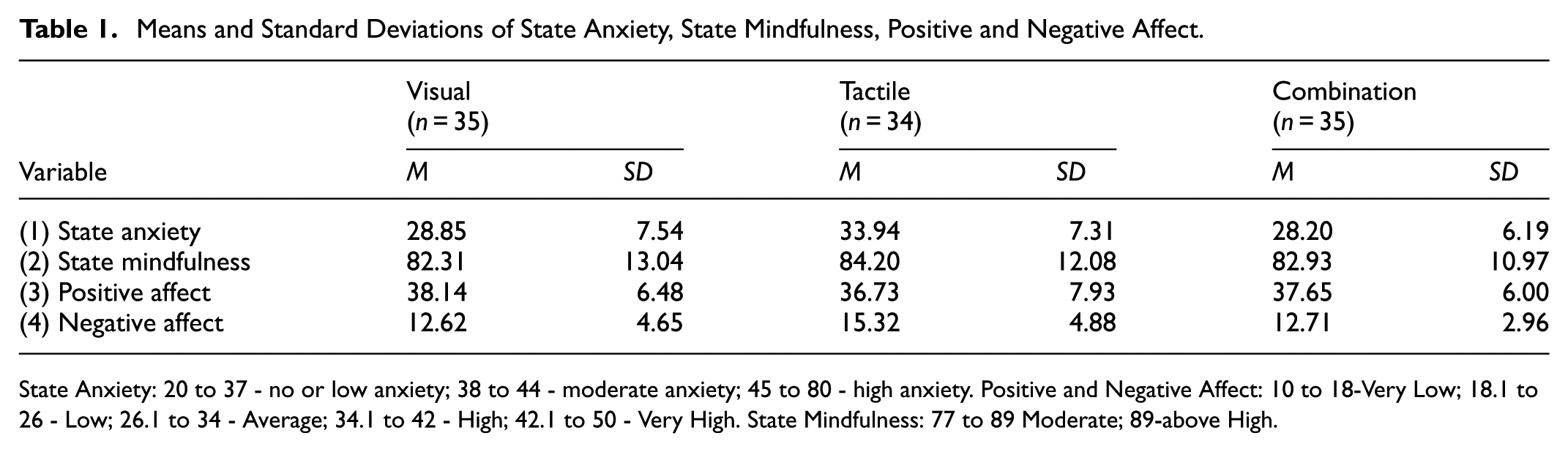
State Anxiety: 20 to 37 - no or low anxiety; 38 to 44 - moderate anxiety; 45 to 80 - high anxiety. Positive and Negative Affect: 10 to 18-Very Low; 18.1 to 26 - Low; 26.1 to 34 - Average; 34.1 to 42 - High; 42.1 to 50 - Very High. State Mindfulness: 77 to 89 Moderate; 89-above High.

Graphical representation of means.
Given that assumptions were satisfied, a one-way MANOVA was performed to assess the effect of exposure type on the combined dependent variables. The analysis revealed a significant difference between the Fish Assisted Activity’s exposure types (λ = 0.829, p = .017, η2 = 0.089), leading to the rejection of the null hypothesis of equal groups across dependent variables. Medium effect size was observed suggesting that approximately 8% of the variance in the dependent variable can be attributed to the independent variable. Specifically, a statistical significant difference was found in State Anxiety (F = 6.845, p = .002) and Negative Affect (F = 4.458, p = .014), both exhibiting moderate effect sizes (Table 2). These findings emphasize that the observed changes are meaningful enough to have practical implications in real-world settings.
Test of Between-Subjects Effect.
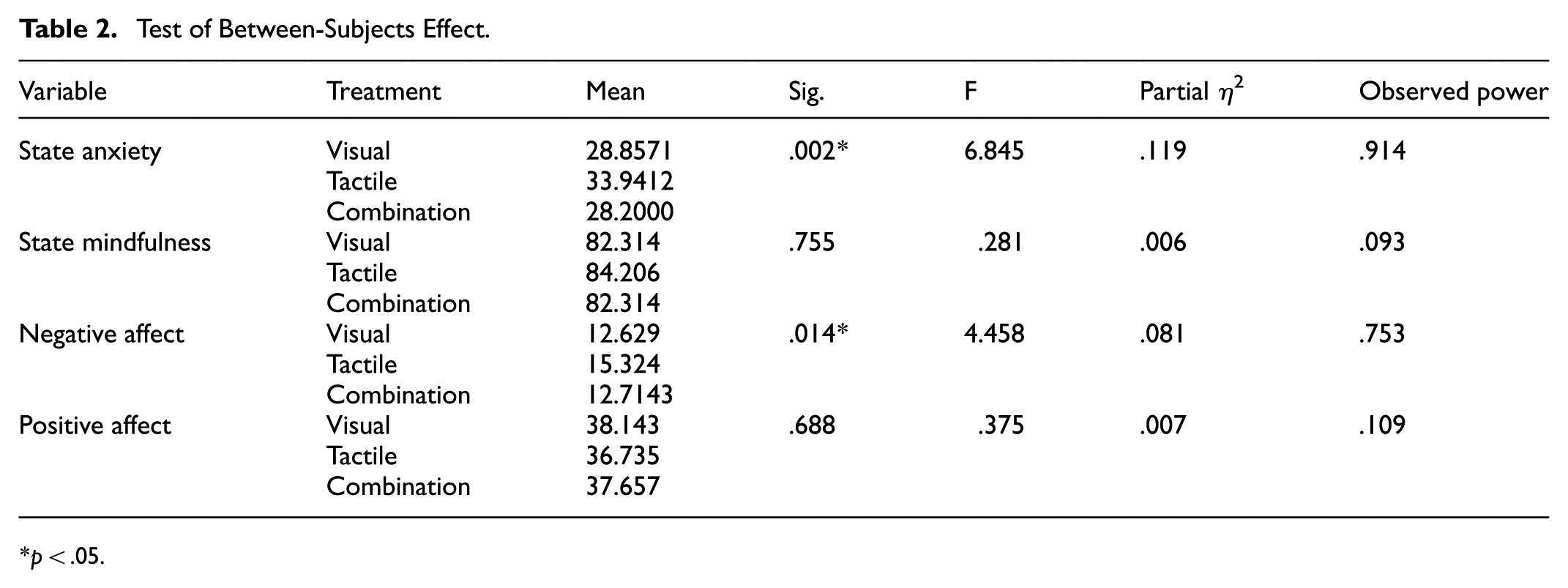
p < .05.
There were no significant differences observed in State Mindfulness (F = 0.281, p > .05) and positive affect (F = 0.375, p < .05 ) among the three treatment conditions (Table 2). Nonetheless, despite the absence of significant differences, the scores for state mindfulness (M = 82.314, M = 84.206, M = 82.314) and positive affect (M = 38.143, M = 36.735, M = 37.657) remain consistently similar across the three groups, implying that, irrespective of the conditions, all groups exhibited similar levels of mindfulness and positive emotions during the exposure (Table 1 and Figure 1).
Table 3 shows the result of post-hoc analysis showed the tactile group exhibited significantly higher levels of state anxiety (M = 33.94) compared to both the visual group (M = 28.85) and combination group (M = 28.20), with mean differences of 5.08 and 5.74, respectively (p < .05) (Table 3). Similarly, significant differences in negative affect were observed between the tactile group (M = 15.32) and both the visual group (M = 12.62) and combination group (M = 12.71), with mean differences of 2.695 and 2.609. No significant differences were found between the visual and combination groups for either state anxiety or negative affect (p>0.05). These findings indicate that while all groups showed reduced levels of state anxiety and low scores of negative affect, the tactile group exhibited comparatively lesser reduction in these psychological states.
Post-Hoc Test via Tukey’s HSD.
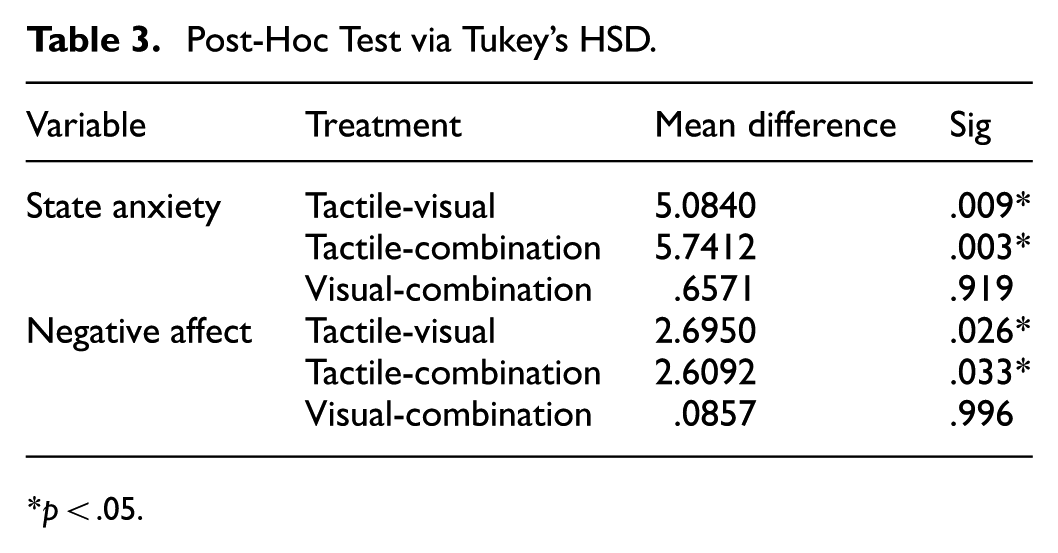
p < .05.
Discussion
The present study investigated the impact of Fish-Assisted Activity (FAA) on college students’ mental health, exploring the differences in the effects of visual observation, tactile interaction, and a combination of both. This study aimed to determine how these modalities influence state anxiety, mindfulness, positive affect, and negative affect among students anticipating their semester examinations.
Participants across all treatment groups showed high levels of positive affect, moderate state mindfulness, very low negative affect and anxiety. Additionally, it was implied through the manipulation check ratings that the participants perceived that they felt relaxed during their respective activities. Qualitative responses further supported these findings, highlighting feelings of relaxation, happiness, and calmness among participants. They also expressed that they felt present at the moment during their respective activities. Overall, these findings provide evidence for the relaxation properties of Fish-Assisted Activity (FAA) and align with previous studies that highlight the benefits of engaging in relaxation activities, such as FAA, to promote mindfulness (Berget et al., 2008), induce positive affect (Grajfoner et al., 2017; Pendry & Vandagriff, 2019), and mitigate anxiety (Pendry et al., 2018; Pendry & Vandagriff, 2019; Walker, 2023).
The nature of this study enables the researchers to assess the impact of Fish-Assisted Activities on students anticipating their first-term examinations. The findings indicate that these activities can effectively alleviate anxiety among college students, particularly when faced with high academic demands. Few participants experienced immediate relief from interacting with fishes during these activities, offering them temporary relief from academic pressures. Despite brief interactions, these results support integrating Fish-Assisted Activities as a campus-based intervention, consistent with existing research on other forms of Animal-Assisted Activities implemented in similar settings (Delgado et al., 2018; Pendry et al., 2018; Pendry & Vandagriff, 2019; Peel et al., 2023).
Interestingly, the findings revealed no statistically significant differences in state mindfulness and positive affect across the visual, tactile, and combination groups. All groups reported relatively high levels of mindfulness and positive affect, potentially leaving little room for measurable differences. Furthermore, the qualitative feedback indicated that participants across all groups felt present and emotionally uplifted, implying that even brief exposure to fish, regardless of modality, can elicit mindful awareness and positive mood states. These findings reinforce the notion that FAA's therapeutic impact may not necessarily depend on tactile engagement, and that the mere presence of fish be sufficient to generate emotional and cognitive benefits (Cracknell et al., 2017; Gee et al., 2019).
Exposure to visual stimuli emerged as superior among the three exposures, aligning with previous studies on the psychological benefits of observing fish in aquariums (Buttelmann & Römpke, 2014; Clements et al., 2019; Cracknell et al., 2017; Gee et al., 2019). Contrary to expectations, tactile interaction did not yield superior results in decreasing state anxiety and negative affect, potentially due to reported discomfort caused by extreme heat during the activity. This environmental factor may also explain why the combined condition did not outperform visual exposure alone, despite incorporating both sensory modalities. Nonetheless, the combination approach demonstrated benefits comparable to those of visual interaction, suggesting that with appropriate adjustments to address environmental challenges, it may hold greater potential for enhancing psychological outcomes.
However, while these positive outcomes are promising, they should be interpreted with caution due to the absence of a control group. Without a comparison group unexposed to FAA, it is difficult to determine whether the observed benefits were directly attributable to the intervention itself or influenced by other confounding factors. One such factor is demand characteristics, as participants were made aware through recruitment materials that the study aimed to investigate FAA's impact on mental health. This prior knowledge may have shaped their expectations and, consequently, their self-reported outcomes. Moreover, non-specific influences such as the novelty of the tactile activity and the quiet, air-conditioned environment experienced during visual exposure may have independently contributed to stress reduction and mood enhancement. These contextual elements, rather than the FAA intervention itself, could have played a significant role in the participants’ perceived improvements.
Despite these limitations, the findings suggest that FAA—particularly in the form of passive visual observation—may serve as a low-risk, low-maintenance campus-based intervention, offering psychological relief during periods of academic stress. Compared to traditional Animal-Assisted Activities, fish-based interventions carry fewer logistical and safety concerns, making them feasible for broader implementation (Ebener & Oh, 2017; Edwards et al., 2014). To strengthen the evidence base, future studies should incorporate randomized control groups, extend the duration of exposure, and withhold explicit disclosure of the study’s intent during recruitment to minimize bias.
Conclusion
This study highlights the relatively unexplored use of fish-assisted activity as an alternative approach to providing tailored psychological benefits for college students. The current paper filled the gap in the literature by pioneering Fish-Assisted Activity as a campus-based intervention. Results showed that across all three fish-assisted activities, participants reported a high level of positive emotions along with very low negative emotions and decreased anxiety. Participants exposed to tactile activity did not show a more significant reduction in state anxiety and negative affect compared to visual activity possibly due to differing temperature conditions. Participants' perceptions of their exposure also support the effectiveness of the activities. Nonetheless, these findings should be interpreted with caution, as the absence of a control group limits causal conclusions and the influence of confounding environmental and psychological factors cannot be ruled out.
Limitation
The limited duration of the intervention, restricted to a single session, presents a constraint in assessing the sustained impact of Fish-Assisted Activity on students' mental health. This was primarily due to scheduling conflicts, as the simultaneous administration of activities had to align with participants’ availability. As a result, the long-term benefits of repeated or prolonged engagement with the FAA could not be fully explored.
Variations in environmental conditions across treatment groups may have influenced participants’ experiences and responses. Differences in room temperature, noise levels, or lighting could have introduced uncontrolled variables that affected the consistency and comparability of the intervention. Moreover, the manipulation check—intended to verify whether the activities were relaxing—relied on subjective self-reports, which are inherently susceptible to social desirability bias and perceived expectations about the study's purpose.
Crucially, the absence of a non-treatment or waitlist control group limits the ability to draw causal conclusions. Without a comparison group unexposed to FAA, it is difficult to determine whether the observed improvements were attributable to the intervention itself or to extraneous factors such as the novelty of the activity, the relaxing environmental context, or expectancy effects. Although differences were noted across the three modalities, these should not be directly interpreted as evidence that FAA alone produced the observed effects.
Additionally, although participants were instructed and signed an agreement to refrain from discussing their assigned treatments, the possibility of informal communication could not be eliminated. This potential for cross-group information sharing is recognized also as a limitation of the study.
Recommendations
Future studies are recommended to include repeated sessions and follow-up assessments beyond the immediate post-intervention period sessions to assess the long-term impact and sustainability of the observed effects. This will provide insights into the long-term impact and sustainability of FAA interventions. Standardizing the setting for fish interactions, such as using the same enclosure or aquarium for all activities, can reduce variation in the level of interaction. Manipulating environmental factors, such as temperature, lighting, and noise levels, can create a consistent and comfortable environment for participants, minimizing potential variations caused by external factors. Including a non-treatment or waitlist control group is also essential to isolate the true impact of FAA from other contributing factors.
Additionally, future studies should consider more objective or physiological measures to supplement self-report instruments and reduce the influence of participant bias. To further improve internal validity, researchers should also take steps to minimize the risk of treatment contamination, such as ensuring participants do not communicate about their assigned activities during the study period. These recommendations aim to enhance the validity, reliability, and comprehensive understanding of the impacts of FAA interventions.
For practical implications, incorporating FAA into educational settings as an intervention to alleviate anxiety and promote mental well-being among students is beneficial, as it has been shown to alleviate anxiety and foster emotional well-being. Additionally, it can be used as an alternative or supplementary activity alongside traditional interventions like counseling. Visual and combination approaches are recommended to enhance engagement; while considering environmental factors such as temperature is important to optimize the effectiveness of tactile activities. Prior research has established the efficacy of Animal-Assisted Activity (AAA) in various therapeutic contexts, including psychiatric, geriatric, and residential care settings, demonstrating consistent reductions in anxiety and depression alongside improvements in mood and affect (i.e.,Ambrosi et al., 2019; Brown et al., 2020; Scott & Kirnan, 2023). Aligned with this literature, the present findings highlight the potential of Fish-Assisted Activity (FAA) as a viable therapeutic modality, warranting further investigation and broader application beyond academic contexts.
Footnotes

Ethical Considerations
The studies involving human participants were reviewed and approved by the Ethics Review Committee at Central Luzon State University ((Ethical Clearance Reference Number: 2023-752) on December 11, 2023. The students/participants provided their written informed consent to participate in this study. The animal study was reviewed and approved by Central Luzon State University’s College of Fisheries – Freshwater Aquaculture Center.
Consent to Participate
The study was approved by the Ethics Review Committee at Central Luzon State University (Ethical Clearance Reference Number: 2023-752) on December 11, 2023. All participants provided written informed consent prior to participating.
Funding
The authors received no financial support for the research, authorship, and/or publication of this article.
Declaration of Conflicting Interests
The authors declared no potential conflicts of interest with respect to the research, authorship, and/or publication of this article.