




Abstract
Microfinancing, as a transformative financial tool for financial inclusion, has gained important consideration for its potential to empower rural populations and disadvantaged groups, including women and people with disabilities, by providing access to credit and other financial services in fostering economic development and reducing poverty. This study explores the bibliometric analysis of Scopus-indexed articles covering the period 2016–2024 to map the research landscape of microfinance. The study utilised the PRISMA technique in the sampling procedure, which resulted in 1,439 sampled papers. VOSviewer software was used to assess publication trends, influential authors, and themes in the research domains. The findings show that microfinance it’s an active field that engages in publishing quality academic papers which address potential issues related to national and individual development. The statistics indicate that Carlos Serrano-Cinca is a prominent author in microfinancing literature, with 68 citations per paper. The principal research themes identified encompass financial inclusion, microfinance, microcredit, women’s empowerment, and poverty alleviation. Nonetheless, the identified significant deficiencies in microfinance research, the intersection of microfinance and technology is are underexplored area that requires attention to augment microfinance’s contribution to financial inclusion, sustainable economic development and poverty alleviation in financially marginalised communities. This study offers significant understandings for legislators, researchers, and other stakeholders of financial inclusion, aiming to enhance microfinance institutions worldwide to promote financial inclusion and sustainable development.
Introduction
Microfinance institutions (MFIs) are among the most suitable entities for promoting financial inclusion (Maeenuddin et al., 2024), primarily focusing on providing financial access in rural regions and to marginalised groups, including women, individuals with disabilities, and those facing economic hardships and excluded by traditional institutions. (Borham et al., 2024; Dhungana, 2023; Gupta & Sharma, 2023; Khan et al., 2024; Khatoon & Reddi, 2014; Maity, 2023; Rasel & Win, 2020; Ribeiro et al., 2022). Initially, microfinance institutions began as providers of microcredit (Khan et al., 2024). Since that time, they have diversified their offerings to include a range of financial services and have broadened their reach to cover larger geographical regions (Hossain et al., 2024; Mia, 2016). Microfinance institutions are acknowledged as entities that utilise appealing and innovative methods for service delivery. These include the implementation of group lending strategies, the replacement of traditional collateral requirements for loan applications, the integration of technology, the offering of financial literacy programs, user-friendly terms, and the development of services specifically designed to cater to the needs of their clients (Mujeri & Mujeri, 2020). Such approaches have significantly increased the accessibility of financial services through these institutions (Bahadur & Bhandari, 2021; Milana & Ashta, 2020; Omowole et al., 2024; Siwale & Godfroid, 2022).
Recently, microfinance has become popular because of its capacity to promote financial inclusion, particularly in highly vulnerable regions and among communities that encounter difficulties in accessing financial services (Maeenuddin et al., 2024). 2016 to 2024, a timeframe characterized by significant changes and advancements which affect microfinance sector, for example the increase usage of digital technology, (Broby, 2021; R. Wang et al., 2024), not only that but also the world was witnessing countries and development stakeholders actively working toward the realization of the 17 Sustainable Development Goals (SDGs), adopted by the United Nations in 2015 (Sachs et al., 2019). Within this framework, financial inclusion has been prioritised as a key instrument for achieving several SDGs, particularly those related to poverty reduction, gender equality, and economic growth (Danladi et al., 2023; Jia et al., 2021; Maity, 2023). Against this backdrop, the period from 2016 to 2024 provides a relevant timeframe for examining scholarly research in the field of microfinance, as it coincides with the global implementation of the SDGs. Therefore, this study conducts a bibliometric analysis to identify the most frequently discussed themes, influential journals, researchers, and highly cited papers within this period. The study aims to provide important insights and recommendations for policymakers, practitioners, and those engaged in the field of microfinance (Sadek et al., 2023). This study is guided by the following key questions:
Literature Review
Different studies underscore the crucial function of Microfinance Institutions in providing financial services to underprivileged populations that have historically encountered obstacles in accessing mainstream financial systems (Herath et al., 2023), including women (Bharti & Malik, 2022; Hinkosa, 2023; Ogunleye, 2017; Pervin et al., 2023), small and medium enterprises (SMEs), smallholder farmers, and other marginalised businesses (Audu et al., 2021; Ouattara et al., 2020). These functions establish MFIs as an essential instrument for financial inclusion (Mishra et al., 2024). Thus, MFIs act as agents for economic development at both individual and national levels by promoting economic activities, alleviating poverty, generating employment opportunities, enhancing asset ownership, encouraging entrepreneurship, and empowering marginalised groups, particularly women (Addai, 2017; Chikwira et al., 2022; Datta & Sahu, 2021, 2022; Z. Ding et al., 2024; Khursheed, 2022; Mengstie, 2022; Odoom et al., 2019). By doing so, the MFI not only contributes to financial inclusion but also supports the achievement of the Sustainable Development Goals.
In 2015, the Millennium Development Goals (MDGs) were succeeded by 17 Sustainable Development Goals (SDGs) designed to steer global development initiatives between 2015 and 2030 (Hák et al., 2016; Pogge & Sengupta, 2015). These goals emphasise fostering prosperity and well-being for people while ensuring the protection of the planet (Stewart, 2015). Within this framework, financial inclusion is recognized as a critical driver for achieving at least seven of the 17 SDGs: eradicating poverty (SDG 1), ending hunger and advancing sustainable agriculture (SDG 2), improving health and well-being (SDG 3), promoting gender equality and women’s economic empowerment (SDG 5), driving economic growth and job creation (SDG 8), supporting industry, innovation, and infrastructure (SDG 9), and reducing inequality (SDG 10) (Yap et al., 2023). The relationship between financial inclusion and sustainable development is evident in the economic and social benefits it delivers to individuals, businesses, and governments, thereby advancing broader sustainability objectives (Ozili, 2022).
A growing body of empirical research provides evidence of the positive role of financial inclusion in advancing Sustainable Development Goals. For example, Mohammed et al. (2017), using data from 35 Sub-Saharan African countries, analysed how financial inclusion contributes to poverty reduction among low-income populations. Their findings revealed that access to financial services enables poor households to build net wealth and improve overall welfare. Similarly, Amadou (2018) examined the impact of financial inclusion in Mali, recommending the provision of credit to enable farmers to purchase agricultural machinery and inputs, thereby enhancing their primary economic activities. Lal (2018) also highlighted that access to basic financial services such as savings, loans, credit, and insurance has a significant positive impact on the livelihoods of the poor, helping them escape the cycle of poverty. Expanding on this, Omar and Inaba (2020) conducted a panel data analysis involving 116 developing countries to investigate the impact of financial inclusion on poverty and income inequality. Their findings offer robust evidence that greater financial inclusion substantially reduces both poverty levels and income disparities. Similarly, Adam and Kulmie (2024) argue that financial inclusion plays a pivotal role in alleviating multidimensional poverty and fostering income equality.
Other studies have explored the gender dimension of financial inclusion. Cabeza-García et al. (2019) demonstrated that greater financial inclusion of women significantly enhances inclusive economic development. Supporting this perspective, Le Quoc (2024), using a panel vector autoregression (PVAR) model, examined the relationship between digital financial inclusion, economic growth, and gender equality. The study found that digital financial inclusion drives economic growth in countries with well-developed financial systems while simultaneously reducing gender disparities. In Sub-Saharan Africa, Matekenya et al. (2021) assessed the impact of financial inclusion on human development, showing that access to and use of financial services stimulate entrepreneurial activities, support investments in health and education, help manage financial risks, and cushion the effects of economic shocks. These findings align with Goel and Madan (2019), who noted that financial inclusion provides women with a vital platform for establishing and growing new businesses.
Furthermore, the existing literature indicates that microfinance institutions are progressively incorporating digital technologies into their operations to improve service delivery and broaden their reach. The initiatives for digital transformation encompass the integration of mobile banking, information and communication technology (ICT), online account registration, and internet banking, all of which have notably enhanced financial accessibility (Ali et al., 2021; Heath et al., 2024; Kingu & Gomera, 2022; Lyimo & Mbesigwe, 2022; Mora & Prior, 2018; Uwamariya et al., 2020). Additionally, the MFIs have been observed to leverage social media for delivering financial education and awareness initiatives (Daowd et al., 2021). Consequently, MFIs encounter various advantages such as enhanced service efficiency, decreased operational costs, and broadened outreach, which result from the adoption of technology (Dorfleitner et al., 2019; Kingu & Gomera, 2022; Mhella, 2023; Mora & Prior, 2018). Hence, technology in microfinance institutions has been acknowledged as a crucial instrument for fulfilling financial inclusion goals, providing a variety of service delivery methods (Santhosh & Aithal, 2024)
Conceptual Framework
The study is guided by the interconnected nature of FinTech and Microfinance Institutions in advancing financial inclusion. Advances in FinTech boost the effectiveness of MFIs, hence enhancing both access to and utilisation of financial services among marginalised populations. Enhanced access and use directly facilitate financial inclusion, which in turn promotes advancement toward the attainment of Sustainable Development Goals (SDGs), encompassing poverty alleviation, economic development, gender parity, and the empowerment of women. The combination of MFIs with FinTech acts as an inspiration for inclusive finance and sustainable development (refer to Figure 1).

Conceptual framework illustrating the relationship between MFIs, FinTech, and the SDGs.
Review Studies in Microfinance Domain
In the realm of microfinance, numerous review studies as presented in (Table 1) have significantly contributed to uncovering trends and themes within the field, for instance Hassan et al. (2021) quantitatively analyzed Islamic microfinance literature from the early 2000s to 2020 using Scopus data, while Gutiérrez-Nieto and Serrano-Cinca (2019) conducted a scientometric analysis of 1,874 papers published between 1997 and 2017 to assess the evolution of the field. Similarly, Murthy et al. (2023) examined the body of work on microfinance and women since 1996, and Kato (2023) surveyed 402 Scopus-indexed publications (2003–2023) to map recent developments in women-owned enterprises within the context of financial technological progress. Other studies have targeted specific contexts, such as Das and Saha (2023), who mapped research directions in India, and Lwesya and Mwakalobo (2023), who analysed microfinance trends in SMEs and MFIs with a focus on entrepreneurship and poverty alleviation. Additional thematic reviews include López-Penabad et al. (2024), who integrated corporate social responsibility (CSR) into microfinance in relation to the SDGs, and Gupta and Sharma (2023), who examined MFIs’ effect on poverty and sustainability in South Asia. Likewise, Tria et al. (2022) reviewed microcredit and employment issues, Ribeiro et al. (2022) analysed 524 studies on microfinance outcomes for vulnerable recipients, and Pattnaik et al. (2024) summarised findings from 1,599 articles (1987–2022) to reveal geographical distributions, theoretical foundations, and influential publications. Collectively, these studies enhance our understanding of microfinance.
Summary of the Previous Reviews in the Microfinance Domain.

Research Gap
Findings from previous review studies rely on outdated datasets with limited incorporation of recent years, narrow in scope, focusing on specific countries or regions, concentrate only on women, SMEs, and examine only particular institutional forms, such as Islamic MFIs (see Table 1). Hence restricts the generalizability of findings, hindering accurate reflection of current trends in the microfinance sector shaped by technological innovations, emphasising financial inclusion and effort in attaining SDGs.
Therefore, this bibliometric study fills the gap by examines the latest research from 2016 to 2024, a timeframe characterized by significant changes and advancements, including the emergence of digital technology, (Broby, 2021; S. Ding et al., 2025; J. Wang et al., 2024) heightened policy interventions, and an increasing focus on the importance of financial inclusion in attaining the Sustainable Development Goals (SDGs). (Danladi et al., 2023; Jia et al., 2021). A comprehensive bibliometric review spanning this timeframe that uses current data, age-normalised citations metrics, network, overlay, and density visualisation is crucial for assessing the current body of knowledge, pinpointing research gaps, and integrating findings to improve future investigations. This approach enhances the credibility and reliability of the study by providing a thorough understanding of advancements in microfinance research. Offering quantitative insights into trends in research, thematic developments, and citation networks, while delivering a systematic and objective evaluation of the microfinance literature.
This review comprises four basic sections. The second section emphasises the methodology, outlining the procedures for data gathering and analysis. Followed by section three, the findings section, presents the results derived from the analysis and offers interpretations by the researcher. The fourth section delineates the conclusion and recommendations, emphasising critical insights and proposing avenues for additional research.
Research Methodology and Data
Methodology
This study utilises bibliometric analysis to examine the existing literature in the microfinance domain. Since its emergence in 1996, bibliometric analysis has garnered significant interest due to its ability to examine data characteristics and the evolving patterns within the literature (Xue & Liu, 2025). Furthermore, bibliometric analysis provides quantitative insights into research trends, thematic developments (Erawati et al., 2024), and citation networks, enabling a systematic and objective evaluation of the progression within a specific field (Jin & Gao, 2025), and serves as an essential instrument for evaluating scientific outputs (Ma, 2024; Zhang et al., 2025).
The study utilises the Scopus database purposefully for the search and extraction of research materials. Scopus is a comprehensive database that encompasses a variety of fields and provides an integrated search option (Burnham, 2006; Casal-Otero et al., 2023; Priyan et al., 2023). Therefore, it’s offering a more extensive coverage of peer-reviewed journals and a wider range of subject areas compared to other databases (Mongeon & Paul-Hus, 2016). Therefore, this option will ensure consistency and replicability of the search process.
The researcher initiated a preliminary search on February 13, 2025, employing pertinent keywords. The study used the Preferred Reporting Items for Systematic Reviews and Meta-Analyses (PRISMA) framework to establish a methodical and clear selection process (J. Wang et al., 2024). This framework was selected due to its provision of a structured flow diagram that delineates each phase of data collection, ranging from study identification to inclusion and exclusion. This approach significantly improves transparency, rigour, and replicability in the extraction and synthesis of research data (Kundy & Shah, 2024; Moher et al., 2009).
The search was conducted within the TITLE-ABS-KEY field, encompassing the title, abstract, and keywords of published papers. The following Boolean search string was applied: TITLE-ABS-KEY (“microfinance” OR “microcredit” OR “micro-credit” OR “microfinance services” OR “microfinancing”). To maintain focus and relevance, only studies from 2016 to 2024 that include the specified keyword within these fields were evaluated, adhering to established inclusion and exclusion criteria to guarantee the relevance and quality of the chosen literature (Priyan et al., 2023; Swain et al., 2023).
A total of 8,184 documents were initially identified, and duplicate screening was performed using DOI and title comparison. No duplicates were found; the dataset was further narrowed to encompass only publications categorised under the “Social Sciences” and “Business, Management, and Accounting” subject areas (Kundy & Shah, 2024), reducing the dataset by 5,021 records and leaving 3,163 documents eligible for the screening stage.
Following the screening process, 1,724 papers were excluded based on additional screening and eligibility verification. The reasons for exclusion included non-scholarly article publications, such as books, book chapters, conference papers, review articles, and trade journals (n = 823), non-English publications (n = 83), and studies that were unrelated to the specified keywords (n = 818). Following the exclusions, 1,439 pertinent publications were identified and exported in CSV format for subsequent examination. Figure 2 presents a comprehensive overview of the selection process, detailing the criteria for article identification, inclusion, and exclusion. The final dataset comprised 1,439 academic papers focused on microfinance, published from 2016 to 2024 within the Scopus database. For transparency and reproducibility, the complete Scopus search string with Boolean syntax and CSV field descriptions is documented in Appendix A.

The PRISMA framework.
Data Analysis
The collected data were analysed using two core bibliometric techniques: performance analysis and science mapping (Donthu et al., 2021). Performance analysis, a widely applied approach in bibliometric reviews, is used to evaluate the contributions of various research constituents, including authors, institutions, countries, and journals within the microfinance domain. This was operationalised through established indicators such as total publications (TP), which measure research productivity, and total citations (TC), which capture scholarly influence (Pattnaik et al., 2024). Through this technique, the study was able to assess publication trends, identify influential scholars, and highlight impactful journals and articles over time.
Science mapping, on the other hand, focuses on examining the relationships and intellectual structures within a field through techniques such as citation analysis, co-citation analysis, bibliographic coupling, co-word analysis, and co-authorship analysis (Donthu et al., 2021). In this study, keyword co-occurrence analysis, a specific form of co-word analysis, was applied to uncover the thematic landscape of microfinance research (Judijanto et al., 2024). To enhance the visibility and interpretability of the results, a minimum keyword-occurrence threshold of 5 was set, and VOSviewer was used to generate a historical map (Priyan et al., 2023). The analysis employed the full counting method, ensuring that each keyword occurrence was counted equally to provide a comprehensive representation of the dataset. Additionally, synonym merging was conducted to combine semantically equivalent terms with varying spellings, and a stop-word list was applied to eliminate irrelevant common words, as shown in Appendix B. Out of 3,034 author keywords, 142 met the inclusion threshold. This approach facilitated the identification of dominant themes, theoretical orientations, and emerging areas of interest. The results were visualised using VOSviewer software, selected for its robust clustering and network analysis capabilities, which enabled the detection of evolving patterns and trending topics within the field (Liu et al., 2023).
In addition, Microsoft Excel was used during the preliminary stages of the study owing to its accessibility and user-friendly interface. It proved valuable for organising and cleaning the dataset by enabling efficient sorting, filtering, and basic statistical checks. This preparatory step ensured that the data were well structured before being subjected to advanced bibliometric analysis in specialised software (López-Penabad et al., 2024).
Findings and Discussion
Research Trends Evolved Over the Past 9 Years in the Domain of Microfinance
The first step in this review was to trace how research has been conducted and published over the nine years period from 2016 to 2024. A key approach used by the study was to distribute the published papers in the field of microfinance over time, which allows for a clearer view of the trends, developments, and shifts in researcher focus within the domain, hence understanding the progression of academic research in the domain of microfinance (Jebarajakirthy et al., 2021)
The findings from the review presented in Figure 3 indicate that from 2016 to 2024, a total of 1,439 research papers were published in the field of microfinance and accumulated 16,155 citations, averaging around 11.22 per document. The study identified a minor variation in publication patterns; nevertheless, the differences were not substantial. In 2016, 157 papers were published, which increased to 172 in 2017. In 2018, the number of publications decreased to 146, thereafter increasing to 181 in 2022, with trends fluctuating throughout the timeframe. Notwithstanding these slight fluctuations in publication numbers, the overarching trend remains stable, indicating sustained academic interest in microfinance. The findings are also supported by (Gupta & Sharma, 2023; Gutiérrez-Nieto & Serrano-Cinca, 2019; Pattnaik et al., 2024), who reported tremendous progress in the microfinance field. This consistent research output indicates that microfinance is a vital field of study, directly influencing individuals’ daily lives and economic endeavours. Moreover, it is essential in national planning and financial inclusion strategies, underscoring its significance in both academic and policymaking domains.

Trends in microfinance research based on the number of publications and citations (2016–2024).
As presented in Figure 3, the study reveals that the number of citations is highly dependent on the time since publication. Papers published in earlier years, such as 2016 and 2017, recorded the highest citation counts (2,462 and 2,979, respectively), reflecting the advantage of having more years of visibility, circulation, and scholarly engagement. In contrast, publications from recent years show fewer citations, with a gradual decline from 2,555 in 2019 to only 144 in 2024. This downward trend does not necessarily reflect lower quality or reduced relevance of recent studies but rather the limited time available for newer works to be discovered and cited by other scholars. Such a pattern is common in bibliometric analysis, where citation accumulation is time-sensitive. The implication is that older publications tend to dominate citation metrics, while recent papers may demonstrate their true impact in the future as they gain wider readership and integration into ongoing research debates.
Most Influential Authors, Papers and Journals in the Field of MFI for the Period of 2016 to 2024
This section highlights the most influential authors contributing to the field of microfinance, the journals that publish research in this domain, and the papers published on microfinance between 2016 and 2024. This information aims to assist scholars and practitioners in identifying key authors, reputable journals, and relevant research, making it easier to access valuable insights on microfinance (Kundy & Shah, 2024). The study prefers to use citation count as a base for identifying the influential author, journal and paper since the number of citations indicates that the content of a paper is reputable and widely referenced. This approach also allows the study to maintain a specific focus on the field of microfinance rather than across all research areas. In contrast, the h-index was found unsuitable in this context because it evaluates the entire body of work of an author, journal, or paper, regardless of the research area, which could lead to misleading conclusions in the context of microfinance (Priyan et al., 2023). To operationalise this, different threshold values were empirically determined to yield a manageable set of influential units, approximately 20 authors, 20 journals, and 20 documents. This ensured that the analysis captured consistent scholarly contributions with substantial impact while excluding less influential works.
Most Influential Authors
An analysis of the influential authors was based on citations received by the authors during this timeframe. Based on the distribution of the dataset, the study considered only authors with a minimum of 5 documents and at least 81 citations, which was determined empirically to yield exactly 20 influential authors. Out of 2,991 authors, the study found 20 most influential authors who have received a total of 3,467 citations, resulting in an average of 173.35 citations per author. This indicates that researcher in the field of microfinance have made a significant academic contribution, as their research is frequently cited. Serrano-Cinca stands out with the highest citation intensity (68 citations per paper), reflecting his strong academic influence in the field of microfinance between 2016 and 2024, with research largely focusing on microfinance performance. He is followed by Szafarz and Hudon, who record impressive averages of 43.4 and 36.7 citations per paper, respectively, with their work centring on mission drift, governance, gender dynamics, and inclusive finance. These findings imply that the researcher's high impact in the microfinance field often emerges from focusing on research area that critically interrogates institutional effectiveness, inclusivity, and sustainability areas that directly shape both academic debate and policy discourse. Furthermore, the analysis revealed that authorial influence in microfinance research is not solely determined by the number of publications but also by the quality and scholarly resonance of individual contributions. For instance, while Mersland and Mia have produced a relatively high number of publications (19 and 24, respectively), their average citation rates remain comparatively low (15.1 and 12.8), suggesting that volume alone does not necessarily translate into higher academic impact (see Table 2).
Most Influential Authors.

Note. Where by DC: Documents and TC: Total Citations and TC/DC: Average citation per document.
The analysis revealed significant geographical patterns in microfinance research. Out of the 20 most influential authors in microfinance research (2016–2024), 8 are based in Europe (Spain, Belgium, France, the Netherlands, and Norway), confirming the continent’s dominance in high-impact research activities. Asia follows with seven authors, mainly from Malaysia and Singapore, highlighting the region’s growing role in global microfinance research. Africa contributes two authors from Uganda, while Australia and the United States each contribute one author. This distribution demonstrates that while Europe remains the core hub, Asia is rapidly emerging, and Africa is gradually strengthening its academic footprint (see Table 2).
Another notable observation is the emergence of influential women authors within the top 20 influential authors. Table 2 presents Ariane Szafarz and Isabelle Guérin, influential women contributors whose research has profoundly influenced discourse on gender dynamics, empowerment, and the societal effects of microfinance. This indicates that gendered perspectives are increasingly being integrated into microfinance research, ensuring that the needs and experiences of women who represent a major segment of microfinance clients are adequately captured. As a result, the field of microfinance is equipped with more accurate and inclusive insights, making it better positioned to generate practical and gender-responsive policy recommendations.
Most Influential Paper
Citations were used to identify influential papers in the field of microfinance over the 9 years from 2016 to 2024. The initial review focused on identifying papers with the highest citation counts, applying a threshold criterion of at least 66 citations, which was determined empirically to yield exactly 20 documents. Based on this criterion, 20 papers were identified as meeting the standard and were recognised as the most influential within the field during the study period. However, this approach was found to be biased toward older publications, which had more time to accumulate citations. To address this limitation, the study applied an additional metric, Citations Per Year (CPY), to measure the average annual impact of each influential paper identified. The CPY was calculated by dividing the total number of citations by the number of years since the paper’s publication. This normalised metric enabled fairer comparisons across papers of varying ages and provided a more precise assessment of each paper’s yearly citation impact. Table 3 displays the papers, their respective authors, and the associated citation counts.
Most Influential Paper.

Note. This table presents influential papers and citation trend where TC is the total citations, PA is the publication age, and TC/PA is the Citations Per Year (CPY).
The data presented in Table 3 shows the 20 most influential papers in the microfinance field, published between 2016 and 2024, which accumulated a total of 2,403 citations, averaging 120.15 citations per paper. Among these, the paper by Ashta and Herrmann (2021) titled “Artificial Intelligence and Fintech: An Overview of Opportunities and Risk for Banking, Investments and Microfinance” ranked highest with a CYP of 53.33, indicating an average of 53 citations per year. Followed by Mushtaq and Bruneau (2019) with a CYP of 45.2 and Hasan et al. (2021) with 44.33, demonstrating their strong and consistent influence in shaping the intersection of financial inclusion, literacy, and technology. Mid-ranked papers included Mader (2018) with a CYP of 29.83 and Kamarudin et al. (2021) with a CYP of 28.33, reflecting significant engagement, particularly on institutional efficiency and policy debates. Older influential works, such as Serrano-Cinca and Gutiérrez-Nieto (2016) with a CYP of 25.38 and Banerjee and Jackson (2017) with a CYP of 24, maintained relevance over time, suggesting sustained interest in peer-to-peer lending and poverty reduction models. Papers in the lower range, such as Ngoasong and Kimbu (2016) with 13.12, Cull et al. (2018) with 12.17, and Al-shami et al. (2018) with 11, indicate more moderate annual citation rates but still contribute valuable insights to specialised areas of the field. See Table 3.
The analysis of influential papers reveals key thematic trends that have shaped microfinance research between 2016 and 2024, significantly contributing to the high citation counts observed. The findings indicate that technology and financial inclusion are the dominant themes across the 20 most influential papers, serving as the primary drivers of their extensive citation impact. For instance, as presented in Table 3, the leading papers, including those by Ashta and Herrmann (2021), Mushtaq and Bruneau (2019), focusing on technology, the finding is also supported by Liu et al. (2023), who found that four of the top five influential papers focused on IT. In addition, other recurring themes in these influential studies address critical contemporary issues, such as women’s empowerment, poverty reduction, and the impact of microcredit, which are closely aligned with the Sustainable Development Goals (SDGs). These findings highlight the importance of ensuring that microfinance research remains responsive to both global and local challenges, thereby supporting evidence-based policy development, strengthening institutional practices, and fostering innovative interventions for the broader benefit of societies and individuals alike.
The analysis further highlights the geographical coverage of microfinance research between 2016 and 2024. Several high-impact studies are grounded in specific developing economies, indicating where microfinance debates are most concentrated. For instance, (Banerjee & Jackson, 2017; Bhuiyan & Ivlevs, 2019) draw on evidence from rural Bangladesh, while (Nakano & Magezi, 2020) focus on Tanzania and (Abate et al., 2016) on Ethiopia, underscoring the centrality of South Asia and Sub-Saharan Africa in shaping scholarly discourse. In addition, Al-shami et al. (2018) examine women’s empowerment in Malaysia, and Ngoasong and Kimbu (2016) explore informal microfinance in African tourism contexts, highlighting Asia and Africa as emerging research hotspots. These geographical patterns suggest that influential microfinance studies centre their debates on the lived realities of communities where microfinance is expected to play a critical role in poverty reduction, gender empowerment, and rural development. This makes the field of microfinance an important arena for both theory-building and policy formulation, providing insights that can guide policymakers, microfinance institutions, and development agencies in designing and implementing interventions that are responsive to the actual needs and challenges of local communities
Moreover, the data in Table 3 indicate that a paper’s influence is more strongly associated with its thematic relevance than with the length of time since its publication. While some older studies, such as Serrano-Cinca and Gutiérrez-Nieto (2016) (TC = 203; CYP = 25.38) and Abate et al. (2016) (TC = 128; CYP = 16), have accumulated high total citations, but their annual citation rates (CYP) are comparatively lower than those of more recent studies, such as Ashta and Herrmann (2021) (TC = 160; CYP = 53.33). This trend demonstrates that papers addressing timely and innovative topics, particularly those related to fintech integration and digital transformation in microfinance, are achieving faster and broader recognition within the academic community. These findings suggest that, beyond the duration since publication, the novelty, applicability, and timeliness of a research theme are critical determinants of a paper’s influence and overall impact in the microfinance field.
Most Influential Journals
The review sought to pinpoint the most impactful journals that have played a crucial role in disseminating studies on microfinance. The analysis focused on the citation counts for each journal spanning a 9-year timeframe from 2016 to 2024. The criteria for selection in this study included that a journal must have published at least 9 papers and garnered a minimum of 30 citations. After reviewing 553 sources, only 20 journals fulfilled the established criteria. See Table 4, which displays the chosen journals alongside their respective citation counts.
Most Influential Journals.

Note. This table presents influential journals and citation trends, where DC represents the total documents, TC the total citations, TC/DC the average citations per document, DC/Year the average number of documents published per year, and TC/Year the average number of citations per year.
The review identifies World Development as the most influential journal in microfinance and financial inclusion research between 2016 and 2024, publishing 32 papers that collectively amassed 941 citations, an average of 29.40 citations per paper and 104.55 citations per year. This exceptional performance underscores the journal’s role as a leading platform for disseminating high-impact studies on poverty reduction, financial access, and development strategies. Following closely are the Journal of International Development with 40 papers and 493 citations (12.32 citations per paper, 54.77 per year), and Development in Practice, which produced 39 papers and 484 citations (12.41 citations per paper, 53.77 per year). These journals highlight a trend toward practical and policy-driven research, reflecting the growing interest in applied approaches to development, sustainability, and inclusive finance. Similarly, the Journal of Development Economics, despite having fewer publications (22), achieved 450 citations (20.45 citations per paper), indicating the high scholarly quality and technical rigour of its contributions. The International Journal of Social Economics also stands out with 30 papers and 418 citations, reflecting its role in advancing discourse on socio-economic dimensions of financial inclusion.
A noteworthy trend revealed from the data presented in Table 4 is that the influence of a journal is driven more by quality and relevance than by quantity. For example, Enterprise Development and Microfinance published the most significant number of papers (54) but received comparatively fewer citations (264), averaging just 4.88 citations per paper. In contrast, Development and Change, with only nine (9) papers, accumulated 299 citations (33.22 per paper), highlighting its status as a hub for thematic depth and theoretical innovation. Similarly, the Journal of Business Ethics, with just 15 papers, garnered 339 citations, demonstrating how focused, high-quality research in ethics and responsible finance continues to gain traction in the microfinance and development literature.
From a thematic perspective, the study revealed a clear shift toward technology-driven financial inclusion, sustainability, and poverty alleviation strategies. Journals like Sustainability (Switzerland), with 26 papers and 359 citations, illustrate the integration of sustainability discourse with financial access, reflecting global priorities around the Sustainable Development Goals (SDGs). Meanwhile, as shown in Table 4, the rising influence of journals such as the Journal of Islamic Accounting and Business Research and the International Journal of Islamic and Middle Eastern Finance and Management underscores the growing importance of Islamic finance as an inclusive mechanism targeting underserved populations in emerging economies.
Emerging Themes
The key objective of this review was to analyze the research trends in the field of microfinance, particularly during a period when the global characterized by significant changes and advancements which affect microfinance sector, for example the increase usage of digital technology, (Broby, 2021; J. Wang et al., 2024) increase focus on financial inclusion as a key strategy for achieving the Sustainable Development Goals (SDGs) by 2030. Given that microfinance plays a crucial role in facilitating financial inclusion (Ade’ Soyemi et al., 2020; Danladi et al., 2023; Jia et al., 2021; Yap et al., 2023), this study seeks to review its development by examining the themes that have been discussed and presented in existing literature to know what has been covered and not covered.
Based on the previous objective discussion of this review, we have seen that microfinance has been an active research area, producing numerous reputable publications that have garnered significant scholarly attention. However, it is essential to identify themes which was highly discussed, as this will help to identify thematic gaps that remain underexplored or lack sufficient research. To achieve this, the study employs keyword co-occurrence analysis, a method that enables the visualisation of thematic relationships within the field. This technique maps connections between author keywords, helping to determine the scientific knowledge structure based on keyword frequency across different studies (Kundy & Shah, 2024; Punjani et al., 2023).
The study kept keyword occurrence at five minimum and used VOSviewer software to create a historical map (Kumar et al., 2020). The review found that out of 3,034 keywords, 142 meet the threshold. The analysis reveals that the keyword microfinance (989 occurrences, TLS = 1,647) remains the dominant research theme, closely connected with women empowerment (171 occurrences, 392 TLS), poverty reduction (141 occurrences, 344 TLS), financial inclusion (104 occurrences, 243 TLS), and financial performance (94 occurrences, 204 TLS). These linkages indicate that the microfinance research landscape during this period was shaped by global attention to financial inclusion, gender equality, and the Sustainable Development Goals (SDGs), alongside the rapid adoption of technological innovations such as fintech (56 occurrences, 120 TLS). As shown in Figure 4

Author keywords co-occurrence network map, 2016 to 2024 (Threshold = 5; full counting method; 142 retained keywords), illustrating the major thematic topics, microfinance, women empowerment, poverty reduction, financial inclusion, and financial performance and their interconnections.
The network visualisation presented in Figure 4 highlights two major themes dominating the field of microfinance between 2016 and 2024. The high occurrence of keywords such as women empowerment, poverty reduction, gender, and livelihood improvement suggests that researchers have focused extensively on the social impact and empowerment aspects of microfinance, emphasising its role in achieving gender equality and social transformation. The finding is consistent with earlier studies by Gupta and Sharma (2023), Gutiérrez-Nieto and Serrano-Cinca (2019), which reported similar thematic dominance. Importantly, this study reaffirms these themes using more recent data, demonstrating their persistence and underscoring their continued relevance in the contemporary microfinance landscape. This indicates that while the themes are not entirely new, they remain central to scholarly discourse and reflect ongoing global development priorities.
Simultaneously, the review identifies a growing emphasis on financial accessibility and performance, particularly within the context of Microfinance Institutions. Studies increasingly examine MFIs’ operations, efficiency, and sustainability, with the prominence of keywords such as financial inclusion, performance, risk, and efficiency in Figure 4 validating this trend. Additionally, the emergence of Islamic Microfinance (64 occurrences, TLS = 93) highlights its rising significance, especially in regions with large Muslim populations such as South Asia, the Middle East, and parts of Africa. Its strong TLS connections with financial inclusion, poverty reduction, and sustainability suggest that Sharia-compliant models are gaining traction as inclusive mechanisms for entrepreneurship and poverty alleviation. This signals an area where future research can focus on innovative models, supportive policies, and the role of Islamic fintech.
Based on the overlay visualisation (2016–2024) in Figure 5, the evolution of research shows a clear thematic shift. Early studies (2016–2018, blue nodes) concentrated on traditional microfinance themes such as poverty alleviation, microcredit, and group lending. From 2019 onward (green nodes), research increasingly emphasised financial inclusion, sustainability, and women’s empowerment, reflecting a broadened developmental orientation. In the most recent period (2021–2024, yellow nodes), the focus shifted toward technology-driven approaches, including digital microfinance, fintech integration, and mobile banking solutions, signalling the sector’s adaptation to digital transformation. Similar shifts have been documented elsewhere, for example, a review study by Kato (2023). This study strengthens the evidence by demonstrating the progression using up-to-date bibliometric data and linking it to global digitalisation trends.
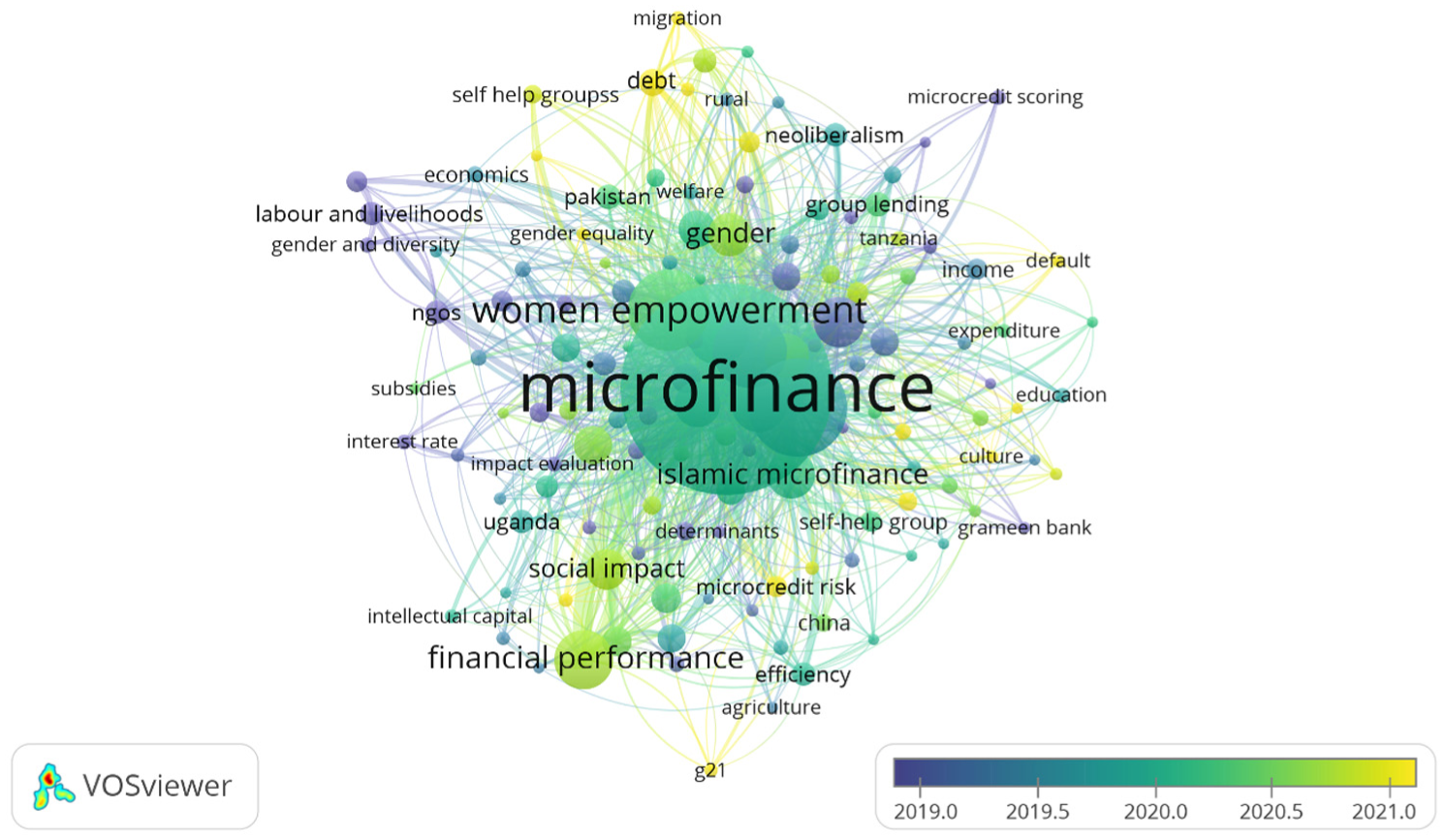
Overlay visualisation of author keywords in microfinance research (2016–2024) (Threshold = 5; full counting method; 142 retained keywords), showing the evolution of major thematic topics over time.
The density visualisation (Figure 6) further reinforces these findings, showing that microfinance, women empowerment, financial performance, and financial inclusion remain the most intensively researched themes. The consistency of these themes across datasets and time frames underscores the dual contribution of this study: first, by validating previously identified trends, and second, by contextualising their persistence, evolution, and growing interconnection with technological innovation and sustainability.

Density visualisation of author keywords in microfinance research (2016–2024) (Threshold = 5; full counting method; 142 retained keywords), highlighting the most frequently occurring themes such as microfinance, women empowerment, poverty reduction, and financial inclusion.
Underexplored Areas in the Field of Microfinance
The world has witnessed significant technological advancements in recent years (Broby, 2021; S. Ding et al., 2025; R. Wang et al., 2024), However, under the constraints of this study’s search strategy and database coverage, technology-related keywords in the microfinance literature exhibited relatively low co-occurrence frequencies, example terms such as Fintech (56 occurrences, TLS = 120), appearing less frequently. This does not necessarily imply a complete absence of research, as several high-impact studies, for example, Mushtaq and Bruneau (2019) and Ashta and Herrmann (2021) have examined the integration of technology into microfinance. Instead, it indicates that, relative to other dominant themes such as financial inclusion and women’s empowerment, the share of technology-focused studies remains comparatively small. This suggests an opportunity for deeper investigations into how emerging technologies can enhance microfinance delivery and financial inclusion outcomes in the future.
Conclusion, Limitations, and Future Research Avenues
Conclusion
In the global context, microfinance serves as a vital intermediary, bridging underserved populations with essential financial services. The period from 2016 to 2024 has been marked by significant developments and challenges impacting the sector. Notably, the introduction of the Sustainable Development Goals (SDGs), the growing emphasis on financial inclusion, and rapid technological advancements have reshaped the microfinance landscape. This bibliometric review offers a comprehensive analysis of 1,439 microfinance research articles published in Scopus from 2016 to 2024, highlighting their evolution, dominant themes, and emerging areas of focus.
The analysis concludes that microfinance research remains highly active and influential. Over the past 9 years, 1,439 papers have been published, accumulating 16,155 citations, reflecting the field’s capacity to produce impactful studies that address evolving community needs. The field is predominantly led by European scholars, followed by those from Asia, while Africa is gradually emerging as a key contributor. The study also highlights the growing presence of women researchers, such as Ariane Szafarz and Isabelle Guérin, reflecting the incorporation of gender perspectives and advancing understanding of financial inclusion and gender dynamics in microfinance.
The analysis of influential microfinance papers from 2016 to 2024 demonstrates that thematic relevance and innovation, particularly in technology and financial inclusion, are key drivers of scholarly impact. High-impact studies not only focus on emerging topics such as fintech integration and digital transformation but also address critical issues like women’s empowerment, poverty reduction, and microcredit effectiveness, aligning closely with the Sustainable Development Goals (SDGs). Geographically, research is concentrated in South Asia and Sub-Saharan Africa, reflecting the real-world contexts where microfinance plays a pivotal role in promoting social and economic development. Importantly, the influence of a paper is shaped more by the novelty and applicability of its theme than by its age, highlighting the value of timely, contextually relevant, and evidence-based research. Collectively, these findings underscore the need for microfinance studies to remain adaptive, innovative, and socially responsive, supporting policy development, institutional practice, and impactful interventions that benefit communities globally.
World Development was founded as a leading microfinance and financial inclusion research journal, publishing 32 papers with 941 citations (29.40 per paper; 104.55 per year), underscoring its influence on publishing papers regarding poverty reduction, financial access, and development strategies. It is followed by the Journal of International Development (40 papers, 493 citations) and Development in Practice (39 papers, 484 citations), highlighting a shift toward practical and policy-driven studies. The analysis reveals that impact is driven more by quality and thematic relevance than publication volume. For instance, the International Journal of Social Economics published 30 papers with 418 citations, outperforming the Enterprise Development and Microfinance journal, which published 54 papers with 264 citations. Furthermore, the study identifies a thematic shift toward technology-driven inclusion and Islamic finance, with journals such as the Journal of Islamic Accounting and Business Research and the International Journal of Islamic and Middle Eastern Finance and Management reflecting the growing interest in the role of Islamic finance in advancing financial inclusion in emerging economies.
The period 2016 to 2024 represents an era of both continuity and transformation in microfinance research. Traditional themes such as poverty reduction, women’s empowerment, and gender equality continued to dominate the field. However, a notable thematic shift emerged, largely driven by technological advancements and the global development agenda. Research increasingly embraced themes of technology, sustainability, and innovation, reflecting a transition toward more adaptive, inclusive, and impact-driven microfinance systems. This evolution has reinforced the field’s focus on the social impact of microfinance, financial accessibility, institutional performance, and risk management, highlighting ongoing efforts to assess the effectiveness and sustainability of microfinance institutions (MFIs).
In this era of rapid technological advancement, the findings highlight actionable strategies for stakeholders. Regulators should adopt regulatory sandboxes to test innovative solutions such as AI-driven risk scoring, blockchain platforms, and digital lending tools in controlled environments. Microfinance institutions (MFIs) need to accelerate digital transformation to boost efficiency, mitigate risks, and expand outreach, especially in underserved rural areas. Meanwhile, international organisations and development agencies should enhance the alignment of microfinance programs with SDG indicators to improve the measurement and reporting of both financial and social impacts.
Study Limitations
While this study offers significant understandings, it is important to recognise the various limitations. Initially, it depends exclusively on bibliometric analysis, concentrating on publication trends, citation counts, and keyword co-occurrences, yet it fails to evaluate the qualitative impact or practical application of the research outcomes. Secondly, the scope of the study is confined to publications in English, which may result in the segregation of important contributions found in other languages. Furthermore, the dataset employed might not encompass all pertinent studies, particularly those released in non-indexed or regional publications. Additionally, although keyword co-occurrence analysis identifies prevalent themes, it does not capture the full depth of discussions within each theme, necessitating further qualitative content analysis to understand thematic progression and research gaps. Importantly, the search strategy focused primarily on core microfinance terms (e.g., microfinance, microcredit, microfinance services) and did not explicitly include technology-related keywords such as fintech, mobile money, blockchain, or AI. As a result, technology-focused studies may be underrepresented, and findings regarding underexplored areas should be interpreted in this context. Future bibliometric studies could expand the keyword set to capture these emerging themes more comprehensively.
Future Research Avenues
The findings highlight multiple opportunities for advancing research in the microfinance field. To generate deeper insights, Future studies should adopt a more structured and actionable approach by integrating a topic x method framework. First, there is a need to examine the evolution of microfinance and financial inclusion research using bibliometric analysis with age-normalised citations and national or regional panel data to map the growth, transformation, and regional variations of research themes over time, thereby informing evidence-based policymaking. Second, future studies should investigate the ethical and fairness dimensions of digital finance and AI-driven credit scoring, using algorithm audits, qualitative case studies, and experimental methods to identify potential risks of bias and ensure the responsible and inclusive adoption of technological innovations in microfinance. Third, researchers should explore how financial literacy and women’s empowerment interact to mediate or moderate financial inclusion outcomes by employing Structural Equation Modelling (SEM), moderated-mediation analysis, and survey-based approaches. Additionally, future studies should analyse the linkages between governance and sustainability metrics through mixed-methods research that combines quantitative performance indicators with qualitative interviews to better understand how governance mechanisms shape both the social and financial performance of microfinance institutions. Finally, there is a need to expand longitudinal impact assessments using panel data and mixed-method evaluations to track program performance over time, providing deeper evidence on effectiveness, emerging challenges, and adaptive policy design. By adopting this multi-dimensional and methodologically diverse approach, future research can bridge existing gaps, enhance the rigour of microfinance studies, and provide actionable evidence to guide policymakers, practitioners, and scholars working to promote sustainable and inclusive financial systems.
Footnotes
Appendix A: Search Strings,CSV Descriptions,Deduplication and Exclusions and Dataset Summary
Appendix B: Network Construction and Data Cleaning Table

|
|
Stop word list | |
|---|---|---|
| 1. | Dea | |
| 2. | Kiva | |
| 3. | Case study | |
| 4. | Commons | |
| 5. | VSLA | |
| 6. | BMT | |
| 7. | Panel data | |
| 8. | Logistic regression | |
|
|
Merged to | |
| 1. | Women’s empowerment | Women empowerment |
| 2. | Rural women | |
| 3. | Social women entrepreneur | |
| 4 | Married women empowerment | |
| 5 | women empowermenthip | |
| 6 | Poor women empowerment | |
| 7 | Vulnerable women empowerment | |
| 8 | women empowerment workers | |
| 9 | self-employed women empowerment | |
| 10 | women empowerment-owned SMMEs | |
| 11 | women empowerment beneficiaries | |
| 12 | women empowerment managers | |
| 13 | women empowerment economy | |
| 14 | women empowerment borrowers | |
| 15 | economic women empowerment | |
| 16 | Marginalized women empowerment | |
| 1. | Micro-credit | Microcredit |
| 2. | Microloan | |
| 3. | loans | |
| 1. | Micro-finance | Microfinance |
| 2. | Microfinance services | |
| 3. | MFI | |
| 4. | MFIs | |
| 5. | Microfinance Institution | |
| 6. | Labor and livelihoods microfinance | |
| 7 | microfinance (MFIs) | |
| 1. | Inclusive finance | Financial Inclusion |
| 2. | Inclusive banking | |
| 3. | Inclusion | |
| 4. | Finance inclusion | |
| 5. | Access to finance | |
| 1. | Micro-small enterprises (MSE) | SMEs |
| 2. | Micro Small and Medium size enterprises | |
| 3. | MSMESS | |
| 4. | Micro and small enterprise | |
| 5. | Micro-enterprise | |
| 6. | microenterprise | |
| 7. | Social enterprise | |
| 8. | small and medium enterprises | |
| 9. | Msmes | |
| 10 | Microentrepreneurship | |
| 11. | micro-entrepreneurs | |
| 1. | Technology | Fintech |
| 2. | Mobile banking | |
| 3. | Technology—Fintech | |
| 4. | Mobile money | |
| 5. | Information and communication technology | |
| 6. | Financial Fintech | |
| 7. | ICT | |
| 1. | Financial efficiency | Financial performance |
| 2. | Business performance | |
| 3. | Performance | |
| 4. | Financial sustainability | |
| 1. | Social efficiency | Social impact |
| 2. | Social performance | |
| 1. | Poverty alleviation | poverty reduction |
| 2. | Poverty | |
| 1. | Self help groups | Self-help groups |
| 2. | shg | |
| 1. | Civil society–NGOs | NGOs |
| 2. | Non governmental organization | |
| 3. | Non-governmental organization | |
| 1. | Islamic banking | Islamic microfinance |
| 2. | Islamic bank | |
| 3. | Islamic finance | |
| 1. | sustainable development goals (SDGs) | sustainable development goals |
| 2. | SDGs | |
| 3. | sustainable development | |
Acknowledgements
The authors sincerely express their gratitude to Almighty God, who allowed us to complete this study. Also, special appreciation to the Post-Graduate Department of Business Studies at Sardar Patel University in India, the Moshi Co-operative University in Tanzania for their moral and material assistance. We remain responsible for errors (Kivara William Daudi and Prof. (Dr.) Yagnesh Dalvadi).

Ethical Considerations
This article is a review of existing literature and does not involve any studies with human participants or animals conducted by the authors. Therefore, ethical approval and informed consent are not applicable.
Consent to Participate
Not applicable in this study because it involves secondary data.
Consent for Publication
Not applicable because the submissions do not contain any data from a person (including individual details, images or videos)
Author Contributions
All authors contributed to the study’s conception and design, Prof. (Dr.) Yagnesh Dalvadi and Kivara W. Daudi performed materials preparation, data collection, and analysis. Kivara W. Daudi wrote the first original draft of the manuscript.
Prof. (Dr.) Yagnesh Dalvadi offered supervision, as well as critical review and editing. All authors have reviewed and agreed to the final manuscript.
Funding
The authors received no financial support for the research, authorship, and/or publication of this article.
Declaration of Conflicting Interests
The authors declared no potential conflicts of interest with respect to the research, authorship, and/or publication of this article.
Data Availability Statement
The data supporting the study findings can be obtained from the corresponding author upon request.