




Abstract
The development of digital technology has brought new possibilities for cultural inheritance, especially in combining traditional cultural elements with modern digital narratives. Digital rural script games, as an emerging form of cultural tourism integration, have opened new pathways for the innovative dissemination of rural culture by combining traditional rural culture with digital narratives. However, the key factors influencing users’ participation intentions and their mechanisms have not been fully studied. Based on the Stimulus-Organism-Response (S-O-R) theoretical framework, this study constructs a theoretical model integrating environmental stimuli (interactivity, entertainment, and authenticity) and organismic responses (immersion experience and emotional attachment) to explore the influence mechanism of users’ participation intention in digital rural script games. Through a questionnaire survey of 415 users, it was found that interactivity and entertainment have significant positive effects on both immersion experience and emotional attachment, while authenticity affects users’ participation intention only through emotional attachment rather than immersion experience. This finding challenges the widely accepted authenticity-experience relationship in traditional cultural tourism research, providing a new perspective for redefining the concept of “authenticity” in the digital age. The results suggest that in digital cultural experiences, designers need to go beyond simple physical authenticity restoration and focus more on how to use technological means to stimulate users’ understanding and emotional identification with cultural connotations.
Plain Language Summary
This research investigates what motivates continued participation in digital rural script games—interactive entertainment that blends traditional rural culture with digital storytelling. These games resemble interactive mystery novels where players become characters in village stories, solving puzzles while exploring rural customs and folklore, much like culturally-themed escape rooms on mobile devices. We analyzed responses from 415 Chinese users to examine three engagement factors: interactivity (player control over story progression, like “choose your own adventure” books), entertainment (the engaging quality that compels binge-watching), and authenticity (authentic representation of rural life that captures meaning beyond mere appearance). Our findings reveal that strong interactive features and entertainment value increase both player absorption—becoming so engrossed that time disappears—and emotional connection to characters, similar to attachment to favorite show characters. Surprisingly, photographic realism didn't enhance absorption. Rather, genuine cultural elements fostered emotional connections through authenticity of feeling, like grandmother's imperfect recipes that resonate through memory and meaning. For successful player engagement, developers should prioritize interactive, entertaining experiences while embedding genuine cultural elements to forge meaningful connections. Cultural preservation through gaming requires not perfect digital museums but participatory experiences that connect players personally to rural heritage. These insights guide game developers and cultural organizations in using digital rural script games for cultural preservation, helping rural communities share traditions with digitally-native generations while supporting tourism and economic development.
Keywords
Introduction
Under the wave of digital transformation, the in-depth promotion of rural revitalization strategies has provided new development opportunities for cultural inheritance and innovation (Chengcai et al., 2024). Digital rural script games represent an emerging form of cultural tourism integration that is gradually becoming an important bridge connecting traditional culture and modern technology (Z. Li, 2023). Digital rural script games are defined as interactive narrative experiences that combine elements of murder mystery games, role-playing, and digital storytelling, specifically incorporating rural cultural themes and heritage elements. These games typically involve players assuming character roles to solve mysteries or complete storylines while engaging with digitally presented rural cultural content through mobile apps or online platforms. For example, players might investigate a mystery set in a traditional Chinese village, learning about local customs, folklore, and agricultural practices while progressing through the narrative.
This innovative form has its roots in the thriving development of script games, which can be traced back to “murder mystery” party games in 19th century England. After nearly a hundred years of evolution, they have developed into an interactive entertainment method popular among young people (Penttilä, 2018; Williams, 2017). In China, especially since 2016, with the promotion of online variety shows and the development of digital technology, script games have gradually moved from offline to online, spawning many digital innovative applications (Deng & Deng, 2024; Z. Li, 2023). According to the latest market data, the scale of China’s script-killing market in 2023 was about 14.5 billion yuan, which is an important component of the script entertainment industry, with the overall script entertainment market reaching 19.5 billion yuan (Gongyan Industry Research Institute, 2024).
However, as an emerging enterprise, the development of digital rural script games still faces problems such as unstable participation intention and insufficient user stickiness. Recent studies have shown that user participation is a key factor in determining the success of digital cultural products. For example, Wu and Zhang (2024), through their research on immersive tourism experiences, found that continuous user engagement has a significant impact on the effectiveness of cultural heritage transmission. Sun et al. (2024) further pointed out that the depth and breadth of user participation directly affect the realization of social value in digital cultural products. Despite this growing recognition, there remains a critical research gap in understanding the specific mechanisms that drive user participation in digital rural script games.
The primary objective of this study is to address this gap by constructing a theoretical model based on the Stimulus-Organism-Response (S-O-R) framework. The S-O-R model, originally proposed by Mehrabian and Russell (1974), provides a systematic approach to understanding how external stimuli influence behavioral responses through internal psychological states. This theoretical framework is particularly suitable for analyzing digital rural script games for several reasons. First, it offers a comprehensive lens for examining the complex interplay between game features (stimuli), user psychological states (organism), and participation behaviors (response). Second, the model has been successfully applied in similar digital contexts, demonstrating its robustness in explaining user behavior in interactive environments (Lu et al., 2024; Y. C. Zhao et al., 2024). Third, it allows for the integration of multiple theoretical perspectives, enabling a more nuanced understanding of the participation phenomenon.
Within this S-O-R framework, we identify three key environmental stimuli that characterize digital rural script games: interactivity, entertainment, and authenticity. These factors were selected based on their theoretical significance in digital experience literature and their relevance to the rural script game context. Interactivity represents the degree to which users can exchange information and exert control through digital interfaces (Liu, 2003; McMillan and Hwang, 2002). Entertainment encompasses the pleasure and enjoyment derived from game participation (Luo et al., 2020). Authenticity refers to the perceived genuineness of cultural representations and experiences (Kolar & Zabkar, 2010). While previous studies have examined these factors individually, their combined influence within the S-O-R framework remains unexplored in the context of digital rural script games. To organismic responses in our model consist of immersion experience and emotional attachment, which serve as psychological mediators between environmental stimuli and behavioral outcomes. Immersion experience, grounded in flow theory (Czikszentmihalyi, 1990), represents the psychological state of deep engagement with digital content. Emotional attachment reflects the affective bonds users develop with game elements (Bowlby, 1969). These mediating variables are crucial for understanding how external game features translate into participation intentions, yet their specific roles in digital rural script games have not been systematically investigated.
Therefore, this study aims to: (a) construct an integrated theoretical model that explains how environmental stimuli (interactivity, entertainment, and authenticity) influence participation intention in digital rural script games; (b) systematically analyze the mechanisms through which these stimuli affect users’ internal psychological states (immersion experience and emotional attachment); and (c) investigate the mediating roles of immersion experience and emotional attachment in converting environmental stimuli into participation behavior. By addressing these objectives, this study makes several contributions to existing research. It enriches the application of S-O-R theory in digital cultural experiences, provides empirical evidence for the unique influence patterns in digital rural script games, and offers practical insights for developers and policymakers seeking to promote cultural heritage through digital innovation.
Literature review
S-O-R theoretical model
The Stimulus-Organism-Response (S-O-R) theoretical model, originally developed by Mehrabian and Russell (1974), provides a comprehensive framework for understanding how environmental stimuli influence behavioral responses through internal psychological states. This model has proven particularly valuable in digital media contexts, where complex interactions between technology features and user psychology shape behavioral outcomes. Recent applications of the S-O-R framework in digital environments have yielded significant insights. Y. C. Zhao et al. (2024) demonstrated its effectiveness in analyzing purchase intentions in open-world games, while Lu et al. (2024) applied it to understand metaverse participation. These studies establish the model’s robustness in capturing the multifaceted dynamics of digital experiences, making it particularly suitable for examining digital rural script games.
Environmental stimulus factors of digital rural script games
Interactivity
Interactivity, as defined by Liu (2003), refers to “the degree to which two or more communication parties can act on each other, on the communication medium, and on the messages and the degree to which such influences are synchronized.”McMillan and Hwang (2002) further conceptualized interactivity as a multidimensional construct encompassing user control, two-way communication, and synchronicity. This foundational understanding has been expanded by recent scholarship to include various forms of digital engagement. Building on these conceptual foundations, Pang and Ruan (2024) distinguish between social interactivity and system interactivity in mobile applications, demonstrating that both dimensions significantly influence users’ perceived benefits and continuance intention. Their study of 808 mobile video app users revealed that interactivity indirectly affects continuance intention through the mediation of perceived benefits, highlighting the critical role of interactive design in sustaining user engagement.
In the specific context of digital rural script games, interactivity manifests through multiple channels: player-to-system interactions (controlling game progression and making narrative choices), player-to-player interactions (collaborative problem-solving and role-playing), and player-to-content interactions (exploring cultural elements and engaging with storylines). Wu and Zhang (2024) found that such multifaceted interactivity promotes immersion by enhancing users’ sense of control and agency within the digital environment.
Entertainment
Entertainment, according to Luo et al. (2020), encompasses “the degree to which the activity of using a specific medium is perceived to be enjoyable and fun in its own right, aside from any performance consequences resulting from system use.” This hedonic dimension of digital experiences has been recognized as a fundamental driver of user engagement across various platforms. Pang and Zhang (2024a) identified hedonic benefits as a crucial component alongside functional and psychosocial benefits in determining user satisfaction with mobile social media. Their analysis of 689 WeChat users demonstrated that hedonic benefits significantly influence cumulative satisfaction, which subsequently affects electronic word-of-mouth engagement. This finding underscore entertainment’s role not merely as an immediate gratification mechanism but as a catalyst for sustained engagement and community building.
Within digital rural script games, entertainment elements serve dual purposes: providing immediate enjoyment through engaging narratives and game mechanics while facilitating cultural learning through “edutainment” approaches. As Viñals et al. (2021) emphasize, the integration of entertainment with educational content creates synergistic effects that enhance both user enjoyment and cultural knowledge acquisition. The entertainment value in these games emerges from mystery-solving challenges, character role-playing opportunities, and the discovery of cultural narratives, all of which contribute to a compelling user experience.
Authenticity
Authenticity, as conceptualized by Kolar and Zabkar (2010), represents “a multi-faceted construct comprising object-based authenticity (genuineness of artifacts and sites) and existential authenticity (personal feelings and experiences evoked by engagement with cultural content).” This distinction between objective and subjective dimensions of authenticity has become increasingly important in digital cultural experiences. Recent scholarship has challenged traditional notions of authenticity in digital environments. Mukerjee and Shen (2025) argue that visual media serves as both a driver and reflection of societal divides, suggesting that authenticity in digital spaces may be constructed through multimodal elements including visual aesthetics, symbols, and narratives rather than purely through faithful reproduction of physical reality. This perspective is particularly relevant for digital rural script games, where authenticity must balance historical accuracy with engaging digital storytelling.
In digital rural script games, authenticity operates through multiple mechanisms: environmental authenticity (accurate representation of rural settings and architecture), cultural authenticity (faithful portrayal of traditions, customs, and values), and narrative authenticity (stories grounded in local history and folklore). Sun et al. (2024) found that while physical authenticity may not directly enhance immersion in digital environments, it plays a crucial role in fostering emotional connections and cultural identification. This suggests that authenticity in digital cultural products should be reconceptualized to emphasize emotional and cultural resonance rather than mere visual verisimilitude.
Immersion experience theory
Immersion experience theory, pioneered by Csikszentmihalyi (2000), describes the optimal psychological state when individuals become fully absorbed in activities. This state features highly focused attention, temporary loss of self-awareness, and distorted time perception. The theory evolved from early three-channel models focusing on skill-challenge balance to sophisticated eight-channel models that provide nuanced understanding of user psychological states in digital environments (Massimini & Carli, 1988). In digital interactive contexts, immersion experience represents a state of deep psychological engagement that occurs when users interact with content through digital interfaces (Wu & Zhang, 2024). As an internal psychological state, it is a critical component of the “Organism” stage within the S-O-R framework.
Recent scholarship reveals both benefits and risks of digital immersion. While immersion enhances learning outcomes in mobile-assisted contexts, excessive cognitive demands can trigger technostress among university students (Pang & Wang, 2025). Their study of 605 participants found cognitive overload significantly correlates with perceived technostress, subsequently diminishing subjective well-being and academic expectancy. This suggests immersion in digital rural script games requires careful balance to avoid cognitive exhaustion. Immersion formation involves multiple cognitive processes: attentional resource allocation, emotional engagement, and cognitive continuity (Y. C. Zhao et al., 2024). System interactivity significantly influences immersion through responsive feedback and user control, while social interactivity enhances immersion via interpersonal engagement (Pang & Ruan, 2024). Analysis of 808 mobile app users revealed this interactivity forms work synergistically to create immersive experiences driving continuance intention. From a theoretical perspective, immersion plays a unique mediating role in digital cultural experiences. Effective immersion promotes users’ transformation from passive receivers to active participants—a transformation critical for sustainable digital cultural product development (Prandi et al., 2023). This emphasizes immersion’s central role in user participation behavior formation, particularly where cultural learning and entertainment intersect.
Emotional attachment theory
Emotional attachment theory, developed by Bowlby (1969), explains psychological mechanisms underlying formation and maintenance of lasting emotional connections between individuals and objects. This framework expanded from interpersonal relationships to encompass digital interactions, providing systematic theoretical support for understanding psychological connections between users and digital content. Emotional attachment formation involves synergistic effects of multiple psychological mechanisms. In digital interactive environments, users develop emotional attachment through internal working models—psychological representation systems integrating cognitive evaluation, emotional investment, and behavioral tendencies (Wu & Zhang, 2024). Technological characteristics and content design significantly influence emotional attachment formation in digital environments (Lu et al., 2024). Research with 598 WeChat users demonstrated that service quality dimensions—system quality, information quality, and service quality—collectively influence user identification, belongingness, and satisfaction, fostering emotional attachment (Pang & Zhang, 2024b). Emotional attachment significantly contributes to service attachment, particularly when users perceive high platform benefits. This highlights how digital emotional bonds are constructed through cumulative positive experiences rather than singular interactions. Digital emotional attachment complexity is illustrated by its vulnerability to negative experiences. Environmental stressors, including cyberbullying and communication overload, lead to depressive mood and app fatigue among young users, significantly predicting app switching intention (Pang et al., 2025). This suggests emotional attachment involves both building positive connections and managing threats to those connections. Privacy concerns emerged as the strongest technostress predictor, challenging assumptions about app addiction primacy in digital stress responses.
In digital rural script games, emotional attachment mechanisms present unique characteristics. Effective emotional attachment influences user experience through three pathways: enhancing psychological investment in digital content, establishing emotional connections with cultural elements, and promoting deep cultural understanding (Sun et al., 2024). These pathways operate simultaneously, creating multifaceted bonds between users and game content. As a key “Organism” variable within the S-O-R framework, emotional attachment not only affects the immediate experience but also promotes continuous participation intention by strengthening users’ psychological connections (Y. C. Zhao et al., 2024). This long-term effect occurs through establishing secure attachment relationships, including trust formation, belonging development, and digital content identification.
Recent research examined emotional attachment’s buffering role against negative digital experiences. While mobile app addiction, privacy concerns, and cognitive overload contribute to technostress, strong emotional attachment moderates these effects, preserving subjective well-being and academic expectancy (Pang & Wang, 2025). This protective function suggests emotional attachment in digital rural script games serves dual purposes: enhancing positive engagement while providing resilience against inherent negative digital experiences. These perspectives indicate emotional attachment operates as a complex, multidimensional construct bridging environmental stimuli with behavioral outcomes, making it crucial for understanding user participation intentions in digital rural script games.
Synthesis and research gaps
Integrating these theoretical perspectives reveals critical gaps in understanding digital rural script games. While existing literature examined interactivity, entertainment, and authenticity separately, their combined effects within a unified S-O-R framework remain unexplored. Moreover, the specific mediating roles of immersion experience and emotional attachment in translating environmental stimuli into participation intentions require systematic investigation. This study addresses these gaps by developing an integrated model capturing the complex interplay between design features, psychological states, and behavioral outcomes in digital rural script games.
Research model and hypotheses
Research model
This study constructs a theoretical model based on the S-O-R framework and literature review, integrating environmental stimuli, organismic responses, and behavioral outcomes to explore user participation intention in digital rural script games. The model (Figure 1) comprises environmental stimuli (S), which include interactivity, entertainment, and authenticity, representing key design features that may influence participation intention. Organismic responses (O) consist of immersion experience and emotional attachment, reflecting users’ internal psychological states and mediating between stimuli and outcomes. The behavioral outcome (R) is represented by participation intention, indicating users’ willingness to continue engaging with digital rural script games.

The proposed research model based on the S-O-R framework.
Research hypotheses
The impact of interactivity, entertainment, and authenticity on immersion experience
In digital interactive environments, the relationship between technological features and immersion experience constitutes a core issue in contemporary digital interaction research. This study focuses on three key antecedent variables affecting immersion experience in digital rural script games: interactivity, entertainment, and authenticity. As a fundamental element of digital experiences, the impact of interactivity on immersion experience has been widely validated. Digital interaction design research indicates that interactivity is a foundational element in shaping users’’ immersion experience (Ryan, 2015). This influence is primarily achieved through multiple mechanisms such as enhancing user subjectivity and instant feedback systems. Particularly in the context of digital rural script games, Bryan-Kinns et al. (2018) found that game interactive design significantly affects users’ immersion level through user-system dialogue, character interaction, and plot progression control. Miller (2019) further points out that interactive narratives can help users construct personalized experiences, thereby deepening their immersion level. This aligns with Calleja (2007) player involvement model, indicating that interactive mechanisms promote users’ transformation from passive observers to active participants.
In the entertainment dimension, existing research generally supports its positive impact on immersion experience. Miller (2019) study reveals that entertainment mechanisms, as cognitive catalysts, can significantly enhance users’ psychological investment in digital environments. This view highly aligns with immersion theory, suggesting that pleasurable experiences help deepen engagement and produce time perception distortion (Calleja, 2007). In digital rural script games, entertainment is mainly manifested through narrative experiences, game mechanics, and social interactions. Bryan-Kinns et al. (2018) empirical research confirms that these entertainment features can effectively maintain user attention and enhance their emotional investment.
Regarding the influence of authenticity, recent research provides new theoretical perspectives. Although traditional literature generally assumes a simple positive relationship between authenticity and immersion experience (Ryan, 2015), emerging research suggests that this relationship may be more complex in digital contexts. Bryan-Kinns et al. (2018) study on digital interactions in rural areas of China found that the effect of authenticity may be moderated by digital design features. Especially when authentic elements conflict with digital affordances, overemphasis on authenticity may inhibit users from achieving deep immersion. Miller (2019) research further supports this view, pointing out that digital environments may follow different immersion paradigms than physical spaces. Based on the above theoretical analysis and empirical findings, this study proposes the following research hypotheses, which correspond to paths H1, H2, and H3 in Figure 1:
The influence of interactivity, entertainment, and authenticity on emotional attachment
The formation mechanism of emotional attachment in digital interactive environments is an important theoretical basis for understanding users’ continuous participation intention. Regarding interactivity, contemporary digital interaction research indicates that it plays a key role in promoting user emotional connections. Sutherland (2022), through an in-depth study of rural-themed digital games, found that interactive design can significantly enhance users’ emotional attachment to virtual narratives. This effect is particularly evident in the context of digital rural script games, mainly achieved through continuous character interaction and plot participation. Miller (2019) research further reveals that interactive narratives can promote users’ deep emotional connections with virtual characters, providing important theoretical support for understanding the relationship between interactivity and emotional attachment.
Entertainment has unique value in the process of cultivating emotional attachment. Viñals et al. (2021) systematic examination of virtual cultural heritage scenarios shows that interactive modes rich in entertainment can significantly enhance participants’ emotional connections. In digital rural script games, this effect not only acts as a catalyst for emotional attachment but also promotes users’ natural acceptance of rural cultural elements. Pyae (2018) empirical research further confirms that the organic combination of game entertainment design and local cultural elements can effectively promote the formation of emotional attachment. This dual effect of entertainment and cultural inheritance provides a new perspective for understanding the mechanism of emotional attachment in digital rural script games.
The influence of authenticity on emotional attachment presents multidimensional characteristics. Sutherland (2022) research emphasizes that authentic reproduction of rural life can significantly enhance users’ emotional investment, mainly manifested as users’ sense of identification and belonging to cultural scenes. Viñals et al. (2021), through analysis of virtual tours of cultural heritage, further found a significant association between scene authenticity and participants’ emotional connection. In the context of digital rural script games, this association involves not only the restoration of the physical environment but also the authentic conveyance of cultural connotations, thus effectively promoting users’ emotional identification and attachment to rural culture. Based on the above analysis, this study proposes the following research hypotheses, representing paths H4, H5, and H6 in Figure 1:
Hypothesis on the influence of immersion experience on participation intention
Through systematic research on open-world games, Y. C. Zhao et al. (2024) found a significant positive correlation between the degree of immersion and the depth of user participation. In the context of digital rural script games, this correlation is mainly manifested as deep immersion states promoting users’ concentrated investment of cognitive resources. Tea et al. (2022) empirical research further reveals that immersion experience can significantly enhance users’ willingness to collaborate in virtual environments, a finding that has important implications for understanding group interactions in digital rural script games. Analyzing from the dimension of emotional attachment, Pressgrove and Bowman (2021) research points out that immersion experience significantly influences participation tendency by activating users’ cognitive processing. This cognitive investment in digital rural script games is primarily reflected in the continuous allocation of attentional resources, deep processing of plot understanding, and psychological construction of character identification. Through research on educational game design, Dimitriadou et al. (2021) further discovered that immersion experience can enhance user participation intention by strengthening emotional investment. This emotional attachment has unique manifestations in digital rural script games, mainly achieved through the formation of cultural identity, enhancement of community belonging, and accumulation of a sense of achievement. Therefore, this study proposes the following research hypothesis, which corresponds to path H7 in Figure 1:
Hypothesis on the influence of emotional attachment on participation intention
Through research on electronic and virtual reality games, Doulou and Drigas (2022) found that emotional connections formed by users in immersive environments can significantly enhance their tendency for continued participation. Ryan (2015), in studying digital media narratives, further discovered that users’ emotional attachment to characters and storylines can directly influence their willingness to continue participating. This integrated cognitive-emotional process not only deepens users’ understanding of game content, but also strengthens their intrinsic motivation for continued participation. From the dimension of social interaction, Kors et al. (2016) research on mixed reality games shows that emotional investment can significantly enhance players’ willingness to participate in game activities, especially in designs that can evoke empathy and emotional resonance. Emezue et al. (2021) empirical research further confirms that in digital intervention programs, the emotional connection formed between users and content can significantly enhance their engagement. This finding has special significance in the context of digital rural script games, where emotional attachment forms a unique cultural participation drive by enhancing users’ sense of identification and belonging to rural cultural elements. Based on the above analysis, this study proposes the following hypothesis (path H8 in Figure 1):
Hypotheses on the mediating effect of immersion experience
Regarding interactivity, Wu and Zhang (2024), through their study on immersive tourism contexts, found that interactive experiences significantly influence tourists’ participation intention through immersion perception. Lu et al. (2024) further confirmed in their metaverse user study that immersion experience plays a key mediating role between interactive elements and user participation intention. These findings suggest that immersion experience constructs a psychological conversion mechanism from interactive design to participatory behavior by deepening users’ perception of interaction and psychological investment. Concerning the influence path of entertainment, X. Zhao’s (2024) study on Chinese digital immersive art found that immersion experience can significantly enhance the effect of entertainment content on participation intention. Prandi et al. (2023) empirical research further revealed that immersive digital narratives promote the effective conversion of entertainment experiences into participation motivation, by enhancing users’ psychological investment. This mediating effect in digital rural script games is mainly manifested as immersion experience integrating the psychological stimulation of entertainment elements. In the process of authenticity converting to participation intention, the mediating role of immersion experience presents unique theoretical value. Wu and Zhang (2024) research shows that authentic cultural experiences significantly influence participants’ continuous interaction willingness through immersion perception. X. Zhao (2024) also found in the context of digital art that immersion experience plays an important mediating role between authenticity and participation intention. These findings suggest that immersion experience may promote the conversion to actual participation intention, by enhancing users’ psychological perception of authenticity elements. Based on the above analysis, this study proposes the following hypotheses regarding the mediating role of immersion experience, as shown by the indirect paths H9a–c in Figure 1:
Hypotheses on the mediating effect of emotional attachment
Regarding interactivity, Wu and Zhang (2024) research found that interactive experiences significantly influence participants’ participation intention through emotional investment. Pentina et al. (2023) study on social chatbots further confirmed that user-system interactions enhanced the tendency for continued participation through emotional connection mechanisms. In the context of digital rural script games, this mediating effect is mainly manifested as emotional attachment deepening users’ perceptions of interactive experiences. In the entertainment conversion process, Sun et al. (2024), through their study on virtual reality experiences of Dunhuang murals, revealed that entertainment experiences significantly increased users’ participation tendency through emotional attachment. Yang et al. (2023) also found in their online community research that the entertainment value of communities influences user participation behavior through the emotional attachment mechanism. This indicates that emotional attachment promotes the conversion to participation motivation by enhancing users’ psychological connection to entertainment elements. Regarding the influence path of authenticity, Sun et al. (2024) research shows that authentic reproduction of cultural heritage significantly enhances users’ participation intention through the emotional attachment mechanism. Wu and Zhang (2024) empirical study further confirms that authentic cultural experiences can promote participants’ continuous interaction intentions through emotional investment. These findings reveal the key mediating role of emotional attachment in the conversion process of cultural authenticity. Based on the above analysis, this study proposes the following hypotheses, which represent the mediating paths H10a-c in our conceptual model (Figure 1):
Methodology
Research design and approach
This study employs a quantitative research method to examine the relationships between environmental stimuli, organismic responses, and participation intention in digital rural script games. Quantitative methodology was selected for several reasons. First, it enables the systematic measurement and statistical analysis of relationships between multiple variables within our S-O-R theoretical framework (J. F. Hair Jr et al., 2016). Second, quantitative methods allow for hypothesis testing with large samples, providing generalizable findings about user behavior patterns in digital rural script games (Creswell & Creswell, 2017). Third, this approach facilitates the examination of mediating effects through structural equation modeling, which is essential for understanding the indirect pathways through which environmental stimuli influence participation intention.
The study utilized a cross-sectional survey design as the primary data collection technique. Survey methodology was deemed most appropriate because it enables efficient collection of standardized data from a large, geographically dispersed sample of digital rural script game users (Fowler Jr, 2013). Additionally, surveys allow participants to report on their psychological states (immersion experience and emotional attachment) and behavioral intentions, which are not directly observable through other methods. The self-report nature of surveys is particularly suitable for measuring subjective experiences and perceptions central to our research questions.
Participants
We collected data through a survey conducted by a leading Chinese survey company (Wenjuanxing) over two weeks in September 2023. Participants received an electronic questionnaire link via WeChat or email, were informed of voluntary participation, and offered 15 RMB compensation. They completed the survey on mobile devices or computers.
After excluding invalid responses, we obtained 415 valid participants: 51.33% male, 47.47% female, and 1.20% other/undisclosed. Ages ranged from 18 to over 56, with 83.61% between 18 and 35. Education levels included 79.76% with undergraduate degrees or above. Occupations comprised 52.29% company employees, 15.90% each freelancers and civil servants, 9.16% students, and 6.75% teachers. Monthly incomes were 40.24% at 3,001–5,000 RMB, 42.17% at 5,001–8,000 RMB, and 17.59% above 8,000 RMB. Participants came from diverse locations: 20.48% first-tier cities, 22.65% second-tier, 18.55% third-tier and below, 21.69% county-level, and 16.63% rural areas. Regarding digital rural script game participation, 59.04% engaged three to four times monthly, while 38.55% participated five or more times. Chung-Ang University’s Academic Ethics Committee approved this study in July 2023.
Measures
The survey instrument consisted of validated scales adapted from established literature, measured using 5-point Likert scales (1 = strongly disagree, 5 = strongly agree). This standardized measurement approach ensures comparability with previous research and facilitates statistical analysis. Extensive research has validated the reliability and validity of these scales, and they have been previously applied in Chinese contexts. The original English scales were translated into Chinese and back-translated to ensure semantic equivalence between the two versions.
Interactivity
We measured interactivity using a five-item scale adapted from McMillan and Hwang (2002) and Liu (2003). A sample item was “In digital rural script games, I can freely control the game progress and character actions.” Participants responded using a 5-point Likert scale ranging from 1 (strongly disagree) to 5 (strongly agree). This scale’s composite reliability (CR) and Cronbach’s α values were .926 and .901, respectively.
Entertainment
Entertainment was measured using a four-item scale developed by Luo et al. (2020). A sample item was “I enjoy participating in digital rural script game activities.” The scale used a 5-point response format, from 1 (strongly disagree) to 5 (strongly agree). This scale’s CR and Cronbach’s α values were .901 and .854, respectively.
Authenticity
We used a four-item scale adapted from Kolar and Zabkar (2010) to measure authenticity. A sample item was “During the experience, I felt connected to the related history, legends, and historical personalities.” Participants responded using a 5-point Likert scale (1 for strongly disagree, 5 for strongly agree). This scale’s CR and Cronbach’s α values were .907 and .863, respectively.
Immersion experience
Immersion experience was measured using a five-item scale adapted from Hamilton et al. (2016). A sample item was “When playing digital rural script games, I often lose track of time.” The measure used a 5-point response scale, ranging from 1 (strongly disagree) to 5 (strongly agree). This scale’s CR and Cronbach’s α values were .899 and .860, respectively.
Emotional attachment
We measured emotional attachment using a seven-item scale adapted from Lewis et al. (2008). A sample item was “I view my game character as a friend.” Participants responded using a 5-point Likert scale (1 for strongly disagree, 5 for strongly agree). This scale’s CR and Cronbach’s α values were .923 and .903, respectively.
Participation intention
Participation intention was measured using a four-item scale adapted from Li et al. (2020). A sample item was “I am willing to participate in different scales of digital rural script games (such as short stories, complete scripts, or long-term games).” The scale used a 5-point response format, from 1 (strongly disagree) to 5 (strongly agree). This scale’s CR and Cronbach’s α values were .889 and .834, respectively.
Results
Measurement model
Reliability and validity analysis
This study used Cronbach’s alpha coefficient, Composite Reliability (CR), and Average Variance Extracted (AVE) to assess internal consistency and validity (Sarstedt et al., 2022). The results show: all constructs have Cronbach’s α > .8, CR > 0.8 (exceeding the 0.7 threshold suggested by Hair (2009)), AVE > 0.6 (higher than the 0.5 standard proposed by Fornell and Larcker (1981)), factor loadings > 0.7, T-values > 40, and p-values all .000. This indicates that the questionnaire has high reliability, excellent internal consistency among indicators for each construct, and good composite validity. The scale performed exceptionally well in terms of reliability and validity, laying a reliable foundation for subsequent analysis, as shown in the Table 1.
Reliability and Validity Analysis.

Discriminant validity
Discriminant validity analysis verifies statistical differences between constructs. Items from different constructs should not correlate highly (>0.85) to avoid measuring the same concept, which can occur when construct definitions overlap excessively. This study uses the AVE method to assess discriminant validity. Fornell and Larcker (1981) suggest that the square root of AVE for each factor should exceed correlation coefficients between variable pairs, indicating discriminant validity. The Table 2 shows diagonal elements (AVE square roots) exceeding off-diagonal standardized correlation coefficients (lower triangular), confirming this study’s discriminant validity.
Discriminant Validity Analysis (Fornell-Larcker Criterion).

We use the Heterotrait-Monotrait (HTMT) ratio to assess discriminant validity. HTMT compares between-trait correlations to within-trait correlations, measuring the average correlation between indicators across different constructs relative to those within the same construct. The results, shown in the Table 3, reveal HTMT values between every two variables lower than 0.85, indicating good discriminant validity among all variables.
HTMT Discriminant Validity.

Structural equation model
Predictive relevance indicator Q2
The Q2 value indicates the predictive relevance of exogenous variables to endogenous variables, typically ranging from 0 to 1. A Q2 > 0 suggests model predictive capability, with 0.02 to 0.13 considered weak, 0.13 to 0.26 moderate, and >0.26 strong. This study’s results, shown in the Table 4, reveal Q2 values for IE, EA, and PI of 0.324, 0.338, and 0.343 respectively. All values exceed 0.26, demonstrating the research model’s strong predictive power for the explained variables.
Predictive Relevance Indicator Q2.

Collinearity diagnosis VIF
A collinearity diagnostic analysis was conducted on the model, with results shown in the Table 5–7. It can be concluded that the VIF between measurement variables is all below 8, and the VIF between latent factors is also below 3, indicating that there is no collinearity in the model.
Collinearity of Measurement Variable Indicators.

Collinearity of Latent Variable Indicators.

Summary of PLS-SEM Path Analysis.

Path coefficient significance
Path coefficients evaluate relationships between research hypotheses. Standardized coefficients range from −1 to 1, with values near 1 indicating positive correlation and those near −1 indicating negative correlation. T-values, obtained by dividing path coefficients by standard deviations, assess significance. For samples >30, normal distribution quartiles serve as critical values. T-values exceeding critical values indicate significance levels: typically 1.96 (5%), 2.57 (1%), and 3.29 (0.1%) (J. F. Hair Jr et al., 2014). This study used bootstrapping with 5,000 samples to calculate path coefficients and T-values. The structural model path coefficients are shown in the Figure 2, with results presented in the following table.
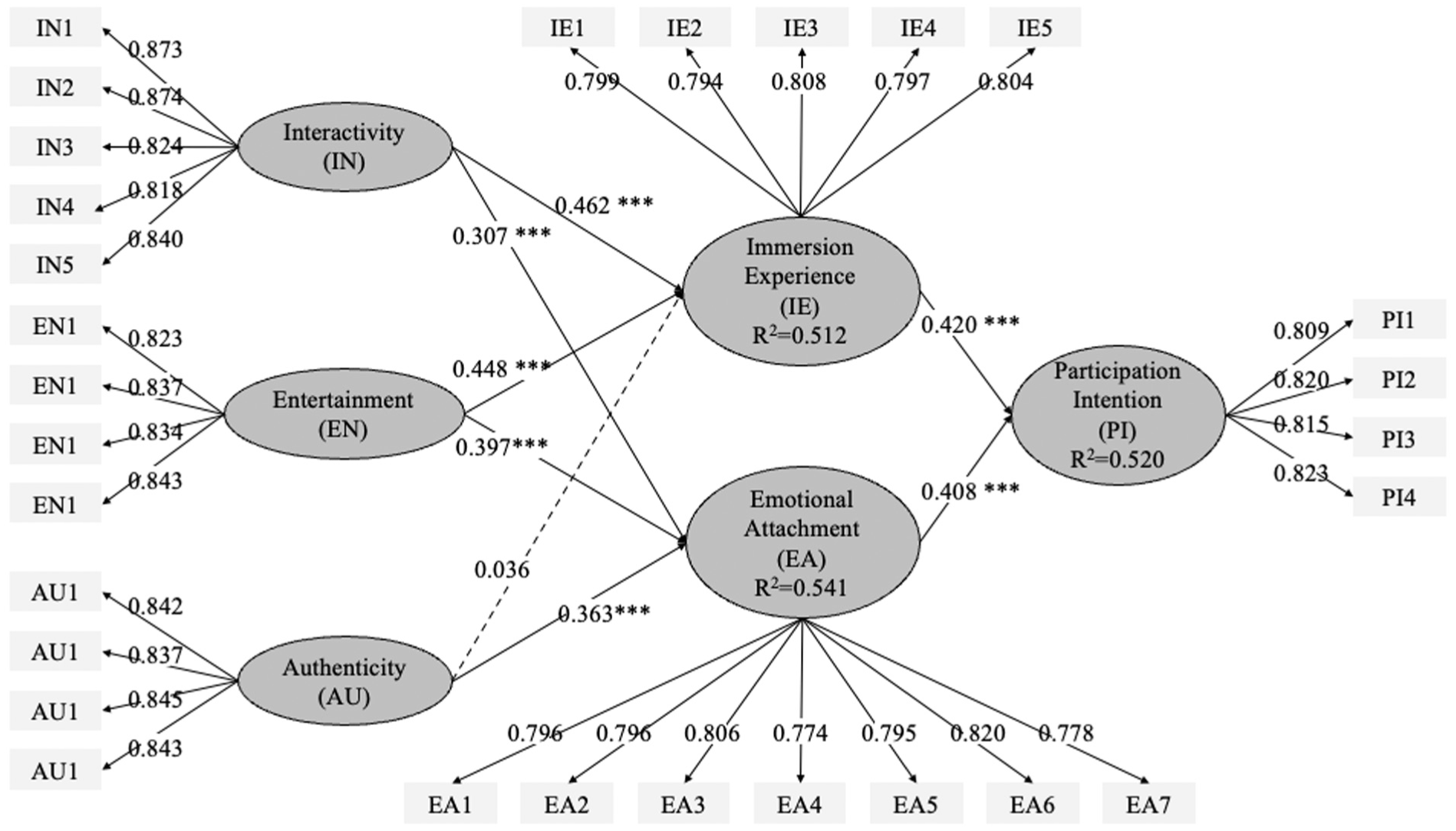
PLS results of the structural model.
From the table above, it can be seen that IN has a significant positive effect on IE (β = .462, p < .001) and EA (β = .307, p < .001); EN has a significant positive effect on IE (β = .448, p < .001) and EA (β = .397, p < .001); AU has a significant positive effect on EA (β = .363, p < .001), but no significant effect on IE (β = .036, p > .05); IE (β = .420, p < .001) and EA (β = .408, p < .001) have significant positive effects on PI. Therefore, except for H3, H1, H2, H4-H8 are all supported.
Mediation effect
In this study, to test the mediation effect, the Bootstrap mediation effect test method was used to examine whether the mediation effect is significant, with a confidence interval of Bias Corrected (95%), and 5,000 resampling iterations were conducted. The results of the mediation effect test are shown in the Table 8.
Bootstrap Mediation Effect Test.
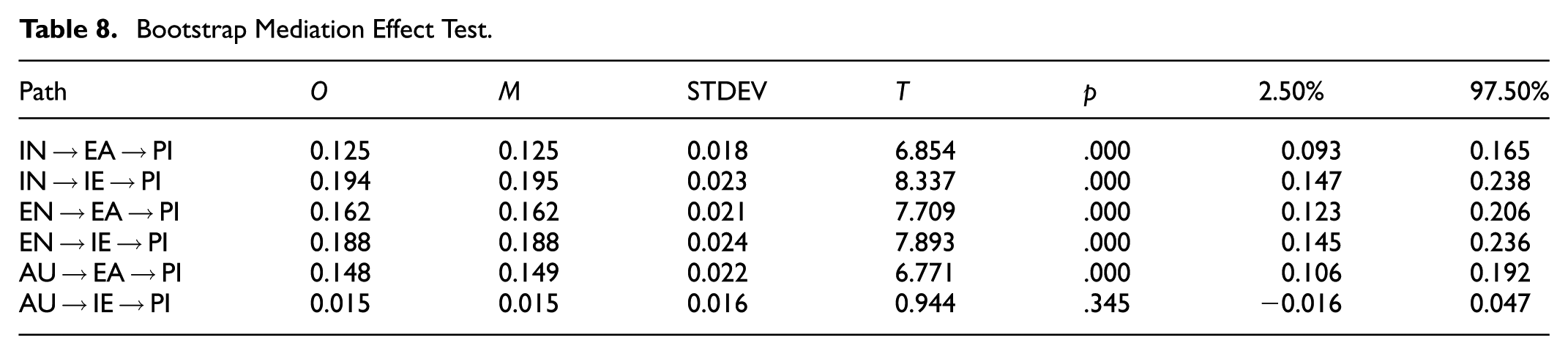
Mediation effect analysis shows: IN → EA → PI (0.125, 95% CI [0.093, 0.165]), IN → IE → PI (0.194, [0.147, 0.238]), EN → EA → PI (0.162, [0.123, 0.206]), EN → IE → PI (0.188, [0.145, 0.236]), AU → EA → PI (0.148, [0.106, 0.192]) effects are significant, with confidence intervals not including 0. However, the mediating effect of AU → IE → PI (0.015, [−0.016, 0.047]) is not significant, with the confidence interval including 0. Therefore, H9a, H9b, H10a, H10b, H10c are supported, while H9c is not supported.
Discussion
Discussion of key findings
This study yielded several important findings. Regarding the basic influence mechanism, interactivity and entertainment had significant positive effects on users’ immersion experience and emotional attachment, consistent with previous research findings that high levels of interactivity and entertainment can enhance users’ psychological investment and emotional connection (Wu & Zhang, 2024; Y. C. Zhao et al., 2024). Particularly in the emerging field of digital rural script games, the roles of interactivity and entertainment demonstrated unique mechanisms. Lu et al. (2024), through their study on metaverse user behavior, found that interactive design significantly enhances immersion experience by increasing users’ sense of control and engagement. In this study, this mechanism was further validated: users’ ability to freely control game progression, interact with other characters, and derive enjoyment from these factors collectively promoted deep immersion experience.
Further analysis showed that entertainment in digital cultural experiences not only brings immediate pleasure but also enhances users’ psychological investment through emotional activation, as pointed out by Prandi et al. (2023). In digital rural script games, the incorporation of entertainment elements not only brought pleasure but also enhanced users’ emotional attachment to game characters and scenarios. This finding echoes Sun et al. (2024) research, emphasizing that moderate gamification design can significantly enhance users’ emotional connection to cultural content. Notably, this study also revealed a synergistic effect between interactivity and entertainment. As Viñals et al. (2021) emphasized, when interactive design is organically combined with entertainment elements, it can produce stronger user experience effects. In digital rural script games, interactivity provided opportunities for user participation, while entertainment reinforced the depth and durability of this participation by increasing interest. This combination not only improved the immediate quality of user experience but also laid the foundation for establishing long-term emotional connections.
However, the most breakthrough finding of this study is the revelation of the differentiated influence mechanism of authenticity. The results show that authenticity’s impact on immersion experience is not significant, challenging the widely accepted view in traditional cultural tourism research. In previous studies, authenticity was often viewed as a core element in enhancing immersion experience (Kolar & Zabkar, 2010), but this relationship does not hold in the emerging field of digital rural script games. This finding suggests that in the context of digital transformation, users’ immersion experience may rely more on interactive design and entertainment mechanisms rather than environmental authenticity in the traditional sense. Especially for younger user groups, digital natives’ understanding and need for authenticity may have undergone fundamental changes (Sun et al., 2024). Interestingly, although authenticity’s impact on immersion experience is not significant, the study found it has a significant positive effect on emotional attachment. This indicates that authenticity elements may not directly create an immediate sense of immersion. Instead, they play a crucial role in the participation process by enhancing a user’s sense of identity and fostering an emotional connection with the cultural content. This differentiated influence mechanism provides a new theoretical perspective for understanding the role of authenticity in digital cultural experiences.
Regarding the model’s deeper mechanisms, the significant positive effects of immersion experience and emotional attachment on participation intention align with previous research (Hamilton et al., 2016; Lewis et al., 2008). Our results confirm that these internal psychological states are crucial in promoting continued user participation. Y. C. Zhao et al. (2024), through their study on open-world games, confirmed that immersion experience can significantly enhance users’ participation tendency, an effect particularly evident in games emphasizing cultural content. Meanwhile, Tea et al. (2022) empirical study showed that emotional attachment, as a deep psychological mechanism, can effectively predict users’ long-term participatory behavior. In digital rural script games, when users achieve deep immersion and form strong emotional attachments, they are more inclined to continue participating in related activities. Pressgrove and Bowman (2021) research explained the psychological mechanism of this phenomenon: immersion experience significantly enhances participation motivation by activating users’ cognitive processing, while emotional attachment promotes continuous interaction by strengthening users’ psychological connection to the content. This dual effect is particularly important in digital rural script games, as it involves not only the game experience itself but also the effectiveness of cultural inheritance. As Dimitriadou et al. (2021) pointed out, in educational games, users’ immersion experience and emotional investment play crucial roles in knowledge transfer and cultural understanding.
Synthesizing the above findings, this study revealed unique influence pathways in digital rural script games by validating the mediating roles of immersion experience and emotional attachment. Particularly regarding the mechanism of authenticity, the study found that the path of authenticity influencing participation intention through immersion experience is not significant; it mainly exerts its effect through emotional attachment. This result further confirms Wu and Zhang (2024) finding that in digital environments, authenticity mainly influences users’ participation intention through emotional attachment rather than immersion experience. This also echoes the earlier conclusion about authenticity having a significant impact on emotional attachment. Prandi et al. (2023) research also supports this view, finding that in digital cultural experiences, authenticity elements mainly promote participatory behavior by enhancing users’ emotional identification. This unique influence mechanism suggests a need to rethink how authenticity elements are applied in the design of digital rural script games. As Sun et al. (2024) suggested, the design of digital cultural products should focus more on how to cultivate users’ emotional connections through authenticity design, rather than blindly pursuing authentic environmental reproduction.
Theoretical implications
This study has several important theoretical implications. Firstly, it deepens our understanding of user participation mechanisms in digital cultural experiences, especially in the emerging field of digital rural script games. By integrating three key factors—interactivity, entertainment, and authenticity—we respond to Sutherland (2022) call for research on cultural inheritance in the digital age. The results validate the importance of interactivity and entertainment in promoting immersion experience and emotional attachment, while revealing the unique role of authenticity in digital environments. The most breakthrough finding of this study is that in digital rural script games, authenticity does not have a significant direct impact on immersion experience. This finding challenges the long-standing “authenticity-experience” paradigm in cultural tourism research (Kolar & Zabkar, 2010), as well as widely accepted views in traditional cultural tourism and heritage studies. This may signal our entry into a “post-authenticity” era of cultural experience, where the quality of experience and emotional connection may be more important than authenticity in the traditional sense. Based on this, we propose the concept of “digital authenticity”. This new form of authenticity has four dimensions: (a) emotional authenticity, where users have genuine emotional responses; (b) cultural authenticity, where core cultural values are accurately conveyed; (c) interactive authenticity, where user actions receive meaningful feedback; and (d) narrative authenticity, which ensures stories and characters are internally consistent. This concept redefines the evaluation criteria for digital cultural heritage research and practice, opens new possibilities for innovative practices and may influence related policymaking. This result implies that in digital environments, we need to redefine and understand the concept of “authenticity.” For digital natives, authenticity may be more about emotional and cultural genuineness rather than the exact reproduction of physical environments.
Secondly, by introducing immersion experience and emotional attachment as mediating variables, this study constructs a more comprehensive model of digital cultural participation. This model is comprehensive because it considers both external stimuli (like interactivity, entertainment, and authenticity) and users’ internal psychological states. By doing so, it provides new theoretical perspectives for explaining how participation intention is formed. This multi-level analytical framework responds to Wu and Zhang (2024) call for in-depth exploration of the internal mechanisms of digital cultural experiences, thereby providing a more solid theoretical foundation for future research. Notably, although authenticity does not have a significant direct impact on immersion experience, the study finds that it can still effectively influence users’ participation intention through emotional attachment. This finding reveals a new influence mechanism, suggesting that in digital cultural experiences, emotional connection may be more important than perceived authenticity. This not only breaks the traditional linear influence hypothesis but also provides new insights for understanding cultural inheritance mechanisms in digital environments.
This finding has important implications for digital cultural heritage protection and dissemination. It suggests that we may need to shift strategies from simply pursuing authentic reproduction of physical environments to creating digital experiences that evoke emotional resonance and cultural identity. For designers of digital cultural products, this means that future design directions may need to focus more on how to create emotional connections and cultural identity, rather than just pursuing visually authentic reproductions. Moreover, this finding provides new entry points for interdisciplinary research in psychology, cultural studies, and information science, especially in exploring how people perceive and experience culture in digital environments. It may reflect that technology is reshaping how people experience culture, and in digital environments, interactivity and entertainment may be more conducive to deep engagement than authenticity in the traditional sense. Overall, this finding not only enriches Sun et al. (2024) theoretical perspectives on the digitalization of cultural heritage but also opens up new research directions for understanding cultural experiences and inheritance in the digital age. It suggests that in today’s increasingly blurred boundaries between virtual and reality, users may value the overall quality of the experience more than whether it fully conforms to physical reality. This provides a new dimension for future digital cultural research and practice.
In terms of theoretical application, the findings of this study enrich the application of S-O-R theory in the digital cultural field. By integrating environmental stimuli (S), organismic responses (O), and behavioral responses (R) into a unified analytical framework, we demonstrate how to increase explanatory power while maintaining theoretical simplicity. The research shows that in digital cultural experiences, environmental stimuli (such as interactivity, entertainment, and authenticity) need to influence final participatory behavior through users’ internal psychological states (immersion experience and emotional attachment). This layered influence mechanism not only deepens the understanding of the “organismic response” stage in S-O-R theory but also provides new perspectives for explaining digital cultural participatory behavior (Viñals et al., 2021). Particularly in this study, the insignificant impact of authenticity on immersion experience challenges the simple assumptions about the relationship between environmental stimuli and psychological responses in traditional S-O-R research, suggesting that we should re-examine the action mechanisms of various environmental stimuli in digital contexts.
Finally, by focusing on the specific scenario of digital rural script games, this study expands the scope of digital cultural heritage research. The results indicate that inheriting and innovating rural culture in digital environments requires balancing technological features with cultural connotations. This view echoes Sun et al. (2024) research on digital cultural heritage protection. More importantly, the findings of this study provide new insights for interdisciplinary research, especially in the fields of psychology, sociology, and information science, broadening our understanding of how people perceive authenticity in digital environments. Furthermore, in digital rural script games, participants may value the “essence” of culture more than surface “authenticity,” providing new ideas for digital cultural dissemination strategies. The study also suggests that more attention should be paid to ways of conveying cultural core values and spirit in virtual environments, rather than relying solely on authentic reproduction of physical environments. At the same time, by introducing media theory, future research can further explore how digital media reshape people’s understanding and expectations of authenticity, thereby providing more comprehensive theoretical guidance for the protection and innovation of digital cultural heritage.
Implications for practice
Our research also provides implications for practitioners. Firstly, create high-quality IP content to enhance user experience. Research shows that interactivity and entertainment have significant positive effects on users’ immersion experience and emotional attachment. Therefore, developers should focus on script writing quality, paying attention to multidimensional design including story structure, logic, language, and emotion. Combining traditional rural cultural elements with modern narratives can create digital scripts with Chinese characteristics. For example, adapting classic folk stories or local legends, developing them innovatively in a “script+” mode, can both enhance cultural identity and provide users with fresh experiences. Script content should focus on emotional resonance, enhancing users’ emotional attachment through touching plots and character backgrounds. Designing scripts around themes such as family affection, friendship, love, or patriotism allows users to gain profound emotional attachment. Develop customized script content for different regions’ cultural characteristics and user preferences. Continuously optimize localization content strategies through data analysis and user feedback. Meanwhile, construct a complete IP worldview, extending IP value through various forms such as series scripts, derivative products, and online communities, to enhance user stickiness. For example, develop series scripts around popular characters or background worlds to form a “universe” effect. Promote quality script content through multiple channels such as social media and live streaming platforms, encouraging users to share game experiences and form positive word-of-mouth propagation. Collaborate with well-known KOLs to conduct online script-killing experience events to expand influence. These strategies not only improve content quality and enhance user experience but also spread traditional cultural elements to the younger generation in innovative ways, achieving the dual goals of cultural inheritance and innovation.
Secondly, innovate technological applications to enhance authenticity experience. Although the research found that authenticity does not have a significant direct impact on immersion experience, it still plays an important role in emotional attachment. Developers can fully utilize XR technologies (VR/AR/MR) to create immersive experience environments, such as restoring rural scenes through VR, using AR to enhance user interaction with the environment, or applying MR to achieve innovative experiences combining virtual and reality. Combine historical documents, folk tales, and local cultural elements to create authentic and attractive game scenes and characters, enhancing users’ emotional connections. In terms of technological applications, explore AI technology to develop intelligent scene interaction systems, such as using natural language processing technology to enable NPCs to engage in natural, emotionally rich dialogues with players. Use procedural generation technology to dynamically adjust storylines based on player choices, increasing game replayability and player engagement. Introduce motion sensing technology to allow players to interact with the game environment through body movements, combining smart wearable devices to enhance tactile experiences and improve the sense of reality in virtual world interactions. In terms of sound design, use 3D audio technology to create realistic sound environments, such as simulating rural natural sounds and traditional instrument effects, enhancing player immersion through auditory means. Collaborate with local musicians to create background music that incorporates traditional elements, enhancing game atmosphere and spreading local cultural characteristics. To balance technological innovation and cultural authenticity, collaborate with cultural scholars and folklore experts to ensure that the essence of traditional culture is preserved when applying new technologies. For example, use high-precision 3D scanning technology to restore cultural relics, combined with expert commentary, allowing players to learn cultural knowledge in the game. Design a “cultural accuracy” scoring system to encourage players to pay attention to cultural details and improve their understanding and respect for traditional culture. To help players establish connections between virtual and reality, design experience modes that combine online and offline elements. For instance, use AR technology to overlay game elements at actual rural scenic spots, allowing players to participate in the game while touring on-site. Or provide discounts on physical cultural products or experience activities based on game performance, encouraging players to explore rural culture. These innovative technological applications not only provide authentic immersion experiences but also attract the younger generation to participate in new ways, achieving the dual goals of cultural dissemination and rural revitalization.
Lastly, construct innovative operational models to promote long-term participation. Research shows that immersion experience and emotional attachment have significant impacts on participation intention, suggesting that operators should design long-term user engagement strategies. Adopt an “online + offline” integrated model, connecting physical experiences through digital technology. Regularly update game content, introduce seasonal activities or special scripts; establish community platforms to encourage users to share experiences and create derivative content, forming a positive social ecosystem. Design dynamic storyline systems that adjust plot directions in real-time based on player choices and behaviors, making each experience unique. Introduce “character growth” mechanisms, allowing players to use the same character across multiple scripts, upgrading abilities or unlocking background stories to increase game depth and strengthen emotional attachment. Integrating social elements is key to promoting long-term participation. Design multiplayer collaborative modes, encouraging team completion of tasks; hold online competitions and establish ranking systems to stimulate competitiveness and a sense of achievement. Create virtual communities for players to interact, share insights, discuss plots, and even participate in new script creation. Collaborate with local cultural institutions to ensure the cultural authenticity and educational value of game content, such as inviting folklore experts to participate in script creation or incorporating real historical events and cultural knowledge, enhancing the cultural value of the game and attracting traditional culture enthusiasts. Innovating business models is an important factor in maintaining user engagement. Consider adopting membership systems, providing exclusive content and priority experiences for paid users; try “freemium” models, offering basic content for free and charging for advanced features. Collaborate with local cultural and creative industries to develop peripheral products, creating additional revenue. Utilize data analysis and personalized recommendations to enhance user experience, recommending suitable scripts and characters for players, continuously optimizing game content and difficulty to attract players of different levels. Explore models combining digital rural script games with on-site tourism. Design special scripts related to actual scenic spots, encouraging players to visit in person; cooperate with local tourism departments to offer on-site travel discounts for players who complete specific tasks. This online-offline integrated model not only enhances user engagement but also provides new opportunities for rural tourism development. These innovative operational strategies not only increase long-term user engagement but also spread cultural knowledge through entertainment, promoting rural economic development and achieving the dual goals of cultural inheritance and rural revitalization.
Limitations and future research directions
This study verified how interactivity, entertainment, and authenticity influence participation intention in digital rural script games while revealing the mediating roles of immersion experience and emotional attachment. These findings provide new perspectives for understanding participation mechanisms in digital cultural experiences, though limitations suggest directions for future research. Additional factors may affect participation intention, including users’ cultural backgrounds, digital literacy levels, and games’ educational value. Future research could explore how cultural identity moderates variable relationships, considering the cultural inheritance function of digital rural script games. The social functions of games also warrant investigation.
While our findings are rooted in Chinese contexts—where digital rural script games emphasize rural revitalization and cultural heritage—they may partially generalize to other sociocultural settings. The positive effects of interactivity and entertainment on immersion and emotional attachment align with cross-cultural digital game research, showing similar engagement mechanisms across diverse groups (Bopp et al., 2019; Kuo et al., 2022). However, authenticity’s role—primarily influencing participation via emotional attachment rather than immersion—might differ in Western contexts. In Western heritage games, authenticity often ties to historical accuracy and may enhance immersion more directly (Mochocki, 2021). Cross-cultural variations in cognitive styles, such as holistic versus analytic attention patterns, could further modulate these effects (Šašinková et al., 2023). While core psychological processes like emotional attachment may transcend cultures, culture-specific elements (e.g., rural nostalgia in China versus historical recreation in Europe) may limit direct applicability, underscoring the need for comparative studies.
Methodological limitations require attention. The sample’s limited scope—mainly Chinese urban residents—restricts generalizability. Future studies should include more rural residents and diverse age groups, with cross-cultural comparative studies exploring differences in user attitudes and behaviors across cultural backgrounds. The cross-sectional survey design introduces common method bias. Future research could employ longitudinal designs or mixed methods to capture dynamic changes in user participation behavior through long-term tracking surveys, in-depth interviews, and observational methods. As technology advances, future research could explore virtual reality (VR) and augmented reality (AR) applications in digital rural script games and their impact on user experience. This would expand theoretical frameworks and provide new directions for digital cultural heritage innovation practices.
Conclusion
This study, grounded in the S-O-R framework, explores factors influencing user participation in digital rural script games using data from 415 users. Findings indicate that interactivity and entertainment positively impact immersion experience and emotional attachment, thereby enhancing participation intention, while authenticity primarily affects intention through emotional attachment, challenging traditional authenticity-experience paradigms. Our contributions include proposing “digital authenticity”—encompassing emotional, cultural, interactive, and narrative dimensions—to bridge literature gaps in digital cultural heritage, enriching S-O-R applications in rural-themed contexts compared to general immersive studies (e.g., Lu et al., 2024; Prandi et al., 2023), and offering practical guidance for designers to prioritize engagement elements for cultural revitalization.
Footnotes

Funding
The authors received no financial support for the research, authorship, and/or publication of this article.
Declaration of conflicting interests
The authors declared no potential conflicts of interest with respect to the research, authorship, and/or publication of this article.
Data availability statement
The research data supporting this study are available from the corresponding author upon reasonable request. Due to privacy and ethical considerations, the raw survey data containing participant responses cannot be publicly shared. However, aggregated data and statistical analysis results that support the findings of this study are available upon request to researchers who meet the criteria for access to confidential data.