




Abstract
Although corporate social responsibility (CSR) activities appear active on social networking sites (SNS), consumers increasingly suspect their authenticity. Based on attribution theory, this study examines consumers’ responses to SNS-based corporate social responsibility (CSR) activities by analyzing the impact of their perceptions of CSR attributes on their perceived authenticity of CSR (CPACSR) and participation intention (PI). We conducted a between-subjects experiment on a sample of 480 Korean undergraduate students to test all the hypotheses. Our findings suggest that the three CSR attributes positively affect CPACSR, partially moderated by the type of message source and CSR activity. These findings suggest several opportunities for future research that may further benefit marketers in CSR marketing decisions.
Keywords
Introduction
In high social volatility, corporate social responsibility (CSR) has been a valuable approach to improving the relationship between firms and their stakeholders (Saxton et al., 2021). CSR activities have gradually become essential for market segmentation, advertising, and public relations (PR) strategies, especially in marketing (Luu, 2019). Various studies have found empirical evidence that CSR marketing has positive effects on consumers’ attitudes, trust (Choi & La, 2013), purchase intention (Lee & Yoon, 2018), customer engagement (Agyei et al., 2021),brand value, and corporate image (Lee, 2016). However, these effects have not been systematically discussed regarding consumers’ perceived authenticity of CSR (CPACSR), an important research focus.
Many existing studies have investigated the effects of CSR from the perspective of enterprise management (i.e., financial performance) (Jones et al., 2017; Pérez et al., 2020); however, this approach excludes some factors and effects of CSR observed at the micro-level (i.e., consumer behavior). As this field of research examines individuals’ feelings at the micro-level, previous studies on CPACSR have mainly focused on qualitative studies and employees’ attitudes, excluding consumers’ perception of authenticity, which is a firm’s basic source of profit. There are certain limitations to the existing literature on CPACSR (Alhouti et al., 2016; Lee & Yoon, 2018; Moehl & Friedman, 2022). For example, empirical research on antecedents has not been conducted from the dimensions of CSR attributes, while outcome variables and specific promotion media have not been considered. Therefore, the central purpose of this study is to establish a systematic formation mechanism of CPACSR for participating in CSR activities through social networking sites (SNS).
Since the 21st century, SNS has been an important channel for CSR marketing communication (Cheng et al., 2021; Dalla-Pria & Rodríguez-de-Dios, 2022; Fernández et al., 2022; Ma & Bentley, 2022; Mar García-de Los Salmones et al., 2021). Many firms have launched “consumer participated CSR activities through SNS” to attract more consumers. Compared to traditional mass media, SNS allows consumers to produce, share, and disseminate information independently. This can improve the connection between consumers and help them actively participate in activities (Torres et al., 2018). However, the numerous and complicated CSR activities on SNS make consumers unaware of which one to believe. This confusion blocks the development of CSR activities, which is a loss for both business and society.
Based on the attribution theory, an individual’s observed behavior is attributed to external or internal forces, defined by three sets of observations (e.g., levels of consistency, distinctiveness, and consensus). We contextualized these three components to CSR activities on SNS and expanded attribution theory. Although previous studies have revealed that the authenticity of CSR marketing activities can be differentiated according to several representative variates, Previous studies have revealed that the authenticity of CSR marketing activities can be differentiated according to several representative variates, there are still gaps in the systematic analysis of activity attributes spread by communication messages (i.e., impact, consistency, and fit) (Moehl & Friedman, 2022; Pérez et al., 2020). Specifically, the impacted attribute of CSR activities refers to the “substantial changes” in the number of direct or indirect benefits generated by the activity enjoyed by stakeholders (Meis-Harris & Kashima, 2020). Consistency refers to the “sustainability” of activities with the same theme and scale. The fit attribute refers to the relevance among the corporate core business area, products, services, and social issues addressed by CSR activities. Furthermore, empirical analysis investigating the context of the antecedents and outcomes of CPACSR in consumer-engaged CSR activities on SNS is lacking. Hence, to fill this gap, we expand the research object from traditional mass media to emerging SNS media and combine attribution theory relations with CSR activity communication to examine the effect of CSR attributes on CPACSR and consumers’ PI.
This study also examined the moderating role of message sources on the relationship between CSR attributes and CPACSR. Many studies on CSR have revealed that the evaluation of communication messages directly influences consumers’ attitudes toward a corporation (Wu & Wang, 2011). Prior communication literature has found that consumers attribute messages intricately, often following the same relational pattern. This means that the message content is first, and the message source is second (Pérez et al., 2020). According to the persuasion knowledge model (PKM), the level of activated persuasion knowledge differs according to the type of message source (Friestad & Wright, 1994). However, the message type’s underlying meaning and motivation mechanism in CPSCSR has not yet been considered. Thus, we suggest that the message type may moderate the relationship between CSR attributes and CPACSR.
Furthermore, it has been observed that different types of activities may reflect firms’ behavioral motivations, which leads to varied perceptions of authenticity among consumers. Many previous studies on CPACSR have regarded CSR activities as a whole or generally classified. In contrast, Jeon and An (2019) have suggested that considering the overlap of various CSR activities, future studies must separate them from their goals, motives, execution strategies, and consumer participation methods. Cause promotion activity (a typical communicative CSR activity that aims to foster public awareness and concerns about specific social issues) and cause-related marketing (CRM) (directly associated with charitable donations and corporate sales performance) must exhibit significant differences in consumers’ perceptions of a firm’s behavioral motives (Jeon & An, 2019), which have not yet been considered. To investigate the motivation mechanism of activity types on CPSCSR, this study further demonstrates how different types of CSR activities moderate the relationship between CSR attributes and CPACSR.
Overall, this study contributes to our understanding of the CPACSR in three ways. First, attribution theory is used as a theoretical model to understand better the effects of the three attributes of CSR activities on CPACSR in SNS media. Second, this study also examines the different influences of message sources and activity types on consumers’ attribution processes. Third, this study used an experimental design to empirically test attribution theory as a theoretical explanation of the formation and positive effect of CPACSR. This study begins with a literature review of CSR activities through SNS, CPACSR, attribution theory, and hypotheses on structural relationships and moderating effects. Subsequently, the design and implementation of the experiment are presented. Finally, this study’s empirical analysis results and theoretical and practical implications are discussed.
Theoretical Background and Hypotheses
The conceptual model shows the structural relationships between CSR attributes, CPACSR, and consumers’ PI to CSR activities (Figure 1). In addition, we examined the moderating effects of the types of message sources and CSR activities on the relationship between CSR attributes and CPACSR.

Conceptual model.
CSR Activities Through SNS
CSR activities through SNS propose a new CSR marketing campaign that attracts consumer attention and participation by planning and implementing such activities on SNS platforms (Lee et al., 2018). Compared to traditional mass media, which can only communicate in a single direction, new SNS media possess the characteristics of establishing relationships and enhancing interactions. It is more capable of fulfilling the need for equal bidirectional communication between operators and customers (Torres et al., 2018). This shortens the psychological distance between consumers and firms and provides new ideas and methods for developing CSR activities. Although “SNS + Consumer Participation” can play a synergistic role, the different online and offline participation, high transparency of SNS (Pires de Sá, 2018), and inability to control consumer participation raise new opportunities and challenges to the development and evaluation of interactive CSR activities through SNS (Abitbol & Lee, 2017; Hartmann et al., 2021; Wang & Huang, 2018).
Consumer Perceived Authenticity of CSR
Joo et al. (2019) defined the authenticity of human behavior as: “A person’s behavior is not a responsibility or obligation, but an act that is carried out from the heart for the sake of others.” The concept of authenticity first appeared in philosophical research; since then, it has been widely used in diverse research fields and especially in social sciences, where authentic leadership, brand authenticity, SNS authenticity, and other professional concepts have been studied (Joo et al., 2019; Nardella et al., 2020). Authenticity was introduced in CSR at the beginning of the 21st century, consistent with the core of “integrity”; the research system has been gradually established since then. CPACSR is defined as consumers’ perception of firms’ CSR efforts and altruistic motives, which are sincere and honest expressions of firms’ beliefs in CSR activities (Alhouti et al., 2016; Moehl & Friedman, 2022). Joo et al. (2019) developed a multidimensional scale to understand and assess consumers’ judgment of CSR, and the positive effects of CSR authenticity were also supported and discussed. Most research in the marketing and communication domain indicates that CPACSR has a positive effect on consumers’ understanding of CSR activities and ultimately affects their attitudes toward brands, purchase intentions, word of mouth, and other long/short-term financial or ethics performance (Ginder et al., 2019; Wang & Huang, 2018; Yu & Liang, 2020). However, there is still a need to understand better and explain the influence mechanisms that contribute to CPACSR in the CSR research field.
Attribution Theory
Attribution theory argues that individuals infer internally (e.g., motivation or ability) or external (e.g., luck, fate, and being in the right place at the right time) causality by observing behavioral patterns across situations, others’ observations, and time (Ginder et al., 2019; Kelley, 1973). According to this model, an individual’s observed behavior is attributed to external or internal forces defined by three observations (e.g., levels of consistency, distinctiveness, and consensus). If an individual’s behavior shows high consistency, low distinctiveness, and low consensus, the observed behavior is likely to be attributed to its internal motivation. In contrast, if an individual’s behavior shows low consistency, high distinctiveness, and high consensus, the observed behavior is likely to be attributed to external factors (Afsar et al., 2020; Kelley, 1973).
For decades, sociologists have developed attribution theories at the individual level. Beckman et al. (2009) first expanded the theoretical application of attribute processes made by consumers to firms’ CSR strategy management. Alhouti et al. (2016) described substantive attribution as depicting a firm’s CSR activity value and symbolic attribution as performing CSR activities to achieve good performance. Ginder et al. (2019) empirically test the effects of CSR authenticity on consumer attributions for a firm’s internal and external CSR motivations and purchase intentions. Consumers’ internal and external attributions to CSR activities may oppose consumer attitudes and behaviors. In subsequent research, attribution theory explains the messages consumers use, leading to symbolic and substantive attribute processes. Consumers can judge the authenticity of a firm’s CSR activities based on information related to consistency, distinctiveness, and consensus (Moehl & Friedman, 2022).
Antecedent of CPACSR
Previous studies investigated the antecedents of CSR performance (Alhouti et al., 2016; Beckman et al., 2009; Joo et al., 2019; Nardella et al., 2020). Beckman et al. (2009) initially proposed several authentic CSR antecedents from the perspective of consumer perception, such as transparency, impact, and consistency, using the FGI method. Following the CSR micro effect of CPACSR was first introduced, Mazutis and Slawinski (2015) and Alhouti et al. (2016) provided empirical support regarding the improvement of CPACSR perception by enhancing variates, such as the specific regions of CSR activities, corporate brand reputation, the fitness of core products, and theme of activities. Some studies have used attribution theory to investigate the different effects of three types of situational information on corporate reputation and CSR effects (Jiang et al., 2022; Kim & Lee, 2020; Nardella et al., 2020; Rim et al., 2020). Recently, focusing on the CSR communication context on social media, Moehl and Friedman (2022) and He et al. (2022) directly tested the effects of all three components of attribution theory on consumers’ judgment of CSR. According to studies on consumer behavior, consumers’ assessment of authenticity includes a complex perceptual process. Thus, the attributes of CSR activities, namely, consistency, company-cause fit, and impact, are positioned as dynamic attributes that influence CPACSR.
Consistency is the most important attribute of CSR activities and captures changes in firm attitudes. It exhibits the characteristic of constant investment in all necessary resources (Yoo & Lee, 2018). Based on attribution theory, prior studies indicate that the higher the consistency of CSR activities, the stronger the CPACSR. Combined with Kelley’s (1973) attribution theory, we propose that consumers’ judgment of altruism or self-interest as motivation for CSR activities is determined by time and money invested, consistency, and other factors. Therefore, a high level of perception of CSR activity in terms of consistency can help consumers perceive the company’s strong altruistic motives, thereby increasing their CPACSR.
Furthermore, we argue that if consistent CSR activity has a high-level company-cause fit, it will appear to be more authentic. Company-cause fit measures the degree of correlation between the themes of specific CSR activities and core business areas, such as the products or services of a company (Yoo & Lee, 2018). When CSR activities are highly compatible with a firm’s core business, consumers can easily associate the corporate image with social issues. However, they might think that the company will use the relevant technology and power to solve its problems with less additional investment (Berry et al., 2017). This is likely to ensure the effectiveness of CSR activities (Joo et al., 2019). Therefore, consumers are more likely to express a friendly attitude toward a company with a high company-cause fit for its CSR activity and accept its authenticity. A high-level fit attribute did not positively affect certain stigmatized products. However, these cases were not considered in the present study.
Similarly, the impacted attribute of campaigns is regarded as an important antecedent of CPACSR. It refers to consumers’ psychological cognition, recognizing the objective and effective benefits that society or the environment can derive from a CSR activity (Beckman et al., 2009; Meis-Harris & Kashima, 2020). Consumers rely on peripheral cues, such as prior reputation, when evaluating CSR activities and objectively evaluate their practical effects, such as the extent of objective benefits created, especially for foreign enterprises (Choi et al., 2016). Holbrook’s (1978) empirical results reveal that a message based on objective facts significantly influences its persuasive effect. Thus, when a message is based on objective facts (versus pure judgment), it reduces the receiver’s uncertain cognition and increases their sense of trust. Therefore, the information released based on CSR activities’ objective and effective influence will certainly increase consumers’ probability of attributing CSR behavior’s motivations toward altruism (Du et al., 2011). This subsequently enhances the CPACSR.
In line with the above arguments, we propose the following hypotheses related to the effects of CSR attributes on CPACSR:
CPACSR and Consumers’ PI
According to the social identity theory (Tajfel, 1975), certain intergroup behaviors can be predicted based on perceived-group status differences. Similarly, consumers’ positive perceptions of a firm regarding CSR activities can positively change their attitudes and behaviors. Consumer-perceived authenticity has been discussed in various disciplines, including CSR management and marketing strategies (Joo et al., 2019; Moulard et al., 2016). Some studies on CSR authenticity in marketing research are conceptual or qualitative in nature, investigating authenticity based on individual perceptions (Mazutis & Slawinski, 2015; McShane & Cunningham, 2012). However, some studies have explored the logical relationship between authenticity perception and consumers’ emotions or attitudes (Joo et al., 2019), and consumers’ behavioral intentions (Afzali & Kim, 2021). In particular, when consumers recognize the authenticity of CSR activities, the firm may gain confidence and benefits from consumers; that is, CPACSR may be expected to have a significant positive effect on consumers’ assessment of the firm or on their decision to purchase product/service (McShane & Cunningham, 2012; Schaefer et al., 2019).
Consistent with the findings of existing literature, authenticity acts as an important variable in establishing a close relationship between corporations and consumers in psychological communication. Further, it is key to helping consumers make their final behavioral decisions (Saxton et al., 2021). Therefore, consumers mobilize the perception of authenticity in relationship recognition, judgment analysis, and final decision-making (Afzali & Kim, 2021). Empirical research has shown that consumers’ perceptions of the authenticity of donation activities can increase the number and frequency of consumers’ donations or volunteer work (Hur et al., 2020; Schaefer et al., 2019). Therefore, when CPACSR was effectively stimulated, the PI for SNS-based CSR activities significantly improved. Therefore, we propose the following hypothesis:
Moderating Effects of the Different Types of Message Sources
A message source is defined as the unit or individual that sends a message (Wu & Wang, 2011). Prior studies have shown that message sources are an effective vehicle for spreading CSR information, although there are differences in experience, professionalism, reliability, business motivation, and other variables of a message source (Buchanan & Benson, 2019; He et al., 2022). Prior studies emphasize the importance of type, message source types, and credibility and how they may improve its persuasive effect (Trivedi et al., 2020). Many studies have highlighted the importance and effects of government/institutional message sources, company official message sources, company staff, celebrities, well-known experts, and ordinary consumers (Jiang et al., 2021; Wang & Huang, 2018). With the rapid development of network technology and new media, SNS has become popular among marketers. Compared to traditional media, SNS media enables its users to be “message receivers” and allows them to develop a variety of information production and communication capabilities (Mar García-de Los Salmones et al., 2021). Thus, many message sources are becoming involved in information spreading, and research is needed to identify how and why message source types affect consumers’ perceptions of CSR information on SNS (Lee et al., 2018).
Extending previous research findings, this study proposes that different message sources moderate the effects of CSR-related communication messages. In this context, we adopted the persuasion knowledge model (PKM) (Friestad & Wright, 1994). PKM focuses on how consumers interpret and evaluate corporate persuasion behavior and, consequently, analyzes whether they accept or resist corporate persuasion. Specifically, the PKM suggests that if the behavior of agents (companies) is judged as “persuasive behavior with some intention,” the targets (consumers) will generate a high degree of persuasion knowledge and activate their resistance. This weakens the persuasiveness of the related messages (Pérez et al., 2020). If the agent’s behavior is not judged as “persuasion behavior,” the targets generate a low degree of persuasion knowledge, such that the resistance is not activated. This enhances the persuasiveness of messages (Ham & Kim, 2019). Combining PKM with SNS media, we observe that consumers in the common system (e.g., relatives, friends, and strangers) are less alert than those in contact with their interests (Clark & Mills, 1979). Their commercial intentions are sufficiently weak to reduce consumers’ message resistance. Corporate SNS message sources cause consumers to perceive more commercial intentions and generate resistance, thus reducing the persuasive effect (Pérez et al., 2020). Therefore, if a company’s CSR-related message is conveyed through personal SNS accounts instead of corporate SNS accounts, consumers will form a higher perception of the purity and authenticity of their activities. This generates lower resistance, such that consumers are more likely to analyze and process information. Therefore, the elements in such messages have a more significant impact on consumers’ final information processing.
We selected Facebook, the most popular SNS medium in the Korean market, as the research object for this study. To explore the moderating role of message resources (personal versus corporate SNS), we propose the following hypotheses:
Moderating Effects of the Type of CSR Activities
Previous studies on CPACSR have evaluated CSR activities. Generally, CSR activities are classified into four types: economic, legal, ethical, and charitable (Carroll, 2003). If CSR activities of the same theme take different forms, different marketing effects will be achieved (Lii & Lee, 2012). For instance, Lii and Lee (2012) divided CSR activities into three types, namely commercial sponsorship, cause-related marketing, and general charitable donations, to examine their significant differences in consumer attitudes and decision-making. Based on these results, we suggest significant differences in consumers’ perceptions of the authenticity of CSR activities with similar attributes due to their different types (Jin & Lee, 2019). The intensity of the influence of antecedent variables may change. Therefore, it is important to study the differences between CSR activities in CSR theory and marketing practice.
Cause promotion is a typical communicative CSR activity that fosters public awareness and concerns about specific social issues. Cause-related marketing is a CSR activity in which corporations provide financial support to solve social problems by donating a portion of their sales (Kotler & Lee, 2008). The two types of CSR activities exhibit different methods of participation and promotion, such that the motivations for corporate behavior perceived by consumers must be different (Jeon & An, 2019). Ginder et al. (2019) summarized consumers’ perceived motivation for CSR activities into two categories: (1) “external motivation” is used to maximize corporate self-interest; (2) “internal motivation” is used to improve the environment public’s interests. The purpose of CRM is to use a part of the sales revenue for charitable donations. Therefore, the number of enterprise donations is always linked to sales volume, making it easy for consumers to associate product promotions with CSR activities (Yan & Hyman, 2019). Therefore, with CRM, consumers are more likely to attribute corporate behavioral motivations to their interests. This results in a lower perception of authenticity (Bergkvist & Zhou, 2019). Participative consumers’ perceptions awaken their awareness of specific environmental and social issues with simple cognition, which increases their intention to participate (Jeon & An, 2019). Consumers are more likely to attribute corporate motivation to altruism, as their perception activities involve no excessive interest, resulting in a higher authenticity perception (Jeon & An, 2019; Joo et al., 2019). A preconceived idea will be generated based on cognitive response theory if consumers estimate corporate behavioral motivation as altruism. In such situations, they seldom consider external variates in the formation of corporate attitudes (Afzali & Kim, 2021; Meis-Harris & Kashima, 2020).
Therefore, we suggest that the CPACSR of consumer perceptions is relatively high as opposed to CRM. The formation of authenticity perception is less affected by CSR activity attributes. To explore the moderating role of CSR activities, we propose the following hypothesis:
Method
Design and Stimuli
This experimental study adopted a 2 (corporate SNS/personal SNS) × 2 (CRM/CP) between-subjects factorial design. As the ultimate target of this study is all consumers, there is no excessive restriction on sampling, and only basic demographic characteristics are considered. A total of 497 Korean undergraduate students with some knowledge of or interest in CSR were recruited for extra credit for their courses. Removing blank and A total of 480 valid questionnaires (n = 480; 53.8% male and 46.2% female; Mage = 22.7,and range = 19–28 years) were collected. Participants were exposed to a print scenario of a fictitious pure water brand (Alpha) and were randomly assigned to one of the four experimental conditions. They then watched an advertisement under different conditions. The message source was shared by a personal Facebook account (personal SNS message source) or published by an official corporate Facebook account (corporate SNS message source) in the printed scenario. We then operationalize the CSR activities. The CP campaign was designed with a statement, “From 2010, Alpha Water began to participate in water-saving, control of sewage, and other water conservation activities (consistency and fit attribute). Alpha Water regularly donates money to Greenpeace’s water protection campaigns. Alpha Water contributed to water protection through these activities and received a positive social response (impact attribute). Alpha Water looks forward to your participation” and the CRM campaign with a statement, “From 2010, Alpha Water participated in water-saving, control of sewage, and other water conservation activities (consistency and fit attributes). Alpha Water commits to donating 1% of sales to Greenpeace’s water protection campaign. Through these activities, Alpha Water contributed to water protection and received a positive social response (impact attribute). Alpha pure water looks forward to your participation”. We adapted real-world materials provided by a real pure-water company to formulate these stimuli. Following the procedure given in existing research, we controlled for the pictures and language expressions in all four scenes to be the same.
In the main experimental questionnaire, after exposure to the print scenario, participants responded to measures of CSR attributes, CPACSR, PI, manipulation check, and demographic variables.
Measures
Five variables were of interest. CSR consistency was stimulated by attributes for three items, including “Be carried out for a long time,” “Invest consistently,” and “Be carried out consistently” (see Choi & La, 2013; Cronbach’s α = .89). Attributes for three items stimulated CSR to fit: “High relevance to core product/service, high relevance to corporate image, and high relevance to the core business area.” (see Choi & La, 2013; Cronbach’s α = .87). Attributes for three items stimulated CSR impact: Help raise public awareness of social problems,” “Mobilize to solve problems, “and “Help solve social problems.” (see Du et al., 2011 Cronbach’s α = .91). attributes for three items also stimulated CPACSR: Sincerely for the public good,” “An innermost behavior, “and “Think for the whole society.” (Cronbach’s α = .88). At last, consumers’ PI to CSR activities was stimulated by two items, including “An intention to participate” and “Encourage friends to participate.” (Cronbach’s α = .85). All items were measured using a five-point Likert scale; the higher the coding value, the higher the level of the measurement index. All the scales were translated into Korean and then back-translated into English.
Manipulation Check
To check the effectiveness of the types of CSR activities and message sources, we conducted two between-subjects pretests before the main experimental questionnaire we conducted two between-subject pretests. For CSR activity type, the final sample consisted of 43 participants (average age: 29.2 years; 46.5% females). Participants perceived cause-related marketing as mainly conveying business motives (MeanBusiness = 4.196, SD = 0.652; MeanPublic = 3.2391, SD = 0.736, n = 23, t = 4.662, p< .001) and promotional marketing as mainly delivering public welfare motives (MeanBusiness = 3.525, SD = 0.379; MeanPublic = 3.900, SD = 0.619, n = 20; t = 2.370, p < .05). supporting the effectiveness of our CSR activity category experimental manipulation. For message source type, the final sample consisted of 41 participants (average age: 26.3 years; 56.1% females). Participants in corporate SNS teams perceived that the message was spread through corporate official channels (Meanofficial = 4.048, SD = 0.645; MeanPersonal = 3.105, SD = 0.459, n = 21; t = 7.274, p < .001), whereas the personal SNS team perceived the message to be spread through personal channels (MeanOfficial = 3.475, SD = 0.525; MeanPersonal = 4.125, SD = 0.582, n = 20; t = 3.708, p < .001).
Results
Non-Response and Common Method Bias
Non-response bias and common method bias were the two common issues in the survey. First, to estimate the non-response bias, we randomly divided all participants into two groups and compared their differences for their demographic characteristics (Armstrong & Overton, 1977). The t-test performed on the two groups yielded no statistically significant differences, suggesting that non-response bias was not a concern. Second, we minimized the potential influence of common method variance (CMV). We arranged independence and dependence into different sections of the survey to control for retrieval cues (Podsakoff et al., 2003). Harman’s single-factor test based on exploratory factor analysis (EFA) (Podsakoff et al., 2003) was conducted to verify possible common method bias. The EFA generated five distinct factors with eigenvalues above 1.0, which explained 80.9% of the total variance. The results suggest that common method bias is not a serious problem.
Reliability and Validity of Measurement Model
We ran a confirmatory factor analysis (CFA) with AMOS 16 on the 14 items representing the five constructs using the full sample dataset. First, to evaluate convergent validity, we linked each item to its corresponding construct and freely estimated the covariance among the constructs (O’Leary-Kelly & Vokurka, 1998). The model fit showed that χ2 = 92.18 (df = 67, p < .05); RMSEA = 0.03; RMR = 0.02; GFI = 0.98; CFI = 0.97; NFI = 0.98, the overall model fitness was acceptable (Hu & Bentler, 1999), all of the factor loadings were higher than 0.60 and t values were greater than 1.96, indicating convergent validity (Hair et al., 2011) (see Table 1). Second, we calculated all five average variances extracted (AVE) values, exceeding the minimum 0.50 acceptable standard (Fornell & Larcker, 1981), suggesting high-level convergent validity. Furthermore, we compared the square root of AVE and the correlation between constructs to test discriminant validity (Fornell & Larcker, 1981). The square root of the AVE value of each construct is much larger than the correlation between any pair of constructs (see Table 2), indicating compliance with discriminant validity.
CFA Analysis Result (n = 480).

Note. Model fit summary: χ 2(67) =92.18; χ2/df = 1.38; RMSEA = 0.03; RMR = 0.02; GFI = 0.98; CFI = 0.97; NFI = 0.98.
Discriminant Analysis Result (n = 480).

Note. Diagonal value is AVE value; Table value is correlation coefficient; Square of the correlation coefficients appear in parentheses.
p < .01. ***p < .001.
Structural Model
To test the structural effect of CSR attributes, CPACSR, and PI, we first estimate the full sample model in Amos. Table 3 presents the results of the structural model. Model fit showed that χ2 = 146.97 (df = 71, p < .05); RMSEA = 0.05; RMR = 0.09; GFI = 0.96; CFI = 0.98; NFI = 0.97, the overall model fit was good. According to the results of the structural model, all three CSR attributes have significantly positive effects on CPACSR (consistency: β = .25, t = 4.99; fit: β = .30, t = 5.52; impact: β = .17, t = 3.36), supporting H1a, H1b, and H1c. H2 was also supported by the fact that CPACSR had a positive and significant influence on PI (β = .52; t = 9.16).
Structural Relationship Between CSR Attributes, CPACSR and PI (n = 480).

Note. Model fit summary: χ 2(71) = 146.97; GFI = 0.96; CFI = 0.98; NFI = 0.97; RMSEA = 0.05; RMR = 0.09; ***p < .001.
Moderating Effects
Consistent with the structural effect, H3 and H4 predicted the moderating effects of the type of message source and CSR activities on the relationship between CSR attributes and CPACSR, and a multi-group analysis was conducted. To test the moderating effect of SNS message sources, we estimated two separate groups: a corporate SNS message resource group and a personal SNS message resource group. Table 4 presents the results of the structural model for the two groups. The results showed that in group B, all three CSR attributes had positive and significant influences on CPACSR (consistency: β = .30, t = 5.16; fit: β = .47, t = 6.95; impact: β = .25, t = 3.78); however, only consistency had a positive and significant influence on CPACSR (consistency: β = .18, t = 2.38; fit: β = .14, t = 1.74; impact: β = .04, t = 0.56). Moreover, the β-value of each path in group B was greater than that in group A.
Structural Analysis for Each Message Source.
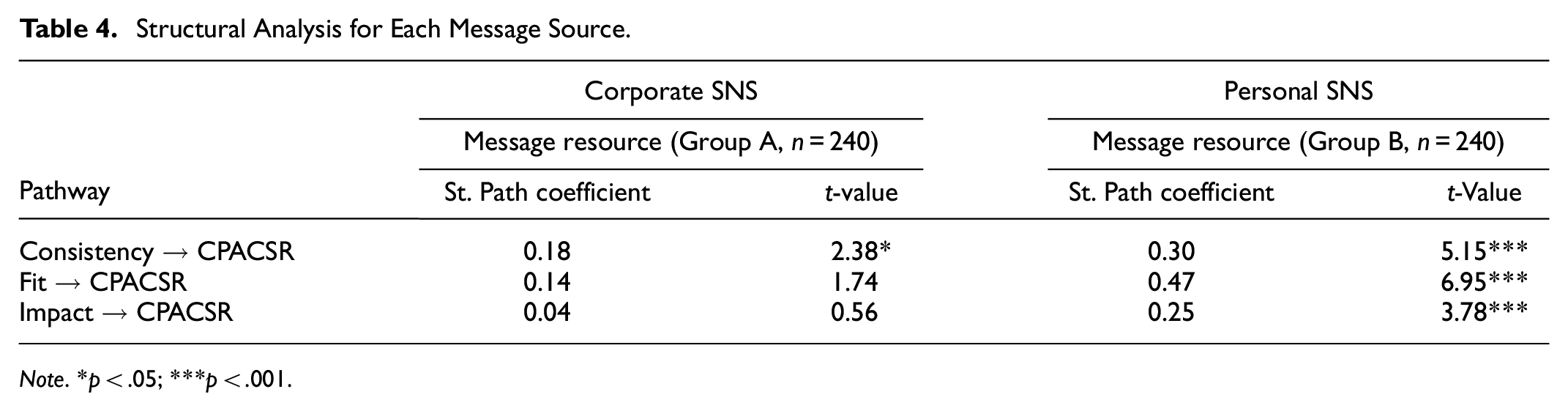
Note. *p < .05; ***p < .001.
To test the predicted moderating role of message sources on the relationship between CSR attributes and CPACSR, the △χ2 (df = 1) values between the free and constraint models in each path were calculated. The results show that both Fit → CPACSR (△χ2 = 6.8 > 3.84) and Impact → CPACSR (△χ2 = 4.3, >3.84) differences are statistically significant at a = 0.05, supporting H3b and H3c. Whereas, a non-statistically significant difference (△χ2 = 0.9 < 3.84) was found in “Consistency → CPACSR” path, rejecting H3a (see Table 5)
Moderating Role of Message Sources on CSR Attributes and CPACSR.
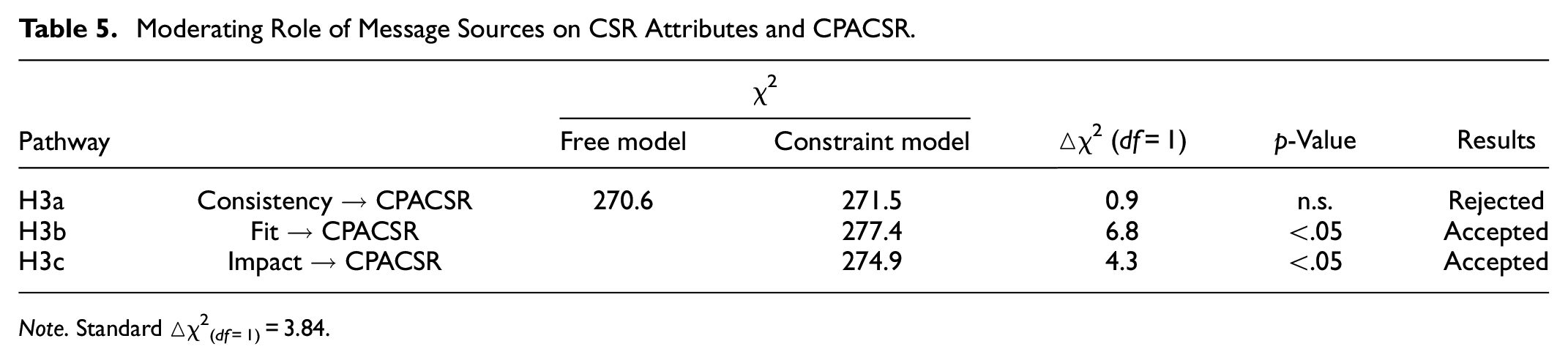
Note. Standard △χ2 (df = 1) = 3.84.
Finally, the moderating role of CSR activities was examined using the same method. We estimated two separate groups: the CP and CRM groups. Table 6 shows that in group D, all three CSR attributes had positive and significant influences on CPACSR(consistency: β = .21, t = 3.64; fit: β = .37, t = 4.77; impact: β = .38, t = 4.83); however, only consistency had a positive and significant influence on CPACSR (consistency: β = .24, t = 3.19; fit: β = .12, t = 1.98; impact: β = .08, t = 1.21) in group C. All the β-values of each path in group D are greater than those in group C. Furthermore, both Fit → CPACSR (△χ2 = 5.6 > 3.84) and Impact → CPACSR (△χ2 = 11.2 > 3.84) differences are statistically significant, supporting H4b and H4c. Whereas, a non-statistically significant difference (△χ2 = 1.0 < 3.84) was found in “Consistency → CPACSR” path, rejecting H4a (see Table 7).
Structural analysis for each CSR campaigns.

Note: *p <0.05; **p < .01; ***p < .001.
Moderating Role of Types of CSR Activities on CSR Attributes and CPACSR.

Note. Standard △χ2 (df = 1) = 3.84.
Discussions
Authenticity is an important factor in the success of CSR strategies (Hur et al., 2020). However, consumer perceptions of authenticity are always influenced by the attributes of CSR activities. The features of the communication channels also influence it. Currently, there is a lack of a comprehensive understanding of these aspects. The main purpose of this study is to analyze how the core attributes of consistency, fit, and the impact of CSR marketing activities influence CPACSR. This study also attempts to understand the context in which this relationship changes and leads to the development of consumers’ PI. Integrating the unique characteristics of SNS-based CSR activities, we investigate the message sources and CSR activities as moderating factors. Following attribution and authenticity theories, we propose a new direction for studying CPACSR and customer behavior. This study demonstrates the theoretical and practical significance of social psychology and CSR marketing strategies from a new perspective.
Results and Theoretical Contributions
First, according to the observed results, this study extends the literature on CSR and consumer behavior by combining CSR with customer participation in CSR activities through SNS. It further focuses on CSR activities that require consumer participation through SNS and empirically verify the relationship between CSR attributes, CPACSR, and PI. Specifically, the formation of CPACSR considers the three related factors of consistency, fit, and impact of the attributes of consumer-perceived CSR activities, which are taken as independent variables in this study. Moreover, the findings emphasize the positive effect of CPACSR on customers’ actual participation intention regarding CSR activities via SNS, which has not been extensively studied in the existing literature.
Second, our results show that SNS message sources partially moderate CSR attributes’ effects on CPACSR. Hence, the messages related to the fit and impact attributes transmitted by personal SNS instead of corporate SNS have a stronger influence on CPACSR. We discuss these results using the “convincing knowledge model.” Consumers are more inclined to generate negative evaluations of the behavioral intentions of individuals or groups in a relationship system established based on exchange or transaction. This contrasts with their relationships with relatives and friends, who are conscious of being present in the same relationship system (Clark & Mills, 1979). This study considers that the message publisher is not related to the firm but presents the same relationship system as the message receiver or consumers. Thus, consumers’ persuasion intentions are relatively weak, whereas the influence of relevant messages is relatively strong (He et al., 2022). As for the enterprise SNS, as a stakeholder, consumers may perceive a strong persuasion intention, due to which they may be excluded psychologically. We found that the influence of the related messages was relatively weak. Therefore, when a company conducts CSR activities through SNS, attribute messages should be disseminated through personal accounts that have no conflicting interests with the company to improve their positive effects on CPACSR.
Third, our results confirm that the impact of CSR attributes on the authenticity of corporate social responsibility is partially affected by the type of CSR activities undertaken. Hence, fit and impact-related messages of CRM have a stronger effect on CPACSR than consumers’ perceptions. The results show that CSR activities have different effects depending on consumers’ dissimilar motivation cognition. As a representative CSR activity, consumers’ perception is realized through pure communication, which has a limited effect on improving the public’s understanding of specific social issues. Most consumers are more likely to attribute corporate motivation to altruism, which generates a higher trust (Jeon & An, 2019). In the formation of CPACSR, this trust will serve as a halo effect, exhibiting that CSR-related information is less important; hence, the effects of the fit and impact attributes on CPACSR will be diminished. However, the donation amount of CRM is always linked to sales volume. Consumers are more likely to be associated with activities that yield corporate profits (Jeon & An, 2019). Thus, when deciding based on CPACSR, it is necessary to rely on information related to the CSR attributes. Accordingly, CSR activities’ fit and impact attributes exhibit relatively strong effects.
In contrast to the hypothesis, the effect of consistency on CPACSR was not moderated by the message sources and CSR activities. Kelley’s (1973) attribution theory explains consumers’ reactions to CSR consistency, which asserts that when consumers make internal or external attributions to behaviors, they rely mainly on distinctiveness, consensus, and consistency. In this context, the consensus is defined as, “do other people respond similarly in the same situation?” and consistency is defined as “do the same events happen time after time?” The CSR consistency attribute proposed by Kelly followed the same pattern. This implies that when consumers contact messages that companies conduct CSR activities in high consistencies without any change, it is easier to attribute CSR behaviors to internal attribution. Therefore, the moderating effects of the message sources and CSR activities are offset by the formation of CPACSR.
Practical Implications
The findings of this study have important implications for the management of CSR activities. First, managers need to implement CSR activities that reflect their firm’s management philosophy, values, and vision so that consumers can recognize CSR activities as internal forces driven. Firms have the flexibility to use relevant information about consistency, fit, and impact attributes of CSR, which can improve consumers’ participation and achieve higher CSR performance. For instance, “the duration of CSR activities being carried out or shared,” “the degree of CSR activities being related to the core business areas,” and “how many direct or indirect benefits have been attributed to internal and external stakeholders through CSR activities” should be disclosed on SNS platforms. From the perspective of a firm’s long-term interest growth and image protection, firms need to consistently conduct and publicize their CSR activities.
Second, many studies have investigated the significant effects of message sources on consumer decision-making processes on SNS platforms. The halo effect of message publishers is particularly important for controversial CSR communication content. CSR practitioners should choose a message source (i.e., colleagues, relatives, or other civilians) that can shorten the psychological distance from consumers and reduce psychological defense to maximize the impact and credibility of CSR attribute-related information (Hartmann et al., 2021). For example, companies should stimulate the dissemination and interaction of information among consumers through SNS media. Even if CSR messages are to be published on the corporate public account, certain elements such as family, country, and nation should be added to shorten the psychological distance with consumers. Simultaneously, establishing a reliable independent/cooperative information release platform will help firms achieve long-term CSR effects (e.g., financial performance and brand image) in the long run.
Finally, when CSR practitioners choose different types of CSR activities according to their business purpose, they should design appropriate communication methods based on the characteristics of each type, which is conducive to enhancing CPACSR. In the case of consumer perception, CSR attribute information can be used. The existing corporate image and the social nature of SNS can also be enhanced to activate the halo effect for a positive corporate image, especially for cause promotion. On the other hand, considering firms’ long-term development, although it is difficult to change the form of CRM (which is labeled as value-driven activities), effective and consistent CSR attribute information issuance needs to be fully considered. For instance, messages related to impact and fit attributes should be used frequently in CRM communication strategies.
Additional questions posed by the study findings Since this field of study focuses on individual feelings at the micro-level, our results provide evidence that messages related to CSR attributes have the potential to increase CPACSR and participate in CSR activities effectively. We believe that this pattern of results will be of interest to various constituent groups, including marketing teams in corporations and the public health or environmental community. These findings suggest several opportunities for future research that may further benefit marketers faced with CSR marketing decisions in choosing the relevant activity types and communication strategies.
Limitations and Future Research
Although we have tried our best to make some theoretical contributions and implications, this study has some limitations that provide further research opportunities. First, we only studied the effects of the three most representative and relatively objective CSR attributes on the CPACSR of activities through SNS. In further research, the characteristics of SNS and consumer-participant activities can be fully considered. More representative antecedents should be compiled to understand the formation and effects of CPACSR better. Second, we used Facebook, the most popular SNS media in the Korean market. However, in different SNS media, consumers have different purposes and ways of using and attaching different importance to factors, reflecting significant differences in consumers’ perceptions of CSR on various SNS platforms. Therefore, it is necessary to conduct further research on CPACSR effects, considering different SNS platforms. Third, in this experiment, all samples were 20-year-old college students, which hinders the generalization of the research results. Although previous studies provided no evidence about the effects of age and occupation on CPACSR, choosing more representative specimens in subsequent studies is bound to make the results more convincing.
Footnotes
Declaration of Conflicting Interests
The author(s) declared no potential conflicts of interest with respect to the research, authorship, and/or publication of this article.
Funding
The author(s) disclosed receipt of the following financial support for the research, authorship, and/or publication of this article: This work was supported by the Fundamental Research Funds for the Central Universities (Grant No. HIT.HSS.202151).
