




Abstract
This article systematically reviews the literature on exclusion errors in cash transfer programs in Brazil, focusing on the Bolsa Família Program (BFP). The study examines the targeting mechanisms and methodologies used to measure these errors, identifying persistent challenges such as income under-reporting, administrative discretion, and political manipulation that led to the exclusion of eligible families. Marginalized groups, including quilombola communities, indigenous peoples, individuals with disabilities, and black women, are particularly affected by these exclusions due to administrative and bureaucratic barriers. The review also underscores the need for more integrated and culturally sensitive approaches, considering intersectional identities. Combined methodologies using quantitative and qualitative data are essential to understanding the complexity of these errors and proposing effective strategies to improve equity in targeting mechanisms. The study concludes that continuous improvements in registration processes, supervision, and the integration of social policies are crucial to ensuring that benefits reach the most vulnerable populations.
Introduction
Poverty and extreme poverty continue to affect a significant portion of the world’s population, as highlighted in global reports such as the World Bank’s Multidimensional Poverty Index (MPI). In Brazil, poverty is a deep-rooted challenge, reflecting the social and economic inequalities that characterize the country. In 2019, approximately 7.8% of the population lived in extreme poverty (R$ 178 per capita per month in 2019 or US$ 2.25 per day at purchasing power parity in 2011), while about 30% subsisted on less than US$120 per month, equivalent to half the minimum wage—a rate that has remained practically unchanged since 2012 (The World Bank, 2022). This scenario points to the persistence of poverty and the need for state interventions, primarily through public policies, such as income transfers.
Historically, the issue of poverty has been a constant concern for Brazilian governments, dating back to the 1940s with the creation of the minimum wage during the administration of Getúlio Vargas (Porto, 2014). However, it was only after the 1988 Constitution and the economic stabilization in 1994 that more significant efforts were implemented. During the government of Fernando Henrique Cardoso, several initiatives, such as the gas allowance and the rent grant, were introduced to mitigate the effects of poverty (Brandão, 2021; Porto, 2014).
These initiatives were expanded by the government of Luiz Inácio Lula da Silva (2002–2007), who consolidated and expanded income transfer programs into a single, comprehensive program, Bolsa Família (de Souza Leão, 2022; Paiva et al., 2020; Rocha, 2008; Soares et al., 2009; Souza, 2015; Tavares et al., 2009). The Lula administration has brought the issue of poverty to the center of social policies, significantly increasing the visibility and impact of these initiatives, which have resulted in tangible benefits for the population in poverty and extreme poverty in Brazil.
Income transfer programs, such as Bolsa Família, have emerged as effective tools to fight poverty and promote social inclusion in Brazil. By requiring school attendance and health monitoring of beneficiaries, these programs provide immediate financial relief and encourage human capital development, resulting in better education and health indicators. Moreover, contrary to what some critics suggest, these programs have shown that they can reduce inequality and poverty without creating disincentives to work. The effectiveness of these programs is also influenced by local factors, such as the educational and economic infrastructure available in the regions served (Banerjee et al., 2017; Bastagli et al., 2019; Chetty et al., 2014; de Brauw et al., 2015; Heckman, 2006).
Recent studies have shown that former Bolsa Família beneficiaries during childhood had greater social mobility and reduced dependence on social programs in adulthood, evidencing the program’s lasting impact on these families’ lives (Fassarella et al., 2024).
Bolsa Família is a conditional cash transfer program of the Brazilian government that provides income to families living in poverty and extreme poverty. The program aims to guarantee a minimum income, promote social inclusion, and fight hunger (de Souza Leão, 2022; Paiva et al., 2020; Rocha, 2008; Soares, 2020; Souza, 2015; Tavares et al., 2009). The selection criteria are based on per capita family income, adjusted over time (Soares, 2020; Souza, 2015).
The program offers a basic benefit for families in poverty and additional benefits for families with pregnant women, nursing mothers, children, and adolescents (N. D. R. Costa, 2009; Hall, 2008; Magalhães et al., 2011; Medeiros et al., 2008; Rocha, 2008; F. D. S. Silva et al., 2019; F. V. Soares et al., 2010; Valente et al., 2021). Families must comply with requirements in the areas of education and health, such as keeping children in school, following the vaccination schedule, carrying out prenatal care, and monitoring pregnant and nursing mothers (Alves & Escorel, 2013; Eiró & Koster, 2019). In addition to guaranteeing a basic income for families in poverty, through these conditionalities, the Bolsa Família Program seeks to integrate public policies, strengthening families’ access to fundamental rights such as health, education, and social assistance (Eiró & Koster, 2019).
The Ministry of Development and Social Assistance, Family and Fight against Hunger manages the program, using the Unified Registry for Social Programs (Cadastro Único) to select the beneficiaries. Various socioeconomic information is collected from families, including identification data, demographic information, income, health and education, family composition, and housing conditions. The data is essential to validate the eligibility criteria, and beneficiaries or municipal managers must update this information at least once every 2 years. Municipal managers, generally linked to the Social Assistance Secretariat, train social interviewers for home visits and use computerized systems to cross-check data and prevent fraud.
In June 2024, Bolsa Família benefited 20.84 million families, representing a population of more than 55 million. It is worth noting that, of the total number of beneficiary families, in 83.7% of the cases, women are the heads of the family, receiving the resources on their behalf. In addition, of the total number of beneficiary families, the program’s resources are transferred to 1,159,854 families that are considered a priority due to their greater social vulnerability, according to data from the Unified Registry: 223,340 families with homeless people; 225,582 families with indigenous people; 253,787 families with quilombolas; 379,783 families with recyclable material collectors; 66,226 families with people rescued from conditions analogous to slavery; and 11,136 families with children in a situation of child labor. Of the total number of beneficiaries, 58.1% are women (32,022,141 women), and 73% are black or brown (40,132,986 people). In 2022, there were 67.8 million people in poverty and 12.7 million in extreme poverty. Despite the gains brought by the Bolsa Família, several groups and families eligible for the benefit were excluded due to the various criteria that guided the selection of beneficiaries (N. D. R. Costa, 2009; Rocha, 2008).
In cash transfer programs, exclusion errors occur when individuals or households who meet the eligibility criteria are omitted from receiving benefits. While targeting mechanisms aim to prioritize the most vulnerable, they often embed administrative, structural, and political biases that contribute to unjust exclusions. Administrative errors arise from issues such as poor data quality or bureaucratic barriers during enrollment; structural errors are linked to systemic limitations in the design of targeting tools that fail to capture poverty accurately; and political errors stem from manipulation, favoritism, or the politicization of beneficiary selection. Together, these different sources of exclusion undermine the effectiveness and equity of cash transfer programs, disproportionately harming marginalized populations who already face barriers to accessing social protection.
This article aims to systematically review the literature on exclusion errors in cash transfer programs in Brazil, focusing on targeting mechanisms, intersectional identities, and methodologies used to measure these errors. The review seeks to answer central questions, such as: What are the main characteristics of the targeting mechanisms of the Bolsa Família Program that influence the reach of beneficiaries? How does the Bolsa Família Program consider the intersectional identities of race, gender, and class in including beneficiaries? What methodologies have measured and quantified exclusion errors in the Bolsa Família Program?
This study aims to contribute to developing more effective and inclusive public policies by identifying patterns of exclusion and proposing strategies to improve equity in these programs.
The systematic review critically analyzes the targeting mechanisms of the Bolsa Família Program, highlighting patterns, similarities, and divergences among existing studies. The focus is on answering key questions related to exclusion errors, the inclusion of intersectional identities, and the methodologies used to measure these errors, as well as discussing proposed strategies to improve equity in programs. The results reveal a process of exclusion of individuals and families that should benefit from the income transfer programs. In addition to identifying the characteristics of this process, which are fundamental for creating effective strategies that promote greater equity in the targeting mechanisms, this review systematizes the conclusions of several studies, highlighting gaps in the literature and offering a roadmap for future research.
The article is structured as follows: the Methodology section describes the review’s objectives, the search strategy, the inclusion and exclusion criteria, and the study selection process. Next, the Outcomes and Discussion section explores the characteristics of targeting mechanisms and methodologies for measuring exclusion errors. It discusses key findings from the literature, focusing on promising practices to increase equity in cash transfer programs. Finally, the Conclusion section synthesizes the main findings and proposes directions for future research and policy interventions to improve Brazil’s social protection programs.
The Bolsa Família Program
The Bolsa Família Program (BFP), instituted by Law No. 14,601 on June 19, 2023, is a Brazilian public policy aimed at fighting hunger, breaking the cycle of poverty, and promoting social development, especially among children and adolescents. This program replaces the old “Auxílio Brasil”. It establishes specific criteria for families’ eligibility, including registration in the Unified Registry and a monthly per capita income of up to R$218 (approximately US$75, based on 2023 purchasing power parity).
The program offers several financial benefits, including:
Citizen Income Benefit: R$142 per family member (US$ 48).
Complementary Benefit: Guarantee that the total benefits per family reach at least R$600 per month (US$205).
Early Childhood Benefit: R$150 (US$51) per child from 0 to 7 years old.
Variable Family Benefit: R$50 (US$17) for pregnant women, breastfeeding women, children from 7 to 12 years old, and adolescents from 12 to 18 years old.
In addition, families that exceed the per capita income of R$218 but are still below half a minimum wage can continue in the program for up to 24 months, receiving 50% of the eligible benefits. After this period, families have priority in re-entering if they meet the eligibility criteria.
To maintain eligibility, families must comply with certain conditionalities, such as prenatal care, compliance with the national vaccination calendar, nutritional monitoring of children up to 7 years of age, and minimum school attendance for children and adolescents. The program is monitored and managed decentralized, collaborating with the federal, state, and municipal governments. The Decentralized Management Index (IGD) evaluates and encourages program management quality at the state and municipal levels, ensuring that resources are used efficiently and effectively.
Bolsa Família also includes a complementary benefit for Gas Aid, providing a bimonthly payment equivalent to 50% of the national average price of a 13 kg gas cylinder for eligible families. This new legislation aims to gradually universalize the citizens’ basic income, promoting social inclusion and the fight against poverty more effectively and comprehensively.
Methodology
This systematic review aims to examine and synthesize the existing evidence on exclusion errors in cash transfer programs implemented in Brazil, specifically focusing on the Bolsa Família Program. The specific objectives include characterizing the targeting mechanisms used in the Bolsa Família Program and analyzing their strengths and weaknesses; identifying and quantifying the magnitude of exclusion errors and the population groups most affected; understanding the causes that contribute to the occurrence of exclusion errors; exploring effective practices to improve equity and minimize exclusion errors in targeting mechanisms; and identify gaps in the literature and areas that require further investigation.
The search strategy is designed to capture a comprehensive range of relevant literature. The searches were conducted in several academic databases, including JSTOR, IBSS, EconLit, PubMed, Scopus, Web of Science, and SciELO. These offer robust social sciences, economics, public health, and social policy coverage.
Combinations of specific keywords were used, such as “income transfers”, “social programs”, “exclusion errors”, “program eligibility”, “intersectionality”, “intersectional targeting”, “Brazil”, “Bolsa Família”, and “Auxílio Brasil”. Boolean operators were employed to refine the searches, using expressions such as (“income transfers” and “exclusion errors” and “Brazil”)—complete list presented in Figure 1.

List of terms searched in databases.
Specific inclusion and exclusion criteria were applied to ensure the inclusion of relevant and high-quality studies. The inclusion criteria included studies on cash transfer programs in Brazil, especially the Bolsa Família Program, published between 2000 and 2024. Emphasis was given to peer-reviewed articles, books, book chapters, theses, dissertations, government reports, and reports from international organizations, and only studies published in Portuguese or English that directly addressed the mechanisms of focusing, exclusion errors, or equity in these programs were considered. On the other hand, the exclusion criteria eliminated documents unrelated to income transfer programs in Brazil, opinion articles, news, book reviews, or documents without empirical support, publications before the year 2000, and studies focused exclusively on other countries or regions.
The study selection process followed several steps to ensure the inclusion of the most relevant articles (Oriol et al. 2025; Souza et al., 2024), as shown in Figure 2. Initially, the titles and abstracts of the 2,263 documents identified in the initial search were evaluated by two independent reviewers. This preliminary screening aimed to eliminate irrelevant and duplicate studies, resulting in the selection of 224 articles for further analysis of the abstracts. In the eligibility review stage, these 224 articles were submitted to a detailed analysis of their abstracts by two reviewers, who applied the inclusion and exclusion criteria to ensure the relevance of the studies. After this evaluation, 54 articles were kept for complete reading. In the last phase, these 54 articles were read in full and reviewed again, resulting in the final selection of 27 studies for inclusion in the review (Appendix I). Both reviewers made Decisions on inclusion independently, aiming to mitigate any bias and ensure the robustness of the selection process.

Schematic report of searching for articles in the databases, each stage of selection until the final choice of articles analyzed in the literature review.
A data extraction matrix was used to organize and analyze the information from the included studies, in which the relevant data extracted from each document were categorized into several fields. These fields included publication details, such as authors, year, title, and journal/editorial, as well as information about the income transfer programs analyzed, characteristics of the targeting mechanisms, inclusion of intersectional identities, quantitative and qualitative methodologies used, types and magnitude of exclusion errors, groups excluded due to errors, factors or causes of exclusion errors, good practices or strategies for greater equity, key findings and conclusions, comments on methodological quality using the JBI tool, and limitations of the study.
The quality of the studies was assessed using the “JBI Critical Appraisal Checklist for Qualitative Research,” which consists of 10 key questions. For the non-qualitative studies, the most relevant JBI checklist was used. Each study reviewed had its methodological quality assessed; if serious doubts arose about the quality of a study, it would be excluded. However, if the doubts did not seriously compromise quality, the studies were used in a contextualized way.
Finally, a document containing the review’s findings and conclusions was prepared based on the data extracted and analyzed. These findings were organized to answer each of the established research questions, highlighting the implications for the next steps of the research project.
Results and Discussion
This section explores the characteristics of the targeting mechanisms of cash transfer programs in Brazil, with a special focus on the Bolsa Família Program (BFP), and discusses key findings from the literature regarding exclusion errors, intersectional identities, measurement methodologies, and promising practices to improve equity in access to benefits.
Characteristics of Focusing Mechanisms
The Bolsa Família Program, Brazil’s central income transfer policy, is widely recognized for its effective targeting mechanisms. According to Souza and Bruce (2022), BFP stands out as one of the best-targeted cash transfer programs globally, regardless of the poverty line or targeting metric. These findings reinforce the program’s reputation for accurately reaching low-income families while maintaining low inclusion errors. However, while the BFP’s targeting system shows promising results overall, challenges remain in ensuring that the most vulnerable populations are consistently reached.
The BFP uses the Unified Registry as a central tool to identify low-income families and direct benefits. Eligibility is based on per capita family income, with specific values that define poverty (Bichir, 2010). In 2024, the eligibility criterion required a monthly per capita family income of up to R$218 (US$75) to qualify for the benefit. Additionally, benefit continuity is conditional on fulfilling specific requirements, such as children’s school attendance and regular health monitoring (de Souza Leão, 2022; Rocha, 2008; Soares, 2020; Souza, 2015).
While effective in rapidly including beneficiaries, the BFP’s targeting mechanisms face significant challenges. One key limitation stems from the reliance on self-declared income, which introduces risks of clientelism and fraud. Beneficiaries may under-declare their income to qualify for the program, while others may be erroneously excluded due to administrative failures or a lack of updated registration information (Medeiros et al, 2008). This underreporting distorts the assessment of beneficiaries’ real needs, reducing the program’s effectiveness in directing resources to the most vulnerable.
Although self-declared income is the only official selection criterion, Souza and Bruce (2022) argue that self-selection by participants also plays a significant role in determining targeting outcomes. They emphasize that factors such as opportunity costs—including commuting time, waiting in queues, and the social stigma associated with receiving benefits—can deter eligible individuals from enrolling, thus contributing to exclusion errors. These “invisible” barriers affect marginalized populations disproportionately, particularly those in rural or remote areas.
Combining a national targeting goal with municipal quotas is another distinctive feature of the BFP. Barros et al. (2010) estimate that municipal quotas account for one-third of the program’s targeting gains compared to a hypothetical random selection of beneficiaries. This strategy, however, presents operational challenges, particularly in reaching remote rural populations or traditionally marginalized groups. Geographic and socioeconomic disparities mean families in more isolated areas may face greater barriers to accessing and updating their information in the Unified Registry (Hall, 2008).
Over the years, the inclusion of information technologies and the cross-referencing of data between different government databases have improved the targeting accuracy of the BFP. However, these improvements also face limitations. While technology can improve accuracy and reduce manual errors, it also introduces new challenges, such as reliance on systems that may be susceptible to technical failures or inconsistencies in data (Rocha, 2008). Thus, while technology is an enabler, it only solves some problems in the focusing process.
Another key aspect influencing the program’s effectiveness is the role of local managers responsible for implementing the program at the municipal level. The literature underscores the importance of the quality and commitment of these managers in achieving successful outcomes (N. D. R. Costa, 2009). Well-trained and motivated managers tend to improve targeting accuracy, while poorly trained or disengaged managers can increase both inclusion and exclusion errors. Political decisions at the local level can also impact targeting outcomes, as discussed by Pinto et al. (2023), who note that political manipulation can compromise the equitable distribution of Bolsa Família benefits.
Finally, Souza and Bruce (2022) argue that the Bolsa Família Program’s evolution over time reflects broader political and institutional choices regarding poverty thresholds and targeting priorities. The debate between prioritizing exclusion errors (reaching all eligible individuals) versus minimizing inclusion errors (reducing fraud) is central to understanding the program’s trajectory. Over the years, the BFP has shifted between these priorities, leading to different evaluations of its performance. From 2007 to 2014, the program expanded its coverage to include more families, prioritizing broader inclusion and reducing exclusion errors. However, from 2014 onwards, the program increasingly focused on minimizing inclusion errors, resulting in tightening eligibility criteria and increasing exclusion errors. This shift highlights the tension between targeting accuracy and ensuring broad access to social protection (Souza & Bruce, 2022).
In summary, while the Bolsa Família Program has achieved impressive results in targeting low-income families, its mechanisms continue to face challenges related to exclusion errors. As Souza and Bruce (2022) note, achieving an optimal balance between inclusion and exclusion errors requires continuous improvement of registration processes and ensuring that the poorest families are not left out of the program. Exclusion errors will persist without addressing these structural issues, limiting the program’s ability to effectively reach those most in need.
Exclusion of People with Intersectional Identities
The exclusion of individuals with intersectional identities presents a significant challenge for social protection programs, as it involves overlapping multiple social factors—such as race, gender, and class—that shape one’s identity and access to rights (Kyrillos, 2020). An intersectional approach reveals how various forms of oppression, including racism and sexism, can intersect and amplify social vulnerabilities, leading to compounded exclusions for those belonging to multiple marginalized groups. Therefore, cash transfer programs must address these complexities to ensure that public policies effectively reach all eligible populations, particularly those facing overlapping forms of disadvantage.
The literature reveals a significant gap in the study of intersectional identities within cash transfer programs in Brazil. Although most studies focus on older adults, people with disabilities, and low-income families, little attention has been given to the intersections of race, gender, and social class (N. D. R. Costa, 2009; Hall, 2008; Medeiros et al., 2008; Rocha, 2008).
Limited research indicates that targeting based exclusively on monetary criteria may exclude eligible groups, such as black women and quilombola families, due to the difficulty of accessing fundamental rights and information. The exclusion of these groups is often a matter of income and historical and structural discrimination that prevents these populations from fully accessing the benefits to which they are entitled (F. D. S. Silva et al., 2019; Valente et al., 2021).
Moreover, bureaucratic complications and prejudice among administrative agents further contribute to these exclusions. The discretion of local officials, influenced by class, race, and gender biases, can result in unfair exclusion of deserving families (Eiró & Koster, 2019). The significant margin of interpretation granted to local actors applying program rules can lead to biased decisions that disproportionately harm marginalized groups.
Additionally, Ascher (2021) highlights that deficiencies in political and administrative intelligence can lead to the significant exclusion of marginalized groups, such as ethnic minorities and women, in situations of vulnerability due to administrative and bureaucratic barriers that hinder access to benefits. These obstacles are exacerbated by the need for more accurate data and the difficulty in adapting programs to the specific needs of these groups, leading to uneven implementation of social assistance policies.
Methodologies for Measuring Exclusion Errors
The measurement of exclusion errors in cash transfer programs in Brazil combines quantitative and qualitative approaches. Quantitative studies often use data from the National Household Sample Survey (PNAD) and the Unified Registry to perform statistical analyses and policy simulations (Medeiros et al., 2008; Rocha, 2008). For example, Barrozo et al. (2024) use Principal Component Analysis (PCA) to create sub-indices that assess the municipal context and the socioeconomic conditions of families. In addition, the quasi-experimental impact evaluation carried out by Oliveira et al. (2007) used propensity score matching (PSM) techniques to measure the mean differences in socioeconomic indicators between families that receive Bolsa Família and those that do not receive it, but who would be eligible for the program, demonstrating the effect of exclusion error on the lives of these people.
However, these quantitative approaches face essential limitations. Household surveys like PNAD and PNAD Contínua systematically underestimate the size of assistance programs such as Bolsa Família. Since 2007, about 4 million beneficiary families have been missing from these surveys. This underestimation is partly because PNAD Contínua excludes populations in special living situations—such as Indigenous territories, military bases, shelters, boats, and street populations—and only surveys residents of permanent private households, omitting those living in improvised dwellings. Moreover, while surveys use the household as the unit of analysis, administrative records like Cadastro Único consider families, potentially missing multiple vulnerable families living together. These biases must be considered when interpreting exclusion error estimates (Souza & Bruce, 2022).
In the qualitative field, methods such as institutional ethnographies, in-depth interviews with beneficiaries, and participant observation have been used to explore the difficulties faced by vulnerable families in accessing benefits. These methods provide essential insights into the cultural and social barriers that contribute to exclusion, revealing, for example, how the stigma associated with poverty or social assistance can dissuade families from enrolling in the BFP (Eiró & Koster, 2019; Hevia de la Jara, 2011). However, qualitative studies also face significant limitations and biases: the very groups most vulnerable to exclusion—such as homeless individuals, Indigenous peoples living in remote areas, quilombola communities (rural settlements founded by Afro-descendants), and Romani communities (traditionally nomadic and marginalized groups)—are often the hardest to reach for interviews or focus groups. This creates a risk that the populations most affected by exclusion are underrepresented in the qualitative evidence base. These approaches nevertheless allow a deeper understanding of the recipients’ perceptions of the program. For example, some studies highlight that specific communities view government aid with suspicion, leading to reluctance to participate in the program, even when there is a clear need (Magalhães et al., 2011).
While the review synthesizes existing evidence on exclusion errors, it also reveals critical methodological limitations in the current literature. As highlighted in the summary table, many studies rely heavily on household surveys such as PNAD or PNAD Contínua, which systematically underestimate Bolsa Família coverage by omitting populations in non-traditional living arrangements, such as Indigenous territories, homeless populations, and informal settlements. Similarly, the reliance on self-declared income introduces significant measurement error, particularly in high labor informality. Few studies triangulate survey data with administrative records or qualitative evidence, which limits the depth of analysis of how exclusion errors affect different groups. Future research should address these gaps by employing a mixed methods design, combining administrative data, household surveys, and qualitative approaches to capture both the scale and the lived experience of exclusion. This would strengthen the validity of findings and provide a more comprehensive understanding of targeting challenges in conditional cash transfer programs.
Types and Magnitude of Exclusion Errors
Exclusion errors in income transfer programs, such as Bolsa Família, are characterized by a series of central issues, which can be classified as program design and implementation errors. The magnitude of these errors varies over time, with studies revealing that, in 2004, about 59% of people in poverty were excluded from the BFP, a challenge that persists to a lesser extent to this day (Paiva et al., 2020; F. V. Soares et al., 2010). In 2010, Census data indicated that about 39% of families eligible for Bolsa Família were excluded from the program due to outdated records and income variations, characterizing a significant exclusion error (Souza et al., 2018). These errors are even more pronounced in times of crisis, as evidenced during the pandemic when adaptability was tested (Stampini et al., 2021).
However, according to Souza and Bruce (2022), the Bolsa Família Program (BFP) is among the three programs with the best targeting in eight of the eleven specifications analyzed, compared to conditional cash transfer programs in countries such as Argentina, Mexico, Uruguay, Colombia, and the Philippines. BFP occupies the first position when the weight assigned varies between 20% and 40%. Even in the most extreme scenarios, where its performance is relatively lower, the BFP remains among the first placed.
Design errors include under-coverage, geographic and socioeconomic disparities, and a lack of integration with other social policies, excluding families eligible for the benefit. For example, the lack of synergy between different social policies can create gaps where certain families qualify for one benefit but are excluded from another due to differences in eligibility criteria (N. D. R. Costa, 2009; Medeiros et al., 2008).
Implementation errors are related to administrative and bureaucratic barriers, such as the lack of adequate training of local agents and the absence of effective monitoring and evaluation mechanisms. This is especially problematic in rural areas and peripheral regions, where the infrastructure to support program implementation could be more robust and present (Valente et al., 2021).
The magnitude of exclusion errors also varies by region and population group. Studies show that families in peripheral urban areas and ethnic minority groups, such as quilombolas and Indigenous people, face higher rates of exclusion, not only for administrative reasons but also due to cultural and linguistic barriers (Hall, 2008; Rocha, 2008).
In addition, exclusion errors affect the number of beneficiaries and the quality of the care provided. For example, excluding families with school-age children can compromise their income and access to education, perpetuating cycles of intergenerational poverty (Paiva et al., 2020; F. V. Soares et al., 2010;).
For illustration, the types and magnitude of exclusion Errors in the Bolsa Família Program, Table 1 summarizes key studies that estimate exclusion errors in the Bolsa Família Program (BFP), highlighting methodologies, time periods, primary findings, and notes on discrepancies. It addresses the reviewer’s suggestion to improve transparency and rigor in the section Types and Magnitude of Exclusion Errors.
Summary Table—Types and Magnitude of Exclusion Errors.

Note. Discrepancies across studies largely reflect different data sources (household surveys vs. administrative registries), variations in poverty lines and eligibility thresholds, and program changes over time (expansion phase 2007–2014 vs. stricter controls post-2014). While early estimates showed very high exclusion rates, more recent analyses using integrated data indicate improvements, though persistent gaps remain for marginalized populations.
Source. Prepared by the authors.
The challenges identified in the Bolsa Família Program, such as reliance on self-reported income, limitations in administrative data, and opportunity costs that discourage enrollment, are not unique to Brazil. Similar issues have been documented worldwide in other conditional cash transfer (CCT) and social protection programs. For example, evaluations of Mexico’s “Prospera/Oportunidades” and Colombia’s “Familias en Acción” highlight persistent difficulties with underreporting and incomplete registries (Cejudo & Olvera, 2024; Sotelo-Forero & Vallejo-Zamudio, 2024). At the same time, studies of programs in Sub-Saharan Africa emphasize the barriers posed by documentation requirements and the costs of accessing enrollment points (Salifu & Kufoalor, 2024). By situating the Brazilian case within this broader landscape, the findings of this review contribute uniquely to the field by showing how these recurrent challenges intersect with local governance capacity and intersectional vulnerabilities. This perspective underscores the importance of designing CCTs that account not only for income-based eligibility but also for administrative feasibility and the lived realities of marginalized populations.
Specific Groups Excluded by Exclusion Errors
Targeting errors in Brazil result in the exclusion of several specific groups, such as low-income families, families slightly above the eligibility threshold, indigenous and quilombola communities, black women, and residents of peripheral urban areas. These exclusions reflect the complexities and shortcomings of current systems, exacerbated by failures in data capture, rigid eligibility criteria, bureaucratic barriers, and broader socioeconomic factors (N. D. R. Costa, 2009; Hall, 2008; Rocha, 2008).
These groups often face multiple forms of marginalization, overlapping, and amplifying barriers to accessing benefits. For example, a black and quilombola woman may face racial discrimination, sexism, and socioeconomic barriers, all of which converge to make it difficult for her to access Bolsa Família (F. D. S. Silva et al., 2019). In addition, J. V. S. Silva et al. (2023) highlight the practical difficulties indigenous and quilombola communities face in registering and accessing benefits. The current structure of the program does not adequately address these difficulties. Issues such as a lack of information and complex application processes make it even more difficult for these groups to access them. Social stigma and administrative burdens can also discourage eligible individuals from applying or successfully navigating the application process.
Moreover, targeting policies that do not adequately consider the cultural and contextual needs of indigenous and quilombola groups may fail to include these populations. For example, the requirement for formal documentation and fixed residence can be particularly challenging for indigenous communities that practice nomadism or live in areas where civil registration is precarious (Valente et al., 2021).
Another group that deserves attention is families headed by women, representing a significant proportion of BFP beneficiaries. However, these women often face additional barriers, such as a lack of access to childcare services, which limit their ability to meet program conditionalities and, consequently, their continued eligibility (Eiró, 2019).
Determining Causes of Exclusion Errors
Several factors contribute to exclusion errors in cash transfer programs, including household income volatility, rigid eligibility criteria, errors in data capture, political manipulation, information asymmetry, and lack of integration between social policies (Coêlho & Fernandes, 2017; N. D. R. Costa, 2009; Medeiros et al., 2008).
Household income volatility is critical, especially in emerging economies like Brazil, where labor informality means household incomes can fluctuate significantly from month to month. This instability makes it difficult for cash transfer programs to capture an accurate and continuous picture of household needs, resulting in the exclusion of those whose economic conditions are rapidly changing (Hall, 2008).
Political manipulation also plays a significant role in exclusion errors. The literature documents cases where access to Bolsa Família was used as a political bargaining tool, where the distribution of benefits was influenced by electoral interests rather than being based on criteria of need (Rocha, 2008). Moreover, the legal and political framework of Bolsa Família makes it more vulnerable to political cycles than programs like the BPC. Because Bolsa Família was created through a presidential measure rather than embedded in the Constitution, its continuity and expansion are more sensitive to political changes. Fluctuations in government leadership and electoral cycles may influence the program’s budget allocations, implementation intensity, and even beneficiary selection practices (Medeiros et al., 2008).
Additionally, political competition at the local level has been found to positively impact program management quality, suggesting that electoral pressures can sometimes drive improvements rather than only manipulation. However, political transition or low institutionalization periods can exacerbate clientelist practices, introducing biases in targeting and risking the exclusion of eligible families (Coêlho & Fernandes, 2017).
In addition, the lack of integration between different social policies can aggravate exclusion errors. When social assistance programs operate in silos, without adequate coordination, families may be excluded from one program because they participate in another or because they do not meet criteria that could be harmonized between different initiatives (Medeiros et al., 2008).
Information asymmetry between program administrators and beneficiaries is also a significant challenge. Often, beneficiaries lack a clear understanding of the eligibility requirements and program processes, leading to misunderstandings and complaints about adjustments to benefits. The lack of transparency and clarity exacerbates beneficiaries’ difficulties navigating the system (Coêlho & Fernandes, 2017).
All the issues raised so far show that exclusion errors within the Bolsa Família program are often related in some way. Thus, we first present Table 2, which summarizes the types of exclusion errors discussed so far, and a flowchart (Figure 3) showing the relationships identified between them and already explained in the analyses.
Resume of Exclusions’ Causes from the Bolsa Família Program.
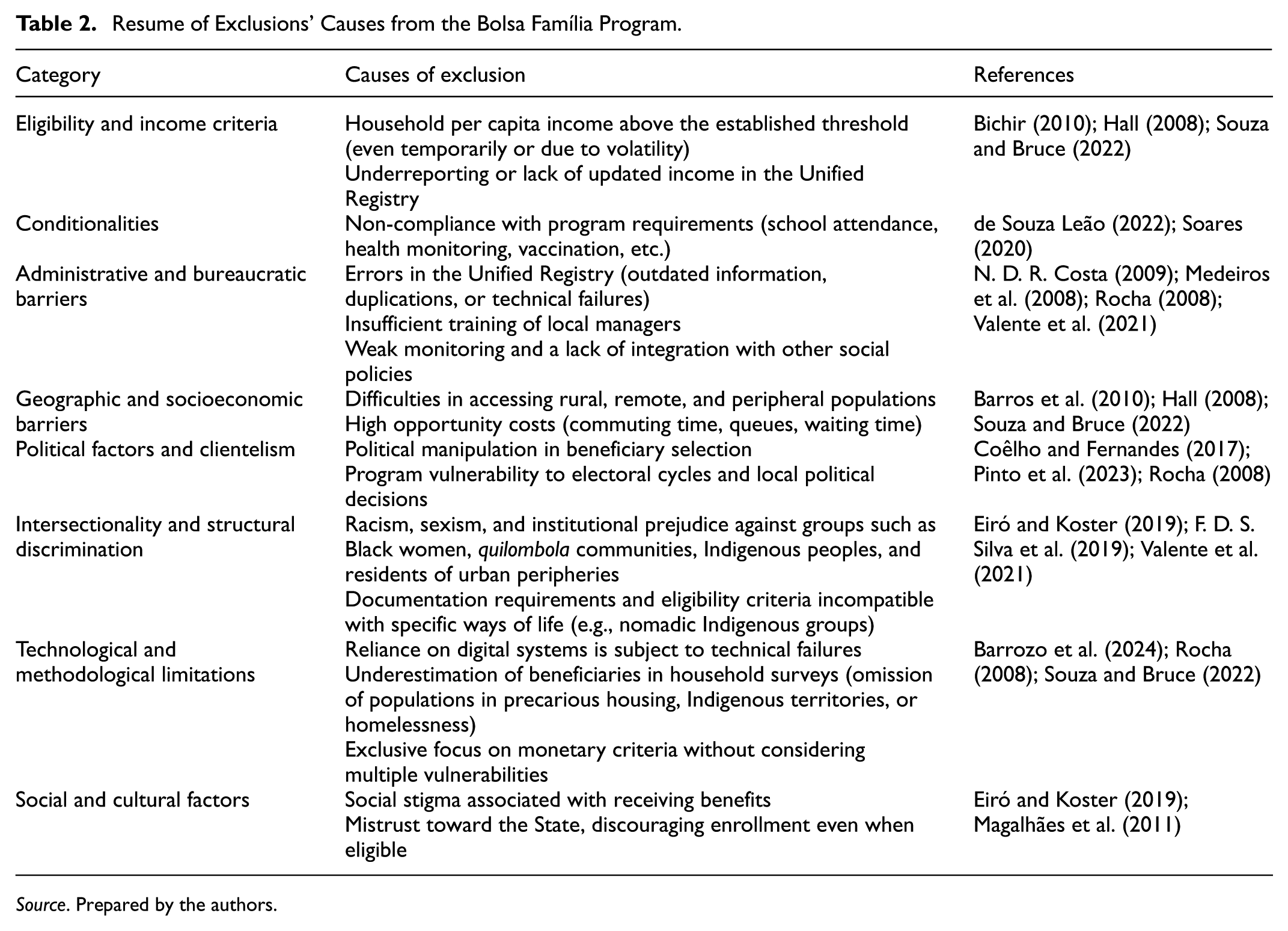
Source. Prepared by the authors.

Flowchart showing the relationships between different types of exclusion errors in the Bolsa Família program.
Promising Practices to Increase Equity
The literature identifies several promising practices to improve equity in the targeting mechanisms of cash transfer programs in Brazil. Suggested interventions include improving registration instruments, cross-validating information, continuous supervision, community participation, adopting multifaceted eligibility criteria, intersectoral coordination, and strengthening administrative processes (Medeiros et al., 2008; Paiva et al., 2020).
Updating the Unified Registry is essential to ensure that household information is always up-to-date and reflects changes in socioeconomic conditions that may affect eligibility. Advanced technologies, such as biometric identification, can increase accuracy and reduce fraud, ensuring that benefits reach those who need them most (Paiva et al., 2020). Ongoing oversight and periodic audits are essential to identify and correct exclusion errors. Implementing real-time monitoring systems can allow managers to detect and respond quickly to problems, preventing families in need from being unfairly excluded for extended periods (Medeiros et al., 2008).
Community participation is another promising practice. Involving community leaders and civil society organizations in selecting and monitoring beneficiaries can help ensure that local needs are considered and that marginalized groups have a voice in the process (Magalhães et al., 2011). Finally, decentralizing program management, allowing local authorities to manage beneficiary registries and conduct verification processes, can improve the accuracy of registries and better meet communities’ specific needs. This decentralized approach allows for greater flexibility and adaptability, adjusting to local realities that a centralized system may not adequately capture (Valente et al., 2021).
However, it is essential to highlight that many of these recommendations have already been partially or fully implemented in different contexts across Brazil in recent years. As much of the reviewed literature predates recent reforms and improvements, some practices described may already be in place today. The focus of this study is to systematically synthesize what the literature suggests regarding promising practices to reduce exclusion errors, rather than to propose new interventions.
Policy Recommendations
Recent reforms to the Bolsa Família Program, introduced through Law No. 14.601 of 2023, have sought to address several of the exclusion problems highlighted in previous studies. Creating new benefits, such as the Early Childhood Benefit and the Complementary Benefit to ensure a minimum family income, reduces the risk of excluding households with children and those hovering around the eligibility threshold. Moreover, the reform strengthens the use of the Unified Registry as the central mechanism for targeting. It expands the program’s integration with other social policies, including health, education, and social assistance, which may reduce structural gaps and overlapping criteria. While it is still early to fully assess the impact of these changes, the new legal framework represents an institutional advance by embedding Bolsa Família into law, potentially reducing its vulnerability to political cycles and ensuring greater continuity. These measures suggest a partial response to long-standing challenges, though continued monitoring will be necessary to verify whether they effectively reduce exclusion errors among marginalized populations.
The findings of this review suggest several avenues for strengthening conditional cash transfer (CCT) programs and reducing exclusion errors:
Strengthen and continuously update the Unified Registry: Regular updates and integrating biometric and digital identification tools could improve data accuracy and reduce undercoverage and fraud (Barrozo et al., 2024; Souza & Bruce, 2022; Valente et al., 2021).
Enhance data integration across social policies: Linking the Unified Registry with health, education, and labor databases can help capture multidimensional vulnerabilities and minimize gaps caused by fragmented eligibility systems (Ascher, 2021; Eiró, 2019; J. V. S. Silva et al., 2023; Souza & Bruce, 2022).
Invest in local implementation capacity: Permanent hiring, training, and supervision of municipal social assistance teams are critical to ensure consistent and humanized service delivery, particularly in rural and marginalized areas (Coêlho & Fernandes, 2017; Magalhães et al., 2011; Schmidt et al., 2017).
Develop targeted outreach strategies: Active search mechanisms and partnerships with community leaders and civil society organizations can help reach populations historically at risk of exclusion, such as Indigenous peoples, quilombola communities, and people experiencing homelessness (Alves & Escorel, 2013; Gonzalez et al., 2023; F. D. S. Silva et al., 2019; Souza, 2015).
Adopt mixed-methods monitoring and evaluation systems: Combining household surveys, administrative records, and qualitative research can provide a fuller picture of exclusion dynamics and inform adaptive program design (Barrozo et al., 2024; Cejudo & Olvera, 2024; Salifu & Kufoalor, 2024; Sotelo-Forero & Vallejo-Zamudio, 2024).
Ensure legal and institutional stability: Embedding programs such as Bolsa Família into law, as achieved in 2023, helps reduce vulnerability to political cycles and strengthens continuity across administrations.
An important point concerning public policy recommendations is how new legislation passed in Brazil in 2023 sought to address different problems identified in our literature review. These changes, instituted by Law No. 14,601 of June 19, 2023 (“Bolsa Família Law of 2023”), modified previous laws and repealed other laws such as 14,284/2021, which governed the Auxílio Brasil program, the name given to the continuation of the Bolsa Família program by a government opposed to the government that created the program.
The new legislation sought to address issues that led to the exclusion of people living in poverty by adjusting the basket of benefits, such as the inclusion of a rule that no one can receive less than R$600.00. Another necessary action was to enshrine in law the conditions that ensure that new generations will be less dependent on CCTs in the future, given that these conditions are linked to school attendance and performance and to monitoring the health of children and adolescents. A protection rule was also created, stipulating that a family should not be automatically removed from the program when it exceeds the income ceiling. In this case, the family continues to receive part of the amount for up to 2 years and may return to receiving the full amount if their income falls below the ceiling again. This protection prevents beneficiaries who have exceeded the ceiling from waiting in line to receive the benefit if they lose part of their income.
In addition to these positive actions, the new law prohibited using Bolsa Família as collateral for payroll loans, which was leading beneficiaries into debt and causing them to lose part of their benefits to pay interest to banks and financial institutions. In addition, based on the everyday use of the Single Registry (CadÚnico), it has been integrated into other programs such as Auxílio Gás, bringing greater efficiency in promoting not only Bolsa Família.
A final important point is that the new law has integrated governance and social control into the program, generating greater transparency and reliability in the actions implemented. In this sense, the law reinforced social control by the Social Assistance Councils. It established coordination, by the MDS (Ministry of Social Development), of the Federal Inspection Network of the Bolsa Família Program and the Single Registry, with payment, monitoring, and auditing guidelines. To reduce the problems caused by intersectionality, the law established a legal preference for the benefit to be paid to the woman indicated as responsible for the family in the CadÚnico.
In practical terms, the new law authorized Caixa Econômica Federal to process payments and, with the consent of the MDS, subcontract banks (public or private) to support the execution; it waived bidding when subcontracting involves a public bank, thus creating a more agile payment system, which guarantees beneficiaries that their funds will reach them quickly and safely. Also, within these practical actions and as a way to strengthen the capacity of municipalities to carry out a more accurate and active search in maintaining the regularity of the Single Registry, the Law (art. 14) instituted/updated the IGD—Decentralized Management Index, as an instrument to support and encourage the improvement of the management of the Single Registry in municipalities. Through specific legislation, metrics, and transfer values were determined to reward municipalities that make the greatest efforts to maintain the Single Registry in their territory. These actions are essential, as the same law reinforced the role of CadÚnico as a gateway and management tool for the target audience, including registry updates and active searches as inter-federative management duties.
Conclusion
The effectiveness of cash transfer programs in addressing poverty and promoting social inclusion depends heavily on their ability to accurately target the most vulnerable populations. However, exclusion errors remain challenging, particularly in Brazil’s Bolsa Família Program (BFP). This systematic review sheds light on various barriers that contribute to these errors, including administrative and bureaucratic issues that may affect marginalized groups such as quilombolas, indigenous people, people with disabilities, and black women. Addressing these challenges is essential for improving the equity and reach of social protection policies.
The review highlights that exclusion errors may stem from the reliance on self-declared income, administrative discretion, and political influences that shape eligibility decisions. Additionally, local implementation practices and data collection processes can affect how effectively benefits reach eligible families. While the BFP has demonstrated strong targeting mechanisms compared to similar programs globally, some gaps remain in ensuring consistent access for all eligible groups. Including more integrated and culturally sensitive approaches, particularly those that consider intersectional identities, could help mitigate these gaps and improve equity in program outcomes.
Although this review focuses on Brazil’s Bolsa Família Program (BFP), its findings provide valuable insights for other conditional cash transfer (CCT) programs in Brazil and internationally. The Brazilian experience with the Unified Registry, which serves as the backbone for all social programs, is particularly illustrative, as it reduces overlaps in targeting the same vulnerable groups and strengthens intersectoral policy coordination. This arrangement demonstrates how integrating administrative records can enhance targeting, minimize exclusion errors, and promote equity, which are equally relevant challenges in other contexts. Therefore, the lessons learned from the BFP can inform the design and adjustment of similar programs in Latin America, Africa, and Asia, contributing to more effective and equitable social protection systems worldwide.
In practical terms, the results of this review extend beyond the Brazilian context and offer lessons for improving social protection systems globally. Within Brazil, the findings reinforce the importance of continuously strengthening the Unified Registry and enhancing the capacity of local implementation teams to reduce exclusion errors. Internationally, the Bolsa Família experience highlights practices that may be adapted to other countries, such as using integrated registries to harmonize eligibility across programs, adopting community-based outreach strategies to reach marginalized groups, and balancing between reducing fraud and ensuring inclusion. By making these contributions explicit, this study underscores how lessons from the Brazilian case can inform the ongoing refinement of conditional cash transfer programs in diverse settings worldwide.
From a theoretical perspective, the findings of this review contribute to broader debates on the design and implementation of conditional cash transfer (CCT) programs. The case of Bolsa Família illustrates how administrative structures, such as a unified social registry, and contextual factors, including local governance capacity and intersectional vulnerabilities, can shape both the effectiveness and the equity of program targeting. By highlighting the persistent challenges of exclusion errors, this study underscores the need for CCT designs that move beyond income thresholds alone and incorporate mechanisms to capture multidimensional forms of vulnerability. These insights provide a conceptual framework that can guide the refinement of CCT programs worldwide, emphasizing the interplay between institutional design, implementation practices, and the lived experiences of beneficiaries.
Despite these insights, this study has certain limitations that must be acknowledged. First, the available literature on exclusion errors remains fragmented and uneven, with significant gaps in analyzing specific groups and regions. For example, there is a limited focus on the experiences of marginalized communities in remote areas or on the intersection of various forms of discrimination, such as race, gender, and disability. The review also highlights a reliance on quantitative studies, which often lack the nuance needed to capture the lived experiences of those excluded from cash transfer programs. While quantitative data is essential for identifying trends, qualitative approaches—such as interviews and focus groups—are necessary to understand the underlying causes of exclusion and the barriers different groups face.
Another limitation is the potential publication bias within the reviewed literature. Studies that report negative or non-significant findings are less likely to be published, which may result in an incomplete picture of the issue. Additionally, the methodologies used in the reviewed studies vary significantly, making direct comparisons challenging and potentially affecting the robustness of the conclusions.
To address these limitations, future research should prioritize mixed-method approaches, combining quantitative and qualitative data to understand exclusion errors comprehensively. Qualitative studies can shed light on the experiences of marginalized groups and help identify practical strategies to reduce exclusion. Furthermore, it is crucial to explore the role of local managers and frontline social workers in implementing the program and mitigating exclusion errors and the impact of broader structural and political factors on targeting outcomes.
Footnotes
Appendix
Articles Analyzed After the Selection Process Described in the Methodology.

| Article | Objective of the article | Data base | Year of publication | Google academic citations | Cited per year |
|---|---|---|---|---|---|
| Medeiros, M., Britto, T., & Soares, F. V. (2008). Targeted cash transfer programmes in Brazil: BPC and the Bolsa Familia. International Poverty Centre, IPEA, work paper n.46. | We describe several characteristics of Brazil’s two most important targeted cash transfer programs, the Continuous Cash Benefit (BPC) and the Bolsa Familia. We discuss their institutional aspects, long-term sustainability, beneficiaries, and levels of targeting. We also address the need for conditionalities, the effects of the transfers on labor market participation, and the relevance of the so-called “exit doors”. | IBSS | 2008 | 119 | 7.00 |
| Hall, A. (2008). Brazil’s Bolsa Família: A double-edged sword? Development and change, 39(5), 799–822. | In common with most Latin American countries, as governments embrace safety nets to attack poverty, conditional cash transfer (CCT) programs have become part of mainstream social policy in Brazil. Under president Fernando Henrique Cardoso (1995–2002), and especially since Luiz Inácio Lula da Silva took office in 2003, targeted assistance in education, health and nutrition, now united under Bolsa Família, have expanded rapidly to benefit 44 million (24% of the total population), absorbing almost two-fifths of the social assistance budget earmarked for the poorest sectors. Despite its operational problems, Bolsa Família appears to have effectively provided short-term relief to some of the most deprived groups in Brazil. | Scopus | 2008 | 297 | 17.47 |
| Rocha, S. (2008). Transferências de renda federais: focalização e impactos sobre pobreza e desigualdade. Revista de economia contemporânea, 12, 67–96. | This article uses microdata from the National Annual Household Sample Survey to explore empirical evidence on implementing the “new” federal income-transfer programs. | Scielo | 2008 | 63 | 3.71 |
| Costa, N. D. R. (2009). A proteção social no Brasil: universalismo e focalização nos governos FHC e Lula. Ciência & saúde coletiva, 14(3), 693–706. | This article analyzes Brazil’s social protection system’s organization after the Federal Constitution of 1998 (CF 1988). It also demonstrates that the 1988 Federal Constitution favored institutionalizing universalist public policies. This institutionalization took place amidst conflict with the stabilization goals of the Real Plan. The paper argues that such an institutionalization protected public spending in the social area of the macroeconomic management’s minimalist project. | Web of science—Scielo | 2009 | 76 | 4.75 |
| Kerstenetzky, C. L. (2009). Redistribuição e desenvolvimento? A economia política do Programa Bolsa Família. Dados, 52, 53–83. | This article seeks to provide a qualitative assessment of the Family Grant Program from income redistribution and development policy perspectives. | Scopus—Scielo | 2009 | 205 | 12.81 |
| Tavares, P. A., Pazello, E. T., Fernandes, R., & Camelo, R. D. S. (2009). Uma avaliação do Programa Bolsa Família: focalização e impacto na distribuição de renda e pobreza. Pesquisa e Planejamento Econômico, 39(1), 25–58 | This article assesses the targeting and impact of the Bolsa Família Program (PBF) on poverty and income inequality in Brazilian states, based on data from the 2004 National Household Sample Survey (PNAD). It also assesses changes in targeting indicators and the impact of two simulations: the first considers the hypothesis that the government adopts the proxy means-test (PMT) as a selection mechanism, maintaining the current cost of the policy. The second simulation shows an increase in the program’s size, maintaining its current selection rule. | EconLit | 2023 | 91 | 45.50 |
| Soares, F. V., Ribas, R. P., & Osório, R. G. (2010). Evaluating the impact of Brazil’s Bolsa Familia: Cash transfer programs in comparative perspective. Latin American Research Review, 45(2), 173–190. | This note reviews the targeting performance of Bolsa Família and its impact on inequality, poverty, consumption, education, health care, and labor force participation. | Web of science | 2010 | 796 | 53.07 |
| Bichir, R. M. (2010). O Bolsa Família na berlinda? Os desafios atuais dos programas de transferência de renda. Novos Estudos CEBRAP, 87, 115–129. | The article explores issues related to Programa Bolsa Família, taking as its starting point a characterization of the institutional designs of cash transfer programs in Brazil, from municipal-level experiences to the federal-level programs Bolsa Escola and Bolsa Família. It ends by addressing the main challenges that are ahead for those programs. | Scopus—Scielo | 2010 | 225 | 15.00 |
| Magalhães, R., Bodstein, R., Coelho, A. V., Ferreira Nogueira, M., & Bocca, C. (2011). The Bolsa Familia (family grant) program in Manguinhos: challenges and lessons learned in a case study: implementation process: development of strategies and evidence. Global Health Promotion, 18(1), 13–15. | This article discusses the results of evaluation research on implementing the Bolsa Família, a conditional cash program targeted at low-income families in Manguinhos, Brazil. | PubMed | 2011 | 6 | 0.43 |
| Hevia de la Jara, F. (2011). The Difficult Articulation between Universal Policies and Targeted Programs: Institutional Ethnography of the Bolsa Familia Program in Brazil. Gestión y política pública, 20(2), 331–379. | One of the unresolved debates about social policy is the relationship between universal and targeted programs. In this context, the conditional cash transfer program Bolsa Familia, in Brazil, has an institutional design that allows us to think about this discussion differently because it generates innovations to transcend the limitations of focused programs. However, many of these innovations do not work in practice because of difficulties of coordination between the program and the universal welfare policy, which is organized in a National System of Social Assistance. | Scopus—Scielo | 2011 | 0 | 0.00 |
| Alves, H., & Escorel, S. (2013). Processos de exclusão social e iniquidades em saúde: um estudo de caso a partir do Programa Bolsa Família, Brasil. Revista Panamericana de Salud Pública, 34, 429–436. | To understand the repercussions of the Bolsa Família Program (PBF) and analyze its effects on the social inclusion and exclusion processes experienced by low-income families in Brazil, especially its potential to address health inequalities. | WoS—Scielo | 2013 | 28 | 2.33 |
| Souza, C. (2015). Breaking the boundary: pro-poor policies and electoral outcomes in Brazilian sub-national governments. Regional & Federal Studies, 25(4), 347–363. | The article explores the role of state-led and center-led pro-poor policies in the electoral shift of state elections in the state of Bahia, in Brazil’s Northeast. | Scopus | 2015 | 19 | 1.90 |
| Schmidt, K. H., Labrecque, J., Santos, I. S., Matijasevich, A., Barros, F. C., & Barros, A. J. D. (2017). Focus and coverage of Bolsa Família Program in the Pelotas 2004 birth cohort. Revista de saude publica, 51, 22. | To describe the focalization and coverage of Bolsa Família Program among the families of children in the 2004 Pelotas birth cohort (2004 cohort). | IBSS, PubMed, Scielo | 2017 | 16 | 2.00 |
| Coêlho, D. B., & Fernandes, A. S. A. (2017). Regras importam: determinantes do controle burocrático no Programa Bolsa Família. Revista de Administração Pública, 51(5), 689–707. | The literature on the Bolsa Família Program has focused on its impact on poverty and inequality, the electoral process, and the role of conditionalities. However, the Bolsa Família Program is also associated with a principal-agent problem, as it requires effective control of a set of rules for its operation. In the national literature, little has been produced on the effect of formal rules as instruments for modeling the behavior of political actors. We propose to explore the role of federal and municipal bureaucracies in managing public policies in a highly decentralized federation. | Scopus—Scielo | 2017 | 20 | 2.50 |
| Souza, A. P., Duarte, J., Neves, J. D. A. S., de Oliveira, P. P., & de Brito Gadelha, S. R. (2018). Uma investigação sobre a focalização do Programa Bolsa Família e seus determinantes imediatos. Economia Aplicada, 22(3), 119–148. | This study aims to investigate the targeting of the Bolsa Família Program (PBF) and its immediate determinants and to conduct a quantitative analysis of the beneficiary families. | EconLit | 2018 | 11 | 1.57 |
| Silva, F. D. S., Queiroz, R. C. D. S., Branco, M. D. R. F. C., Habenschus, M. I. A. T., Scorzafave, L. G., Saraiva, M. D. C. P., Bettiol, H., Barbieri, M. A., Rodrigues, M. A. F. R., Barbosa, Y. C., Simões, V. M. F., & Silva, A. A. M. D. (2019). Foco e cobertura do programa Bolsa Família em crianças das coortes de nascimento BRISA, Ribeirão Preto (São Paulo) e São Luís (Maranhão), Brasil. Cadernos de Saúde Pública, 35, e00159718. | A cross-sectional study nested within a cohort aimed to describe the focus and coverage of the Bolsa Família program among children aged 13–35 months. Data from the BRISA birth cohorts in Ribeirão Preto, São Paulo, and São Luís, Maranhão, Brazil, were used. | WoS | 2019 | 7 | 1.17 |
| Eiró, F., & Koster, M. (2019). Facing bureaucratic uncertainty in the Bolsa Família Program: Clientelism beyond reciprocity and economic rationality. Focaal: Journal of Global and Historical Anthropology, 85, 84–96. | Clientelism is often analyzed along lines of moral values and reciprocity, or an economic Rationality. This article, instead, moves beyond this dichotomy and shows how both. Frameworks coexist and become entwined. Based on ethnographic research in a city in the Brazilian Northeast, it analyzes how the anti-poverty Bolsa Família Program and its Bureaucracies are entangled with electoral politics and clientelism. |
Scopus | 2019 | 11 | 1.83 |
| Eiró, F. (2019). The vicious cycle in the Bolsa Família program’s implementation: Discretionality and the challenge of social rights consolidation in Brazil. Qualitative Sociology, 42(3), 385–409. | This article considers conceptions of the Brazilian conditional cash transfer Bolsa Família Program as elaborated by those responsible for its implementation and its beneficiaries in Northeast Brazil. | Scopus | 2019 | 51 | 8.50 |
| Costa, C. (2020). Conditional Cash Transfers and Homogeneous Spaces: The Politics of Multiplicative Effects. Latin American Policy, 11(2), 229–253. | Conditional cash transfers are a popular poverty-alleviation policy around the world. Their significant effects draw the attention of politicians, who may manipulate these programs to garner votes. This article analyzes how the spatial distribution of voter profiles affects the distribution of benefits. | WoS | 2020 | 2 | 0.40 |
| Paiva, L. H., de Souza, P. H. G. F., Bartholo, L., & Soares, S. (2020). Avoiding the poverty pandemic: the potential of the Bolsa Família program and the Single Registry for Social Programs to face the COVID-19 pandemic. Revista de Administração Pública, 54, 1097–1110. | This study suggests three measures to enhance the potential of the Bolsa Família program. and the Single Registry for Social Protection (Cadastro Único) as responses to the economic Consequences of the COVID-19 pandemic. |
Scopus | 2020 | 1 | 0.20 |
| Paiva, L. H., de Sousa, M. F., & Nunes, H. M. P. (2020). A focalização do programa Bolsa Família (PBF) no período 2012-2018, a partir dos dados da Pesquisa Nacional por Amostra de Domicílios Contínua (PNAD Contínua) (No. 2567). Texto para Discussão. | This study takes advantage of the recent release of complete income data from the Continuous National Household Sample Survey (PNAD Contínua) for 2012–2018 to assess the evolution of the Bolsa Família Program (PBF) targeting. | EconLit | 2020 | 8 | 1.60 |
| Ascher, W. (2021). Coping with intelligence deficits in poverty-alleviation policies in low-income countries. Policy Sciences, 54(2), 345–370. | Poverty-alleviation initiatives in lower-income countries are challenged by intelligence deficits that cause suboptimal designs that threaten their effectiveness, targeting, and sustainability. The uncertainty of theory and information, the adverse consequences of conventional family-level “means testing,” and unpredictable future events and conditions call for auto-targeting and auto-correcting policy designs with built-in adaptive capacity. Numerous categories and examples of these designs from multiple countries are presented. | Scopus | 2021 | 7 | 1.75 |
| Valente, M. G., Neris, N., & Fragoso, N. (2021). Presa na rede de proteção social: Privacidade, gênero e justiça de dados no Programa Bolsa Família. Novos estudos CEBRAP, 40(1), 11–31. | The article analyzes the Bolsa Família Program (PBF) as an “information value chain” and observes, based on elements gathered from interviews and complaints, aspects of data justice and the impacts of the program’s datafication on its beneficiaries, especially regarding privacy and gender. | Scopus | 2021 | 11 | 2.75 |
| de Souza Leão, L. (2022). Optics of the state: the politics of making poverty visible in Brazil and Mexico. American Journal of Sociology, 128(1), 1–46. | Sociological studies stress how state legibility serves as a form of control. Often overlooked is how states differ in their will to control and how this difference shapes legibility projects. To account for this variation, this article proposes a three-dimensional analytical framework to study legibility from a comparative perspective, illustrating it with an in-depth analysis of how Brazil and Mexico rendered low-income families visible to implement conditional cash transfer programs. | WoS | 2022 | 19 | 6.33 |
| Pinto, T. L. S., Tabak, B. M., & Cajueiro, D. O. (2023). How politics can influence the allocation of social program benefits: A case study of the Brazilian poverty reduction program Bolsa Família. Economic Analysis and Policy, 80, 77–89. | We investigate the utilization of Bolsa Família, a Brazilian social program aimed at reducing. Poverty and social inequalities, for electoral purposes. |
Scopus | 2023 | 1 | 0.50 |
| Silva, J. V. S. D., Vieira, J. G. V., & Yoshizaki, H. T. Y. (2023). Avaliação do perfil socioeconômico da população de baixa renda do Brasil: uma crítica às classificações correntes. urbe. Revista Brasileira de Gestão Urbana, 15, e20210370. | The contrasts and inequalities in income and opportunities among the Brazilian population at the bottom of the socioeconomic pyramid make it essential to conduct further studies on poverty limits for better urban management. This article uses data from the Cadastro Único (Single Registry) and information collected in field research to verify whether the definitions of the main social programs cover the entire poor population. | Scopus | 2023 | 1 | 0.50 |
| Barrozo, L. V., Serafim, M. B., Gomes, L. A. C., Uhrigshardt, G. G., Martins, N. F. A., de Oliveira, T. F., Resende, J. F., & Junior, E. A. (2024). Targeting the “poorest of the poor”: A multi-scale approach. Socio-Economic Planning Sciences, 93, 101903. | Understanding that poverty presents multidimensional and multi-scale deployments, a methodology is proposed to identify the poorest families among the poor in the State of São Paulo for cash transfer purposes. | Scopus | 2024 | 2 | 2.00 |
Acknowledgements
We would like to thank the Dom Cabral Foundation for facilitating our work, AIR for financing this noble initiative, and the Ministry of Social Promotion for supporting us during our research.

Funding
The authors disclosed receipt of the following financial support for the research, authorship, and/or publication of this article: This research was funded by AIR through the transfer of funds to Fundação Dom Cabral to promote the research that gave rise to the article submitted here.
Declaration of Conflicting Interests
The authors declared no potential conflicts of interest with respect to the research, authorship, and/or publication of this article.
Data Availability Statement
Data sharing not applicable to this article as no datasets were generated or analyzed during the current study.